
MICK Law Due Diligence: Current Developments,
SN
Published · 22 slides · 0 views
1 / 1

Description
MICK Law Due Diligence: Current Developments, Process, Opportunities, Pitfalls To Avoid BraD Updike, llm, jD, MBA Mick Law P.C. LLO www.micklawpc.com Main topics covered 1. Whats happening in retail oriented private placements 2. Recent
Related Topics
Share
Embed code
Download this presentation From Below
"MICK Law Due Diligence: Current Developments," is the property of its rightful owner. Permission is granted to download and print the materials on this website for personal, non-commercial use only, and to display it on your personal computer provided you do not modify the materials and that you retain all copyright notices contained in the materials. By downloading content from our website, you accept the terms of this agreement.
Presentation Transcript
01
MICK Law Due Diligence: Current Developments, Process, Opportunities, & Pitfalls To Avoid BraD Updike, llm, jD, MBA
Mick Law P.C. LLO
www.micklawpc.com<br>
Mick Law P.C. LLO
www.micklawpc.com<br>
02
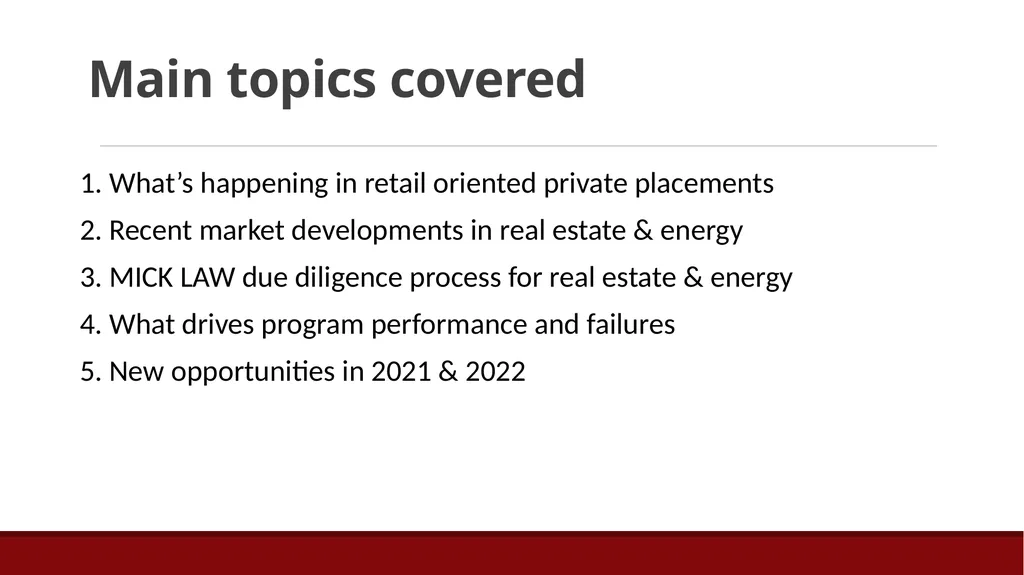
Main topics covered 1. What’s happening in retail oriented private placements
2. Recent market developments in real estate & energy
3. MICK LAW due diligence process for real estate & energy
4. What drives program performance and failures
5. New opportunities in 2021 & 2022<br>
2. Recent market developments in real estate & energy
3. MICK LAW due diligence process for real estate & energy
4. What drives program performance and failures
5. New opportunities in 2021 & 2022<br>
03
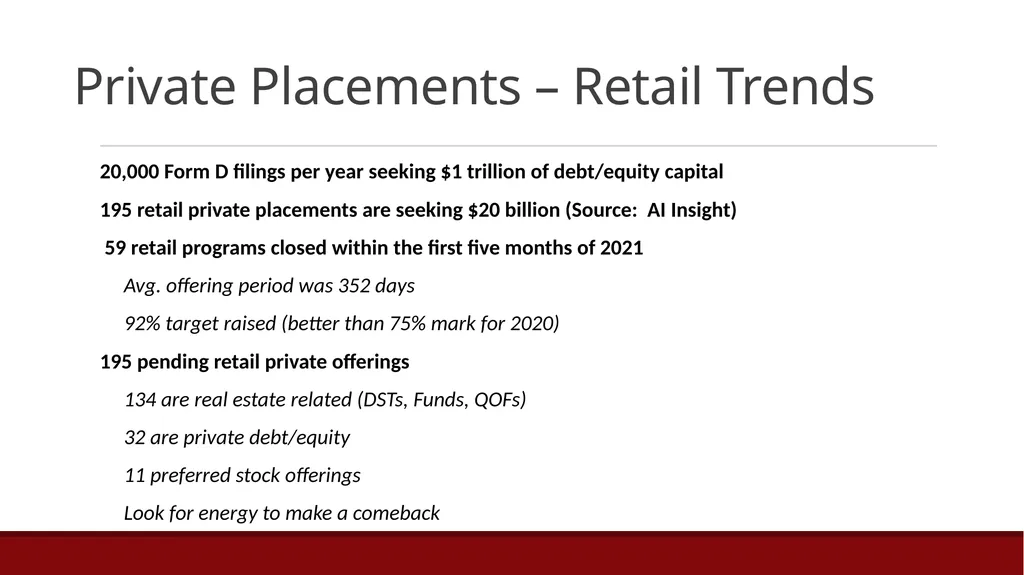
Private Placements – Retail Trends 20,000 Form D filings per year seeking $1 trillion of debt/equity capital
195 retail private placements are seeking $20 billion (Source: AI Insight)
59 retail programs closed within the first five months of 2021
Avg. offering period was 352 days
92% target raised (better than 75% mark for 2020)
195 pending retail private offerings
134 are real estate related (DSTs, Funds, QOFs)
32 are private debt/equity
11 preferred stock offerings
Look for energy to make a comeback<br>
195 retail private placements are seeking $20 billion (Source: AI Insight)
59 retail programs closed within the first five months of 2021
Avg. offering period was 352 days
92% target raised (better than 75% mark for 2020)
195 pending retail private offerings
134 are real estate related (DSTs, Funds, QOFs)
32 are private debt/equity
11 preferred stock offerings
Look for energy to make a comeback<br>
04
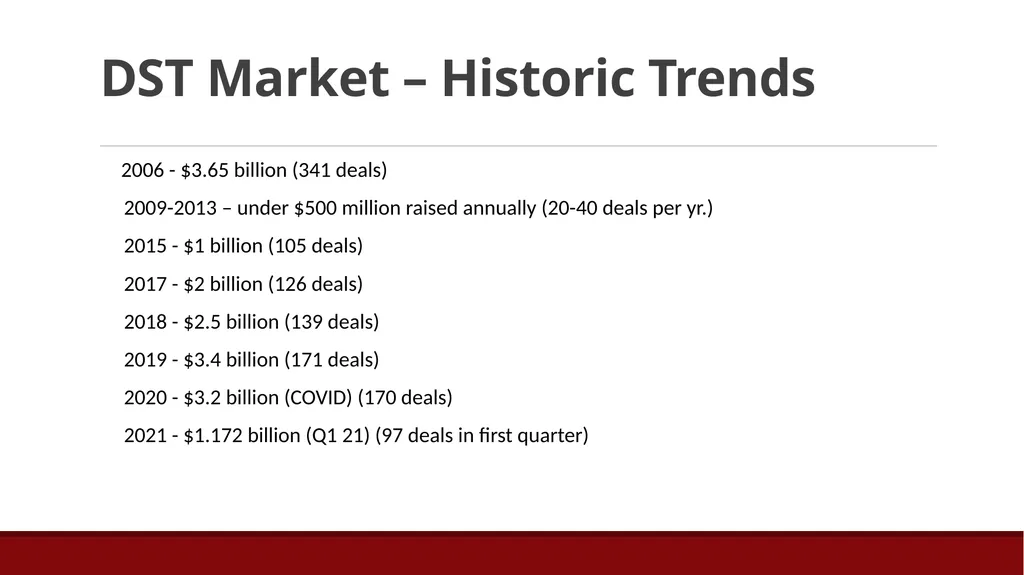
DST Market – Historic Trends 2006 - $3.65 billion (341 deals)
2009-2013 – under $500 million raised annually (20-40 deals per yr.)
2015 - $1 billion (105 deals)
2017 - $2 billion (126 deals)
2018 - $2.5 billion (139 deals)
2019 - $3.4 billion (171 deals)
2020 - $3.2 billion (COVID) (170 deals)
2021 - $1.172 billion (Q1 21) (97 deals in first quarter)<br>
2009-2013 – under $500 million raised annually (20-40 deals per yr.)
2015 - $1 billion (105 deals)
2017 - $2 billion (126 deals)
2018 - $2.5 billion (139 deals)
2019 - $3.4 billion (171 deals)
2020 - $3.2 billion (COVID) (170 deals)
2021 - $1.172 billion (Q1 21) (97 deals in first quarter)<br>
05
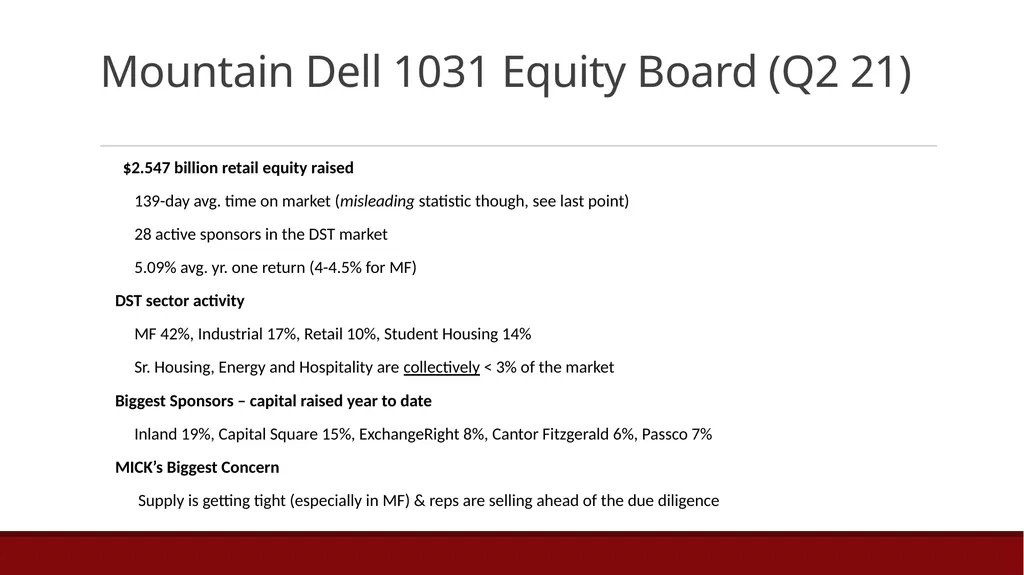
Mountain Dell 1031 Equity Board (Q2 21) $2.547 billion retail equity raised
139-day avg. time on market (misleading statistic though, see last point)
28 active sponsors in the DST market
5.09% avg. yr. one return (4-4.5% for MF)
DST sector activity
MF 42%, Industrial 17%, Retail 10%, Student Housing 14%
Sr. Housing, Energy and Hospitality are collectively < 3% of the market
Biggest Sponsors – capital raised year to date
Inland 19%, Capital Square 15%, ExchangeRight 8%, Cantor Fitzgerald 6%, Passco 7%
MICK’s Biggest Concern
Supply is getting tight (especially in MF) & reps are selling ahead of the due diligence<br>
139-day avg. time on market (misleading statistic though, see last point)
28 active sponsors in the DST market
5.09% avg. yr. one return (4-4.5% for MF)
DST sector activity
MF 42%, Industrial 17%, Retail 10%, Student Housing 14%
Sr. Housing, Energy and Hospitality are collectively < 3% of the market
Biggest Sponsors – capital raised year to date
Inland 19%, Capital Square 15%, ExchangeRight 8%, Cantor Fitzgerald 6%, Passco 7%
MICK’s Biggest Concern
Supply is getting tight (especially in MF) & reps are selling ahead of the due diligence<br>
06
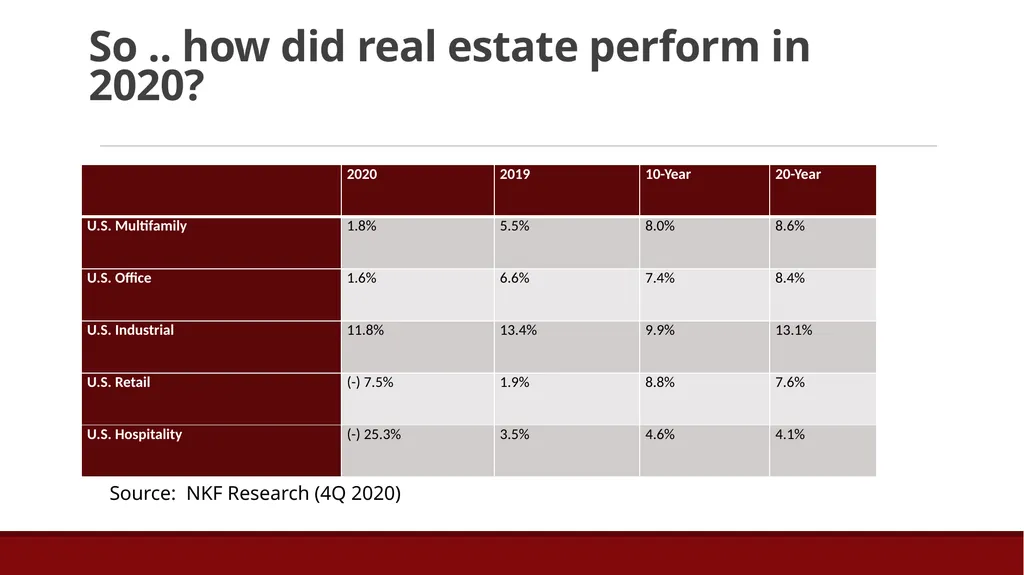
So .. how did real estate perform in 2020? Total Returns – Real Estate
Source: NKF Research (4Q 2020) Source: NKF Research (4Q 2020)<br>
Source: NKF Research (4Q 2020) Source: NKF Research (4Q 2020)<br>
07
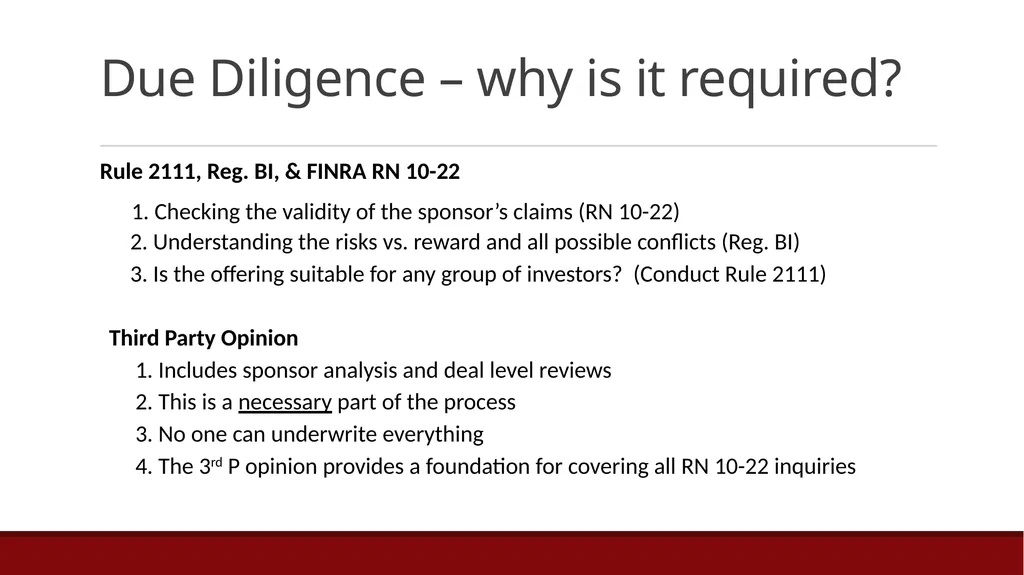
Due Diligence – why is it required? Rule 2111, Reg. BI, & FINRA RN 10-22
1. Checking the validity of the sponsor’s claims (RN 10-22)
2. Understanding the risks vs. reward and all possible conflicts (Reg. BI)
3. Is the offering suitable for any group of investors? (Conduct Rule 2111)
Third Party Opinion
1. Includes sponsor analysis and deal level reviews
2. This is a necessary part of the process
3. No one can underwrite everything
4. The 3rd P opinion provides a foundation for covering all RN 10-22 inquiries<br>
1. Checking the validity of the sponsor’s claims (RN 10-22)
2. Understanding the risks vs. reward and all possible conflicts (Reg. BI)
3. Is the offering suitable for any group of investors? (Conduct Rule 2111)
Third Party Opinion
1. Includes sponsor analysis and deal level reviews
2. This is a necessary part of the process
3. No one can underwrite everything
4. The 3rd P opinion provides a foundation for covering all RN 10-22 inquiries<br>
08
Sponsor-Level Due Diligence Is the sponsor financially and operationally viable?
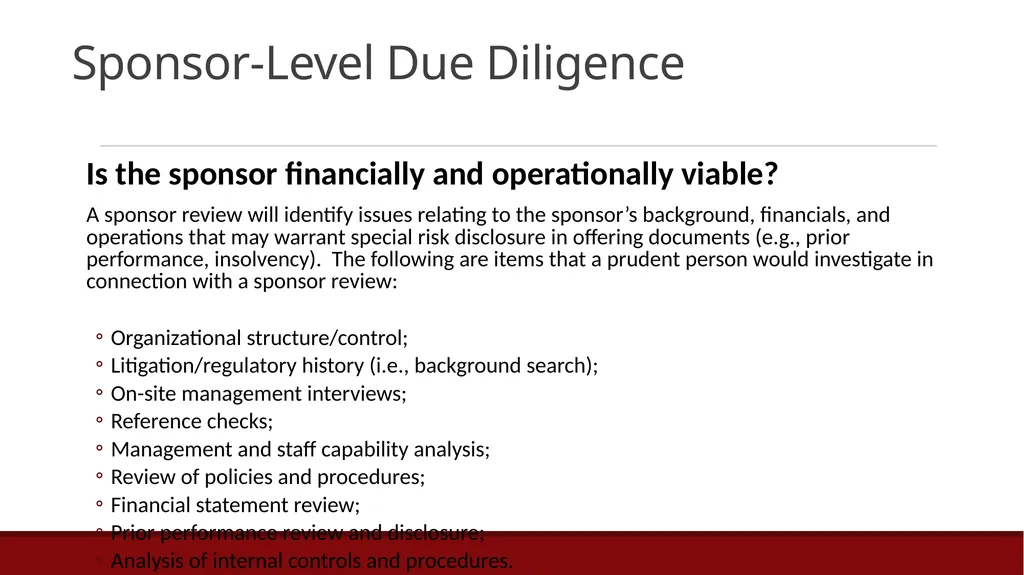
A sponsor review will identify issues relating to the sponsor’s background, financials, and operations that may warrant special risk disclosure in offering documents (e.g., prior performance, insolvency). The following are items that a prudent person would investigate in connection with a sponsor review:
Organizational structure/control;
Litigation/regulatory history (i.e., background search);
On-site management interviews;
Reference checks;
Management and staff capability analysis;
Review of policies and procedures;
Financial statement review;
Prior performance review and disclosure;
Analysis of internal controls and procedures.<br>
A sponsor review will identify issues relating to the sponsor’s background, financials, and operations that may warrant special risk disclosure in offering documents (e.g., prior performance, insolvency). The following are items that a prudent person would investigate in connection with a sponsor review:
Organizational structure/control;
Litigation/regulatory history (i.e., background search);
On-site management interviews;
Reference checks;
Management and staff capability analysis;
Review of policies and procedures;
Financial statement review;
Prior performance review and disclosure;
Analysis of internal controls and procedures.<br>
09
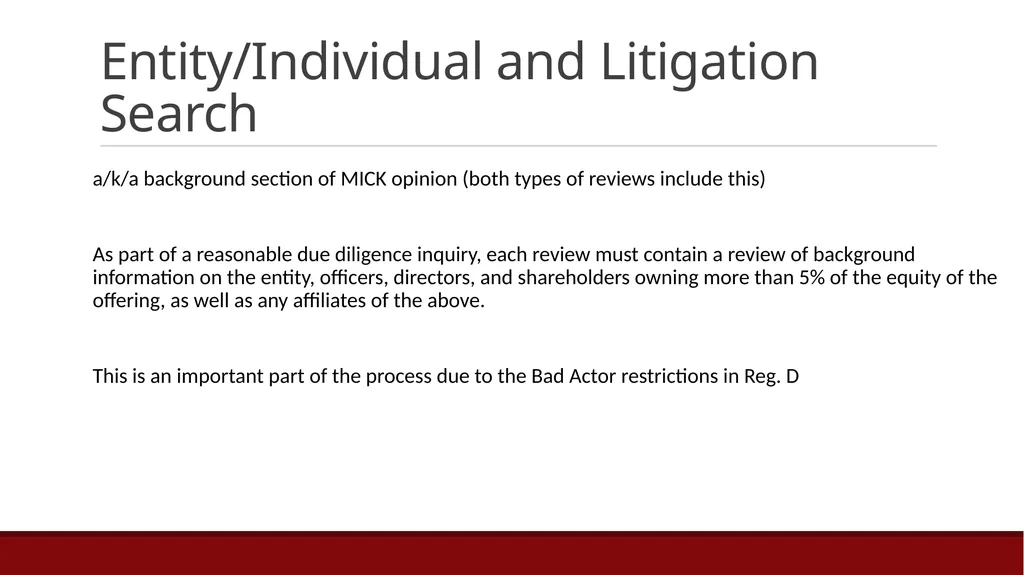
Entity/Individual and Litigation Search a/k/a background section of MICK opinion (both types of reviews include this)
As part of a reasonable due diligence inquiry, each review must contain a review of background information on the entity, officers, directors, and shareholders owning more than 5% of the equity of the offering, as well as any affiliates of the above.
This is an important part of the process due to the Bad Actor restrictions in Reg. D<br>
As part of a reasonable due diligence inquiry, each review must contain a review of background information on the entity, officers, directors, and shareholders owning more than 5% of the equity of the offering, as well as any affiliates of the above.
This is an important part of the process due to the Bad Actor restrictions in Reg. D<br>
10
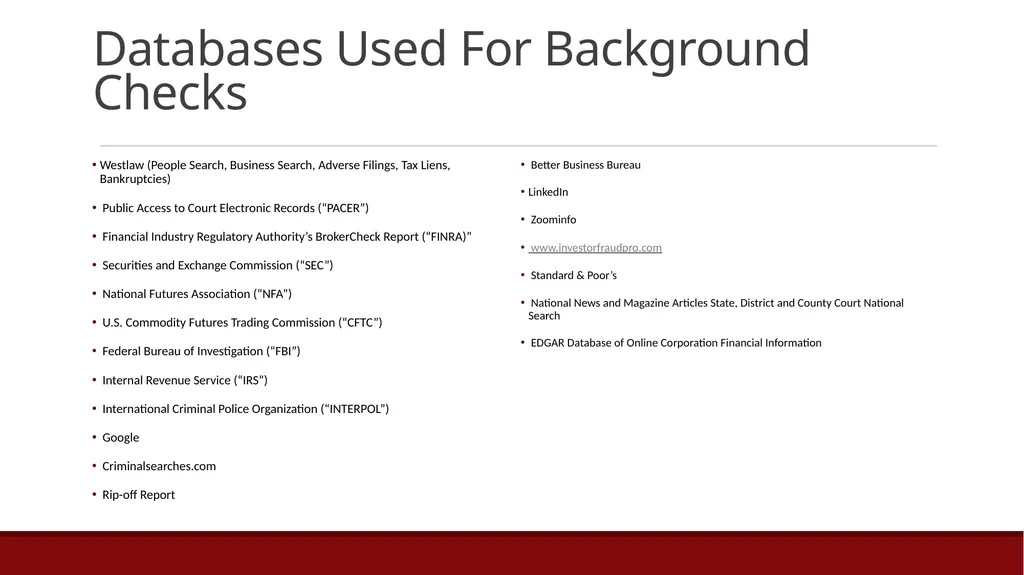
Databases Used For Background Checks Westlaw (People Search, Business Search, Adverse Filings, Tax Liens, Bankruptcies)
Public Access to Court Electronic Records (“PACER”)
Financial Industry Regulatory Authority’s BrokerCheck Report (“FINRA)”
Securities and Exchange Commission (“SEC”)
National Futures Association (“NFA”)
U.S. Commodity Futures Trading Commission (“CFTC”)
Federal Bureau of Investigation (“FBI”)
Internal Revenue Service (“IRS”)
International Criminal Police Organization (“INTERPOL”)
Google
Criminalsearches.com
Rip-off Report Better Business Bureau
LinkedIn
Zoominfo
www.investorfraudpro.com
Standard & Poor’s
National News and Magazine Articles State, District and County Court National Search
EDGAR Database of Online Corporation Financial Information<br>
Public Access to Court Electronic Records (“PACER”)
Financial Industry Regulatory Authority’s BrokerCheck Report (“FINRA)”
Securities and Exchange Commission (“SEC”)
National Futures Association (“NFA”)
U.S. Commodity Futures Trading Commission (“CFTC”)
Federal Bureau of Investigation (“FBI”)
Internal Revenue Service (“IRS”)
International Criminal Police Organization (“INTERPOL”)
Criminalsearches.com
Rip-off Report Better Business Bureau
Zoominfo
www.investorfraudpro.com
Standard & Poor’s
National News and Magazine Articles State, District and County Court National Search
EDGAR Database of Online Corporation Financial Information<br>
11
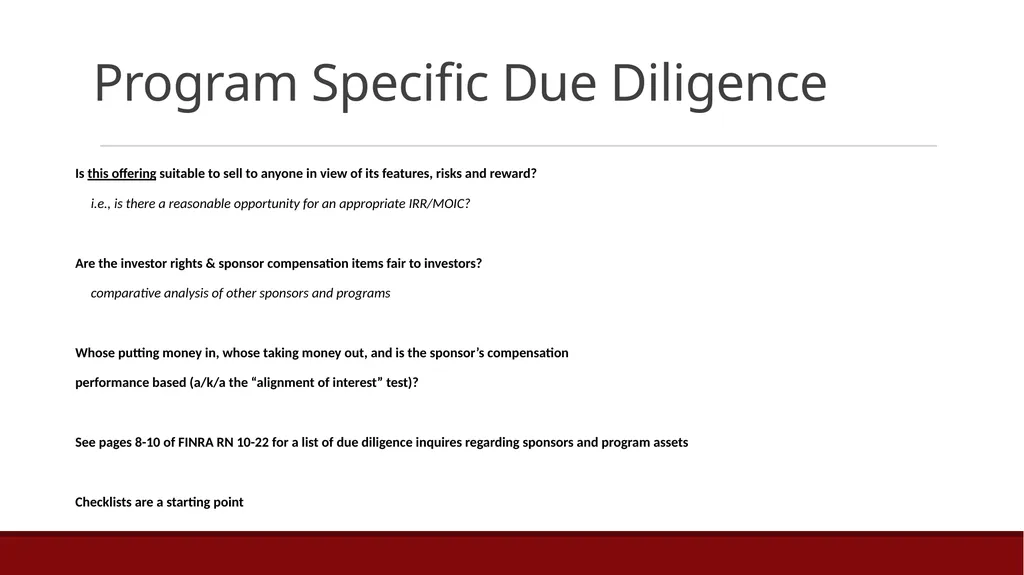
Program Specific Due Diligence Is this offering suitable to sell to anyone in view of its features, risks and reward?
i.e., is there a reasonable opportunity for an appropriate IRR/MOIC?
Are the investor rights & sponsor compensation items fair to investors?
comparative analysis of other sponsors and programs
Whose putting money in, whose taking money out, and is the sponsor’s compensation
performance based (a/k/a the “alignment of interest” test)?
See pages 8-10 of FINRA RN 10-22 for a list of due diligence inquires regarding sponsors and program assets
Checklists are a starting point<br>
i.e., is there a reasonable opportunity for an appropriate IRR/MOIC?
Are the investor rights & sponsor compensation items fair to investors?
comparative analysis of other sponsors and programs
Whose putting money in, whose taking money out, and is the sponsor’s compensation
performance based (a/k/a the “alignment of interest” test)?
See pages 8-10 of FINRA RN 10-22 for a list of due diligence inquires regarding sponsors and program assets
Checklists are a starting point<br>
12
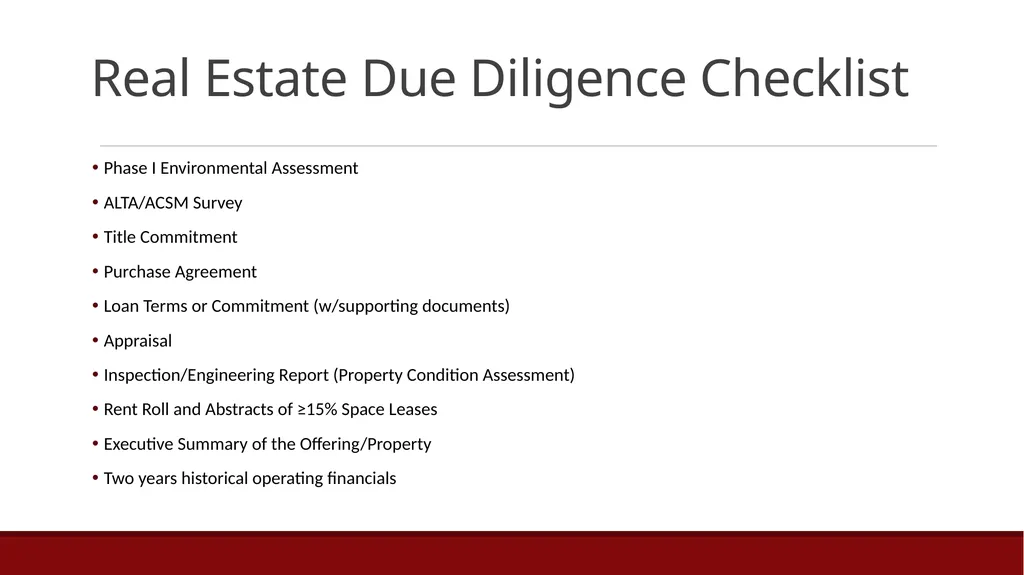
Real Estate Due Diligence Checklist Phase I Environmental Assessment
ALTA/ACSM Survey
Title Commitment
Purchase Agreement
Loan Terms or Commitment (w/supporting documents)
Appraisal
Inspection/Engineering Report (Property Condition Assessment)
Rent Roll and Abstracts of ≥15% Space Leases
Executive Summary of the Offering/Property
Two years historical operating financials<br>
ALTA/ACSM Survey
Title Commitment
Purchase Agreement
Loan Terms or Commitment (w/supporting documents)
Appraisal
Inspection/Engineering Report (Property Condition Assessment)
Rent Roll and Abstracts of ≥15% Space Leases
Executive Summary of the Offering/Property
Two years historical operating financials<br>
13
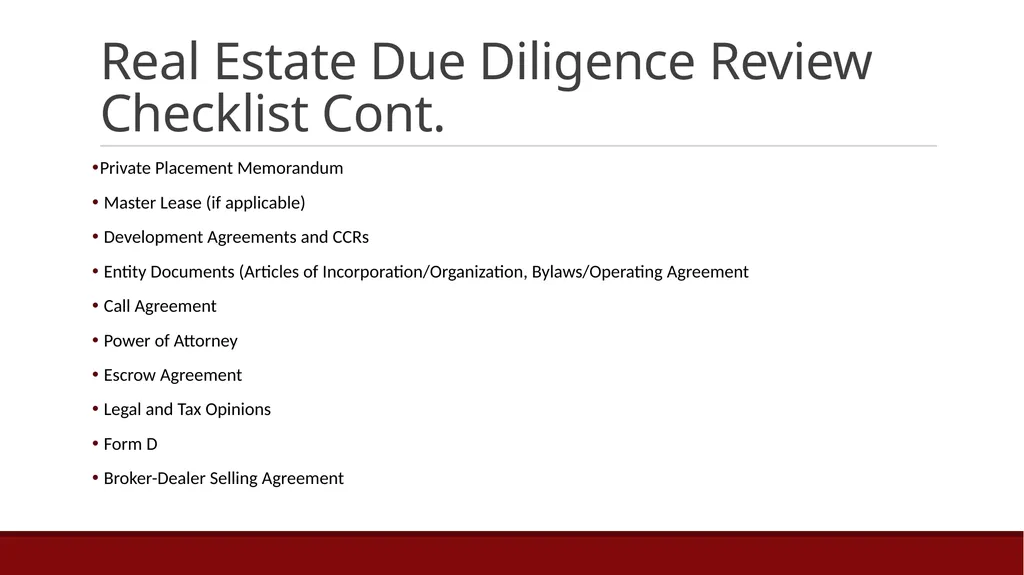
Real Estate Due Diligence Review Checklist Cont. Private Placement Memorandum
Master Lease (if applicable)
Development Agreements and CCRs
Entity Documents (Articles of Incorporation/Organization, Bylaws/Operating Agreement
Call Agreement
Power of Attorney
Escrow Agreement
Legal and Tax Opinions
Form D
Broker-Dealer Selling Agreement<br>
Master Lease (if applicable)
Development Agreements and CCRs
Entity Documents (Articles of Incorporation/Organization, Bylaws/Operating Agreement
Call Agreement
Power of Attorney
Escrow Agreement
Legal and Tax Opinions
Form D
Broker-Dealer Selling Agreement<br>
14
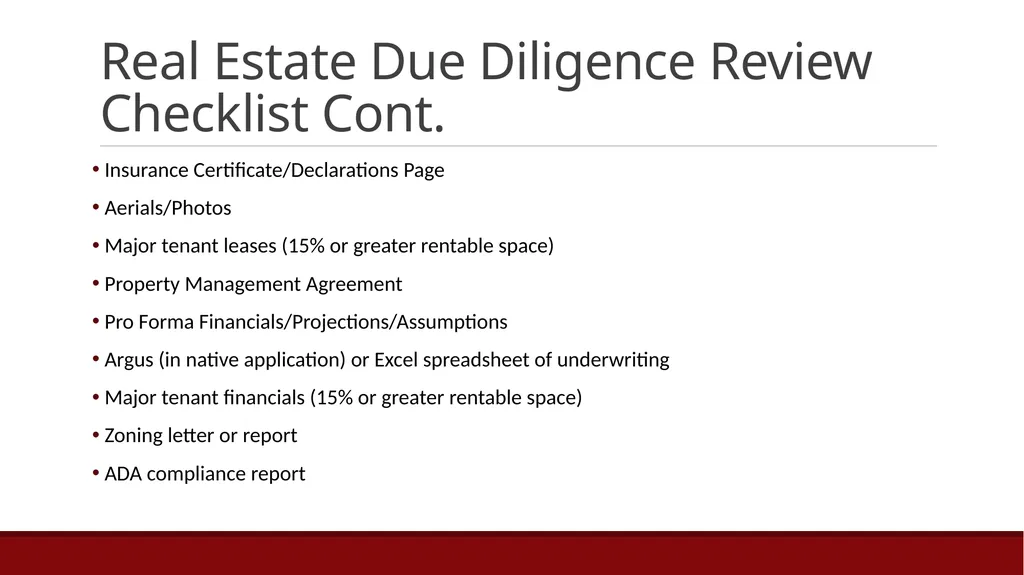
Real Estate Due Diligence Review Checklist Cont. Insurance Certificate/Declarations Page
Aerials/Photos
Major tenant leases (15% or greater rentable space)
Property Management Agreement
Pro Forma Financials/Projections/Assumptions
Argus (in native application) or Excel spreadsheet of underwriting
Major tenant financials (15% or greater rentable space)
Zoning letter or report
ADA compliance report<br>
Aerials/Photos
Major tenant leases (15% or greater rentable space)
Property Management Agreement
Pro Forma Financials/Projections/Assumptions
Argus (in native application) or Excel spreadsheet of underwriting
Major tenant financials (15% or greater rentable space)
Zoning letter or report
ADA compliance report<br>
15
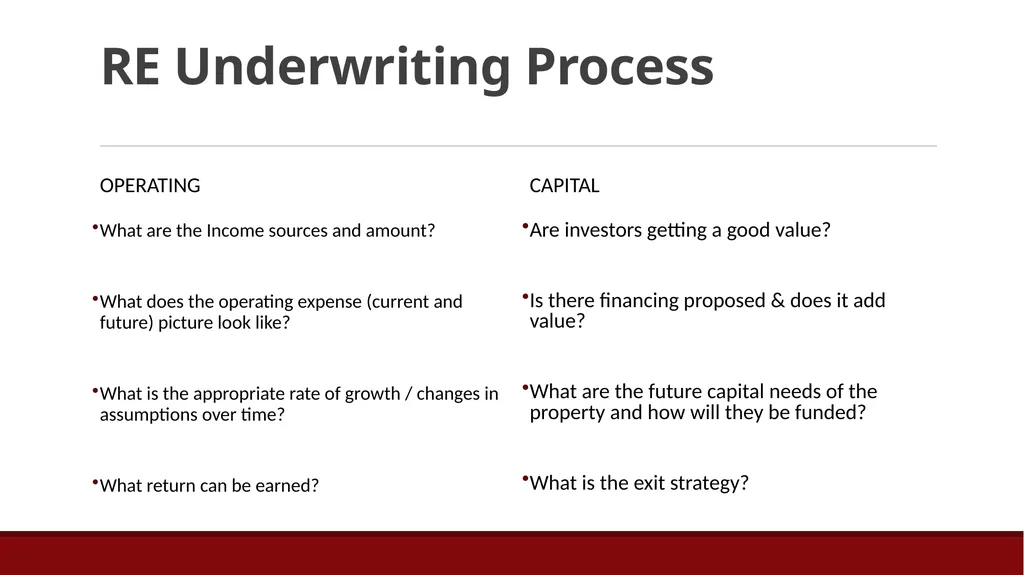
RE Underwriting Process Operating What are the Income sources and amount?
What does the operating expense (current and future) picture look like?
What is the appropriate rate of growth / changes in assumptions over time?
What return can be earned? capital Are investors getting a good value?
Is there financing proposed & does it add value?
What are the future capital needs of the property and how will they be funded?
What is the exit strategy?<br>
What does the operating expense (current and future) picture look like?
What is the appropriate rate of growth / changes in assumptions over time?
What return can be earned? capital Are investors getting a good value?
Is there financing proposed & does it add value?
What are the future capital needs of the property and how will they be funded?
What is the exit strategy?<br>
16
Oil & Gas U/W We use a similar asset valuation approach to determine IRR/MOIC per project
Reserve reports are prepared for each oil/gas program with specified assets
We adjust our U/W for production patterns, offering loads and sponsor compensation
It is important to understand the geology, reservoir qualities and operational requirements
of the sponsor’s projects
Outside engineering consultants are helpful in this process
To be frank, performance has been challenging within this asset class
A lot of promoters historically
Some vertically integrated sponsors drifted away from their core fields in search of better returns
Markets have been extremely volatile since 2008
We are in a better place today than 10 years ago (better quality of sponsors)<br>
Reserve reports are prepared for each oil/gas program with specified assets
We adjust our U/W for production patterns, offering loads and sponsor compensation
It is important to understand the geology, reservoir qualities and operational requirements
of the sponsor’s projects
Outside engineering consultants are helpful in this process
To be frank, performance has been challenging within this asset class
A lot of promoters historically
Some vertically integrated sponsors drifted away from their core fields in search of better returns
Markets have been extremely volatile since 2008
We are in a better place today than 10 years ago (better quality of sponsors)<br>
17
Oil & Gas Finding Risks – The Sponsor Must Find Oil Considerations:
Depth of sponsor’s staff in geology, engineering, land and production
Is the sponsor a true E&P company or a promoter?
What is the depth of the sponsor’s experience within the area where the
drilling is to take place?
Is the drilling really developmental or is it exploratory in nature?<br>
Depth of sponsor’s staff in geology, engineering, land and production
Is the sponsor a true E&P company or a promoter?
What is the depth of the sponsor’s experience within the area where the
drilling is to take place?
Is the drilling really developmental or is it exploratory in nature?<br>
18
Why sponsors perform (across all assets)? Strong market fundamentals
Executive know-how
Financially viable sponsor
Structure/skin in game (i.e., who’s putting money in, who’s taking money out, and is the sponsor comp performance based)
Accountability (e.g., financial transparency, strong accounting controls)<br>
Executive know-how
Financially viable sponsor
Structure/skin in game (i.e., who’s putting money in, who’s taking money out, and is the sponsor comp performance based)
Accountability (e.g., financial transparency, strong accounting controls)<br>
19
Why programs do not perform Bad markets (e.g., Great Recession, COVID 19) (#1)
The sponsor’s business decisions produce a bad outcome (#2)
Too much debt
Wrong drilling methods used
We developed the project in the wrong city
We were off budget
We made a mistake with our pro forma
Bad structure – the sponsor and/or project developer got paid too much (#3)
Misconduct (which always occurs after the BD does its initial due diligence on the first deal or two) (#4)<br>
The sponsor’s business decisions produce a bad outcome (#2)
Too much debt
Wrong drilling methods used
We developed the project in the wrong city
We were off budget
We made a mistake with our pro forma
Bad structure – the sponsor and/or project developer got paid too much (#3)
Misconduct (which always occurs after the BD does its initial due diligence on the first deal or two) (#4)<br>
20
Understanding Misconduct Pressure – what motivates the sponsor?
Stay in business & keep stakeholders happy
Opportunity – what enables the sponsor to undertake the misconduct
Culture of un-accountability (next slide)
Noise – how did we ignore the misconduct?
Investors got paid and it just seemed to work for awhile
Rationalization – the sponsor’s justification for the bad act<br>
Stay in business & keep stakeholders happy
Opportunity – what enables the sponsor to undertake the misconduct
Culture of un-accountability (next slide)
Noise – how did we ignore the misconduct?
Investors got paid and it just seemed to work for awhile
Rationalization – the sponsor’s justification for the bad act<br>
21
Sponsor solvency must be vetted today (not 1-2 yrs. ago)
Potential Considerations
Current Ratio (is it under 1.0???)
Sponsor Leverage/Covenant Compliance
Liabilities to Assets (is it over 70%???)
Profit or Loss Patterns (look at the last 2-3 years) Where due diligence sometimes falls apart<br>
Potential Considerations
Current Ratio (is it under 1.0???)
Sponsor Leverage/Covenant Compliance
Liabilities to Assets (is it over 70%???)
Profit or Loss Patterns (look at the last 2-3 years) Where due diligence sometimes falls apart<br>
22
What is a culture of un-accountability?
It's found within the offering materials and organizational documents
Lack of meaningful accounting controls
Treating all programs as one for accounting reasons
Sponsor’s ability to buy/sell assets between funds
Sponsor’s ability to loan money among programs
The fund can pay distributions from capital
Sponsor’s ability to engage in style drift and to buy anything<br>
It's found within the offering materials and organizational documents
Lack of meaningful accounting controls
Treating all programs as one for accounting reasons
Sponsor’s ability to buy/sell assets between funds
Sponsor’s ability to loan money among programs
The fund can pay distributions from capital
Sponsor’s ability to engage in style drift and to buy anything<br>