Mid Term PPT Submitted by IVAA Mem500 Voice-Controlled Multimodal Desktop Assistant Faculty Mentor: Mr. Vishwanil Suman Project Overview ULTRON is an Agentic AI-based computer assistant designed to understand natural-language instructions
"Mid Term PPT Submitted by IVAA Mem500" is the property of its rightful owner. Permission is granted to
download and print the materials on this website for personal, non-commercial use only, and to display it
on your personal computer provided you do not modify the materials and that you retain all copyright
notices contained in the materials. By downloading content from our website, you accept the terms of this
agreement.
Presentation Transcript
01
Mid Term PPT
Submitted by IVAA Mem500
Voice-Controlled Multimodal Desktop Assistant Faculty Mentor: Mr. Vishwanil Suman<br>
02
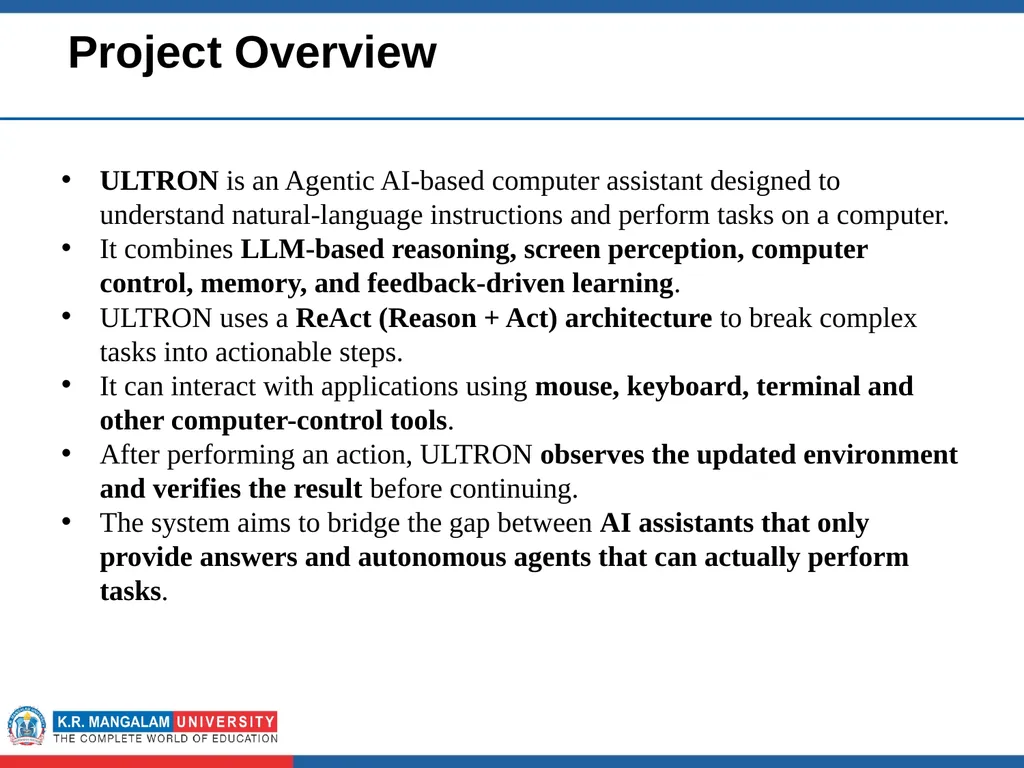
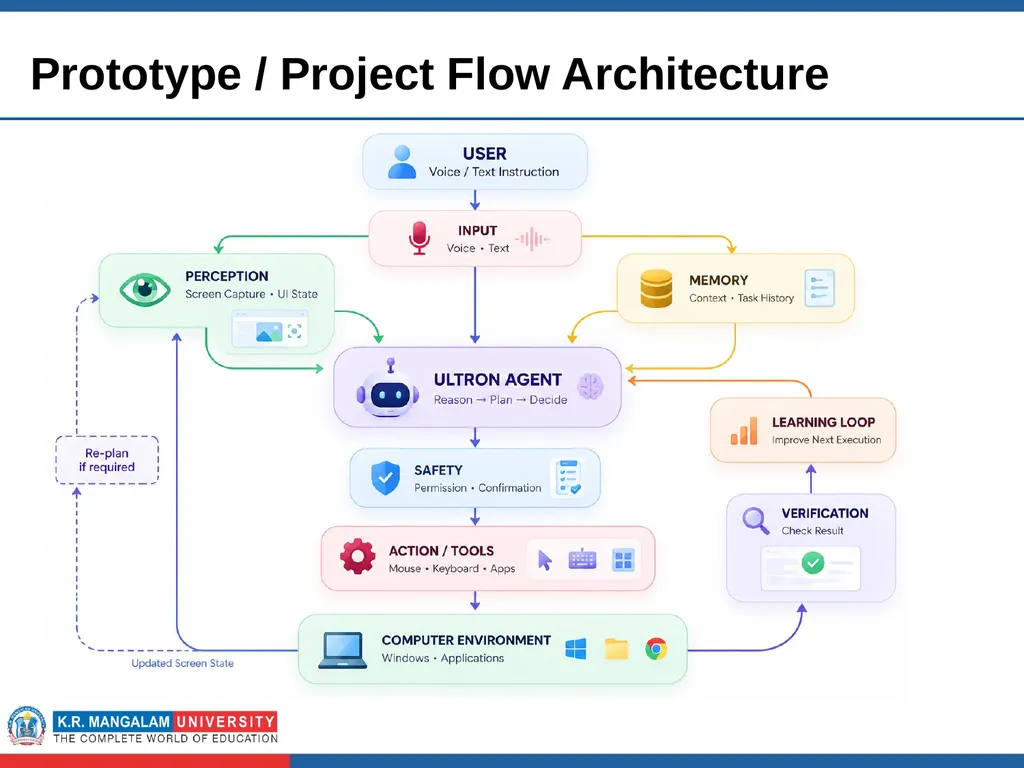
Project Overview ULTRON is an Agentic AI-based computer assistant designed to understand natural-language instructions and perform tasks on a computer.
It combines LLM-based reasoning, screen perception, computer control, memory, and feedback-driven learning.
ULTRON uses a ReAct (Reason + Act) architecture to break complex tasks into actionable steps.
It can interact with applications using mouse, keyboard, terminal and other computer-control tools.
After performing an action, ULTRON observes the updated environment and verifies the result before continuing.
The system aims to bridge the gap between AI assistants that only provide answers and autonomous agents that can actually perform tasks.<br>
03
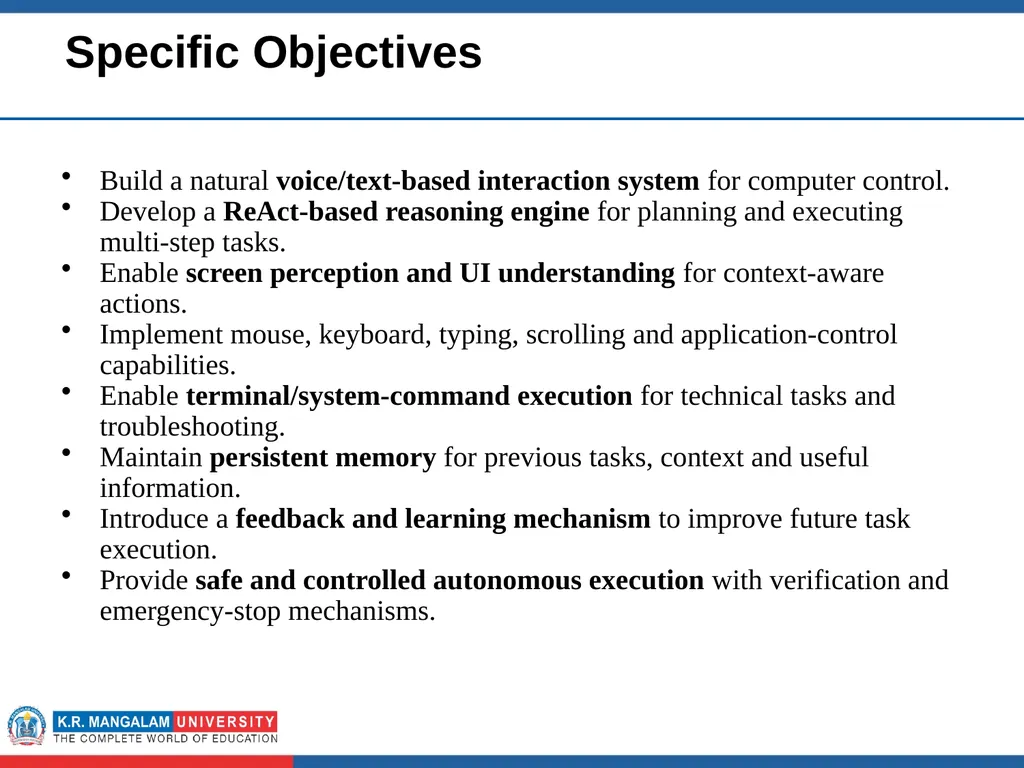
Specific Objectives Build a natural voice/text-based interaction system for computer control.
Develop a ReAct-based reasoning engine for planning and executing multi-step tasks.
Enable screen perception and UI understanding for context-aware actions.
Implement mouse, keyboard, typing, scrolling and application-control capabilities.
Enable terminal/system-command execution for technical tasks and troubleshooting.
Maintain persistent memory for previous tasks, context and useful information.
Introduce a feedback and learning mechanism to improve future task execution.
Provide safe and controlled autonomous execution with verification and emergency-stop mechanisms.<br>
Project Usecases & Scope Navigate unfamiliar applications using natural-language instructions.
Automate repetitive desktop tasks without requiring users to know exact menus or shortcuts.
Assist users in opening applications, managing files and performing system operations.
Troubleshoot computer problems by observing the screen and executing diagnostic commands.
Perform multi-step tasks by dynamically deciding the next action.
Remember previous interactions and use stored context during future tasks.
Scope
Windows Desktop Prototype with LLM reasoning, screen perception, computer automation, persistent memory and feedback-based task improvement.<br>
06
Prototype / Project Flow Architecture<br>
07
Data & Resources Python — Core implementation language for AI integration and computer automation.
LLM / Gemini API — Natural-language understanding and agent reasoning.
ReAct Architecture — Reasoning and action planning.
PyAutoGUI — Mouse, keyboard and desktop interaction.
Screen Capture Tools — Capturing the current computer state for visual grounding.
OpenCV / Computer Vision — Processing and understanding visual information.
SQLite / Local Storage — Persistent memory and task history.
Terminal / Shell — System-level commands and diagnostics.<br>
08
Methodology Capture the user's voice/text instruction.
Interpret the request using the LLM-based reasoning engine.
Use the ReAct framework to determine the required sequence of actions.
Observe the current screen/UI state before performing actions.
Select and execute appropriate computer-control tools.
Re-observe the environment after every major action.
Verify whether the expected result has been achieved.
If execution fails, re-plan and attempt an alternative action.
Store useful task information and execution feedback in memory.
Apply safety checks before sensitive or high-impact operations.
Expected Results & Impact A functional agentic computer assistant capable of performing real-world desktop tasks.
Reduced dependency on manual navigation and technical computer knowledge.
Improved task execution through screen-aware reasoning.
Ability to handle changes in application state instead of following rigid scripts.
Personalized assistance through persistent contextual memory.
Improved performance through feedback and previous execution experience.
Safer autonomous computer interaction through verification and controlled execution.
Demonstration of how LLMs can move from answering questions to performing actions.<br>