
Midlands workforce, race, equality and inclusion



Description: Midlands workforce, race, equality and inclusion strategy Kuvy Seenan Head of Equality and Inclusion - NHSEI Midlands Time for action Action Its time to act. Lasting and meaningful change will only happen if we agree measurable actions
Related Topics
Download Presentation
"Midlands workforce, race, equality and inclusion" is the property of its rightful owner. Permission is granted to download and print the materials on this website for personal, non-commercial use only, and to display it on your personal computer provided you do not modify the materials and that you retain all copyright notices contained in the materials. By downloading content from our website, you accept the terms of this agreement.
Presentation Transcript
slide1. Midlands workforce, race, equality and inclusion strategy Kuvy Seenan
Head of Equality and Inclusion - NHSE&I Midlands<br>
slide2. Time for action “Action – It’s time to act. Lasting and meaningful change will only happen if we agree measurable actions and outcomes and detailed plans of how we achieve them. It would be wrong to think that focusing on race equality would be detrimental to other protected characteristics, such as gender. Action on one area results in a ‘targeted universalism’ that benefits all groups”.
- Karl George<br>
slide3. Introduction The People Plan- action for all of us and the phase 3 letter from the CEO of NHS England & NHS Improvement Simon Stevens in July 2020, emphasis that racism is a problem that needs to be addressed urgently. However, that in no way diminishes the need to address the equality and inclusion needs of people with other protected characteristics.
The reality is that in addressing race inequalities, research* has shown that this does have a positive impact not only on other staff groups but also on patients’ outcome. This strategy document focuses on improving the experience and opportunities for the BAME workforce.
However, the evidence demonstrates the link between improvements in workforce experience and better health outcomes for patients.
Given the complexity of addressing race inequality, the focus in the strategy is solely on improving the workforce experience. It’s important to draw attention to this link as health inequalities themselves fall outside of the remit of this strategy.<br>
slide4. Introduction This is a strategic document which sets out what need to be achieved, the timeframe to reach these goals, and who will be responsible. However, it is not in itself a strategic plan. The responsibility to develop those plans rest with individual Sustainability Transformational Partnerships (STP)/ Integrated Care Systems (ICS) and Organisations.
It is also acknowledged that this strategy is heavily focused on secondary NHS organisations. This emphasis has been in part influenced by the People Plan, and because systems are yet to be fully established. For that reason, please note that this document will need to remain live and be adapted as we evolve to work at a more integrated system level.
Race, equality and inclusion is everyone’s business, and the responsibility to turn this strategy into reality rests with each person in the Midland workforce. Once this strategy approved, it will be available in an easy-to-read format that will be interactive and accessible online.
*Research on NHS staff and patient surveys in 2012 by Michael West found:
The experience of black and minority ethnic NHS staff is a good barometer of the climate of respect and care for all within the NHS. Put simply, if BME staff feel engaged, motivated, valued and part of a team with a sense of belonging, patients were more likely to be satisfied with the service they received.
Source: NHS Staff Survey and Related Data West, M et al 2012<br>
slide5. The aim of the strategy is to create an anti-racist, compassionate and inclusive working culture. BAME staff are negatively affected by structural racism. Many also suffer from day to day racism. The strategy is designed to tackle both of these problems. To improve the quality of work life and also remove barriers to professional development for all BAME Staff. By improving the experience of BAME staff, it will have a positive impact on all our workforce in regards to how we tackle discrimination.<br>
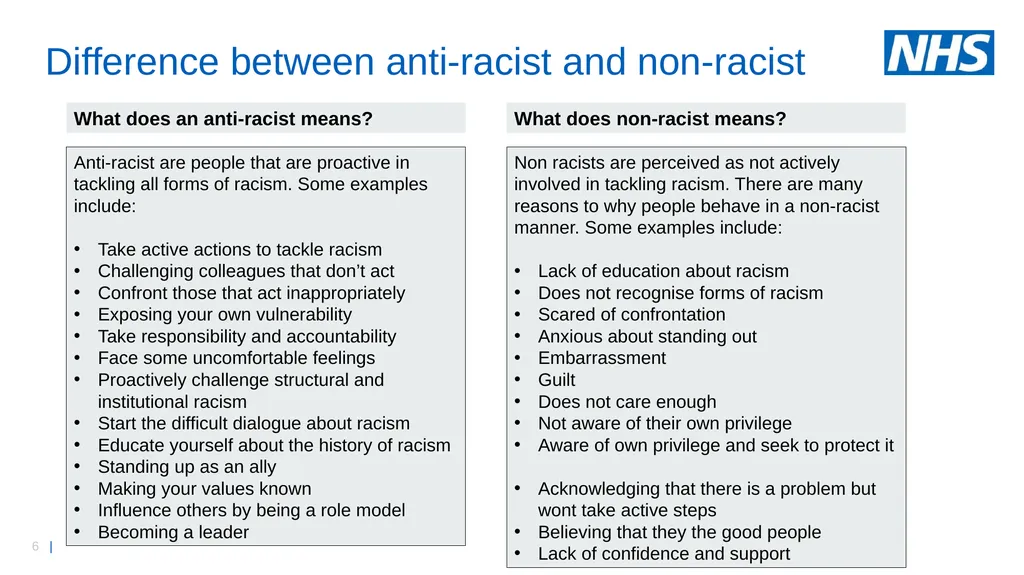
slide6. Difference between anti-racist and non-racist Anti-racist are people that are proactive in tackling all forms of racism. Some examples include:
Take active actions to tackle racism
Challenging colleagues that don’t act
Confront those that act inappropriately
Exposing your own vulnerability
Take responsibility and accountability
Face some uncomfortable feelings
Proactively challenge structural and institutional racism
Start the difficult dialogue about racism
Educate yourself about the history of racism
Standing up as an ally
Making your values known
Influence others by being a role model
Becoming a leader Non racists are perceived as not actively involved in tackling racism. There are many reasons to why people behave in a non-racist manner. Some examples include:
Lack of education about racism
Does not recognise forms of racism
Scared of confrontation
Anxious about standing out
Embarrassment
Guilt
Does not care enough
Not aware of their own privilege
Aware of own privilege and seek to protect it
Acknowledging that there is a problem but wont take active steps
Believing that they the good people
Lack of confidence and support What does an anti-racist means? What does non-racist means?<br>
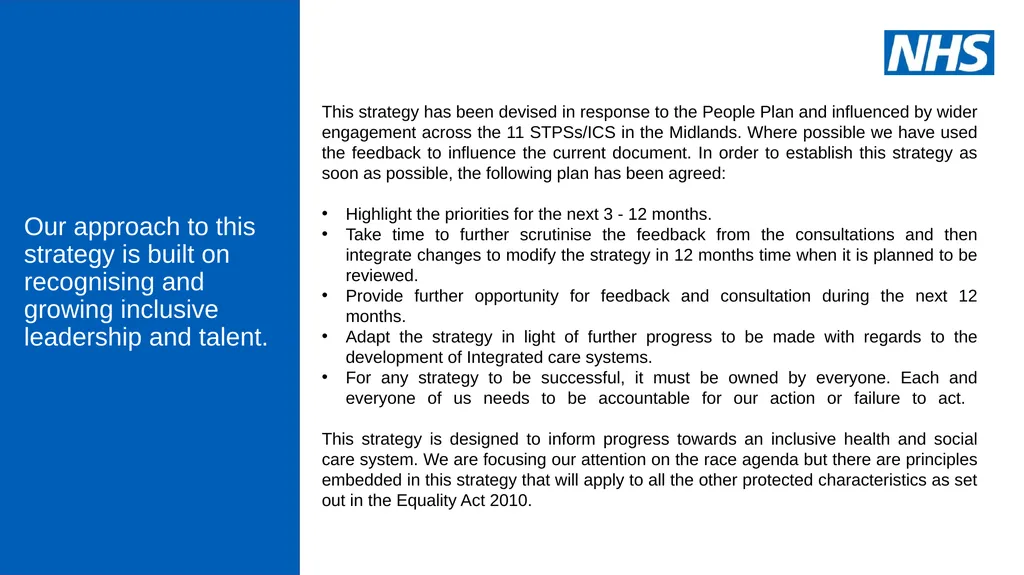
slide7. Our approach to this strategy is built on recognising and growing inclusive leadership and talent. This strategy has been devised in response to the People Plan and influenced by wider engagement across the 11 STPSs/ICS in the Midlands. Where possible we have used the feedback to influence the current document. In order to establish this strategy as soon as possible, the following plan has been agreed:
Highlight the priorities for the next 3 - 12 months.
Take time to further scrutinise the feedback from the consultations and then integrate changes to modify the strategy in 12 months time when it is planned to be reviewed.
Provide further opportunity for feedback and consultation during the next 12 months.
Adapt the strategy in light of further progress to be made with regards to the development of Integrated care systems.
For any strategy to be successful, it must be owned by everyone. Each and everyone of us needs to be accountable for our action or failure to act.
This strategy is designed to inform progress towards an inclusive health and social care system. We are focusing our attention on the race agenda but there are principles embedded in this strategy that will apply to all the other protected characteristics as set out in the Equality Act 2010.<br>
slide8. Underpinning principles The proposed recommendations in this strategy are based on the three principles of challenge, educate and support. These principles are embedded in all our actions. We believe that if these principles underpin the actions we take, they will make a significant shift in progressing equality and inclusion across all protected characteristics in the Midlands in the next 12 months to 5 years.
The two most important drivers that will help us to embed those three principles across all our actions is leadership and accountability:
We need to have the right and diverse leadership at all levels within our health care system. Senior managers need to lead by example.
Ensuring that we have accountability at all levels is key to the success of this strategy. Those that are not prepared to be accountable for progress or demonstrate a lack of progress are simply not leaders and therefore cannot be expected to lead.
One of the ways for us to know that this strategy is successful is when staff tell us we have achieved our goal.<br>
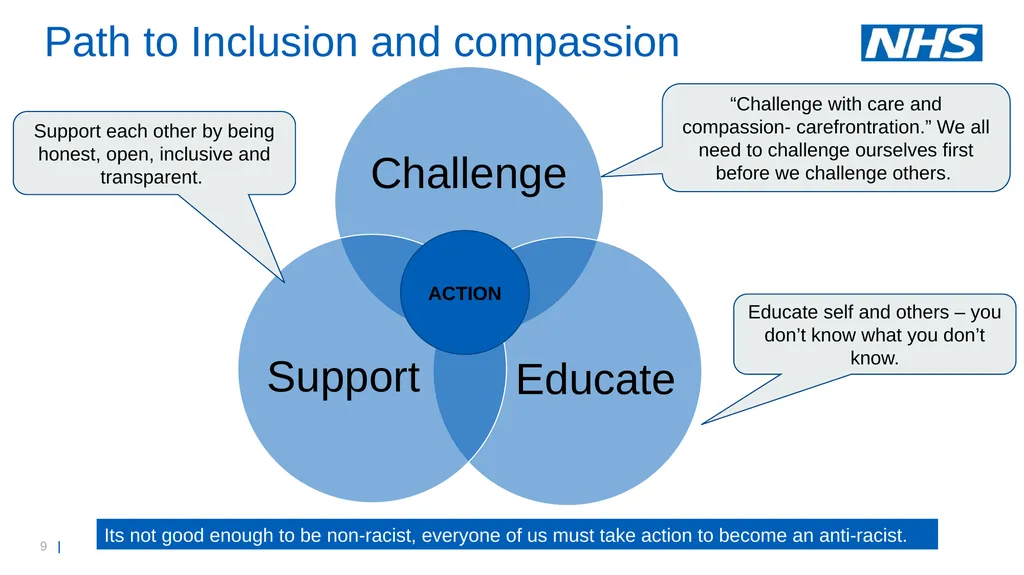
slide9. Path to Inclusion and compassion “Challenge with care and compassion- carefrontration.” We all need to challenge ourselves first before we challenge others. ACTION Educate self and others – you don’t know what you don’t know. Support each other by being honest, open, inclusive and transparent. Its not good enough to be non-racist, everyone of us must take action to become an anti-racist.<br>
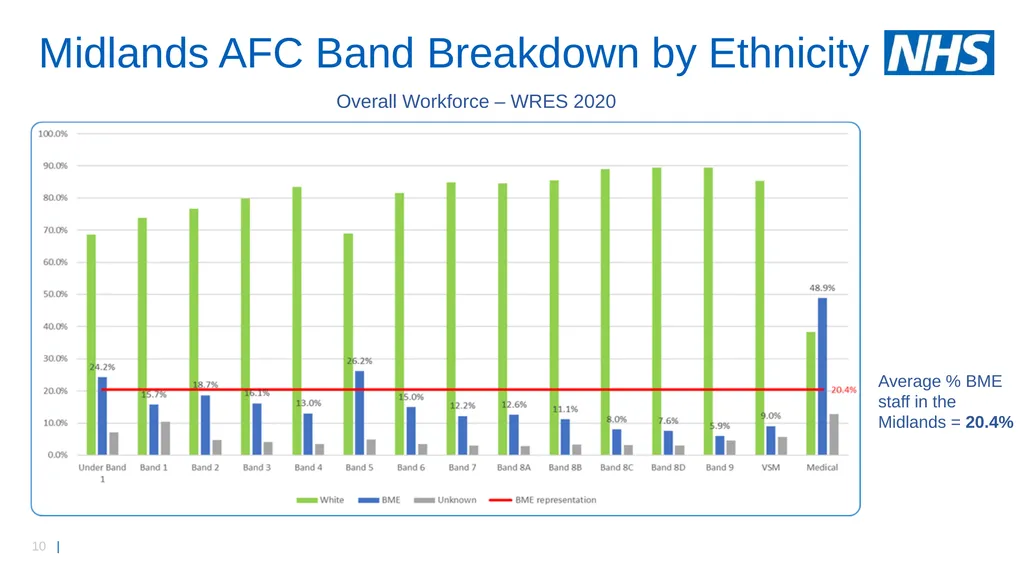
slide10. Midlands AFC Band Breakdown by Ethnicity Overall Workforce – WRES 2020 Average % BME staff in the Midlands = 20.4%<br>
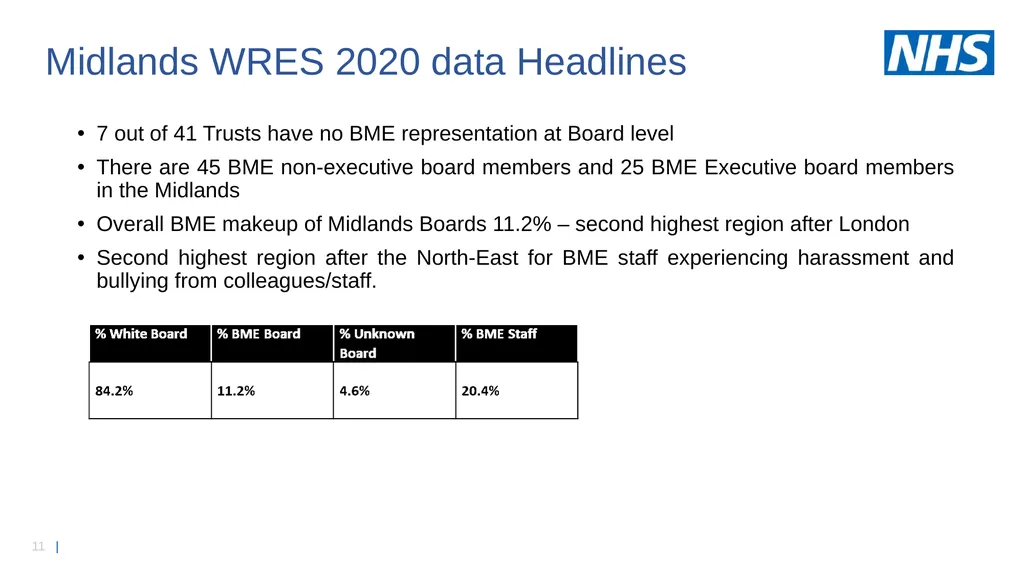
slide11. Midlands WRES 2020 data Headlines 7 out of 41 Trusts have no BME representation at Board level
There are 45 BME non-executive board members and 25 BME Executive board members in the Midlands
Overall BME makeup of Midlands Boards 11.2% – second highest region after London
Second highest region after the North-East for BME staff experiencing harassment and bullying from colleagues/staff.<br>
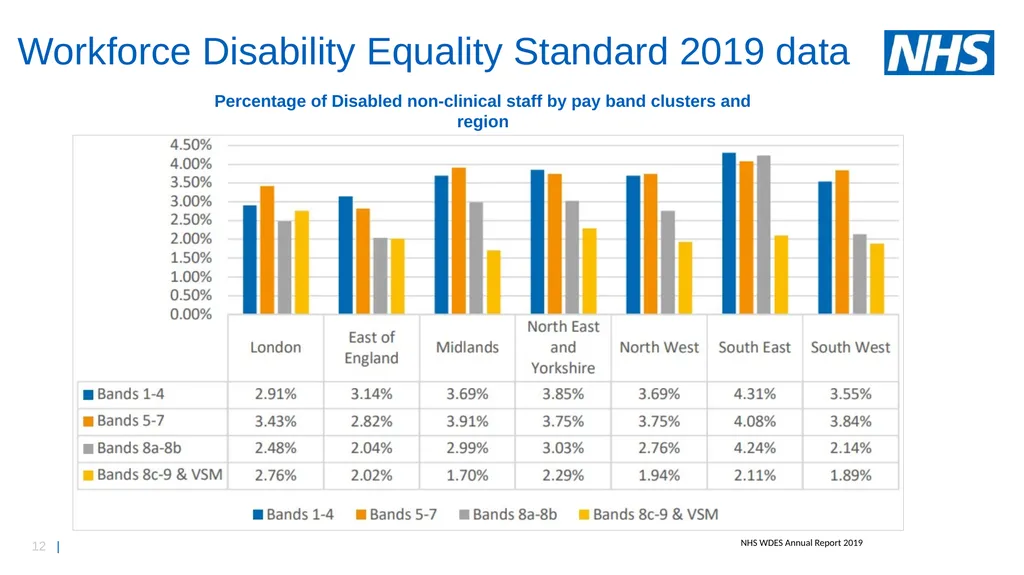
slide12. Workforce Disability Equality Standard 2019 data Percentage of Disabled non-clinical staff by pay band clusters and region NHS WDES Annual Report 2019<br>
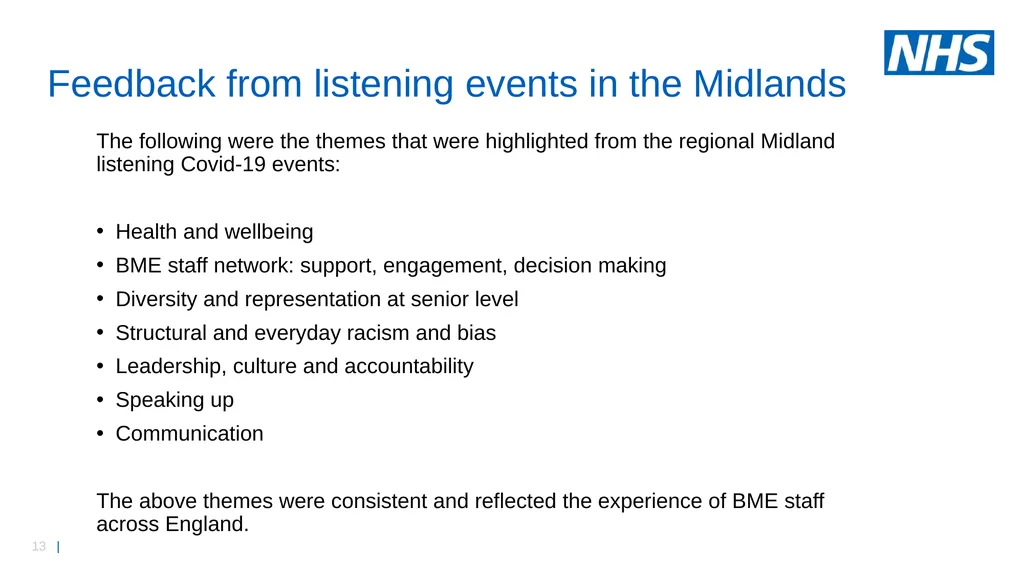
slide13. Feedback from listening events in the Midlands The following were the themes that were highlighted from the regional Midland listening Covid-19 events:
Health and wellbeing
BME staff network: support, engagement, decision making
Diversity and representation at senior level
Structural and everyday racism and bias
Leadership, culture and accountability
Speaking up
Communication
The above themes were consistent and reflected the experience of BME staff across England.<br>
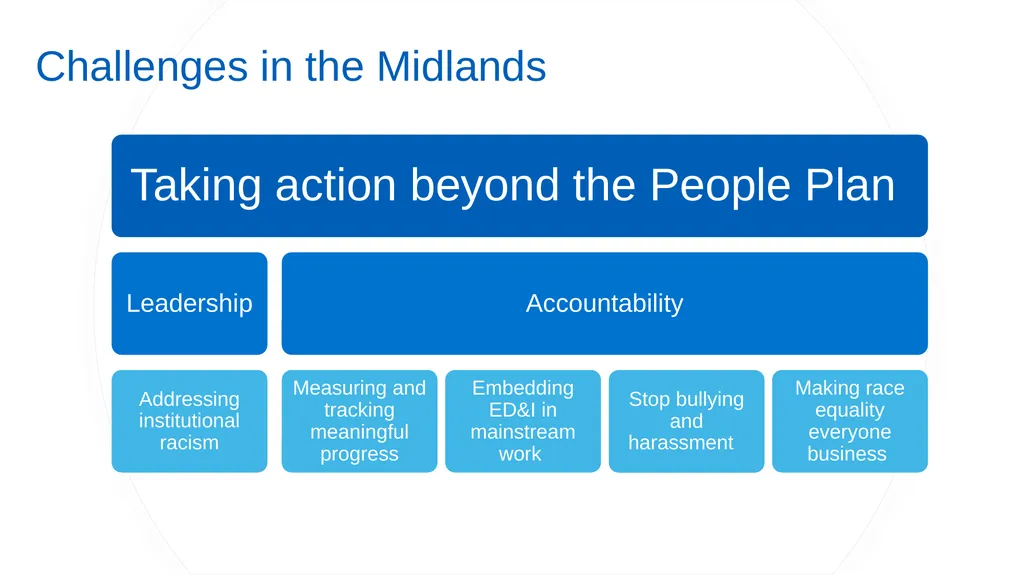
slide14. Presentation title Challenges in the Midlands<br>
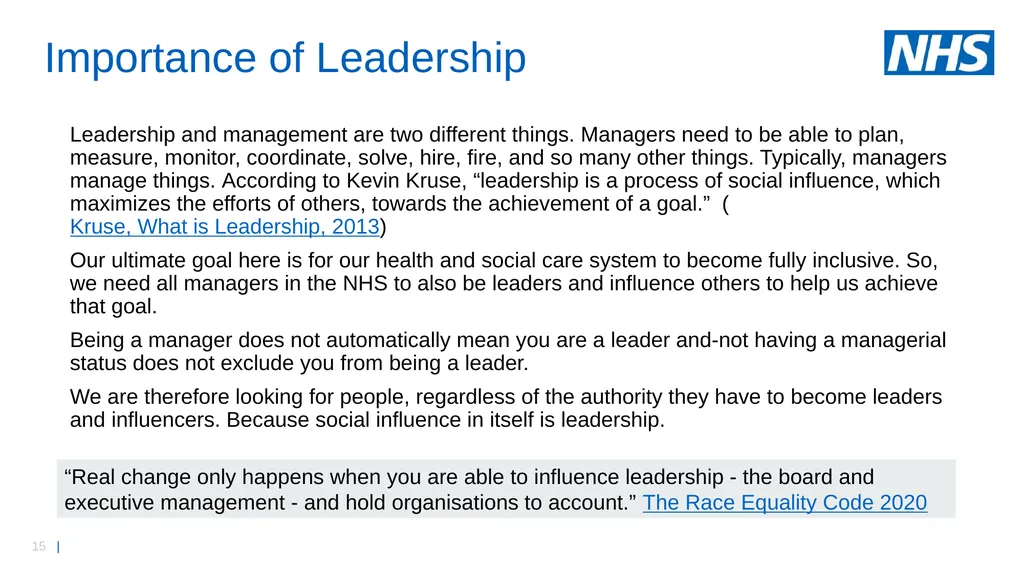
slide15. Importance of Leadership Leadership and management are two different things. Managers need to be able to plan, measure, monitor, coordinate, solve, hire, fire, and so many other things. Typically, managers manage things. According to Kevin Kruse, “leadership is a process of social influence, which maximizes the efforts of others, towards the achievement of a goal.” (Kruse, What is Leadership, 2013)
Our ultimate goal here is for our health and social care system to become fully inclusive. So, we need all managers in the NHS to also be leaders and influence others to help us achieve that goal.
Being a manager does not automatically mean you are a leader and-not having a managerial status does not exclude you from being a leader.
We are therefore looking for people, regardless of the authority they have to become leaders and influencers. Because social influence in itself is leadership. “Real change only happens when you are able to influence leadership - the board and executive management - and hold organisations to account.” The Race Equality Code 2020<br>
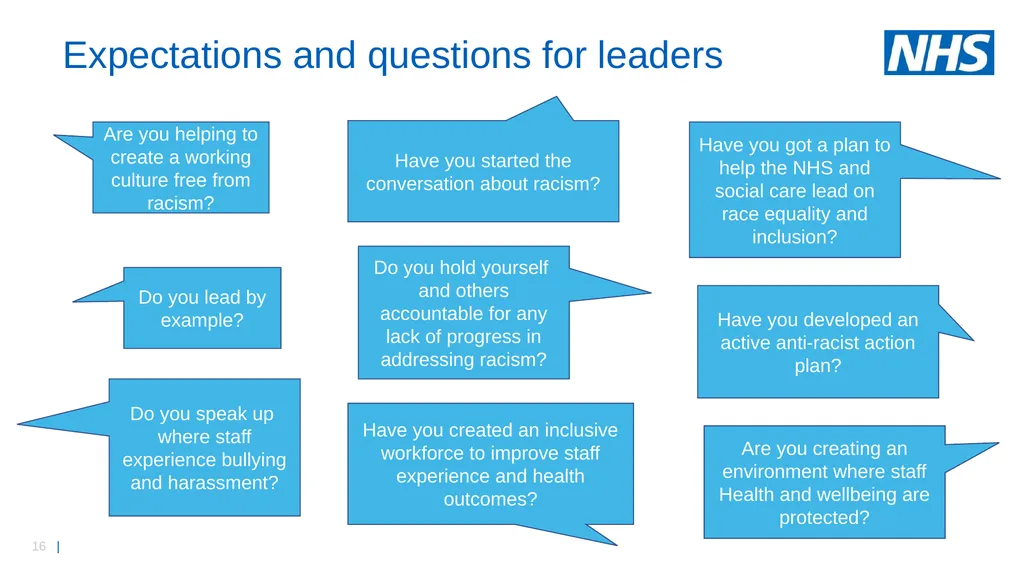
slide16. Expectations and questions for leaders Have you got a plan to help the NHS and social care lead on race equality and inclusion? Have you created an inclusive workforce to improve staff experience and health outcomes? Do you lead by example? Do you hold yourself and others accountable for any lack of progress in addressing racism? Are you helping to create a working culture free from racism? Have you started the conversation about racism? Do you speak up where staff experience bullying and harassment? Have you developed an active anti-racist action plan? Are you creating an environment where staff Health and wellbeing are protected?<br>
slide17. Change = taking radical action “Action speaks louder than words- we don’t want another strategy that looks good on paper but does not effect change. Instead, we want actions that make a difference in improving people’s life.”
Our strategy in the Midlands needs to reflect a radical approach owned from board to ward. By radical we mean:
Being courageous
Taking positive risks
Being prepared to do things that haven’t been done before and measuring their effectiveness
Learn how to modify challenging initiatives if not initially successful
Supporting those that are prepared to challenge the status quo “Culture eats strategy for breakfast” - Peter Drucker<br>
slide18. What must we stop doing? Presentation title Seeing racism as other people’s business
Staying silent when seeing and hearing racist behaviours
Protecting those who are causing harm through incivility
asking Black, Asian and other minority ethnic (BME) people to fix the problem of racism
Waiting for more data as an excuse not to act
Saying that racism has been dealt with
Passing the responsibility to others
Leading if you cannot acknowledge racism is a significant problem
Seeing people who are from a BME background as a homogenous group<br>
slide19. What we must do? Presentation title Notes: This strategy is intended to be a live document to stimulate discussion and generate ideas that will contribute to the ongoing fight against racism and inequalities. We need the active engagement from all staff across all sectors. Everybody can contribute and our actions are not to be seen in isolation. Remove barriers to inclusive and compassionate health and wellbeing support
Lead with compassion and inclusion
Remove barriers to help staff speak up
Tackle racism, bullying, harassment and other types of discrimination
Eliminate racism and bias in disciplinaries
Celebrate and reward success
Develop a collaborative approach across Systems
Build accountability across the region.
Eliminate racism and bias in recruitment and progression<br>
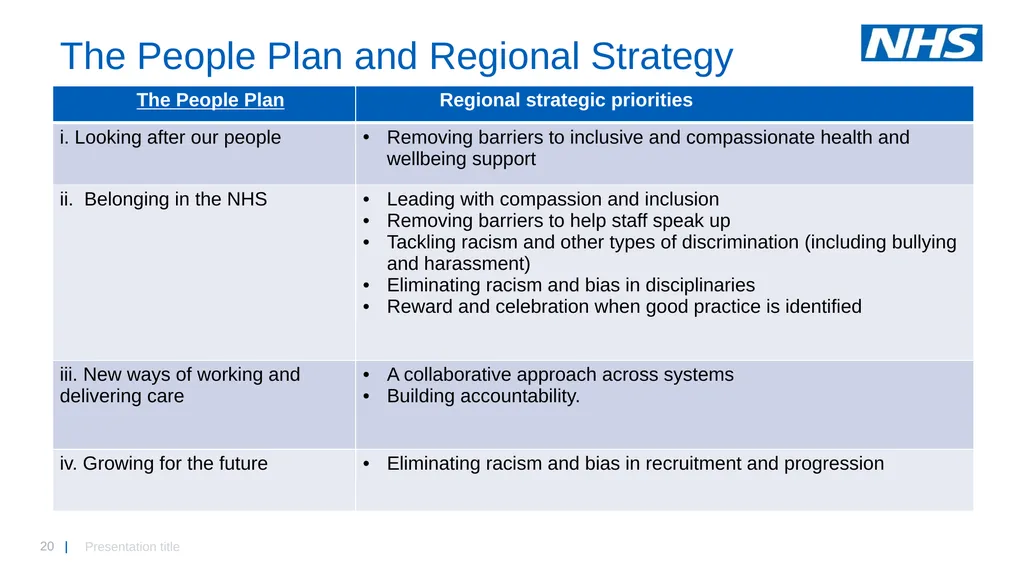
slide20. The People Plan and Regional Strategy Presentation title<br>
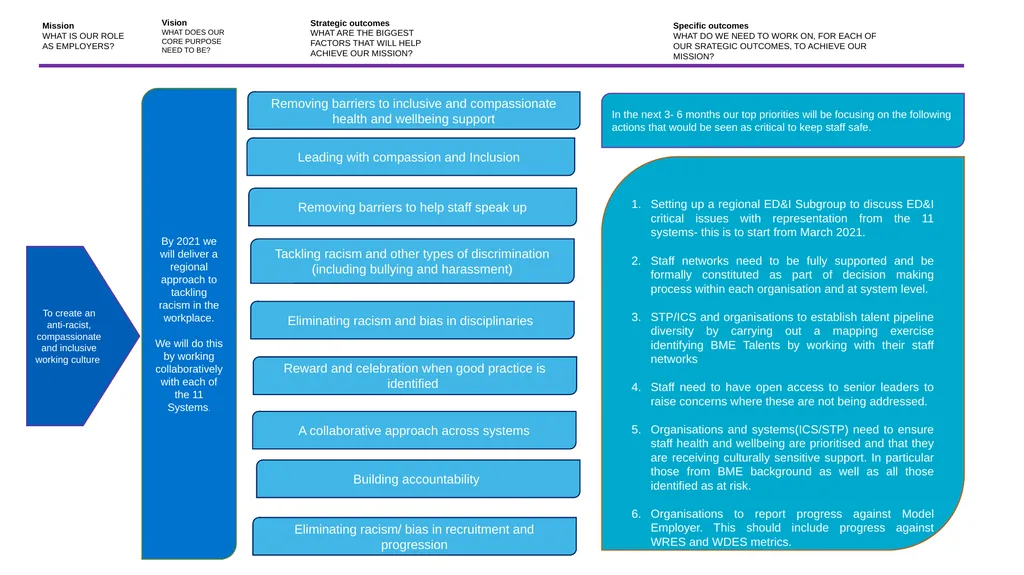
slide21. Mission
WHAT IS OUR ROLE AS EMPLOYERS? Vision WHAT DOES OUR CORE PURPOSE NEED TO BE? Strategic outcomes WHAT ARE THE BIGGEST FACTORS THAT WILL HELP ACHIEVE OUR MISSION? Specific outcomes WHAT DO WE NEED TO WORK ON, FOR EACH OF OUR SRATEGIC OUTCOMES, TO ACHIEVE OUR MISSION? To create an anti-racist, compassionate and inclusive working culture By 2021 we will deliver a regional approach to tackling racism in the workplace.
We will do this by working collaboratively with each of the 11 Systems. Reward and celebration when good practice is identified A collaborative approach across systems Building accountability Eliminating racism/ bias in recruitment and progression Setting up a regional ED&I Subgroup to discuss ED&I critical issues with representation from the 11 systems- this is to start from March 2021.
Staff networks need to be fully supported and be formally constituted as part of decision making process within each organisation and at system level.
STP/ICS and organisations to establish talent pipeline diversity by carrying out a mapping exercise identifying BME Talents by working with their staff networks
Staff need to have open access to senior leaders to raise concerns where these are not being addressed.
Organisations and systems(ICS/STP) need to ensure staff health and wellbeing are prioritised and that they are receiving culturally sensitive support. In particular those from BME background as well as all those identified as at risk.
Organisations to report progress against Model Employer. This should include progress against WRES and WDES metrics. Removing barriers to inclusive and compassionate health and wellbeing support Leading with compassion and Inclusion Removing barriers to help staff speak up Tackling racism and other types of discrimination (including bullying and harassment) Eliminating racism and bias in disciplinaries In the next 3- 6 months our top priorities will be focusing on the following actions that would be seen as critical to keep staff safe.<br>
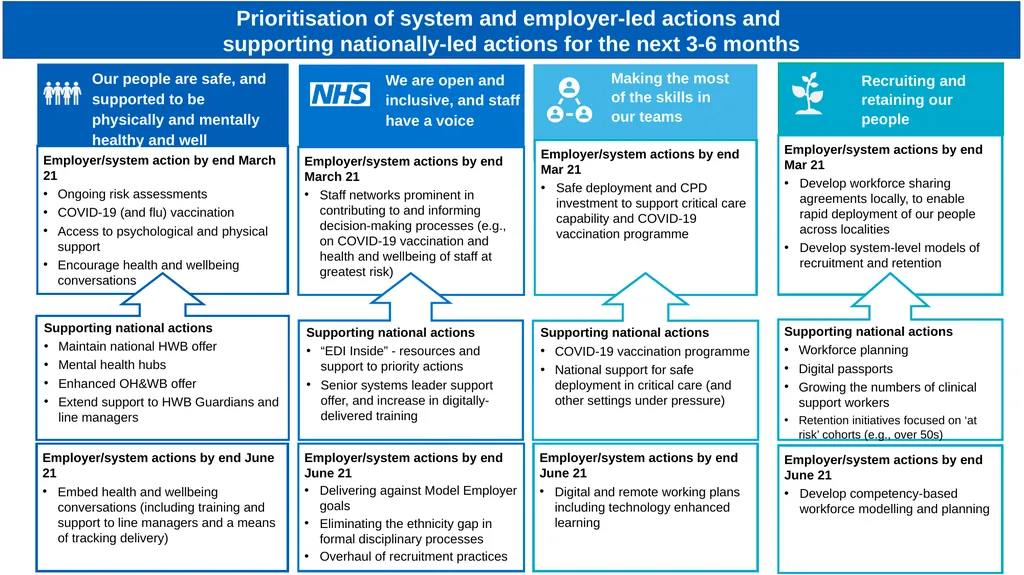
slide22. Employer/system action by end March 21
Ongoing risk assessments
COVID-19 (and flu) vaccination
Access to psychological and physical support
Encourage health and wellbeing conversations Prioritisation of system and employer-led actions and
supporting nationally-led actions for the next 3-6 months Employer/system actions by end March 21
Staff networks prominent in contributing to and informing decision-making processes (e.g., on COVID-19 vaccination and health and wellbeing of staff at greatest risk) Employer/system actions by end Mar 21
Safe deployment and CPD investment to support critical care capability and COVID-19 vaccination programme Employer/system actions by end Mar 21
Develop workforce sharing agreements locally, to enable rapid deployment of our people across localities
Develop system-level models of recruitment and retention Our people are safe, and supported to be physically and mentally healthy and well We are open and inclusive, and staff have a voice Recruiting and retaining our people Making the most of the skills in our teams Employer/system actions by end June 21
Embed health and wellbeing conversations (including training and support to line managers and a means of tracking delivery) Employer/system actions by end June 21
Delivering against Model Employer goals
Eliminating the ethnicity gap in formal disciplinary processes
Overhaul of recruitment practices Employer/system actions by end June 21
Digital and remote working plans including technology enhanced learning Employer/system actions by end June 21
Develop competency-based workforce modelling and planning Supporting national actions
Maintain national HWB offer
Mental health hubs
Enhanced OH&WB offer
Extend support to HWB Guardians and line managers Supporting national actions
“EDI Inside” - resources and support to priority actions
Senior systems leader support offer, and increase in digitally-delivered training Supporting national actions
COVID-19 vaccination programme
National support for safe deployment in critical care (and other settings under pressure) Supporting national actions
Workforce planning
Digital passports
Growing the numbers of clinical support workers
Retention initiatives focused on ‘at risk’ cohorts (e.g., over 50s)<br>
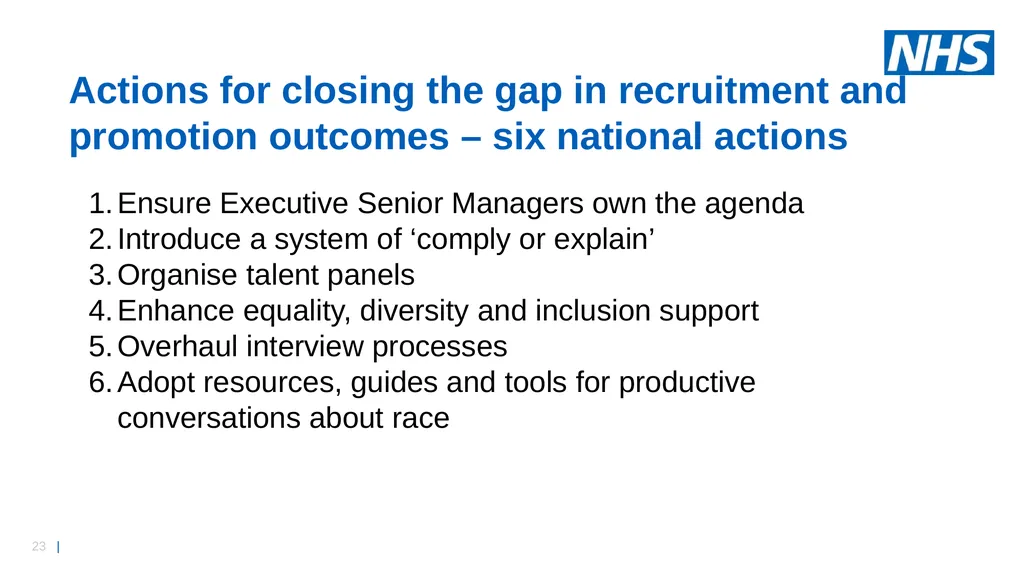
slide23. Actions for closing the gap in recruitment and promotion outcomes – six national actions Ensure Executive Senior Managers own the agenda
Introduce a system of ‘comply or explain’
Organise talent panels
Enhance equality, diversity and inclusion support
Overhaul interview processes
Adopt resources, guides and tools for productive conversations about race<br>
slide24. Leading with compassion and inclusion<br>
slide25. The NHS must have senior managers with the right skills to lead a health care service that is inclusive and compassionate. Good leadership can be found at all levels and in all teams in the NHS. This has been highlighted in response to the COVID-19 pandemic where people in non-formal leadership roles became significant. However, we also know that progress in tackling racism and other inequalities have been in part slow due to lack of leadership in the NHS. We need to recognise the areas of good leadership and celebrate all colleagues that are leading the way in challenging racism and creating a culture of inclusion for all.
Leaders set the tone and play a key role in influencing the culture of an organisation. To embed the core values of compassion and inclusion we need leaders to lead by example across all level of our health care system. To fight systemic racism leaders need to be engaged in a compassionate way with staff affected by such inequalities and injustice.
Leaders must also create inclusive and compassionate organisations that ensures BME staff are free from discrimination. We must continue to engage with staff affected by racism and other type of discriminations. However, leaders should stop expecting BME colleagues and those affected by discriminations to solve the problems of racism. Therefore, one of our priorities is to ensure leaders are supported and equipped to understand better how to use their leadership position and White privilege to tackle racism. “The standard we walk past is the standard we accept” - David Lindsay Morrison Leadership skills<br>
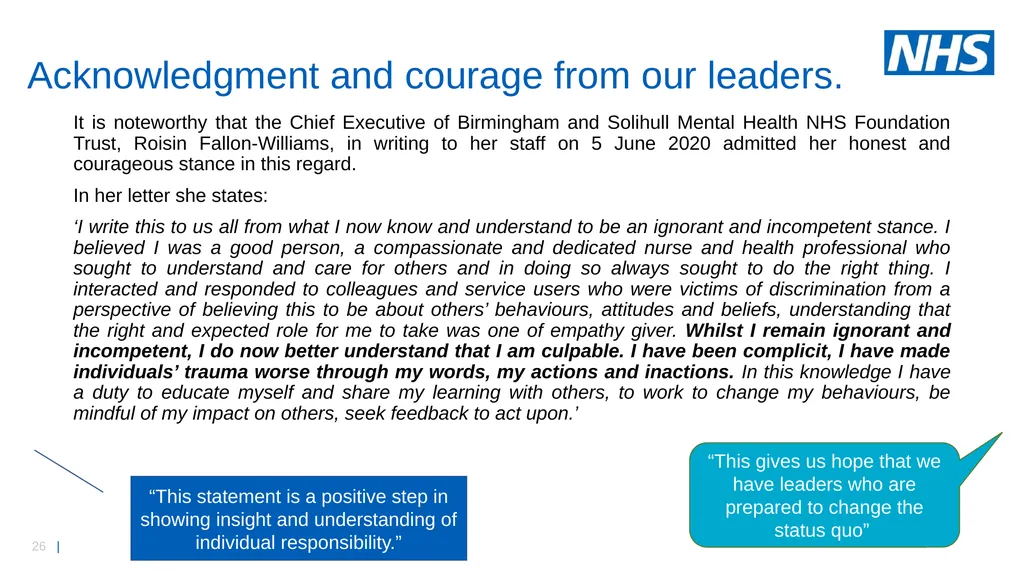
slide26. Acknowledgment and courage from our leaders. It is noteworthy that the Chief Executive of Birmingham and Solihull Mental Health NHS Foundation Trust, Roisin Fallon-Williams, in writing to her staff on 5 June 2020 admitted her honest and courageous stance in this regard.
In her letter she states:
‘I write this to us all from what I now know and understand to be an ignorant and incompetent stance. I believed I was a good person, a compassionate and dedicated nurse and health professional who sought to understand and care for others and in doing so always sought to do the right thing. I interacted and responded to colleagues and service users who were victims of discrimination from a perspective of believing this to be about others’ behaviours, attitudes and beliefs, understanding that the right and expected role for me to take was one of empathy giver. Whilst I remain ignorant and incompetent, I do now better understand that I am culpable. I have been complicit, I have made individuals’ trauma worse through my words, my actions and inactions. In this knowledge I have a duty to educate myself and share my learning with others, to work to change my behaviours, be mindful of my impact on others, seek feedback to act upon.’ “This statement is a positive step in showing insight and understanding of individual responsibility.” “This gives us hope that we have leaders who are prepared to change the status quo”<br>
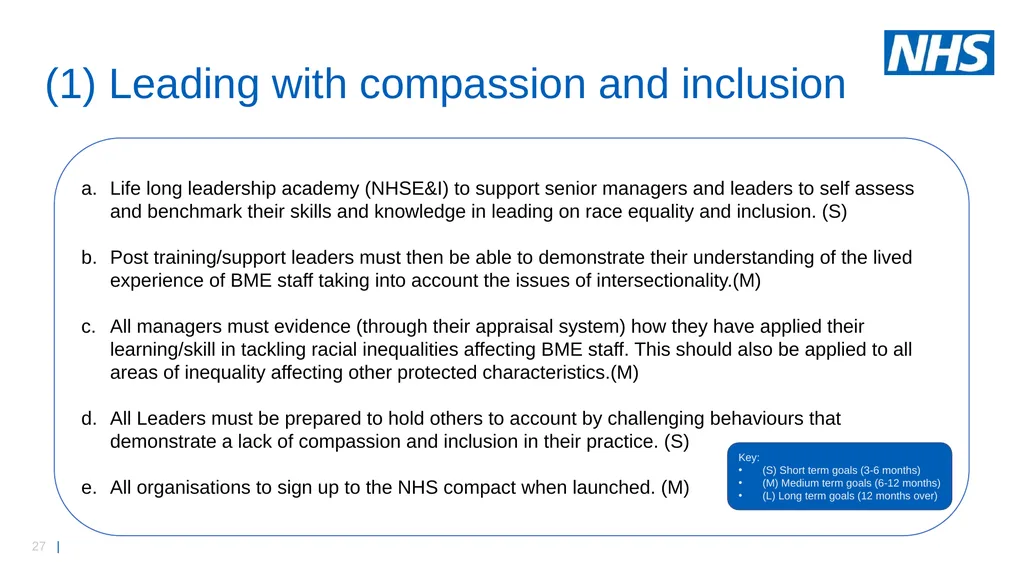
slide27. (1) Leading with compassion and inclusion Life long leadership academy (NHSE&I) to support senior managers and leaders to self assess and benchmark their skills and knowledge in leading on race equality and inclusion. (S)
Post training/support leaders must then be able to demonstrate their understanding of the lived experience of BME staff taking into account the issues of intersectionality.(M)
All managers must evidence (through their appraisal system) how they have applied their learning/skill in tackling racial inequalities affecting BME staff. This should also be applied to all areas of inequality affecting other protected characteristics.(M)
All Leaders must be prepared to hold others to account by challenging behaviours that demonstrate a lack of compassion and inclusion in their practice. (S)
All organisations to sign up to the NHS compact when launched. (M) Key:
(S) Short term goals (3-6 months)
(M) Medium term goals (6-12 months)
(L) Long term goals (12 months over)<br>
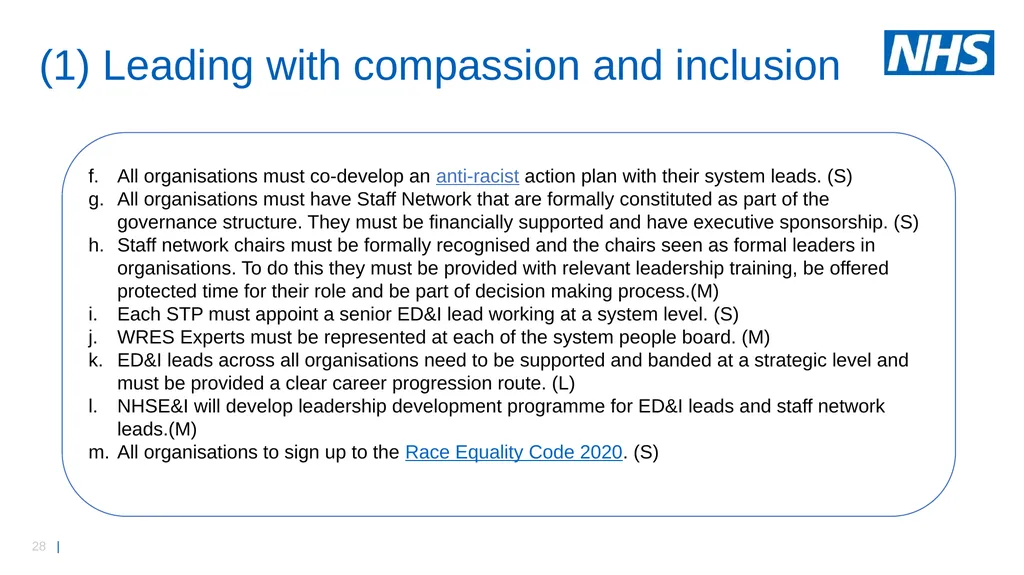
slide28. (1) Leading with compassion and inclusion All organisations must co-develop an anti-racist action plan with their system leads. (S)
All organisations must have Staff Network that are formally constituted as part of the governance structure. They must be financially supported and have executive sponsorship. (S)
Staff network chairs must be formally recognised and the chairs seen as formal leaders in organisations. To do this they must be provided with relevant leadership training, be offered protected time for their role and be part of decision making process.(M)
Each STP must appoint a senior ED&I lead working at a system level. (S)
WRES Experts must be represented at each of the system people board. (M)
ED&I leads across all organisations need to be supported and banded at a strategic level and must be provided a clear career progression route. (L)
NHSE&I will develop leadership development programme for ED&I leads and staff network leads.(M)
All organisations to sign up to the Race Equality Code 2020. (S)<br>
slide29. Accessing inclusive and compassionate health and wellbeing support “People don’t care how much you know unless they know how much you care” - Theodore Roosevelt<br>
slide30. We must be able to provide the best support for maintaining optimum health, wellbeing and safety for BME staff. This support must be both accessible and inclusive. It must be delivered in a culturally sensitive way through greater understanding of current barriers of achieving this goal.
The issue is for leaders to understand and respond by providing an environment that protects the health, wellbeing and safety of all staff. The health, wellbeing and safety of our staff is essential if we are to provide the best service to our local communities.
A recent report identified that over 60% of BME people do not believe that their health is as equally protected by the NHS compared to White people. The impact of Covid-19 on BME communities has been disproportionately severe. The health inequalities of our BME communities is obviously reflective of the experience of BME staff.
The proportion of BME NHS staff who have lost their lives as a result of COVID-19 was significantly higher compared to white NHS staff. BME NHS staff still reports concerns about their safety, health and wellbeing in the Midlands. A recent engagement in the Midland reveals that the majority of BME staff (64%) stated that they did not feel safer following a risk assessment carried out by their managers. (2) Access to inclusive and compassionate health and wellbeing support<br>
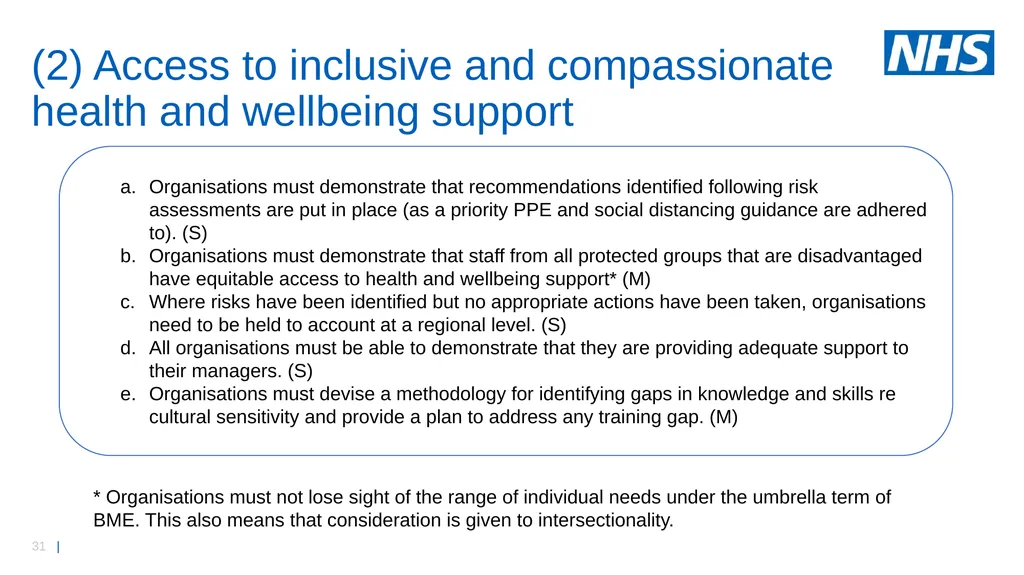
slide31. (2) Access to inclusive and compassionate health and wellbeing support Organisations must demonstrate that recommendations identified following risk assessments are put in place (as a priority PPE and social distancing guidance are adhered to). (S)
Organisations must demonstrate that staff from all protected groups that are disadvantaged have equitable access to health and wellbeing support* (M)
Where risks have been identified but no appropriate actions have been taken, organisations need to be held to account at a regional level. (S)
All organisations must be able to demonstrate that they are providing adequate support to their managers. (S)
Organisations must devise a methodology for identifying gaps in knowledge and skills re cultural sensitivity and provide a plan to address any training gap. (M) * Organisations must not lose sight of the range of individual needs under the umbrella term of BME. This also means that consideration is given to intersectionality.<br>
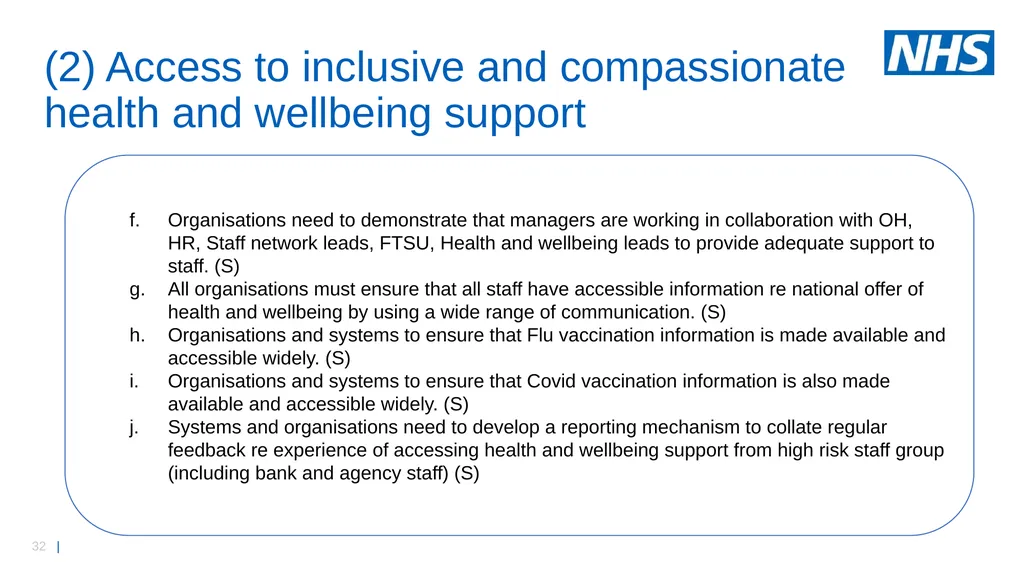
slide32. (2) Access to inclusive and compassionate health and wellbeing support Organisations need to demonstrate that managers are working in collaboration with OH, HR, Staff network leads, FTSU, Health and wellbeing leads to provide adequate support to staff. (S)
All organisations must ensure that all staff have accessible information re national offer of health and wellbeing by using a wide range of communication. (S)
Organisations and systems to ensure that Flu vaccination information is made available and accessible widely. (S)
Organisations and systems to ensure that Covid vaccination information is also made available and accessible widely. (S)
Systems and organisations need to develop a reporting mechanism to collate regular feedback re experience of accessing health and wellbeing support from high risk staff group (including bank and agency staff) (S)<br>
slide33. (2) Access to inclusive and compassionate health and wellbeing support 33 Where staff decline a Covid risk assessment , Team managers need to ask why staff are declining, record the reasons and ensure this is followed up if appropriate to do so. (S)
Managers to ensure that the process used in carrying out assessment is transparent, open and supportive. (S)
Managers to record concerns raised by staff and when those are not addressed, rationale needs to be recorded and communicated. (S)
Managers to identify any personal lack of skills, knowledge or support to carry out effective Covid risk assessment . (S)
Where risks are identified and recommendations are not actioned, the reasons need to be recorded and communicated to staff by all managers. (S)<br>
slide34. (3) Removing barriers to help staff speak up Engagement across the country revealed that there may be issues among BME staff to use the existing system such as Freedom to speak up guardian service. This has also been highlighted in the People Plan that BME staff must have confidence in the system for this to be effective.
The Francis report indicates that this is not new to the NHS and that this is an institutional problem which affects every member of staff. The inquiry also highlighted the additional barriers for vulnerable groups including BME staff when raising issues such as bullying, harassment or discrimination. The reality is that the NHS actively discourages people to speak up and tries to ignore those that do. In the worst cases this has led to job losses, mental health problems or suicide. Ironically, the perpetrators have often been protected or even promoted. There has been a lack of awareness by an organisation’s leadership of the existence or scale of problems known to the frontline.
It was also clear from the evidence that there are some groups who, for different reasons, are particularly vulnerable including locums and agency staff, students and trainees, BME groups and staff working in primary care.
These issues have a significant impact on patients care and outcomes as evidenced in the report.
According to the People Plan, NHS England and NHS Improvement will launch a joint training programme for Freedom to Speak Up Guardians and WRES Experts. NHSE&I are planning to recruit BME staff to Freedom to Speak Up Guardian roles, in line with the composition of our workforce. But unless the lack of confidence of staff (including BME) in the current system are explored this will have limited impact.<br>
slide35. (3)Removing barriers to help staff speak up All organisations need to assess the current level of trust that staff have in speaking up. This needs to include the level of confidence that any concerns raised are addressed appropriately.(M)
Organisations need to ensure those dealing with concerns raised have adequate training to response sensitively to those that speak out. (M)
Each STP/ICS need to explore options that will allow staff to report concerns anonymously when they feel this is not addressed in their respective organisations. (M)
An example that system could explore is the establishment of an independent external freedom to speak up guardian. (M)
All organisations need to ensure that ‘Freedom To Speak Up guardians’ (FTSU) report directly to the Board (to maintain independence) and the CEO must be accountable for any action/inaction in response. (S)
All FTSU need to work closely with ED&I Leads and staff network leads (whilst maintaining confidentiality) to identify patterns of bullying, harassment and discrimination in relation to specific protected characteristics. (S)<br>
slide36. (3)Removing barriers to help staff speak up g. Each STP/ICS needs to find ways to identify where there are patterns of bullying and harassment, discrimination and or exclusion in organisations these will be pro-actively investigated. (S)
h. Organisations to demonstrate high level of transparency in dealing with incidents and how they have dealt with perpetrators and held them to account (i.e. how many people have been trained, re-educated, disciplined, promoted) (M)
i. Organisations need to take into consideration historical evidence of bullying, harassment and discrimination when a person is applying for any senior post including director level in an NHS organisation. (S)
j. Employers need to demonstrate that staff have open access to senior leaders to discuss concerns when they feel this has not been dealt with appropriately. (S)<br>
slide37. (4) Tackling racism and other types of discrimination Despite years of trying to address issues of racism in the NHS there has only been a limited amount of success. Part of the reasons are that we have seen many short lived race equality initiatives, all designed to improve the experiences of BME staff, but unfortunately with no long lasting or significant effect. Also part of the reasons is that strategy is often defeated by deep rooted cultural norms. It has been stated clearly that there is no substantial evidence that any singular intervention will make a significant difference. For instance reverse mentoring on its own will not address racial inequalities unless seen as part of a wider set of initiatives.
We understand that the reasons for this lack of progress are complex and that this is an uncomfortable issue. To address the structural racism we must all:
Acknowledge the problem and take this seriously through demonstrable action
Improve our understanding of the depth and complexity of the issue
Ensure our commitment is followed by positive targeted action
Be prepared to be held accountable and hold others to account
Be prepared to face the consequence if our behaviour is unacceptable and causing harm to others
Create equality of opportunity for under-represented group if in position of power and privilege
Centuries of racial discrimination have hard wired inequality into our institutions and people’s ways of thinking. These inequalities have ensured that White people get better chances in life. These issues are complex and there must be a sustainable strategy built on educating, supporting and challenging.<br>
slide38. (4) Tackling racism and other types of discrimination There has always been a fundamental need to change these realities, but this extraordinary year has seen a shift in rhetoric and understanding around race disparity in England and worldwide. The disproportionate impact of Covid-19 on BME people in the UK and elsewhere, combined with the increased awareness of the Black Lives Matter movement, have shone a spotlight on structural inequalities and institutional racism in British society that have been tolerated for too long.
In the UK and in the NHS today, there is a structural, historical bias that favours certain individuals. This does not just stand in the way of ethnic minorities, but women, those with disabilities and others. But unless we are focused and determined to make significant progress in addressing racial injustice, the other aspect of inequalities will continue to be a significant problem. If all of us put our effort, commitment and action in addressing racism we are more likely to make a bigger impact on other areas.
There are competing demands between protected groups for a focus to be placed on specific inequality issues. NHSE&I recognise the importance of getting this right for all groups. However, our current priority is on racism because we also know that if our staff are from a BME background they are likely to experience the double or triple penalty of discrimination if they are for instance gay and disabled.
If we truly want to be inclusive, we expect everyone regardless of their protected characteristics to stand up together to fight against racism. This is not to say that we should ignore or neglect other areas of inequalities.
The NHS, although a treasured institution, is not immune from these forces, and the WRES continues to show disparities. This is critical, because a diverse workforce has a positive impact upon staff experience, patient outcomes and on organisational efficiency.<br>
slide39. (4) Tackling racism and other type of discrimination Organisations must demonstrate that they are providing opportunities for all staff (White and BME) to have the difficult conversations about racism without fear or repercussions. (S)
All Organisations need to report progress on WRES and WDES metrics at a system level. (S)
All organisations to implement a White ally programme- the principles of the allyship programme to be rolled out to other protected groups. This needs to be part of the anti-racist action plan. (M)
Cultural safeguards need to be in place to ensure that White Allies are acting responsibly, building trust, working co-productively and led by expertise and lived experience whilst progressing on their journey towards becoming an anti-racist leader. (S)
WRES Experts should be given agreed protected time to act as change agent within each of the 11 STP/ICS. (S)
The national team will establish a ‘code of civility that everyone can understand and sign up to. (M)
Organisations must ensure all staff have the skills, knowledge and a clear expectation of acceptable behaviour to create an inclusive environment that is anti-racist. (M)
All staff Personal Development Review (PDR) must include a personal objective in addressing race inequalities. (S)
All organisations must develop a method of reporting to system leads on the number of cases (formal and informal) with regards to all forms of incivility including racism, bullying, harassment and discrimination. (M)
ICS/STPs and organisations need to capture the lived experience of staff on a regular basis by protected characteristics. The data capture needs to include issues such as: (M)
Do staff feel a sense of belonging where they work? If not why not?
Would staff recommend friends and family to their place of work?
If staff have reported bullying, harassment and discrimination, have this been dealt with appropriately?<br>
slide40. (5) Eliminating racism/bias in recruitment and progression The health care sector must have a workforce that reflects the diversity of their communities. The workforce is not representative at some levels (in particular noticeable at more senior level) across the NHS. For instance, BME staff makes up 23% (as at July 2020) of our workforce in the Midlands and yet only 9.5% are working at Board level.
This lack of representation is also evidenced in both non-clinical and clinical roles (including nurses and midwives, medical and allied health professionals).
There needs to be a radical shift for the NHS to ensure that both its approach to recruitment and progression is fair and inclusive. As a region, we are calling for organisations to commit to overhauling and actively de-biasing recruitment and selection processes. This will be in line with the national priorities outlined in the People Plan.
It is necessary for us to go beyond the minimum standard of anonymised applications and unconscious bias training for recruiting managers. This is clearly has not made the shift we want to see.
We strongly recommend the focus on recruitment is shifted to take much more radical positive actions. This means fully utilising positive action provisions within the Equality Act 2010. This would determine that recruiting managers will look for staff that add to the inclusive culture rather than those that fit with the current culture.<br>
slide41. (5) Eliminating racism/bias in recruitment and progression By June 2021, all organisations will provide an action about how they intend to overhaul recruitment and promotion practices to make sure that their staffing reflects the diversity of their community? (S)
Every NHS trust, foundation trust and CCG must publish progress against the Model Employer goals to ensure that at every level, the workforce is representative of the overall BAME workforce. (S)
System leads need to explore how the WRES and the NHS model employer aspirations are applied across social care and primary care sectors. (M)
All organisations to meet the minimum national target of 19% of BME staff at all level (or more where BME staff % are higher in organisations) by 2025. (L)
Health and social care organisations must identify which staff groups are underrepresented in terms of BME staff. (M)
Organisations must work with their WRES Experts, ED&I and BME leads to research and/or develop innovative methods of recruitment (taking positive action with the reference within the provision of Equality Act 2010) (M)
All Executive’s and senior management’s job descriptions must include an essential criteria of knowledge and skills in addressing ED&I issues – with a specific focus on race. This needs to be assessed under Kark recommendations. (S)
Organisations must use Value based recruitment with specific questions related to race, equality and inclusion. (S)
Organisations within ICS/STP need to identify BME staff who have necessary skills, knowledge and competence to take on senior positions at Band 8a (or similar) and above. These staff need to be offered sponsorship to take on senior roles. (M)<br>
slide42. (6)Eliminating racism and bias in disciplinaries Despite some improvements in recent years, there is still lots of work to be done. Every survey over the last decade and every workforce race equality standard (WRES) report has shown that in shortlisting, appointment, promotion, and disciplinary processes, institutional racism is at play. According to the 2019 WRES data, Midlands and the East of the England were two regions showing an increased in formal disciplinaries for BME staff.
Since the inception of the WRES, it has been clear that existing capability, disciplinary and sickness procedures adversely impact our colleagues from BME backgrounds.
The 2019 General Medical Council (GMC) Fair to Refer report by Dr Doyin Atewologun and Roger Kline found that BME doctors were twice as likely as their white counterparts to be referred to the GMC.
Qualitative feedback (London Race Equality Strategy 2020) also illustrates the negative impact that adherence to these processes has on BME staff engagement, trust and productivity. Work has been ongoing to close this gap, particularly centred on formal disciplinary processes.
Targets have been set at a national level in the People Plan with the expectation that 51% of organisations will have eliminated the gap in relative likelihood of entry into the disciplinary processes by the end of 2020<br>
slide43. (6)Eliminating racism and bias in disciplinaries All managers and HR personnel involved in a potential disciplinary procedures of a BME staff, need to consider the involvement of an independent person (i.e. cultural ambassador) prior to a formal investigation to help eliminate any potential bias. (S)
All organisations to use the National Patient Safety Just Culture guidance as a framework for improvement. (S)
All organisations within the Midlands will have closed the ethnicity gap in disciplinary process by the end 2021. (M)
Anyone dealing with either formal or informal disciplinary must be able to demonstrate the necessary knowledge, skills and cultural sensitivity to understand the effects of conscious and unconscious bias in decision making. (S)
Organisations must demonstrate that they are taking effective actions against those who are making decisions that have subsequently deemed to be biased or discriminatory. (S)<br>
slide44. (7) A collaborative approach across Systems NHS organisations have mainly placed their focus on the annual WRES data collection to measure progress re workforce race equality. Whilst the collection of data will remain important, it is ignoring the lived experience of staff. We have developed this strategy to include staff voice in measuring progress as well as influencing decision.
The recent development of STPs and ICSs brings both new challenges and opportunities to ensure equality, diversity and inclusion issues are at the forefront of designing new services.
It will be both challenging and exciting to work across sectors to co-design and co-deliver joined up health and social care services. But these changes will be essential to the delivery of a high quality, effective, and inclusive service to our local communities. A system approach will require organisations to work together to understand the racial inequalities (as well as other wider equality issues) experienced by the workforce and the community that it serves. Whatever action is undertaken to improve racial equality must be driven by a system approach.
With greater focus on ICSs/STPs, ultimately systems need to be accountable for the progress of race equality and inclusion. Systems will need to oversee any equality initiatives and ensure they are properly implemented in their constituent organisations. They will also play a key role in holding organisations to account in making agreed measurable progress.
Systems will have an opportunity to develop the right structure, the right governance arrangements, the right measures (building on the WRES and the WDES) supported by leaders that are competent in addressing issues of inclusion. There will also be opportunities for Trusts and other organisations to consider recruitment, retention and talent development across different sectors. All these changes will give us an unprecedented opportunity to address race inequality at a system level.<br>
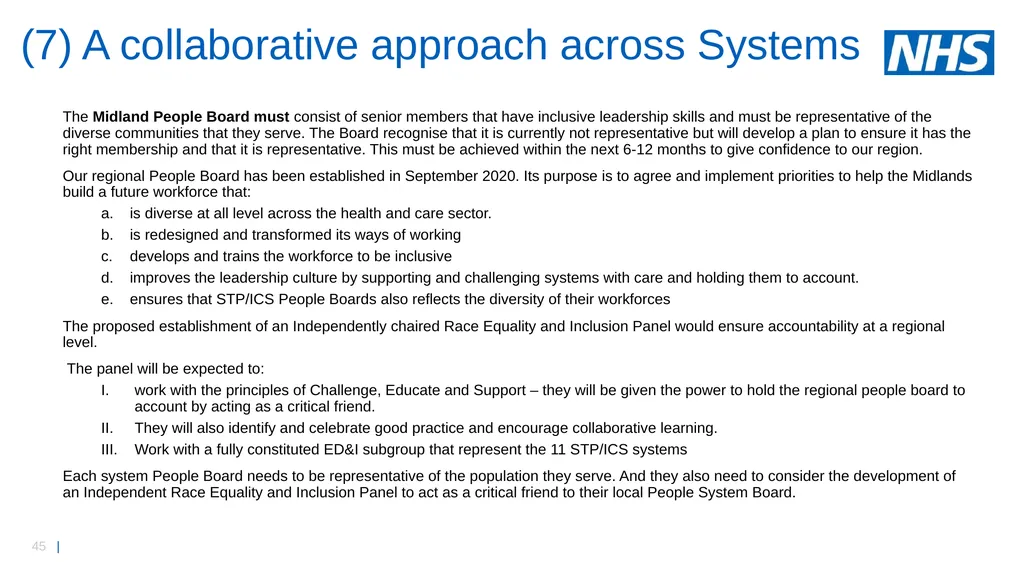
slide45. The Midland People Board must consist of senior members that have inclusive leadership skills and must be representative of the diverse communities that they serve. The Board recognise that it is currently not representative but will develop a plan to ensure it has the right membership and that it is representative. This must be achieved within the next 6-12 months to give confidence to our region.
Our regional People Board has been established in September 2020. Its purpose is to agree and implement priorities to help the Midlands build a future workforce that:
is diverse at all level across the health and care sector.
is redesigned and transformed its ways of working
develops and trains the workforce to be inclusive
improves the leadership culture by supporting and challenging systems with care and holding them to account.
ensures that STP/ICS People Boards also reflects the diversity of their workforces
The proposed establishment of an Independently chaired Race Equality and Inclusion Panel would ensure accountability at a regional level.
The panel will be expected to:
work with the principles of Challenge, Educate and Support – they will be given the power to hold the regional people board to account by acting as a critical friend.
They will also identify and celebrate good practice and encourage collaborative learning.
Work with a fully constituted ED&I subgroup that represent the 11 STP/ICS systems
Each system People Board needs to be representative of the population they serve. And they also need to consider the development of an Independent Race Equality and Inclusion Panel to act as a critical friend to their local People System Board. (7) A collaborative approach across Systems<br>
slide46. STP/ICS’s equality and inclusion approach:
Each STP/ICS will appoint a Director of ED&I to provide support and leadership for all equality matters. (M/L)
Each STP/ICS will develop a system wide staff network starting with BME. This is to ensure a cross system engagement and that staff networks are involved in decision making process in each system and act as critical friend to the people board . (S)
To build a collaborative approach within each STP/ICS, it is proposed that an ED&I sub committee is established at a system level. The aim of the ED&I sub committee will be
To will provide oversight and progress against the regional and national ED&I activities.
To identify and celebrate good practice and encourage collaborative learning. (7) A collaborative approach across Systems<br>
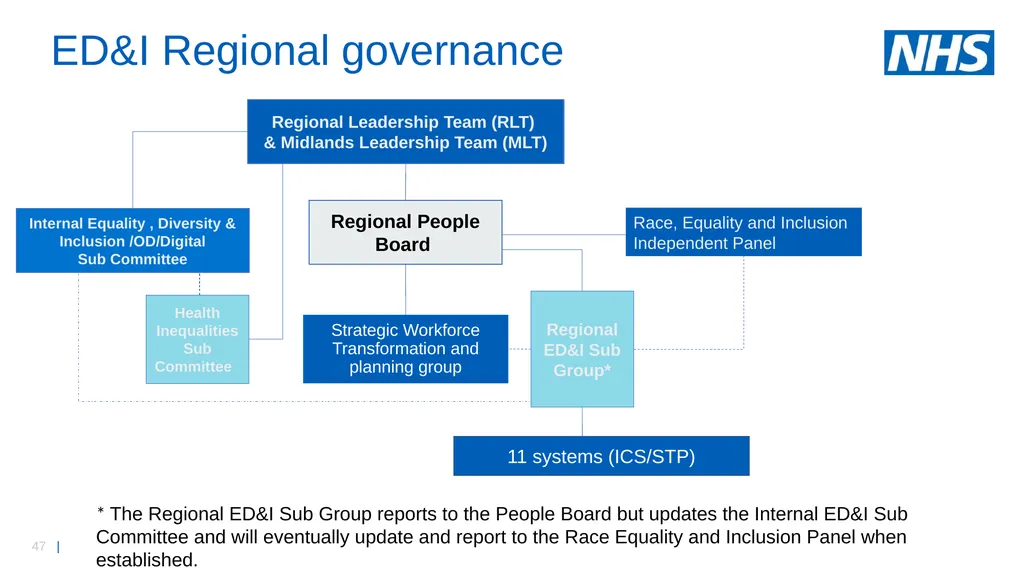
slide47. Race, Equality and Inclusion Independent Panel 11 systems (ICS/STP) ED&I Regional governance Regional Leadership Team (RLT)
& Midlands Leadership Team (MLT) Regional People Board Regional ED&I Sub Group* Internal Equality , Diversity & Inclusion /OD/Digital
Sub Committee Health Inequalities Sub Committee * The Regional ED&I Sub Group reports to the People Board but updates the Internal ED&I Sub Committee and will eventually update and report to the Race Equality and Inclusion Panel when established.<br>
slide48. (8) Building accountability Within the NHS, there appears to be a lack of accountability. Feedback from staff within the Midlands reflect some of the findings of the Francis report to that effect. Comments made by staff stated that progress has been too slow and, in some areas, we are observing no change in eliminating discrimination due to a perceive lack of accountability.
Where people highlight issues, they must be given the confidence that they will be listened to, issues will be investigated and individuals will be held accountable and action will be taken.
We also need to ensure that issues of equality are central the CQC inspection measure. Trust have been rated as outstanding/good despite demonstrating a lack of progress in addressing equality issues. This needs to be challenged so that CQC holds organisations to account appropriately.
Whilst the People Plan makes reference to the need for accountability, it does not dictate what the sanctions need to be for the lack of progress. This issue needs to be addressed by the national NHSE&I team.
The CEO is ultimately the most senior person who is responsible and accountable in regards to ED&I within any organisation. As STP/ICS develop we need to be clear what level of accountability System leads have for dealing with organisations are failing to progress on E,D&I issues.
A study carried out by UCU revealed that sanctions were seen to be the most effective method in tackling racism.<br>
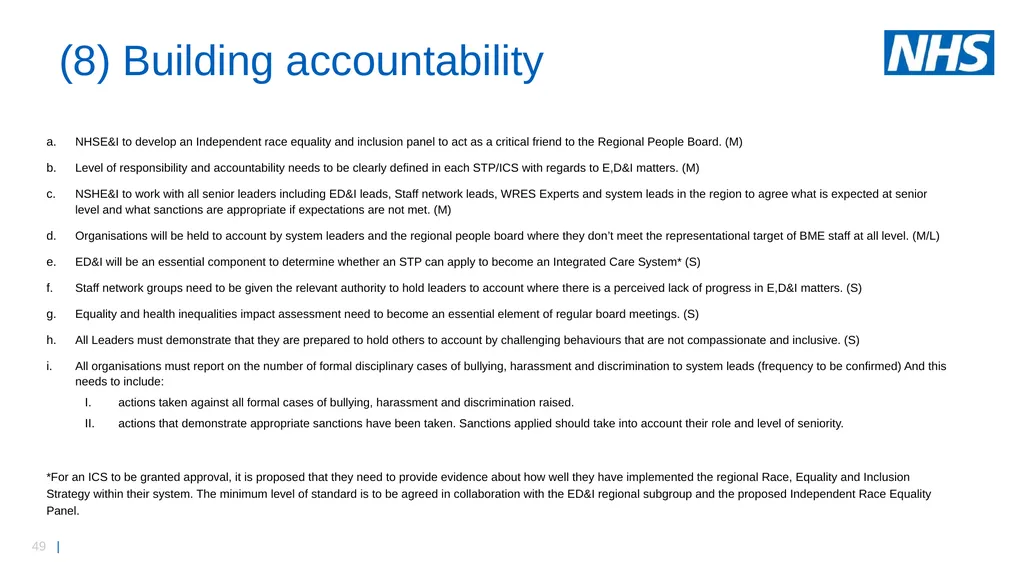
slide49. (8) Building accountability NHSE&I to develop an Independent race equality and inclusion panel to act as a critical friend to the Regional People Board. (M)
Level of responsibility and accountability needs to be clearly defined in each STP/ICS with regards to E,D&I matters. (M)
NSHE&I to work with all senior leaders including ED&I leads, Staff network leads, WRES Experts and system leads in the region to agree what is expected at senior level and what sanctions are appropriate if expectations are not met. (M)
Organisations will be held to account by system leaders and the regional people board where they don’t meet the representational target of BME staff at all level. (M/L)
ED&I will be an essential component to determine whether an STP can apply to become an Integrated Care System* (S)
Staff network groups need to be given the relevant authority to hold leaders to account where there is a perceived lack of progress in E,D&I matters. (S)
Equality and health inequalities impact assessment need to become an essential element of regular board meetings. (S)
All Leaders must demonstrate that they are prepared to hold others to account by challenging behaviours that are not compassionate and inclusive. (S)
All organisations must report on the number of formal disciplinary cases of bullying, harassment and discrimination to system leads (frequency to be confirmed) And this needs to include:
actions taken against all formal cases of bullying, harassment and discrimination raised.
actions that demonstrate appropriate sanctions have been taken. Sanctions applied should take into account their role and level of seniority.
*For an ICS to be granted approval, it is proposed that they need to provide evidence about how well they have implemented the regional Race, Equality and Inclusion Strategy within their system. The minimum level of standard is to be agreed in collaboration with the ED&I regional subgroup and the proposed Independent Race Equality Panel.<br>
slide50. (9) Reward and celebration First of all we have to acknowledge the good work that many staff, managers and leaders are currently doing. We have to be aware that negative bias might make us dwell on things that we haven’t achieved.
Progress on the race equality agenda has been slow and there is a danger that our colleagues and communities may have lost confidence that significant change can occur. Morale of staff from senior management to front line staff have been affected during this pandemic crisis
Despite the lack of progress, we have to be optimistic, confident and positive that we can make the necessary changes.
However, even in normal circumstances NHS staff have often been expected to work beyond their normal capacity. Therefore it is absolutely crucial for us to recognise, encourage and reward those that are doing a good work.<br>
slide51. (9) Reward and celebration Develop a regional hub for accessing and sharing positive actions and progress including research/evaluation. (S)
Develop incentives for Organisations/Systems that move the Equality and Inclusion agenda forward. (M)
Award for those that have lead with compassion and inclusion on the race and other equalities agenda(assessed by their own staff groups) (M)
Celebrate organisations* who have signed up to the Race Equality Code 2020.
NHSE&I to work with the region and Heath Service Journal (HSJ) to develop an appropriate annual celebration of positive action (MIDAS – Midlands Inclusion & Diversity Awards Scheme). (M)
* Birmingham City Council and Birmingham Solihull women’s aid are the two early adopters in the Midlands.<br>
slide52. Measuring progress The qualitative measures that we think are necessary are:
Developing real time survey
Providing opportunities for staff to talk about concerns confidentially
BME STAFF NETWORK (to be constituted and supported to be part of decision making process)
Training and support to help staff to use their voice
Potential access to and feedback from external ‘Freedom to speak up’ guardian
All Staff network (should be affiliated to the regional race equality and inclusion good practice hub) Organisations will measure staff progress in two ways. The main quantitative measures that are currently used are the:
Workforce Race Equality Standard (WRES)
Workforce Disability Equality Standard (WDES)
NHS staff surveys
Equality and diversity workforce dashboard
Equality Delivery system
Gender pay gap reporting<br>
slide53. Research and evaluation There have been many worthy initiatives regarding the general reduction of racism or development programmes devised to support BME people to gain equality with regards to promotion and career progression.
However, their does not appear to be sufficient evidence base to support the effectiveness of any one specific strategy or intervention.
Much more research is necessary. That is why it would be useful for organisations in the Midlands to think about, devising and implementing innovative interventions.
The Midlands Inclusion and Diversity Awards Scheme (MIDAS) welcomes new ideas from any staff across all sectors of our workforce. The proposed annual MIDAS awards will celebrate those ideas. Even where those ideas have been heroic failures’. The people that have recently developed our vaccines for Covid-19 have had multiple failures over the year before finally getting it right. That’s, because finding out ‘what works’ and what doesn’t often involves many failure’s on the way.
We know form the WRES and other metrics that there has been slow progress up till now in achieving the results we want to see. However People Plan is demanding that we all see the issue of racism as an issue that needs urgently addressing.
Good research initiatives don’t necessarily have to be complex, time consuming or costly. Often, the simple ideas are game changers.
However, research does demand that before embarking on any new intervention it is essential to gather ‘baseline’ information and structure the initiative in a way that we can then accurately measure the results. Individuals or teams within organisations need to seek out those that can help develop research so that the results can be tested and validated. Where initiatives do work within a team or at an organisational level, we can share the results and promote it’s effectiveness.<br>
slide54. Resource and funding for STP/ICS It is proposed that organisations within each STP/ICS should consider how they contribute to a system pot of funding. This needs to be discussed and agreed by each ICS/STP and to decide how much each organisation will contribute.
As an example London have agreed the following:
Every Trust in London has agreed to commit £10,000 per year for 3 years (end 2022), which is then match funded from NHS E/I London budget to a total of £750k per year.
In light of the commitment to bold action, cultural transformation and to deliver their London Race Equality Strategy they have now agreed to amend the funding model to the following:
10 year funding commitment –2021/22 to 2031/32
Increased Trust contribution to £20k per annum to be reviewed at years 3 and 7
Continued match funding at a regional level
This have now increased the available budget to £1.5million per year.<br>
slide55. Next step Covid crisis in 2020 has meant that many of us working in the NHS have had to re-prioritise our workloads. In ‘normal’ circumstances a strategy document would have been put out for much wider consultation for a longer period of time for feedback. Then the document would be amended (where necessary) in the light of any of that feedback received. However, we did consult prior to the document being initially approved on 23rd November and we have sought further input from systems.
This strategy has been put together to address the urgent as well as longer term Race Equality and Inclusion priorities. To ensure that this strategy is collaboratively owned by the region, we have engaged with all the 11 STPs/ICSs to seek their input. We have received valuable and comprehensive feedback which has been extremely useful and we are grateful for all input received despite current Covid-19 crisis. However, there has been some criticism that wider consultation is required which is a valid one.
Covid-19 has unfortunately impacted on the consultation process. At the same time we are all aware that the longstanding issues related to Race and Inclusion have now been prioritised in the People Plan. The Covid-19 crisis has been devastating, and has placed a spotlight on health inequalities and wider issues of discrimination facing BME staff specifically.
So, it was felt that a Strategy document was needed to be developed and put into action as soon as possible. To address the issues in regards to consultation and give justice to the feedback received we will consider a review of the strategy in 12 months time.
Next steps
March 15 2021- Regional Leadership Team approval
March 23 2021- Regional People Board sign off
April 2021- Development of a website/interactive tool to promote the strategy
May 2021- Launch of the interactive Race Equality and Inclusion Strategy
Consider ongoing capture of feedback during the next 12 months re: improvement of the initial strategy to be reviewed in 12 months post launch.<br>
slide56. Terminology and key concepts BME- Black and Minority Ethnic*: Several terms are used in public policy, and in wider society, to refer to collective ethnic minority populations. These include black, Asian and minority ethnic (BAME), black and minority ethnic (BME), people of colour, and racialised minorities. For the purpose of this strategy we have used the term BME to describe groups of people whose ethnicity or racial background is a key factor in their experience or risk of racial discrimination at work in the NHS. This is not an endorsement of this term into the future, but an effort to ensure consistency with other NHS workforce race equality publications
Racism: Racism is often misunderstood as just treating someone unfairly or holding prejudiced views. Prejudice views and unfair treatment can occur between any racial groups. However, there is a much more fundamental issue. Systemic racism is power and privilege that can offer intrinsic advantages to White people over people from a BAME background.
Institutional Racism: The Macpherson report’s definition of institutional racism is “the collective failure of an organisation to provide an appropriate and professional service to people because of their colour, culture, or ethnic origin. It can be seen or detected in processes, attitudes and behaviour which amount to discrimination through unwitting prejudice, ignorance, thoughtlessness and racist stereotyping which disadvantage minority ethnic people”
Structural Racism: inequality rooted across the operation of a system or society that excludes and/or has a significant negative impact on large numbers of a particular racial group and their ability to participate. * Following a recent government guidance, it is proposed that organisations should consider replacing BME or BAME to ethnic minority. This is currently being debated in NHSE&I central team.<br>
slide57. Terminology and key concepts Discrimination: Discrimination happens when someone is treated unfairly or less favourably due to an actual or perceived protected characteristic and is unlawful under the Equality Act 2010.
There are four types of discrimination. Examples given are in the race context:
Direct discrimination – Treating someone worse than someone else, for example not inviting someone for an interview because you believe them to be from a particular racial background
Indirect discrimination – Rules, policies, or ways of doing things which have a worse impact on someone with a particular characteristic than someone from another group, for example Friday team meetings taking place in a pub.
Harassment – violating someone’s dignity; creating a hostile, humiliating, degrading or offensive environment. For example, making fun of someone’s name or how it is pronounced.
Victimisation – This is treating someone unfairly if they are taking action under the Equality Act or supporting someone else who is doing so. For example, a white ally can be victimised if they are supporting a BME colleague with a harassment claim.<br>
slide58. Terminology and key concepts White Privilege: Coined by the black civil rights activist William Du Bois in the 1930s and later coming to further prominence in Peggy McIntosh’s 1988 ground breaking paper White Privilege: Unpacking the invisible knapsack, the term white privilege is used to describe how having white skin gives an individual an advantage in life. White privilege does not mean that white people have never struggled, but in Britain they do not experience racial discrimination on an institutional or societal basis.
Having white privilege and recognising it is not racist. But white privilege exists because of historic, enduring racism and biases and is the “power of accumulated power” The list of terminology and key concepts in here have been drawn from the London Race Equality Strategy. We intend to build on this further.<br>
Head of Equality and Inclusion - NHSE&I Midlands<br>
slide2. Time for action “Action – It’s time to act. Lasting and meaningful change will only happen if we agree measurable actions and outcomes and detailed plans of how we achieve them. It would be wrong to think that focusing on race equality would be detrimental to other protected characteristics, such as gender. Action on one area results in a ‘targeted universalism’ that benefits all groups”.
- Karl George<br>
slide3. Introduction The People Plan- action for all of us and the phase 3 letter from the CEO of NHS England & NHS Improvement Simon Stevens in July 2020, emphasis that racism is a problem that needs to be addressed urgently. However, that in no way diminishes the need to address the equality and inclusion needs of people with other protected characteristics.
The reality is that in addressing race inequalities, research* has shown that this does have a positive impact not only on other staff groups but also on patients’ outcome. This strategy document focuses on improving the experience and opportunities for the BAME workforce.
However, the evidence demonstrates the link between improvements in workforce experience and better health outcomes for patients.
Given the complexity of addressing race inequality, the focus in the strategy is solely on improving the workforce experience. It’s important to draw attention to this link as health inequalities themselves fall outside of the remit of this strategy.<br>
slide4. Introduction This is a strategic document which sets out what need to be achieved, the timeframe to reach these goals, and who will be responsible. However, it is not in itself a strategic plan. The responsibility to develop those plans rest with individual Sustainability Transformational Partnerships (STP)/ Integrated Care Systems (ICS) and Organisations.
It is also acknowledged that this strategy is heavily focused on secondary NHS organisations. This emphasis has been in part influenced by the People Plan, and because systems are yet to be fully established. For that reason, please note that this document will need to remain live and be adapted as we evolve to work at a more integrated system level.
Race, equality and inclusion is everyone’s business, and the responsibility to turn this strategy into reality rests with each person in the Midland workforce. Once this strategy approved, it will be available in an easy-to-read format that will be interactive and accessible online.
*Research on NHS staff and patient surveys in 2012 by Michael West found:
The experience of black and minority ethnic NHS staff is a good barometer of the climate of respect and care for all within the NHS. Put simply, if BME staff feel engaged, motivated, valued and part of a team with a sense of belonging, patients were more likely to be satisfied with the service they received.
Source: NHS Staff Survey and Related Data West, M et al 2012<br>
slide5. The aim of the strategy is to create an anti-racist, compassionate and inclusive working culture. BAME staff are negatively affected by structural racism. Many also suffer from day to day racism. The strategy is designed to tackle both of these problems. To improve the quality of work life and also remove barriers to professional development for all BAME Staff. By improving the experience of BAME staff, it will have a positive impact on all our workforce in regards to how we tackle discrimination.<br>
slide6. Difference between anti-racist and non-racist Anti-racist are people that are proactive in tackling all forms of racism. Some examples include:
Take active actions to tackle racism
Challenging colleagues that don’t act
Confront those that act inappropriately
Exposing your own vulnerability
Take responsibility and accountability
Face some uncomfortable feelings
Proactively challenge structural and institutional racism
Start the difficult dialogue about racism
Educate yourself about the history of racism
Standing up as an ally
Making your values known
Influence others by being a role model
Becoming a leader Non racists are perceived as not actively involved in tackling racism. There are many reasons to why people behave in a non-racist manner. Some examples include:
Lack of education about racism
Does not recognise forms of racism
Scared of confrontation
Anxious about standing out
Embarrassment
Guilt
Does not care enough
Not aware of their own privilege
Aware of own privilege and seek to protect it
Acknowledging that there is a problem but wont take active steps
Believing that they the good people
Lack of confidence and support What does an anti-racist means? What does non-racist means?<br>
slide7. Our approach to this strategy is built on recognising and growing inclusive leadership and talent. This strategy has been devised in response to the People Plan and influenced by wider engagement across the 11 STPSs/ICS in the Midlands. Where possible we have used the feedback to influence the current document. In order to establish this strategy as soon as possible, the following plan has been agreed:
Highlight the priorities for the next 3 - 12 months.
Take time to further scrutinise the feedback from the consultations and then integrate changes to modify the strategy in 12 months time when it is planned to be reviewed.
Provide further opportunity for feedback and consultation during the next 12 months.
Adapt the strategy in light of further progress to be made with regards to the development of Integrated care systems.
For any strategy to be successful, it must be owned by everyone. Each and everyone of us needs to be accountable for our action or failure to act.
This strategy is designed to inform progress towards an inclusive health and social care system. We are focusing our attention on the race agenda but there are principles embedded in this strategy that will apply to all the other protected characteristics as set out in the Equality Act 2010.<br>
slide8. Underpinning principles The proposed recommendations in this strategy are based on the three principles of challenge, educate and support. These principles are embedded in all our actions. We believe that if these principles underpin the actions we take, they will make a significant shift in progressing equality and inclusion across all protected characteristics in the Midlands in the next 12 months to 5 years.
The two most important drivers that will help us to embed those three principles across all our actions is leadership and accountability:
We need to have the right and diverse leadership at all levels within our health care system. Senior managers need to lead by example.
Ensuring that we have accountability at all levels is key to the success of this strategy. Those that are not prepared to be accountable for progress or demonstrate a lack of progress are simply not leaders and therefore cannot be expected to lead.
One of the ways for us to know that this strategy is successful is when staff tell us we have achieved our goal.<br>
slide9. Path to Inclusion and compassion “Challenge with care and compassion- carefrontration.” We all need to challenge ourselves first before we challenge others. ACTION Educate self and others – you don’t know what you don’t know. Support each other by being honest, open, inclusive and transparent. Its not good enough to be non-racist, everyone of us must take action to become an anti-racist.<br>
slide10. Midlands AFC Band Breakdown by Ethnicity Overall Workforce – WRES 2020 Average % BME staff in the Midlands = 20.4%<br>
slide11. Midlands WRES 2020 data Headlines 7 out of 41 Trusts have no BME representation at Board level
There are 45 BME non-executive board members and 25 BME Executive board members in the Midlands
Overall BME makeup of Midlands Boards 11.2% – second highest region after London
Second highest region after the North-East for BME staff experiencing harassment and bullying from colleagues/staff.<br>
slide12. Workforce Disability Equality Standard 2019 data Percentage of Disabled non-clinical staff by pay band clusters and region NHS WDES Annual Report 2019<br>
slide13. Feedback from listening events in the Midlands The following were the themes that were highlighted from the regional Midland listening Covid-19 events:
Health and wellbeing
BME staff network: support, engagement, decision making
Diversity and representation at senior level
Structural and everyday racism and bias
Leadership, culture and accountability
Speaking up
Communication
The above themes were consistent and reflected the experience of BME staff across England.<br>
slide14. Presentation title Challenges in the Midlands<br>
slide15. Importance of Leadership Leadership and management are two different things. Managers need to be able to plan, measure, monitor, coordinate, solve, hire, fire, and so many other things. Typically, managers manage things. According to Kevin Kruse, “leadership is a process of social influence, which maximizes the efforts of others, towards the achievement of a goal.” (Kruse, What is Leadership, 2013)
Our ultimate goal here is for our health and social care system to become fully inclusive. So, we need all managers in the NHS to also be leaders and influence others to help us achieve that goal.
Being a manager does not automatically mean you are a leader and-not having a managerial status does not exclude you from being a leader.
We are therefore looking for people, regardless of the authority they have to become leaders and influencers. Because social influence in itself is leadership. “Real change only happens when you are able to influence leadership - the board and executive management - and hold organisations to account.” The Race Equality Code 2020<br>
slide16. Expectations and questions for leaders Have you got a plan to help the NHS and social care lead on race equality and inclusion? Have you created an inclusive workforce to improve staff experience and health outcomes? Do you lead by example? Do you hold yourself and others accountable for any lack of progress in addressing racism? Are you helping to create a working culture free from racism? Have you started the conversation about racism? Do you speak up where staff experience bullying and harassment? Have you developed an active anti-racist action plan? Are you creating an environment where staff Health and wellbeing are protected?<br>
slide17. Change = taking radical action “Action speaks louder than words- we don’t want another strategy that looks good on paper but does not effect change. Instead, we want actions that make a difference in improving people’s life.”
Our strategy in the Midlands needs to reflect a radical approach owned from board to ward. By radical we mean:
Being courageous
Taking positive risks
Being prepared to do things that haven’t been done before and measuring their effectiveness
Learn how to modify challenging initiatives if not initially successful
Supporting those that are prepared to challenge the status quo “Culture eats strategy for breakfast” - Peter Drucker<br>
slide18. What must we stop doing? Presentation title Seeing racism as other people’s business
Staying silent when seeing and hearing racist behaviours
Protecting those who are causing harm through incivility
asking Black, Asian and other minority ethnic (BME) people to fix the problem of racism
Waiting for more data as an excuse not to act
Saying that racism has been dealt with
Passing the responsibility to others
Leading if you cannot acknowledge racism is a significant problem
Seeing people who are from a BME background as a homogenous group<br>
slide19. What we must do? Presentation title Notes: This strategy is intended to be a live document to stimulate discussion and generate ideas that will contribute to the ongoing fight against racism and inequalities. We need the active engagement from all staff across all sectors. Everybody can contribute and our actions are not to be seen in isolation. Remove barriers to inclusive and compassionate health and wellbeing support
Lead with compassion and inclusion
Remove barriers to help staff speak up
Tackle racism, bullying, harassment and other types of discrimination
Eliminate racism and bias in disciplinaries
Celebrate and reward success
Develop a collaborative approach across Systems
Build accountability across the region.
Eliminate racism and bias in recruitment and progression<br>
slide20. The People Plan and Regional Strategy Presentation title<br>
slide21. Mission
WHAT IS OUR ROLE AS EMPLOYERS? Vision WHAT DOES OUR CORE PURPOSE NEED TO BE? Strategic outcomes WHAT ARE THE BIGGEST FACTORS THAT WILL HELP ACHIEVE OUR MISSION? Specific outcomes WHAT DO WE NEED TO WORK ON, FOR EACH OF OUR SRATEGIC OUTCOMES, TO ACHIEVE OUR MISSION? To create an anti-racist, compassionate and inclusive working culture By 2021 we will deliver a regional approach to tackling racism in the workplace.
We will do this by working collaboratively with each of the 11 Systems. Reward and celebration when good practice is identified A collaborative approach across systems Building accountability Eliminating racism/ bias in recruitment and progression Setting up a regional ED&I Subgroup to discuss ED&I critical issues with representation from the 11 systems- this is to start from March 2021.
Staff networks need to be fully supported and be formally constituted as part of decision making process within each organisation and at system level.
STP/ICS and organisations to establish talent pipeline diversity by carrying out a mapping exercise identifying BME Talents by working with their staff networks
Staff need to have open access to senior leaders to raise concerns where these are not being addressed.
Organisations and systems(ICS/STP) need to ensure staff health and wellbeing are prioritised and that they are receiving culturally sensitive support. In particular those from BME background as well as all those identified as at risk.
Organisations to report progress against Model Employer. This should include progress against WRES and WDES metrics. Removing barriers to inclusive and compassionate health and wellbeing support Leading with compassion and Inclusion Removing barriers to help staff speak up Tackling racism and other types of discrimination (including bullying and harassment) Eliminating racism and bias in disciplinaries In the next 3- 6 months our top priorities will be focusing on the following actions that would be seen as critical to keep staff safe.<br>
slide22. Employer/system action by end March 21
Ongoing risk assessments
COVID-19 (and flu) vaccination
Access to psychological and physical support
Encourage health and wellbeing conversations Prioritisation of system and employer-led actions and
supporting nationally-led actions for the next 3-6 months Employer/system actions by end March 21
Staff networks prominent in contributing to and informing decision-making processes (e.g., on COVID-19 vaccination and health and wellbeing of staff at greatest risk) Employer/system actions by end Mar 21
Safe deployment and CPD investment to support critical care capability and COVID-19 vaccination programme Employer/system actions by end Mar 21
Develop workforce sharing agreements locally, to enable rapid deployment of our people across localities
Develop system-level models of recruitment and retention Our people are safe, and supported to be physically and mentally healthy and well We are open and inclusive, and staff have a voice Recruiting and retaining our people Making the most of the skills in our teams Employer/system actions by end June 21
Embed health and wellbeing conversations (including training and support to line managers and a means of tracking delivery) Employer/system actions by end June 21
Delivering against Model Employer goals
Eliminating the ethnicity gap in formal disciplinary processes
Overhaul of recruitment practices Employer/system actions by end June 21
Digital and remote working plans including technology enhanced learning Employer/system actions by end June 21
Develop competency-based workforce modelling and planning Supporting national actions
Maintain national HWB offer
Mental health hubs
Enhanced OH&WB offer
Extend support to HWB Guardians and line managers Supporting national actions
“EDI Inside” - resources and support to priority actions
Senior systems leader support offer, and increase in digitally-delivered training Supporting national actions
COVID-19 vaccination programme
National support for safe deployment in critical care (and other settings under pressure) Supporting national actions
Workforce planning
Digital passports
Growing the numbers of clinical support workers
Retention initiatives focused on ‘at risk’ cohorts (e.g., over 50s)<br>
slide23. Actions for closing the gap in recruitment and promotion outcomes – six national actions Ensure Executive Senior Managers own the agenda
Introduce a system of ‘comply or explain’
Organise talent panels
Enhance equality, diversity and inclusion support
Overhaul interview processes
Adopt resources, guides and tools for productive conversations about race<br>
slide24. Leading with compassion and inclusion<br>
slide25. The NHS must have senior managers with the right skills to lead a health care service that is inclusive and compassionate. Good leadership can be found at all levels and in all teams in the NHS. This has been highlighted in response to the COVID-19 pandemic where people in non-formal leadership roles became significant. However, we also know that progress in tackling racism and other inequalities have been in part slow due to lack of leadership in the NHS. We need to recognise the areas of good leadership and celebrate all colleagues that are leading the way in challenging racism and creating a culture of inclusion for all.
Leaders set the tone and play a key role in influencing the culture of an organisation. To embed the core values of compassion and inclusion we need leaders to lead by example across all level of our health care system. To fight systemic racism leaders need to be engaged in a compassionate way with staff affected by such inequalities and injustice.
Leaders must also create inclusive and compassionate organisations that ensures BME staff are free from discrimination. We must continue to engage with staff affected by racism and other type of discriminations. However, leaders should stop expecting BME colleagues and those affected by discriminations to solve the problems of racism. Therefore, one of our priorities is to ensure leaders are supported and equipped to understand better how to use their leadership position and White privilege to tackle racism. “The standard we walk past is the standard we accept” - David Lindsay Morrison Leadership skills<br>
slide26. Acknowledgment and courage from our leaders. It is noteworthy that the Chief Executive of Birmingham and Solihull Mental Health NHS Foundation Trust, Roisin Fallon-Williams, in writing to her staff on 5 June 2020 admitted her honest and courageous stance in this regard.
In her letter she states:
‘I write this to us all from what I now know and understand to be an ignorant and incompetent stance. I believed I was a good person, a compassionate and dedicated nurse and health professional who sought to understand and care for others and in doing so always sought to do the right thing. I interacted and responded to colleagues and service users who were victims of discrimination from a perspective of believing this to be about others’ behaviours, attitudes and beliefs, understanding that the right and expected role for me to take was one of empathy giver. Whilst I remain ignorant and incompetent, I do now better understand that I am culpable. I have been complicit, I have made individuals’ trauma worse through my words, my actions and inactions. In this knowledge I have a duty to educate myself and share my learning with others, to work to change my behaviours, be mindful of my impact on others, seek feedback to act upon.’ “This statement is a positive step in showing insight and understanding of individual responsibility.” “This gives us hope that we have leaders who are prepared to change the status quo”<br>
slide27. (1) Leading with compassion and inclusion Life long leadership academy (NHSE&I) to support senior managers and leaders to self assess and benchmark their skills and knowledge in leading on race equality and inclusion. (S)
Post training/support leaders must then be able to demonstrate their understanding of the lived experience of BME staff taking into account the issues of intersectionality.(M)
All managers must evidence (through their appraisal system) how they have applied their learning/skill in tackling racial inequalities affecting BME staff. This should also be applied to all areas of inequality affecting other protected characteristics.(M)
All Leaders must be prepared to hold others to account by challenging behaviours that demonstrate a lack of compassion and inclusion in their practice. (S)
All organisations to sign up to the NHS compact when launched. (M) Key:
(S) Short term goals (3-6 months)
(M) Medium term goals (6-12 months)
(L) Long term goals (12 months over)<br>
slide28. (1) Leading with compassion and inclusion All organisations must co-develop an anti-racist action plan with their system leads. (S)
All organisations must have Staff Network that are formally constituted as part of the governance structure. They must be financially supported and have executive sponsorship. (S)
Staff network chairs must be formally recognised and the chairs seen as formal leaders in organisations. To do this they must be provided with relevant leadership training, be offered protected time for their role and be part of decision making process.(M)
Each STP must appoint a senior ED&I lead working at a system level. (S)
WRES Experts must be represented at each of the system people board. (M)
ED&I leads across all organisations need to be supported and banded at a strategic level and must be provided a clear career progression route. (L)
NHSE&I will develop leadership development programme for ED&I leads and staff network leads.(M)
All organisations to sign up to the Race Equality Code 2020. (S)<br>
slide29. Accessing inclusive and compassionate health and wellbeing support “People don’t care how much you know unless they know how much you care” - Theodore Roosevelt<br>
slide30. We must be able to provide the best support for maintaining optimum health, wellbeing and safety for BME staff. This support must be both accessible and inclusive. It must be delivered in a culturally sensitive way through greater understanding of current barriers of achieving this goal.
The issue is for leaders to understand and respond by providing an environment that protects the health, wellbeing and safety of all staff. The health, wellbeing and safety of our staff is essential if we are to provide the best service to our local communities.
A recent report identified that over 60% of BME people do not believe that their health is as equally protected by the NHS compared to White people. The impact of Covid-19 on BME communities has been disproportionately severe. The health inequalities of our BME communities is obviously reflective of the experience of BME staff.
The proportion of BME NHS staff who have lost their lives as a result of COVID-19 was significantly higher compared to white NHS staff. BME NHS staff still reports concerns about their safety, health and wellbeing in the Midlands. A recent engagement in the Midland reveals that the majority of BME staff (64%) stated that they did not feel safer following a risk assessment carried out by their managers. (2) Access to inclusive and compassionate health and wellbeing support<br>
slide31. (2) Access to inclusive and compassionate health and wellbeing support Organisations must demonstrate that recommendations identified following risk assessments are put in place (as a priority PPE and social distancing guidance are adhered to). (S)
Organisations must demonstrate that staff from all protected groups that are disadvantaged have equitable access to health and wellbeing support* (M)
Where risks have been identified but no appropriate actions have been taken, organisations need to be held to account at a regional level. (S)
All organisations must be able to demonstrate that they are providing adequate support to their managers. (S)
Organisations must devise a methodology for identifying gaps in knowledge and skills re cultural sensitivity and provide a plan to address any training gap. (M) * Organisations must not lose sight of the range of individual needs under the umbrella term of BME. This also means that consideration is given to intersectionality.<br>
slide32. (2) Access to inclusive and compassionate health and wellbeing support Organisations need to demonstrate that managers are working in collaboration with OH, HR, Staff network leads, FTSU, Health and wellbeing leads to provide adequate support to staff. (S)
All organisations must ensure that all staff have accessible information re national offer of health and wellbeing by using a wide range of communication. (S)
Organisations and systems to ensure that Flu vaccination information is made available and accessible widely. (S)
Organisations and systems to ensure that Covid vaccination information is also made available and accessible widely. (S)
Systems and organisations need to develop a reporting mechanism to collate regular feedback re experience of accessing health and wellbeing support from high risk staff group (including bank and agency staff) (S)<br>
slide33. (2) Access to inclusive and compassionate health and wellbeing support 33 Where staff decline a Covid risk assessment , Team managers need to ask why staff are declining, record the reasons and ensure this is followed up if appropriate to do so. (S)
Managers to ensure that the process used in carrying out assessment is transparent, open and supportive. (S)
Managers to record concerns raised by staff and when those are not addressed, rationale needs to be recorded and communicated. (S)
Managers to identify any personal lack of skills, knowledge or support to carry out effective Covid risk assessment . (S)
Where risks are identified and recommendations are not actioned, the reasons need to be recorded and communicated to staff by all managers. (S)<br>
slide34. (3) Removing barriers to help staff speak up Engagement across the country revealed that there may be issues among BME staff to use the existing system such as Freedom to speak up guardian service. This has also been highlighted in the People Plan that BME staff must have confidence in the system for this to be effective.
The Francis report indicates that this is not new to the NHS and that this is an institutional problem which affects every member of staff. The inquiry also highlighted the additional barriers for vulnerable groups including BME staff when raising issues such as bullying, harassment or discrimination. The reality is that the NHS actively discourages people to speak up and tries to ignore those that do. In the worst cases this has led to job losses, mental health problems or suicide. Ironically, the perpetrators have often been protected or even promoted. There has been a lack of awareness by an organisation’s leadership of the existence or scale of problems known to the frontline.
It was also clear from the evidence that there are some groups who, for different reasons, are particularly vulnerable including locums and agency staff, students and trainees, BME groups and staff working in primary care.
These issues have a significant impact on patients care and outcomes as evidenced in the report.
According to the People Plan, NHS England and NHS Improvement will launch a joint training programme for Freedom to Speak Up Guardians and WRES Experts. NHSE&I are planning to recruit BME staff to Freedom to Speak Up Guardian roles, in line with the composition of our workforce. But unless the lack of confidence of staff (including BME) in the current system are explored this will have limited impact.<br>
slide35. (3)Removing barriers to help staff speak up All organisations need to assess the current level of trust that staff have in speaking up. This needs to include the level of confidence that any concerns raised are addressed appropriately.(M)
Organisations need to ensure those dealing with concerns raised have adequate training to response sensitively to those that speak out. (M)
Each STP/ICS need to explore options that will allow staff to report concerns anonymously when they feel this is not addressed in their respective organisations. (M)
An example that system could explore is the establishment of an independent external freedom to speak up guardian. (M)
All organisations need to ensure that ‘Freedom To Speak Up guardians’ (FTSU) report directly to the Board (to maintain independence) and the CEO must be accountable for any action/inaction in response. (S)
All FTSU need to work closely with ED&I Leads and staff network leads (whilst maintaining confidentiality) to identify patterns of bullying, harassment and discrimination in relation to specific protected characteristics. (S)<br>
slide36. (3)Removing barriers to help staff speak up g. Each STP/ICS needs to find ways to identify where there are patterns of bullying and harassment, discrimination and or exclusion in organisations these will be pro-actively investigated. (S)
h. Organisations to demonstrate high level of transparency in dealing with incidents and how they have dealt with perpetrators and held them to account (i.e. how many people have been trained, re-educated, disciplined, promoted) (M)
i. Organisations need to take into consideration historical evidence of bullying, harassment and discrimination when a person is applying for any senior post including director level in an NHS organisation. (S)
j. Employers need to demonstrate that staff have open access to senior leaders to discuss concerns when they feel this has not been dealt with appropriately. (S)<br>
slide37. (4) Tackling racism and other types of discrimination Despite years of trying to address issues of racism in the NHS there has only been a limited amount of success. Part of the reasons are that we have seen many short lived race equality initiatives, all designed to improve the experiences of BME staff, but unfortunately with no long lasting or significant effect. Also part of the reasons is that strategy is often defeated by deep rooted cultural norms. It has been stated clearly that there is no substantial evidence that any singular intervention will make a significant difference. For instance reverse mentoring on its own will not address racial inequalities unless seen as part of a wider set of initiatives.
We understand that the reasons for this lack of progress are complex and that this is an uncomfortable issue. To address the structural racism we must all:
Acknowledge the problem and take this seriously through demonstrable action
Improve our understanding of the depth and complexity of the issue
Ensure our commitment is followed by positive targeted action
Be prepared to be held accountable and hold others to account
Be prepared to face the consequence if our behaviour is unacceptable and causing harm to others
Create equality of opportunity for under-represented group if in position of power and privilege
Centuries of racial discrimination have hard wired inequality into our institutions and people’s ways of thinking. These inequalities have ensured that White people get better chances in life. These issues are complex and there must be a sustainable strategy built on educating, supporting and challenging.<br>
slide38. (4) Tackling racism and other types of discrimination There has always been a fundamental need to change these realities, but this extraordinary year has seen a shift in rhetoric and understanding around race disparity in England and worldwide. The disproportionate impact of Covid-19 on BME people in the UK and elsewhere, combined with the increased awareness of the Black Lives Matter movement, have shone a spotlight on structural inequalities and institutional racism in British society that have been tolerated for too long.
In the UK and in the NHS today, there is a structural, historical bias that favours certain individuals. This does not just stand in the way of ethnic minorities, but women, those with disabilities and others. But unless we are focused and determined to make significant progress in addressing racial injustice, the other aspect of inequalities will continue to be a significant problem. If all of us put our effort, commitment and action in addressing racism we are more likely to make a bigger impact on other areas.
There are competing demands between protected groups for a focus to be placed on specific inequality issues. NHSE&I recognise the importance of getting this right for all groups. However, our current priority is on racism because we also know that if our staff are from a BME background they are likely to experience the double or triple penalty of discrimination if they are for instance gay and disabled.
If we truly want to be inclusive, we expect everyone regardless of their protected characteristics to stand up together to fight against racism. This is not to say that we should ignore or neglect other areas of inequalities.
The NHS, although a treasured institution, is not immune from these forces, and the WRES continues to show disparities. This is critical, because a diverse workforce has a positive impact upon staff experience, patient outcomes and on organisational efficiency.<br>
slide39. (4) Tackling racism and other type of discrimination Organisations must demonstrate that they are providing opportunities for all staff (White and BME) to have the difficult conversations about racism without fear or repercussions. (S)
All Organisations need to report progress on WRES and WDES metrics at a system level. (S)
All organisations to implement a White ally programme- the principles of the allyship programme to be rolled out to other protected groups. This needs to be part of the anti-racist action plan. (M)
Cultural safeguards need to be in place to ensure that White Allies are acting responsibly, building trust, working co-productively and led by expertise and lived experience whilst progressing on their journey towards becoming an anti-racist leader. (S)
WRES Experts should be given agreed protected time to act as change agent within each of the 11 STP/ICS. (S)
The national team will establish a ‘code of civility that everyone can understand and sign up to. (M)
Organisations must ensure all staff have the skills, knowledge and a clear expectation of acceptable behaviour to create an inclusive environment that is anti-racist. (M)
All staff Personal Development Review (PDR) must include a personal objective in addressing race inequalities. (S)
All organisations must develop a method of reporting to system leads on the number of cases (formal and informal) with regards to all forms of incivility including racism, bullying, harassment and discrimination. (M)
ICS/STPs and organisations need to capture the lived experience of staff on a regular basis by protected characteristics. The data capture needs to include issues such as: (M)
Do staff feel a sense of belonging where they work? If not why not?
Would staff recommend friends and family to their place of work?
If staff have reported bullying, harassment and discrimination, have this been dealt with appropriately?<br>
slide40. (5) Eliminating racism/bias in recruitment and progression The health care sector must have a workforce that reflects the diversity of their communities. The workforce is not representative at some levels (in particular noticeable at more senior level) across the NHS. For instance, BME staff makes up 23% (as at July 2020) of our workforce in the Midlands and yet only 9.5% are working at Board level.
This lack of representation is also evidenced in both non-clinical and clinical roles (including nurses and midwives, medical and allied health professionals).
There needs to be a radical shift for the NHS to ensure that both its approach to recruitment and progression is fair and inclusive. As a region, we are calling for organisations to commit to overhauling and actively de-biasing recruitment and selection processes. This will be in line with the national priorities outlined in the People Plan.
It is necessary for us to go beyond the minimum standard of anonymised applications and unconscious bias training for recruiting managers. This is clearly has not made the shift we want to see.
We strongly recommend the focus on recruitment is shifted to take much more radical positive actions. This means fully utilising positive action provisions within the Equality Act 2010. This would determine that recruiting managers will look for staff that add to the inclusive culture rather than those that fit with the current culture.<br>
slide41. (5) Eliminating racism/bias in recruitment and progression By June 2021, all organisations will provide an action about how they intend to overhaul recruitment and promotion practices to make sure that their staffing reflects the diversity of their community? (S)
Every NHS trust, foundation trust and CCG must publish progress against the Model Employer goals to ensure that at every level, the workforce is representative of the overall BAME workforce. (S)
System leads need to explore how the WRES and the NHS model employer aspirations are applied across social care and primary care sectors. (M)
All organisations to meet the minimum national target of 19% of BME staff at all level (or more where BME staff % are higher in organisations) by 2025. (L)
Health and social care organisations must identify which staff groups are underrepresented in terms of BME staff. (M)
Organisations must work with their WRES Experts, ED&I and BME leads to research and/or develop innovative methods of recruitment (taking positive action with the reference within the provision of Equality Act 2010) (M)
All Executive’s and senior management’s job descriptions must include an essential criteria of knowledge and skills in addressing ED&I issues – with a specific focus on race. This needs to be assessed under Kark recommendations. (S)
Organisations must use Value based recruitment with specific questions related to race, equality and inclusion. (S)
Organisations within ICS/STP need to identify BME staff who have necessary skills, knowledge and competence to take on senior positions at Band 8a (or similar) and above. These staff need to be offered sponsorship to take on senior roles. (M)<br>
slide42. (6)Eliminating racism and bias in disciplinaries Despite some improvements in recent years, there is still lots of work to be done. Every survey over the last decade and every workforce race equality standard (WRES) report has shown that in shortlisting, appointment, promotion, and disciplinary processes, institutional racism is at play. According to the 2019 WRES data, Midlands and the East of the England were two regions showing an increased in formal disciplinaries for BME staff.
Since the inception of the WRES, it has been clear that existing capability, disciplinary and sickness procedures adversely impact our colleagues from BME backgrounds.
The 2019 General Medical Council (GMC) Fair to Refer report by Dr Doyin Atewologun and Roger Kline found that BME doctors were twice as likely as their white counterparts to be referred to the GMC.
Qualitative feedback (London Race Equality Strategy 2020) also illustrates the negative impact that adherence to these processes has on BME staff engagement, trust and productivity. Work has been ongoing to close this gap, particularly centred on formal disciplinary processes.
Targets have been set at a national level in the People Plan with the expectation that 51% of organisations will have eliminated the gap in relative likelihood of entry into the disciplinary processes by the end of 2020<br>
slide43. (6)Eliminating racism and bias in disciplinaries All managers and HR personnel involved in a potential disciplinary procedures of a BME staff, need to consider the involvement of an independent person (i.e. cultural ambassador) prior to a formal investigation to help eliminate any potential bias. (S)
All organisations to use the National Patient Safety Just Culture guidance as a framework for improvement. (S)
All organisations within the Midlands will have closed the ethnicity gap in disciplinary process by the end 2021. (M)
Anyone dealing with either formal or informal disciplinary must be able to demonstrate the necessary knowledge, skills and cultural sensitivity to understand the effects of conscious and unconscious bias in decision making. (S)
Organisations must demonstrate that they are taking effective actions against those who are making decisions that have subsequently deemed to be biased or discriminatory. (S)<br>
slide44. (7) A collaborative approach across Systems NHS organisations have mainly placed their focus on the annual WRES data collection to measure progress re workforce race equality. Whilst the collection of data will remain important, it is ignoring the lived experience of staff. We have developed this strategy to include staff voice in measuring progress as well as influencing decision.
The recent development of STPs and ICSs brings both new challenges and opportunities to ensure equality, diversity and inclusion issues are at the forefront of designing new services.
It will be both challenging and exciting to work across sectors to co-design and co-deliver joined up health and social care services. But these changes will be essential to the delivery of a high quality, effective, and inclusive service to our local communities. A system approach will require organisations to work together to understand the racial inequalities (as well as other wider equality issues) experienced by the workforce and the community that it serves. Whatever action is undertaken to improve racial equality must be driven by a system approach.
With greater focus on ICSs/STPs, ultimately systems need to be accountable for the progress of race equality and inclusion. Systems will need to oversee any equality initiatives and ensure they are properly implemented in their constituent organisations. They will also play a key role in holding organisations to account in making agreed measurable progress.
Systems will have an opportunity to develop the right structure, the right governance arrangements, the right measures (building on the WRES and the WDES) supported by leaders that are competent in addressing issues of inclusion. There will also be opportunities for Trusts and other organisations to consider recruitment, retention and talent development across different sectors. All these changes will give us an unprecedented opportunity to address race inequality at a system level.<br>
slide45. The Midland People Board must consist of senior members that have inclusive leadership skills and must be representative of the diverse communities that they serve. The Board recognise that it is currently not representative but will develop a plan to ensure it has the right membership and that it is representative. This must be achieved within the next 6-12 months to give confidence to our region.
Our regional People Board has been established in September 2020. Its purpose is to agree and implement priorities to help the Midlands build a future workforce that:
is diverse at all level across the health and care sector.
is redesigned and transformed its ways of working
develops and trains the workforce to be inclusive
improves the leadership culture by supporting and challenging systems with care and holding them to account.
ensures that STP/ICS People Boards also reflects the diversity of their workforces
The proposed establishment of an Independently chaired Race Equality and Inclusion Panel would ensure accountability at a regional level.
The panel will be expected to:
work with the principles of Challenge, Educate and Support – they will be given the power to hold the regional people board to account by acting as a critical friend.
They will also identify and celebrate good practice and encourage collaborative learning.
Work with a fully constituted ED&I subgroup that represent the 11 STP/ICS systems
Each system People Board needs to be representative of the population they serve. And they also need to consider the development of an Independent Race Equality and Inclusion Panel to act as a critical friend to their local People System Board. (7) A collaborative approach across Systems<br>
slide46. STP/ICS’s equality and inclusion approach:
Each STP/ICS will appoint a Director of ED&I to provide support and leadership for all equality matters. (M/L)
Each STP/ICS will develop a system wide staff network starting with BME. This is to ensure a cross system engagement and that staff networks are involved in decision making process in each system and act as critical friend to the people board . (S)
To build a collaborative approach within each STP/ICS, it is proposed that an ED&I sub committee is established at a system level. The aim of the ED&I sub committee will be
To will provide oversight and progress against the regional and national ED&I activities.
To identify and celebrate good practice and encourage collaborative learning. (7) A collaborative approach across Systems<br>
slide47. Race, Equality and Inclusion Independent Panel 11 systems (ICS/STP) ED&I Regional governance Regional Leadership Team (RLT)
& Midlands Leadership Team (MLT) Regional People Board Regional ED&I Sub Group* Internal Equality , Diversity & Inclusion /OD/Digital
Sub Committee Health Inequalities Sub Committee * The Regional ED&I Sub Group reports to the People Board but updates the Internal ED&I Sub Committee and will eventually update and report to the Race Equality and Inclusion Panel when established.<br>
slide48. (8) Building accountability Within the NHS, there appears to be a lack of accountability. Feedback from staff within the Midlands reflect some of the findings of the Francis report to that effect. Comments made by staff stated that progress has been too slow and, in some areas, we are observing no change in eliminating discrimination due to a perceive lack of accountability.
Where people highlight issues, they must be given the confidence that they will be listened to, issues will be investigated and individuals will be held accountable and action will be taken.
We also need to ensure that issues of equality are central the CQC inspection measure. Trust have been rated as outstanding/good despite demonstrating a lack of progress in addressing equality issues. This needs to be challenged so that CQC holds organisations to account appropriately.
Whilst the People Plan makes reference to the need for accountability, it does not dictate what the sanctions need to be for the lack of progress. This issue needs to be addressed by the national NHSE&I team.
The CEO is ultimately the most senior person who is responsible and accountable in regards to ED&I within any organisation. As STP/ICS develop we need to be clear what level of accountability System leads have for dealing with organisations are failing to progress on E,D&I issues.
A study carried out by UCU revealed that sanctions were seen to be the most effective method in tackling racism.<br>
slide49. (8) Building accountability NHSE&I to develop an Independent race equality and inclusion panel to act as a critical friend to the Regional People Board. (M)
Level of responsibility and accountability needs to be clearly defined in each STP/ICS with regards to E,D&I matters. (M)
NSHE&I to work with all senior leaders including ED&I leads, Staff network leads, WRES Experts and system leads in the region to agree what is expected at senior level and what sanctions are appropriate if expectations are not met. (M)
Organisations will be held to account by system leaders and the regional people board where they don’t meet the representational target of BME staff at all level. (M/L)
ED&I will be an essential component to determine whether an STP can apply to become an Integrated Care System* (S)
Staff network groups need to be given the relevant authority to hold leaders to account where there is a perceived lack of progress in E,D&I matters. (S)
Equality and health inequalities impact assessment need to become an essential element of regular board meetings. (S)
All Leaders must demonstrate that they are prepared to hold others to account by challenging behaviours that are not compassionate and inclusive. (S)
All organisations must report on the number of formal disciplinary cases of bullying, harassment and discrimination to system leads (frequency to be confirmed) And this needs to include:
actions taken against all formal cases of bullying, harassment and discrimination raised.
actions that demonstrate appropriate sanctions have been taken. Sanctions applied should take into account their role and level of seniority.
*For an ICS to be granted approval, it is proposed that they need to provide evidence about how well they have implemented the regional Race, Equality and Inclusion Strategy within their system. The minimum level of standard is to be agreed in collaboration with the ED&I regional subgroup and the proposed Independent Race Equality Panel.<br>
slide50. (9) Reward and celebration First of all we have to acknowledge the good work that many staff, managers and leaders are currently doing. We have to be aware that negative bias might make us dwell on things that we haven’t achieved.
Progress on the race equality agenda has been slow and there is a danger that our colleagues and communities may have lost confidence that significant change can occur. Morale of staff from senior management to front line staff have been affected during this pandemic crisis
Despite the lack of progress, we have to be optimistic, confident and positive that we can make the necessary changes.
However, even in normal circumstances NHS staff have often been expected to work beyond their normal capacity. Therefore it is absolutely crucial for us to recognise, encourage and reward those that are doing a good work.<br>
slide51. (9) Reward and celebration Develop a regional hub for accessing and sharing positive actions and progress including research/evaluation. (S)
Develop incentives for Organisations/Systems that move the Equality and Inclusion agenda forward. (M)
Award for those that have lead with compassion and inclusion on the race and other equalities agenda(assessed by their own staff groups) (M)
Celebrate organisations* who have signed up to the Race Equality Code 2020.
NHSE&I to work with the region and Heath Service Journal (HSJ) to develop an appropriate annual celebration of positive action (MIDAS – Midlands Inclusion & Diversity Awards Scheme). (M)
* Birmingham City Council and Birmingham Solihull women’s aid are the two early adopters in the Midlands.<br>
slide52. Measuring progress The qualitative measures that we think are necessary are:
Developing real time survey
Providing opportunities for staff to talk about concerns confidentially
BME STAFF NETWORK (to be constituted and supported to be part of decision making process)
Training and support to help staff to use their voice
Potential access to and feedback from external ‘Freedom to speak up’ guardian
All Staff network (should be affiliated to the regional race equality and inclusion good practice hub) Organisations will measure staff progress in two ways. The main quantitative measures that are currently used are the:
Workforce Race Equality Standard (WRES)
Workforce Disability Equality Standard (WDES)
NHS staff surveys
Equality and diversity workforce dashboard
Equality Delivery system
Gender pay gap reporting<br>
slide53. Research and evaluation There have been many worthy initiatives regarding the general reduction of racism or development programmes devised to support BME people to gain equality with regards to promotion and career progression.
However, their does not appear to be sufficient evidence base to support the effectiveness of any one specific strategy or intervention.
Much more research is necessary. That is why it would be useful for organisations in the Midlands to think about, devising and implementing innovative interventions.
The Midlands Inclusion and Diversity Awards Scheme (MIDAS) welcomes new ideas from any staff across all sectors of our workforce. The proposed annual MIDAS awards will celebrate those ideas. Even where those ideas have been heroic failures’. The people that have recently developed our vaccines for Covid-19 have had multiple failures over the year before finally getting it right. That’s, because finding out ‘what works’ and what doesn’t often involves many failure’s on the way.
We know form the WRES and other metrics that there has been slow progress up till now in achieving the results we want to see. However People Plan is demanding that we all see the issue of racism as an issue that needs urgently addressing.
Good research initiatives don’t necessarily have to be complex, time consuming or costly. Often, the simple ideas are game changers.
However, research does demand that before embarking on any new intervention it is essential to gather ‘baseline’ information and structure the initiative in a way that we can then accurately measure the results. Individuals or teams within organisations need to seek out those that can help develop research so that the results can be tested and validated. Where initiatives do work within a team or at an organisational level, we can share the results and promote it’s effectiveness.<br>
slide54. Resource and funding for STP/ICS It is proposed that organisations within each STP/ICS should consider how they contribute to a system pot of funding. This needs to be discussed and agreed by each ICS/STP and to decide how much each organisation will contribute.
As an example London have agreed the following:
Every Trust in London has agreed to commit £10,000 per year for 3 years (end 2022), which is then match funded from NHS E/I London budget to a total of £750k per year.
In light of the commitment to bold action, cultural transformation and to deliver their London Race Equality Strategy they have now agreed to amend the funding model to the following:
10 year funding commitment –2021/22 to 2031/32
Increased Trust contribution to £20k per annum to be reviewed at years 3 and 7
Continued match funding at a regional level
This have now increased the available budget to £1.5million per year.<br>
slide55. Next step Covid crisis in 2020 has meant that many of us working in the NHS have had to re-prioritise our workloads. In ‘normal’ circumstances a strategy document would have been put out for much wider consultation for a longer period of time for feedback. Then the document would be amended (where necessary) in the light of any of that feedback received. However, we did consult prior to the document being initially approved on 23rd November and we have sought further input from systems.
This strategy has been put together to address the urgent as well as longer term Race Equality and Inclusion priorities. To ensure that this strategy is collaboratively owned by the region, we have engaged with all the 11 STPs/ICSs to seek their input. We have received valuable and comprehensive feedback which has been extremely useful and we are grateful for all input received despite current Covid-19 crisis. However, there has been some criticism that wider consultation is required which is a valid one.
Covid-19 has unfortunately impacted on the consultation process. At the same time we are all aware that the longstanding issues related to Race and Inclusion have now been prioritised in the People Plan. The Covid-19 crisis has been devastating, and has placed a spotlight on health inequalities and wider issues of discrimination facing BME staff specifically.
So, it was felt that a Strategy document was needed to be developed and put into action as soon as possible. To address the issues in regards to consultation and give justice to the feedback received we will consider a review of the strategy in 12 months time.
Next steps
March 15 2021- Regional Leadership Team approval
March 23 2021- Regional People Board sign off
April 2021- Development of a website/interactive tool to promote the strategy
May 2021- Launch of the interactive Race Equality and Inclusion Strategy
Consider ongoing capture of feedback during the next 12 months re: improvement of the initial strategy to be reviewed in 12 months post launch.<br>
slide56. Terminology and key concepts BME- Black and Minority Ethnic*: Several terms are used in public policy, and in wider society, to refer to collective ethnic minority populations. These include black, Asian and minority ethnic (BAME), black and minority ethnic (BME), people of colour, and racialised minorities. For the purpose of this strategy we have used the term BME to describe groups of people whose ethnicity or racial background is a key factor in their experience or risk of racial discrimination at work in the NHS. This is not an endorsement of this term into the future, but an effort to ensure consistency with other NHS workforce race equality publications
Racism: Racism is often misunderstood as just treating someone unfairly or holding prejudiced views. Prejudice views and unfair treatment can occur between any racial groups. However, there is a much more fundamental issue. Systemic racism is power and privilege that can offer intrinsic advantages to White people over people from a BAME background.
Institutional Racism: The Macpherson report’s definition of institutional racism is “the collective failure of an organisation to provide an appropriate and professional service to people because of their colour, culture, or ethnic origin. It can be seen or detected in processes, attitudes and behaviour which amount to discrimination through unwitting prejudice, ignorance, thoughtlessness and racist stereotyping which disadvantage minority ethnic people”
Structural Racism: inequality rooted across the operation of a system or society that excludes and/or has a significant negative impact on large numbers of a particular racial group and their ability to participate. * Following a recent government guidance, it is proposed that organisations should consider replacing BME or BAME to ethnic minority. This is currently being debated in NHSE&I central team.<br>
slide57. Terminology and key concepts Discrimination: Discrimination happens when someone is treated unfairly or less favourably due to an actual or perceived protected characteristic and is unlawful under the Equality Act 2010.
There are four types of discrimination. Examples given are in the race context:
Direct discrimination – Treating someone worse than someone else, for example not inviting someone for an interview because you believe them to be from a particular racial background
Indirect discrimination – Rules, policies, or ways of doing things which have a worse impact on someone with a particular characteristic than someone from another group, for example Friday team meetings taking place in a pub.
Harassment – violating someone’s dignity; creating a hostile, humiliating, degrading or offensive environment. For example, making fun of someone’s name or how it is pronounced.
Victimisation – This is treating someone unfairly if they are taking action under the Equality Act or supporting someone else who is doing so. For example, a white ally can be victimised if they are supporting a BME colleague with a harassment claim.<br>
slide58. Terminology and key concepts White Privilege: Coined by the black civil rights activist William Du Bois in the 1930s and later coming to further prominence in Peggy McIntosh’s 1988 ground breaking paper White Privilege: Unpacking the invisible knapsack, the term white privilege is used to describe how having white skin gives an individual an advantage in life. White privilege does not mean that white people have never struggled, but in Britain they do not experience racial discrimination on an institutional or societal basis.
Having white privilege and recognising it is not racist. But white privilege exists because of historic, enduring racism and biases and is the “power of accumulated power” The list of terminology and key concepts in here have been drawn from the London Race Equality Strategy. We intend to build on this further.<br>