
MIMOD – Project overview ROME April 11th | 12th
TA
Published · 25 slides · 0 views

1 / 1
Description
MIMOD Project overview ROME April 11th 12th 2019 MIMOD Mixed-Mode Designs for Social Surveys FINAL WORKSHOP Marina Signore Istat The MIMOD Mixed Mode Designs in Social Surveys is a multi-beneficiary grant awarded by Eurostat
Related Topics
Share
Embed code
Download this presentation From Below
"MIMOD – Project overview ROME April 11th | 12th" is the property of its rightful owner. Permission is granted to download and print the materials on this website for personal, non-commercial use only, and to display it on your personal computer provided you do not modify the materials and that you retain all copyright notices contained in the materials. By downloading content from our website, you accept the terms of this agreement.
Presentation Transcript
01
MIMOD – Project overview ROME
April 11th | 12th 2019
MIMOD
Mixed-Mode Designs for Social Surveys
FINAL WORKSHOP Marina Signore
Istat<br>
April 11th | 12th 2019
MIMOD
Mixed-Mode Designs for Social Surveys
FINAL WORKSHOP Marina Signore
Istat<br>
02
The MIMOD – Mixed Mode Designs in Social Surveys is a multi-beneficiary grant awarded by Eurostat
Consortium:
Leader: Istat (Italy)
Partners: CBS (Netherlands), SSB (Norway), STAT (Austria) and Destatis (Germany)
Supporting Network:
INSEE (France), Czech Statistical Office (Czech Republic), Central Statistical Office of Poland (Poland), Statistic Finland (Finland) and Statistics Sweden (Sweden)
Start: 1st December 2017 - Final Workshop: 11-12 April 2019 2 MIMOD project - Mixed-Mode Designs in Social Surveys
Rome, 11-12 April 2019 MIMOD project<br>
Consortium:
Leader: Istat (Italy)
Partners: CBS (Netherlands), SSB (Norway), STAT (Austria) and Destatis (Germany)
Supporting Network:
INSEE (France), Czech Statistical Office (Czech Republic), Central Statistical Office of Poland (Poland), Statistic Finland (Finland) and Statistics Sweden (Sweden)
Start: 1st December 2017 - Final Workshop: 11-12 April 2019 2 MIMOD project - Mixed-Mode Designs in Social Surveys
Rome, 11-12 April 2019 MIMOD project<br>
03
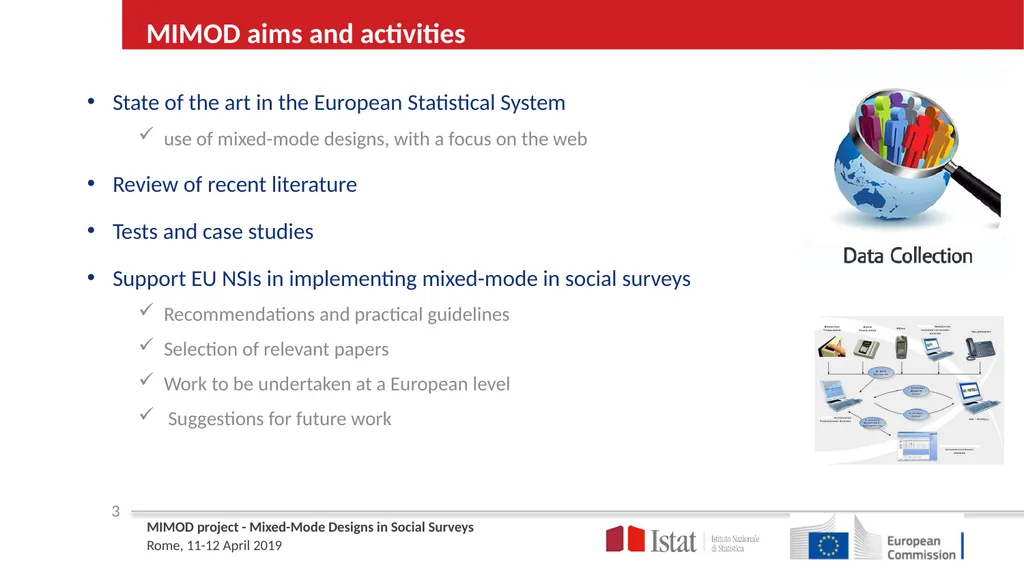
State of the art in the European Statistical System
use of mixed-mode designs, with a focus on the web
Review of recent literature
Tests and case studies
Support EU NSIs in implementing mixed-mode in social surveys
Recommendations and practical guidelines
Selection of relevant papers
Work to be undertaken at a European level
Suggestions for future work MIMOD aims and activities 3 MIMOD project - Mixed-Mode Designs in Social Surveys
Rome, 11-12 April 2019<br>
use of mixed-mode designs, with a focus on the web
Review of recent literature
Tests and case studies
Support EU NSIs in implementing mixed-mode in social surveys
Recommendations and practical guidelines
Selection of relevant papers
Work to be undertaken at a European level
Suggestions for future work MIMOD aims and activities 3 MIMOD project - Mixed-Mode Designs in Social Surveys
Rome, 11-12 April 2019<br>
04
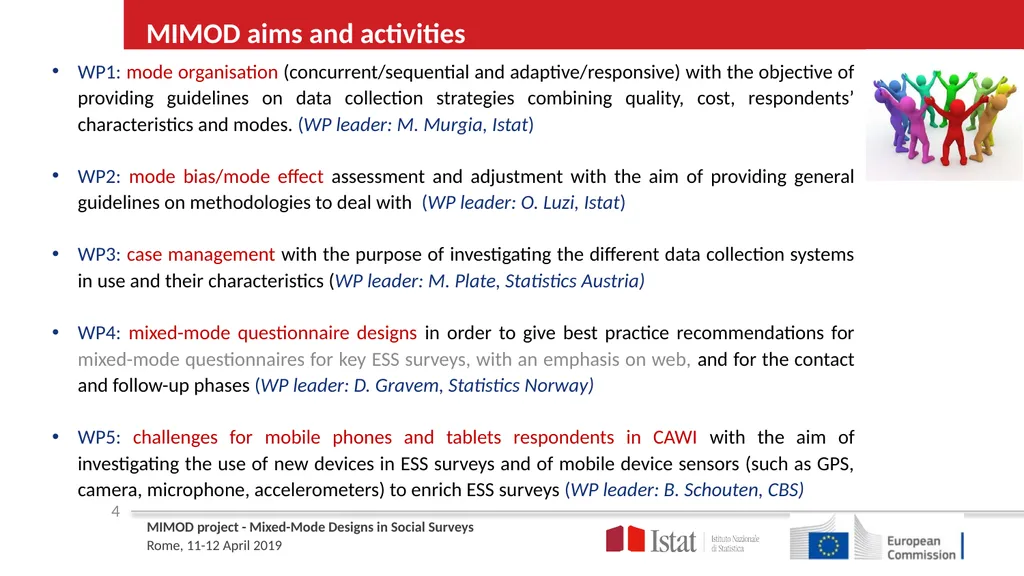
WP1: mode organisation (concurrent/sequential and adaptive/responsive) with the objective of providing guidelines on data collection strategies combining quality, cost, respondents’ characteristics and modes. (WP leader: M. Murgia, Istat)
WP2: mode bias/mode effect assessment and adjustment with the aim of providing general guidelines on methodologies to deal with (WP leader: O. Luzi, Istat)
WP3: case management with the purpose of investigating the different data collection systems in use and their characteristics (WP leader: M. Plate, Statistics Austria)
WP4: mixed-mode questionnaire designs in order to give best practice recommendations for mixed-mode questionnaires for key ESS surveys, with an emphasis on web, and for the contact and follow-up phases (WP leader: D. Gravem, Statistics Norway)
WP5: challenges for mobile phones and tablets respondents in CAWI with the aim of investigating the use of new devices in ESS surveys and of mobile device sensors (such as GPS, camera, microphone, accelerometers) to enrich ESS surveys (WP leader: B. Schouten, CBS) MIMOD aims and activities 4 MIMOD project - Mixed-Mode Designs in Social Surveys
Rome, 11-12 April 2019<br>
WP2: mode bias/mode effect assessment and adjustment with the aim of providing general guidelines on methodologies to deal with (WP leader: O. Luzi, Istat)
WP3: case management with the purpose of investigating the different data collection systems in use and their characteristics (WP leader: M. Plate, Statistics Austria)
WP4: mixed-mode questionnaire designs in order to give best practice recommendations for mixed-mode questionnaires for key ESS surveys, with an emphasis on web, and for the contact and follow-up phases (WP leader: D. Gravem, Statistics Norway)
WP5: challenges for mobile phones and tablets respondents in CAWI with the aim of investigating the use of new devices in ESS surveys and of mobile device sensors (such as GPS, camera, microphone, accelerometers) to enrich ESS surveys (WP leader: B. Schouten, CBS) MIMOD aims and activities 4 MIMOD project - Mixed-Mode Designs in Social Surveys
Rome, 11-12 April 2019<br>
05
A summary of MIMOD results:
Final methodological report summarizing the results of WP 1-5
WP1
Del. 1: Report on MIMOD survey on the state of the art of mixed-mode for EU social surveys
Del. 2: Methodological report - Mixed-mode strategies for social surveys: how to best combine data collection modes
WP2
Del. 1: Current methodologies to deal with mode effects and mode bias in mixed-mode designs
Del. 2: Report containing the results of the analyses performed on re-interview designs -A cost-benefit analysis of re-interview designs for mode-specific measurement bias
Del. 3: Report containing the results of the applications of selected methods on mixed-mode social surveys. - Experimenting methods to assess and adjust mode effect when a single mode control survey is available as a benchmark: a case study on the Italian “Aspects of daily life” survey
Del. 4: Methodological report MIMOD results 5 MIMOD project - Mixed-Mode Designs in Social Surveys
Rome, 11-12 April 2019<br>
Final methodological report summarizing the results of WP 1-5
WP1
Del. 1: Report on MIMOD survey on the state of the art of mixed-mode for EU social surveys
Del. 2: Methodological report - Mixed-mode strategies for social surveys: how to best combine data collection modes
WP2
Del. 1: Current methodologies to deal with mode effects and mode bias in mixed-mode designs
Del. 2: Report containing the results of the analyses performed on re-interview designs -A cost-benefit analysis of re-interview designs for mode-specific measurement bias
Del. 3: Report containing the results of the applications of selected methods on mixed-mode social surveys. - Experimenting methods to assess and adjust mode effect when a single mode control survey is available as a benchmark: a case study on the Italian “Aspects of daily life” survey
Del. 4: Methodological report MIMOD results 5 MIMOD project - Mixed-Mode Designs in Social Surveys
Rome, 11-12 April 2019<br>
06
WP3
Del. 1: Desktop review exercise and draft typology
Del. 2: Exploratory interviews and questionnaire - Exploratory standardized questions in MIMOD survey
Del. 3: Standardized survey on CMS - In-depth telephone interviews on data collection systems in practice
Del. 4: In-depth expert interviews on data collection systems in practice - Technical solutions to the challenges of running mixed-mode surveys
Del. 5: Methodological report - Final Report on Data Collection Systems within the ESS
WP4
Del. 1: Mixed-mode experiences of European NSIs
Del. 2: Survey communication in mixed-mode surveys
Del. 3: Recommandations for key questionnaire elements, questions and question types in mixed mode settings. Related to the European Statistical System’s person and household surveys
Del. 4: Methodological report MIMOD results (continued) 6 MIMOD project - Mixed-Mode Designs in Social Surveys
Rome, 11-12 April 2019<br>
Del. 1: Desktop review exercise and draft typology
Del. 2: Exploratory interviews and questionnaire - Exploratory standardized questions in MIMOD survey
Del. 3: Standardized survey on CMS - In-depth telephone interviews on data collection systems in practice
Del. 4: In-depth expert interviews on data collection systems in practice - Technical solutions to the challenges of running mixed-mode surveys
Del. 5: Methodological report - Final Report on Data Collection Systems within the ESS
WP4
Del. 1: Mixed-mode experiences of European NSIs
Del. 2: Survey communication in mixed-mode surveys
Del. 3: Recommandations for key questionnaire elements, questions and question types in mixed mode settings. Related to the European Statistical System’s person and household surveys
Del. 4: Methodological report MIMOD results (continued) 6 MIMOD project - Mixed-Mode Designs in Social Surveys
Rome, 11-12 April 2019<br>
07
WP5
Del. 1: Assessment of fitness of ESS surveys for smartphones
Del. 2: Responsive questionnaire designs for the LFS and ICT
Del. 3: Final methodological report discussing the use of mobile device sensors in ESS surveys - Sensor data for ESS surveys: a first inventory
Del. 4: Final methodological report presenting results of usability tests on selected ESS surveys and Census - Smartphone fitness of ESS surveys – case studies on the ICT survey and the LFS MIMOD results (continued) 7 MIMOD project - Mixed-Mode Designs in Social Surveys
Rome, 11-12 April 2019<br>
Del. 1: Assessment of fitness of ESS surveys for smartphones
Del. 2: Responsive questionnaire designs for the LFS and ICT
Del. 3: Final methodological report discussing the use of mobile device sensors in ESS surveys - Sensor data for ESS surveys: a first inventory
Del. 4: Final methodological report presenting results of usability tests on selected ESS surveys and Census - Smartphone fitness of ESS surveys – case studies on the ICT survey and the LFS MIMOD results (continued) 7 MIMOD project - Mixed-Mode Designs in Social Surveys
Rome, 11-12 April 2019<br>
08
8 MIMOD project - Mixed-Mode Designs in Social Surveys
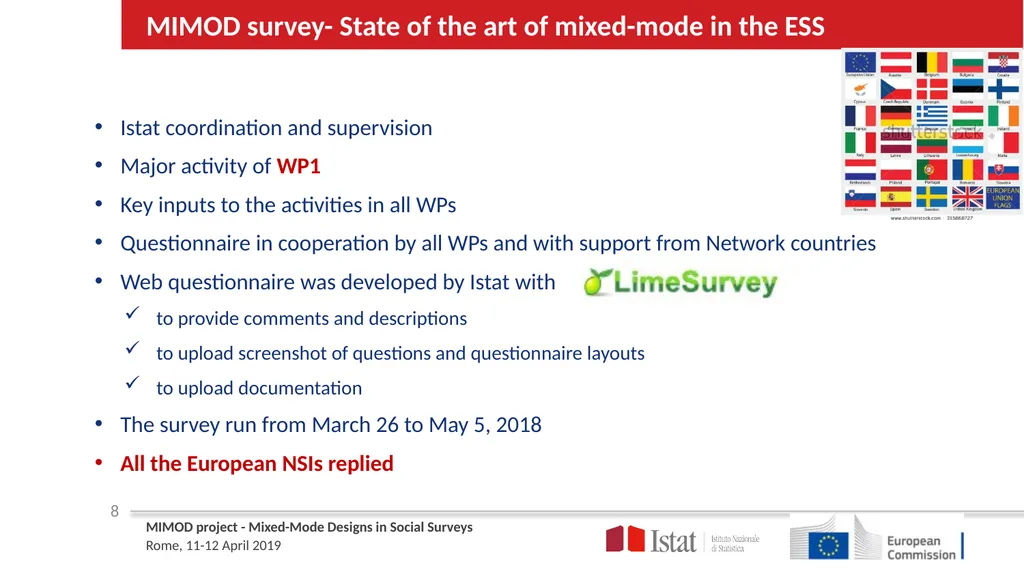
Rome, 11-12 April 2019 MIMOD survey- State of the art of mixed-mode in the ESS Istat coordination and supervision
Major activity of WP1
Key inputs to the activities in all WPs
Questionnaire in cooperation by all WPs and with support from Network countries
Web questionnaire was developed by Istat with
to provide comments and descriptions
to upload screenshot of questions and questionnaire layouts
to upload documentation
The survey run from March 26 to May 5, 2018
All the European NSIs replied<br>
Rome, 11-12 April 2019 MIMOD survey- State of the art of mixed-mode in the ESS Istat coordination and supervision
Major activity of WP1
Key inputs to the activities in all WPs
Questionnaire in cooperation by all WPs and with support from Network countries
Web questionnaire was developed by Istat with
to provide comments and descriptions
to upload screenshot of questions and questionnaire layouts
to upload documentation
The survey run from March 26 to May 5, 2018
All the European NSIs replied<br>
09
9 MIMOD project - Mixed-Mode Designs in Social Surveys
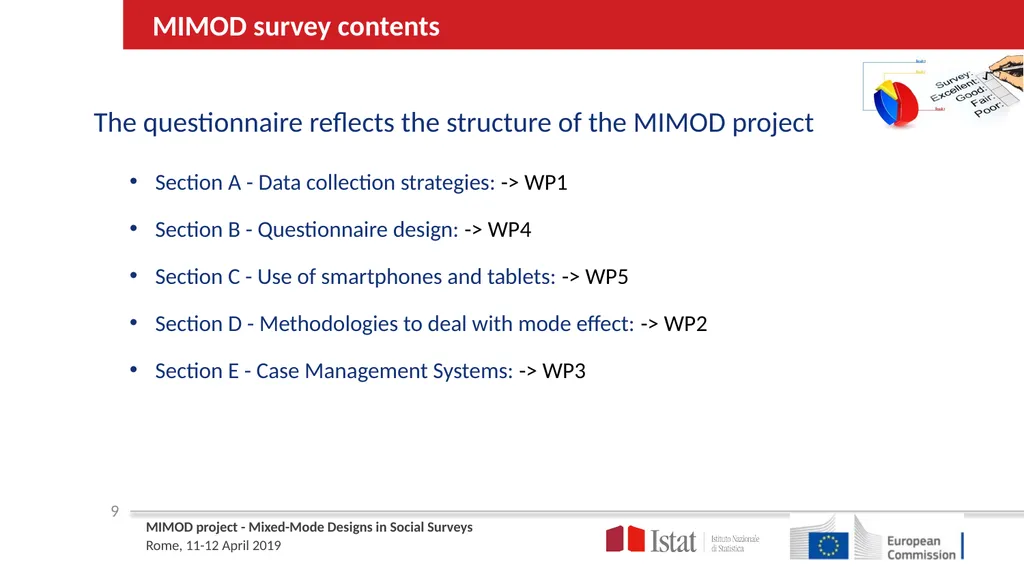
Rome, 11-12 April 2019 Section A - Data collection strategies: -> WP1
Section B - Questionnaire design: -> WP4
Section C - Use of smartphones and tablets: -> WP5
Section D - Methodologies to deal with mode effect: -> WP2
Section E - Case Management Systems: -> WP3 MIMOD survey contents The questionnaire reflects the structure of the MIMOD project<br>
Rome, 11-12 April 2019 Section A - Data collection strategies: -> WP1
Section B - Questionnaire design: -> WP4
Section C - Use of smartphones and tablets: -> WP5
Section D - Methodologies to deal with mode effect: -> WP2
Section E - Case Management Systems: -> WP3 MIMOD survey contents The questionnaire reflects the structure of the MIMOD project<br>
10
10 MIMOD project - Mixed-Mode Designs in Social Surveys
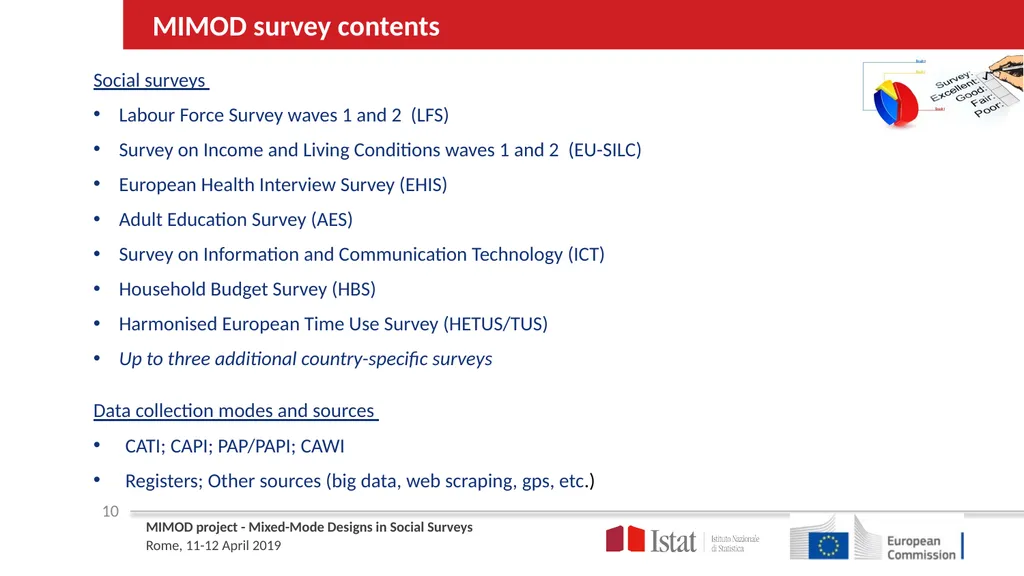
Rome, 11-12 April 2019 MIMOD survey contents Social surveys
Labour Force Survey waves 1 and 2 (LFS)
Survey on Income and Living Conditions waves 1 and 2 (EU-SILC)
European Health Interview Survey (EHIS)
Adult Education Survey (AES)
Survey on Information and Communication Technology (ICT)
Household Budget Survey (HBS)
Harmonised European Time Use Survey (HETUS/TUS)
Up to three additional country-specific surveys
Data collection modes and sources
CATI; CAPI; PAP/PAPI; CAWI
Registers; Other sources (big data, web scraping, gps, etc.)<br>
Rome, 11-12 April 2019 MIMOD survey contents Social surveys
Labour Force Survey waves 1 and 2 (LFS)
Survey on Income and Living Conditions waves 1 and 2 (EU-SILC)
European Health Interview Survey (EHIS)
Adult Education Survey (AES)
Survey on Information and Communication Technology (ICT)
Household Budget Survey (HBS)
Harmonised European Time Use Survey (HETUS/TUS)
Up to three additional country-specific surveys
Data collection modes and sources
CATI; CAPI; PAP/PAPI; CAWI
Registers; Other sources (big data, web scraping, gps, etc.)<br>
11
11 MIMOD project - Mixed-Mode Designs in Social Surveys
Rome, 11-12 April 2019 M
A
I
N
R
E
S
U
L
T
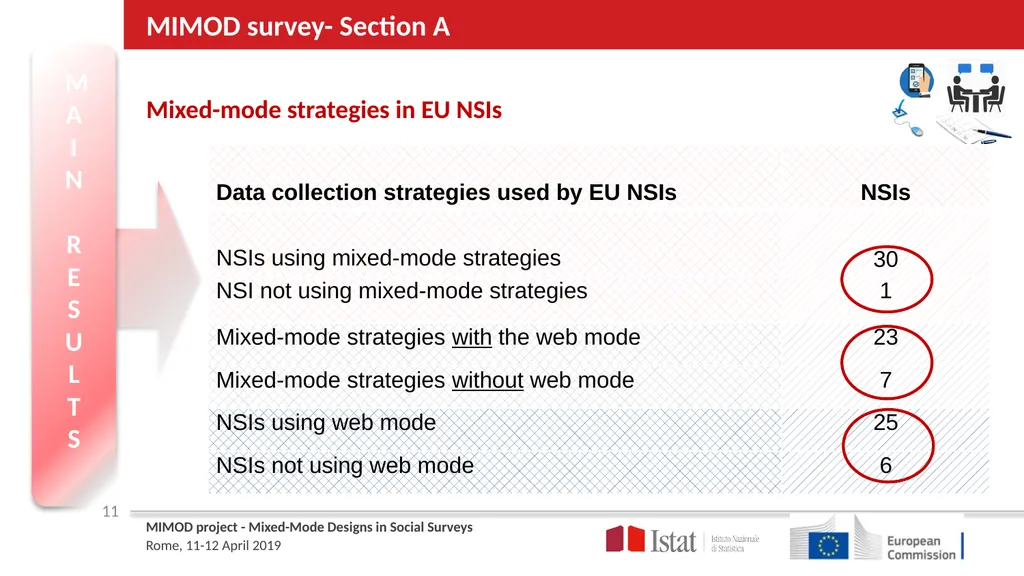
S Mixed-mode strategies in EU NSIs MIMOD survey- Section A<br>
Rome, 11-12 April 2019 M
A
I
N
R
E
S
U
L
T
S Mixed-mode strategies in EU NSIs MIMOD survey- Section A<br>
12
12 MIMOD project - Mixed-Mode Designs in Social Surveys
Rome, 11-12 April 2019 M
A
I
N
R
E
S
U
L
T
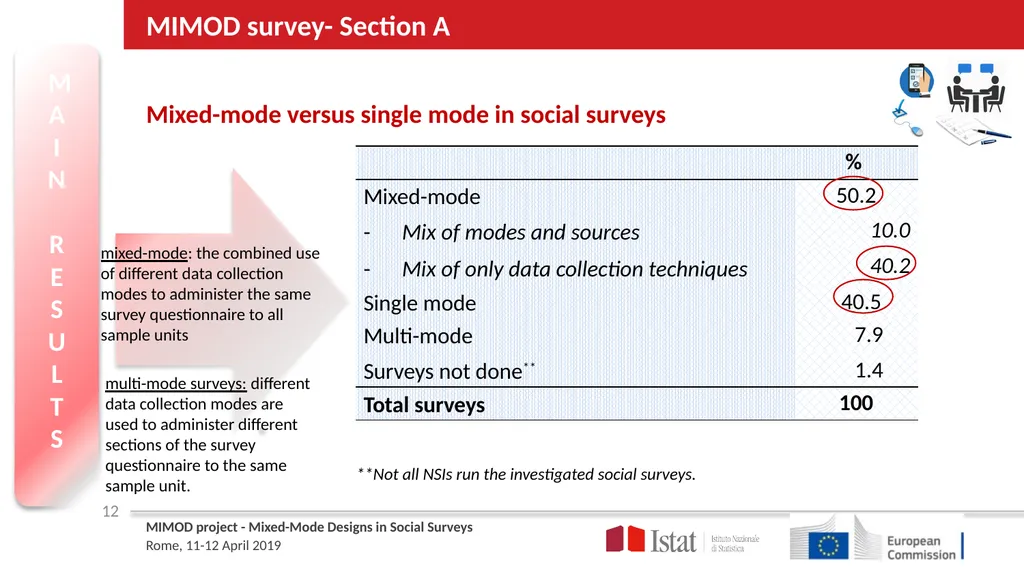
S Mixed-mode versus single mode in social surveys **Not all NSIs run the investigated social surveys. MIMOD survey- Section A mixed-mode: the combined use of different data collection modes to administer the same survey questionnaire to all sample units multi-mode surveys: different data collection modes are used to administer different sections of the survey questionnaire to the same sample unit.<br>
Rome, 11-12 April 2019 M
A
I
N
R
E
S
U
L
T
S Mixed-mode versus single mode in social surveys **Not all NSIs run the investigated social surveys. MIMOD survey- Section A mixed-mode: the combined use of different data collection modes to administer the same survey questionnaire to all sample units multi-mode surveys: different data collection modes are used to administer different sections of the survey questionnaire to the same sample unit.<br>
13
13 MIMOD project - Mixed-Mode Designs in Social Surveys
Rome, 11-12 April 2019 M
A
I
N
R
E
S
U
L
T
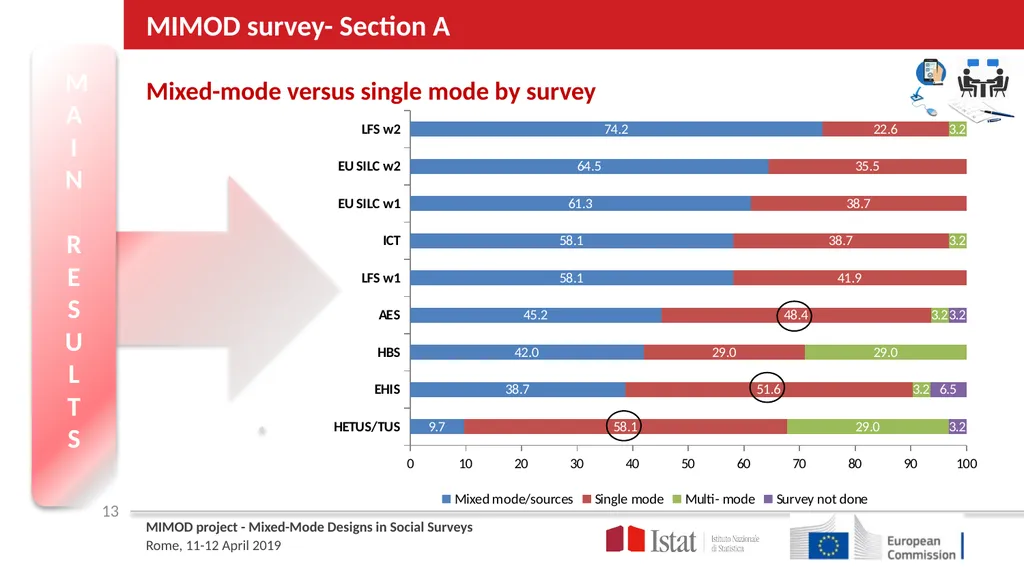
S Mixed-mode versus single mode by survey MIMOD survey- Section A<br>
Rome, 11-12 April 2019 M
A
I
N
R
E
S
U
L
T
S Mixed-mode versus single mode by survey MIMOD survey- Section A<br>
14
14 MIMOD project - Mixed-Mode Designs in Social Surveys
Rome, 11-12 April 2019 M
A
I
N
R
E
S
U
L
T
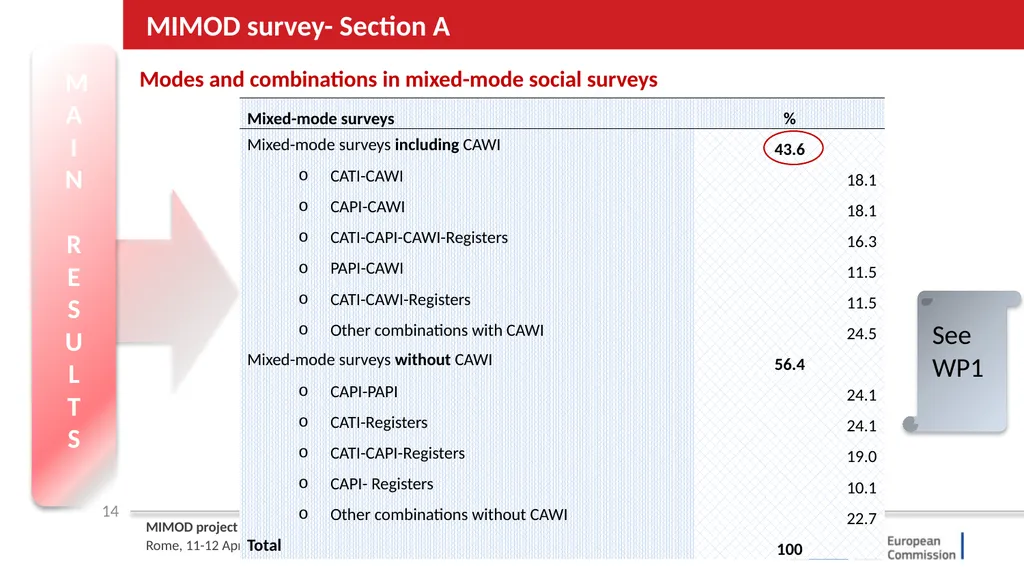
S Modes and combinations in mixed-mode social surveys MIMOD survey- Section A See WP1<br>
Rome, 11-12 April 2019 M
A
I
N
R
E
S
U
L
T
S Modes and combinations in mixed-mode social surveys MIMOD survey- Section A See WP1<br>
15
15 MIMOD project - Mixed-Mode Designs in Social Surveys
Rome, 11-12 April 2019 M
A
I
N
R
E
S
U
L
T
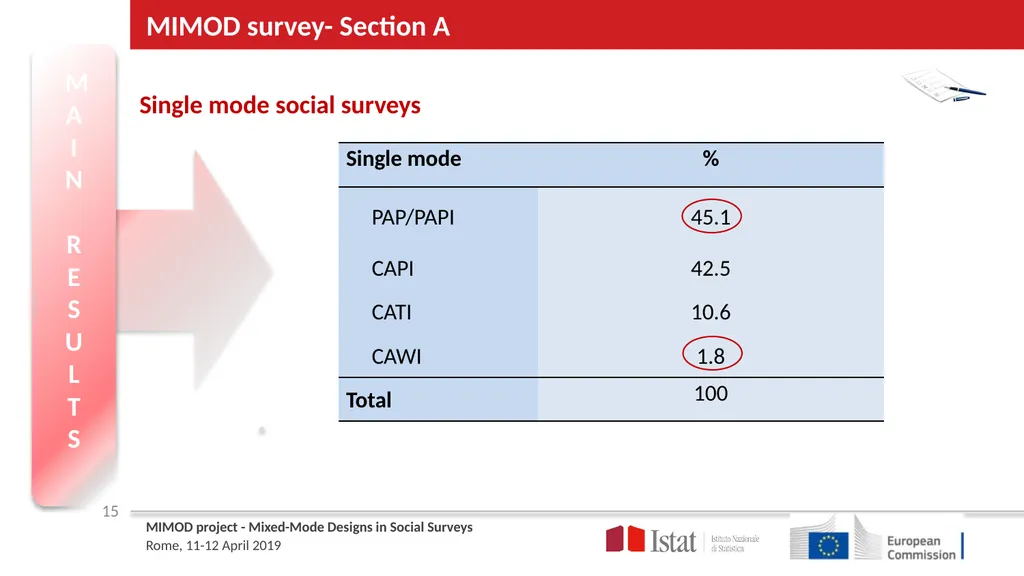
S Single mode social surveys MIMOD survey- Section A<br>
Rome, 11-12 April 2019 M
A
I
N
R
E
S
U
L
T
S Single mode social surveys MIMOD survey- Section A<br>
16
16 MIMOD project - Mixed-Mode Designs in Social Surveys
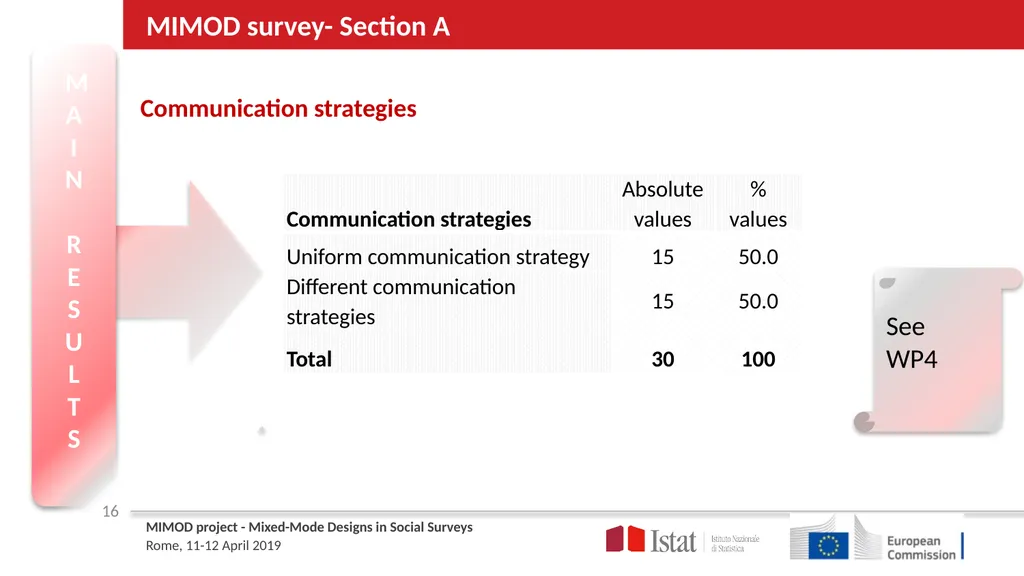
Rome, 11-12 April 2019 Communication strategies M
A
I
N
R
E
S
U
L
T
S MIMOD survey- Section A See WP4<br>
Rome, 11-12 April 2019 Communication strategies M
A
I
N
R
E
S
U
L
T
S MIMOD survey- Section A See WP4<br>
17
17 MIMOD project - Mixed-Mode Designs in Social Surveys
Rome, 11-12 April 2019 M
A
I
N
R
E
S
U
L
T
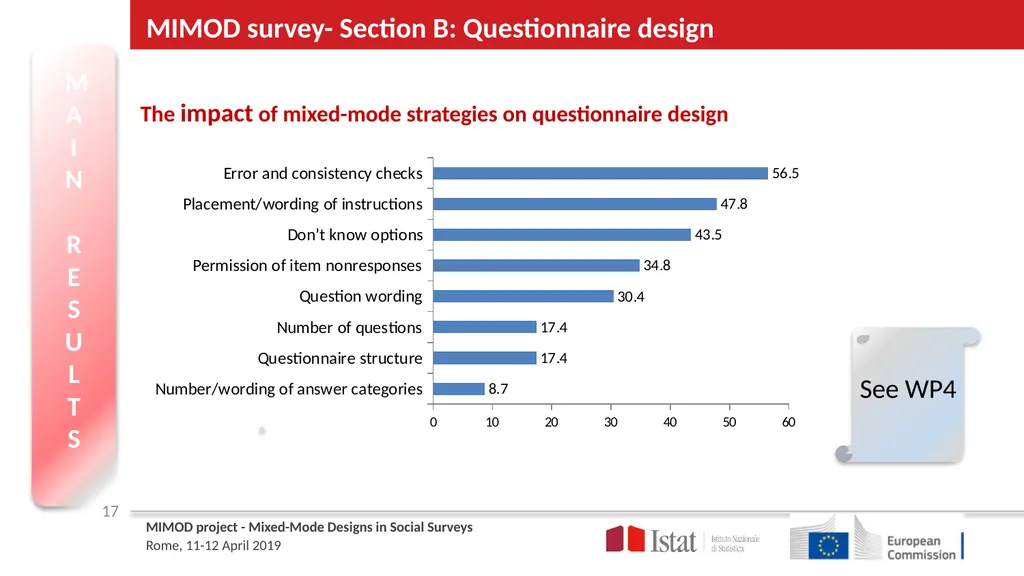
S The impact of mixed-mode strategies on questionnaire design See WP4 MIMOD survey- Section B: Questionnaire design<br>
Rome, 11-12 April 2019 M
A
I
N
R
E
S
U
L
T
S The impact of mixed-mode strategies on questionnaire design See WP4 MIMOD survey- Section B: Questionnaire design<br>
18
18 MIMOD project - Mixed-Mode Designs in Social Surveys
Rome, 11-12 April 2019 M
A
I
N
R
E
S
U
L
T
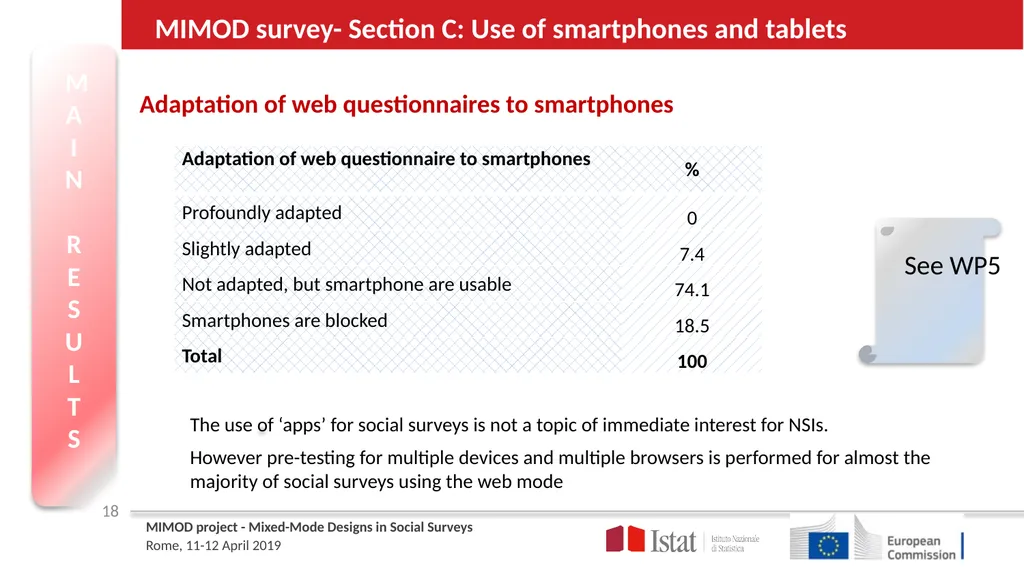
S See WP5 Adaptation of web questionnaires to smartphones The use of ‘apps’ for social surveys is not a topic of immediate interest for NSIs.
However pre-testing for multiple devices and multiple browsers is performed for almost the majority of social surveys using the web mode MIMOD survey- Section C: Use of smartphones and tablets<br>
Rome, 11-12 April 2019 M
A
I
N
R
E
S
U
L
T
S See WP5 Adaptation of web questionnaires to smartphones The use of ‘apps’ for social surveys is not a topic of immediate interest for NSIs.
However pre-testing for multiple devices and multiple browsers is performed for almost the majority of social surveys using the web mode MIMOD survey- Section C: Use of smartphones and tablets<br>
19
19 MIMOD project - Mixed-Mode Designs in Social Surveys
Rome, 11-12 April 2019 MIMOD survey- Section D: Methodologies to deal with mode effect M
A
I
N
R
E
S
U
L
T
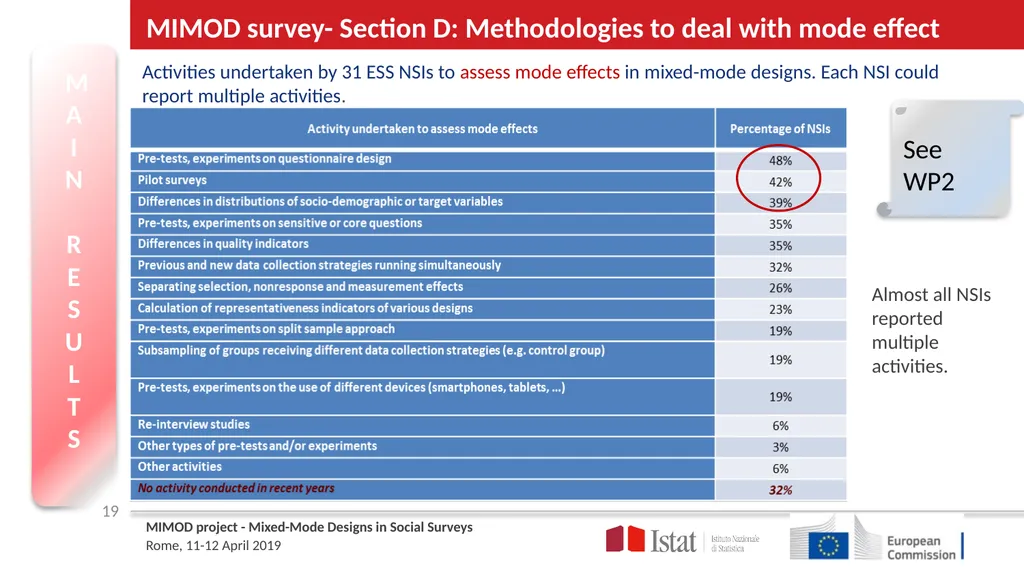
S See WP2 Activities undertaken by 31 ESS NSIs to assess mode effects in mixed-mode designs. Each NSI could report multiple activities. Almost all NSIs reported multiple activities.<br>
Rome, 11-12 April 2019 MIMOD survey- Section D: Methodologies to deal with mode effect M
A
I
N
R
E
S
U
L
T
S See WP2 Activities undertaken by 31 ESS NSIs to assess mode effects in mixed-mode designs. Each NSI could report multiple activities. Almost all NSIs reported multiple activities.<br>
20
20 MIMOD project - Mixed-Mode Designs in Social Surveys
Rome, 11-12 April 2019 MIMOD survey- Section D: Methodologies to deal with mode effect M
A
I
N
R
E
S
U
L
T
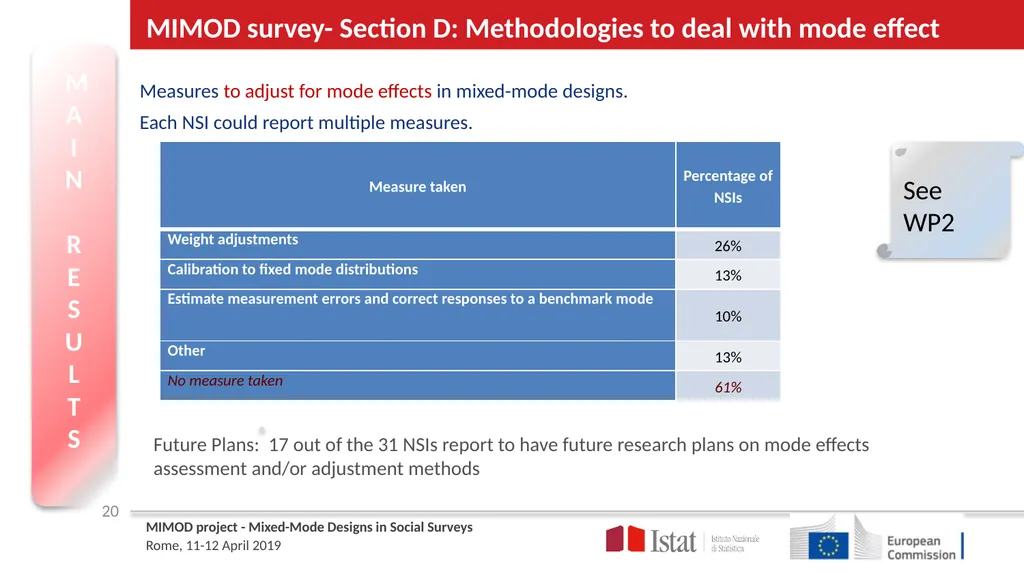
S Measures to adjust for mode effects in mixed-mode designs.
Each NSI could report multiple measures. Future Plans: 17 out of the 31 NSIs report to have future research plans on mode effects assessment and/or adjustment methods See WP2<br>
Rome, 11-12 April 2019 MIMOD survey- Section D: Methodologies to deal with mode effect M
A
I
N
R
E
S
U
L
T
S Measures to adjust for mode effects in mixed-mode designs.
Each NSI could report multiple measures. Future Plans: 17 out of the 31 NSIs report to have future research plans on mode effects assessment and/or adjustment methods See WP2<br>
21
21 MIMOD project - Mixed-Mode Designs in Social Surveys
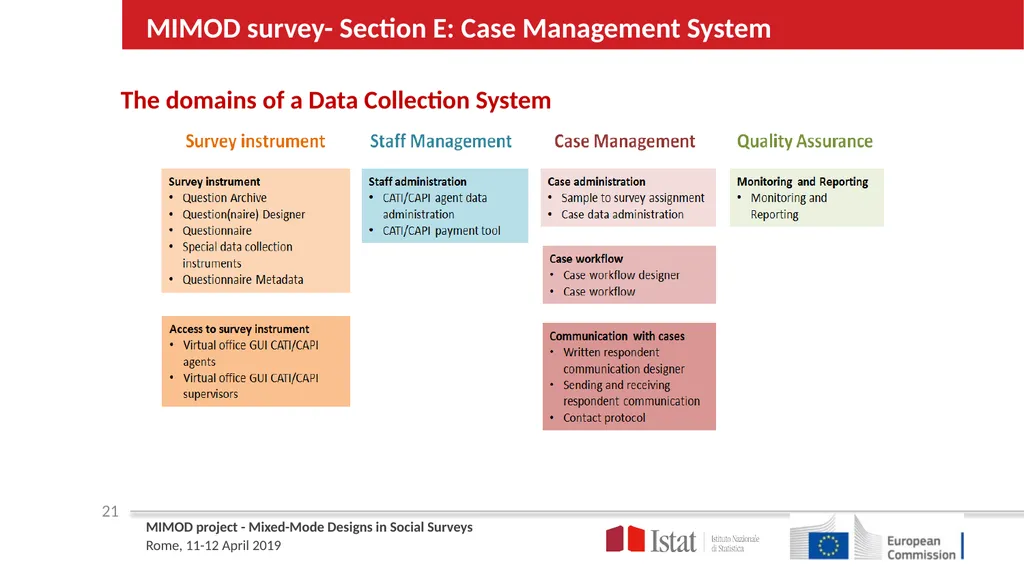
Rome, 11-12 April 2019 MIMOD survey- Section E: Case Management System The domains of a Data Collection System<br>
Rome, 11-12 April 2019 MIMOD survey- Section E: Case Management System The domains of a Data Collection System<br>
22
22 MIMOD project - Mixed-Mode Designs in Social Surveys
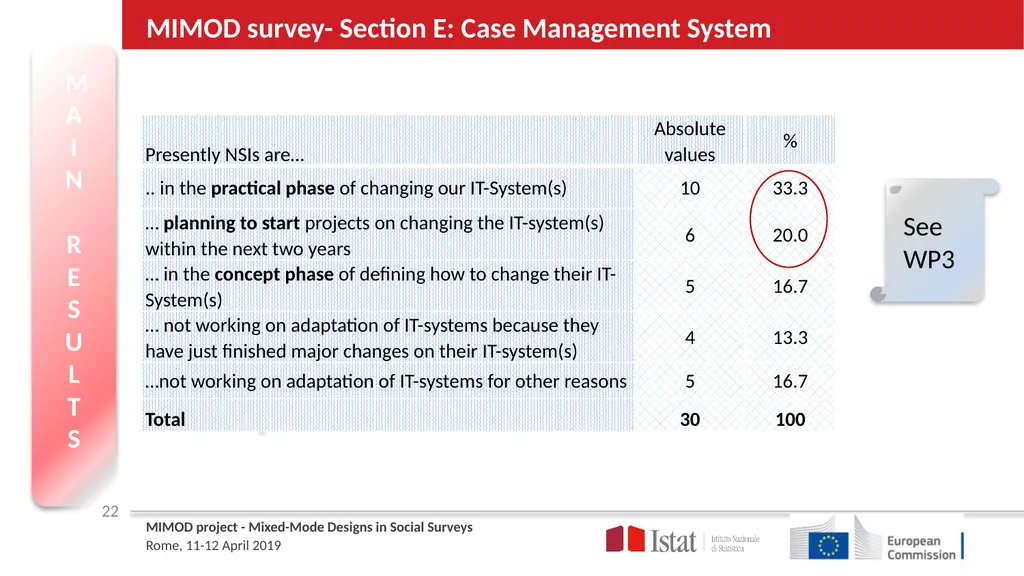
Rome, 11-12 April 2019 MIMOD survey- Section E: Case Management System M
A
I
N
R
E
S
U
L
T
S See WP3<br>
Rome, 11-12 April 2019 MIMOD survey- Section E: Case Management System M
A
I
N
R
E
S
U
L
T
S See WP3<br>
23
23 MIMOD project - Mixed-Mode Designs in Social Surveys
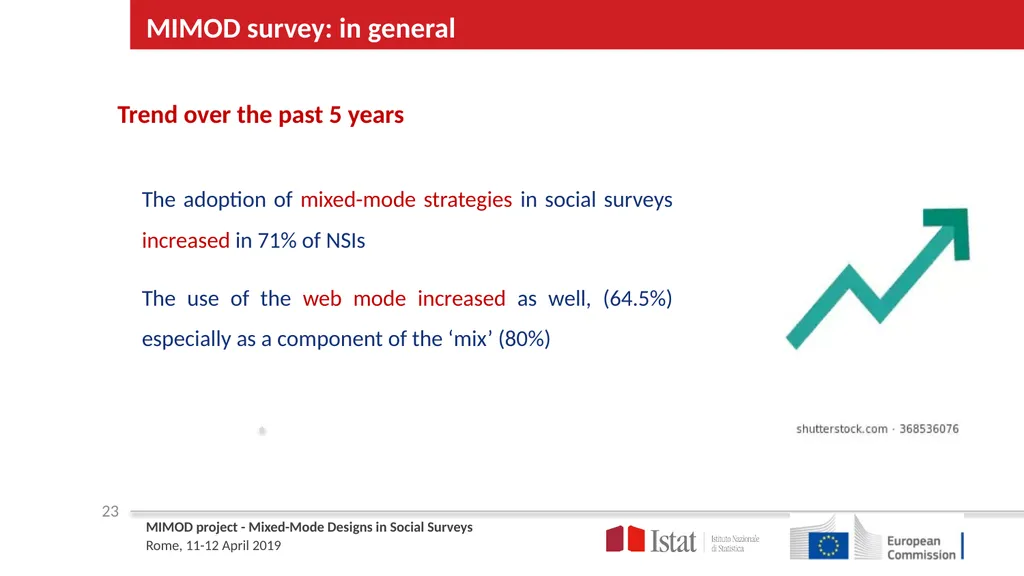
Rome, 11-12 April 2019 MIMOD survey: in general Trend over the past 5 years The adoption of mixed-mode strategies in social surveys increased in 71% of NSIs
The use of the web mode increased as well, (64.5%) especially as a component of the ‘mix’ (80%)<br>
Rome, 11-12 April 2019 MIMOD survey: in general Trend over the past 5 years The adoption of mixed-mode strategies in social surveys increased in 71% of NSIs
The use of the web mode increased as well, (64.5%) especially as a component of the ‘mix’ (80%)<br>
24
24 MIMOD project - Mixed-Mode Designs in Social Surveys
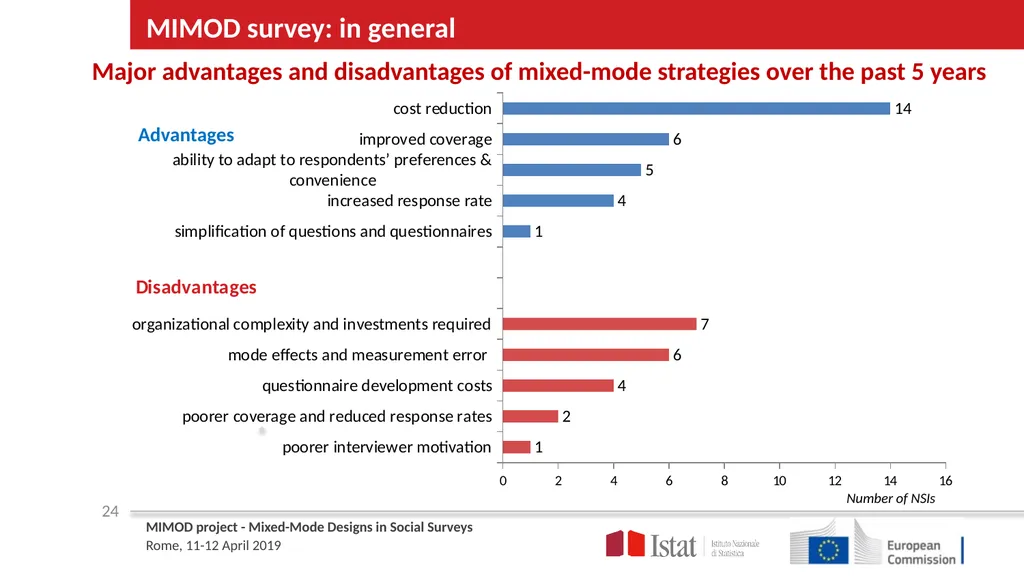
Rome, 11-12 April 2019 MIMOD survey: in general Major advantages and disadvantages of mixed-mode strategies over the past 5 years Advantages Number of NSIs<br>
Rome, 11-12 April 2019 MIMOD survey: in general Major advantages and disadvantages of mixed-mode strategies over the past 5 years Advantages Number of NSIs<br>
25
25 MIMOD project - Mixed-Mode Designs in Social Surveys
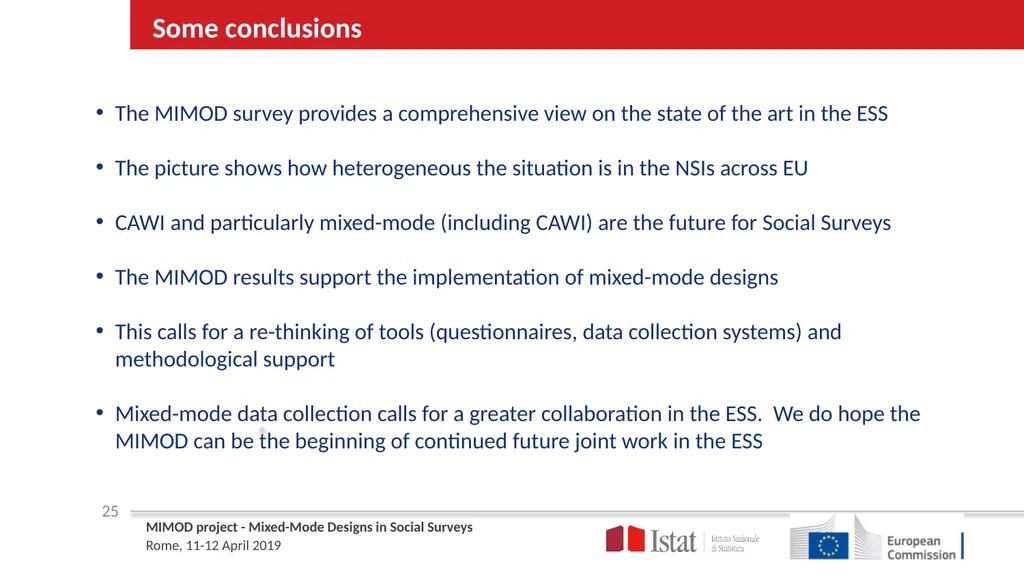
Rome, 11-12 April 2019 Some conclusions The MIMOD survey provides a comprehensive view on the state of the art in the ESS
The picture shows how heterogeneous the situation is in the NSIs across EU
CAWI and particularly mixed-mode (including CAWI) are the future for Social Surveys
The MIMOD results support the implementation of mixed-mode designs
This calls for a re-thinking of tools (questionnaires, data collection systems) and methodological support
Mixed-mode data collection calls for a greater collaboration in the ESS. We do hope the MIMOD can be the beginning of continued future joint work in the ESS<br>
Rome, 11-12 April 2019 Some conclusions The MIMOD survey provides a comprehensive view on the state of the art in the ESS
The picture shows how heterogeneous the situation is in the NSIs across EU
CAWI and particularly mixed-mode (including CAWI) are the future for Social Surveys
The MIMOD results support the implementation of mixed-mode designs
This calls for a re-thinking of tools (questionnaires, data collection systems) and methodological support
Mixed-mode data collection calls for a greater collaboration in the ESS. We do hope the MIMOD can be the beginning of continued future joint work in the ESS<br>