Minimization methods Minimization problems: from easy to hard to insanely hard. Easy Hard Find Local optimum. function of 1 variable Find Local optimum. function of N variables Find global optimum. function of N variables Minimization
"Minimization methods Minimization problems: from" is the property of its rightful owner. Permission is granted to
download and print the materials on this website for personal, non-commercial use only, and to display it
on your personal computer provided you do not modify the materials and that you retain all copyright
notices contained in the materials. By downloading content from our website, you accept the terms of this
agreement.
Presentation Transcript
01
Minimization methods<br>
02
Minimization problems: from easy to hard to insanely hard. Easy Hard Find Local optimum. function of 1 variable Find Local optimum. function of N variables Find global optimum. function of N variables<br>
03
Minimization problem Easy Hard Find Local minimum. function of 1 variable<br>
04
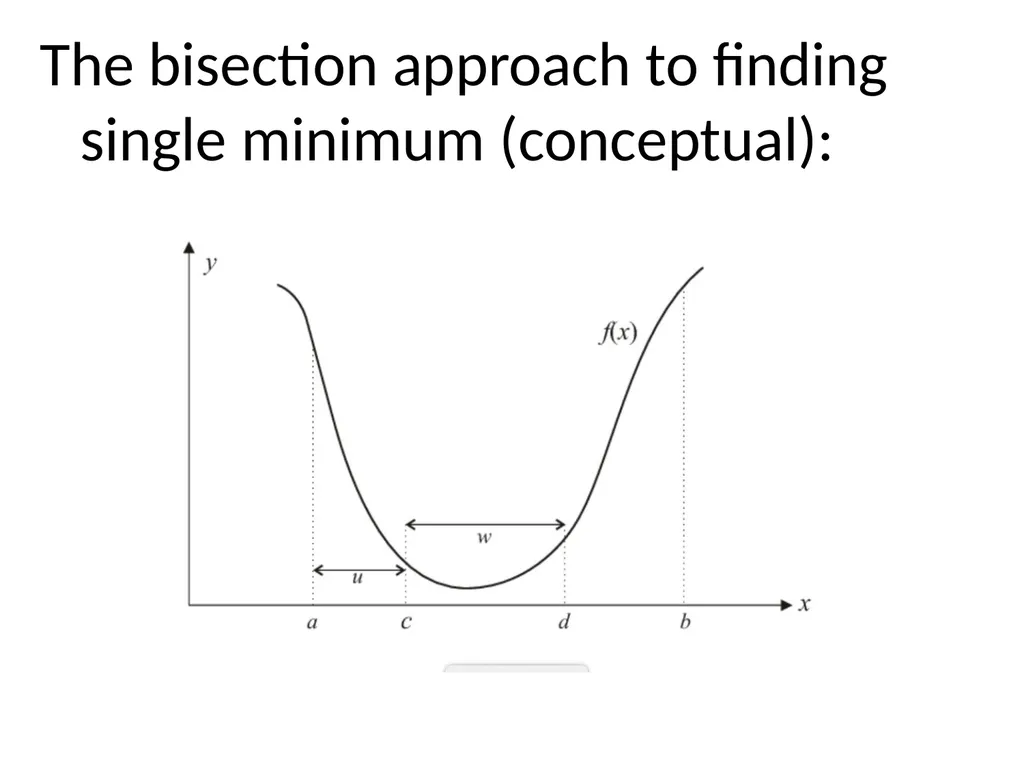
The bisection approach to finding single minimum (conceptual):<br>
05
A more efficient version used in practice: golden section. Keeps on bracketing the root by dividing the initial interval and choosing the half where the minimum is by comparing value of the function “up hill” and “down hill”. Continues until the convergence criteria are met, e.g. (this is general, by the way). |xn+1 – xn| < TOL (assuming x ~1. )
|xn+1 – xn| < TOL*xn (better. TOL is relative accuracy. )
Linear (1st order) convergence. Robust but slow.
https://www.youtube.com/watch?v=VBFuqglVW3c<br>
06
Newton’s method for finding local minimum. Motivation: utilize more information about the function. Hope to be faster.<br>
07
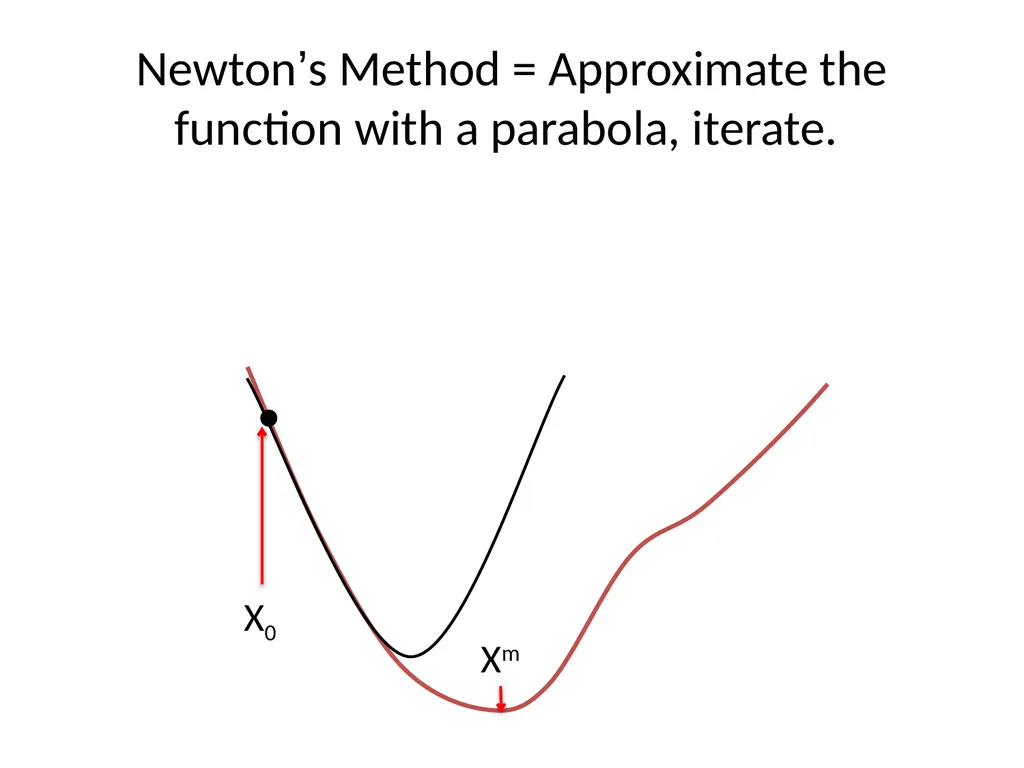
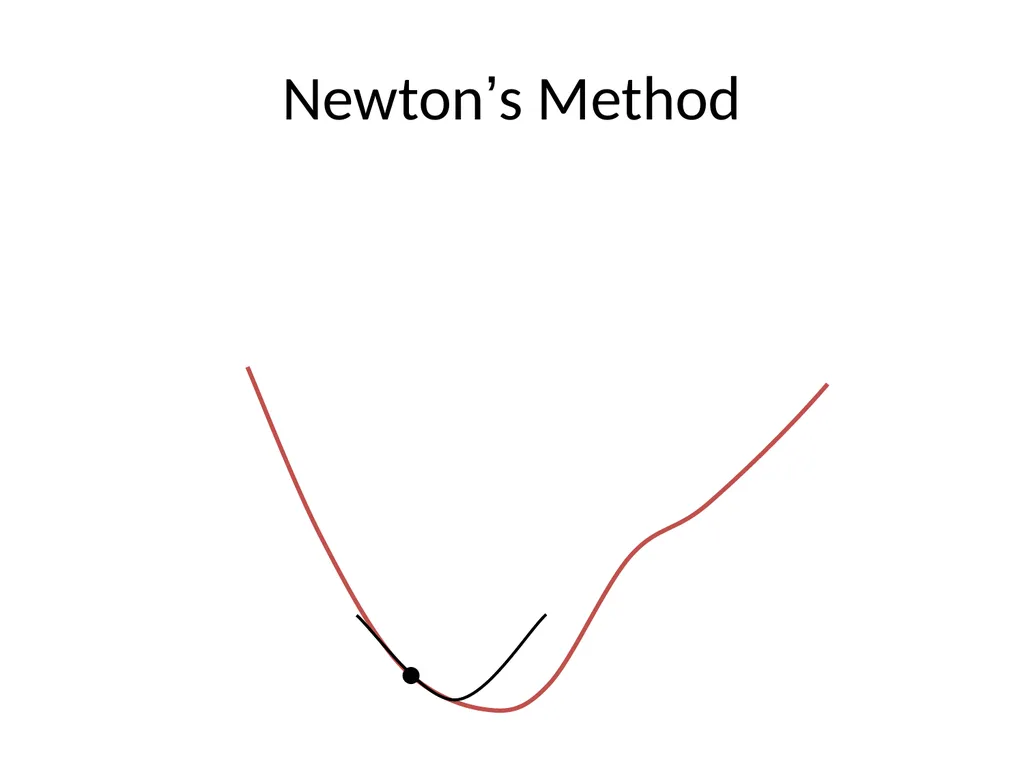
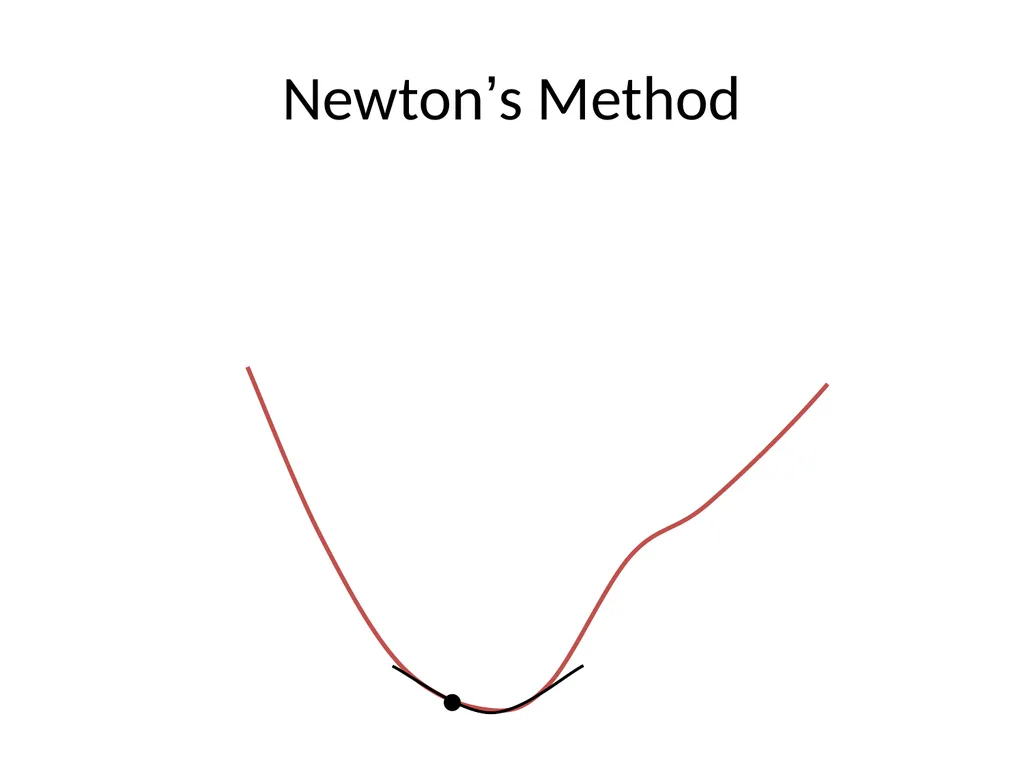
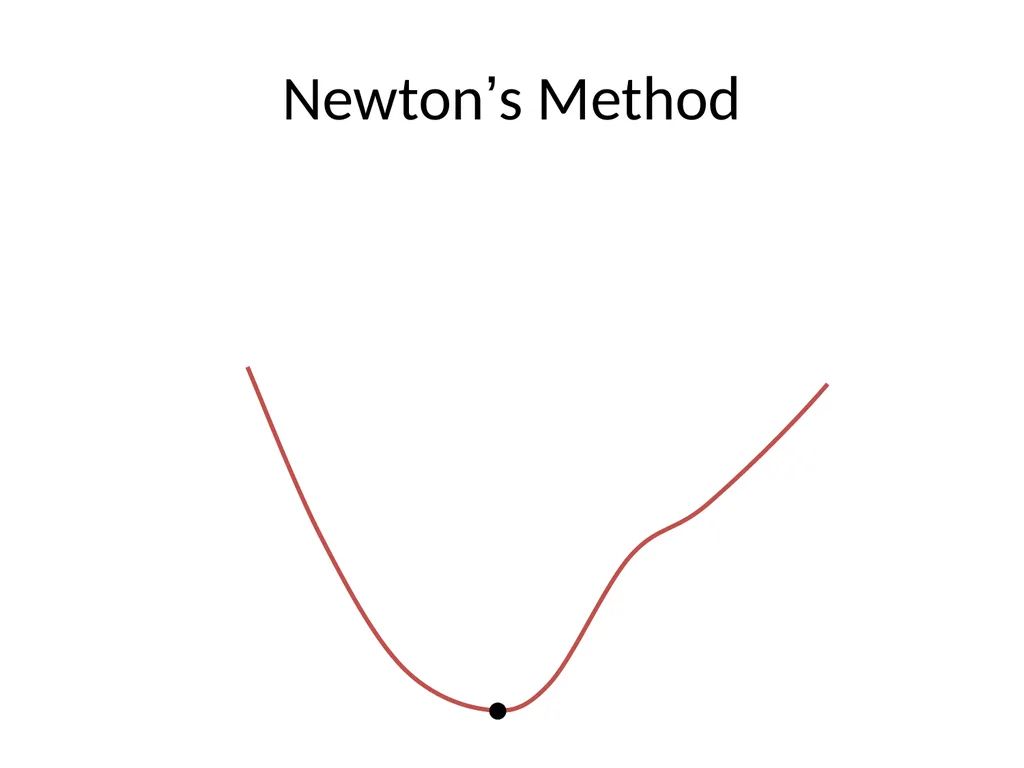
Newton’s Method = Approximate the function with a parabola, iterate. X0 Xm<br>
08
Newton’s Method<br>
09
Newton’s Method<br>
10
Newton’s Method<br>
11
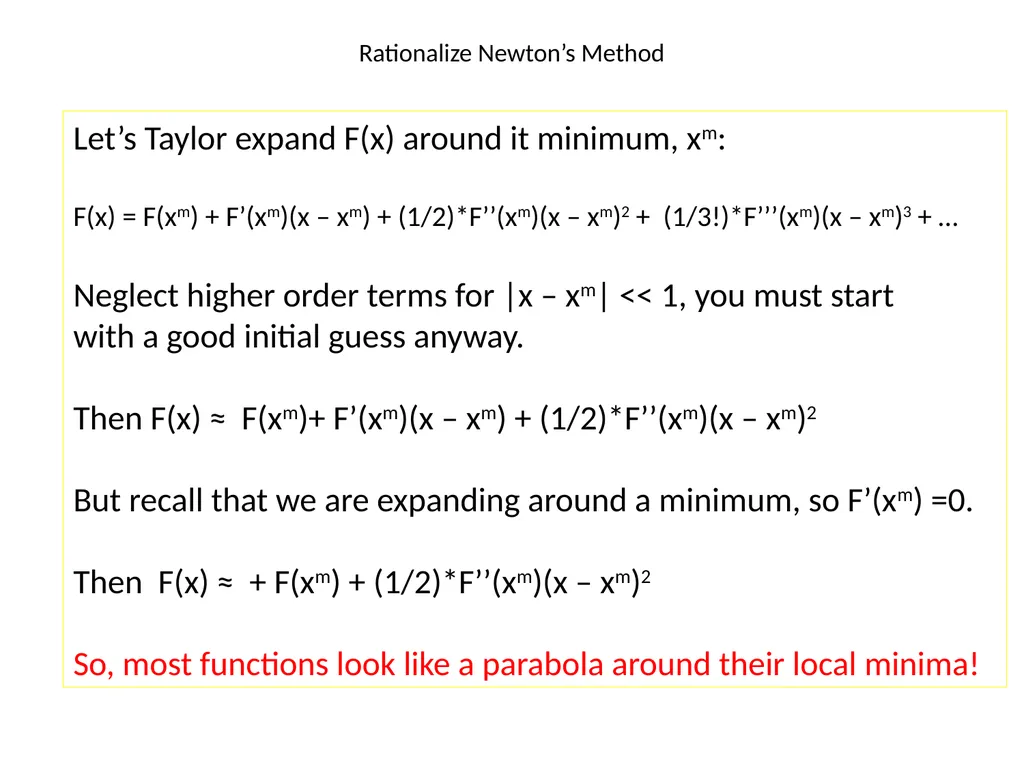
Rationalize Newton’s Method Let’s Taylor expand F(x) around it minimum, xm:
But recall that we are expanding around a minimum, so F’(xm) =0.
Then F(x) ≈ + F(xm) + (1/2)*F’’(xm)(x – xm)2
So, most functions look like a parabola around their local minima!<br>
12
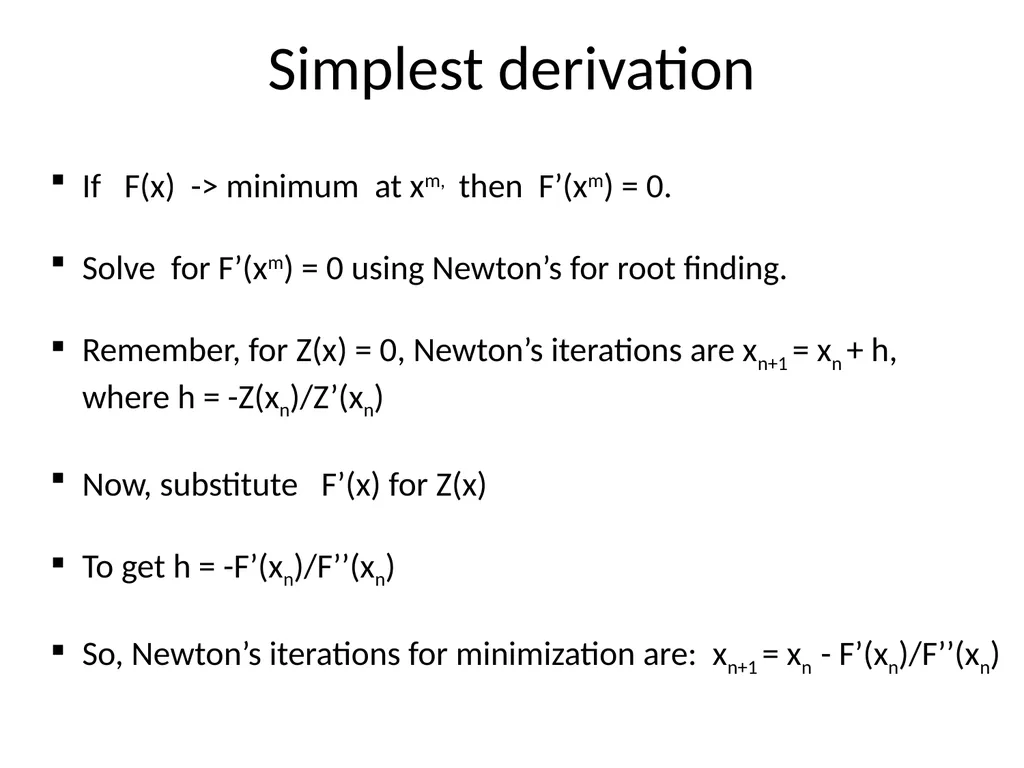
Simplest derivation If F(x) -> minimum at xm, then F’(xm) = 0.
Solve for F’(xm) = 0 using Newton’s for root finding.
Remember, for Z(x) = 0, Newton’s iterations are xn+1 = xn + h, where h = -Z(xn)/Z’(xn)
Now, substitute F’(x) for Z(x)
To get h = -F’(xn)/F’’(xn)
So, Newton’s iterations for minimization are: xn+1 = xn - F’(xn)/F’’(xn)<br>
13
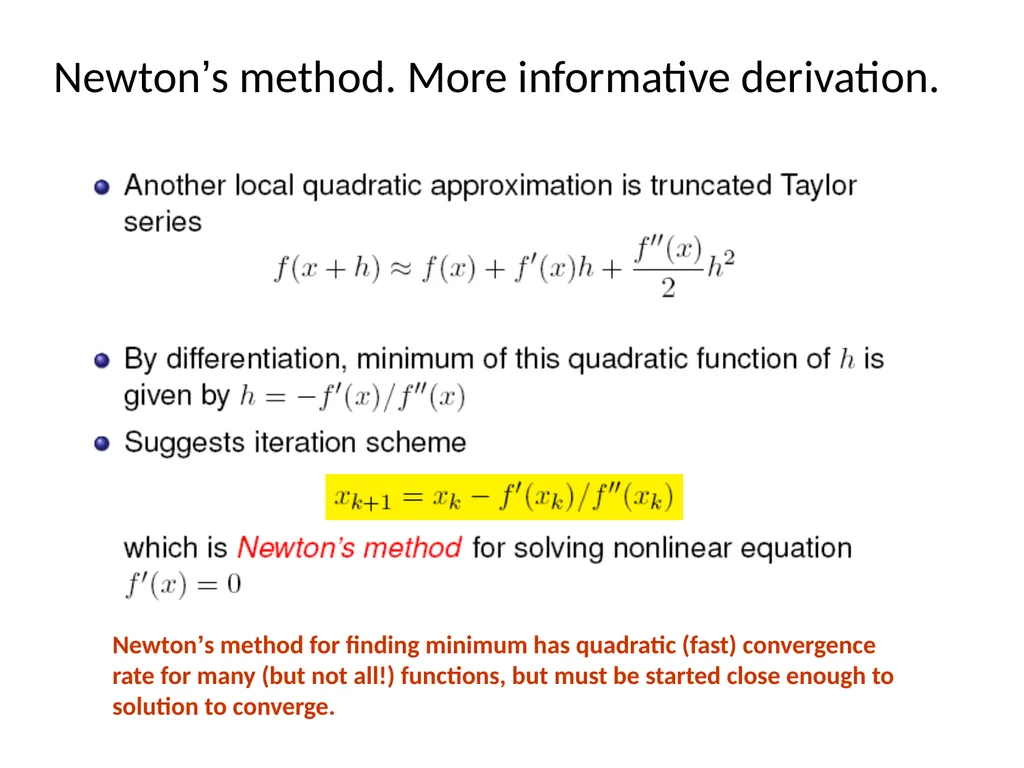
Newton’s method. More informative derivation. Newton’s method for finding minimum has quadratic (fast) convergence rate for many (but not all!) functions, but must be started close enough to solution to converge.<br>
14
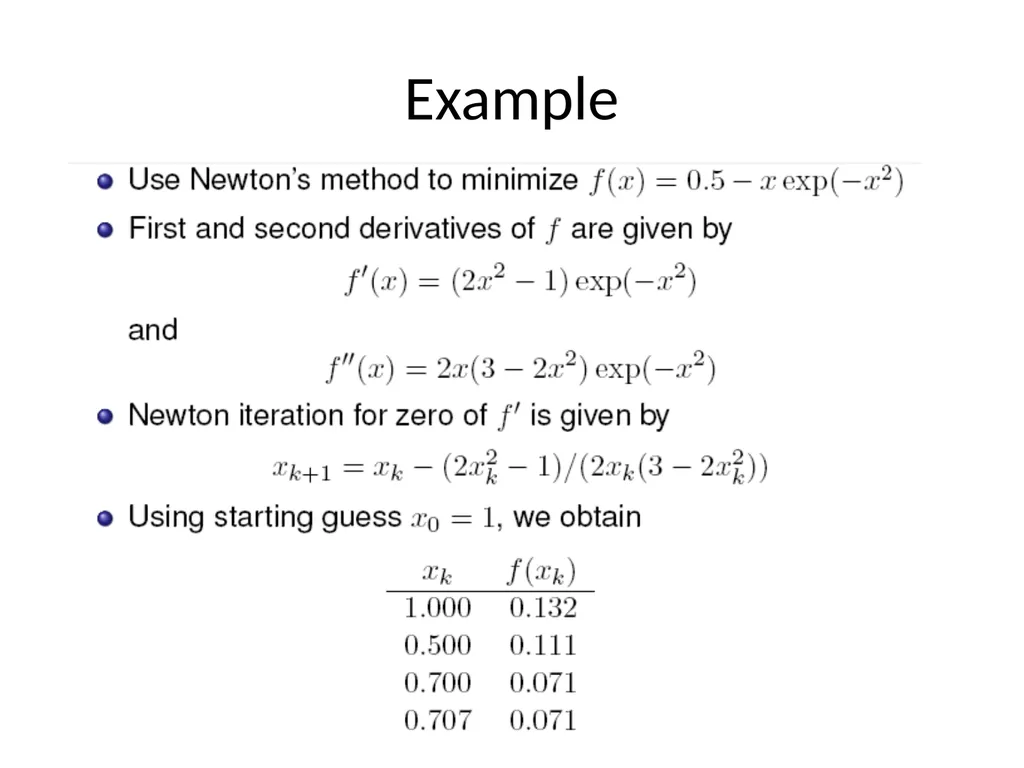
Example<br>
15
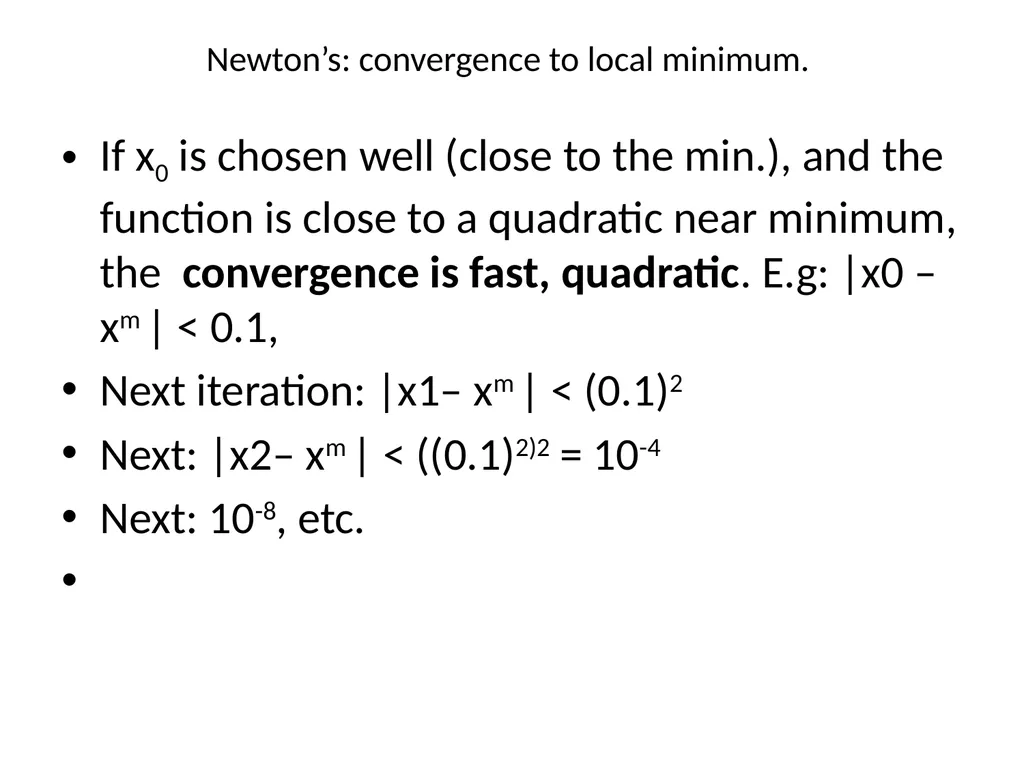
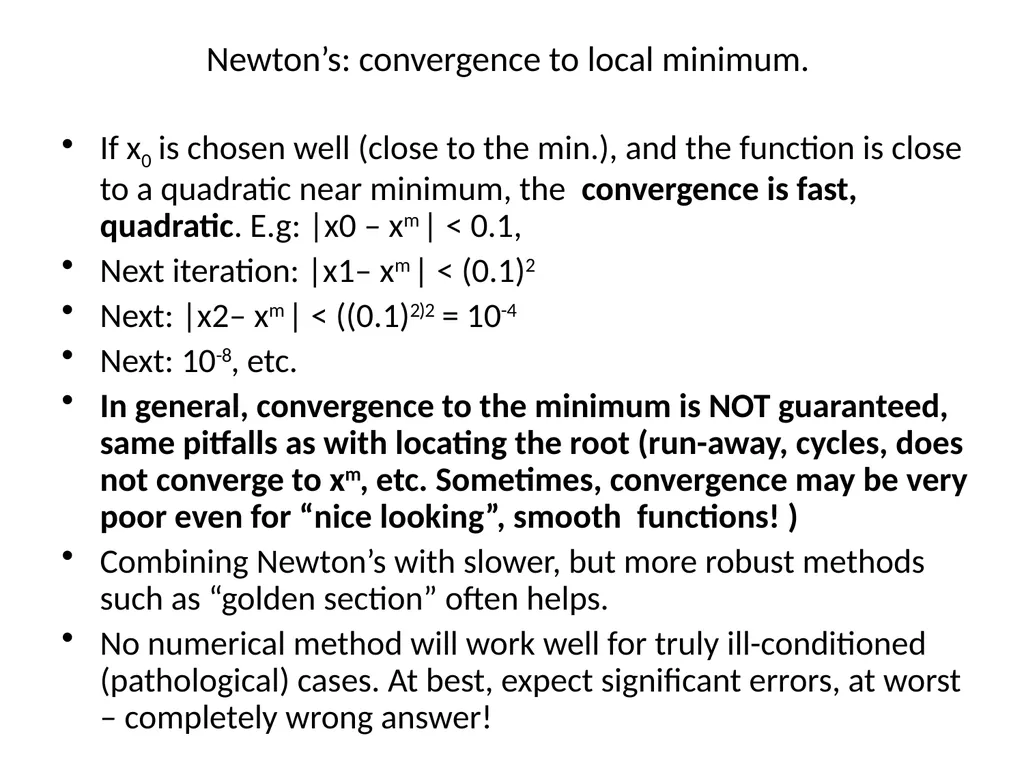
Newton’s: convergence to local minimum. If x0 is chosen well (close to the min.), and the function is close to a quadratic near minimum, the convergence is fast, quadratic. E.g: |x0 – xm | < 0.1,
Next iteration: |x1– xm | < (0.1)2
Next: |x2– xm | < ((0.1)2)2 = 10-4
Next: 10-8, etc.<br>
16
Newton’s: convergence to local minimum. If x0 is chosen well (close to the min.), and the function is close to a quadratic near minimum, the convergence is fast, quadratic. E.g: |x0 – xm | < 0.1,
Next iteration: |x1– xm | < (0.1)2
Next: |x2– xm | < ((0.1)2)2 = 10-4
Next: 10-8, etc.
In general, convergence to the minimum is NOT guaranteed, same pitfalls as with locating the root (run-away, cycles, does not converge to xm, etc. Sometimes, convergence may be very poor even for “nice looking”, smooth functions! )
Combining Newton’s with slower, but more robust methods such as “golden section” often helps.
No numerical method will work well for truly ill-conditioned (pathological) cases. At best, expect significant errors, at worst – completely wrong answer!<br>
17
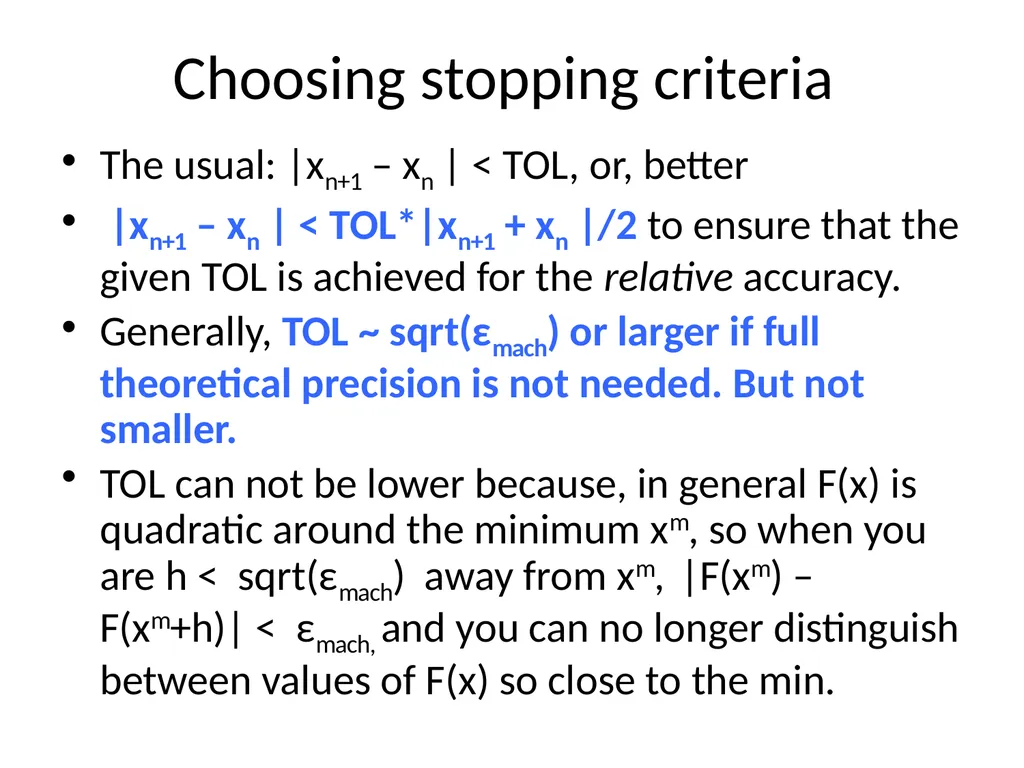
Choosing stopping criteria The usual: |xn+1 – xn | < TOL, or, better
|xn+1 – xn | < TOL*|xn+1 + xn |/2 to ensure that the given TOL is achieved for the relative accuracy.
Generally, TOL ~ sqrt(εmach) or larger if full theoretical precision is not needed. But not smaller.
TOL can not be lower because, in general F(x) is quadratic around the minimum xm, so when you are h < sqrt(εmach) away from xm, |F(xm) – F(xm+h)| < εmach, and you can no longer distinguish between values of F(x) so close to the min.<br>
18
Why you can’t beat the sqrt(em) error in finding the minimum?<br>
19
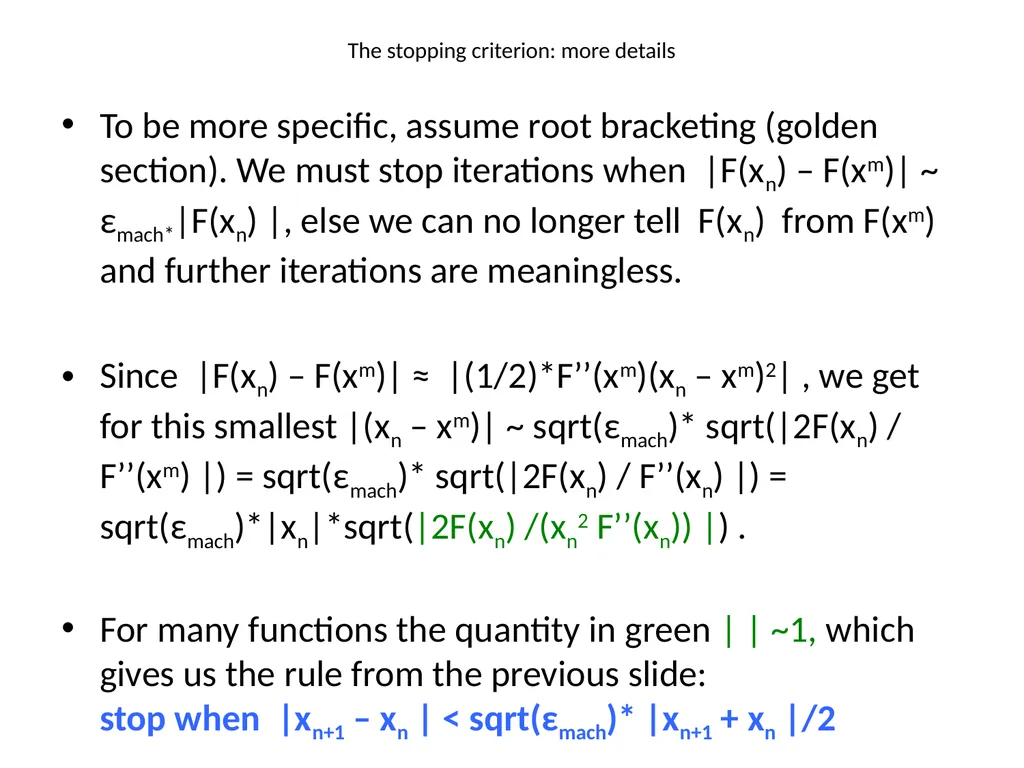
The stopping criterion: more details To be more specific, assume root bracketing (golden section). We must stop iterations when |F(xn) – F(xm)| ~ εmach*|F(xn) |, else we can no longer tell F(xn) from F(xm) and further iterations are meaningless.
Since |F(xn) – F(xm)| ≈ |(1/2)*F’’(xm)(xn – xm)2| , we get for this smallest |(xn – xm)| ~ sqrt(εmach)* sqrt(|2F(xn) / F’’(xm) |) = sqrt(εmach)* sqrt(|2F(xn) / F’’(xn) |) = sqrt(εmach)*|xn|*sqrt(|2F(xn) /(xn2 F’’(xn)) |) .
For many functions the quantity in green | | ~1, which gives us the rule from the previous slide: stop when |xn+1 – xn | < sqrt(εmach)* |xn+1 + xn |/2<br>