
MLA 9th Edition Formatting and Style Guide Purdue
LS
Published · 47 slides · 0 views
1 / 1

Description
MLA 9th Edition Formatting and Style Guide Purdue OWL Staff Brought to you in cooperation with the Purdue Online Writing Lab MLA (Modern Language Association) Style formatting is often used in various humanities disciplines. In addition to
Related Topics
Share
Embed code
Download this presentation From Below
"MLA 9th Edition Formatting and Style Guide Purdue" is the property of its rightful owner. Permission is granted to download and print the materials on this website for personal, non-commercial use only, and to display it on your personal computer provided you do not modify the materials and that you retain all copyright notices contained in the materials. By downloading content from our website, you accept the terms of this agreement.
Presentation Transcript
01
MLA 9th Edition Formatting and Style Guide Purdue OWL Staff
Brought to you in cooperation with the Purdue Online Writing Lab<br>
Brought to you in cooperation with the Purdue Online Writing Lab<br>
02
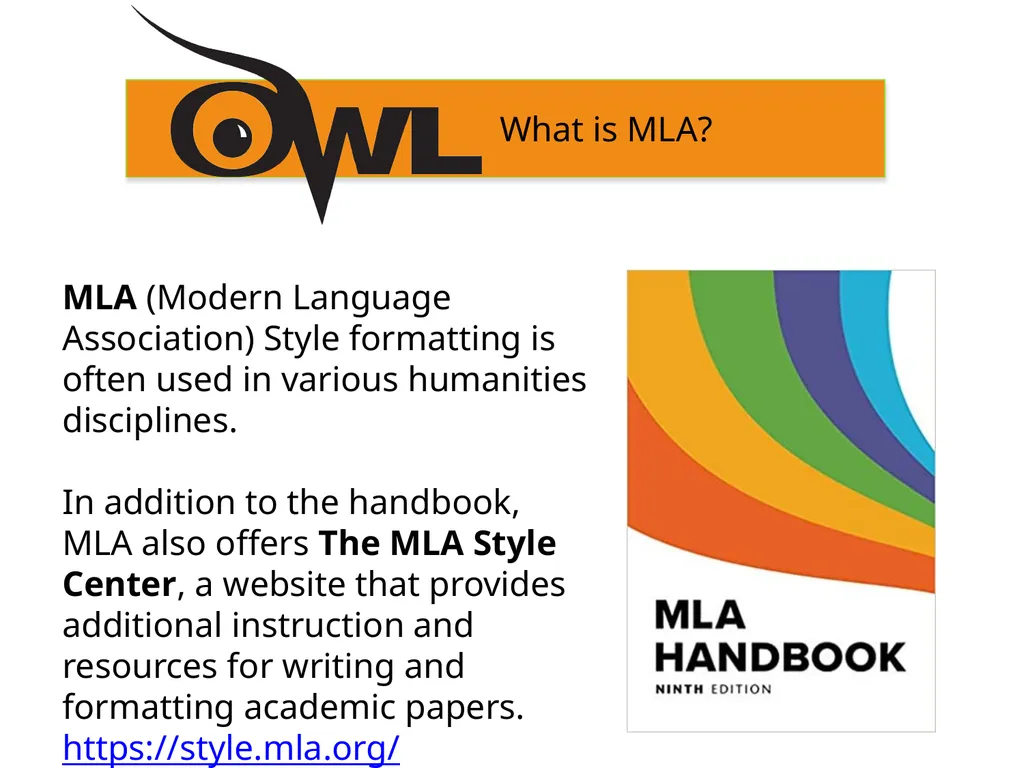
MLA (Modern Language Association) Style formatting is often used in various humanities disciplines.
In addition to the handbook, MLA also offers The MLA Style Center, a website that provides additional instruction and resources for writing and formatting academic papers. https://style.mla.org/<br>
In addition to the handbook, MLA also offers The MLA Style Center, a website that provides additional instruction and resources for writing and formatting academic papers. https://style.mla.org/<br>
03
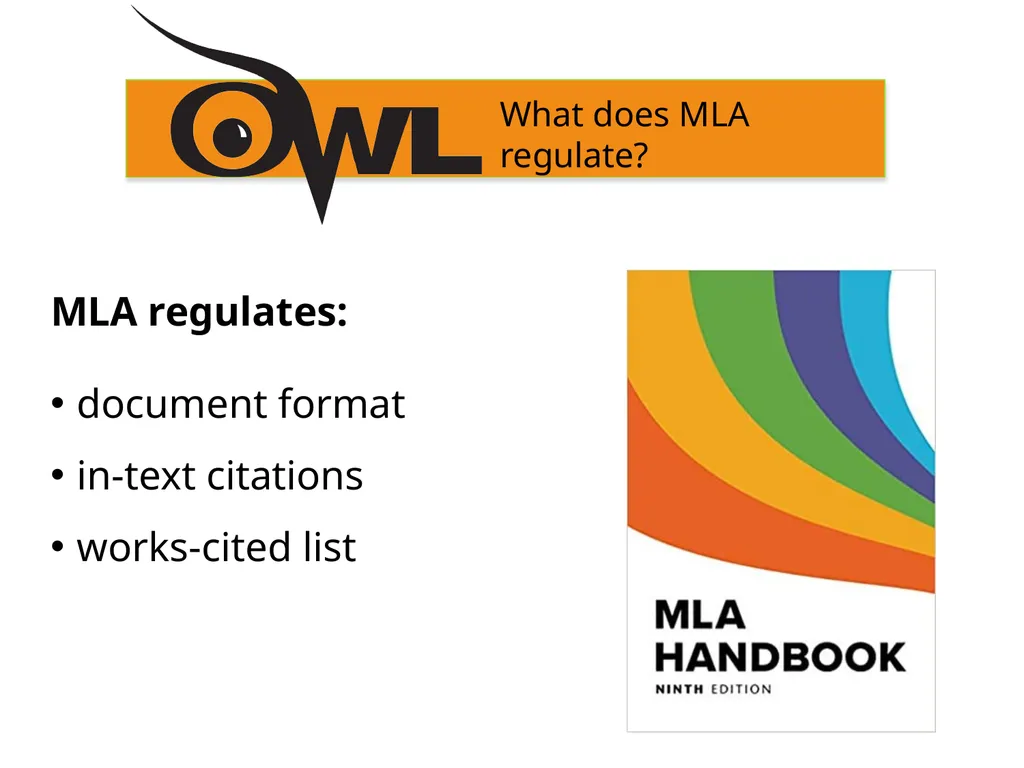
MLA regulates:
document format
in-text citations
works-cited list<br>
document format
in-text citations
works-cited list<br>
04
The 9th edition handbook focuses on clarification, guidance, and expansion on MLA 8’s introduction of core elements for Works Cited through calcification and expansion and meaning of the categories.
The three guiding principles:
Cite simple traits shared by most works.
Remember that there is more than one way to cite the same source.
Make your documentation useful to readers.<br>
The three guiding principles:
Cite simple traits shared by most works.
Remember that there is more than one way to cite the same source.
Make your documentation useful to readers.<br>
05
This presentation will cover:
How to format a paper in MLA style (9th ed.)
General guidelines
First page format
Section headings
In-text citations
Formatting quotations
Documenting sources in MLA style (9th ed.)
Core elements
List of works cited<br>
How to format a paper in MLA style (9th ed.)
General guidelines
First page format
Section headings
In-text citations
Formatting quotations
Documenting sources in MLA style (9th ed.)
Core elements
List of works cited<br>
06
Basic rule for any formatting style:
Always
Follow your instructor’s
guidelines<br>
Always
Follow your instructor’s
guidelines<br>
07
An MLA Style paper should:
Be typed on white 8.5“ x 11“ paper
Double-space everything
Use 12 pt. Times New Roman (or similar) font
Leave only one space after punctuation
Set all margins to 1 inch on all sides
Indent the first line of paragraphs one half-inch<br>
Be typed on white 8.5“ x 11“ paper
Double-space everything
Use 12 pt. Times New Roman (or similar) font
Leave only one space after punctuation
Set all margins to 1 inch on all sides
Indent the first line of paragraphs one half-inch<br>
08
An MLA Style paper should:
Have a header with page numbers located in the upper right-hand corner
Use italics for titles of container works (e.g., books) and quotation marks for sources within containers (e.g., chapters within books)
Place endnotes on a separate page before the list of works cited<br>
Have a header with page numbers located in the upper right-hand corner
Use italics for titles of container works (e.g., books) and quotation marks for sources within containers (e.g., chapters within books)
Place endnotes on a separate page before the list of works cited<br>
09
The first page of an individually-written MLA Style paper will:
Have no title page unless it is a group project
For a group project, list all names of contributors in their own line, followed by the remainder of the MLA 9 header described below
Double space everything
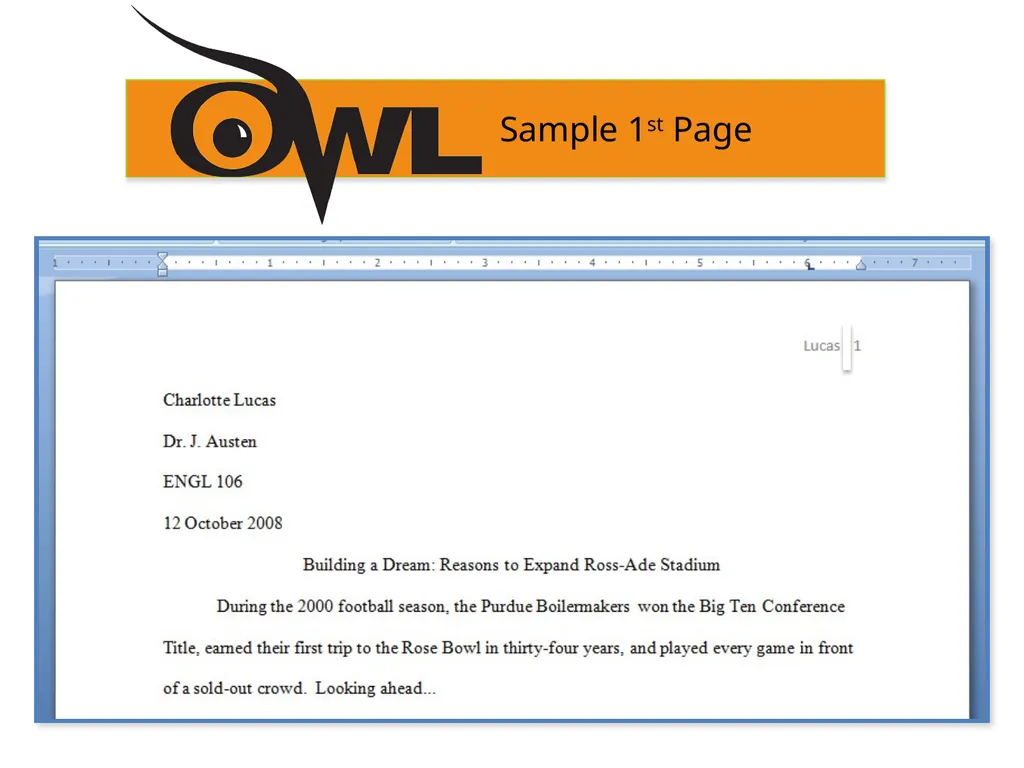
List your name, your instructor's name, the course, and date in the upper left-hand corner
Center the paper title (use standard caps but no underlining, italics, quote marks, or bold typeface)
Create a header in the upper right corner at half inch from the top and one inch from the right of the page (list your last name and page number here)<br>
Have no title page unless it is a group project
For a group project, list all names of contributors in their own line, followed by the remainder of the MLA 9 header described below
Double space everything
List your name, your instructor's name, the course, and date in the upper left-hand corner
Center the paper title (use standard caps but no underlining, italics, quote marks, or bold typeface)
Create a header in the upper right corner at half inch from the top and one inch from the right of the page (list your last name and page number here)<br>
10
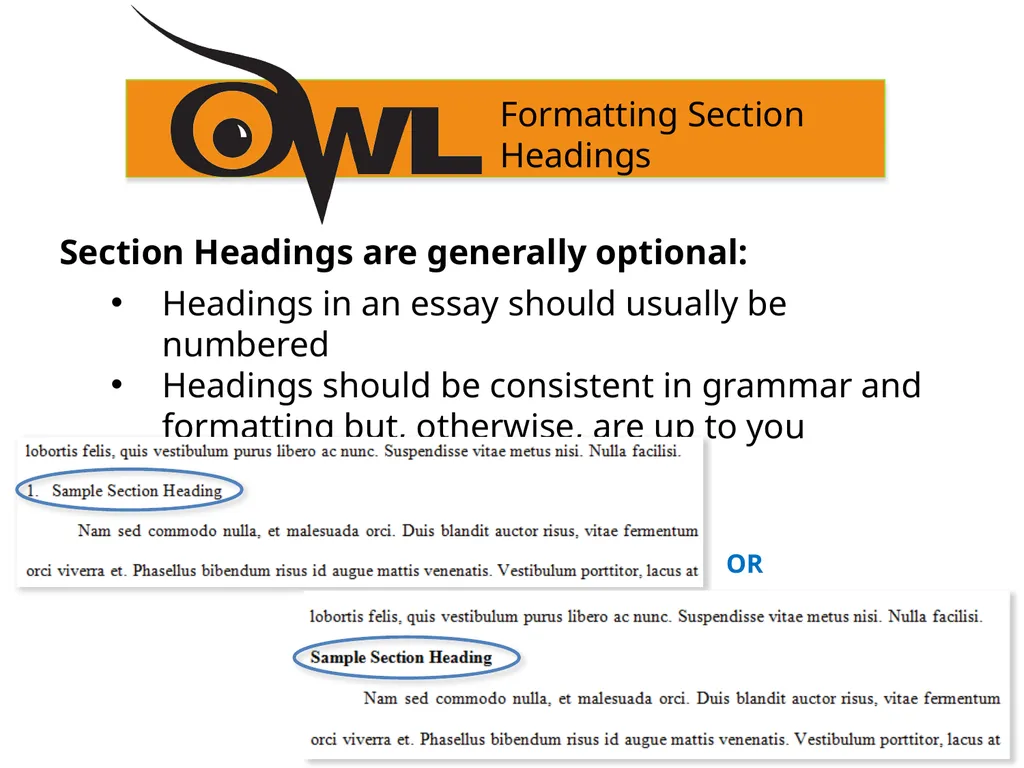
Section Headings are generally optional:
Headings in an essay should usually be numbered
Headings should be consistent in grammar and formatting but, otherwise, are up to you OR<br>
Headings in an essay should usually be numbered
Headings should be consistent in grammar and formatting but, otherwise, are up to you OR<br>
11
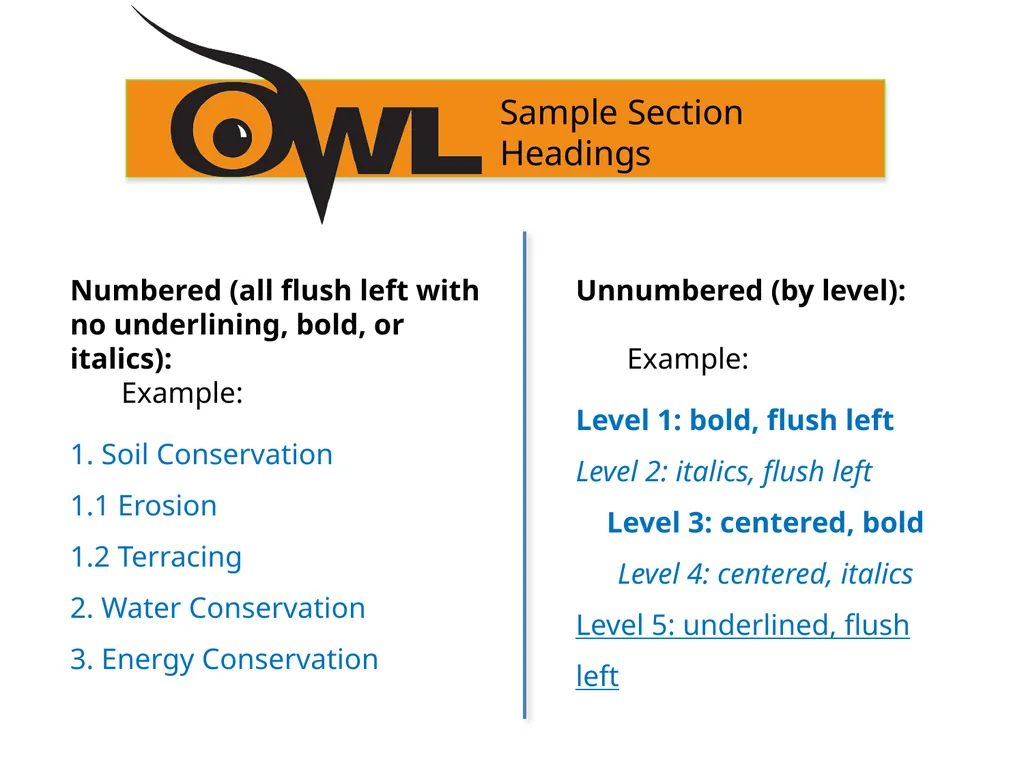
Numbered (all flush left with no underlining, bold, or italics):
Example:
1. Soil Conservation
1.1 Erosion
1.2 Terracing
2. Water Conservation
3. Energy Conservation Unnumbered (by level):
Example:
Level 1: bold, flush left
Level 2: italics, flush left
Level 3: centered, bold
Level 4: centered, italics
Level 5: underlined, flush left<br>
Example:
1. Soil Conservation
1.1 Erosion
1.2 Terracing
2. Water Conservation
3. Energy Conservation Unnumbered (by level):
Example:
Level 1: bold, flush left
Level 2: italics, flush left
Level 3: centered, bold
Level 4: centered, italics
Level 5: underlined, flush left<br>
12
An in-text citation is a brief reference in your text that indicates the source you consulted.
It should direct readers to the entry in your works-cited list for that source.
It should be unobtrusive: provide the citation information without interrupting your own text.
In general, the in-text citation will be the author’s last name (or abbreviated title) with a page number, enclosed in parentheses.<br>
It should direct readers to the entry in your works-cited list for that source.
It should be unobtrusive: provide the citation information without interrupting your own text.
In general, the in-text citation will be the author’s last name (or abbreviated title) with a page number, enclosed in parentheses.<br>
13
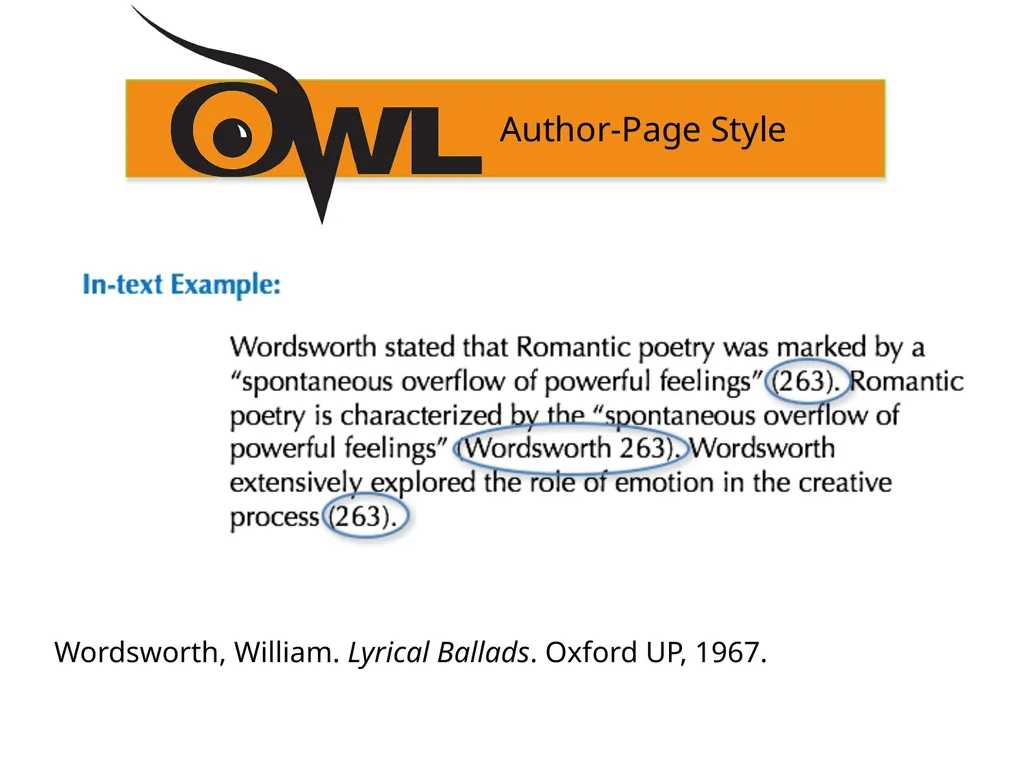
Wordsworth, William. Lyrical Ballads. Oxford UP, 1967.<br>
14
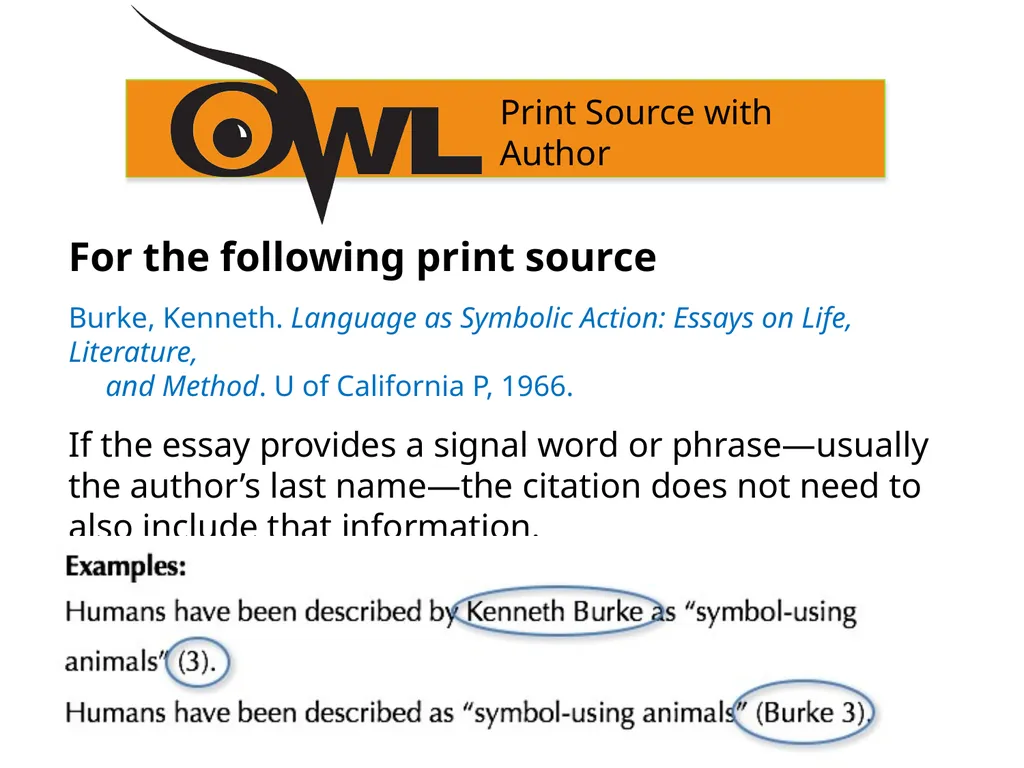
For the following print source
Burke, Kenneth. Language as Symbolic Action: Essays on Life, Literature,
and Method. U of California P, 1966.
If the essay provides a signal word or phrase—usually the author’s last name—the citation does not need to also include that information.<br>
Burke, Kenneth. Language as Symbolic Action: Essays on Life, Literature,
and Method. U of California P, 1966.
If the essay provides a signal word or phrase—usually the author’s last name—the citation does not need to also include that information.<br>
15
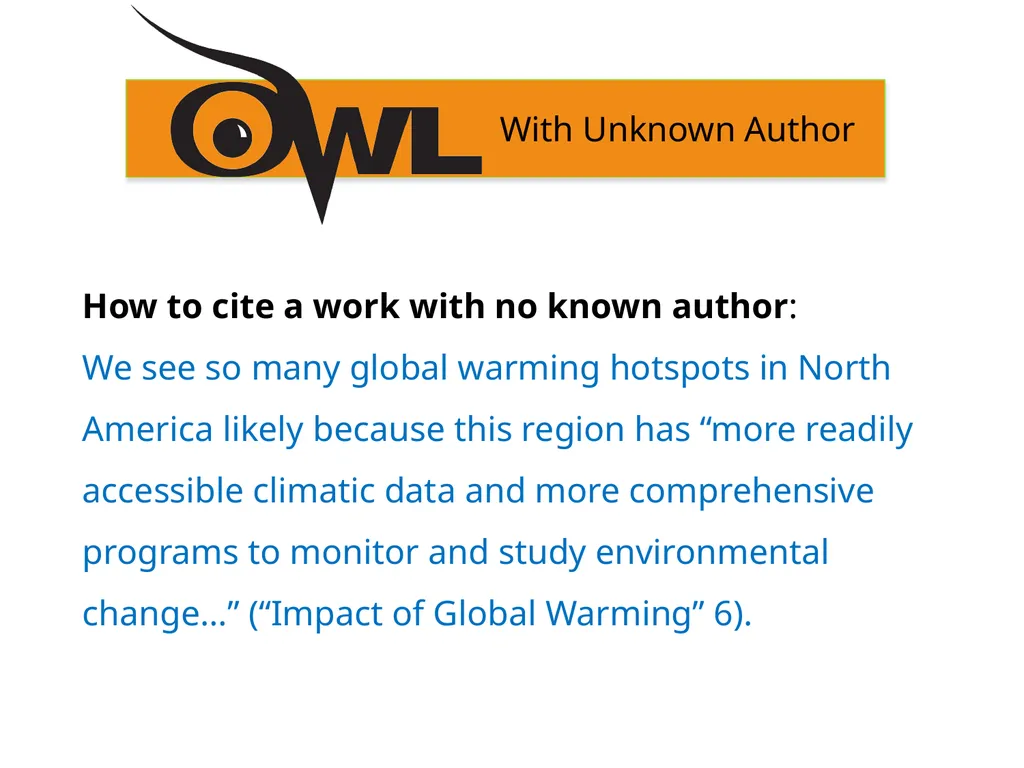
How to cite a work with no known author:
We see so many global warming hotspots in North America likely because this region has “more readily accessible climatic data and more comprehensive programs to monitor and study environmental change…” (“Impact of Global Warming” 6).<br>
We see so many global warming hotspots in North America likely because this region has “more readily accessible climatic data and more comprehensive programs to monitor and study environmental change…” (“Impact of Global Warming” 6).<br>
16
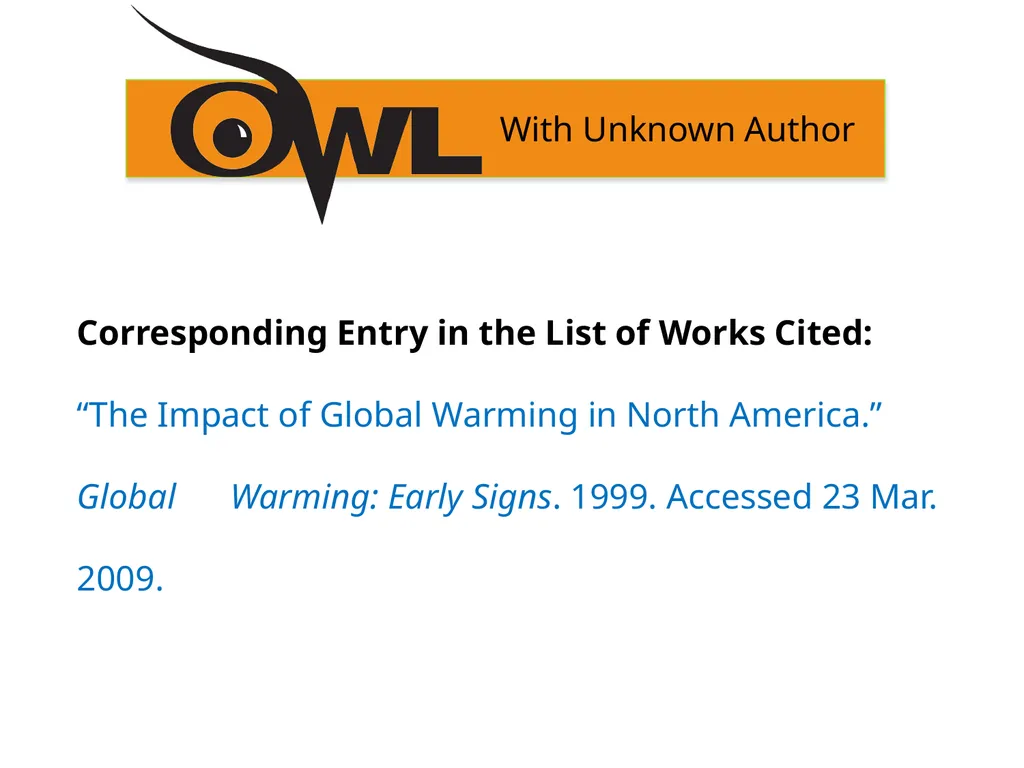
Corresponding Entry in the List of Works Cited:
“The Impact of Global Warming in North America.” Global Warming: Early Signs. 1999. Accessed 23 Mar. 2009.<br>
“The Impact of Global Warming in North America.” Global Warming: Early Signs. 1999. Accessed 23 Mar. 2009.<br>
17
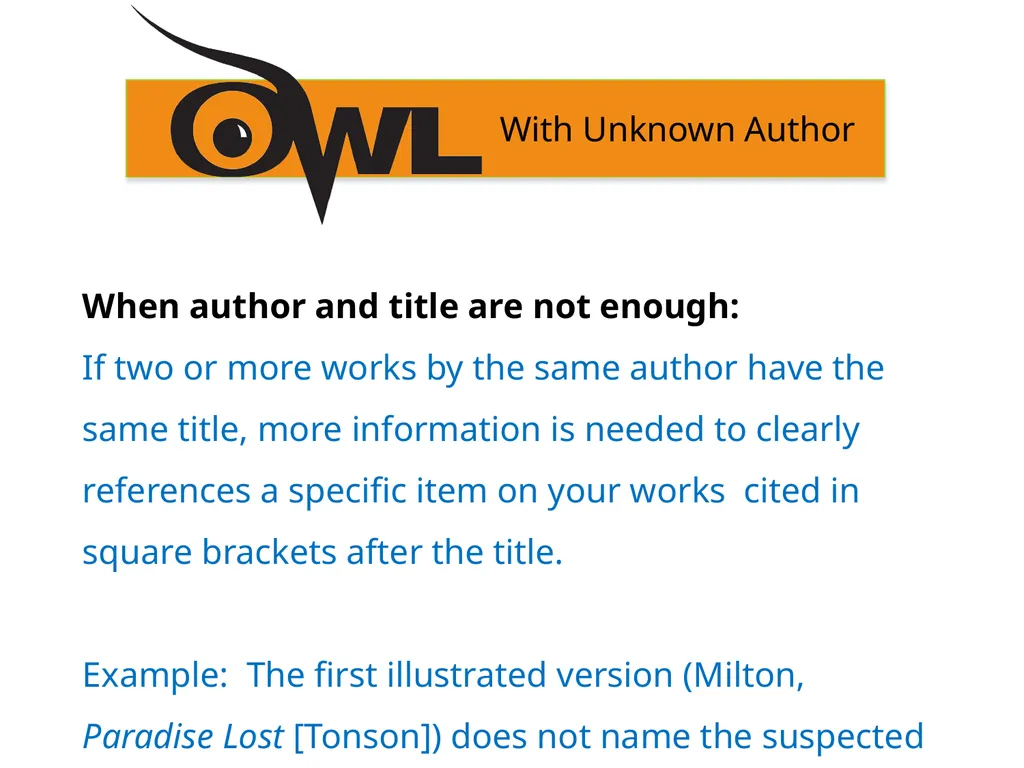
When author and title are not enough:
If two or more works by the same author have the same title, more information is needed to clearly references a specific item on your works cited in square brackets after the title.
Example: The first illustrated version (Milton, Paradise Lost [Tonson]) does not name the suspected four illustrators that contributed.<br>
If two or more works by the same author have the same title, more information is needed to clearly references a specific item on your works cited in square brackets after the title.
Example: The first illustrated version (Milton, Paradise Lost [Tonson]) does not name the suspected four illustrators that contributed.<br>
18
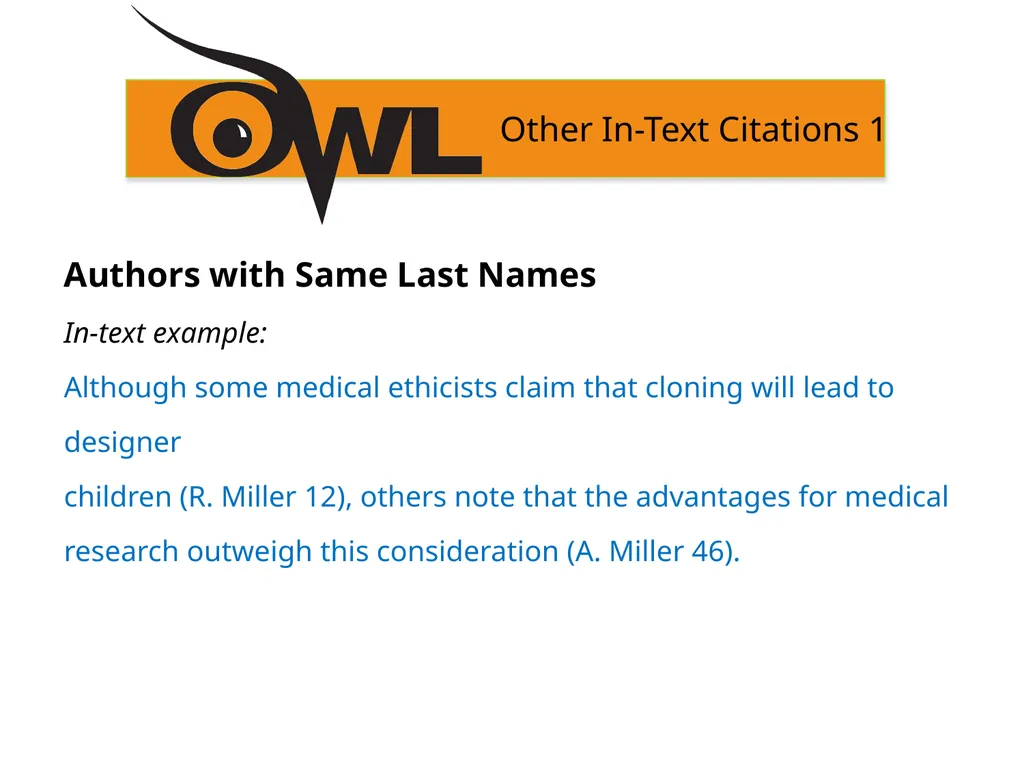
Authors with Same Last Names
In-text example:
Although some medical ethicists claim that cloning will lead to designer
children (R. Miller 12), others note that the advantages for medical research outweigh this consideration (A. Miller 46).<br>
In-text example:
Although some medical ethicists claim that cloning will lead to designer
children (R. Miller 12), others note that the advantages for medical research outweigh this consideration (A. Miller 46).<br>
19
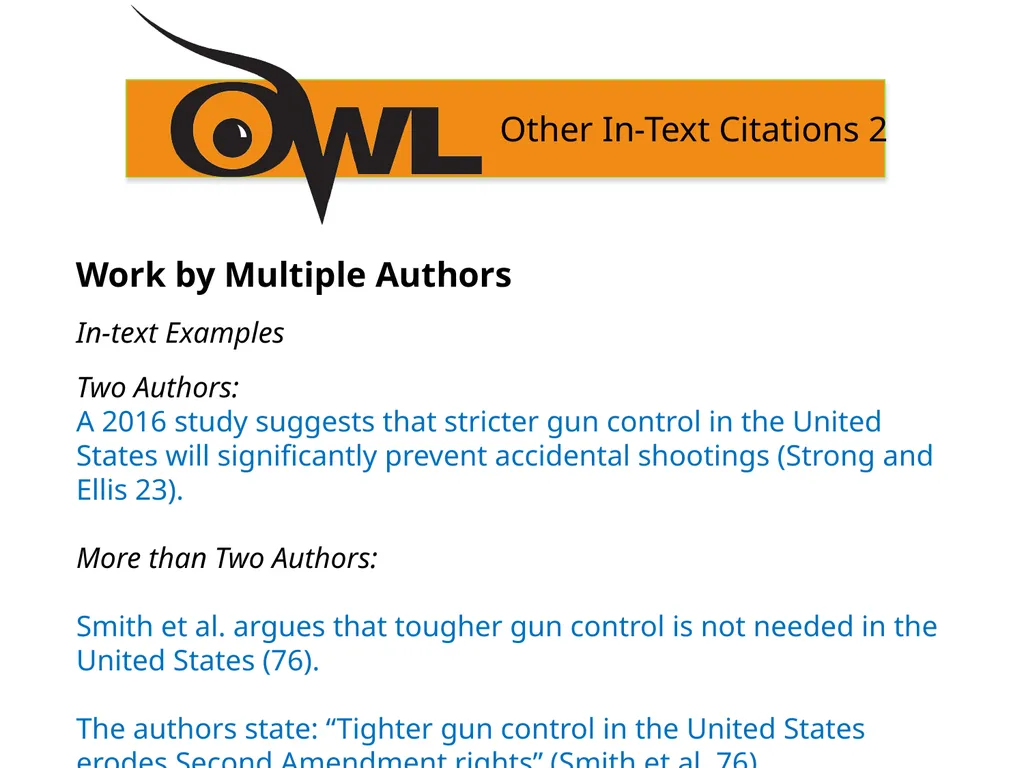
Work by Multiple Authors
In-text Examples
Two Authors:
A 2016 study suggests that stricter gun control in the United States will significantly prevent accidental shootings (Strong and Ellis 23).
More than Two Authors:
Smith et al. argues that tougher gun control is not needed in the United States (76).
The authors state: “Tighter gun control in the United States erodes Second Amendment rights” (Smith et al. 76).<br>
In-text Examples
Two Authors:
A 2016 study suggests that stricter gun control in the United States will significantly prevent accidental shootings (Strong and Ellis 23).
More than Two Authors:
Smith et al. argues that tougher gun control is not needed in the United States (76).
The authors state: “Tighter gun control in the United States erodes Second Amendment rights” (Smith et al. 76).<br>
20
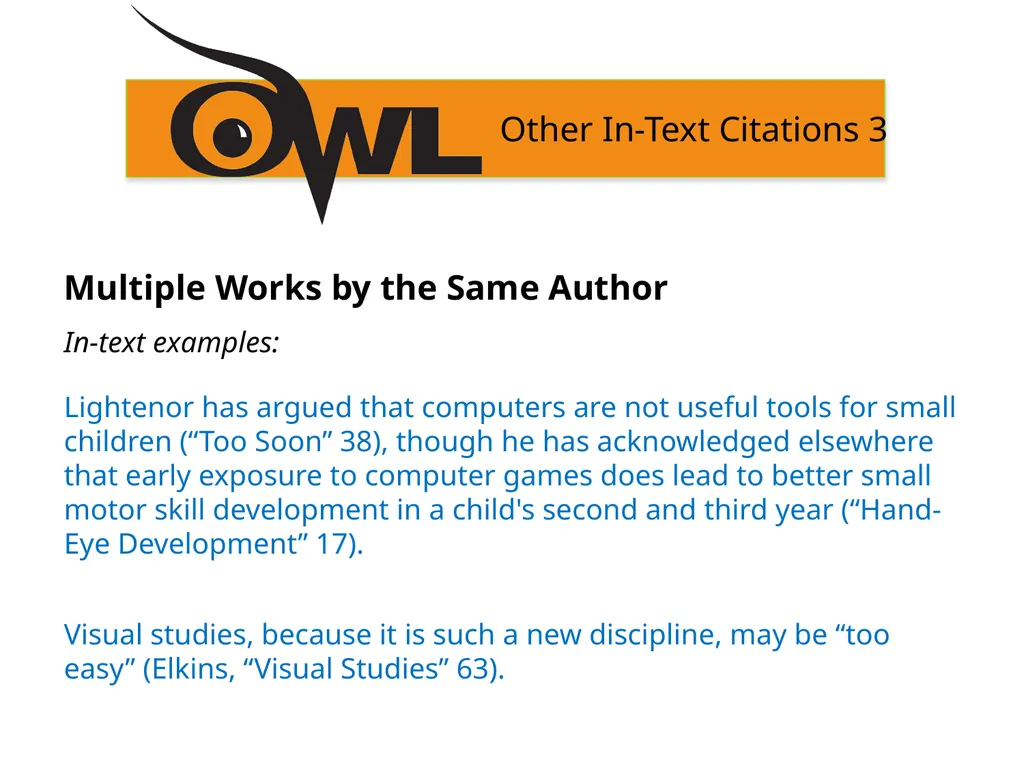
Multiple Works by the Same Author
In-text examples:
Lightenor has argued that computers are not useful tools for small children (“Too Soon” 38), though he has acknowledged elsewhere that early exposure to computer games does lead to better small motor skill development in a child's second and third year (“Hand-Eye Development” 17).
Visual studies, because it is such a new discipline, may be “too easy” (Elkins, “Visual Studies” 63).<br>
In-text examples:
Lightenor has argued that computers are not useful tools for small children (“Too Soon” 38), though he has acknowledged elsewhere that early exposure to computer games does lead to better small motor skill development in a child's second and third year (“Hand-Eye Development” 17).
Visual studies, because it is such a new discipline, may be “too easy” (Elkins, “Visual Studies” 63).<br>
21
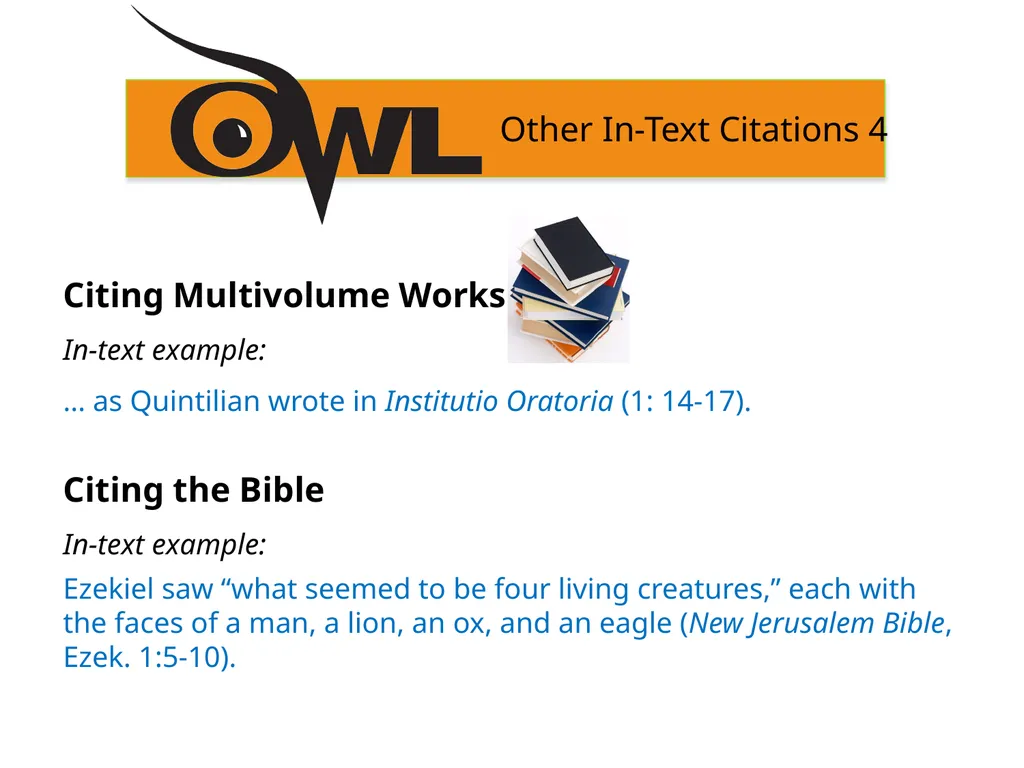
Citing Multivolume Works
In-text example:
… as Quintilian wrote in Institutio Oratoria (1: 14-17).
Citing the Bible
In-text example:
Ezekiel saw “what seemed to be four living creatures,” each with the faces of a man, a lion, an ox, and an eagle (New Jerusalem Bible, Ezek. 1:5-10).<br>
In-text example:
… as Quintilian wrote in Institutio Oratoria (1: 14-17).
Citing the Bible
In-text example:
Ezekiel saw “what seemed to be four living creatures,” each with the faces of a man, a lion, an ox, and an eagle (New Jerusalem Bible, Ezek. 1:5-10).<br>
22
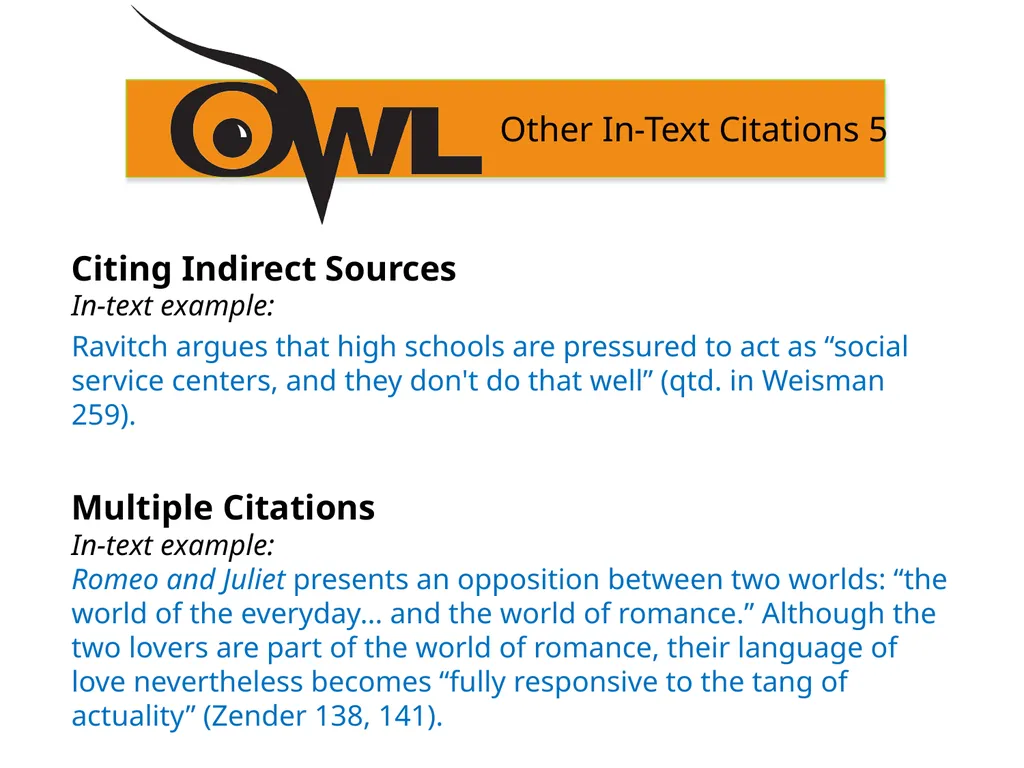
Citing Indirect Sources
In-text example:
Ravitch argues that high schools are pressured to act as “social service centers, and they don't do that well” (qtd. in Weisman 259).
Multiple Citations
In-text example:
Romeo and Juliet presents an opposition between two worlds: “the world of the everyday… and the world of romance.” Although the two lovers are part of the world of romance, their language of love nevertheless becomes “fully responsive to the tang of actuality” (Zender 138, 141).<br>
In-text example:
Ravitch argues that high schools are pressured to act as “social service centers, and they don't do that well” (qtd. in Weisman 259).
Multiple Citations
In-text example:
Romeo and Juliet presents an opposition between two worlds: “the world of the everyday… and the world of romance.” Although the two lovers are part of the world of romance, their language of love nevertheless becomes “fully responsive to the tang of actuality” (Zender 138, 141).<br>
23
Works in time-based media
In-text example:
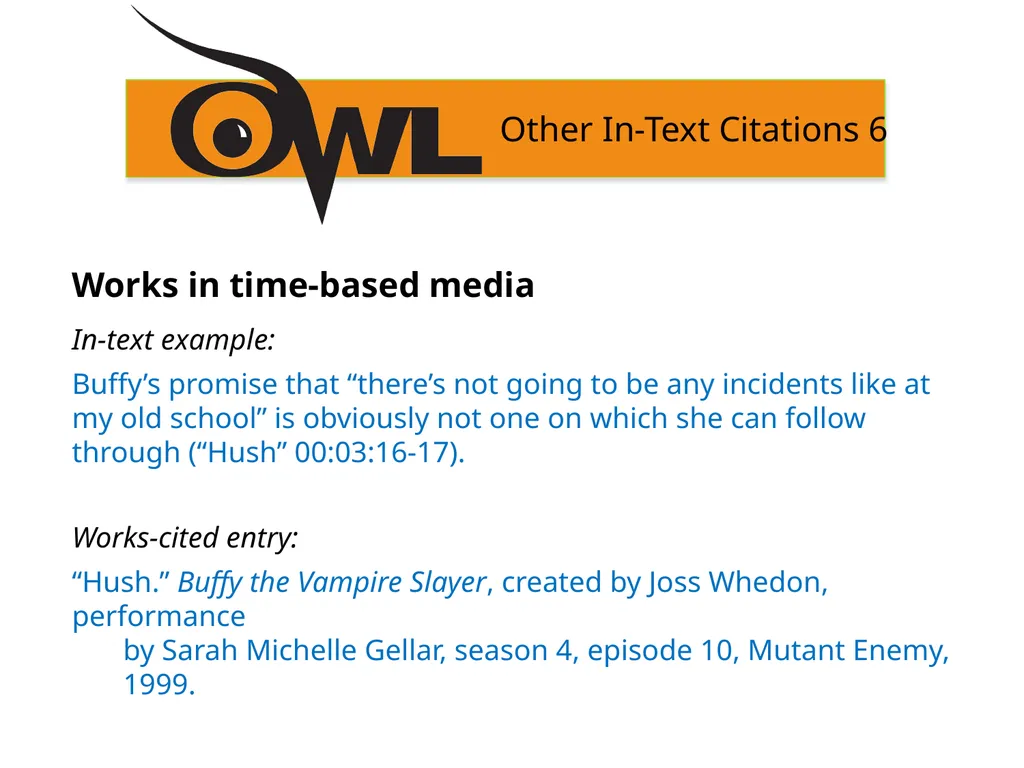
Buffy’s promise that “there’s not going to be any incidents like at my old school” is obviously not one on which she can follow through (“Hush” 00:03:16-17).
Works-cited entry:
“Hush.” Buffy the Vampire Slayer, created by Joss Whedon, performance
by Sarah Michelle Gellar, season 4, episode 10, Mutant Enemy, 1999.<br>
In-text example:
Buffy’s promise that “there’s not going to be any incidents like at my old school” is obviously not one on which she can follow through (“Hush” 00:03:16-17).
Works-cited entry:
“Hush.” Buffy the Vampire Slayer, created by Joss Whedon, performance
by Sarah Michelle Gellar, season 4, episode 10, Mutant Enemy, 1999.<br>
24
Sources without page numbers
In-text example:
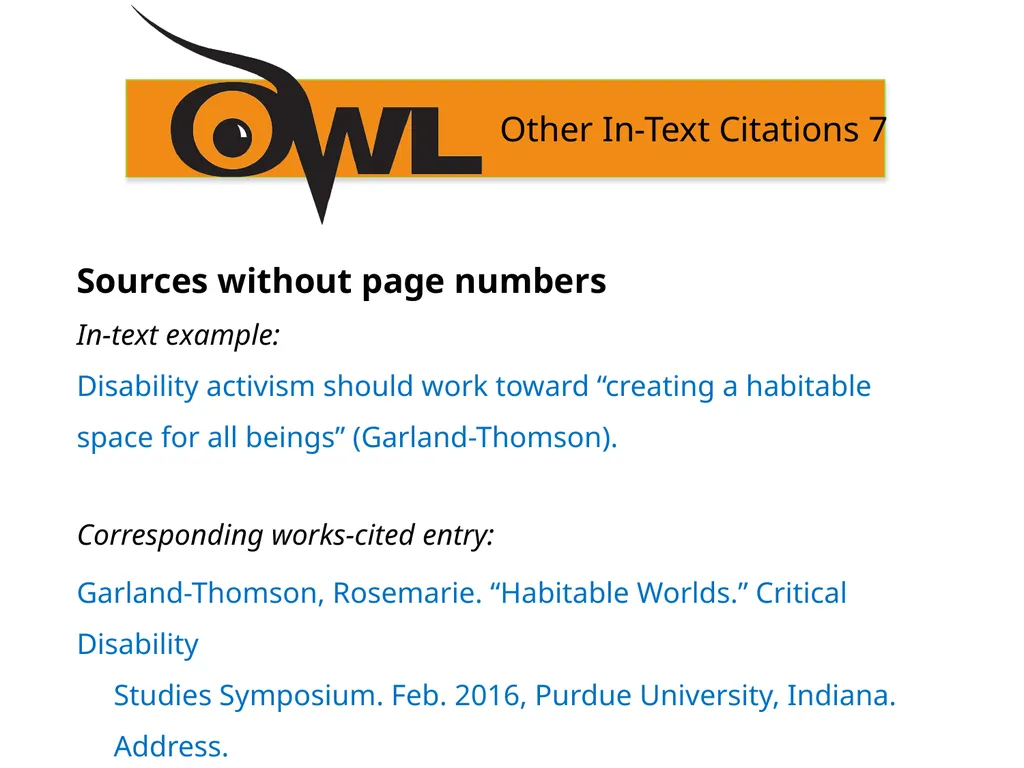
Disability activism should work toward “creating a habitable space for all beings” (Garland-Thomson).
Corresponding works-cited entry:
Garland-Thomson, Rosemarie. “Habitable Worlds.” Critical Disability
Studies Symposium. Feb. 2016, Purdue University, Indiana.
Address.<br>
In-text example:
Disability activism should work toward “creating a habitable space for all beings” (Garland-Thomson).
Corresponding works-cited entry:
Garland-Thomson, Rosemarie. “Habitable Worlds.” Critical Disability
Studies Symposium. Feb. 2016, Purdue University, Indiana.
Address.<br>
25
Sources without page numbers
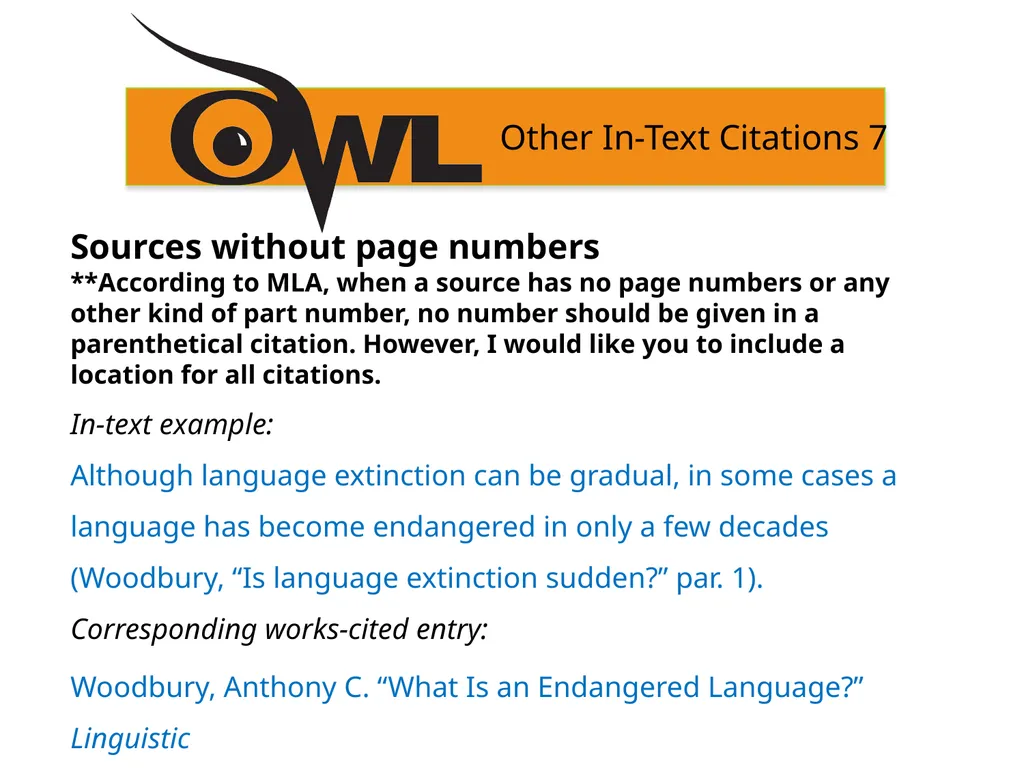
**According to MLA, when a source has no page numbers or any other kind of part number, no number should be given in a parenthetical citation. However, I would like you to include a location for all citations.
In-text example:
Although language extinction can be gradual, in some cases a language has become endangered in only a few decades (Woodbury, “Is language extinction sudden?” par. 1).
Corresponding works-cited entry:
Woodbury, Anthony C. “What Is an Endangered Language?” Linguistic
Society of America, 2021, www.linguisticsociety.org/resource/faq-what-
endangered-language.<br>
**According to MLA, when a source has no page numbers or any other kind of part number, no number should be given in a parenthetical citation. However, I would like you to include a location for all citations.
In-text example:
Although language extinction can be gradual, in some cases a language has become endangered in only a few decades (Woodbury, “Is language extinction sudden?” par. 1).
Corresponding works-cited entry:
Woodbury, Anthony C. “What Is an Endangered Language?” Linguistic
Society of America, 2021, www.linguisticsociety.org/resource/faq-what-
endangered-language.<br>
26
Short prose quotations
In-text example:
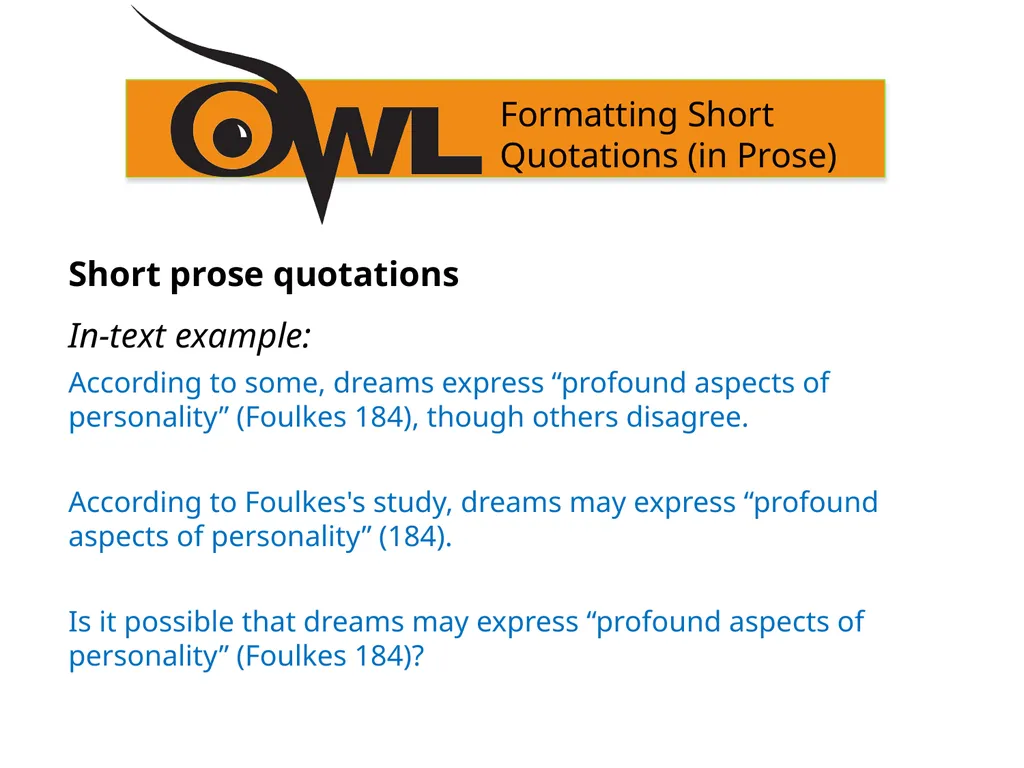
According to some, dreams express “profound aspects of personality” (Foulkes 184), though others disagree.
According to Foulkes's study, dreams may express “profound aspects of personality” (184).
Is it possible that dreams may express “profound aspects of personality” (Foulkes 184)?<br>
In-text example:
According to some, dreams express “profound aspects of personality” (Foulkes 184), though others disagree.
According to Foulkes's study, dreams may express “profound aspects of personality” (184).
Is it possible that dreams may express “profound aspects of personality” (Foulkes 184)?<br>
27
Quoting more than four lines of prose
In-text example:
Nelly Dean treats Heathcliff poorly and dehumanizes him throughout her narration:
They entirely refused to have it in bed with them, or even in their room, and I had no more sense, so, I put it on the landing of the stairs, hoping it would be gone on the morrow. By chance, or else attracted by hearing his voice, it crept to Mr. Earnshaw's door, and there he found it on quitting his chamber. Inquiries were made as to how it got there; I was obliged to confess, and in recompense for my cowardice and inhumanity was sent out of the house. (Bronte 78) **Avoid unnecessary use of block quotations. Paraphrase information whenever possible to demonstrate understanding of the information. A paper should consist of NO MORE than 15% quoted material. Excessive quoting is a sign that the writer does not understand the material.<br>
In-text example:
Nelly Dean treats Heathcliff poorly and dehumanizes him throughout her narration:
They entirely refused to have it in bed with them, or even in their room, and I had no more sense, so, I put it on the landing of the stairs, hoping it would be gone on the morrow. By chance, or else attracted by hearing his voice, it crept to Mr. Earnshaw's door, and there he found it on quitting his chamber. Inquiries were made as to how it got there; I was obliged to confess, and in recompense for my cowardice and inhumanity was sent out of the house. (Bronte 78) **Avoid unnecessary use of block quotations. Paraphrase information whenever possible to demonstrate understanding of the information. A paper should consist of NO MORE than 15% quoted material. Excessive quoting is a sign that the writer does not understand the material.<br>
28
Quoting 1-3 lines of poetry
Examples:
Properzia Rossi tells the statue that it will be a container for her feelings: “The bright work grows / Beneath my hand, unfolding, as a rose” (lines 31-32).
In “The Thorn,” Wordsworth’s narrator locates feelings of horror in the landscape: “The little babe was buried there, / Beneath that hill of moss so fair. // I’ve heard the scarlet moss is red” (stanzas xx-xxi).<br>
Examples:
Properzia Rossi tells the statue that it will be a container for her feelings: “The bright work grows / Beneath my hand, unfolding, as a rose” (lines 31-32).
In “The Thorn,” Wordsworth’s narrator locates feelings of horror in the landscape: “The little babe was buried there, / Beneath that hill of moss so fair. // I’ve heard the scarlet moss is red” (stanzas xx-xxi).<br>
29
Use block quotations for three or more lines of poetry.
If the poem is formatted in an unusual way, reproduce the unique formatting as accurately as possible.<br>
If the poem is formatted in an unusual way, reproduce the unique formatting as accurately as possible.<br>
30
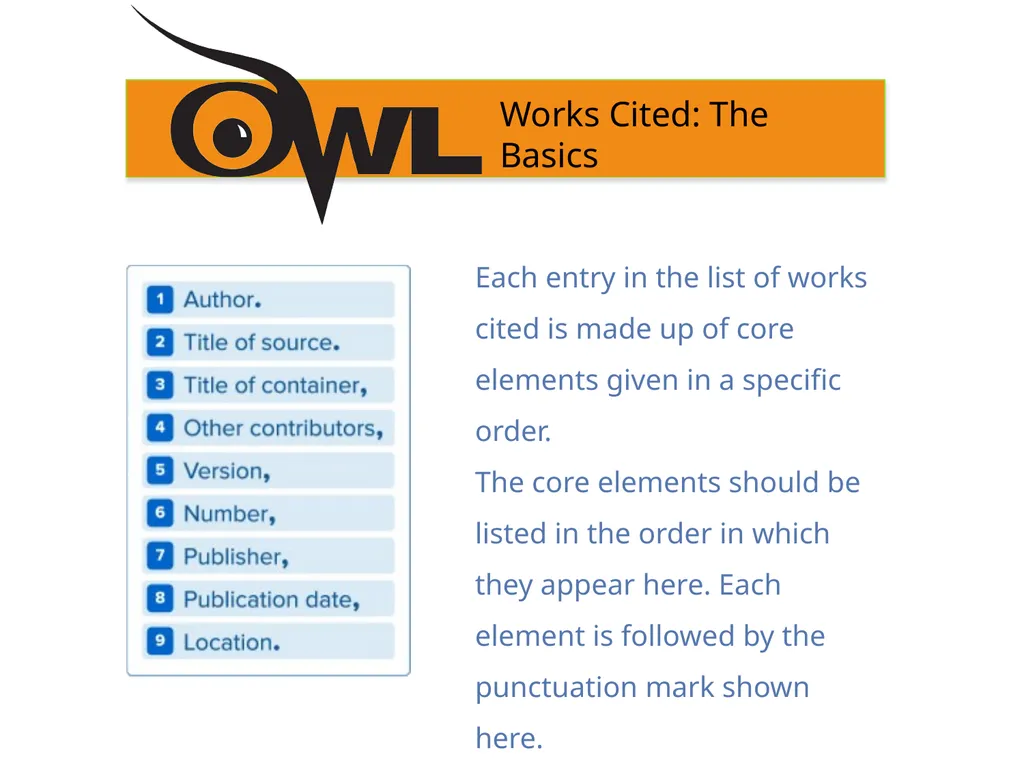
Each entry in the list of works cited is made up of core elements given in a specific order.
The core elements should be listed in the order in which they appear here. Each element is followed by the punctuation mark shown here.<br>
The core elements should be listed in the order in which they appear here. Each element is followed by the punctuation mark shown here.<br>
31
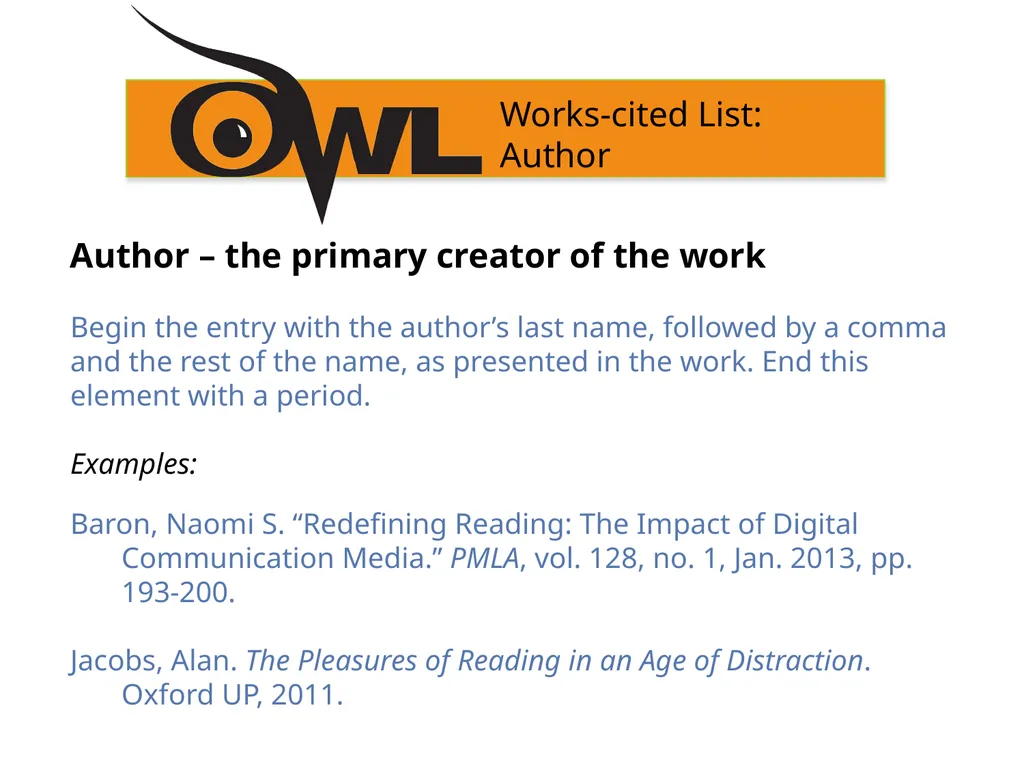
Author – the primary creator of the work
Begin the entry with the author’s last name, followed by a comma and the rest of the name, as presented in the work. End this element with a period.
Examples: Baron, Naomi S. “Redefining Reading: The Impact of Digital Communication Media.” PMLA, vol. 128, no. 1, Jan. 2013, pp. 193-200.
Jacobs, Alan. The Pleasures of Reading in an Age of Distraction. Oxford UP, 2011.<br>
Begin the entry with the author’s last name, followed by a comma and the rest of the name, as presented in the work. End this element with a period.
Examples: Baron, Naomi S. “Redefining Reading: The Impact of Digital Communication Media.” PMLA, vol. 128, no. 1, Jan. 2013, pp. 193-200.
Jacobs, Alan. The Pleasures of Reading in an Age of Distraction. Oxford UP, 2011.<br>
32
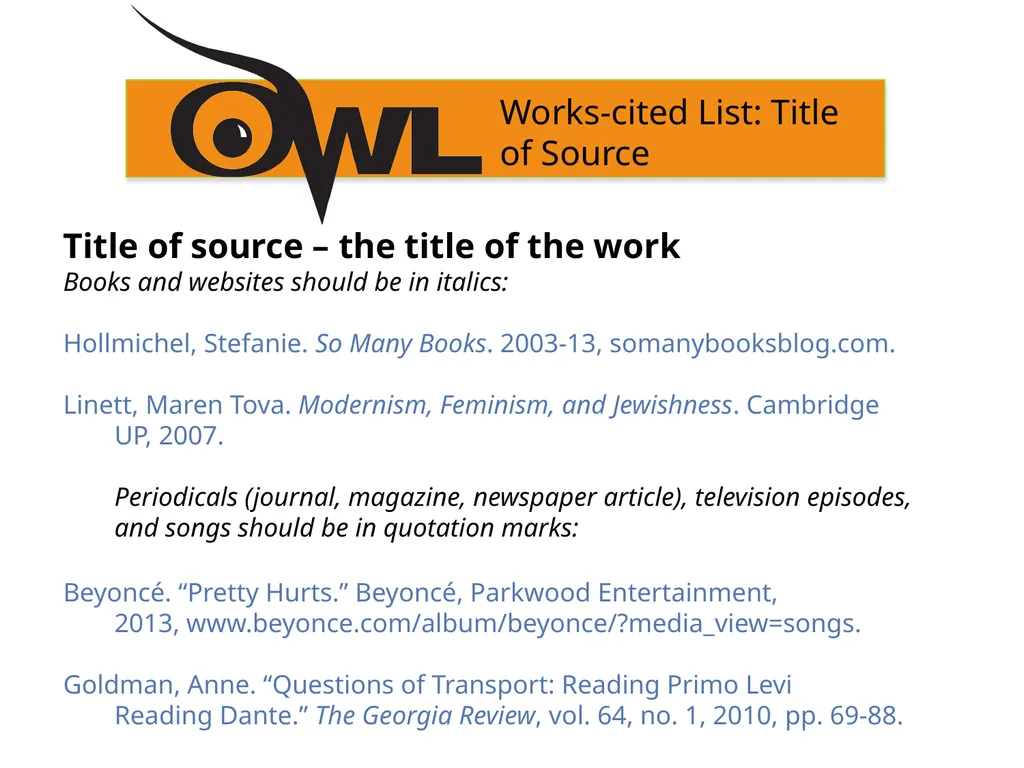
Title of source – the title of the work
Books and websites should be in italics:
Hollmichel, Stefanie. So Many Books. 2003-13, somanybooksblog.com.
Linett, Maren Tova. Modernism, Feminism, and Jewishness. Cambridge UP, 2007.
Periodicals (journal, magazine, newspaper article), television episodes, and songs should be in quotation marks:
Beyoncé. “Pretty Hurts.” Beyoncé, Parkwood Entertainment, 2013, www.beyonce.com/album/beyonce/?media_view=songs.
Goldman, Anne. “Questions of Transport: Reading Primo Levi Reading Dante.” The Georgia Review, vol. 64, no. 1, 2010, pp. 69-88.<br>
Books and websites should be in italics:
Hollmichel, Stefanie. So Many Books. 2003-13, somanybooksblog.com.
Linett, Maren Tova. Modernism, Feminism, and Jewishness. Cambridge UP, 2007.
Periodicals (journal, magazine, newspaper article), television episodes, and songs should be in quotation marks:
Beyoncé. “Pretty Hurts.” Beyoncé, Parkwood Entertainment, 2013, www.beyonce.com/album/beyonce/?media_view=songs.
Goldman, Anne. “Questions of Transport: Reading Primo Levi Reading Dante.” The Georgia Review, vol. 64, no. 1, 2010, pp. 69-88.<br>
33
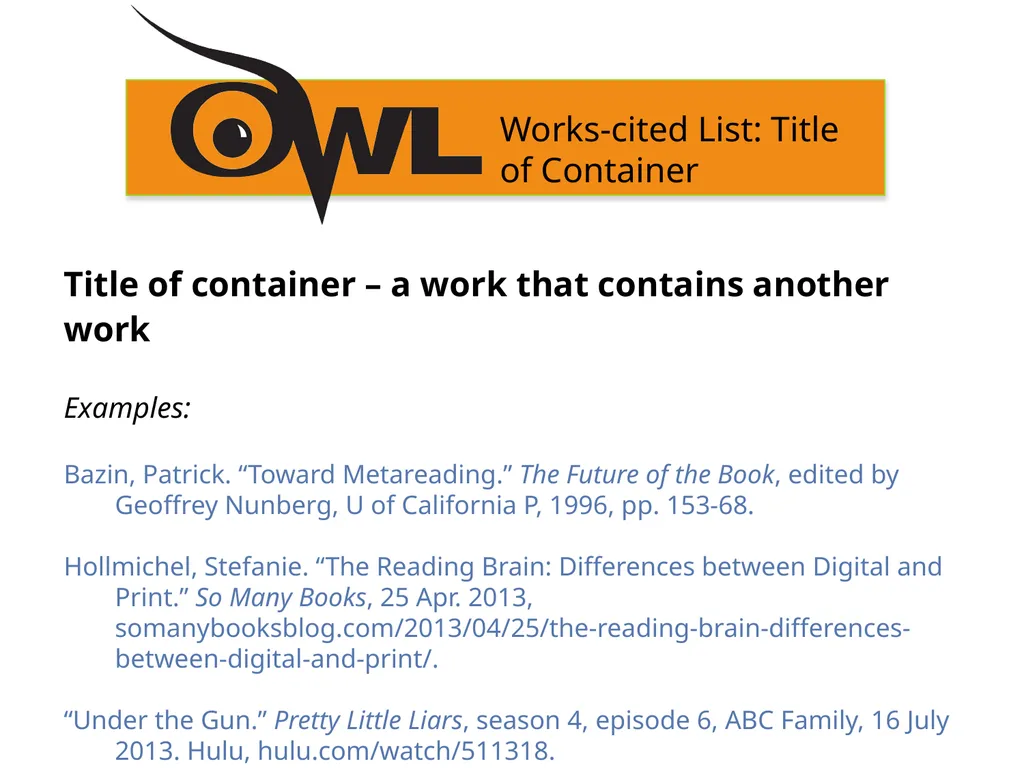
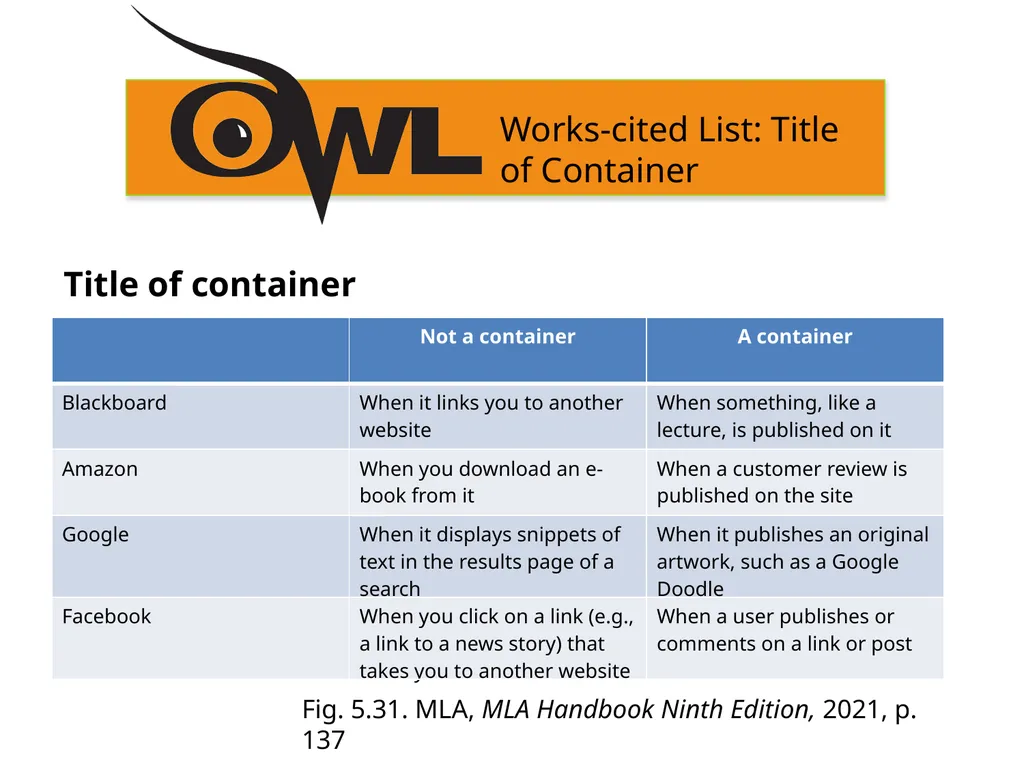
Title of container – a work that contains another work
Examples:
Bazin, Patrick. “Toward Metareading.” The Future of the Book, edited by Geoffrey Nunberg, U of California P, 1996, pp. 153-68.
Hollmichel, Stefanie. “The Reading Brain: Differences between Digital and Print.” So Many Books, 25 Apr. 2013, somanybooksblog.com/2013/04/25/the-reading-brain-differences-between-digital-and-print/.
“Under the Gun.” Pretty Little Liars, season 4, episode 6, ABC Family, 16 July 2013. Hulu, hulu.com/watch/511318.<br>
Examples:
Bazin, Patrick. “Toward Metareading.” The Future of the Book, edited by Geoffrey Nunberg, U of California P, 1996, pp. 153-68.
Hollmichel, Stefanie. “The Reading Brain: Differences between Digital and Print.” So Many Books, 25 Apr. 2013, somanybooksblog.com/2013/04/25/the-reading-brain-differences-between-digital-and-print/.
“Under the Gun.” Pretty Little Liars, season 4, episode 6, ABC Family, 16 July 2013. Hulu, hulu.com/watch/511318.<br>
34
Title of container Fig. 5.31. MLA, MLA Handbook Ninth Edition, 2021, p. 137<br>
35
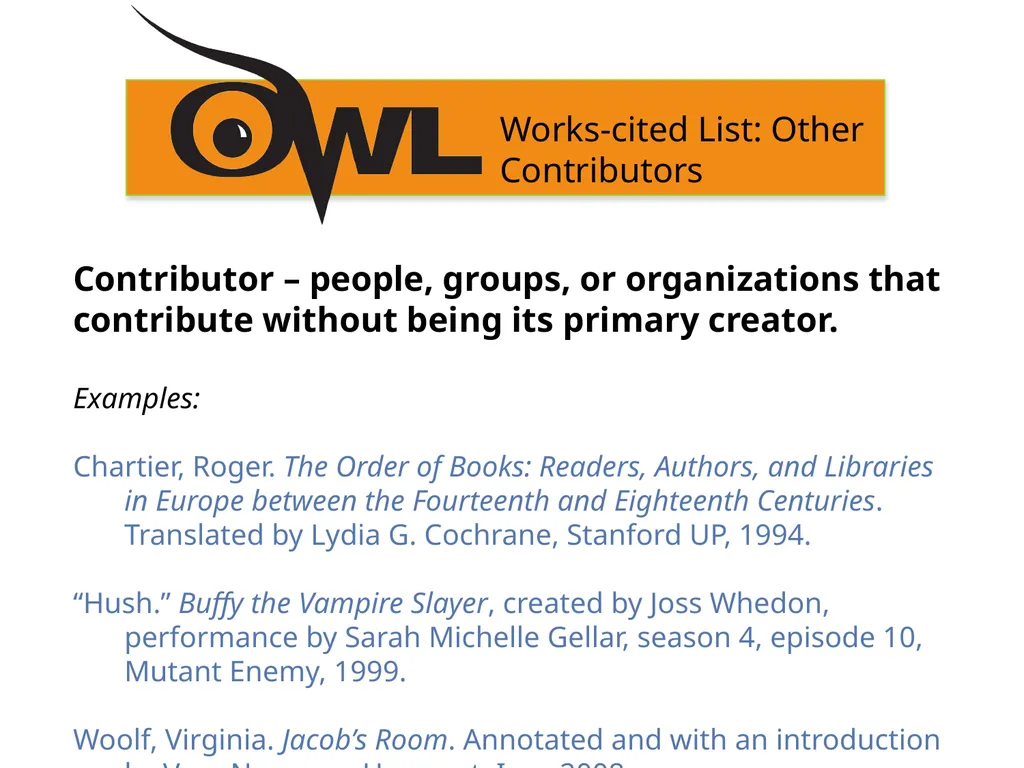
Contributor – people, groups, or organizations that contribute without being its primary creator.
Examples:
Chartier, Roger. The Order of Books: Readers, Authors, and Libraries in Europe between the Fourteenth and Eighteenth Centuries. Translated by Lydia G. Cochrane, Stanford UP, 1994.
“Hush.” Buffy the Vampire Slayer, created by Joss Whedon, performance by Sarah Michelle Gellar, season 4, episode 10, Mutant Enemy, 1999.
Woolf, Virginia. Jacob’s Room. Annotated and with an introduction by Vara Neverow, Harcourt, Inc., 2008.<br>
Examples:
Chartier, Roger. The Order of Books: Readers, Authors, and Libraries in Europe between the Fourteenth and Eighteenth Centuries. Translated by Lydia G. Cochrane, Stanford UP, 1994.
“Hush.” Buffy the Vampire Slayer, created by Joss Whedon, performance by Sarah Michelle Gellar, season 4, episode 10, Mutant Enemy, 1999.
Woolf, Virginia. Jacob’s Room. Annotated and with an introduction by Vara Neverow, Harcourt, Inc., 2008.<br>
36
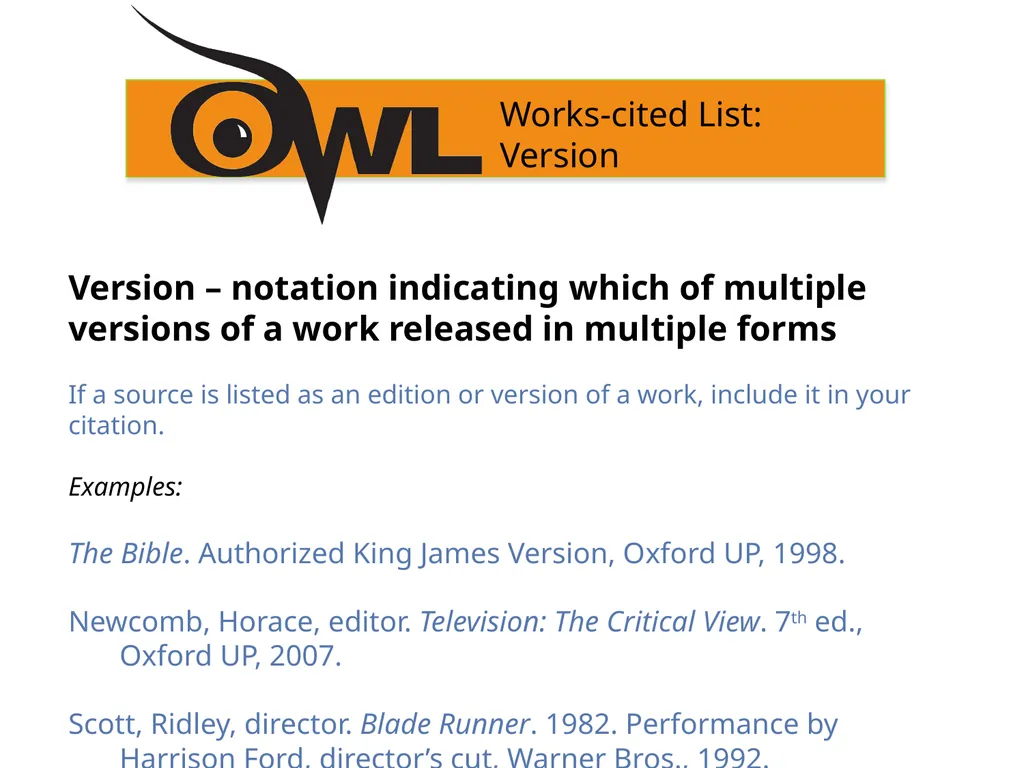
Version – notation indicating which of multiple versions of a work released in multiple forms
If a source is listed as an edition or version of a work, include it in your citation.
Examples:
The Bible. Authorized King James Version, Oxford UP, 1998.
Newcomb, Horace, editor. Television: The Critical View. 7th ed., Oxford UP, 2007.
Scott, Ridley, director. Blade Runner. 1982. Performance by Harrison Ford, director’s cut, Warner Bros., 1992.<br>
If a source is listed as an edition or version of a work, include it in your citation.
Examples:
The Bible. Authorized King James Version, Oxford UP, 1998.
Newcomb, Horace, editor. Television: The Critical View. 7th ed., Oxford UP, 2007.
Scott, Ridley, director. Blade Runner. 1982. Performance by Harrison Ford, director’s cut, Warner Bros., 1992.<br>
37
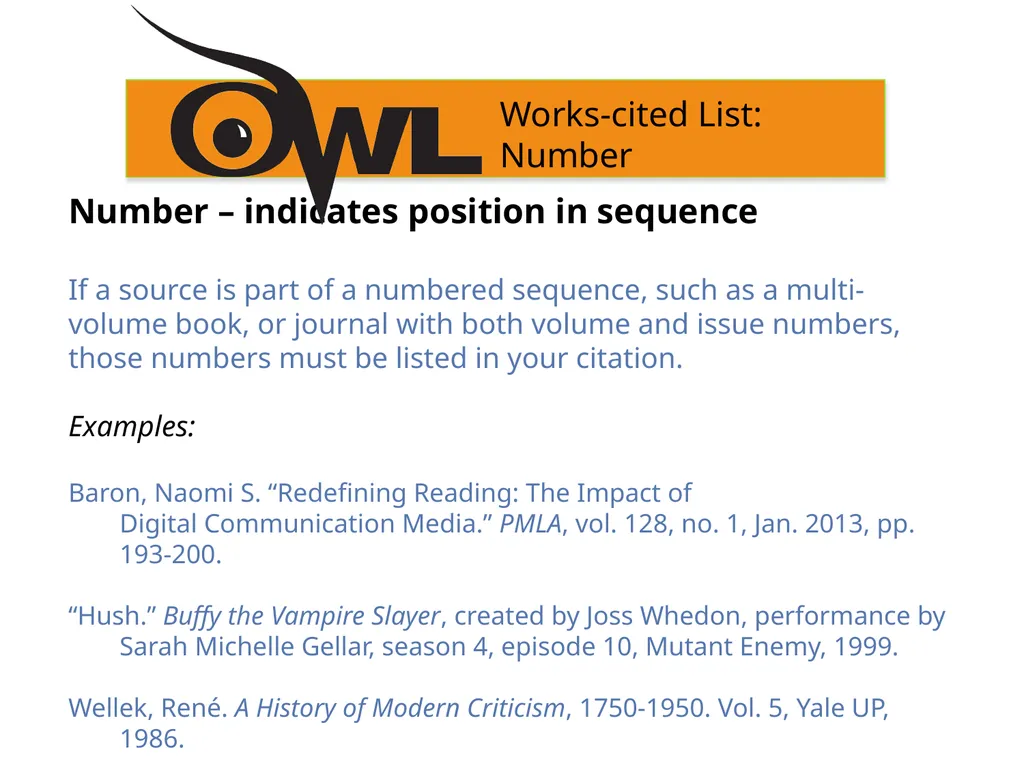
Number – indicates position in sequence
If a source is part of a numbered sequence, such as a multi-volume book, or journal with both volume and issue numbers, those numbers must be listed in your citation.
Examples:
Baron, Naomi S. “Redefining Reading: The Impact of Digital Communication Media.” PMLA, vol. 128, no. 1, Jan. 2013, pp. 193-200.
“Hush.” Buffy the Vampire Slayer, created by Joss Whedon, performance by Sarah Michelle Gellar, season 4, episode 10, Mutant Enemy, 1999.
Wellek, René. A History of Modern Criticism, 1750-1950. Vol. 5, Yale UP, 1986.<br>
If a source is part of a numbered sequence, such as a multi-volume book, or journal with both volume and issue numbers, those numbers must be listed in your citation.
Examples:
Baron, Naomi S. “Redefining Reading: The Impact of Digital Communication Media.” PMLA, vol. 128, no. 1, Jan. 2013, pp. 193-200.
“Hush.” Buffy the Vampire Slayer, created by Joss Whedon, performance by Sarah Michelle Gellar, season 4, episode 10, Mutant Enemy, 1999.
Wellek, René. A History of Modern Criticism, 1750-1950. Vol. 5, Yale UP, 1986.<br>
38
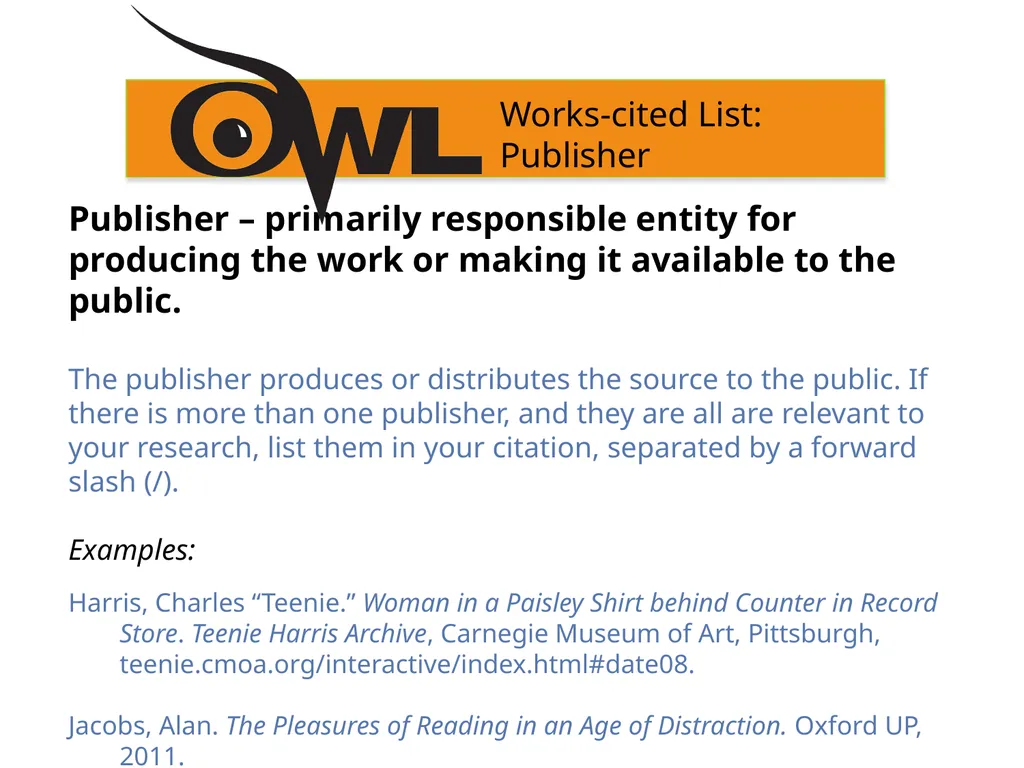
Publisher – primarily responsible entity for producing the work or making it available to the public.
The publisher produces or distributes the source to the public. If there is more than one publisher, and they are all are relevant to your research, list them in your citation, separated by a forward slash (/).
Examples:
Harris, Charles “Teenie.” Woman in a Paisley Shirt behind Counter in Record Store. Teenie Harris Archive, Carnegie Museum of Art, Pittsburgh, teenie.cmoa.org/interactive/index.html#date08.
Jacobs, Alan. The Pleasures of Reading in an Age of Distraction. Oxford UP, 2011.
Kuzui, Fran Rubel, director. Buffy the Vampire Slayer. Twentieth Century Fox, 1992.<br>
The publisher produces or distributes the source to the public. If there is more than one publisher, and they are all are relevant to your research, list them in your citation, separated by a forward slash (/).
Examples:
Harris, Charles “Teenie.” Woman in a Paisley Shirt behind Counter in Record Store. Teenie Harris Archive, Carnegie Museum of Art, Pittsburgh, teenie.cmoa.org/interactive/index.html#date08.
Jacobs, Alan. The Pleasures of Reading in an Age of Distraction. Oxford UP, 2011.
Kuzui, Fran Rubel, director. Buffy the Vampire Slayer. Twentieth Century Fox, 1992.<br>
39
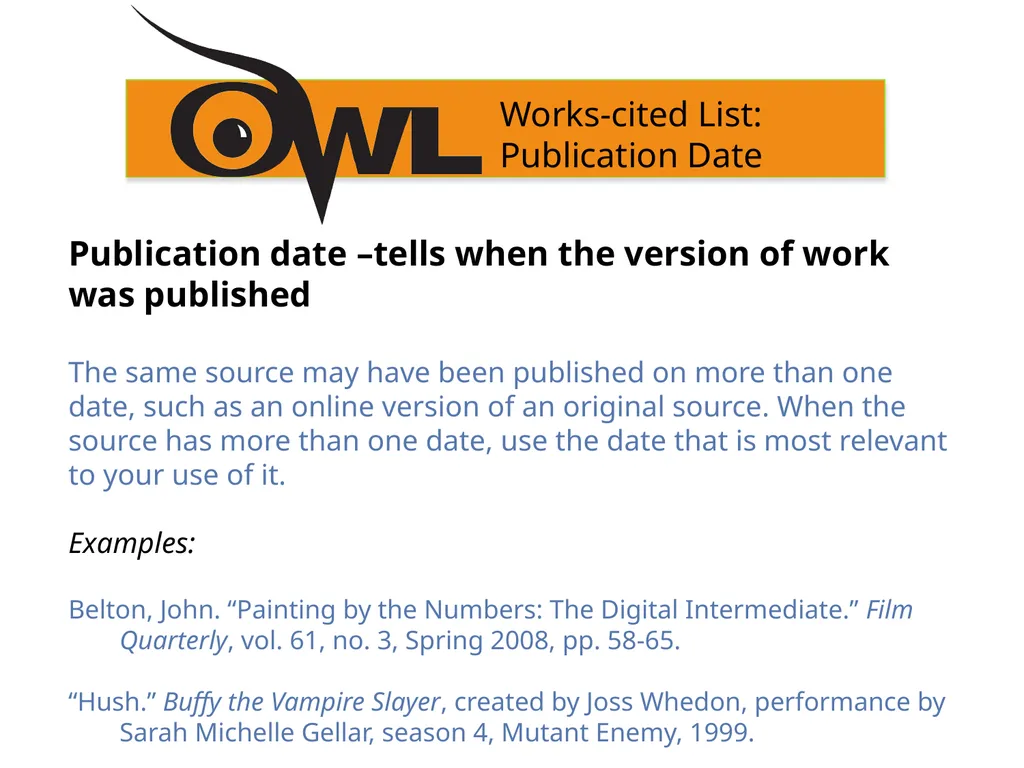
Publication date –tells when the version of work was published
The same source may have been published on more than one date, such as an online version of an original source. When the source has more than one date, use the date that is most relevant to your use of it.
Examples:
Belton, John. “Painting by the Numbers: The Digital Intermediate.” Film Quarterly, vol. 61, no. 3, Spring 2008, pp. 58-65.
“Hush.” Buffy the Vampire Slayer, created by Joss Whedon, performance by Sarah Michelle Gellar, season 4, Mutant Enemy, 1999.<br>
The same source may have been published on more than one date, such as an online version of an original source. When the source has more than one date, use the date that is most relevant to your use of it.
Examples:
Belton, John. “Painting by the Numbers: The Digital Intermediate.” Film Quarterly, vol. 61, no. 3, Spring 2008, pp. 58-65.
“Hush.” Buffy the Vampire Slayer, created by Joss Whedon, performance by Sarah Michelle Gellar, season 4, Mutant Enemy, 1999.<br>
40
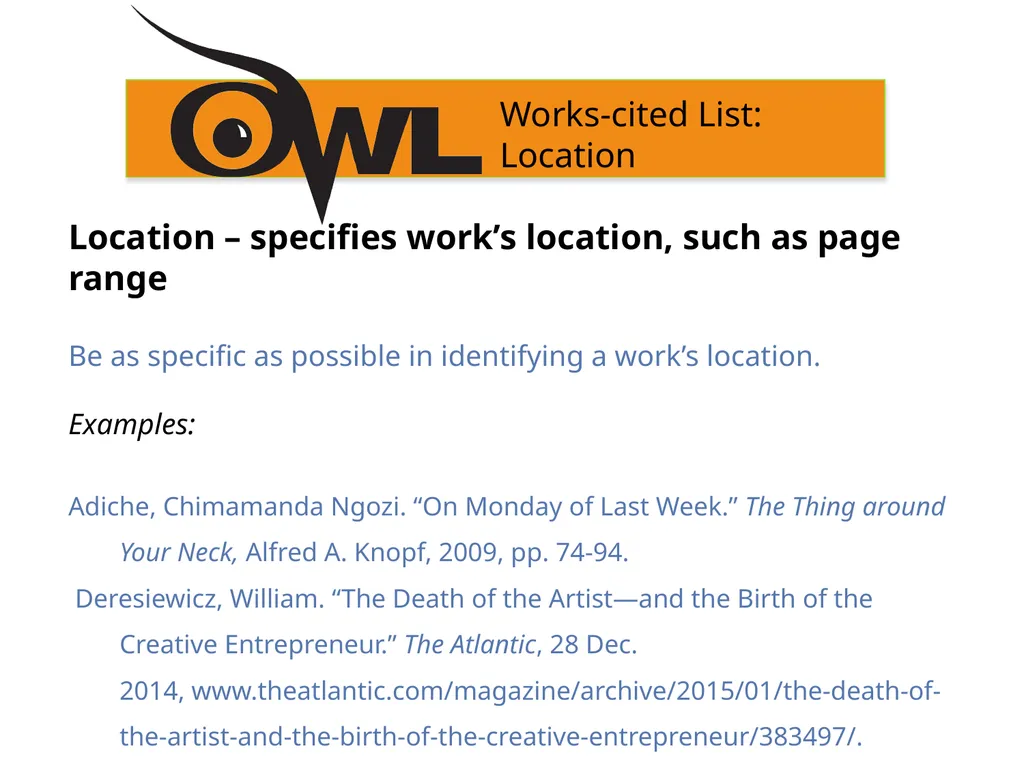
Location – specifies work’s location, such as page range
Be as specific as possible in identifying a work’s location.
Examples:
Adiche, Chimamanda Ngozi. “On Monday of Last Week.” The Thing around Your Neck, Alfred A. Knopf, 2009, pp. 74-94.
Deresiewicz, William. “The Death of the Artist—and the Birth of the Creative Entrepreneur.” The Atlantic, 28 Dec. 2014, www.theatlantic.com/magazine/archive/2015/01/the-death-of-the-artist-and-the-birth-of-the-creative-entrepreneur/383497/.
Bearden, Romare. The Train. 1975, Museum of Modern Art, New York.<br>
Be as specific as possible in identifying a work’s location.
Examples:
Adiche, Chimamanda Ngozi. “On Monday of Last Week.” The Thing around Your Neck, Alfred A. Knopf, 2009, pp. 74-94.
Deresiewicz, William. “The Death of the Artist—and the Birth of the Creative Entrepreneur.” The Atlantic, 28 Dec. 2014, www.theatlantic.com/magazine/archive/2015/01/the-death-of-the-artist-and-the-birth-of-the-creative-entrepreneur/383497/.
Bearden, Romare. The Train. 1975, Museum of Modern Art, New York.<br>
41
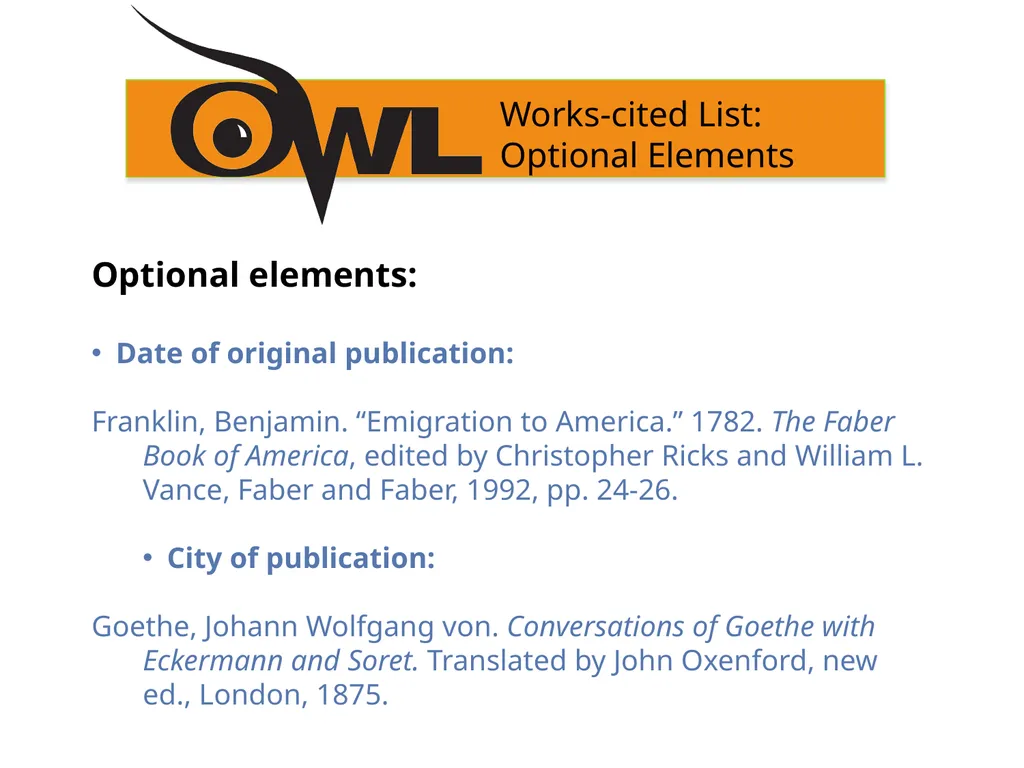
Optional elements:
Date of original publication:
Franklin, Benjamin. “Emigration to America.” 1782. The Faber Book of America, edited by Christopher Ricks and William L. Vance, Faber and Faber, 1992, pp. 24-26.
City of publication:
Goethe, Johann Wolfgang von. Conversations of Goethe with Eckermann and Soret. Translated by John Oxenford, new ed., London, 1875.<br>
Date of original publication:
Franklin, Benjamin. “Emigration to America.” 1782. The Faber Book of America, edited by Christopher Ricks and William L. Vance, Faber and Faber, 1992, pp. 24-26.
City of publication:
Goethe, Johann Wolfgang von. Conversations of Goethe with Eckermann and Soret. Translated by John Oxenford, new ed., London, 1875.<br>
42
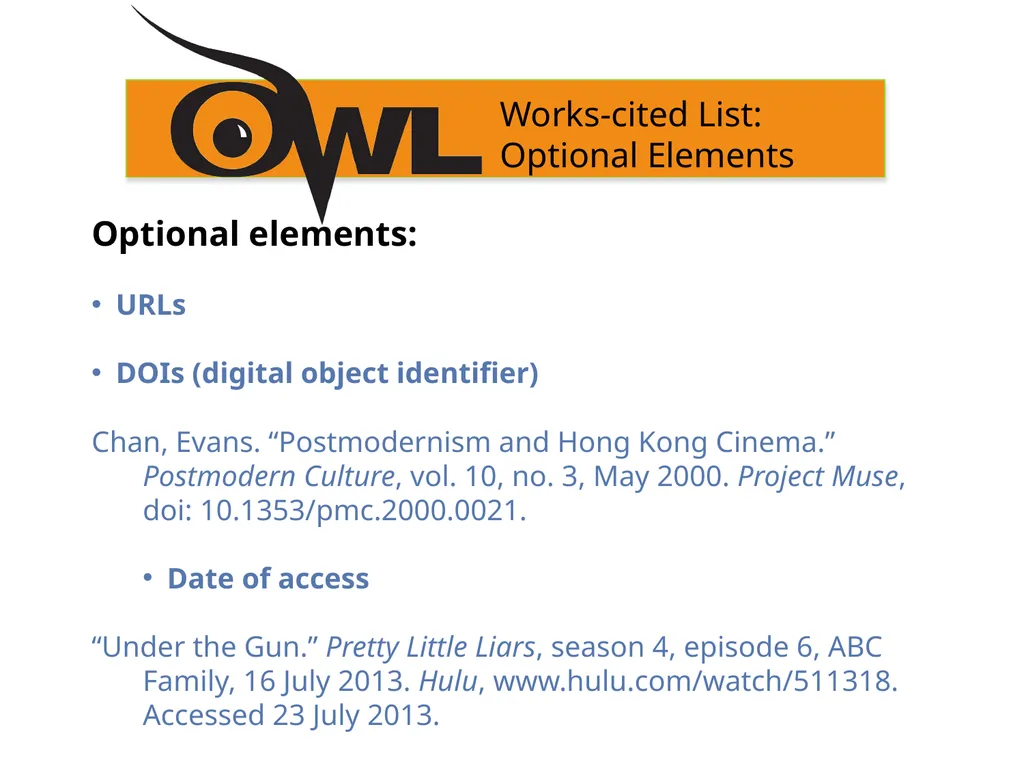
Optional elements:
URLs
DOIs (digital object identifier)
Chan, Evans. “Postmodernism and Hong Kong Cinema.” Postmodern Culture, vol. 10, no. 3, May 2000. Project Muse, doi: 10.1353/pmc.2000.0021.
Date of access
“Under the Gun.” Pretty Little Liars, season 4, episode 6, ABC Family, 16 July 2013. Hulu, www.hulu.com/watch/511318. Accessed 23 July 2013.<br>
URLs
DOIs (digital object identifier)
Chan, Evans. “Postmodernism and Hong Kong Cinema.” Postmodern Culture, vol. 10, no. 3, May 2000. Project Muse, doi: 10.1353/pmc.2000.0021.
Date of access
“Under the Gun.” Pretty Little Liars, season 4, episode 6, ABC Family, 16 July 2013. Hulu, www.hulu.com/watch/511318. Accessed 23 July 2013.<br>
43
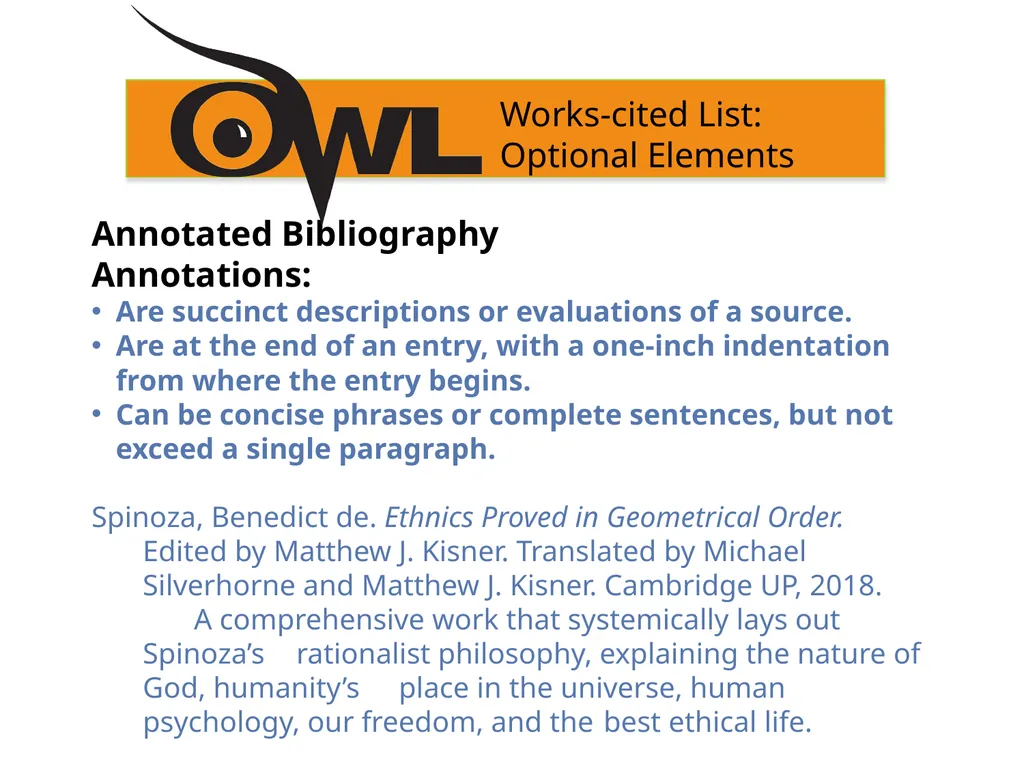
Annotated Bibliography
Annotations:
Are succinct descriptions or evaluations of a source.
Are at the end of an entry, with a one-inch indentation from where the entry begins.
Can be concise phrases or complete sentences, but not exceed a single paragraph.
Spinoza, Benedict de. Ethnics Proved in Geometrical Order. Edited by Matthew J. Kisner. Translated by Michael Silverhorne and Matthew J. Kisner. Cambridge UP, 2018.
A comprehensive work that systemically lays out Spinoza’s rationalist philosophy, explaining the nature of God, humanity’s place in the universe, human psychology, our freedom, and the best ethical life.<br>
Annotations:
Are succinct descriptions or evaluations of a source.
Are at the end of an entry, with a one-inch indentation from where the entry begins.
Can be concise phrases or complete sentences, but not exceed a single paragraph.
Spinoza, Benedict de. Ethnics Proved in Geometrical Order. Edited by Matthew J. Kisner. Translated by Michael Silverhorne and Matthew J. Kisner. Cambridge UP, 2018.
A comprehensive work that systemically lays out Spinoza’s rationalist philosophy, explaining the nature of God, humanity’s place in the universe, human psychology, our freedom, and the best ethical life.<br>
44
Purdue University Writing Lab
Heavilon 226
Web: http://owl.english.purdue.edu/
Phone: (765) 494-3723
Email: owl@owl.english.purdue.edu<br>
Heavilon 226
Web: http://owl.english.purdue.edu/
Phone: (765) 494-3723
Email: owl@owl.english.purdue.edu<br>
45
The End MLA 9th Edition Formatting Style Guide
Brought to you in cooperation with the Purdue Online Writing Lab<br>
Brought to you in cooperation with the Purdue Online Writing Lab<br>