Mobility Programme from and to European schoolS 27 NOVEMBER 2023 Information session Ref.: 2016-01-D-49-en-4: https:www.eursc.euBasicTexts2016-01-D-49-en-420Annex.pdf European schools official and accredited offer the possibility
"Mobility Programme from and to European schoolS 27" is the property of its rightful owner. Permission is granted to
download and print the materials on this website for personal, non-commercial use only, and to display it
on your personal computer provided you do not modify the materials and that you retain all copyright
notices contained in the materials. By downloading content from our website, you accept the terms of this
agreement.
Presentation Transcript
01
Mobility Programme from and to European schoolS 27 NOVEMBER 2023
Information session Ref.: 2016-01-D-49-en-4: https://www.eursc.eu/BasicTexts/2016-01-D-49-en-4%20+Annex.pdf<br>
02
European schools – official and accredited – offer the possibility of hosting as well as sending pupils to other European schools – official and accredited – during the first semester of S5.
All S4 students are eligible to apply to participate in the Mobility programme. The stay takes place during the first semester of S5, i.e. from September to December 2024. It is not possible to extend the stay, unless there is a valid pedagogical justification. WHAT IS THE MOBILITY PROGRAMME?<br>
03
aims This programme was created to give students the opportunity go to another European school for a short period (maximum 1 semester) in their L1 section.
The goal is both linguistic (improve LII, LIII or LIV) and cultural. Adaptation to a different educational and cultural context and to the host family requires a certain maturity.
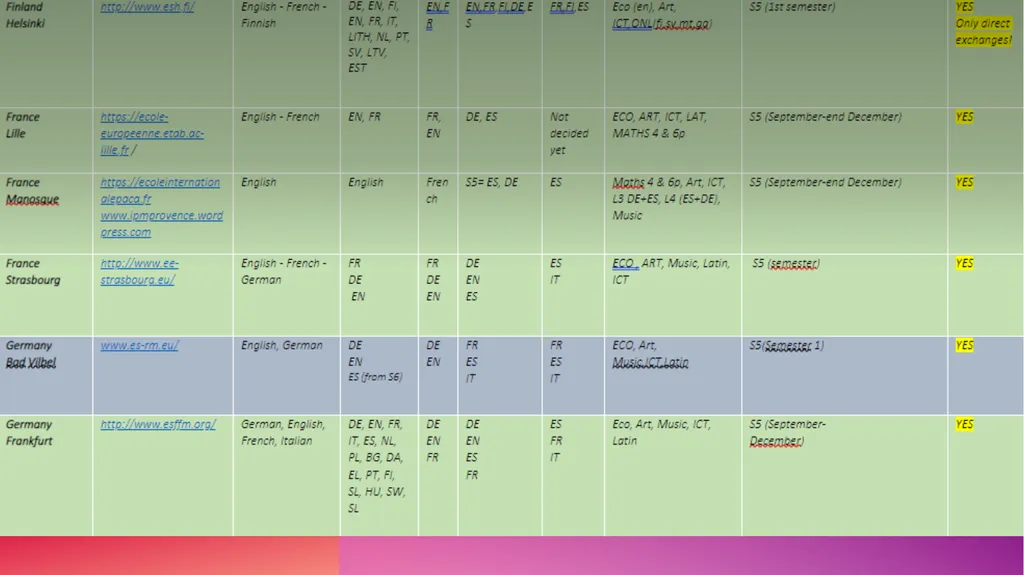
Pupils may choose three European schools, according to their linguistic, cultural and personal goals. The list of participating schools is on the school's website.<br>
04
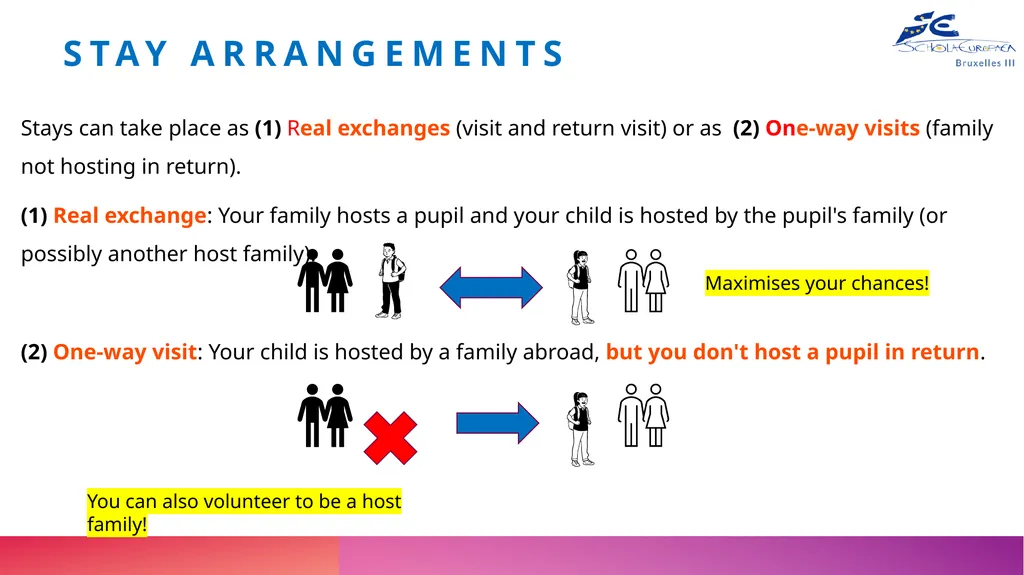
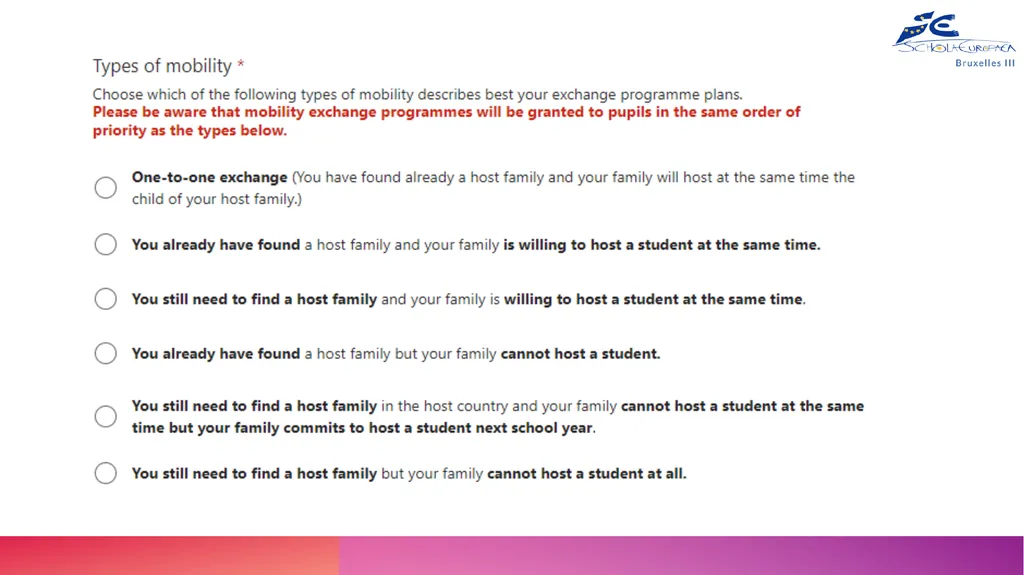
Stay arrangements Stays can take place as (1) Real exchanges (visit and return visit) or as (2) One-way visits (family not hosting in return).
(1) Real exchange: Your family hosts a pupil and your child is hosted by the pupil's family (or possibly another host family).
(2) One-way visit: Your child is hosted by a family abroad, but you don't host a pupil in return. You can also volunteer to be a host family! Maximises your chances!<br>
05
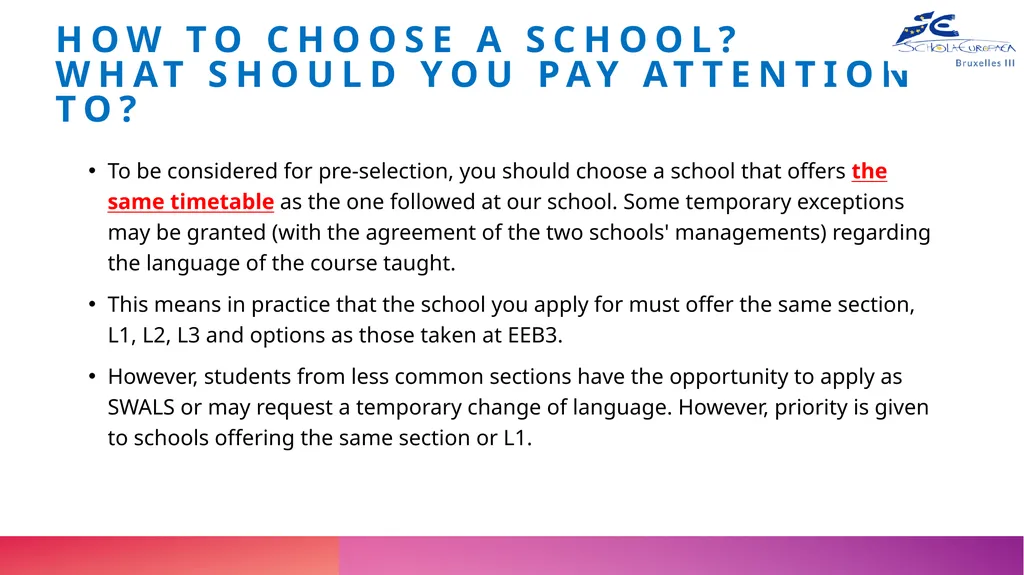
How to choose a school? What should you pay attention to? To be considered for pre-selection, you should choose a school that offers the same timetable as the one followed at our school. Some temporary exceptions may be granted (with the agreement of the two schools' managements) regarding the language of the course taught.
This means in practice that the school you apply for must offer the same section, L1, L2, L3 and options as those taken at EEB3.
However, students from less common sections have the opportunity to apply as SWALS or may request a temporary change of language. However, priority is given to schools offering the same section or L1.<br>
06
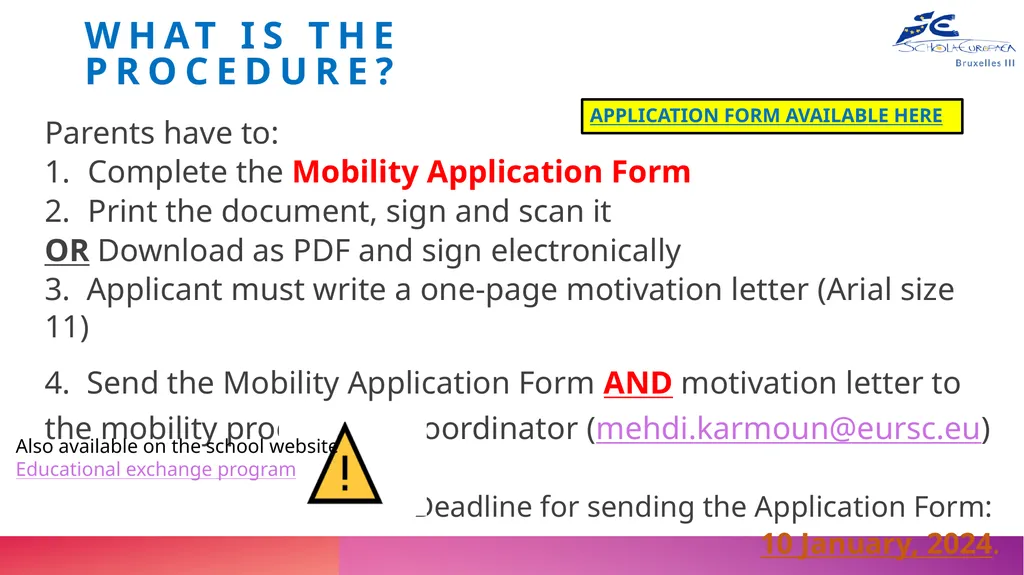
What is the procedure? Parents have to:
Complete the Mobility Application Form
Print the document, sign and scan it
OR Download as PDF and sign electronically
3. Applicant must write a one-page motivation letter (Arial size 11)
4. Send the Mobility Application Form AND motivation letter to the mobility programme coordinator (mehdi.karmoun@eursc.eu)
Deadline for sending the Application Form:
10 January, 2024. Also available on the school website
Educational exchange program APPLICATION FORM AVAILABLE HERE<br>
07
Application form You will need to read and consent to the following three annexes:
Roles and Responsibility (Annex 1)
Host Family Charter (Annex 6)
Learning Agreement (Annex 7) The Annexes are available on our school's website: Educational exchange program APPLICATION FORM AVAILABLE HERE<br>
08
PRE-SELECTION CRITERIA Motivation, maturity, educational project,
Similar curriculum,
Direct exchange,
Family willing to host and who already has a host family in the host country,
Positive recommendation by the Class Council.
Students and parents will be informed of the results of the pre-selection process at the end of February.<br>
09
ONCE selected If your child's application has been selected, the school coordinator contacts the targeted European schools so that they can make their own selection. Being preselected does not mean that the exchange has been confirmed.
The decision is announced by the host schools around the end of April.
There is a very limited number of places in the schools!
Schools generally offer no more than 1 or 2 places.
We try, as much as possible, to send and receive a similar number of pupils per language section (for class size and capacity reasons) and per school.
What may seem relatively straightforward as a participant is not necessarily so, given the way the system of European Schools is organised. A FEW FACTS<br>
10
Consequences when back to eeb3 In case a subject is not followed in the host school during the exchange, the pupil takes
responsibility for catching up with the subjects seen during his/her absence so as not to fall
behind when back to EEB3.
Exams: The grades from the host school are recorded in the report upon return at EEB3. If an Exam/B-Test should have been taken in December at EEB3 but was not taken at the host school (because the course was not offered), the grades for the second semester at EEB3 will be duplicated and will count for the entire school year.<br>
11
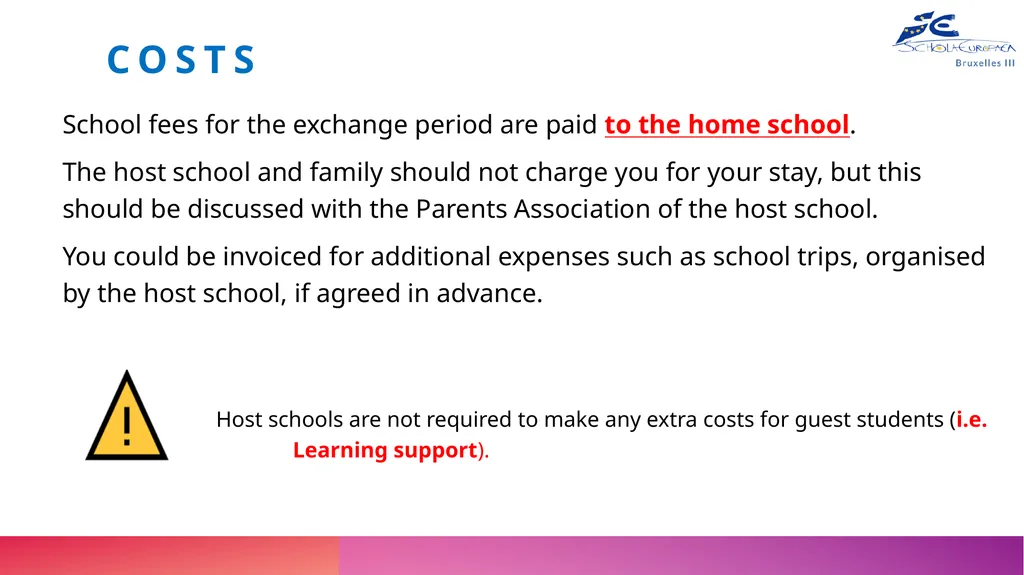
Costs School fees for the exchange period are paid to the home school.
The host school and family should not charge you for your stay, but this should be discussed with the Parents Association of the host school.
You could be invoiced for additional expenses such as school trips, organised by the host school, if agreed in advance.
Host schools are not required to make any extra costs for guest students (i.e. Learning support).<br>
12
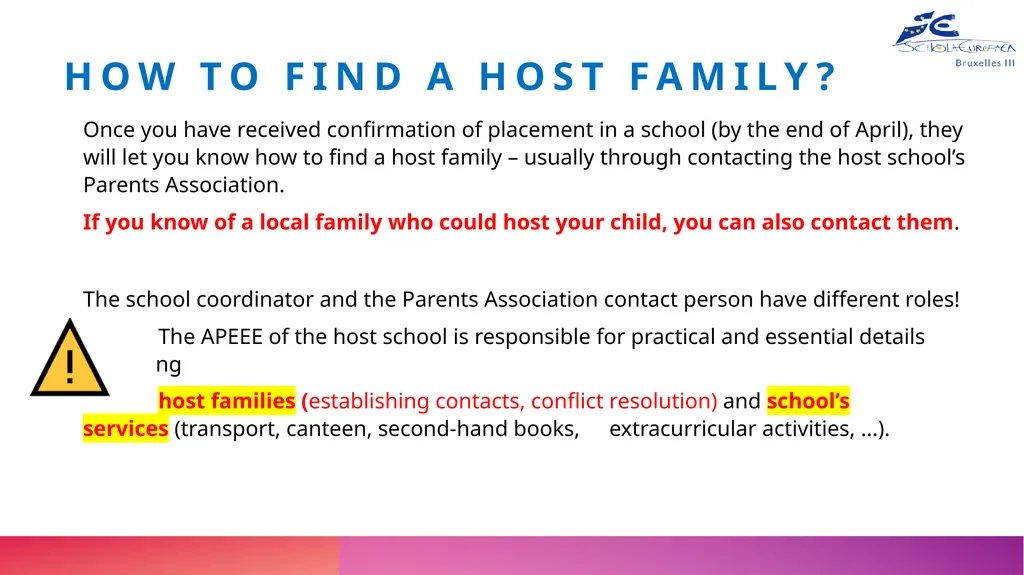
HOW TO FIND A HOST FAMILY? Once you have received confirmation of placement in a school (by the end of April), they will let you know how to find a host family – usually through contacting the host school’s Parents Association.
If you know of a local family who could host your child, you can also contact them.
The school coordinator and the Parents Association contact person have different roles!
The APEEE of the host school is responsible for practical and essential details regarding
host families (establishing contacts, conflict resolution) and school’s services (transport, canteen, second-hand books, extracurricular activities, ...).<br>
13
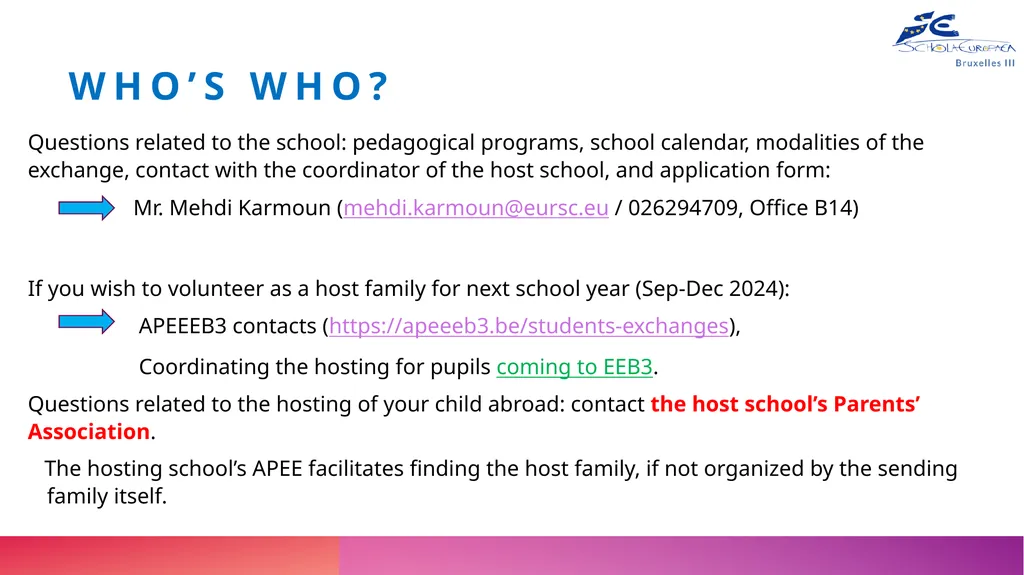
Questions related to the school: pedagogical programs, school calendar, modalities of the exchange, contact with the coordinator of the host school, and application form:
Mr. Mehdi Karmoun (mehdi.karmoun@eursc.eu / 026294709, Office B14)
If you wish to volunteer as a host family for next school year (Sep-Dec 2024):
APEEEB3 contacts (https://apeeeb3.be/students-exchanges),
Coordinating the hosting for pupils coming to EEB3.
Questions related to the hosting of your child abroad: contact the host school’s Parents’ Association.
The hosting school’s APEE facilitates finding the host family, if not organized by the sending family itself. Who’s who?<br>
14
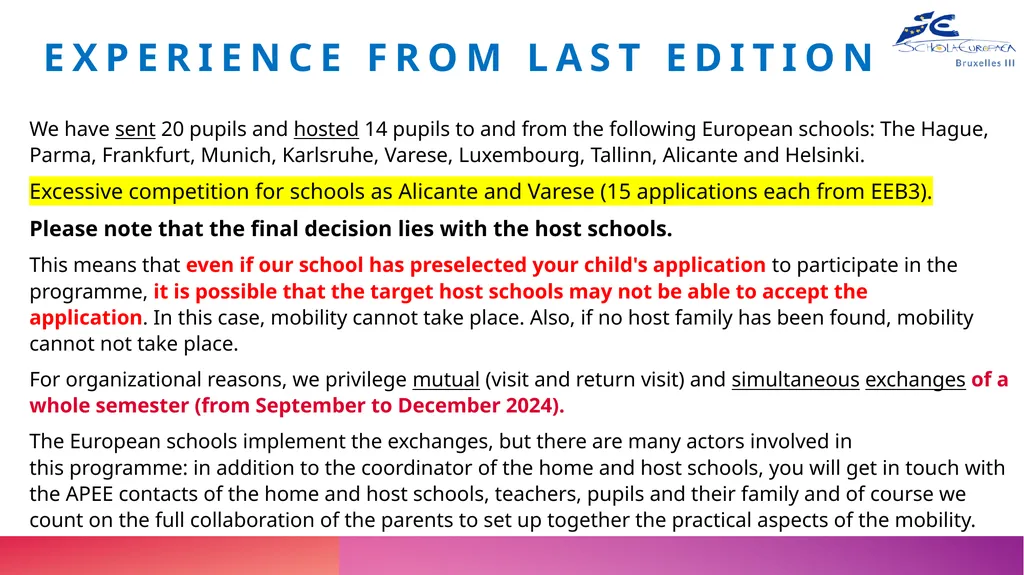
Experience from LAST EDITION We have sent 20 pupils and hosted 14 pupils to and from the following European schools: The Hague, Parma, Frankfurt, Munich, Karlsruhe, Varese, Luxembourg, Tallinn, Alicante and Helsinki.
Excessive competition for schools as Alicante and Varese (15 applications each from EEB3).
Please note that the final decision lies with the host schools.
This means that even if our school has preselected your child's application to participate in the programme, it is possible that the target host schools may not be able to accept the application. In this case, mobility cannot take place. Also, if no host family has been found, mobility cannot not take place.
For organizational reasons, we privilege mutual (visit and return visit) and simultaneous exchanges of a whole semester (from September to December 2024).
The European schools implement the exchanges, but there are many actors involved in this programme: in addition to the coordinator of the home and host schools, you will get in touch with the APEE contacts of the home and host schools, teachers, pupils and their family and of course we count on the full collaboration of the parents to set up together the practical aspects of the mobility.<br>