
MODELS AND DIE MATERIALS CONTENTS INTRODUCTION
LS
Published · 41 slides · 0 views
1 / 1


Description
MODELS AND DIE MATERIALS CONTENTS INTRODUCTION MODELS Gypsum products Classification of gypsum products Properties Manipulation DIE MATERIALS Types of die materials Compatibility with impression materials CONCLUSION INTRODUCTION MODEL: A
Related Topics
Share
Embed code
Download this presentation From Below
"MODELS AND DIE MATERIALS CONTENTS INTRODUCTION" is the property of its rightful owner. Permission is granted to download and print the materials on this website for personal, non-commercial use only, and to display it on your personal computer provided you do not modify the materials and that you retain all copyright notices contained in the materials. By downloading content from our website, you accept the terms of this agreement.
Presentation Transcript
01
MODELS AND DIE MATERIALS<br>
02
CONTENTS INTRODUCTION
MODELS
Gypsum products
Classification of gypsum products
Properties
Manipulation
DIE MATERIALS
Types of die materials
Compatibility with impression materials
CONCLUSION<br>
MODELS
Gypsum products
Classification of gypsum products
Properties
Manipulation
DIE MATERIALS
Types of die materials
Compatibility with impression materials
CONCLUSION<br>
03
INTRODUCTION MODEL:
A fascimile used for display purposes;
A positive likeness of an object. Glossary of prosthodontic terms DIE:
The positive reproduction of the form of a prepared tooth in any suitable substance.<br>
A fascimile used for display purposes;
A positive likeness of an object. Glossary of prosthodontic terms DIE:
The positive reproduction of the form of a prepared tooth in any suitable substance.<br>
04
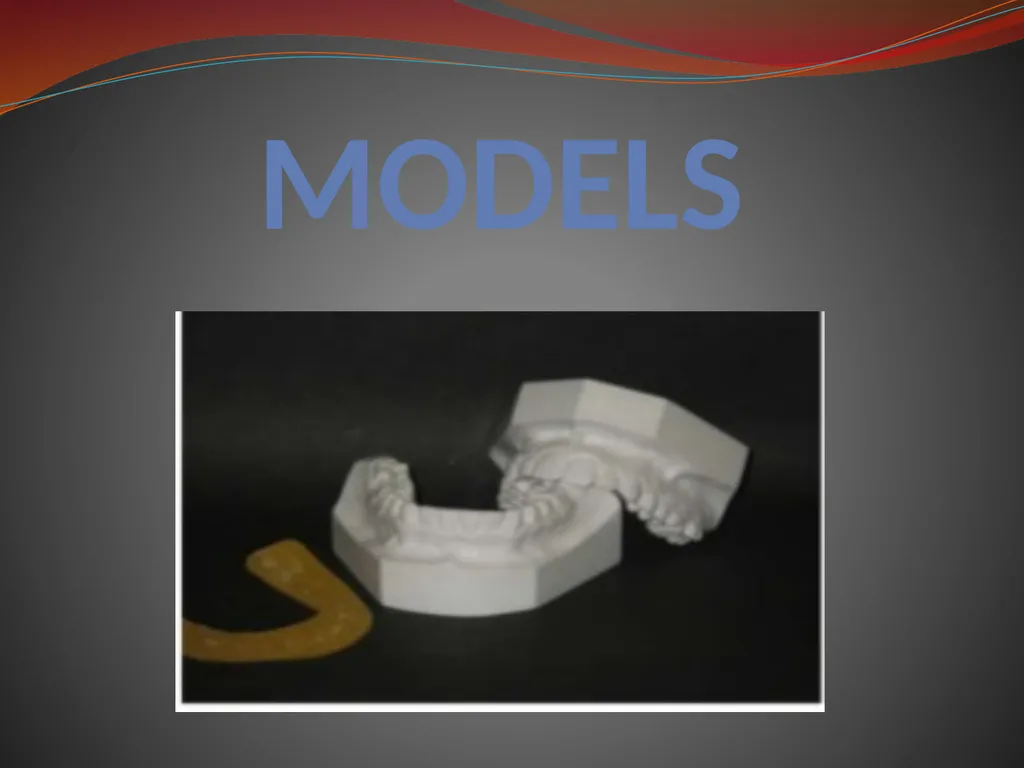
MODELS<br>
05
GYPSUM PRODUCTS Gypsum is a mineral mined in various parts of the world.
It is produced as a by-product of some chemical processing operations.
It is obtained from natural rock.
The dihydrate form of calcium sulfate is called GYPSUM. PHILIPS SCIENCE OF DENTAL MATERIALS ELEVENTH EDITION<br>
It is produced as a by-product of some chemical processing operations.
It is obtained from natural rock.
The dihydrate form of calcium sulfate is called GYPSUM. PHILIPS SCIENCE OF DENTAL MATERIALS ELEVENTH EDITION<br>
06
TYPES OF GYPSUM PRODUCTS TYPE I - Impression plaster
TYPE II - Model plaster
TYPE III - Dental stone
TYPE IV – Dental stone ,Die , High strength
TYPE V - Dental stone ,Die , High strength , High expansion PHILIPS SCIENCE OF DENTAL MATERIALS ELEVENTH EDITION<br>
TYPE II - Model plaster
TYPE III - Dental stone
TYPE IV – Dental stone ,Die , High strength
TYPE V - Dental stone ,Die , High strength , High expansion PHILIPS SCIENCE OF DENTAL MATERIALS ELEVENTH EDITION<br>
07
DENTAL PLASTER AND STONE PLASTER is beta form of calcium sulfate hemihydrate.
STONE is an alpha form of calcium sulfate hemihydrate.
Manufacturing of plaster and stone:
plaster Produced by calcination process in open air.
Dental stone produced by wet calcination. PHILIPS SCIENCE OF DENTAL MATERIALS ELEVENTH EDITION<br>
STONE is an alpha form of calcium sulfate hemihydrate.
Manufacturing of plaster and stone:
plaster Produced by calcination process in open air.
Dental stone produced by wet calcination. PHILIPS SCIENCE OF DENTAL MATERIALS ELEVENTH EDITION<br>
08
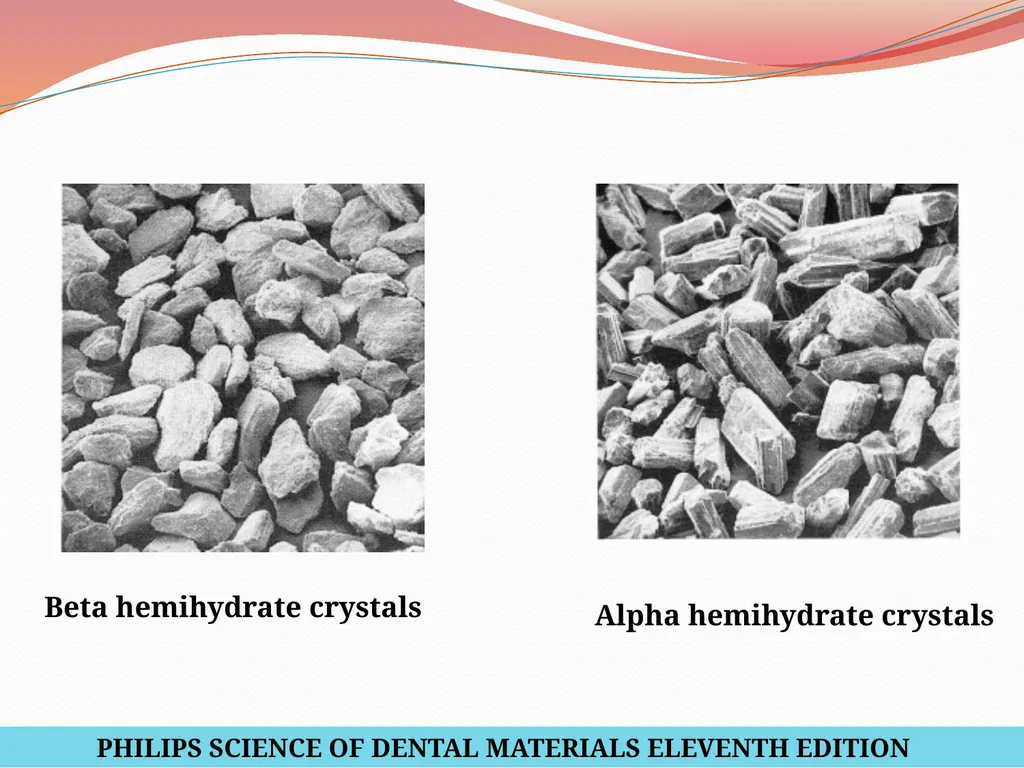
Beta hemihydrate crystals Alpha hemihydrate crystals PHILIPS SCIENCE OF DENTAL MATERIALS ELEVENTH EDITION<br>
09
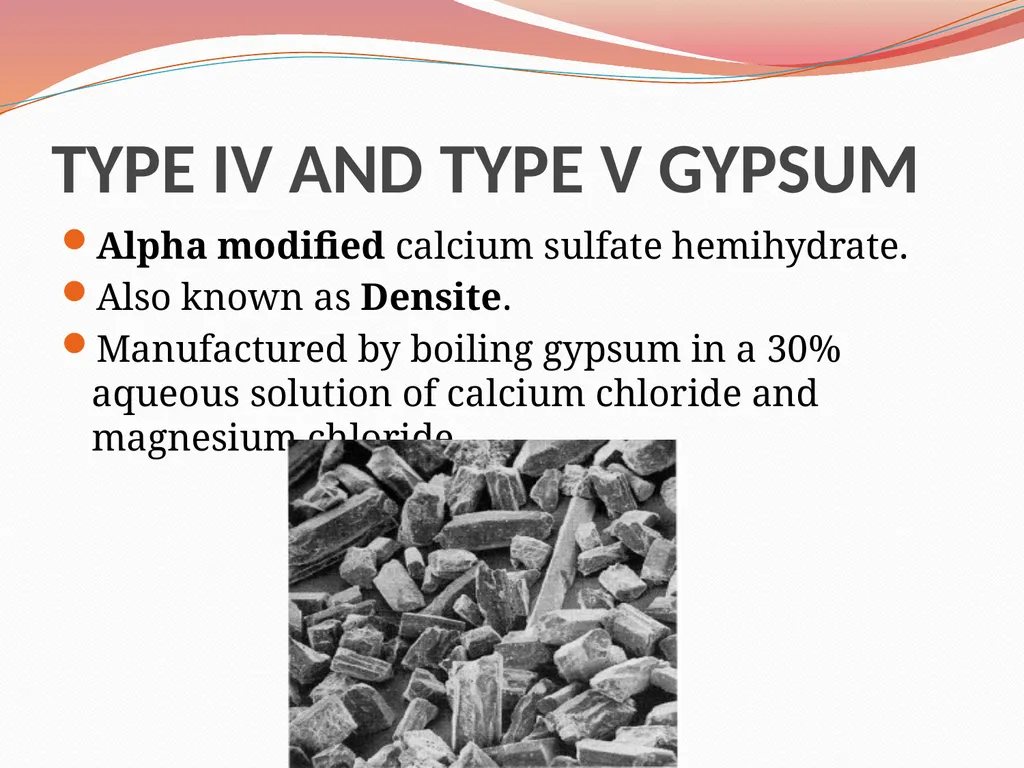
TYPE IV AND TYPE V GYPSUM Alpha modified calcium sulfate hemihydrate.
Also known as Densite.
Manufactured by boiling gypsum in a 30% aqueous solution of calcium chloride and magnesium chloride.<br>
Also known as Densite.
Manufactured by boiling gypsum in a 30% aqueous solution of calcium chloride and magnesium chloride.<br>
10
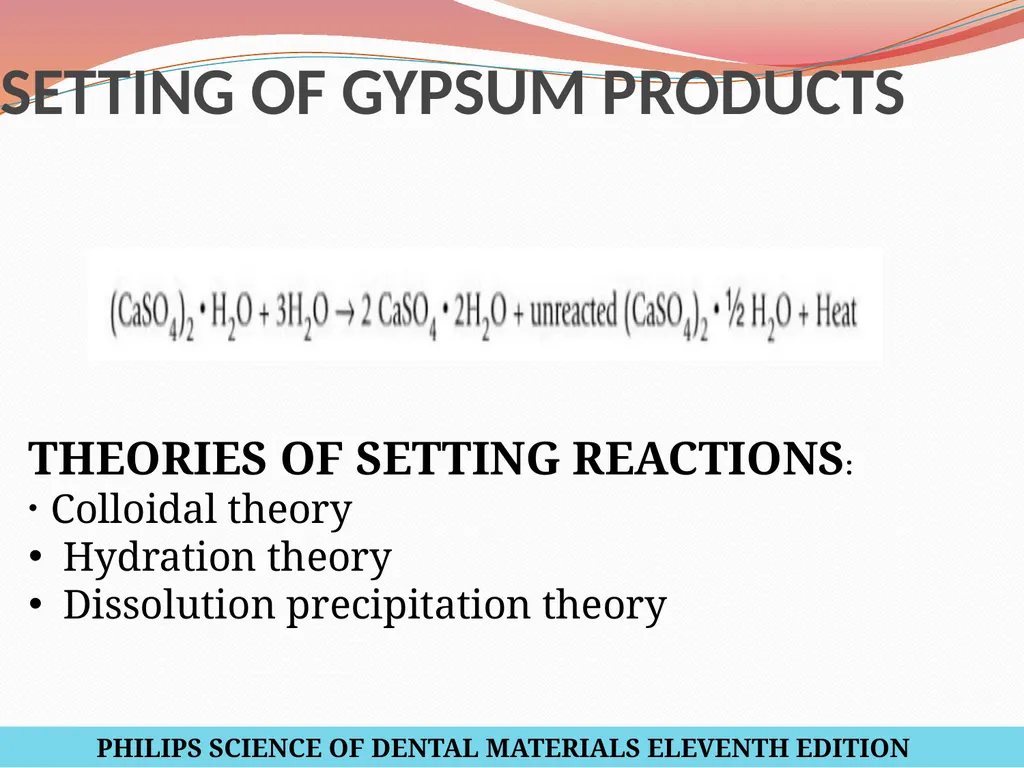
SETTING OF GYPSUM PRODUCTS THEORIES OF SETTING REACTIONS:
Colloidal theory
Hydration theory
Dissolution precipitation theory PHILIPS SCIENCE OF DENTAL MATERIALS ELEVENTH EDITION<br>
Colloidal theory
Hydration theory
Dissolution precipitation theory PHILIPS SCIENCE OF DENTAL MATERIALS ELEVENTH EDITION<br>
11
WATER –POWDER RATIO The amounts of water and hemihydrate should be gauged accurately by weight.
The W/P ratio is an important factor in determining the physical and chemical properties of the final gypsum product PHILIPS SCIENCE OF DENTAL MATERIALS ELEVENTH EDITION<br>
The W/P ratio is an important factor in determining the physical and chemical properties of the final gypsum product PHILIPS SCIENCE OF DENTAL MATERIALS ELEVENTH EDITION<br>
12
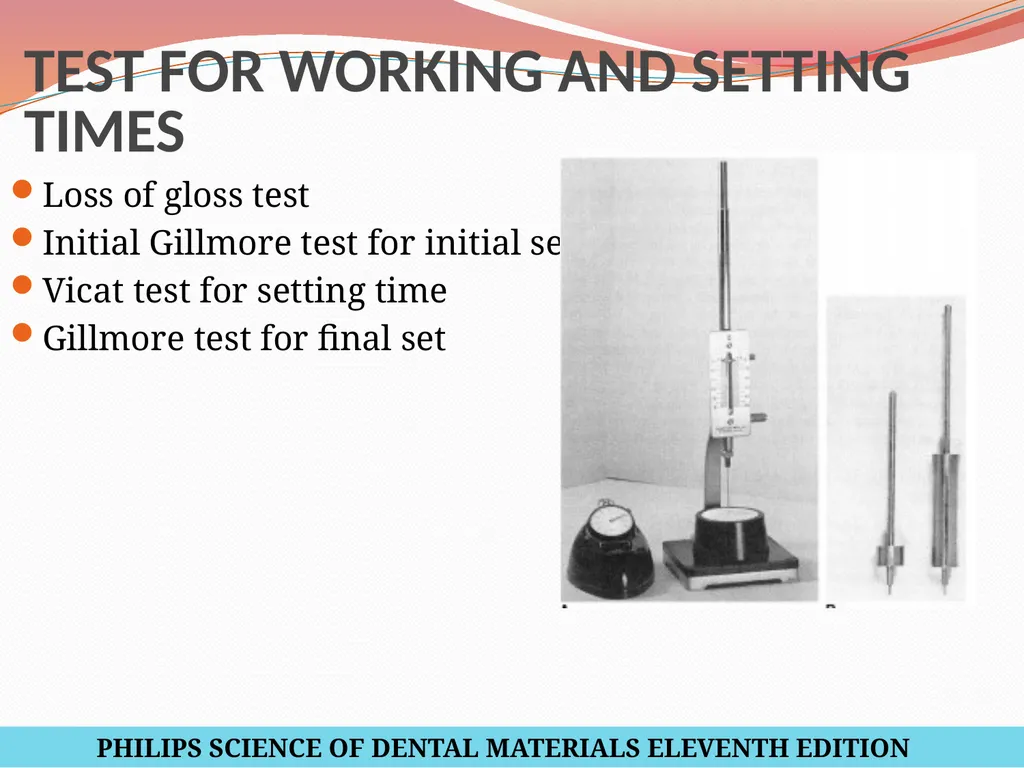
TEST FOR WORKING AND SETTING TIMES Loss of gloss test
Initial Gillmore test for initial set
Vicat test for setting time
Gillmore test for final set PHILIPS SCIENCE OF DENTAL MATERIALS ELEVENTH EDITION<br>
Initial Gillmore test for initial set
Vicat test for setting time
Gillmore test for final set PHILIPS SCIENCE OF DENTAL MATERIALS ELEVENTH EDITION<br>
13
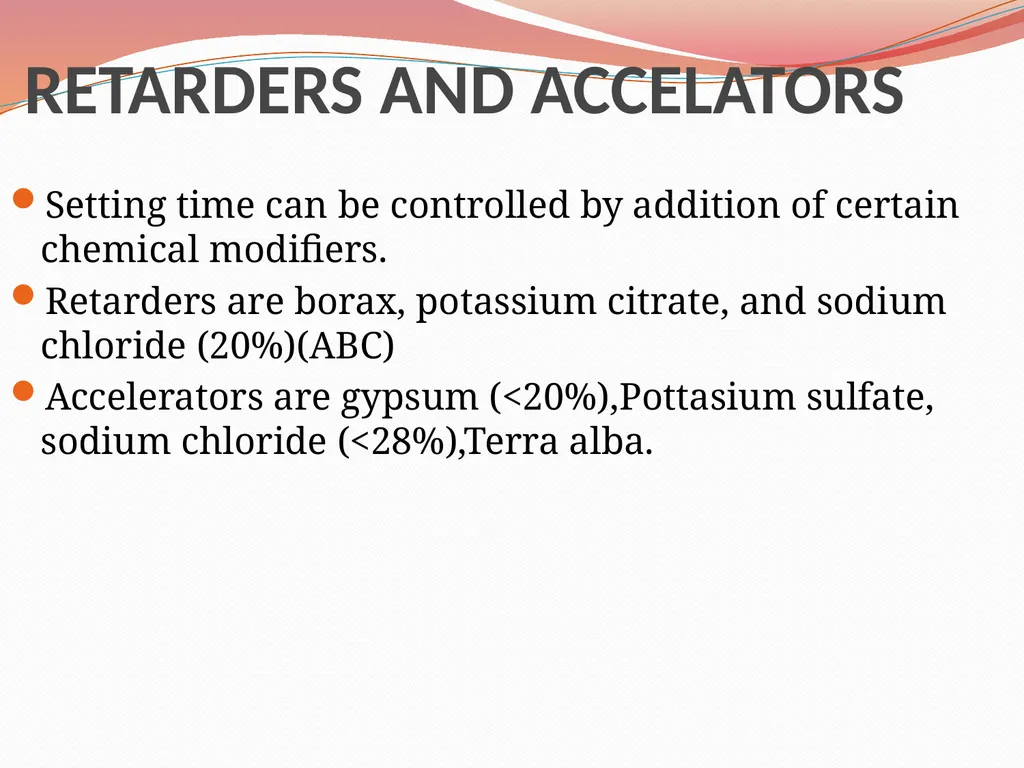
RETARDERS AND ACCELATORS Setting time can be controlled by addition of certain chemical modifiers.
Retarders are borax, potassium citrate, and sodium chloride (20%)(ABC)
Accelerators are gypsum (<20%),Pottasium sulfate, sodium chloride (<28%),Terra alba.<br>
Retarders are borax, potassium citrate, and sodium chloride (20%)(ABC)
Accelerators are gypsum (<20%),Pottasium sulfate, sodium chloride (<28%),Terra alba.<br>
14
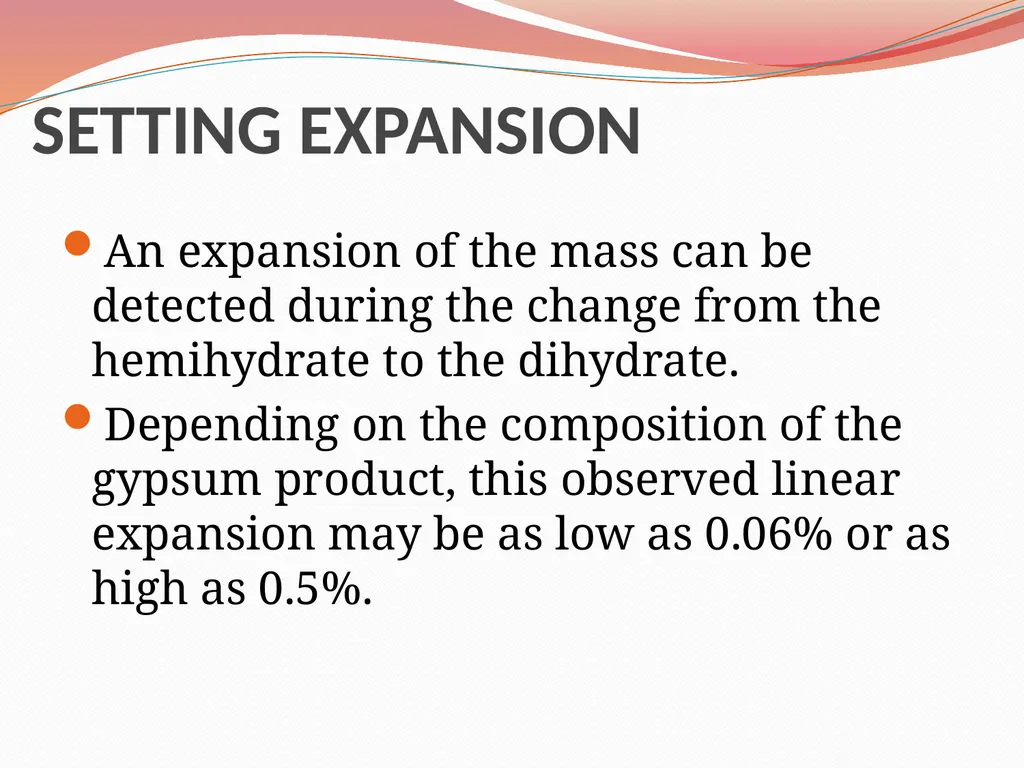
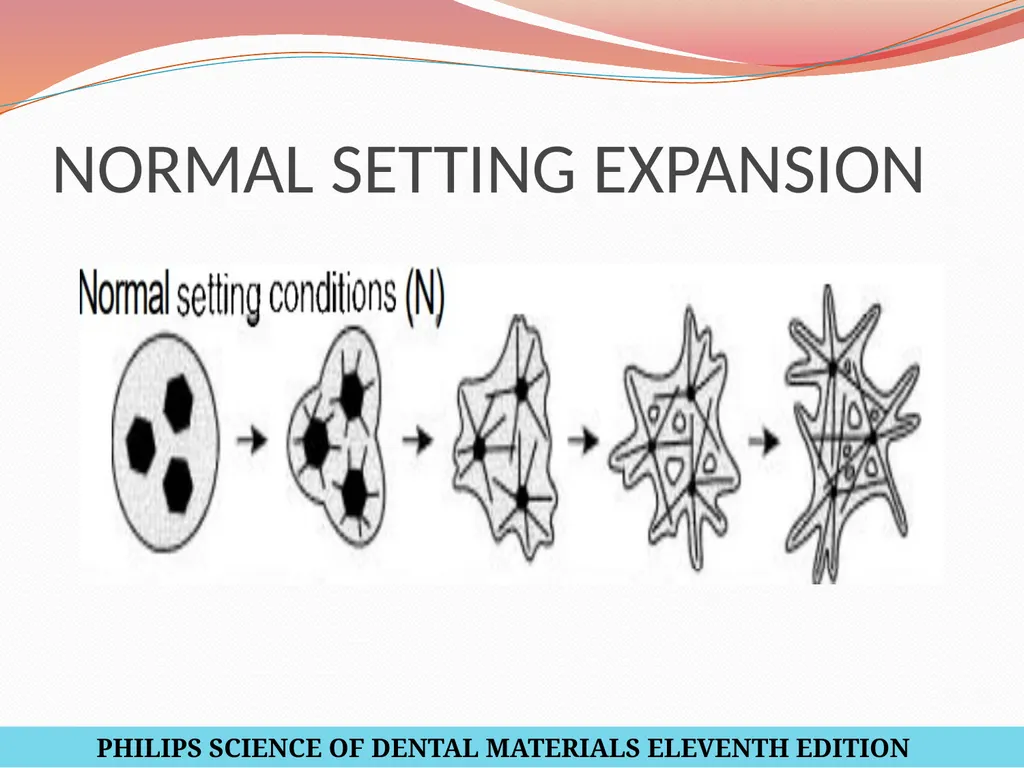
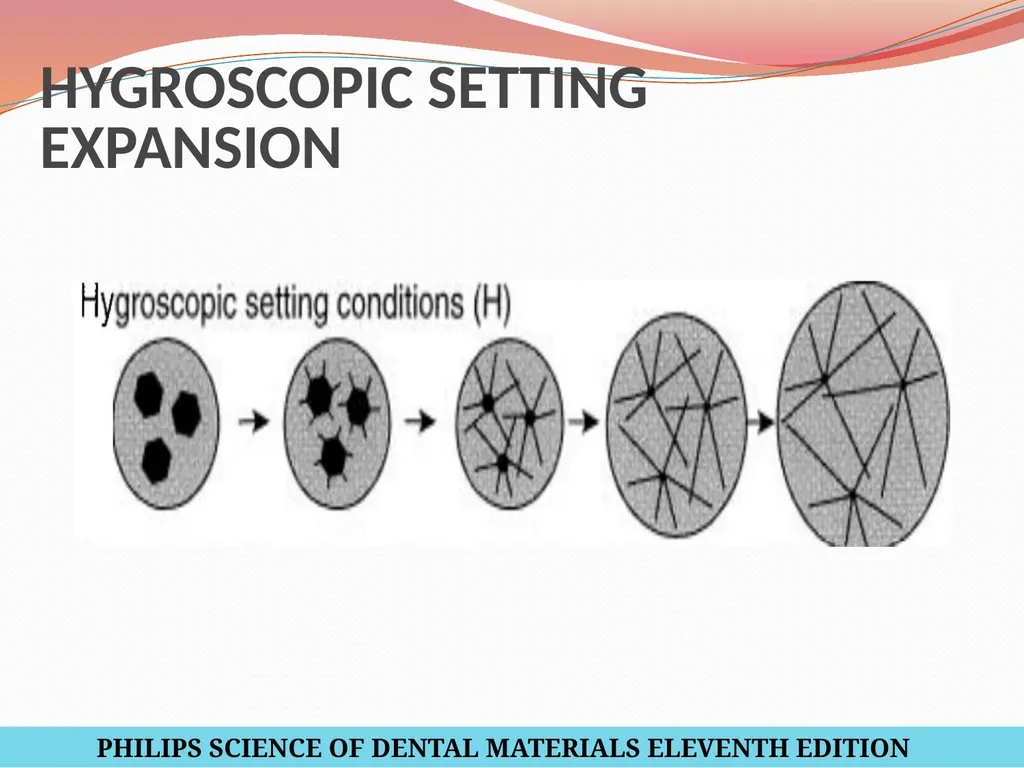
SETTING EXPANSION An expansion of the mass can be detected during the change from the hemihydrate to the dihydrate.
Depending on the composition of the gypsum product, this observed linear expansion may be as low as 0.06% or as high as 0.5%.<br>
Depending on the composition of the gypsum product, this observed linear expansion may be as low as 0.06% or as high as 0.5%.<br>
15
NORMAL SETTING EXPANSION PHILIPS SCIENCE OF DENTAL MATERIALS ELEVENTH EDITION<br>
16
HYGROSCOPIC SETTING EXPANSION PHILIPS SCIENCE OF DENTAL MATERIALS ELEVENTH EDITION<br>
17
STRENGTH The strength of gypsum products is generally expressed in terms of compressive strength.
The free-water content of the set product definitely affects its strength.
Two strength properties of gypsum are reported: the wet strength (also known as green strength) and the dry strength PHILIPS SCIENCE OF DENTAL MATERIALS ELEVENTH EDITION<br>
The free-water content of the set product definitely affects its strength.
Two strength properties of gypsum are reported: the wet strength (also known as green strength) and the dry strength PHILIPS SCIENCE OF DENTAL MATERIALS ELEVENTH EDITION<br>
18
MANIPULATION The preferred method of mixing is to add the measured water first, followed by gradual addition of the preweighed powder.
'I'he powder is incorporated during approximately 15 sec of mixing with a hand spatula, followed by 20 to 30 sec of mechanical mixing under vacuum.
A longer spatulation time reduces the working time particularly for pouring models. CRAIGS RESTOATIVE DENTAL MATERIALS<br>
'I'he powder is incorporated during approximately 15 sec of mixing with a hand spatula, followed by 20 to 30 sec of mechanical mixing under vacuum.
A longer spatulation time reduces the working time particularly for pouring models. CRAIGS RESTOATIVE DENTAL MATERIALS<br>
19
INVESTMENTS A ceramic material that is suitable for forming a mold into which a metal or alloy is cast.
It is a mixture of three distinct type of materials
Refractory material
Binder material
Other chemicals CRAIGS RESTOATIVE DENTAL MATERIALS<br>
It is a mixture of three distinct type of materials
Refractory material
Binder material
Other chemicals CRAIGS RESTOATIVE DENTAL MATERIALS<br>
20
TYPES OF INVESTMENTS Gypsum bonded investments
Phosphate bonded investments
Ethyl Silicate bonded investments<br>
Phosphate bonded investments
Ethyl Silicate bonded investments<br>
21
GYPSUM BONDED INVESTMENTS Supplied as fine powder.
Refractory : cristoballite , quartz
Binder: type III dental stone.
Modifiers: k, Li,Na chlorides or boric acid
Reducing agents : copper,graphite
Small amount of color CRAIGS RESTOATIVE DENTAL MATERIALS<br>
Refractory : cristoballite , quartz
Binder: type III dental stone.
Modifiers: k, Li,Na chlorides or boric acid
Reducing agents : copper,graphite
Small amount of color CRAIGS RESTOATIVE DENTAL MATERIALS<br>
22
PHOSPHATE BONDED INVESTMENTS Supplied in sealed sachets weighing 200-500gms
Used with high fusing alloys
Refractory : cristoballite or quartz
Binder : mixture of basic MgO and acidic NH4H2PO4
Small amounts of carbon
LIQUID: colloidal silica suspension CRAIGS RESTOATIVE DENTAL MATERIALS<br>
Used with high fusing alloys
Refractory : cristoballite or quartz
Binder : mixture of basic MgO and acidic NH4H2PO4
Small amounts of carbon
LIQUID: colloidal silica suspension CRAIGS RESTOATIVE DENTAL MATERIALS<br>
23
ETHYL SILICATE BONDED INVESTMENTS Developed to meet the refractory requirements of high fusing PBM alloys.
It is supplied as a powder of quartz or crystoballite.
Setting and bonding mechanisms are more complex.
Green shrinkage occurs when water and alcohols escape. CRAIGS RESTOATIVE DENTAL MATERIALS<br>
It is supplied as a powder of quartz or crystoballite.
Setting and bonding mechanisms are more complex.
Green shrinkage occurs when water and alcohols escape. CRAIGS RESTOATIVE DENTAL MATERIALS<br>
24
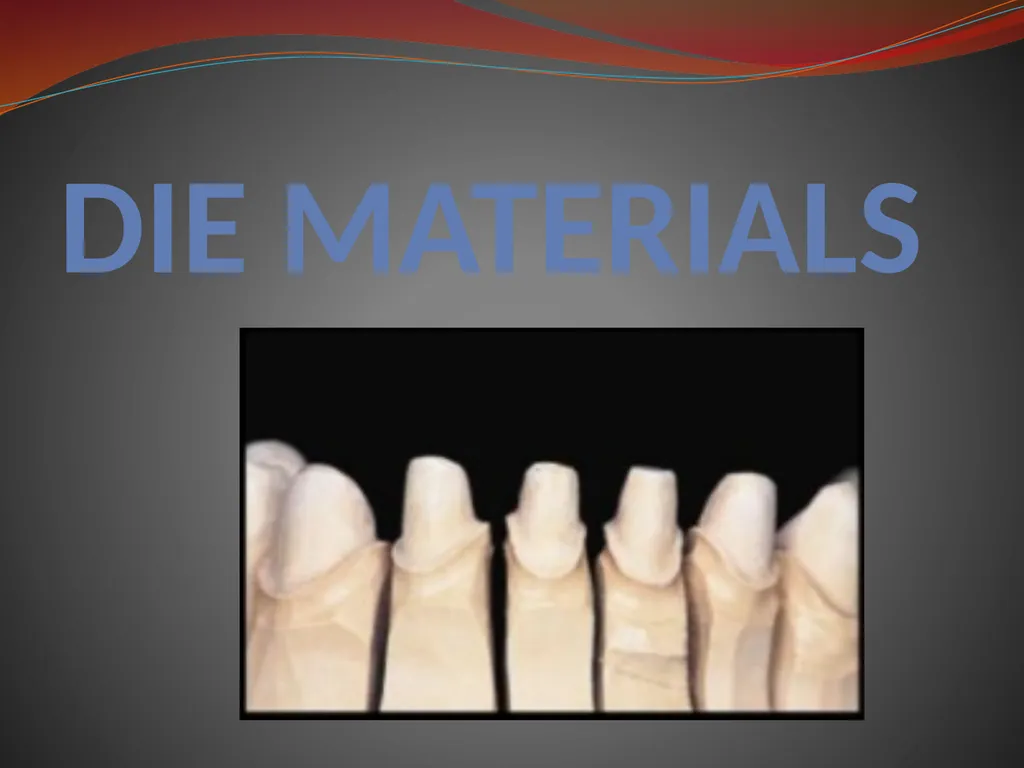
DIE MATERIALS<br>
25
DIE MATERIALS USED GYPSUM PRODUCTS: Type IV Dental stone
Type V Dental stone
DIE STONE – INVESTMENT COMBINATION
ELECTROFORMED DIES: Silver plated
Copper plated
EPOXY RESINS
POLYURETHANE DIES
AMALGAM DIES
METAL SPRAYED DIES
FLEXIBLE DIE MATERIALS
REFRACTORY DIES
SILICOPHOSPHATE DIES
CERAMIC DIES<br>
Type V Dental stone
DIE STONE – INVESTMENT COMBINATION
ELECTROFORMED DIES: Silver plated
Copper plated
EPOXY RESINS
POLYURETHANE DIES
AMALGAM DIES
METAL SPRAYED DIES
FLEXIBLE DIE MATERIALS
REFRACTORY DIES
SILICOPHOSPHATE DIES
CERAMIC DIES<br>
26
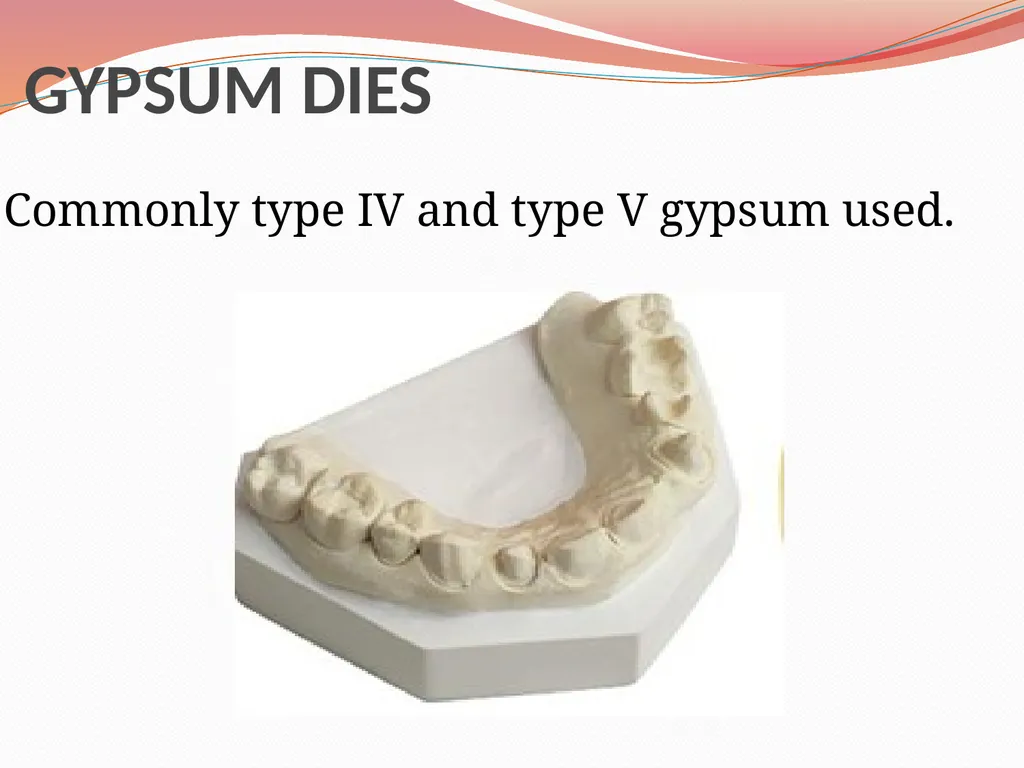
GYPSUM DIES Commonly type IV and type V gypsum used.<br>
27
DIE STONE – INVESTMENT COMBINATION Commercially available gypsum bonded materials.
The divestment is mixed with colloidal silica and liquid.
Die is made and wax pattern is constructed on it.
Then the whole complex is invested in
a mixture of divestment and water.<br>
The divestment is mixed with colloidal silica and liquid.
Die is made and wax pattern is constructed on it.
Then the whole complex is invested in
a mixture of divestment and water.<br>
28
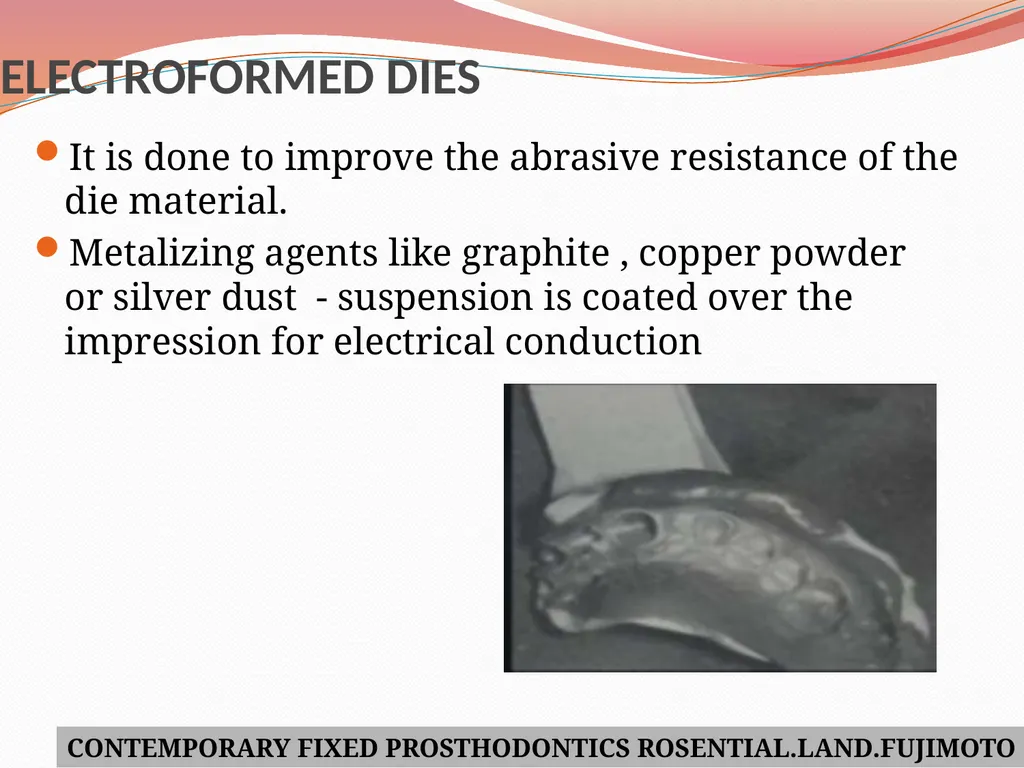
ELECTROFORMED DIES It is done to improve the abrasive resistance of the die material.
Metalizing agents like graphite , copper powder or silver dust - suspension is coated over the impression for electrical conduction CONTEMPORARY FIXED PROSTHODONTICS ROSENTIAL.LAND.FUJIMOTO<br>
Metalizing agents like graphite , copper powder or silver dust - suspension is coated over the impression for electrical conduction CONTEMPORARY FIXED PROSTHODONTICS ROSENTIAL.LAND.FUJIMOTO<br>
29
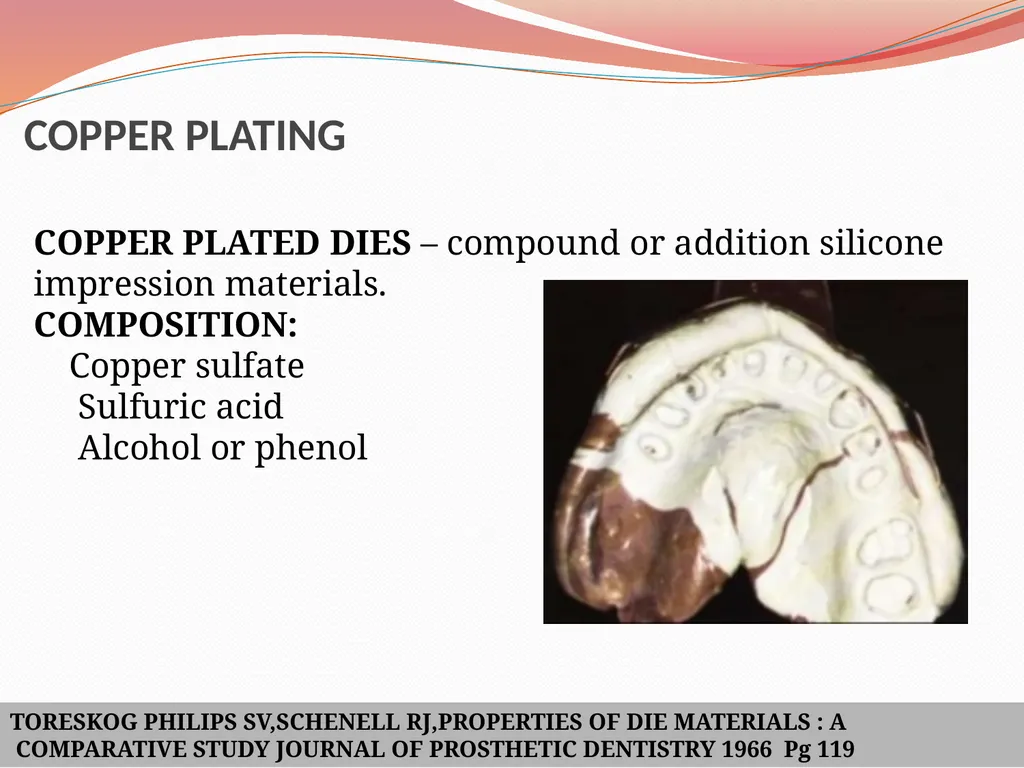
COPPER PLATING COPPER PLATED DIES – compound or addition silicone impression materials.
COMPOSITION:
Copper sulfate
Sulfuric acid
Alcohol or phenol TORESKOG PHILIPS SV,SCHENELL RJ,PROPERTIES OF DIE MATERIALS : A
COMPARATIVE STUDY JOURNAL OF PROSTHETIC DENTISTRY 1966 Pg 119<br>
COMPOSITION:
Copper sulfate
Sulfuric acid
Alcohol or phenol TORESKOG PHILIPS SV,SCHENELL RJ,PROPERTIES OF DIE MATERIALS : A
COMPARATIVE STUDY JOURNAL OF PROSTHETIC DENTISTRY 1966 Pg 119<br>
30
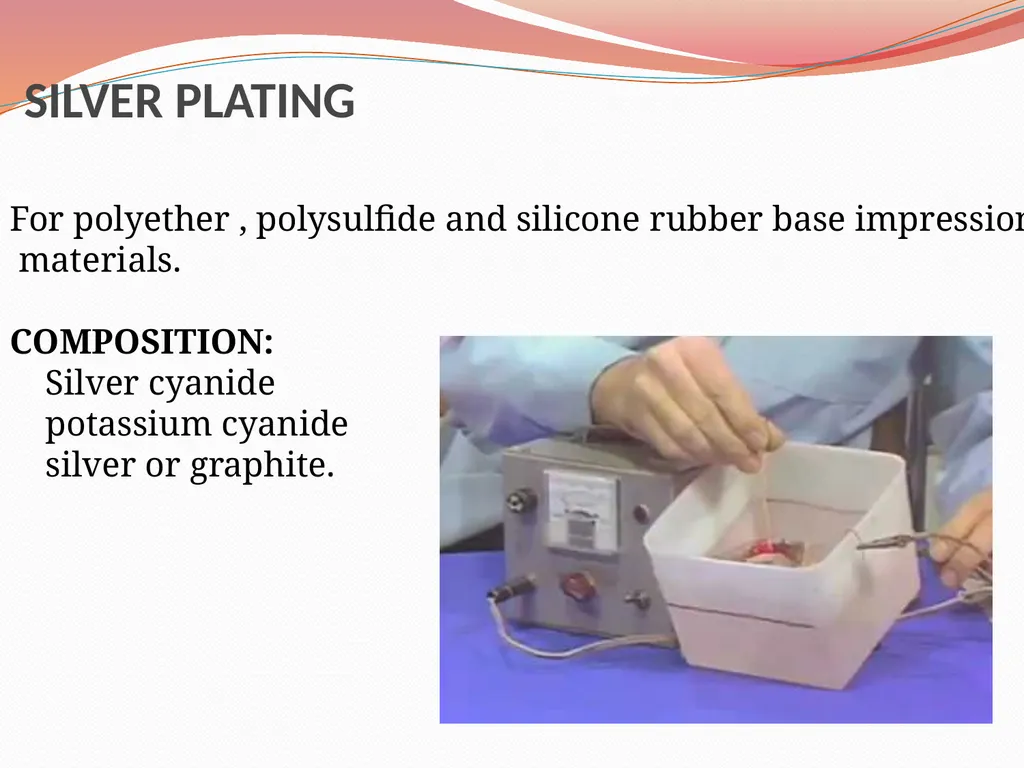
SILVER PLATING For polyether , polysulfide and silicone rubber base impression
materials.
COMPOSITION:
Silver cyanide
potassium cyanide
silver or graphite.<br>
materials.
COMPOSITION:
Silver cyanide
potassium cyanide
silver or graphite.<br>
31
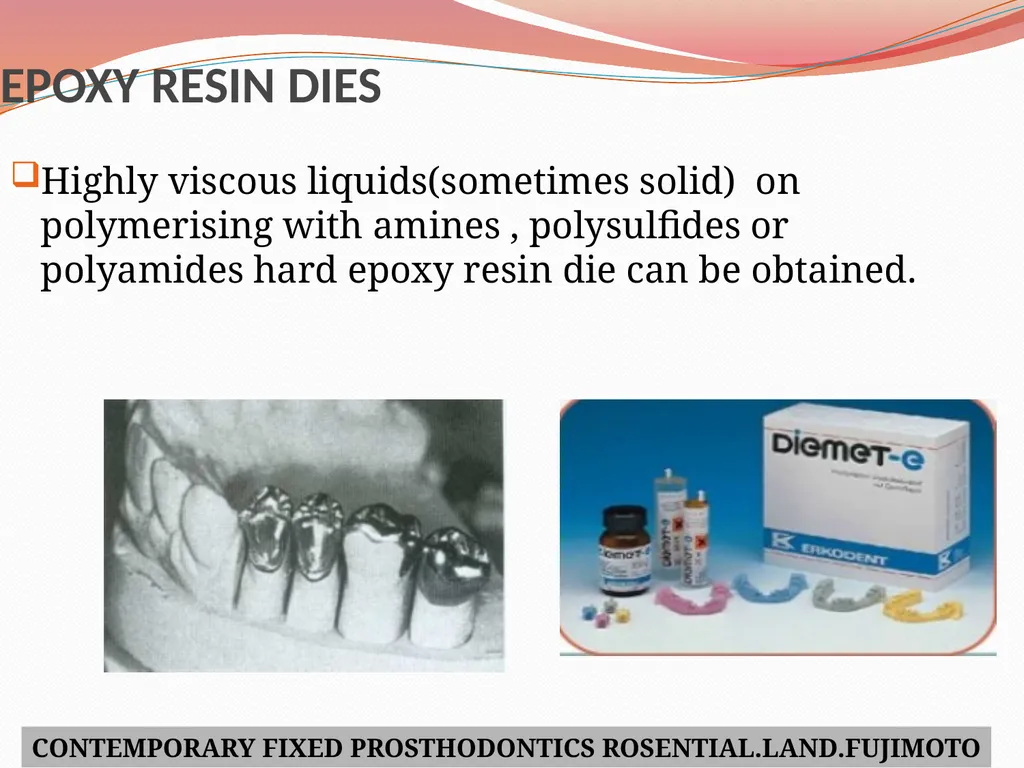
EPOXY RESIN DIES Highly viscous liquids(sometimes solid) on polymerising with amines , polysulfides or polyamides hard epoxy resin die can be obtained. CONTEMPORARY FIXED PROSTHODONTICS ROSENTIAL.LAND.FUJIMOTO<br>
32
Epoxy resin exhibits better detail reproduction,
abrasion resistance and transverse
strength than the gypsum products.
The setting shrinkage compared with the expansion observed with gypsum die materials may require modifications in technique to obtain castings that will be
well adapted to the tooth preparation . Philip Duke,B.K.Moore ,Steven Phaug and Carle J Andres .Study of the physical properties
Of type IV gypsum ,resin containing and epoxy die material journal of prosthetic dentistry
2000 ; 83; 466-473<br>
abrasion resistance and transverse
strength than the gypsum products.
The setting shrinkage compared with the expansion observed with gypsum die materials may require modifications in technique to obtain castings that will be
well adapted to the tooth preparation . Philip Duke,B.K.Moore ,Steven Phaug and Carle J Andres .Study of the physical properties
Of type IV gypsum ,resin containing and epoxy die material journal of prosthetic dentistry
2000 ; 83; 466-473<br>
33
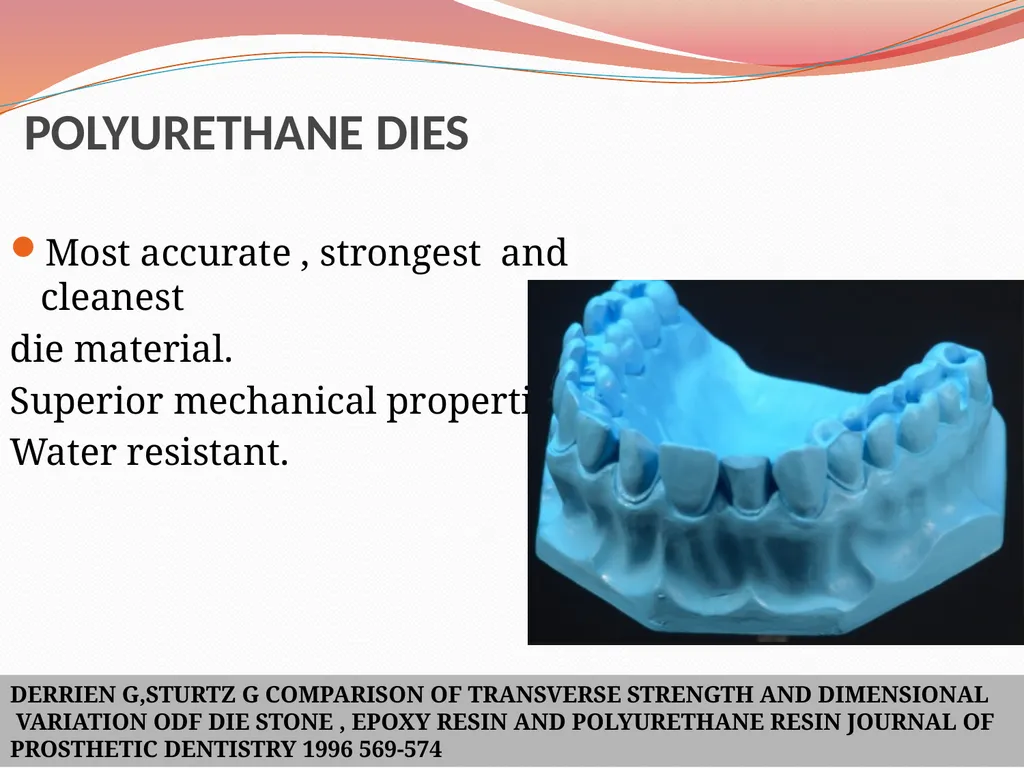
POLYURETHANE DIES Most accurate , strongest and cleanest
die material.
Superior mechanical properties.
Water resistant. DERRIEN G,STURTZ G COMPARISON OF TRANSVERSE STRENGTH AND DIMENSIONAL
VARIATION ODF DIE STONE , EPOXY RESIN AND POLYURETHANE RESIN JOURNAL OF PROSTHETIC DENTISTRY 1996 569-574<br>
die material.
Superior mechanical properties.
Water resistant. DERRIEN G,STURTZ G COMPARISON OF TRANSVERSE STRENGTH AND DIMENSIONAL
VARIATION ODF DIE STONE , EPOXY RESIN AND POLYURETHANE RESIN JOURNAL OF PROSTHETIC DENTISTRY 1996 569-574<br>
34
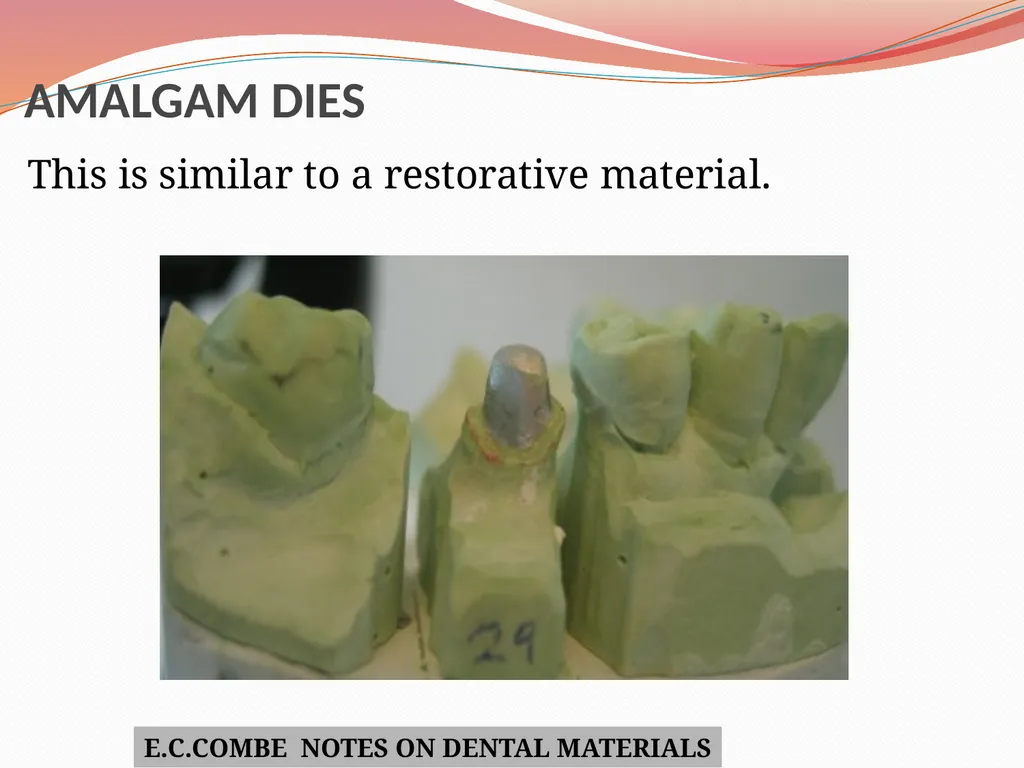
AMALGAM DIES This is similar to a restorative material. E.C.COMBE NOTES ON DENTAL MATERIALS<br>
35
METAL SPRAYED DIES A bismuth- tin alloy is used.
ADVANTAGES:
It can be rapidly obtained from impression materials.
DISADVANTAGES:
Alloy is soft it will tend to abrade. E.C.COMBE NOTES ON DENTAL MATERIALS<br>
ADVANTAGES:
It can be rapidly obtained from impression materials.
DISADVANTAGES:
Alloy is soft it will tend to abrade. E.C.COMBE NOTES ON DENTAL MATERIALS<br>
36
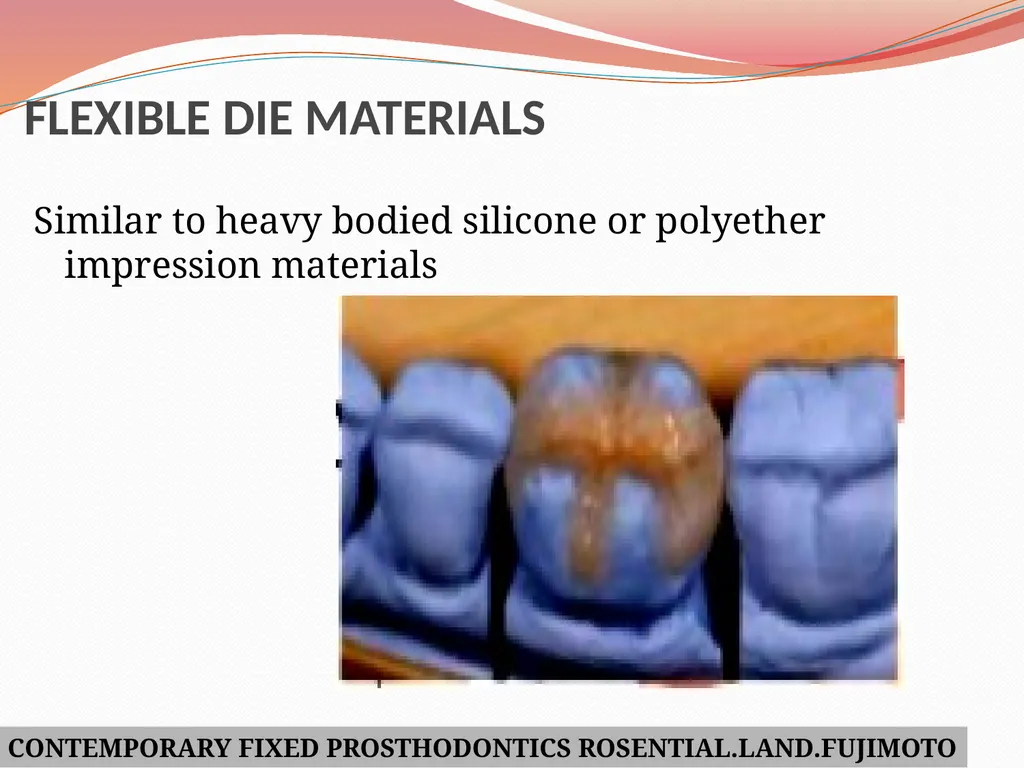
FLEXIBLE DIE MATERIALS Similar to heavy bodied silicone or polyether impression materials CONTEMPORARY FIXED PROSTHODONTICS ROSENTIAL.LAND.FUJIMOTO<br>
37
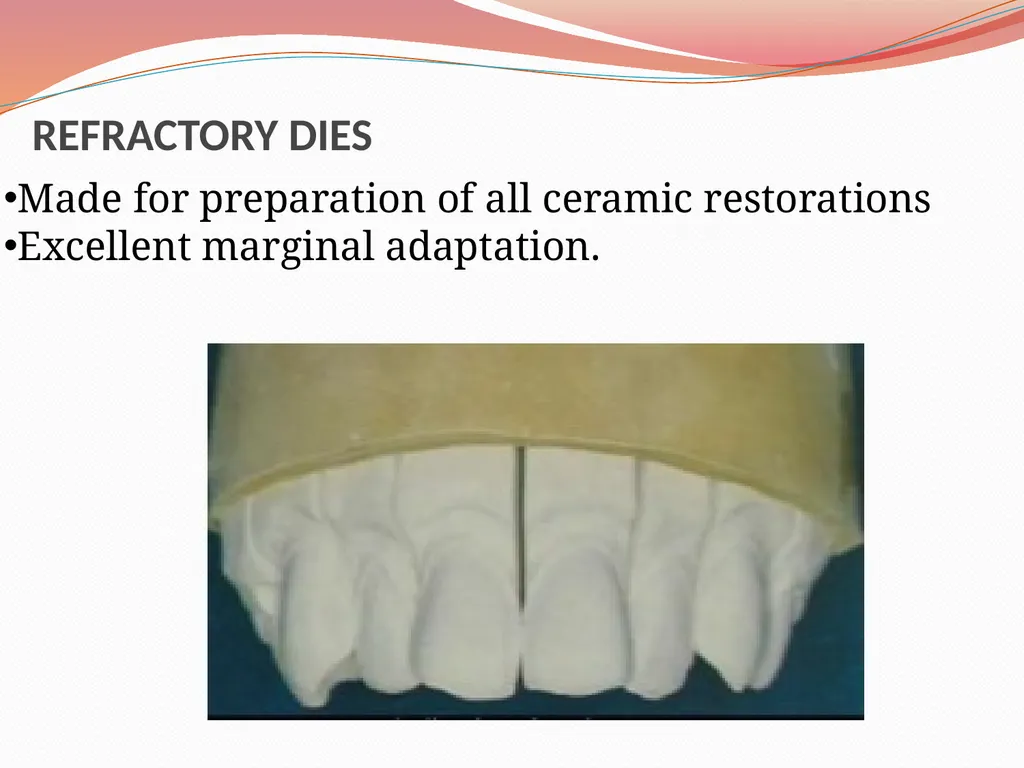
REFRACTORY DIES Made for preparation of all ceramic restorations
Excellent marginal adaptation.<br>
Excellent marginal adaptation.<br>
38
SILICOPHOSPHATE DIES Similar to the filling and cementing material. E.C.COMBE NOTES ON DENTAL MATERIALS<br>
39
COMPATIBILITY WITH IMPRESSION MATERIALS DIE STONE – Impression compound, zinc oxide eugenol , alginate , impression plaster and rubber base impression material.
ELECTROPLATED COPPER – Impression compound
ELECTROPLATED SILVER - polysulphide , rubber base material.
EPOXY RESIN - Rubber base impression material.<br>
ELECTROPLATED COPPER – Impression compound
ELECTROPLATED SILVER - polysulphide , rubber base material.
EPOXY RESIN - Rubber base impression material.<br>
40
CONCLUSION Good impression and die fabrication with selection of the die material and its manipulation paramount to achieve accuracy in the final restoration.<br>
41
THANK YOU<br>