
Modern Business Practices Dr. Jyoti Harchekar
TA
Published · 31 slides · 0 views

1 / 1

Description
Modern Business Practices Dr. Jyoti Harchekar Assistant Professor Tilak Maharashtra Vidyapeeth, Pune PUBLIC ENTERPRISES IN INDIA Introduction :- All industrial and commercial undertakings owned, managed and controlled by the Government are
Related Topics
Share
Embed code
Download this presentation From Below
"Modern Business Practices Dr. Jyoti Harchekar" is the property of its rightful owner. Permission is granted to download and print the materials on this website for personal, non-commercial use only, and to display it on your personal computer provided you do not modify the materials and that you retain all copyright notices contained in the materials. By downloading content from our website, you accept the terms of this agreement.
Presentation Transcript
01
Modern Business Practices Dr. Jyoti Harchekar
Assistant Professor
Tilak Maharashtra Vidyapeeth, Pune<br>
Assistant Professor
Tilak Maharashtra Vidyapeeth, Pune<br>
02
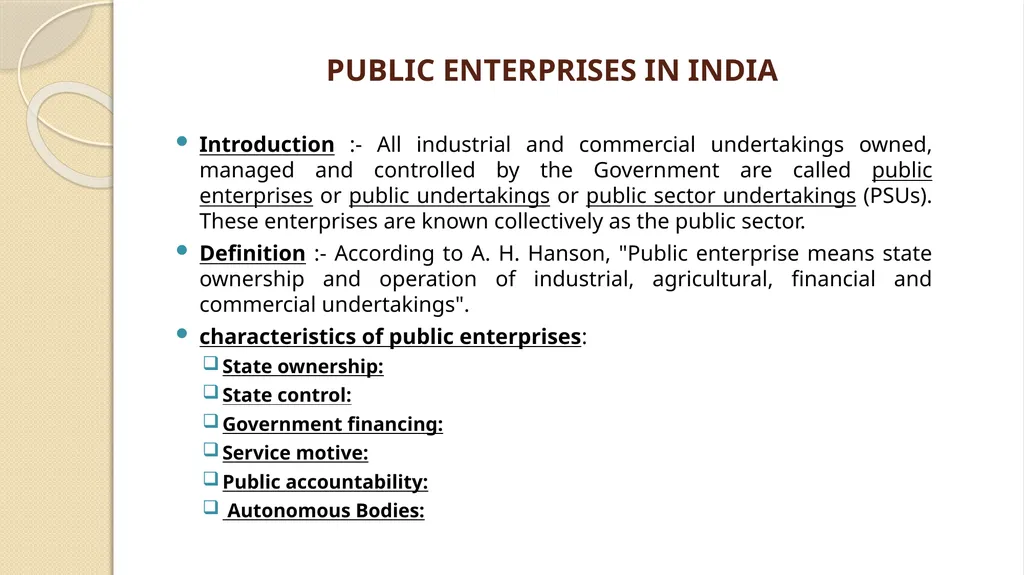
PUBLIC ENTERPRISES IN INDIA Introduction :- All industrial and commercial undertakings owned, managed and controlled by the Government are called public enterprises or public undertakings or public sector undertakings (PSUs). These enterprises are known collectively as the public sector.
Definition :- According to A. H. Hanson, "Public enterprise means state ownership and operation of industrial, agricultural, financial and commercial undertakings".
characteristics of public enterprises:
State ownership:
State control:
Government financing:
Service motive:
Public accountability:
Autonomous Bodies:<br>
Definition :- According to A. H. Hanson, "Public enterprise means state ownership and operation of industrial, agricultural, financial and commercial undertakings".
characteristics of public enterprises:
State ownership:
State control:
Government financing:
Service motive:
Public accountability:
Autonomous Bodies:<br>
03
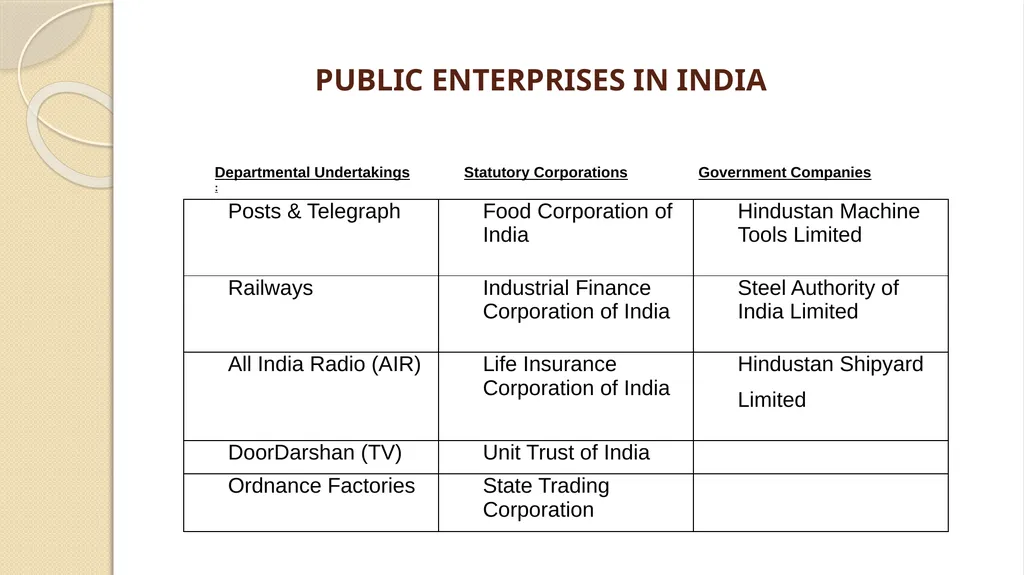
PUBLIC ENTERPRISES IN INDIA Departmental Undertakings Statutory Corporations Government Companies
:<br>
:<br>
04
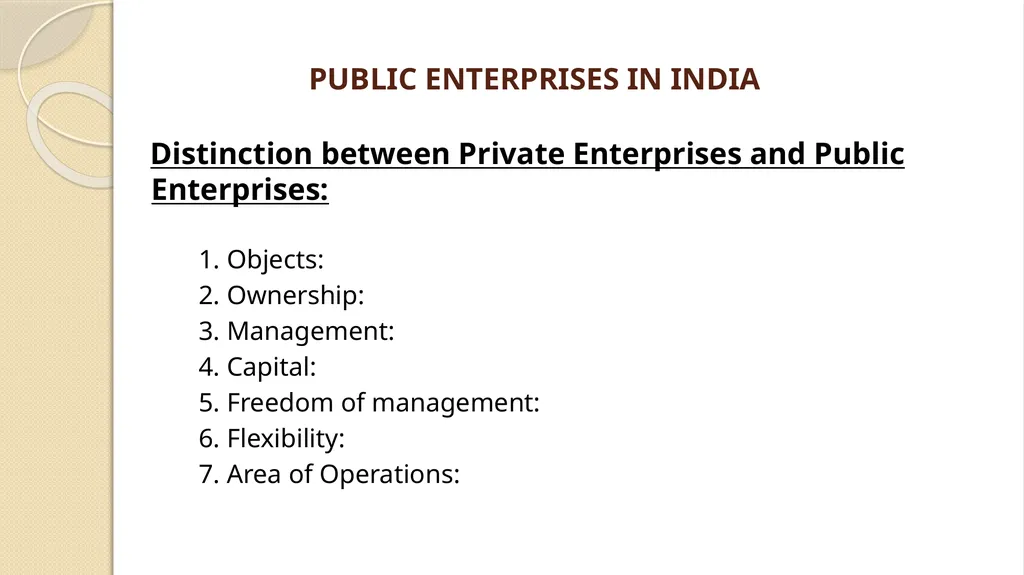
PUBLIC ENTERPRISES IN INDIA Distinction between Private Enterprises and Public Enterprises:
1. Objects:
2. Ownership:
3. Management:
4. Capital:
5. Freedom of management:
6. Flexibility:
7. Area of Operations:<br>
1. Objects:
2. Ownership:
3. Management:
4. Capital:
5. Freedom of management:
6. Flexibility:
7. Area of Operations:<br>
05
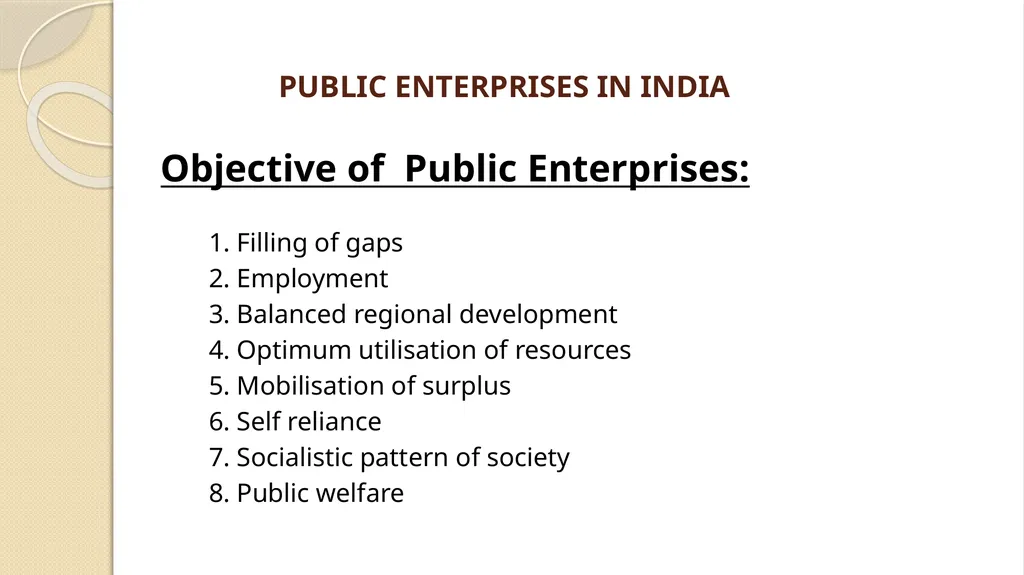
PUBLIC ENTERPRISES IN INDIA Objective of Public Enterprises:
1. Filling of gaps
2. Employment
3. Balanced regional development
4. Optimum utilisation of resources
5. Mobilisation of surplus
6. Self reliance
7. Socialistic pattern of society
8. Public welfare<br>
1. Filling of gaps
2. Employment
3. Balanced regional development
4. Optimum utilisation of resources
5. Mobilisation of surplus
6. Self reliance
7. Socialistic pattern of society
8. Public welfare<br>
06
PUBLIC ENTERPRISES IN INDIA MANAGEMENT AND CONTROL OF PUBLIC SECTOR ENTERPRISES
There is no need to justify the rationale of control over public enterprises as it is ingrained in the word 'public'. In India, three types of control are exercised in this regard, namely,
parliamentary control,
ministerial control, and
Audit control.
Parliamentary control :- The parliamentary control over public enterprises is needed for fulfilling the constitutional responsibility of the parliament in respect of these enterprises like protection of capital invested, safeguarding public interests in running of these enterprises.
Ministerial control :- The ministerial control over public enterprises is highly significant and effective. From the very inception of a public enterprise, the minister is associated in one way or the other with its operations and management. In the Indian context, the ministerial control is more real than is admitted.
Audit Control:- Effective Audit Control:- is imperatively necessary in case of public enterprise, as the investments made in them do not belong to the people who manage these enterprises.<br>
There is no need to justify the rationale of control over public enterprises as it is ingrained in the word 'public'. In India, three types of control are exercised in this regard, namely,
parliamentary control,
ministerial control, and
Audit control.
Parliamentary control :- The parliamentary control over public enterprises is needed for fulfilling the constitutional responsibility of the parliament in respect of these enterprises like protection of capital invested, safeguarding public interests in running of these enterprises.
Ministerial control :- The ministerial control over public enterprises is highly significant and effective. From the very inception of a public enterprise, the minister is associated in one way or the other with its operations and management. In the Indian context, the ministerial control is more real than is admitted.
Audit Control:- Effective Audit Control:- is imperatively necessary in case of public enterprise, as the investments made in them do not belong to the people who manage these enterprises.<br>
07
PUBLIC ENTERPRISES IN INDIA Problems Of Public Sector Enterprises In India:
1. Objective and Role
2. Extent and Coverage
3. Organisation and Management
4. Personnel Administration
5. Financial Management
6. Workers' Participation in Management
7. Autonomy and Accountability<br>
1. Objective and Role
2. Extent and Coverage
3. Organisation and Management
4. Personnel Administration
5. Financial Management
6. Workers' Participation in Management
7. Autonomy and Accountability<br>
08
PUBLIC ENTERPRISES IN INDIA ADVANTAGES AND LIMITATIONS OF GOVERNMENT UNDERTAKING
Balanced growth
Long period planning
Facilities for economic development
Greater public welfare
Equal distribution of wealth
Better co-ordination
Abolition of monopoly
Greater economy
Better relation with labour force
Better deal to consumers
Utilization of local resources
Achievement of self-reliance
Establishment of heavy and strategic industry
Balanced production<br>
Balanced growth
Long period planning
Facilities for economic development
Greater public welfare
Equal distribution of wealth
Better co-ordination
Abolition of monopoly
Greater economy
Better relation with labour force
Better deal to consumers
Utilization of local resources
Achievement of self-reliance
Establishment of heavy and strategic industry
Balanced production<br>
09
PUBLIC ENTERPRISES IN INDIA RECENT PRACTICES AND POLICIES IN PUBLIC ENTERPRISES BY INDIAN GOVERNMENT
Public sector enterprises occupy an important place in the Indian economy. At the time of
independence, the Indian economy was basically agrarian with a weak industrial base. There
were very few public sector enterprises in our country. The Indian Railways, the Posts and
Telegraphs, the Port Trust, Government Salt Factories were the prominent public sector
enterprises. After getting independence, the government felt that if the country needs to speed up its economic growth, then state’s intervention in all sectors of the economy is inevitable
overall performance of most of the public sector enterprises is not satisfactory. The rate of return on capital investment is very low.
On 24 July 1991 the Government of India announced its Industrial policy to improve the performance and portfolio of public sector enterprises<br>
Public sector enterprises occupy an important place in the Indian economy. At the time of
independence, the Indian economy was basically agrarian with a weak industrial base. There
were very few public sector enterprises in our country. The Indian Railways, the Posts and
Telegraphs, the Port Trust, Government Salt Factories were the prominent public sector
enterprises. After getting independence, the government felt that if the country needs to speed up its economic growth, then state’s intervention in all sectors of the economy is inevitable
overall performance of most of the public sector enterprises is not satisfactory. The rate of return on capital investment is very low.
On 24 July 1991 the Government of India announced its Industrial policy to improve the performance and portfolio of public sector enterprises<br>
10
AGRICULTURE BUSINESS PRACTICES INTRODUCTION:- Agriculture means cultivation of land and rearing of animals. Agriculture is the essence of India. Government has played a pivotal role in this sector by providing various facilities & schemes to the farmers and petty growers
NATURE AND CHARACTERISTICS OF INDIAN AGRICULTURE:- The term agriculture has been derived from two Latin words: ager meaning ‘land’ and cultura meaning ‘cultivation’. Agriculture thus means cultivation of land and rearing of animals. The branch of science which deals with methods of food production is known as agriculture<br>
NATURE AND CHARACTERISTICS OF INDIAN AGRICULTURE:- The term agriculture has been derived from two Latin words: ager meaning ‘land’ and cultura meaning ‘cultivation’. Agriculture thus means cultivation of land and rearing of animals. The branch of science which deals with methods of food production is known as agriculture<br>
11
AGRICULTURE BUSINESS PRACTICES There are various steps involved in agricultural practices
Preparation of the soil--ploughing & turning the soil loose with the help of ploughs, spade & other mechanical implements
sowing the seeds--treating the seeds with fungicides & sowing them with hand or using a seed drill. Preparing a seed bed & growing seedlings when plants are transplanted like paddy adding weedicides to remove the weeds.
adding fertilizers
Irrigation--supply water
spraying pesticides to protect crops
Harvesting -- using sickle, mechanical harvesters, combines
storage--- drying the crops in case of cereals & pulses & storing in air tight containers like gunny bags in moisture proof, rat proof godowns.<br>
Preparation of the soil--ploughing & turning the soil loose with the help of ploughs, spade & other mechanical implements
sowing the seeds--treating the seeds with fungicides & sowing them with hand or using a seed drill. Preparing a seed bed & growing seedlings when plants are transplanted like paddy adding weedicides to remove the weeds.
adding fertilizers
Irrigation--supply water
spraying pesticides to protect crops
Harvesting -- using sickle, mechanical harvesters, combines
storage--- drying the crops in case of cereals & pulses & storing in air tight containers like gunny bags in moisture proof, rat proof godowns.<br>
12
AGRICULTURE BUSINESS PRACTICES Basic Characteristics of Indian Agriculture:
(a) The average size of agricultural holdings is still very small and uneconomical to cultivate the national average being around 1.69 hectares. Because of these uneconomic holdings, there is a great hindrance to the developmental programme of agriculture.
(b) India has the largest irrigated area of the cultivated land. Still the facilities of irrigation are available only on 30 percent area of our cultivated land 60 to 65 percent of the cropped area being rainfed.
(c) Indian farmers grow a wide variety of crops both food crops and commercial or cash crops. Yet a very large portion of our crops consist of food grains.
(d) Agriculture in India depends on the monsoon rains, which are uncertain, irregular and inequitably distributed. Artificial irrigation is very essential for growing various crops.
(e) There are mainly two crop-seasons in India Rabi (November to April) and Kharif (June to October). An extra-crop known as "Zayad" is also grown after the kharif crop in the months of April May and June.
(f) The average productivity of crops is very low in comparison to several other agriculturally well developed countries of the world.
(g) Indian agriculture is predominantly of the subsistence type. About 72.3 percent of the total cultivated area is devoted to food crops and yet the country is just self-sufficient in its food requirements.<br>
(a) The average size of agricultural holdings is still very small and uneconomical to cultivate the national average being around 1.69 hectares. Because of these uneconomic holdings, there is a great hindrance to the developmental programme of agriculture.
(b) India has the largest irrigated area of the cultivated land. Still the facilities of irrigation are available only on 30 percent area of our cultivated land 60 to 65 percent of the cropped area being rainfed.
(c) Indian farmers grow a wide variety of crops both food crops and commercial or cash crops. Yet a very large portion of our crops consist of food grains.
(d) Agriculture in India depends on the monsoon rains, which are uncertain, irregular and inequitably distributed. Artificial irrigation is very essential for growing various crops.
(e) There are mainly two crop-seasons in India Rabi (November to April) and Kharif (June to October). An extra-crop known as "Zayad" is also grown after the kharif crop in the months of April May and June.
(f) The average productivity of crops is very low in comparison to several other agriculturally well developed countries of the world.
(g) Indian agriculture is predominantly of the subsistence type. About 72.3 percent of the total cultivated area is devoted to food crops and yet the country is just self-sufficient in its food requirements.<br>
13
AGRICULTURE BUSINESS PRACTICES PROBLEMS AND PROSPECTS OF INDIAN AGRICULTURE
India is largely an agricultural country. Seventy per cent of her vast populations live, directly or indirectly, on income derived from agriculture. But to say that India lives by agriculture does not mean that India is agriculturally advanced machines have superseded manual labour. That means a larger acreage is brought under cultivation in more efficient manner. Secondly, the fertility of the soil has been increased by scientific, i.e. chemical manuring. Thirdly, new crops of a better quality and higher yield have been introduced. Fourthly, highly improved methods of irrigation and crop-protection and storing have been adopted.<br>
India is largely an agricultural country. Seventy per cent of her vast populations live, directly or indirectly, on income derived from agriculture. But to say that India lives by agriculture does not mean that India is agriculturally advanced machines have superseded manual labour. That means a larger acreage is brought under cultivation in more efficient manner. Secondly, the fertility of the soil has been increased by scientific, i.e. chemical manuring. Thirdly, new crops of a better quality and higher yield have been introduced. Fourthly, highly improved methods of irrigation and crop-protection and storing have been adopted.<br>
14
AGRICULTURE BUSINESS PRACTICES GOVERNMENT POLICIES RELATED TO AGRICULTURE AND AGRIBUSINESS
Agriculture is a way of life, a tradition, which, for centuries, has shaped the thought, the outlook, the culture and the economic life of the people of India
Over 200 million Indian farmers and farm workers have been the backbone of India’s agriculture
The National Policy on Agriculture seeks to actualise the vast untapped growth potential of Indian agriculture, strengthen rural infrastructure to support faster agricultural development, promote value addition, accelerate the growth of agro business, create employment in rural areas<br>
Agriculture is a way of life, a tradition, which, for centuries, has shaped the thought, the outlook, the culture and the economic life of the people of India
Over 200 million Indian farmers and farm workers have been the backbone of India’s agriculture
The National Policy on Agriculture seeks to actualise the vast untapped growth potential of Indian agriculture, strengthen rural infrastructure to support faster agricultural development, promote value addition, accelerate the growth of agro business, create employment in rural areas<br>
15
AGRICULTURE BUSINESS PRACTICES New Agriculture Policy
Sustainable Agriculture:
Food and Nutritional Security:
Generation and Transfer of Technology:
Inputs Management:
Incentives for Agriculture:
Investments in Agriculture:
Institutional Structure:
Risk Management:
Management Reforms:<br>
Sustainable Agriculture:
Food and Nutritional Security:
Generation and Transfer of Technology:
Inputs Management:
Incentives for Agriculture:
Investments in Agriculture:
Institutional Structure:
Risk Management:
Management Reforms:<br>
16
AGRICULTURE BUSINESS PRACTICES Government Programmes for Agribusiness Both the central government and state governments have devised programmes to woo the entrepreneurs for setting up agribusiness in India
Entrepreneurial Training institutes
Fragrance & Flavour Development Centre (FFDC), Kannauj
Export Processing Zones
Special Economic Zones –
Export Oriented Units (EOU) –
Export Promotion Industrial Park (EPIP) Scheme -
New Anna Marumalarchi Thittam -
Agri-Clinic and Agribusiness Centres -
Regulations (Legal regulation)<br>
Entrepreneurial Training institutes
Fragrance & Flavour Development Centre (FFDC), Kannauj
Export Processing Zones
Special Economic Zones –
Export Oriented Units (EOU) –
Export Promotion Industrial Park (EPIP) Scheme -
New Anna Marumalarchi Thittam -
Agri-Clinic and Agribusiness Centres -
Regulations (Legal regulation)<br>
17
AGRICULTURE BUSINESS PRACTICES SUMMARY
The branch of science which deals with methods of food production is known as agriculture. This deals with food production, growing better variety of crops & managing the animals & birds for farm work & better yield of food like egg, meat etc. Agriculture industry has seen some remarkable changes since independence, also become very important from the perspective of employment generation, so Indian economy is reckoned as Agri-oriented. The National Policy on Agriculture seeks to actualise the vast untapped growth potential of Indian agriculture, strengthen rural infrastructure to support faster agricultural development, promote value addition, accelerate the growth of agro business, create employment in rural areas, secure a fair standard of living for the farmers and agricultural workers and their families, discourage migration to urban areas and face the challenges arising out of economic liberalization and globalisation.<br>
The branch of science which deals with methods of food production is known as agriculture. This deals with food production, growing better variety of crops & managing the animals & birds for farm work & better yield of food like egg, meat etc. Agriculture industry has seen some remarkable changes since independence, also become very important from the perspective of employment generation, so Indian economy is reckoned as Agri-oriented. The National Policy on Agriculture seeks to actualise the vast untapped growth potential of Indian agriculture, strengthen rural infrastructure to support faster agricultural development, promote value addition, accelerate the growth of agro business, create employment in rural areas, secure a fair standard of living for the farmers and agricultural workers and their families, discourage migration to urban areas and face the challenges arising out of economic liberalization and globalisation.<br>
18
ALLIED AGRICULTURE BUSINESS AND WTO INTRODUCTION:- India is one of the founding members of WTO - World Trade Organisation. Firstly, you will study WTO provisions pose no real threat to Indian agriculture. Also, here you will learn the farm waste management and implementation of its techniques; further the types of fertilizers and the dairy and poultry industry and products.
WTO AND INDIAN AGRICULTURE :- India is one of the founding members of WTO (World Trade Organisation) which came into existence on January 01, 1995 replacing GATT (General Agreement on Tariffs and Trade) and promising the herald of new era in the rule based system of governing and promoting international trade concomitant with the needs of the on-going processor globalization.
WTO provisions related to international trade are now similarly applicable to agriculture which was brought within the fold of GATT in the Uruguay Round (1986-93) of multilateral trade Negotiations (MTNs).
Application of WTO provisions on agriculture involves many contentions issues and is an area of serious concern for developing countries which are primarily agrarian economies, Moreover, the world, despite growing interdependence and integration, is highly heterogeneous with regard to levels of development. This heterogeneity is very much noticeable when we compare the agricultural sector of developed and developing countries.
Support infrastructure like storage, processing, finance, marketing, transport and R&D facilities are much more advanced and organized. In sharp contrast, in a country like India, for millions of farmers who derived their livelihood from agricultural, it is still a way of life and not an occupation they have chosen for themselves. Indian farmers are mostly involved in subsistence farming with very little or no marketable surplus.<br>
WTO AND INDIAN AGRICULTURE :- India is one of the founding members of WTO (World Trade Organisation) which came into existence on January 01, 1995 replacing GATT (General Agreement on Tariffs and Trade) and promising the herald of new era in the rule based system of governing and promoting international trade concomitant with the needs of the on-going processor globalization.
WTO provisions related to international trade are now similarly applicable to agriculture which was brought within the fold of GATT in the Uruguay Round (1986-93) of multilateral trade Negotiations (MTNs).
Application of WTO provisions on agriculture involves many contentions issues and is an area of serious concern for developing countries which are primarily agrarian economies, Moreover, the world, despite growing interdependence and integration, is highly heterogeneous with regard to levels of development. This heterogeneity is very much noticeable when we compare the agricultural sector of developed and developing countries.
Support infrastructure like storage, processing, finance, marketing, transport and R&D facilities are much more advanced and organized. In sharp contrast, in a country like India, for millions of farmers who derived their livelihood from agricultural, it is still a way of life and not an occupation they have chosen for themselves. Indian farmers are mostly involved in subsistence farming with very little or no marketable surplus.<br>
19
ALLIED AGRICULTURE BUSINESS AND WTO India is one of the founding members of WTO
AoA has classified all subsidies given to farmers into three categories -
AMBER BOX subsidies,
BLUE BOX subsidies, and
GREEN BOX subsidies.
Under AMBER box subsidies such domestic support its included which is meant to encourage farmers to produce more.
BLUE BOX subsidies are related to quantum of output and hence are considered minimally trade distorting. Such subsided is provided only up to certain limit of production.
GREEN BOX subsidiary aid to farmers comes under this category. The developed countries have used provisions of AoA to further infest of their farmers.
The developed countries have used provisions of AoA to further the interest of their farmers. For example, they have remodeled AMBER BOX subsidies in such a way that these qualities to be put into BLUE or GREEN BOX subsidies. These countries are constantly pressuring the developing countries for greater market access for agricultural product but are not willing to bring down the level support that they provide to their own farmers.
Developing countries like India feel that they are being discriminated against in matter like tariff on food imports into developed countries. For example, in the name of mutual access, OECD countries impose very low tariff on imports from fellow members while similar imports from developing countries are subjected to higher tariffs.
To conclude, it can be said that WTO provisions pose no real threat to Indian agriculture though aspects related to IPR (intellectual properties right), removal of tariff and non-tariff barriers and market access need to be dealt with constant vigil and suitable expertise. Relevant institutional and legal changes (like in patenting) need to be brought about and Equally important is the need to restructure, modify and revamp our agriculture sector so that it can rise up to the challenges thrown by growing integration with the rest of the world. The need of the time is to make it more efficient, modern diversified and competitive. The time to engineer a second Green revolution has arrived.<br>
AoA has classified all subsidies given to farmers into three categories -
AMBER BOX subsidies,
BLUE BOX subsidies, and
GREEN BOX subsidies.
Under AMBER box subsidies such domestic support its included which is meant to encourage farmers to produce more.
BLUE BOX subsidies are related to quantum of output and hence are considered minimally trade distorting. Such subsided is provided only up to certain limit of production.
GREEN BOX subsidiary aid to farmers comes under this category. The developed countries have used provisions of AoA to further infest of their farmers.
The developed countries have used provisions of AoA to further the interest of their farmers. For example, they have remodeled AMBER BOX subsidies in such a way that these qualities to be put into BLUE or GREEN BOX subsidies. These countries are constantly pressuring the developing countries for greater market access for agricultural product but are not willing to bring down the level support that they provide to their own farmers.
Developing countries like India feel that they are being discriminated against in matter like tariff on food imports into developed countries. For example, in the name of mutual access, OECD countries impose very low tariff on imports from fellow members while similar imports from developing countries are subjected to higher tariffs.
To conclude, it can be said that WTO provisions pose no real threat to Indian agriculture though aspects related to IPR (intellectual properties right), removal of tariff and non-tariff barriers and market access need to be dealt with constant vigil and suitable expertise. Relevant institutional and legal changes (like in patenting) need to be brought about and Equally important is the need to restructure, modify and revamp our agriculture sector so that it can rise up to the challenges thrown by growing integration with the rest of the world. The need of the time is to make it more efficient, modern diversified and competitive. The time to engineer a second Green revolution has arrived.<br>
20
ALLIED AGRICULTURE BUSINESS AND WTO AGRICULTURAL WASTE MANAGEMENT:- The proper management of waste from agricultural operations can contribute in a significant way to farm operations. Waste management helps maintain a healthy environment for farm animals and can reduce the need for commercial fertilizers while providing other nutrients needed for crop production. Agricultural waste typically associated with animals includes but is not limited to manure, bedding and litter, wasted feed, runoff from feedlots and holding areas, and wastewater from buildings like dairy parlors.
Best management practices (BMPs) such as rotational grazing and pasture renovation to maintain adequate vegetative cover and structures built to trap or retain waste should be utilized in order to prevent contamination of both surface waters and groundwater. When this waste is carried in overland flow from rain events, it is categorized as a nonpoint source pollutant, or one that originates from diffuse areas of land. Nonpoint source pollutants are one of the primary water quality problems in the United States. Furthermore, runoff and waste that does not pass through a vegetated buffer zone along the waterbody is likely to result in bank erosion and subsequent property loss.<br>
Best management practices (BMPs) such as rotational grazing and pasture renovation to maintain adequate vegetative cover and structures built to trap or retain waste should be utilized in order to prevent contamination of both surface waters and groundwater. When this waste is carried in overland flow from rain events, it is categorized as a nonpoint source pollutant, or one that originates from diffuse areas of land. Nonpoint source pollutants are one of the primary water quality problems in the United States. Furthermore, runoff and waste that does not pass through a vegetated buffer zone along the waterbody is likely to result in bank erosion and subsequent property loss.<br>
21
ALLIED AGRICULTURE BUSINESS AND WTO Benefits of waste management:
Like most other aspects of agricultural production, there are requirements for the application and management of agricultural waste on farms. However, the primary reasons behind managing agricultural waste make good sense both environmentally and economically. Where feasible, the reuse of animal waste in farming operations can reduce the quantity and hauling costs of commercial fertilizer. The contribution of animal waste increases the organic matter content of soils, which not only increases nutrient availability for crops but also improves the water holding capacity and tilth of the soil. Good waste management reduces the instances of well water contamination and minimizes surface water pollution.<br>
Like most other aspects of agricultural production, there are requirements for the application and management of agricultural waste on farms. However, the primary reasons behind managing agricultural waste make good sense both environmentally and economically. Where feasible, the reuse of animal waste in farming operations can reduce the quantity and hauling costs of commercial fertilizer. The contribution of animal waste increases the organic matter content of soils, which not only increases nutrient availability for crops but also improves the water holding capacity and tilth of the soil. Good waste management reduces the instances of well water contamination and minimizes surface water pollution.<br>
22
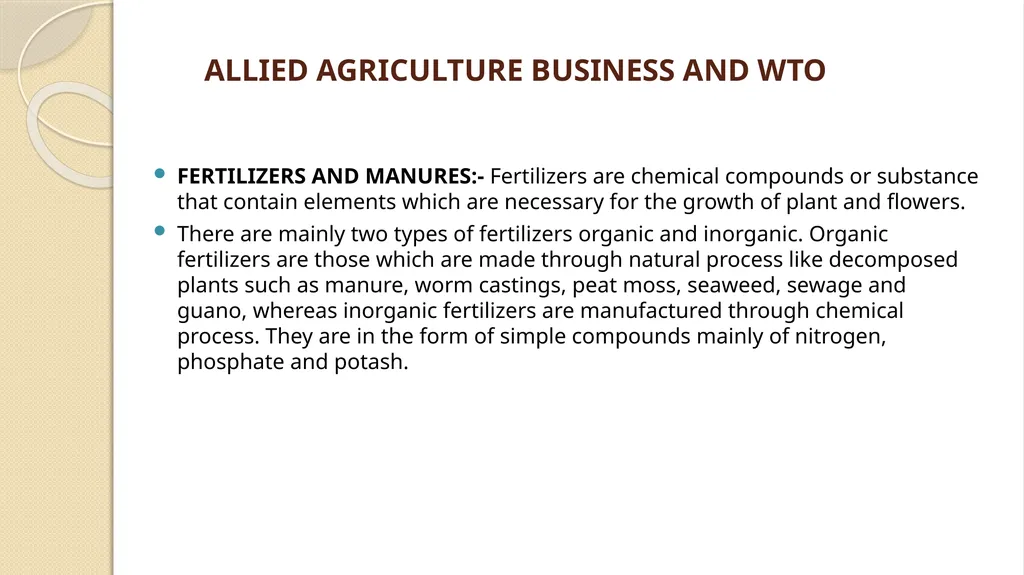
ALLIED AGRICULTURE BUSINESS AND WTO FERTILIZERS AND MANURES:- Fertilizers are chemical compounds or substance that contain elements which are necessary for the growth of plant and flowers.
There are mainly two types of fertilizers organic and inorganic. Organic fertilizers are those which are made through natural process like decomposed plants such as manure, worm castings, peat moss, seaweed, sewage and guano, whereas inorganic fertilizers are manufactured through chemical process. They are in the form of simple compounds mainly of nitrogen, phosphate and potash.<br>
There are mainly two types of fertilizers organic and inorganic. Organic fertilizers are those which are made through natural process like decomposed plants such as manure, worm castings, peat moss, seaweed, sewage and guano, whereas inorganic fertilizers are manufactured through chemical process. They are in the form of simple compounds mainly of nitrogen, phosphate and potash.<br>
23
ALLIED AGRICULTURE BUSINESS AND WTO Bio Fertilizers:
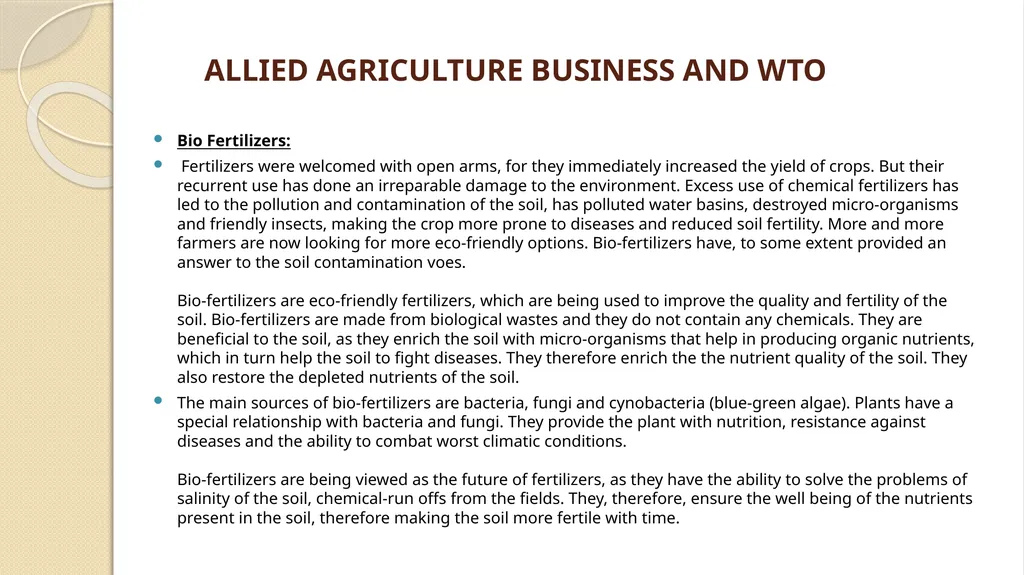
Fertilizers were welcomed with open arms, for they immediately increased the yield of crops. But their recurrent use has done an irreparable damage to the environment. Excess use of chemical fertilizers has led to the pollution and contamination of the soil, has polluted water basins, destroyed micro-organisms and friendly insects, making the crop more prone to diseases and reduced soil fertility. More and more farmers are now looking for more eco-friendly options. Bio-fertilizers have, to some extent provided an answer to the soil contamination voes. Bio-fertilizers are eco-friendly fertilizers, which are being used to improve the quality and fertility of the soil. Bio-fertilizers are made from biological wastes and they do not contain any chemicals. They are beneficial to the soil, as they enrich the soil with micro-organisms that help in producing organic nutrients, which in turn help the soil to fight diseases. They therefore enrich the the nutrient quality of the soil. They also restore the depleted nutrients of the soil.
The main sources of bio-fertilizers are bacteria, fungi and cynobacteria (blue-green algae). Plants have a special relationship with bacteria and fungi. They provide the plant with nutrition, resistance against diseases and the ability to combat worst climatic conditions. Bio-fertilizers are being viewed as the future of fertilizers, as they have the ability to solve the problems of salinity of the soil, chemical-run offs from the fields. They, therefore, ensure the well being of the nutrients present in the soil, therefore making the soil more fertile with time.<br>
Fertilizers were welcomed with open arms, for they immediately increased the yield of crops. But their recurrent use has done an irreparable damage to the environment. Excess use of chemical fertilizers has led to the pollution and contamination of the soil, has polluted water basins, destroyed micro-organisms and friendly insects, making the crop more prone to diseases and reduced soil fertility. More and more farmers are now looking for more eco-friendly options. Bio-fertilizers have, to some extent provided an answer to the soil contamination voes. Bio-fertilizers are eco-friendly fertilizers, which are being used to improve the quality and fertility of the soil. Bio-fertilizers are made from biological wastes and they do not contain any chemicals. They are beneficial to the soil, as they enrich the soil with micro-organisms that help in producing organic nutrients, which in turn help the soil to fight diseases. They therefore enrich the the nutrient quality of the soil. They also restore the depleted nutrients of the soil.
The main sources of bio-fertilizers are bacteria, fungi and cynobacteria (blue-green algae). Plants have a special relationship with bacteria and fungi. They provide the plant with nutrition, resistance against diseases and the ability to combat worst climatic conditions. Bio-fertilizers are being viewed as the future of fertilizers, as they have the ability to solve the problems of salinity of the soil, chemical-run offs from the fields. They, therefore, ensure the well being of the nutrients present in the soil, therefore making the soil more fertile with time.<br>
24
ALLIED AGRICULTURE BUSINESS AND WTO Bio Fertilizers:
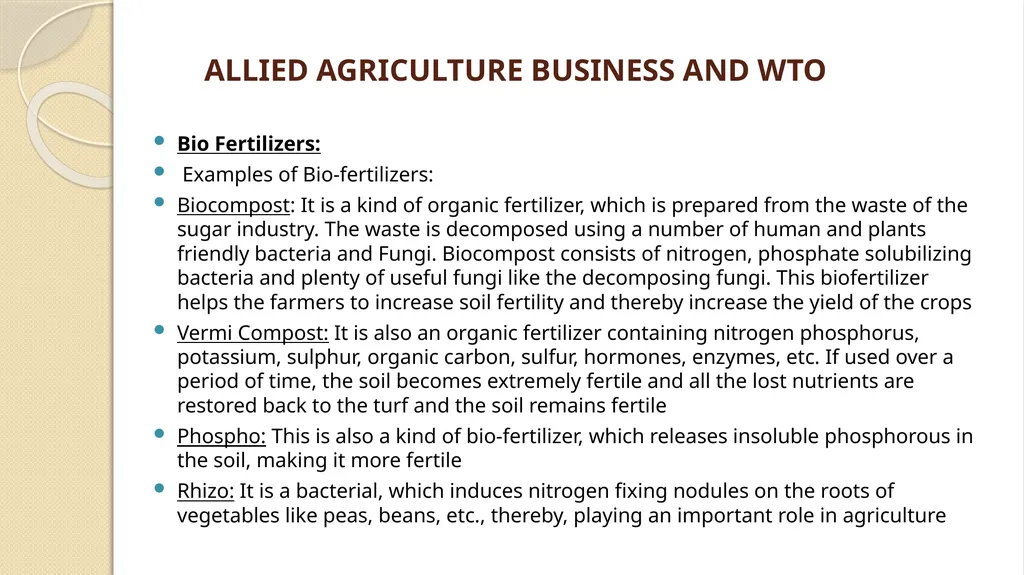
Examples of Bio-fertilizers:
Biocompost: It is a kind of organic fertilizer, which is prepared from the waste of the sugar industry. The waste is decomposed using a number of human and plants friendly bacteria and Fungi. Biocompost consists of nitrogen, phosphate solubilizing bacteria and plenty of useful fungi like the decomposing fungi. This biofertilizer helps the farmers to increase soil fertility and thereby increase the yield of the crops
Vermi Compost: It is also an organic fertilizer containing nitrogen phosphorus, potassium, sulphur, organic carbon, sulfur, hormones, enzymes, etc. If used over a period of time, the soil becomes extremely fertile and all the lost nutrients are restored back to the turf and the soil remains fertile
Phospho: This is also a kind of bio-fertilizer, which releases insoluble phosphorous in the soil, making it more fertile
Rhizo: It is a bacterial, which induces nitrogen fixing nodules on the roots of vegetables like peas, beans, etc., thereby, playing an important role in agriculture<br>
Examples of Bio-fertilizers:
Biocompost: It is a kind of organic fertilizer, which is prepared from the waste of the sugar industry. The waste is decomposed using a number of human and plants friendly bacteria and Fungi. Biocompost consists of nitrogen, phosphate solubilizing bacteria and plenty of useful fungi like the decomposing fungi. This biofertilizer helps the farmers to increase soil fertility and thereby increase the yield of the crops
Vermi Compost: It is also an organic fertilizer containing nitrogen phosphorus, potassium, sulphur, organic carbon, sulfur, hormones, enzymes, etc. If used over a period of time, the soil becomes extremely fertile and all the lost nutrients are restored back to the turf and the soil remains fertile
Phospho: This is also a kind of bio-fertilizer, which releases insoluble phosphorous in the soil, making it more fertile
Rhizo: It is a bacterial, which induces nitrogen fixing nodules on the roots of vegetables like peas, beans, etc., thereby, playing an important role in agriculture<br>
25
ALLIED AGRICULTURE BUSINESS AND WTO Bio Fertilizers:
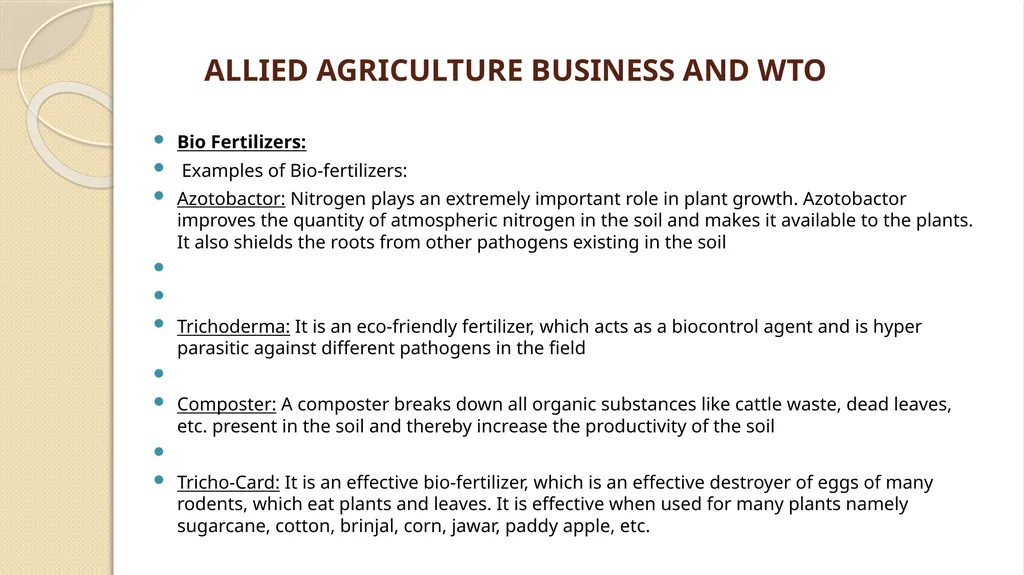
Examples of Bio-fertilizers:
Azotobactor: Nitrogen plays an extremely important role in plant growth. Azotobactor improves the quantity of atmospheric nitrogen in the soil and makes it available to the plants. It also shields the roots from other pathogens existing in the soil
Trichoderma: It is an eco-friendly fertilizer, which acts as a biocontrol agent and is hyper parasitic against different pathogens in the field
Composter: A composter breaks down all organic substances like cattle waste, dead leaves, etc. present in the soil and thereby increase the productivity of the soil
Tricho-Card: It is an effective bio-fertilizer, which is an effective destroyer of eggs of many rodents, which eat plants and leaves. It is effective when used for many plants namely sugarcane, cotton, brinjal, corn, jawar, paddy apple, etc.<br>
Examples of Bio-fertilizers:
Azotobactor: Nitrogen plays an extremely important role in plant growth. Azotobactor improves the quantity of atmospheric nitrogen in the soil and makes it available to the plants. It also shields the roots from other pathogens existing in the soil
Trichoderma: It is an eco-friendly fertilizer, which acts as a biocontrol agent and is hyper parasitic against different pathogens in the field
Composter: A composter breaks down all organic substances like cattle waste, dead leaves, etc. present in the soil and thereby increase the productivity of the soil
Tricho-Card: It is an effective bio-fertilizer, which is an effective destroyer of eggs of many rodents, which eat plants and leaves. It is effective when used for many plants namely sugarcane, cotton, brinjal, corn, jawar, paddy apple, etc.<br>
26
ALLIED AGRICULTURE BUSINESS AND WTO Bio Fertilizers:
Examples of Bio-fertilizers:
Azotobactor: Nitrogen plays an extremely important role in plant growth. Azotobactor improves the quantity of atmospheric nitrogen in the soil and makes it available to the plants. It also shields the roots from other pathogens existing in the soil
Trichoderma: It is an eco-friendly fertilizer, which acts as a biocontrol agent and is hyper parasitic against different pathogens in the field
Composter: A composter breaks down all organic substances like cattle waste, dead leaves, etc. present in the soil and thereby increase the productivity of the soil
Tricho-Card: It is an effective bio-fertilizer, which is an effective destroyer of eggs of many rodents, which eat plants and leaves. It is effective when used for many plants namely sugarcane, cotton, brinjal, corn, jawar, paddy apple, etc.<br>
Examples of Bio-fertilizers:
Azotobactor: Nitrogen plays an extremely important role in plant growth. Azotobactor improves the quantity of atmospheric nitrogen in the soil and makes it available to the plants. It also shields the roots from other pathogens existing in the soil
Trichoderma: It is an eco-friendly fertilizer, which acts as a biocontrol agent and is hyper parasitic against different pathogens in the field
Composter: A composter breaks down all organic substances like cattle waste, dead leaves, etc. present in the soil and thereby increase the productivity of the soil
Tricho-Card: It is an effective bio-fertilizer, which is an effective destroyer of eggs of many rodents, which eat plants and leaves. It is effective when used for many plants namely sugarcane, cotton, brinjal, corn, jawar, paddy apple, etc.<br>
27
ALLIED AGRICULTURE BUSINESS AND WTO Organic Manure:
Ever since agriculture has evolved, animal waste has been treated as a fertilizing element for the soil. The first step towards civilization was plantation and as time progressed, human beings developed new techniques of plantations and looked forward to improvise on the previous ones. It was a simple observation that the primitive man made, that led him to treat animal waste as manure.
The grazing animals in the agricultural lands left their waste there itself and this led to better and enhanced growth of grass and crops. Man took no time to realize that this waste matter acted as a fertilizer for the crops and thus stored the waste materials to be decomposed. And today we are well aware of the results.
Organic fertilizers have proved to be the safest and long lasting soil improvisers. They do not exert harmful and polluting effects on the soil and plants. these fertilizers consist of natural and bio-degradable components and elements which can easily be worked upon by little microorganisms and thus reach the crops and plants in a safe manner.
Organic manure is a similar compound highly rich in nitrogen,which prominently consists of animal waste and rotten grass. The natural components are harmless and take long time to be decomposed. However as the time has progressed, manure is also manufactured in the plants under the enhanced effects of temperature and other required conditions for the decomposition to occur.
Manures are a great contribution to the fertility of the soil as they add organic matter and nutrients in the soil. and thus accomplish the demands of the much needed nutrition.
Manure has been classified in main two types:
Green Manure
Animal Manure<br>
Ever since agriculture has evolved, animal waste has been treated as a fertilizing element for the soil. The first step towards civilization was plantation and as time progressed, human beings developed new techniques of plantations and looked forward to improvise on the previous ones. It was a simple observation that the primitive man made, that led him to treat animal waste as manure.
The grazing animals in the agricultural lands left their waste there itself and this led to better and enhanced growth of grass and crops. Man took no time to realize that this waste matter acted as a fertilizer for the crops and thus stored the waste materials to be decomposed. And today we are well aware of the results.
Organic fertilizers have proved to be the safest and long lasting soil improvisers. They do not exert harmful and polluting effects on the soil and plants. these fertilizers consist of natural and bio-degradable components and elements which can easily be worked upon by little microorganisms and thus reach the crops and plants in a safe manner.
Organic manure is a similar compound highly rich in nitrogen,which prominently consists of animal waste and rotten grass. The natural components are harmless and take long time to be decomposed. However as the time has progressed, manure is also manufactured in the plants under the enhanced effects of temperature and other required conditions for the decomposition to occur.
Manures are a great contribution to the fertility of the soil as they add organic matter and nutrients in the soil. and thus accomplish the demands of the much needed nutrition.
Manure has been classified in main two types:
Green Manure
Animal Manure<br>
28
ALLIED AGRICULTURE BUSINESS AND WTO Organic Manure:
Green Manure: The green manure essentially comprises of green rotten crops or plants. Certain agricultural practices involve growing of certain useless crops simply to plow them under so as to provide green manure to the agricultural land.
This crops when rotten nourish the soil with their nutrients. Mainly these crops are described as cover crops which are meant to serve the purpose of nourishing the dead soil. However not only this, these cover crops also serve the fertility of the soil in various other means as well. These cover crops are more often leguminous crops which along with the rhizobium bacteria synthesize nitrogen and thus enhance the soil fertility.
These multipurpose crops also increase the biomass of the soil by great margins, and promote water retention, aeration, and other soil characteristics.
By exerting the soil in the roots, these cover crops like vetch or clover also prevent soil erosion and prevent flooding of the soil.
The strong root system of the cover crops help the main crop to quarry the essential nutrient from inside the deep soil.
Certain examples of cover crops which act as green manure are oat, rye,fava beans, mustard, clover, fenugreek, lupins, sunn hemp, vetch, alfalfa, tyfon, buckwheat and ferns of all kinds, etc. these cover crops are also used as mulch in the soil.
Animal Manure: The animal waste has been extensively used as soil fertilizer since ages now. However the manure of different animals possesses various soil nutrients and especially nitrogen.
Animal manure when kept for a long time is decomposed and it forms compost, one of the richest nutrient source for fertilization of the soil. The most common forms of animal manures
are horse manure, cow manure, pig manure, sheep manure, chicken and turkey manures, rabbit manure, seabird and bat Guano, etc.
Moreover, the waste of all household animals like cow, buffalo, oxen, goats, sheep, etc. is extensively used to fertilize the soil.<br>
Green Manure: The green manure essentially comprises of green rotten crops or plants. Certain agricultural practices involve growing of certain useless crops simply to plow them under so as to provide green manure to the agricultural land.
This crops when rotten nourish the soil with their nutrients. Mainly these crops are described as cover crops which are meant to serve the purpose of nourishing the dead soil. However not only this, these cover crops also serve the fertility of the soil in various other means as well. These cover crops are more often leguminous crops which along with the rhizobium bacteria synthesize nitrogen and thus enhance the soil fertility.
These multipurpose crops also increase the biomass of the soil by great margins, and promote water retention, aeration, and other soil characteristics.
By exerting the soil in the roots, these cover crops like vetch or clover also prevent soil erosion and prevent flooding of the soil.
The strong root system of the cover crops help the main crop to quarry the essential nutrient from inside the deep soil.
Certain examples of cover crops which act as green manure are oat, rye,fava beans, mustard, clover, fenugreek, lupins, sunn hemp, vetch, alfalfa, tyfon, buckwheat and ferns of all kinds, etc. these cover crops are also used as mulch in the soil.
Animal Manure: The animal waste has been extensively used as soil fertilizer since ages now. However the manure of different animals possesses various soil nutrients and especially nitrogen.
Animal manure when kept for a long time is decomposed and it forms compost, one of the richest nutrient source for fertilization of the soil. The most common forms of animal manures
are horse manure, cow manure, pig manure, sheep manure, chicken and turkey manures, rabbit manure, seabird and bat Guano, etc.
Moreover, the waste of all household animals like cow, buffalo, oxen, goats, sheep, etc. is extensively used to fertilize the soil.<br>
29
ALLIED AGRICULTURE BUSINESS AND WTO Benefits of Organic Manure
Organic manure is easy to find and can be made available in all conditions.
Easy to store, manure does not require any special treatment as it is not reactive or inflammable.
Green manure can be easily cultivated through the cover crops and the farmers can enjoy the double or multi-benefits of it.
Animal manure can also be prepared into slurry and is easy to use as well.
Manure can also be used as fuel and has been used as same since ages. Dried cow dung is also used as fuel sources.
Manure is totally safe to use and does not incur any harmful effects on the soil.
Moreover, the nutrients of the soil are not only replenished with the help of manures but are also retained for a longer duration.
Prevention of soil erosion and other catastrophes are also fueled by the usage of manures.
Manure is also used to make paper and thus the cutting of trees can be prevented to a great extent.<br>
Organic manure is easy to find and can be made available in all conditions.
Easy to store, manure does not require any special treatment as it is not reactive or inflammable.
Green manure can be easily cultivated through the cover crops and the farmers can enjoy the double or multi-benefits of it.
Animal manure can also be prepared into slurry and is easy to use as well.
Manure can also be used as fuel and has been used as same since ages. Dried cow dung is also used as fuel sources.
Manure is totally safe to use and does not incur any harmful effects on the soil.
Moreover, the nutrients of the soil are not only replenished with the help of manures but are also retained for a longer duration.
Prevention of soil erosion and other catastrophes are also fueled by the usage of manures.
Manure is also used to make paper and thus the cutting of trees can be prevented to a great extent.<br>
30
ALLIED AGRICULTURE BUSINESS AND WTO DIARY AND POULTRY FARM SERVICES
Dairy:
India derives nearly 33% of the gross Domestic population from agriculture and has 66% of economically active population, engaged in agriculture. The share of livestock product is estimated at 21% of total agriculture sector. The fact that dairing could play a more constructive role in promoting rural welfare and reducing poverty is increasly being recognised. Milk production alone involves more than 70 million producers, each raising one or two cows/ buffaloes primarily for milk production. The domesticated water buffalo is one of the gentlest of all farm animals, hence it can be breeded easily. The dairy sector offers a good opportunity to entrepreneurs in India. India is a land of opportunity for those who are looking for new and expanding markets. Growth prospects in the dairy sector are very bright.
Milk: Milk offers moderately rapid proceeds for small-scale livestock keepers. It is a fair nourishing food and is a input element in domestic food security. Smallholders manufacture the gigantic mass of milk in developing countries where demand is expected to increase by 25%. Determined by a amalgamation of type of weather change, trade policies and struggle for cattle feed from biofuel producers, global milk prices have become twice over the past couple of years or so. There’s a world scarcity of milk, but the major strength driving up milk prices is the identical one that has driven up prices for predictable commodities like iron ore and copper: a roaring global economy. Growing incomes in up-and-coming economies from China and India to Latin America and the Middle East are lifting millions of people out of poverty and into the middle class. What is extraordinary, and fairly confusing, about the milk explosion compared with other booming commodities is that milk is not like oil: You can't fuse it in barrels and store it. It becomes sour. Even in<br>
Dairy:
India derives nearly 33% of the gross Domestic population from agriculture and has 66% of economically active population, engaged in agriculture. The share of livestock product is estimated at 21% of total agriculture sector. The fact that dairing could play a more constructive role in promoting rural welfare and reducing poverty is increasly being recognised. Milk production alone involves more than 70 million producers, each raising one or two cows/ buffaloes primarily for milk production. The domesticated water buffalo is one of the gentlest of all farm animals, hence it can be breeded easily. The dairy sector offers a good opportunity to entrepreneurs in India. India is a land of opportunity for those who are looking for new and expanding markets. Growth prospects in the dairy sector are very bright.
Milk: Milk offers moderately rapid proceeds for small-scale livestock keepers. It is a fair nourishing food and is a input element in domestic food security. Smallholders manufacture the gigantic mass of milk in developing countries where demand is expected to increase by 25%. Determined by a amalgamation of type of weather change, trade policies and struggle for cattle feed from biofuel producers, global milk prices have become twice over the past couple of years or so. There’s a world scarcity of milk, but the major strength driving up milk prices is the identical one that has driven up prices for predictable commodities like iron ore and copper: a roaring global economy. Growing incomes in up-and-coming economies from China and India to Latin America and the Middle East are lifting millions of people out of poverty and into the middle class. What is extraordinary, and fairly confusing, about the milk explosion compared with other booming commodities is that milk is not like oil: You can't fuse it in barrels and store it. It becomes sour. Even in<br>
31
ALLIED AGRICULTURE BUSINESS AND WTO SUMMARY:- Application of WTO provisions on agriculture involves many contentions issues and is an area of serious concern for developing countries which are primarily agrarian economies. The proper management of waste from agricultural operations can contribute in a significant way to farm operations. Waste management helps maintain a healthy environment for farm animals and can reduce the need for commercial fertilizers while providing other nutrients needed for crop production. Fertilizers are chemical compounds or substance that contains elements which are necessary for the growth of plant and flowers. Milk production alone involves more than 70 million producers besides India is the ninth largest producer of poultry meat in the world.<br>