
Modern Slavery – General awareness information for
PC
Published · 35 slides · 0 views

1 / 1


Description
Modern Slavery General awareness information for professionals who may come into contact with victims of slavery and human trafficking. Topics covered in this presentation What is Modern Slavery? Recognising the signs and indicators
Related Topics
Share
Embed code
Download this presentation From Below
"Modern Slavery – General awareness information for" is the property of its rightful owner. Permission is granted to download and print the materials on this website for personal, non-commercial use only, and to display it on your personal computer provided you do not modify the materials and that you retain all copyright notices contained in the materials. By downloading content from our website, you accept the terms of this agreement.
Presentation Transcript
01
Modern Slavery
–
General awareness information for professionals who may come into contact with victims of slavery and human trafficking.<br>
–
General awareness information for professionals who may come into contact with victims of slavery and human trafficking.<br>
02
Topics covered in this presentation What is Modern Slavery?
Recognising the signs and indicators
Reporting your concerns
Common Myths about Modern Slavery
Further sources of help and advice<br>
Recognising the signs and indicators
Reporting your concerns
Common Myths about Modern Slavery
Further sources of help and advice<br>
03
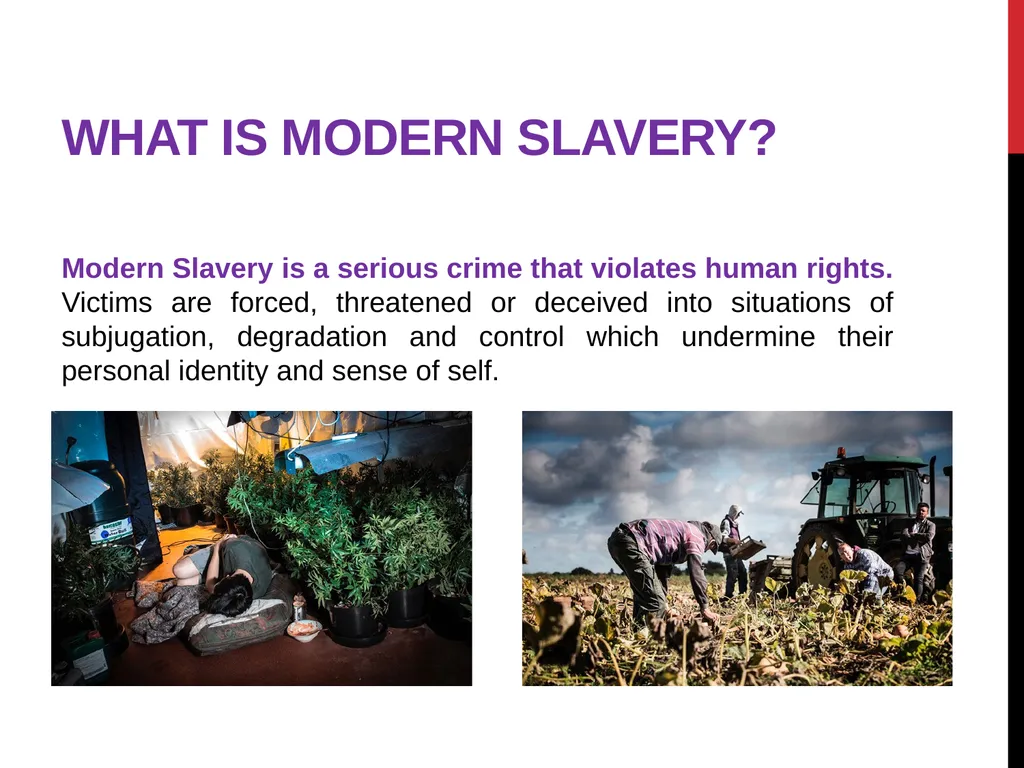
What is modern slavery? Modern Slavery is a serious crime that violates human rights. Victims are forced, threatened or deceived into situations of subjugation, degradation and control which undermine their personal identity and sense of self.<br>
04
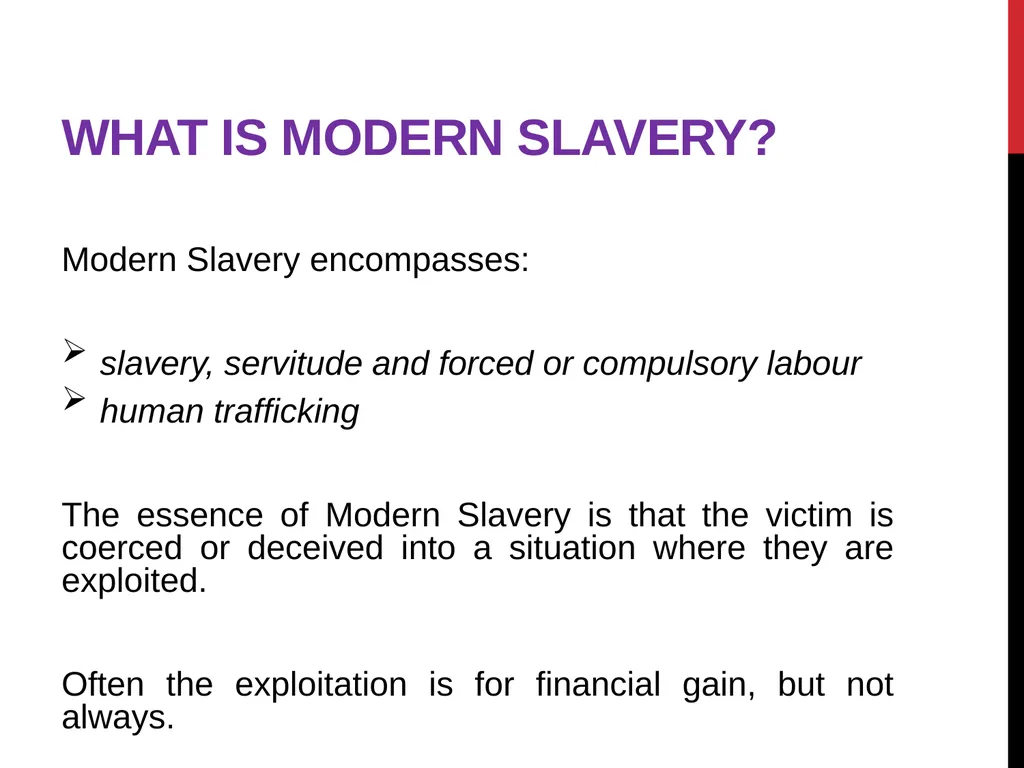
Modern Slavery encompasses:
slavery, servitude and forced or compulsory labour
human trafficking
The essence of Modern Slavery is that the victim is coerced or deceived into a situation where they are exploited.
Often the exploitation is for financial gain, but not always. What is modern slavery?<br>
slavery, servitude and forced or compulsory labour
human trafficking
The essence of Modern Slavery is that the victim is coerced or deceived into a situation where they are exploited.
Often the exploitation is for financial gain, but not always. What is modern slavery?<br>
05
Slavery, Servitude and Forced or Compulsory Labour
Slavery and servitude are aggravated forms of forced or compulsory labour. What is modern slavery?<br>
Slavery and servitude are aggravated forms of forced or compulsory labour. What is modern slavery?<br>
06
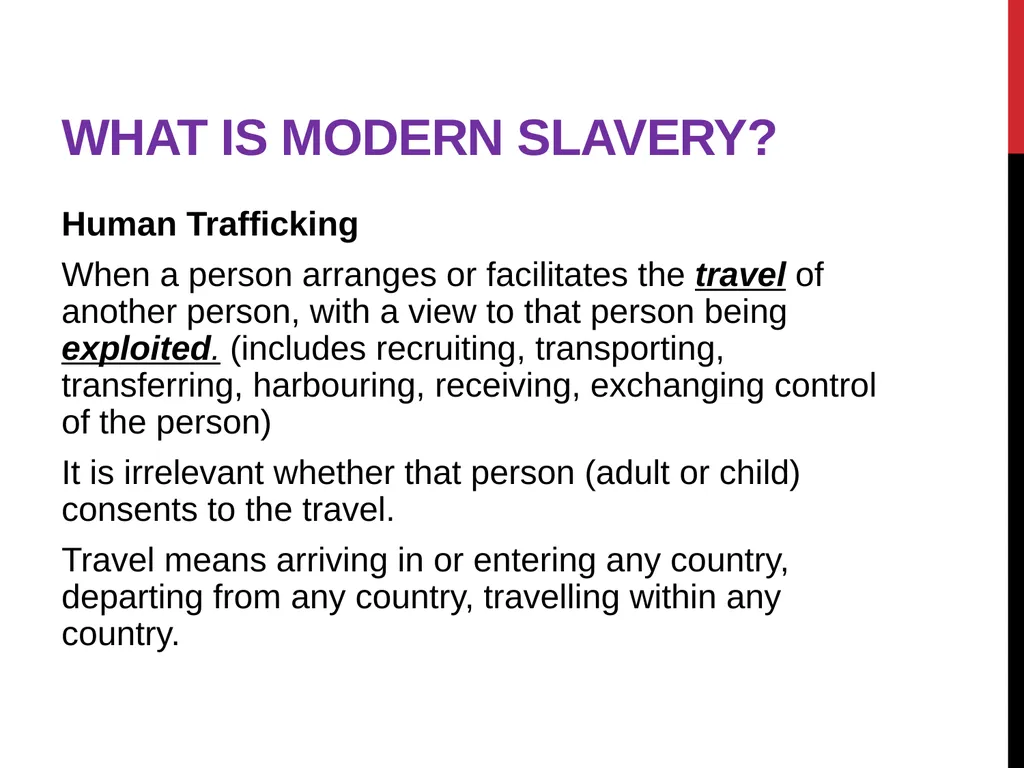
Human Trafficking
When a person arranges or facilitates the travel of another person, with a view to that person being exploited. (includes recruiting, transporting, transferring, harbouring, receiving, exchanging control of the person)
It is irrelevant whether that person (adult or child) consents to the travel.
Travel means arriving in or entering any country, departing from any country, travelling within any country. What is modern slavery?<br>
When a person arranges or facilitates the travel of another person, with a view to that person being exploited. (includes recruiting, transporting, transferring, harbouring, receiving, exchanging control of the person)
It is irrelevant whether that person (adult or child) consents to the travel.
Travel means arriving in or entering any country, departing from any country, travelling within any country. What is modern slavery?<br>
07
Modern Slavery can happen in wide variety of settings and industries. Depending on the setting, Modern Slavery is often referred to by typology. What is modern slavery? What are the most common types seen in the UK? Whilst victims of different types of exploitation may present very differently, they are all victims and must be treated with compassion.<br>
08
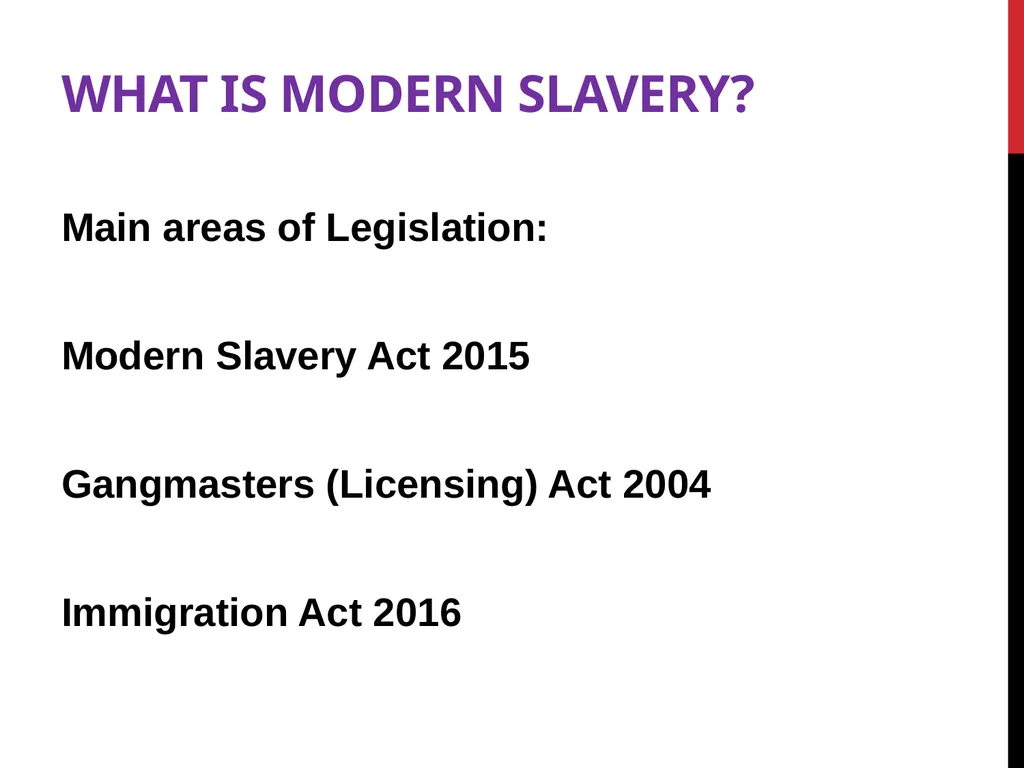
What is modern slavery? Main areas of Legislation:
Modern Slavery Act 2015
Gangmasters (Licensing) Act 2004
Immigration Act 2016<br>
Modern Slavery Act 2015
Gangmasters (Licensing) Act 2004
Immigration Act 2016<br>
09
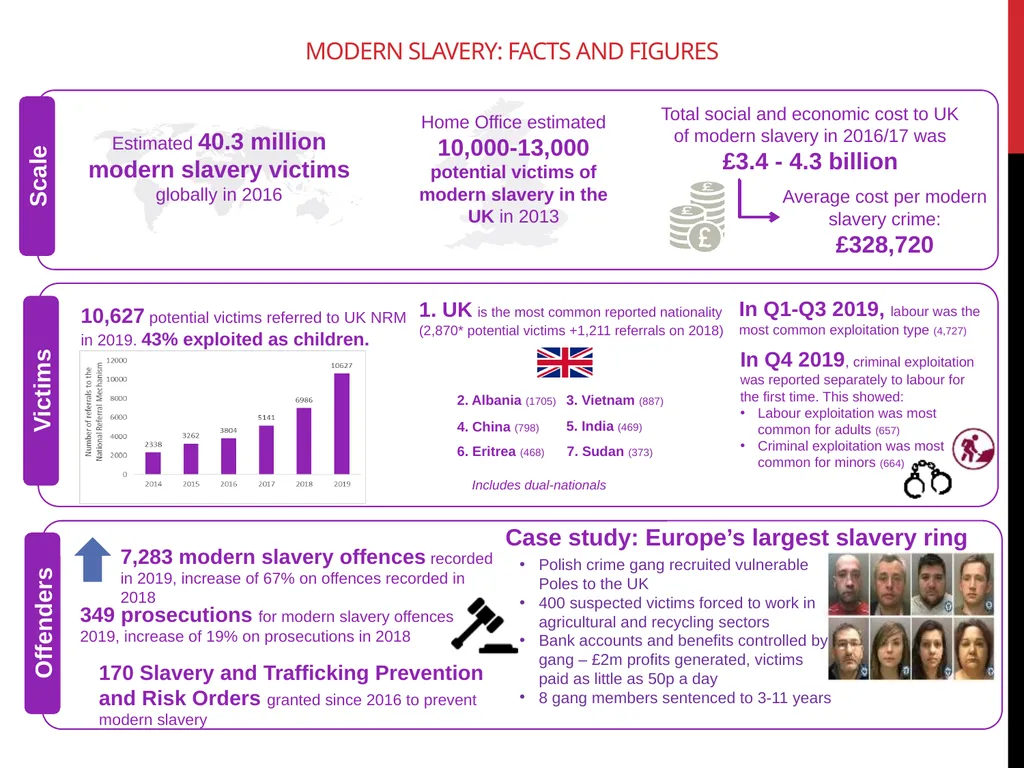
Modern Slavery: Facts and Figures Offenders Case study: Europe’s largest slavery ring Polish crime gang recruited vulnerable Poles to the UK
400 suspected victims forced to work in agricultural and recycling sectors
Bank accounts and benefits controlled by gang – £2m profits generated, victims paid as little as 50p a day
8 gang members sentenced to 3-11 years 349 prosecutions for modern slavery offences 2019, increase of 19% on prosecutions in 2018 7,283 modern slavery offences recorded in 2019, increase of 67% on offences recorded in 2018 170 Slavery and Trafficking Prevention and Risk Orders granted since 2016 to prevent modern slavery<br>
400 suspected victims forced to work in agricultural and recycling sectors
Bank accounts and benefits controlled by gang – £2m profits generated, victims paid as little as 50p a day
8 gang members sentenced to 3-11 years 349 prosecutions for modern slavery offences 2019, increase of 19% on prosecutions in 2018 7,283 modern slavery offences recorded in 2019, increase of 67% on offences recorded in 2018 170 Slavery and Trafficking Prevention and Risk Orders granted since 2016 to prevent modern slavery<br>
10
What is modern slavery?<br>
11
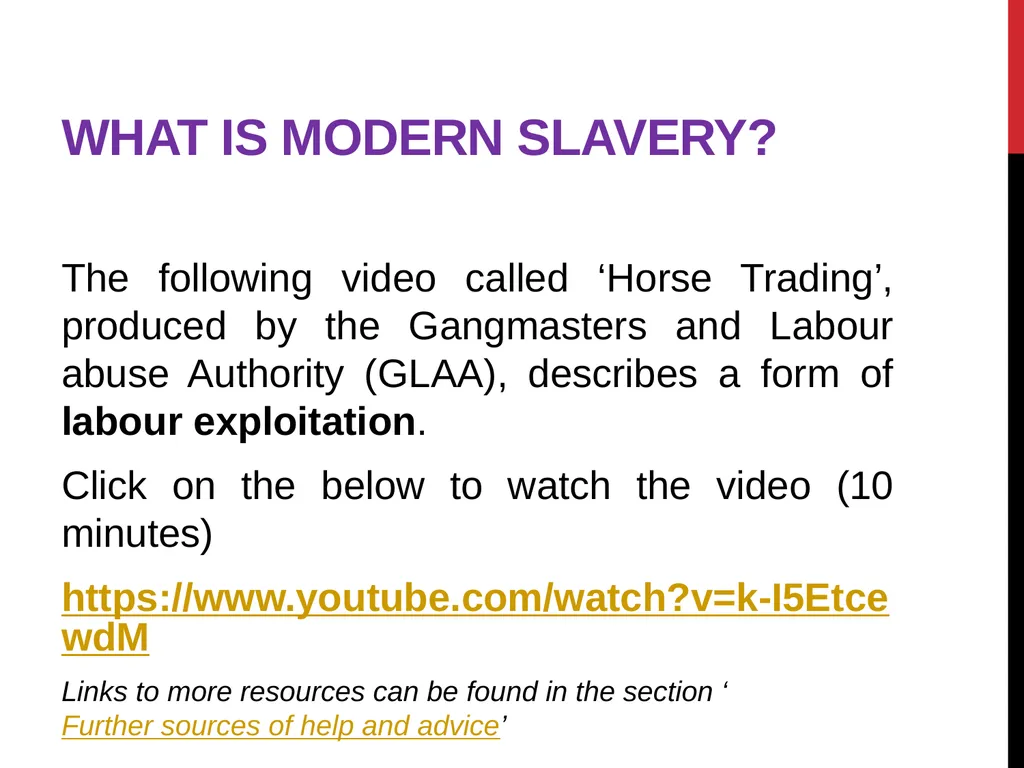
The following video called ‘Horse Trading’, produced by the Gangmasters and Labour abuse Authority (GLAA), describes a form of labour exploitation.
Click on the below to watch the video (10 minutes)
https://www.youtube.com/watch?v=k-I5EtcewdM
Links to more resources can be found in the section ‘Further sources of help and advice’ What is modern slavery?<br>
Click on the below to watch the video (10 minutes)
https://www.youtube.com/watch?v=k-I5EtcewdM
Links to more resources can be found in the section ‘Further sources of help and advice’ What is modern slavery?<br>
12
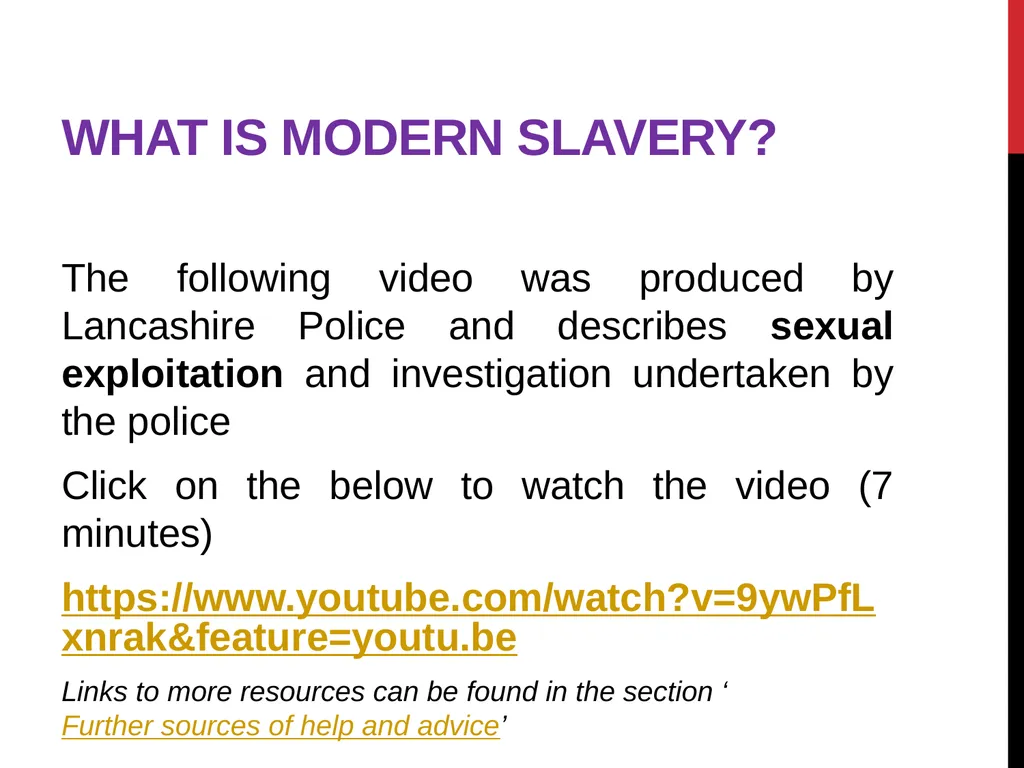
The following video was produced by Lancashire Police and describes sexual exploitation and investigation undertaken by the police
Click on the below to watch the video (7 minutes)
https://www.youtube.com/watch?v=9ywPfLxnrak&feature=youtu.be
Links to more resources can be found in the section ‘Further sources of help and advice’ What is modern slavery?<br>
Click on the below to watch the video (7 minutes)
https://www.youtube.com/watch?v=9ywPfLxnrak&feature=youtu.be
Links to more resources can be found in the section ‘Further sources of help and advice’ What is modern slavery?<br>
13
This section will look at;
Some of the locations where victims are found.
The indicators of exploitation.
The barriers victims may experience to reporting. Signs and Indicators<br>
Some of the locations where victims are found.
The indicators of exploitation.
The barriers victims may experience to reporting. Signs and Indicators<br>
14
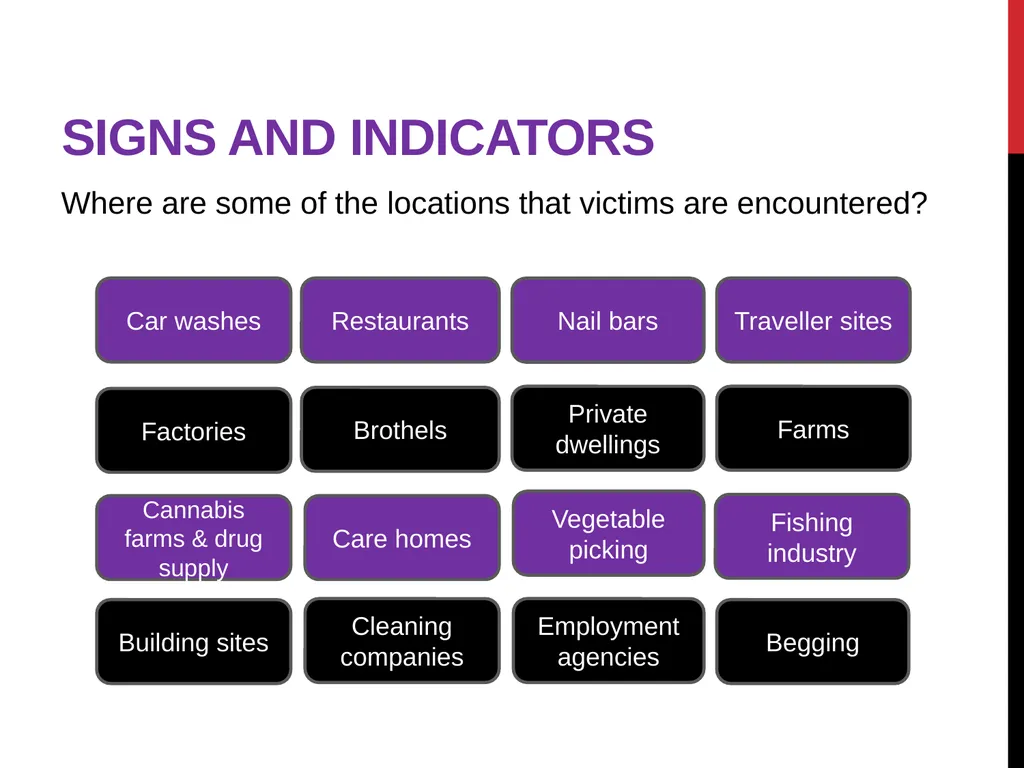
Signs and indicators Where are some of the locations that victims are encountered? Car washes Restaurants Nail bars Traveller sites Factories Brothels Private dwellings Farms Cannabis farms & drug supply Care homes Vegetable picking Fishing industry Building sites Cleaning companies Employment agencies Begging<br>
15
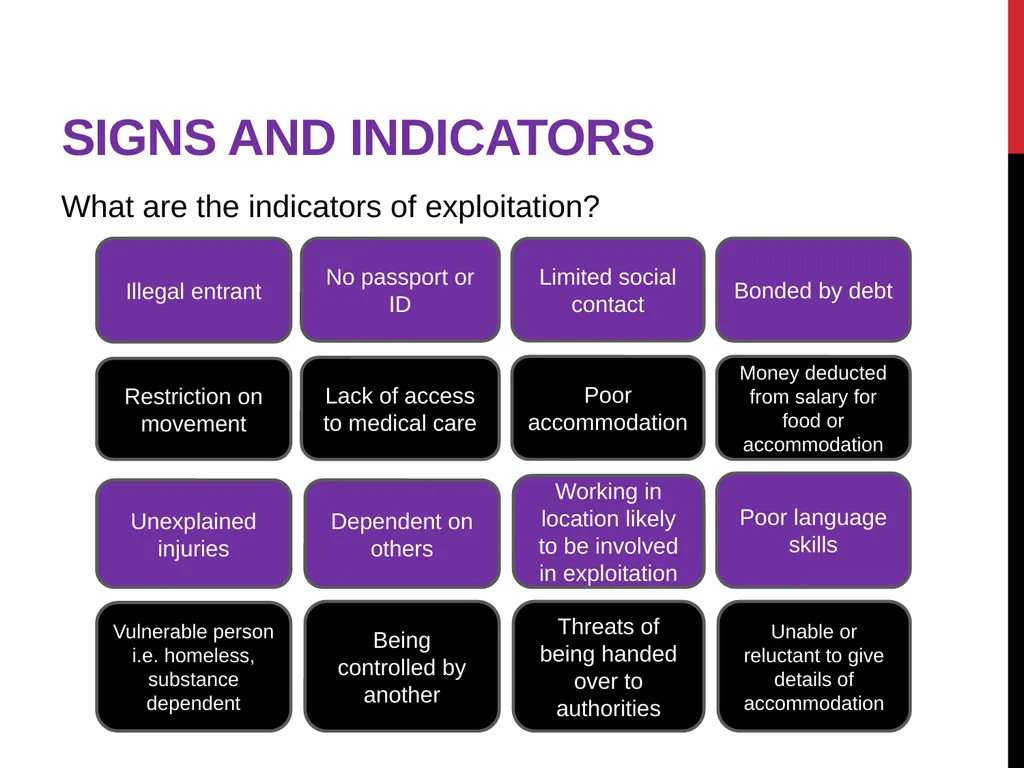
Signs and indicators What are the indicators of exploitation? Illegal entrant No passport or ID Limited social contact Bonded by debt Restriction on movement Lack of access to medical care Poor accommodation Money deducted from salary for food or accommodation Unexplained injuries Dependent on others Working in location likely to be involved in exploitation Poor language skills Vulnerable person i.e. homeless, substance dependent Being controlled by another Threats of being handed over to authorities Unable or reluctant to give details of accommodation<br>
16
Signs and Indicators<br>
17
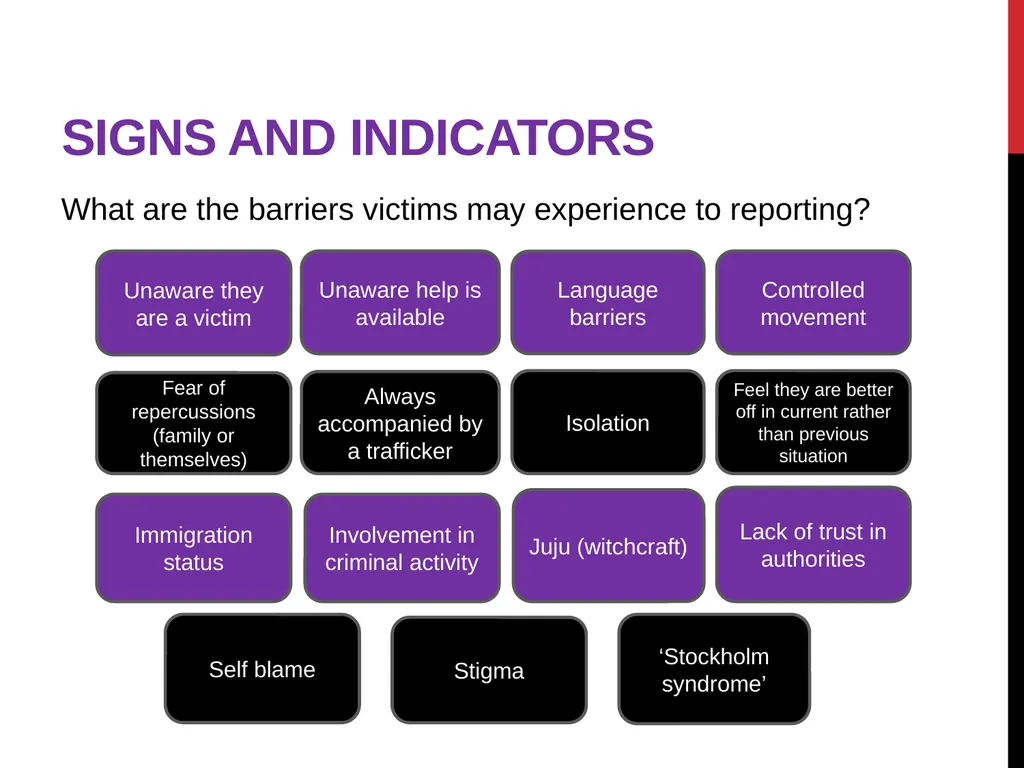
Signs and indicators What are the barriers victims may experience to reporting? Unaware they are a victim Unaware help is available Language barriers Controlled movement Fear of repercussions (family or themselves) Always accompanied by a trafficker Isolation Feel they are better off in current rather than previous situation Immigration status Involvement in criminal activity Juju (witchcraft) Lack of trust in authorities Self blame Stigma ‘Stockholm syndrome’<br>
18
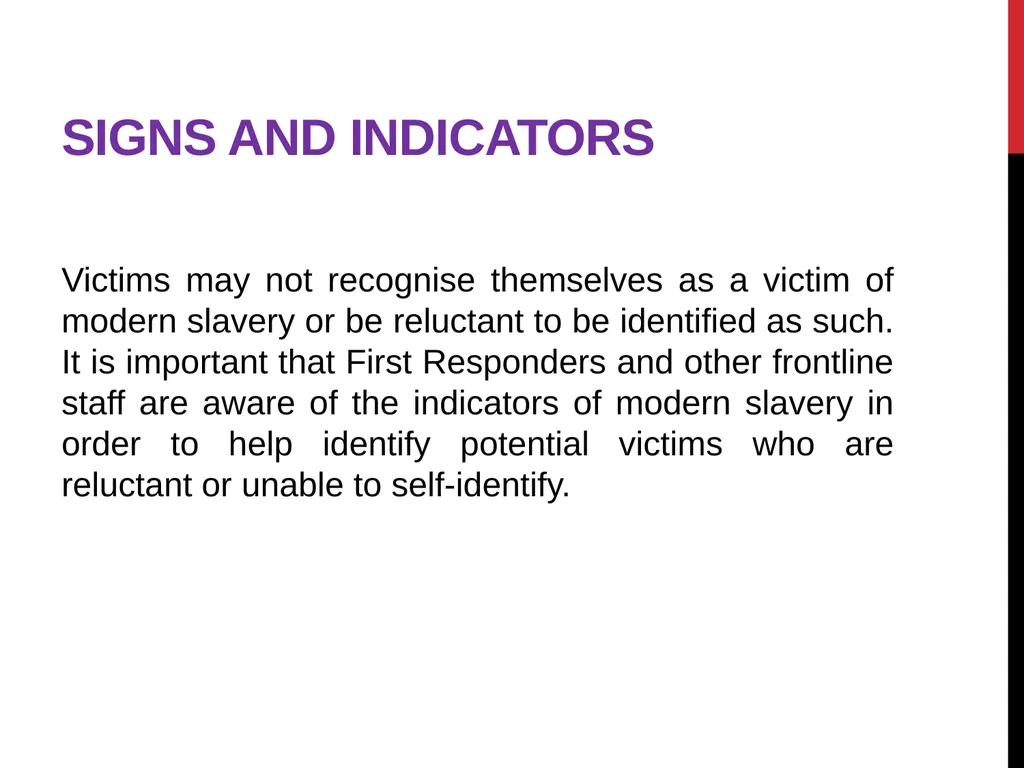
Victims may not recognise themselves as a victim of modern slavery or be reluctant to be identified as such. It is important that First Responders and other frontline staff are aware of the indicators of modern slavery in order to help identify potential victims who are reluctant or unable to self-identify. Signs and Indicators<br>
19
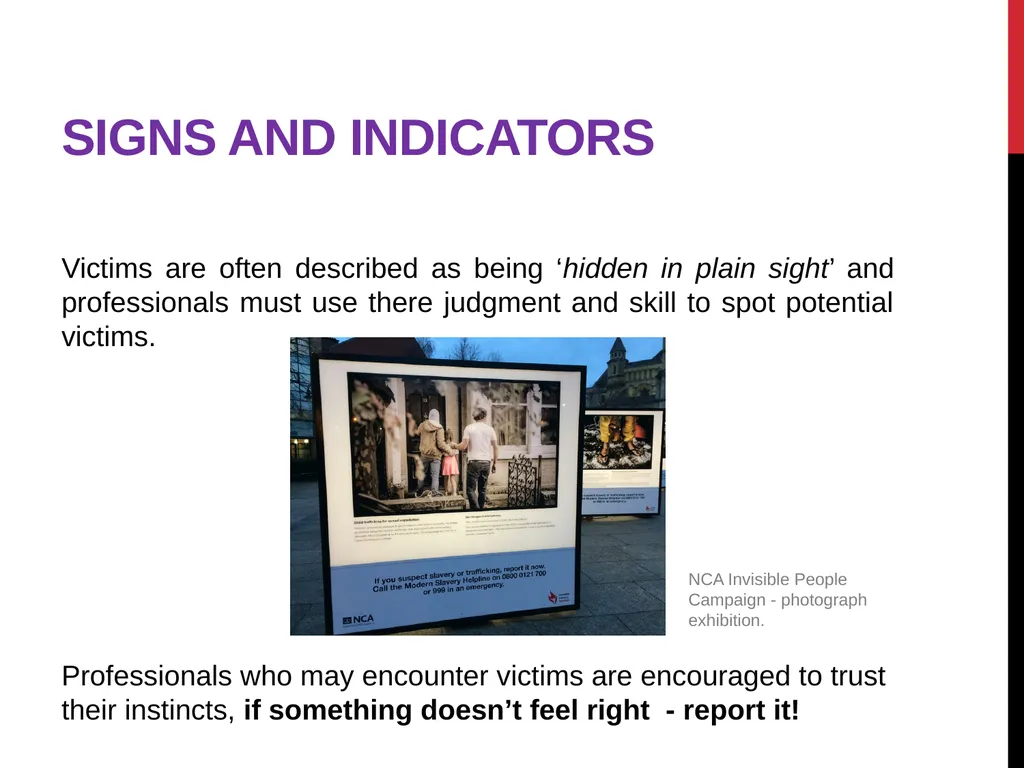
Victims are often described as being ‘hidden in plain sight’ and professionals must use there judgment and skill to spot potential victims.
Professionals who may encounter victims are encouraged to trust their instincts, if something doesn’t feel right - report it! Signs and Indicators NCA Invisible People Campaign - photograph exhibition.<br>
Professionals who may encounter victims are encouraged to trust their instincts, if something doesn’t feel right - report it! Signs and Indicators NCA Invisible People Campaign - photograph exhibition.<br>
20
The National Referral Mechanism
The National Referral Mechanism (NRM) is the framework by which potential victims of Modern Slavery are identified and supported. Reporting Concerns Potential victims can be referred in to the NRM by a wide range of ‘First Responders’. Where potential victims are encountered by professionals who are not First Responders, they should be referred to a First Responder as soon as possible. Remember - NRM support is not dependant on victims of Modern Slavery supporting a criminal investigation.<br>
The National Referral Mechanism (NRM) is the framework by which potential victims of Modern Slavery are identified and supported. Reporting Concerns Potential victims can be referred in to the NRM by a wide range of ‘First Responders’. Where potential victims are encountered by professionals who are not First Responders, they should be referred to a First Responder as soon as possible. Remember - NRM support is not dependant on victims of Modern Slavery supporting a criminal investigation.<br>
21
The National Referral Mechanism
Adults must consent, Children do not have to consent.
Victims who enter the NRM are entitled to support
Does anyone know what type of support is available?
Full details of all support can be found in annexes F & G to the Home Office Statutory Guidance for England and Wales. Reporting Concerns<br>
Adults must consent, Children do not have to consent.
Victims who enter the NRM are entitled to support
Does anyone know what type of support is available?
Full details of all support can be found in annexes F & G to the Home Office Statutory Guidance for England and Wales. Reporting Concerns<br>
22
Which agencies are First Responders?
In England and Wales, the agencies listed below are First Responders. Reporting Concerns Public Authorities:
Police
Gangmasters and Labour Abuse Authority (GLAA)
National Crime Agency (NCA)
Local Authorities
Immigration Enforcement (IE)
Border Force
UK Visa and Immigration
Charities:
Barnardo’s
BAWSO
Kalayaan
Medaille Trust
Migrant Help
New Pathways
NSPCC
Refugee Council
The Salvation Army
Unseen UK<br>
In England and Wales, the agencies listed below are First Responders. Reporting Concerns Public Authorities:
Police
Gangmasters and Labour Abuse Authority (GLAA)
National Crime Agency (NCA)
Local Authorities
Immigration Enforcement (IE)
Border Force
UK Visa and Immigration
Charities:
Barnardo’s
BAWSO
Kalayaan
Medaille Trust
Migrant Help
New Pathways
NSPCC
Refugee Council
The Salvation Army
Unseen UK<br>
23
Reporting Concerns Any First Responder must notify the Home Office about when they encounter a potential victim of Modern Slavery.
This is usually done when that potential victim enters the NRM.
However, when an adult victim refuses the NRM the First Responder still has a Duty to Notify the Home Office of the existence of that potential victim so there is an accurate record of Modern Slavery in the UK.<br>
This is usually done when that potential victim enters the NRM.
However, when an adult victim refuses the NRM the First Responder still has a Duty to Notify the Home Office of the existence of that potential victim so there is an accurate record of Modern Slavery in the UK.<br>
24
Which first responder should I approach?
The individual circumstances of the victim may mean a professional encountering a victim feels it is more appropriate to approach a particular First Responder. (e.g. a child)
Remember, whilst any First Responder can refer a victim into the NRM, only law enforcement agencies can investigate Modern Slavery.
If you are in doubt about which First Responder to contact, it is advisable to contact the police. If the individual is in immediate risk, you must always contact the police using 999. Reporting Concerns<br>
The individual circumstances of the victim may mean a professional encountering a victim feels it is more appropriate to approach a particular First Responder. (e.g. a child)
Remember, whilst any First Responder can refer a victim into the NRM, only law enforcement agencies can investigate Modern Slavery.
If you are in doubt about which First Responder to contact, it is advisable to contact the police. If the individual is in immediate risk, you must always contact the police using 999. Reporting Concerns<br>
25
Reporting concerns to the police
The police will always prioritise the safety of a potential victims over anything else.
Victims can speak to the police in confidence and will be given time to decide if they wish to support a criminal investigation by providing a statement and attend potentially attend court at a later date. Police can still investigate Modern Slavery without the need for victims to provide a statement or go to court.
If the potential victim is worried about speaking to authorities, then the professional who identified the potential victim may be asked to assist in facilitating engagement between the police and the victim. Reporting Concerns<br>
The police will always prioritise the safety of a potential victims over anything else.
Victims can speak to the police in confidence and will be given time to decide if they wish to support a criminal investigation by providing a statement and attend potentially attend court at a later date. Police can still investigate Modern Slavery without the need for victims to provide a statement or go to court.
If the potential victim is worried about speaking to authorities, then the professional who identified the potential victim may be asked to assist in facilitating engagement between the police and the victim. Reporting Concerns<br>
26
Reporting concerns to the police…(cont.)
When making a report to the police it is important to distinguish between intelligence and a Modern Slavery report, which is in effect the report of a crime.
When making a Modern Slavery report to the police, the person making the report will be expected to provide basic details, including the name of the potential victim, and a means by which they can be safely contacted (this can be via the reporting person in the first instance).
Less specific information can be passed to the police as intelligence. Whilst this will help the police, it may not result in immediate safeguarding or an NRM referral for an individual. Reporting Concerns<br>
When making a report to the police it is important to distinguish between intelligence and a Modern Slavery report, which is in effect the report of a crime.
When making a Modern Slavery report to the police, the person making the report will be expected to provide basic details, including the name of the potential victim, and a means by which they can be safely contacted (this can be via the reporting person in the first instance).
Less specific information can be passed to the police as intelligence. Whilst this will help the police, it may not result in immediate safeguarding or an NRM referral for an individual. Reporting Concerns<br>
27
Reporting Concerns Concerns about Labour Exploitation
GLAA - Contact details
By telephone - 0800 432 0804, to report your concerns in confidence. Lines are open Monday to Friday 9:00am - 5:00pm, You can also call 0115 959 7049 (and leave a message outside of office hours
By email - intelligence@gla.gov.uk, please give them as much information as you can.<br>
GLAA - Contact details
By telephone - 0800 432 0804, to report your concerns in confidence. Lines are open Monday to Friday 9:00am - 5:00pm, You can also call 0115 959 7049 (and leave a message outside of office hours
By email - intelligence@gla.gov.uk, please give them as much information as you can.<br>
28
Reporting Concerns Concerns about non payment of National Minimum Wage
ACAS -
Acas helpline - Pay and work rights helpline and complaints Telephone: 0300 123 1100 Monday to Friday, 8am to 6pm
https://www.gov.uk/pay-and-work-rights<br>
ACAS -
Acas helpline - Pay and work rights helpline and complaints Telephone: 0300 123 1100 Monday to Friday, 8am to 6pm
https://www.gov.uk/pay-and-work-rights<br>
29
Reporting Concerns HMRC - National Minimum Wage enquiries and complaints
Online complaints - https://www.gov.uk/government/publications/pay-and-work-rights-complaints<br>
Online complaints - https://www.gov.uk/government/publications/pay-and-work-rights-complaints<br>
30
Modern Slavery Helpline 08000 121 700
The Modern Slavery Helpline provides a 24/7 service to victims and people who may come into contact with victims.
For professionals who are unsure whether a person they have come into contact with is a victim, this is an invaluable resource to be able to talk through the circumstances with an expert, who can then provide advice on what steps should be taken. In an emergency or where there is immediate risk the police should be called on 999. Reporting Concerns "The Modern Slavery Helpline is a unique one-stop phone number for everything from general enquiries to reporting actual or suspected abuse. One phone call to the Modern Slavery Helpline creates the opportunity for anyone to add their own eyes and ears to thousands of others and help bring an end to modern slavery in the UK” James Ewins QC, Ambassador for the Modern Slavery Helpline<br>
The Modern Slavery Helpline provides a 24/7 service to victims and people who may come into contact with victims.
For professionals who are unsure whether a person they have come into contact with is a victim, this is an invaluable resource to be able to talk through the circumstances with an expert, who can then provide advice on what steps should be taken. In an emergency or where there is immediate risk the police should be called on 999. Reporting Concerns "The Modern Slavery Helpline is a unique one-stop phone number for everything from general enquiries to reporting actual or suspected abuse. One phone call to the Modern Slavery Helpline creates the opportunity for anyone to add their own eyes and ears to thousands of others and help bring an end to modern slavery in the UK” James Ewins QC, Ambassador for the Modern Slavery Helpline<br>
31
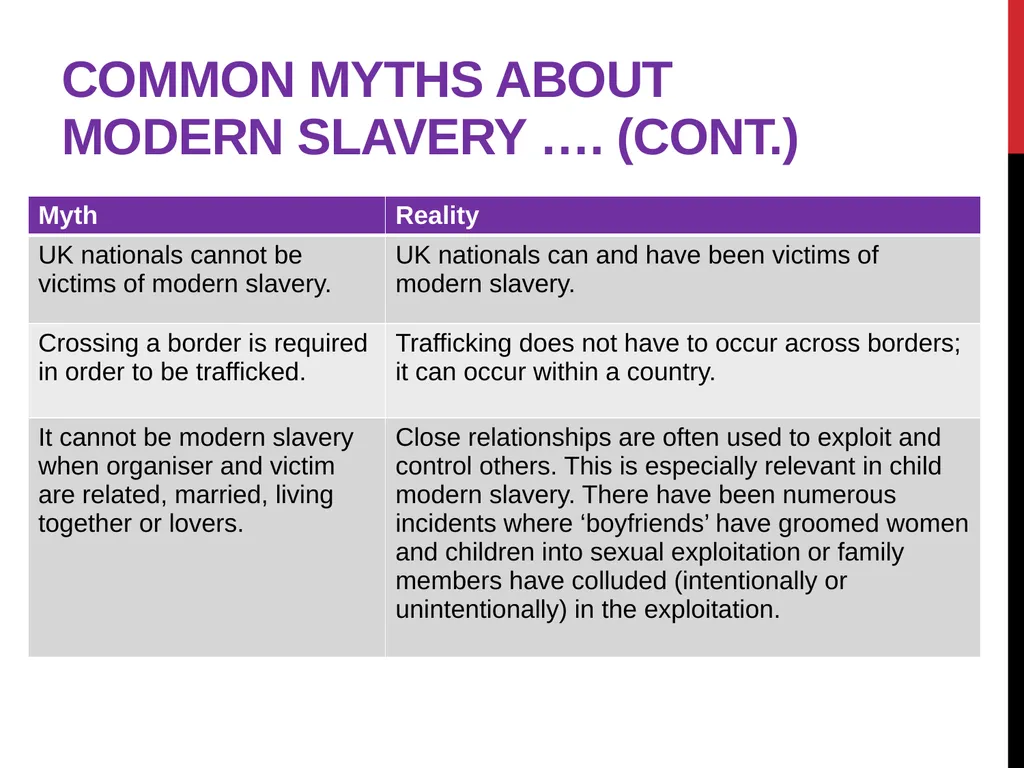
Common Myths about modern slavery<br>
32
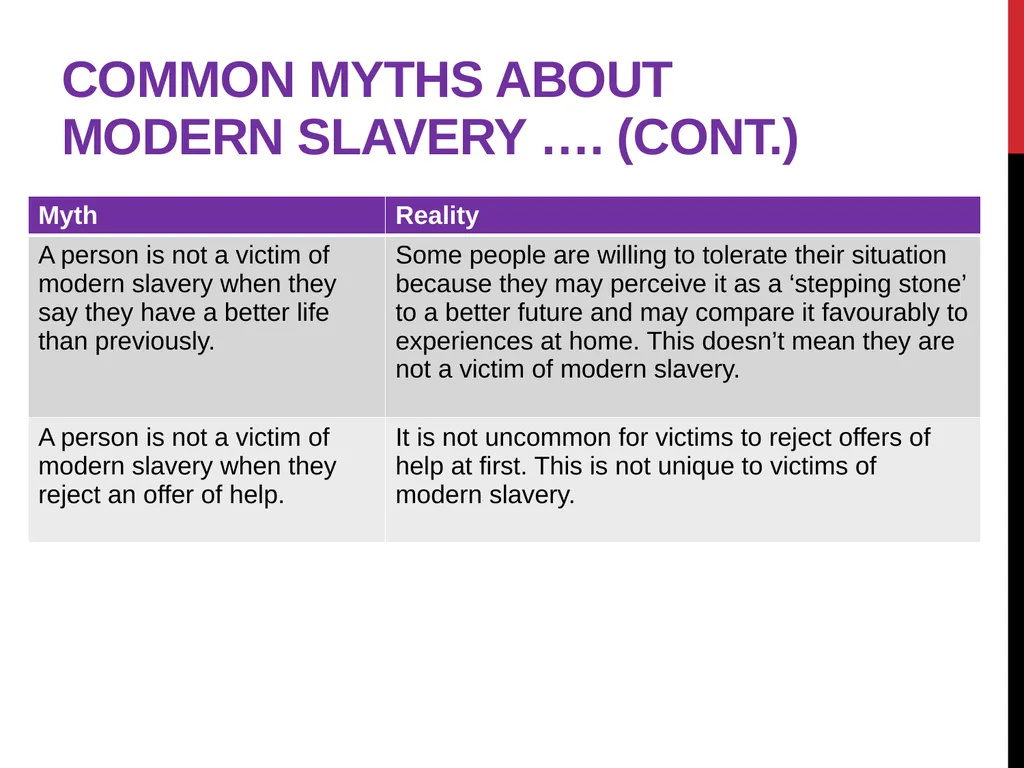
Common Myths about modern slavery …. (cont.)<br>
33
Common Myths about modern slavery …. (cont.)<br>
34
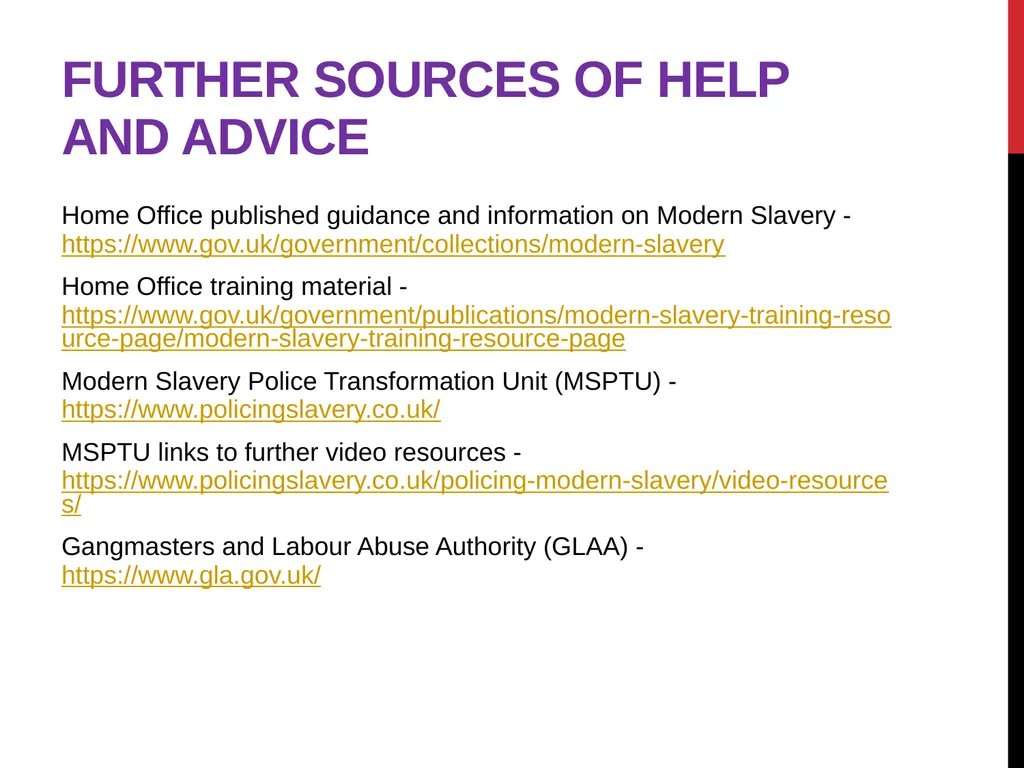
Home Office published guidance and information on Modern Slavery - https://www.gov.uk/government/collections/modern-slavery
Home Office training material - https://www.gov.uk/government/publications/modern-slavery-training-resource-page/modern-slavery-training-resource-page
Modern Slavery Police Transformation Unit (MSPTU) - https://www.policingslavery.co.uk/
MSPTU links to further video resources - https://www.policingslavery.co.uk/policing-modern-slavery/video-resources/
Gangmasters and Labour Abuse Authority (GLAA) - https://www.gla.gov.uk/ Further sources of help and advice<br>
Home Office training material - https://www.gov.uk/government/publications/modern-slavery-training-resource-page/modern-slavery-training-resource-page
Modern Slavery Police Transformation Unit (MSPTU) - https://www.policingslavery.co.uk/
MSPTU links to further video resources - https://www.policingslavery.co.uk/policing-modern-slavery/video-resources/
Gangmasters and Labour Abuse Authority (GLAA) - https://www.gla.gov.uk/ Further sources of help and advice<br>
35
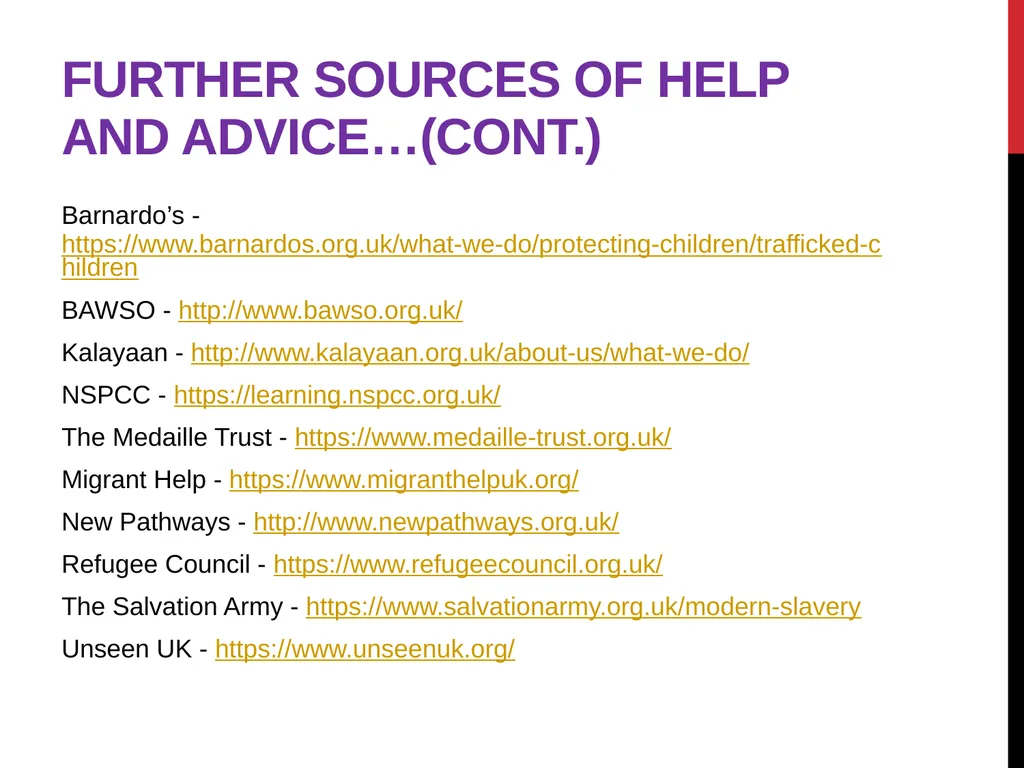
Barnardo’s - https://www.barnardos.org.uk/what-we-do/protecting-children/trafficked-children
BAWSO - http://www.bawso.org.uk/
Kalayaan - http://www.kalayaan.org.uk/about-us/what-we-do/
NSPCC - https://learning.nspcc.org.uk/
The Medaille Trust - https://www.medaille-trust.org.uk/
Migrant Help - https://www.migranthelpuk.org/
New Pathways - http://www.newpathways.org.uk/
Refugee Council - https://www.refugeecouncil.org.uk/
The Salvation Army - https://www.salvationarmy.org.uk/modern-slavery
Unseen UK - https://www.unseenuk.org/ Further sources of help and advice…(cont.)<br>
BAWSO - http://www.bawso.org.uk/
Kalayaan - http://www.kalayaan.org.uk/about-us/what-we-do/
NSPCC - https://learning.nspcc.org.uk/
The Medaille Trust - https://www.medaille-trust.org.uk/
Migrant Help - https://www.migranthelpuk.org/
New Pathways - http://www.newpathways.org.uk/
Refugee Council - https://www.refugeecouncil.org.uk/
The Salvation Army - https://www.salvationarmy.org.uk/modern-slavery
Unseen UK - https://www.unseenuk.org/ Further sources of help and advice…(cont.)<br>
36
This presentation has been created by the Home Office Modern Slavery Unit, in collaboration with the Modern Slavery Police Transformation Unit.<br>