Modernisation Evolution or Revolution World Statistics Day October 20, 2015 Budapest Pádraig Dalton Director General, CSO, Ireland www.cso.ie 1 What am I going to talk about? Environmental context Modernisation broad perspective
"Modernisation Evolution or Revolution World" is the property of its rightful owner. Permission is granted to
download and print the materials on this website for personal, non-commercial use only, and to display it
on your personal computer provided you do not modify the materials and that you retain all copyright
notices contained in the materials. By downloading content from our website, you accept the terms of this
agreement.
Presentation Transcript
01
Modernisation Evolution or Revolution World Statistics Day
October 20, 2015
Budapest
Pádraig Dalton
Director General, CSO, Ireland www.cso.ie 1<br>
02
What am I going to talk about?
Environmental context
Modernisation – broad perspective
Modernisation – Who is involved
Modernisation activities
Modernisation challenges
Collaboration – focus on European perspective<br>
03
Environmental context
Increased user demand
Emergence of global user
Digital age – technology, sources, strategic alliances?
Skills: Re-profiling, outsource?
Politicisation – crisis, targets and indicators
Scrutiny – changing the nature of relationships?<br>
04
Environmental context - continued
Resources – are we too passive, a consistent message?
Urgency some areas – revolution?
Other areas will take more time – evolution?
How do we decide – links to collaboration?<br>
05
Modernisation – Broad perspective
Common perception - Technology, Big Data, CSPA, Visualisation – but its more than that!
“Modernisation” is a relative term
Needed to broaden our understanding of what modernisation means
Also need to broaden our minds about what it will take to modernise<br>
06
Modernisation – Who is involved
Many active participants on modernisation front
NSI’s, UNECE, Eurostat, UNSD, OECD etc….
Individually we can develop our own strategies and reactions to the challenges
But really to meet the challenges we must work together
At a global level one of the best examples is HLG MOS
“Collaboration of the willing”<br>
07
UNECE HLG MOS
Created by the CES bureau in 2010
Strategic vision endorsed by CES in 2011/2012
To oversee and coordinate international work relating to the modernisation of official statistics
Over 40 countries involved in HLG MOS activities
See http://www1.unece.org/stat/platform/display/hlgbas/High-Level+Group+for+the+Modernisation+of+Official+Statistics<br>
08
Some modernisation activities - Evolution
Standards based modernisation:
GSBPM
GAMSO
SDMX
DDI
Plug & Play - CSPA
Big Data – Sandbox, privacy, partnership
Branding
Identification of new skill sets<br>
09
Modernisation - Technology - Revolution
Proliferation of mobile technology
Web services
Web scraping
Visualisation
Pace of change is incredible but is it sustainable
NSIs must share experiences (and tools) – collaboration<br>
10
Modernisation activities: Practical example
Shift from primary data collection to increased usage of secondary data sources
Continued evolution from product based to process based organisational structures
Embedding process based models aligned to the GSBPM and GAMSO
Increased usage of visualisation tools across the GSBPM
Recruiting resources with new skill sets
Developing a CSPA compatible architecture<br>
11
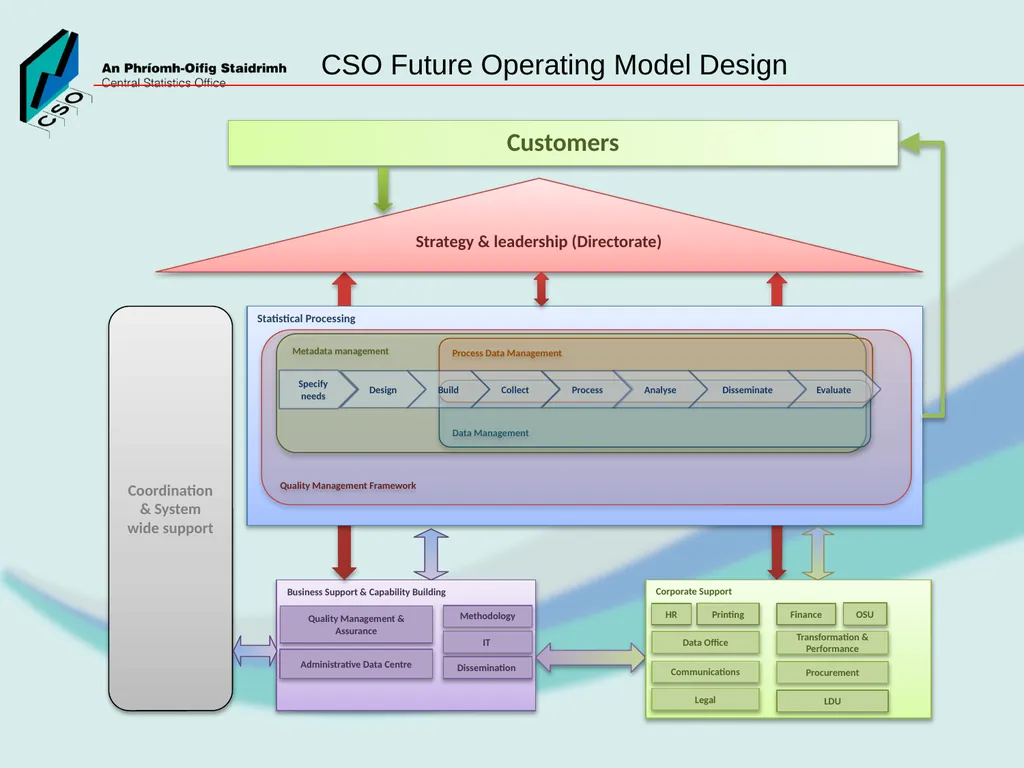
CSO Future Operating Model Design Customers Business Support & Capability Building Statistical Processing Quality Management Framework Metadata management Data Management Process Data Management Specify needs Design Evaluate Build Collect Process Analyse Administrative Data Centre Methodology Quality Management & Assurance Strategy & leadership (Directorate) Disseminate IT Dissemination Procurement Legal LDU Coordination & System wide support<br>
12
Modernisation Challenges
Exploitation of secondary data sources - access, technology, skill-sets, quality, partnerships
Privacy & Data Protection
Linking secondary and primary data sources
Possibility of strategic alliances
Privacy versus efficiency debate
Ensuring public trust in this new environment
Perception is part of the challenge
Availability of necessary skill sets<br>
13
Modernisation Challenges
Collaboration
Behavioural – not all about technical challenges
Leadership, openness to change
“Culture eats strategy for breakfast”
Communications - One voice – what is the message
Social conscience: Creating a road-map for others to follow
Who pays for the road-map?<br>
14
Modernisation Challenges - Collaboration
Collaboration within the ESS
Do we have a shared view on the nature of collaboration in the future?
Will our collaboration be increasingly regulated?
Are we inching, sub-consciously, towards a federalised statistical system in Europe?
Collaboration with decision makers
Maintaining our independence in a world of indicators
Positioning closer to decision making – policy relevant without being politically driven – what are the rules of engagement
Perception versus reality of independence – how do we address this<br>
15
Evolution or revolution
Some elements of modernisation will evolve
Are other areas, such as Technology, where a revolution is taking place and we need to move quickly
Collaboration – Is it evolving or is there a revolution on the way?<br>
16
Conclusions
Modernisation means different things to different people
Are challenges and opportunities
Nature of the challenges are varied
Culture
Collaboration
Change
Communication<br>