
Module 1: Bankruptcy Overview Pro Bono Bankruptcy
MS
Published · 118 slides · 0 views

1 / 1






Description
Module 1: Bankruptcy Overview Pro Bono Bankruptcy Training Program Material This presentation has been prepared by the National Consumer Law Center, Inc. (NCLC). For more information about NCLC, go to www.consumerlaw.org. Copyright 2015
Related Topics
Share
Embed code
Download this presentation From Below
"Module 1: Bankruptcy Overview Pro Bono Bankruptcy" is the property of its rightful owner. Permission is granted to download and print the materials on this website for personal, non-commercial use only, and to display it on your personal computer provided you do not modify the materials and that you retain all copyright notices contained in the materials. By downloading content from our website, you accept the terms of this agreement.
Presentation Transcript
01
Module 1:
Bankruptcy Overview<br>
02
Pro Bono Bankruptcy Training Program Material This presentation has been prepared by the National Consumer Law Center, Inc. (NCLC). For more information about NCLC, go to www.consumerlaw.org.
Copyright © 2015 by National Consumer Law Center, Inc. National Consumer Law Center and NCLC are registered trademarks of National Consumer Law Center, Inc. All Rights Reserved 2<br>
Copyright © 2015 by National Consumer Law Center, Inc. National Consumer Law Center and NCLC are registered trademarks of National Consumer Law Center, Inc. All Rights Reserved 2<br>
03
Sources of Bankruptcy Law: Bankruptcy Code
Federal Rules of Bankruptcy Procedure
Official Forms
Local Rules and Standing Orders 3<br>
Federal Rules of Bankruptcy Procedure
Official Forms
Local Rules and Standing Orders 3<br>
04
Two Key Bankruptcy Concepts: Fresh Start for Debtors
Fair and Equitable Distribution of Non-Exempt Assets to Creditors 4<br>
Fair and Equitable Distribution of Non-Exempt Assets to Creditors 4<br>
05
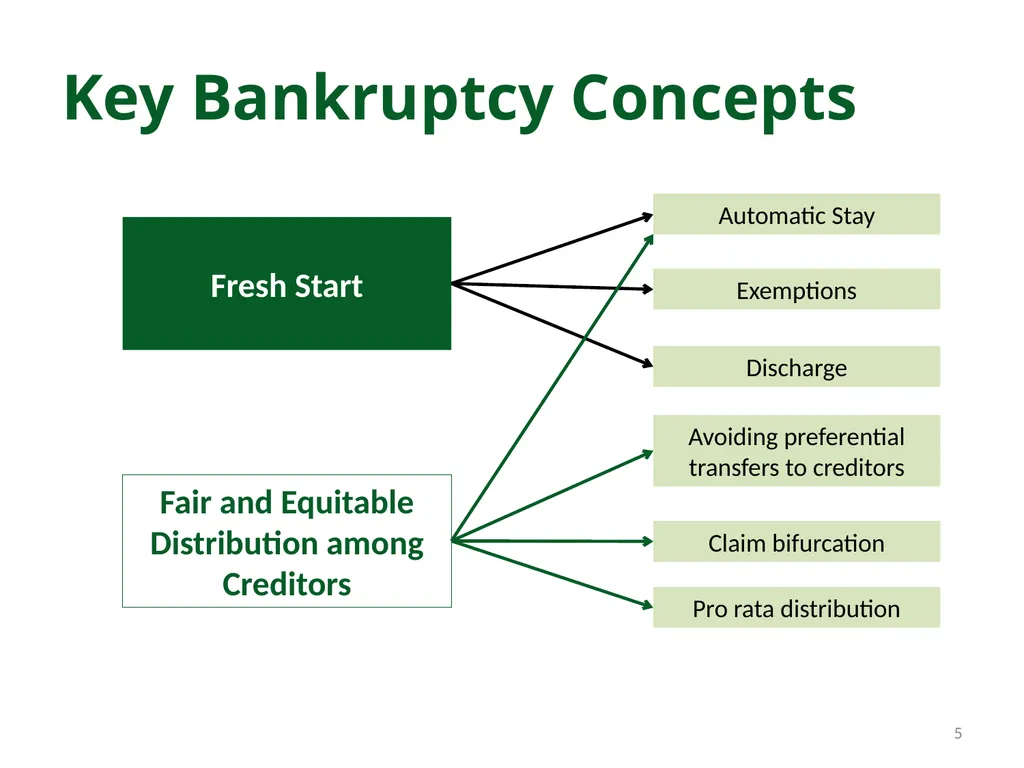
Key Bankruptcy Concepts 5 Fresh Start Fair and Equitable Distribution among Creditors Automatic Stay Exemptions Discharge Avoiding preferential transfers to creditors Claim bifurcation Pro rata distribution<br>
06
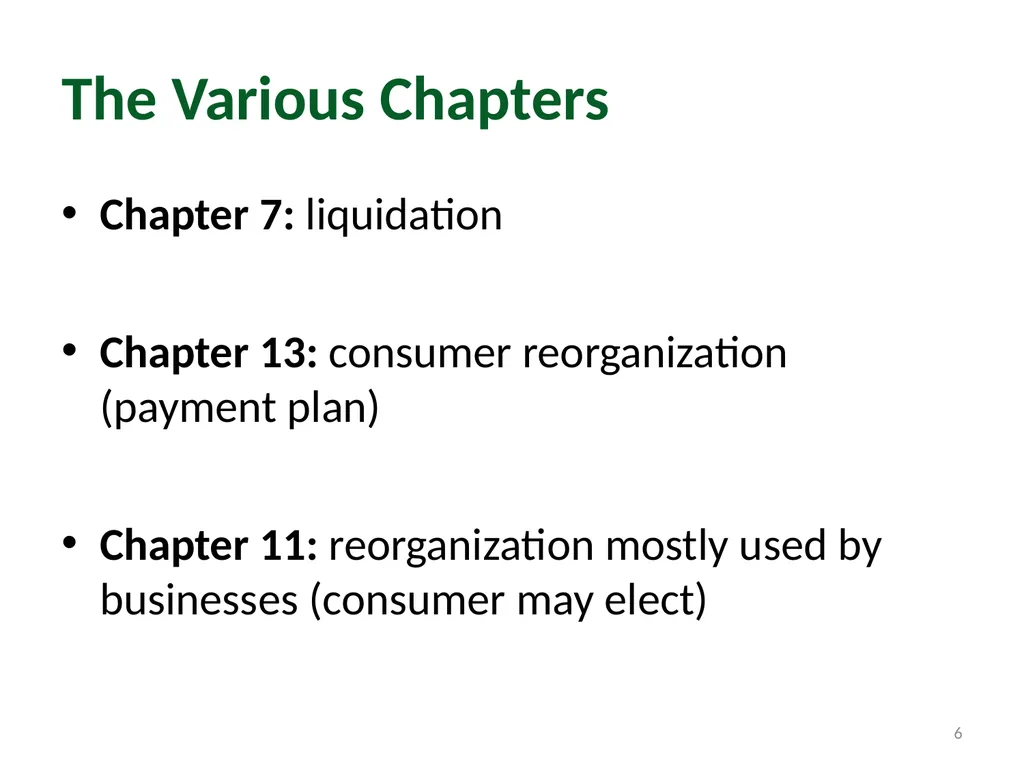
The Various Chapters Chapter 7: liquidation
Chapter 13: consumer reorganization (payment plan)
Chapter 11: reorganization mostly used by businesses (consumer may elect) 6<br>
Chapter 13: consumer reorganization (payment plan)
Chapter 11: reorganization mostly used by businesses (consumer may elect) 6<br>
07
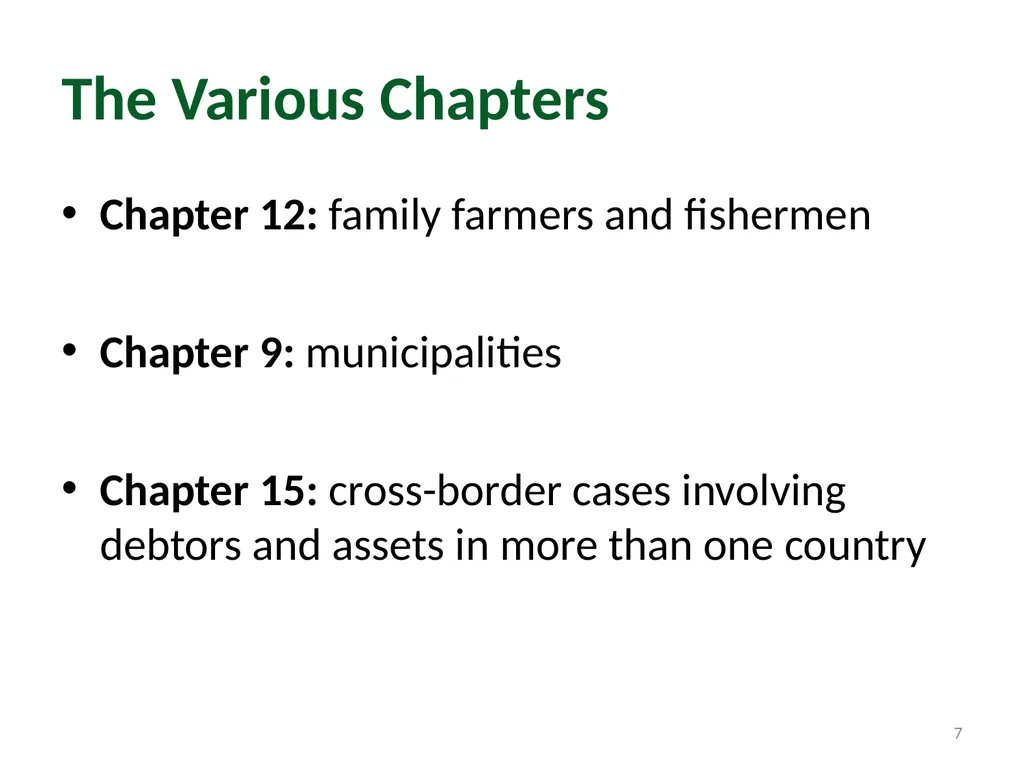
The Various Chapters Chapter 12: family farmers and fishermen
Chapter 9: municipalities
Chapter 15: cross-border cases involving debtors and assets in more than one country 7<br>
Chapter 9: municipalities
Chapter 15: cross-border cases involving debtors and assets in more than one country 7<br>
08
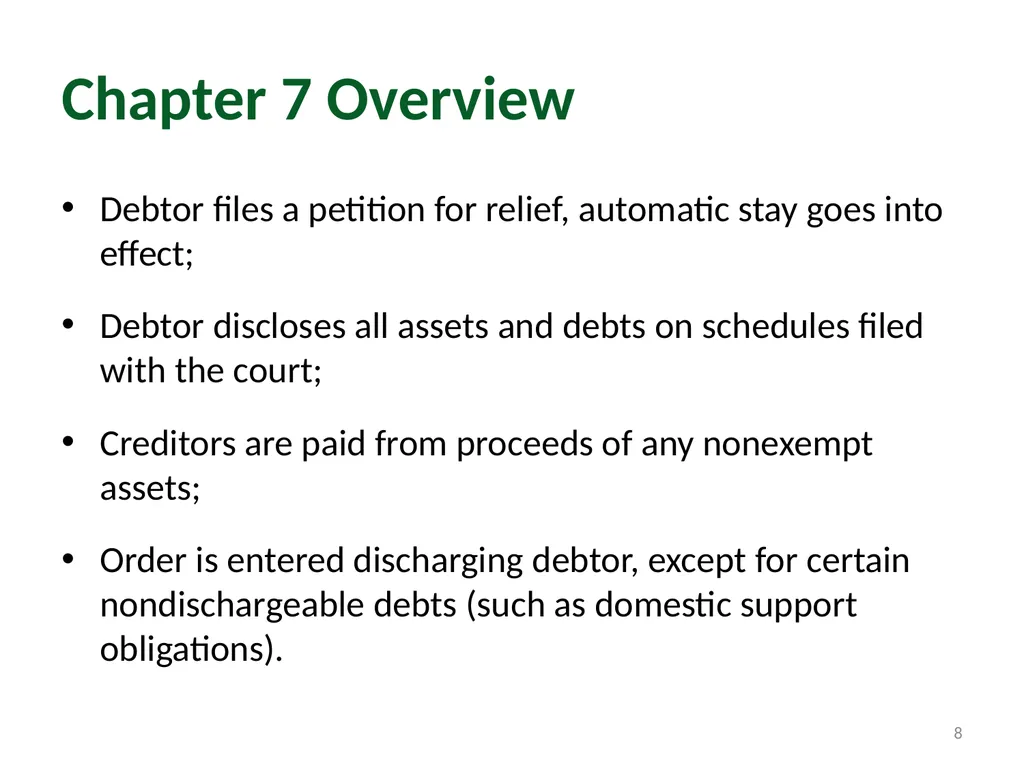
Chapter 7 Overview Debtor files a petition for relief, automatic stay goes into effect;
Debtor discloses all assets and debts on schedules filed with the court;
Creditors are paid from proceeds of any nonexempt assets;
Order is entered discharging debtor, except for certain nondischargeable debts (such as domestic support obligations). 8<br>
Debtor discloses all assets and debts on schedules filed with the court;
Creditors are paid from proceeds of any nonexempt assets;
Order is entered discharging debtor, except for certain nondischargeable debts (such as domestic support obligations). 8<br>
09
Chapter 13 Overview Debtor files a petition for relief, automatic stay goes into effect;
Debtor discloses all assets and debts on schedules;
Debtor proposes a chapter 13 plan to pay all or part of the debt over three to five years from future income; 9<br>
Debtor discloses all assets and debts on schedules;
Debtor proposes a chapter 13 plan to pay all or part of the debt over three to five years from future income; 9<br>
10
Chapter 13 Overview Creditors are paid generally from chapter 13 plan payments made by the debtor and disbursed by trustee;
Debtor has opportunity to cure arrearages on secured debts – to save a home or car;
Discharge order is entered when the plan is completed. 10<br>
Debtor has opportunity to cure arrearages on secured debts – to save a home or car;
Discharge order is entered when the plan is completed. 10<br>
11
Property of the Estate and Exemptions 11<br>
12
The Bankruptcy Estate Virtually all property debtor has interest in at time of filing goes into bankruptcy estate
includes intangible, contingent, and future property interests
examples include potential cause of action or anticipated tax refund
Exempt property comes back out of estate
property the debtor gets to keep as part of the fresh start
11 U.S.C. § 541 12<br>
includes intangible, contingent, and future property interests
examples include potential cause of action or anticipated tax refund
Exempt property comes back out of estate
property the debtor gets to keep as part of the fresh start
11 U.S.C. § 541 12<br>
13
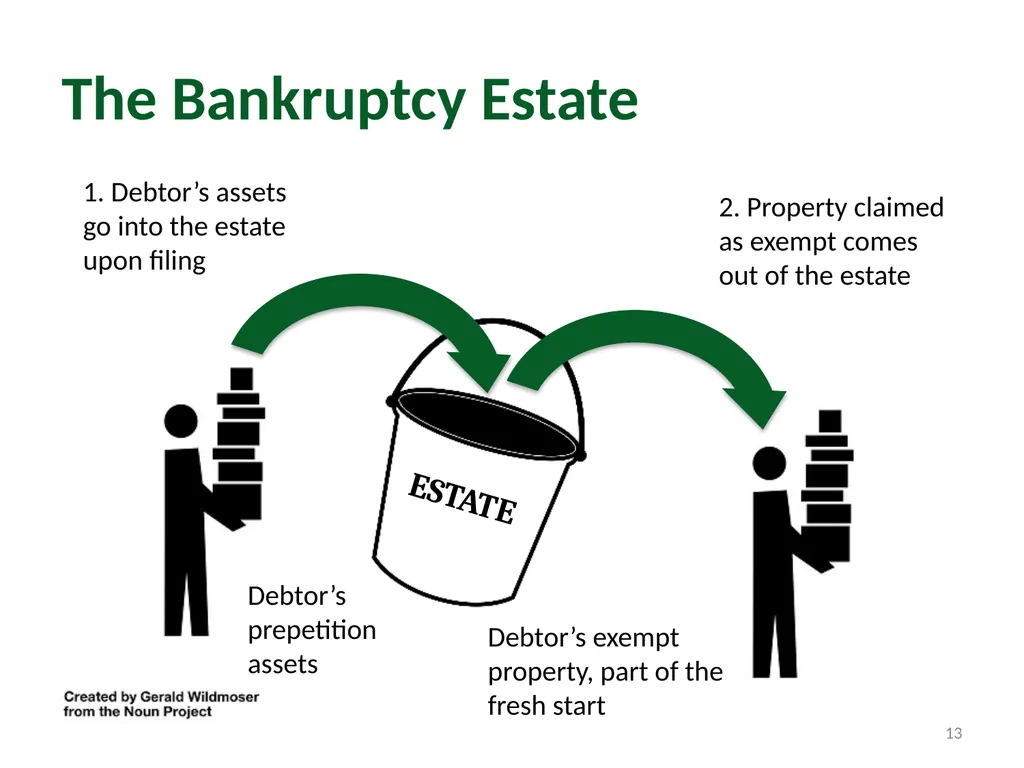
The Bankruptcy Estate 13 ESTATE 1. Debtor’s assets go into the estate upon filing 2. Property claimed as exempt comes out of the estate Debtor’s prepetition assets Debtor’s exempt property, part of the fresh start<br>
14
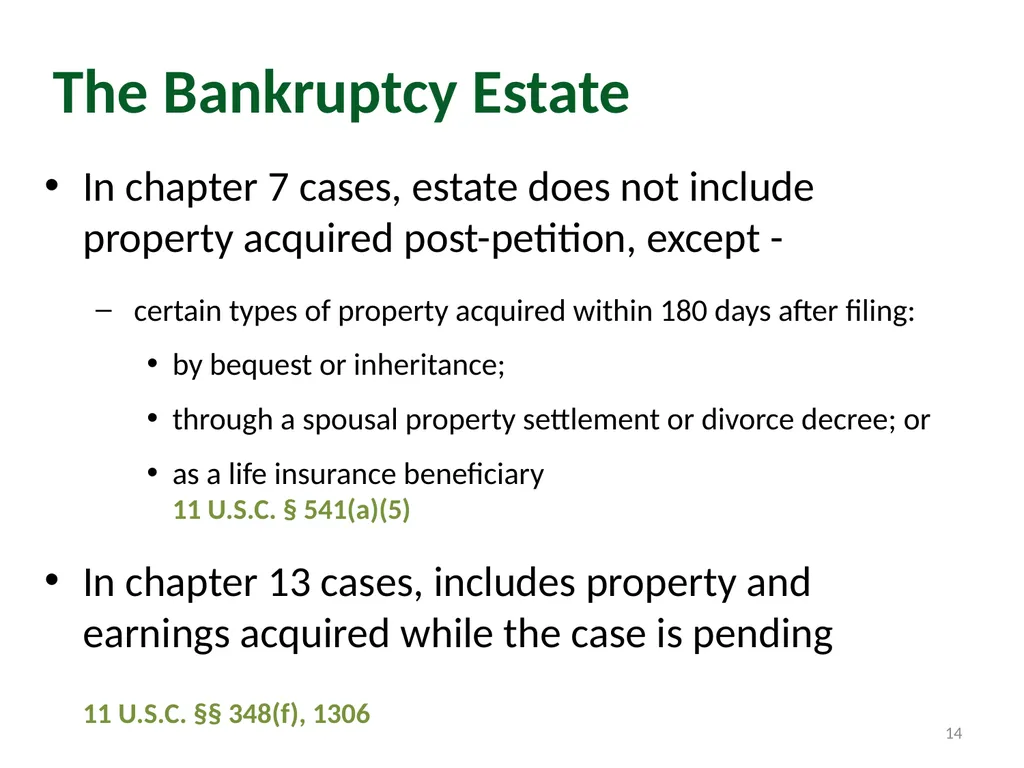
The Bankruptcy Estate In chapter 7 cases, estate does not include property acquired post-petition, except -
certain types of property acquired within 180 days after filing:
by bequest or inheritance;
through a spousal property settlement or divorce decree; or
as a life insurance beneficiary 11 U.S.C. § 541(a)(5)
In chapter 13 cases, includes property and earnings acquired while the case is pending 11 U.S.C. §§ 348(f), 1306 14<br>
certain types of property acquired within 180 days after filing:
by bequest or inheritance;
through a spousal property settlement or divorce decree; or
as a life insurance beneficiary 11 U.S.C. § 541(a)(5)
In chapter 13 cases, includes property and earnings acquired while the case is pending 11 U.S.C. §§ 348(f), 1306 14<br>
15
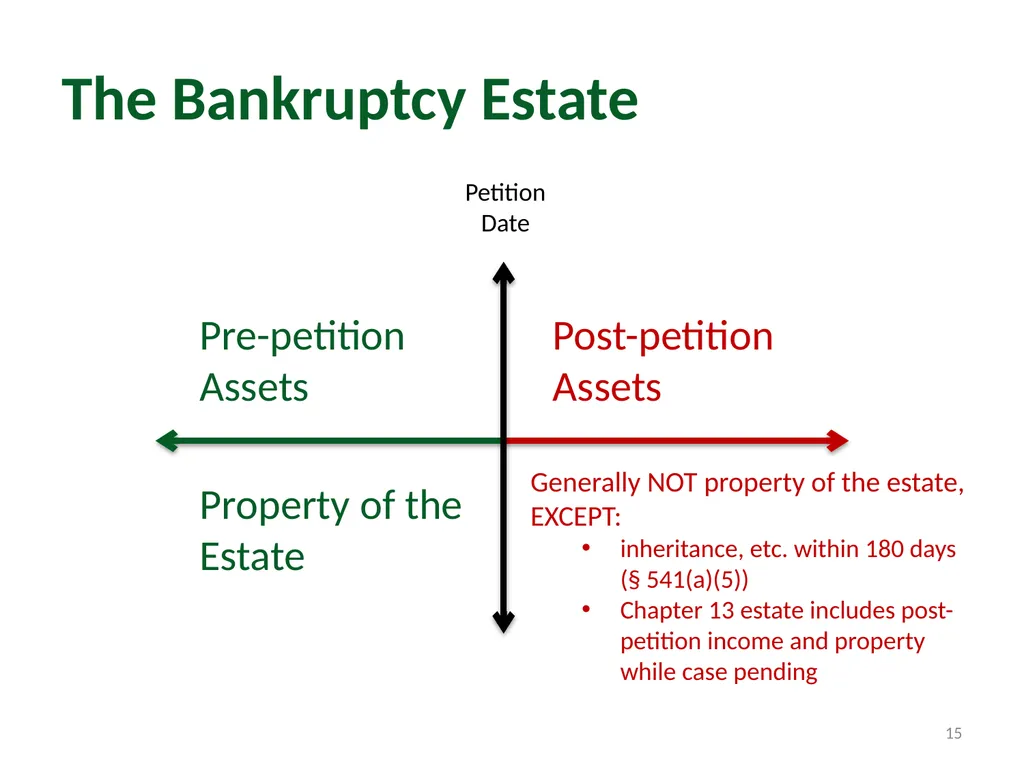
The Bankruptcy Estate 15 Pre-petition Assets Post-petition Assets Property of the Estate Generally NOT property of the estate, EXCEPT:
inheritance, etc. within 180 days (§ 541(a)(5))
Chapter 13 estate includes post-petition income and property while case pending Petition Date<br>
inheritance, etc. within 180 days (§ 541(a)(5))
Chapter 13 estate includes post-petition income and property while case pending Petition Date<br>
16
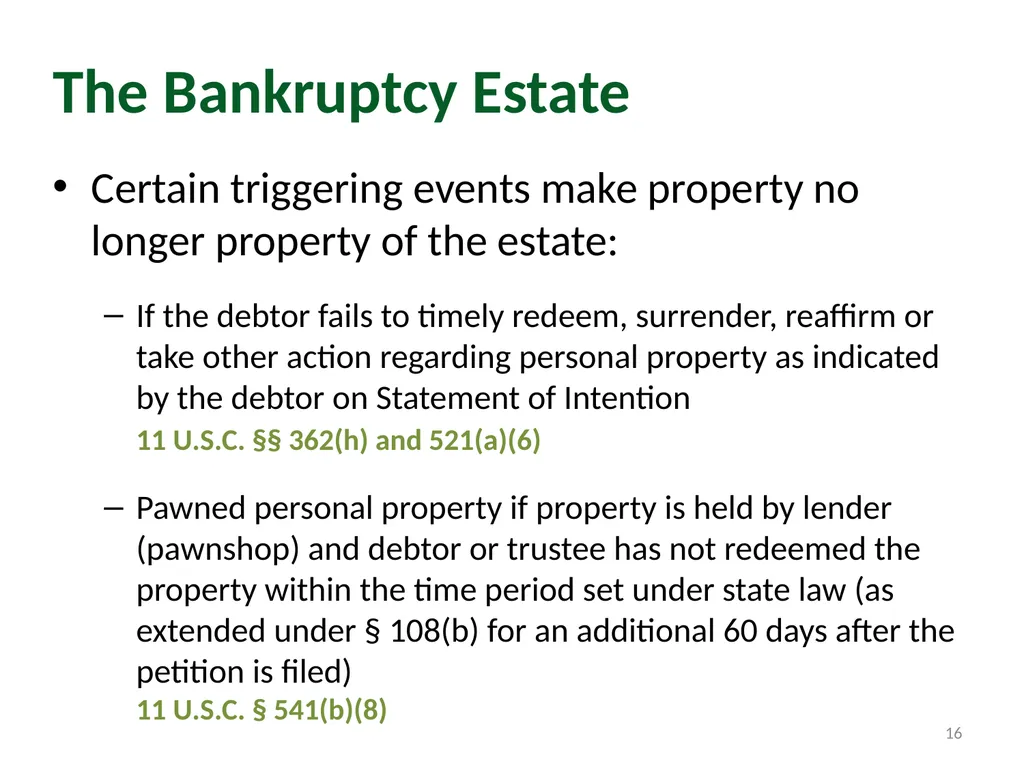
The Bankruptcy Estate Certain triggering events make property no longer property of the estate:
If the debtor fails to timely redeem, surrender, reaffirm or take other action regarding personal property as indicated by the debtor on Statement of Intention 11 U.S.C. §§ 362(h) and 521(a)(6)
Pawned personal property if property is held by lender (pawnshop) and debtor or trustee has not redeemed the property within the time period set under state law (as extended under § 108(b) for an additional 60 days after the petition is filed) 11 U.S.C. § 541(b)(8) 16<br>
If the debtor fails to timely redeem, surrender, reaffirm or take other action regarding personal property as indicated by the debtor on Statement of Intention 11 U.S.C. §§ 362(h) and 521(a)(6)
Pawned personal property if property is held by lender (pawnshop) and debtor or trustee has not redeemed the property within the time period set under state law (as extended under § 108(b) for an additional 60 days after the petition is filed) 11 U.S.C. § 541(b)(8) 16<br>
17
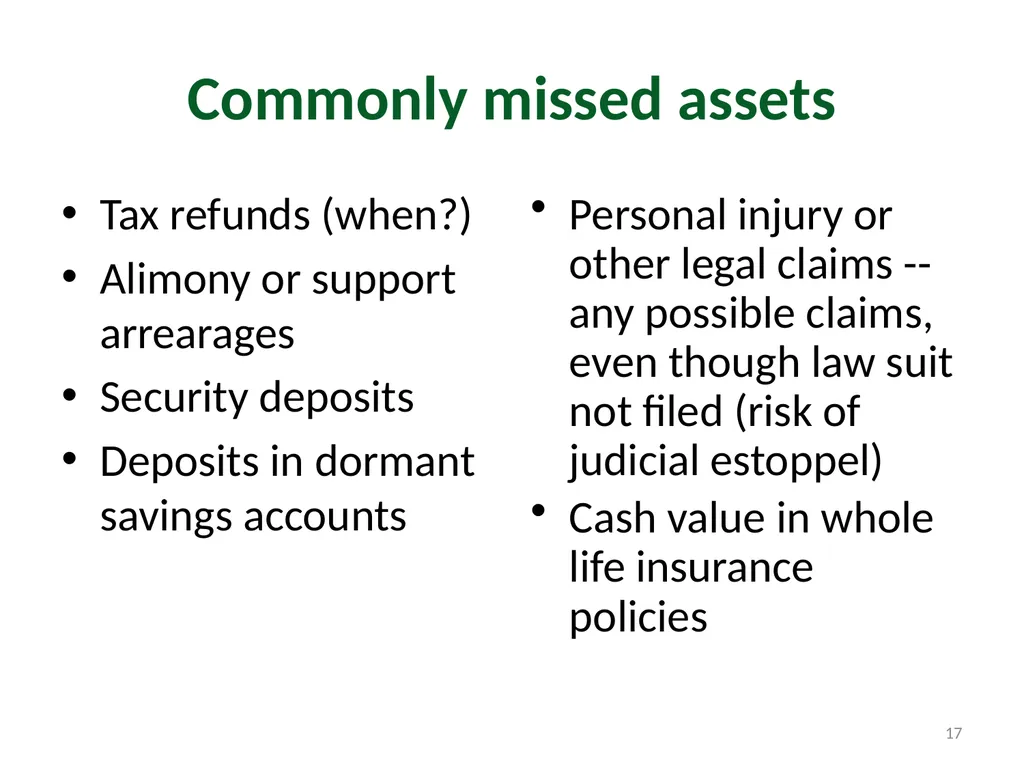
Commonly missed assets Tax refunds (when?)
Alimony or support arrearages
Security deposits
Deposits in dormant savings accounts Personal injury or other legal claims --any possible claims, even though law suit not filed (risk of judicial estoppel)
Cash value in whole life insurance policies 17<br>
Alimony or support arrearages
Security deposits
Deposits in dormant savings accounts Personal injury or other legal claims --any possible claims, even though law suit not filed (risk of judicial estoppel)
Cash value in whole life insurance policies 17<br>
18
Commonly missed assets Inherited real estate/heir property
Cars being driven by someone else
Pledged goods at pawnbrokers Voidable preferences (payments to creditors in past 90 days)
Pension plans
Burial plots 18<br>
Cars being driven by someone else
Pledged goods at pawnbrokers Voidable preferences (payments to creditors in past 90 days)
Pension plans
Burial plots 18<br>
19
Exemption Choice Generally, one of two schemes will apply:
Exemptions available under § 522(d)
OR
Exemptions available under state law 19<br>
Exemptions available under § 522(d)
OR
Exemptions available under state law 19<br>
20
Exemption Choice If the state has “opted out,” then debtor must use state law exemptions
If the state has not “opted out,” then debtor may choose exemptions under either § 522(d) or state law
In a joint case, both spouses must choose same exemption scheme 20<br>
If the state has not “opted out,” then debtor may choose exemptions under either § 522(d) or state law
In a joint case, both spouses must choose same exemption scheme 20<br>
21
Exemption Choice If state law exemption scheme is elected or required (as in an opt-out state), debtor may also exempt:
Tenancy by entirety or joint tenancy property interest, if exempt from process under state law
Property exempt under Federal nonbankruptcy law (e.g. Social Security benefits)
Retirement funds, if exempt from taxation
11 U.S.C. §§ 522(b)(3)(B) and (b)(3)(C) 21<br>
Tenancy by entirety or joint tenancy property interest, if exempt from process under state law
Property exempt under Federal nonbankruptcy law (e.g. Social Security benefits)
Retirement funds, if exempt from taxation
11 U.S.C. §§ 522(b)(3)(B) and (b)(3)(C) 21<br>
22
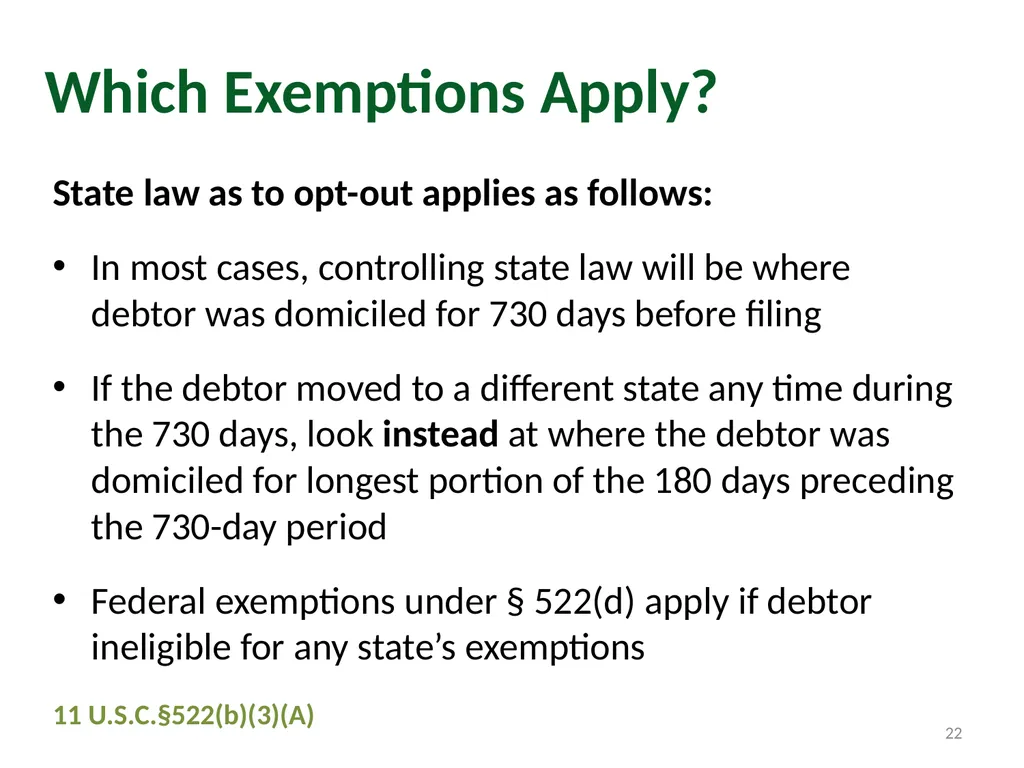
Which Exemptions Apply? State law as to opt-out applies as follows:
In most cases, controlling state law will be where debtor was domiciled for 730 days before filing
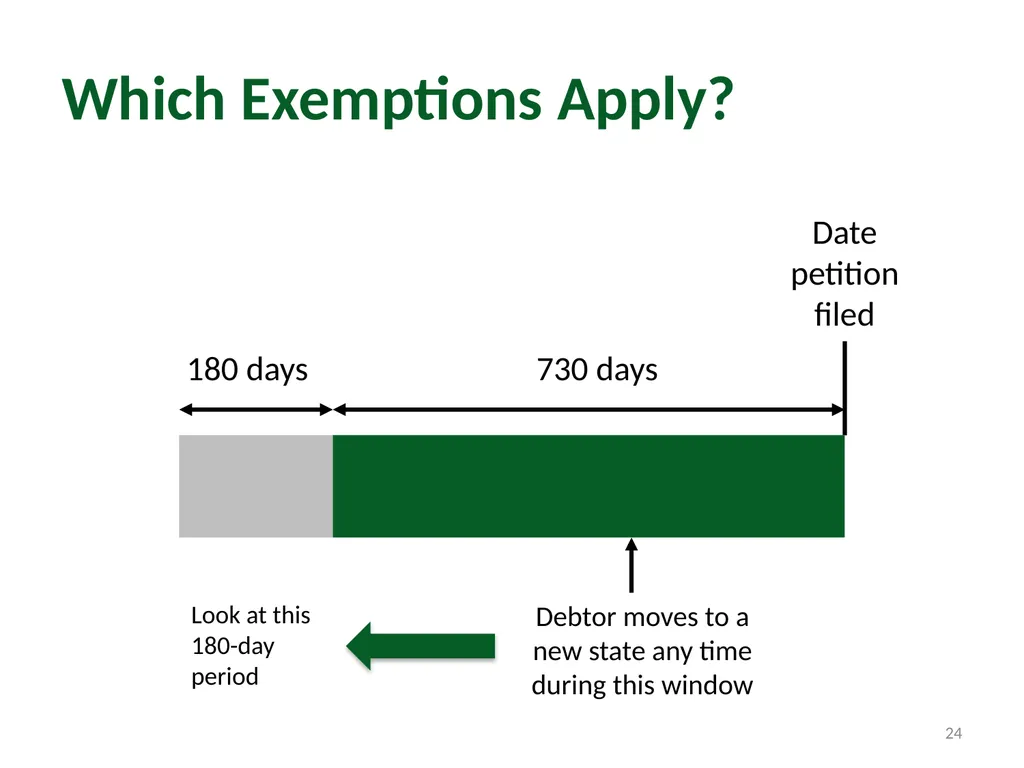
If the debtor moved to a different state any time during the 730 days, look instead at where the debtor was domiciled for longest portion of the 180 days preceding the 730-day period
Federal exemptions under § 522(d) apply if debtor ineligible for any state’s exemptions
11 U.S.C.§522(b)(3)(A) 22<br>
In most cases, controlling state law will be where debtor was domiciled for 730 days before filing
If the debtor moved to a different state any time during the 730 days, look instead at where the debtor was domiciled for longest portion of the 180 days preceding the 730-day period
Federal exemptions under § 522(d) apply if debtor ineligible for any state’s exemptions
11 U.S.C.§522(b)(3)(A) 22<br>
23
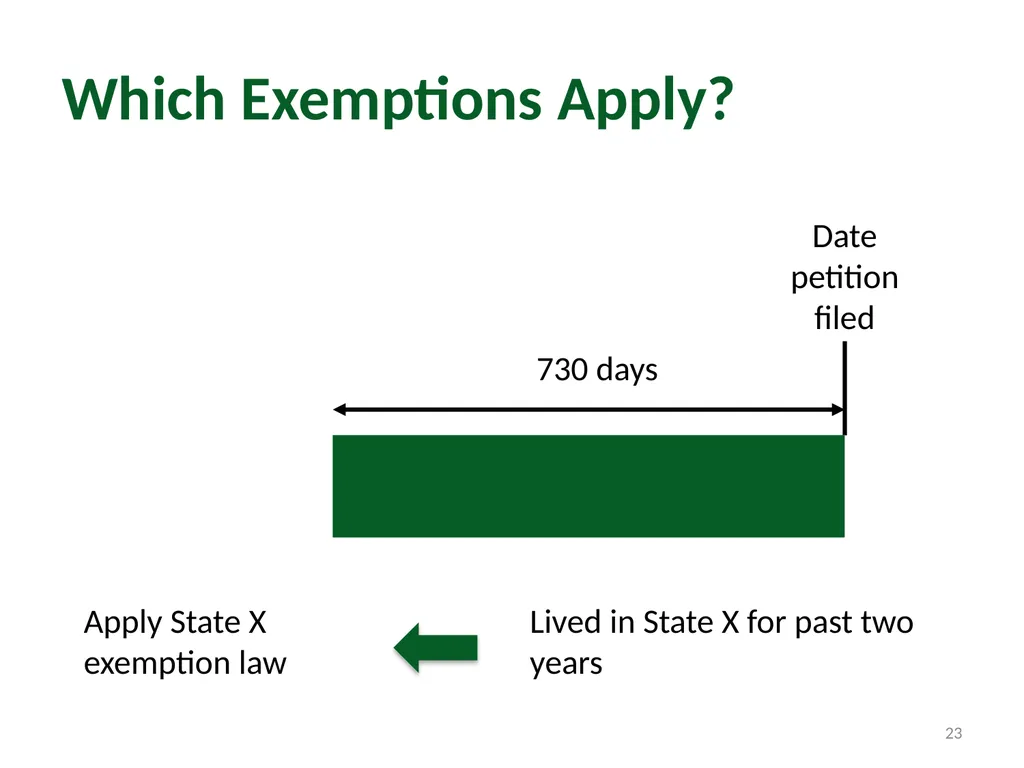
Which Exemptions Apply? 23 Date petition filed 730 days Lived in State X for past two years Apply State X
exemption law<br>
exemption law<br>
24
Which Exemptions Apply? 24 Date petition filed 730 days 180 days Debtor moves to a new state any time during this window Look at this 180-day period<br>
25
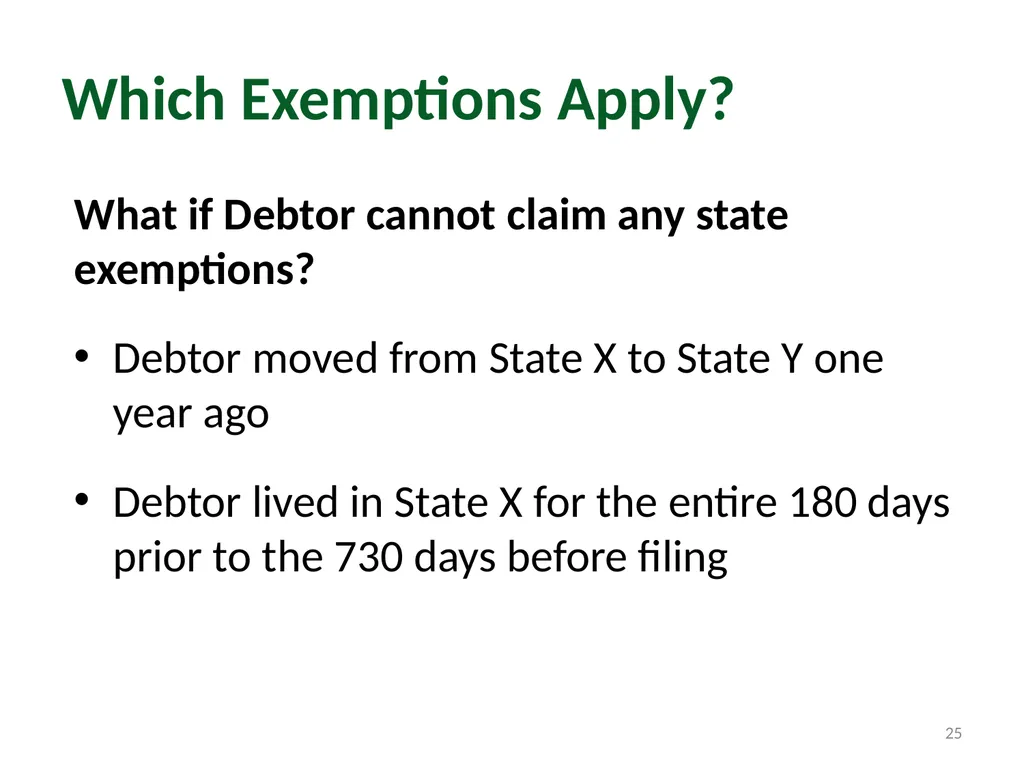
Which Exemptions Apply? What if Debtor cannot claim any state exemptions?
Debtor moved from State X to State Y one year ago
Debtor lived in State X for the entire 180 days prior to the 730 days before filing 25<br>
Debtor moved from State X to State Y one year ago
Debtor lived in State X for the entire 180 days prior to the 730 days before filing 25<br>
26
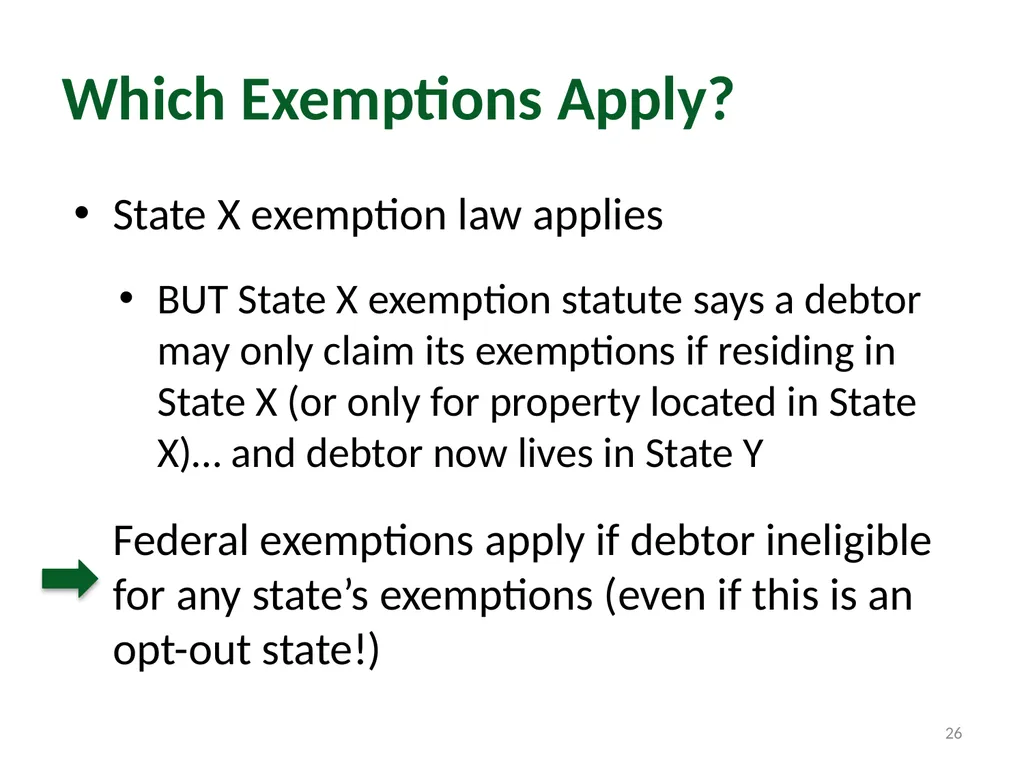
Which Exemptions Apply? State X exemption law applies
BUT State X exemption statute says a debtor may only claim its exemptions if residing in State X (or only for property located in State X)… and debtor now lives in State Y
Federal exemptions apply if debtor ineligible for any state’s exemptions (even if this is an opt-out state!) 26<br>
BUT State X exemption statute says a debtor may only claim its exemptions if residing in State X (or only for property located in State X)… and debtor now lives in State Y
Federal exemptions apply if debtor ineligible for any state’s exemptions (even if this is an opt-out state!) 26<br>
27
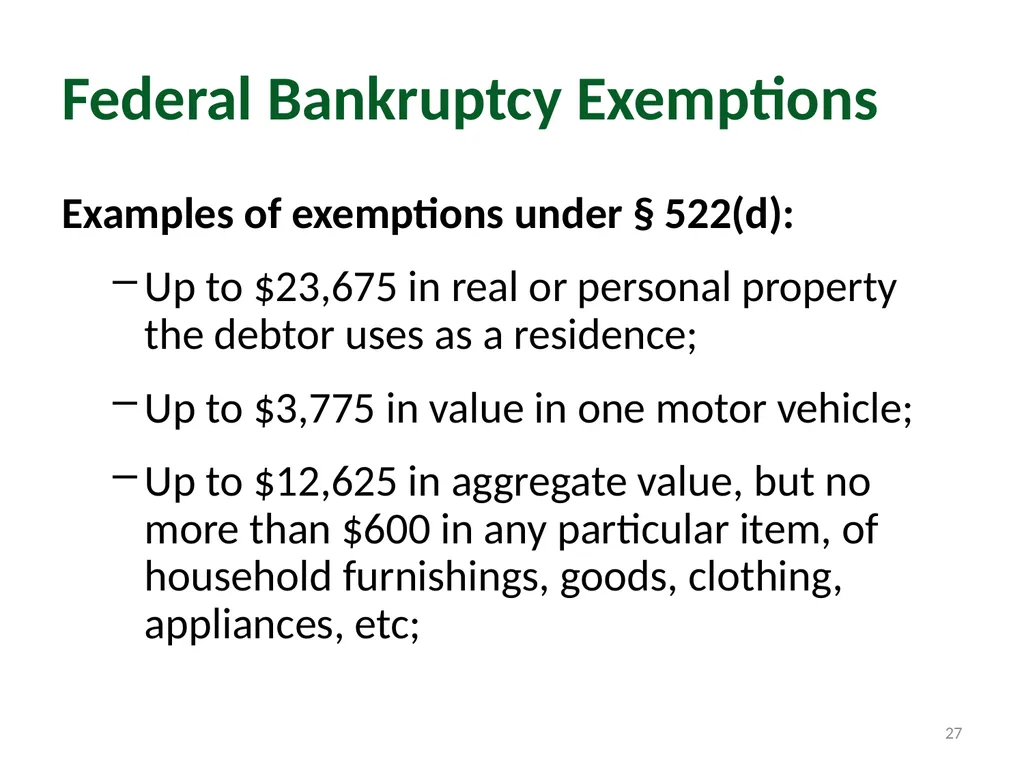
Federal Bankruptcy Exemptions Examples of exemptions under § 522(d):
Up to $23,675 in real or personal property the debtor uses as a residence;
Up to $3,775 in value in one motor vehicle;
Up to $12,625 in aggregate value, but no more than $600 in any particular item, of household furnishings, goods, clothing, appliances, etc; 27<br>
Up to $23,675 in real or personal property the debtor uses as a residence;
Up to $3,775 in value in one motor vehicle;
Up to $12,625 in aggregate value, but no more than $600 in any particular item, of household furnishings, goods, clothing, appliances, etc; 27<br>
28
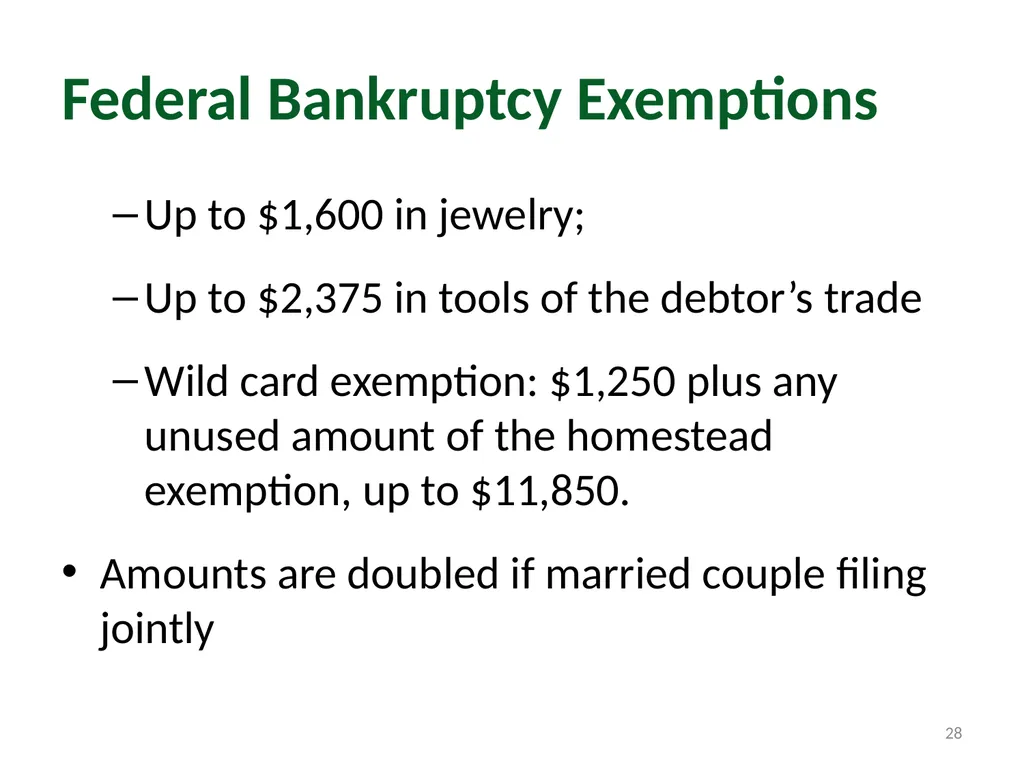
Federal Bankruptcy Exemptions Up to $1,600 in jewelry;
Up to $2,375 in tools of the debtor’s trade
Wild card exemption: $1,250 plus any unused amount of the homestead exemption, up to $11,850.
Amounts are doubled if married couple filing jointly 28<br>
Up to $2,375 in tools of the debtor’s trade
Wild card exemption: $1,250 plus any unused amount of the homestead exemption, up to $11,850.
Amounts are doubled if married couple filing jointly 28<br>
29
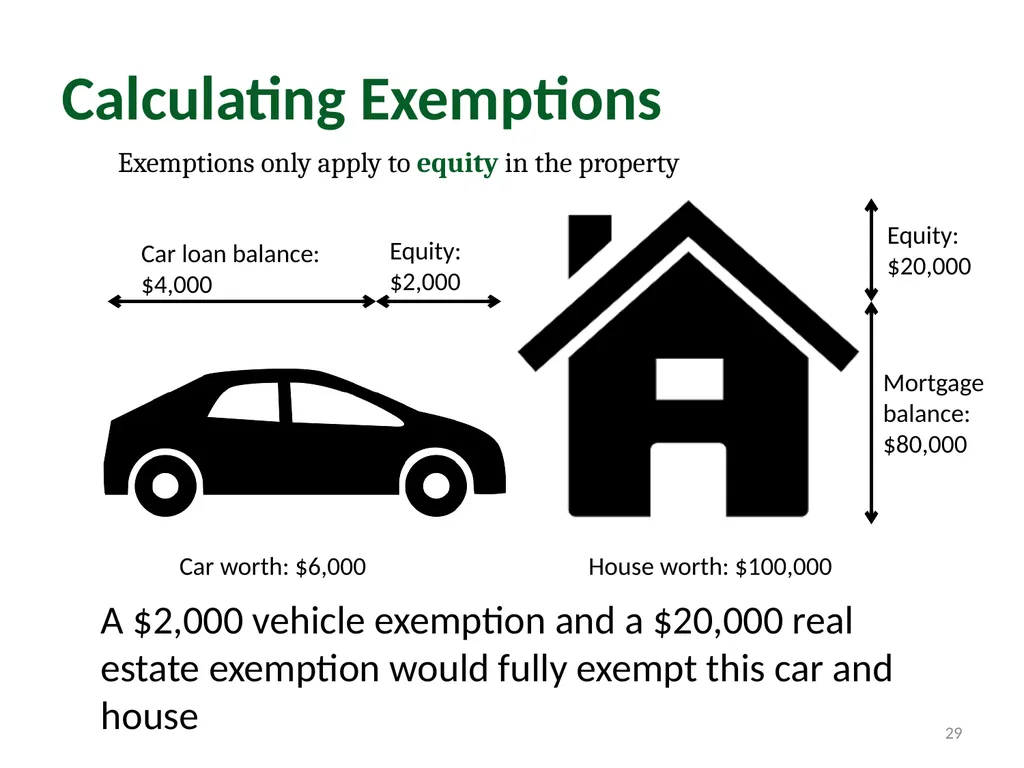
Calculating Exemptions 29 Exemptions only apply to equity in the property Car loan balance: $4,000 Equity: $2,000 Car worth: $6,000 House worth: $100,000 Mortgage balance: $80,000 Equity: $20,000 A $2,000 vehicle exemption and a $20,000 real estate exemption would fully exempt this car and house<br>
30
Protection for Exempt Property Exempt property is not liable during or after case for prepetition debts (even some nondischargeable debts), except:
Debts for taxes, domestic support obligations
Debts secured by liens not avoided during the bankruptcy
Fraudulently obtained: student loan or aid and debt owed to insured bank
11 U.S.C. § 522(c) 30<br>
Debts for taxes, domestic support obligations
Debts secured by liens not avoided during the bankruptcy
Fraudulently obtained: student loan or aid and debt owed to insured bank
11 U.S.C. § 522(c) 30<br>
31
State Homestead Exemption Limitations 522(o) – reduction to extent of fraudulent conversion within 10 years before filing of petition
522(p) - $160,375 cap based on interest acquired within 1215 days before filing of petition
522(q) - $160,375 cap based on certain criminal and wrongful conduct 31<br>
522(p) - $160,375 cap based on interest acquired within 1215 days before filing of petition
522(q) - $160,375 cap based on certain criminal and wrongful conduct 31<br>
32
The Automatic Stay 32<br>
33
The Automatic Stay 33<br>
34
Scope of the Stay The Automatic Stay prohibits:
Attempts to collect pre-petition debts
Commencement or continuation of judicial or other proceedings to collect pre-petition debts (e.g., foreclosure, garnishment)
Efforts to create, perfect or enforce liens on property of the estate or of the debtor, if relating to a pre-petition claim 34<br>
Attempts to collect pre-petition debts
Commencement or continuation of judicial or other proceedings to collect pre-petition debts (e.g., foreclosure, garnishment)
Efforts to create, perfect or enforce liens on property of the estate or of the debtor, if relating to a pre-petition claim 34<br>
35
Scope of the Stay The Automatic Stay prohibits:
Efforts to take possession of or assume control of property of the estate (e.g., repossession of a car)
Enforcement against the debtor or property of the estate of a pre-petition judgment
Setoff of pre-petition debts
11 U.S.C. § 362(a) 35<br>
Efforts to take possession of or assume control of property of the estate (e.g., repossession of a car)
Enforcement against the debtor or property of the estate of a pre-petition judgment
Setoff of pre-petition debts
11 U.S.C. § 362(a) 35<br>
36
Exceptions to Automatic Stay Section 362(b) contains 28 exceptions to the stay, including:
Criminal actions or proceedings
Enforcement of domestic support obligations
Enforcement of police or regulatory powers 36<br>
Criminal actions or proceedings
Enforcement of domestic support obligations
Enforcement of police or regulatory powers 36<br>
37
Exceptions to Automatic Stay Petition filed in violation of § 109(g) or prior court order
In Rem Order in a prior case related to real property
Residential tenant eviction if judgment for possession was entered prepetition
Repeat bankruptcy filings (within prior year) 37<br>
In Rem Order in a prior case related to real property
Residential tenant eviction if judgment for possession was entered prepetition
Repeat bankruptcy filings (within prior year) 37<br>
38
Repeat Filings ONE PRIOR CASE DISMISSED WITHIN ONE YEAR BEFORE THIS FILING:
Automatic stay expires 30 days after petition date in individual chapter 7, 11, or 13 case
No effect on codebtor stay under § 1301 in chapter 13 cases
Motion to extend stay must be filed and heard before 30 days expires 38<br>
Automatic stay expires 30 days after petition date in individual chapter 7, 11, or 13 case
No effect on codebtor stay under § 1301 in chapter 13 cases
Motion to extend stay must be filed and heard before 30 days expires 38<br>
39
Repeat Filings Debtor must demonstrate case filed in good faith with respect to creditors to be stayed
Debtor may need to rebut presumption of bad faith
Court may extend stay as to all or some creditors, and may impose conditions on extension
11 U.S.C. § 362(c)(3) – motions to extend stay covered in Module 4 39<br>
Debtor may need to rebut presumption of bad faith
Court may extend stay as to all or some creditors, and may impose conditions on extension
11 U.S.C. § 362(c)(3) – motions to extend stay covered in Module 4 39<br>
40
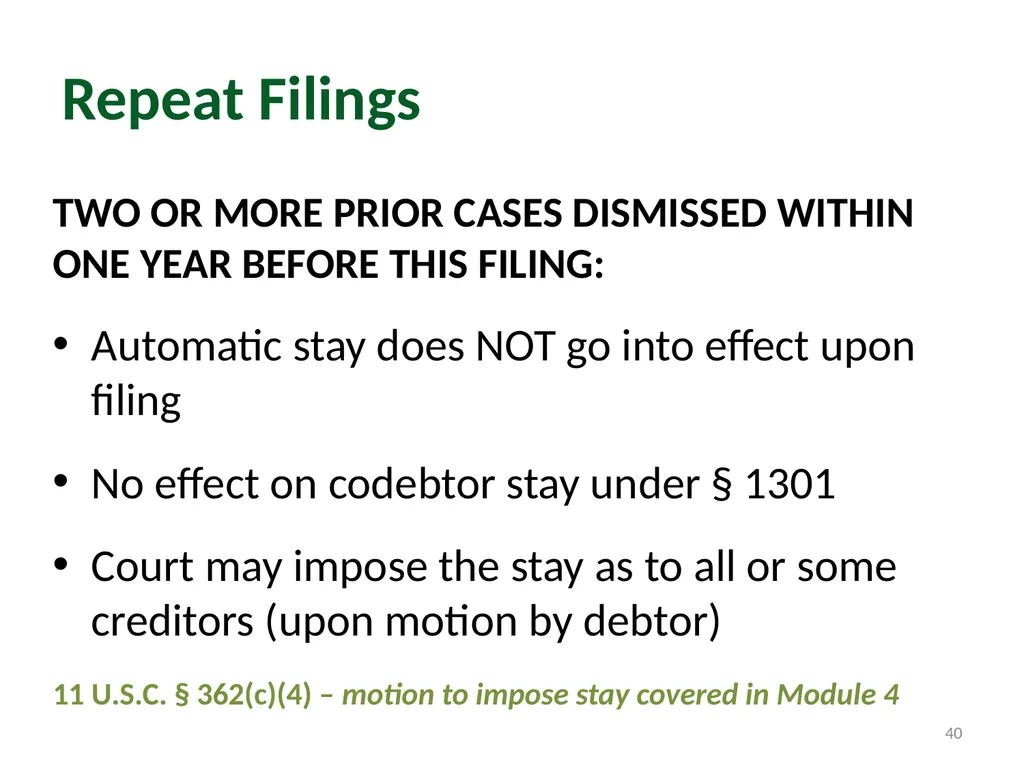
Repeat Filings TWO OR MORE PRIOR CASES DISMISSED WITHIN ONE YEAR BEFORE THIS FILING:
Automatic stay does NOT go into effect upon filing
No effect on codebtor stay under § 1301
Court may impose the stay as to all or some creditors (upon motion by debtor)
11 U.S.C. § 362(c)(4) – motion to impose stay covered in Module 4 40<br>
Automatic stay does NOT go into effect upon filing
No effect on codebtor stay under § 1301
Court may impose the stay as to all or some creditors (upon motion by debtor)
11 U.S.C. § 362(c)(4) – motion to impose stay covered in Module 4 40<br>
41
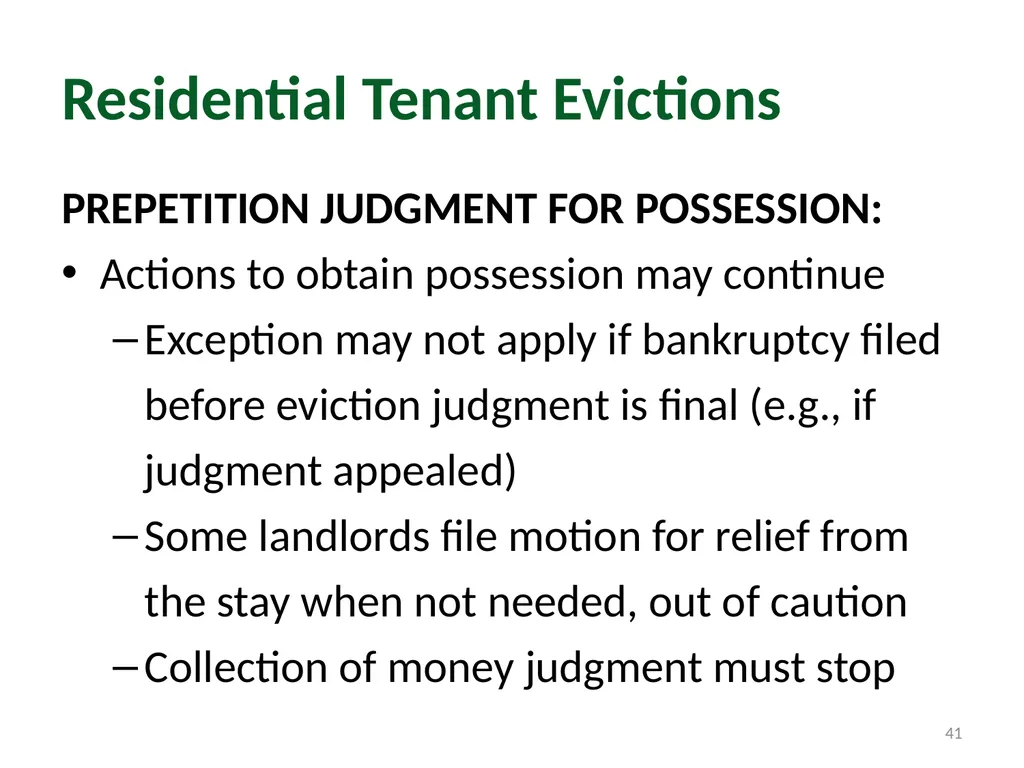
Residential Tenant Evictions PREPETITION JUDGMENT FOR POSSESSION:
Actions to obtain possession may continue
Exception may not apply if bankruptcy filed before eviction judgment is final (e.g., if judgment appealed)
Some landlords file motion for relief from the stay when not needed, out of caution
Collection of money judgment must stop 41<br>
Actions to obtain possession may continue
Exception may not apply if bankruptcy filed before eviction judgment is final (e.g., if judgment appealed)
Some landlords file motion for relief from the stay when not needed, out of caution
Collection of money judgment must stop 41<br>
42
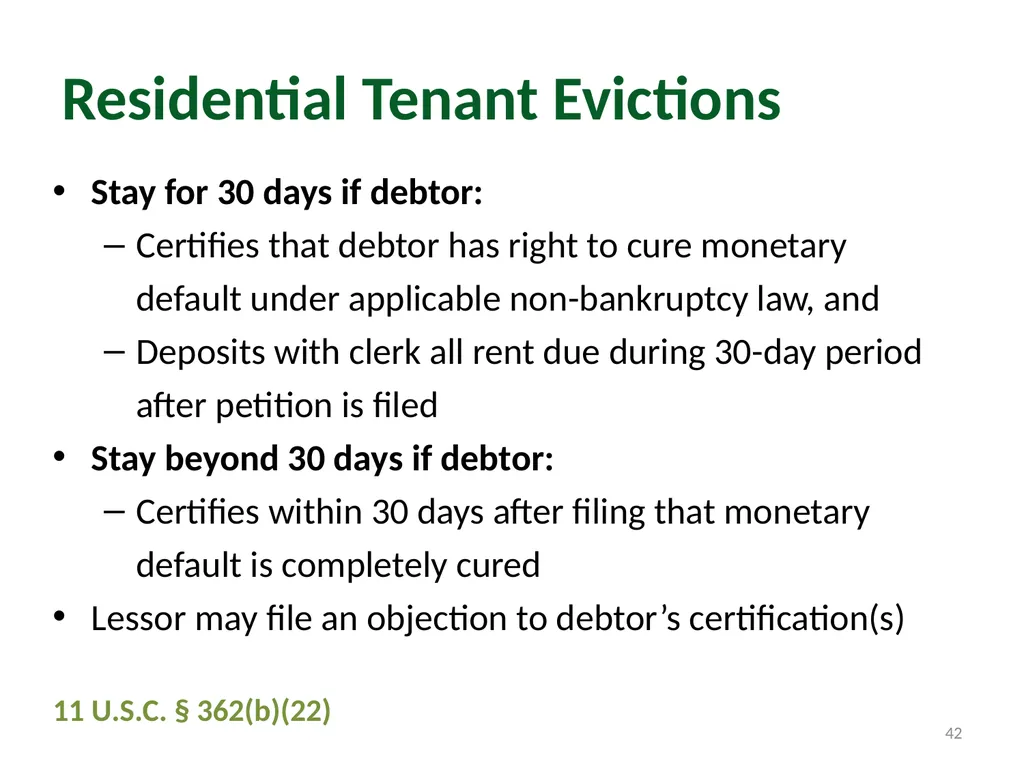
Residential Tenant Evictions Stay for 30 days if debtor:
Certifies that debtor has right to cure monetary default under applicable non-bankruptcy law, and
Deposits with clerk all rent due during 30-day period after petition is filed
Stay beyond 30 days if debtor:
Certifies within 30 days after filing that monetary default is completely cured
Lessor may file an objection to debtor’s certification(s)
11 U.S.C. § 362(b)(22) 42<br>
Certifies that debtor has right to cure monetary default under applicable non-bankruptcy law, and
Deposits with clerk all rent due during 30-day period after petition is filed
Stay beyond 30 days if debtor:
Certifies within 30 days after filing that monetary default is completely cured
Lessor may file an objection to debtor’s certification(s)
11 U.S.C. § 362(b)(22) 42<br>
43
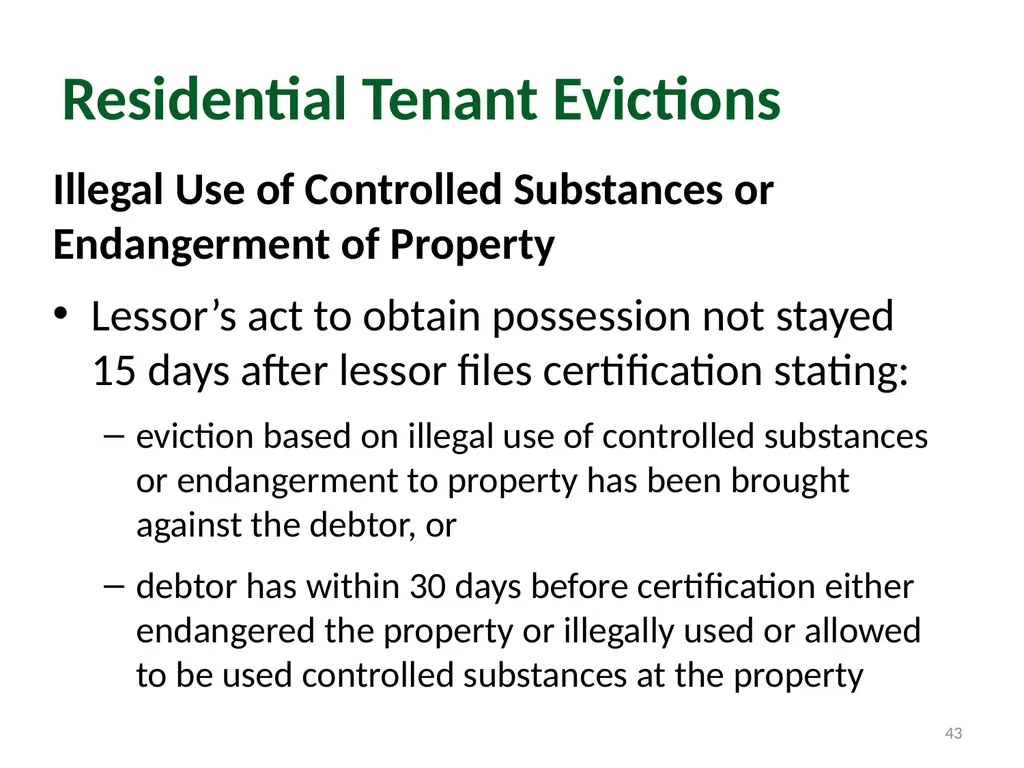
Residential Tenant Evictions Illegal Use of Controlled Substances or Endangerment of Property
Lessor’s act to obtain possession not stayed 15 days after lessor files certification stating:
eviction based on illegal use of controlled substances or endangerment to property has been brought against the debtor, or
debtor has within 30 days before certification either endangered the property or illegally used or allowed to be used controlled substances at the property 43<br>
Lessor’s act to obtain possession not stayed 15 days after lessor files certification stating:
eviction based on illegal use of controlled substances or endangerment to property has been brought against the debtor, or
debtor has within 30 days before certification either endangered the property or illegally used or allowed to be used controlled substances at the property 43<br>
44
Residential Tenant Evictions Debtor has 15 days to object to lessor’s certification; hearing must be held within 10 days of filing of objection
Debtor must prove situation alleged in certification did not exist or has been remedied
11 U.S.C. 362(b)(23) 44<br>
Debtor must prove situation alleged in certification did not exist or has been remedied
11 U.S.C. 362(b)(23) 44<br>
45
Duration of Stay Stay against property of the estate continues until earlier of:
Date property is no longer property of the estate (usually when deemed abandoned upon close of case), or
Effective date of order terminating stay 45<br>
Date property is no longer property of the estate (usually when deemed abandoned upon close of case), or
Effective date of order terminating stay 45<br>
46
Duration of Stay Stay against all other acts continues until earliest of:
Case is closed;
Case is dismissed;
Discharge is granted or denied (court may defer entry under Rule 4004(c)(2)); or
Effective date of order terminating stay
11 U.S.C. 362(c) and (d) 46<br>
Case is closed;
Case is dismissed;
Discharge is granted or denied (court may defer entry under Rule 4004(c)(2)); or
Effective date of order terminating stay
11 U.S.C. 362(c) and (d) 46<br>
47
Violation of Automatic Stay Actions taken in violation of automatic stay generally are void
Debtor may recover actual damages, including attorneys’ fees, if willful violation
Willful – act done intentionally with knowledge of the filing
Split of authority on whether emotional distress damages may be recovered
Punitive damages may be recovered in “appropriate” circumstances
11 U.S.C. 362(k)<br>
Debtor may recover actual damages, including attorneys’ fees, if willful violation
Willful – act done intentionally with knowledge of the filing
Split of authority on whether emotional distress damages may be recovered
Punitive damages may be recovered in “appropriate” circumstances
11 U.S.C. 362(k)<br>
48
Motion for Relief from Stay COURT MAY TERMINATE, ANNUL, MODIFY, OR CONDITION THE STAY
For cause, including lack of adequate protection
Lack of equity and property not necessary for effective reorganization
Burden of proof
Equity – burden is on party requesting relief
All other issues – burden is on party opposing relief
11 U.S.C. 362(d) 48<br>
For cause, including lack of adequate protection
Lack of equity and property not necessary for effective reorganization
Burden of proof
Equity – burden is on party requesting relief
All other issues – burden is on party opposing relief
11 U.S.C. 362(d) 48<br>
49
Utility Service During first 20 days after the petition date:
Utility service may not be shut off
If terminated prepetition, service should be restored
Prepetition arrearage is dischargeable debt and utility may not refuse future service because of discharge of pre-petition arrearage
11 U.S.C.§366(a)<br>
Utility service may not be shut off
If terminated prepetition, service should be restored
Prepetition arrearage is dischargeable debt and utility may not refuse future service because of discharge of pre-petition arrearage
11 U.S.C.§366(a)<br>
50
Utility Service After first 20 days from the petition date:
Utility may condition continued service on receipt within 20 days after the petition date of “adequate assurance” deposit
Post-bankruptcy deposit is typically similar to deposit required for new customers
Utility may terminate service for nonpayment of postpetition usage or nonpayment of adequate assurance
11 U.S.C. § 366(b)<br>
Utility may condition continued service on receipt within 20 days after the petition date of “adequate assurance” deposit
Post-bankruptcy deposit is typically similar to deposit required for new customers
Utility may terminate service for nonpayment of postpetition usage or nonpayment of adequate assurance
11 U.S.C. § 366(b)<br>
51
Discharge and Dischargeability 51<br>
52
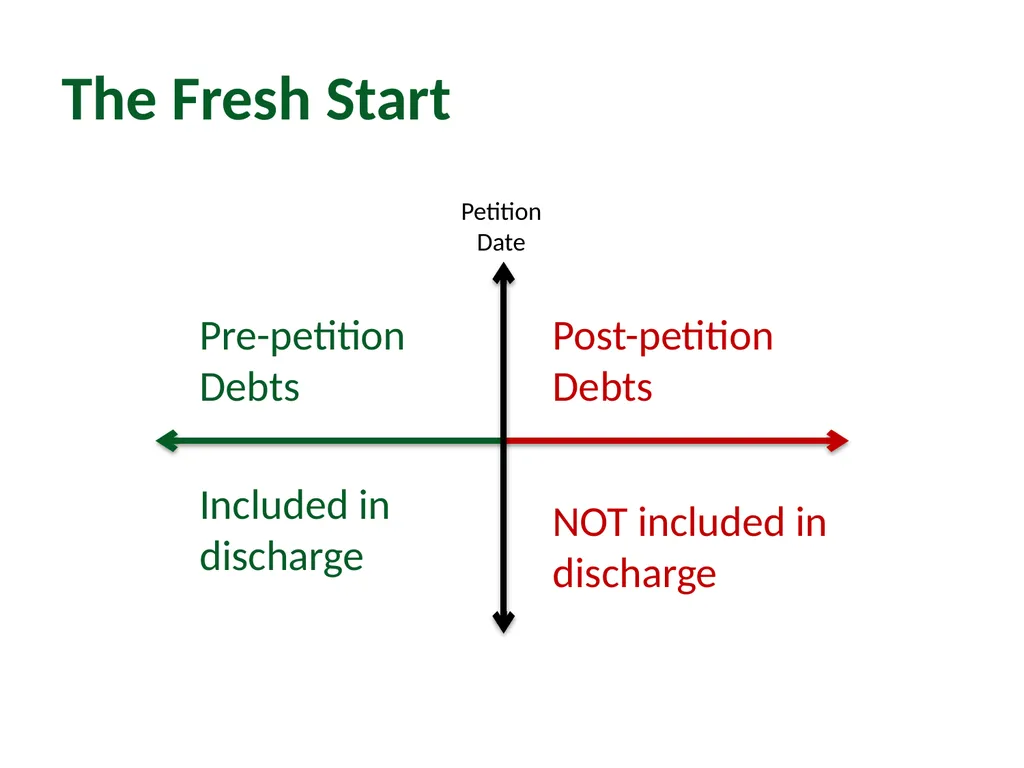
The Fresh Start Pre-petition Debts Post-petition Debts Included in discharge NOT included in discharge Petition Date<br>
53
Discharge of Debts Court enters a Discharge Order
In chapter 7, any time after 60 days after first scheduled meeting of creditors;
In chapter 13, upon plan completion
Operates as an injunction preventing creditors from attempting to collect discharged debts in the future as personal liability of debtor
Violations of the discharge injunction may be punished by contempt
11 U.S.C. § 524(a)<br>
In chapter 7, any time after 60 days after first scheduled meeting of creditors;
In chapter 13, upon plan completion
Operates as an injunction preventing creditors from attempting to collect discharged debts in the future as personal liability of debtor
Violations of the discharge injunction may be punished by contempt
11 U.S.C. § 524(a)<br>
54
Exceptions to the Discharge Debts that are not dischargeable:
Most taxes;
Debts the debtor failed to list in the schedules (unless creditor had notice, or no-asset case);
Domestic support obligations (child support and alimony);
Most fines and penalties owed to government agencies; 54<br>
Most taxes;
Debts the debtor failed to list in the schedules (unless creditor had notice, or no-asset case);
Domestic support obligations (child support and alimony);
Most fines and penalties owed to government agencies; 54<br>
55
Exceptions to the Discharge Student loans, unless the debtor can prove to the court that repaying them will be an “undue hardship;”
Debts incurred by driving while intoxicated;
Debts the debtor has formally agreed to repay by entering into a reaffirmation agreement.
11 U.S.C.§523(a) 55<br>
Debts incurred by driving while intoxicated;
Debts the debtor has formally agreed to repay by entering into a reaffirmation agreement.
11 U.S.C.§523(a) 55<br>
56
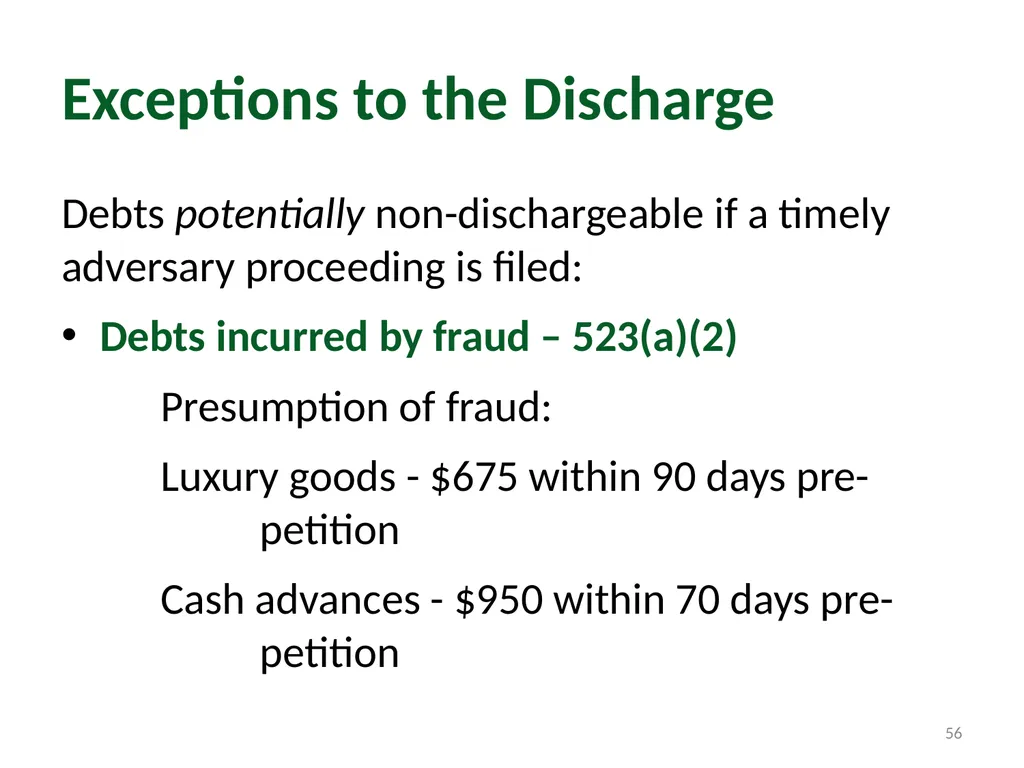
Exceptions to the Discharge Debts potentially non-dischargeable if a timely adversary proceeding is filed:
Debts incurred by fraud – 523(a)(2)
Presumption of fraud:
Luxury goods - $675 within 90 days pre- petition
Cash advances - $950 within 70 days pre- petition 56<br>
Debts incurred by fraud – 523(a)(2)
Presumption of fraud:
Luxury goods - $675 within 90 days pre- petition
Cash advances - $950 within 70 days pre- petition 56<br>
57
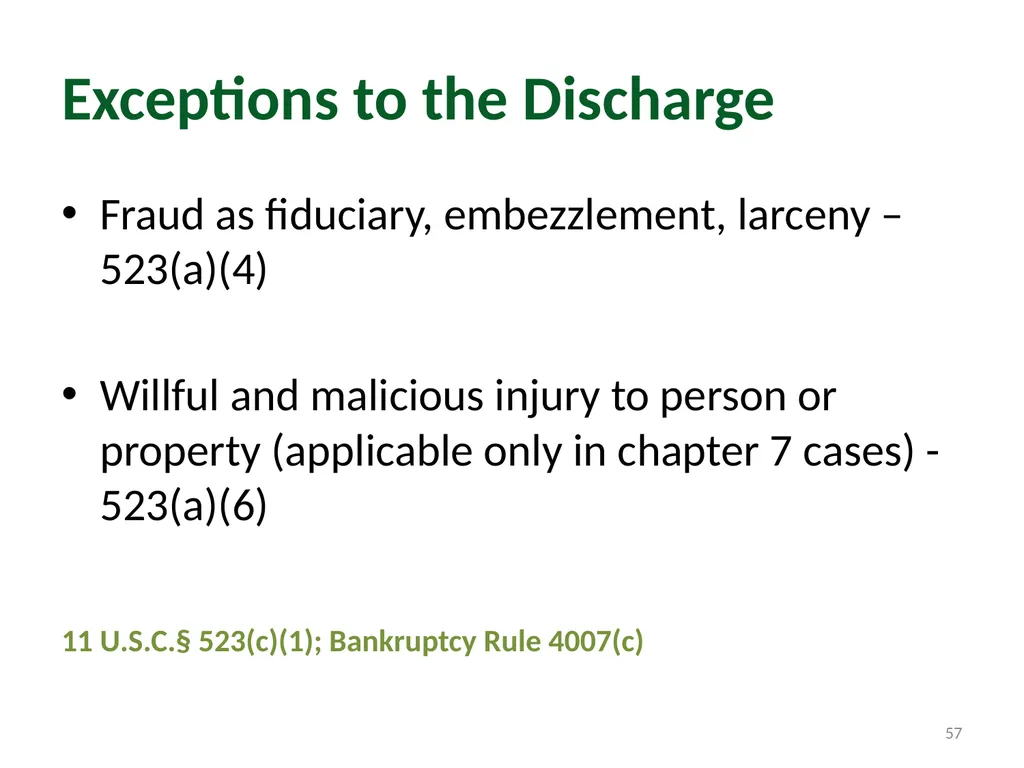
Exceptions to the Discharge Fraud as fiduciary, embezzlement, larceny –
523(a)(4)
Willful and malicious injury to person or property (applicable only in chapter 7 cases) - 523(a)(6)
11 U.S.C.§ 523(c)(1); Bankruptcy Rule 4007(c) 57<br>
Willful and malicious injury to person or property (applicable only in chapter 7 cases) - 523(a)(6)
11 U.S.C.§ 523(c)(1); Bankruptcy Rule 4007(c) 57<br>
58
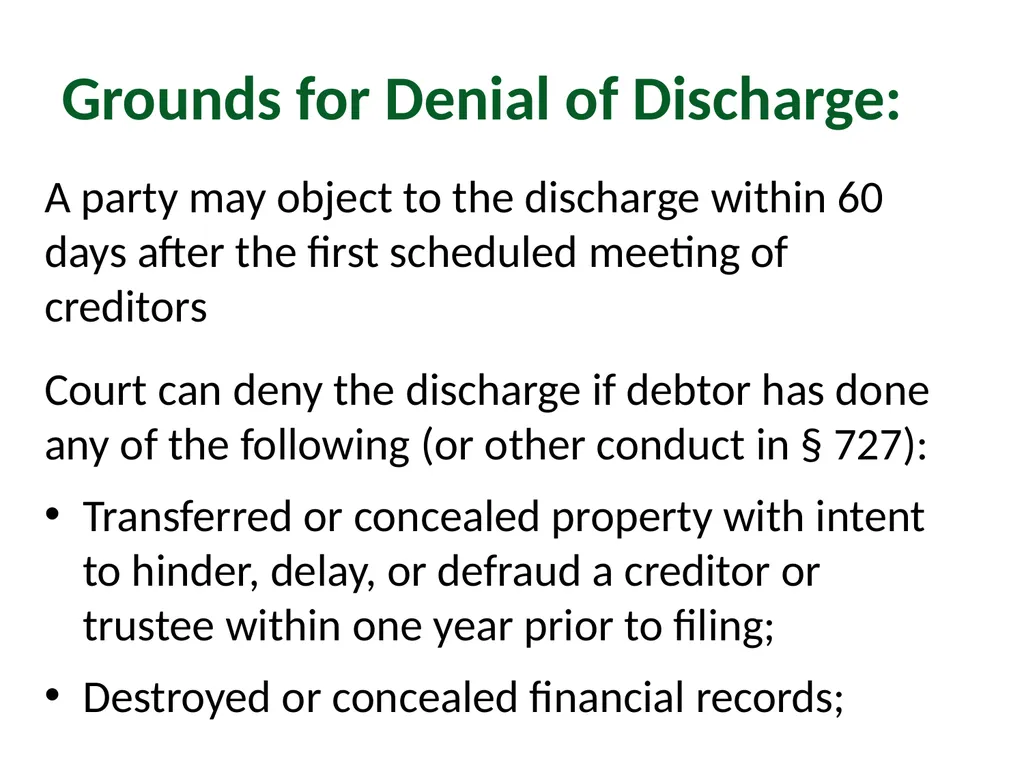
Grounds for Denial of Discharge: A party may object to the discharge within 60 days after the first scheduled meeting of creditors
Court can deny the discharge if debtor has done any of the following (or other conduct in § 727):
Transferred or concealed property with intent to hinder, delay, or defraud a creditor or trustee within one year prior to filing;
Destroyed or concealed financial records;<br>
Court can deny the discharge if debtor has done any of the following (or other conduct in § 727):
Transferred or concealed property with intent to hinder, delay, or defraud a creditor or trustee within one year prior to filing;
Destroyed or concealed financial records;<br>
59
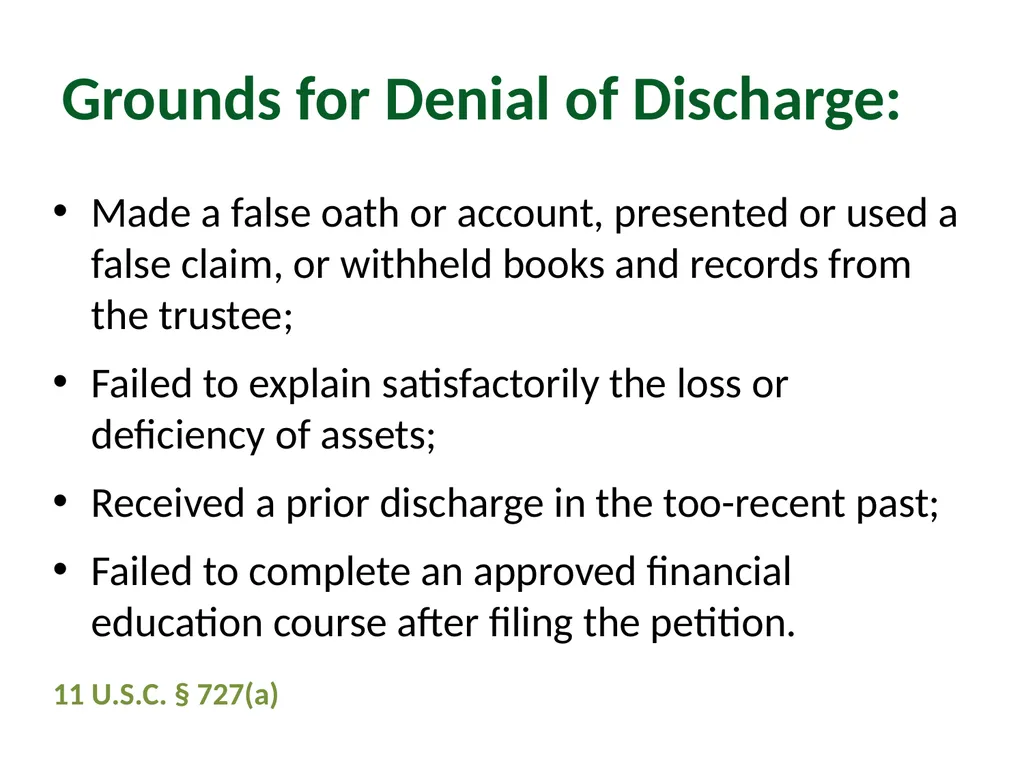
Grounds for Denial of Discharge: Made a false oath or account, presented or used a false claim, or withheld books and records from the trustee;
Failed to explain satisfactorily the loss or deficiency of assets;
Received a prior discharge in the too-recent past;
Failed to complete an approved financial education course after filing the petition.
11 U.S.C. § 727(a)<br>
Failed to explain satisfactorily the loss or deficiency of assets;
Received a prior discharge in the too-recent past;
Failed to complete an approved financial education course after filing the petition.
11 U.S.C. § 727(a)<br>
60
Overview of Chapter 7<br>
61
Eligibility to File Chapter 7 Any individual who lives in the United States or has property or a business in the United States
Debtor must obtain briefing from an approved credit counseling agency within 180 days before filing (covered in Module 2)<br>
Debtor must obtain briefing from an approved credit counseling agency within 180 days before filing (covered in Module 2)<br>
62
Eligibility to File Chapter 7 Under § 109(g), debtor must not within the 180-day period prior to filing:
have had a prior case dismissed by the court for willful violation of court order or failure to prosecute prior case; or
have voluntarily dismissed a prior case after the filing of a motion for relief from the automatic stay.
11 U.S.C. § 109<br>
have had a prior case dismissed by the court for willful violation of court order or failure to prosecute prior case; or
have voluntarily dismissed a prior case after the filing of a motion for relief from the automatic stay.
11 U.S.C. § 109<br>
63
Eligibility for Chapter 7 Discharge A debtor is disqualified from receiving a chapter 7 discharge if the debtor got a prior discharge:
under chapter 7 in a case filed within 8 years before the filing of this case; or
under chapter 13 in a case filed within 6 years before the filing of this case, unless:
unsecured claims were paid in full in the ch. 13
payments under the ch. 13 plan totaled at least 70% of allowed secured claims, court finds best effort and good faith.
11 U.S.C. § 727<br>
under chapter 7 in a case filed within 8 years before the filing of this case; or
under chapter 13 in a case filed within 6 years before the filing of this case, unless:
unsecured claims were paid in full in the ch. 13
payments under the ch. 13 plan totaled at least 70% of allowed secured claims, court finds best effort and good faith.
11 U.S.C. § 727<br>
64
The Means Test Bankruptcy judge can dismiss chapter 7 case if filing is an abuse of bankruptcy system
“Means test” creates a presumption that the filing was abusive if the debtor fails the means test
Most debtors represented by pro bono attorneys are exempt from the means test
consumers with household income below state median family income are protected by a “safe harbor” and not subject to the means test
11 U.S.C. § 707 – covered in Module 2<br>
“Means test” creates a presumption that the filing was abusive if the debtor fails the means test
Most debtors represented by pro bono attorneys are exempt from the means test
consumers with household income below state median family income are protected by a “safe harbor” and not subject to the means test
11 U.S.C. § 707 – covered in Module 2<br>
65
The Means Test Consumers with income above median complete Official Form that compares monthly income with actual and assumed expenses in variety of categories
Some expenses are based on IRS collection guidelines
If Form shows that consumer should have a certain amount left over to pay unsecured creditors, presumption applies and bankruptcy court may decide consumer can not file chapter 7 case, unless there are “special circumstances”<br>
Some expenses are based on IRS collection guidelines
If Form shows that consumer should have a certain amount left over to pay unsecured creditors, presumption applies and bankruptcy court may decide consumer can not file chapter 7 case, unless there are “special circumstances”<br>
66
Filing Initial Documents Voluntary petition
Schedules (listing debtor’s property, debts, income, and expenses) and other required forms
Means test form
Creditor matrix<br>
Schedules (listing debtor’s property, debts, income, and expenses) and other required forms
Means test form
Creditor matrix<br>
67
Filing Initial Documents Debtor’s paystubs for the 60 days before filing
Certificate showing debtor did the mandatory credit counseling
Filing fee (may request to pay in installments or seek waiver if under 150% poverty level)
11 USC § 521 - covered in Modules 2 and 3<br>
Certificate showing debtor did the mandatory credit counseling
Filing fee (may request to pay in installments or seek waiver if under 150% poverty level)
11 USC § 521 - covered in Modules 2 and 3<br>
68
Chapter 7 Trustee After the case is filed, a chapter 7 trustee is appointed as representative of debtor’s bankruptcy estate
Selected from a panel of private trustees established by the U.S. Trustee
Duties include:
examining debtor at meeting of creditors;
collecting any nonexempt property that can be sold;
distributing proceeds from sale of nonexempt property to creditors with valid claims; and
making a final accounting to the court.<br>
Selected from a panel of private trustees established by the U.S. Trustee
Duties include:
examining debtor at meeting of creditors;
collecting any nonexempt property that can be sold;
distributing proceeds from sale of nonexempt property to creditors with valid claims; and
making a final accounting to the court.<br>
69
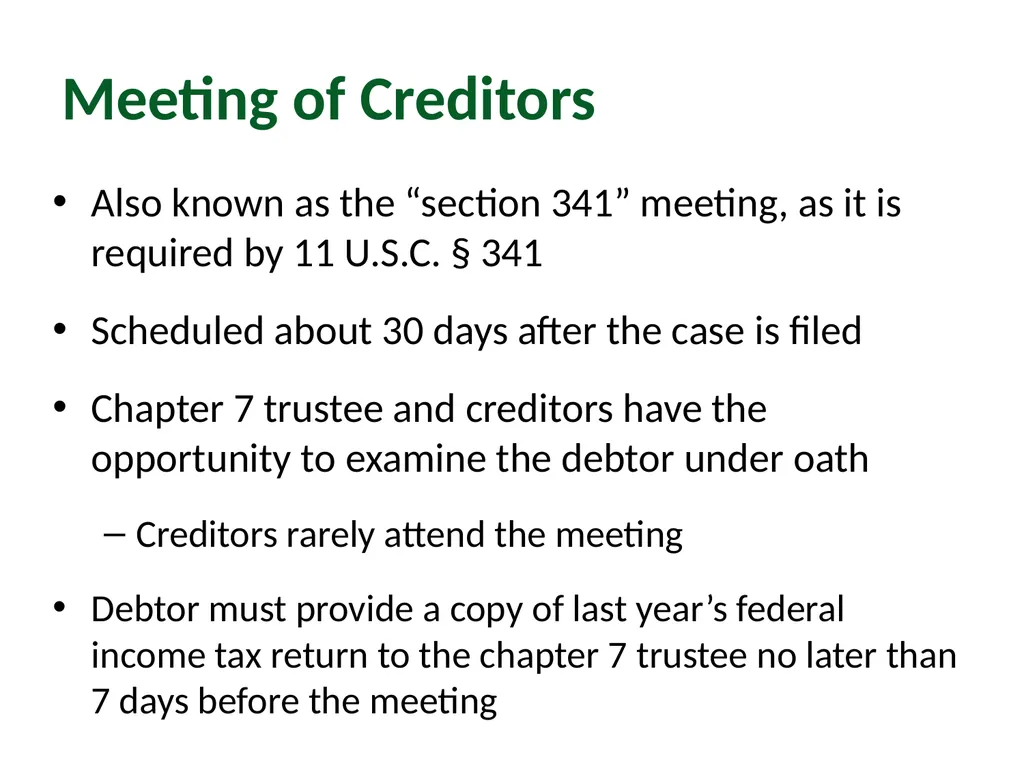
Meeting of Creditors Also known as the “section 341” meeting, as it is required by 11 U.S.C. § 341
Scheduled about 30 days after the case is filed
Chapter 7 trustee and creditors have the opportunity to examine the debtor under oath
Creditors rarely attend the meeting
Debtor must provide a copy of last year’s federal income tax return to the chapter 7 trustee no later than 7 days before the meeting<br>
Scheduled about 30 days after the case is filed
Chapter 7 trustee and creditors have the opportunity to examine the debtor under oath
Creditors rarely attend the meeting
Debtor must provide a copy of last year’s federal income tax return to the chapter 7 trustee no later than 7 days before the meeting<br>
70
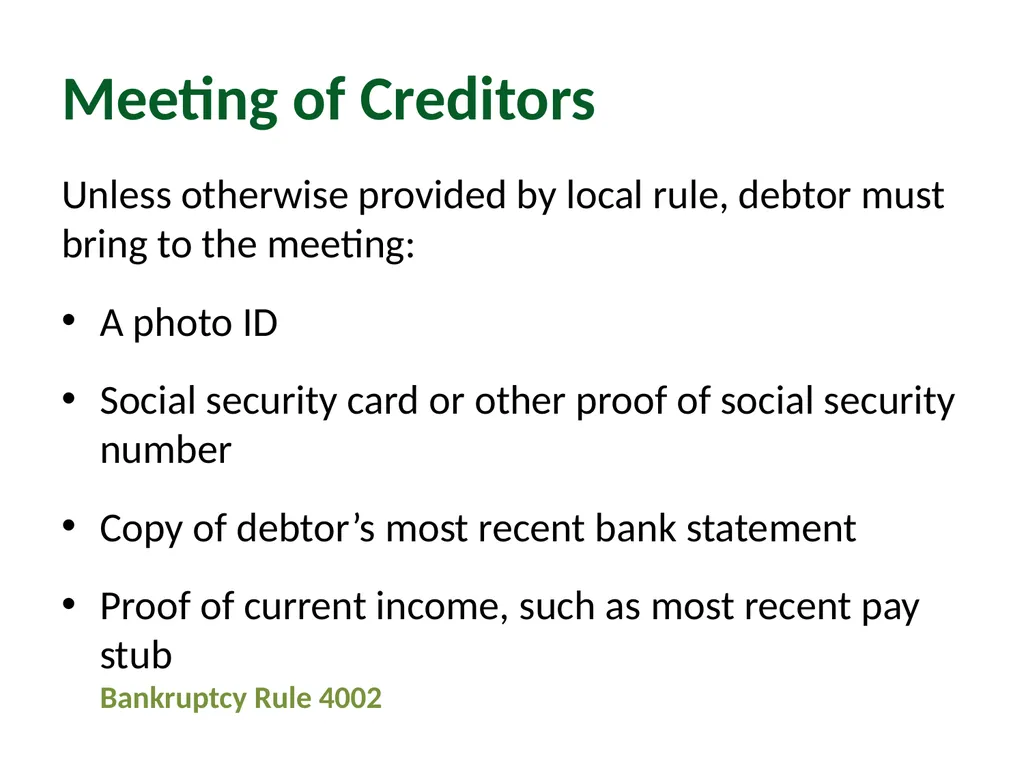
Meeting of Creditors Unless otherwise provided by local rule, debtor must bring to the meeting:
A photo ID
Social security card or other proof of social security number
Copy of debtor’s most recent bank statement
Proof of current income, such as most recent pay stub Bankruptcy Rule 4002<br>
A photo ID
Social security card or other proof of social security number
Copy of debtor’s most recent bank statement
Proof of current income, such as most recent pay stub Bankruptcy Rule 4002<br>
71
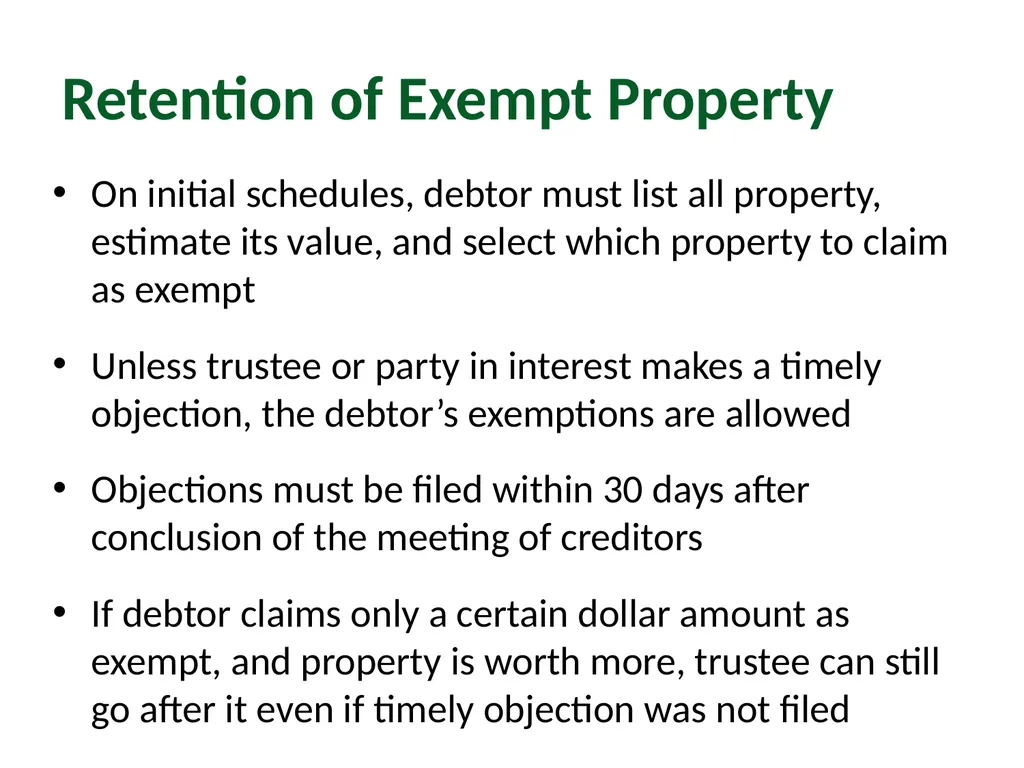
Retention of Exempt Property On initial schedules, debtor must list all property, estimate its value, and select which property to claim as exempt
Unless trustee or party in interest makes a timely objection, the debtor’s exemptions are allowed
Objections must be filed within 30 days after conclusion of the meeting of creditors
If debtor claims only a certain dollar amount as exempt, and property is worth more, trustee can still go after it even if timely objection was not filed<br>
Unless trustee or party in interest makes a timely objection, the debtor’s exemptions are allowed
Objections must be filed within 30 days after conclusion of the meeting of creditors
If debtor claims only a certain dollar amount as exempt, and property is worth more, trustee can still go after it even if timely objection was not filed<br>
72
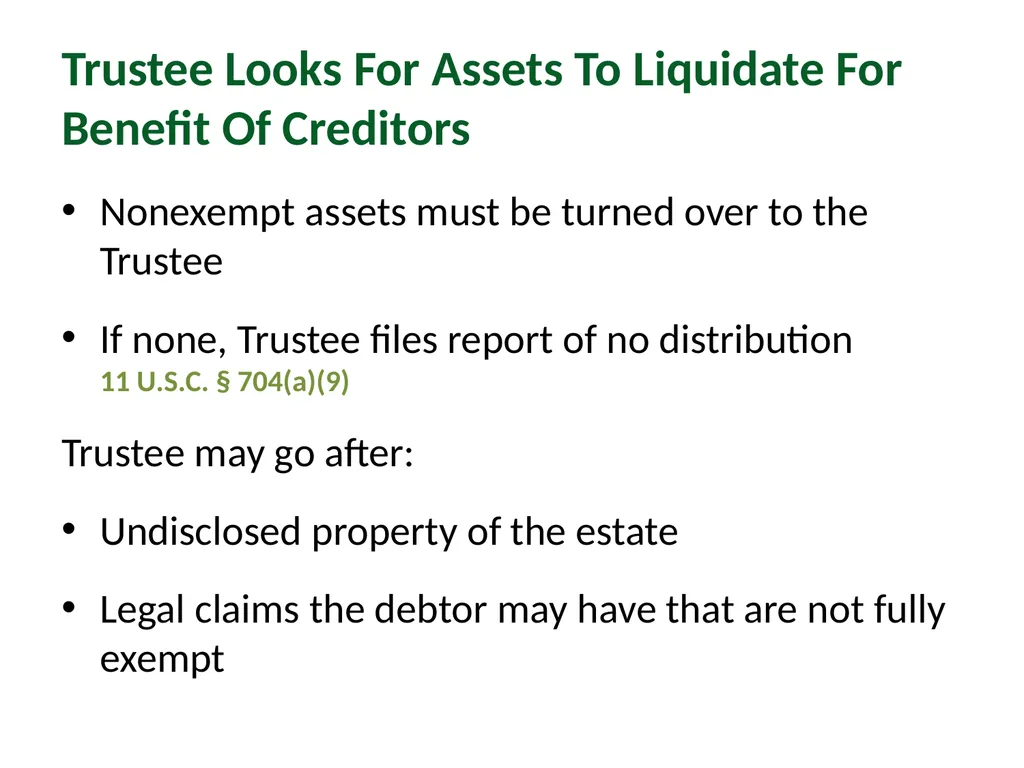
Trustee Looks For Assets To Liquidate For Benefit Of Creditors Nonexempt assets must be turned over to the Trustee
If none, Trustee files report of no distribution 11 U.S.C. § 704(a)(9)
Trustee may go after:
Undisclosed property of the estate
Legal claims the debtor may have that are not fully exempt<br>
If none, Trustee files report of no distribution 11 U.S.C. § 704(a)(9)
Trustee may go after:
Undisclosed property of the estate
Legal claims the debtor may have that are not fully exempt<br>
73
Trustee Looks For Assets To Liquidate For Benefit Of Creditors Fraudulent transfers: 11 U.S.C. §§ 544 and 548
Any transfer within the 2 years prior to filing (or longer under state statutes) -
for less than reasonably equivalent value, while insolvent, or
with intent to hinder, delay or defraud a creditor
Voidable preferences: 11 U.S.C. § 547
Payments made to a creditor totaling $600 or more within 90 days prior to the filing of the petition, if the transfer enables the creditor to get more than it otherwise would have gotten<br>
Any transfer within the 2 years prior to filing (or longer under state statutes) -
for less than reasonably equivalent value, while insolvent, or
with intent to hinder, delay or defraud a creditor
Voidable preferences: 11 U.S.C. § 547
Payments made to a creditor totaling $600 or more within 90 days prior to the filing of the petition, if the transfer enables the creditor to get more than it otherwise would have gotten<br>
74
General Rule: Secured Creditors Stay Secured Personal liability on secured debts is wiped out (no deficiency after foreclosure, for example)
Unless a court orders otherwise, the lien (or security interest) survives the bankruptcy
Thus, secured creditors will still be able to foreclose on a home or seize other property if consumer is in default
They may file a motion for relief from stay or wait for the discharge to be entered<br>
Unless a court orders otherwise, the lien (or security interest) survives the bankruptcy
Thus, secured creditors will still be able to foreclose on a home or seize other property if consumer is in default
They may file a motion for relief from stay or wait for the discharge to be entered<br>
75
Avoiding Liens That Impair The Debtor’s Exemptions Debtor may avoid a judgment lien that impairs the debtor’s exemptions
If a creditor has a judgment lien, the debtor may file a motion to avoid (or remove) the lien to the extent the lien attaches to value that would otherwise be exempt
Debtor may also avoid nonpossessory, nonpurchase-money security interests in certain exempt personal property listed in § 522(f) (such as household goods or furnishings)
11 USC § 522(f) - covered in Module 4<br>
If a creditor has a judgment lien, the debtor may file a motion to avoid (or remove) the lien to the extent the lien attaches to value that would otherwise be exempt
Debtor may also avoid nonpossessory, nonpurchase-money security interests in certain exempt personal property listed in § 522(f) (such as household goods or furnishings)
11 USC § 522(f) - covered in Module 4<br>
76
Redemption “An individual debtor may redeem tangible personal property intended for personal, family, or household use, from a lien. . . by paying the holder of such lien the amount of the allowed secured claim. . .”
Available only in chapter 7 cases
Debtor may file a motion to redeem the asset, pay the creditor an amount equal to the value of the asset, and eliminate the lien
11 USC § 722 - covered in Module 4<br>
Available only in chapter 7 cases
Debtor may file a motion to redeem the asset, pay the creditor an amount equal to the value of the asset, and eliminate the lien
11 USC § 722 - covered in Module 4<br>
77
Reaffirmation Debtor agrees to remove a debt from the discharge
It is as if bankruptcy never happened for this debt
Debtor must decide whether to reaffirm
Car loans?
Mortgage loans? (usually not)
If attorney does not certify that the reaffirmation will not impose undue hardship, court will hold a hearing on that question
11 USC § 524(c) - covered in Module 4<br>
It is as if bankruptcy never happened for this debt
Debtor must decide whether to reaffirm
Car loans?
Mortgage loans? (usually not)
If attorney does not certify that the reaffirmation will not impose undue hardship, court will hold a hearing on that question
11 USC § 524(c) - covered in Module 4<br>
78
Discharge Can be entered any time after 60 days after the first date scheduled for meeting of creditors
Time from filing until entry of discharge is usually 3-4 months
Debtor must certify that she has completed a financial management course by an approved provider after the petition is filed in order to receive discharge
Discharge may be delayed if a court review of a reaffirmation agreement is pending<br>
Time from filing until entry of discharge is usually 3-4 months
Debtor must certify that she has completed a financial management course by an approved provider after the petition is filed in order to receive discharge
Discharge may be delayed if a court review of a reaffirmation agreement is pending<br>
79
In Summary: When is Chapter 7 a Good Option? The debtor has significant dischargeable unsecured debt
The debtor does not have nonexempt assets that the debtor wants to keep
The debtor is not behind on debts secured by collateral the debtor wants to keep;
The debtor’s debt load has peaked.<br>
The debtor does not have nonexempt assets that the debtor wants to keep
The debtor is not behind on debts secured by collateral the debtor wants to keep;
The debtor’s debt load has peaked.<br>
80
Overview of Chapter 13<br>
81
How is Chapter 13 Different? Instead of getting paid from sale of non-exempt assets, creditors get paid from the debtor’s future income – through the chapter 13 plan
Debtor may keep nonexempt assets
The chapter 13 plan gives the debtor an opportunity to cure arrearages on secured debts – to save a home or car
Generally, no discharge until the plan is completed<br>
Debtor may keep nonexempt assets
The chapter 13 plan gives the debtor an opportunity to cure arrearages on secured debts – to save a home or car
Generally, no discharge until the plan is completed<br>
82
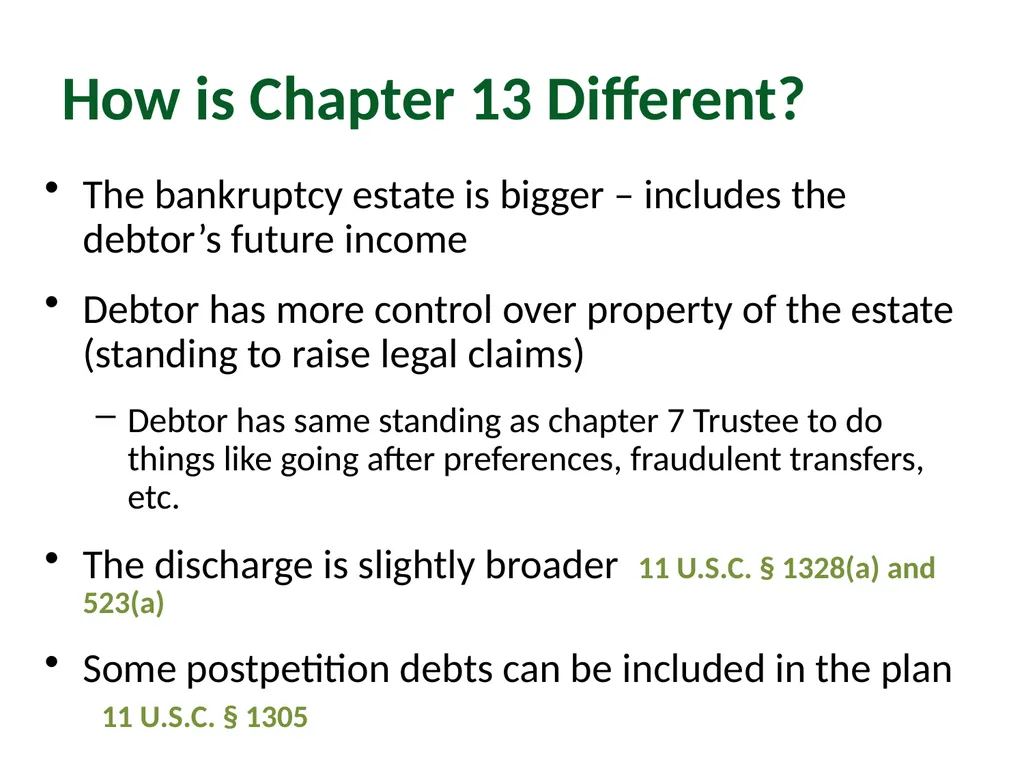
How is Chapter 13 Different? The bankruptcy estate is bigger – includes the debtor’s future income
Debtor has more control over property of the estate (standing to raise legal claims)
Debtor has same standing as chapter 7 Trustee to do things like going after preferences, fraudulent transfers, etc.
The discharge is slightly broader 11 U.S.C. § 1328(a) and 523(a)
Some postpetition debts can be included in the plan 11 U.S.C. § 1305<br>
Debtor has more control over property of the estate (standing to raise legal claims)
Debtor has same standing as chapter 7 Trustee to do things like going after preferences, fraudulent transfers, etc.
The discharge is slightly broader 11 U.S.C. § 1328(a) and 523(a)
Some postpetition debts can be included in the plan 11 U.S.C. § 1305<br>
83
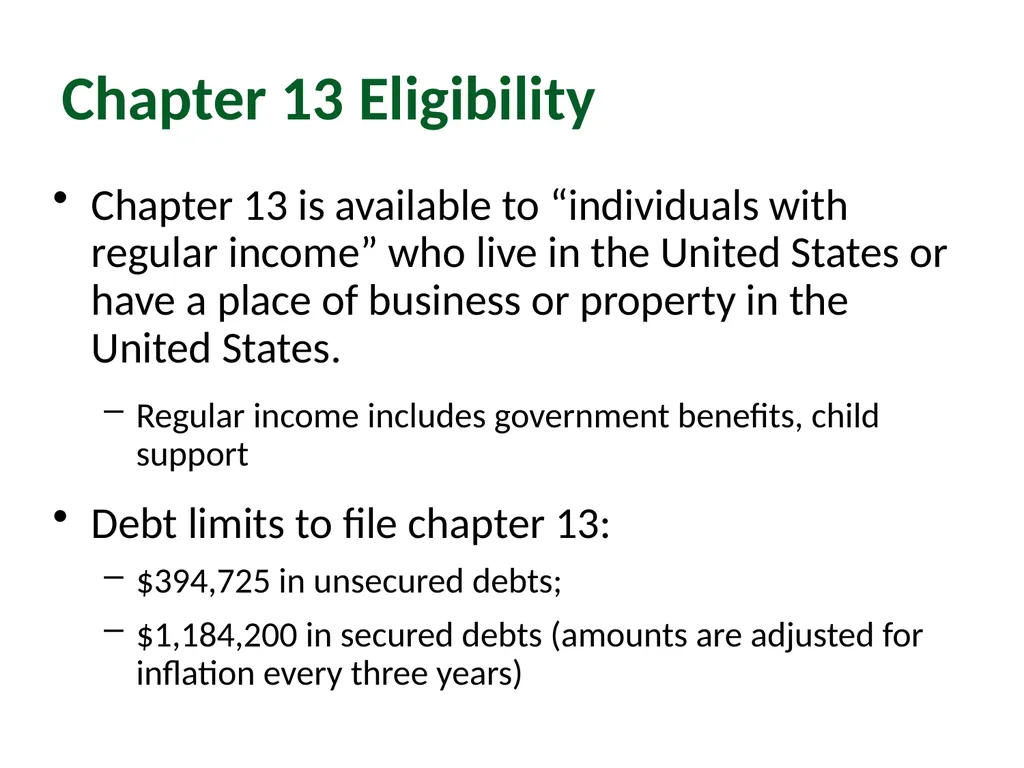
Chapter 13 Eligibility Chapter 13 is available to “individuals with regular income” who live in the United States or have a place of business or property in the United States.
Regular income includes government benefits, child support
Debt limits to file chapter 13:
$394,725 in unsecured debts;
$1,184,200 in secured debts (amounts are adjusted for inflation every three years)<br>
Regular income includes government benefits, child support
Debt limits to file chapter 13:
$394,725 in unsecured debts;
$1,184,200 in secured debts (amounts are adjusted for inflation every three years)<br>
84
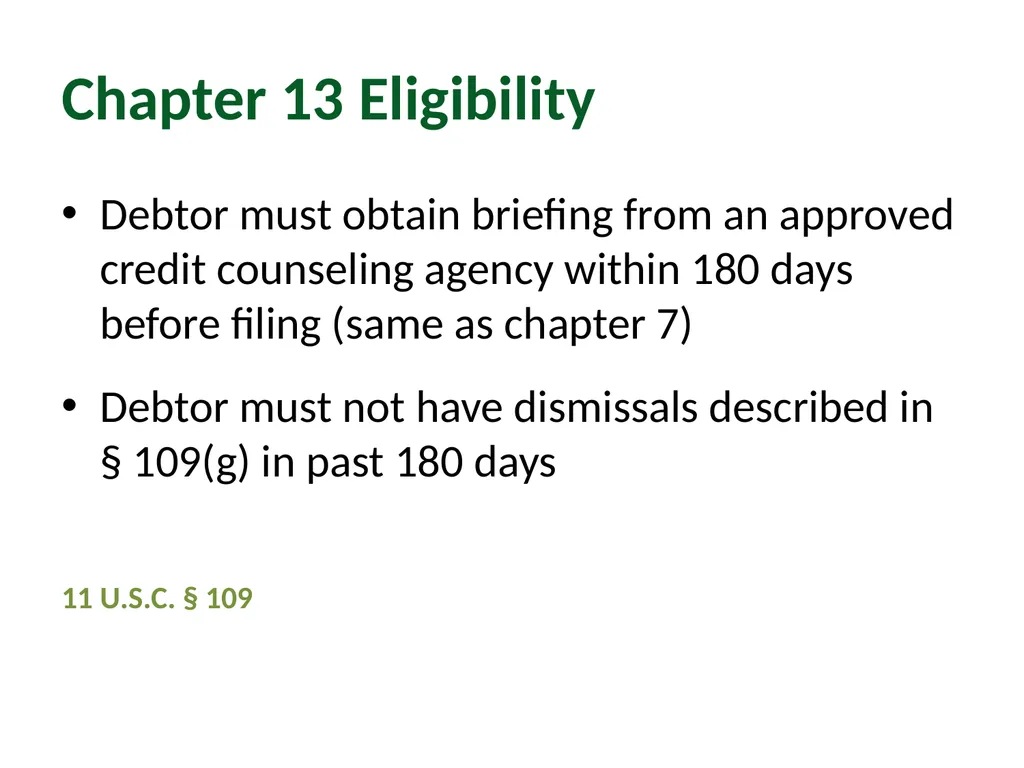
Chapter 13 Eligibility Debtor must obtain briefing from an approved credit counseling agency within 180 days before filing (same as chapter 7)
Debtor must not have dismissals described in § 109(g) in past 180 days
11 U.S.C. § 109<br>
Debtor must not have dismissals described in § 109(g) in past 180 days
11 U.S.C. § 109<br>
85
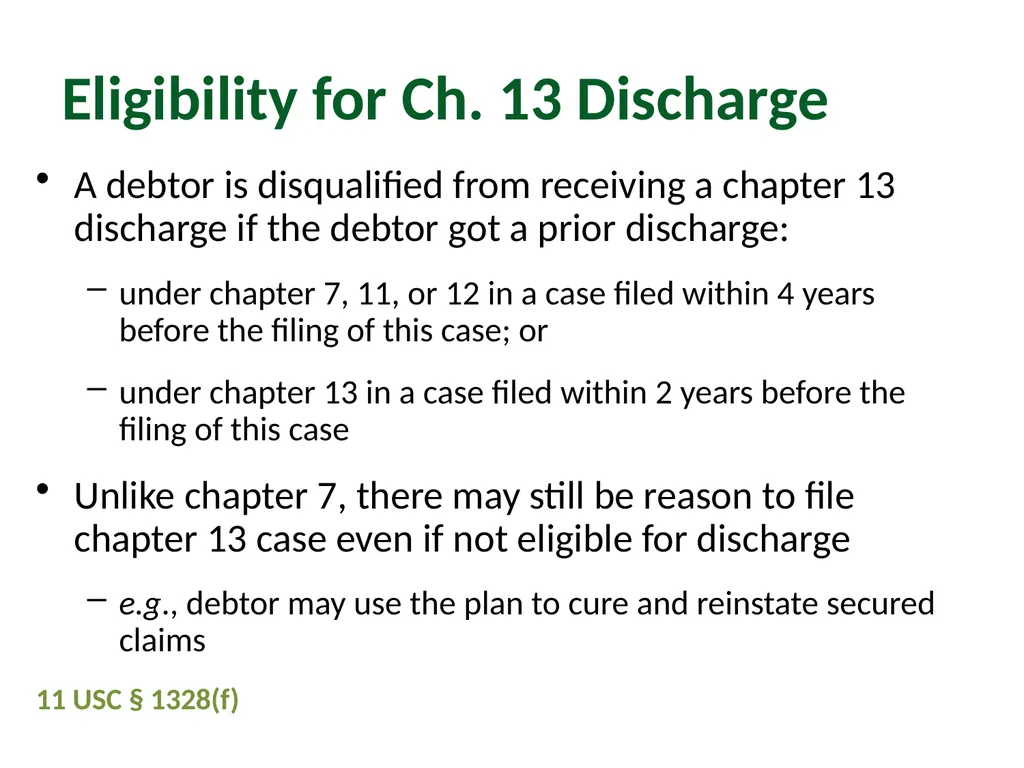
Eligibility for Ch. 13 Discharge A debtor is disqualified from receiving a chapter 13 discharge if the debtor got a prior discharge:
under chapter 7, 11, or 12 in a case filed within 4 years before the filing of this case; or
under chapter 13 in a case filed within 2 years before the filing of this case
Unlike chapter 7, there may still be reason to file chapter 13 case even if not eligible for discharge
e.g., debtor may use the plan to cure and reinstate secured claims
11 USC § 1328(f)<br>
under chapter 7, 11, or 12 in a case filed within 4 years before the filing of this case; or
under chapter 13 in a case filed within 2 years before the filing of this case
Unlike chapter 7, there may still be reason to file chapter 13 case even if not eligible for discharge
e.g., debtor may use the plan to cure and reinstate secured claims
11 USC § 1328(f)<br>
86
Filing Initial Documents Voluntary petition
Schedules and other required forms
Statement of current monthly income and calculation of commitment period
Statement of disposable income (if above-median debtor)
Creditor matrix
Debtor’s paystubs for the 60 days before filing<br>
Schedules and other required forms
Statement of current monthly income and calculation of commitment period
Statement of disposable income (if above-median debtor)
Creditor matrix
Debtor’s paystubs for the 60 days before filing<br>
87
Filing Initial Documents Certificate showing debtor did the mandatory credit counseling
Filing fee (may apply to pay in installments; no waiver)
Chapter 13 plan (local rules in most districts require use of a model plan)
Tax returns must be filed with state and federal taxing authorities
11 USC § 521 - covered in Modules 2 and 3<br>
Filing fee (may apply to pay in installments; no waiver)
Chapter 13 plan (local rules in most districts require use of a model plan)
Tax returns must be filed with state and federal taxing authorities
11 USC § 521 - covered in Modules 2 and 3<br>
88
Codebtor Stay Unlike chapter 7, chapter 13 case puts into effect a stay preventing creditors from taking any action against codebtors (cosigners) who have not filed for bankruptcy
Applies to “consumer debt” (debt incurred for a personal, family, or household purpose)
Prevents a creditor from pursuing collection against the cosigner
Remains in place until the case is closed, dismissed, or converted to another chapter; or until the codebtor stay is lifted by the court upon a creditor’s motion
11 USC § 1301<br>
Applies to “consumer debt” (debt incurred for a personal, family, or household purpose)
Prevents a creditor from pursuing collection against the cosigner
Remains in place until the case is closed, dismissed, or converted to another chapter; or until the codebtor stay is lifted by the court upon a creditor’s motion
11 USC § 1301<br>
89
Chapter 13 Trustee Has more to do than a chapter 7 trustee
Must review the debtor’s chapter 13 plan to ensure that it is feasible and complies with the law, object to confirmation if it does not
If the plan is confirmed, chapter 13 trustee collects payments from the debtor and distributes money to creditors who have filed claims
Both debtor and chapter 13 trustee may object to claims<br>
Must review the debtor’s chapter 13 plan to ensure that it is feasible and complies with the law, object to confirmation if it does not
If the plan is confirmed, chapter 13 trustee collects payments from the debtor and distributes money to creditors who have filed claims
Both debtor and chapter 13 trustee may object to claims<br>
90
Chapter 13 Plan Plan sets out how much debtor pays each month, how much each class of creditors will get, and the treatment of secured claims
Debtor must make first chapter 13 payment to the trustee within 30 days after filing
Plan must propose to pay priority claims in full, such as tax debts and domestic support obligations<br>
Debtor must make first chapter 13 payment to the trustee within 30 days after filing
Plan must propose to pay priority claims in full, such as tax debts and domestic support obligations<br>
91
Chapter 13 Plan Below-median debtors may propose a three year plan, or up to five years to make plan payments affordable
Debtors with income above the state median income may be required to remain in chapter 13 for five years – the “Applicable Commitment Period”
11 USC § 1325<br>
Debtors with income above the state median income may be required to remain in chapter 13 for five years – the “Applicable Commitment Period”
11 USC § 1325<br>
92
Plan Confirmation Tests Best Interest of Creditors: Are unsecured creditors getting at least as much as they would get if the debtor filed chapter 7 (and the trustee liquidated any nonexempt assets)?
Good Faith: Is the plan proposed in good faith?<br>
Good Faith: Is the plan proposed in good faith?<br>
93
Plan Confirmation Tests Ability to Pay: Is the debtor paying all disposable income into the plan (if unsecured creditors are getting paid less than 100%)?
Below median: consider reasonably necessary expenses
Above median: consider expenses provided by the means test
Feasibility: Can the debtor afford the plan payment?
11 USC § 1325<br>
Below median: consider reasonably necessary expenses
Above median: consider expenses provided by the means test
Feasibility: Can the debtor afford the plan payment?
11 USC § 1325<br>
94
Secured Claims Treatment of secured claims:
If debtor does not wish to keep the collateral, plan may provide for its surrender;
If debtor wishes to keep the collateral, the plan may be confirmed if:
Secured creditor accepts the plan, OR
Plan provides for the creditor to retain its lien and receive the present value of its allowed secured claim during the plan
11 USC § 1325(a)(5) – covered in Module 4<br>
If debtor does not wish to keep the collateral, plan may provide for its surrender;
If debtor wishes to keep the collateral, the plan may be confirmed if:
Secured creditor accepts the plan, OR
Plan provides for the creditor to retain its lien and receive the present value of its allowed secured claim during the plan
11 USC § 1325(a)(5) – covered in Module 4<br>
95
Modifying Secured Claims The plan may “modify the rights” of holders of secured claims, except:
Claims secured only by real property that is the debtor’s principal residence, and
Claims that may not be bifurcated based on the “hanging paragraph” of § 1325(a):
Purchase-money security interest in a motor vehicle for personal use, incurred with 910 days before filing;
Purchase-money security interest in any other thing of value, incurred within 1 year before filing<br>
Claims secured only by real property that is the debtor’s principal residence, and
Claims that may not be bifurcated based on the “hanging paragraph” of § 1325(a):
Purchase-money security interest in a motor vehicle for personal use, incurred with 910 days before filing;
Purchase-money security interest in any other thing of value, incurred within 1 year before filing<br>
96
Modifying Secured Claims For secured claims that may be modified, if the amount of the claim exceeds the value of the collateral, the claim will be “bifurcated” into a secured and unsecured claim;
Interest rate may be reduced to prime plus a margin for risk;
Repayment may be stretched out through the term of the plan
11 USC §§ 506(a), 1322(b)(2); 1325(a)(5) – covered in Module 4<br>
Interest rate may be reduced to prime plus a margin for risk;
Repayment may be stretched out through the term of the plan
11 USC §§ 506(a), 1322(b)(2); 1325(a)(5) – covered in Module 4<br>
97
Mortgage Secured by Principal Residence: Cure and Maintain For most mortgages secured by the debtor’s principal residence, modification will not be an option
Except: stripping off totally unsecured junior mortgages
Still, chapter 13 provides great benefits:
Stop foreclosure (automatic stay, immediate upon filing)
Cure arrearage through the chapter 13 plan
Maintain ongoing payments – either directly to the creditor or through chapter 13 plan (depends on local practice)<br>
Except: stripping off totally unsecured junior mortgages
Still, chapter 13 provides great benefits:
Stop foreclosure (automatic stay, immediate upon filing)
Cure arrearage through the chapter 13 plan
Maintain ongoing payments – either directly to the creditor or through chapter 13 plan (depends on local practice)<br>
98
Mortgage Secured by Principal Residence: Cure and Maintain Important: Debtor must be able to make regular periodic mortgage payments going forward, plus the chapter 13 plan payment!
Alternative: Seek a loan modification while bankruptcy is pending
11 USC § 1322(b)(5) – covered in Module 4<br>
Alternative: Seek a loan modification while bankruptcy is pending
11 USC § 1322(b)(5) – covered in Module 4<br>
99
Chapter 13 Discharge Will be entered after plan payments are completed
Debtor must complete a financial management course by an approved provider before final plan payment
If debtor cannot complete the chapter 13 plan, consider:
Modification of the plan (by motion)
Hardship discharge
Conversion to chapter 7
Dismissal of the case (voluntary or by court) without discharge<br>
Debtor must complete a financial management course by an approved provider before final plan payment
If debtor cannot complete the chapter 13 plan, consider:
Modification of the plan (by motion)
Hardship discharge
Conversion to chapter 7
Dismissal of the case (voluntary or by court) without discharge<br>
100
Chapter 13 Discharge Debts discharged in chapter 13 but not
chapter 7:
Debts for willful and malicious injury to property (and in some cases to individuals)
Certain civil fines and penalties, including some tax penalties
Certain debts for which discharge was denied in a previous case<br>
Debts for willful and malicious injury to property (and in some cases to individuals)
Certain civil fines and penalties, including some tax penalties
Certain debts for which discharge was denied in a previous case<br>
101
Chapter 13 Discharge Debts incurred to pay nondischargeable tax debts
Non-support debts arising from property settlements in divorce
HOA debts incurred postpetition if the debtor has vacated the property
Debts not discharged in chapter 13:
long-term debts, like home mortgages, that the debtor elects to cure and maintain through plan
11 USC § 1328(a)<br>
Non-support debts arising from property settlements in divorce
HOA debts incurred postpetition if the debtor has vacated the property
Debts not discharged in chapter 13:
long-term debts, like home mortgages, that the debtor elects to cure and maintain through plan
11 USC § 1328(a)<br>
102
Counseling the Consumer Debtor
Why Bankruptcy?<br>
103
What Bankruptcy Can Do Eliminate the legal obligation to pay most debts
Stop foreclosure on a home and allow the debtor an opportunity to cure a default
Prevent repossession of an automobile or other personal property (and force creditor to return property even after repossession)
Prevent termination of utility service or restore service after a shutoff<br>
Stop foreclosure on a home and allow the debtor an opportunity to cure a default
Prevent repossession of an automobile or other personal property (and force creditor to return property even after repossession)
Prevent termination of utility service or restore service after a shutoff<br>
104
What Bankruptcy Can Do Stop garnishment of wages or a bank account (and get back money taken in the 90 days before filing)
Prevent government agencies from collecting overpayments (such as Social Security), unless the overpayment was obtained by fraud
Lower the monthly payments on some secured debts such as car loans<br>
Prevent government agencies from collecting overpayments (such as Social Security), unless the overpayment was obtained by fraud
Lower the monthly payments on some secured debts such as car loans<br>
105
What Bankruptcy Cannot Do Force a modification of a mortgage secured by the debtor’s principal residence, except that a chapter 13 debtor can:
cure a default, but will have to make the regular postpetition payments on time
modify a mortgage that is wholly unsecured, secured by additional property, or has the final payment due before the end of the chapter 13 plan<br>
cure a default, but will have to make the regular postpetition payments on time
modify a mortgage that is wholly unsecured, secured by additional property, or has the final payment due before the end of the chapter 13 plan<br>
106
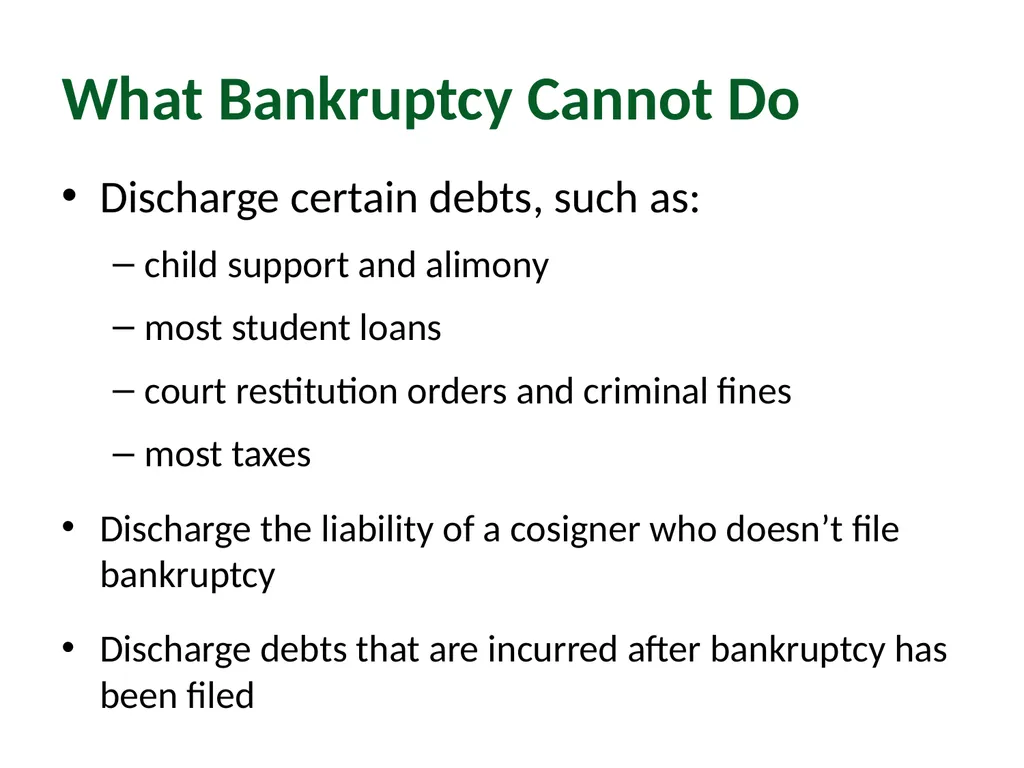
What Bankruptcy Cannot Do Discharge certain debts, such as:
child support and alimony
most student loans
court restitution orders and criminal fines
most taxes
Discharge the liability of a cosigner who doesn’t file bankruptcy
Discharge debts that are incurred after bankruptcy has been filed<br>
child support and alimony
most student loans
court restitution orders and criminal fines
most taxes
Discharge the liability of a cosigner who doesn’t file bankruptcy
Discharge debts that are incurred after bankruptcy has been filed<br>
107
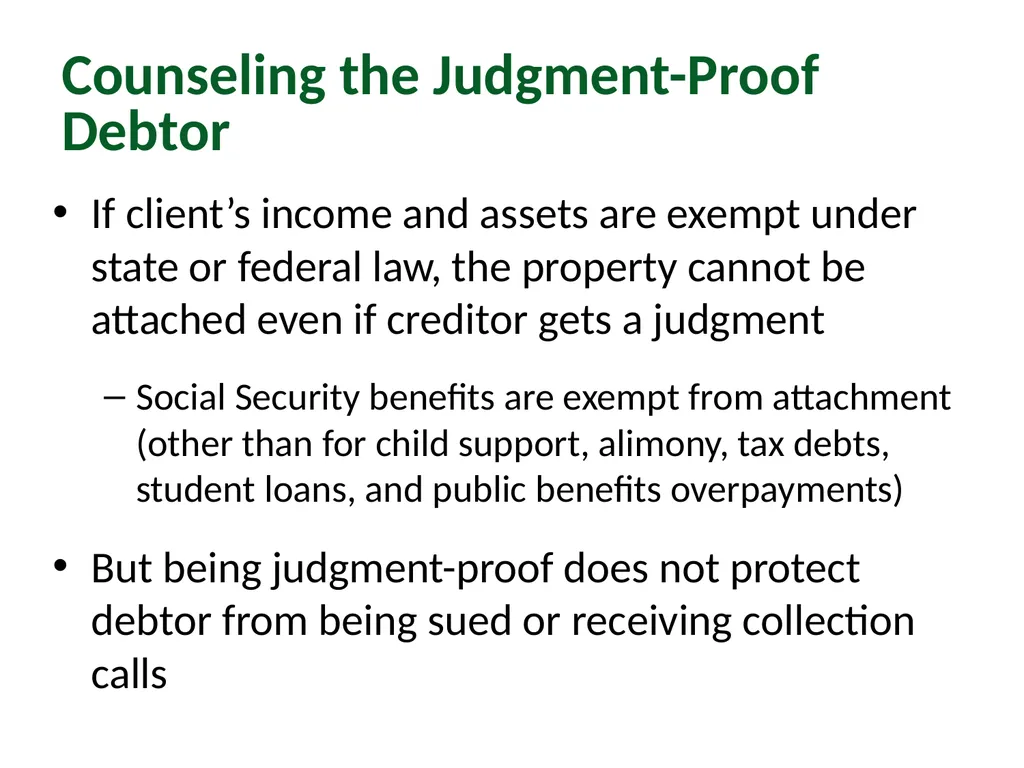
Counseling the Judgment-Proof Debtor If client’s income and assets are exempt under state or federal law, the property cannot be attached even if creditor gets a judgment
Social Security benefits are exempt from attachment (other than for child support, alimony, tax debts, student loans, and public benefits overpayments)
But being judgment-proof does not protect debtor from being sued or receiving collection calls<br>
Social Security benefits are exempt from attachment (other than for child support, alimony, tax debts, student loans, and public benefits overpayments)
But being judgment-proof does not protect debtor from being sued or receiving collection calls<br>
108
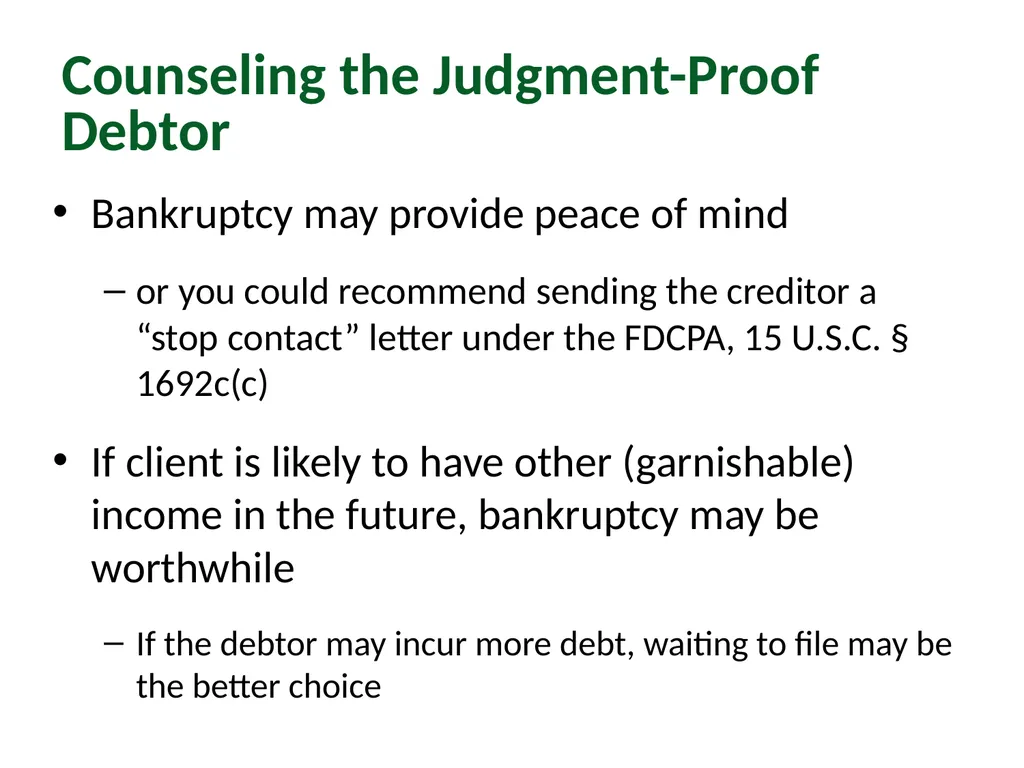
Counseling the Judgment-Proof Debtor Bankruptcy may provide peace of mind
or you could recommend sending the creditor a “stop contact” letter under the FDCPA, 15 U.S.C. § 1692c(c)
If client is likely to have other (garnishable) income in the future, bankruptcy may be worthwhile
If the debtor may incur more debt, waiting to file may be the better choice<br>
or you could recommend sending the creditor a “stop contact” letter under the FDCPA, 15 U.S.C. § 1692c(c)
If client is likely to have other (garnishable) income in the future, bankruptcy may be worthwhile
If the debtor may incur more debt, waiting to file may be the better choice<br>
109
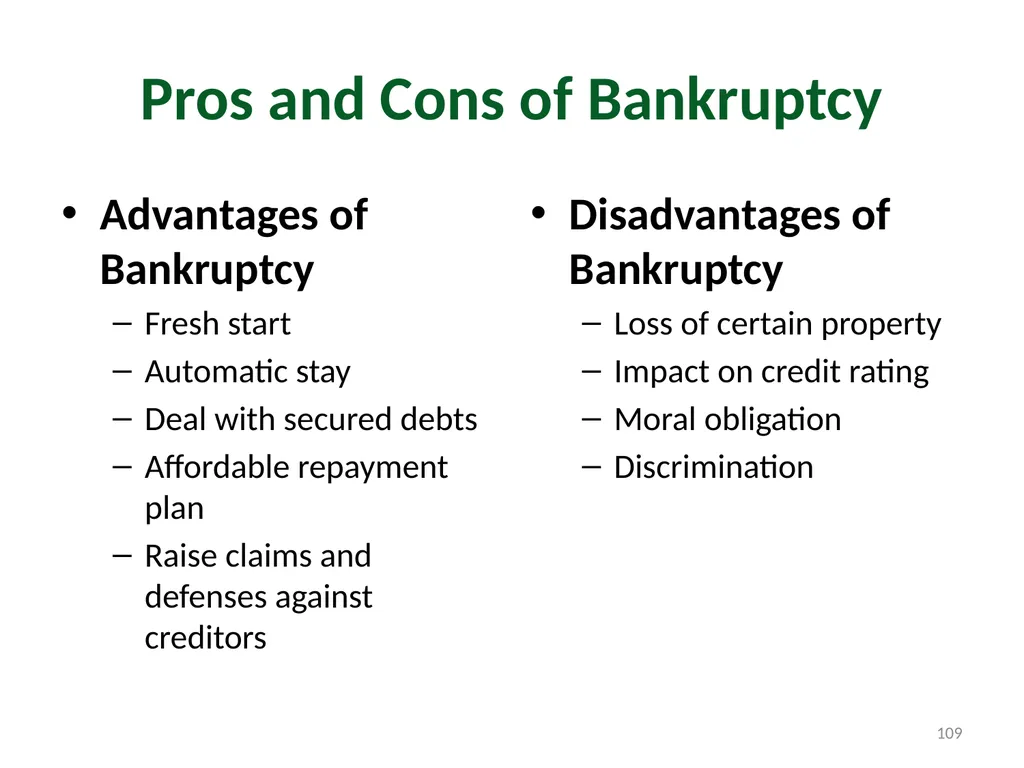
Pros and Cons of Bankruptcy Advantages of Bankruptcy
Fresh start
Automatic stay
Deal with secured debts
Affordable repayment plan
Raise claims and defenses against creditors Disadvantages of Bankruptcy
Loss of certain property
Impact on credit rating
Moral obligation
Discrimination 109<br>
Fresh start
Automatic stay
Deal with secured debts
Affordable repayment plan
Raise claims and defenses against creditors Disadvantages of Bankruptcy
Loss of certain property
Impact on credit rating
Moral obligation
Discrimination 109<br>
110
Alternatives to Bankruptcy Credit Counseling
Debt Management Plan
Debtor sends monthly payment, distributed each month among creditors
Usually no cancellation of principal
Creditors may waive some fees
If plan is not affordable and debtor fails to complete it, all debts revert to original contract terms<br>
Debt Management Plan
Debtor sends monthly payment, distributed each month among creditors
Usually no cancellation of principal
Creditors may waive some fees
If plan is not affordable and debtor fails to complete it, all debts revert to original contract terms<br>
111
Alternatives to Bankruptcy Debt Settlement (*beware!)
For-profit businesses
Collect money from the consumer, but do not send regular payments to the creditors; hold money until a debt can be settled
Often make false or unrealistic claims about their ability to settle debts
If debts are settled for less than the amount owed, consumer may owe taxes based on cancellation of debt income (not so if discharged in bankruptcy)<br>
For-profit businesses
Collect money from the consumer, but do not send regular payments to the creditors; hold money until a debt can be settled
Often make false or unrealistic claims about their ability to settle debts
If debts are settled for less than the amount owed, consumer may owe taxes based on cancellation of debt income (not so if discharged in bankruptcy)<br>
112
Alternatives to Bankruptcy Reverse Mortgage
Borrower must be at least 62 years old
Loan proceeds taken as a lump sum, annuity, or line of credit
No required monthly payment of principal or interest; loan balance increases over time
High closing costs
May help some homeowners with low income and substantial home equity
Debt Consolidation Loan
Usually not a good idea to use a mortgage to pay off credit card and other unsecured debt<br>
Borrower must be at least 62 years old
Loan proceeds taken as a lump sum, annuity, or line of credit
No required monthly payment of principal or interest; loan balance increases over time
High closing costs
May help some homeowners with low income and substantial home equity
Debt Consolidation Loan
Usually not a good idea to use a mortgage to pay off credit card and other unsecured debt<br>
113
Alternatives – Saving a Home Does client qualify for:
Repayment plan: client can afford regular payment plus extra to catch up
Forbearance agreement: client has no permanent income (unemployed, medical hardship)
Homeowner makes a low payment or no payment for limited time (3-12 months) while looking for work
Full arrearage is due at the end (try for a mod)
Loan modification: client has permanent income at a reduced level – needs permanent reduction in payment<br>
Repayment plan: client can afford regular payment plus extra to catch up
Forbearance agreement: client has no permanent income (unemployed, medical hardship)
Homeowner makes a low payment or no payment for limited time (3-12 months) while looking for work
Full arrearage is due at the end (try for a mod)
Loan modification: client has permanent income at a reduced level – needs permanent reduction in payment<br>
114
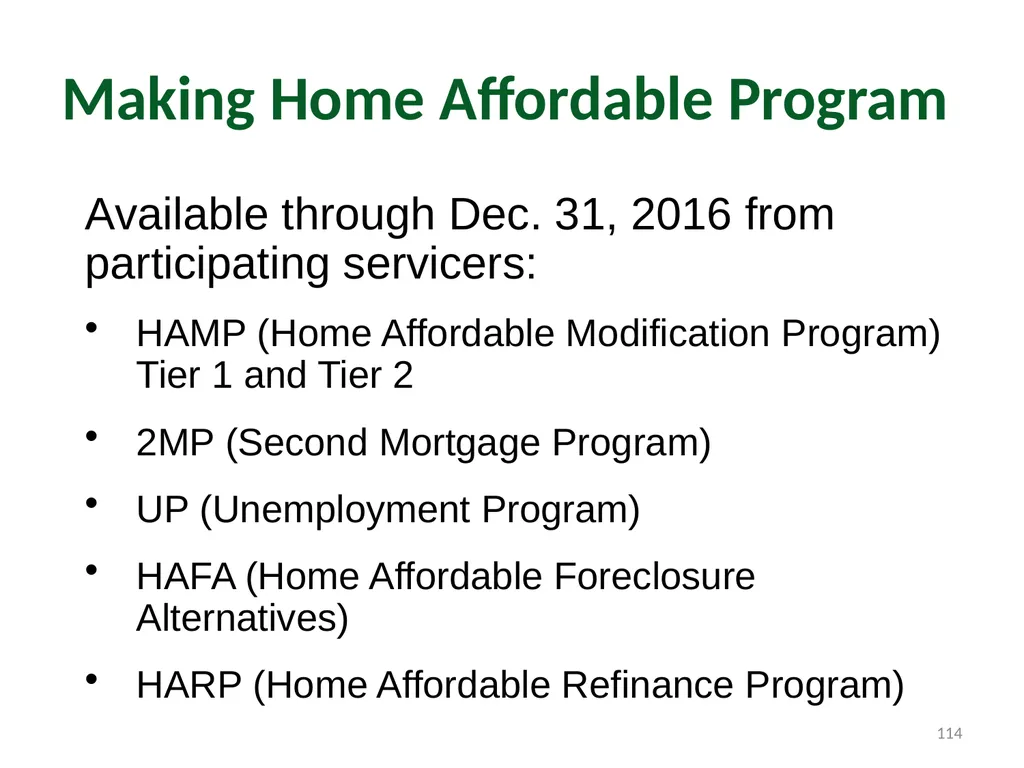
Making Home Affordable Program Available through Dec. 31, 2016 from participating servicers:
HAMP (Home Affordable Modification Program) Tier 1 and Tier 2
2MP (Second Mortgage Program)
UP (Unemployment Program)
HAFA (Home Affordable Foreclosure Alternatives)
HARP (Home Affordable Refinance Program) 114<br>
HAMP (Home Affordable Modification Program) Tier 1 and Tier 2
2MP (Second Mortgage Program)
UP (Unemployment Program)
HAFA (Home Affordable Foreclosure Alternatives)
HARP (Home Affordable Refinance Program) 114<br>
115
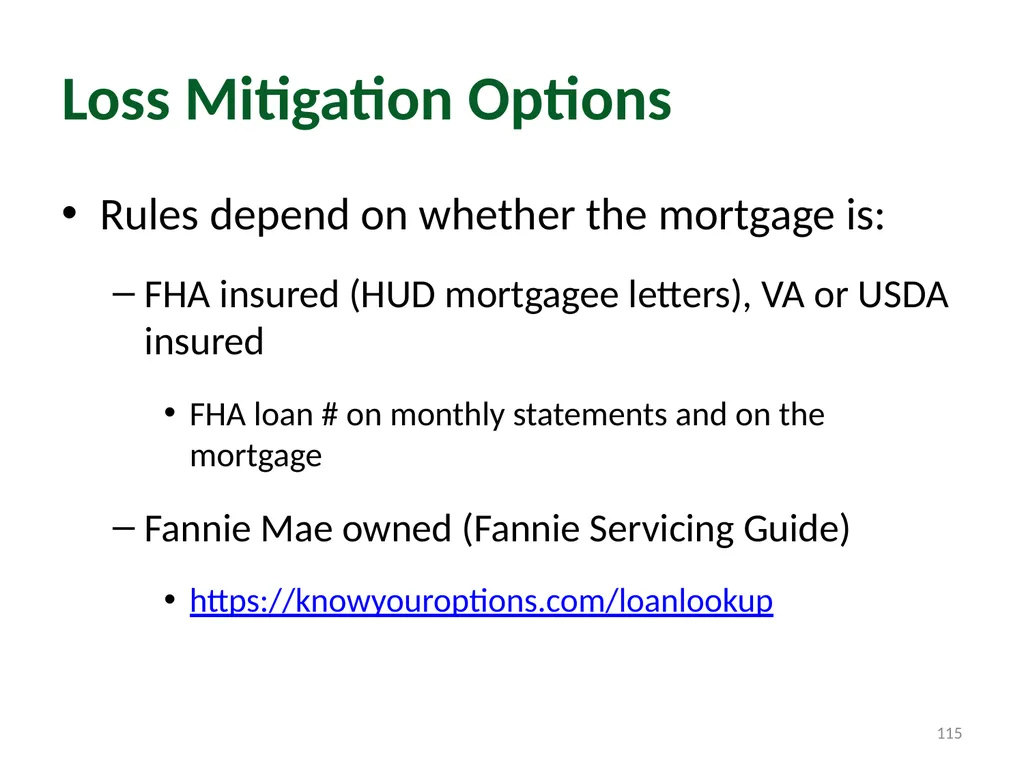
Loss Mitigation Options Rules depend on whether the mortgage is:
FHA insured (HUD mortgagee letters), VA or USDA insured
FHA loan # on monthly statements and on the mortgage
Fannie Mae owned (Fannie Servicing Guide)
https://knowyouroptions.com/loanlookup 115<br>
FHA insured (HUD mortgagee letters), VA or USDA insured
FHA loan # on monthly statements and on the mortgage
Fannie Mae owned (Fannie Servicing Guide)
https://knowyouroptions.com/loanlookup 115<br>
116
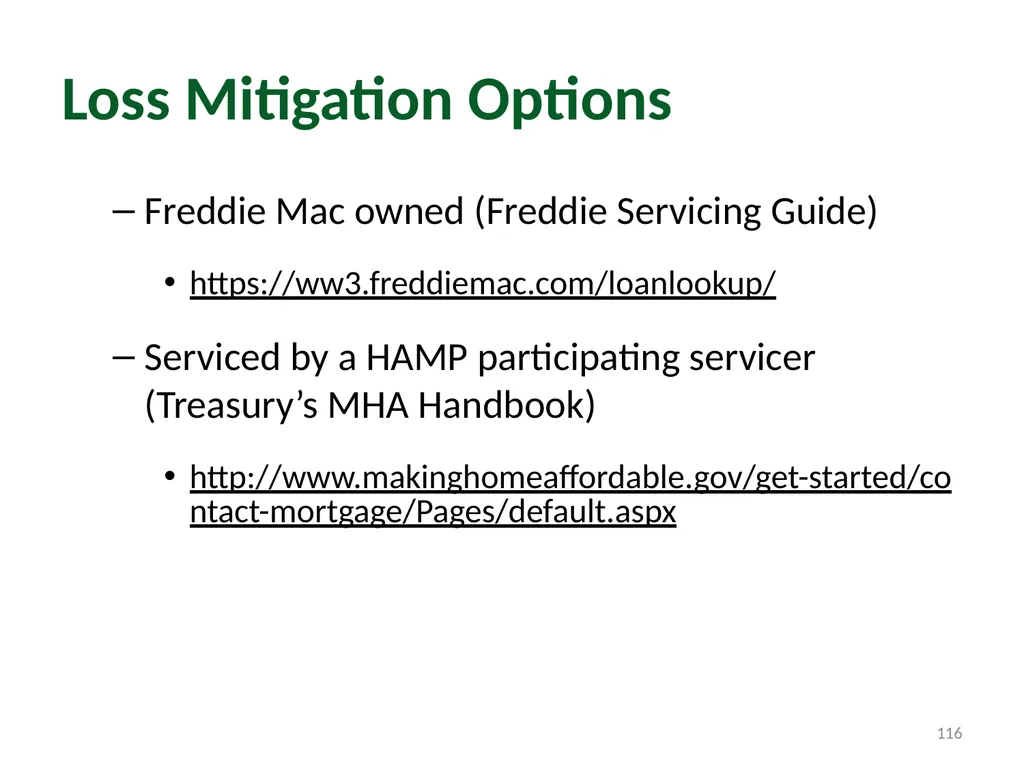
Loss Mitigation Options Freddie Mac owned (Freddie Servicing Guide)
https://ww3.freddiemac.com/loanlookup/
Serviced by a HAMP participating servicer (Treasury’s MHA Handbook)
http://www.makinghomeaffordable.gov/get-started/contact-mortgage/Pages/default.aspx 116<br>
https://ww3.freddiemac.com/loanlookup/
Serviced by a HAMP participating servicer (Treasury’s MHA Handbook)
http://www.makinghomeaffordable.gov/get-started/contact-mortgage/Pages/default.aspx 116<br>
117
Advice for Homeowners Work with a HUD-certified housing counselor
Their services are free
Knowledgeable about existing loan mod programs
Help the client gather docs and create an accurate budget<br>
Their services are free
Knowledgeable about existing loan mod programs
Help the client gather docs and create an accurate budget<br>
118
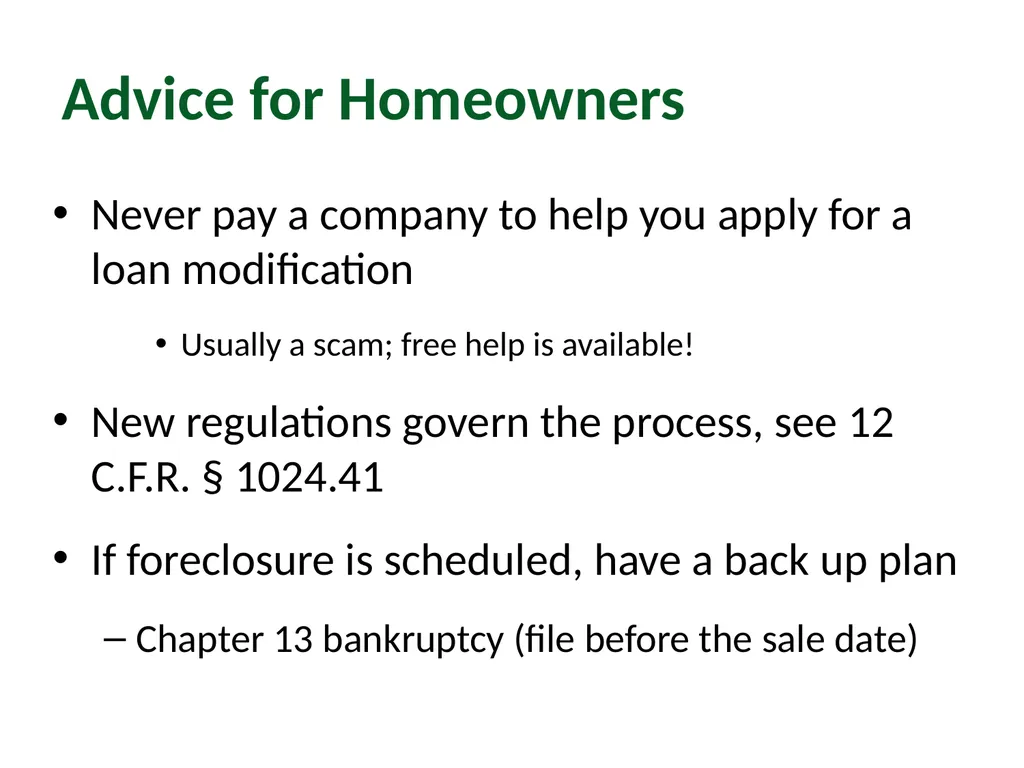
Advice for Homeowners Never pay a company to help you apply for a loan modification
Usually a scam; free help is available!
New regulations govern the process, see 12 C.F.R. § 1024.41
If foreclosure is scheduled, have a back up plan
Chapter 13 bankruptcy (file before the sale date)<br>
Usually a scam; free help is available!
New regulations govern the process, see 12 C.F.R. § 1024.41
If foreclosure is scheduled, have a back up plan
Chapter 13 bankruptcy (file before the sale date)<br>