
Module 1 Behavioral Theory I Jennifer Freeman, PhD
NS
Published · 90 slides · 0 views
1 / 1


Description
Module 1 Behavioral Theory I Jennifer Freeman, PhD Don Briere, PhD Brandi Simonsen, PhD Acknowledgements Much of the content shared in this module was developed by members of the OSEP-funded National Technical Assistance Center for Positive
Related Topics
Share
Embed code
Download this presentation From Below
"Module 1 Behavioral Theory I Jennifer Freeman, PhD" is the property of its rightful owner. Permission is granted to download and print the materials on this website for personal, non-commercial use only, and to display it on your personal computer provided you do not modify the materials and that you retain all copyright notices contained in the materials. By downloading content from our website, you accept the terms of this agreement.
Presentation Transcript
01
Module 1
Behavioral Theory I Jennifer Freeman, PhD
Don Briere, PhD
Brandi Simonsen, PhD<br>
Don Briere, PhD
Brandi Simonsen, PhD<br>
02
Acknowledgements Much of the content shared in this module was developed by members of the OSEP-funded National Technical Assistance Center for Positive Behavioral Interventions and Supports.
Thank you to:
Members of classroom workgroup:
Brandi Simonsen, Jennifer Freeman, Jessica Swain-Bradway, Robert Putnam, Heather George, Steve Goodman, Barb Mitchell, Kimberly Yanek, Kathleen Lane & Jeffrey Sprague
Members of the Northeast PBIS Network:
Susannah Everett, Adam Feinberg, George Sugai, Brandi Simonsen & Jennifer Freeman<br>
Thank you to:
Members of classroom workgroup:
Brandi Simonsen, Jennifer Freeman, Jessica Swain-Bradway, Robert Putnam, Heather George, Steve Goodman, Barb Mitchell, Kimberly Yanek, Kathleen Lane & Jeffrey Sprague
Members of the Northeast PBIS Network:
Susannah Everett, Adam Feinberg, George Sugai, Brandi Simonsen & Jennifer Freeman<br>
03
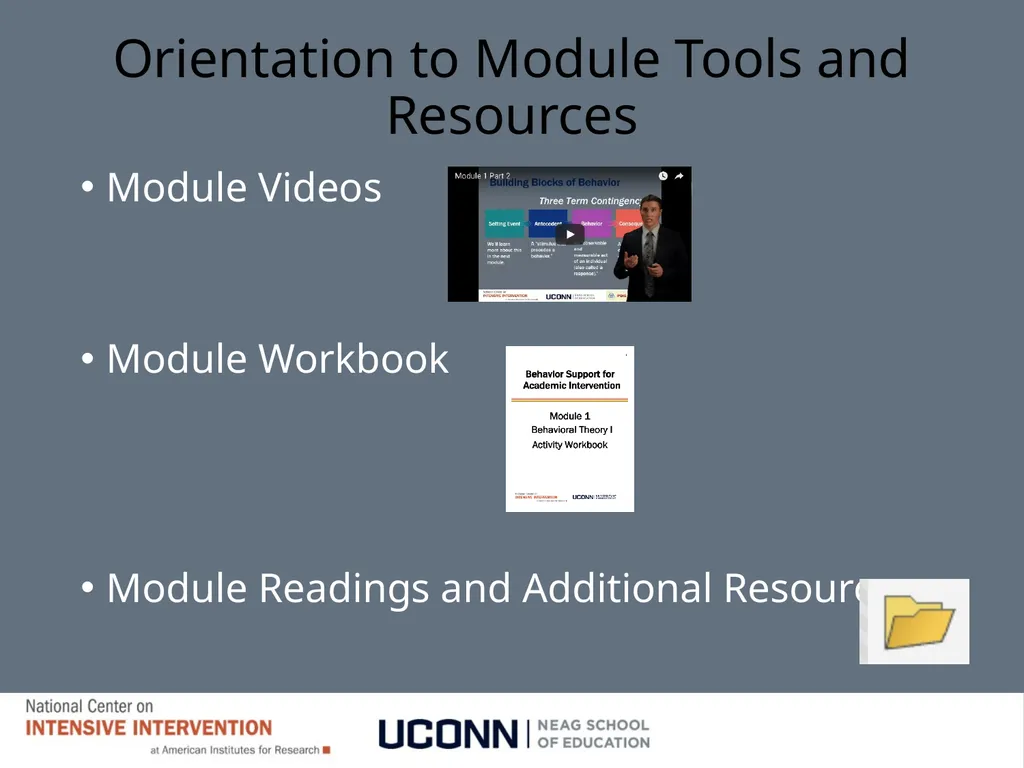
Orientation to Module Tools and Resources Module Videos
Module Workbook
Module Readings and Additional Resources<br>
Module Workbook
Module Readings and Additional Resources<br>
04
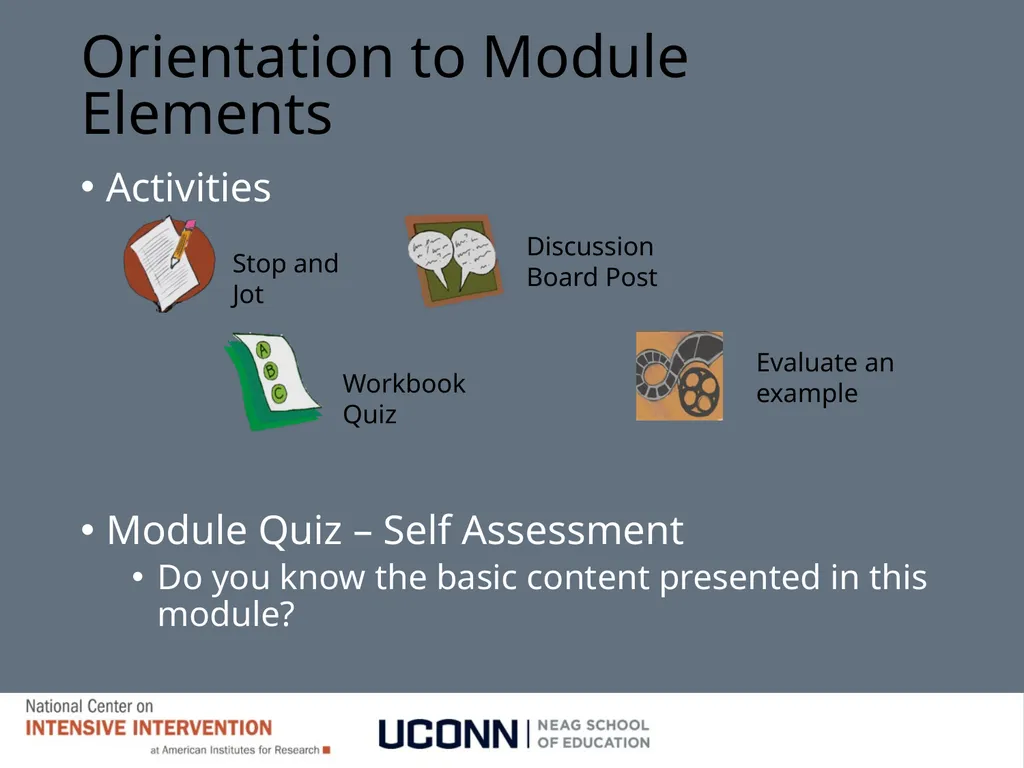
Orientation to Module Elements Activities
Module Quiz – Self Assessment
Do you know the basic content presented in this module? Stop and Jot Discussion Board Post Workbook Quiz Evaluate an example<br>
Module Quiz – Self Assessment
Do you know the basic content presented in this module? Stop and Jot Discussion Board Post Workbook Quiz Evaluate an example<br>
05
Activity 1.1: Stop and Jot
What do you know about behavior support? What do you know?
What do you want to know? Please pause the video to complete Activity 1.1<br>
What do you want to know? Please pause the video to complete Activity 1.1<br>
06
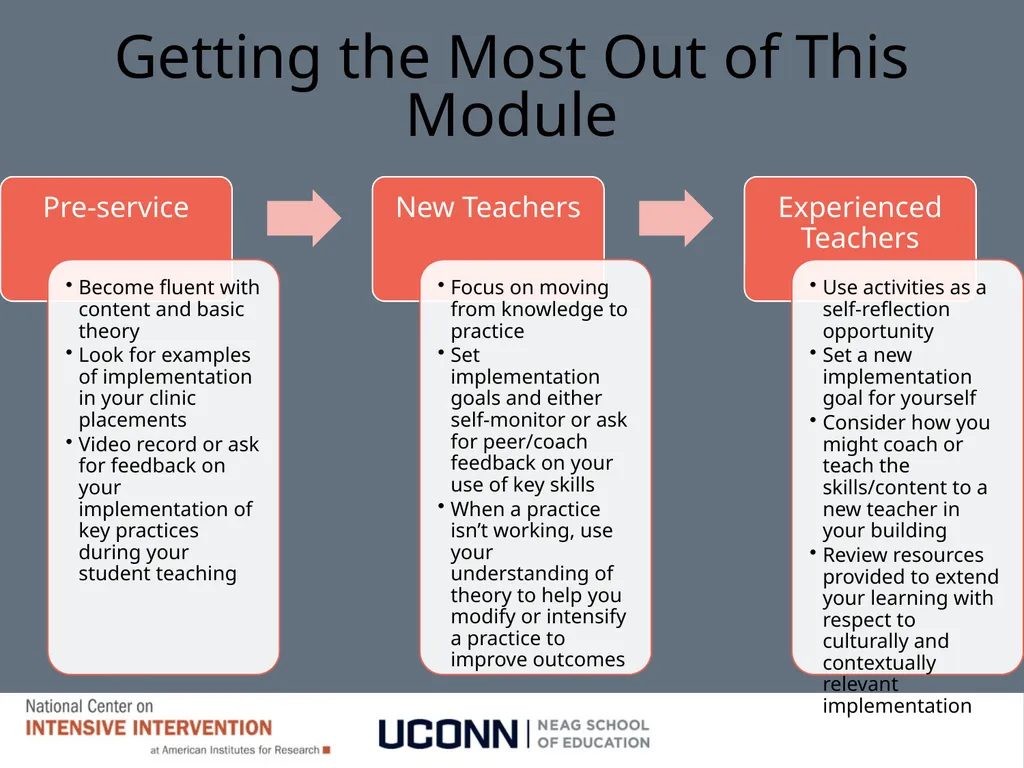
Getting the Most Out of This Module<br>
07
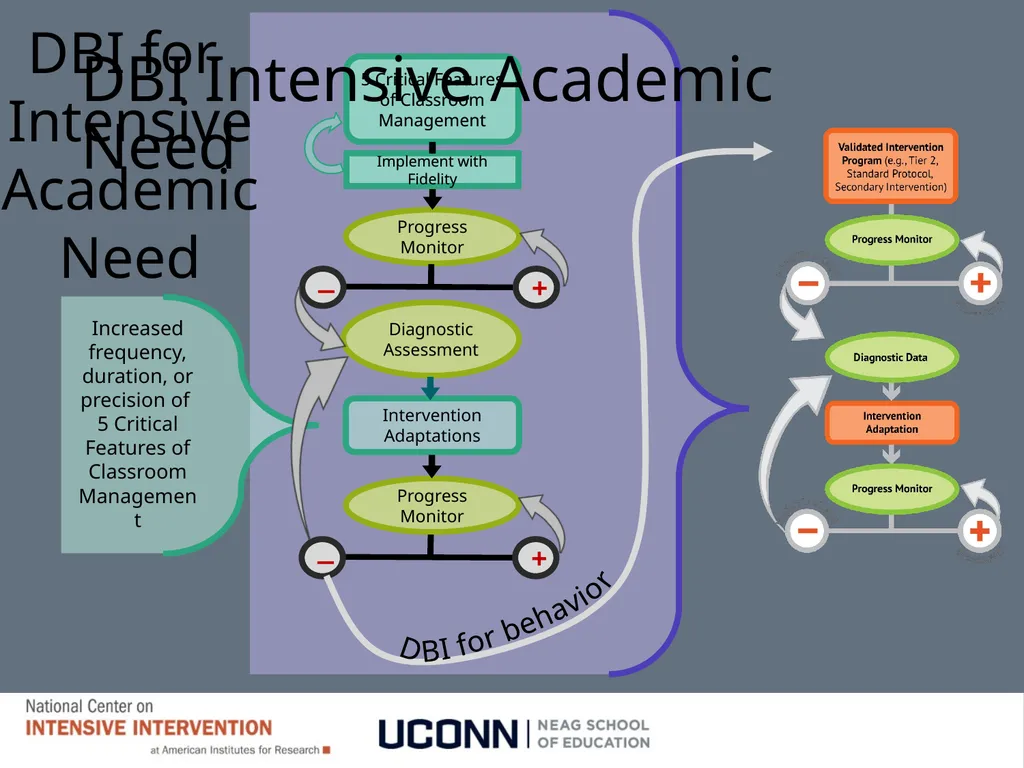
5 Critical Features of Classroom Management Implement with Fidelity Progress Monitor + _ Diagnostic Assessment Intervention Adaptations Progress Monitor + _ Increased frequency, duration, or precision of
5 Critical Features of Classroom Management DBI for behavior DBI for
Intensive Academic Need 5 Critical Features of Classroom Management Implement with Fidelity DBI Intensive Academic Need<br>
5 Critical Features of Classroom Management DBI for behavior DBI for
Intensive Academic Need 5 Critical Features of Classroom Management Implement with Fidelity DBI Intensive Academic Need<br>
08
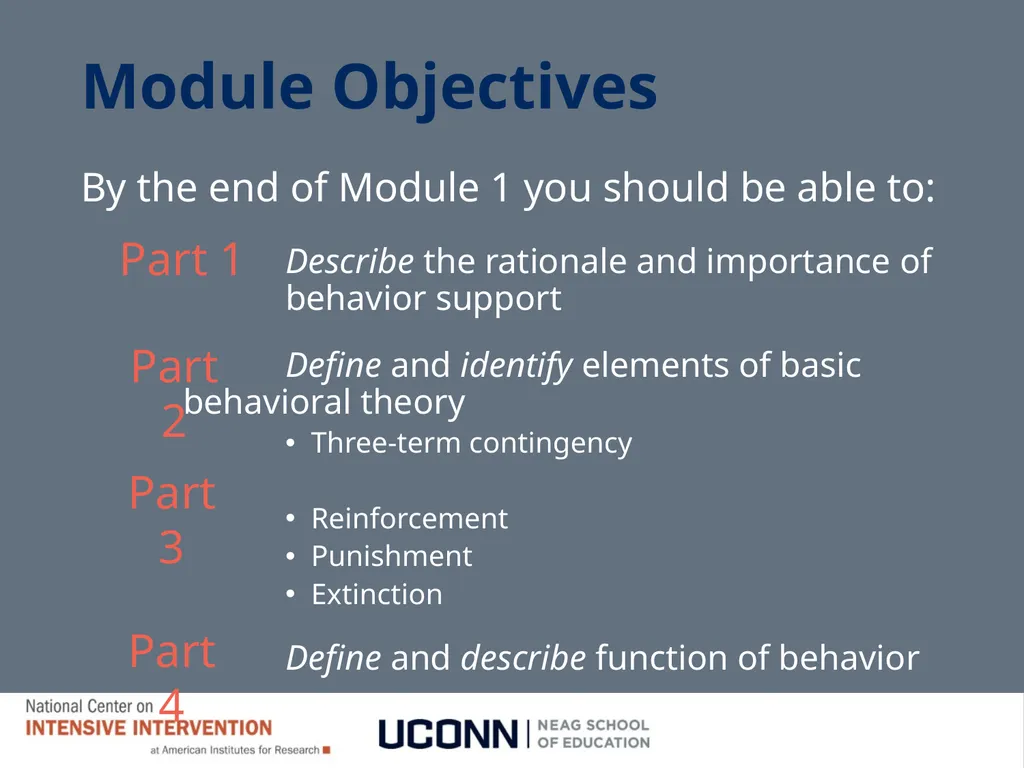
Module Objectives By the end of Module 1 you should be able to:
Describe the rationale and importance of behavior support
Define and identify elements of basic behavioral theory
Three-term contingency
Reinforcement
Punishment
Extinction
Define and describe function of behavior Part 3 Part 1 Part 2 Part 4<br>
Describe the rationale and importance of behavior support
Define and identify elements of basic behavioral theory
Three-term contingency
Reinforcement
Punishment
Extinction
Define and describe function of behavior Part 3 Part 1 Part 2 Part 4<br>
09
Behavioral Theory I Part 1
Why do we need to focus on behavior?<br>
Why do we need to focus on behavior?<br>
10
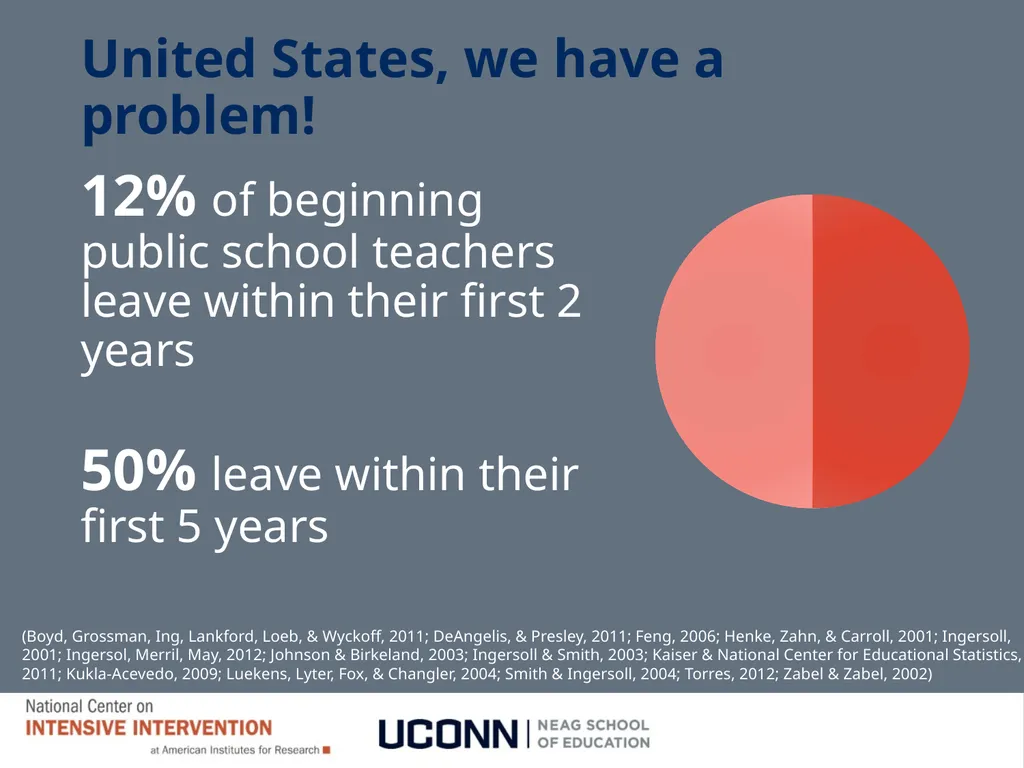
United States, we have a problem! 12% of beginning public school teachers leave within their first 2 years
50% leave within their first 5 years (Boyd, Grossman, Ing, Lankford, Loeb, & Wyckoff, 2011; DeAngelis, & Presley, 2011; Feng, 2006; Henke, Zahn, & Carroll, 2001; Ingersoll, 2001; Ingersol, Merril, May, 2012; Johnson & Birkeland, 2003; Ingersoll & Smith, 2003; Kaiser & National Center for Educational Statistics, 2011; Kukla-Acevedo, 2009; Luekens, Lyter, Fox, & Changler, 2004; Smith & Ingersoll, 2004; Torres, 2012; Zabel & Zabel, 2002)<br>
50% leave within their first 5 years (Boyd, Grossman, Ing, Lankford, Loeb, & Wyckoff, 2011; DeAngelis, & Presley, 2011; Feng, 2006; Henke, Zahn, & Carroll, 2001; Ingersoll, 2001; Ingersol, Merril, May, 2012; Johnson & Birkeland, 2003; Ingersoll & Smith, 2003; Kaiser & National Center for Educational Statistics, 2011; Kukla-Acevedo, 2009; Luekens, Lyter, Fox, & Changler, 2004; Smith & Ingersoll, 2004; Torres, 2012; Zabel & Zabel, 2002)<br>
11
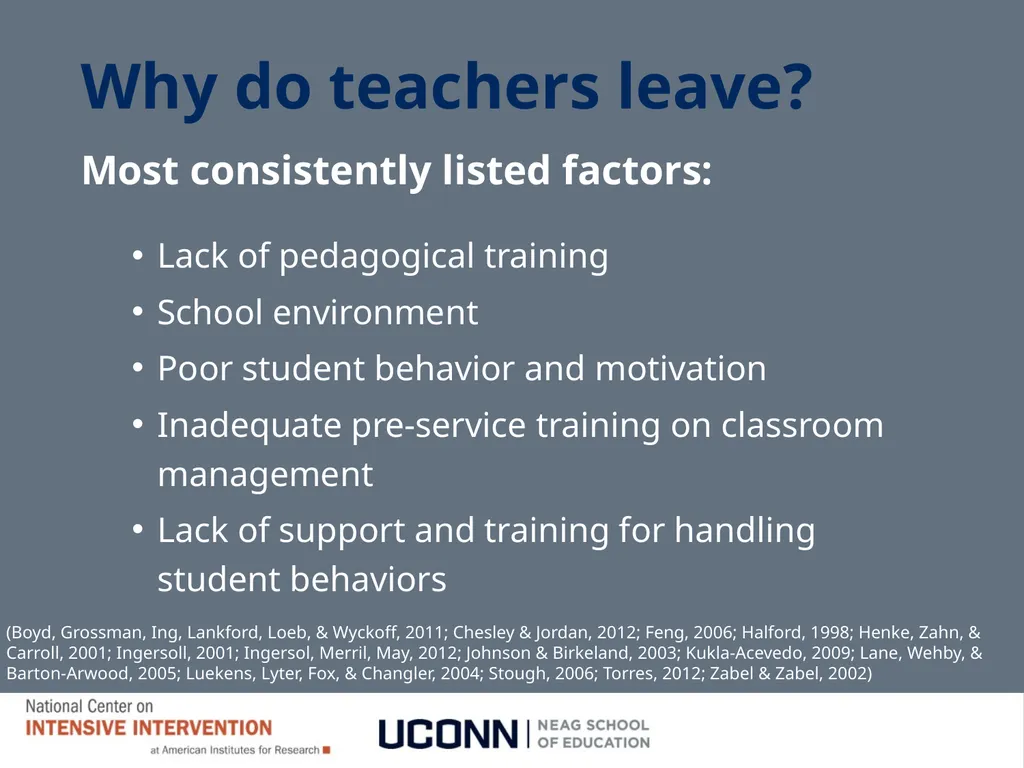
Why do teachers leave? Most consistently listed factors:
Lack of pedagogical training
School environment
Poor student behavior and motivation
Inadequate pre-service training on classroom management
Lack of support and training for handling student behaviors (Boyd, Grossman, Ing, Lankford, Loeb, & Wyckoff, 2011; Chesley & Jordan, 2012; Feng, 2006; Halford, 1998; Henke, Zahn, & Carroll, 2001; Ingersoll, 2001; Ingersol, Merril, May, 2012; Johnson & Birkeland, 2003; Kukla-Acevedo, 2009; Lane, Wehby, & Barton-Arwood, 2005; Luekens, Lyter, Fox, & Changler, 2004; Stough, 2006; Torres, 2012; Zabel & Zabel, 2002)<br>
Lack of pedagogical training
School environment
Poor student behavior and motivation
Inadequate pre-service training on classroom management
Lack of support and training for handling student behaviors (Boyd, Grossman, Ing, Lankford, Loeb, & Wyckoff, 2011; Chesley & Jordan, 2012; Feng, 2006; Halford, 1998; Henke, Zahn, & Carroll, 2001; Ingersoll, 2001; Ingersol, Merril, May, 2012; Johnson & Birkeland, 2003; Kukla-Acevedo, 2009; Lane, Wehby, & Barton-Arwood, 2005; Luekens, Lyter, Fox, & Changler, 2004; Stough, 2006; Torres, 2012; Zabel & Zabel, 2002)<br>
12
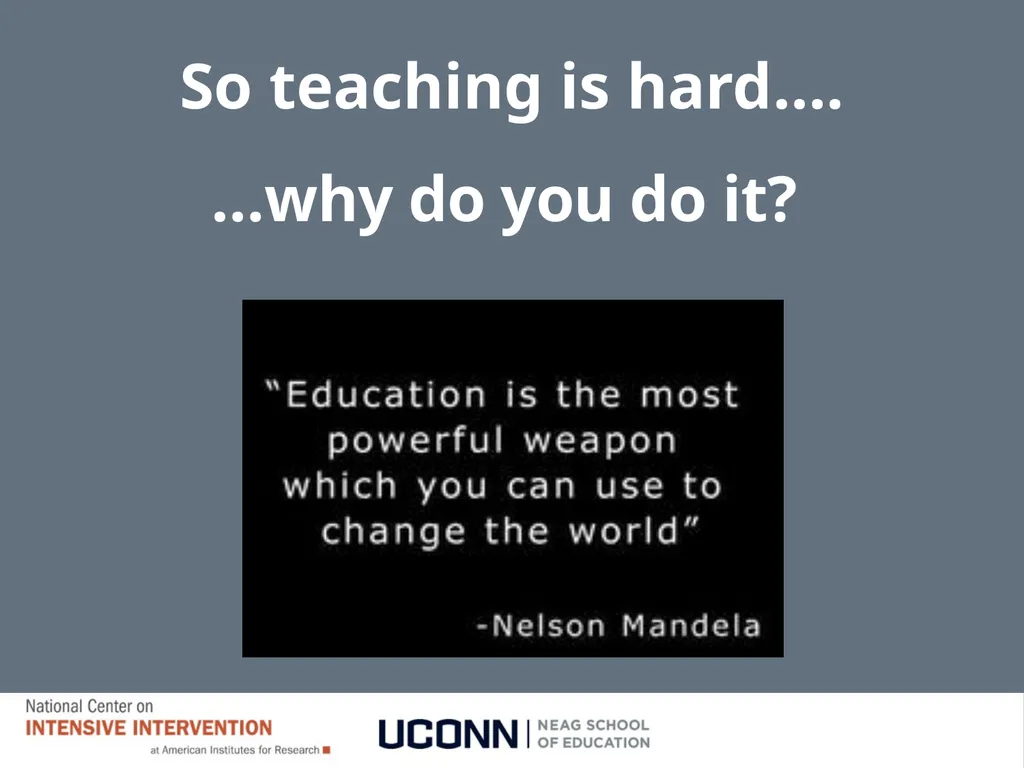
So teaching is hard…. …why do you do it?<br>
13
Activity 1.2: Stop and Jot
Effective teacher behaviors Use this video to prompt your thinking Then respond to the following question in your workbook:
What 3 words would you use to describe the classroom environment of the most effective teacher you’ve had? Please pause the video to complete Activity 1.2 https://www.youtube.com/watch?v=VXCl2fMsdTU<br>
What 3 words would you use to describe the classroom environment of the most effective teacher you’ve had? Please pause the video to complete Activity 1.2 https://www.youtube.com/watch?v=VXCl2fMsdTU<br>
14
Our job in this course is to boil down some of these big concepts into concrete skills, which when implemented translate back into great teaching<br>
15
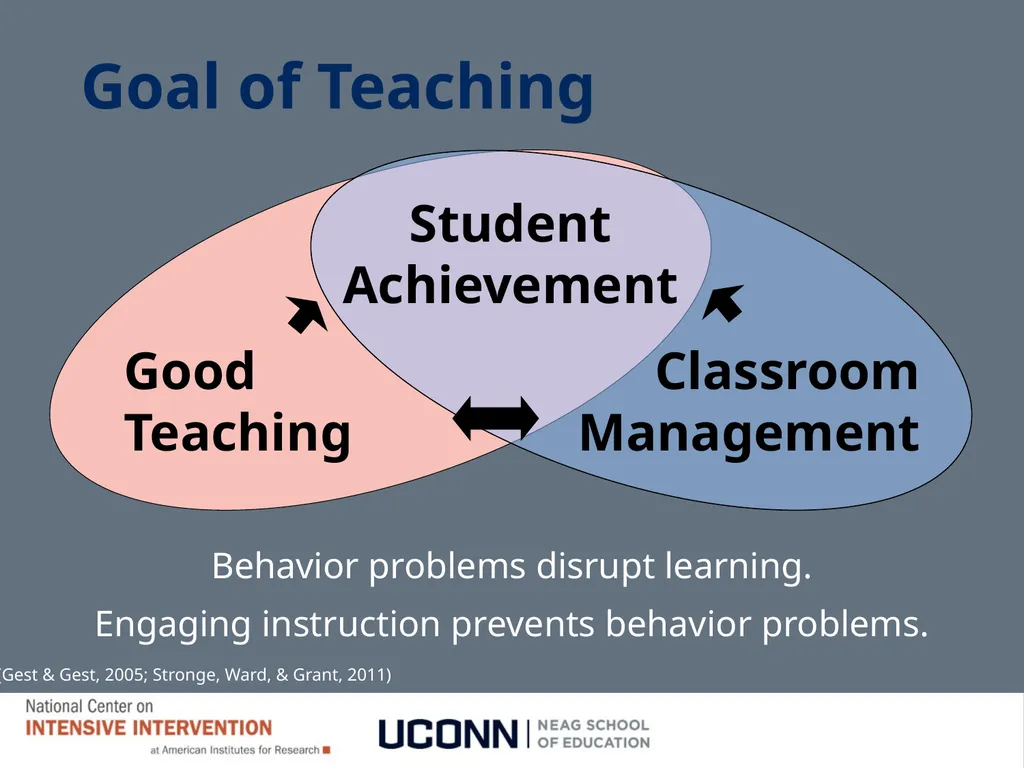
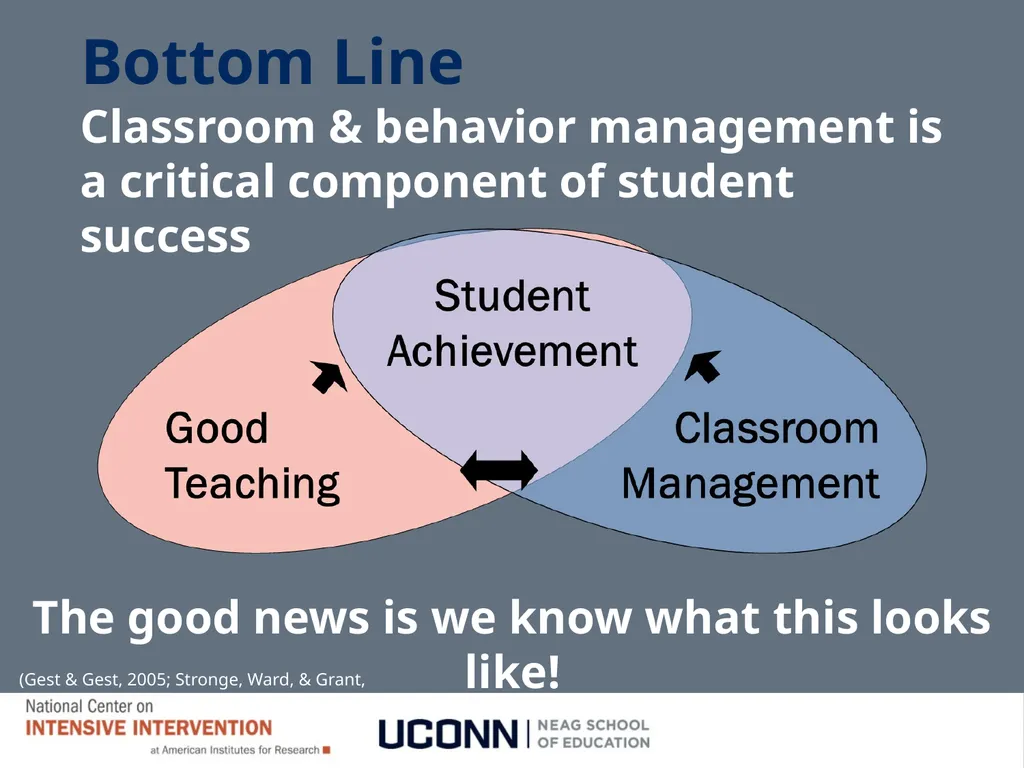
Goal of Teaching Behavior problems disrupt learning.
Engaging instruction prevents behavior problems. Good Teaching Classroom Management Student Achievement (Gest & Gest, 2005; Stronge, Ward, & Grant, 2011)<br>
16
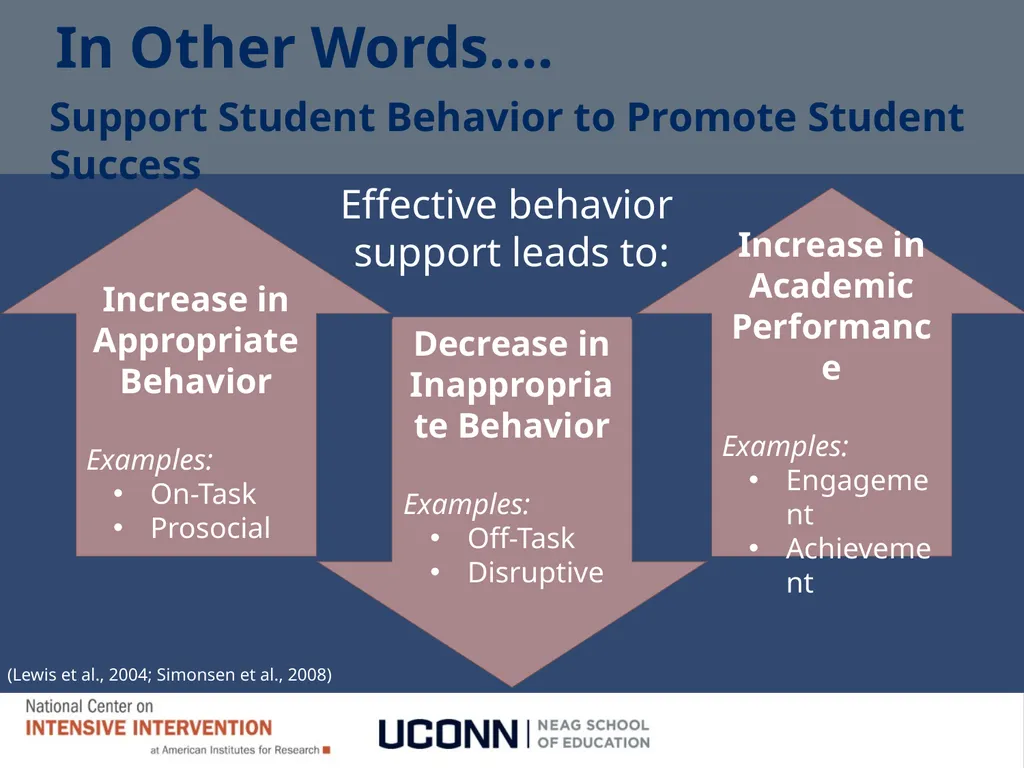
In Other Words…. Effective behavior
support leads to: Increase in Appropriate Behavior
Examples:
On-Task
Prosocial Increase in Academic Performance
Examples:
Engagement
Achievement (Lewis et al., 2004; Simonsen et al., 2008) Support Student Behavior to Promote Student Success<br>
support leads to: Increase in Appropriate Behavior
Examples:
On-Task
Prosocial Increase in Academic Performance
Examples:
Engagement
Achievement (Lewis et al., 2004; Simonsen et al., 2008) Support Student Behavior to Promote Student Success<br>
17
Classroom & behavior management is a critical component of student success (Gest & Gest, 2005; Stronge, Ward, & Grant, 2011) The good news is we know what this looks like! Bottom Line<br>
18
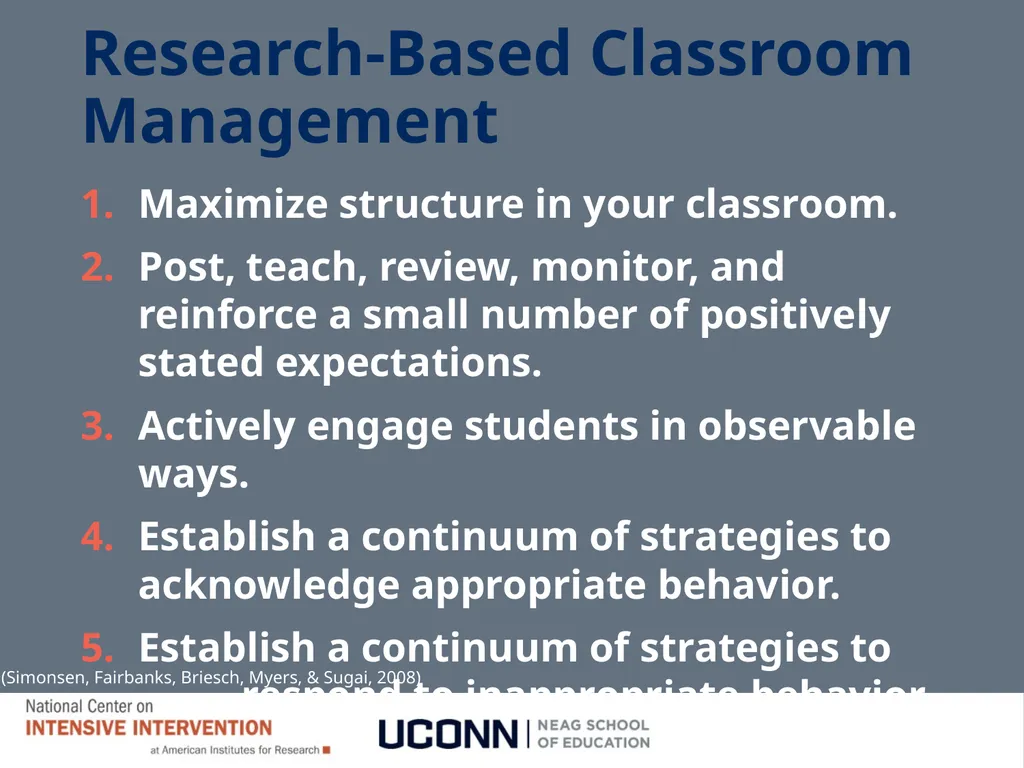
Research-Based Classroom Management Maximize structure in your classroom.
Post, teach, review, monitor, and reinforce a small number of positively stated expectations.
Actively engage students in observable ways.
Establish a continuum of strategies to acknowledge appropriate behavior.
Establish a continuum of strategies to respond to inappropriate behavior. (Simonsen, Fairbanks, Briesch, Myers, & Sugai, 2008)<br>
Post, teach, review, monitor, and reinforce a small number of positively stated expectations.
Actively engage students in observable ways.
Establish a continuum of strategies to acknowledge appropriate behavior.
Establish a continuum of strategies to respond to inappropriate behavior. (Simonsen, Fairbanks, Briesch, Myers, & Sugai, 2008)<br>
19
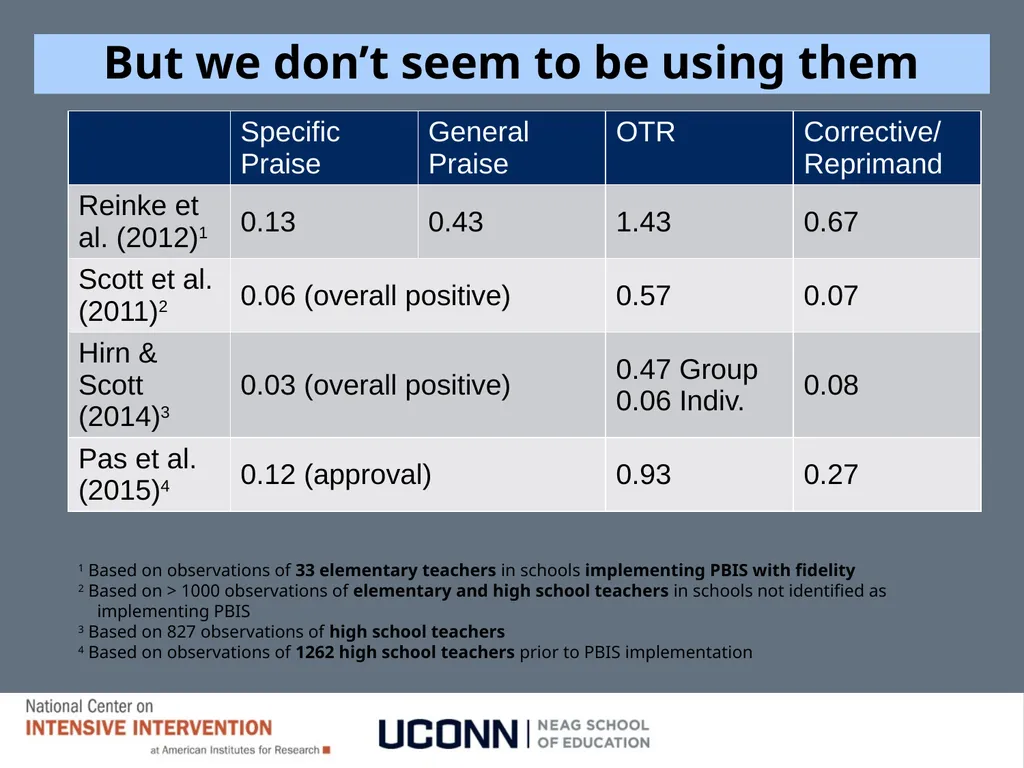
But we don’t seem to be using them 1 Based on observations of 33 elementary teachers in schools implementing PBIS with fidelity
2 Based on > 1000 observations of elementary and high school teachers in schools not identified as implementing PBIS
3 Based on 827 observations of high school teachers
4 Based on observations of 1262 high school teachers prior to PBIS implementation<br>
2 Based on > 1000 observations of elementary and high school teachers in schools not identified as implementing PBIS
3 Based on 827 observations of high school teachers
4 Based on observations of 1262 high school teachers prior to PBIS implementation<br>
20
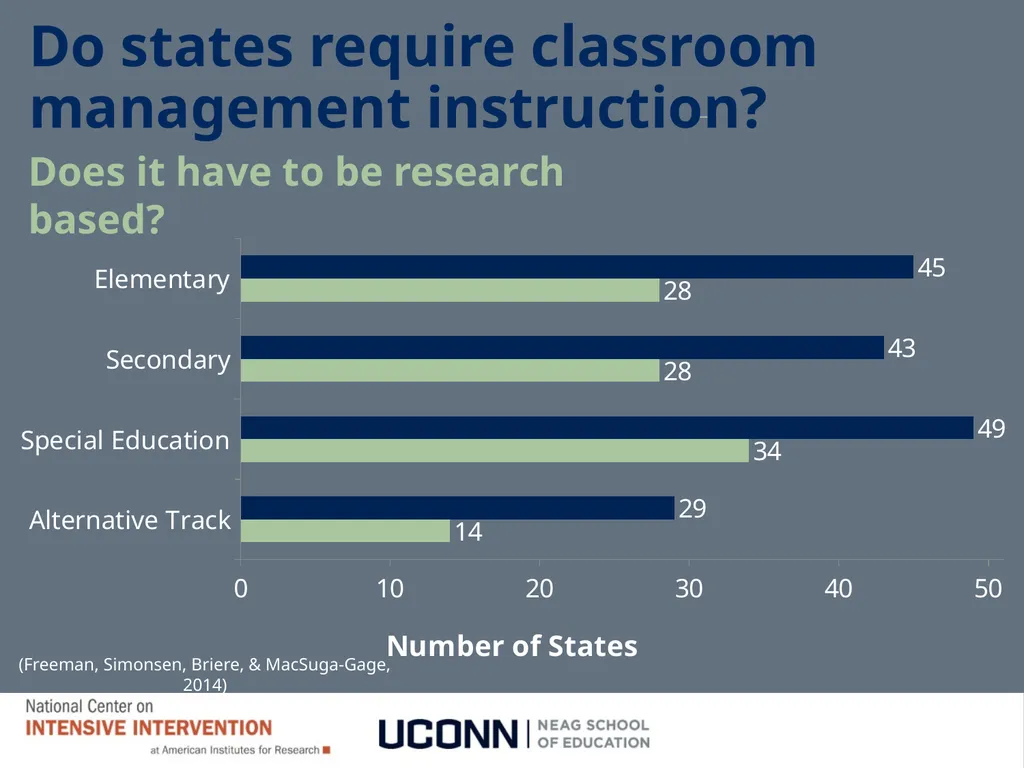
Do states require classroom management instruction? (Freeman, Simonsen, Briere, & MacSuga-Gage, 2014) Does it have to be research based?<br>
21
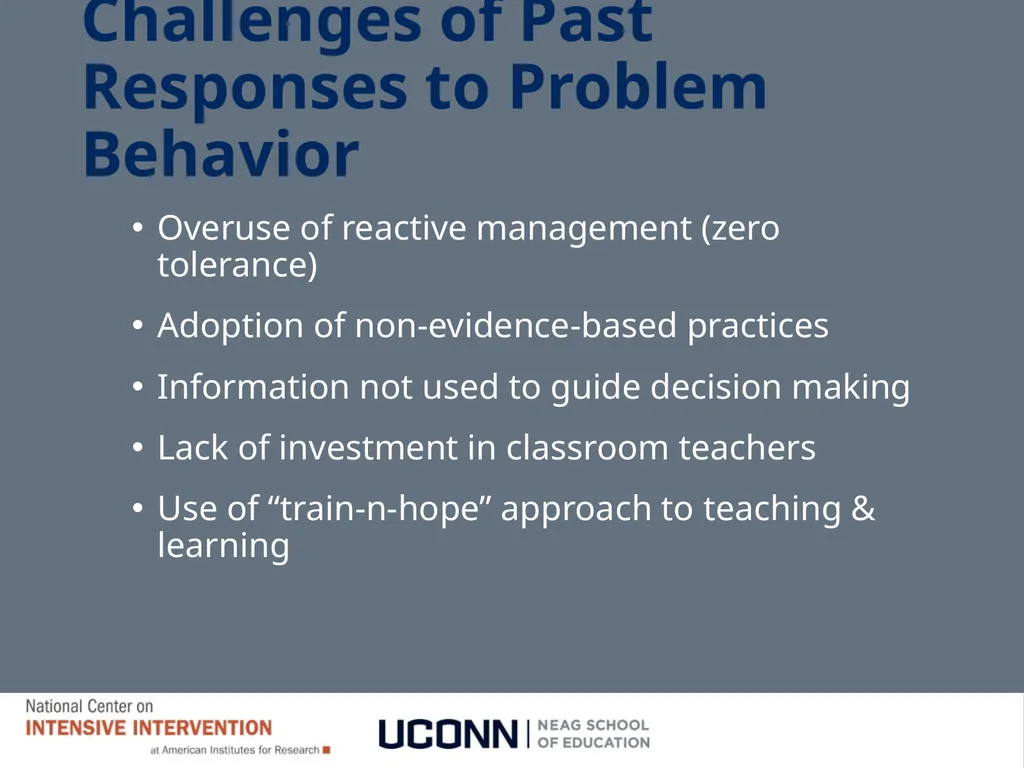
Challenges of Past Responses to Problem Behavior Overuse of reactive management (zero tolerance)
Adoption of non-evidence-based practices
Information not used to guide decision making
Lack of investment in classroom teachers
Use of “train-n-hope” approach to teaching & learning<br>
Adoption of non-evidence-based practices
Information not used to guide decision making
Lack of investment in classroom teachers
Use of “train-n-hope” approach to teaching & learning<br>
22
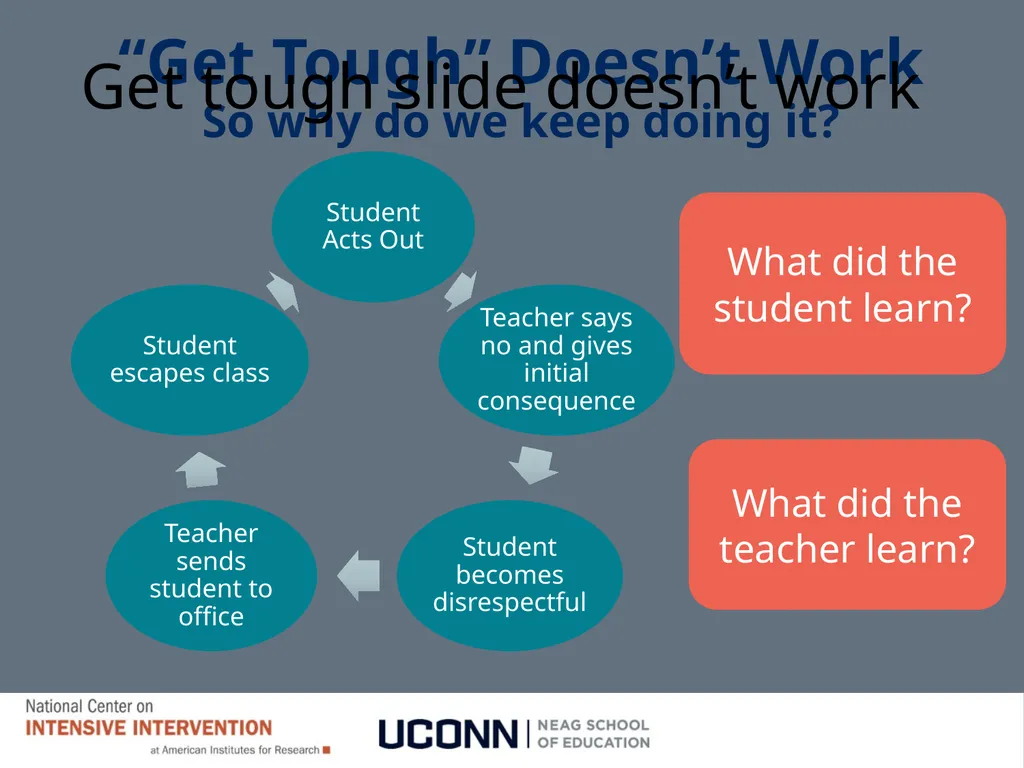
What did the student learn? What did the teacher learn? “Get Tough” Doesn’t Work
So why do we keep doing it? Get tough slide doesn’t work<br>
23
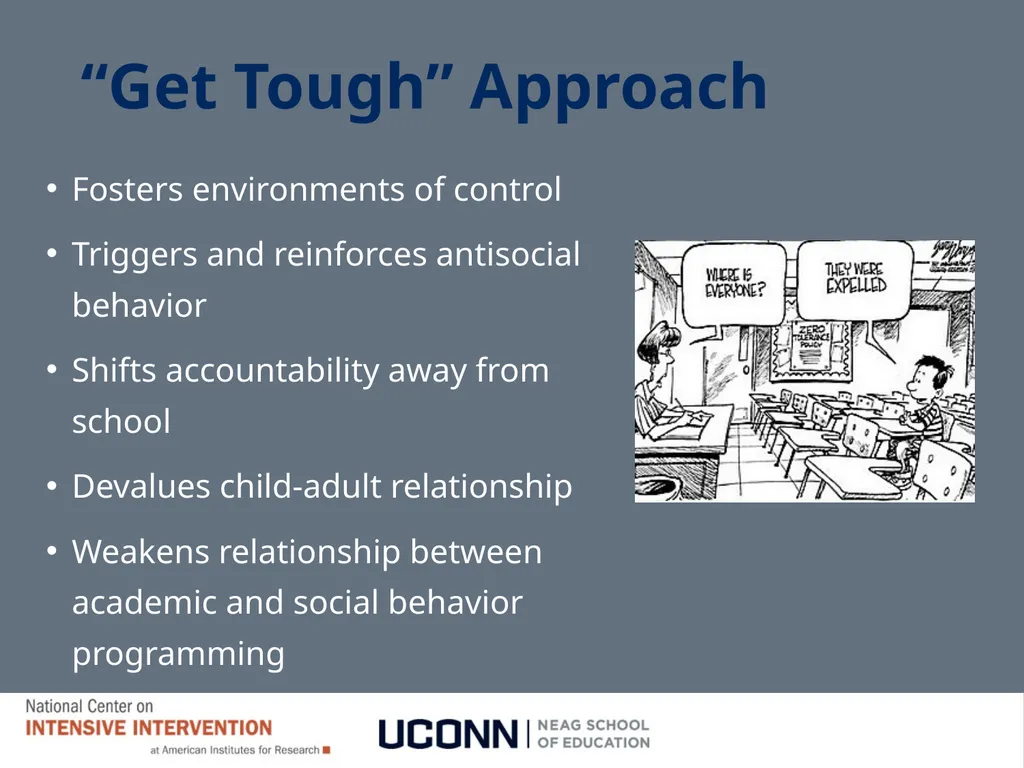
“Get Tough” Approach Fosters environments of control
Triggers and reinforces antisocial behavior
Shifts accountability away from school
Devalues child-adult relationship
Weakens relationship between academic and social behavior programming<br>
Triggers and reinforces antisocial behavior
Shifts accountability away from school
Devalues child-adult relationship
Weakens relationship between academic and social behavior programming<br>
24
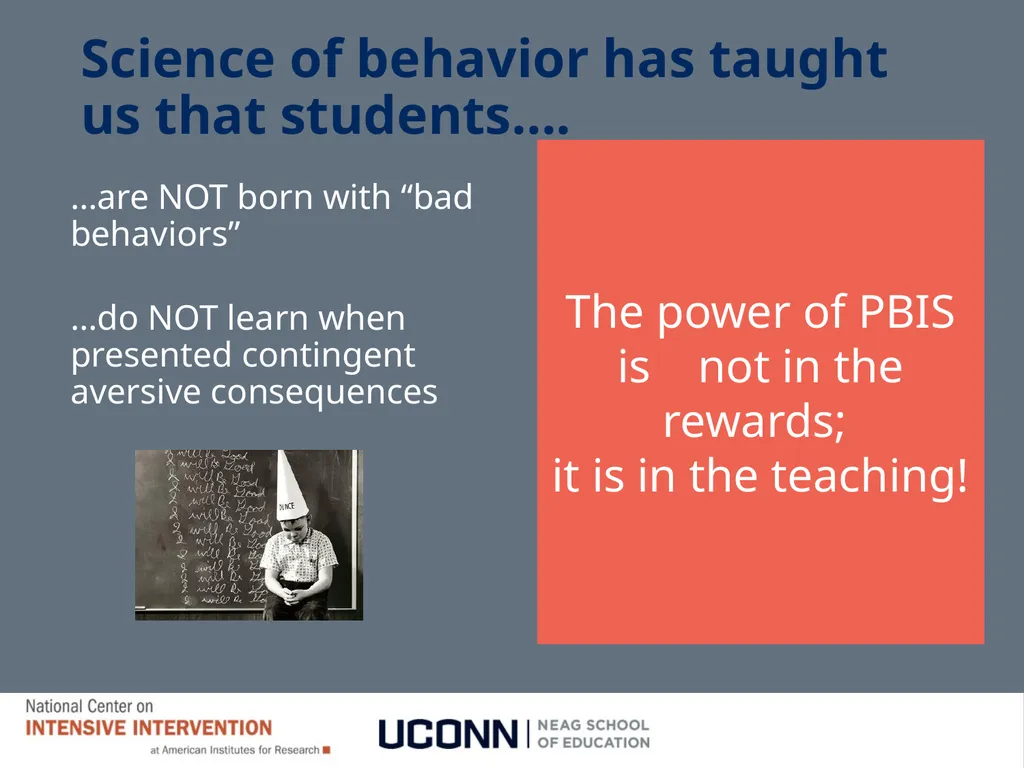
Science of behavior has taught us that students…. …are NOT born with “bad behaviors”
…do NOT learn when presented contingent aversive consequences ...DO LEARN better ways of behaving by being taught directly & receiving positive feedback The power of PBIS is not in the rewards;
it is in the teaching!<br>
…do NOT learn when presented contingent aversive consequences ...DO LEARN better ways of behaving by being taught directly & receiving positive feedback The power of PBIS is not in the rewards;
it is in the teaching!<br>
25
Positive Behavioral Interventions and Supports (PBIS) Logic Successful individual student behavior support is linked to host environments or school climates that are effective, efficient, relevant, and durable. (Zins & Ponti, 1990)<br>
26
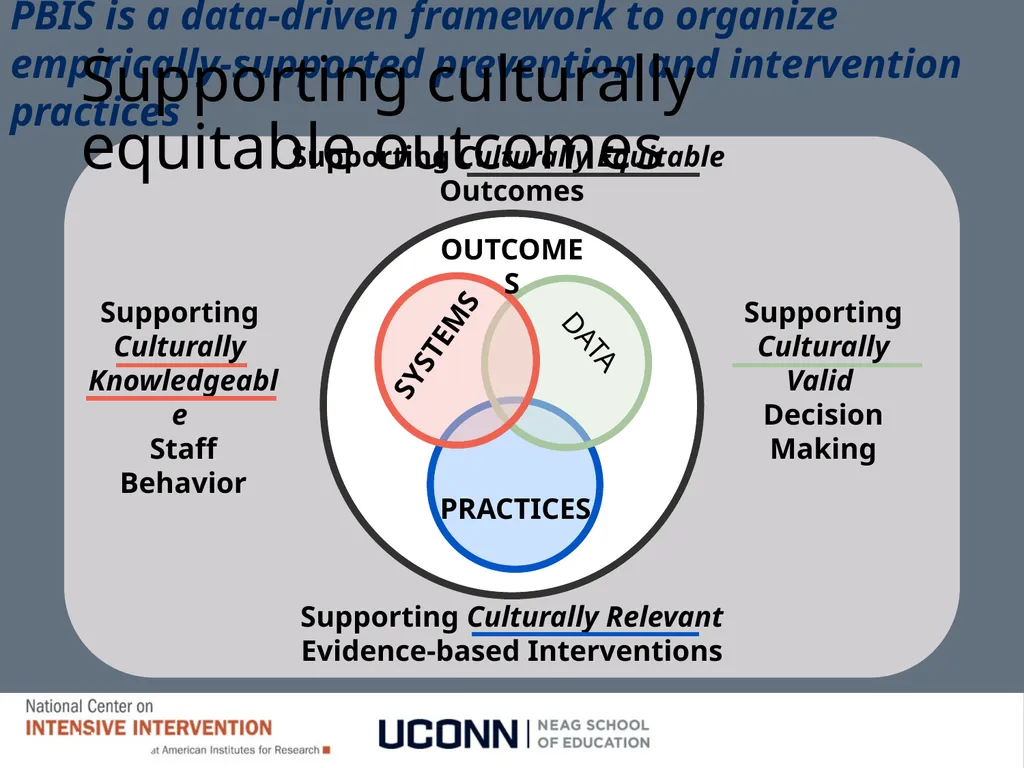
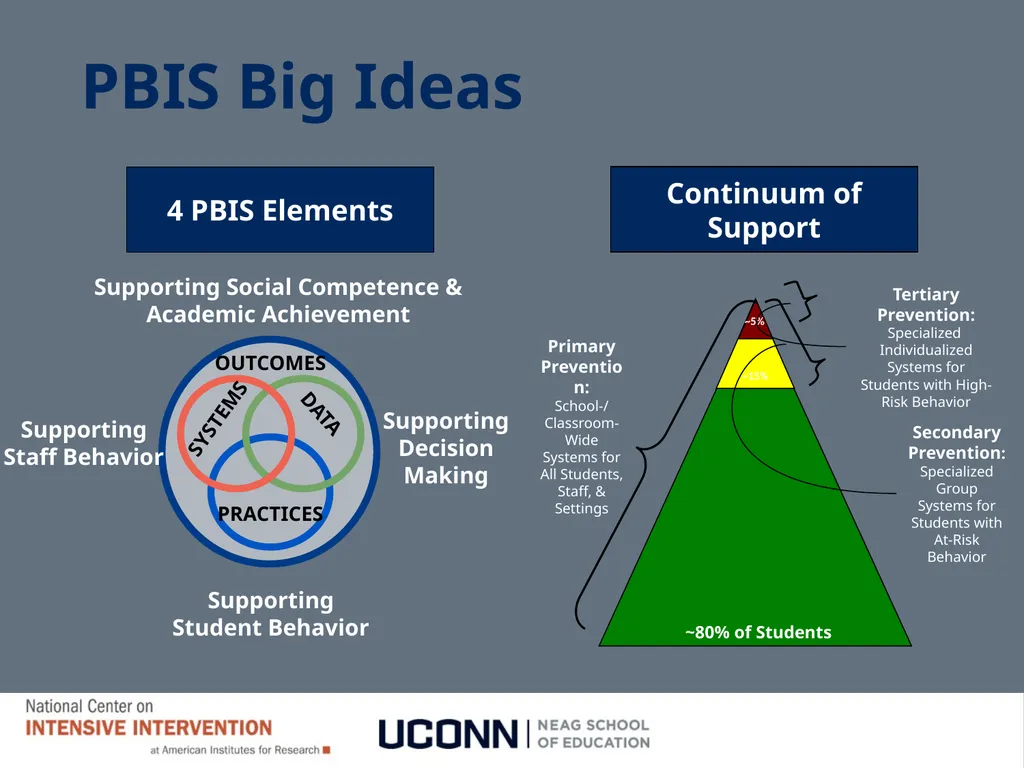
PBIS is a data-driven framework to organize empirically-supported prevention and intervention practices (www.pbis.org) Supporting
Culturally
Knowledgeable
Staff Behavior Supporting Culturally Relevant
Evidence-based Interventions SYSTEMS PRACTICES DATA OUTCOMES Supporting Culturally Equitable
Outcomes Supporting
Culturally Valid
Decision
Making Supporting culturally equitable outcomes<br>
Culturally
Knowledgeable
Staff Behavior Supporting Culturally Relevant
Evidence-based Interventions SYSTEMS PRACTICES DATA OUTCOMES Supporting Culturally Equitable
Outcomes Supporting
Culturally Valid
Decision
Making Supporting culturally equitable outcomes<br>
27
Activity 1.3: Discussion Board
Effective teacher behaviors Have you seen a “get tough” approach used in schools or classrooms?
Was it effective? Why or Why not?
Share your initial impressions of the PBIS logic. Please pause the video to complete Activity 1.3<br>
28
Behavioral Theory I Part 2
What are the elements of basic behavioral theory?<br>
What are the elements of basic behavioral theory?<br>
29
Activity 1.4: Stop and Jot
Thinking about Behavior Take a moment to consider:
What are some typical patterns of behavior you have seen in classrooms?
Why do you think they continue? Please pause the video to complete Activity 1.4<br>
What are some typical patterns of behavior you have seen in classrooms?
Why do you think they continue? Please pause the video to complete Activity 1.4<br>
30
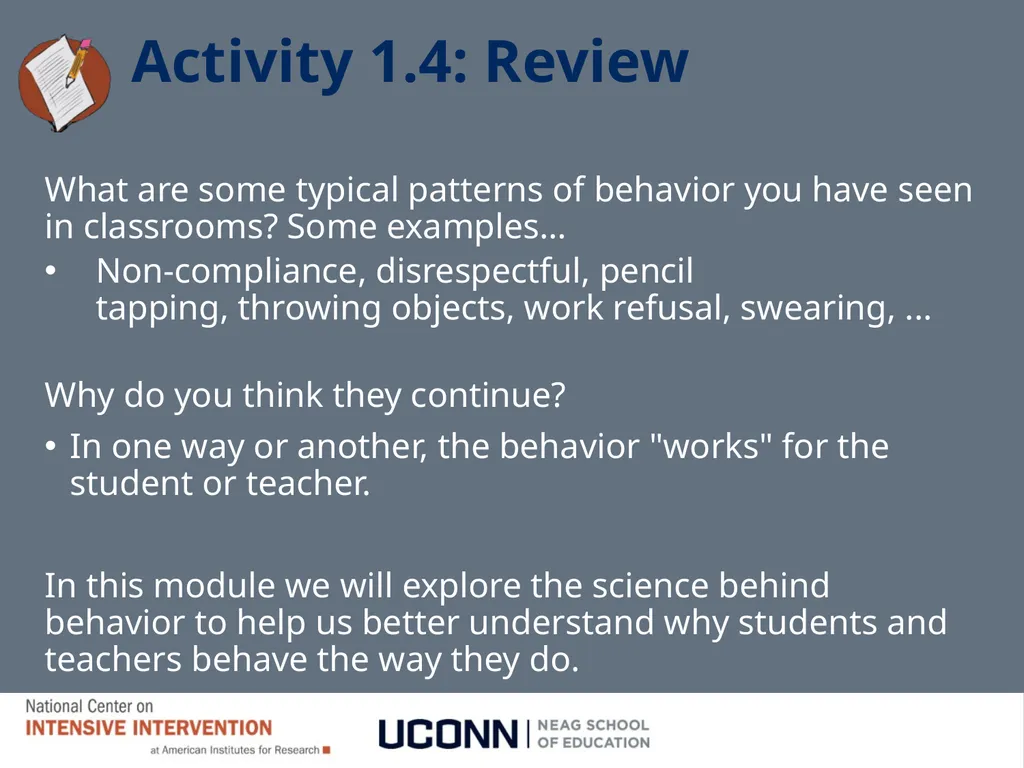
Activity 1.4: Review What are some typical patterns of behavior you have seen in classrooms? Some examples…
Non-compliance, disrespectful, pencil tapping, throwing objects, work refusal, swearing, ...
Why do you think they continue?
In one way or another, the behavior "works" for the student or teacher.
In this module we will explore the science behind behavior to help us better understand why students and teachers behave the way they do.<br>
Non-compliance, disrespectful, pencil tapping, throwing objects, work refusal, swearing, ...
Why do you think they continue?
In one way or another, the behavior "works" for the student or teacher.
In this module we will explore the science behind behavior to help us better understand why students and teachers behave the way they do.<br>
31
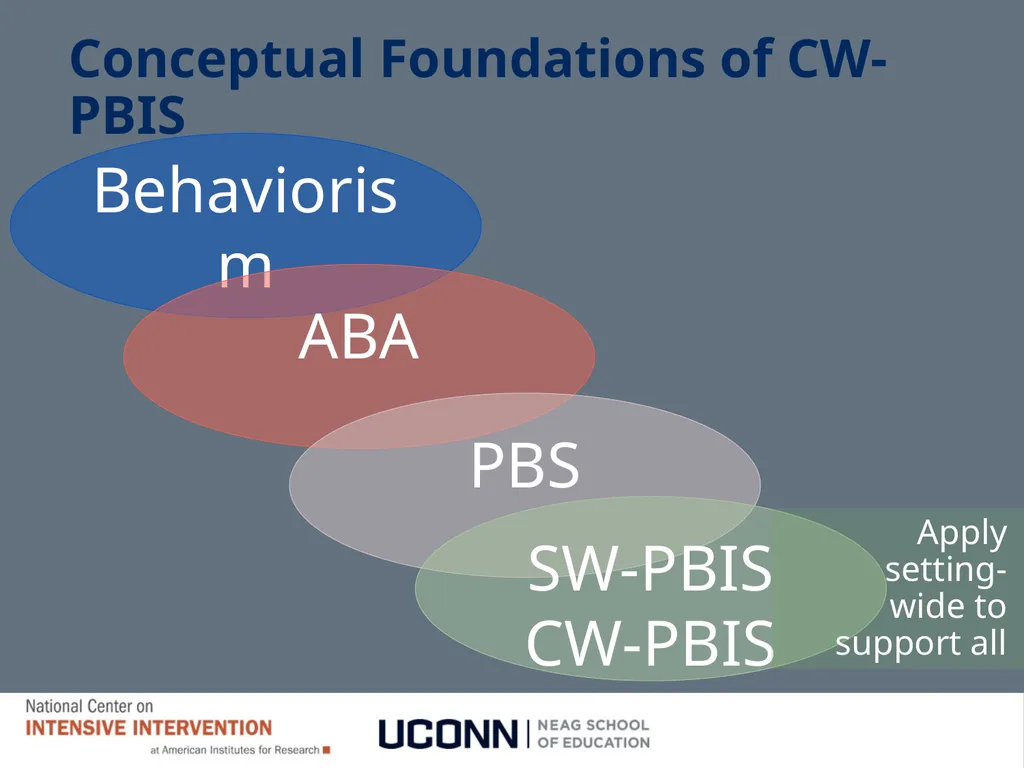
Conceptual Foundations of CW-PBIS Behaviorism ABA PBS SW-PBIS
CW-PBIS Apply setting-wide to support all<br>
CW-PBIS Apply setting-wide to support all<br>
32
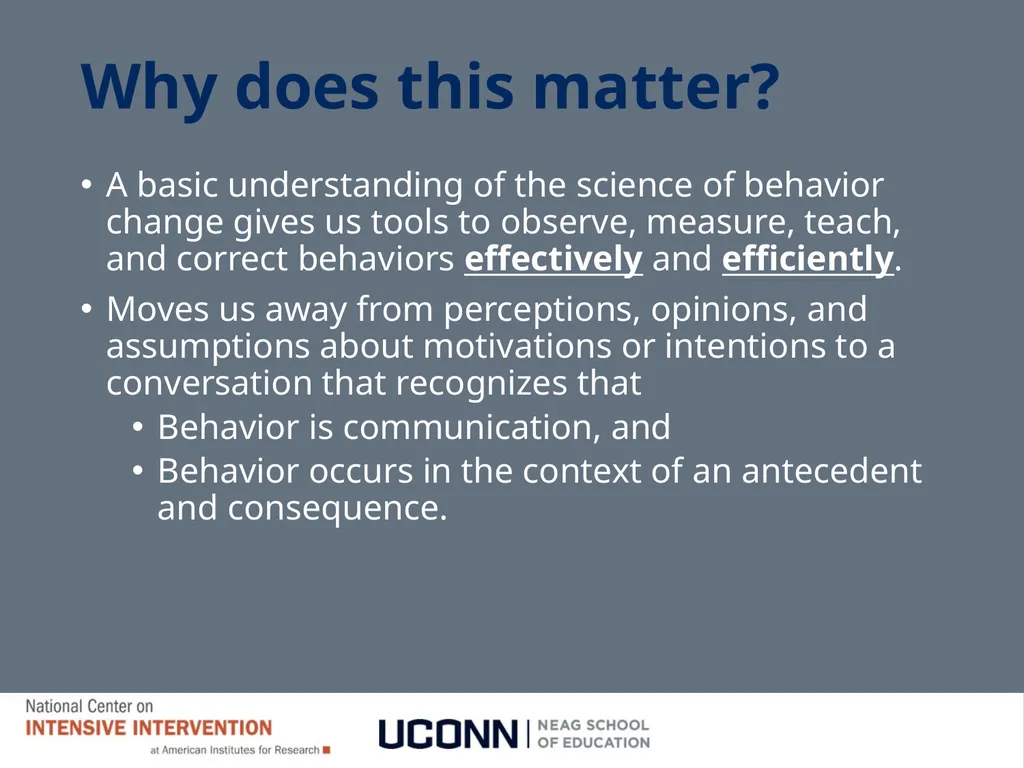
Why does this matter? A basic understanding of the science of behavior change gives us tools to observe, measure, teach, and correct behaviors effectively and efficiently.
Moves us away from perceptions, opinions, and assumptions about motivations or intentions to a conversation that recognizes that
Behavior is communication, and
Behavior occurs in the context of an antecedent and consequence.<br>
Moves us away from perceptions, opinions, and assumptions about motivations or intentions to a conversation that recognizes that
Behavior is communication, and
Behavior occurs in the context of an antecedent and consequence.<br>
33
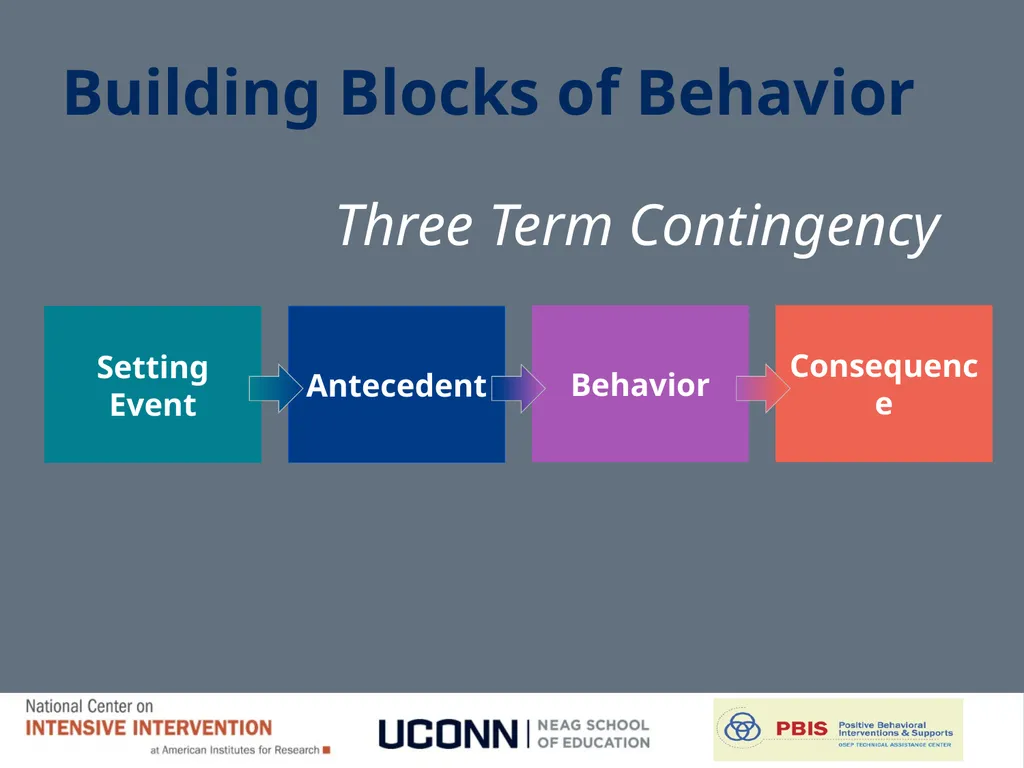
Antecedent Behavior Consequence Setting Event Three Term Contingency Building Blocks of Behavior<br>
34
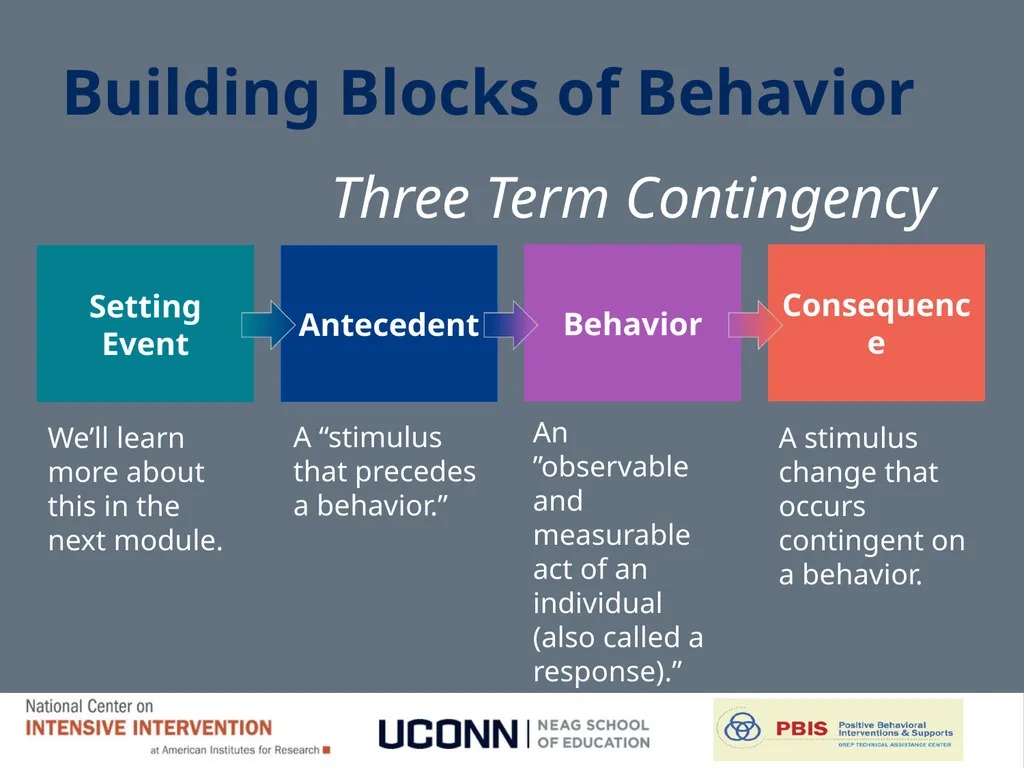
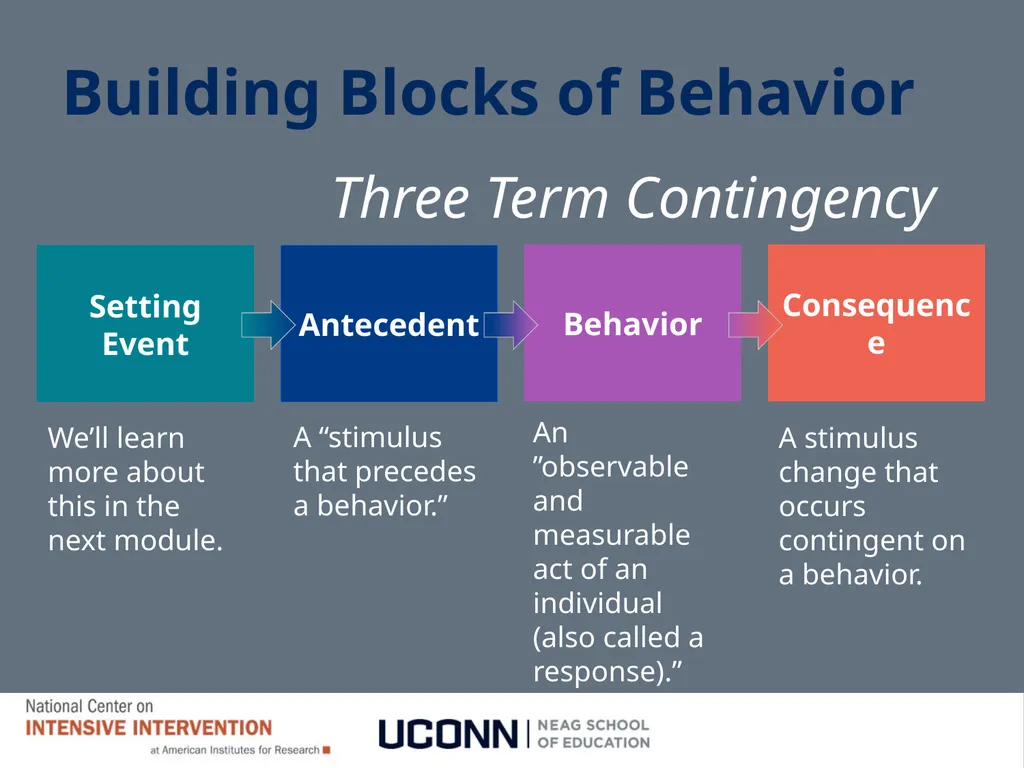
Antecedent Behavior Consequence Setting Event An ”observable and measurable act of an individual (also called a response).” A “stimulus that precedes a behavior.” A stimulus change that occurs contingent on a behavior. We’ll learn more about this in the next module. Three Term Contingency Building Blocks of Behavior<br>
35
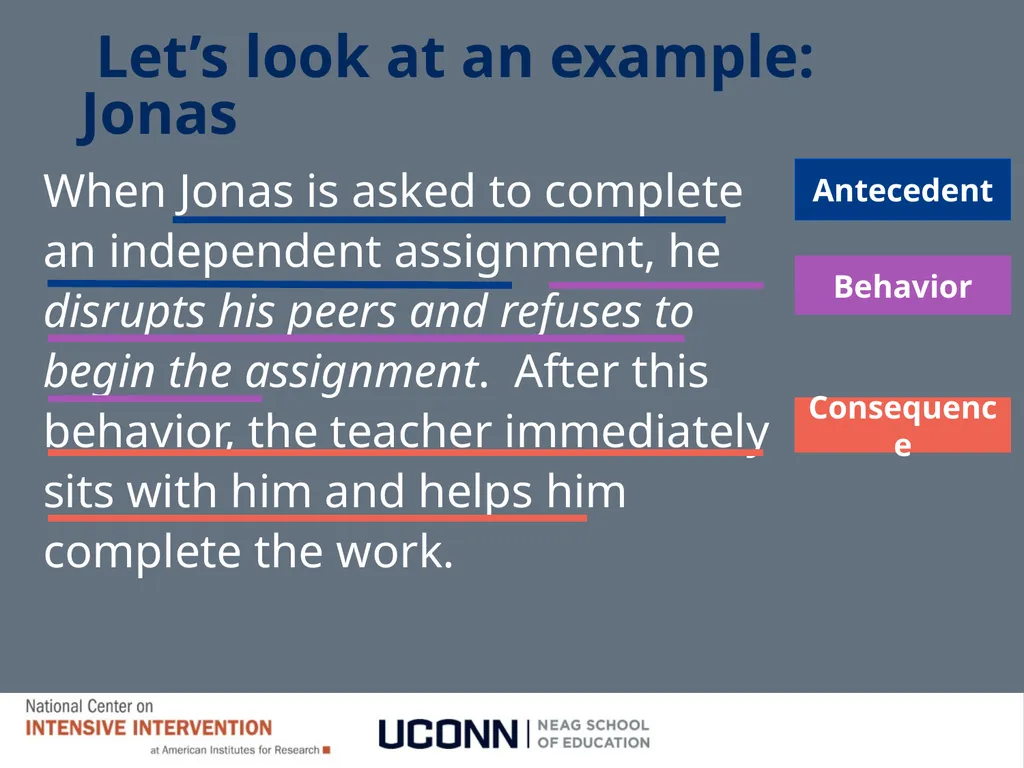
When Jonas is asked to complete an independent assignment, he disrupts his peers and refuses to begin the assignment. After this behavior, the teacher immediately sits with him and helps him complete the work. Let’s look at an example: Jonas Antecedent Behavior Consequence<br>
36
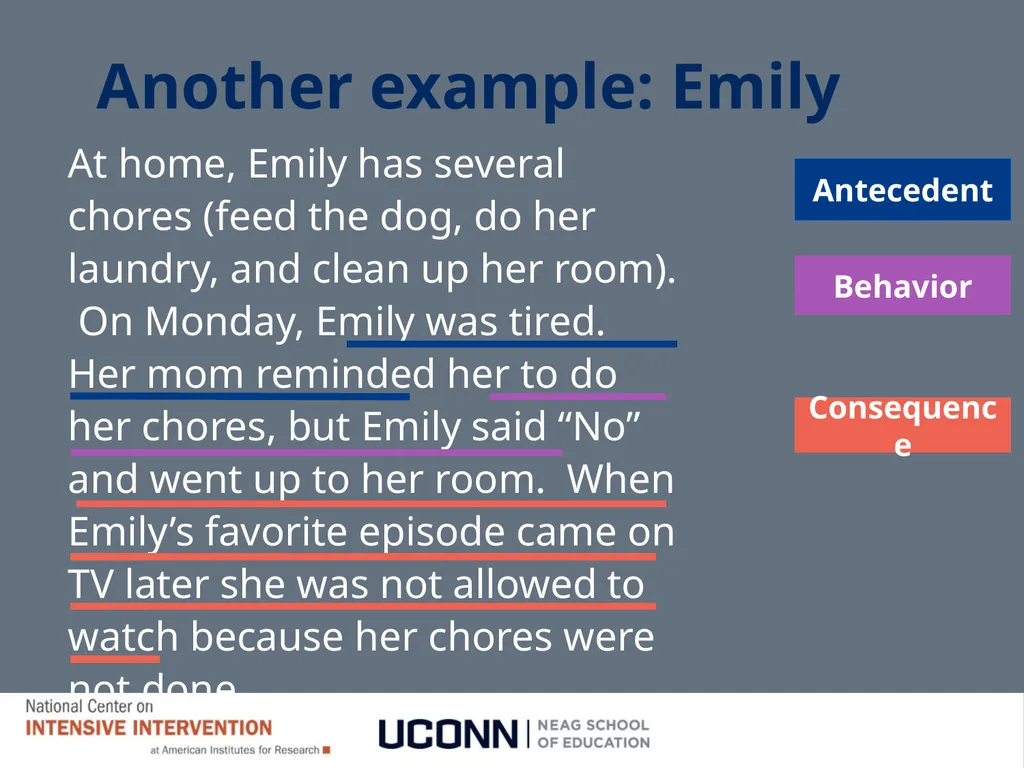
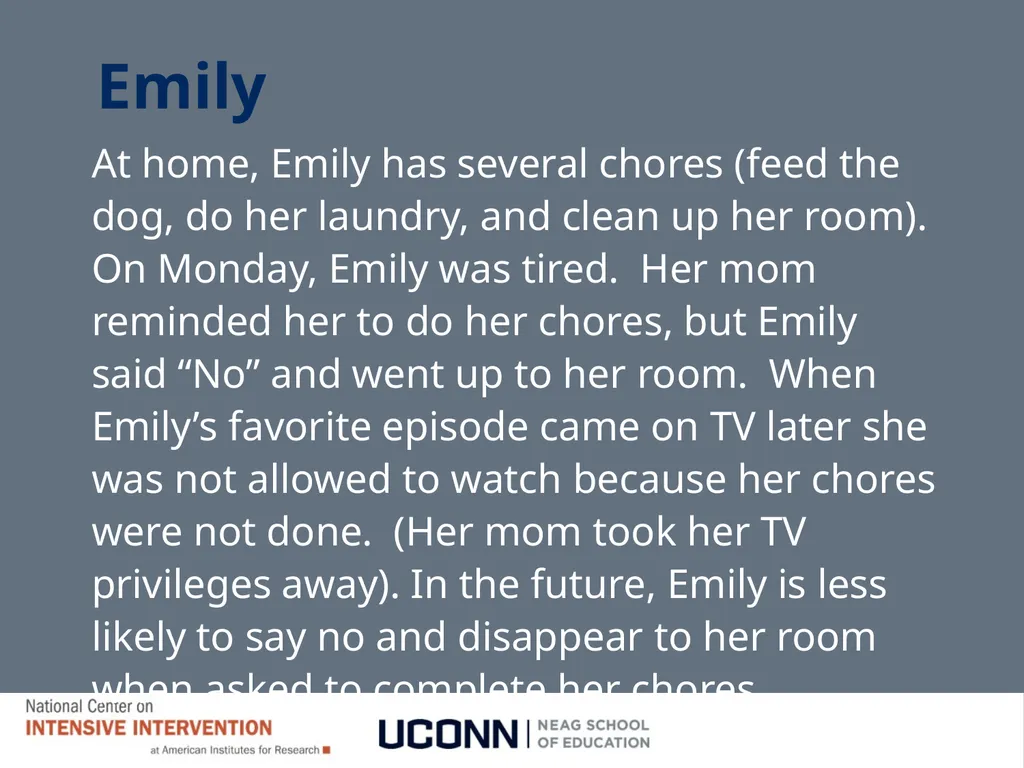
At home, Emily has several chores (feed the dog, do her laundry, and clean up her room). On Monday, Emily was tired. Her mom reminded her to do her chores, but Emily said “No” and went up to her room. When Emily’s favorite episode came on TV later she was not allowed to watch because her chores were not done. Another example: Emily Antecedent Behavior Consequence<br>
37
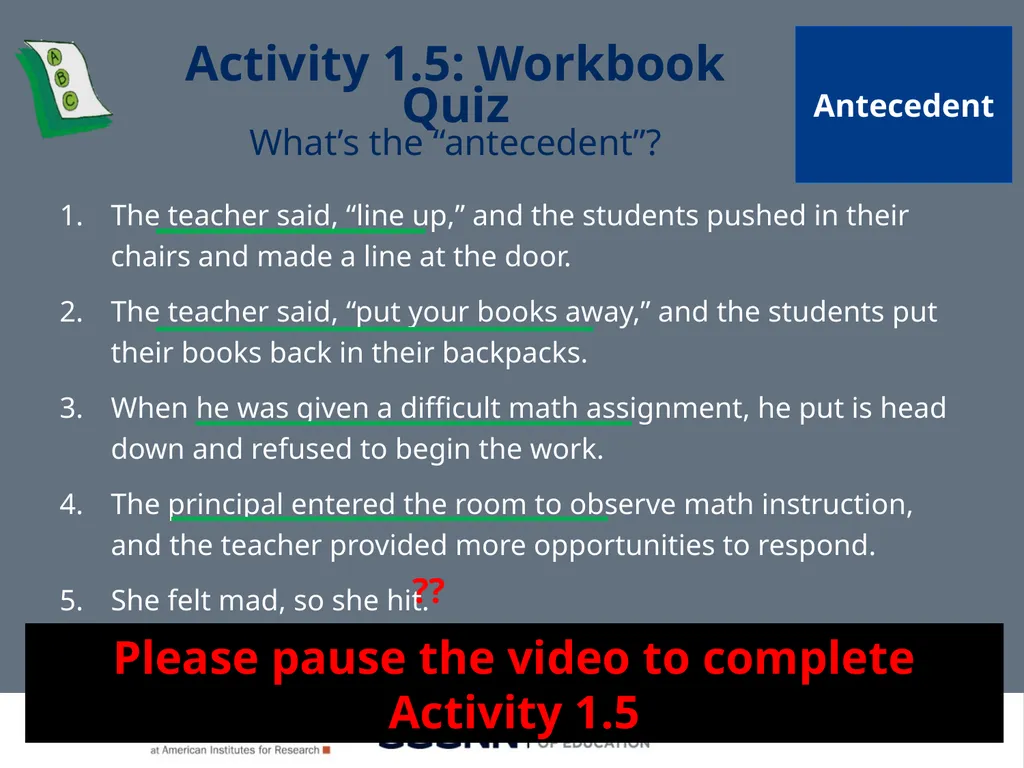
Activity 1.5: Workbook Quiz
What’s the “antecedent”? The teacher said, “line up,” and the students pushed in their chairs and made a line at the door.
The teacher said, “put your books away,” and the students put their books back in their backpacks.
When he was given a difficult math assignment, he put is head down and refused to begin the work.
The principal entered the room to observe math instruction, and the teacher provided more opportunities to respond.
She felt mad, so she hit. Antecedent Please pause the video to complete Activity 1.5 ??<br>
The teacher said, “put your books away,” and the students put their books back in their backpacks.
When he was given a difficult math assignment, he put is head down and refused to begin the work.
The principal entered the room to observe math instruction, and the teacher provided more opportunities to respond.
She felt mad, so she hit. Antecedent Please pause the video to complete Activity 1.5 ??<br>
38
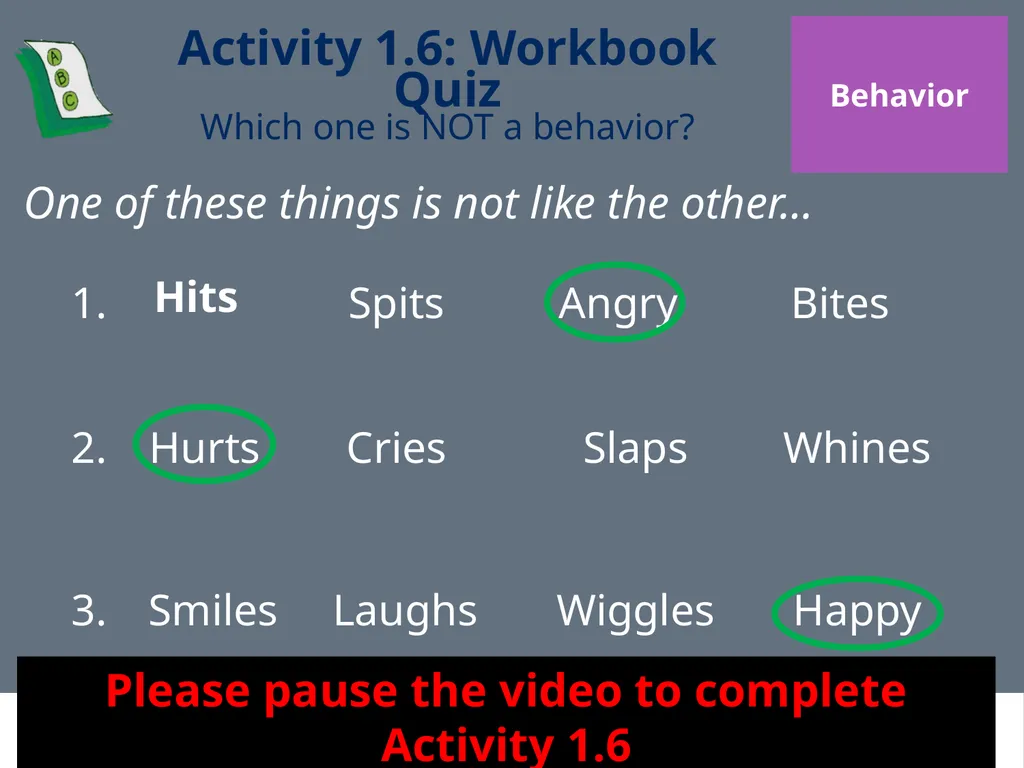
Activity 1.6: Workbook Quiz
Which one is NOT a behavior? Hits Spits Angry Bites 1. Hurts Cries Slaps Whines 2. Smiles Laughs Wiggles Happy 3. One of these things is not like the other… Behavior Please pause the video to complete Activity 1.6<br>
39
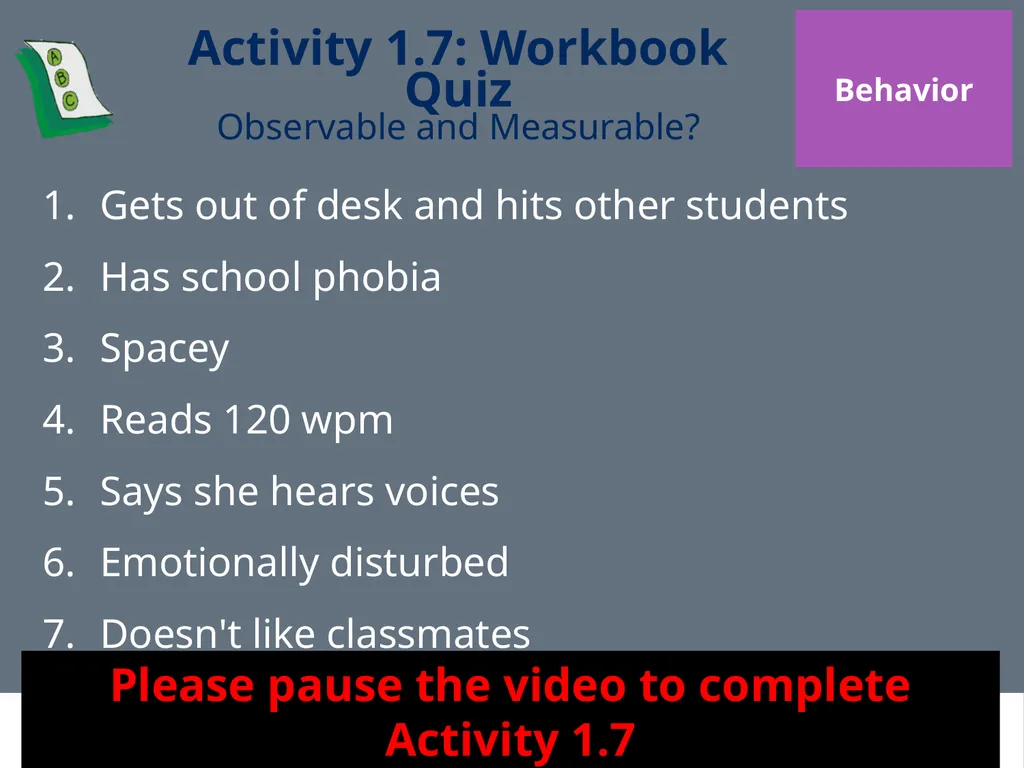
Activity 1.7: Workbook Quiz
Observable and Measurable? Gets out of desk and hits other students
Has school phobia
Spacey
Reads 120 wpm
Says she hears voices
Emotionally disturbed
Doesn't like classmates Behavior Please pause the video to complete Activity 1.7<br>
Has school phobia
Spacey
Reads 120 wpm
Says she hears voices
Emotionally disturbed
Doesn't like classmates Behavior Please pause the video to complete Activity 1.7<br>
40
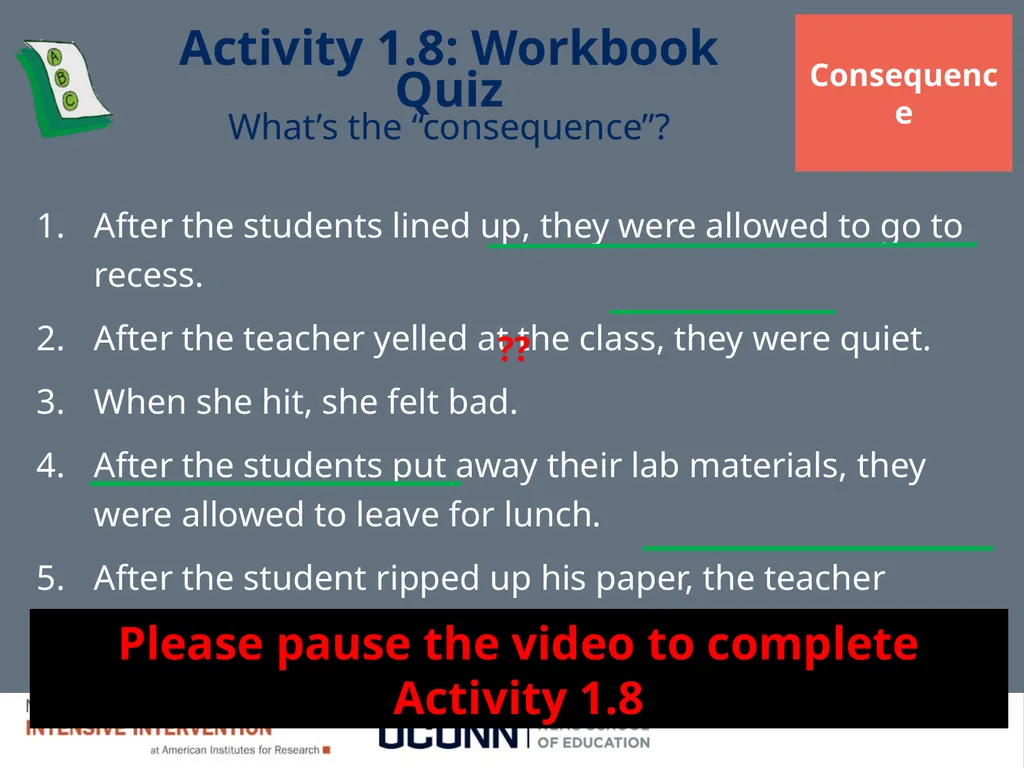
Activity 1.8: Workbook Quiz
What’s the “consequence”? After the students lined up, they were allowed to go to recess.
After the teacher yelled at the class, they were quiet.
When she hit, she felt bad.
After the students put away their lab materials, they were allowed to leave for lunch.
After the student ripped up his paper, the teacher walked away. Consequence Please pause the video to complete Activity 1.8 ??<br>
After the teacher yelled at the class, they were quiet.
When she hit, she felt bad.
After the students put away their lab materials, they were allowed to leave for lunch.
After the student ripped up his paper, the teacher walked away. Consequence Please pause the video to complete Activity 1.8 ??<br>
41
Activity 1.9: Evaluate an Example
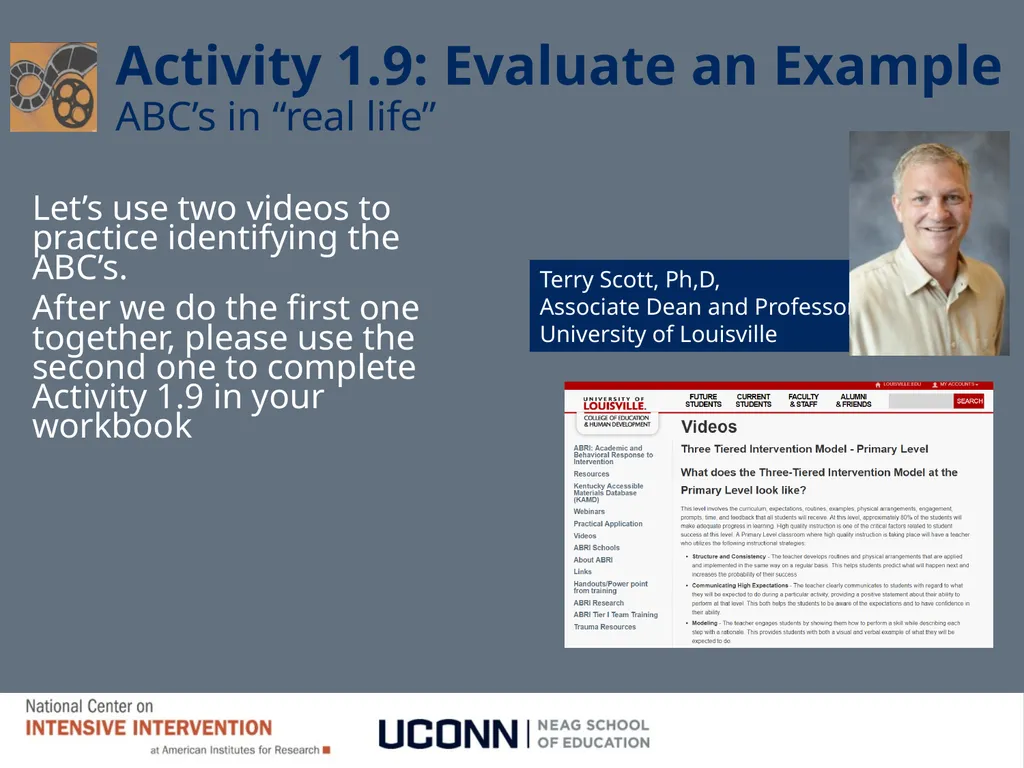
ABC’s in “real life” Let’s use two videos to practice identifying the ABC’s.
After we do the first one together, please use the second one to complete Activity 1.9 in your workbook Terry Scott, Ph,D,
Associate Dean and Professor
University of Louisville<br>
After we do the first one together, please use the second one to complete Activity 1.9 in your workbook Terry Scott, Ph,D,
Associate Dean and Professor
University of Louisville<br>
42
Activity 1.9: Evaluate an Example
Video 1 Link to Video: https://www.youtube.com/watch?v=VXCl2fMsdTU Activity 1.9<br>
43
Activity 1.9: Evaluate an Example
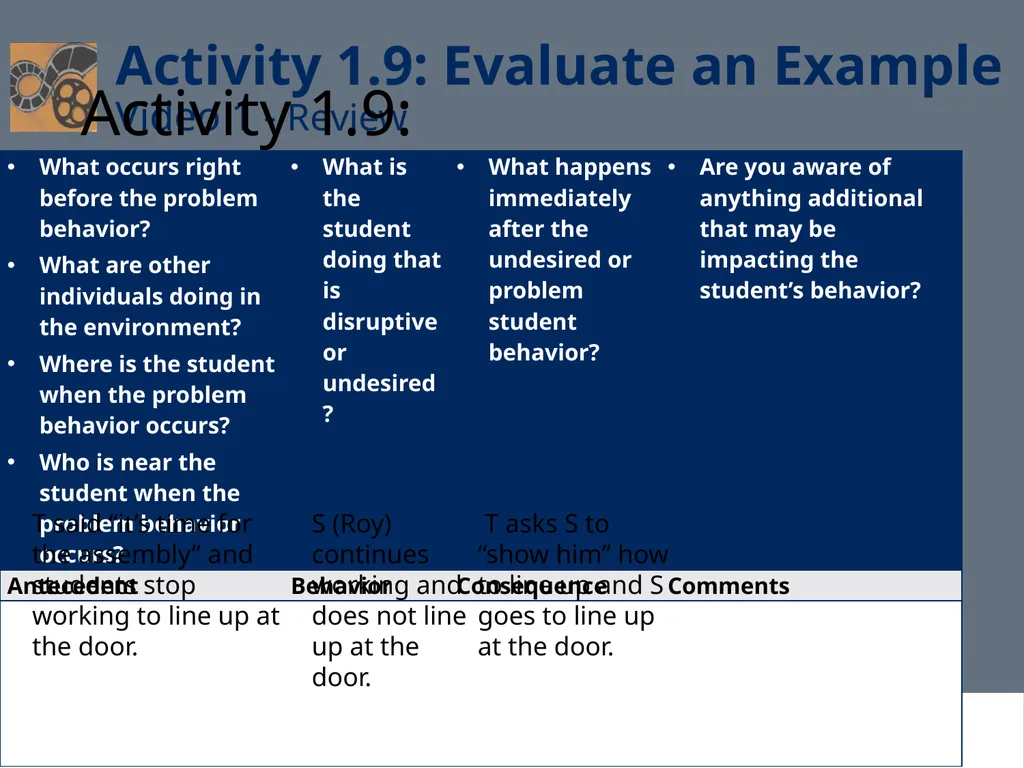
Video 1 - Review Activity 1.9: T said “it’s time for the assembly” and students stop working to line up at the door. S (Roy) continues working and does not line up at the door. T asks S to “show him” how to line up and S goes to line up at the door.<br>
44
Activity 1.9: Evaluate an Example
Video 2 Link to Video: Video 2: http://video.louisville.edu/vod/flashmgr/sefrey01/Video/1438280021295-iPhone.mp4 Activity 1.9 video 2<br>
45
Activity 1.9: Evaluate an Example
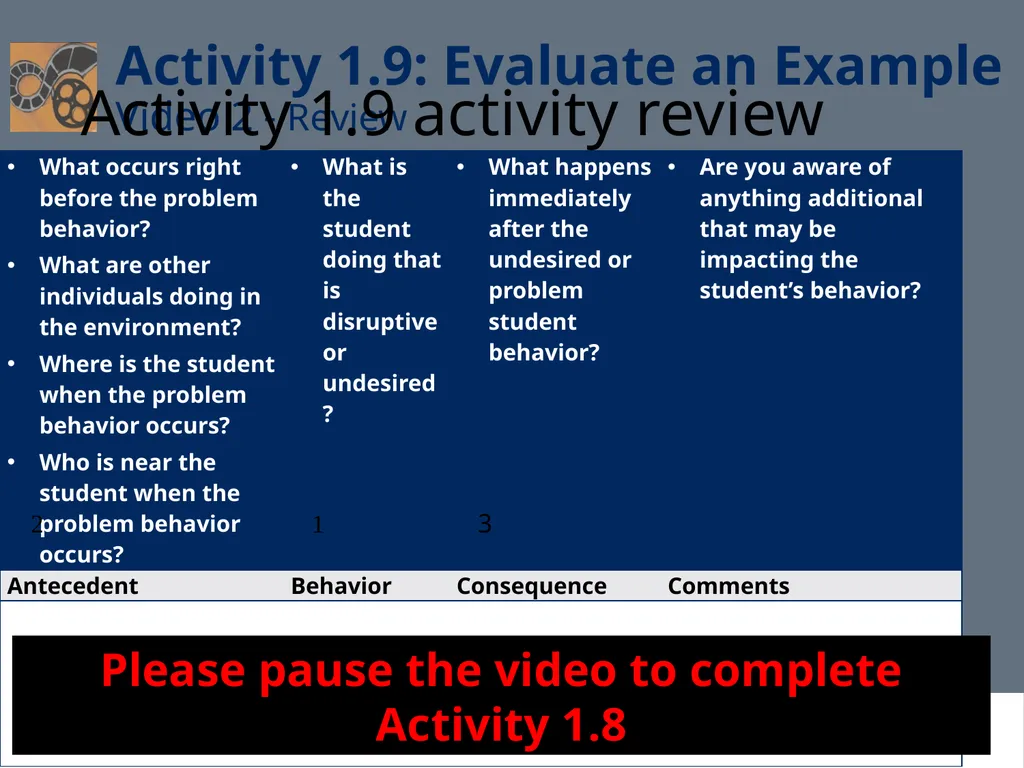
Video 2 - Review Activity 1.9 activity review 2 1 3 Please pause the video to complete Activity 1.8<br>
46
Behavioral Theory I Part 3
What are the elements of basic behavioral theory?<br>
What are the elements of basic behavioral theory?<br>
47
Now that we understand that antecedents, behaviors, and consequences are…
what?
…OBSERVABLE and MEASURABLE,
we can go into more depth with types of consequences and types of antecedents. ABC’s of Behavior<br>
what?
…OBSERVABLE and MEASURABLE,
we can go into more depth with types of consequences and types of antecedents. ABC’s of Behavior<br>
48
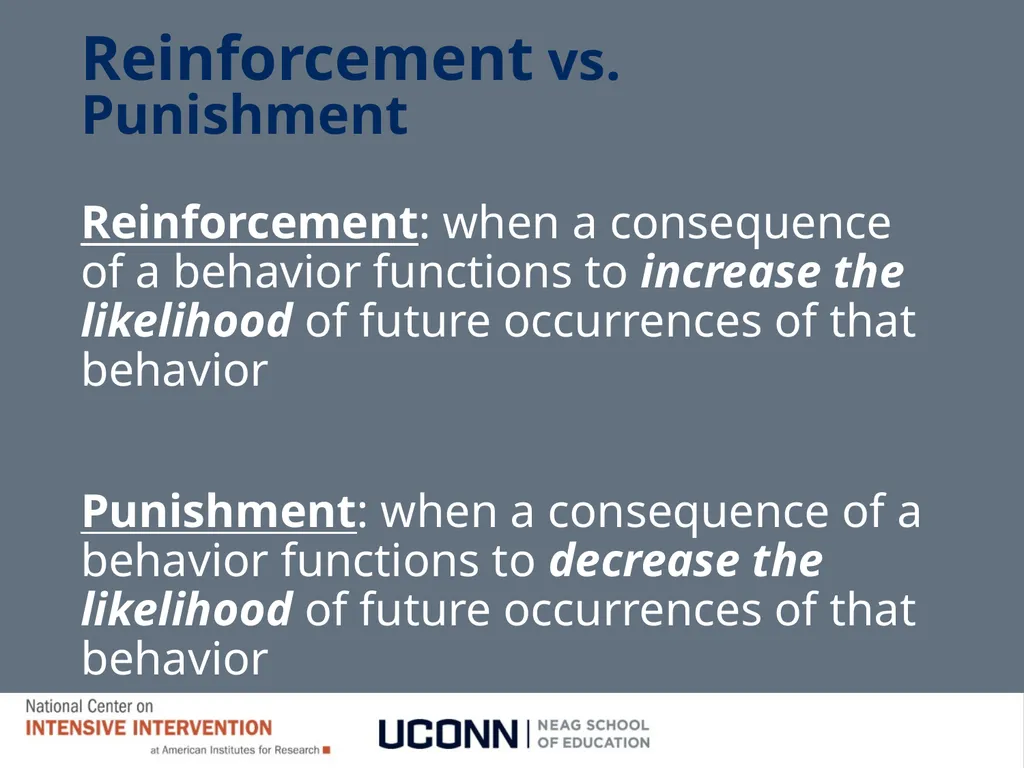
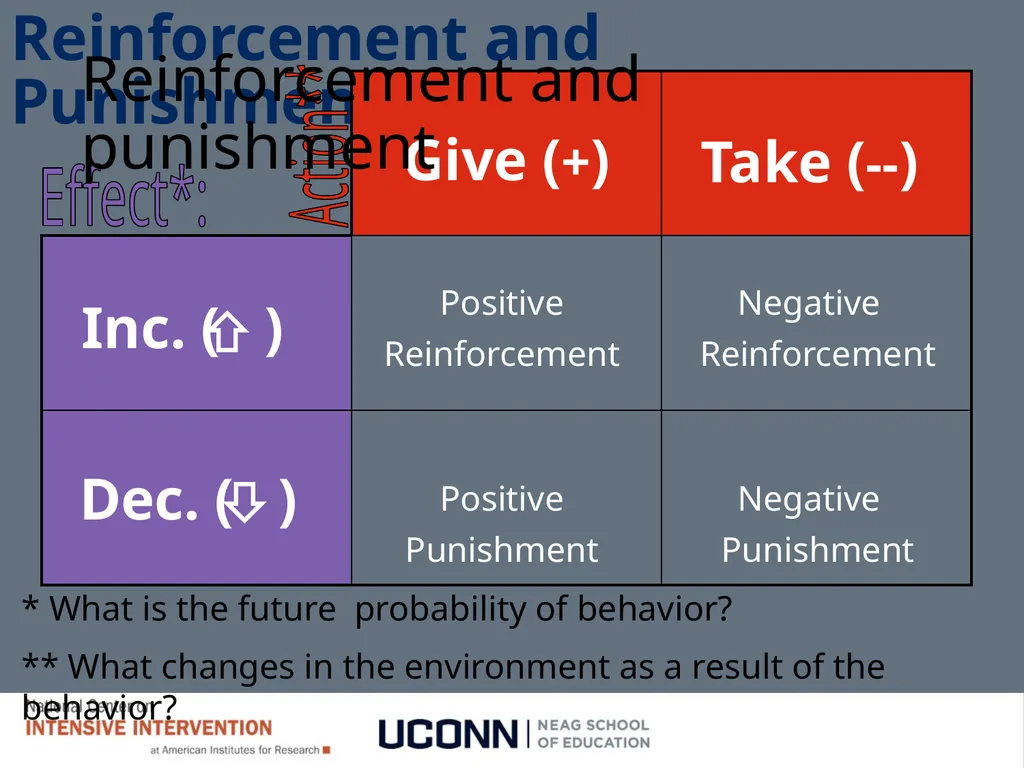
Reinforcement vs. Punishment Reinforcement: when a consequence of a behavior functions to increase the likelihood of future occurrences of that behavior
Punishment: when a consequence of a behavior functions to decrease the likelihood of future occurrences of that behavior<br>
Punishment: when a consequence of a behavior functions to decrease the likelihood of future occurrences of that behavior<br>
49
Reinforcement and Punishment * What is the future probability of behavior?
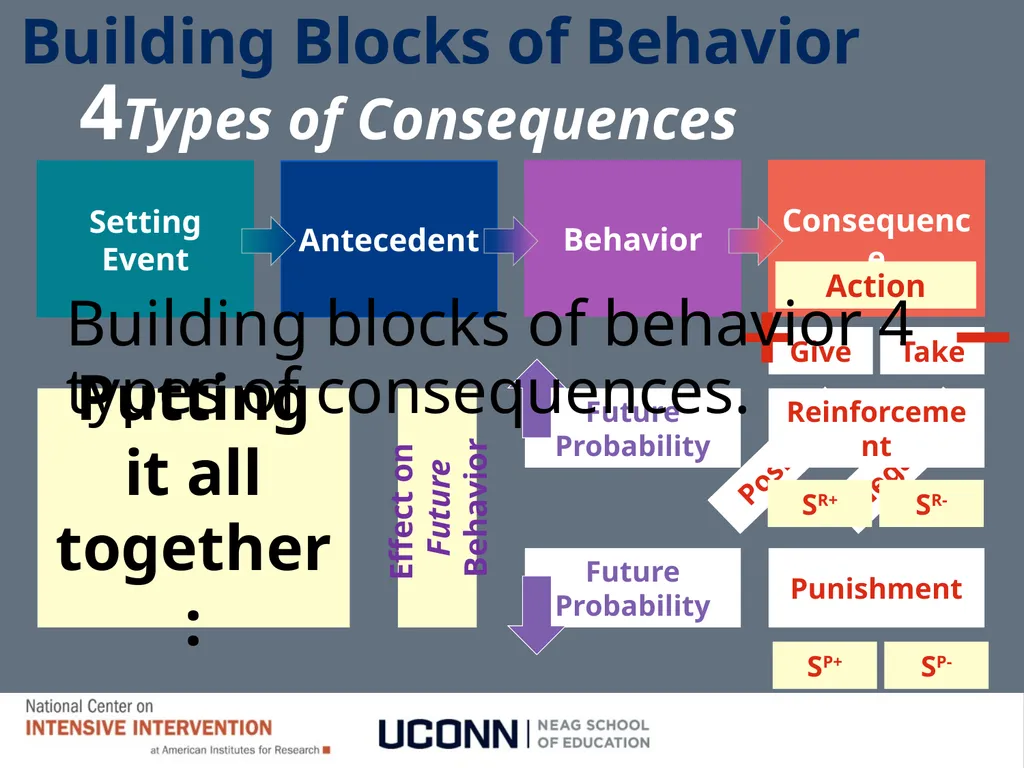
** What changes in the environment as a result of the behavior? Reinforcement Reinforcement Punishment Punishment Give (+) Take (--) Positive Positive Negative Negative Effect*: Action** Reinforcement and punishment<br>
** What changes in the environment as a result of the behavior? Reinforcement Reinforcement Punishment Punishment Give (+) Take (--) Positive Positive Negative Negative Effect*: Action** Reinforcement and punishment<br>
50
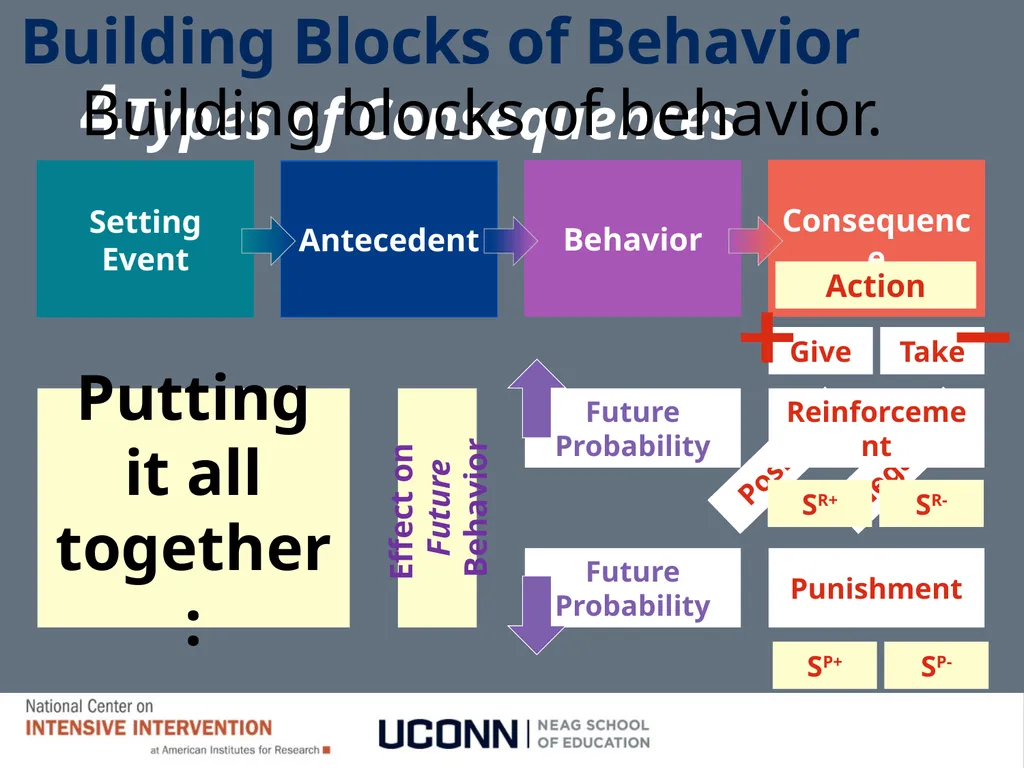
Positive Negative Building Blocks of Behavior Antecedent Behavior Consequence Setting Event Types of Consequences Reinforcement Future
Probability Punishment Future
Probability Effect on
Future Behavior Give Take Action SR+ SR- SP+ SP- 4 Putting it all together: Building blocks of behavior.<br>
Probability Punishment Future
Probability Effect on
Future Behavior Give Take Action SR+ SR- SP+ SP- 4 Putting it all together: Building blocks of behavior.<br>
51
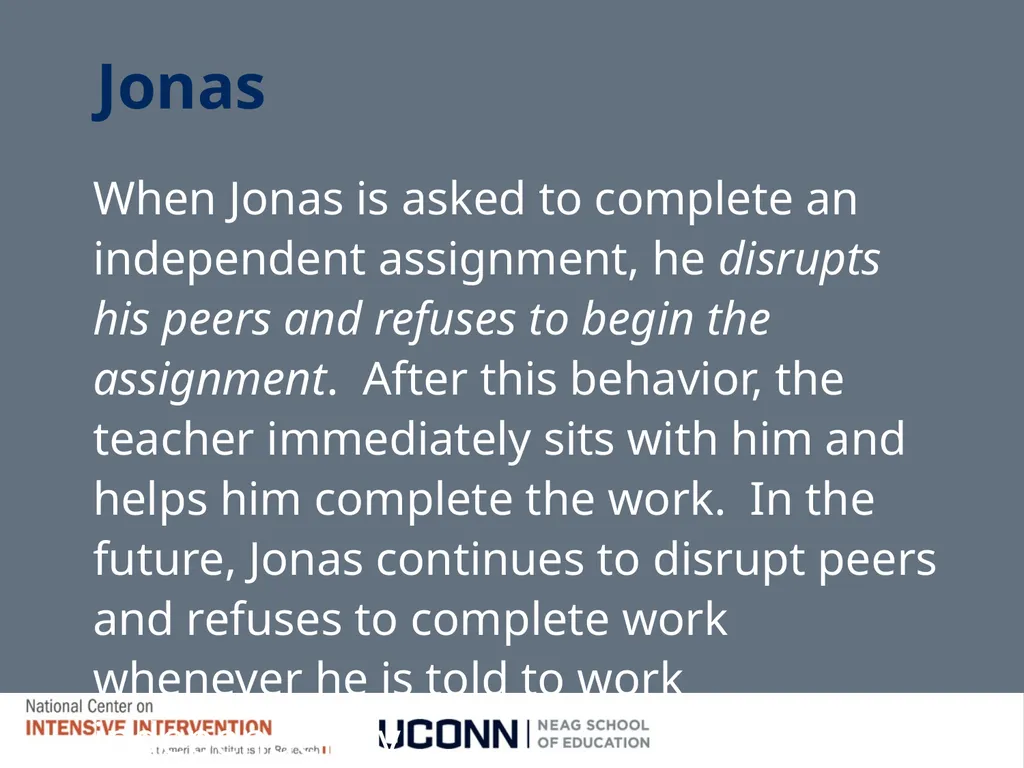
When Jonas is asked to complete an independent assignment, he disrupts his peers and refuses to begin the assignment. After this behavior, the teacher immediately sits with him and helps him complete the work. In the future, Jonas continues to disrupt peers and refuses to complete work whenever he is told to work independently. Jonas<br>
52
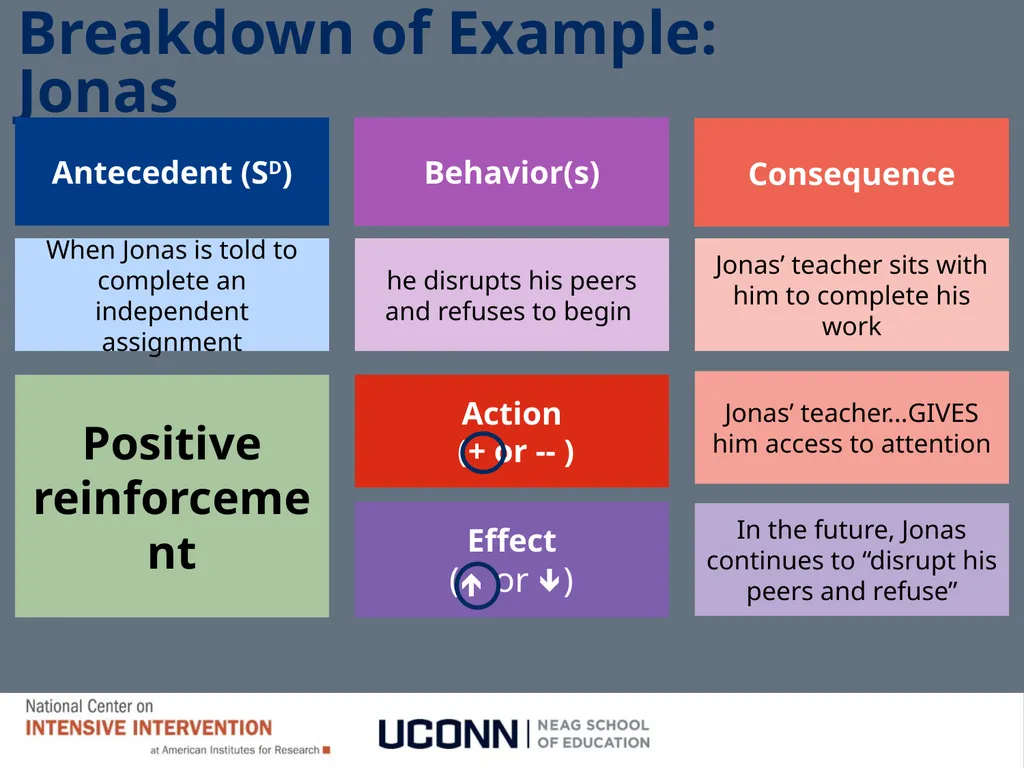
When Jonas is told to complete an independent assignment he disrupts his peers and refuses to begin Jonas’ teacher sits with him to complete his work In the future, Jonas continues to “disrupt his peers and refuse” Jonas’ teacher…GIVES him access to attention Positive reinforcement Breakdown of Example: Jonas Antecedent (SD) Behavior(s) Consequence Action
(+ or -- ) Effect
( or )<br>
(+ or -- ) Effect
( or )<br>
53
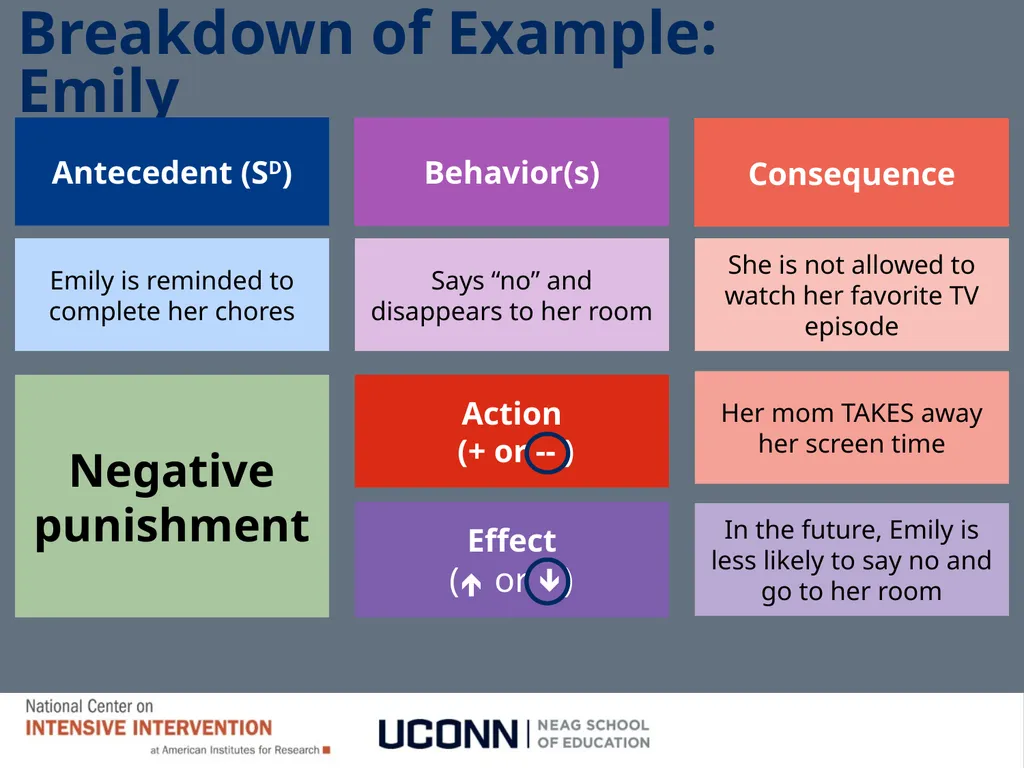
At home, Emily has several chores (feed the dog, do her laundry, and clean up her room). On Monday, Emily was tired. Her mom reminded her to do her chores, but Emily said “No” and went up to her room. When Emily’s favorite episode came on TV later she was not allowed to watch because her chores were not done. (Her mom took her TV privileges away). In the future, Emily is less likely to say no and disappear to her room when asked to complete her chores. Emily<br>
54
Emily is reminded to complete her chores Says “no” and disappears to her room She is not allowed to watch her favorite TV episode In the future, Emily is less likely to say no and go to her room Her mom TAKES away her screen time Negative punishment Breakdown of Example: Emily Antecedent (SD) Behavior(s) Consequence Action
(+ or -- ) Effect
( or )<br>
(+ or -- ) Effect
( or )<br>
55
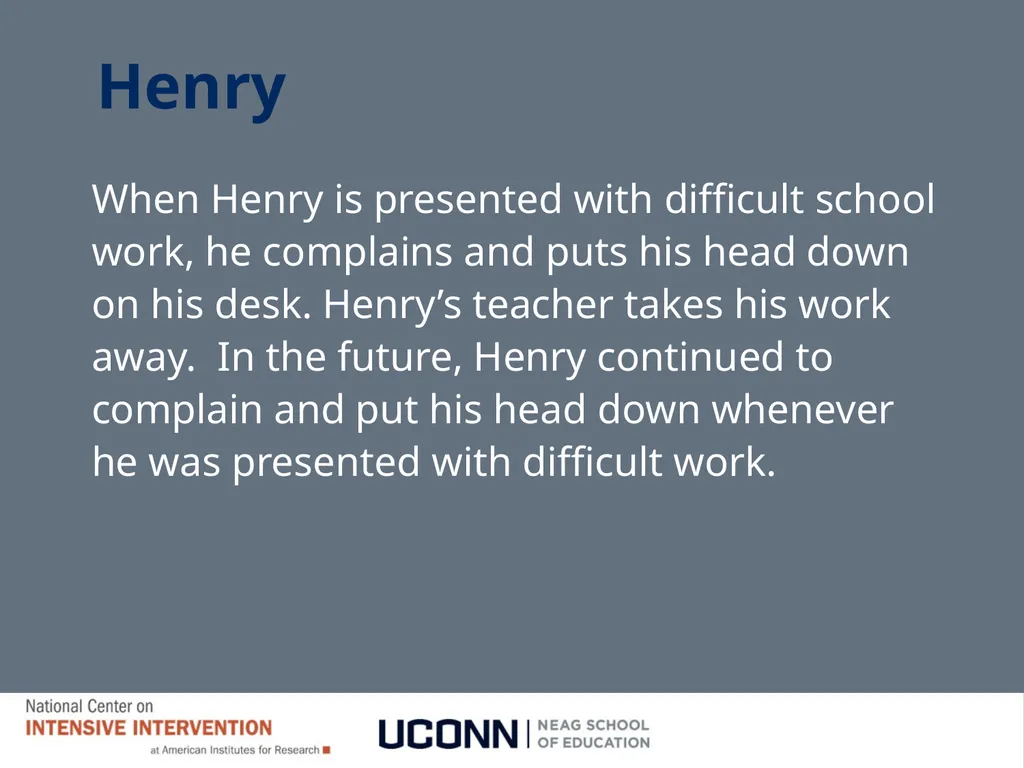
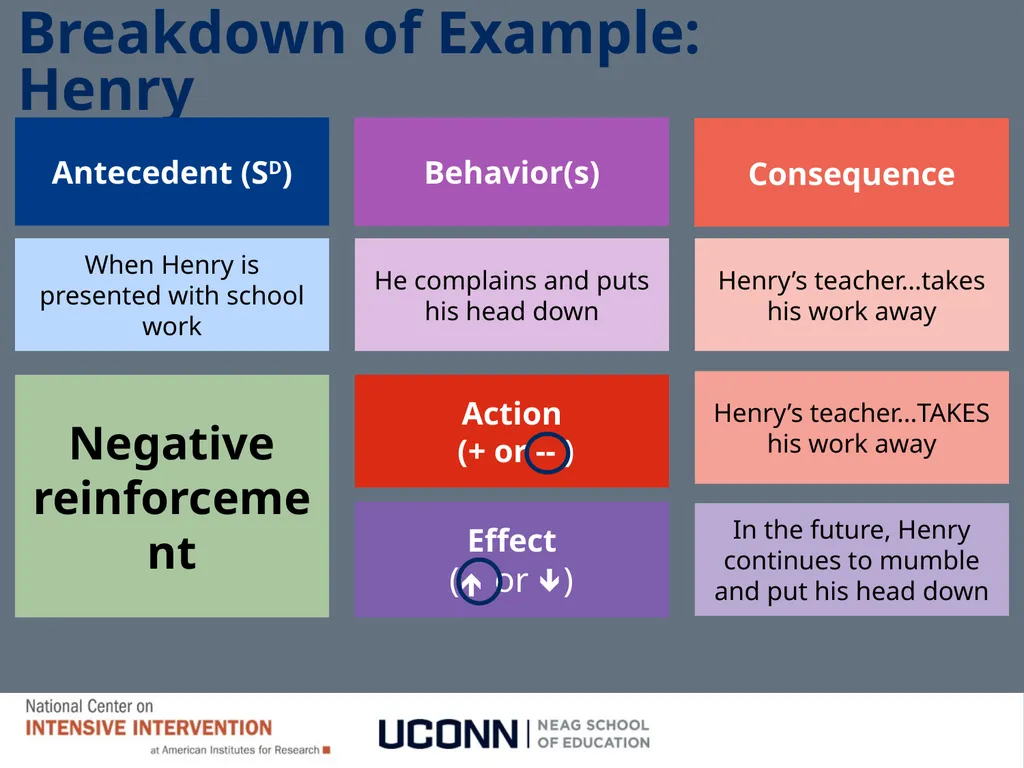
When Henry is presented with difficult school work, he complains and puts his head down on his desk. Henry’s teacher takes his work away. In the future, Henry continued to complain and put his head down whenever he was presented with difficult work. Henry<br>
56
When Henry is presented with school work He complains and puts his head down Henry’s teacher…takes his work away In the future, Henry continues to mumble and put his head down Henry’s teacher…TAKES his work away Negative reinforcement Breakdown of Example: Henry Antecedent (SD) Behavior(s) Consequence Action
(+ or -- ) Effect
( or )<br>
(+ or -- ) Effect
( or )<br>
57
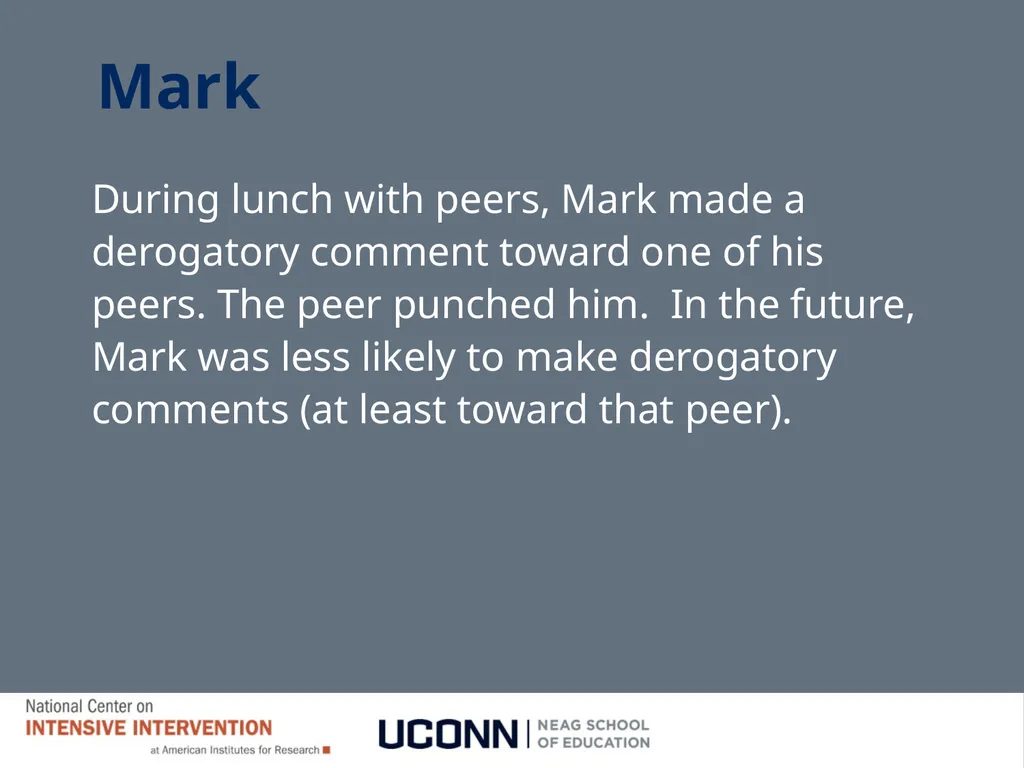
During lunch with peers, Mark made a derogatory comment toward one of his peers. The peer punched him. In the future, Mark was less likely to make derogatory comments (at least toward that peer). Mark<br>
58
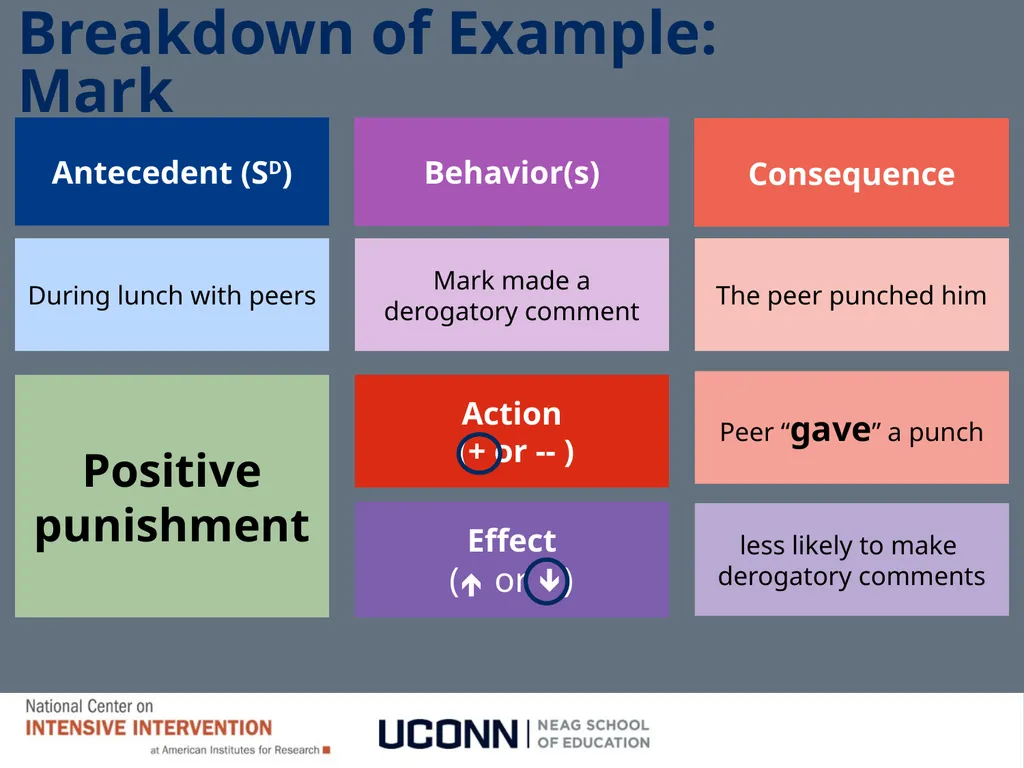
During lunch with peers Mark made a derogatory comment The peer punched him less likely to make derogatory comments Peer “gave” a punch Positive punishment Breakdown of Example: Mark Antecedent (SD) Behavior(s) Consequence Action
(+ or -- ) Effect
( or )<br>
(+ or -- ) Effect
( or )<br>
59
Activity 1.10: Discussion Board
Share your examples of antecedents and consequences Develop an example for each type of consequence (Positive and Negative Reinforcement and Positive and Negative Punishment) Please pause the video to complete Activity 1.10<br>
60
Remember! You only know if a consequence is reinforcing or punishing by looking at the effect on future behavior.<br>
61
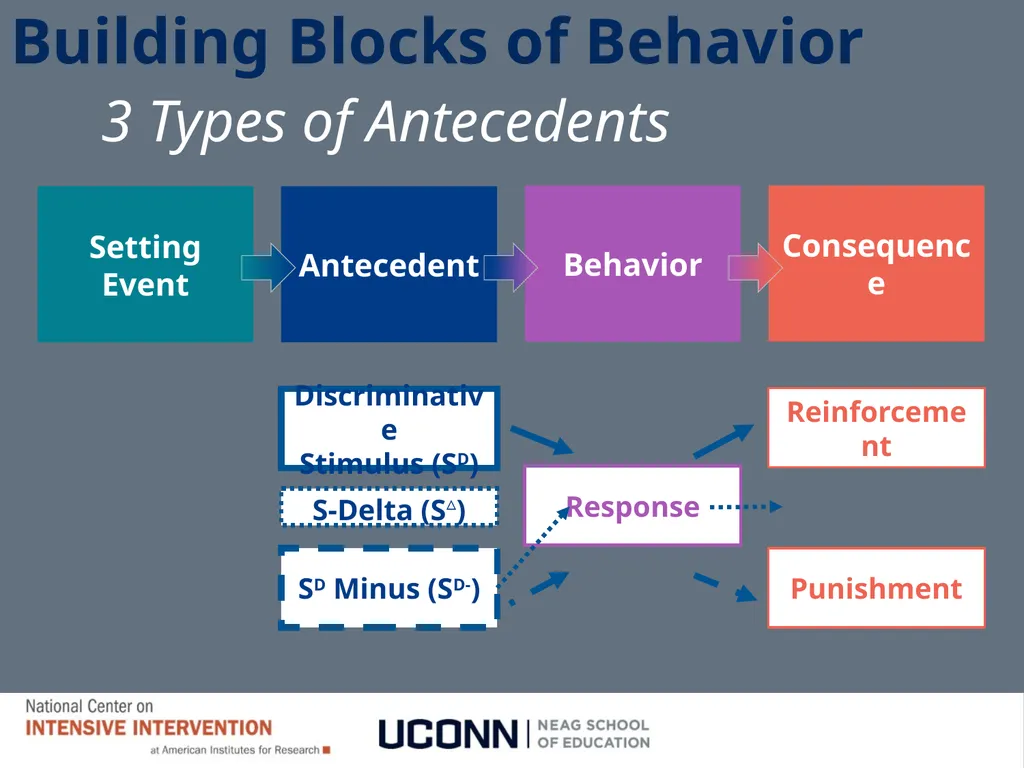
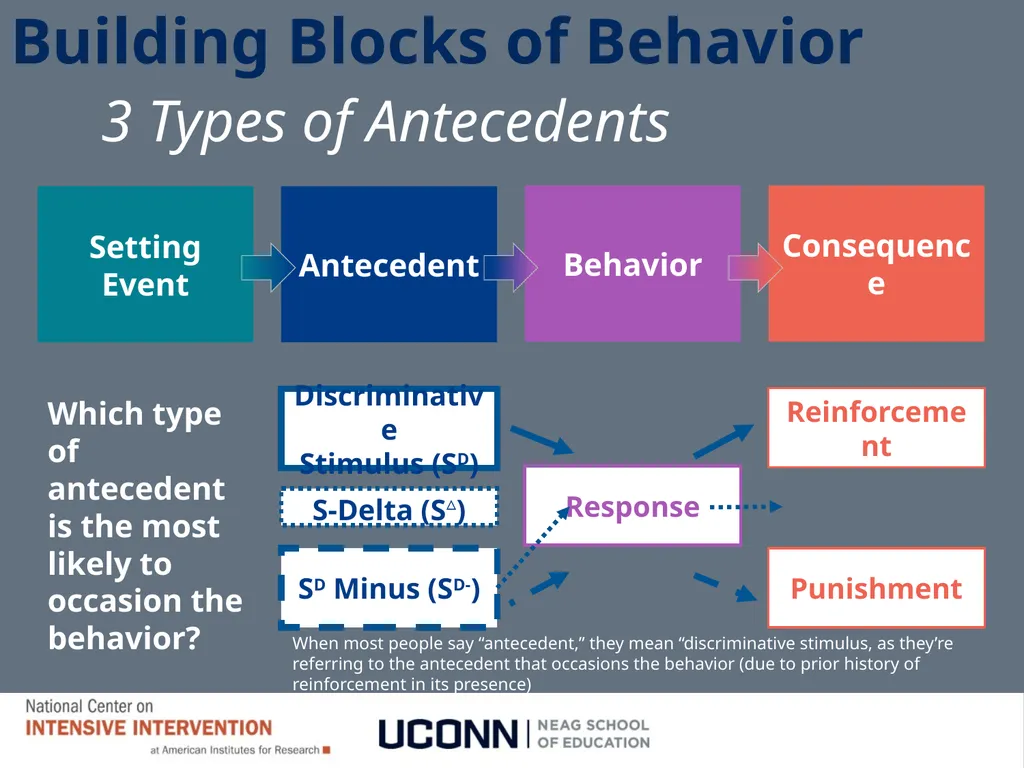
Antecedent Behavior Consequence Setting Event Reinforcement Punishment Discriminative
Stimulus (SD) S-Delta (S▵) SD Minus (SD-) Response Building Blocks of Behavior 3 Types of Antecedents<br>
Stimulus (SD) S-Delta (S▵) SD Minus (SD-) Response Building Blocks of Behavior 3 Types of Antecedents<br>
62
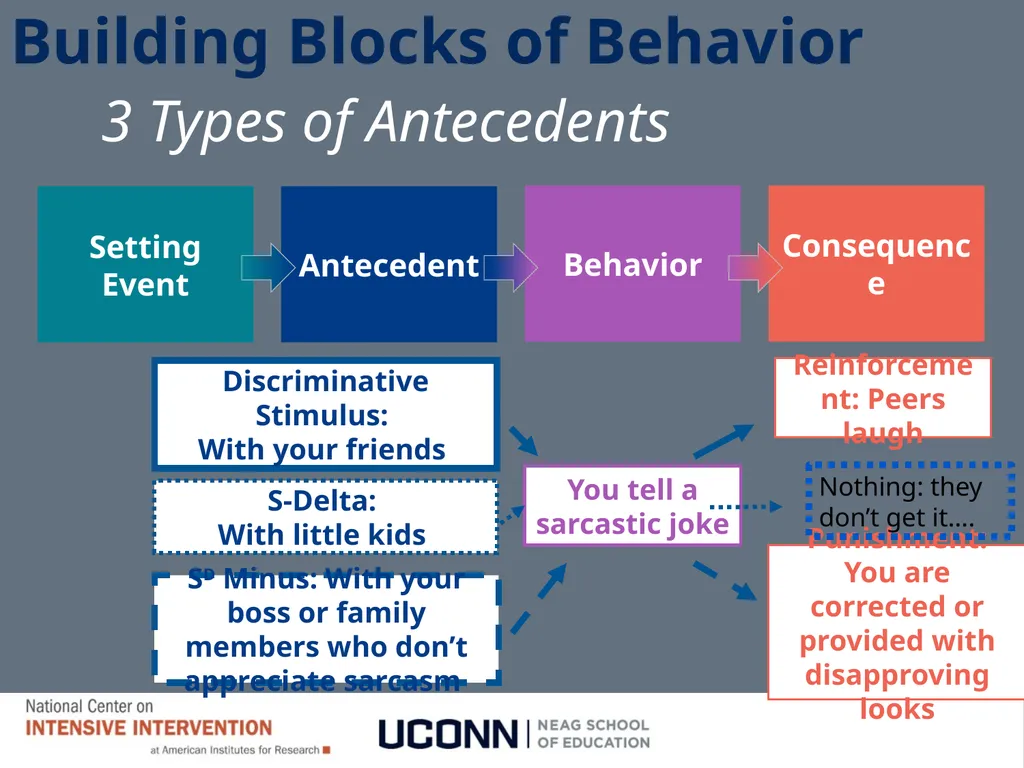
Antecedent Behavior Consequence Setting Event Reinforcement: Peers laugh Punishment: You are corrected or provided with disapproving looks Discriminative
Stimulus:
With your friends S-Delta:
With little kids SD Minus: With your boss or family members who don’t appreciate sarcasm You tell a sarcastic joke Building Blocks of Behavior 3 Types of Antecedents Nothing: they don’t get it….<br>
Stimulus:
With your friends S-Delta:
With little kids SD Minus: With your boss or family members who don’t appreciate sarcasm You tell a sarcastic joke Building Blocks of Behavior 3 Types of Antecedents Nothing: they don’t get it….<br>
63
When most people say “antecedent,” they mean “discriminative stimulus, as they’re referring to the antecedent that occasions the behavior (due to prior history of reinforcement in its presence) Antecedent Behavior Consequence Setting Event Reinforcement Punishment Discriminative
Stimulus (SD) S-Delta (S▵) SD Minus (SD-) Response Which type of antecedent is the most likely to occasion the behavior? Building Blocks of Behavior 3 Types of Antecedents<br>
Stimulus (SD) S-Delta (S▵) SD Minus (SD-) Response Which type of antecedent is the most likely to occasion the behavior? Building Blocks of Behavior 3 Types of Antecedents<br>
64
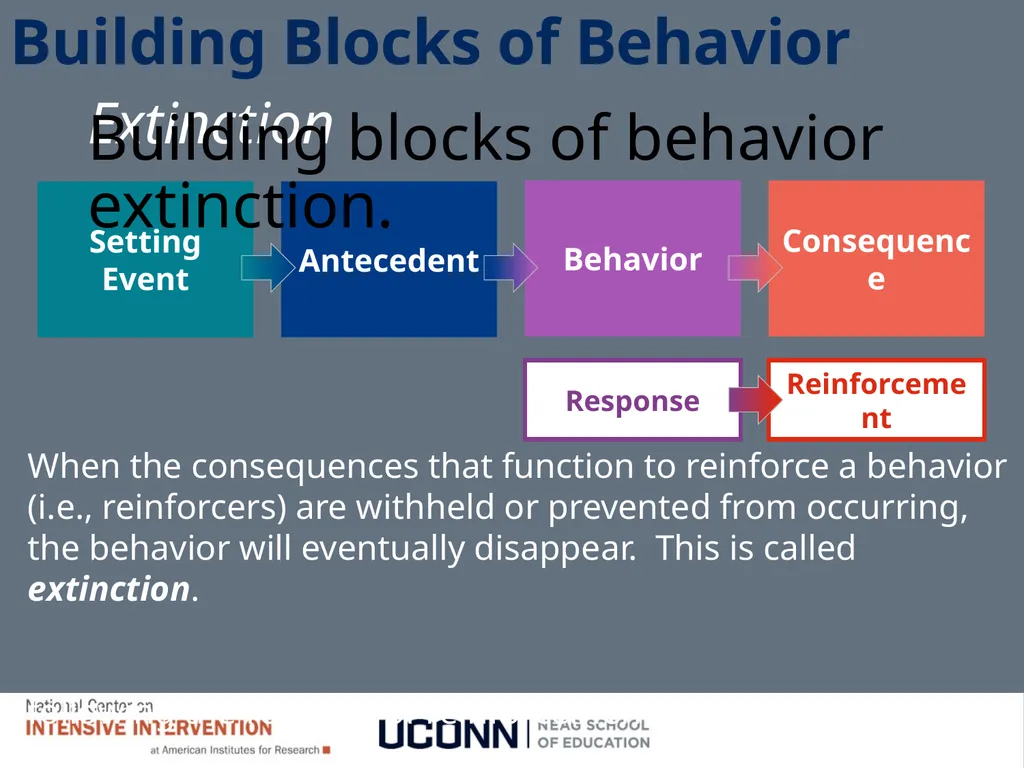
Building Blocks of Behavior Antecedent Behavior Consequence Setting Event Reinforcement Response When the consequences that function to reinforce a behavior (i.e., reinforcers) are withheld or prevented from occurring,
the behavior will eventually disappear. This is called extinction.
An extinction burst is a temporary increase in behavior following the removal of reinforcement. Extinction Building blocks of behavior extinction.<br>
the behavior will eventually disappear. This is called extinction.
An extinction burst is a temporary increase in behavior following the removal of reinforcement. Extinction Building blocks of behavior extinction.<br>
65
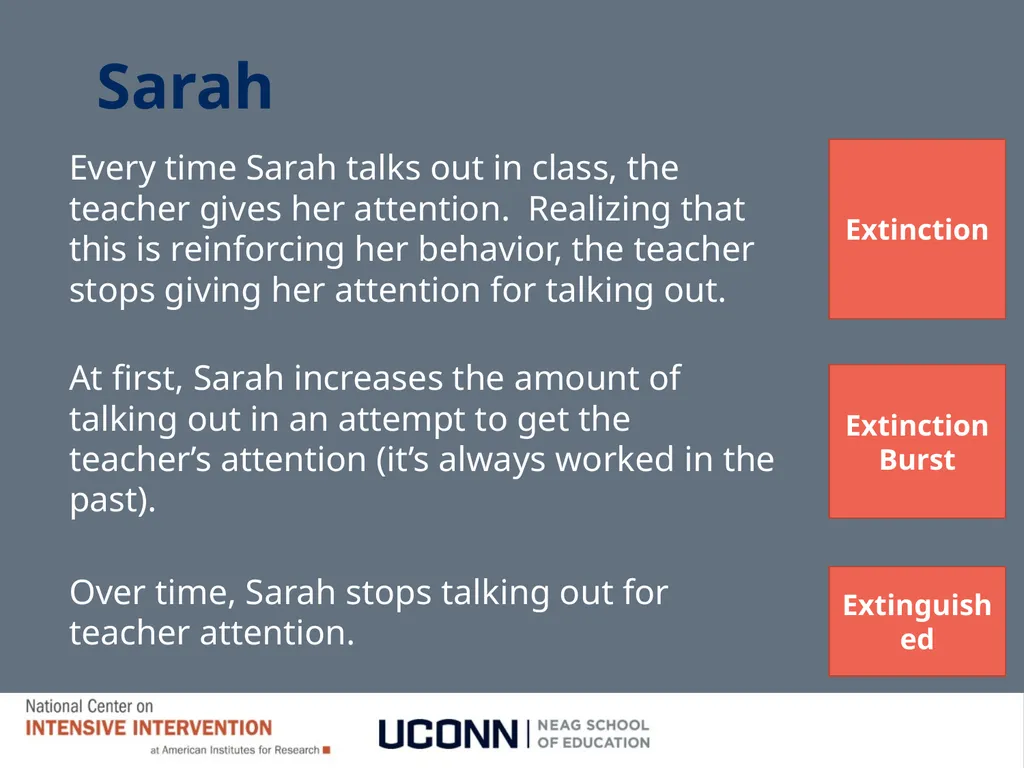
Sarah Every time Sarah talks out in class, the teacher gives her attention. Realizing that this is reinforcing her behavior, the teacher stops giving her attention for talking out.
At first, Sarah increases the amount of talking out in an attempt to get the teacher’s attention (it’s always worked in the past).
Over time, Sarah stops talking out for teacher attention. Extinction Extinction
Burst Extinguished<br>
At first, Sarah increases the amount of talking out in an attempt to get the teacher’s attention (it’s always worked in the past).
Over time, Sarah stops talking out for teacher attention. Extinction Extinction
Burst Extinguished<br>
66
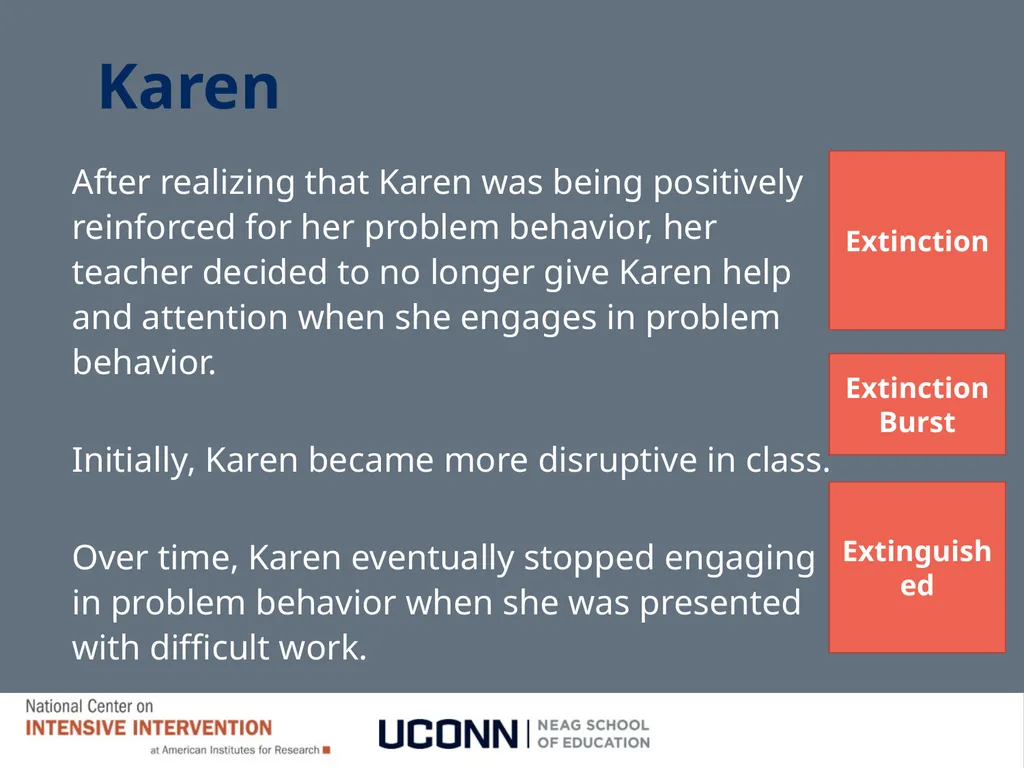
After realizing that Karen was being positively reinforced for her problem behavior, her teacher decided to no longer give Karen help and attention when she engages in problem behavior.
Initially, Karen became more disruptive in class.
Over time, Karen eventually stopped engaging in problem behavior when she was presented with difficult work. Karen Extinction Extinction
Burst Extinguished<br>
Initially, Karen became more disruptive in class.
Over time, Karen eventually stopped engaging in problem behavior when she was presented with difficult work. Karen Extinction Extinction
Burst Extinguished<br>
67
Activity 1.11: Stop and Jot
Your examples of extinction Develop an example to illustrate extinction.
Develop an example of an extinction burst Please pause the video to complete Activity 1.11<br>
Develop an example of an extinction burst Please pause the video to complete Activity 1.11<br>
68
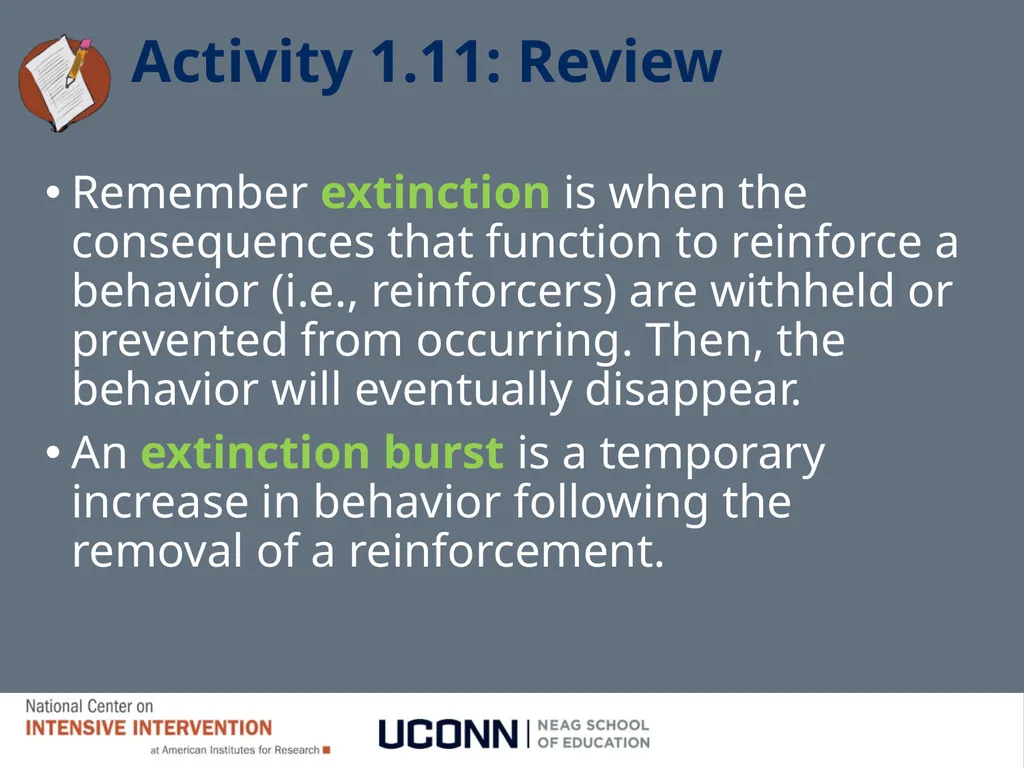
Activity 1.11: Review Remember extinction is when the consequences that function to reinforce a behavior (i.e., reinforcers) are withheld or prevented from occurring. Then, the behavior will eventually disappear.
An extinction burst is a temporary increase in behavior following the removal of a reinforcement.<br>
An extinction burst is a temporary increase in behavior following the removal of a reinforcement.<br>
69
Behavioral Theory I Part 4
How Do We Determine the Function of Behavior?<br>
How Do We Determine the Function of Behavior?<br>
70
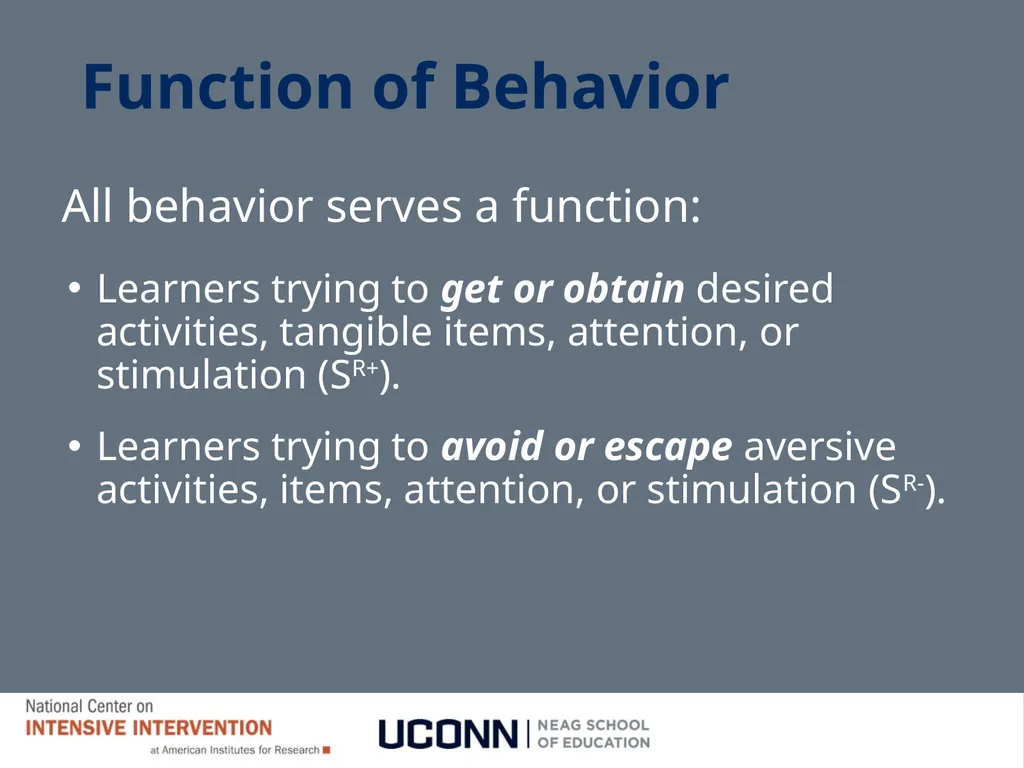
All behavior serves a function:
Learners trying to get or obtain desired activities, tangible items, attention, or stimulation (SR+).
Learners trying to avoid or escape aversive activities, items, attention, or stimulation (SR-). Function of Behavior<br>
Learners trying to get or obtain desired activities, tangible items, attention, or stimulation (SR+).
Learners trying to avoid or escape aversive activities, items, attention, or stimulation (SR-). Function of Behavior<br>
71
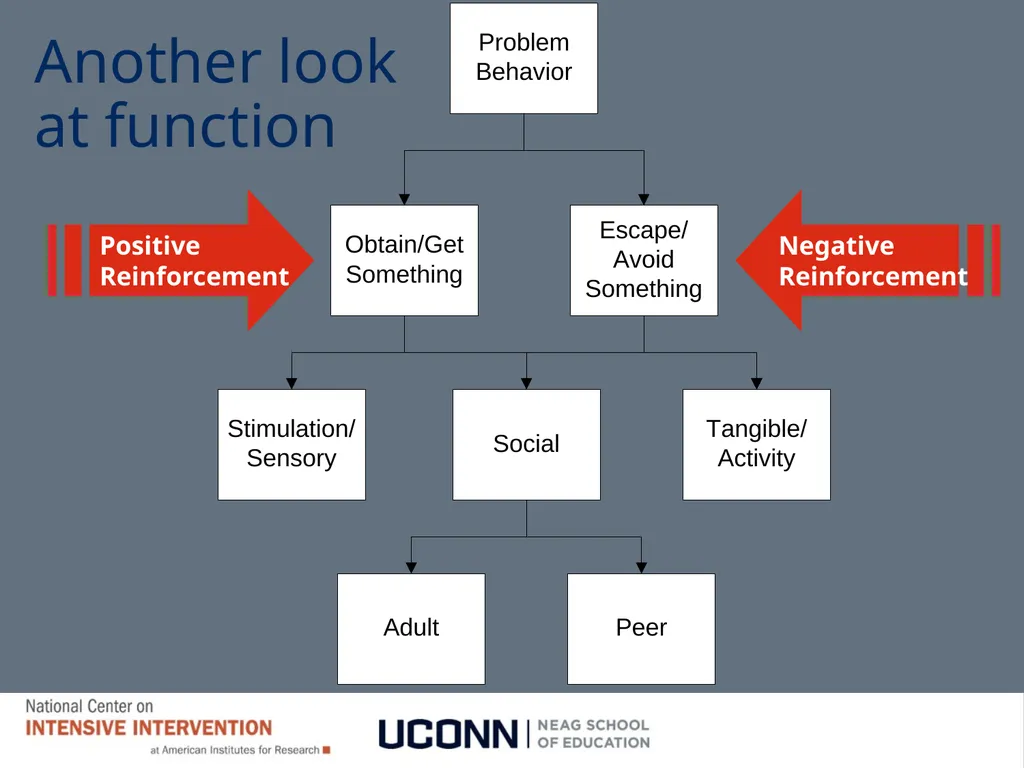
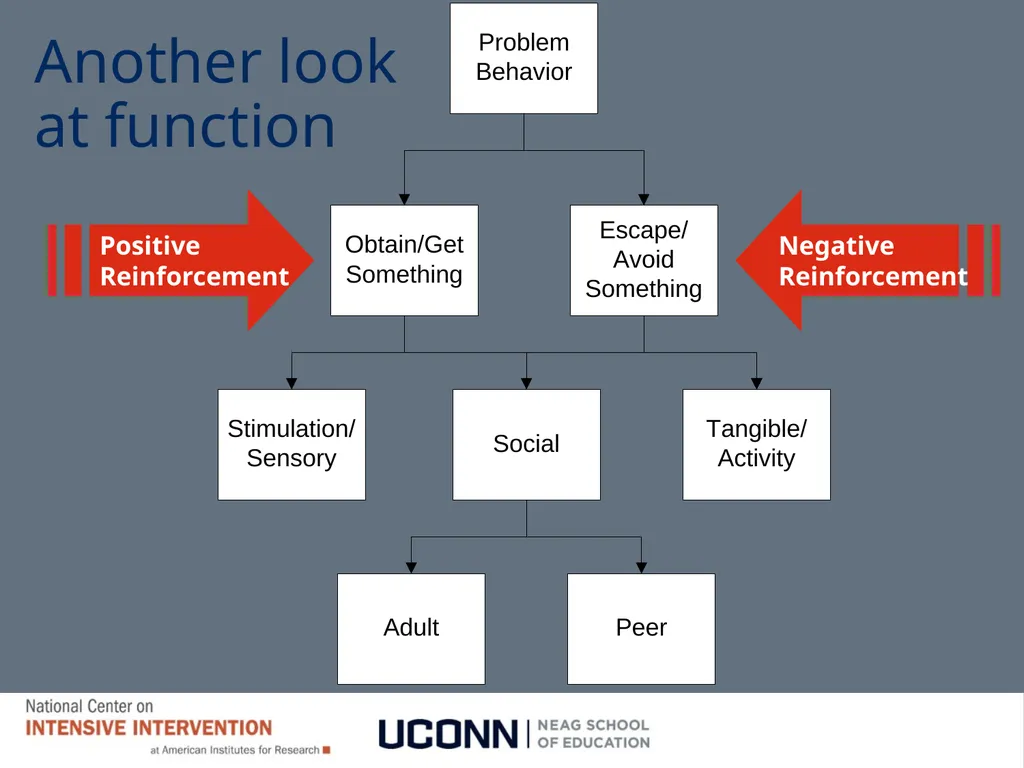
Positive
Reinforcement Negative
Reinforcement Another look at function<br>
Reinforcement Negative
Reinforcement Another look at function<br>
72
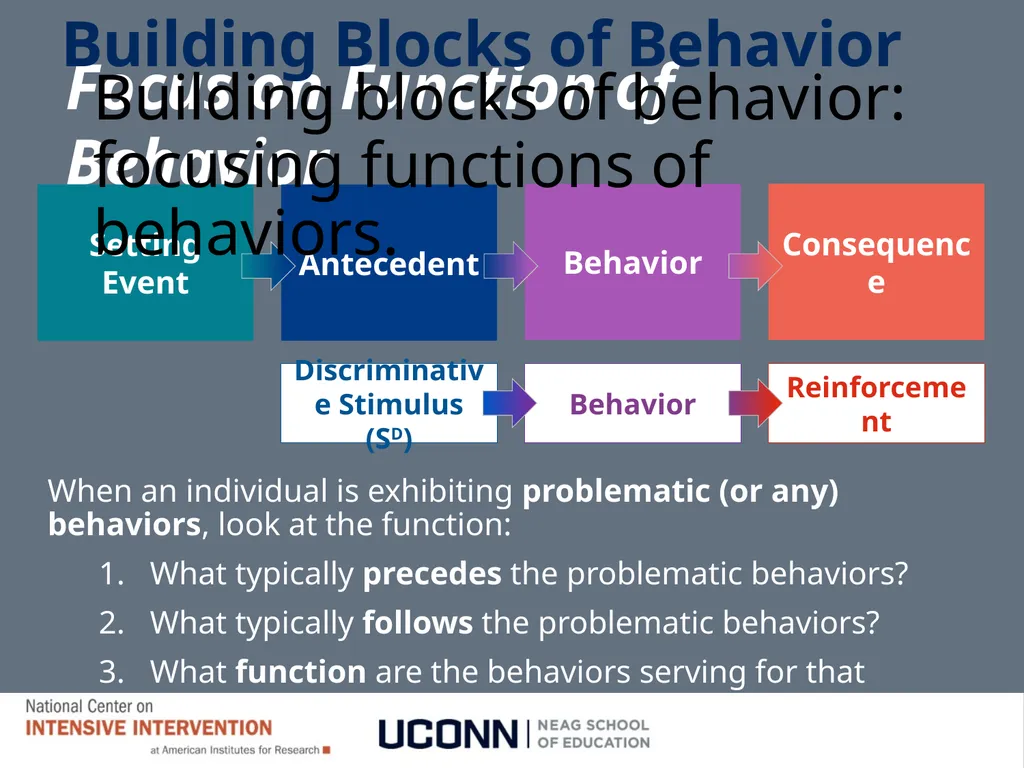
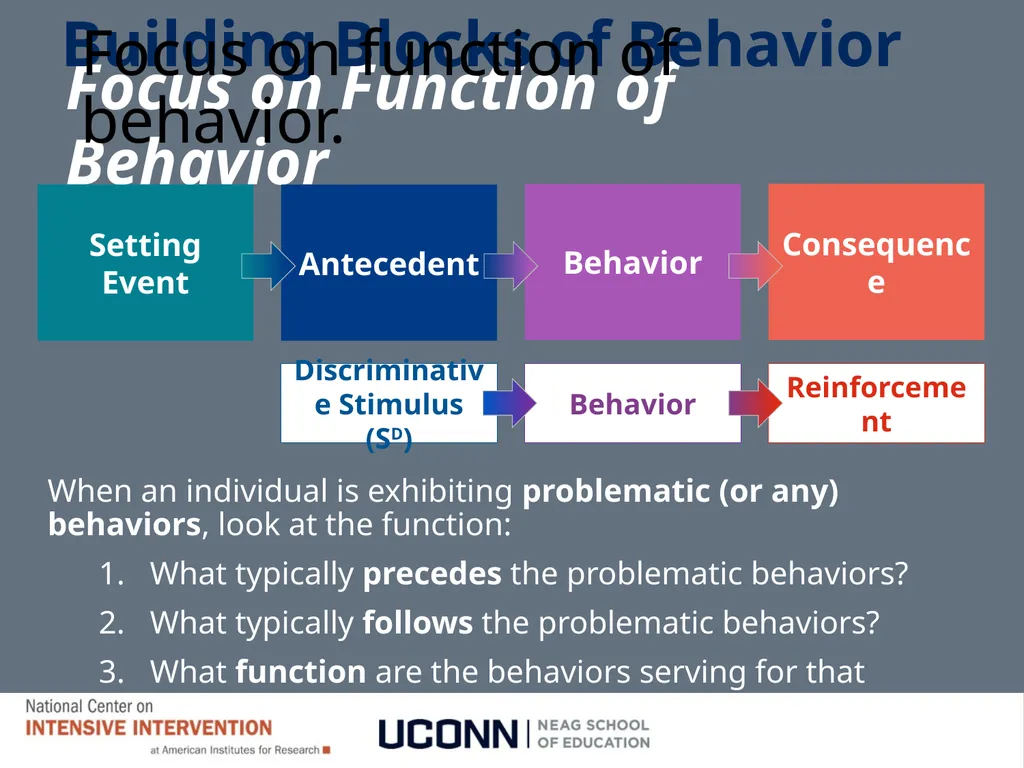
Focus on Function of Behavior Building Blocks of Behavior Antecedent Behavior Consequence Setting Event Reinforcement Behavior When an individual is exhibiting problematic (or any) behaviors, look at the function:
What typically precedes the problematic behaviors?
What typically follows the problematic behaviors?
What function are the behaviors serving for that individual? Discriminative Stimulus (SD) Building blocks of behavior: focusing functions of behaviors.<br>
What typically precedes the problematic behaviors?
What typically follows the problematic behaviors?
What function are the behaviors serving for that individual? Discriminative Stimulus (SD) Building blocks of behavior: focusing functions of behaviors.<br>
73
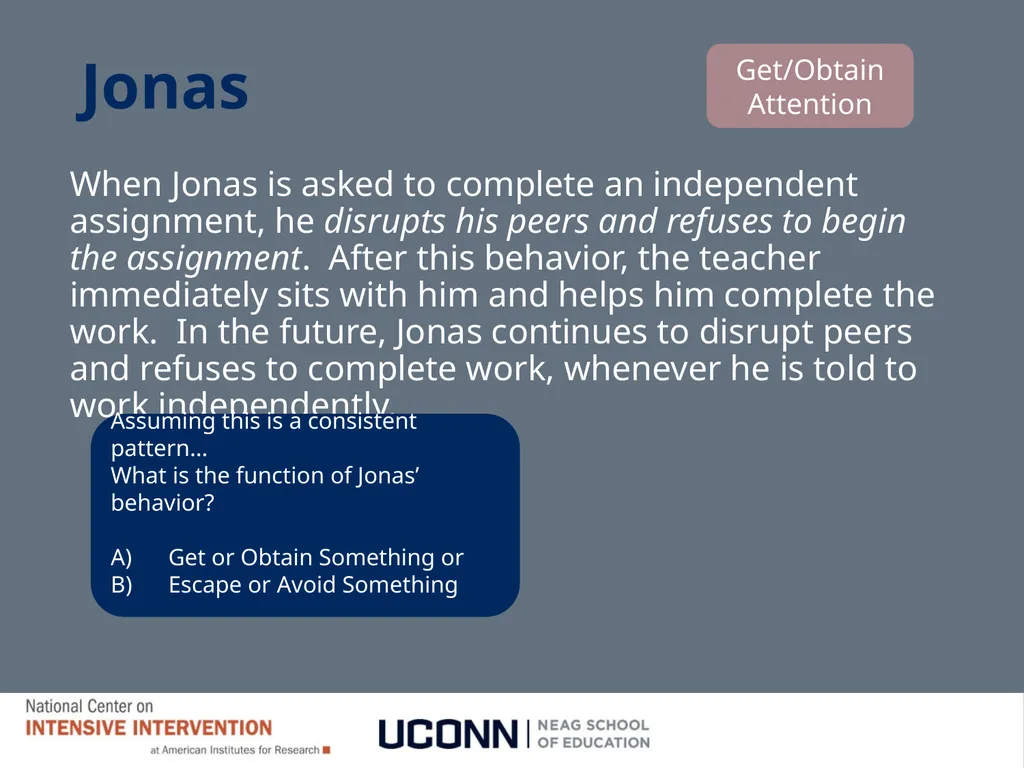
When Jonas is asked to complete an independent assignment, he disrupts his peers and refuses to begin the assignment. After this behavior, the teacher immediately sits with him and helps him complete the work. In the future, Jonas continues to disrupt peers and refuses to complete work, whenever he is told to work independently. Assuming this is a consistent pattern…
What is the function of Jonas’ behavior?
Get or Obtain Something or
Escape or Avoid Something Get/Obtain Attention Jonas<br>
What is the function of Jonas’ behavior?
Get or Obtain Something or
Escape or Avoid Something Get/Obtain Attention Jonas<br>
74
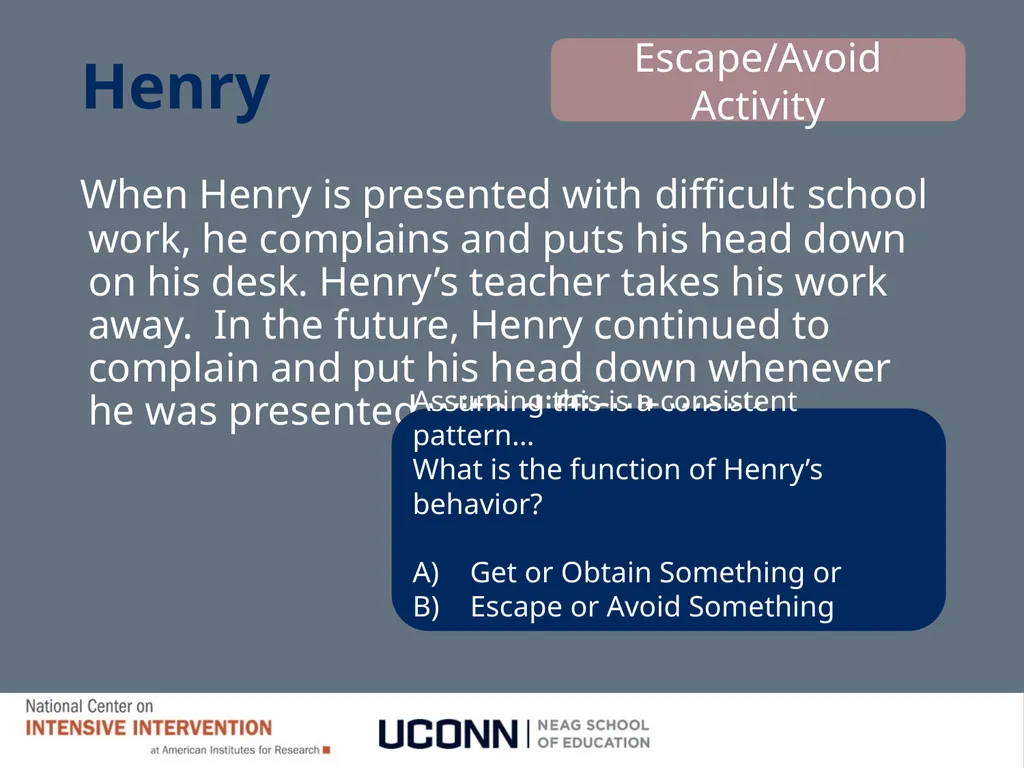
When Henry is presented with difficult school work, he complains and puts his head down on his desk. Henry’s teacher takes his work away. In the future, Henry continued to complain and put his head down whenever he was presented with difficult work. Henry Assuming this is a consistent pattern…
What is the function of Henry’s behavior?
Get or Obtain Something or
Escape or Avoid Something Escape/Avoid Activity<br>
What is the function of Henry’s behavior?
Get or Obtain Something or
Escape or Avoid Something Escape/Avoid Activity<br>
75
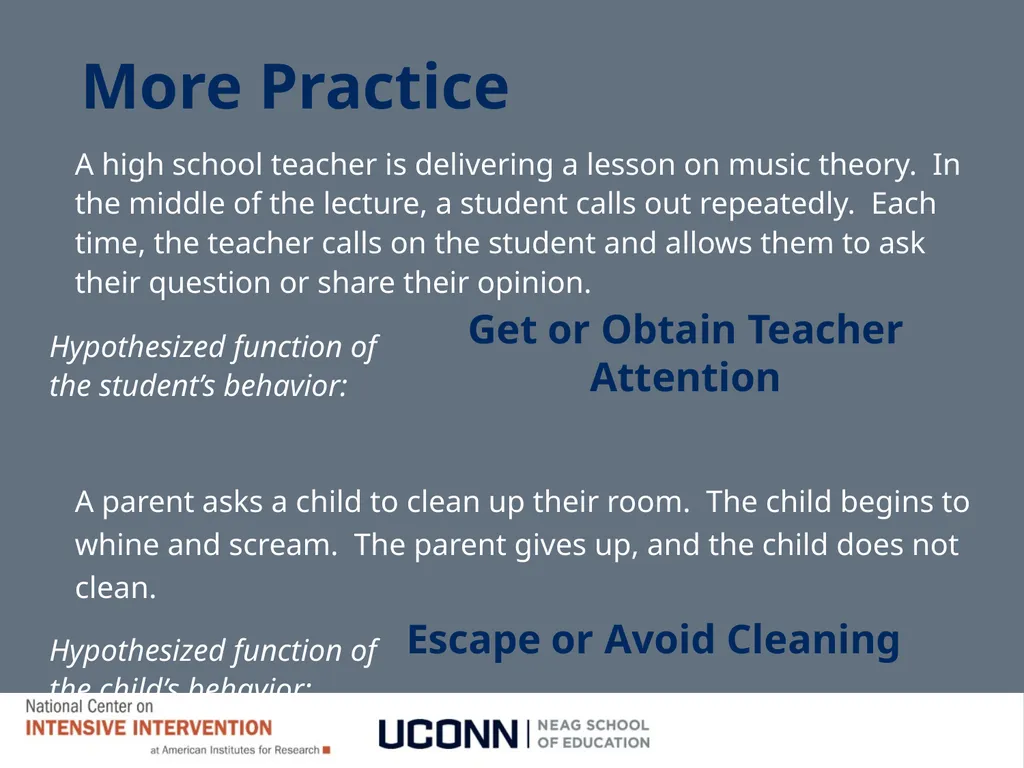
More Practice A high school teacher is delivering a lesson on music theory. In the middle of the lecture, a student calls out repeatedly. Each time, the teacher calls on the student and allows them to ask their question or share their opinion.
Hypothesized function of
the student’s behavior:
A parent asks a child to clean up their room. The child begins to whine and scream. The parent gives up, and the child does not clean.
Hypothesized function of
the child’s behavior: Get or Obtain Teacher Attention Escape or Avoid Cleaning<br>
Hypothesized function of
the student’s behavior:
A parent asks a child to clean up their room. The child begins to whine and scream. The parent gives up, and the child does not clean.
Hypothesized function of
the child’s behavior: Get or Obtain Teacher Attention Escape or Avoid Cleaning<br>
76
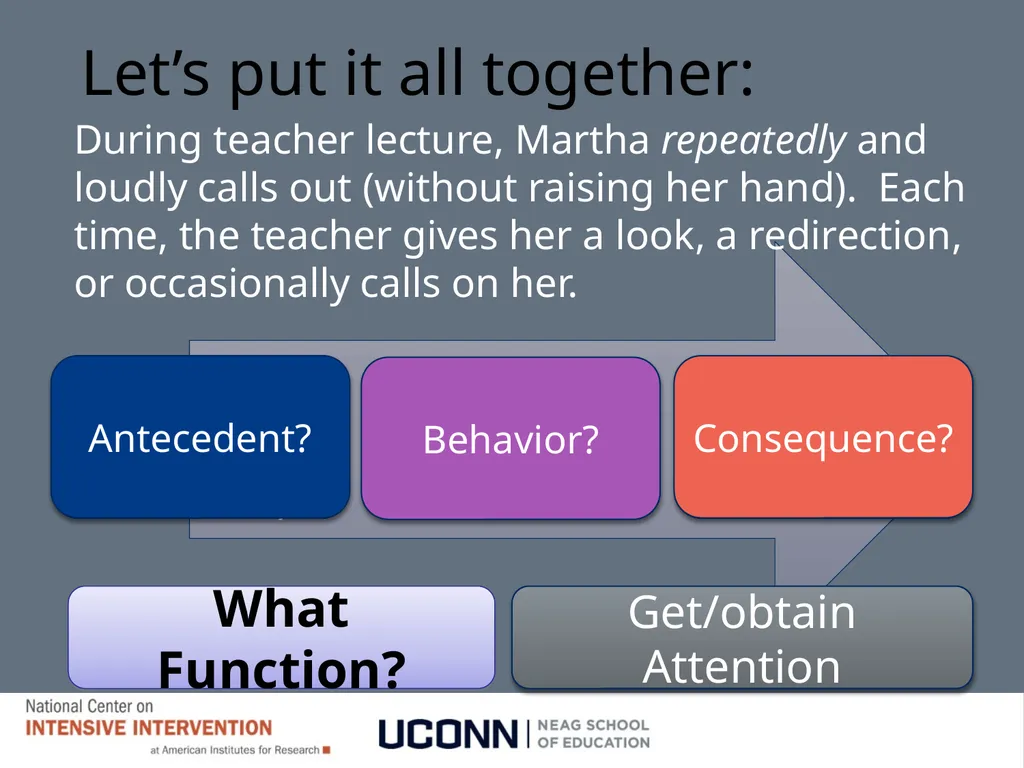
What Function? Get/obtain Attention Antecedent? Behavior? Consequence? During teacher lecture, Martha repeatedly and loudly calls out (without raising her hand). Each time, the teacher gives her a look, a redirection, or occasionally calls on her. Let’s put it all together:<br>
77
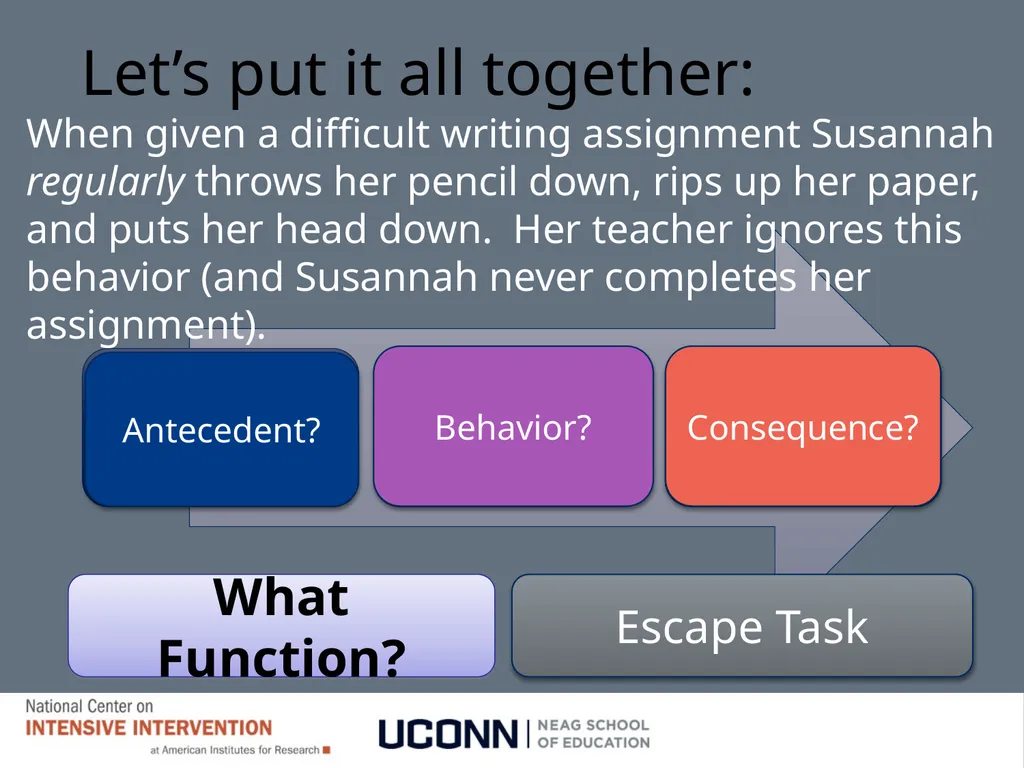
What Function? Escape Task Antecedent? When given a difficult writing assignment Susannah regularly throws her pencil down, rips up her paper, and puts her head down. Her teacher ignores this behavior (and Susannah never completes her assignment). Behavior? Consequence? Let’s put it all together:<br>
78
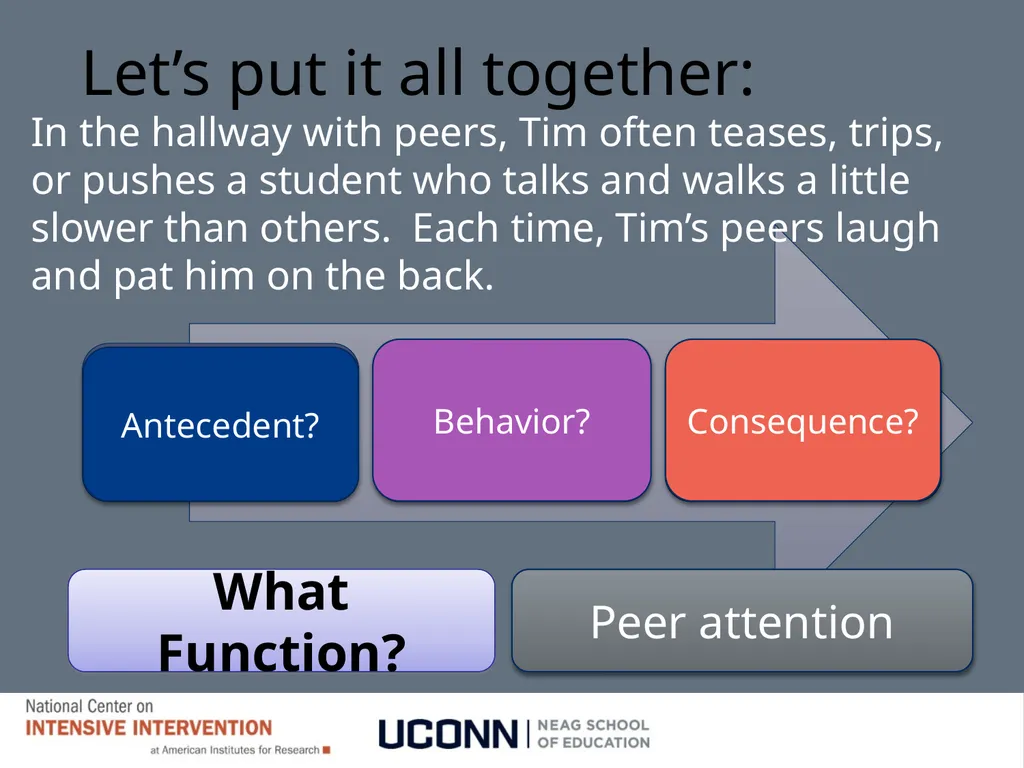
What Function? Peer attention Antecedent? In the hallway with peers, Tim often teases, trips, or pushes a student who talks and walks a little slower than others. Each time, Tim’s peers laugh and pat him on the back. Behavior? Consequence? Let’s put it all together:<br>
79
Activity 1.12: Stop and Jot
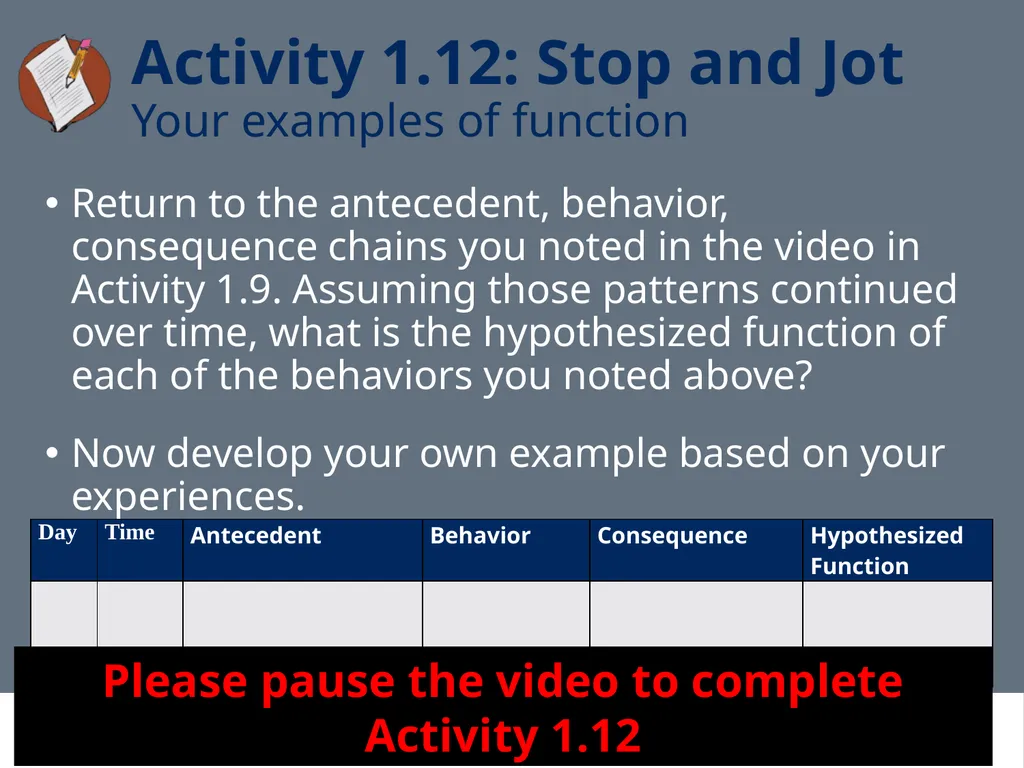
Your examples of function Return to the antecedent, behavior, consequence chains you noted in the video in Activity 1.9. Assuming those patterns continued over time, what is the hypothesized function of each of the behaviors you noted above?
Now develop your own example based on your experiences. Please pause the video to complete Activity 1.12<br>
Now develop your own example based on your experiences. Please pause the video to complete Activity 1.12<br>
80
Activity 1.12: Review Let’s review the first video together.
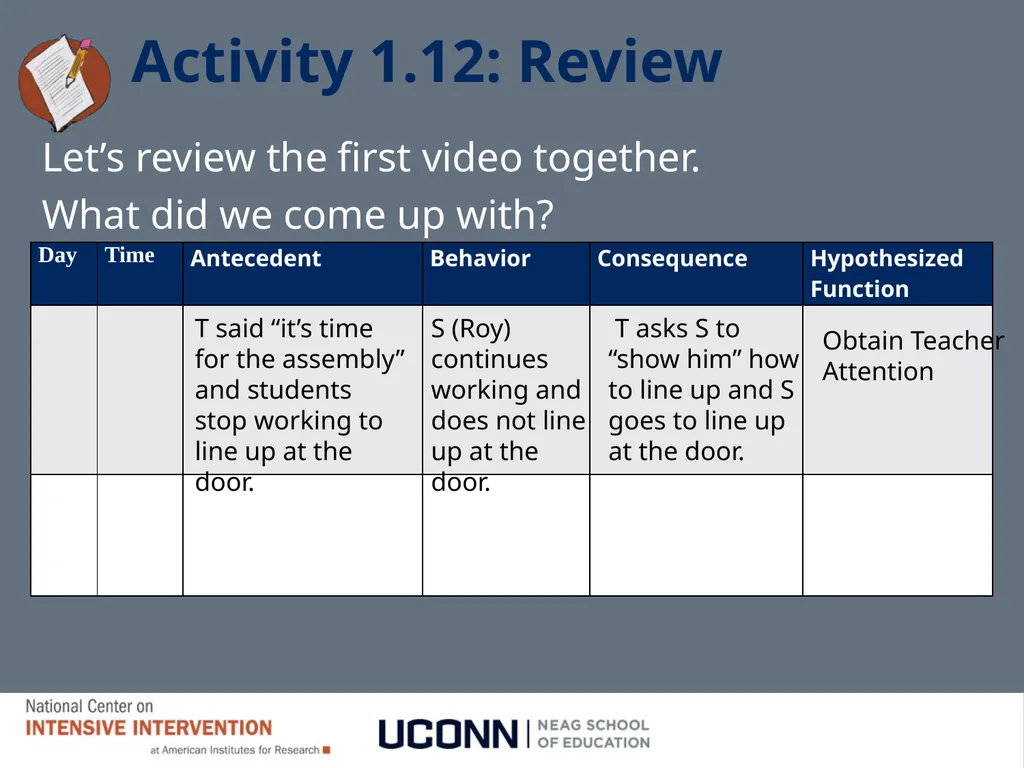
What did we come up with? T said “it’s time for the assembly” and students stop working to line up at the door. S (Roy) continues working and does not line up at the door. T asks S to “show him” how to line up and S goes to line up at the door. Obtain Teacher Attention<br>
What did we come up with? T said “it’s time for the assembly” and students stop working to line up at the door. S (Roy) continues working and does not line up at the door. T asks S to “show him” how to line up and S goes to line up at the door. Obtain Teacher Attention<br>
81
Activity 1.13: Discussion Board
Function discussion How does an understanding of the context in which behavior occurs (ABC) help you develop interventions?
Share a time you think you have seen a mismatch between function and intervention? Please pause the video to complete Activity 1.13<br>
Share a time you think you have seen a mismatch between function and intervention? Please pause the video to complete Activity 1.13<br>
82
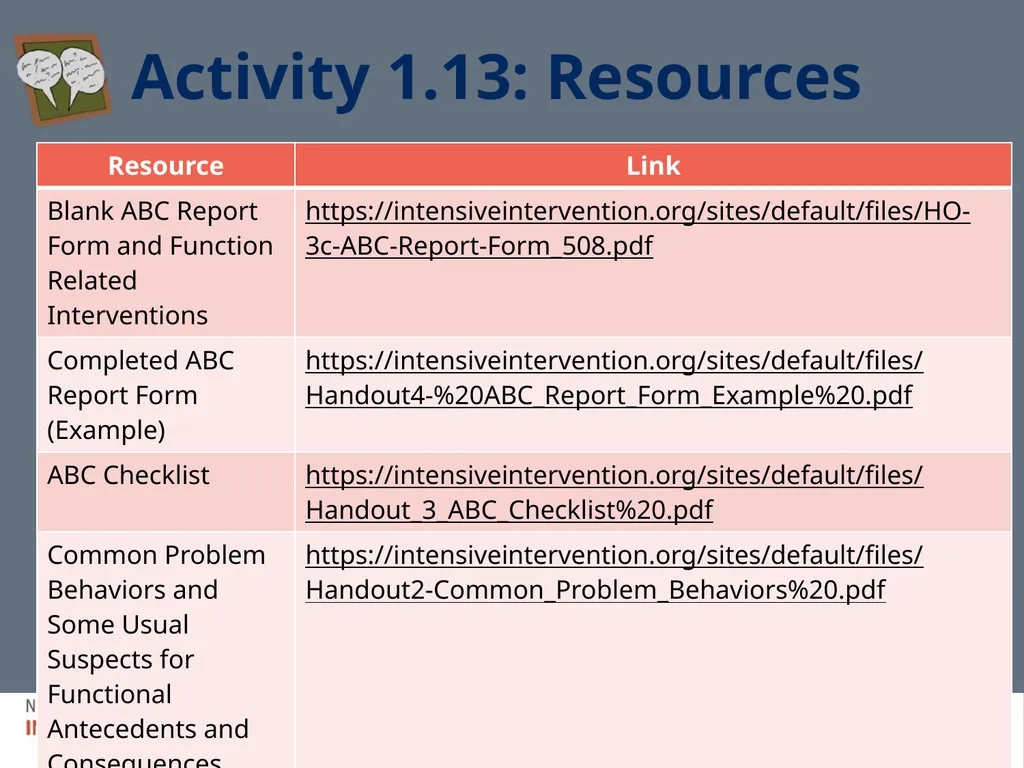
Activity 1.13: Resources<br>
83
PBIS Big Ideas 4 PBIS Elements Continuum of Support<br>
84
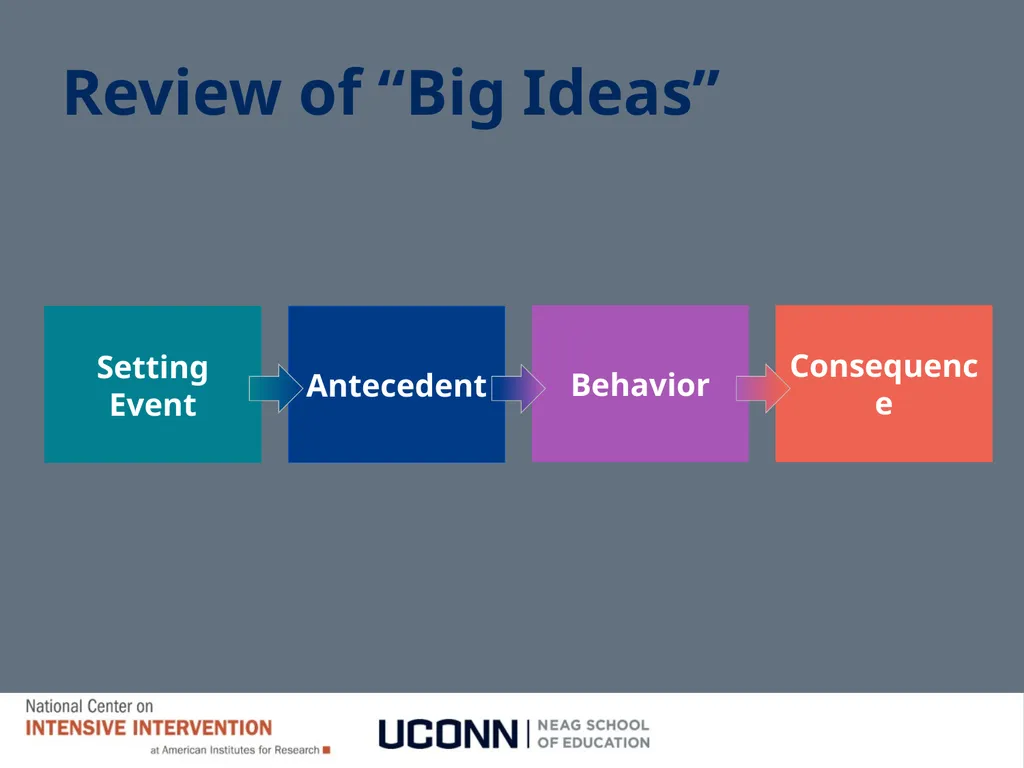
Antecedent Behavior Consequence Setting Event Review of “Big Ideas”<br>
85
Antecedent Behavior Consequence Setting Event An ”observable and measurable act of an individual (also called a response).” A “stimulus that precedes a behavior.” A stimulus change that occurs contingent on a behavior. We’ll learn more about this in the next module. Three Term Contingency Building Blocks of Behavior<br>
86
Positive Negative Building Blocks of Behavior Antecedent Behavior Consequence Setting Event Types of Consequences Reinforcement Future
Probability Punishment Future
Probability Effect on
Future Behavior Give Take Action SR+ SR- SP+ SP- 4 Putting it all together: Building blocks of behavior 4 types of consequences.<br>
Probability Punishment Future
Probability Effect on
Future Behavior Give Take Action SR+ SR- SP+ SP- 4 Putting it all together: Building blocks of behavior 4 types of consequences.<br>
87
Antecedent Behavior Consequence Setting Event Reinforcement Punishment Discriminative
Stimulus (SD) S-Delta (S▵) SD Minus (SD-) Response Which type of antecedent is the most likely to occasion the behavior? Building Blocks of Behavior 3 Types of Antecedents When most people say “antecedent,” they mean “discriminative stimulus, as they’re referring to the antecedent that occasions the behavior (due to prior history of reinforcement in its presence)<br>
Stimulus (SD) S-Delta (S▵) SD Minus (SD-) Response Which type of antecedent is the most likely to occasion the behavior? Building Blocks of Behavior 3 Types of Antecedents When most people say “antecedent,” they mean “discriminative stimulus, as they’re referring to the antecedent that occasions the behavior (due to prior history of reinforcement in its presence)<br>
88
Positive
Reinforcement Negative
Reinforcement Another look at function<br>
Reinforcement Negative
Reinforcement Another look at function<br>
89
Focus on Function of Behavior Building Blocks of Behavior Antecedent Behavior Consequence Setting Event Reinforcement Behavior When an individual is exhibiting problematic (or any) behaviors, look at the function:
What typically precedes the problematic behaviors?
What typically follows the problematic behaviors?
What function are the behaviors serving for that individual? Discriminative Stimulus (SD) Focus on function of behavior.<br>
What typically precedes the problematic behaviors?
What typically follows the problematic behaviors?
What function are the behaviors serving for that individual? Discriminative Stimulus (SD) Focus on function of behavior.<br>
90
What’s next Module 1 Self-Assessment Quiz<br>