
Module 1 Grief First Aid – Handout’s How to use

Description: Module 1 Grief First Aid Handouts How to use the QR codes and images in this document. Printed Point your phone camera at them and open the link to take you to the material. On a digital page - You can click the QR codes or an image,
Related Topics
Download Presentation
"Module 1 Grief First Aid – Handout’s How to use" is the property of its rightful owner. Permission is granted to download and print the materials on this website for personal, non-commercial use only, and to display it on your personal computer provided you do not modify the materials and that you retain all copyright notices contained in the materials. By downloading content from our website, you accept the terms of this agreement.
Presentation Transcript
slide1. Module 1 Grief First Aid – Handout’s How to use the QR codes and images in this document.
Printed – Point your phone camera at them and open the link to take you to the material.
On a digital page - You can click the QR codes or an image, and you will be taken to the webpage.<br>
slide2. Group Agreement Foundation working agreement
Before attending Day 1 of the training, consider the items below that may contribute to a safe learning environment and pencil in any additions you would like to see included or strike though anything you consider inappropriate.
We will treat each other with respect and patience.
We will honestly share with one another and maintain confidentiality, anything personal that is said/shared in the room stays in the room. Anything of a personal nature said in small groups will only be shared with permission.
We will be supportive to one another, behaving in a non-judgmental manner.
We will be open to new ideas and clarify misunderstandings.
We will maintain our commitment to the course.
We will be prompt in our timekeeping and maintain good attendance. If we are unavailable for a session or start time, we will notify the trainer in advance.
Additions.<br>
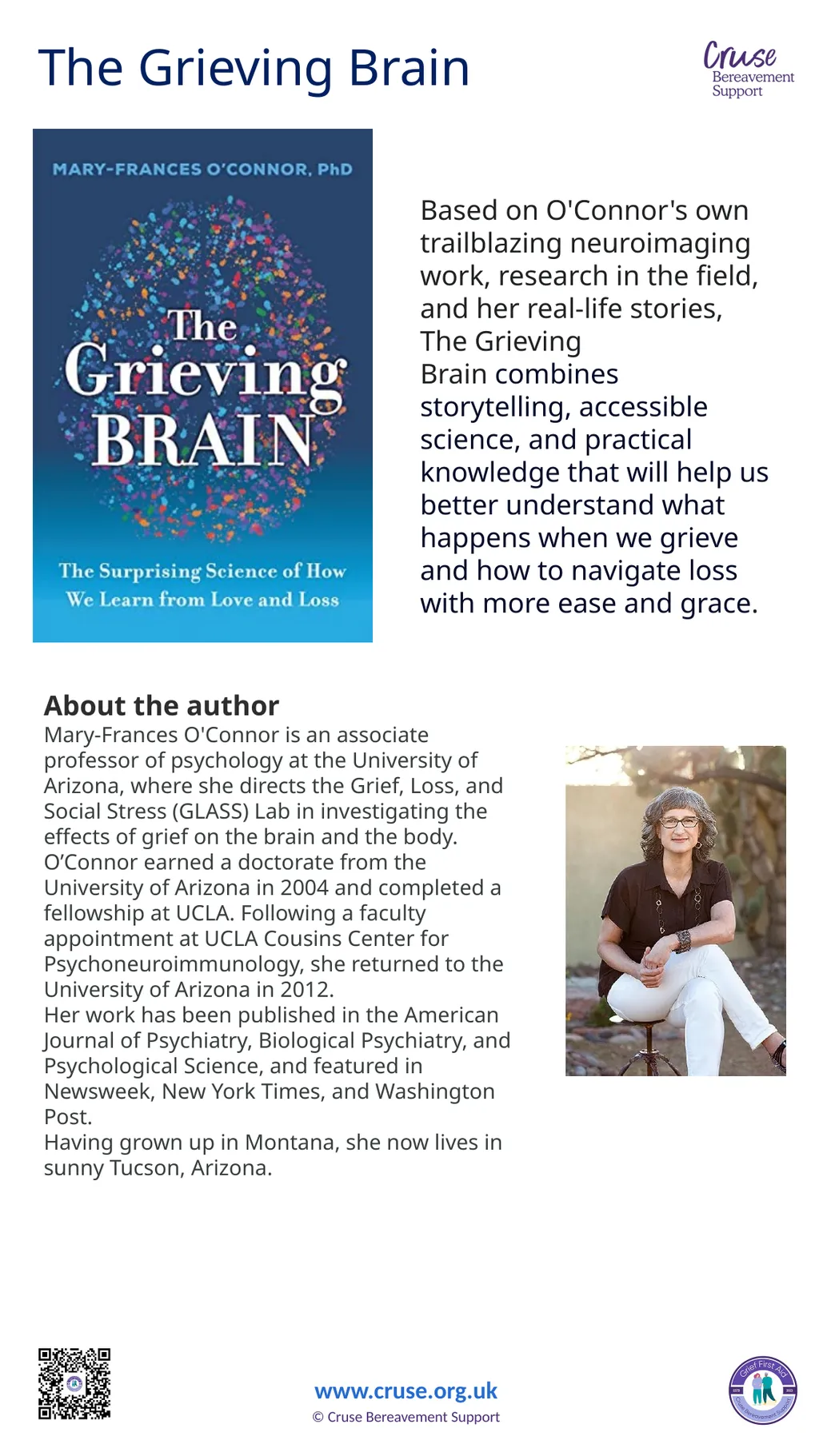
slide3. The Grieving Brain About the author
Mary-Frances O'Connor is an associate professor of psychology at the University of Arizona, where she directs the Grief, Loss, and Social Stress (GLASS) Lab in investigating the effects of grief on the brain and the body.
O’Connor earned a doctorate from the University of Arizona in 2004 and completed a fellowship at UCLA. Following a faculty appointment at UCLA Cousins Center for Psychoneuroimmunology, she returned to the University of Arizona in 2012.
Her work has been published in the American Journal of Psychiatry, Biological Psychiatry, and Psychological Science, and featured in Newsweek, New York Times, and Washington Post.
Having grown up in Montana, she now lives in sunny Tucson, Arizona. Based on O'Connor's own trailblazing neuroimaging work, research in the field, and her real-life stories, The Grieving Brain combines storytelling, accessible science, and practical knowledge that will help us better understand what happens when we grieve and how to navigate loss with more ease and grace.<br>
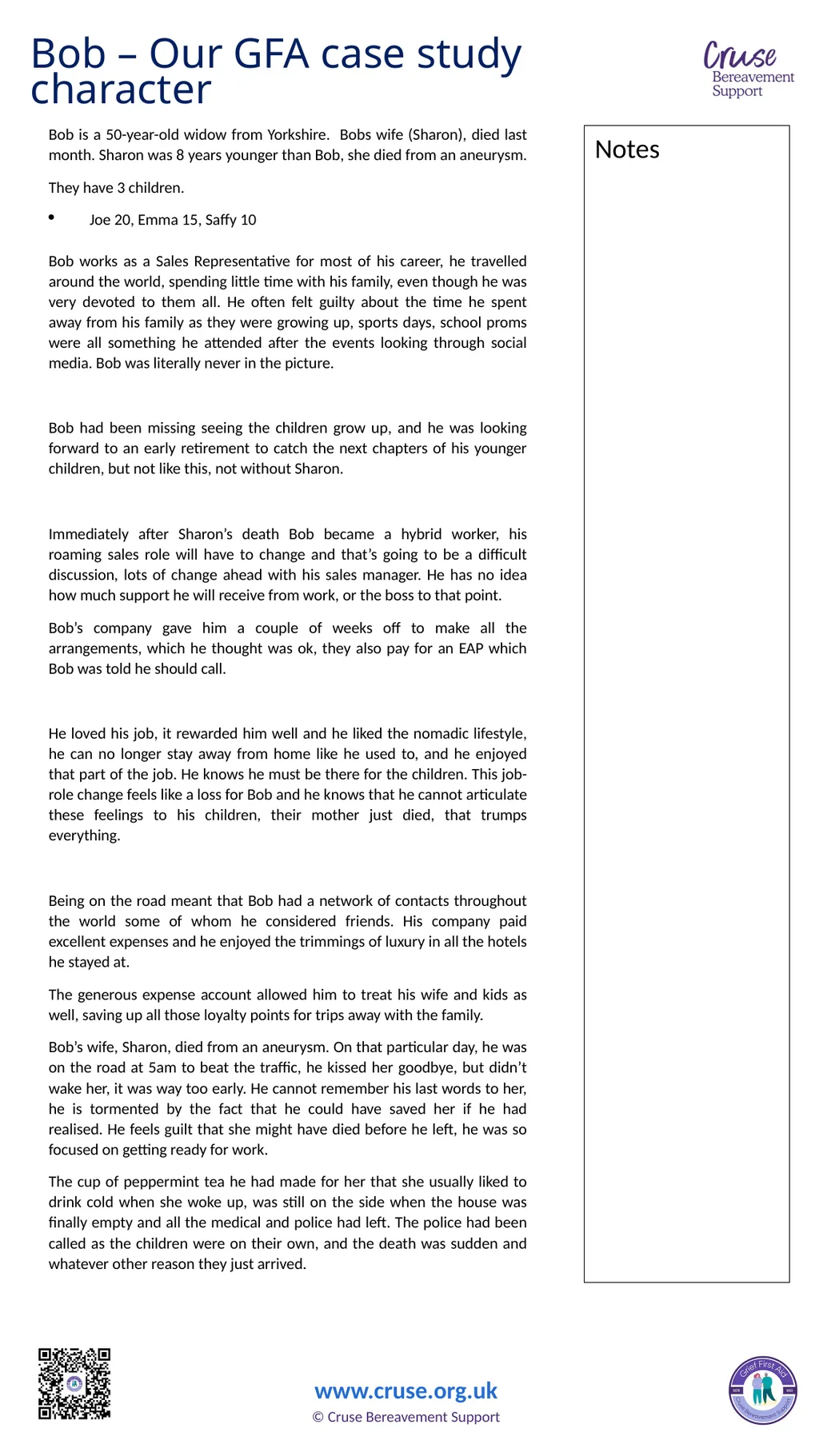
slide4. Bob – Our GFA case study character Bob is a 50-year-old widow from Yorkshire. Bobs wife (Sharon), died last month. Sharon was 8 years younger than Bob, she died from an aneurysm.
They have 3 children.
Joe 20, Emma 15, Saffy 10
Bob works as a Sales Representative for most of his career, he travelled around the world, spending little time with his family, even though he was very devoted to them all. He often felt guilty about the time he spent away from his family as they were growing up, sports days, school proms were all something he attended after the events looking through social media. Bob was literally never in the picture.
Bob had been missing seeing the children grow up, and he was looking forward to an early retirement to catch the next chapters of his younger children, but not like this, not without Sharon.
Immediately after Sharon’s death Bob became a hybrid worker, his roaming sales role will have to change and that’s going to be a difficult discussion, lots of change ahead with his sales manager. He has no idea how much support he will receive from work, or the boss to that point.
Bob’s company gave him a couple of weeks off to make all the arrangements, which he thought was ok, they also pay for an EAP which Bob was told he should call.
He loved his job, it rewarded him well and he liked the nomadic lifestyle, he can no longer stay away from home like he used to, and he enjoyed that part of the job. He knows he must be there for the children. This job-role change feels like a loss for Bob and he knows that he cannot articulate these feelings to his children, their mother just died, that trumps everything.
Being on the road meant that Bob had a network of contacts throughout the world some of whom he considered friends. His company paid excellent expenses and he enjoyed the trimmings of luxury in all the hotels he stayed at.
The generous expense account allowed him to treat his wife and kids as well, saving up all those loyalty points for trips away with the family.
Bob’s wife, Sharon, died from an aneurysm. On that particular day, he was on the road at 5am to beat the traffic, he kissed her goodbye, but didn’t wake her, it was way too early. He cannot remember his last words to her, he is tormented by the fact that he could have saved her if he had realised. He feels guilt that she might have died before he left, he was so focused on getting ready for work.
The cup of peppermint tea he had made for her that she usually liked to drink cold when she woke up, was still on the side when the house was finally empty and all the medical and police had left. The police had been called as the children were on their own, and the death was sudden and whatever other reason they just arrived. Notes<br>
slide5. Bob’s wife Bobs Wife (Sharon)
Bob’s wife, Sharon, was a stay-at-home mum who had moved from Scotland to Yorkshire when she married Bob, love, and laughter at first sight. Sharon’s family all still live in Scotland and are a closed knit bunch, all Sharon’s siblings stayed in the highlands and have raised huge families.
Sharon was sometimes resentful that Bob was away a lot from home, but he was a good provider.
She happily looked after the children; her family kept in touch “virtually” , visiting in-person a couple of times a year. She missed them dearly and was unable to travel to see them during the pandemic.
Her local friends seemed to always be doing “family things” two parents plus kids, and she felt a little like a third leg when invited over.
She felt sometimes that they took pity on her, that Bob was always away. Perhaps they were a little jealous as money was never an issue for Sharon.
Sharon found it difficult to make new friends, she was busy with the kids, running the house and it was a strange land, even though she had lived there for twenty years.
She was lonely at times, and she had told Bob this. She enjoyed the lockdown period, they may have been “locked down” but she had really enjoyed having Bob at home, and she let him know this, she wasn’t overly happy when he could start working again.
Bobs thoughts
Bob knew Sharon was sometimes lonely and now feels guilt about it all over again, he is also feeling a little lonely himself now he has stopped travelling.
Because her family are so far away, he feels it’s too late to now connect with them, especially because he didn’t really have much of a relationship with them when Sharon was alive, he was busy, and they were so far away. He thinks they are only interested in a relationship with the grandkids now anyways.
Bob feels that the emotional and physical distance has become a real barrier now Sharon has died, and he could do with their help and support. Christmas is going to be a tough time with lots of decisions to make. Notes<br>
slide6. Bob’s children Bob’s children
Saffy, 10, Joe 20, Emma, 15 are all dealing with the loss of their mum differently.
Scenario one.
Joe is close to his dad, whereas Saffy and Emma were very close to their mum and did everything with her on a daily basis.
They miss her dearly. Saffy cries every night, asking for mum, and Emma tries to be the strong one and comforts her, but she is very quiet and doesn’t say much about how she feels. Neither really look to Bob for comfort in these moments.
Joe is very avoidant to his mum’s death, he has started partying hard and trying to deal with it through drink, which worries Bob. However, he is struggling to connect with him emotionally, even though they have always been pretty close.
Alternative scenario for Joe – he is remote, away at University and not engaging with Bob emotionally, actively hostile.
The funeral arrangements
Making the funeral arrangements were strained because Sharon’s family live so far away in the west coast highlands.
They had different views on what and where, in regard to all of the arrangements, they feel that they know better, and they are steeped in tradition. Her family have not been obviously critical about the arrangements Bob made, but he gets the impression they may have wanted something more, and closer to them, perhaps where she was born with all her family around her, and her local priest.
Bob had spoken to Sharon only recently about funerals, and she had laughed at the conversation and said that she does not care what she gets, shouting “organise a post-box funeral me as much as I care, your way older than me and we all know you're going first”.
Bob was going down this simple funeral route, but the girls were getting really upset with the idea, he came even more confused. He was thinking or wasn’t thinking that it would be a good idea to keep the younger kids at home on funeral day, after all, he never went to his mum’s funeral when he was young. She had also died suddenly when he was ten from a brain aneurism. Notes<br>
slide7. Bob’s GFA meeting The GFA intervention
Bob’s new role means that he works near to one of your offices.
He comes into the office occasionally, (not the office that you are based in). This is the first time that you have met him. Bob was advised by another colleague to reach out to a GFA for support, but he has no idea how you can help.
Bob eventually calls you and asks you how, and when can you help him.
A- You arrange to meet in person.
B- You arrange to meet on zoom.
c- You squeeze in a quick call.
Bob tells you that he doesn’t know what’s happening at the moment, in life, in general, with his kids. He works late and whilst retirement s only five years away, he cannot afford to not have his job; he is so stressed and isolated trying to manage everything.
Sharon had no life assurance, why would she have, he was the provider.
Bob spends most of his time telling you, his story.
Bob has been thinking recently about if the kids could manage if he wasn’t here anymore. Joe hardly speaks to him, and the two girls seem so supportive of each another, but they are too young, thy need him, and that fact is keeping him tethered to life.
The new workplace arrangement
Bob does not feel that he can confide in his manager, as he feels that he would think he was unstable and would put his job at risk. The sales manager is 15 years younger than Bob, has been with the company only a few years, a real highflier, in truth, Bob feels that the role should have been his. He is starting to feel a little trapped, not just at work, but at home as well.
Bob feels increasingly disconnected form Sharon’s memory; he just wants her back with him, perhaps he should have been the one to die, they would miss him, but they have missed him for years, and they would have received lots of life insurance money if he had died.
But then reality sinks in, and a little fear, what would happen now if he did die, who would look after the youngest, not the Scottish contingent for sure.
He feels increasingly worried about his children and how they would cope should something happen to him.
Bob needs to put some things in order and hasn’t really thought about his own mortality, until now, because he was the one mapped in to die first, wasn’t he. Notes<br>
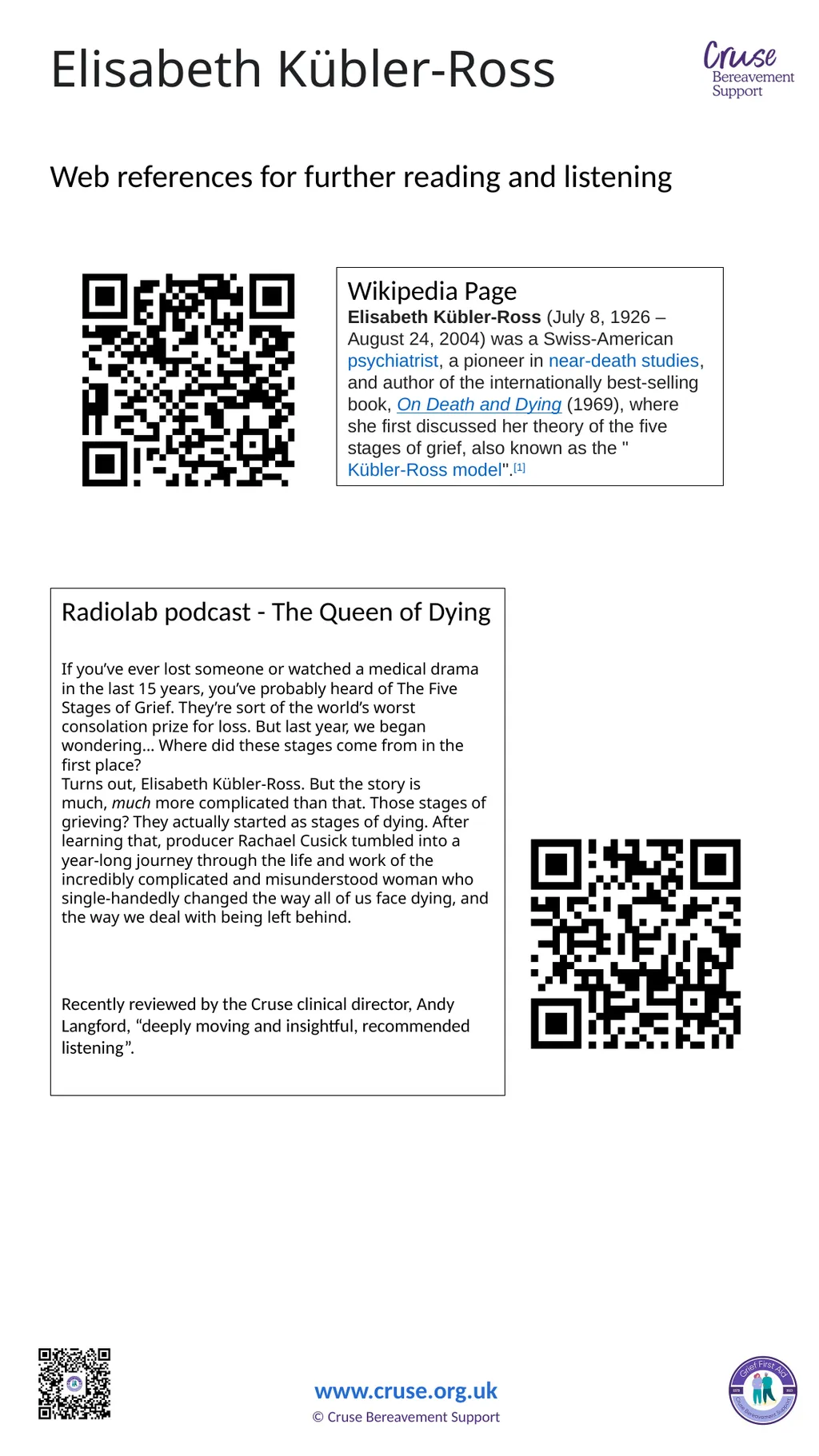
slide8. Elisabeth Kübler-Ross Web references for further reading and listening Wikipedia Page
Elisabeth Kübler-Ross (July 8, 1926 – August 24, 2004) was a Swiss-American psychiatrist, a pioneer in near-death studies, and author of the internationally best-selling book, On Death and Dying (1969), where she first discussed her theory of the five stages of grief, also known as the "Kübler-Ross model".[1] Radiolab podcast - The Queen of Dying
If you’ve ever lost someone or watched a medical drama in the last 15 years, you’ve probably heard of The Five Stages of Grief. They’re sort of the world’s worst consolation prize for loss. But last year, we began wondering… Where did these stages come from in the first place?
Turns out, Elisabeth Kübler-Ross. But the story is much, much more complicated than that. Those stages of grieving? They actually started as stages of dying. After learning that, producer Rachael Cusick tumbled into a year-long journey through the life and work of the incredibly complicated and misunderstood woman who single-handedly changed the way all of us face dying, and the way we deal with being left behind.
Recently reviewed by the Cruse clinical director, Andy Langford, “deeply moving and insightful, recommended listening”.<br>
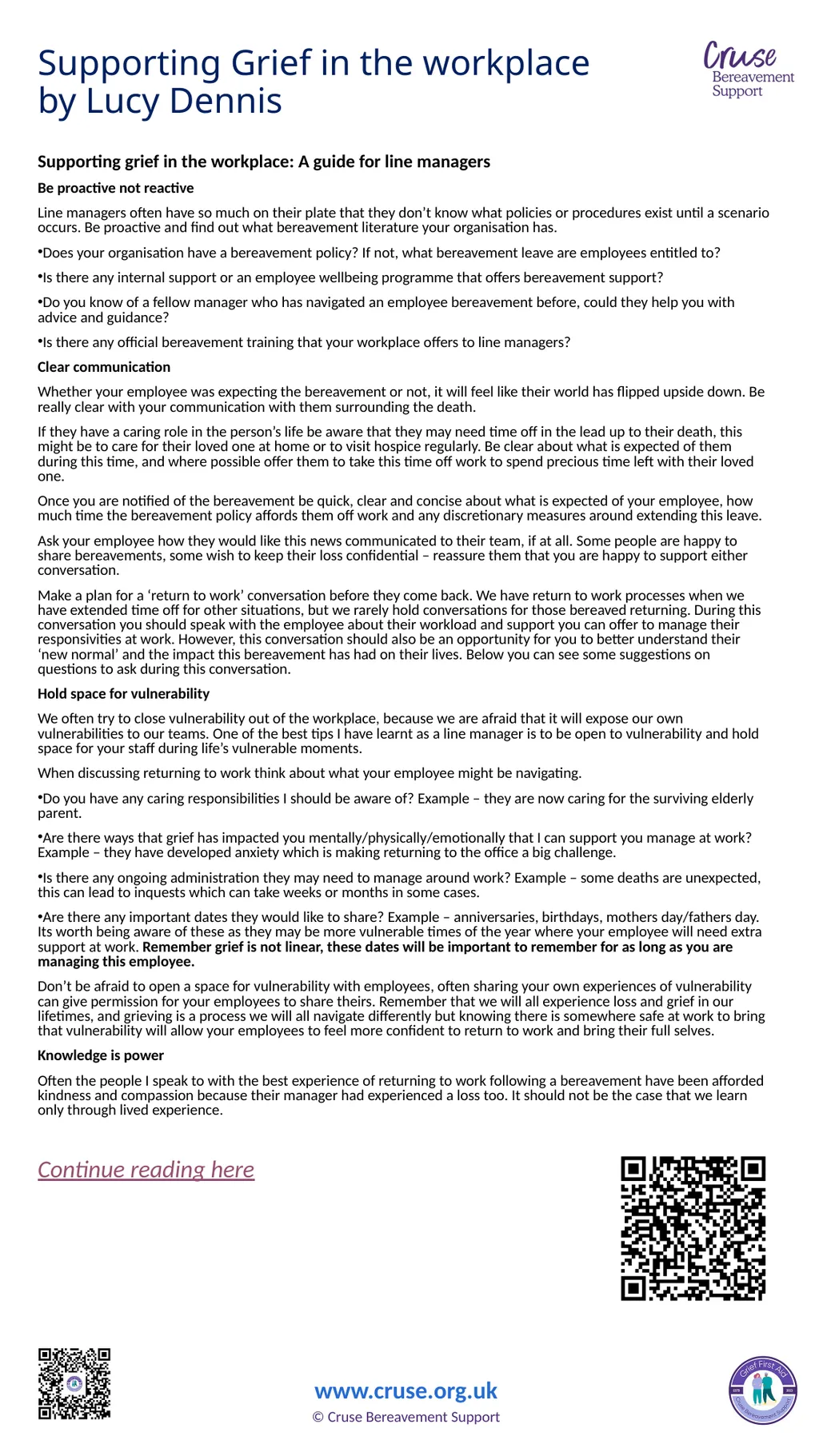
slide9. Supporting Grief in the workplace by Lucy Dennis Supporting grief in the workplace: A guide for line managers
Be proactive not reactive
Line managers often have so much on their plate that they don’t know what policies or procedures exist until a scenario occurs. Be proactive and find out what bereavement literature your organisation has.
Does your organisation have a bereavement policy? If not, what bereavement leave are employees entitled to?
Is there any internal support or an employee wellbeing programme that offers bereavement support?
Do you know of a fellow manager who has navigated an employee bereavement before, could they help you with advice and guidance?
Is there any official bereavement training that your workplace offers to line managers?
Clear communication
Whether your employee was expecting the bereavement or not, it will feel like their world has flipped upside down. Be really clear with your communication with them surrounding the death.
If they have a caring role in the person’s life be aware that they may need time off in the lead up to their death, this might be to care for their loved one at home or to visit hospice regularly. Be clear about what is expected of them during this time, and where possible offer them to take this time off work to spend precious time left with their loved one.
Once you are notified of the bereavement be quick, clear and concise about what is expected of your employee, how much time the bereavement policy affords them off work and any discretionary measures around extending this leave.
Ask your employee how they would like this news communicated to their team, if at all. Some people are happy to share bereavements, some wish to keep their loss confidential – reassure them that you are happy to support either conversation.
Make a plan for a ‘return to work’ conversation before they come back. We have return to work processes when we have extended time off for other situations, but we rarely hold conversations for those bereaved returning. During this conversation you should speak with the employee about their workload and support you can offer to manage their responsivities at work. However, this conversation should also be an opportunity for you to better understand their ‘new normal’ and the impact this bereavement has had on their lives. Below you can see some suggestions on questions to ask during this conversation.
Hold space for vulnerability
We often try to close vulnerability out of the workplace, because we are afraid that it will expose our own vulnerabilities to our teams. One of the best tips I have learnt as a line manager is to be open to vulnerability and hold space for your staff during life’s vulnerable moments.
When discussing returning to work think about what your employee might be navigating.
Do you have any caring responsibilities I should be aware of? Example – they are now caring for the surviving elderly parent.
Are there ways that grief has impacted you mentally/physically/emotionally that I can support you manage at work? Example – they have developed anxiety which is making returning to the office a big challenge.
Is there any ongoing administration they may need to manage around work? Example – some deaths are unexpected, this can lead to inquests which can take weeks or months in some cases.
Are there any important dates they would like to share? Example – anniversaries, birthdays, mothers day/fathers day. Its worth being aware of these as they may be more vulnerable times of the year where your employee will need extra support at work. Remember grief is not linear, these dates will be important to remember for as long as you are managing this employee.
Don’t be afraid to open a space for vulnerability with employees, often sharing your own experiences of vulnerability can give permission for your employees to share theirs. Remember that we will all experience loss and grief in our lifetimes, and grieving is a process we will all navigate differently but knowing there is somewhere safe at work to bring that vulnerability will allow your employees to feel more confident to return to work and bring their full selves.
Knowledge is power
Often the people I speak to with the best experience of returning to work following a bereavement have been afforded kindness and compassion because their manager had experienced a loss too. It should not be the case that we learn only through lived experience.
Continue reading here<br>
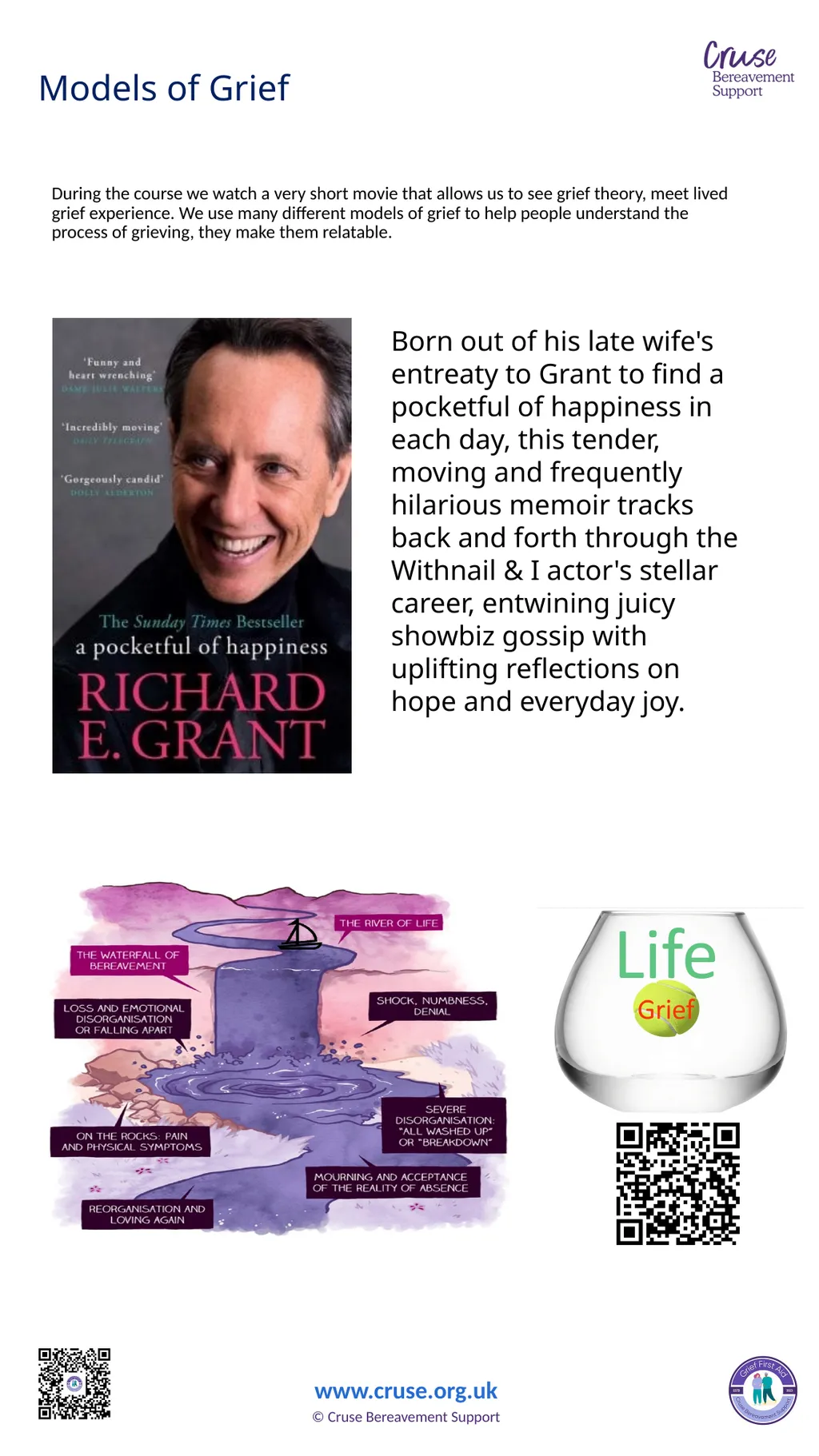
slide10. Models of Grief During the course we watch a very short movie that allows us to see grief theory, meet lived grief experience. We use many different models of grief to help people understand the process of grieving, they make them relatable. Born out of his late wife's entreaty to Grant to find a pocketful of happiness in each day, this tender, moving and frequently hilarious memoir tracks back and forth through the Withnail & I actor's stellar career, entwining juicy showbiz gossip with uplifting reflections on hope and everyday joy.<br>
slide11. The Dual Process Model Background:
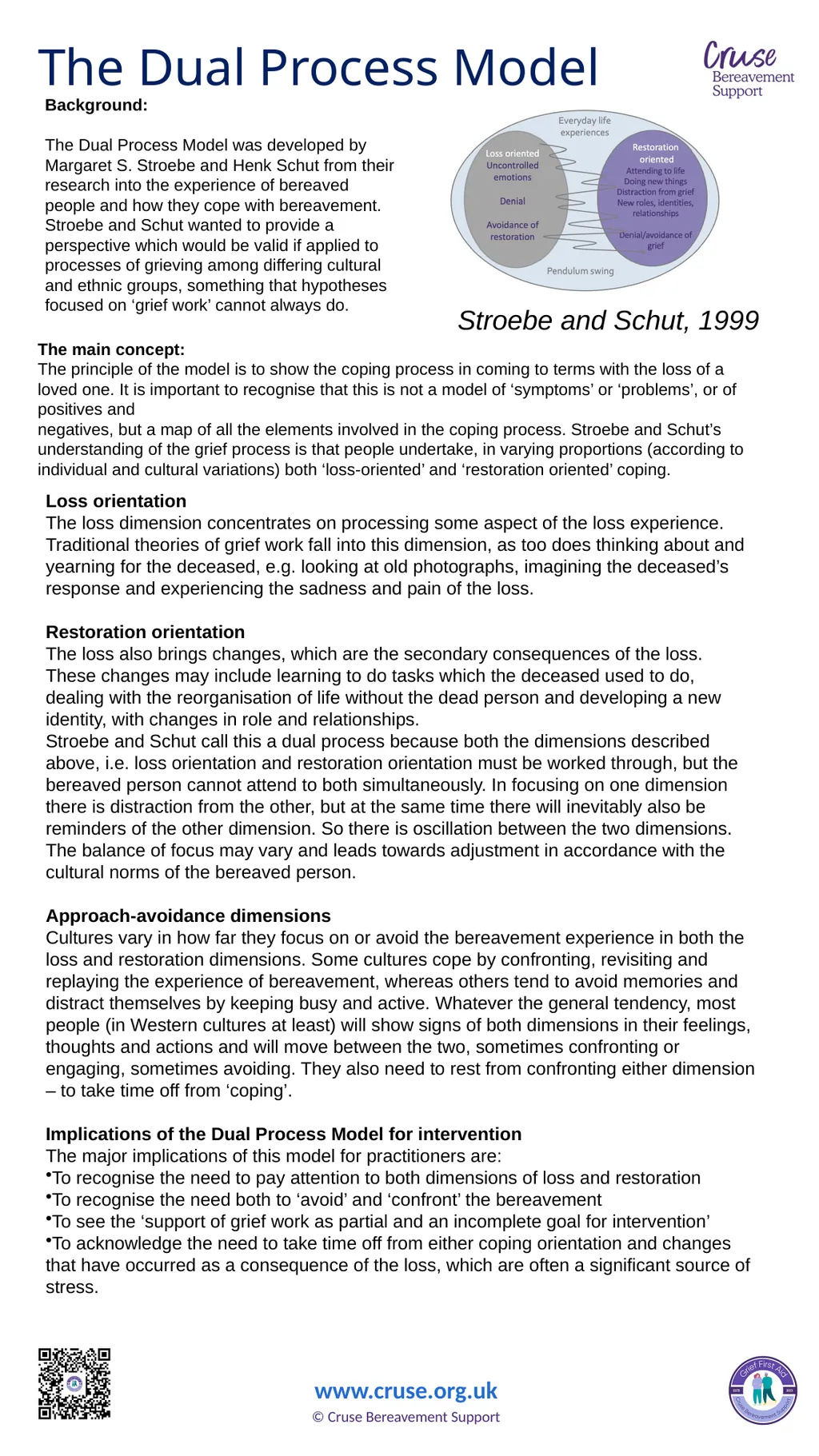
The Dual Process Model was developed by Margaret S. Stroebe and Henk Schut from their research into the experience of bereaved people and how they cope with bereavement. Stroebe and Schut wanted to provide a perspective which would be valid if applied to processes of grieving among differing cultural and ethnic groups, something that hypotheses focused on ‘grief work’ cannot always do. Loss orientation
The loss dimension concentrates on processing some aspect of the loss experience. Traditional theories of grief work fall into this dimension, as too does thinking about and yearning for the deceased, e.g. looking at old photographs, imagining the deceased’s response and experiencing the sadness and pain of the loss.
Restoration orientation
The loss also brings changes, which are the secondary consequences of the loss. These changes may include learning to do tasks which the deceased used to do, dealing with the reorganisation of life without the dead person and developing a new identity, with changes in role and relationships.
Stroebe and Schut call this a dual process because both the dimensions described above, i.e. loss orientation and restoration orientation must be worked through, but the bereaved person cannot attend to both simultaneously. In focusing on one dimension there is distraction from the other, but at the same time there will inevitably also be reminders of the other dimension. So there is oscillation between the two dimensions. The balance of focus may vary and leads towards adjustment in accordance with the cultural norms of the bereaved person.
Approach-avoidance dimensions
Cultures vary in how far they focus on or avoid the bereavement experience in both the loss and restoration dimensions. Some cultures cope by confronting, revisiting and replaying the experience of bereavement, whereas others tend to avoid memories and distract themselves by keeping busy and active. Whatever the general tendency, most people (in Western cultures at least) will show signs of both dimensions in their feelings, thoughts and actions and will move between the two, sometimes confronting or engaging, sometimes avoiding. They also need to rest from confronting either dimension – to take time off from ‘coping’.
Implications of the Dual Process Model for intervention
The major implications of this model for practitioners are:
To recognise the need to pay attention to both dimensions of loss and restoration
To recognise the need both to ‘avoid’ and ‘confront’ the bereavement
To see the ‘support of grief work as partial and an incomplete goal for intervention’
To acknowledge the need to take time off from either coping orientation and changes that have occurred as a consequence of the loss, which are often a significant source of stress. The main concept:
The principle of the model is to show the coping process in coming to terms with the loss of a loved one. It is important to recognise that this is not a model of ‘symptoms’ or ‘problems’, or of positives and
negatives, but a map of all the elements involved in the coping process. Stroebe and Schut’s understanding of the grief process is that people undertake, in varying proportions (according to individual and cultural variations) both ‘loss-oriented’ and ‘restoration oriented’ coping. Stroebe and Schut, 1999<br>
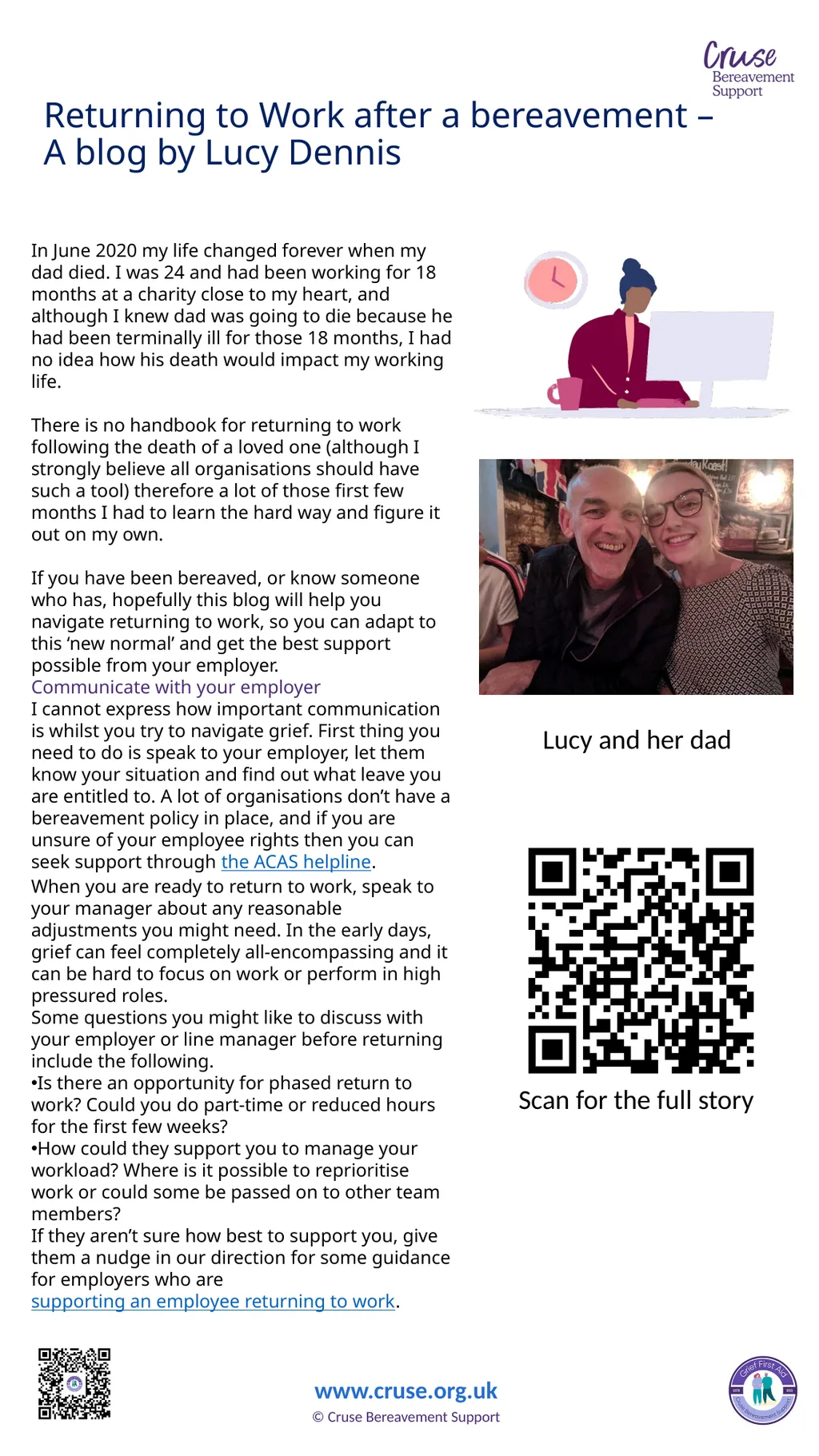
slide12. Returning to Work after a bereavement – A blog by Lucy Dennis In June 2020 my life changed forever when my dad died. I was 24 and had been working for 18 months at a charity close to my heart, and although I knew dad was going to die because he had been terminally ill for those 18 months, I had no idea how his death would impact my working life.
There is no handbook for returning to work following the death of a loved one (although I strongly believe all organisations should have such a tool) therefore a lot of those first few months I had to learn the hard way and figure it out on my own.
If you have been bereaved, or know someone who has, hopefully this blog will help you navigate returning to work, so you can adapt to this ‘new normal’ and get the best support possible from your employer.
Communicate with your employer
I cannot express how important communication is whilst you try to navigate grief. First thing you need to do is speak to your employer, let them know your situation and find out what leave you are entitled to. A lot of organisations don’t have a bereavement policy in place, and if you are unsure of your employee rights then you can seek support through the ACAS helpline.
When you are ready to return to work, speak to your manager about any reasonable adjustments you might need. In the early days, grief can feel completely all-encompassing and it can be hard to focus on work or perform in high pressured roles.
Some questions you might like to discuss with your employer or line manager before returning include the following.
Is there an opportunity for phased return to work? Could you do part-time or reduced hours for the first few weeks?
How could they support you to manage your workload? Where is it possible to reprioritise work or could some be passed on to other team members?
If they aren’t sure how best to support you, give them a nudge in our direction for some guidance for employers who are supporting an employee returning to work. Lucy and her dad<br>
Printed – Point your phone camera at them and open the link to take you to the material.
On a digital page - You can click the QR codes or an image, and you will be taken to the webpage.<br>
slide2. Group Agreement Foundation working agreement
Before attending Day 1 of the training, consider the items below that may contribute to a safe learning environment and pencil in any additions you would like to see included or strike though anything you consider inappropriate.
We will treat each other with respect and patience.
We will honestly share with one another and maintain confidentiality, anything personal that is said/shared in the room stays in the room. Anything of a personal nature said in small groups will only be shared with permission.
We will be supportive to one another, behaving in a non-judgmental manner.
We will be open to new ideas and clarify misunderstandings.
We will maintain our commitment to the course.
We will be prompt in our timekeeping and maintain good attendance. If we are unavailable for a session or start time, we will notify the trainer in advance.
Additions.<br>
slide3. The Grieving Brain About the author
Mary-Frances O'Connor is an associate professor of psychology at the University of Arizona, where she directs the Grief, Loss, and Social Stress (GLASS) Lab in investigating the effects of grief on the brain and the body.
O’Connor earned a doctorate from the University of Arizona in 2004 and completed a fellowship at UCLA. Following a faculty appointment at UCLA Cousins Center for Psychoneuroimmunology, she returned to the University of Arizona in 2012.
Her work has been published in the American Journal of Psychiatry, Biological Psychiatry, and Psychological Science, and featured in Newsweek, New York Times, and Washington Post.
Having grown up in Montana, she now lives in sunny Tucson, Arizona. Based on O'Connor's own trailblazing neuroimaging work, research in the field, and her real-life stories, The Grieving Brain combines storytelling, accessible science, and practical knowledge that will help us better understand what happens when we grieve and how to navigate loss with more ease and grace.<br>
slide4. Bob – Our GFA case study character Bob is a 50-year-old widow from Yorkshire. Bobs wife (Sharon), died last month. Sharon was 8 years younger than Bob, she died from an aneurysm.
They have 3 children.
Joe 20, Emma 15, Saffy 10
Bob works as a Sales Representative for most of his career, he travelled around the world, spending little time with his family, even though he was very devoted to them all. He often felt guilty about the time he spent away from his family as they were growing up, sports days, school proms were all something he attended after the events looking through social media. Bob was literally never in the picture.
Bob had been missing seeing the children grow up, and he was looking forward to an early retirement to catch the next chapters of his younger children, but not like this, not without Sharon.
Immediately after Sharon’s death Bob became a hybrid worker, his roaming sales role will have to change and that’s going to be a difficult discussion, lots of change ahead with his sales manager. He has no idea how much support he will receive from work, or the boss to that point.
Bob’s company gave him a couple of weeks off to make all the arrangements, which he thought was ok, they also pay for an EAP which Bob was told he should call.
He loved his job, it rewarded him well and he liked the nomadic lifestyle, he can no longer stay away from home like he used to, and he enjoyed that part of the job. He knows he must be there for the children. This job-role change feels like a loss for Bob and he knows that he cannot articulate these feelings to his children, their mother just died, that trumps everything.
Being on the road meant that Bob had a network of contacts throughout the world some of whom he considered friends. His company paid excellent expenses and he enjoyed the trimmings of luxury in all the hotels he stayed at.
The generous expense account allowed him to treat his wife and kids as well, saving up all those loyalty points for trips away with the family.
Bob’s wife, Sharon, died from an aneurysm. On that particular day, he was on the road at 5am to beat the traffic, he kissed her goodbye, but didn’t wake her, it was way too early. He cannot remember his last words to her, he is tormented by the fact that he could have saved her if he had realised. He feels guilt that she might have died before he left, he was so focused on getting ready for work.
The cup of peppermint tea he had made for her that she usually liked to drink cold when she woke up, was still on the side when the house was finally empty and all the medical and police had left. The police had been called as the children were on their own, and the death was sudden and whatever other reason they just arrived. Notes<br>
slide5. Bob’s wife Bobs Wife (Sharon)
Bob’s wife, Sharon, was a stay-at-home mum who had moved from Scotland to Yorkshire when she married Bob, love, and laughter at first sight. Sharon’s family all still live in Scotland and are a closed knit bunch, all Sharon’s siblings stayed in the highlands and have raised huge families.
Sharon was sometimes resentful that Bob was away a lot from home, but he was a good provider.
She happily looked after the children; her family kept in touch “virtually” , visiting in-person a couple of times a year. She missed them dearly and was unable to travel to see them during the pandemic.
Her local friends seemed to always be doing “family things” two parents plus kids, and she felt a little like a third leg when invited over.
She felt sometimes that they took pity on her, that Bob was always away. Perhaps they were a little jealous as money was never an issue for Sharon.
Sharon found it difficult to make new friends, she was busy with the kids, running the house and it was a strange land, even though she had lived there for twenty years.
She was lonely at times, and she had told Bob this. She enjoyed the lockdown period, they may have been “locked down” but she had really enjoyed having Bob at home, and she let him know this, she wasn’t overly happy when he could start working again.
Bobs thoughts
Bob knew Sharon was sometimes lonely and now feels guilt about it all over again, he is also feeling a little lonely himself now he has stopped travelling.
Because her family are so far away, he feels it’s too late to now connect with them, especially because he didn’t really have much of a relationship with them when Sharon was alive, he was busy, and they were so far away. He thinks they are only interested in a relationship with the grandkids now anyways.
Bob feels that the emotional and physical distance has become a real barrier now Sharon has died, and he could do with their help and support. Christmas is going to be a tough time with lots of decisions to make. Notes<br>
slide6. Bob’s children Bob’s children
Saffy, 10, Joe 20, Emma, 15 are all dealing with the loss of their mum differently.
Scenario one.
Joe is close to his dad, whereas Saffy and Emma were very close to their mum and did everything with her on a daily basis.
They miss her dearly. Saffy cries every night, asking for mum, and Emma tries to be the strong one and comforts her, but she is very quiet and doesn’t say much about how she feels. Neither really look to Bob for comfort in these moments.
Joe is very avoidant to his mum’s death, he has started partying hard and trying to deal with it through drink, which worries Bob. However, he is struggling to connect with him emotionally, even though they have always been pretty close.
Alternative scenario for Joe – he is remote, away at University and not engaging with Bob emotionally, actively hostile.
The funeral arrangements
Making the funeral arrangements were strained because Sharon’s family live so far away in the west coast highlands.
They had different views on what and where, in regard to all of the arrangements, they feel that they know better, and they are steeped in tradition. Her family have not been obviously critical about the arrangements Bob made, but he gets the impression they may have wanted something more, and closer to them, perhaps where she was born with all her family around her, and her local priest.
Bob had spoken to Sharon only recently about funerals, and she had laughed at the conversation and said that she does not care what she gets, shouting “organise a post-box funeral me as much as I care, your way older than me and we all know you're going first”.
Bob was going down this simple funeral route, but the girls were getting really upset with the idea, he came even more confused. He was thinking or wasn’t thinking that it would be a good idea to keep the younger kids at home on funeral day, after all, he never went to his mum’s funeral when he was young. She had also died suddenly when he was ten from a brain aneurism. Notes<br>
slide7. Bob’s GFA meeting The GFA intervention
Bob’s new role means that he works near to one of your offices.
He comes into the office occasionally, (not the office that you are based in). This is the first time that you have met him. Bob was advised by another colleague to reach out to a GFA for support, but he has no idea how you can help.
Bob eventually calls you and asks you how, and when can you help him.
A- You arrange to meet in person.
B- You arrange to meet on zoom.
c- You squeeze in a quick call.
Bob tells you that he doesn’t know what’s happening at the moment, in life, in general, with his kids. He works late and whilst retirement s only five years away, he cannot afford to not have his job; he is so stressed and isolated trying to manage everything.
Sharon had no life assurance, why would she have, he was the provider.
Bob spends most of his time telling you, his story.
Bob has been thinking recently about if the kids could manage if he wasn’t here anymore. Joe hardly speaks to him, and the two girls seem so supportive of each another, but they are too young, thy need him, and that fact is keeping him tethered to life.
The new workplace arrangement
Bob does not feel that he can confide in his manager, as he feels that he would think he was unstable and would put his job at risk. The sales manager is 15 years younger than Bob, has been with the company only a few years, a real highflier, in truth, Bob feels that the role should have been his. He is starting to feel a little trapped, not just at work, but at home as well.
Bob feels increasingly disconnected form Sharon’s memory; he just wants her back with him, perhaps he should have been the one to die, they would miss him, but they have missed him for years, and they would have received lots of life insurance money if he had died.
But then reality sinks in, and a little fear, what would happen now if he did die, who would look after the youngest, not the Scottish contingent for sure.
He feels increasingly worried about his children and how they would cope should something happen to him.
Bob needs to put some things in order and hasn’t really thought about his own mortality, until now, because he was the one mapped in to die first, wasn’t he. Notes<br>
slide8. Elisabeth Kübler-Ross Web references for further reading and listening Wikipedia Page
Elisabeth Kübler-Ross (July 8, 1926 – August 24, 2004) was a Swiss-American psychiatrist, a pioneer in near-death studies, and author of the internationally best-selling book, On Death and Dying (1969), where she first discussed her theory of the five stages of grief, also known as the "Kübler-Ross model".[1] Radiolab podcast - The Queen of Dying
If you’ve ever lost someone or watched a medical drama in the last 15 years, you’ve probably heard of The Five Stages of Grief. They’re sort of the world’s worst consolation prize for loss. But last year, we began wondering… Where did these stages come from in the first place?
Turns out, Elisabeth Kübler-Ross. But the story is much, much more complicated than that. Those stages of grieving? They actually started as stages of dying. After learning that, producer Rachael Cusick tumbled into a year-long journey through the life and work of the incredibly complicated and misunderstood woman who single-handedly changed the way all of us face dying, and the way we deal with being left behind.
Recently reviewed by the Cruse clinical director, Andy Langford, “deeply moving and insightful, recommended listening”.<br>
slide9. Supporting Grief in the workplace by Lucy Dennis Supporting grief in the workplace: A guide for line managers
Be proactive not reactive
Line managers often have so much on their plate that they don’t know what policies or procedures exist until a scenario occurs. Be proactive and find out what bereavement literature your organisation has.
Does your organisation have a bereavement policy? If not, what bereavement leave are employees entitled to?
Is there any internal support or an employee wellbeing programme that offers bereavement support?
Do you know of a fellow manager who has navigated an employee bereavement before, could they help you with advice and guidance?
Is there any official bereavement training that your workplace offers to line managers?
Clear communication
Whether your employee was expecting the bereavement or not, it will feel like their world has flipped upside down. Be really clear with your communication with them surrounding the death.
If they have a caring role in the person’s life be aware that they may need time off in the lead up to their death, this might be to care for their loved one at home or to visit hospice regularly. Be clear about what is expected of them during this time, and where possible offer them to take this time off work to spend precious time left with their loved one.
Once you are notified of the bereavement be quick, clear and concise about what is expected of your employee, how much time the bereavement policy affords them off work and any discretionary measures around extending this leave.
Ask your employee how they would like this news communicated to their team, if at all. Some people are happy to share bereavements, some wish to keep their loss confidential – reassure them that you are happy to support either conversation.
Make a plan for a ‘return to work’ conversation before they come back. We have return to work processes when we have extended time off for other situations, but we rarely hold conversations for those bereaved returning. During this conversation you should speak with the employee about their workload and support you can offer to manage their responsivities at work. However, this conversation should also be an opportunity for you to better understand their ‘new normal’ and the impact this bereavement has had on their lives. Below you can see some suggestions on questions to ask during this conversation.
Hold space for vulnerability
We often try to close vulnerability out of the workplace, because we are afraid that it will expose our own vulnerabilities to our teams. One of the best tips I have learnt as a line manager is to be open to vulnerability and hold space for your staff during life’s vulnerable moments.
When discussing returning to work think about what your employee might be navigating.
Do you have any caring responsibilities I should be aware of? Example – they are now caring for the surviving elderly parent.
Are there ways that grief has impacted you mentally/physically/emotionally that I can support you manage at work? Example – they have developed anxiety which is making returning to the office a big challenge.
Is there any ongoing administration they may need to manage around work? Example – some deaths are unexpected, this can lead to inquests which can take weeks or months in some cases.
Are there any important dates they would like to share? Example – anniversaries, birthdays, mothers day/fathers day. Its worth being aware of these as they may be more vulnerable times of the year where your employee will need extra support at work. Remember grief is not linear, these dates will be important to remember for as long as you are managing this employee.
Don’t be afraid to open a space for vulnerability with employees, often sharing your own experiences of vulnerability can give permission for your employees to share theirs. Remember that we will all experience loss and grief in our lifetimes, and grieving is a process we will all navigate differently but knowing there is somewhere safe at work to bring that vulnerability will allow your employees to feel more confident to return to work and bring their full selves.
Knowledge is power
Often the people I speak to with the best experience of returning to work following a bereavement have been afforded kindness and compassion because their manager had experienced a loss too. It should not be the case that we learn only through lived experience.
Continue reading here<br>
slide10. Models of Grief During the course we watch a very short movie that allows us to see grief theory, meet lived grief experience. We use many different models of grief to help people understand the process of grieving, they make them relatable. Born out of his late wife's entreaty to Grant to find a pocketful of happiness in each day, this tender, moving and frequently hilarious memoir tracks back and forth through the Withnail & I actor's stellar career, entwining juicy showbiz gossip with uplifting reflections on hope and everyday joy.<br>
slide11. The Dual Process Model Background:
The Dual Process Model was developed by Margaret S. Stroebe and Henk Schut from their research into the experience of bereaved people and how they cope with bereavement. Stroebe and Schut wanted to provide a perspective which would be valid if applied to processes of grieving among differing cultural and ethnic groups, something that hypotheses focused on ‘grief work’ cannot always do. Loss orientation
The loss dimension concentrates on processing some aspect of the loss experience. Traditional theories of grief work fall into this dimension, as too does thinking about and yearning for the deceased, e.g. looking at old photographs, imagining the deceased’s response and experiencing the sadness and pain of the loss.
Restoration orientation
The loss also brings changes, which are the secondary consequences of the loss. These changes may include learning to do tasks which the deceased used to do, dealing with the reorganisation of life without the dead person and developing a new identity, with changes in role and relationships.
Stroebe and Schut call this a dual process because both the dimensions described above, i.e. loss orientation and restoration orientation must be worked through, but the bereaved person cannot attend to both simultaneously. In focusing on one dimension there is distraction from the other, but at the same time there will inevitably also be reminders of the other dimension. So there is oscillation between the two dimensions. The balance of focus may vary and leads towards adjustment in accordance with the cultural norms of the bereaved person.
Approach-avoidance dimensions
Cultures vary in how far they focus on or avoid the bereavement experience in both the loss and restoration dimensions. Some cultures cope by confronting, revisiting and replaying the experience of bereavement, whereas others tend to avoid memories and distract themselves by keeping busy and active. Whatever the general tendency, most people (in Western cultures at least) will show signs of both dimensions in their feelings, thoughts and actions and will move between the two, sometimes confronting or engaging, sometimes avoiding. They also need to rest from confronting either dimension – to take time off from ‘coping’.
Implications of the Dual Process Model for intervention
The major implications of this model for practitioners are:
To recognise the need to pay attention to both dimensions of loss and restoration
To recognise the need both to ‘avoid’ and ‘confront’ the bereavement
To see the ‘support of grief work as partial and an incomplete goal for intervention’
To acknowledge the need to take time off from either coping orientation and changes that have occurred as a consequence of the loss, which are often a significant source of stress. The main concept:
The principle of the model is to show the coping process in coming to terms with the loss of a loved one. It is important to recognise that this is not a model of ‘symptoms’ or ‘problems’, or of positives and
negatives, but a map of all the elements involved in the coping process. Stroebe and Schut’s understanding of the grief process is that people undertake, in varying proportions (according to individual and cultural variations) both ‘loss-oriented’ and ‘restoration oriented’ coping. Stroebe and Schut, 1999<br>
slide12. Returning to Work after a bereavement – A blog by Lucy Dennis In June 2020 my life changed forever when my dad died. I was 24 and had been working for 18 months at a charity close to my heart, and although I knew dad was going to die because he had been terminally ill for those 18 months, I had no idea how his death would impact my working life.
There is no handbook for returning to work following the death of a loved one (although I strongly believe all organisations should have such a tool) therefore a lot of those first few months I had to learn the hard way and figure it out on my own.
If you have been bereaved, or know someone who has, hopefully this blog will help you navigate returning to work, so you can adapt to this ‘new normal’ and get the best support possible from your employer.
Communicate with your employer
I cannot express how important communication is whilst you try to navigate grief. First thing you need to do is speak to your employer, let them know your situation and find out what leave you are entitled to. A lot of organisations don’t have a bereavement policy in place, and if you are unsure of your employee rights then you can seek support through the ACAS helpline.
When you are ready to return to work, speak to your manager about any reasonable adjustments you might need. In the early days, grief can feel completely all-encompassing and it can be hard to focus on work or perform in high pressured roles.
Some questions you might like to discuss with your employer or line manager before returning include the following.
Is there an opportunity for phased return to work? Could you do part-time or reduced hours for the first few weeks?
How could they support you to manage your workload? Where is it possible to reprioritise work or could some be passed on to other team members?
If they aren’t sure how best to support you, give them a nudge in our direction for some guidance for employers who are supporting an employee returning to work. Lucy and her dad<br>