
MODULE 1 OVERVIEW OF STRATEGIC MANAGEMENT Prof.
DP
Published · 43 slides · 0 views

1 / 1

Description
MODULE 1 OVERVIEW OF STRATEGIC MANAGEMENT Prof. Chandana Priya M S Assistant Professor MEANING OF STRATEGY Strategy is a plan of action designed to achieve a long-term objectives. It helps to determine the best course of action to achieve
Related Topics
Share
Embed code
Download this presentation From Below
"MODULE 1 OVERVIEW OF STRATEGIC MANAGEMENT Prof." is the property of its rightful owner. Permission is granted to download and print the materials on this website for personal, non-commercial use only, and to display it on your personal computer provided you do not modify the materials and that you retain all copyright notices contained in the materials. By downloading content from our website, you accept the terms of this agreement.
Presentation Transcript
01
MODULE 1 OVERVIEW OF STRATEGIC MANAGEMENT Prof. Chandana Priya M S Assistant Professor<br>
02
MEANING OF STRATEGY Strategy is a plan of action designed to achieve a long-term objectives.
It helps to determine the best course of action to achieve long-term success and stay ahead of competitors.
Organizational strategies are crucial for businesses looking to succeed and grow in today’s competitive environment. Popular examples of such strategies are- Market Penetration, Diversification, Innovation.
Amazon is a company known for its strategic excellence. Its success lies in its customer-centric approach and relentless focus on innovation.
Strategic initiatives, such as Prime membership and personalized recommendations, have propelled it to become a dominant player in e-commerce globally.<br>
It helps to determine the best course of action to achieve long-term success and stay ahead of competitors.
Organizational strategies are crucial for businesses looking to succeed and grow in today’s competitive environment. Popular examples of such strategies are- Market Penetration, Diversification, Innovation.
Amazon is a company known for its strategic excellence. Its success lies in its customer-centric approach and relentless focus on innovation.
Strategic initiatives, such as Prime membership and personalized recommendations, have propelled it to become a dominant player in e-commerce globally.<br>
03
MEANING OF STRATEGIC MANAGEMENT Strategic Management is the amalgamation of two words:
Strategy and Management.
Strategy involves making choices and decisions to achieve organizational goals, while Management focuses on planning, organizing, and controlling resources to execute those strategic choices effectively.
Strategic management is the process of formulating and implementing strategies to achieve the goals and objectives of an organization.
It ensures the organization’s ability to prosper and maintain competitiveness in an ever-shifting business environment.<br>
Strategy and Management.
Strategy involves making choices and decisions to achieve organizational goals, while Management focuses on planning, organizing, and controlling resources to execute those strategic choices effectively.
Strategic management is the process of formulating and implementing strategies to achieve the goals and objectives of an organization.
It ensures the organization’s ability to prosper and maintain competitiveness in an ever-shifting business environment.<br>
04
Example of Strategic Management
Amazon employed several strategic management techniques to overcome local players like Snapdeal and Flipkart in the Indian market:
Strong Market Entry: Amazon entered the Indian market with significant investment and long-term vision, demonstrating its commitment to success. They strategically focused on building a robust logistics infrastructure, expanding product offerings, and offering competitive pricing.
Customer-Centric Approach: Amazon prioritized providing excellence customer experience by offering fast and reliable delivery, easy returns, and a wide range of products. They leveraged their global expertise in e-commerce to create a seamless online shopping experience for Indian customers.<br>
Amazon employed several strategic management techniques to overcome local players like Snapdeal and Flipkart in the Indian market:
Strong Market Entry: Amazon entered the Indian market with significant investment and long-term vision, demonstrating its commitment to success. They strategically focused on building a robust logistics infrastructure, expanding product offerings, and offering competitive pricing.
Customer-Centric Approach: Amazon prioritized providing excellence customer experience by offering fast and reliable delivery, easy returns, and a wide range of products. They leveraged their global expertise in e-commerce to create a seamless online shopping experience for Indian customers.<br>
05
Continuous Innovation: Amazon introduced innovative features and services tailored to the Indian market, such as Hindi language support, regional content, and localized payment options. They constantly adapted their offerings based on customer feedback and market trends.
Competitive Pricing: Amazon employed a competitive pricing strategy to attract customers, offering discounts and deals on popular products. They leveraged their global scale and supply chain efficiencies to provide cost-effective solutions.
Strategic Partnerships: Amazon forged partnerships with local retailers, brands, and small businesses, enabling them to expand their product range and offer exclusive deals. This approach helped them tap into the vast Indian market and build trust among local sellers.<br>
Competitive Pricing: Amazon employed a competitive pricing strategy to attract customers, offering discounts and deals on popular products. They leveraged their global scale and supply chain efficiencies to provide cost-effective solutions.
Strategic Partnerships: Amazon forged partnerships with local retailers, brands, and small businesses, enabling them to expand their product range and offer exclusive deals. This approach helped them tap into the vast Indian market and build trust among local sellers.<br>
06
Investments in Technology: Amazon significantly invested in technology and data analytics to enhance customer personalization, improve operational efficiency, and drive insights for strategic decision-making.
These strategies allowed Amazon to differentiate itself, gain market share, and gradually surpass local players like Snapdeal and Flipkart in terms of customer trust, brand recognition, and market dominance.<br>
These strategies allowed Amazon to differentiate itself, gain market share, and gradually surpass local players like Snapdeal and Flipkart in terms of customer trust, brand recognition, and market dominance.<br>
07
BENEFITS OF STRATEGIC MANAGEMENT Increased Profitability
Strategic management helps businesses make better decisions about resource allocation, investments, and market opportunities.
This can lead to increased revenue, cost savings, and improved profitability.
Enhanced Market Share
By understanding the competitive landscape and developing effective strategies, companies can gain a competitive edge and increase their market share.
Improved Risk Management
Strategic planning helps identify and mitigate potential risks, such as new competition, economic downturns, or technological disruptions.<br>
Strategic management helps businesses make better decisions about resource allocation, investments, and market opportunities.
This can lead to increased revenue, cost savings, and improved profitability.
Enhanced Market Share
By understanding the competitive landscape and developing effective strategies, companies can gain a competitive edge and increase their market share.
Improved Risk Management
Strategic planning helps identify and mitigate potential risks, such as new competition, economic downturns, or technological disruptions.<br>
08
Enhanced Clarity and Focus
Strategic management provides a clear roadmap for the organization, ensuring everyone is working towards the same objectives. This fosters a sense of direction and purpose.
Increased Employee Engagement
When employees understand the organization's goals and their role in achieving them, they feel more engaged and motivated.
Improved Communication and Collaboration
The strategic planning process encourages communication and collaboration across different departments, leading to a more cohesive and efficient organization.<br>
Strategic management provides a clear roadmap for the organization, ensuring everyone is working towards the same objectives. This fosters a sense of direction and purpose.
Increased Employee Engagement
When employees understand the organization's goals and their role in achieving them, they feel more engaged and motivated.
Improved Communication and Collaboration
The strategic planning process encourages communication and collaboration across different departments, leading to a more cohesive and efficient organization.<br>
09
Increased focus and alignment
Strategic management ensures everyone in the organization is working towards the same goals.
This fosters better communication and collaboration across departments.
Improved adaptability
Strategic management encourages businesses to be proactive and anticipate changes in the market.
This allows them to adapt their strategies quickly and remain competitive in a dynamic environment.
Boosted employee morale
When employees understand the organization's goals and their role in achieving them, it can lead to increased motivation and engagement.<br>
Strategic management ensures everyone in the organization is working towards the same goals.
This fosters better communication and collaboration across departments.
Improved adaptability
Strategic management encourages businesses to be proactive and anticipate changes in the market.
This allows them to adapt their strategies quickly and remain competitive in a dynamic environment.
Boosted employee morale
When employees understand the organization's goals and their role in achieving them, it can lead to increased motivation and engagement.<br>
10
STRATEGIC MANAGEMENT MODEL / PROCESS A strategic management model is a framework which helps an organisation to achieve its goals comprehensively. It mainly focuses on a specific strategy adopted by an organisation and involves a thorough analysis of the environments within and outside the firm.
Key components of strategic management include:
Environmental scanning: monitoring the internal and external environment to identify oppurtunities and threat.
Strategy formulation: determining goals and objectives, and developing plans and actions to achieve them
Strategy implementation: putting the plan into action, allocating resources and establishing metrics for measuring progress
Evaluation and control: monitoring progress, making adjustments as needed, and taking corrective action to ensure that goals and objectives are met.<br>
Key components of strategic management include:
Environmental scanning: monitoring the internal and external environment to identify oppurtunities and threat.
Strategy formulation: determining goals and objectives, and developing plans and actions to achieve them
Strategy implementation: putting the plan into action, allocating resources and establishing metrics for measuring progress
Evaluation and control: monitoring progress, making adjustments as needed, and taking corrective action to ensure that goals and objectives are met.<br>
11
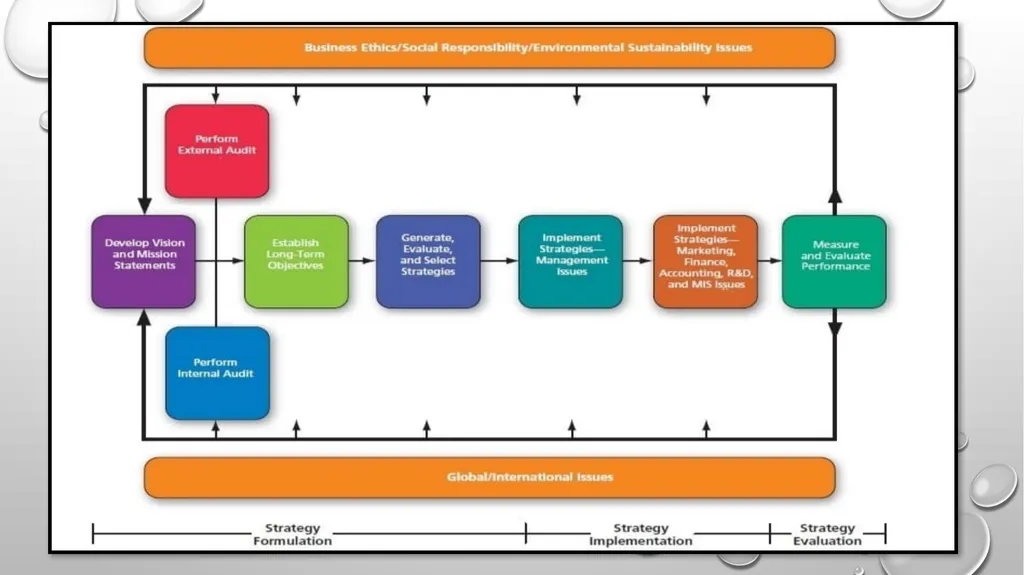
This model outlines a cyclical process for strategic planning and implementation within an organization.
Strategy Formulation
Develop Vision and Mission Statements: Create a clear vision for the organization's future and a mission statement that defines its purpose and values.
Perform External Audit: Analyze the organization's external environment, including industry analysis, competitor analysis, customer analysis, and economic analysis.
Perform Internal Audit: Assess the organization's internal resources and capabilities, including financial analysis, human resource analysis, and operational analysis.<br>
Strategy Formulation
Develop Vision and Mission Statements: Create a clear vision for the organization's future and a mission statement that defines its purpose and values.
Perform External Audit: Analyze the organization's external environment, including industry analysis, competitor analysis, customer analysis, and economic analysis.
Perform Internal Audit: Assess the organization's internal resources and capabilities, including financial analysis, human resource analysis, and operational analysis.<br>
12
Establish Long-Term Objectives: Set specific, measurable, achievable, relevant, and time-bound (SMART) objectives to guide the organization's strategic direction.
Generate, Evaluate, and Select Strategies: Develop various strategic options, evaluate them based on feasibility, acceptability, and desirability, and select the most appropriate strategies.
2. Strategy Implementation
Implement Strategies - Management Issues: Putting the chosen strategies into action, addressing organizational and leadership challenges. Address organizational structure, culture, leadership, and decision-making processes to support strategy execution.
Implement Strategies - Marketing, Finance, Accounting, R&D, MIS Issues: Develop and execute functional-level strategies for each department to align with the overall organizational strategy.<br>
Generate, Evaluate, and Select Strategies: Develop various strategic options, evaluate them based on feasibility, acceptability, and desirability, and select the most appropriate strategies.
2. Strategy Implementation
Implement Strategies - Management Issues: Putting the chosen strategies into action, addressing organizational and leadership challenges. Address organizational structure, culture, leadership, and decision-making processes to support strategy execution.
Implement Strategies - Marketing, Finance, Accounting, R&D, MIS Issues: Develop and execute functional-level strategies for each department to align with the overall organizational strategy.<br>
13
3. Strategy Evaluation
Measure and Evaluate Performance: Monitor and assess the organization's performance against its strategic objectives using key performance indicators (KPIs).
Feedback: Continuously gather feedback on the effectiveness of the implemented strategies and make necessary adjustments.
Business Ethics/Social Responsibility/Environmental Sustainability Issues: Emphasizes the importance of ethical considerations throughout the strategic management process.
Global/International Issues: Highlights the need to consider global factors and opportunities in strategy formulation, implementation, and evaluation.<br>
Measure and Evaluate Performance: Monitor and assess the organization's performance against its strategic objectives using key performance indicators (KPIs).
Feedback: Continuously gather feedback on the effectiveness of the implemented strategies and make necessary adjustments.
Business Ethics/Social Responsibility/Environmental Sustainability Issues: Emphasizes the importance of ethical considerations throughout the strategic management process.
Global/International Issues: Highlights the need to consider global factors and opportunities in strategy formulation, implementation, and evaluation.<br>
14
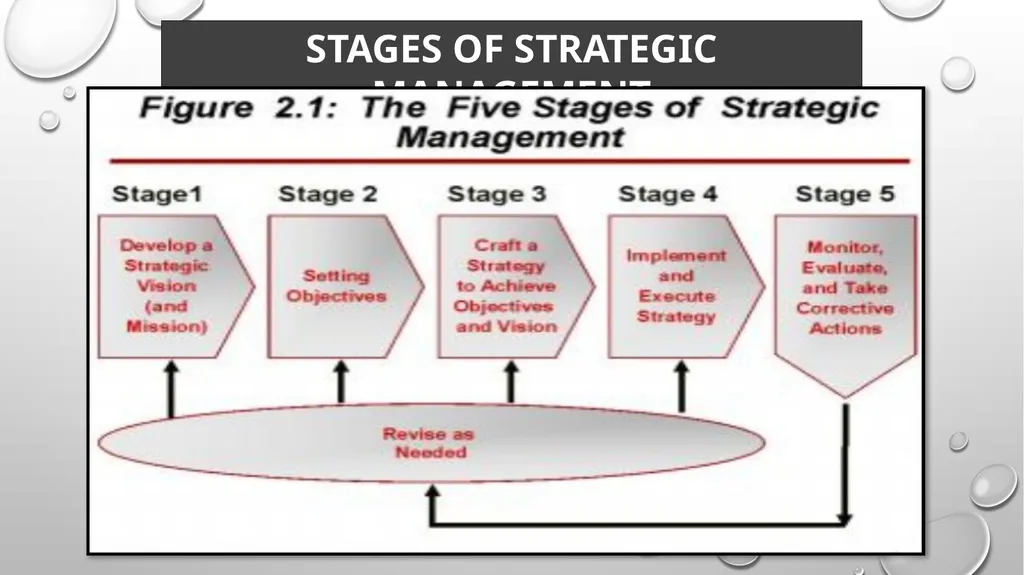
STAGES OF STRATEGIC MANAGEMENT<br>
15
Stage 1: Develop a Strategic Vision (and Mission)
This is the foundational stage where an organization defines its purpose and direction.
Vision: A long-term aspiration of what the organization wants to become. It's future-oriented and inspirational.
Mission: A clear and concise statement of the organization's core purpose and focus. It outlines the organization's reason for being.
Stage 2: Setting Objectives
Setting objectives: Specific, measurable, achievable, relevant, and time-bound (SMART) goals aligned with the vision and mission.<br>
This is the foundational stage where an organization defines its purpose and direction.
Vision: A long-term aspiration of what the organization wants to become. It's future-oriented and inspirational.
Mission: A clear and concise statement of the organization's core purpose and focus. It outlines the organization's reason for being.
Stage 2: Setting Objectives
Setting objectives: Specific, measurable, achievable, relevant, and time-bound (SMART) goals aligned with the vision and mission.<br>
16
Stage 3: Craft a Strategy to Achieve Objectives and Vision
Once the vision and mission are established, the organization develops strategies to achieve them. This involves:
Crafting a strategy: Developing a comprehensive plan outlining how the organization will compete, allocate resources, and achieve its objectives.
A strategy is developed to achieve these objectives. This involves analyzing the internal and external environment to identify strengths, weaknesses, opportunities, and threats (SWOT analysis).
Strategies are formulated to leverage strengths, address weaknesses, capitalize on opportunities, and mitigate threats.<br>
Once the vision and mission are established, the organization develops strategies to achieve them. This involves:
Crafting a strategy: Developing a comprehensive plan outlining how the organization will compete, allocate resources, and achieve its objectives.
A strategy is developed to achieve these objectives. This involves analyzing the internal and external environment to identify strengths, weaknesses, opportunities, and threats (SWOT analysis).
Strategies are formulated to leverage strengths, address weaknesses, capitalize on opportunities, and mitigate threats.<br>
17
Stage 4: Implement the Strategy and Execute
This stage involves putting the strategy into action. It includes:
Operational planning: Developing detailed plans for various departments and functions.
Resource allocation: Assigning necessary resources (financial, human, technological) to support the strategy.
Organizational structure: Aligning the organizational structure to facilitate strategy implementation.
Performance management: Establishing systems to monitor and evaluate performance.<br>
This stage involves putting the strategy into action. It includes:
Operational planning: Developing detailed plans for various departments and functions.
Resource allocation: Assigning necessary resources (financial, human, technological) to support the strategy.
Organizational structure: Aligning the organizational structure to facilitate strategy implementation.
Performance management: Establishing systems to monitor and evaluate performance.<br>
18
Stage 5: Monitor, Evaluate, and Take Corrective Actions
Continuous monitoring of the internal and external environment is crucial to ensure the strategy remains relevant and effective. This stage involves:
Performance measurement: Tracking key performance indicators (KPIs) to assess progress.
Strategic control: Comparing actual performance with planned performance.
Corrective actions: Taking steps to address any deviations from the plan.
Last - Revise as Needed
Based on the evaluation, the strategy may need to be revised or updated.
The strategic management process is cyclical, and adjustments are made as needed to adapt to changing circumstances.<br>
Continuous monitoring of the internal and external environment is crucial to ensure the strategy remains relevant and effective. This stage involves:
Performance measurement: Tracking key performance indicators (KPIs) to assess progress.
Strategic control: Comparing actual performance with planned performance.
Corrective actions: Taking steps to address any deviations from the plan.
Last - Revise as Needed
Based on the evaluation, the strategy may need to be revised or updated.
The strategic management process is cyclical, and adjustments are made as needed to adapt to changing circumstances.<br>
19
KEY TERMS IN
STRATEGIC MANAGEMENT<br>
STRATEGIC MANAGEMENT<br>
20
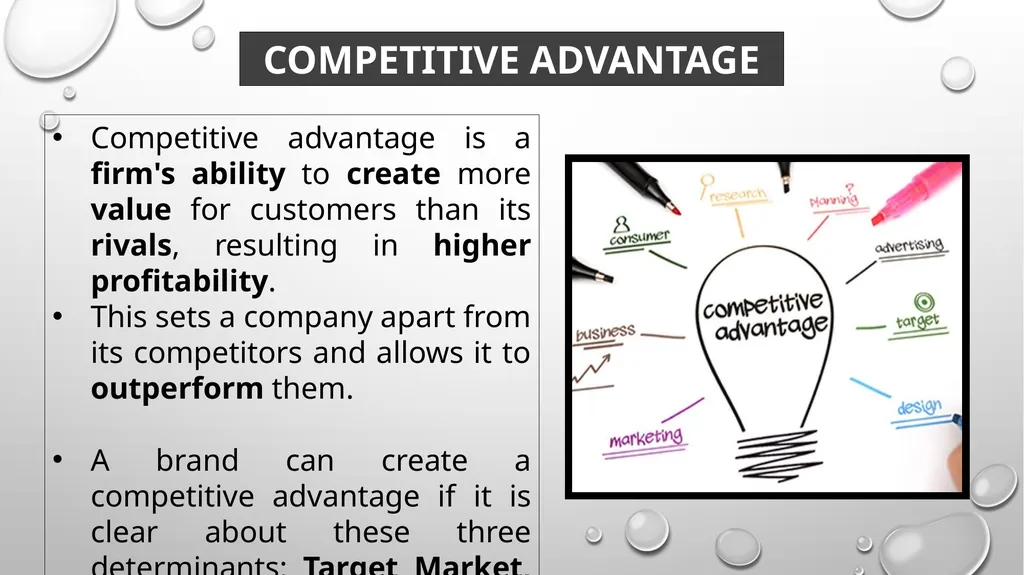
COMPETITIVE ADVANTAGE Competitive advantage is a firm's ability to create more value for customers than its rivals, resulting in higher profitability.
This sets a company apart from its competitors and allows it to outperform them.
A brand can create a competitive advantage if it is clear about these three determinants: Target Market, Competition, USP<br>
This sets a company apart from its competitors and allows it to outperform them.
A brand can create a competitive advantage if it is clear about these three determinants: Target Market, Competition, USP<br>
21
EXAMPLES
Tesla: As a pioneer in electric vehicles, Tesla has a strong brand reputation for innovation and sustainability. Their early mover advantage and focus on technology have given them a significant competitive edge in the rapidly growing electric vehicle market.
Netflix: It's extensive library of original content and licensed shows has made it a dominant player in the streaming industry.
Google: Google enjoys the competitive advantage of being the only effective search engine over the internet. The company was able to reach this height because of its size, innovation, market position, and the network effect.<br>
Tesla: As a pioneer in electric vehicles, Tesla has a strong brand reputation for innovation and sustainability. Their early mover advantage and focus on technology have given them a significant competitive edge in the rapidly growing electric vehicle market.
Netflix: It's extensive library of original content and licensed shows has made it a dominant player in the streaming industry.
Google: Google enjoys the competitive advantage of being the only effective search engine over the internet. The company was able to reach this height because of its size, innovation, market position, and the network effect.<br>
22
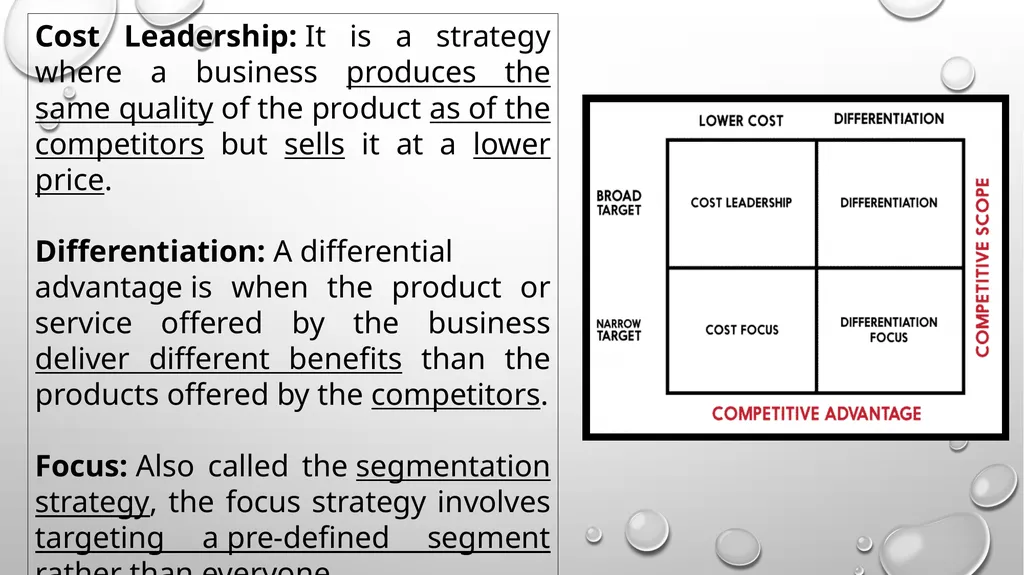
Cost Leadership: It is a strategy where a business produces the same quality of the product as of the competitors but sells it at a lower price.
Differentiation: A differential advantage is when the product or service offered by the business deliver different benefits than the products offered by the competitors.
Focus: Also called the segmentation strategy, the focus strategy involves targeting a pre-defined segment rather than everyone.<br>
Differentiation: A differential advantage is when the product or service offered by the business deliver different benefits than the products offered by the competitors.
Focus: Also called the segmentation strategy, the focus strategy involves targeting a pre-defined segment rather than everyone.<br>
23
STRATEGISTS Strategists are individuals who are responsible for developing, implementing, and evaluating the strategic direction of an organization.
They are the architects of an organization's future, responsible for making high-level decisions that impact the entire enterprise.
Strategists possess a deep understanding of the organization's internal capabilities, external environment, and industry dynamics.
They are skilled in analyzing complex situations, identifying opportunities and threats, and developing innovative strategies to achieve organizational goals.<br>
They are the architects of an organization's future, responsible for making high-level decisions that impact the entire enterprise.
Strategists possess a deep understanding of the organization's internal capabilities, external environment, and industry dynamics.
They are skilled in analyzing complex situations, identifying opportunities and threats, and developing innovative strategies to achieve organizational goals.<br>
24
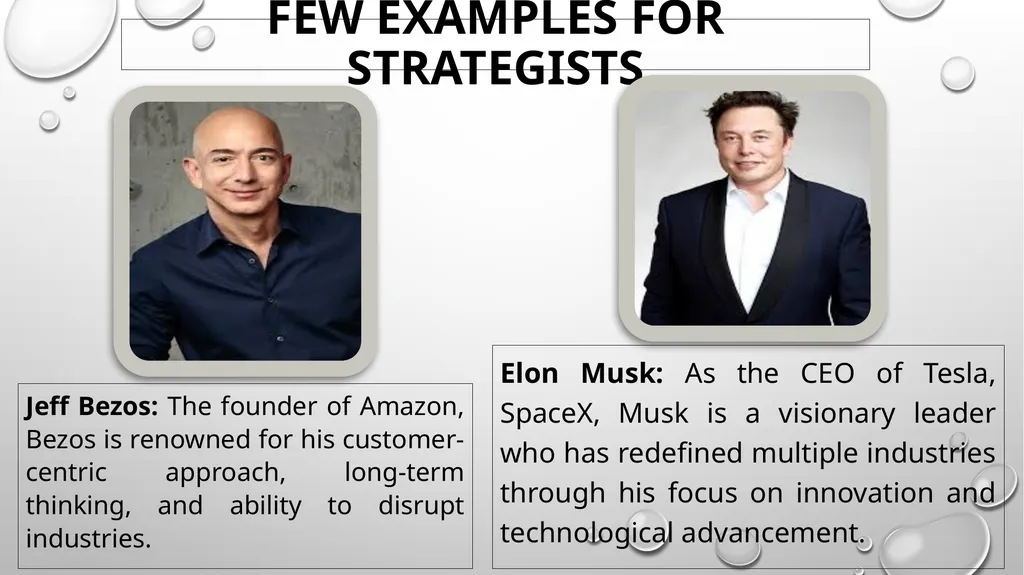
FEW EXAMPLES FOR STRATEGISTS Jeff Bezos: The founder of Amazon, Bezos is renowned for his customer-centric approach, long-term thinking, and ability to disrupt industries. Elon Musk: As the CEO of Tesla, SpaceX, Musk is a visionary leader who has redefined multiple industries through his focus on innovation and technological advancement.<br>
25
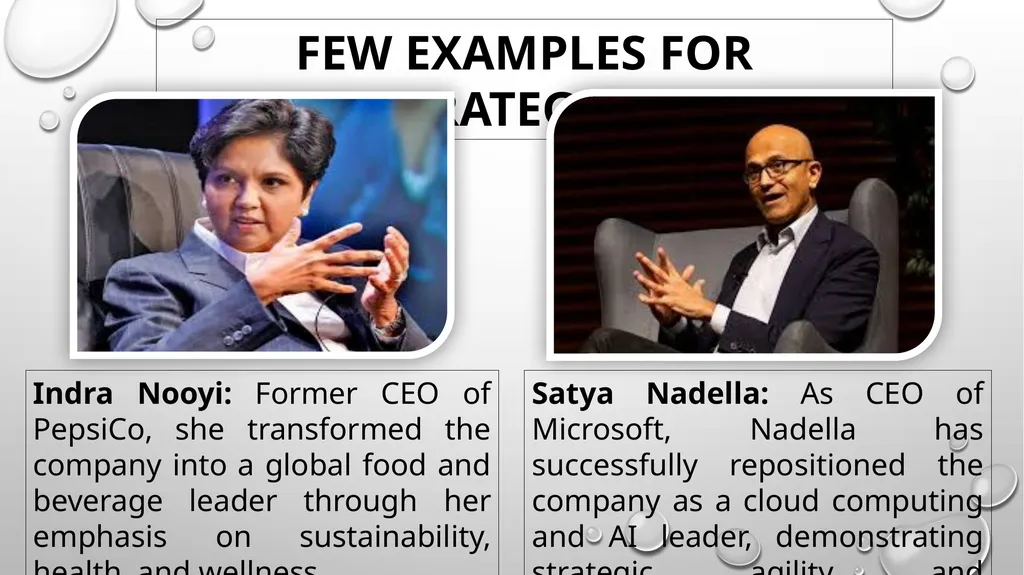
Indra Nooyi: Former CEO of PepsiCo, she transformed the company into a global food and beverage leader through her emphasis on sustainability, health, and wellness. Satya Nadella: As CEO of Microsoft, Nadella has successfully repositioned the company as a cloud computing and AI leader, demonstrating strategic agility and adaptability. FEW EXAMPLES FOR STRATEGISTS<br>
26
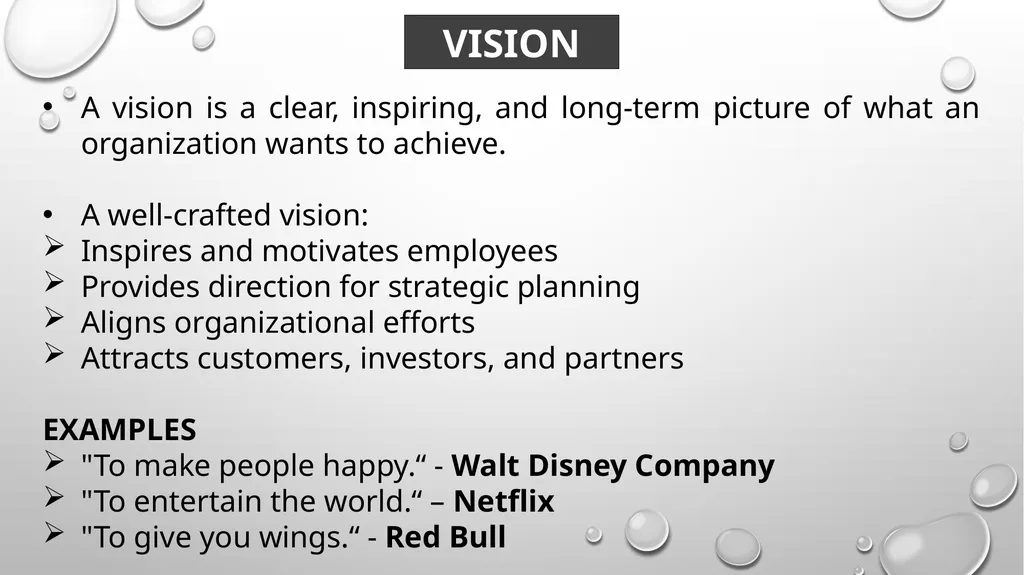
VISION A vision is a clear, inspiring, and long-term picture of what an organization wants to achieve.
A well-crafted vision:
Inspires and motivates employees
Provides direction for strategic planning
Aligns organizational efforts
Attracts customers, investors, and partners
EXAMPLES
"To make people happy.“ - Walt Disney Company
"To entertain the world.“ – Netflix
"To give you wings.“ - Red Bull<br>
A well-crafted vision:
Inspires and motivates employees
Provides direction for strategic planning
Aligns organizational efforts
Attracts customers, investors, and partners
EXAMPLES
"To make people happy.“ - Walt Disney Company
"To entertain the world.“ – Netflix
"To give you wings.“ - Red Bull<br>
27
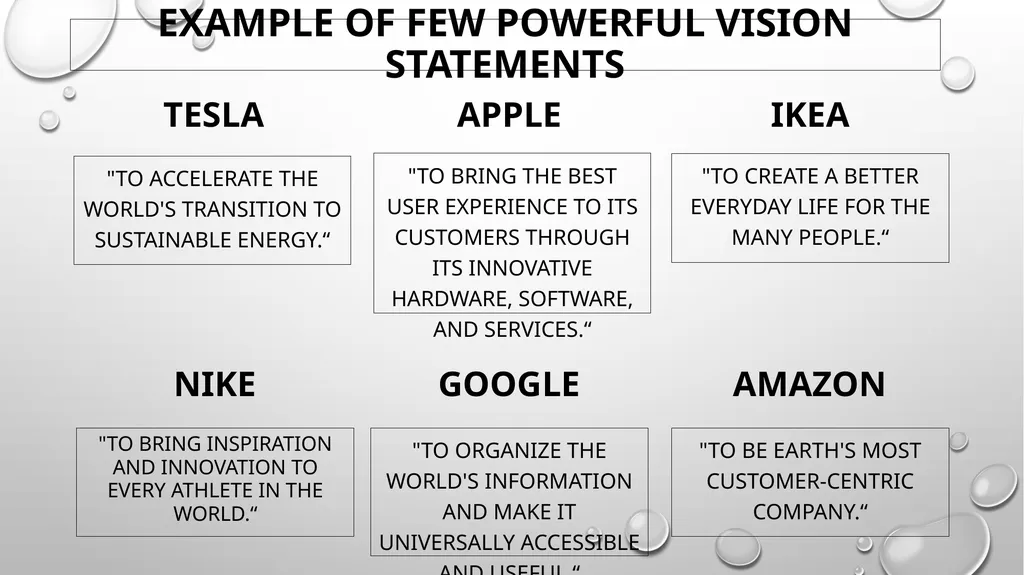
EXAMPLE OF FEW POWERFUL VISION STATEMENTS TESLA amazon IKEA "To accelerate the world's transition to sustainable energy.“ "To be Earth's most customer-centric company.“ "To create a better everyday life for the many people.“ "To organize the world's information and make it universally accessible and useful.“ GOOGLE "To bring inspiration and innovation to every athlete in the world.“ NIKE "To bring the best user experience to its customers through its innovative hardware, software, and services.“ APPLE<br>
28
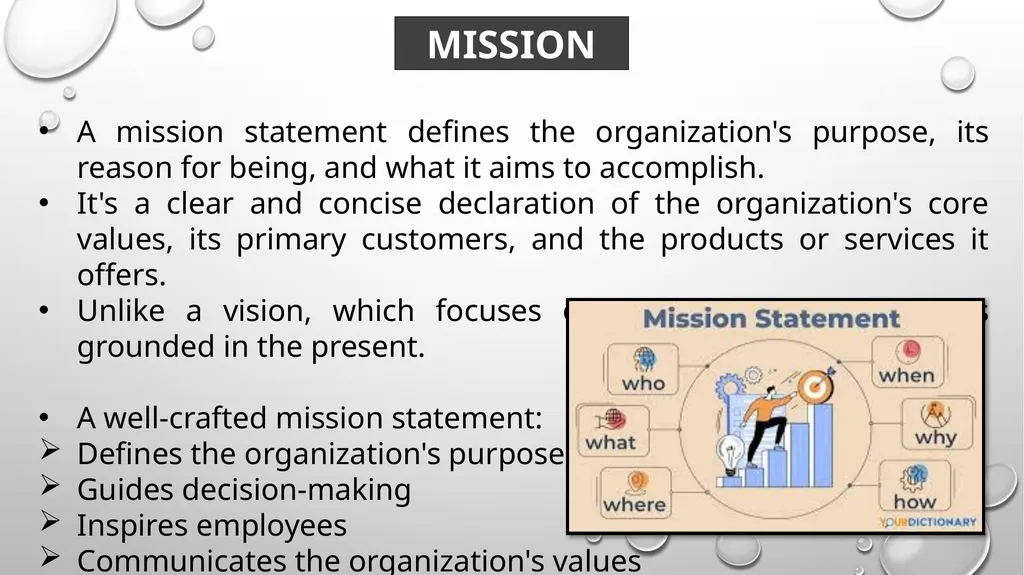
MISSION A mission statement defines the organization's purpose, its reason for being, and what it aims to accomplish.
It's a clear and concise declaration of the organization's core values, its primary customers, and the products or services it offers.
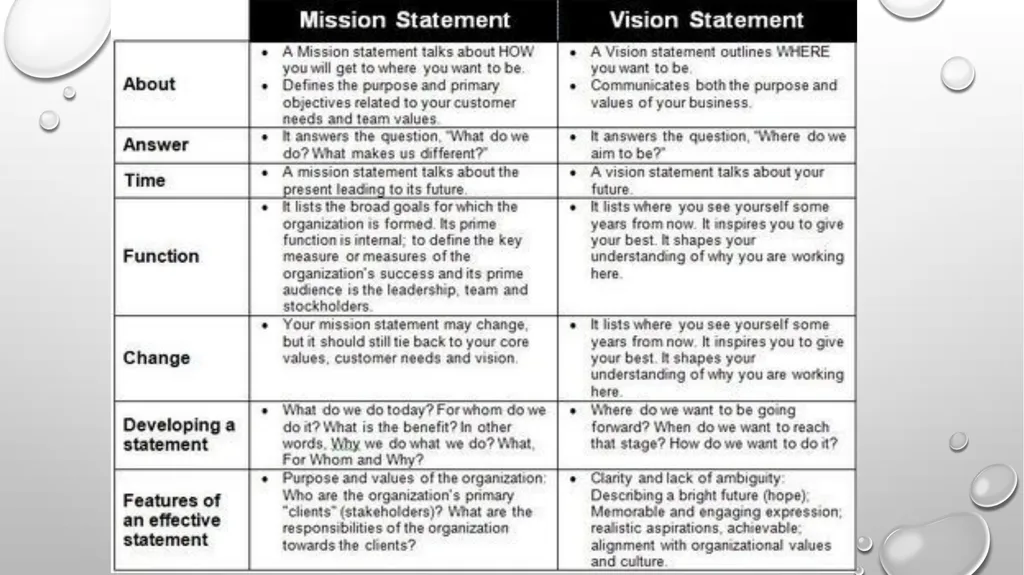
Unlike a vision, which focuses on the future, a mission is grounded in the present.
A well-crafted mission statement:
Defines the organization's purpose
Guides decision-making
Inspires employees
Communicates the organization's values<br>
It's a clear and concise declaration of the organization's core values, its primary customers, and the products or services it offers.
Unlike a vision, which focuses on the future, a mission is grounded in the present.
A well-crafted mission statement:
Defines the organization's purpose
Guides decision-making
Inspires employees
Communicates the organization's values<br>
29
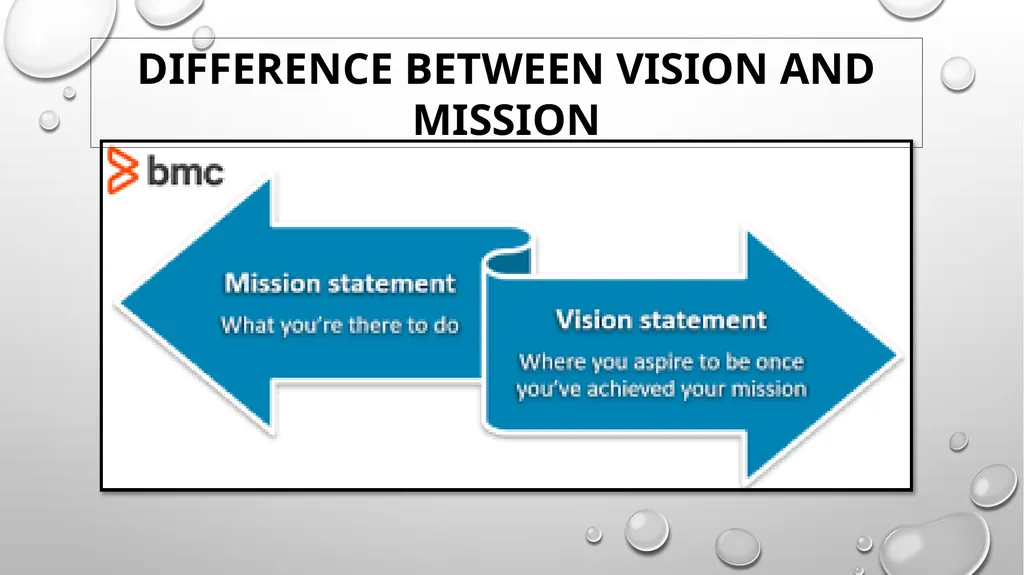
DIFFERENCE BETWEEN VISION AND MISSION<br>
30
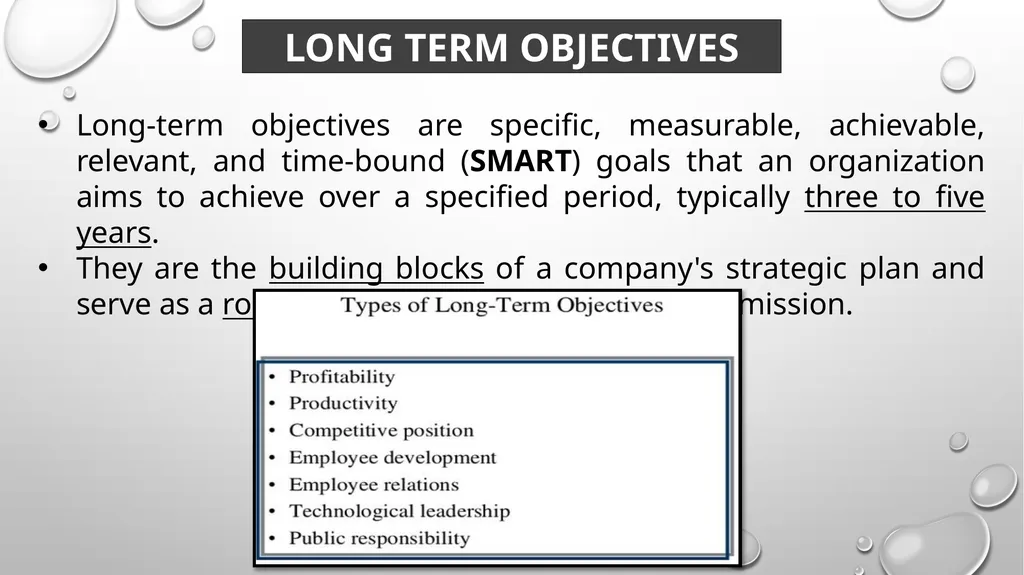
LONG TERM OBJECTIVES Long-term objectives are specific, measurable, achievable, relevant, and time-bound (SMART) goals that an organization aims to achieve over a specified period, typically three to five years.
They are the building blocks of a company's strategic plan and serve as a roadmap for achieving its vision and mission.<br>
They are the building blocks of a company's strategic plan and serve as a roadmap for achieving its vision and mission.<br>
31
EXAMPLES
Increase market share by 20% in the target market within next 5 years.
Increase employee engagement and retention by 15% within the next 3 years.
Develop and launch five innovative products in the next three years.
Reduce operational costs by 10% through process optimization and automation by 2027.<br>
Increase market share by 20% in the target market within next 5 years.
Increase employee engagement and retention by 15% within the next 3 years.
Develop and launch five innovative products in the next three years.
Reduce operational costs by 10% through process optimization and automation by 2027.<br>
32
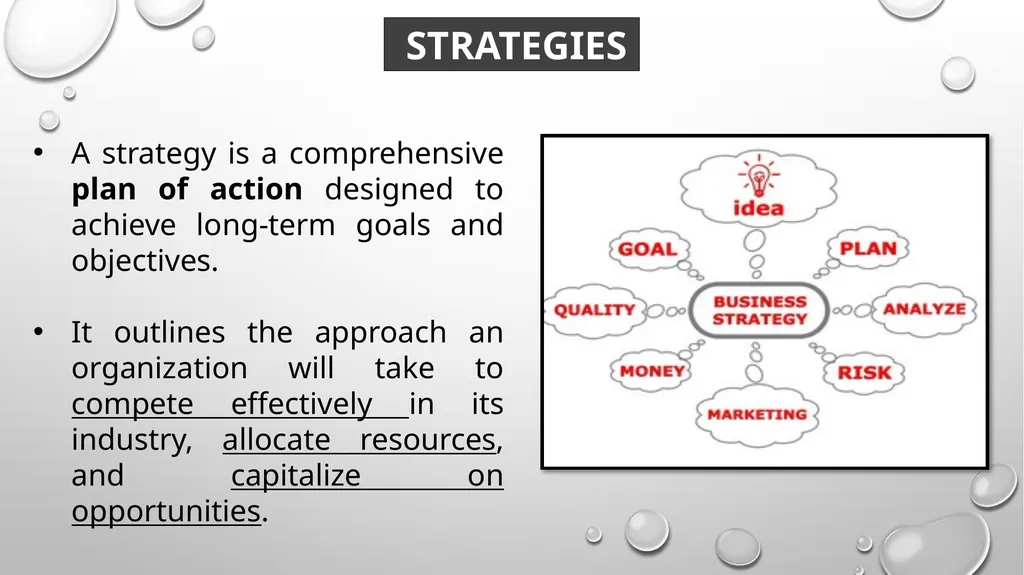
STRATEGIES A strategy is a comprehensive plan of action designed to achieve long-term goals and objectives.
It outlines the approach an organization will take to compete effectively in its industry, allocate resources, and capitalize on opportunities.<br>
It outlines the approach an organization will take to compete effectively in its industry, allocate resources, and capitalize on opportunities.<br>
33
TYPES/ LEVELS OF STRATEGIES
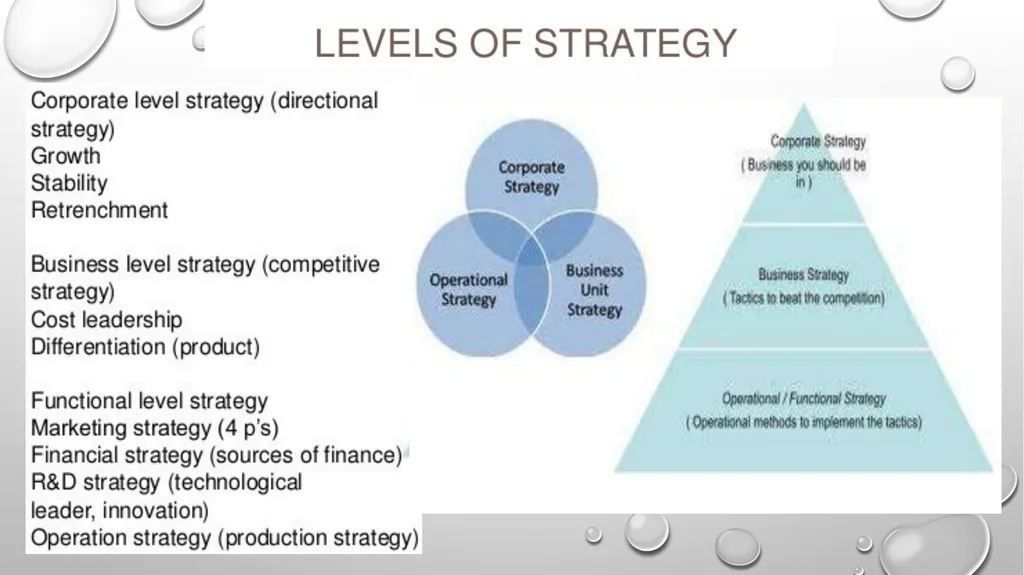
1. Corporate Level Strategy
This focuses on Overall direction of the organization.
It decides “What businesses to be in.”
Strategies includes - Resource allocation, diversification, acquisition, integration, joint ventures and divestment.
Example: A company deciding to enter a new market or industry.
2. Business Level Strategy
This focuses on How to compete successfully in a specific market or industry.
Strategies includes - Competitive advantage, cost leadership, differentiation, focus, and market segmentation.
Example: A company adopting a cost leadership strategy to gain a competitive edge.<br>
1. Corporate Level Strategy
This focuses on Overall direction of the organization.
It decides “What businesses to be in.”
Strategies includes - Resource allocation, diversification, acquisition, integration, joint ventures and divestment.
Example: A company deciding to enter a new market or industry.
2. Business Level Strategy
This focuses on How to compete successfully in a specific market or industry.
Strategies includes - Competitive advantage, cost leadership, differentiation, focus, and market segmentation.
Example: A company adopting a cost leadership strategy to gain a competitive edge.<br>
34
3. Functional Level Strategy
This focuses on Detailed, short-term operational plans for key functional areas.
Its strategies include - Cost reduction, quality improvement, process optimization, technology adoption.
It supports the business-level strategy through efficient operations.
Example: A marketing department developing a social media campaign to increase brand awareness.<br>
This focuses on Detailed, short-term operational plans for key functional areas.
Its strategies include - Cost reduction, quality improvement, process optimization, technology adoption.
It supports the business-level strategy through efficient operations.
Example: A marketing department developing a social media campaign to increase brand awareness.<br>
35
ANNUAL OBJECTIVES Annual objectives are specific, measurable, achievable, relevant, and time-bound (SMART) goals that an organization sets to achieve within a one-year period.
They are derived from the organization's long-term strategic objectives and serve as the tactical steps to reach those overarching goals.
They provide a clear focus for the organization and its employees, enabling them to align their efforts towards common goals.<br>
They are derived from the organization's long-term strategic objectives and serve as the tactical steps to reach those overarching goals.
They provide a clear focus for the organization and its employees, enabling them to align their efforts towards common goals.<br>
36
EXAMPLES
Implement a new performance management system.
Reduce production costs by 7%.
Improve on-time delivery by 95%.<br>
Implement a new performance management system.
Reduce production costs by 7%.
Improve on-time delivery by 95%.<br>
37
POLICIES Policies in strategic management are the guidelines or rules that guide decision-making and actions within an organization to achieve its strategic objectives.
They provide a framework for consistent and effective implementation of strategies.
Strategies outline the overall direction, while policies ensure that everyone follows the same path to reach the goal.
Policies should align with the organization’s overall strategy and should be regularly reviewed and updated to reflect changes in the business environment.<br>
They provide a framework for consistent and effective implementation of strategies.
Strategies outline the overall direction, while policies ensure that everyone follows the same path to reach the goal.
Policies should align with the organization’s overall strategy and should be regularly reviewed and updated to reflect changes in the business environment.<br>
38
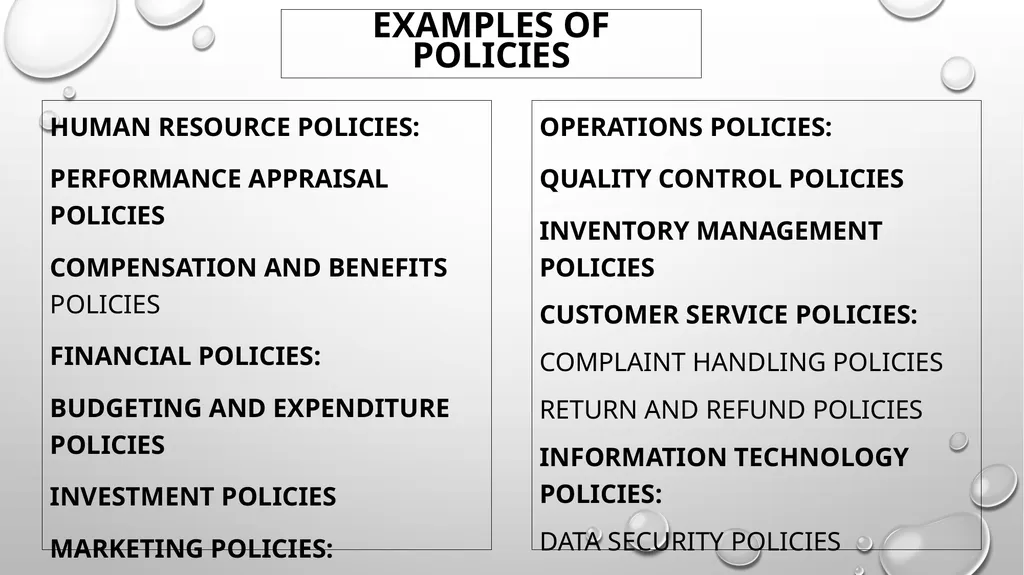
EXAMPLES OF POLICIES Human Resource Policies:
Performance appraisal policies
Compensation and benefits policieS
Financial Policies:
Budgeting and expenditure policies
Investment policies
Marketing Policies:
Pricing policies
Distribution channel policies Operations Policies:
Quality control policies
Inventory management policies
Customer Service Policies:
complaint handling policies
Return and refund policies
Information Technology Policies:
Data security policies
Software acquisition policies<br>
Performance appraisal policies
Compensation and benefits policieS
Financial Policies:
Budgeting and expenditure policies
Investment policies
Marketing Policies:
Pricing policies
Distribution channel policies Operations Policies:
Quality control policies
Inventory management policies
Customer Service Policies:
complaint handling policies
Return and refund policies
Information Technology Policies:
Data security policies
Software acquisition policies<br>
39
USEFUL LINKS https://youtu.be/iuYlGRnC7J8?si=wunxvfnxh4T9QtTx
https://wdcweb.com/blog/companies-with-best-marketing-strategies-in-india/
https://www.cascade.app/blog/the-5-best-business-strategies-ive-ever-seen
https://growthx.club/blog/zomato-business-model<br>
https://wdcweb.com/blog/companies-with-best-marketing-strategies-in-india/
https://www.cascade.app/blog/the-5-best-business-strategies-ive-ever-seen
https://growthx.club/blog/zomato-business-model<br>