
Module 3 -Preliminary Considerations Training
MS
Published · 19 slides · 0 views
1 / 1




Description
Module 3 -Preliminary Considerations Training Materials on the International Protocol Institute for International Criminal Investigations 2015 INTERNATIONAL PROTOCOL, PART 2 MODULE 3 PAGES 29-36 What is your most important obligation?
Related Topics
Share
Embed code
Download this presentation From Below
"Module 3 -Preliminary Considerations Training" is the property of its rightful owner. Permission is granted to download and print the materials on this website for personal, non-commercial use only, and to display it on your personal computer provided you do not modify the materials and that you retain all copyright notices contained in the materials. By downloading content from our website, you accept the terms of this agreement.
Presentation Transcript
01
Module 3 -Preliminary Considerations Training Materials on the International Protocol
© Institute for International Criminal Investigations 2015 INTERNATIONAL PROTOCOL,
PART 2 MODULE 3
PAGES 29-36<br>
© Institute for International Criminal Investigations 2015 INTERNATIONAL PROTOCOL,
PART 2 MODULE 3
PAGES 29-36<br>
02
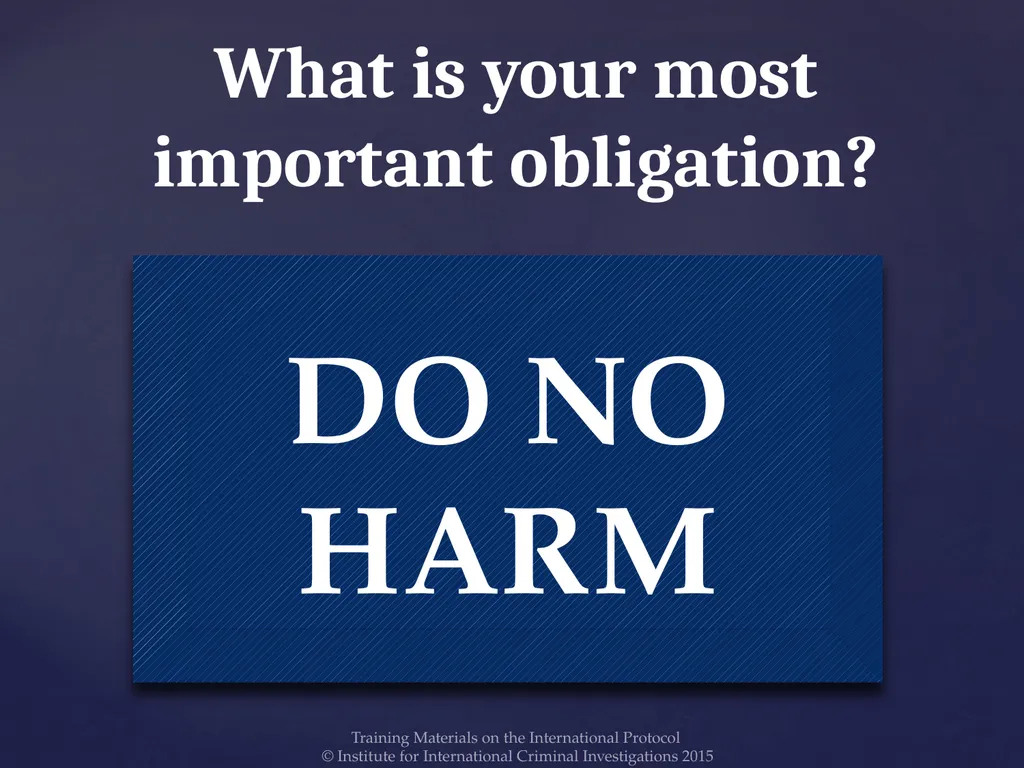
What is your most important obligation? Training Materials on the International Protocol
© Institute for International Criminal Investigations 2015 DO NO HARM<br>
© Institute for International Criminal Investigations 2015 DO NO HARM<br>
03
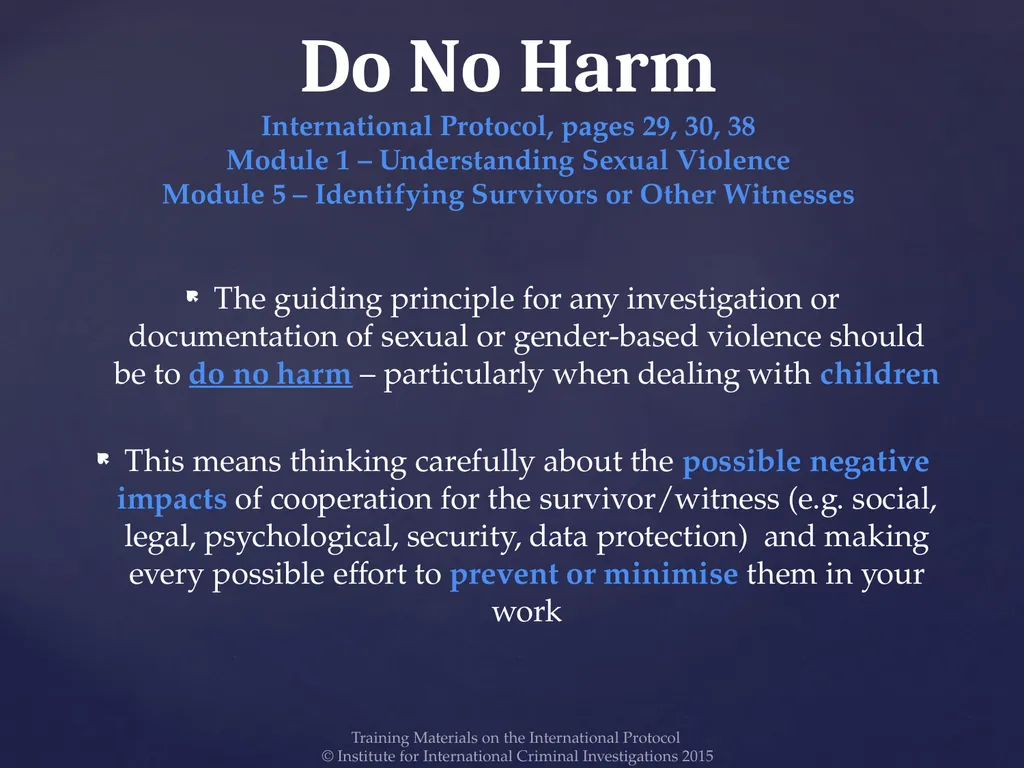
The guiding principle for any investigation or documentation of sexual or gender-based violence should be to do no harm – particularly when dealing with children
This means thinking carefully about the possible negative impacts of cooperation for the survivor/witness (e.g. social, legal, psychological, security, data protection) and making every possible effort to prevent or minimise them in your work Do No Harm International Protocol, pages 29, 30, 38 Module 1 – Understanding Sexual Violence Module 5 – Identifying Survivors or Other Witnesses Training Materials on the International Protocol
© Institute for International Criminal Investigations 2015<br>
This means thinking carefully about the possible negative impacts of cooperation for the survivor/witness (e.g. social, legal, psychological, security, data protection) and making every possible effort to prevent or minimise them in your work Do No Harm International Protocol, pages 29, 30, 38 Module 1 – Understanding Sexual Violence Module 5 – Identifying Survivors or Other Witnesses Training Materials on the International Protocol
© Institute for International Criminal Investigations 2015<br>
04
Plan and prepare – don’t patronise
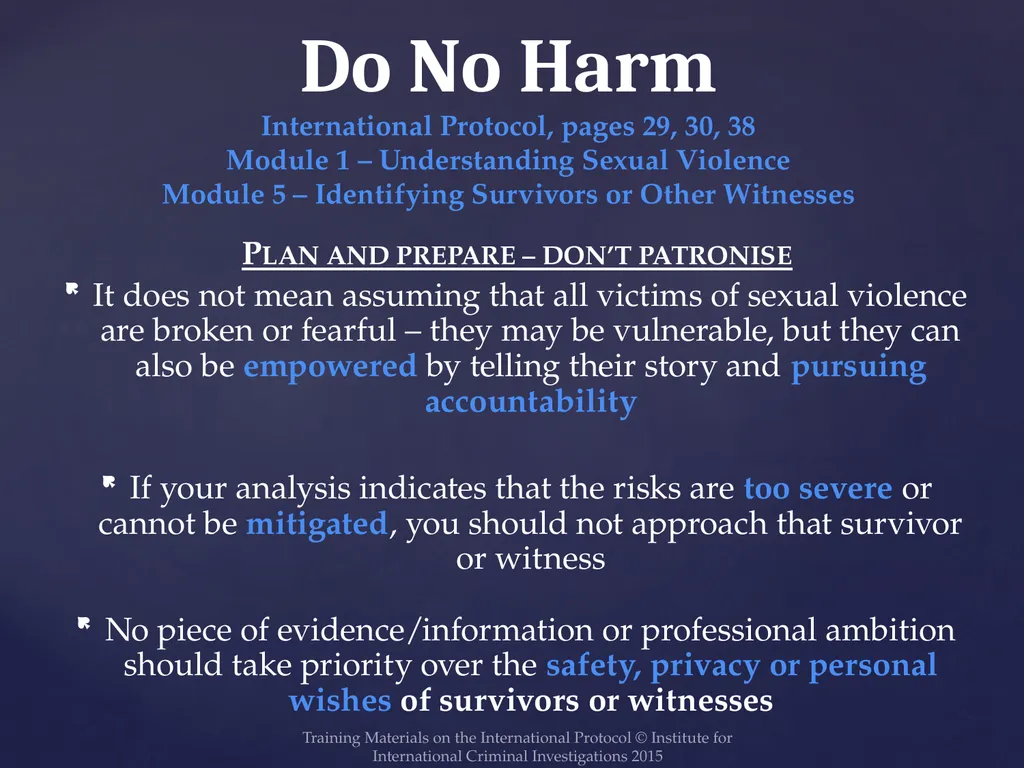
It does not mean assuming that all victims of sexual violence are broken or fearful – they may be vulnerable, but they can also be empowered by telling their story and pursuing accountability
If your analysis indicates that the risks are too severe or cannot be mitigated, you should not approach that survivor or witness
No piece of evidence/information or professional ambition should take priority over the safety, privacy or personal wishes of survivors or witnesses Do No Harm International Protocol, pages 29, 30, 38 Module 1 – Understanding Sexual Violence Module 5 – Identifying Survivors or Other Witnesses Training Materials on the International Protocol © Institute for International Criminal Investigations 2015<br>
It does not mean assuming that all victims of sexual violence are broken or fearful – they may be vulnerable, but they can also be empowered by telling their story and pursuing accountability
If your analysis indicates that the risks are too severe or cannot be mitigated, you should not approach that survivor or witness
No piece of evidence/information or professional ambition should take priority over the safety, privacy or personal wishes of survivors or witnesses Do No Harm International Protocol, pages 29, 30, 38 Module 1 – Understanding Sexual Violence Module 5 – Identifying Survivors or Other Witnesses Training Materials on the International Protocol © Institute for International Criminal Investigations 2015<br>
05
All members of your team should try to meet the following minimum standards: Do No Harm
International Protocol, pages 29, 30, 38
Module 1 – Understanding Sexual Violence
Module 6 – Testimony Training Materials on the International Protocol
© Institute for International Criminal Investigations 2015<br>
© Institute for International Criminal Investigations 2015<br>
06
All members of your team should be appropriately trained and vetted to deal with sexual violence – that includes interpreters, interviewers, analysts, support staff and intermediaries
The International Protocol and these training materials can be used to train team members on the basic standards of documentation
All members of the documentation team should also be trained on and be aware of the following issues: Training International Protocol, pages 29-30 Module 7 – Interviewing Training Materials on the International Protocol
© Institute for International Criminal Investigations 2015<br>
The International Protocol and these training materials can be used to train team members on the basic standards of documentation
All members of the documentation team should also be trained on and be aware of the following issues: Training International Protocol, pages 29-30 Module 7 – Interviewing Training Materials on the International Protocol
© Institute for International Criminal Investigations 2015<br>
07
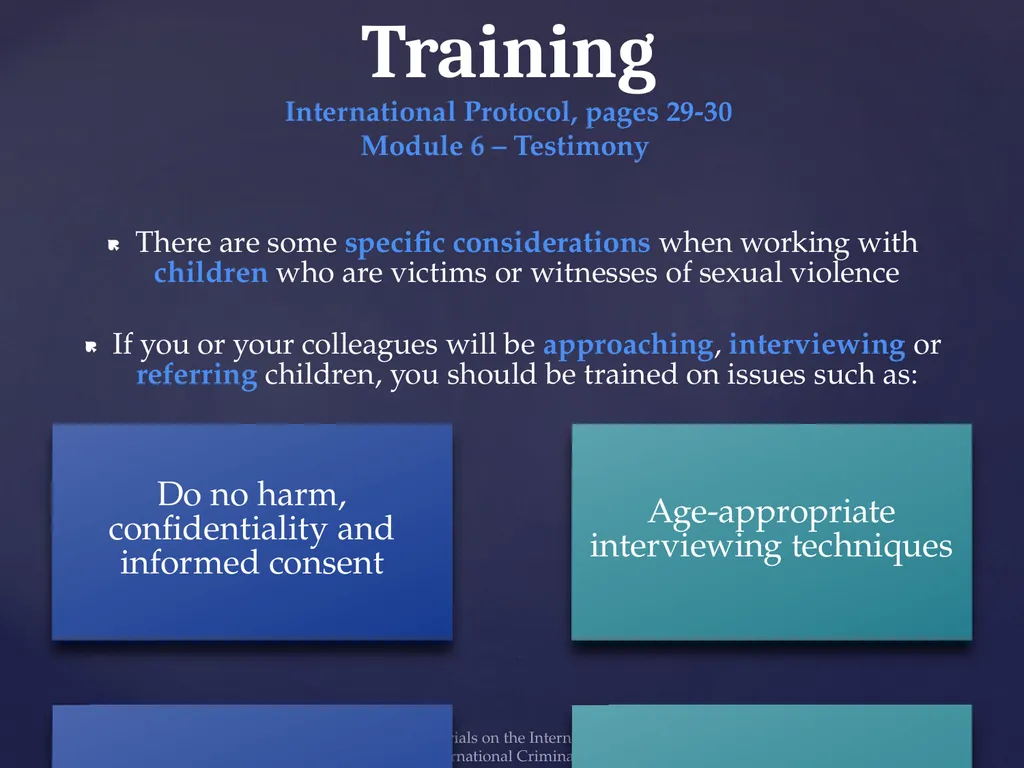
There are some specific considerations when working with children who are victims or witnesses of sexual violence
If you or your colleagues will be approaching, interviewing or referring children, you should be trained on issues such as: Training International Protocol, pages 29-30 Module 6 – Testimony Training Materials on the International Protocol
© Institute for International Criminal Investigations 2015<br>
If you or your colleagues will be approaching, interviewing or referring children, you should be trained on issues such as: Training International Protocol, pages 29-30 Module 6 – Testimony Training Materials on the International Protocol
© Institute for International Criminal Investigations 2015<br>
08
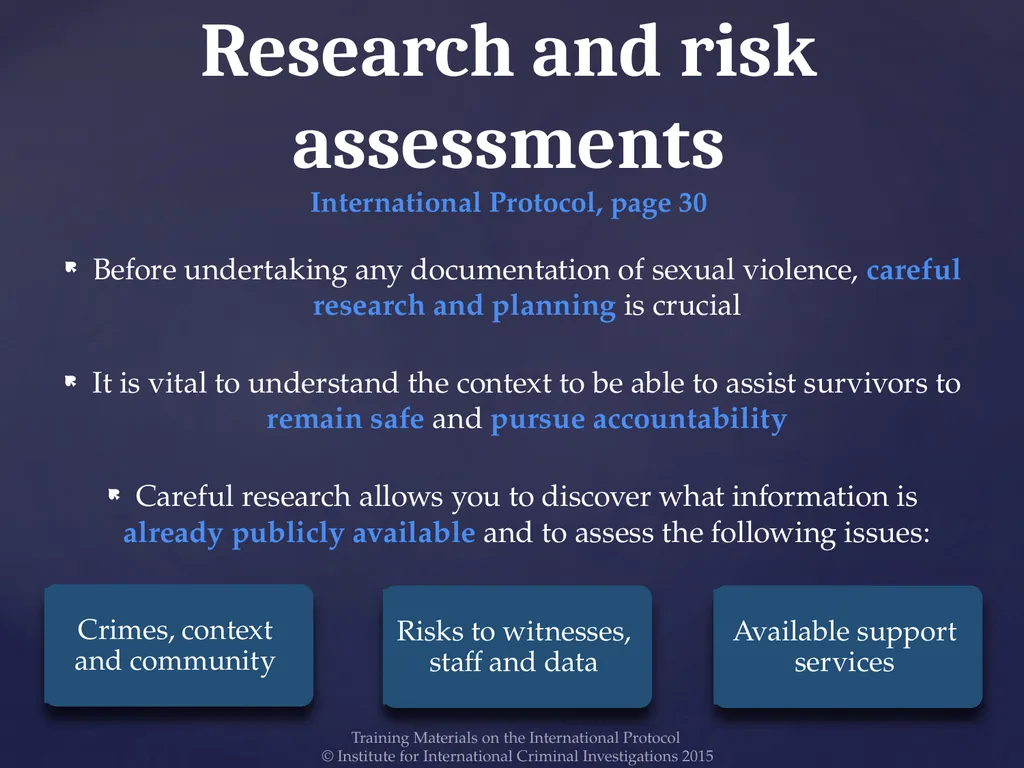
Before undertaking any documentation of sexual violence, careful research and planning is crucial
It is vital to understand the context to be able to assist survivors to remain safe and pursue accountability
Careful research allows you to discover what information is already publicly available and to assess the following issues: Training Materials on the International Protocol
© Institute for International Criminal Investigations 2015 Research and risk assessments International Protocol, page 30<br>
It is vital to understand the context to be able to assist survivors to remain safe and pursue accountability
Careful research allows you to discover what information is already publicly available and to assess the following issues: Training Materials on the International Protocol
© Institute for International Criminal Investigations 2015 Research and risk assessments International Protocol, page 30<br>
09
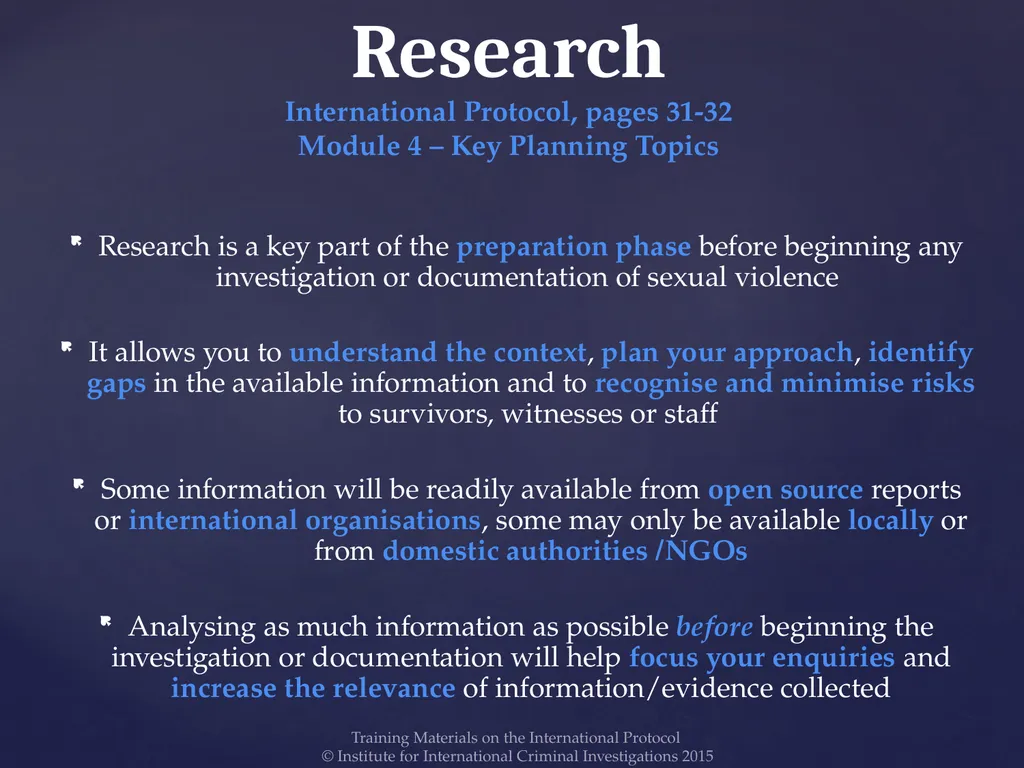
Research is a key part of the preparation phase before beginning any investigation or documentation of sexual violence
It allows you to understand the context, plan your approach, identify gaps in the available information and to recognise and minimise risks to survivors, witnesses or staff
Some information will be readily available from open source reports or international organisations, some may only be available locally or from domestic authorities /NGOs
Analysing as much information as possible before beginning the investigation or documentation will help focus your enquiries and increase the relevance of information/evidence collected Research International Protocol, pages 31-32 Module 4 – Key Planning Topics Training Materials on the International Protocol
© Institute for International Criminal Investigations 2015<br>
It allows you to understand the context, plan your approach, identify gaps in the available information and to recognise and minimise risks to survivors, witnesses or staff
Some information will be readily available from open source reports or international organisations, some may only be available locally or from domestic authorities /NGOs
Analysing as much information as possible before beginning the investigation or documentation will help focus your enquiries and increase the relevance of information/evidence collected Research International Protocol, pages 31-32 Module 4 – Key Planning Topics Training Materials on the International Protocol
© Institute for International Criminal Investigations 2015<br>
10
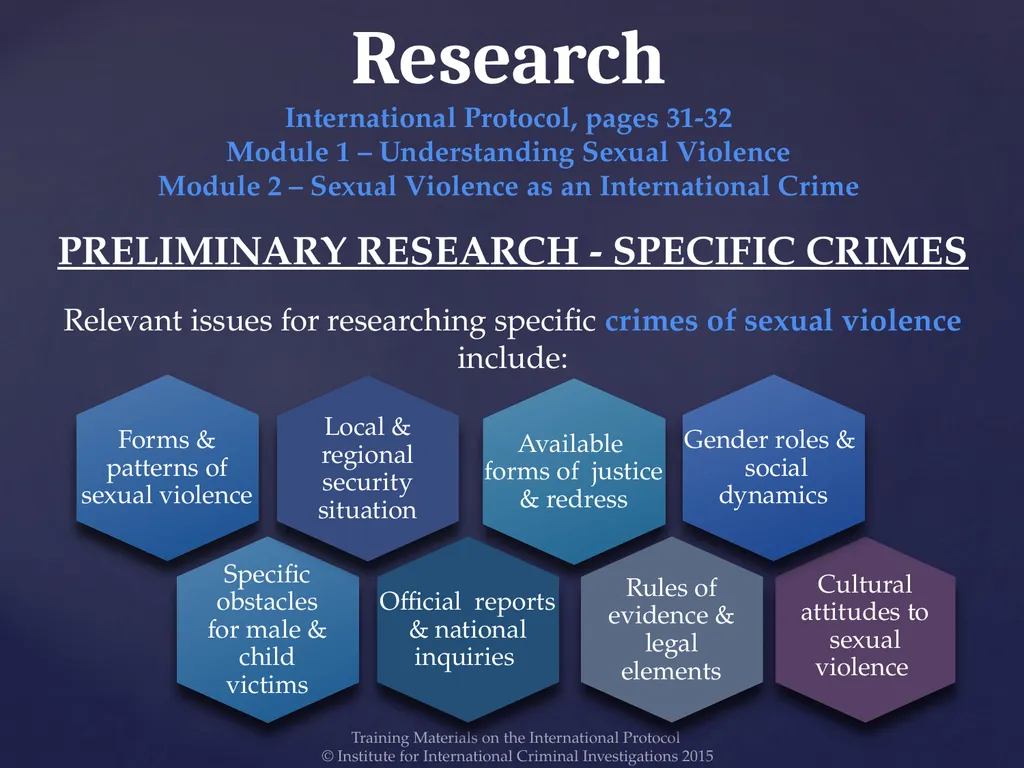
PRELIMINARY RESEARCH - SPECIFIC CRIMES
Relevant issues for researching specific crimes of sexual violence include: Research International Protocol, pages 31-32 Module 1 – Understanding Sexual Violence Module 2 – Sexual Violence as an International Crime Training Materials on the International Protocol
© Institute for International Criminal Investigations 2015<br>
Relevant issues for researching specific crimes of sexual violence include: Research International Protocol, pages 31-32 Module 1 – Understanding Sexual Violence Module 2 – Sexual Violence as an International Crime Training Materials on the International Protocol
© Institute for International Criminal Investigations 2015<br>
11
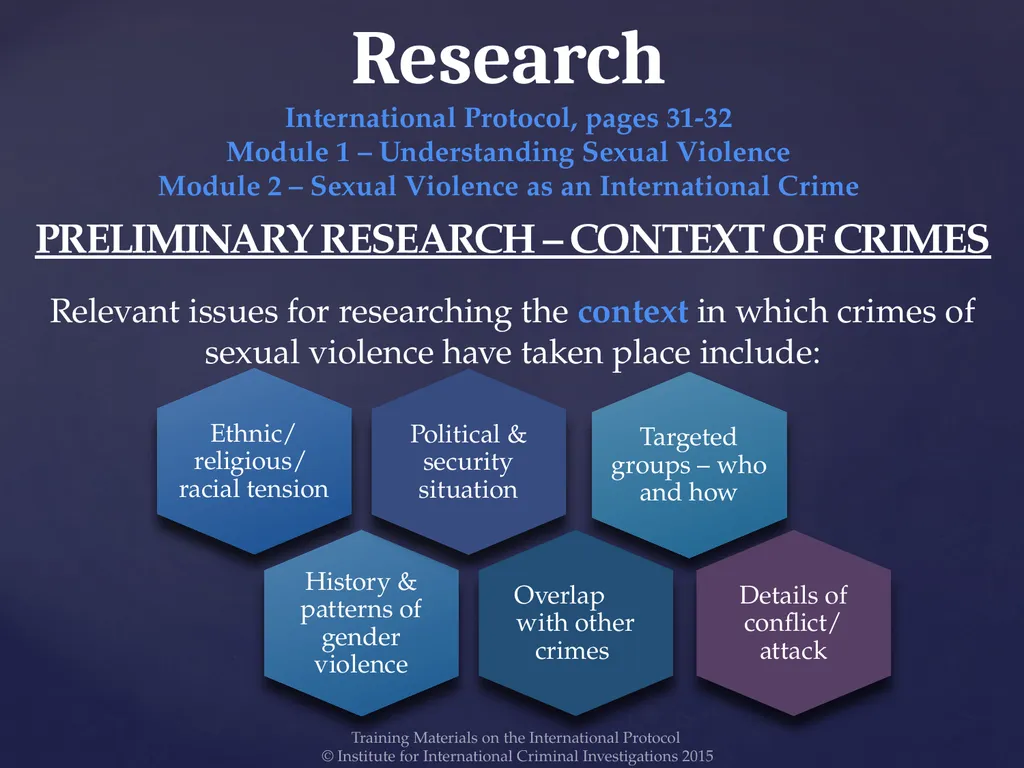
PRELIMINARY RESEARCH – CONTEXT OF CRIMES
Relevant issues for researching the context in which crimes of sexual violence have taken place include: Research International Protocol, pages 31-32 Module 1 – Understanding Sexual Violence Module 2 – Sexual Violence as an International Crime Training Materials on the International Protocol
© Institute for International Criminal Investigations 2015<br>
Relevant issues for researching the context in which crimes of sexual violence have taken place include: Research International Protocol, pages 31-32 Module 1 – Understanding Sexual Violence Module 2 – Sexual Violence as an International Crime Training Materials on the International Protocol
© Institute for International Criminal Investigations 2015<br>
12
Research
International Protocol, pages 31-32
Module 2 – Sexual Violence as an International Crime
Module 5 – Identifying Survivors and Other Witnesses Training Materials on the International Protocol
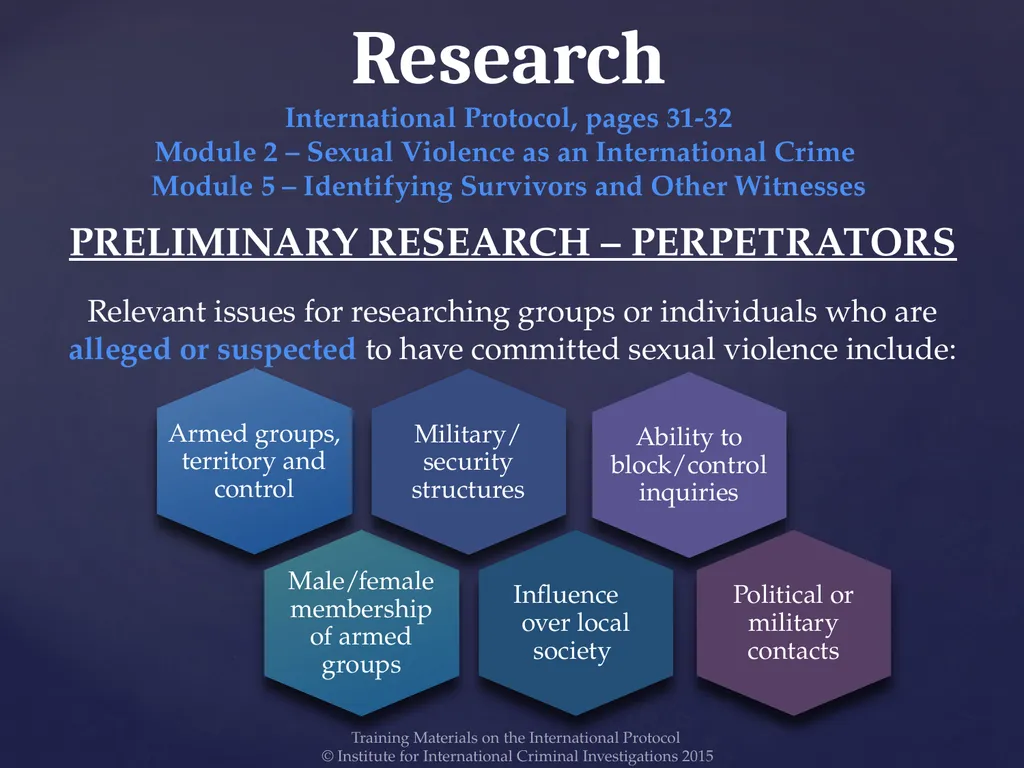
© Institute for International Criminal Investigations 2015 PRELIMINARY RESEARCH – PERPETRATORS
Relevant issues for researching groups or individuals who are alleged or suspected to have committed sexual violence include:<br>
© Institute for International Criminal Investigations 2015 PRELIMINARY RESEARCH – PERPETRATORS
Relevant issues for researching groups or individuals who are alleged or suspected to have committed sexual violence include:<br>
13
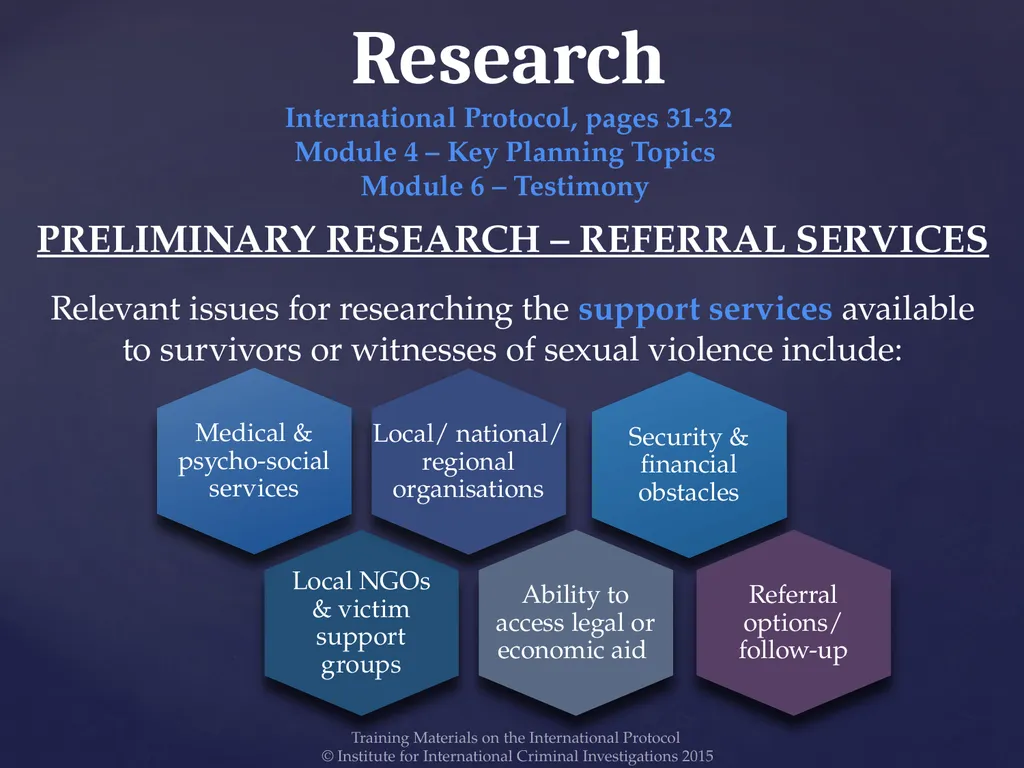
PRELIMINARY RESEARCH – REFERRAL SERVICES
Relevant issues for researching the support services available to survivors or witnesses of sexual violence include: Research International Protocol, pages 31-32 Module 4 – Key Planning Topics Module 6 – Testimony Training Materials on the International Protocol
© Institute for International Criminal Investigations 2015<br>
Relevant issues for researching the support services available to survivors or witnesses of sexual violence include: Research International Protocol, pages 31-32 Module 4 – Key Planning Topics Module 6 – Testimony Training Materials on the International Protocol
© Institute for International Criminal Investigations 2015<br>
14
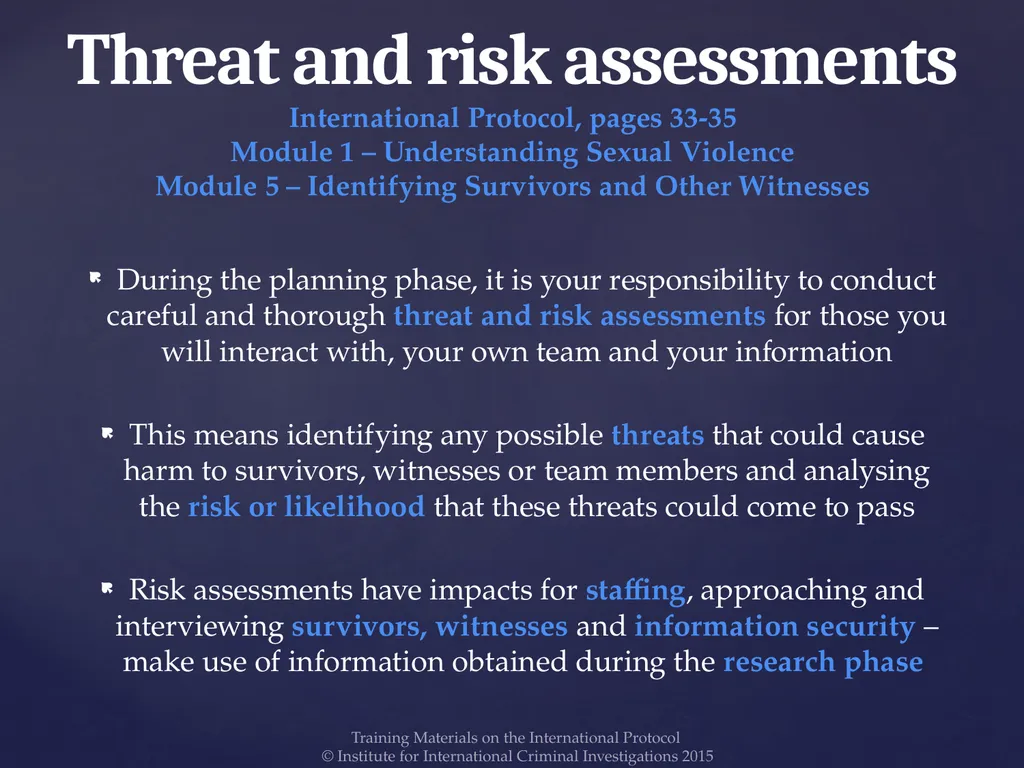
During the planning phase, it is your responsibility to conduct careful and thorough threat and risk assessments for those you will interact with, your own team and your information
This means identifying any possible threats that could cause harm to survivors, witnesses or team members and analysing the risk or likelihood that these threats could come to pass
Risk assessments have impacts for staffing, approaching and interviewing survivors, witnesses and information security – make use of information obtained during the research phase Threat and risk assessments International Protocol, pages 33-35 Module 1 – Understanding Sexual Violence Module 5 – Identifying Survivors and Other Witnesses Training Materials on the International Protocol
© Institute for International Criminal Investigations 2015<br>
This means identifying any possible threats that could cause harm to survivors, witnesses or team members and analysing the risk or likelihood that these threats could come to pass
Risk assessments have impacts for staffing, approaching and interviewing survivors, witnesses and information security – make use of information obtained during the research phase Threat and risk assessments International Protocol, pages 33-35 Module 1 – Understanding Sexual Violence Module 5 – Identifying Survivors and Other Witnesses Training Materials on the International Protocol
© Institute for International Criminal Investigations 2015<br>
15
Threat and risk assessments
International Protocol, pages 33-35
Module 1 – Understanding Sexual Violence
Module 5 – Identifying Survivors and Other Witnesses Training Materials on the International Protocol
© Institute for International Criminal Investigations 2015 ASSESSING RISKS TO SURVIVORS/ WITNESSES
For each of these issues, you should assess the severity of the potential harm, identify individual vulnerability, analyse the risk or likelihood of them occurring and look for potential mitigating factors<br>
© Institute for International Criminal Investigations 2015 ASSESSING RISKS TO SURVIVORS/ WITNESSES
For each of these issues, you should assess the severity of the potential harm, identify individual vulnerability, analyse the risk or likelihood of them occurring and look for potential mitigating factors<br>
16
Threat and risk assessments
International Protocol, pages 33-35
Module 1 – Understanding Sexual Violence
Module 5 – Identifying Survivors and Other Witnesses Training Materials on the International Protocol
© Institute for International Criminal Investigations 2015 ASSESSING RISKS TO SURVIVORS/ WITNESSES
The following factors can be relevant when assessing risks to survivors or witnesses: Other & safer means of accessing information<br>
© Institute for International Criminal Investigations 2015 ASSESSING RISKS TO SURVIVORS/ WITNESSES
The following factors can be relevant when assessing risks to survivors or witnesses: Other & safer means of accessing information<br>
17
Threat and risk assessments
International Protocol, pages 34-35
Module 5 – Identifying Survivors and Other Witnesses Training Materials on the International Protocol
© Institute for International Criminal Investigations 2015 ASSESSING RISKS TO STAFF/ TEAM MEMBERS
For each of these issues, you should assess the severity of the potential harm, identify individual vulnerability, analyse the risk or likelihood of them occurring and look for potential mitigating factors<br>
© Institute for International Criminal Investigations 2015 ASSESSING RISKS TO STAFF/ TEAM MEMBERS
For each of these issues, you should assess the severity of the potential harm, identify individual vulnerability, analyse the risk or likelihood of them occurring and look for potential mitigating factors<br>
18
Threat and risk assessments
International Protocol, page 35
Module 9 – Storing Information Training Materials on the International Protocol
© Institute for International Criminal Investigations 2015 ASSESSING RISKS TO EVIDENCE/ INFORMATION
The following factors can be relevant when planning how to store and manage your evidence or information:<br>
© Institute for International Criminal Investigations 2015 ASSESSING RISKS TO EVIDENCE/ INFORMATION
The following factors can be relevant when planning how to store and manage your evidence or information:<br>
19
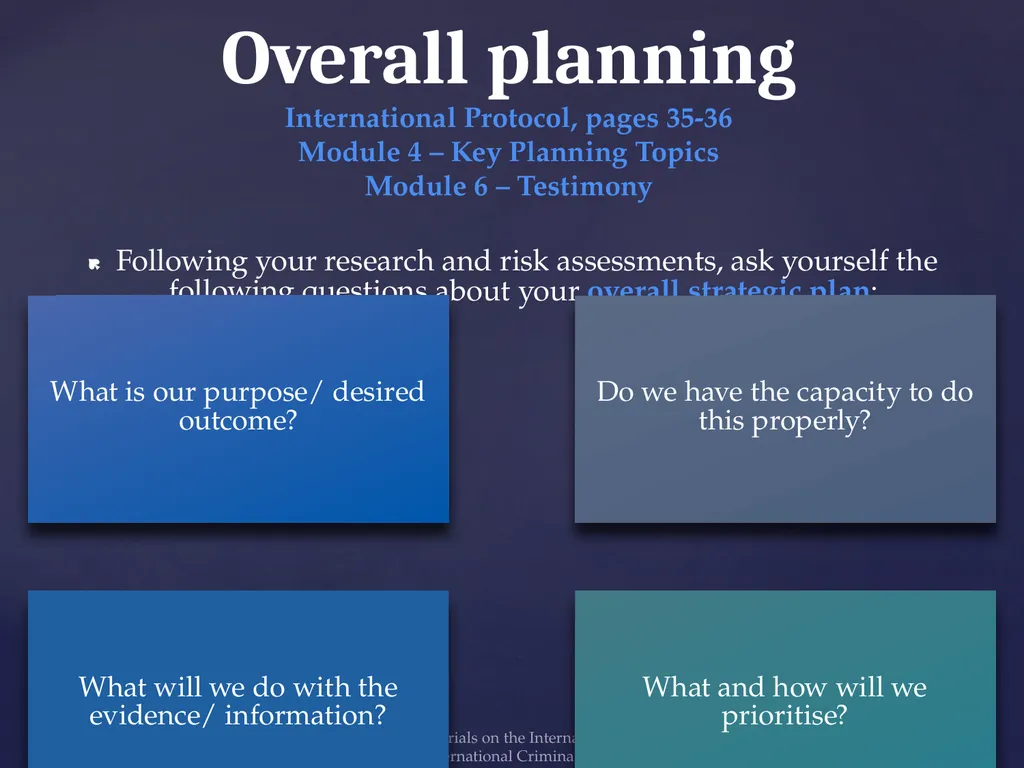
Following your research and risk assessments, ask yourself the following questions about your overall strategic plan: Overall planning
International Protocol, pages 35-36
Module 4 – Key Planning Topics
Module 6 – Testimony Training Materials on the International Protocol
© Institute for International Criminal Investigations 2015<br>
© Institute for International Criminal Investigations 2015<br>