Module 4 The Five Phases of DRM PPT 4.1 Module
Description: Module 4 The Five Phases of DRM PPT 4.1 Module 4: Performance Objectives At the end of this Module, trainees will be able to: Explain the five phases of DRM strategy and the objectives of each phase List the activities that are required to
Related Topics
Download Presentation
"Module 4 The Five Phases of DRM PPT 4.1 Module" is the property of its rightful owner. Permission is granted to download and print the materials on this website for personal, non-commercial use only, and to display it on your personal computer provided you do not modify the materials and that you retain all copyright notices contained in the materials. By downloading content from our website, you accept the terms of this agreement.
Presentation Transcript
slide1. Module 4 The Five Phases of DRM PPT 4.1<br>
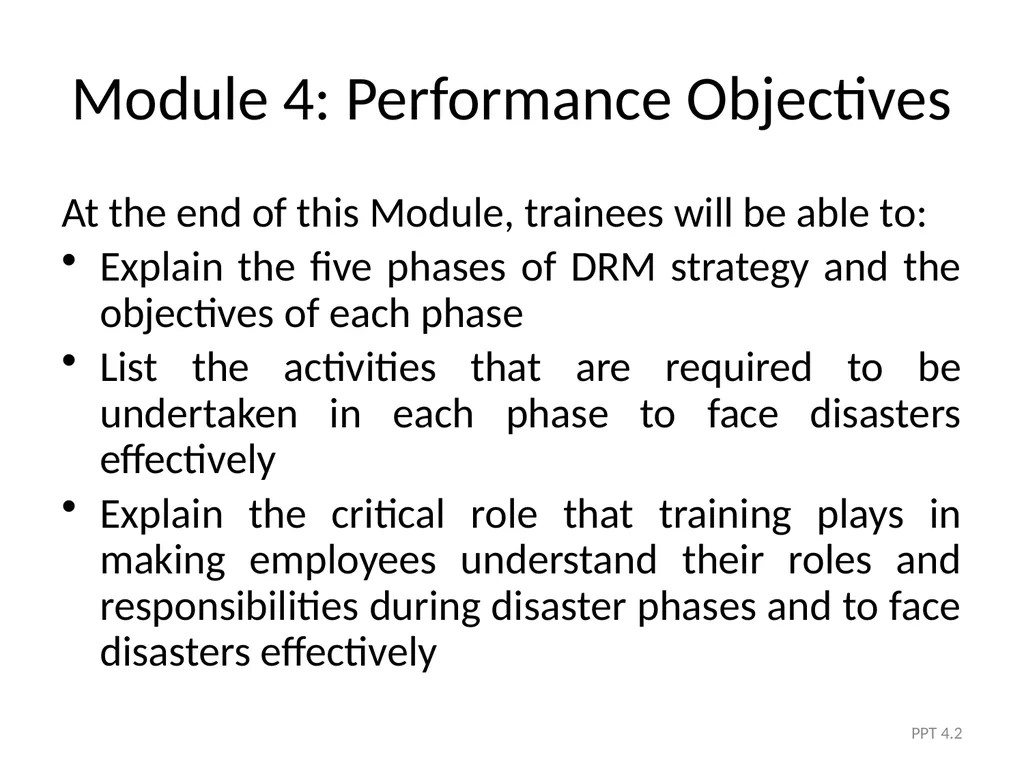
slide2. Module 4: Performance Objectives At the end of this Module, trainees will be able to:
Explain the five phases of DRM strategy and the objectives of each phase
List the activities that are required to be undertaken in each phase to face disasters effectively
Explain the critical role that training plays in making employees understand their roles and responsibilities during disaster phases and to face disasters effectively PPT 4.2<br>
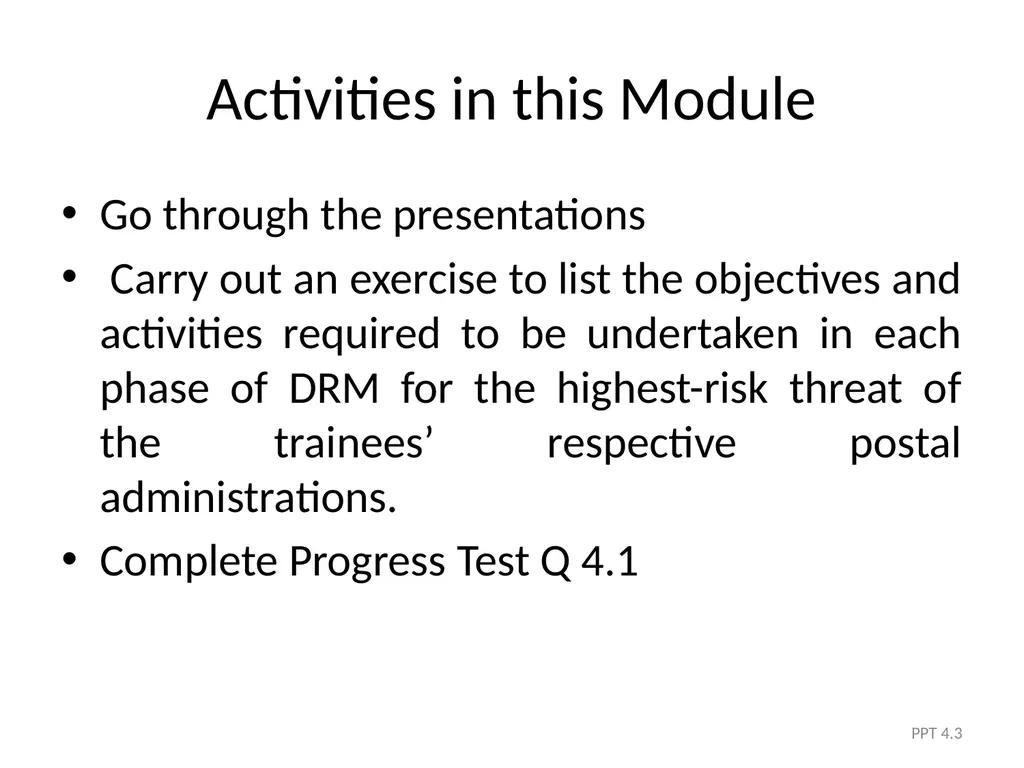
slide3. Activities in this Module Go through the presentations
Carry out an exercise to list the objectives and activities required to be undertaken in each phase of DRM for the highest-risk threat of the trainees’ respective postal administrations.
Complete Progress Test Q 4.1 PPT 4.3<br>
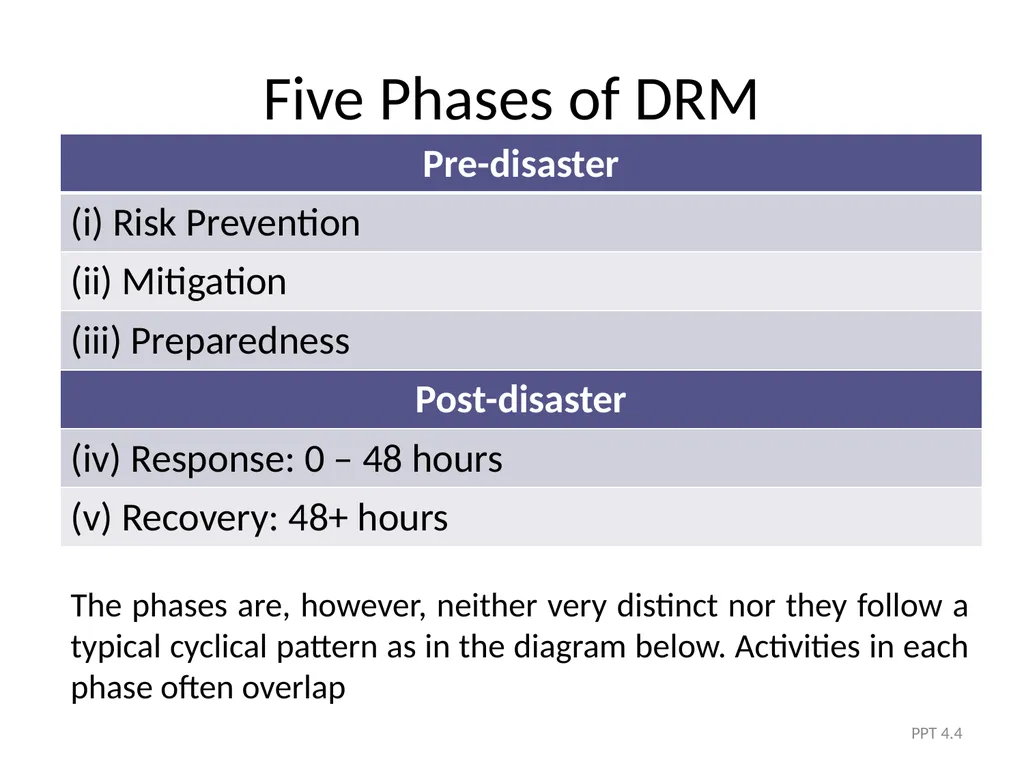
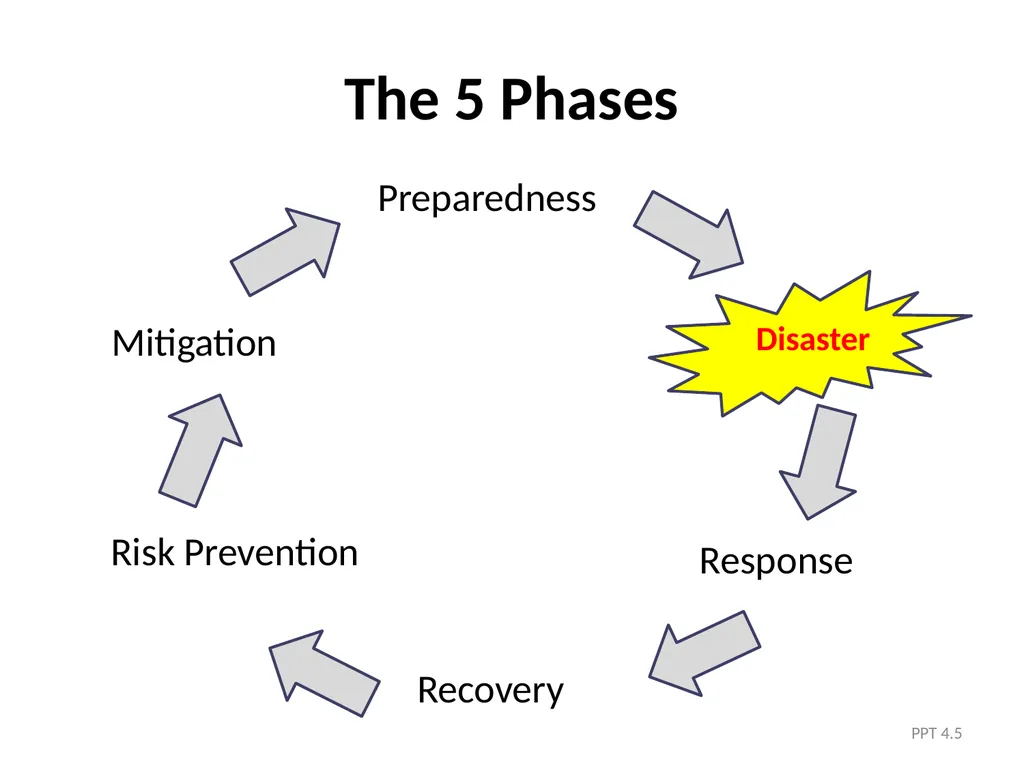
slide4. Five Phases of DRM PPT 4.4 The phases are, however, neither very distinct nor they follow a typical cyclical pattern as in the diagram below. Activities in each phase often overlap<br>
slide5. The 5 Phases PPT 4.5 Preparedness Response Recovery Risk Prevention Mitigation Disaster<br>
slide6. Objectives and Activities in each phase of a Disaster PPT 4.6<br>
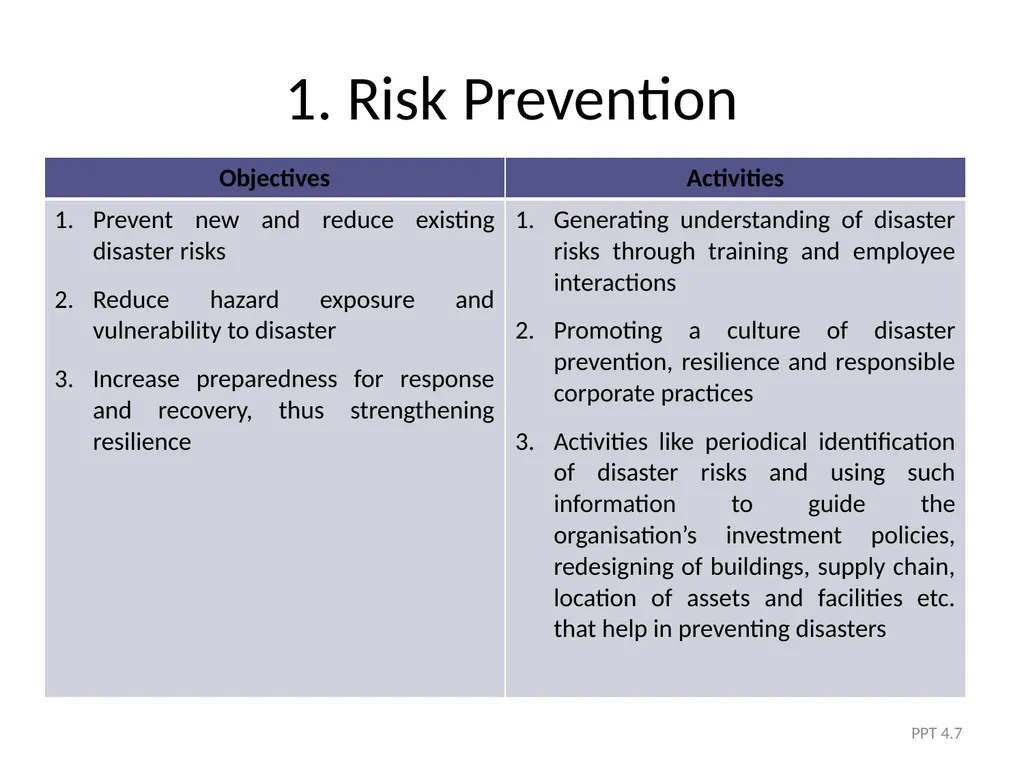
slide7. 1. Risk Prevention PPT 4.7<br>
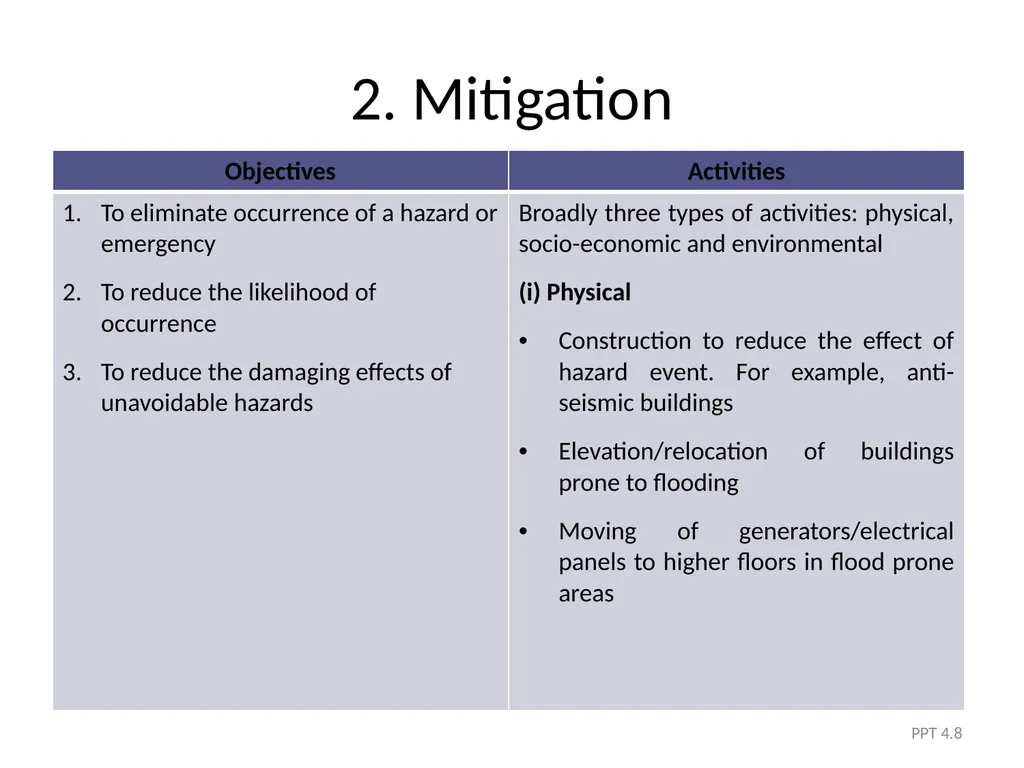
slide8. 2. Mitigation PPT 4.8<br>
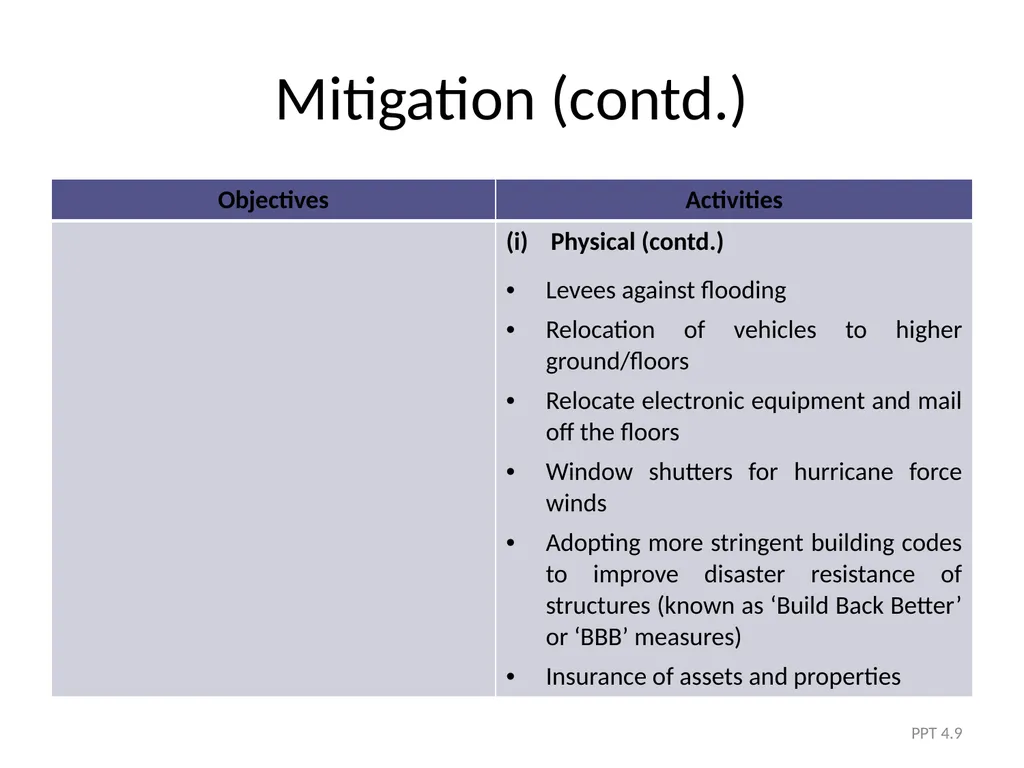
slide9. Mitigation (contd.) PPT 4.9<br>
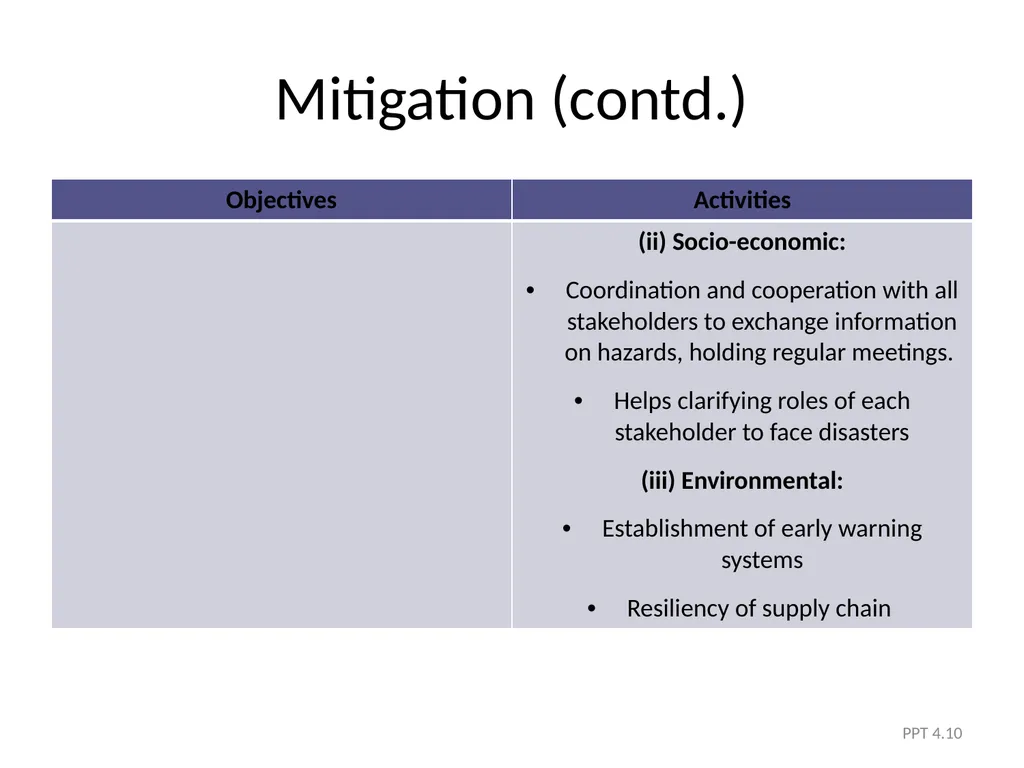
slide10. Mitigation (contd.) PPT 4.10<br>
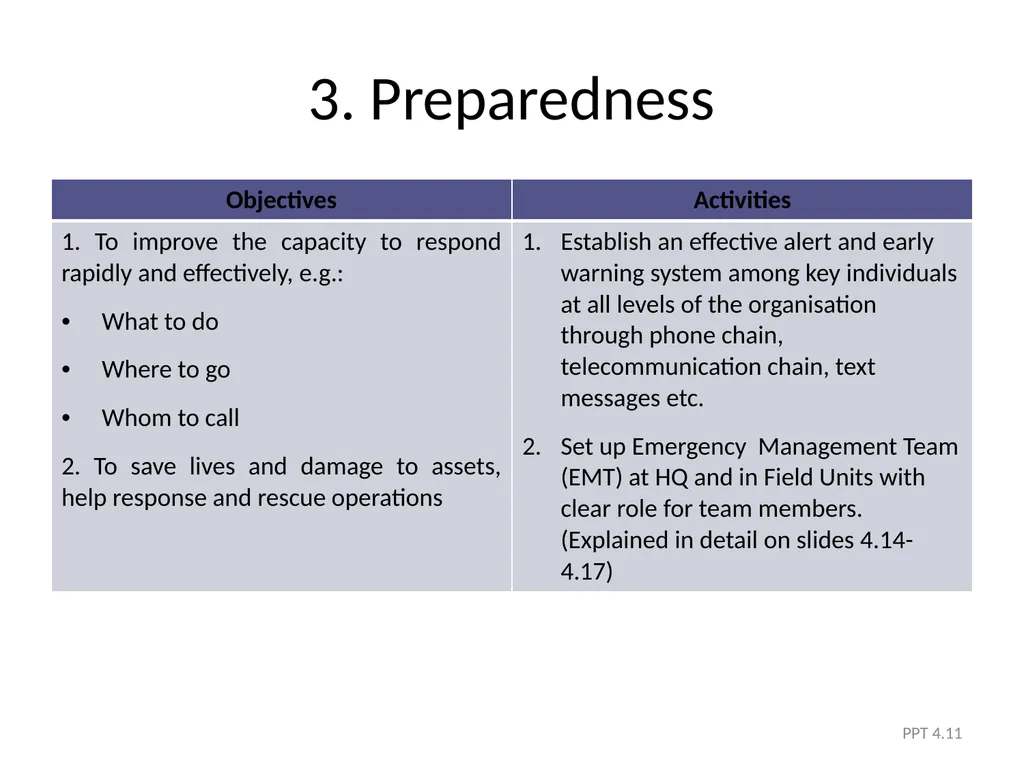
slide11. 3. Preparedness PPT 4.11<br>
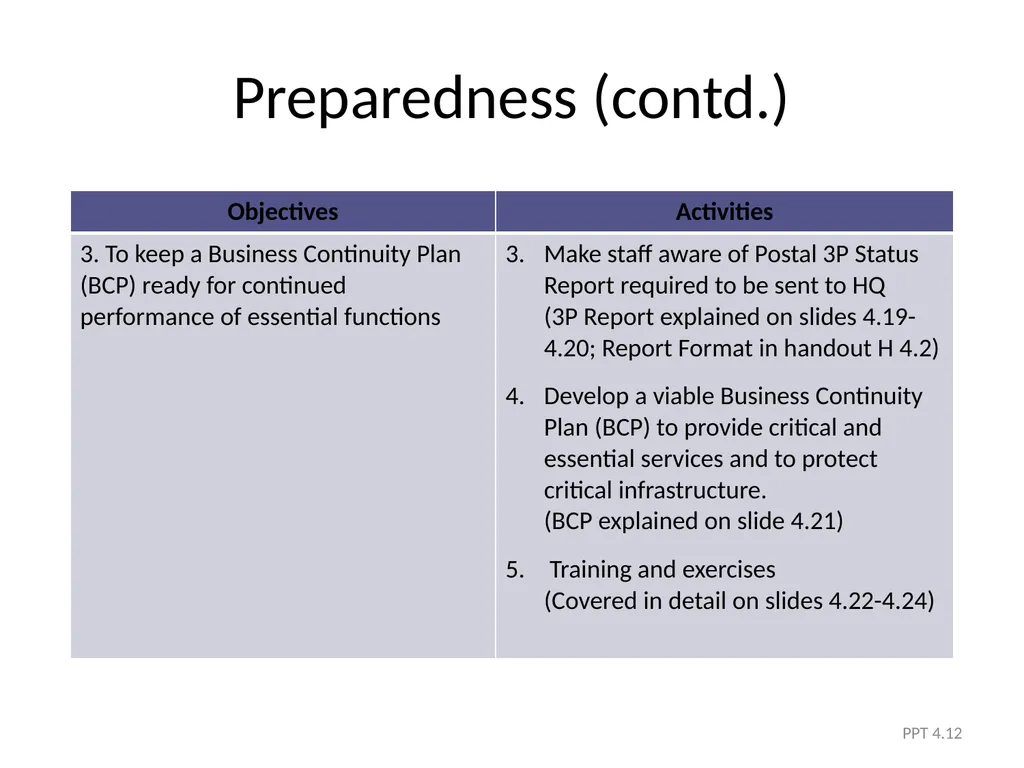
slide12. Preparedness (contd.) PPT 4.12<br>
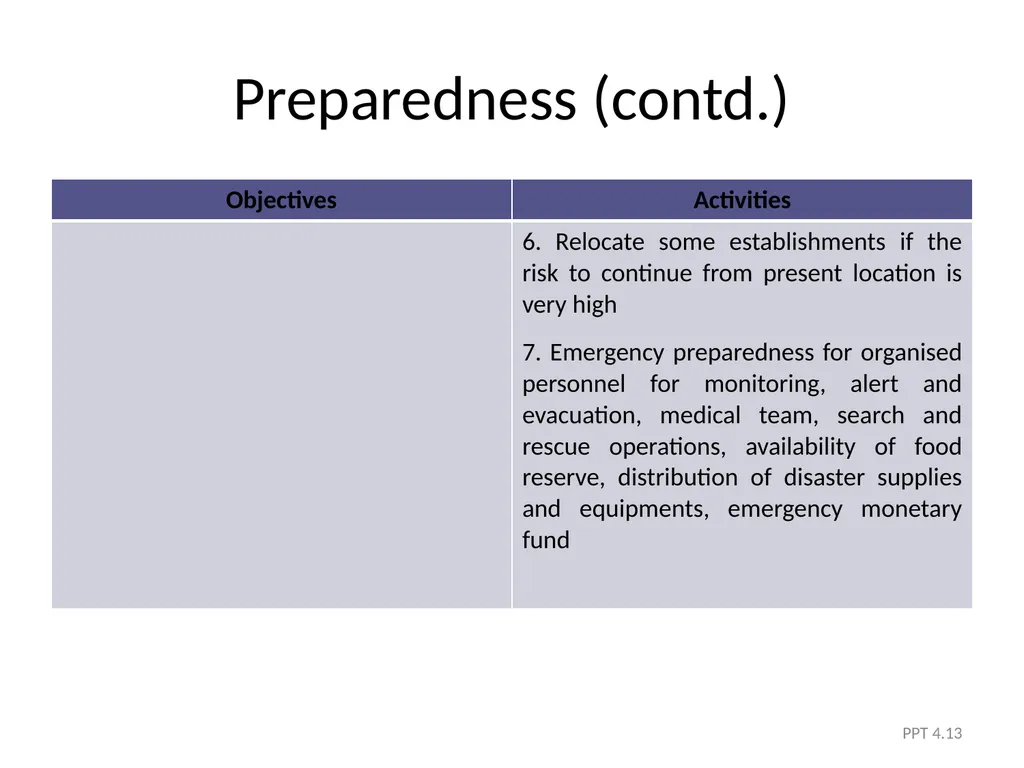
slide13. Preparedness (contd.) PPT 4.13<br>
slide14. Preparedness – Setting up Emergency Management Team (EMT) This is set up to manage response & recovery activities effectively following a disaster
Set up both at HQ and in Field Units
Should consist of most senior managers of the organization like DG/PMG, Board Members, Heads of Divisions
Each member of EMT has clear roles and responsibilities in their respective areas PPT 4.14<br>
slide15. EMT at HQ – Suggested Roles of Team Members PPT 4.15<br>
slide16. EMT at HQ – Suggested Roles of Team Members (contd.) PPT 4.16<br>
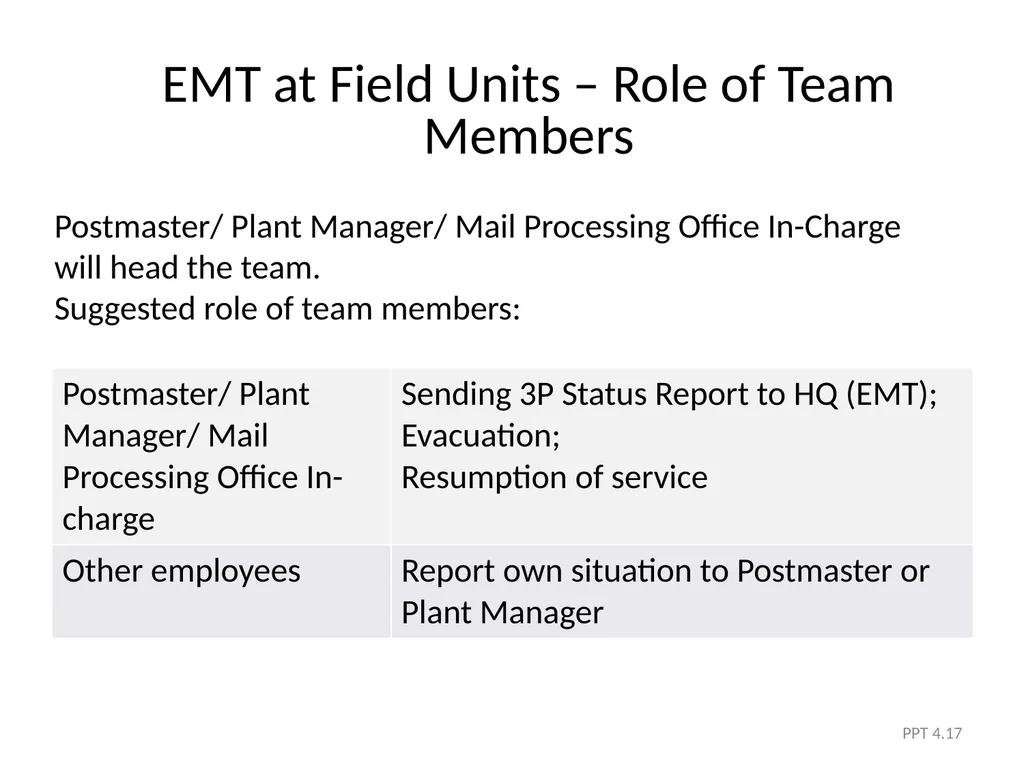
slide17. EMT at Field Units – Role of Team Members PPT 4.17 Postmaster/ Plant Manager/ Mail Processing Office In-Charge will head the team.
Suggested role of team members:<br>
slide18. Emergency Operations Centre (EOC) EOCs are set up both at the HQ and in Field Units, whenever needed, to support assessment and communication efforts
Such centres may have to work 24 hours in cases of serious disruptions
All decisions and communications in EMT/ EOC should be recorded by a responsible person for their tracking and review in future. PPT 4.18<br>
slide19. Preparedness – 3P Status Report 3P Status Reports are prepared by Field Units and Heads of Divisions covering status of People, Property and Product on a day to day basis or even more frequently as necessary
Field Units send their reports to HQ (EMT)
All other employees, whether in HQ or field units, also send status reports covering their own situation to Heads of Divisions or Postmaster/ Plant Manager/ Mail Processing Office In-charge
Format of 3P Status Report is at Hand Out H 4.2. PPT 4.19<br>
slide20. Advantages of 3P Status Reports Use of a standardized situational report like 3P Status Report throughout all levels of the organization facilitates
Assessment of impacts
Prioritisation of assistance needed
Work towards support in normalising operations PPT 4.20<br>
slide21. Preparedness – Business Continuity Plan (BCP) Each administration must develop a viable BCP to face any disaster
A BCP
Ensures successful disaster response and recovery operations
Identifies critical activities to be maintained after a disaster
Improves overall resiliency of administrations
Mitigates the strategic, stakeholder and financial impacts of a disruption
Protects critical resources (facilities, equipment, records etc.) and personnel required for performing critical activities PPT 4.21<br>
slide22. Preparedness - Role of Training & Exercises Objectives of Training & Exercises should be to
reach the preparedness goals
make employees understand their roles and responsibilities during a disaster
respond correctly to disaster situations
The Training Plan is a crucial part of the DRM Plan PPT 4.22<br>
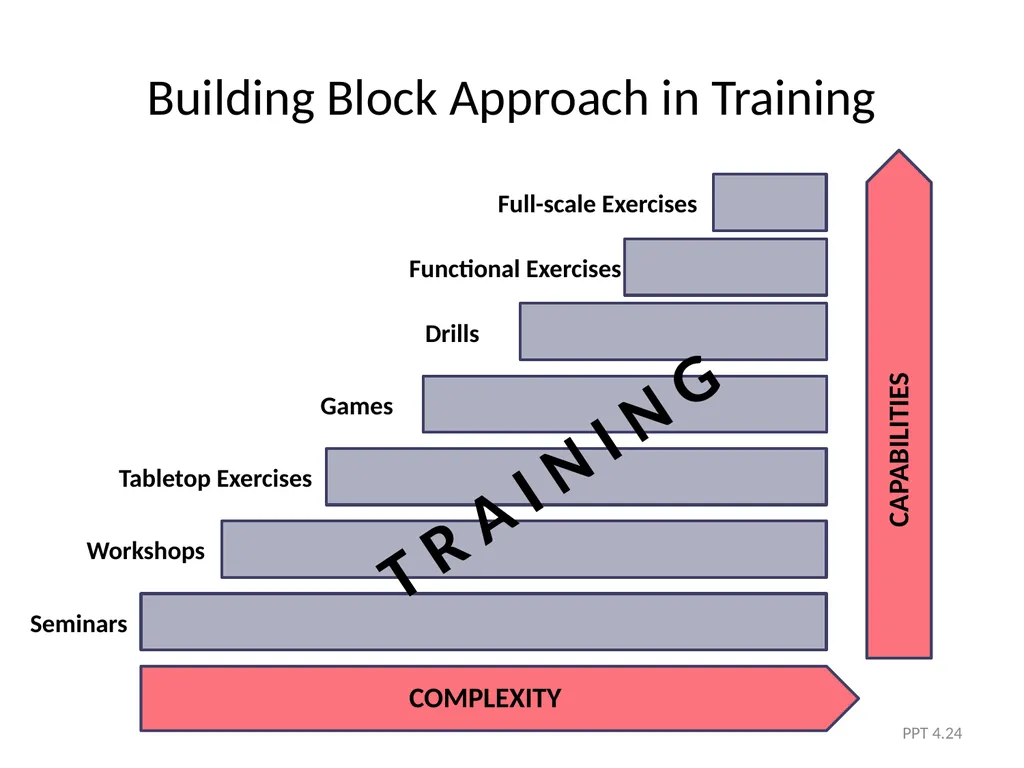
slide23. Role of Training & Exercises (contd.) Training should be conducted through lectures, seminars, workshops, drills, exercises etc.
It should be progressive and utilise a building block approach, with training covering simple to complex situations and each exercise designed to build on the previous one.
Diagram in next slide will explain this.
Seminars, workshops, tabletop exercises, games, drills, functional exercises, full scale exercises are some training methods employed to train employees. PPT 4.23<br>
slide24. Building Block Approach in Training PPT 4.24 Seminars Workshops COMPLEXITY Tabletop Exercises Games Drills Functional Exercises Full-scale Exercises CAPABILITIES T R A I N I N G<br>
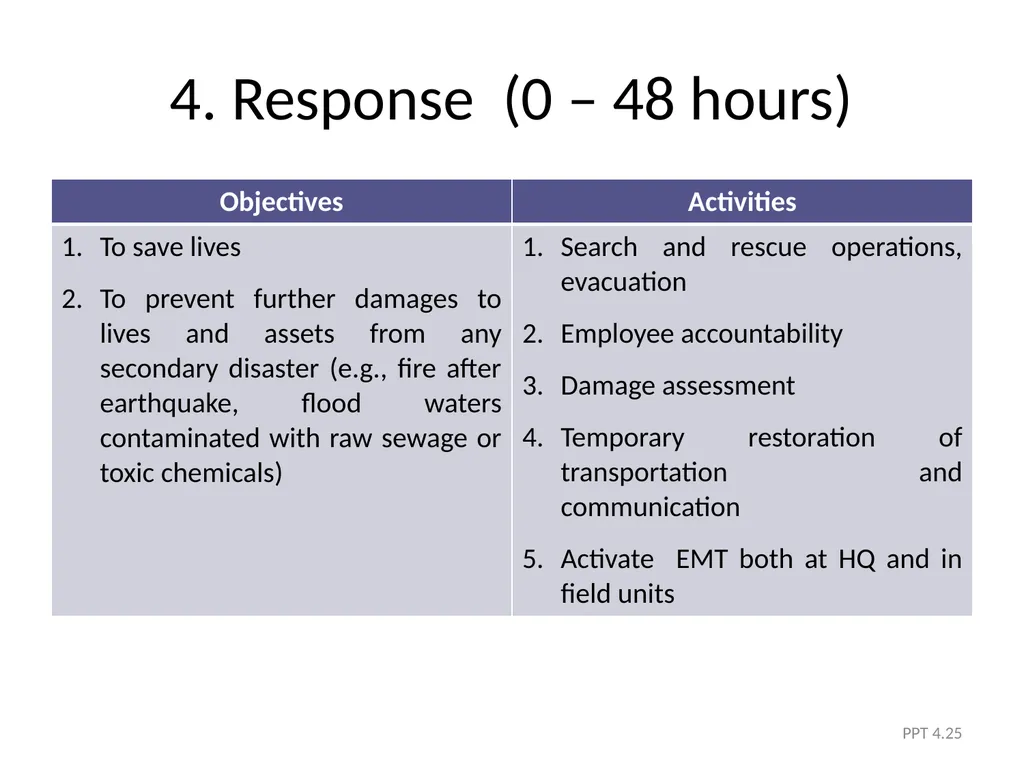
slide25. 4. Response (0 – 48 hours) PPT 4.25<br>
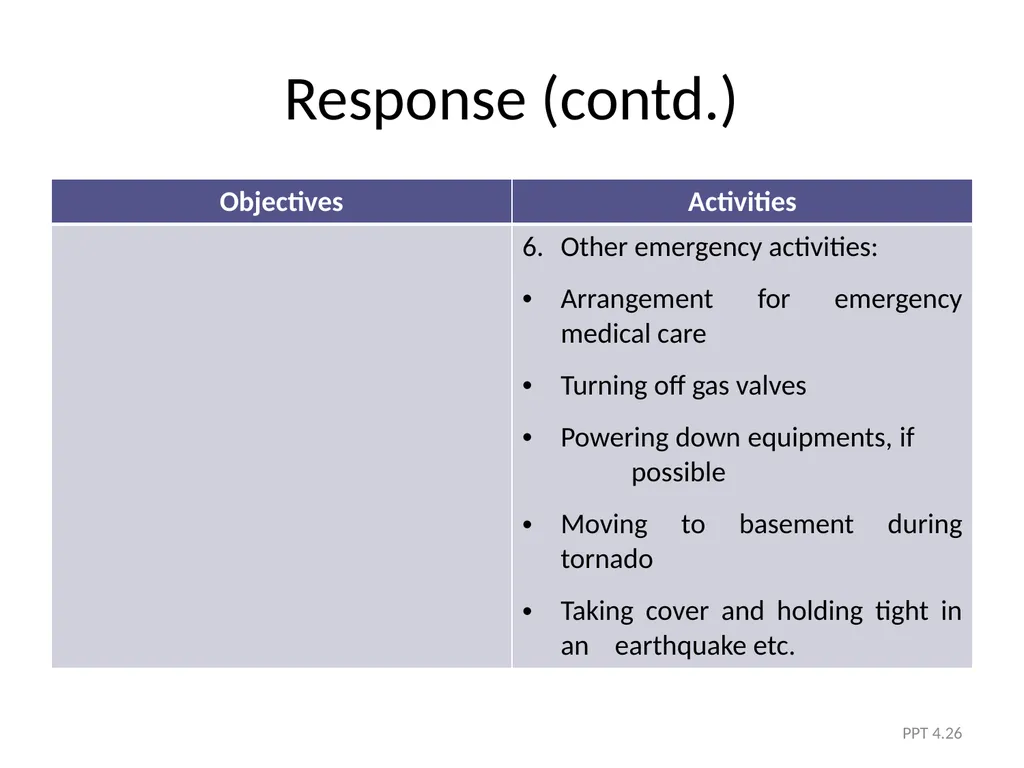
slide26. Response (contd.) PPT 4.26<br>
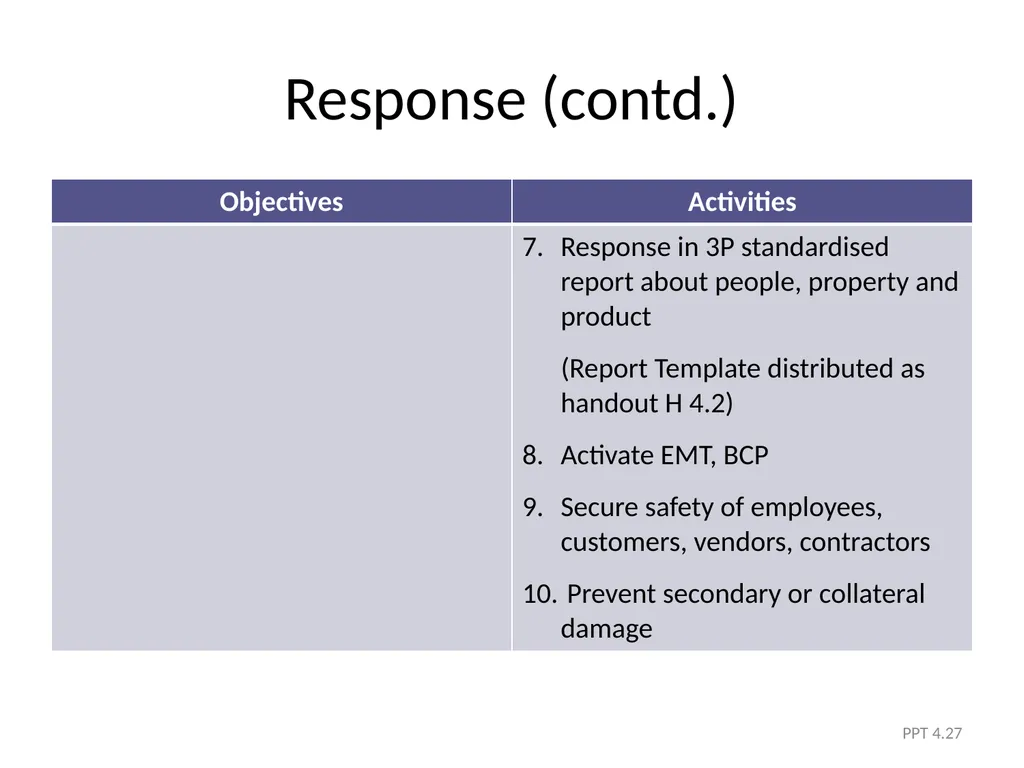
slide27. Response (contd.) PPT 4.27<br>
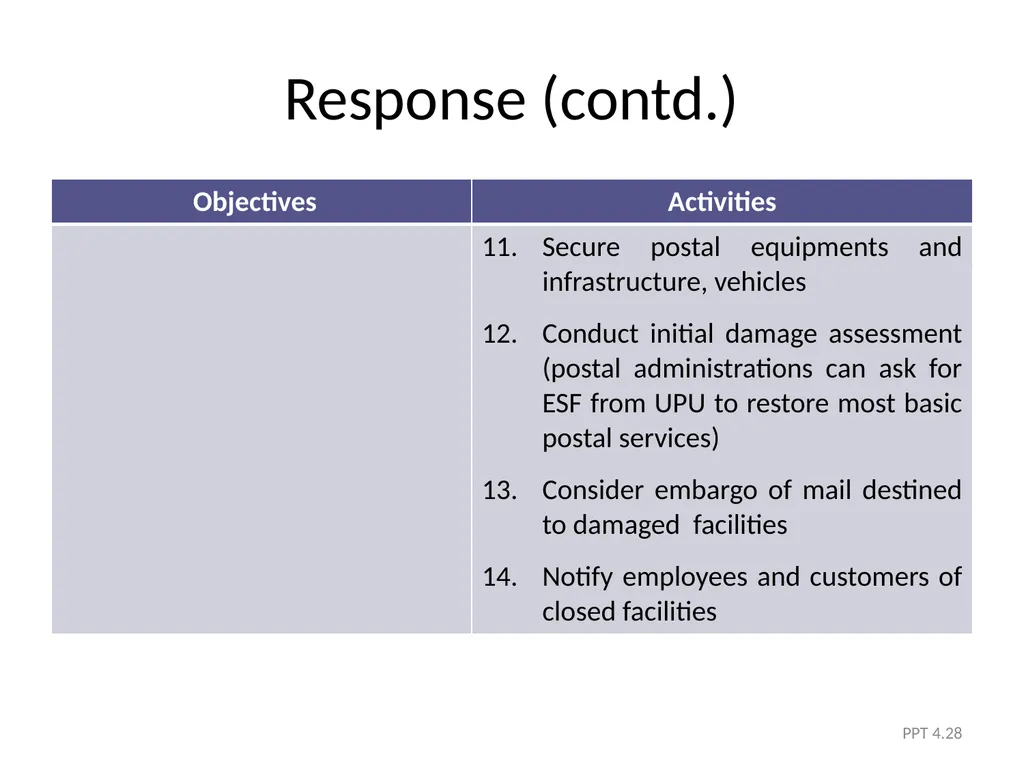
slide28. Response (contd.) PPT 4.28<br>
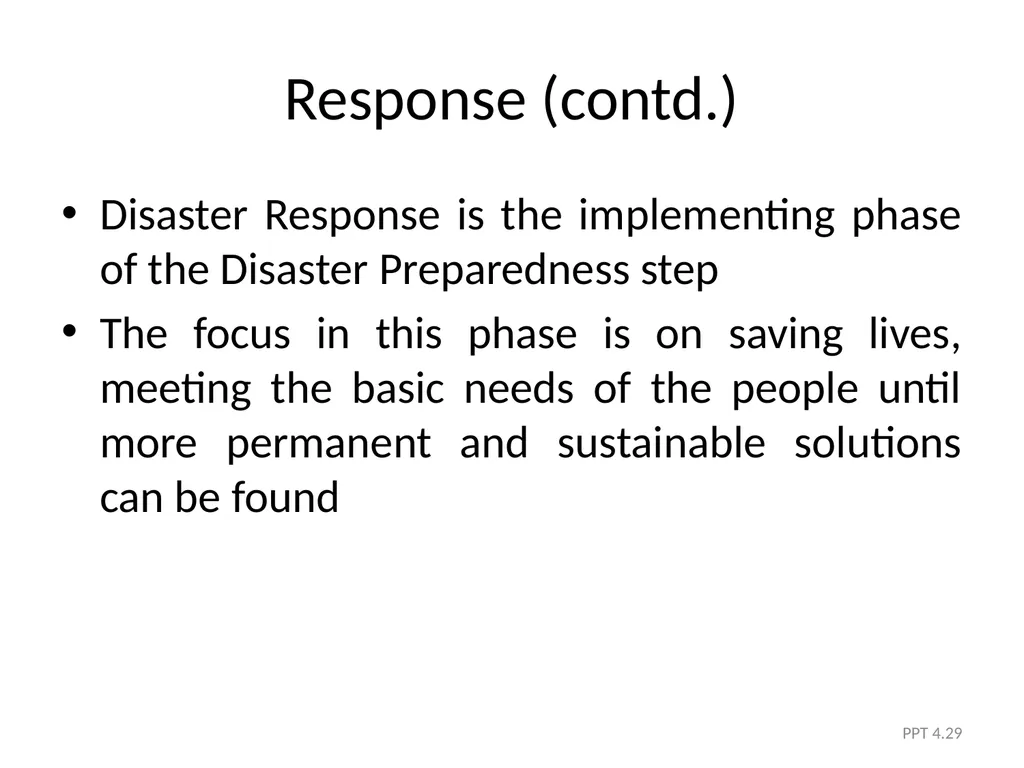
slide29. Response (contd.) Disaster Response is the implementing phase of the Disaster Preparedness step
The focus in this phase is on saving lives, meeting the basic needs of the people until more permanent and sustainable solutions can be found PPT 4.29<br>
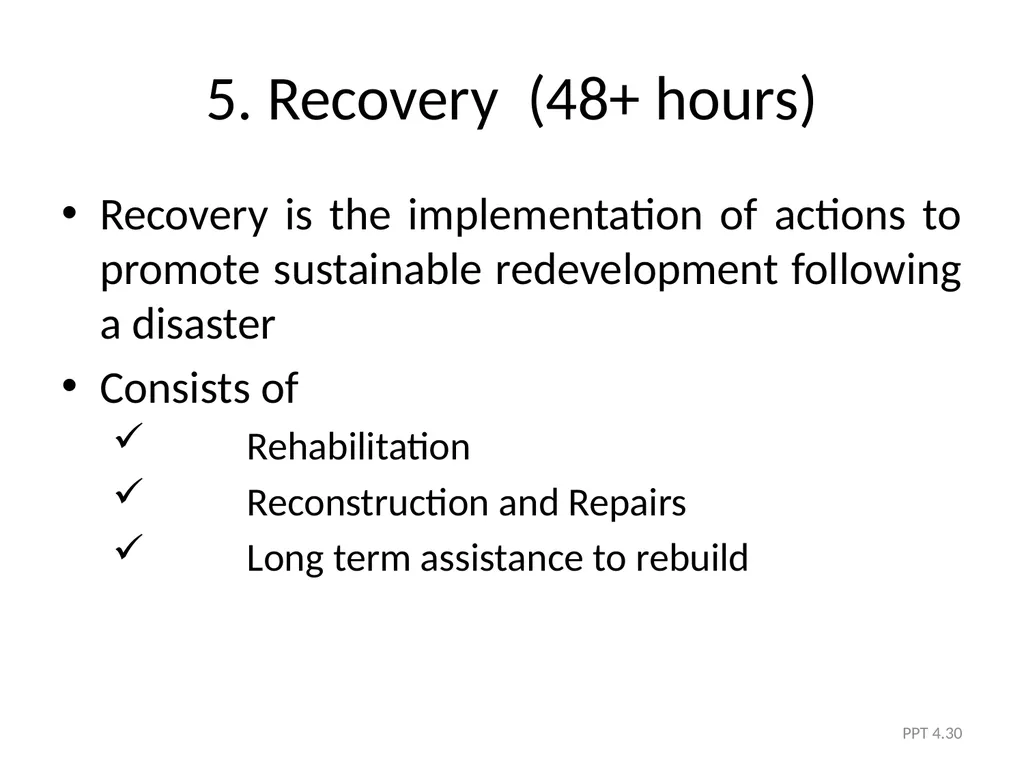
slide30. 5. Recovery (48+ hours) Recovery is the implementation of actions to promote sustainable redevelopment following a disaster
Consists of
Rehabilitation
Reconstruction and Repairs
Long term assistance to rebuild PPT 4.30<br>
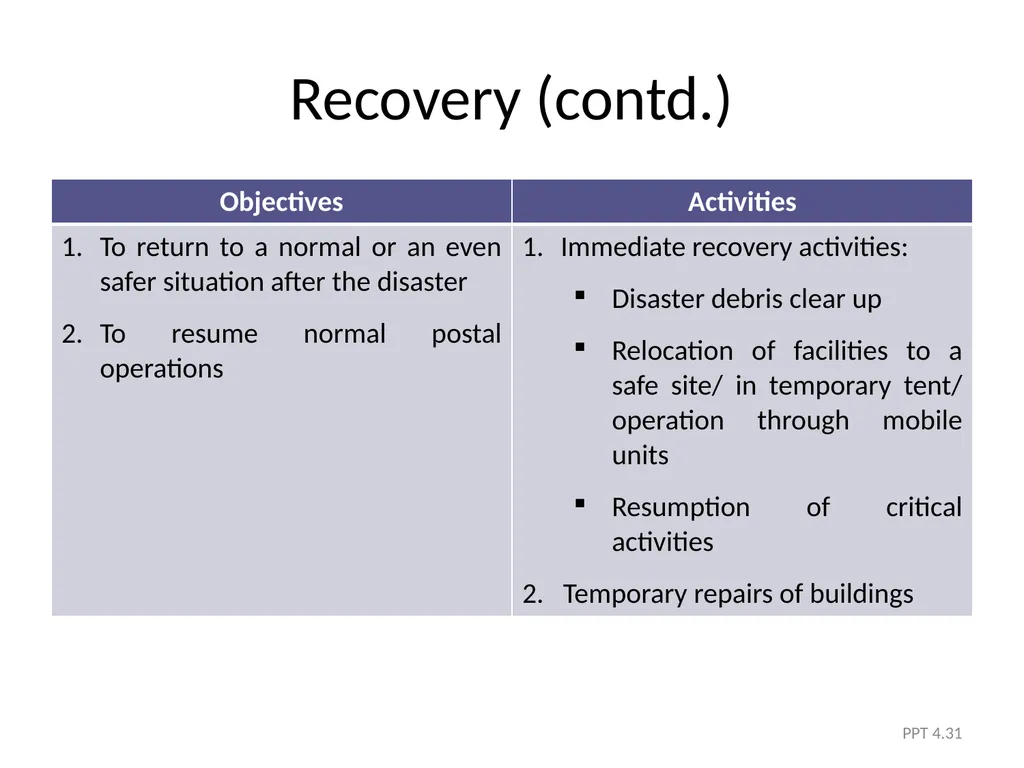
slide31. Recovery (contd.) PPT 4.31<br>
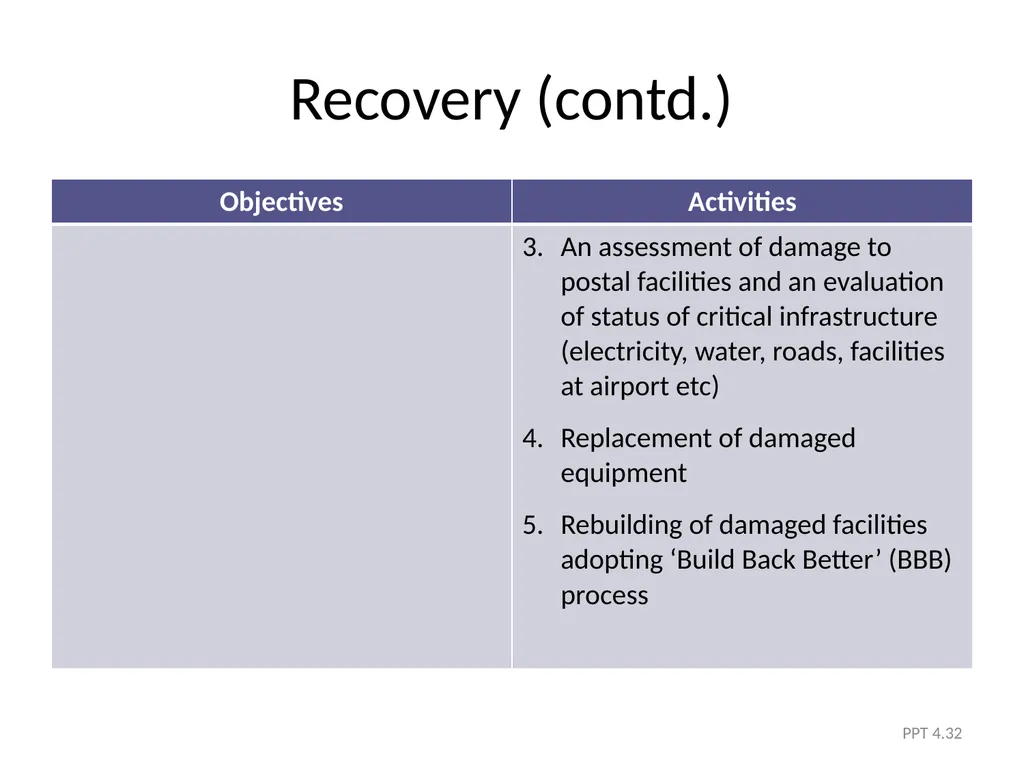
slide32. Recovery (contd.) PPT 4.32<br>
slide33. Emergency Procedure Checklists to Face Disasters Will be covered in detail in Module 7 later.
Such checklists are also known as DRM tools and products
These checklists have been developed out of industry best practices and should be followed by postal operators both in pre-disaster and post-disaster phases
Helps to face disasters effectively
Each postal administration is required to customise these checklists to suit their own requirements PPT 4.33<br>
slide34. Exercise to list Objectives & Activities for the top-risk threat of trainees’ administrations Trainees have already identified the high-risk threats (in High Risk High Impact zone) of their administrations from Risk Grid
Now select the threat with the highest risk
List the objectives and activities required to be undertaken in each phase of DRM to face this highest-risk threat as a sample exercise
[Use Handout H 4.3 for this] PPT 4.34<br>
slide35. Progress Test Q 4.1 PPT 4.35<br>
slide2. Module 4: Performance Objectives At the end of this Module, trainees will be able to:
Explain the five phases of DRM strategy and the objectives of each phase
List the activities that are required to be undertaken in each phase to face disasters effectively
Explain the critical role that training plays in making employees understand their roles and responsibilities during disaster phases and to face disasters effectively PPT 4.2<br>
slide3. Activities in this Module Go through the presentations
Carry out an exercise to list the objectives and activities required to be undertaken in each phase of DRM for the highest-risk threat of the trainees’ respective postal administrations.
Complete Progress Test Q 4.1 PPT 4.3<br>
slide4. Five Phases of DRM PPT 4.4 The phases are, however, neither very distinct nor they follow a typical cyclical pattern as in the diagram below. Activities in each phase often overlap<br>
slide5. The 5 Phases PPT 4.5 Preparedness Response Recovery Risk Prevention Mitigation Disaster<br>
slide6. Objectives and Activities in each phase of a Disaster PPT 4.6<br>
slide7. 1. Risk Prevention PPT 4.7<br>
slide8. 2. Mitigation PPT 4.8<br>
slide9. Mitigation (contd.) PPT 4.9<br>
slide10. Mitigation (contd.) PPT 4.10<br>
slide11. 3. Preparedness PPT 4.11<br>
slide12. Preparedness (contd.) PPT 4.12<br>
slide13. Preparedness (contd.) PPT 4.13<br>
slide14. Preparedness – Setting up Emergency Management Team (EMT) This is set up to manage response & recovery activities effectively following a disaster
Set up both at HQ and in Field Units
Should consist of most senior managers of the organization like DG/PMG, Board Members, Heads of Divisions
Each member of EMT has clear roles and responsibilities in their respective areas PPT 4.14<br>
slide15. EMT at HQ – Suggested Roles of Team Members PPT 4.15<br>
slide16. EMT at HQ – Suggested Roles of Team Members (contd.) PPT 4.16<br>
slide17. EMT at Field Units – Role of Team Members PPT 4.17 Postmaster/ Plant Manager/ Mail Processing Office In-Charge will head the team.
Suggested role of team members:<br>
slide18. Emergency Operations Centre (EOC) EOCs are set up both at the HQ and in Field Units, whenever needed, to support assessment and communication efforts
Such centres may have to work 24 hours in cases of serious disruptions
All decisions and communications in EMT/ EOC should be recorded by a responsible person for their tracking and review in future. PPT 4.18<br>
slide19. Preparedness – 3P Status Report 3P Status Reports are prepared by Field Units and Heads of Divisions covering status of People, Property and Product on a day to day basis or even more frequently as necessary
Field Units send their reports to HQ (EMT)
All other employees, whether in HQ or field units, also send status reports covering their own situation to Heads of Divisions or Postmaster/ Plant Manager/ Mail Processing Office In-charge
Format of 3P Status Report is at Hand Out H 4.2. PPT 4.19<br>
slide20. Advantages of 3P Status Reports Use of a standardized situational report like 3P Status Report throughout all levels of the organization facilitates
Assessment of impacts
Prioritisation of assistance needed
Work towards support in normalising operations PPT 4.20<br>
slide21. Preparedness – Business Continuity Plan (BCP) Each administration must develop a viable BCP to face any disaster
A BCP
Ensures successful disaster response and recovery operations
Identifies critical activities to be maintained after a disaster
Improves overall resiliency of administrations
Mitigates the strategic, stakeholder and financial impacts of a disruption
Protects critical resources (facilities, equipment, records etc.) and personnel required for performing critical activities PPT 4.21<br>
slide22. Preparedness - Role of Training & Exercises Objectives of Training & Exercises should be to
reach the preparedness goals
make employees understand their roles and responsibilities during a disaster
respond correctly to disaster situations
The Training Plan is a crucial part of the DRM Plan PPT 4.22<br>
slide23. Role of Training & Exercises (contd.) Training should be conducted through lectures, seminars, workshops, drills, exercises etc.
It should be progressive and utilise a building block approach, with training covering simple to complex situations and each exercise designed to build on the previous one.
Diagram in next slide will explain this.
Seminars, workshops, tabletop exercises, games, drills, functional exercises, full scale exercises are some training methods employed to train employees. PPT 4.23<br>
slide24. Building Block Approach in Training PPT 4.24 Seminars Workshops COMPLEXITY Tabletop Exercises Games Drills Functional Exercises Full-scale Exercises CAPABILITIES T R A I N I N G<br>
slide25. 4. Response (0 – 48 hours) PPT 4.25<br>
slide26. Response (contd.) PPT 4.26<br>
slide27. Response (contd.) PPT 4.27<br>
slide28. Response (contd.) PPT 4.28<br>
slide29. Response (contd.) Disaster Response is the implementing phase of the Disaster Preparedness step
The focus in this phase is on saving lives, meeting the basic needs of the people until more permanent and sustainable solutions can be found PPT 4.29<br>
slide30. 5. Recovery (48+ hours) Recovery is the implementation of actions to promote sustainable redevelopment following a disaster
Consists of
Rehabilitation
Reconstruction and Repairs
Long term assistance to rebuild PPT 4.30<br>
slide31. Recovery (contd.) PPT 4.31<br>
slide32. Recovery (contd.) PPT 4.32<br>
slide33. Emergency Procedure Checklists to Face Disasters Will be covered in detail in Module 7 later.
Such checklists are also known as DRM tools and products
These checklists have been developed out of industry best practices and should be followed by postal operators both in pre-disaster and post-disaster phases
Helps to face disasters effectively
Each postal administration is required to customise these checklists to suit their own requirements PPT 4.33<br>
slide34. Exercise to list Objectives & Activities for the top-risk threat of trainees’ administrations Trainees have already identified the high-risk threats (in High Risk High Impact zone) of their administrations from Risk Grid
Now select the threat with the highest risk
List the objectives and activities required to be undertaken in each phase of DRM to face this highest-risk threat as a sample exercise
[Use Handout H 4.3 for this] PPT 4.34<br>
slide35. Progress Test Q 4.1 PPT 4.35<br>