
Module # 7 Recognizing and Controlling Hazards
Description: Module 7 Recognizing and Controlling Hazards From Exposed Environments 1 Disclaimer This material was produced under grant number SH-05144-SH9 from the Occupational Safety and Health Administration, U.S. Department of Labor. It does not
Related Topics
Download Presentation
"Module # 7 Recognizing and Controlling Hazards" is the property of its rightful owner. Permission is granted to download and print the materials on this website for personal, non-commercial use only, and to display it on your personal computer provided you do not modify the materials and that you retain all copyright notices contained in the materials. By downloading content from our website, you accept the terms of this agreement.
Presentation Transcript
slide1. Module # 7 Recognizing and Controlling Hazards From
Exposed Environments 1<br>
slide2. Disclaimer This material was produced under grant number SH-05144-SH9 from the Occupational Safety and Health Administration, U.S. Department of Labor. It does not necessarily reflect the views or policies of the U.S. Department of Labor, nor does mention of trade names, commercial products, or organizations imply endorsement by the U.S. Government. 2<br>
slide3. Learning Objectives Recognizing and controlling hazards from exposed environments, in wind tower construction, maintenance and demolition:
Explain the factors that affect thermal balance.
Recognize the signs of heat stress.
Recognize the signs of cold stress.
Recognize other potential hazards in exposed environments.
Identify best practices while working externally.
Identify obstacles to safe practices at a worksite. 3<br>
slide4. Thermal Balance Definition:
Thermal balance is the state of equilibrium in which the sum heat flowing in and out of a system equals zero.
This implies an equal rate of gain and loss of heat by the system.
Involves mathematical determination and comparison of heat flow within a system.
Thermal balance is achieved when body heat from metabolism dissipates and is in thermal equilibrium with the surroundings. 4<br>
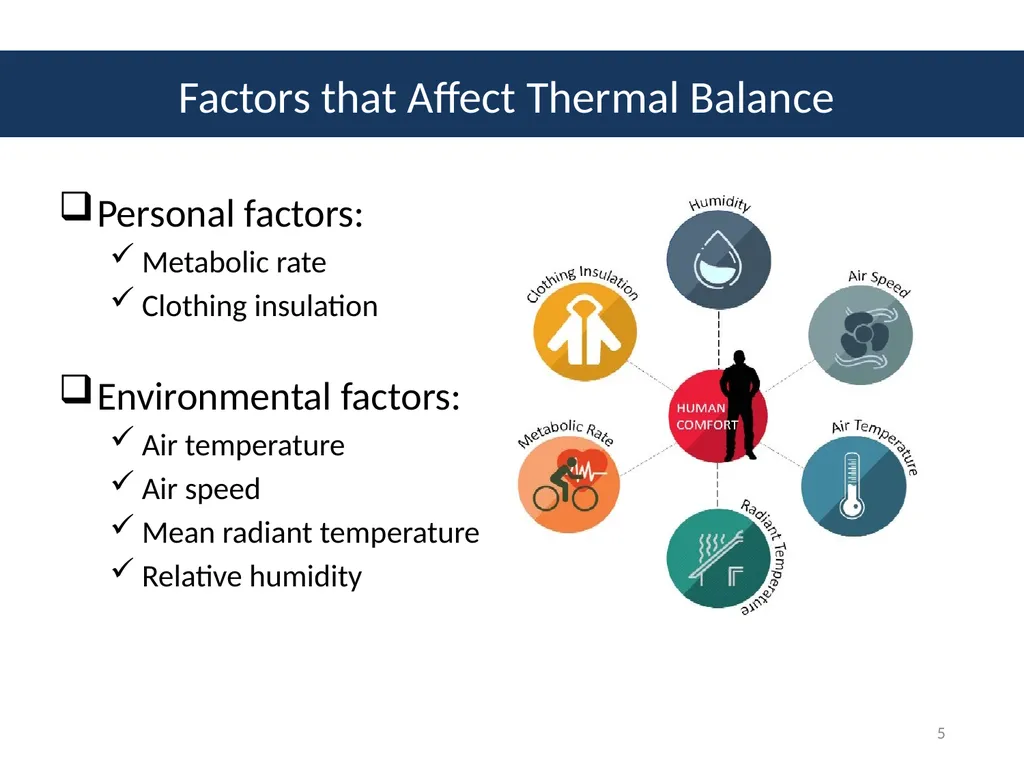
slide5. Factors that Affect Thermal Balance Personal factors:
Metabolic rate
Clothing insulation
Environmental factors:
Air temperature
Air speed
Mean radiant temperature
Relative humidity 5<br>
slide6. Metabolic Rate According to the American Society of Heating, Refrigerating and Air-Conditioning Engineers (ASHRAE) 55-2010 standard, metabolic rate is the level of transformation of chemical energy into heat and mechanical work by metabolic activities within an organism.
Usually expressed in terms of unit area of the total body surface.
Differs from person to person.
Is influenced by the physical, eating and drinking habits of a person. 6<br>
slide7. Clothing Insulation Definition:
Is the thermal insulation provided by the clothing worn by a person
The amount of clothing layers worn has a significant impact on thermal balance.
Multiple layers can prevent heat loss, and either keeps a person warm or causes overheating and heat stress.
Inadequate amount of clothing layers can result in cold stress.
Air speed and relative humidity may reduce insulation. 7<br>
slide8. Air Temperature, Air Speed, Mean Radiant Temperature Air temperature: Is the temperature of the air surrounding an individual.
Air speed: The speed of air moving around a person at a specific time and location, irrespective of direction.
It can help cool a person in a warm environment, through heat loss by convection.
Mean radiant temperature: The amount of radiant heat transferred from the surface of a warm object.
Depends on ability of material to absorb or emit heat.
Has more influence on heat gain or loss compared with air temperature. 8<br>
slide9. Relative Humidity Definition:
The ratio of the actual amount of water vapor in the air to the maximum amount of water vapor that the air can hold at a specific air temperature and pressure.
Sweating helps the body loose heat through evaporation from the skin.
In high relative humidity, there is reduced heat loss through sweating due to maximum water vapor in air.
Humidity within vapor-impermeable PPE will be higher than that of the environment. 9<br>
slide10. Recognize the Signs of Heat Stress Wind energy workers:
Perform work tasks in exposed environment.
Are sometimes exposed to extreme heat
Work in hot and humid environments
Are potentially at risk of heat stress.
Heat stress is a hazard which can result in injuries and occupational illnesses. 10<br>
slide11. Effects of Heat Stress Headache
Heat exhaustion
Heat stroke
Heat cramps
Heat rashes
Sunburns
Fatigue 11<br>
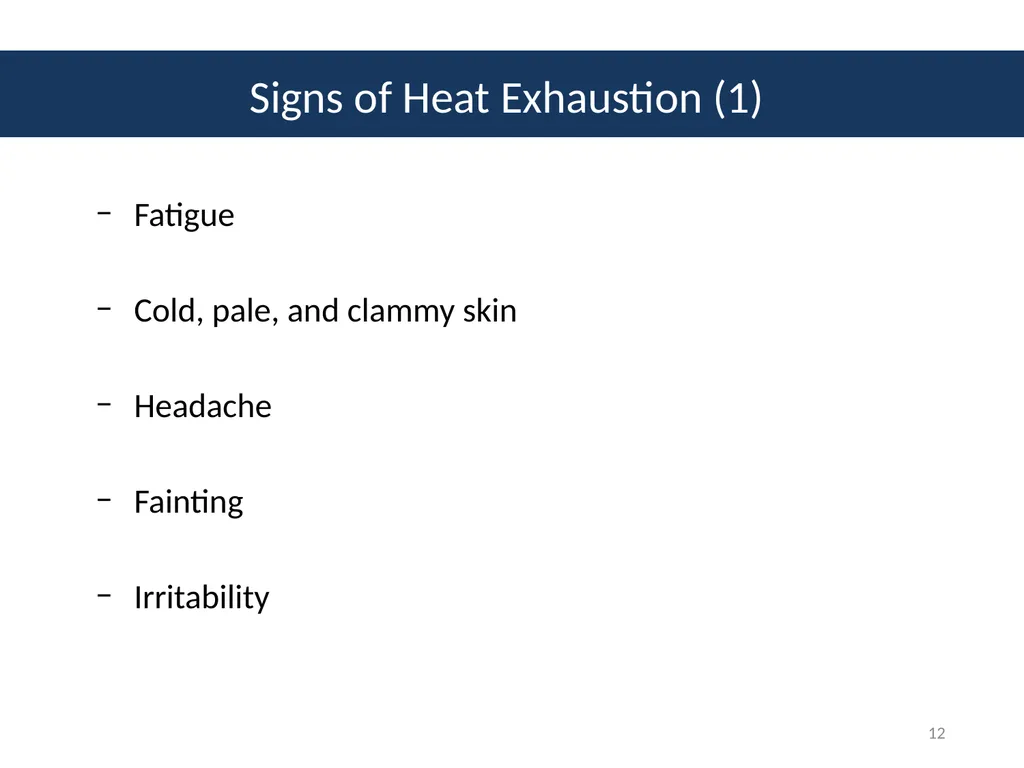
slide12. Signs of Heat Exhaustion (1) Fatigue
Cold, pale, and clammy skin
Headache
Fainting
Irritability 12<br>
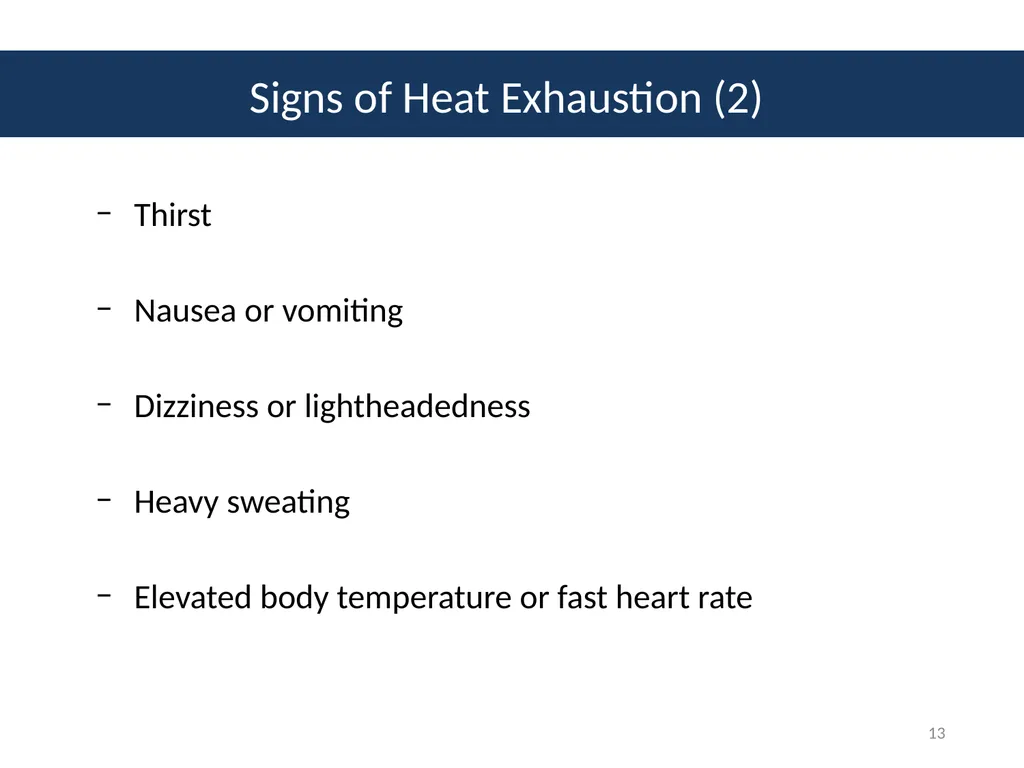
slide13. Signs of Heat Exhaustion (2) Thirst
Nausea or vomiting
Dizziness or lightheadedness
Heavy sweating
Elevated body temperature or fast heart rate 13<br>
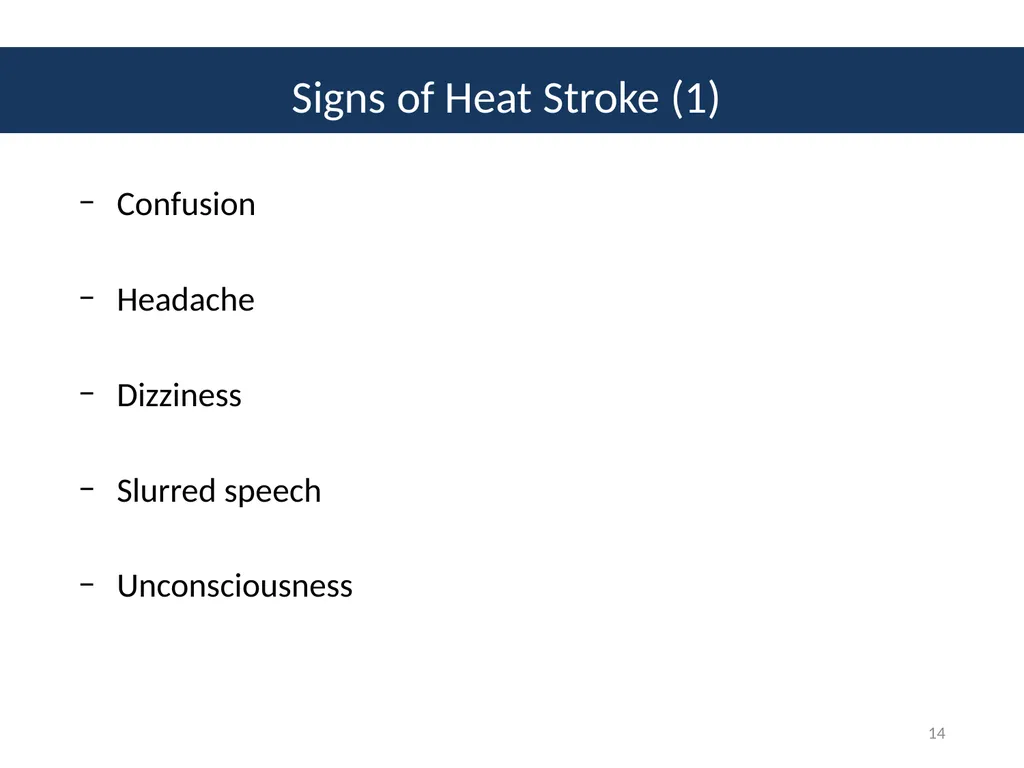
slide14. Signs of Heat Stroke (1) Confusion
Headache
Dizziness
Slurred speech
Unconsciousness 14<br>
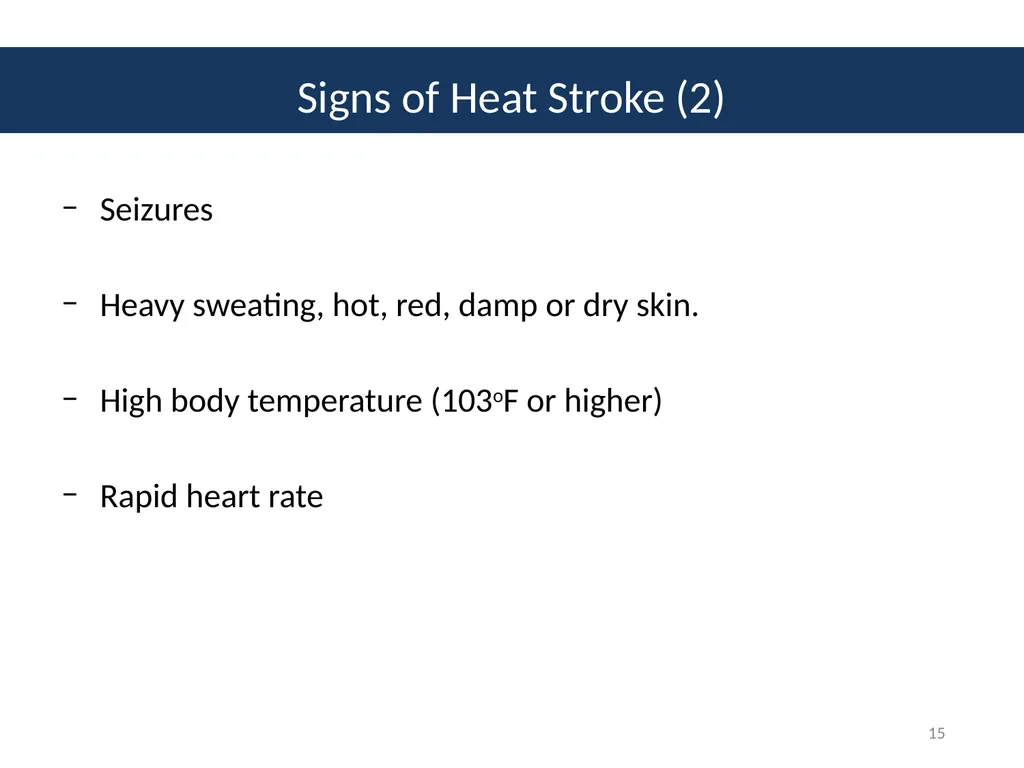
slide15. Signs of Heat Stroke (2) Seizures
Heavy sweating, hot, red, damp or dry skin.
High body temperature (103oF or higher)
Rapid heart rate 15<br>
slide16. Signs of Heat Cramps & Heat Rash Heat cramps
Muscle spasms or pain
Usually in legs, arms, or trunk
Heat rash
Clusters of red bumps on skin
Often on neck, upper chest, and skin folds 16<br>
slide17. Signs of Heat Syncope & Rhabdomyolysis Heat syncope
Fainting
Dizziness
Rhabdomyolysis (muscle breakdown)
Muscle pain
Dark or reduced urine
Fatigue 17<br>
slide18. First Aid for Heat-related Illnesses Move the affected person to a ventilated area.
Reduce body temperature with a cold water or an ice bath.
Remove protective clothing
Place wet towels on the head, neck etc.
Ensure uninterrupted circulation of air.
Provide adequate care and attention
Call 911 immediately if symptoms of heat stroke are observed. 18<br>
slide19. Cold Stress With increased wind speed and low temperatures, there is usually rapid heat loss.
Extreme cold environment can cause health emergencies in outdoor workers.
Cold stress occurs when there is a reduction in body temperature below normal
This situation can result in critical health issues including tissue damage and death. 19<br>
slide20. Contributory Factors Long exposure to extreme cold
Inappropriate dressing for the weather
Wetness
Exhaustion
Poor physical condition
Health conditions such as hypertension, hypothyroidism, and diabetes. 11<br>
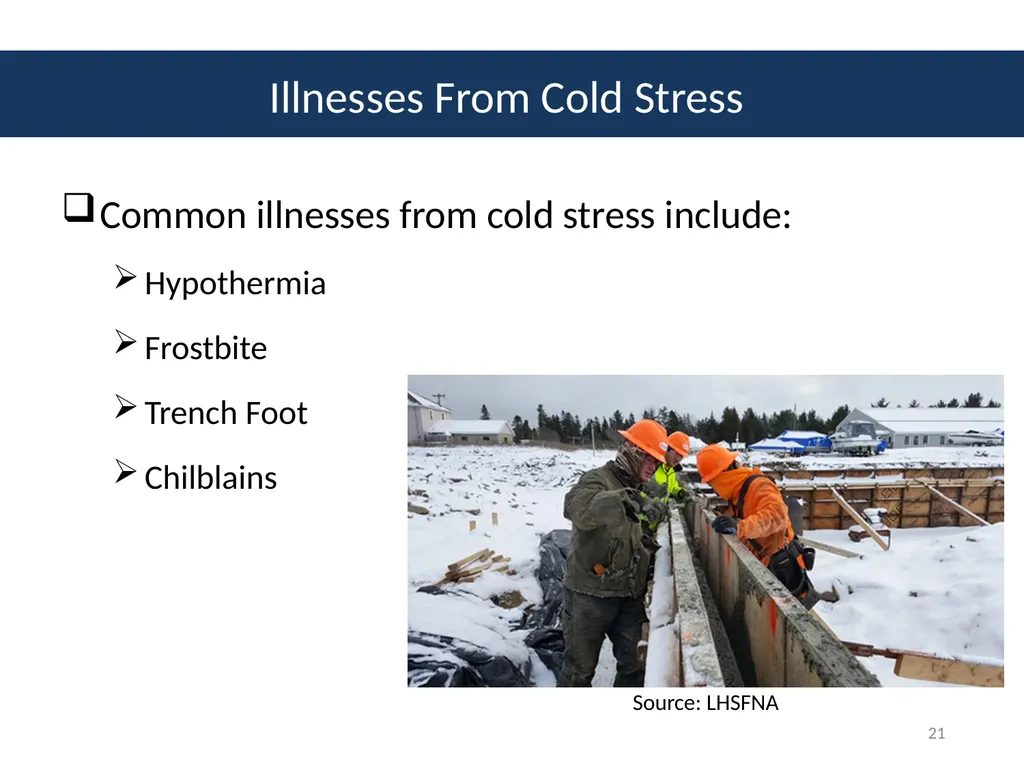
slide21. Illnesses From Cold Stress Common illnesses from cold stress include:
Hypothermia
Frostbite
Trench Foot
Chilblains Source: LHSFNA 21<br>
slide22. Recognize the Signs of Cold Stress: Hypothermia Hypothermia, which is an abnormally low body temperature, affects the brain and thought process of an individual. Early Symptoms:
Shivering
Fatigue
Loss of coordination
Confusion and disorientation Late Symptoms:
Blue skin
Dilated pupils
Slowed pulse and breathing
Loss of consciousness 22<br>
slide23. Treatment of Hypothermia 23 First aid:
Inform the supervisor immediately
Relocate affected individual to warm environment.
Take off wet clothes.
Give sweetened warm beverages to help increase body temperature.
Keep dry and cover with warm blanket.
Seek medical help.
If victim has no pulse:
Call 911 for emergency medical assistance,
Perform rescue breathing for 3 minutes
Administer cardiopulmonary resuscitation (CPR)<br>
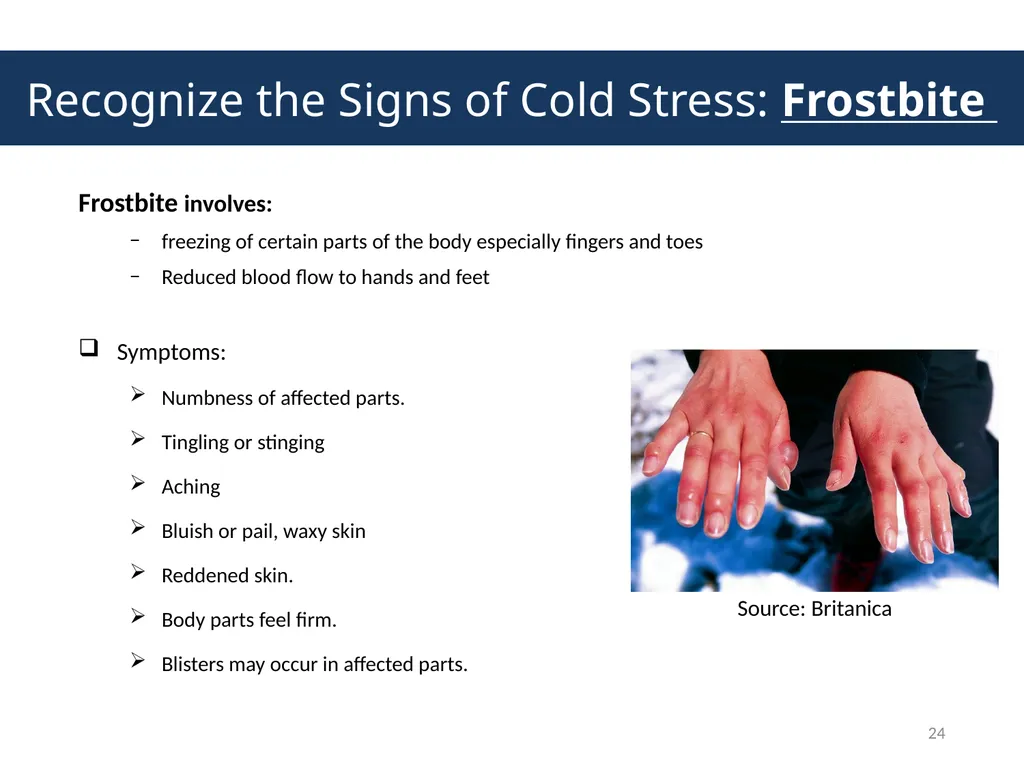
slide24. Recognize the Signs of Cold Stress: Frostbite Frostbite involves:
freezing of certain parts of the body especially fingers and toes
Reduced blood flow to hands and feet
Symptoms:
Numbness of affected parts.
Tingling or stinging
Aching
Bluish or pail, waxy skin
Reddened skin.
Body parts feel firm.
Blisters may occur in affected parts. Source: Britanica 24<br>
slide25. Treatment of Frostbite First aid for frostbite:
Get into a warm room.
Avoid walking on frostbitten feet or toes.
Immerse the affected area in warm water
Warm the affected area with heat from the body
Do not rub or massage the frostbitten area
Do not use a heating devices to warm body parts. 25<br>
slide26. Recognize the Signs of Cold Stress: Trench Foot Symptoms:
Reddening of skin
Numbness
Leg cramps
Swelling
Tingling pain
Blisters or ulcers
Bleeding under skin
Gangrene (Foot may turn dark purple, blue, or gray) 26<br>
slide27. Treatment of Trench Foot First aid for trench foot:
Call 911 immediately in an emergency
Remove shoes/boots and wet socks.
Dry feet.
Avoid walking on feet as this may cause tissue damage. 27<br>
slide28. Recognize the Signs of Cold Stress: Chilblains Symptoms:
Redness
Itching
Possible blistering
Inflammation
Possible ulceration in severe cases 28<br>
slide29. Treatment of Chilblains First aid for chilblains:
Avoid scratching
Slowly warm the skin
Use corticosteroid creams to relieve itching and swelling
Keep blisters and ulcers clean and covered 29<br>
slide30. Other Hazards Sun exposure hazards:
UV radiation can cause skin cancer
Sunburns
Hazardous noise leading to hearing loss
Contact with poisonous plants hazards
Exposure to venomous spider and snake bites
Risk of stinging insects or scorpions
Exposure to mosquito-borne diseases
Risk of tick-borne diseases
Risk of Lyme disease
Lightning. 30<br>
slide31. Best Practices in Exposed Environments (1) Schedule work on cooler days to avoid heat stress.
Establish a buddy system and train them to watch out for first symptoms of heat stress.
Encourage workers to drink water at least every 20 minutes.
Workers should take regular breaks to cool off in airconditioned site office.
Reduce energy requirements of the job. 31<br>
slide32. Best Practices in Exposed Environments (2) Assign an adequate amount of workers to each task.
Develop a program to acclimatize workers to heat and increase their physical fitness.
Train supervisors and workers on heat and cold stresses and other outdoor work hazards.
Apply sunscreen products with an SPF of at least 15.
Utilize UV-protective sunglasses for protection against UVA and UVB light. 32<br>
slide33. Best Practices in Exposed Environments (3) Train workers to recognize symptoms of cold stress.
Create buddy system among workers
Encourage them to monitor their physical condition and coworkers.
Ensure workers dress properly for the cold.
Stay dry in the cold. Moisture or dampness can increase the rate of heat loss from the body. 33<br>
slide34. Best Practices in Exposed Environments (4) Keep extra clothing handy.
Drink warm sweetened beverages to keep warm
Use proper engineering controls, safe work practices, and personal protective equipment (PPE)
Encourage workers to take short breaks when in discomfort.
Assign tasks according to outdoor work experience of workers. 34<br>
slide35. Best Practices in Exposed Environments (5) CDC recommends to shorten work tasks and increase rest periods when:
Temperature, humidity, and sunshine increase.
There is limited air flow in work area.
Protective clothing or equipment is worn.
Heavy-duty tasks are performed 35<br>
slide36. Best Practices in Exposed Environments (6) Supervisors should be trained on:
Weather acclimatization program.
Response procedure for signs of heat or cold-related illness.
Monitoring and using weather reports.
Response during extreme weather events.
Worker hydration and intermittent breaks. 36<br>
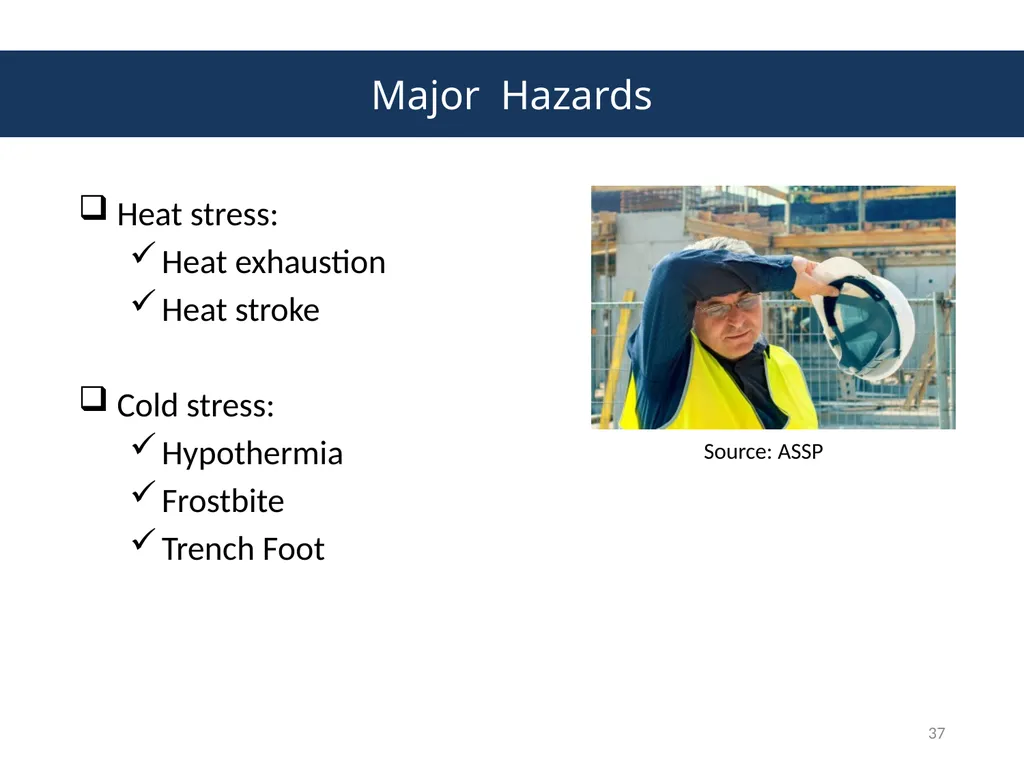
slide37. Major Hazards Heat stress:
Heat exhaustion
Heat stroke
Cold stress:
Hypothermia
Frostbite
Trench Foot Source: ASSP 37<br>
slide38. Control Measures Perform work on cooler days to avoid heat stress.
Train supervisors and workers on heat, cold stresses and other outdoor work hazards.
Encourage workers to take short breaks in heat or cold discomfort
Stay hydrated 38<br>
slide39. Review & Questions Name three important things you learned in this section. 39<br>
slide2. Disclaimer This material was produced under grant number SH-05144-SH9 from the Occupational Safety and Health Administration, U.S. Department of Labor. It does not necessarily reflect the views or policies of the U.S. Department of Labor, nor does mention of trade names, commercial products, or organizations imply endorsement by the U.S. Government. 2<br>
slide3. Learning Objectives Recognizing and controlling hazards from exposed environments, in wind tower construction, maintenance and demolition:
Explain the factors that affect thermal balance.
Recognize the signs of heat stress.
Recognize the signs of cold stress.
Recognize other potential hazards in exposed environments.
Identify best practices while working externally.
Identify obstacles to safe practices at a worksite. 3<br>
slide4. Thermal Balance Definition:
Thermal balance is the state of equilibrium in which the sum heat flowing in and out of a system equals zero.
This implies an equal rate of gain and loss of heat by the system.
Involves mathematical determination and comparison of heat flow within a system.
Thermal balance is achieved when body heat from metabolism dissipates and is in thermal equilibrium with the surroundings. 4<br>
slide5. Factors that Affect Thermal Balance Personal factors:
Metabolic rate
Clothing insulation
Environmental factors:
Air temperature
Air speed
Mean radiant temperature
Relative humidity 5<br>
slide6. Metabolic Rate According to the American Society of Heating, Refrigerating and Air-Conditioning Engineers (ASHRAE) 55-2010 standard, metabolic rate is the level of transformation of chemical energy into heat and mechanical work by metabolic activities within an organism.
Usually expressed in terms of unit area of the total body surface.
Differs from person to person.
Is influenced by the physical, eating and drinking habits of a person. 6<br>
slide7. Clothing Insulation Definition:
Is the thermal insulation provided by the clothing worn by a person
The amount of clothing layers worn has a significant impact on thermal balance.
Multiple layers can prevent heat loss, and either keeps a person warm or causes overheating and heat stress.
Inadequate amount of clothing layers can result in cold stress.
Air speed and relative humidity may reduce insulation. 7<br>
slide8. Air Temperature, Air Speed, Mean Radiant Temperature Air temperature: Is the temperature of the air surrounding an individual.
Air speed: The speed of air moving around a person at a specific time and location, irrespective of direction.
It can help cool a person in a warm environment, through heat loss by convection.
Mean radiant temperature: The amount of radiant heat transferred from the surface of a warm object.
Depends on ability of material to absorb or emit heat.
Has more influence on heat gain or loss compared with air temperature. 8<br>
slide9. Relative Humidity Definition:
The ratio of the actual amount of water vapor in the air to the maximum amount of water vapor that the air can hold at a specific air temperature and pressure.
Sweating helps the body loose heat through evaporation from the skin.
In high relative humidity, there is reduced heat loss through sweating due to maximum water vapor in air.
Humidity within vapor-impermeable PPE will be higher than that of the environment. 9<br>
slide10. Recognize the Signs of Heat Stress Wind energy workers:
Perform work tasks in exposed environment.
Are sometimes exposed to extreme heat
Work in hot and humid environments
Are potentially at risk of heat stress.
Heat stress is a hazard which can result in injuries and occupational illnesses. 10<br>
slide11. Effects of Heat Stress Headache
Heat exhaustion
Heat stroke
Heat cramps
Heat rashes
Sunburns
Fatigue 11<br>
slide12. Signs of Heat Exhaustion (1) Fatigue
Cold, pale, and clammy skin
Headache
Fainting
Irritability 12<br>
slide13. Signs of Heat Exhaustion (2) Thirst
Nausea or vomiting
Dizziness or lightheadedness
Heavy sweating
Elevated body temperature or fast heart rate 13<br>
slide14. Signs of Heat Stroke (1) Confusion
Headache
Dizziness
Slurred speech
Unconsciousness 14<br>
slide15. Signs of Heat Stroke (2) Seizures
Heavy sweating, hot, red, damp or dry skin.
High body temperature (103oF or higher)
Rapid heart rate 15<br>
slide16. Signs of Heat Cramps & Heat Rash Heat cramps
Muscle spasms or pain
Usually in legs, arms, or trunk
Heat rash
Clusters of red bumps on skin
Often on neck, upper chest, and skin folds 16<br>
slide17. Signs of Heat Syncope & Rhabdomyolysis Heat syncope
Fainting
Dizziness
Rhabdomyolysis (muscle breakdown)
Muscle pain
Dark or reduced urine
Fatigue 17<br>
slide18. First Aid for Heat-related Illnesses Move the affected person to a ventilated area.
Reduce body temperature with a cold water or an ice bath.
Remove protective clothing
Place wet towels on the head, neck etc.
Ensure uninterrupted circulation of air.
Provide adequate care and attention
Call 911 immediately if symptoms of heat stroke are observed. 18<br>
slide19. Cold Stress With increased wind speed and low temperatures, there is usually rapid heat loss.
Extreme cold environment can cause health emergencies in outdoor workers.
Cold stress occurs when there is a reduction in body temperature below normal
This situation can result in critical health issues including tissue damage and death. 19<br>
slide20. Contributory Factors Long exposure to extreme cold
Inappropriate dressing for the weather
Wetness
Exhaustion
Poor physical condition
Health conditions such as hypertension, hypothyroidism, and diabetes. 11<br>
slide21. Illnesses From Cold Stress Common illnesses from cold stress include:
Hypothermia
Frostbite
Trench Foot
Chilblains Source: LHSFNA 21<br>
slide22. Recognize the Signs of Cold Stress: Hypothermia Hypothermia, which is an abnormally low body temperature, affects the brain and thought process of an individual. Early Symptoms:
Shivering
Fatigue
Loss of coordination
Confusion and disorientation Late Symptoms:
Blue skin
Dilated pupils
Slowed pulse and breathing
Loss of consciousness 22<br>
slide23. Treatment of Hypothermia 23 First aid:
Inform the supervisor immediately
Relocate affected individual to warm environment.
Take off wet clothes.
Give sweetened warm beverages to help increase body temperature.
Keep dry and cover with warm blanket.
Seek medical help.
If victim has no pulse:
Call 911 for emergency medical assistance,
Perform rescue breathing for 3 minutes
Administer cardiopulmonary resuscitation (CPR)<br>
slide24. Recognize the Signs of Cold Stress: Frostbite Frostbite involves:
freezing of certain parts of the body especially fingers and toes
Reduced blood flow to hands and feet
Symptoms:
Numbness of affected parts.
Tingling or stinging
Aching
Bluish or pail, waxy skin
Reddened skin.
Body parts feel firm.
Blisters may occur in affected parts. Source: Britanica 24<br>
slide25. Treatment of Frostbite First aid for frostbite:
Get into a warm room.
Avoid walking on frostbitten feet or toes.
Immerse the affected area in warm water
Warm the affected area with heat from the body
Do not rub or massage the frostbitten area
Do not use a heating devices to warm body parts. 25<br>
slide26. Recognize the Signs of Cold Stress: Trench Foot Symptoms:
Reddening of skin
Numbness
Leg cramps
Swelling
Tingling pain
Blisters or ulcers
Bleeding under skin
Gangrene (Foot may turn dark purple, blue, or gray) 26<br>
slide27. Treatment of Trench Foot First aid for trench foot:
Call 911 immediately in an emergency
Remove shoes/boots and wet socks.
Dry feet.
Avoid walking on feet as this may cause tissue damage. 27<br>
slide28. Recognize the Signs of Cold Stress: Chilblains Symptoms:
Redness
Itching
Possible blistering
Inflammation
Possible ulceration in severe cases 28<br>
slide29. Treatment of Chilblains First aid for chilblains:
Avoid scratching
Slowly warm the skin
Use corticosteroid creams to relieve itching and swelling
Keep blisters and ulcers clean and covered 29<br>
slide30. Other Hazards Sun exposure hazards:
UV radiation can cause skin cancer
Sunburns
Hazardous noise leading to hearing loss
Contact with poisonous plants hazards
Exposure to venomous spider and snake bites
Risk of stinging insects or scorpions
Exposure to mosquito-borne diseases
Risk of tick-borne diseases
Risk of Lyme disease
Lightning. 30<br>
slide31. Best Practices in Exposed Environments (1) Schedule work on cooler days to avoid heat stress.
Establish a buddy system and train them to watch out for first symptoms of heat stress.
Encourage workers to drink water at least every 20 minutes.
Workers should take regular breaks to cool off in airconditioned site office.
Reduce energy requirements of the job. 31<br>
slide32. Best Practices in Exposed Environments (2) Assign an adequate amount of workers to each task.
Develop a program to acclimatize workers to heat and increase their physical fitness.
Train supervisors and workers on heat and cold stresses and other outdoor work hazards.
Apply sunscreen products with an SPF of at least 15.
Utilize UV-protective sunglasses for protection against UVA and UVB light. 32<br>
slide33. Best Practices in Exposed Environments (3) Train workers to recognize symptoms of cold stress.
Create buddy system among workers
Encourage them to monitor their physical condition and coworkers.
Ensure workers dress properly for the cold.
Stay dry in the cold. Moisture or dampness can increase the rate of heat loss from the body. 33<br>
slide34. Best Practices in Exposed Environments (4) Keep extra clothing handy.
Drink warm sweetened beverages to keep warm
Use proper engineering controls, safe work practices, and personal protective equipment (PPE)
Encourage workers to take short breaks when in discomfort.
Assign tasks according to outdoor work experience of workers. 34<br>
slide35. Best Practices in Exposed Environments (5) CDC recommends to shorten work tasks and increase rest periods when:
Temperature, humidity, and sunshine increase.
There is limited air flow in work area.
Protective clothing or equipment is worn.
Heavy-duty tasks are performed 35<br>
slide36. Best Practices in Exposed Environments (6) Supervisors should be trained on:
Weather acclimatization program.
Response procedure for signs of heat or cold-related illness.
Monitoring and using weather reports.
Response during extreme weather events.
Worker hydration and intermittent breaks. 36<br>
slide37. Major Hazards Heat stress:
Heat exhaustion
Heat stroke
Cold stress:
Hypothermia
Frostbite
Trench Foot Source: ASSP 37<br>
slide38. Control Measures Perform work on cooler days to avoid heat stress.
Train supervisors and workers on heat, cold stresses and other outdoor work hazards.
Encourage workers to take short breaks in heat or cold discomfort
Stay hydrated 38<br>
slide39. Review & Questions Name three important things you learned in this section. 39<br>