MODULE 7: RHIS Governance and Management of Resources SESSION 2: Management of RHIS Resources ROUTINE HEALTH INFORMATION SYSTEMS A Curriculum on Basic Concepts and Practice 1 The complete RHIS curriculum is available here:
"MODULE 7: RHIS Governance and Management of" is the property of its rightful owner. Permission is granted to
download and print the materials on this website for personal, non-commercial use only, and to display it
on your personal computer provided you do not modify the materials and that you retain all copyright
notices contained in the materials. By downloading content from our website, you accept the terms of this
agreement.
Presentation Transcript
01
MODULE 7:
RHIS Governance and Management of Resources SESSION 2:
Management of RHIS Resources ROUTINE HEALTH INFORMATION SYSTEMS
A Curriculum on Basic Concepts and Practice 1 The complete RHIS curriculum is available here: https://www.measureevaluation.org/our-work/ routine-health-information-systems/rhis-curriculum<br>
02
By the end of this session, participants will:
Be able to describe essential aspects of managing RHIS resources (particularly human, financial, and physical resources)
Understand the importance of adhering to RHIS procedures and standards 2 Learning Objectives<br>
03
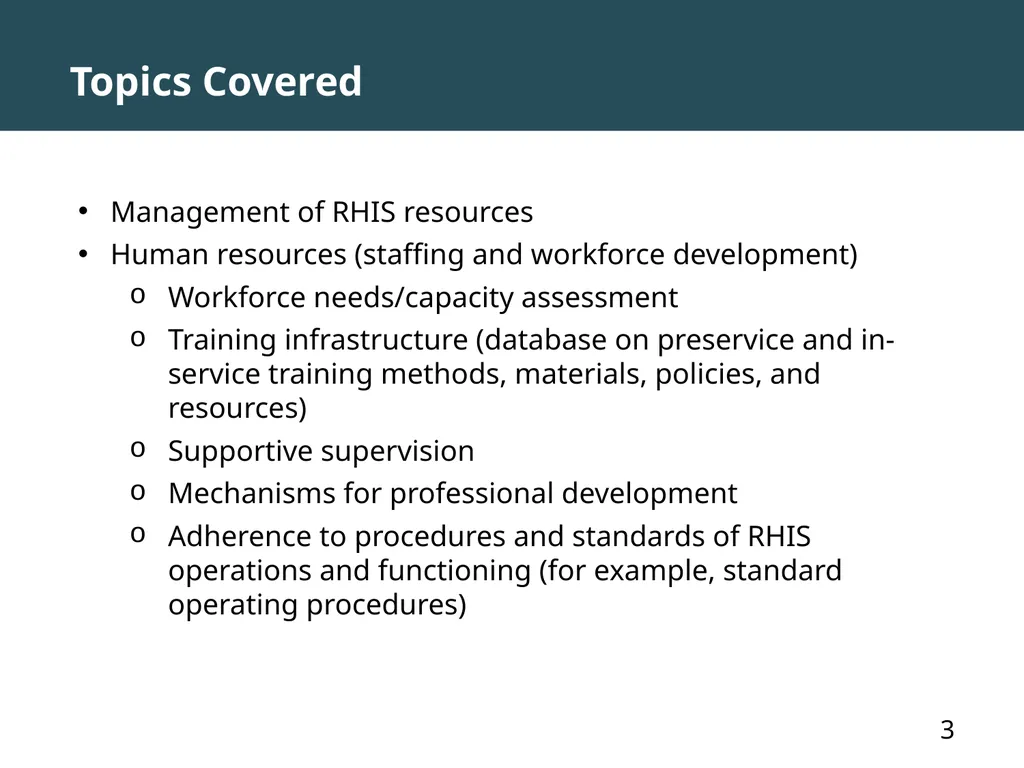
Management of RHIS resources
Human resources (staffing and workforce development)
Workforce needs/capacity assessment
Training infrastructure (database on preservice and in-service training methods, materials, policies, and resources)
Supportive supervision
Mechanisms for professional development
Adherence to procedures and standards of RHIS operations and functioning (for example, standard operating procedures) Topics Covered 3<br>
04
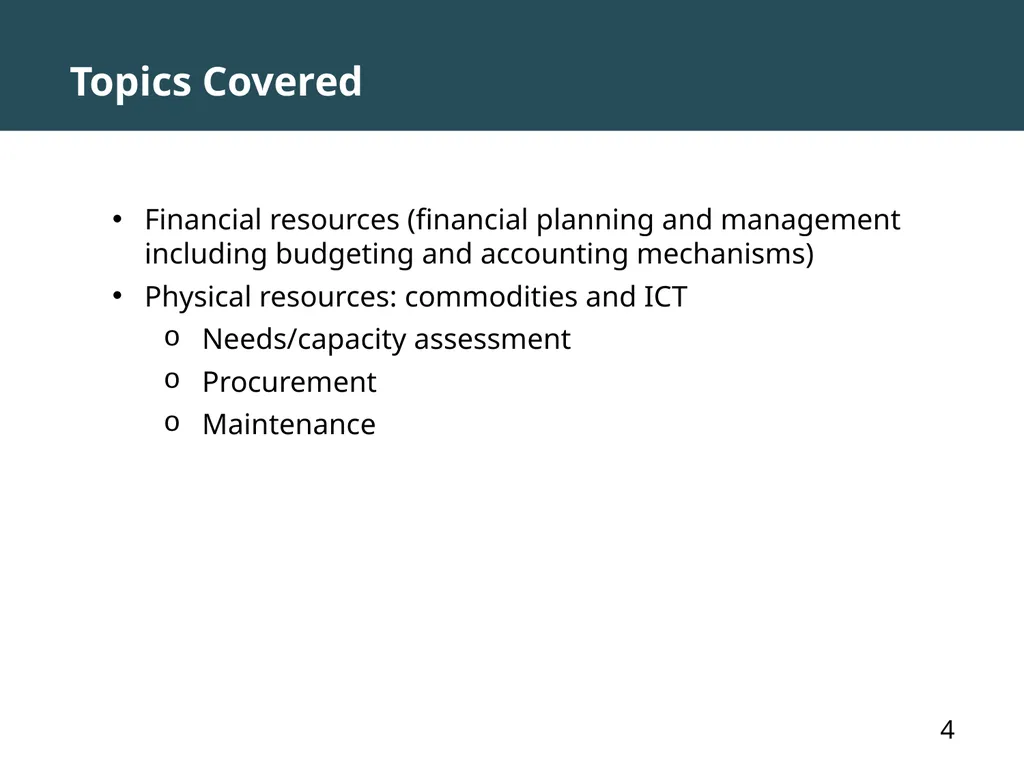
Financial resources (financial planning and management including budgeting and accounting mechanisms)
Physical resources: commodities and ICT
Needs/capacity assessment
Procurement
Maintenance Topics Covered 4<br>
05
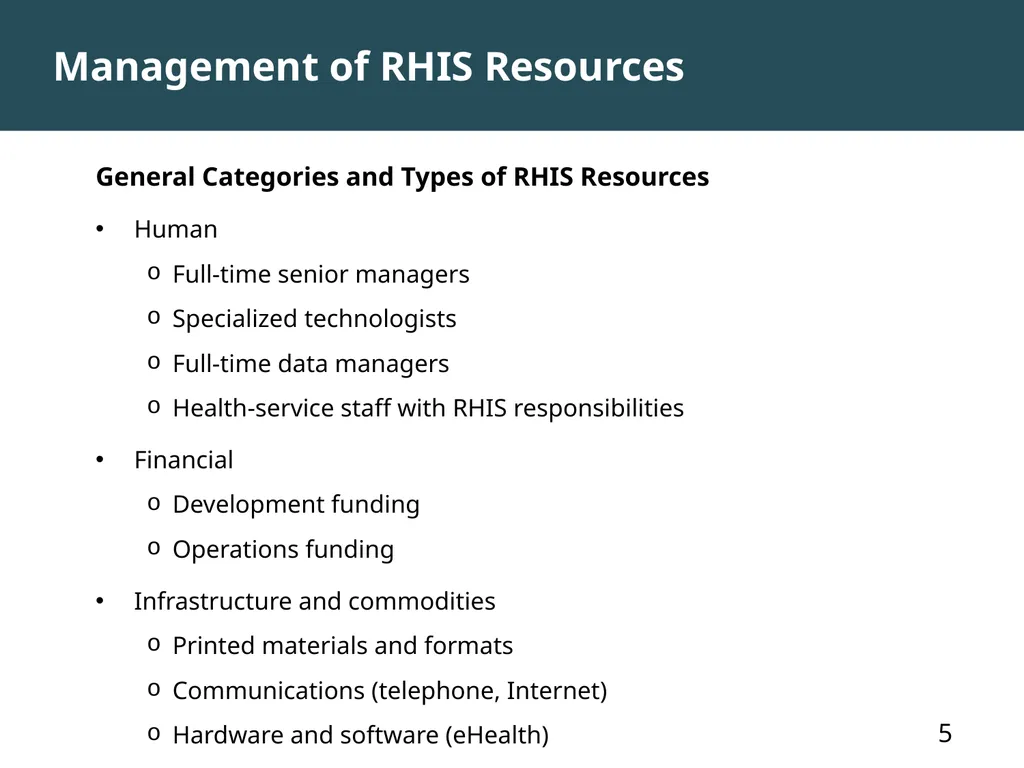
Management of RHIS Resources General Categories and Types of RHIS Resources
Human
Full-time senior managers
Specialized technologists
Full-time data managers
Health-service staff with RHIS responsibilities
Financial
Development funding
Operations funding
Infrastructure and commodities
Printed materials and formats
Communications (telephone, Internet)
Hardware and software (eHealth) 5<br>
06
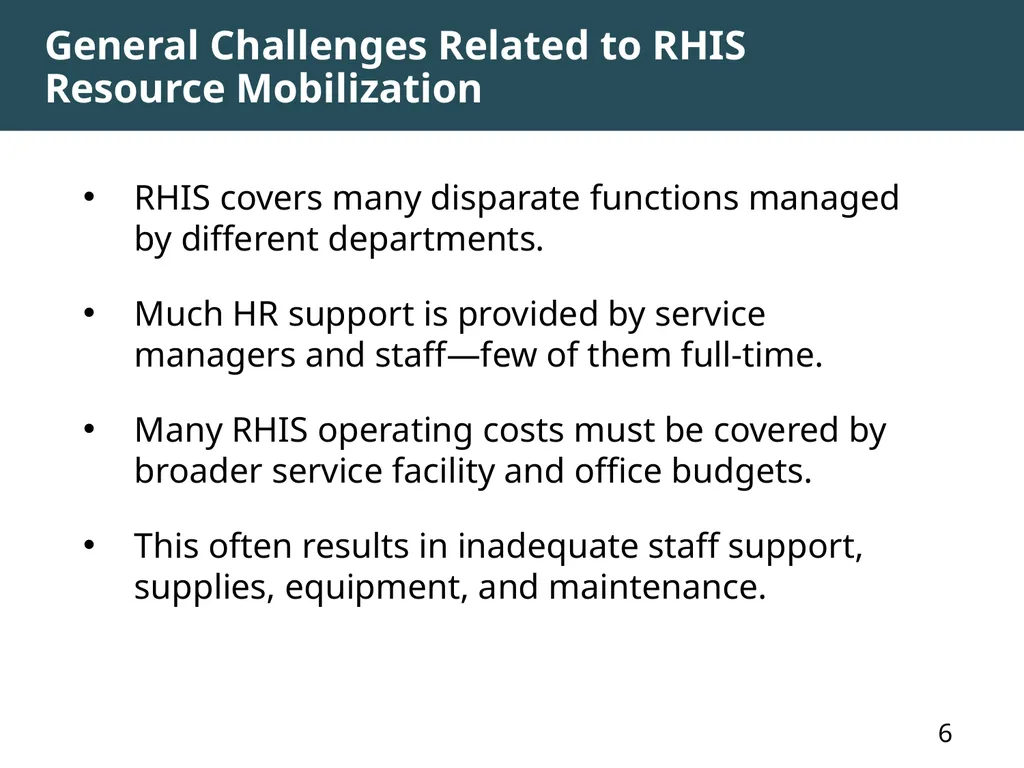
General Challenges Related to RHIS Resource Mobilization RHIS covers many disparate functions managed by different departments.
Much HR support is provided by service managers and staff―few of them full-time.
Many RHIS operating costs must be covered by broader service facility and office budgets.
This often results in inadequate staff support, supplies, equipment, and maintenance. 6<br>
07
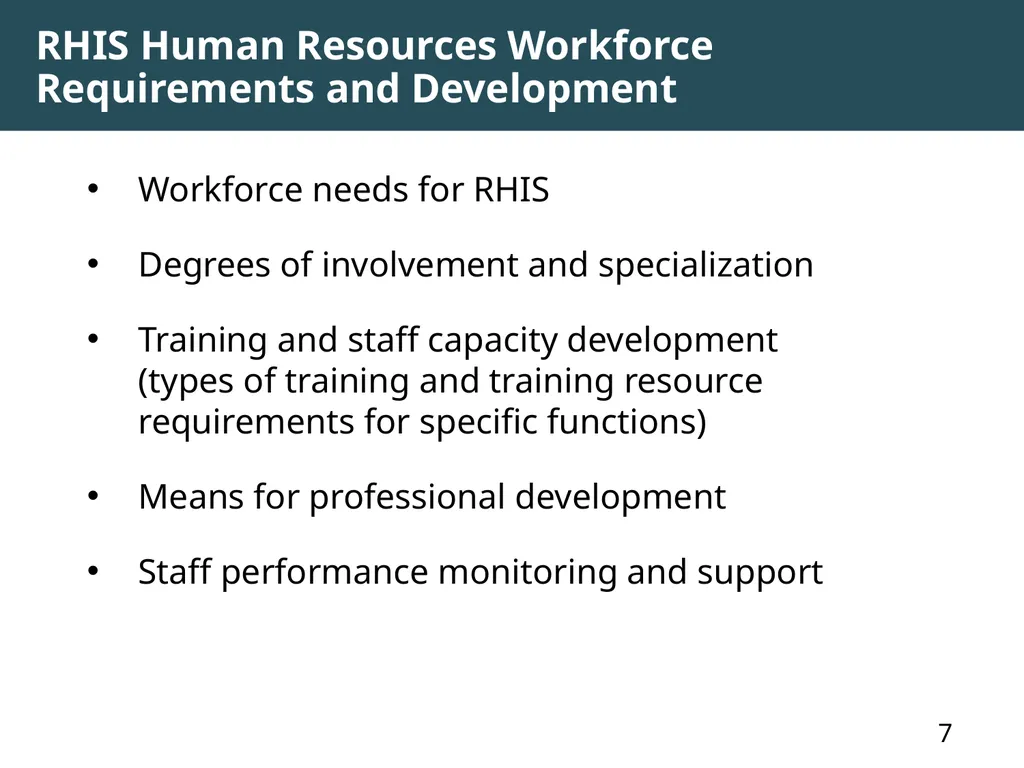
RHIS Human Resources Workforce Requirements and Development Workforce needs for RHIS
Degrees of involvement and specialization
Training and staff capacity development (types of training and training resource requirements for specific functions)
Means for professional development
Staff performance monitoring and support 7<br>
08
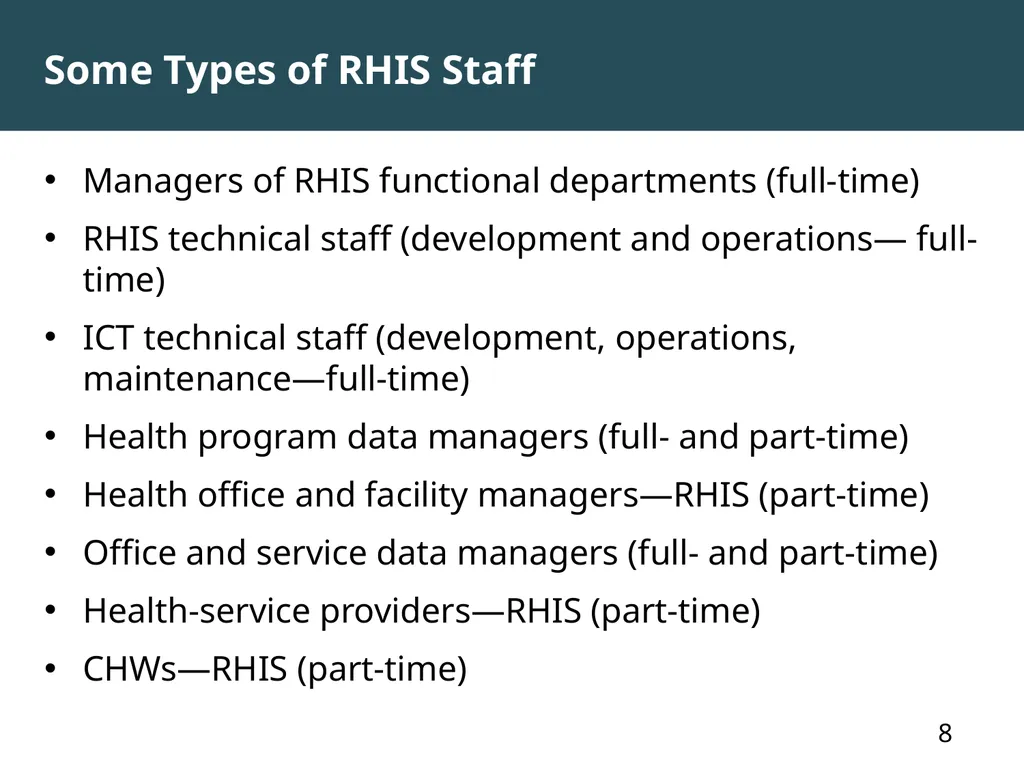
Some Types of RHIS Staff Managers of RHIS functional departments (full-time)
RHIS technical staff (development and operations― full-time)
ICT technical staff (development, operations, maintenance―full-time)
Health program data managers (full- and part-time)
Health office and facility managers―RHIS (part-time)
Office and service data managers (full- and part-time)
Health-service providers―RHIS (part-time)
CHWs―RHIS (part-time) 8<br>
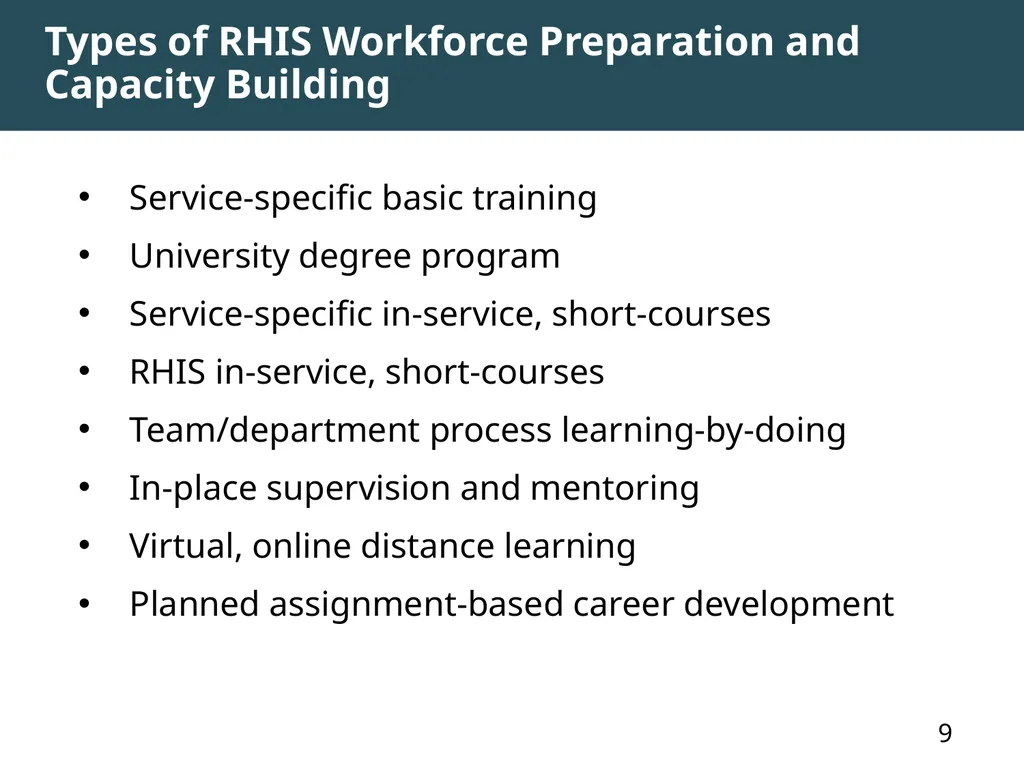
09
Types of RHIS Workforce Preparation and Capacity Building Service-specific basic training
University degree program
Service-specific in-service, short-courses
RHIS in-service, short-courses
Team/department process learning-by-doing
In-place supervision and mentoring
Virtual, online distance learning
Planned assignment-based career development 9<br>
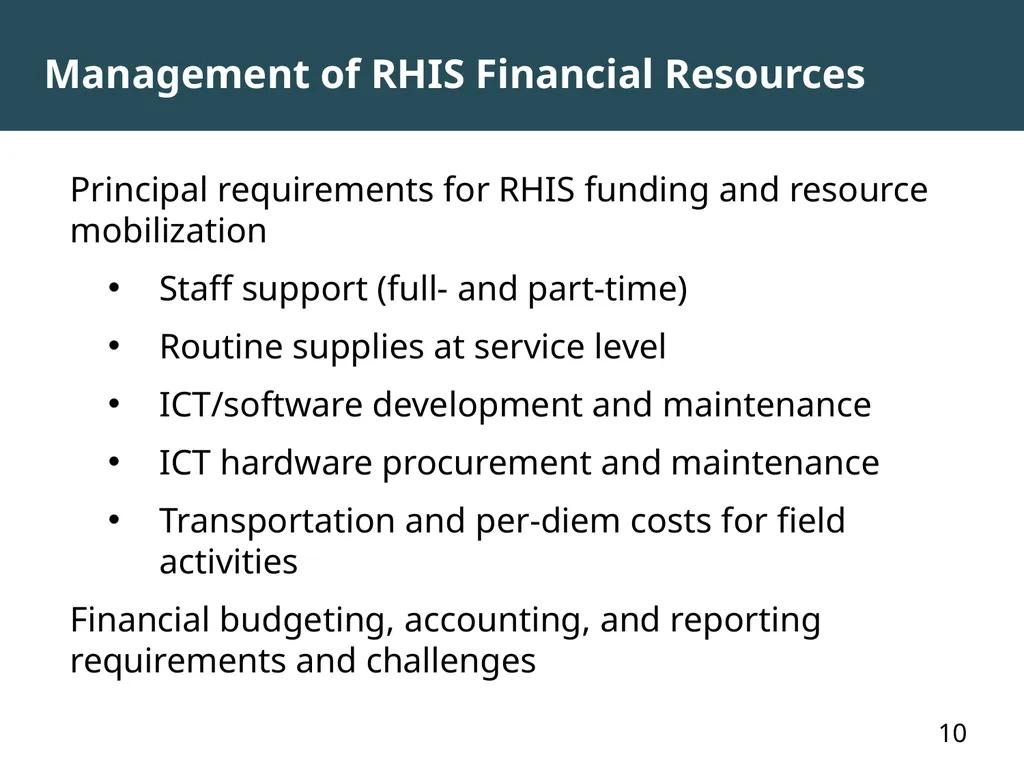
10
Management of RHIS Financial Resources Principal requirements for RHIS funding and resource mobilization
Staff support (full- and part-time)
Routine supplies at service level
ICT/software development and maintenance
ICT hardware procurement and maintenance
Transportation and per-diem costs for field activities
Financial budgeting, accounting, and reporting requirements and challenges 10<br>
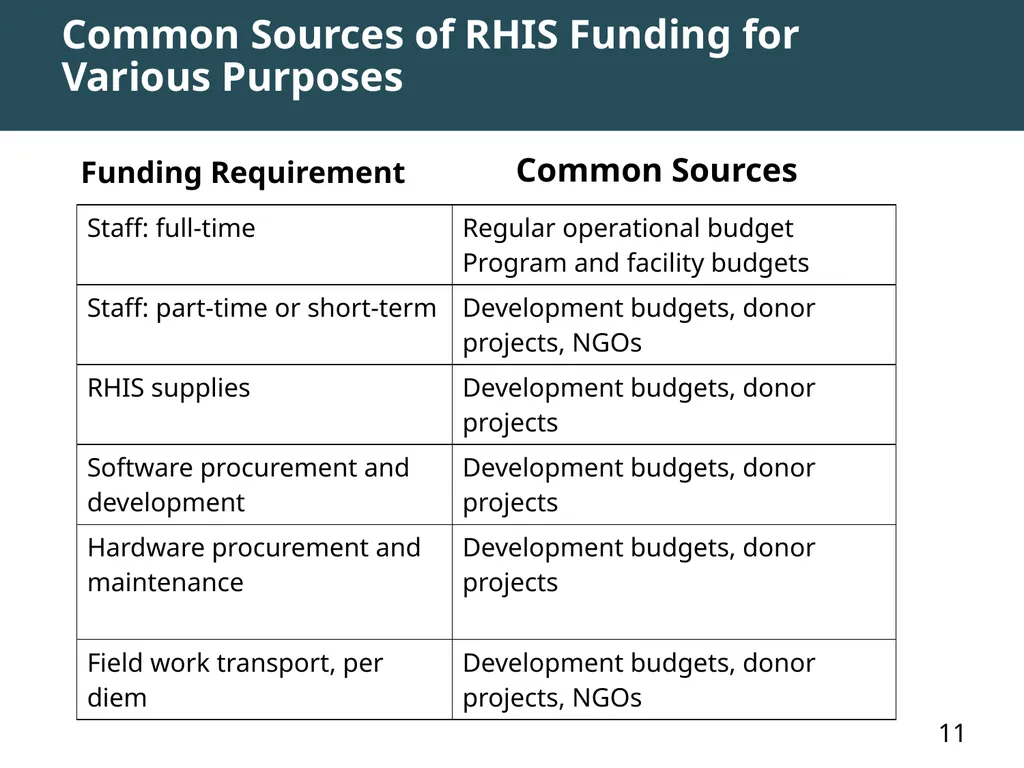
11
Common Sources of RHIS Funding for Various Purposes Funding Requirement Common Sources 11<br>
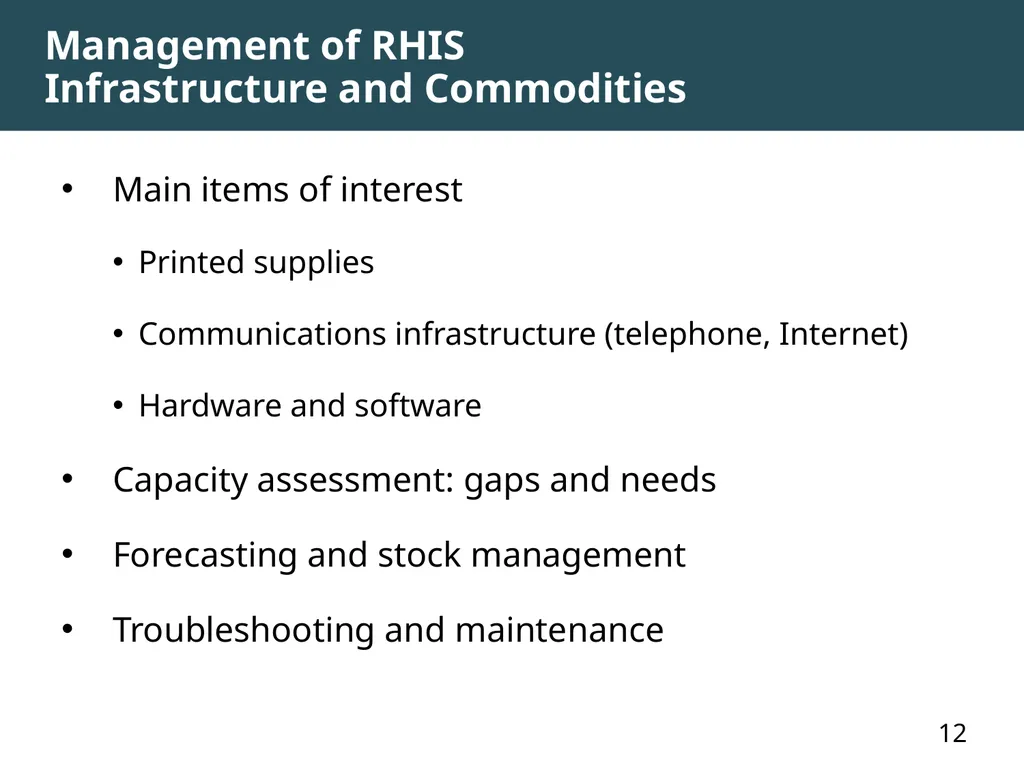
12
Management of RHIS Infrastructure and Commodities Main items of interest
Printed supplies
Communications infrastructure (telephone, Internet)
Hardware and software
Capacity assessment: gaps and needs
Forecasting and stock management
Troubleshooting and maintenance 12<br>
13
Group Exercise Ideas for Preventing and Responding to: Breakdown in routine and emergency telephone communications (fixed and mobile)
Computer, software, and Internet functionality problems
Frequent stockouts of important registers, records, and report formats 13<br>
14
Plenary Presentation and Discussion How can we best monitor and assess the occurrence of the problem across the health districts and service facilities?
How can we rapidly solve the problem in the facilities and offices currently affected?
How can we prevent the problem from occurring frequently, within the limits of current resources? 14<br>
15
ROUTINE HEALTH INFORMATION SYSTEMS
A Curriculum on Basic Concepts and Practice This presentation was produced with the support of the United States Agency for International Development (USAID) under the terms of MEASURE Evaluation cooperative agreement AID-OAA-L-14-00004. MEASURE Evaluation is implemented by the Carolina Population Center, University of North Carolina at Chapel Hill in partnership with ICF International; John Snow, Inc.; Management Sciences for Health; Palladium; and Tulane University. The views expressed in this presentation do not necessarily reflect the views of USAID or the United States government. 15<br>