
MODULE 9 HiAP implementation at local, regional
CB
Published · 31 slides · 0 views
1 / 1




Description
MODULE 9 HiAP implementation at local, regional and global levels HiAP implementation at global, regional and local levels 9 LEARNING OBJECTIVES Discuss examples of HiAP implementation at the local, regional andor global level What
Related Topics
Share
Embed code
Download this presentation From Below
"MODULE 9 HiAP implementation at local, regional" is the property of its rightful owner. Permission is granted to download and print the materials on this website for personal, non-commercial use only, and to display it on your personal computer provided you do not modify the materials and that you retain all copyright notices contained in the materials. By downloading content from our website, you accept the terms of this agreement.
Presentation Transcript
01
MODULE 9
HiAP implementation at local, regional and global levels HiAP implementation at global, regional and local levels 9<br>
HiAP implementation at local, regional and global levels HiAP implementation at global, regional and local levels 9<br>
02
LEARNING OBJECTIVES Discuss examples of HiAP implementation at the local, regional and/or global level<br>
03
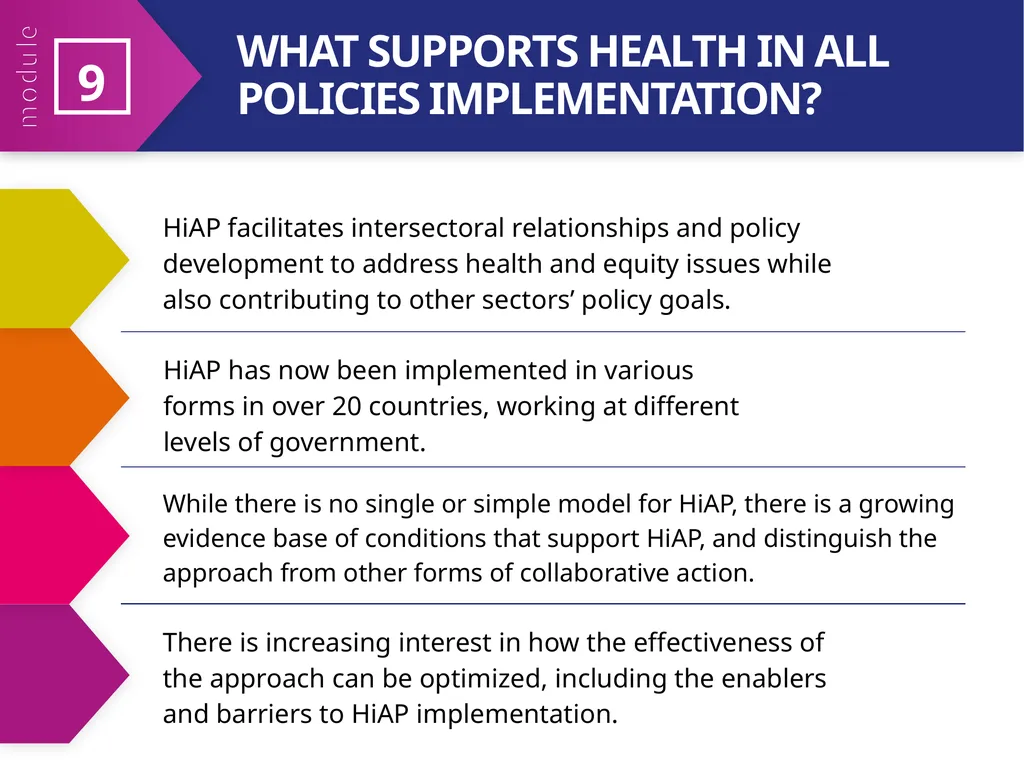
What supports Health in All Policies implementation? HiAP facilitates intersectoral relationships and policy development to address health and equity issues while
also contributing to other sectors’ policy goals. HiAP has now been implemented in various
forms in over 20 countries, working at different
levels of government. While there is no single or simple model for HiAP, there is a growing evidence base of conditions that support HiAP, and distinguish the approach from other forms of collaborative action. There is increasing interest in how the effectiveness of the approach can be optimized, including the enablers and barriers to HiAP implementation.<br>
levels of government. While there is no single or simple model for HiAP, there is a growing evidence base of conditions that support HiAP, and distinguish the approach from other forms of collaborative action. There is increasing interest in how the effectiveness of the approach can be optimized, including the enablers and barriers to HiAP implementation.<br>
04
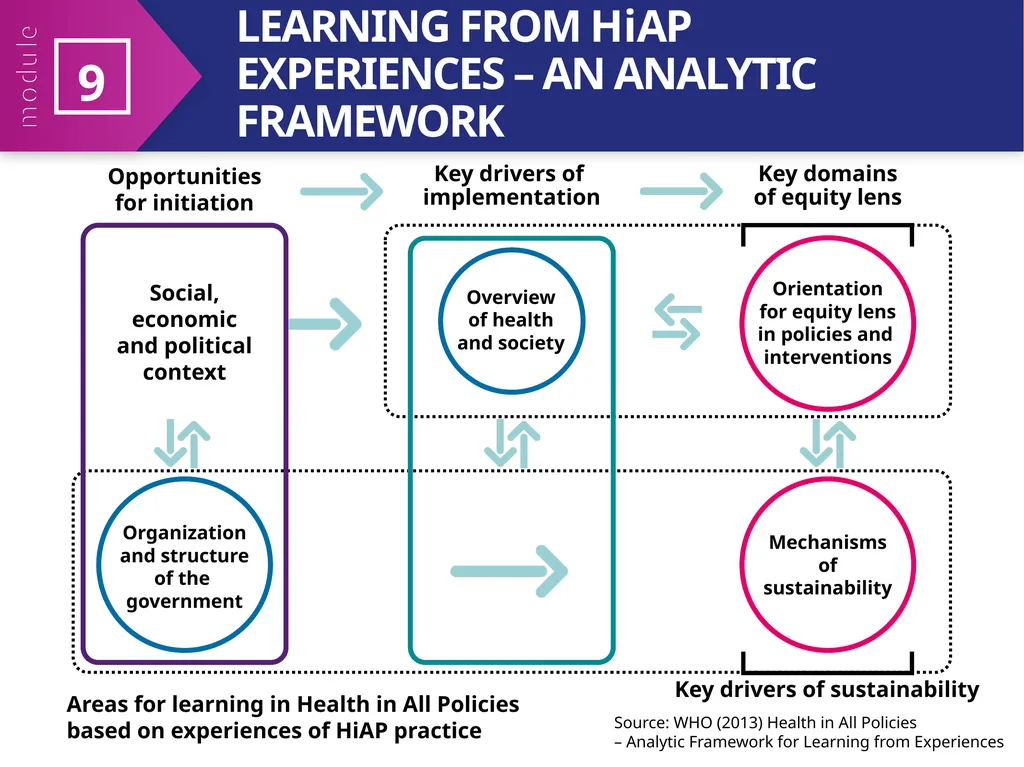
Learning from hiap experiences – an analytic framework<br>
05
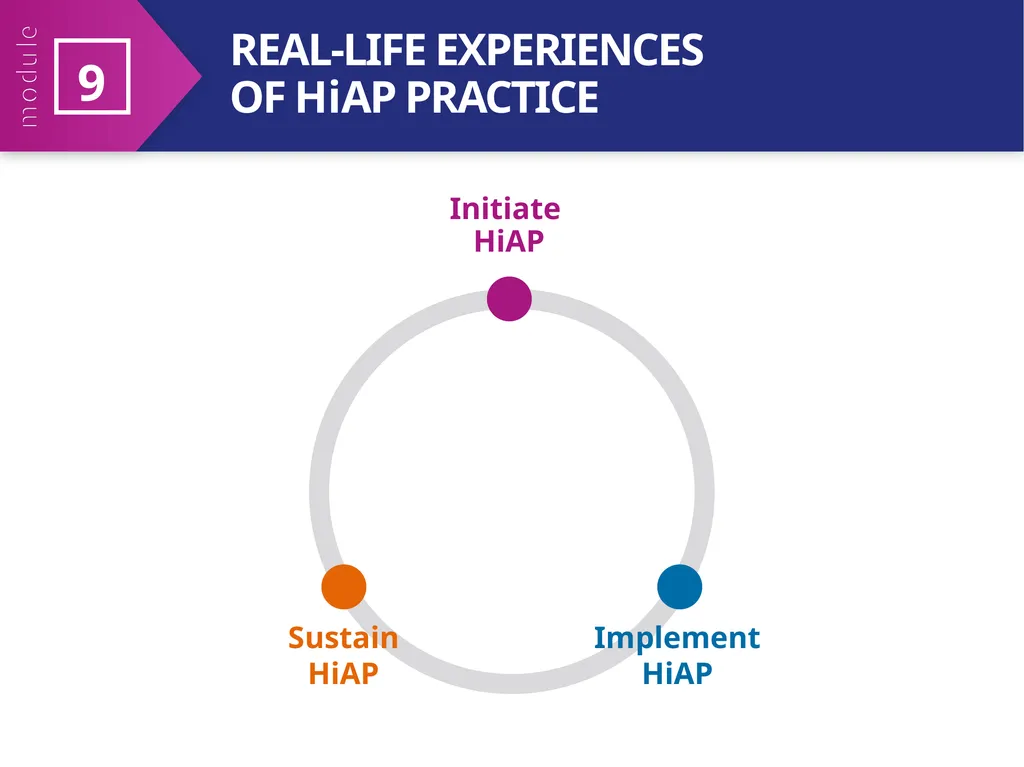
Real-life experiences
of hiap practice<br>
of hiap practice<br>
06
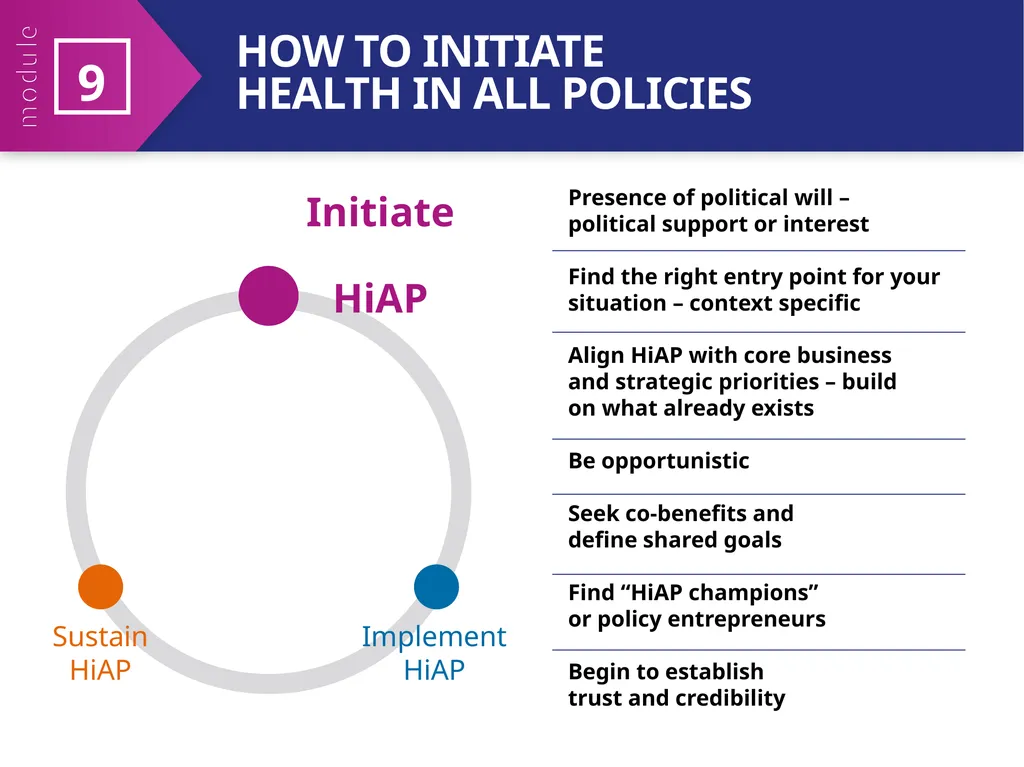
How to INITIATE
Health in All Policies Presence of political will –
political support or interest
Find the right entry point for your situation – context specific
Align HiAP with core business and strategic priorities – build on what already exists
Be opportunistic
Seek co-benefits and define shared goals
Find “HiAP champions” or policy entrepreneurs Begin to establish trust and credibility<br>
Align HiAP with core business and strategic priorities – build on what already exists
Be opportunistic
Seek co-benefits and define shared goals
Find “HiAP champions” or policy entrepreneurs Begin to establish trust and credibility<br>
07
How to initiate Health in All Policies: Real-life experiences Leveraging strategic and
reform opportunities Namibia and Zambia are using the Sustainable Development Agenda as an entry point to more closely link health with other sectors’ work. Country Development Plans have enabled existing strategic priorities to be aligned with HiAP and helped to shape a whole-of-government agenda e.g. Sudan and Suriname Bhutan is exploring how HiAP can be applied using the existing governance and processes of their Gross National Happiness (GNH) strategy, where policies are shaped and vetted through specific GNH mechanisms.<br>
reform opportunities Namibia and Zambia are using the Sustainable Development Agenda as an entry point to more closely link health with other sectors’ work. Country Development Plans have enabled existing strategic priorities to be aligned with HiAP and helped to shape a whole-of-government agenda e.g. Sudan and Suriname Bhutan is exploring how HiAP can be applied using the existing governance and processes of their Gross National Happiness (GNH) strategy, where policies are shaped and vetted through specific GNH mechanisms.<br>
08
Climate and obesity action were important drivers to introducing HiAP to California – key priorities for the then Governor Arnold Schwarzenegger. Californian HiAP Task Force established as the governance body through the introduction
of an Executive Order. Health issues/increasing burden of disease Influencers South Australia’s “Thinker in Residence” programme provided for an international expert to explore how health and well-being could be improved in the state. HiAP was recommended as an approach to collaborative policy-making, using the government’s strategic plan as an overarching governance framework. How to initiate Health in All Policies: Real-life experiences<br>
09
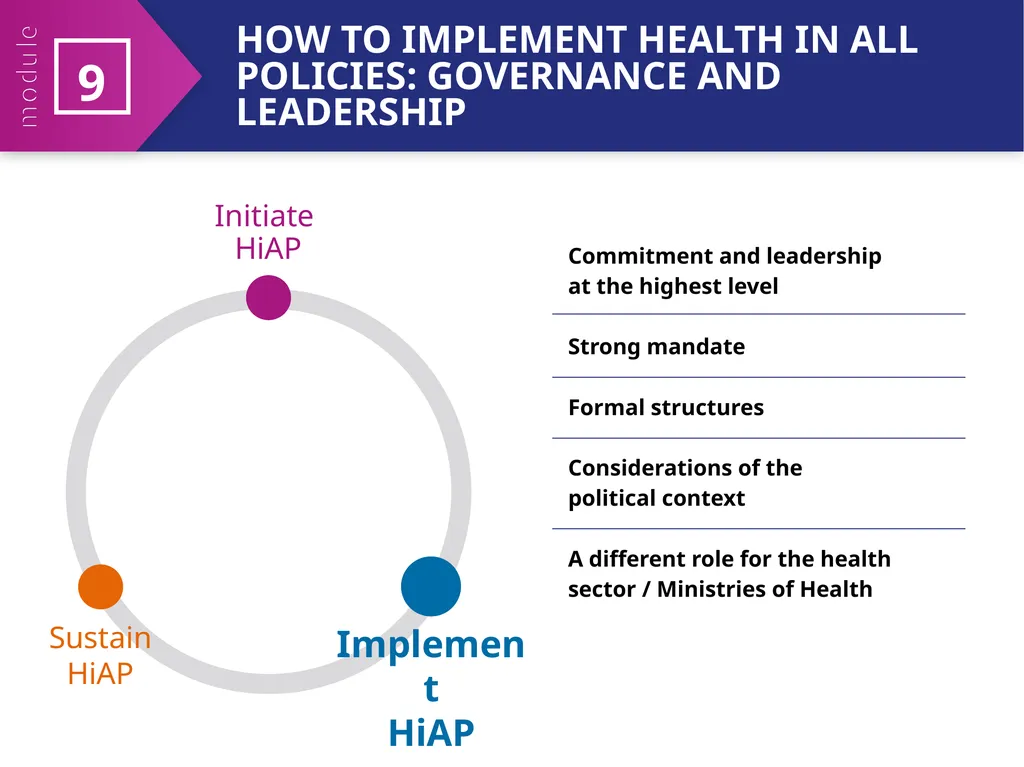
How to IMPLEMENT Health in All Policies: Governance and leadership<br>
10
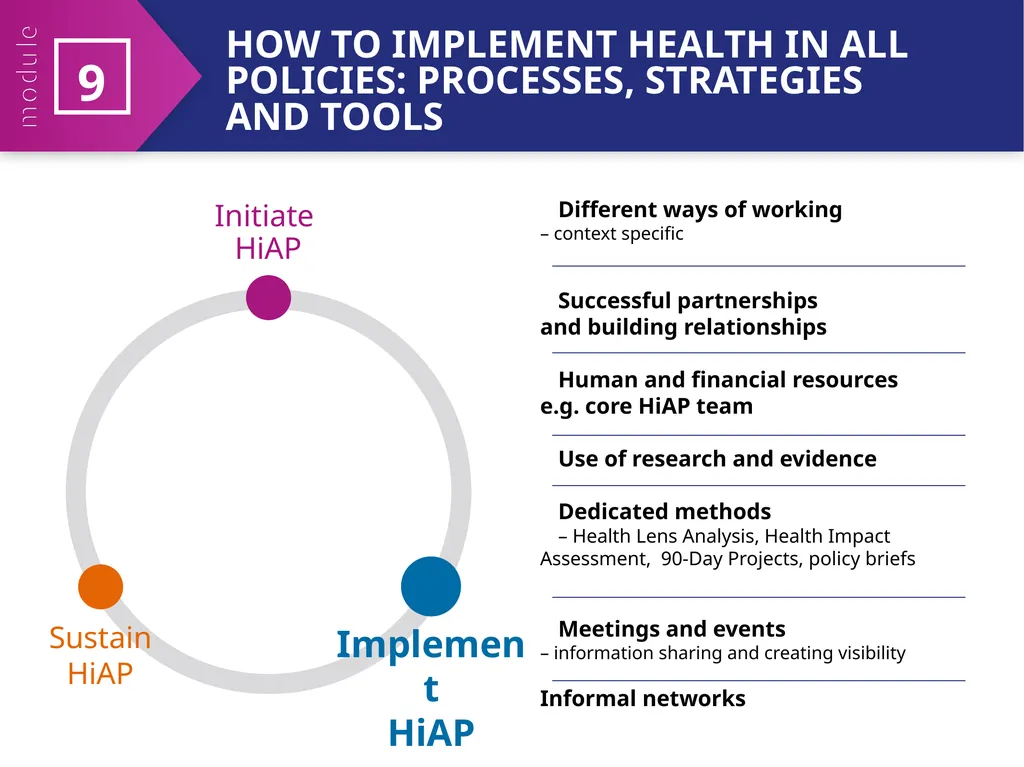
How to IMPLEMENT Health in All Policies: PROCESSES, STRATEGIES
AND TOOLS<br>
11
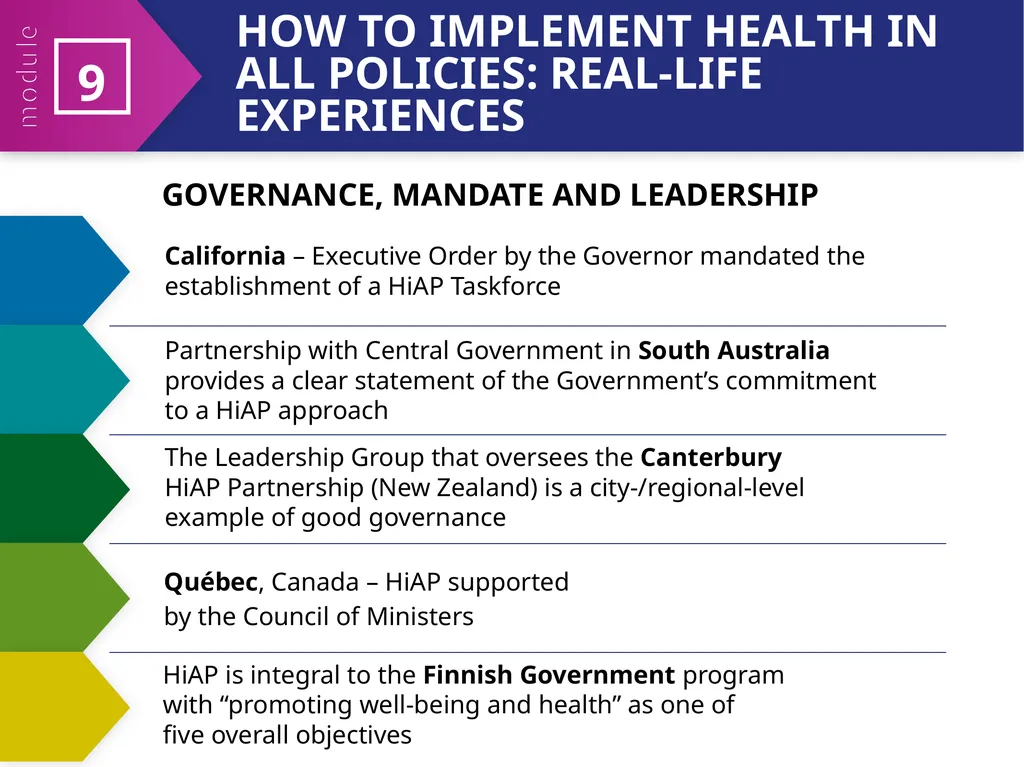
How to implement Health in All Policies: Real-life experiences California – Executive Order by the Governor mandated the establishment of a HiAP Taskforce Partnership with Central Government in South Australia provides a clear statement of the Government’s commitment to a HiAP approach The Leadership Group that oversees the Canterbury
HiAP Partnership (New Zealand) is a city-/regional-level
example of good governance Québec, Canada – HiAP supported
by the Council of Ministers HiAP is integral to the Finnish Government program
with “promoting well-being and health” as one of
five overall objectives GOVERNANCE, MANDATE AND LEADERSHIP<br>
12
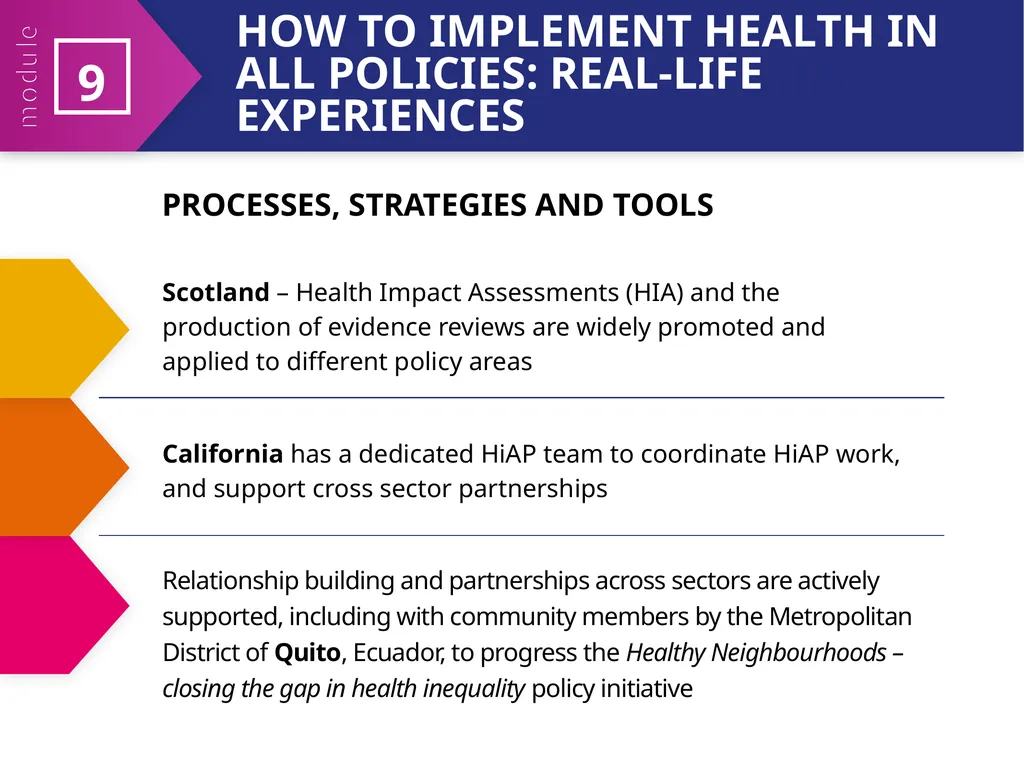
How to implement Health in All Policies: Real-life experiences Scotland – Health Impact Assessments (HIA) and the production of evidence reviews are widely promoted and applied to different policy areas PROCESSES, STRATEGIES AND TOOLS California has a dedicated HiAP team to coordinate HiAP work, and support cross sector partnerships Relationship building and partnerships across sectors are actively supported, including with community members by the Metropolitan District of Quito, Ecuador, to progress the Healthy Neighbourhoods – closing the gap in health inequality policy initiative<br>
13
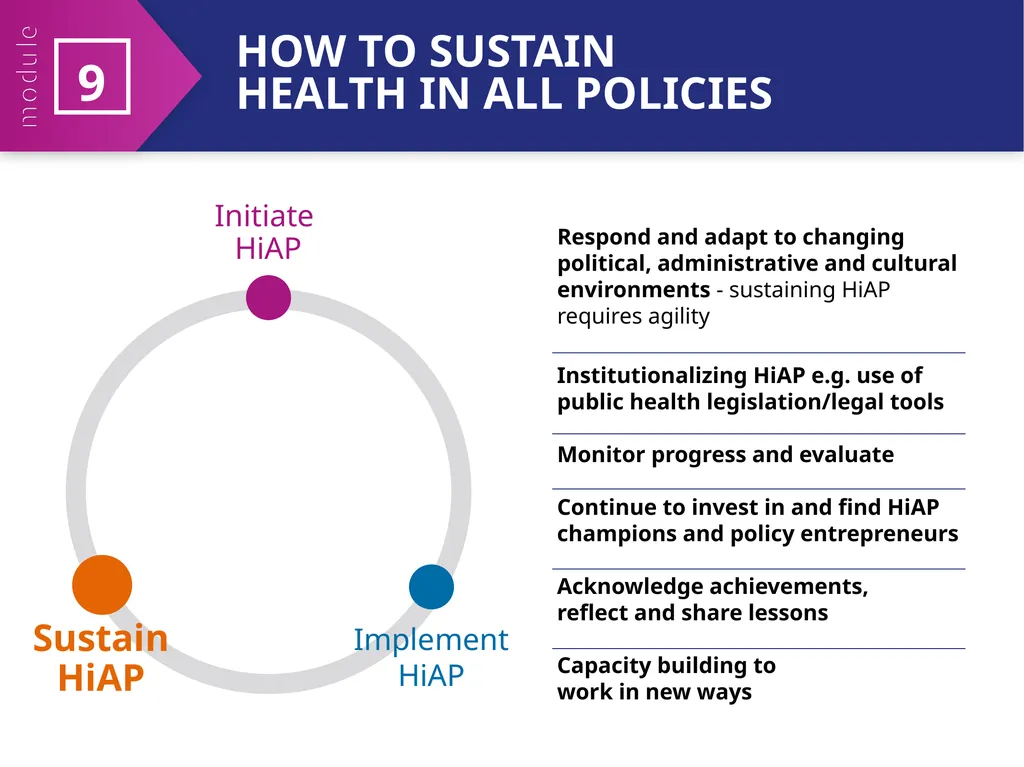
Institutionalizing HiAP e.g. use of
public health legislation/legal tools
Monitor progress and evaluate
Continue to invest in and find HiAP
champions and policy entrepreneurs
Acknowledge achievements,
reflect and share lessons
Capacity building to
work in new ways How to SUSTAIN Health in All Policies Respond and adapt to changing political, administrative and cultural environments - sustaining HiAP
requires agility<br>
public health legislation/legal tools
Monitor progress and evaluate
Continue to invest in and find HiAP
champions and policy entrepreneurs
Acknowledge achievements,
reflect and share lessons
Capacity building to
work in new ways How to SUSTAIN Health in All Policies Respond and adapt to changing political, administrative and cultural environments - sustaining HiAP
requires agility<br>
14
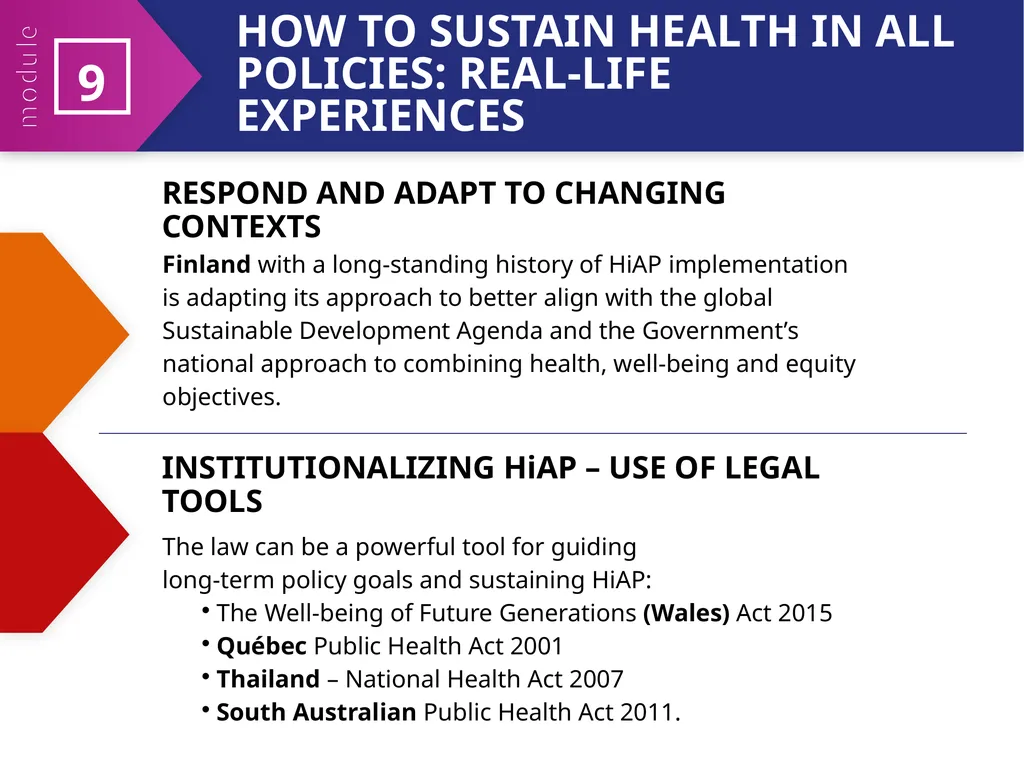
How to sustain Health in All Policies: Real-life experiences Finland with a long-standing history of HiAP implementation is adapting its approach to better align with the global Sustainable Development Agenda and the Government’s national approach to combining health, well-being and equity objectives. Respond and adapt to changing contexts The law can be a powerful tool for guiding
long-term policy goals and sustaining HiAP:
The Well-being of Future Generations (Wales) Act 2015
Québec Public Health Act 2001
Thailand – National Health Act 2007
South Australian Public Health Act 2011. Institutionalizing HiAP – use of legal tools<br>
The Well-being of Future Generations (Wales) Act 2015
Québec Public Health Act 2001
Thailand – National Health Act 2007
South Australian Public Health Act 2011. Institutionalizing HiAP – use of legal tools<br>
15
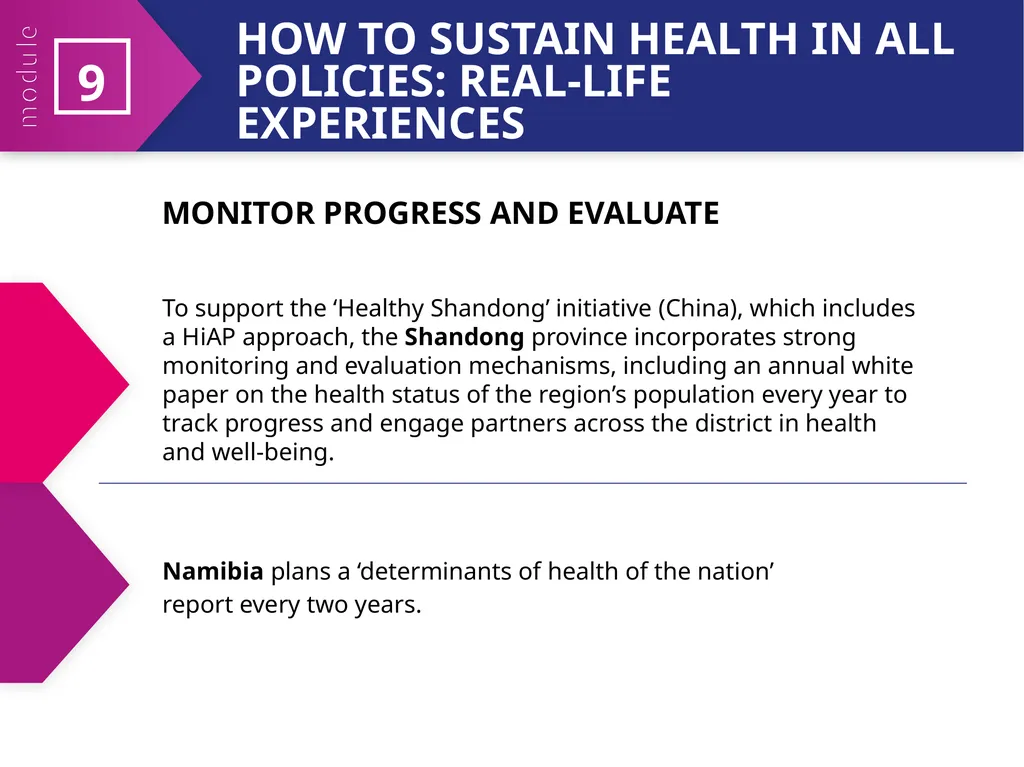
To support the ‘Healthy Shandong’ initiative (China), which includes a HiAP approach, the Shandong province incorporates strong monitoring and evaluation mechanisms, including an annual white paper on the health status of the region’s population every year to track progress and engage partners across the district in health and well-being. Monitor progress and evaluate Namibia plans a ‘determinants of health of the nation’ report every two years. How to sustain Health in All Policies: Real-life experiences<br>
16
The role of broader society and citizens for action on
the determinants of health Thailand’s National Health Assembly demonstrates
participatory governance in action<br>
17
The dominance of siloed decision-making and
narrow definitions of core business Resource constraints Weak governance structures and arrangements Lack of support from senior officials Threats to Health in
All Policies action HiAP requires agility<br>
18
First Global Status Report
on Health in All Policies Designed and published by The Global Network
for Health in All Policies (GNHiAP) in 2019 Provides baseline information on HiAP practice and describes different HiAP models from around the world<br>
19
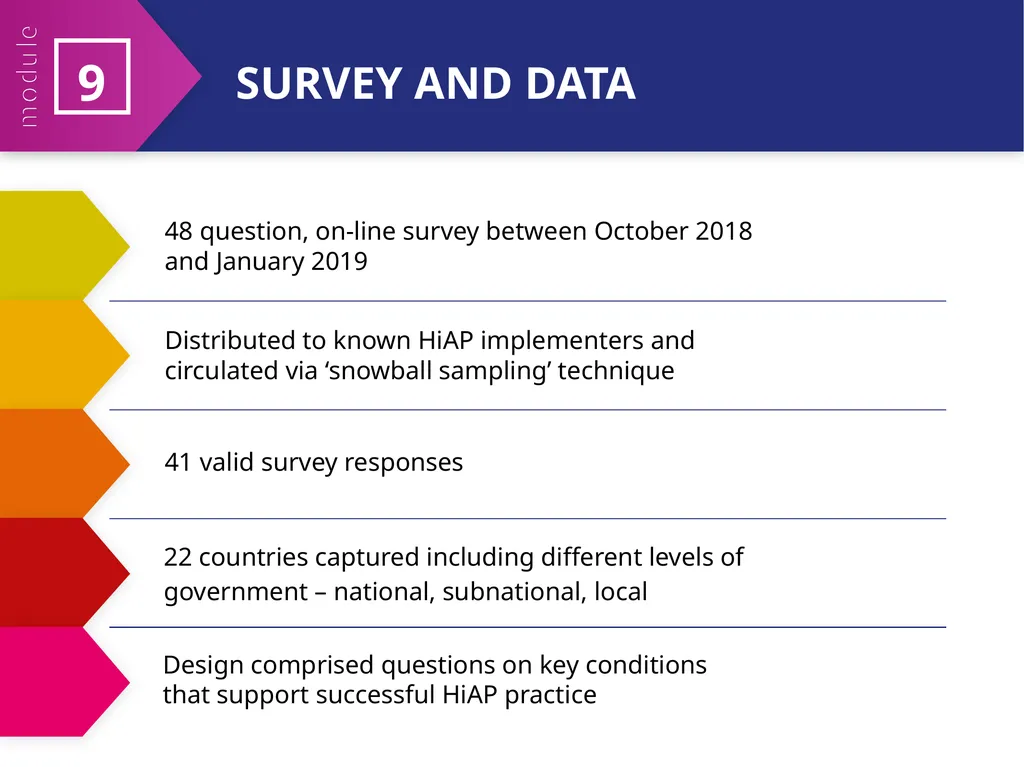
Survey and data 48 question, on-line survey between October 2018
and January 2019 Distributed to known HiAP implementers and
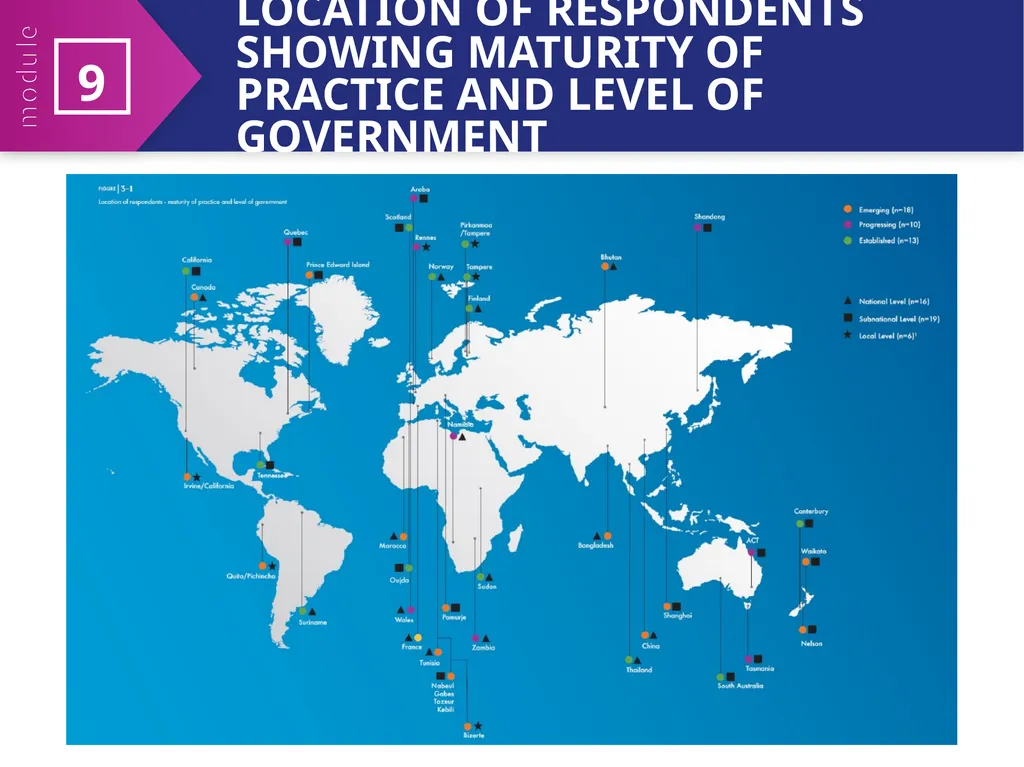
circulated via ‘snowball sampling’ technique 41 valid survey responses 22 countries captured including different levels of government – national, subnational, local Design comprised questions on key conditions
that support successful HiAP practice<br>
20
First Global Status Report
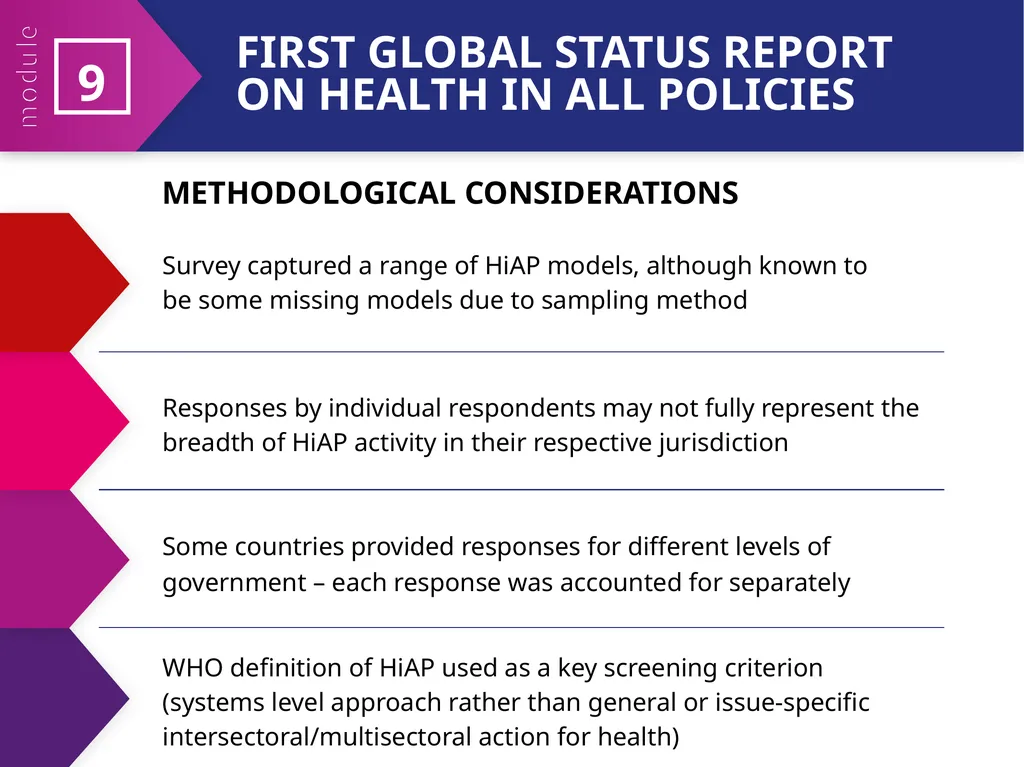
on Health in All Policies Survey captured a range of HiAP models, although known to be some missing models due to sampling method Responses by individual respondents may not fully represent the breadth of HiAP activity in their respective jurisdiction Some countries provided responses for different levels of government – each response was accounted for separately WHO definition of HiAP used as a key screening criterion (systems level approach rather than general or issue-specific intersectoral/multisectoral action for health) Methodological considerations<br>
21
First Global Status Report
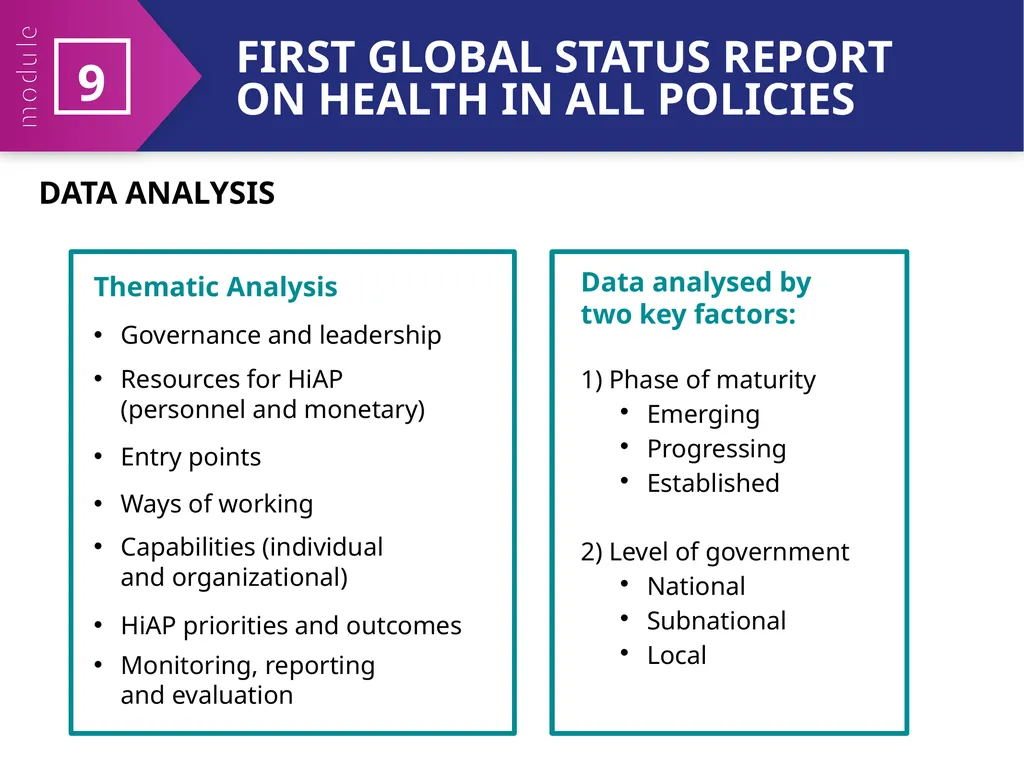
on Health in All Policies Data analysis<br>
22
Location of respondents showing maturity of practice and level of government<br>
23
First Global Status Report
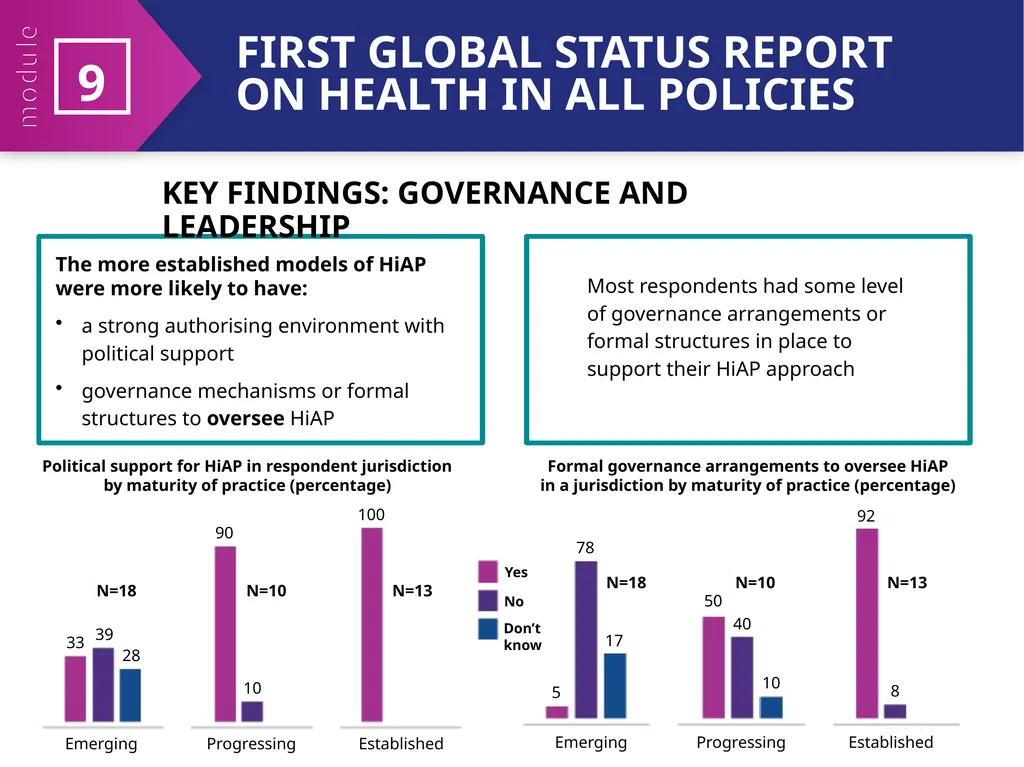
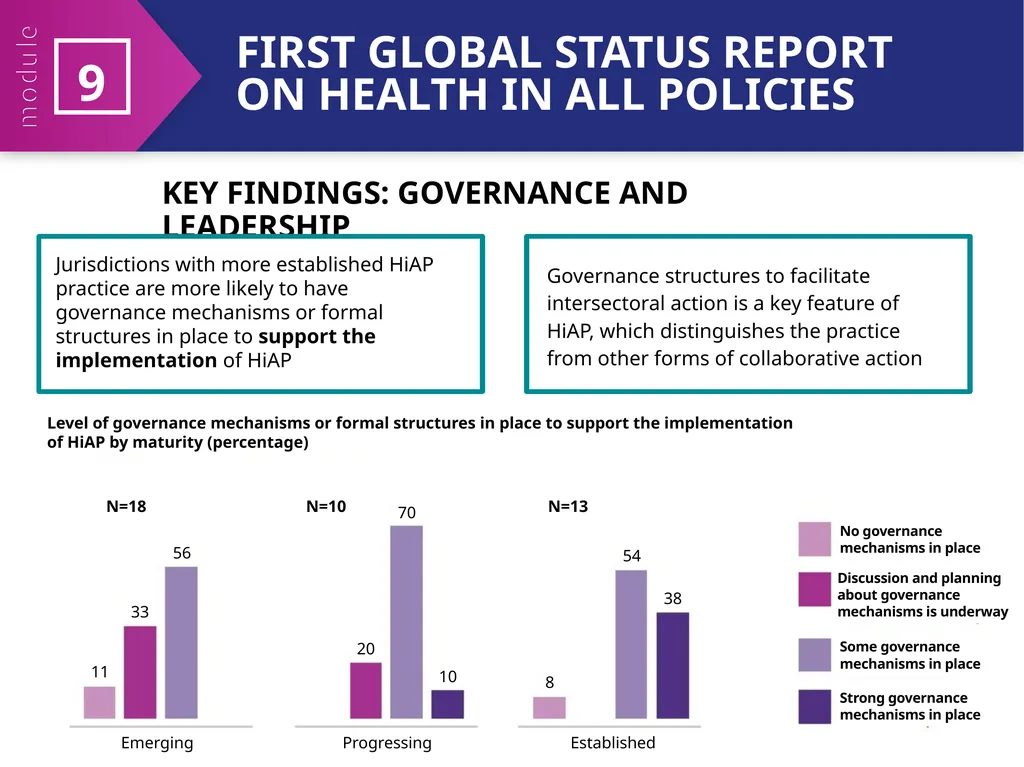
on Health in All Policies KEY FINDINGS: GOVERNANCE AND LEADERSHIP The more established models of HiAP were more likely to have:
a strong authorising environment with political support
governance mechanisms or formal structures to oversee HiAP Most respondents had some level of governance arrangements or formal structures in place to support their HiAP approach<br>
a strong authorising environment with political support
governance mechanisms or formal structures to oversee HiAP Most respondents had some level of governance arrangements or formal structures in place to support their HiAP approach<br>
24
First Global Status Report
on Health in All Policies Key findings: Governance and leadership Jurisdictions with more established HiAP practice are more likely to have governance mechanisms or formal structures in place to support the implementation of HiAP Governance structures to facilitate intersectoral action is a key feature of HiAP, which distinguishes the practice from other forms of collaborative action<br>
25
First Global Status Report
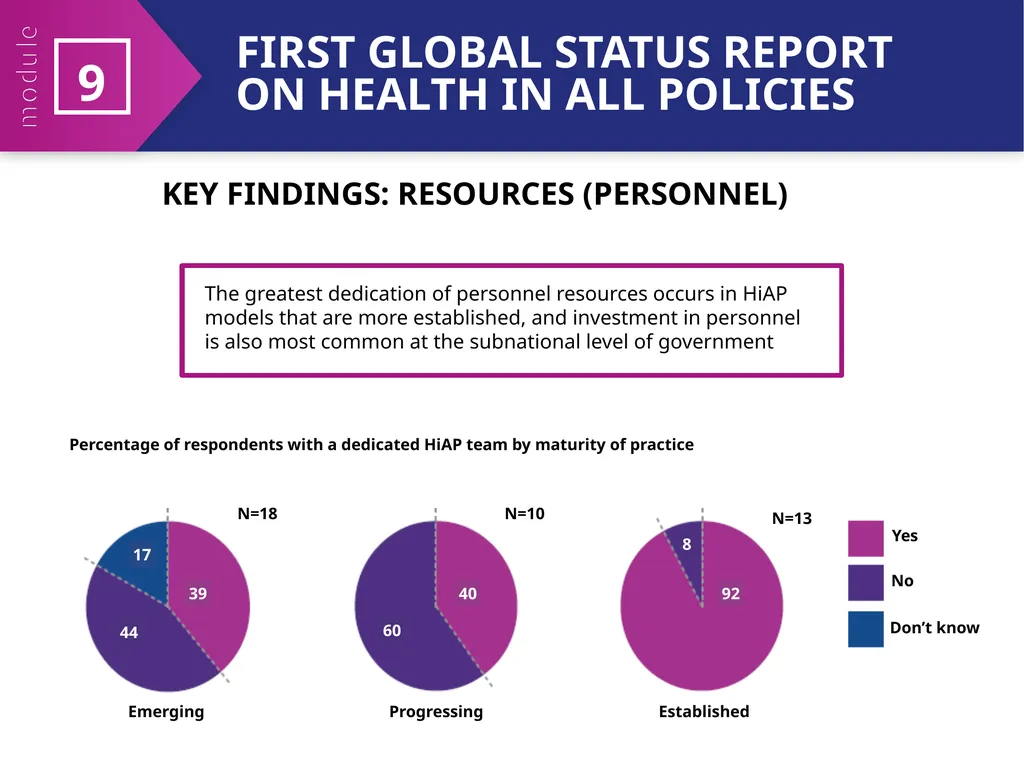
on Health in All Policies Key findings: Resources (personnel) The greatest dedication of personnel resources occurs in HiAP models that are more established, and investment in personnel is also most common at the subnational level of government<br>
26
First Global Status Report
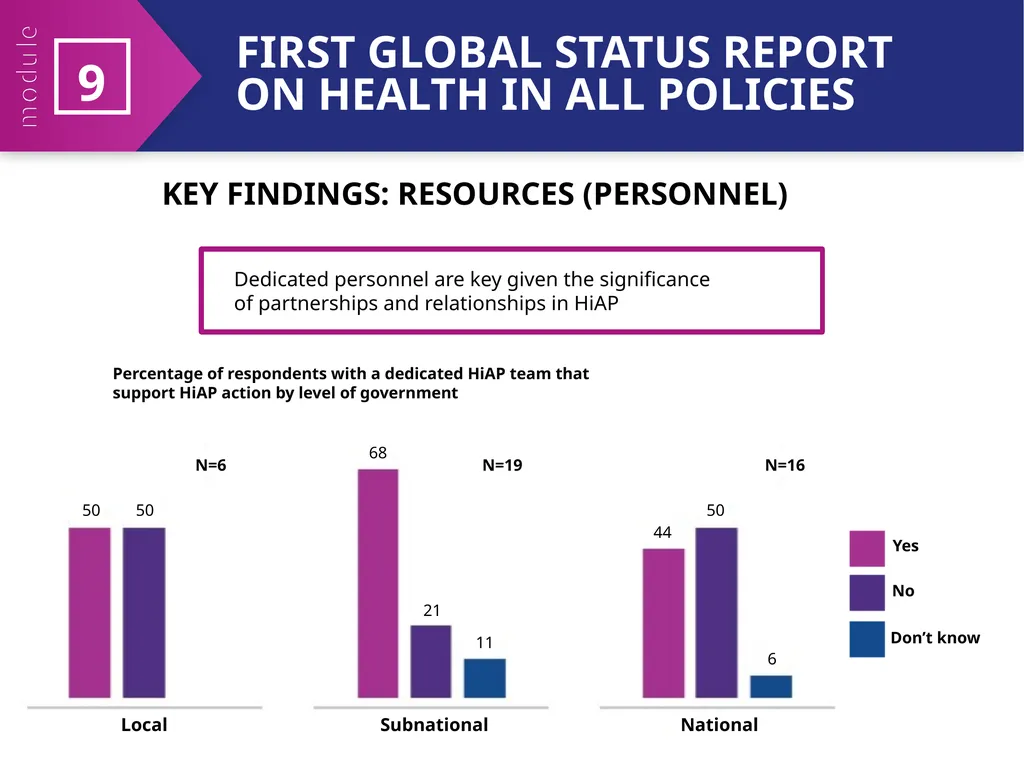
on Health in All Policies Key findings: Resources (personnel) Dedicated personnel are key given the significance
of partnerships and relationships in HiAP Percentage of respondents with a dedicated HiAP team that support HiAP action by level of government<br>
27
First Global Status Report
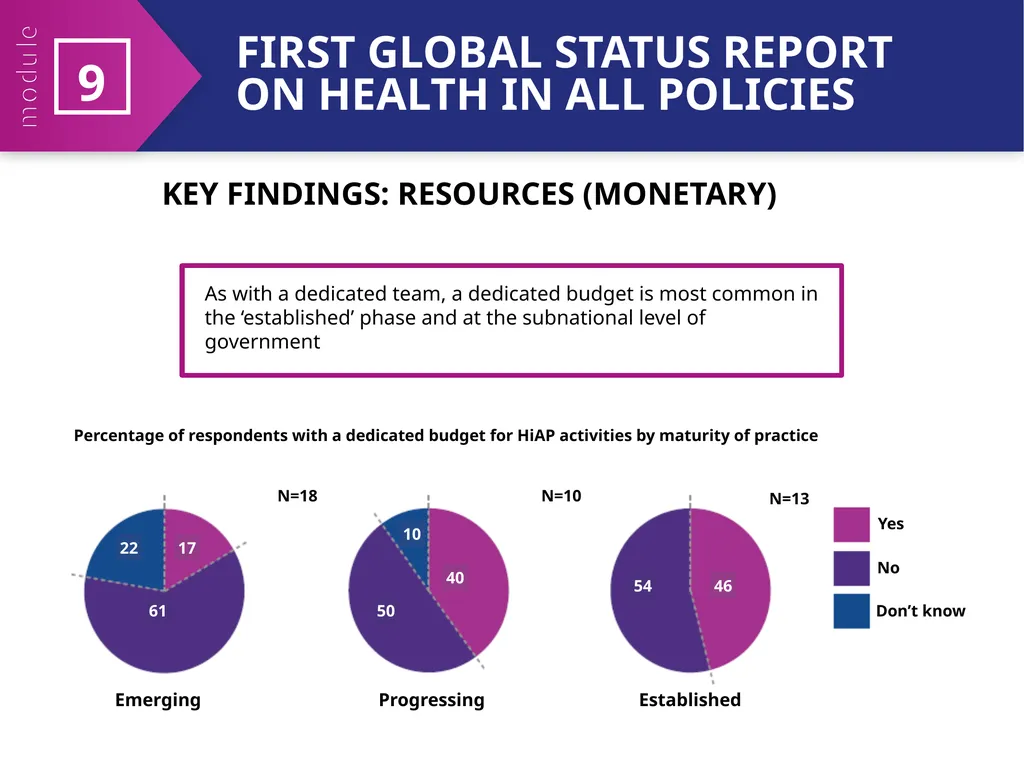
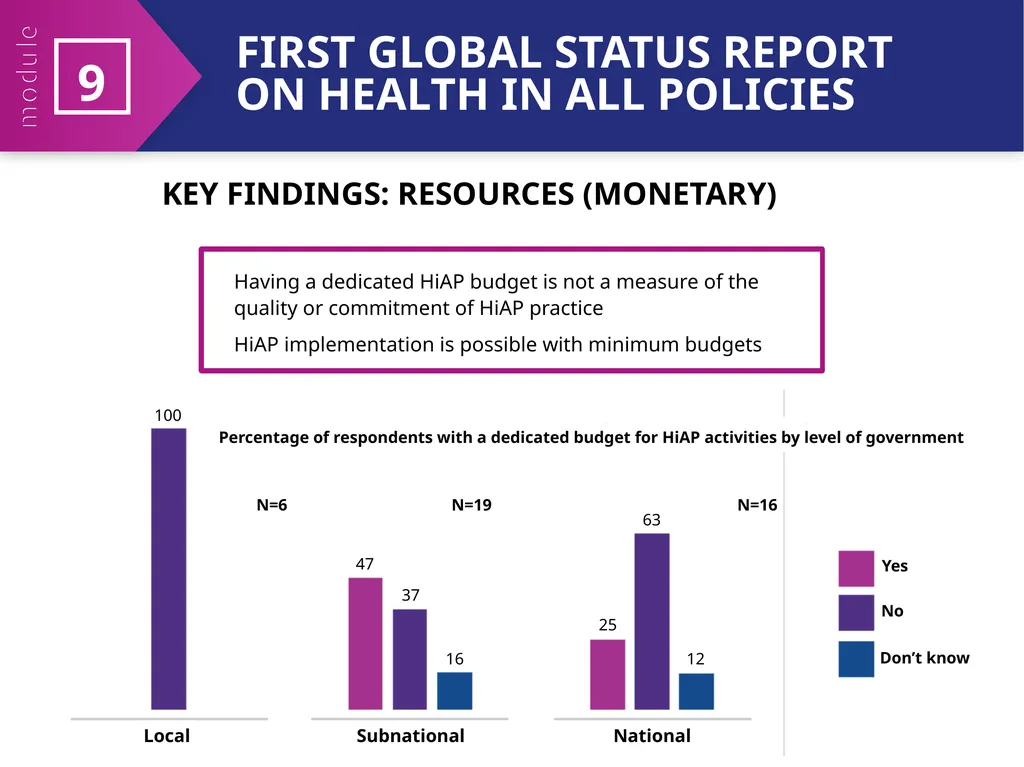
on Health in All Policies Key findings: Resources (monetary) As with a dedicated team, a dedicated budget is most common in the ‘established’ phase and at the subnational level of government<br>
28
First Global Status Report
on Health in All Policies Key findings: Resources (monetary) Having a dedicated HiAP budget is not a measure of the quality or commitment of HiAP practice
HiAP implementation is possible with minimum budgets<br>
HiAP implementation is possible with minimum budgets<br>
29
First Global Status Report
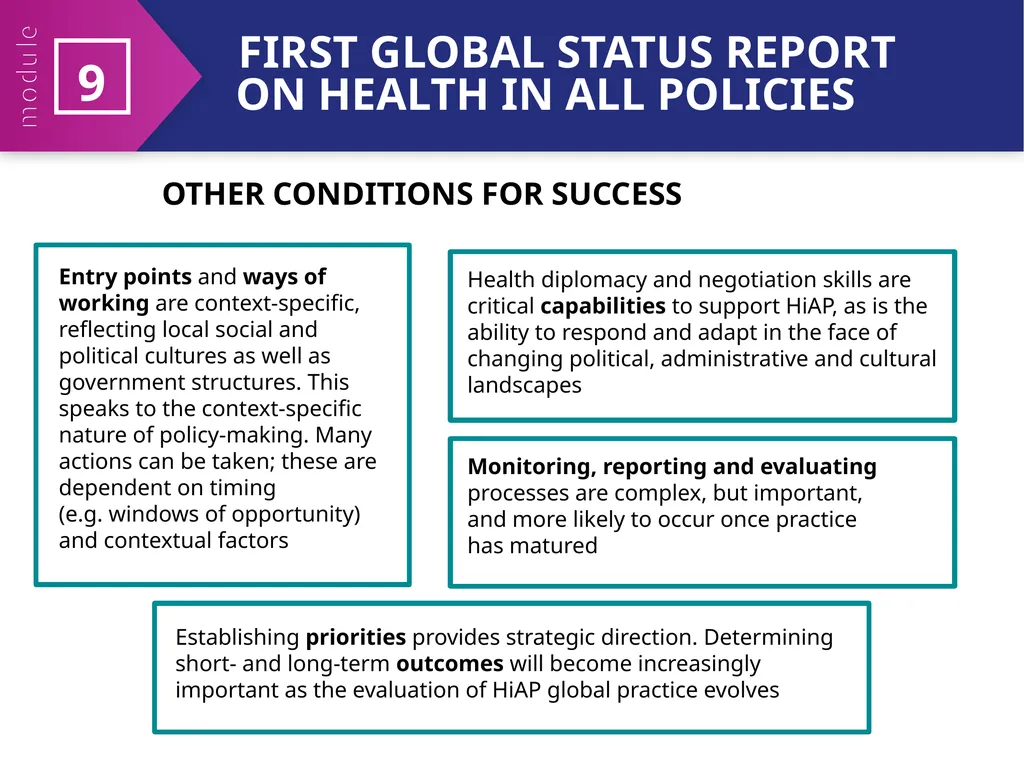
on Health in All Policies Other conditions for success<br>
30
First Global Status Report
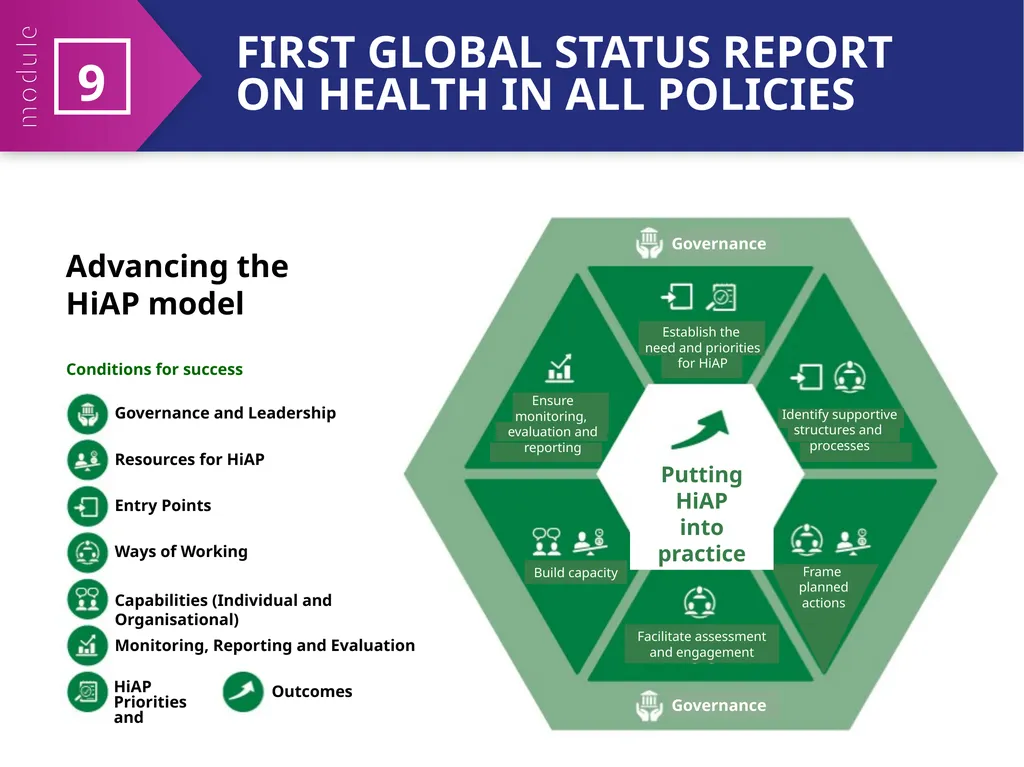
on Health in All Policies<br>
31
End of
Module 9
Please continue to Module 10<br>
Module 9
Please continue to Module 10<br>