
MODULE II: Presented By: LRA TRAINING TEAM

Description: MODULE II: Presented By: LRA TRAINING TEAM INCOTERMS COMMERCIAL LAW CUSTOMS BROKERS LICENSING TRAINING PROGRAM MODULE OUTLINE Introduction Module objectives Session I Outline Session I objectives Brief History of Incoterms Terms
Related Topics
Download Presentation
"MODULE II: Presented By: LRA TRAINING TEAM" is the property of its rightful owner. Permission is granted to download and print the materials on this website for personal, non-commercial use only, and to display it on your personal computer provided you do not modify the materials and that you retain all copyright notices contained in the materials. By downloading content from our website, you accept the terms of this agreement.
Presentation Transcript
slide1. MODULE II: Presented By: LRA TRAINING TEAM INCOTERMS & COMMERCIAL LAW CUSTOMS BROKERS LICENSING TRAINING PROGRAM<br>
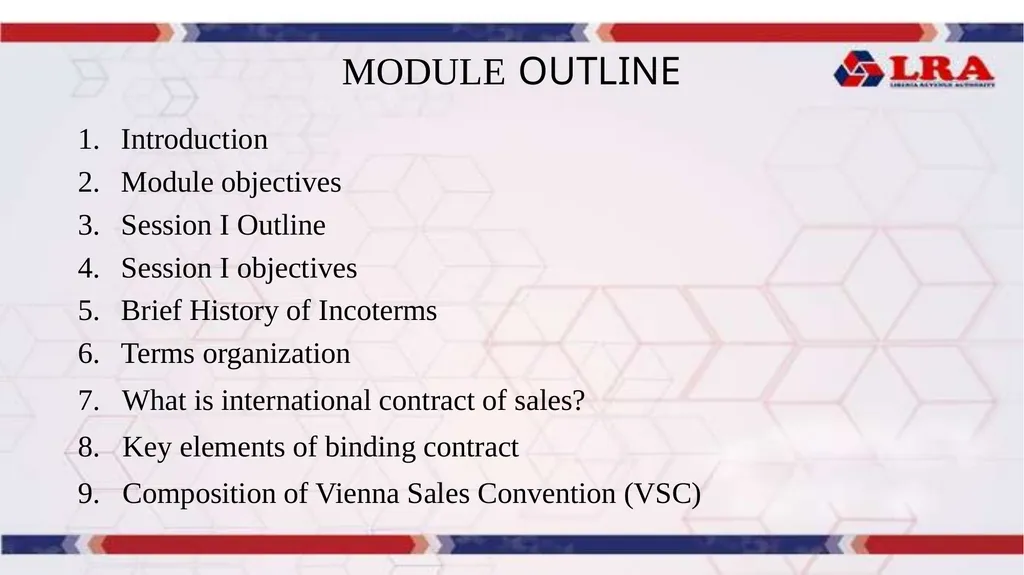
slide2. MODULE OUTLINE Introduction
Module objectives
Session I Outline
Session I objectives
Brief History of Incoterms
Terms organization
7. What is international contract of sales?
8. Key elements of binding contract
9. Composition of Vienna Sales Convention (VSC)<br>
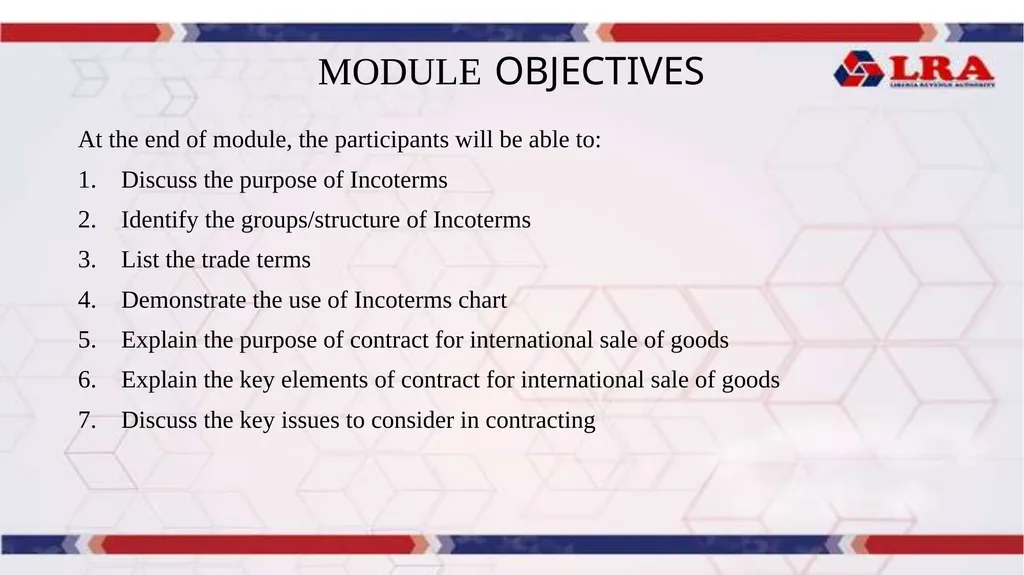
slide3. MODULE OBJECTIVES At the end of module, the participants will be able to:
Discuss the purpose of Incoterms
Identify the groups/structure of Incoterms
List the trade terms
Demonstrate the use of Incoterms chart
Explain the purpose of contract for international sale of goods
Explain the key elements of contract for international sale of goods
Discuss the key issues to consider in contracting<br>
slide4. INTRODUCTION This module attempts to present the rational for the
alignment of appropriate International Commercial
terms (Incoterms)in International contract laws for the
movement of cargos across borders.<br>
slide5. INTRODUCTION CONT. The participants in this course are entreated to do their
utmost best to enhance their knowledge and skills to
make them efficient and active participants and to
contribute effectively to the conduct of the class session.
This may lead to a successful pass in the Customs Brokers
Licensing uniform examination.<br>
slide6. INTRODUCTION CONT. On the other hand, participants who may not assert themselves
proficiently in this module, could stand the risk of not passing
the uniform examination and may fail to be licensed to practice
as professional Customs broker.<br>
slide7. SESSION I
INTERNATIONAL COMMERCIAL TERMS
(INCOTERMS)<br>
slide8. SESSION OUTLINE Session Objectives
Introduction
Division of Incoterms
Brief history of Incoterms
Dos and Don’ts of Incoterms
The organization of Trade Terms
Incoterms Chart<br>
slide9. SESSION OBJECTIVES At the end of the session, the participants will be able to:
Discuss the formation of Incoterms
List the Incoterms
Identify the terms by groups/structure
Discuss the terms according parts
Explain the terms according to level of risk bear by each party
Demonstration the use of Incoterms chart<br>
slide10. INTRODUCTION Incoterms are series of internationally recognized standardized trade
terms published by the International Chamber of Commerce (ICC)
and widely used in international sales.
They cover issues like who does what, who pays for what and when
risk in the goods passes from seller to buyer. Also, when delivery
occurs, as well as matters such as insurance, export and import
clearance and the division of other costs pertaining to the delivery
of goods. These are determinant factors in the valuation process
of goods. Hence, brokers need to be knowledgeable of incoterms.<br>
slide11. BRIEF HISTORY ICC introduced Incoterms in 1936 & are revised every 10 years
They were 13, but now simplified to 11 terms
Incoterms comprises 3 English language letters acronym
The current version is Incoterms 2010
Exclusively used in sales/purchase contract
Updated to reflect current trade practice
Written to reflect rather than dictate trade practice
Always accompanied by a geographic place (the more precise the be
better).<br>
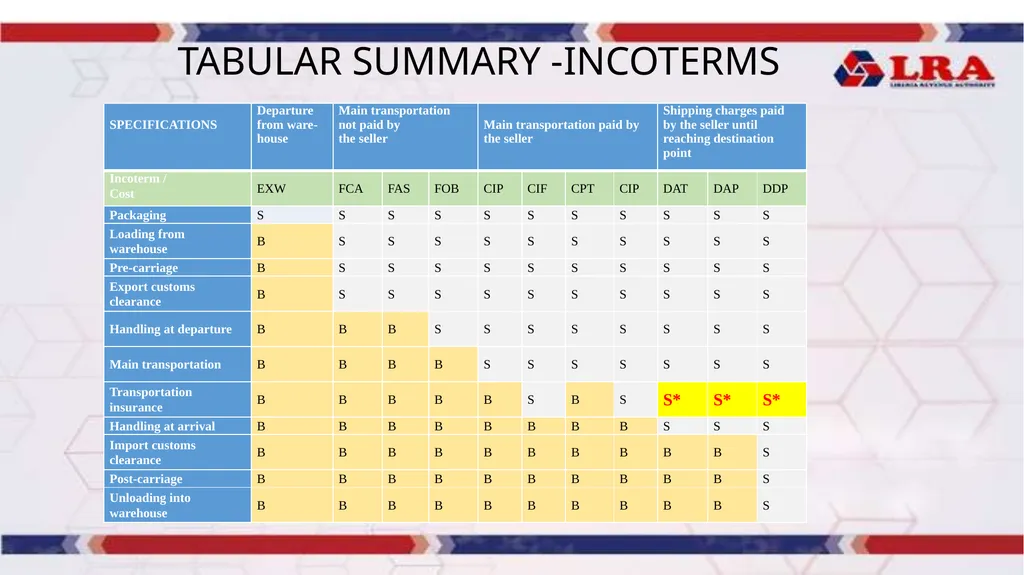
slide12. TABULAR SUMMARY -INCOTERMS<br>
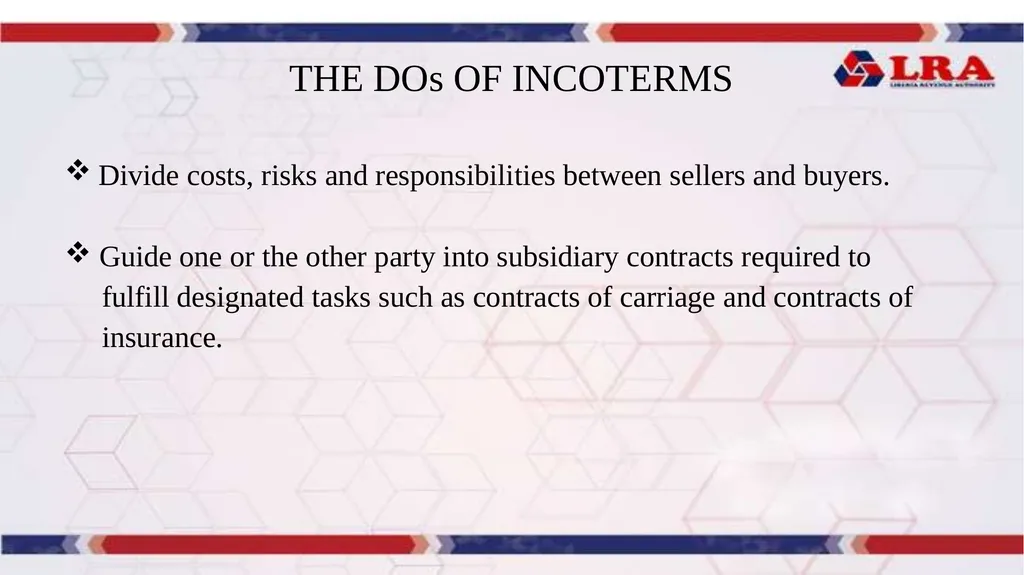
slide13. THE DOs OF INCOTERMS Divide costs, risks and responsibilities between sellers and buyers.
Guide one or the other party into subsidiary contracts required to
fulfill designated tasks such as contracts of carriage and contracts of
insurance.<br>
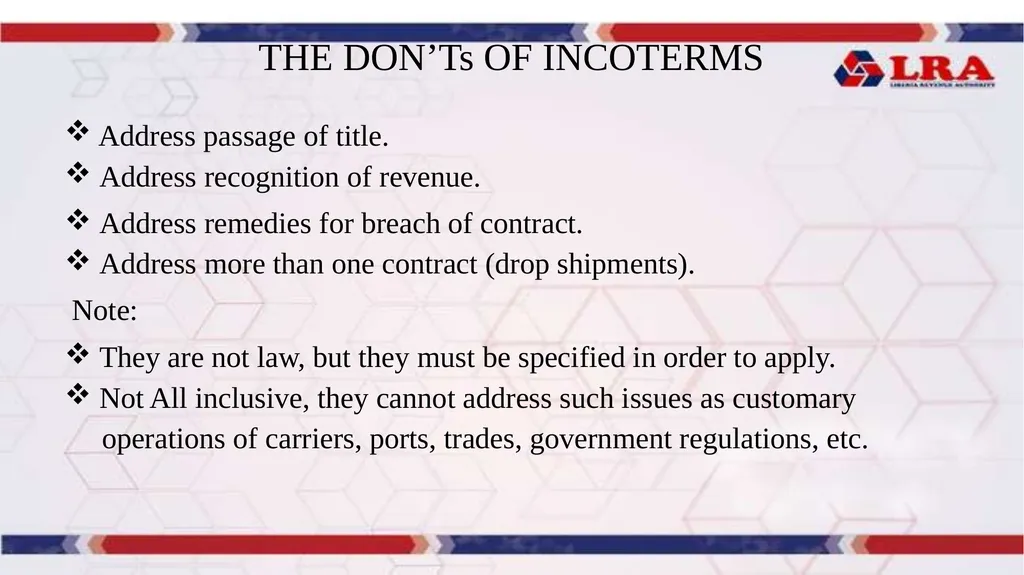
slide14. THE DON’Ts OF INCOTERMS Address passage of title.
Address recognition of revenue.
Address remedies for breach of contract.
Address more than one contract (drop shipments).
Note:
They are not law, but they must be specified in order to apply.
Not All inclusive, they cannot address such issues as customary
operations of carriers, ports, trades, government regulations, etc.<br>
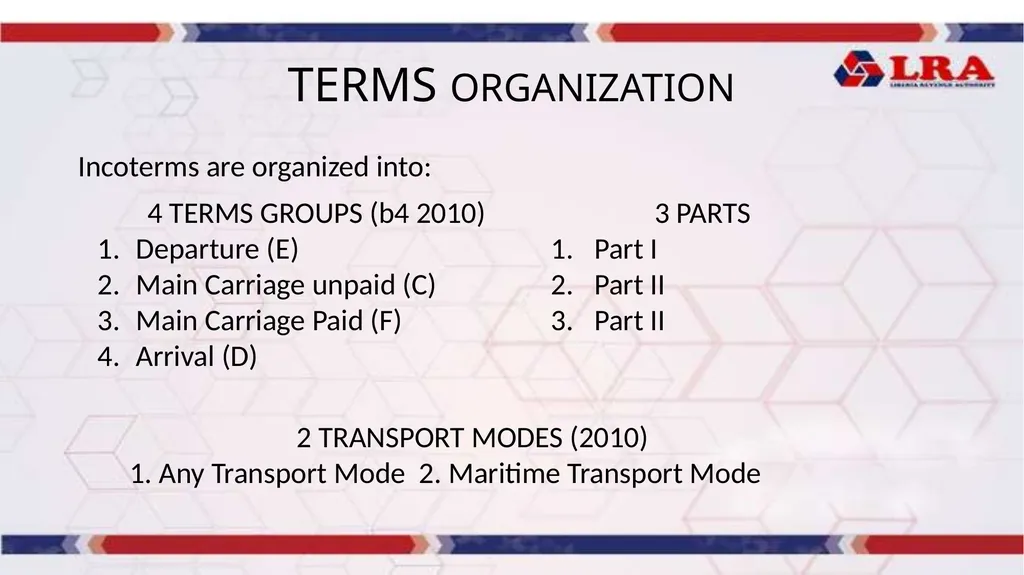
slide15. TERMS ORGANIZATION Incoterms are organized into: 3 PARTS
Part I
Part II
Part II 4 TERMS GROUPS (b4 2010)
Departure (E)
Main Carriage unpaid (C)
Main Carriage Paid (F)
Arrival (D) 2 TRANSPORT MODES (2010)
1. Any Transport Mode 2. Maritime Transport Mode<br>
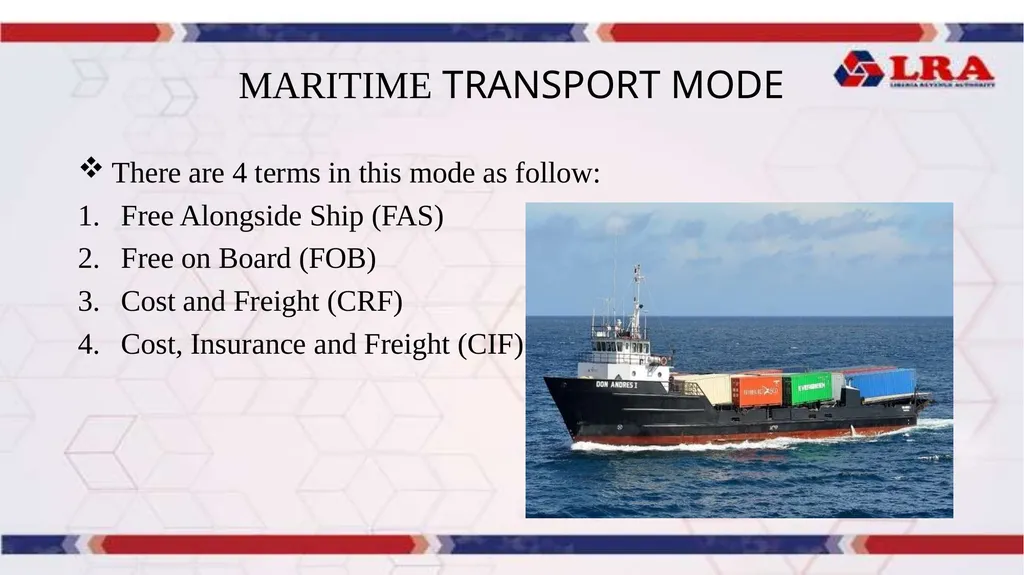
slide16. MARITIME TRANSPORT MODE There are 4 terms in this mode as follow:
Free Alongside Ship (FAS)
Free on Board (FOB)
Cost and Freight (CRF)
Cost, Insurance and Freight (CIF)<br>
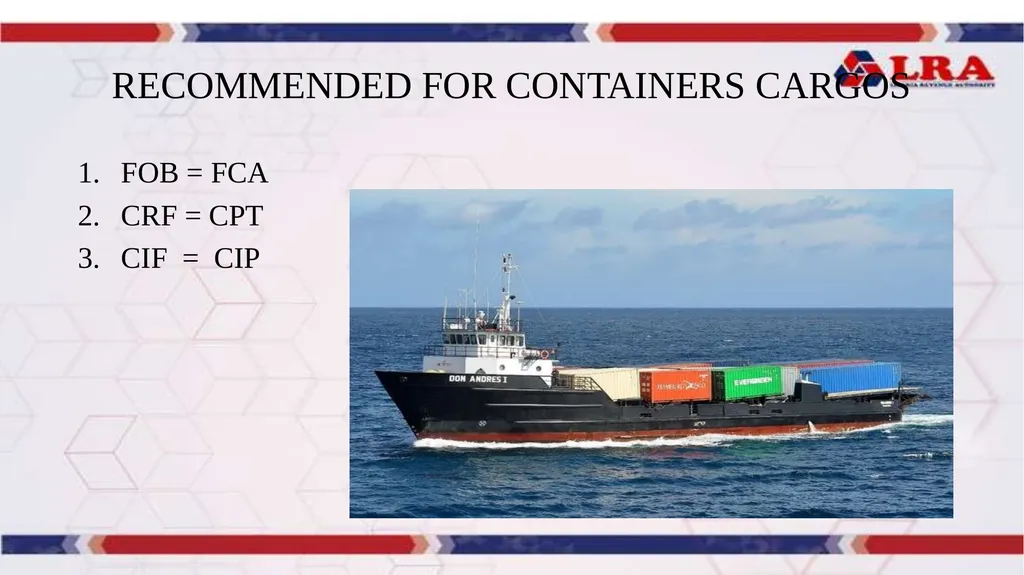
slide17. RECOMMENDED FOR CONTAINERS CARGOS FOB = FCA
CRF = CPT
CIF = CIP<br>
slide18. PART I-III OF INCOTERMS 1. PART I
Comprises of D and F groups (EXW, FAS, FCA & FOB)
2. PART II
Incorporates only the C group terms (CPT, CRF, CIF & CIP)
3. PART III
incorporates only D group terms (DAT, DAP & DDP)
4 terms replaced in 2010 (DEF, DES, DDU & DEQ) only in this group<br>
slide19. CHANGES IN INCOTERMS 2010 DAT (delivered at Destination)
- Delivered at a named place, at buyer’s disposal, unloaded
Replaces DEQ
DAP (delivered at place)
- Delivered at a named place, at buyer’s disposal, not unloaded
Replaces DAF, DES, DDU
Guidance notes
- Explain fundamentals, usage, risk, cost, etc.<br>
slide20. CHANGES IN INCOTERMS 2010 cont. Rules for Any Mode of Transport
- EXW, FCA, CPT, CIP, DAT, DAP, DDP
Rules for Sea and Inland Waterway Transport
FAS, FOB, CFR, CIF
Electronic Communication
Electronic means of communication now given same effect as paper as long as parties agree or where customary
Security-Related Clearances
- Rules now allocate responsibility for these<br>
slide21. CHANGES IN INCOTERMS 2010 cont. String Sales
Rules now recognize that seller may fulfill its obligations by procuring goods that have been shipped
Terminal Handling Charges
Now specifically allocated so that buyer is not charged twice
(seller and terminal)<br>
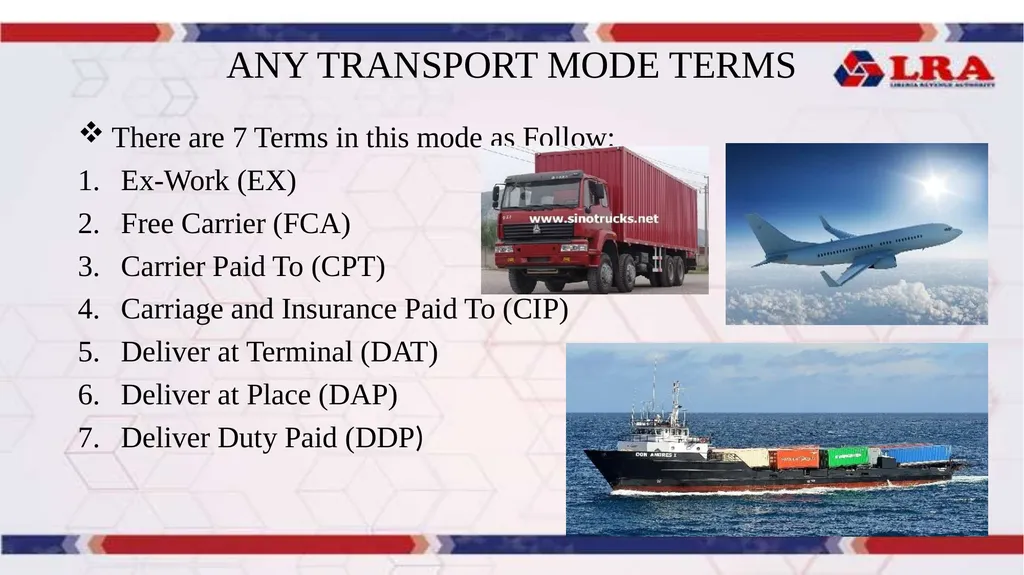
slide22. ANY TRANSPORT MODE TERMS There are 7 Terms in this mode as Follow:
Ex-Work (EX)
Free Carrier (FCA)
Carrier Paid To (CPT)
Carriage and Insurance Paid To (CIP)
Deliver at Terminal (DAT)
Deliver at Place (DAP)
Deliver Duty Paid (DDP)<br>
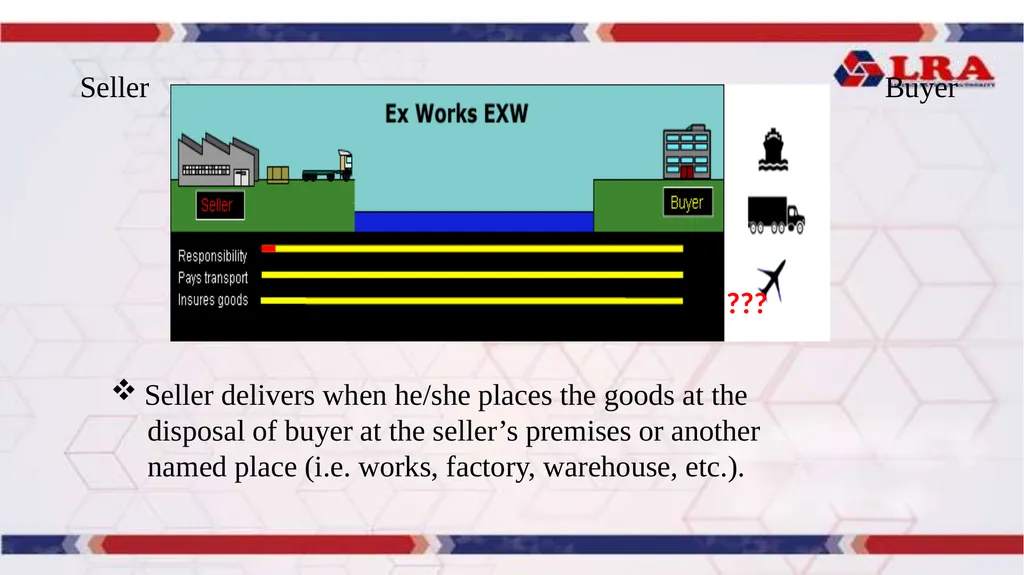
slide23. Seller Buyer ??? Seller delivers when he/she places the goods at the
disposal of buyer at the seller’s premises or another
named place (i.e. works, factory, warehouse, etc.).<br>
slide24. EX-WORKS cont. Seller does not need to load the goods on any collecting vehicle,
nor does it need to clear the goods for export, where such
clearance is applicable.
Fewest up front requirements for seller
Example: “Ex works [factory] Beer factory, Monrovia- Liberia
(Incoterms 2010)” or
2,000, 000 liters of raw rubber at $500,000.00 EXW, Firestone
warehouse, Freeport of Monrovia-Liberia<br>
slide25. Free Carrier (FCA) Seller delivers the goods to the carrier or another person
nominated by the buyer at the seller’s premises or another
named place.
The parties are well advised to specify as clearly as possible the
point within the named place of delivery, as the risk passes to
the buyer at that point.
Seller does clear goods for export; import formalities are
buyer’s responsibility
Seller may contract for carriage at buyer’s expense and risk<br>
slide26. Free Carrier (FCA) cont. Seller’s delivery options
If the named place is seller’s premises: seller must load goods onto
buyer’s means of transport
If the named place is any other place: seller must place the goods
at buyer’s (or his carrier’s disposal) on seller’s mode of transport
(ready for unloading)
Seller has no control over carrier, insurance, etc.
Improvements over Ex Works
- Seller clears goods for export
- Can be used to require seller to load goods, when seller is in a
better position to do so<br>
slide27. Carriage Paid To (CPT) Seller delivers the goods to the carrier or another person
nominated by the seller at an agreed place (if any place is agreed
between the parties) and the seller must contract for and pay the
costs of carriage necessary to bring the goods to the named
place of destination
2 Key points
Place of delivery of goods to carrier
- Seller’s delivery obligation is complete
- Risk of loss passes
Place of destination
- Seller contracts for and pays for carriage to the place of destination<br>
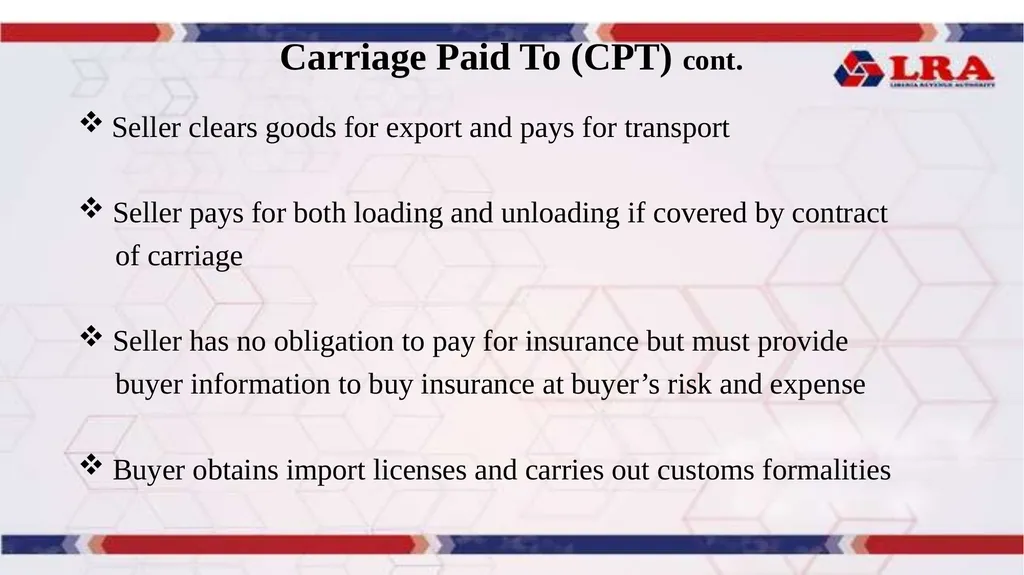
slide28. Carriage Paid To (CPT) cont. Seller clears goods for export and pays for transport
Seller pays for both loading and unloading if covered by contract
of carriage
Seller has no obligation to pay for insurance but must provide
buyer information to buy insurance at buyer’s risk and expense
Buyer obtains import licenses and carries out customs formalities<br>
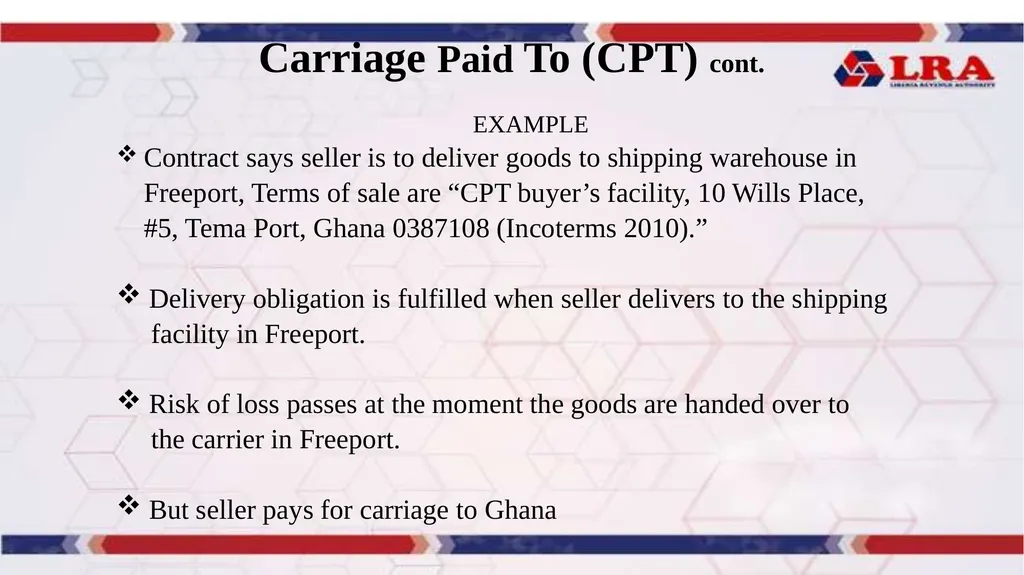
slide29. Carriage Paid To (CPT) cont. EXAMPLE
Contract says seller is to deliver goods to shipping warehouse in
Freeport, Terms of sale are “CPT buyer’s facility, 10 Wills Place,
#5, Tema Port, Ghana 0387108 (Incoterms 2010).”
Delivery obligation is fulfilled when seller delivers to the shipping
facility in Freeport.
Risk of loss passes at the moment the goods are handed over to
the carrier in Freeport.
But seller pays for carriage to Ghana<br>
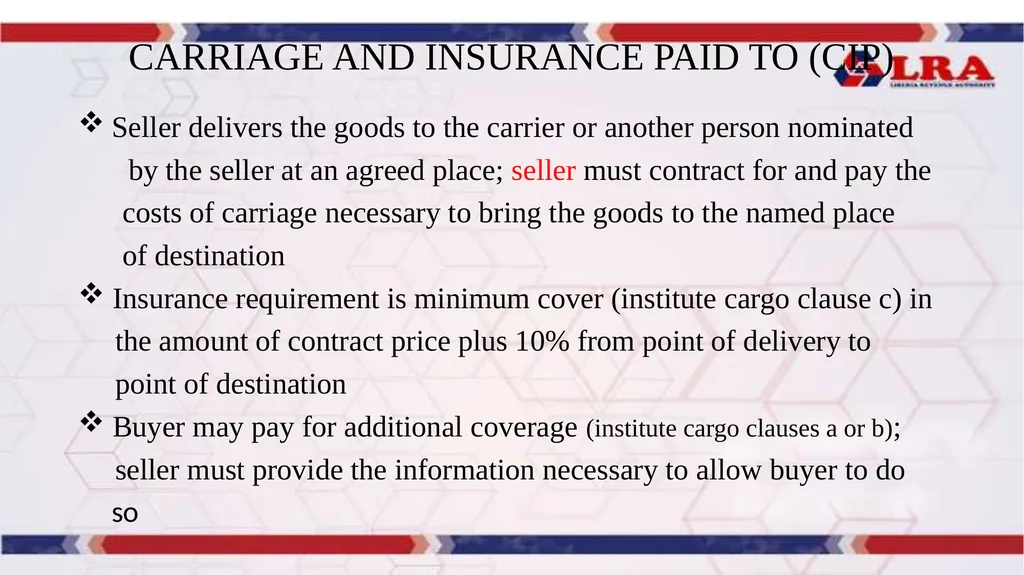
slide30. CARRIAGE AND INSURANCE PAID TO (CIP) Seller delivers the goods to the carrier or another person nominated
by the seller at an agreed place; seller must contract for and pay the
costs of carriage necessary to bring the goods to the named place
of destination
Insurance requirement is minimum cover (institute cargo clause c) in
the amount of contract price plus 10% from point of delivery to
point of destination
Buyer may pay for additional coverage (institute cargo clauses a or b);
seller must provide the information necessary to allow buyer to do
so<br>
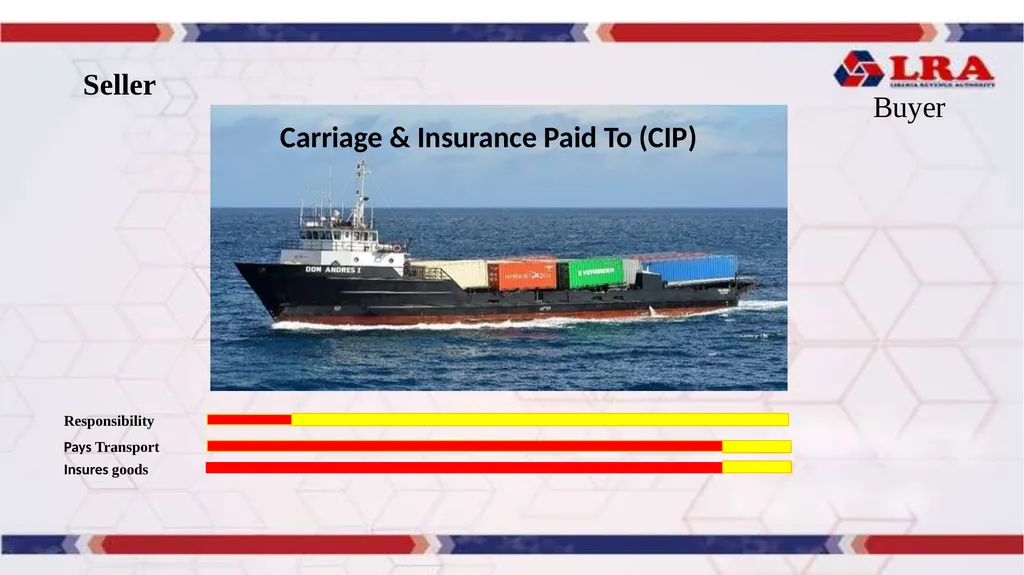
slide31. Responsibility Pays Transport Carriage & Insurance Paid To (CIP) Insures goods Seller Buyer<br>
slide32. DELIVER AT TERMINAL (DAT) Seller delivers when the goods, once unloaded from the arriving
means of transport, are placed at the disposal of the buyer at
a named terminal at the named port or place of destination.
“Terminal” includes any place, whether covered or not, such
as a quay, warehouse, container yard or road, rail or air cargo
terminal.
The seller bears all risks involved in bringing the goods to and
unloading them at the terminal at the named port or place of
destination.<br>
slide33. DELIVER AT TERMINAL (DAT) cont. Seller’s obligation is fulfilled and risk of loss passes at
same time: when the goods are unloaded at the arriving
terminal and placed at buyer’s disposal
Can specify a point within the terminal at which time the
obligation is complete
Seller clears goods for export but not for import
No requirement for insurance<br>
slide34. DELIVERED AT PLACE (DAP) Seller delivers when the goods are placed at the disposal of the
buyer on the arriving means of transport ready for unloading
at the named place of destination.
The seller bears all risks involved in bringing the goods to the
named place.
Goods are placed at buyer’s disposal at named location ready
for unloading; risk passes at that point
No obligation for insurance<br>
slide35. DELIVERED AT PLACE (DAP) (cont.) Much like DAT, but with additional obligation by seller into
country of delivery
Seller clears goods for export but not import (use DDP if intent
is to require seller to clear goods for import also).<br>
slide36. Delivered Duty Paid (DDP) Seller delivers the goods when the goods are placed at the
disposal of the buyer, cleared for import on the arriving means
of transport ready for unloading at the named place of
destination.
The seller bears all the costs and risks involved in bringing the
goods to the place of destination and has an obligation to
clear the goods for export and import, to pay all duty/taxes for
both export and import and to carry out all customs formalities.<br>
slide37. Delivered Duty Paid (DDP) cont. Like DAP, but including seller’s obligation to clear goods for
import—pay for any necessary licenses
Maximum obligation for seller
If seller is not well-suited to clear goods for import, DAP
should be used
No obligation to pay for insurance<br>
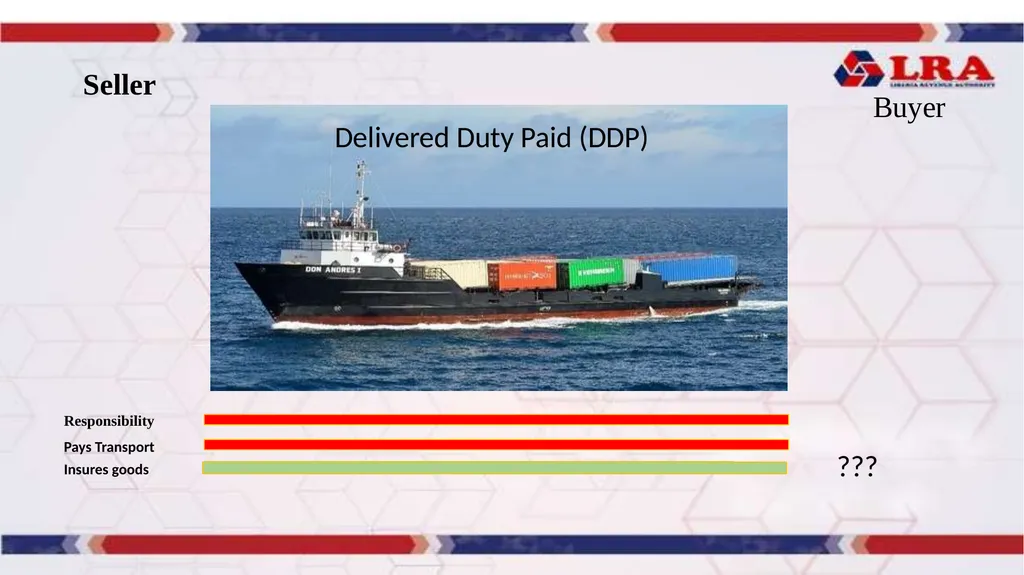
slide38. Responsibility Pays Transport Delivered Duty Paid (DDP) Insures goods Seller Buyer ???<br>
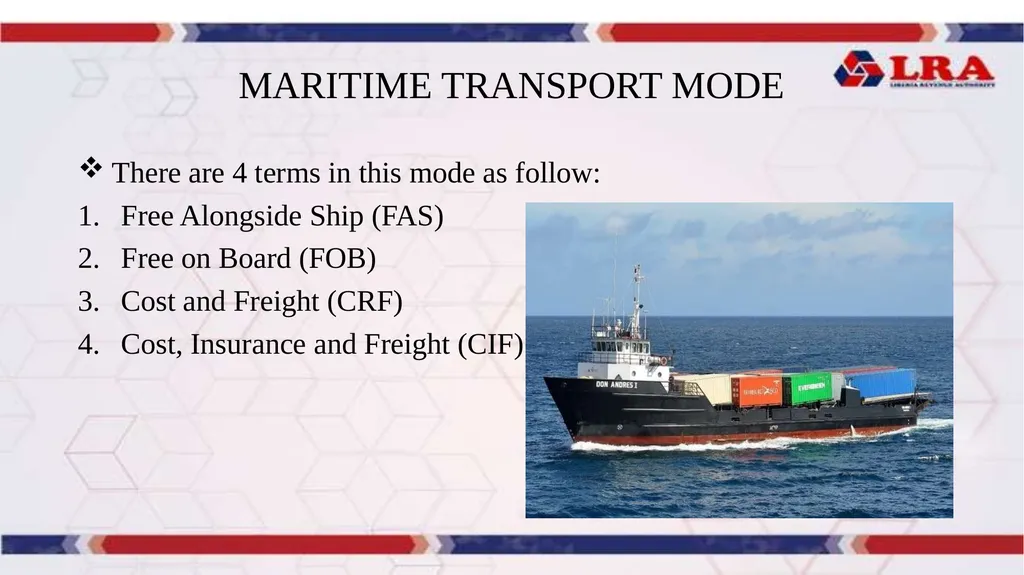
slide39. MARITIME TRANSPORT MODE There are 4 terms in this mode as follow:
Free Alongside Ship (FAS)
Free on Board (FOB)
Cost and Freight (CRF)
Cost, Insurance and Freight (CIF)<br>
slide40. FREE ALONGSIDE SHIP (FAS) Seller delivers when the goods are placed alongside the vessel
(e.g., on a quay or a barge) nominated by the buyer at the named
port of shipment.
The risk of loss of or damage to the goods passes when the
goods are alongside the ship, the buyer bears all costs from the
moment onwards.
Seller is obligated to clear goods for export but not import
Can be used in a string sale where seller procures goods already
delivered for shipment<br>
slide41. FREE ALONGSIDE SHIP (FAS) cont. Not appropriate when goods in container and delivered to carrier
at terminal; FCA recommended.
Seller has no obligation to pay for contracts of carriage or
insurance but may contract for carriage and must assist buyer
by providing necessary information for insurance
Example:
FAS BMC pier, Freeport, Liberia (incoterms 2010)<br>
slide42. FREE ON BOARD (FOB) Seller delivers the goods on board the vessel nominated by the
buyer at the named port of shipment or procures the goods
already so delivered.
The risk of loss of or damage to the goods passes when the
goods are on board the vessel, and the buyer bears all costs
from that moment onwards.
Another change in 2010: if requested by buyer or if it is a
commercial practice and buyer does not instruct otherwise, seller
may contract for carriage at buyer’s risk and expense; seller may
decline but must notify buyer promptly.<br>
slide43. FREE ON BOARD (FOB) cont. Free on board, no longer means across the ship’s rail; now means
on board the vessel- innovation of Incoterms 20110.
Like FAS, but goods must be placed on board the vessel/boat
Example:
FOB Harper (Incoterms 2010)<br>
slide44. COST AND FREIGHT (CRF) Seller delivers the goods on board the vessel or procures the goods
already so delivered.
The risk of loss of or damage to the goods passes when the goods
are on board the vessel.
The seller must contract for and pay the costs and freight
necessary to bring the goods to the named port of destination
Seller clears goods for export but not import<br>
slide45. COST AND FREIGHT (CRF) cont. 2 places of importance
Place of delivery of goods
Seller’s delivery obligation is fulfilled when goods are on board
the vessel
- Risk of loss passes when the goods are on board the vessel
Port of destination
Seller pays for carriage to port of destination
Seller has no obligation to obtain insurance<br>
slide46. COST AND FREIGHT (CRF) cont. Seller pays for unloading if the contract of carriage covers unloading
If intent to ship in containers and delivery is to carrier other
than vessel, use CPT
Example:
Contract says: Seller is to deliver goods on board vessel at Port of Buchanan, G/Bassa, Liberia. Terms of sale are: “CFR, Freetown (Incoterms 2010).”<br>
slide47. COST AND FREIGHT (CRF) cont. Example:
- Seller’s delivery obligation is fulfilled when the goods are on
board the vessel in Buchanan; risk of loss passes then also
- Seller must pay for shipment to Freeport
Contract says terms of sale are: “CFR, Freeport
(Incoterms 2010).” Silent as to port of shipment
Seller’s delivery obligation is fulfilled when the goods are on board the vessel in the port selected by seller; risk of loss
passes then also
- Seller must pay for shipment to Freetown<br>
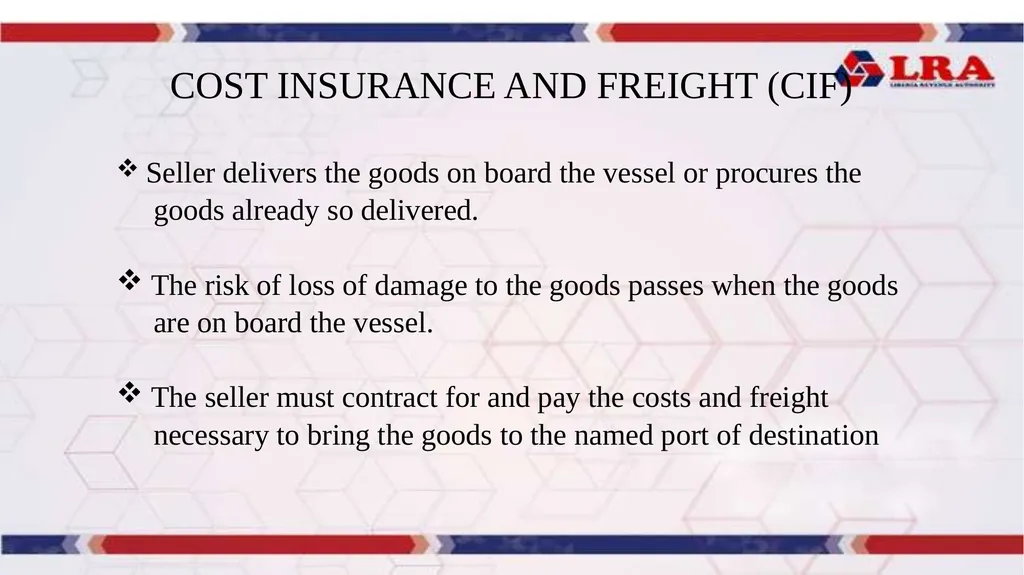
slide48. COST INSURANCE AND FREIGHT (CIF) Seller delivers the goods on board the vessel or procures the
goods already so delivered.
The risk of loss of damage to the goods passes when the goods
are on board the vessel.
The seller must contract for and pay the costs and freight
necessary to bring the goods to the named port of destination<br>
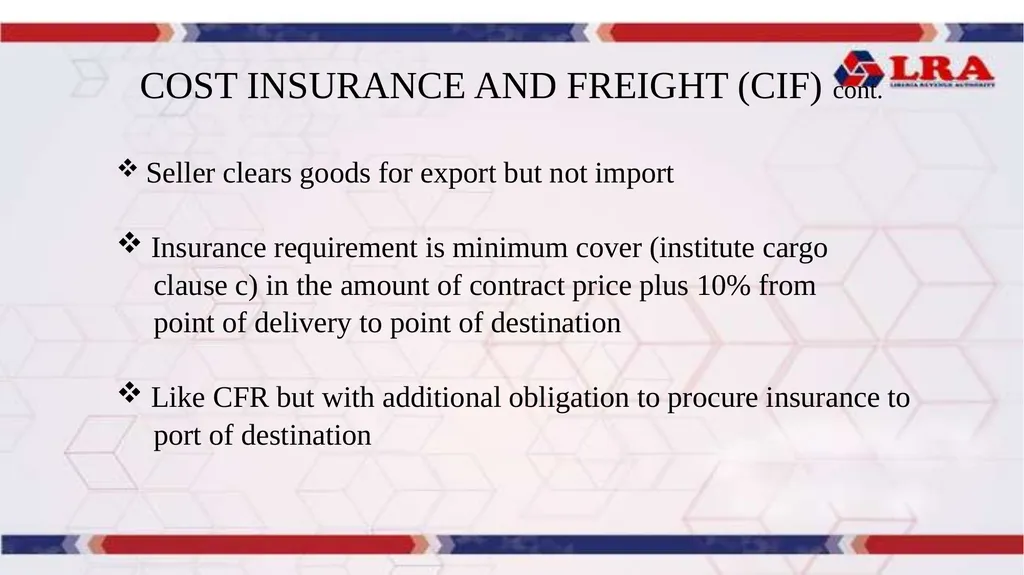
slide49. COST INSURANCE AND FREIGHT (CIF) cont. Seller clears goods for export but not import
Insurance requirement is minimum cover (institute cargo
clause c) in the amount of contract price plus 10% from
point of delivery to point of destination
Like CFR but with additional obligation to procure insurance to
port of destination<br>
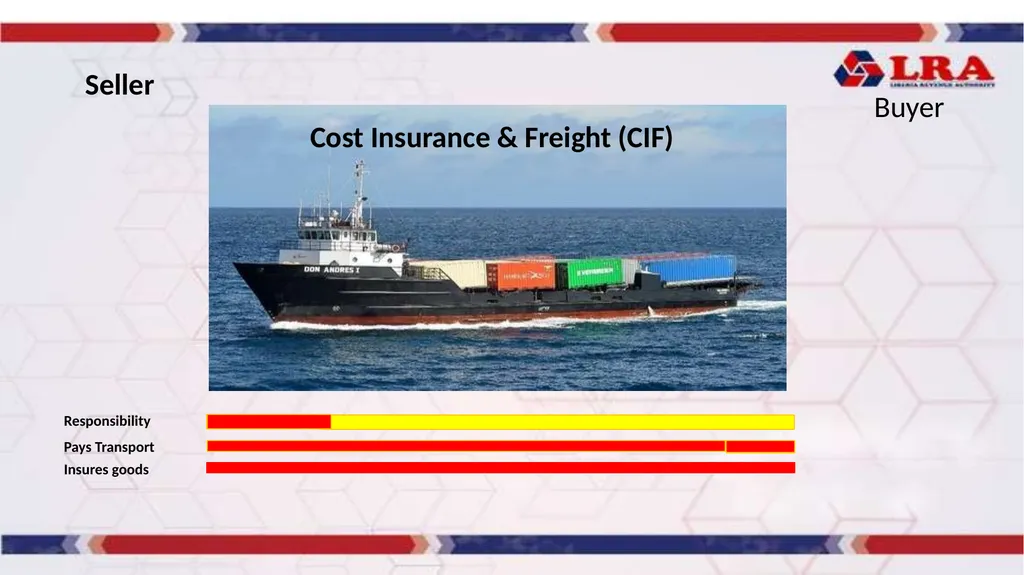
slide50. Responsibility Pays Transport Cost Insurance & Freight (CIF) Insures goods Seller Buyer<br>
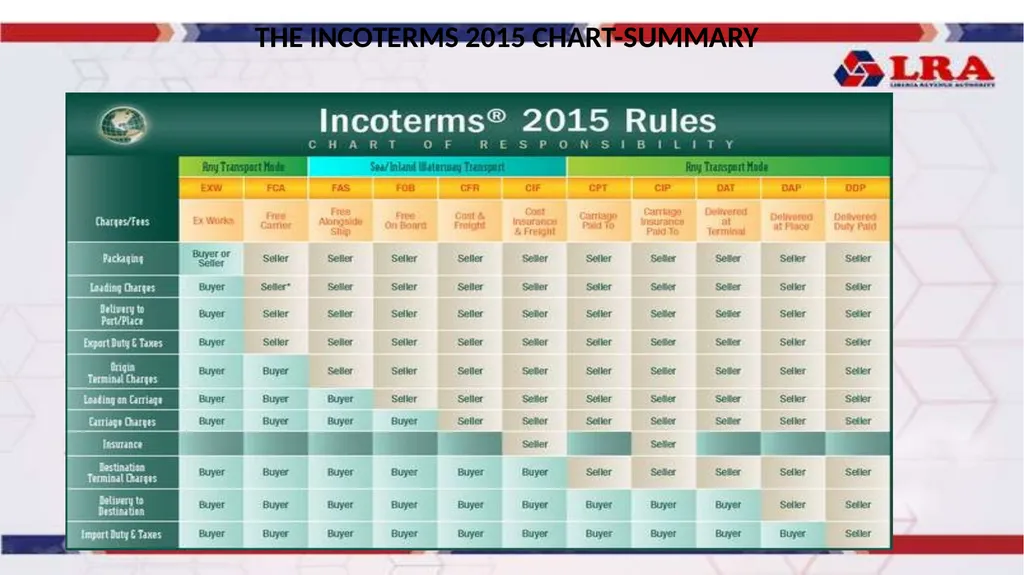
slide51. THE INCOTERMS 2015 CHART-SUMMARY<br>
slide52. SESSION II INTERNATIONAL CONTRACT OF SALE<br>
slide53. SESSION OUTLINE Introduction
Background
Session Objectives
What is international contract of sales?
Key elements of binding contract
Composition of Vienna Sales Convection (VSC)
7. Methods of payments<br>
slide54. SESSION OBJECTIVES At the end of the session, the participants will be able to:
Explain the purpose of the Contract for International Sale of Goods
Explain the key elements of contract for international sale of goods
Discuss key issues to consider in contracting
Discuss the methods of payments<br>
slide55. INTRODUCTION An International Contract of Sales is an agreement between a seller
and a buyer for the sale of goods, it should at a minimum,
identify the seller and buyer, the quantity and type of product,
delivery time, price and conditions of payment.
It references the governing body of law, the forum where any
disputes are to be resolved and the method of dispute resolution
- arbitration as opposed to litigation.
It refers to the UN Convention on Contracts for the International
Sale of Goods (CISG), also, known as Vienna Convention.<br>
slide56. BACKGROUND The United Nations Convention on Contracts for the International
sale of goods provides a uniform text of law for international sales
of goods. The convention was prepared by UN Commission on
International Trade Law (UNCITRAL) and adopted by a diplomatic
conference on 11 April 1980 in Vienna.<br>
slide57. BACKGROUND cont. Preparation of a uniform law for the international sale of goods
began in 1930 at the International Institute for the Unification
of Private Law (UNIDROIT) in Rome. After a long intervention in
work as result of the second World War, the draft was submitted to
the diplomatic conference in 1964 which adopted two conventions
one on the international law of goods and the other on the formation
of contracts for international sales of goods.<br>
slide58. WHAT IS INT’L CONTRACT OF SALES? An agreement between the seller and buyer for sales of goods.
It identifies the quantity, type of products, delivery time, price
and conditions of the goods.
It references the body of law any disputes arising from contract will
be resolved under and the method of resolution.
It should always indicates terms of sales –preferably one of
11 Incoterms.
Refers to sales between 2 parties from different countries<br>
slide59. KEY ELEMENTS OF BINDING CONTRACT Maturity of obligation or meeting of minds
Definite terms
Consideration
Capacity
Legal Purpose<br>
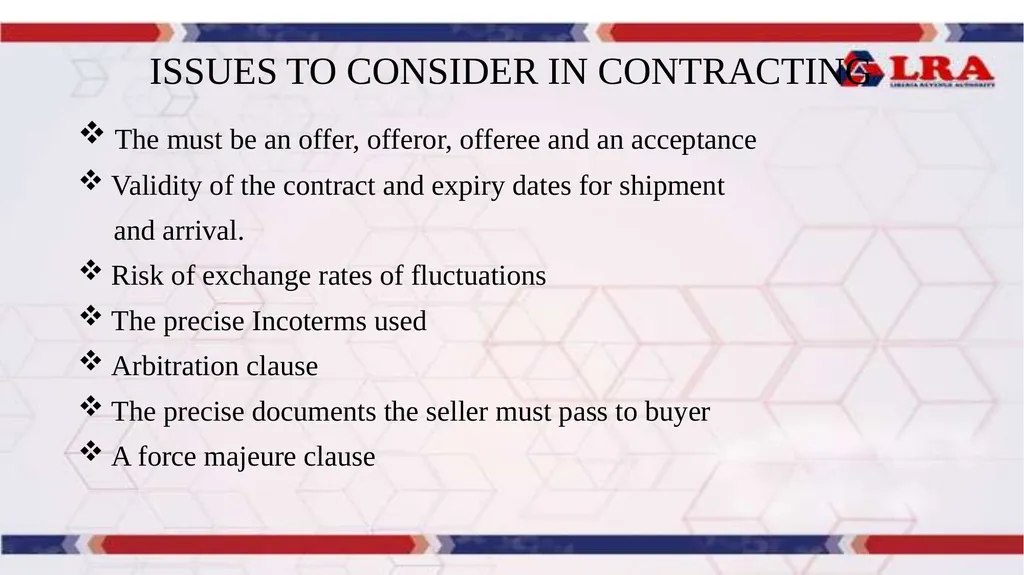
slide60. ISSUES TO CONSIDER IN CONTRACTING The must be an offer, offeror, offeree and an acceptance
Validity of the contract and expiry dates for shipment
and arrival.
Risk of exchange rates of fluctuations
The precise Incoterms used
Arbitration clause
The precise documents the seller must pass to buyer
A force majeure clause<br>
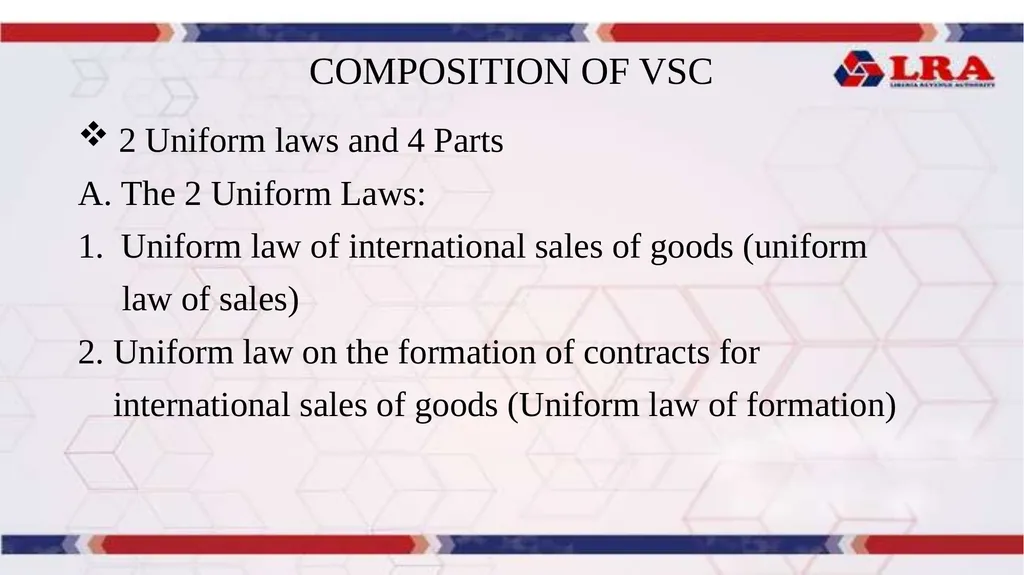
slide61. COMPOSITION OF VSC 2 Uniform laws and 4 Parts
The 2 Uniform Laws:
Uniform law of international sales of goods (uniform
law of sales)
2. Uniform law on the formation of contracts for
international sales of goods (Uniform law of formation)<br>
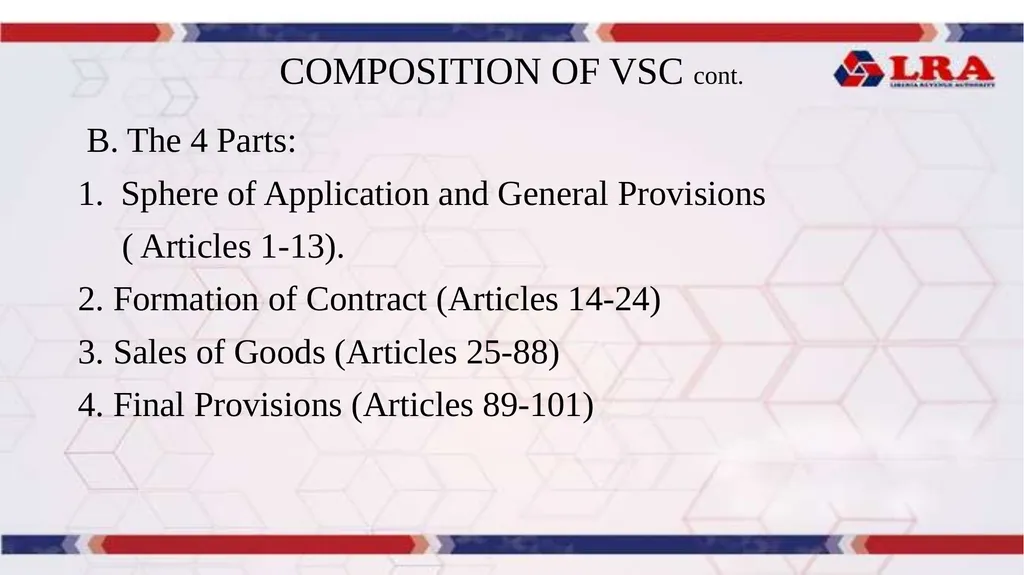
slide62. COMPOSITION OF VSC cont. B. The 4 Parts:
Sphere of Application and General Provisions
( Articles 1-13).
2. Formation of Contract (Articles 14-24)
3. Sales of Goods (Articles 25-88)
4. Final Provisions (Articles 89-101)<br>
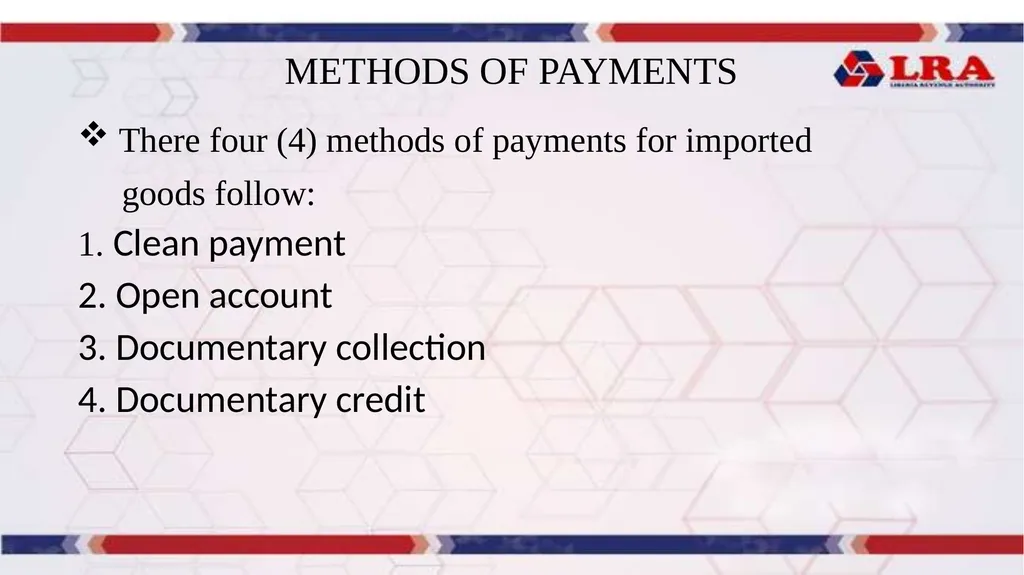
slide63. METHODS OF PAYMENTS There four (4) methods of payments for imported
goods follow:
1. Clean payment
2. Open account
3. Documentary collection
4. Documentary credit<br>
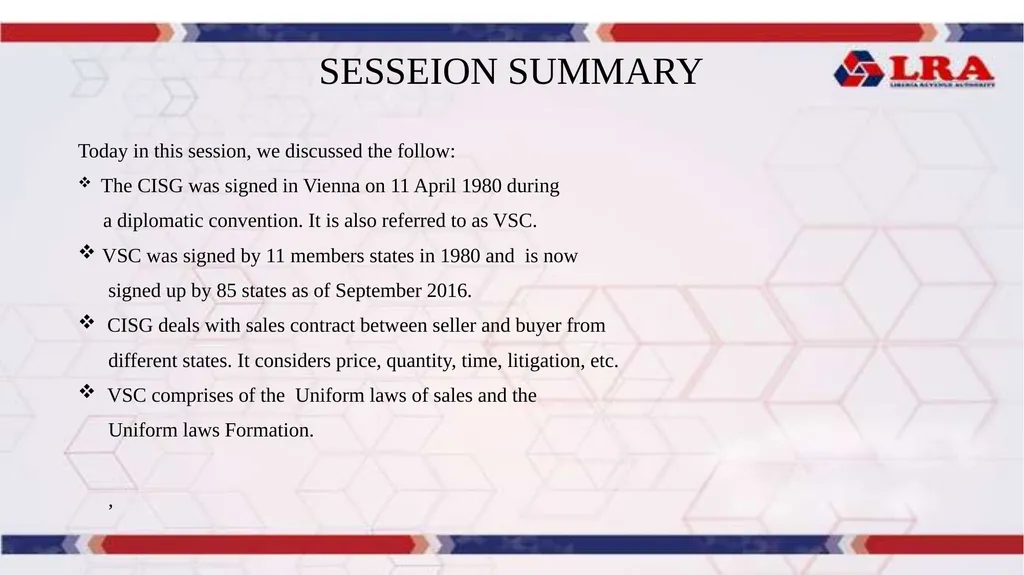
slide64. SESSEION SUMMARY Today in this session, we discussed the follow:
The CISG was signed in Vienna on 11 April 1980 during
a diplomatic convention. It is also referred to as VSC.
VSC was signed by 11 members states in 1980 and is now
signed up by 85 states as of September 2016.
CISG deals with sales contract between seller and buyer from
different states. It considers price, quantity, time, litigation, etc.
VSC comprises of the Uniform laws of sales and the
Uniform laws Formation.
,<br>
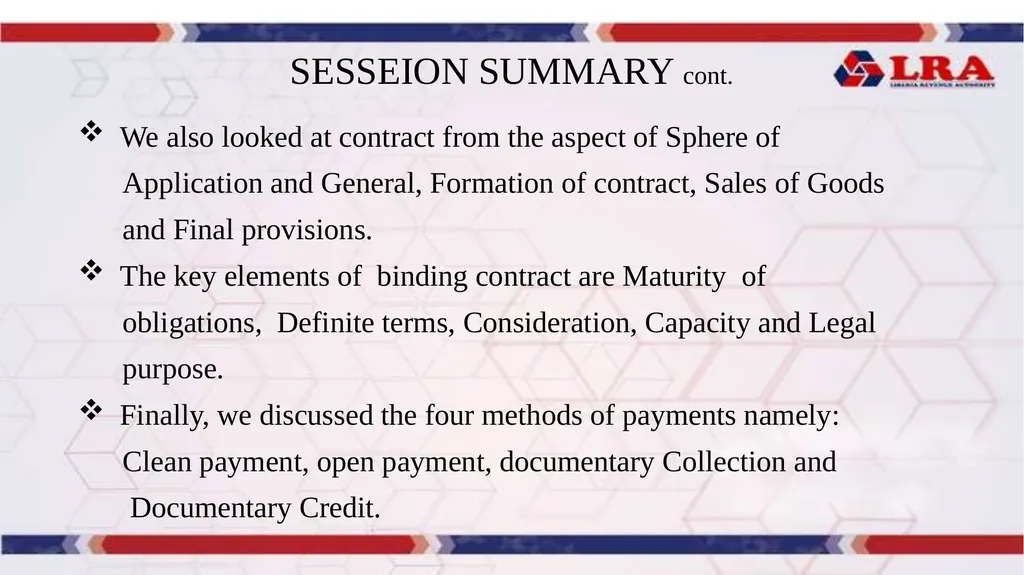
slide65. SESSEION SUMMARY cont. We also looked at contract from the aspect of Sphere of
Application and General, Formation of contract, Sales of Goods
and Final provisions.
The key elements of binding contract are Maturity of
obligations, Definite terms, Consideration, Capacity and Legal
purpose.
Finally, we discussed the four methods of payments namely:
Clean payment, open payment, documentary Collection and
Documentary Credit.<br>
slide66. THANK YOU Q &A<br>
slide2. MODULE OUTLINE Introduction
Module objectives
Session I Outline
Session I objectives
Brief History of Incoterms
Terms organization
7. What is international contract of sales?
8. Key elements of binding contract
9. Composition of Vienna Sales Convention (VSC)<br>
slide3. MODULE OBJECTIVES At the end of module, the participants will be able to:
Discuss the purpose of Incoterms
Identify the groups/structure of Incoterms
List the trade terms
Demonstrate the use of Incoterms chart
Explain the purpose of contract for international sale of goods
Explain the key elements of contract for international sale of goods
Discuss the key issues to consider in contracting<br>
slide4. INTRODUCTION This module attempts to present the rational for the
alignment of appropriate International Commercial
terms (Incoterms)in International contract laws for the
movement of cargos across borders.<br>
slide5. INTRODUCTION CONT. The participants in this course are entreated to do their
utmost best to enhance their knowledge and skills to
make them efficient and active participants and to
contribute effectively to the conduct of the class session.
This may lead to a successful pass in the Customs Brokers
Licensing uniform examination.<br>
slide6. INTRODUCTION CONT. On the other hand, participants who may not assert themselves
proficiently in this module, could stand the risk of not passing
the uniform examination and may fail to be licensed to practice
as professional Customs broker.<br>
slide7. SESSION I
INTERNATIONAL COMMERCIAL TERMS
(INCOTERMS)<br>
slide8. SESSION OUTLINE Session Objectives
Introduction
Division of Incoterms
Brief history of Incoterms
Dos and Don’ts of Incoterms
The organization of Trade Terms
Incoterms Chart<br>
slide9. SESSION OBJECTIVES At the end of the session, the participants will be able to:
Discuss the formation of Incoterms
List the Incoterms
Identify the terms by groups/structure
Discuss the terms according parts
Explain the terms according to level of risk bear by each party
Demonstration the use of Incoterms chart<br>
slide10. INTRODUCTION Incoterms are series of internationally recognized standardized trade
terms published by the International Chamber of Commerce (ICC)
and widely used in international sales.
They cover issues like who does what, who pays for what and when
risk in the goods passes from seller to buyer. Also, when delivery
occurs, as well as matters such as insurance, export and import
clearance and the division of other costs pertaining to the delivery
of goods. These are determinant factors in the valuation process
of goods. Hence, brokers need to be knowledgeable of incoterms.<br>
slide11. BRIEF HISTORY ICC introduced Incoterms in 1936 & are revised every 10 years
They were 13, but now simplified to 11 terms
Incoterms comprises 3 English language letters acronym
The current version is Incoterms 2010
Exclusively used in sales/purchase contract
Updated to reflect current trade practice
Written to reflect rather than dictate trade practice
Always accompanied by a geographic place (the more precise the be
better).<br>
slide12. TABULAR SUMMARY -INCOTERMS<br>
slide13. THE DOs OF INCOTERMS Divide costs, risks and responsibilities between sellers and buyers.
Guide one or the other party into subsidiary contracts required to
fulfill designated tasks such as contracts of carriage and contracts of
insurance.<br>
slide14. THE DON’Ts OF INCOTERMS Address passage of title.
Address recognition of revenue.
Address remedies for breach of contract.
Address more than one contract (drop shipments).
Note:
They are not law, but they must be specified in order to apply.
Not All inclusive, they cannot address such issues as customary
operations of carriers, ports, trades, government regulations, etc.<br>
slide15. TERMS ORGANIZATION Incoterms are organized into: 3 PARTS
Part I
Part II
Part II 4 TERMS GROUPS (b4 2010)
Departure (E)
Main Carriage unpaid (C)
Main Carriage Paid (F)
Arrival (D) 2 TRANSPORT MODES (2010)
1. Any Transport Mode 2. Maritime Transport Mode<br>
slide16. MARITIME TRANSPORT MODE There are 4 terms in this mode as follow:
Free Alongside Ship (FAS)
Free on Board (FOB)
Cost and Freight (CRF)
Cost, Insurance and Freight (CIF)<br>
slide17. RECOMMENDED FOR CONTAINERS CARGOS FOB = FCA
CRF = CPT
CIF = CIP<br>
slide18. PART I-III OF INCOTERMS 1. PART I
Comprises of D and F groups (EXW, FAS, FCA & FOB)
2. PART II
Incorporates only the C group terms (CPT, CRF, CIF & CIP)
3. PART III
incorporates only D group terms (DAT, DAP & DDP)
4 terms replaced in 2010 (DEF, DES, DDU & DEQ) only in this group<br>
slide19. CHANGES IN INCOTERMS 2010 DAT (delivered at Destination)
- Delivered at a named place, at buyer’s disposal, unloaded
Replaces DEQ
DAP (delivered at place)
- Delivered at a named place, at buyer’s disposal, not unloaded
Replaces DAF, DES, DDU
Guidance notes
- Explain fundamentals, usage, risk, cost, etc.<br>
slide20. CHANGES IN INCOTERMS 2010 cont. Rules for Any Mode of Transport
- EXW, FCA, CPT, CIP, DAT, DAP, DDP
Rules for Sea and Inland Waterway Transport
FAS, FOB, CFR, CIF
Electronic Communication
Electronic means of communication now given same effect as paper as long as parties agree or where customary
Security-Related Clearances
- Rules now allocate responsibility for these<br>
slide21. CHANGES IN INCOTERMS 2010 cont. String Sales
Rules now recognize that seller may fulfill its obligations by procuring goods that have been shipped
Terminal Handling Charges
Now specifically allocated so that buyer is not charged twice
(seller and terminal)<br>
slide22. ANY TRANSPORT MODE TERMS There are 7 Terms in this mode as Follow:
Ex-Work (EX)
Free Carrier (FCA)
Carrier Paid To (CPT)
Carriage and Insurance Paid To (CIP)
Deliver at Terminal (DAT)
Deliver at Place (DAP)
Deliver Duty Paid (DDP)<br>
slide23. Seller Buyer ??? Seller delivers when he/she places the goods at the
disposal of buyer at the seller’s premises or another
named place (i.e. works, factory, warehouse, etc.).<br>
slide24. EX-WORKS cont. Seller does not need to load the goods on any collecting vehicle,
nor does it need to clear the goods for export, where such
clearance is applicable.
Fewest up front requirements for seller
Example: “Ex works [factory] Beer factory, Monrovia- Liberia
(Incoterms 2010)” or
2,000, 000 liters of raw rubber at $500,000.00 EXW, Firestone
warehouse, Freeport of Monrovia-Liberia<br>
slide25. Free Carrier (FCA) Seller delivers the goods to the carrier or another person
nominated by the buyer at the seller’s premises or another
named place.
The parties are well advised to specify as clearly as possible the
point within the named place of delivery, as the risk passes to
the buyer at that point.
Seller does clear goods for export; import formalities are
buyer’s responsibility
Seller may contract for carriage at buyer’s expense and risk<br>
slide26. Free Carrier (FCA) cont. Seller’s delivery options
If the named place is seller’s premises: seller must load goods onto
buyer’s means of transport
If the named place is any other place: seller must place the goods
at buyer’s (or his carrier’s disposal) on seller’s mode of transport
(ready for unloading)
Seller has no control over carrier, insurance, etc.
Improvements over Ex Works
- Seller clears goods for export
- Can be used to require seller to load goods, when seller is in a
better position to do so<br>
slide27. Carriage Paid To (CPT) Seller delivers the goods to the carrier or another person
nominated by the seller at an agreed place (if any place is agreed
between the parties) and the seller must contract for and pay the
costs of carriage necessary to bring the goods to the named
place of destination
2 Key points
Place of delivery of goods to carrier
- Seller’s delivery obligation is complete
- Risk of loss passes
Place of destination
- Seller contracts for and pays for carriage to the place of destination<br>
slide28. Carriage Paid To (CPT) cont. Seller clears goods for export and pays for transport
Seller pays for both loading and unloading if covered by contract
of carriage
Seller has no obligation to pay for insurance but must provide
buyer information to buy insurance at buyer’s risk and expense
Buyer obtains import licenses and carries out customs formalities<br>
slide29. Carriage Paid To (CPT) cont. EXAMPLE
Contract says seller is to deliver goods to shipping warehouse in
Freeport, Terms of sale are “CPT buyer’s facility, 10 Wills Place,
#5, Tema Port, Ghana 0387108 (Incoterms 2010).”
Delivery obligation is fulfilled when seller delivers to the shipping
facility in Freeport.
Risk of loss passes at the moment the goods are handed over to
the carrier in Freeport.
But seller pays for carriage to Ghana<br>
slide30. CARRIAGE AND INSURANCE PAID TO (CIP) Seller delivers the goods to the carrier or another person nominated
by the seller at an agreed place; seller must contract for and pay the
costs of carriage necessary to bring the goods to the named place
of destination
Insurance requirement is minimum cover (institute cargo clause c) in
the amount of contract price plus 10% from point of delivery to
point of destination
Buyer may pay for additional coverage (institute cargo clauses a or b);
seller must provide the information necessary to allow buyer to do
so<br>
slide31. Responsibility Pays Transport Carriage & Insurance Paid To (CIP) Insures goods Seller Buyer<br>
slide32. DELIVER AT TERMINAL (DAT) Seller delivers when the goods, once unloaded from the arriving
means of transport, are placed at the disposal of the buyer at
a named terminal at the named port or place of destination.
“Terminal” includes any place, whether covered or not, such
as a quay, warehouse, container yard or road, rail or air cargo
terminal.
The seller bears all risks involved in bringing the goods to and
unloading them at the terminal at the named port or place of
destination.<br>
slide33. DELIVER AT TERMINAL (DAT) cont. Seller’s obligation is fulfilled and risk of loss passes at
same time: when the goods are unloaded at the arriving
terminal and placed at buyer’s disposal
Can specify a point within the terminal at which time the
obligation is complete
Seller clears goods for export but not for import
No requirement for insurance<br>
slide34. DELIVERED AT PLACE (DAP) Seller delivers when the goods are placed at the disposal of the
buyer on the arriving means of transport ready for unloading
at the named place of destination.
The seller bears all risks involved in bringing the goods to the
named place.
Goods are placed at buyer’s disposal at named location ready
for unloading; risk passes at that point
No obligation for insurance<br>
slide35. DELIVERED AT PLACE (DAP) (cont.) Much like DAT, but with additional obligation by seller into
country of delivery
Seller clears goods for export but not import (use DDP if intent
is to require seller to clear goods for import also).<br>
slide36. Delivered Duty Paid (DDP) Seller delivers the goods when the goods are placed at the
disposal of the buyer, cleared for import on the arriving means
of transport ready for unloading at the named place of
destination.
The seller bears all the costs and risks involved in bringing the
goods to the place of destination and has an obligation to
clear the goods for export and import, to pay all duty/taxes for
both export and import and to carry out all customs formalities.<br>
slide37. Delivered Duty Paid (DDP) cont. Like DAP, but including seller’s obligation to clear goods for
import—pay for any necessary licenses
Maximum obligation for seller
If seller is not well-suited to clear goods for import, DAP
should be used
No obligation to pay for insurance<br>
slide38. Responsibility Pays Transport Delivered Duty Paid (DDP) Insures goods Seller Buyer ???<br>
slide39. MARITIME TRANSPORT MODE There are 4 terms in this mode as follow:
Free Alongside Ship (FAS)
Free on Board (FOB)
Cost and Freight (CRF)
Cost, Insurance and Freight (CIF)<br>
slide40. FREE ALONGSIDE SHIP (FAS) Seller delivers when the goods are placed alongside the vessel
(e.g., on a quay or a barge) nominated by the buyer at the named
port of shipment.
The risk of loss of or damage to the goods passes when the
goods are alongside the ship, the buyer bears all costs from the
moment onwards.
Seller is obligated to clear goods for export but not import
Can be used in a string sale where seller procures goods already
delivered for shipment<br>
slide41. FREE ALONGSIDE SHIP (FAS) cont. Not appropriate when goods in container and delivered to carrier
at terminal; FCA recommended.
Seller has no obligation to pay for contracts of carriage or
insurance but may contract for carriage and must assist buyer
by providing necessary information for insurance
Example:
FAS BMC pier, Freeport, Liberia (incoterms 2010)<br>
slide42. FREE ON BOARD (FOB) Seller delivers the goods on board the vessel nominated by the
buyer at the named port of shipment or procures the goods
already so delivered.
The risk of loss of or damage to the goods passes when the
goods are on board the vessel, and the buyer bears all costs
from that moment onwards.
Another change in 2010: if requested by buyer or if it is a
commercial practice and buyer does not instruct otherwise, seller
may contract for carriage at buyer’s risk and expense; seller may
decline but must notify buyer promptly.<br>
slide43. FREE ON BOARD (FOB) cont. Free on board, no longer means across the ship’s rail; now means
on board the vessel- innovation of Incoterms 20110.
Like FAS, but goods must be placed on board the vessel/boat
Example:
FOB Harper (Incoterms 2010)<br>
slide44. COST AND FREIGHT (CRF) Seller delivers the goods on board the vessel or procures the goods
already so delivered.
The risk of loss of or damage to the goods passes when the goods
are on board the vessel.
The seller must contract for and pay the costs and freight
necessary to bring the goods to the named port of destination
Seller clears goods for export but not import<br>
slide45. COST AND FREIGHT (CRF) cont. 2 places of importance
Place of delivery of goods
Seller’s delivery obligation is fulfilled when goods are on board
the vessel
- Risk of loss passes when the goods are on board the vessel
Port of destination
Seller pays for carriage to port of destination
Seller has no obligation to obtain insurance<br>
slide46. COST AND FREIGHT (CRF) cont. Seller pays for unloading if the contract of carriage covers unloading
If intent to ship in containers and delivery is to carrier other
than vessel, use CPT
Example:
Contract says: Seller is to deliver goods on board vessel at Port of Buchanan, G/Bassa, Liberia. Terms of sale are: “CFR, Freetown (Incoterms 2010).”<br>
slide47. COST AND FREIGHT (CRF) cont. Example:
- Seller’s delivery obligation is fulfilled when the goods are on
board the vessel in Buchanan; risk of loss passes then also
- Seller must pay for shipment to Freeport
Contract says terms of sale are: “CFR, Freeport
(Incoterms 2010).” Silent as to port of shipment
Seller’s delivery obligation is fulfilled when the goods are on board the vessel in the port selected by seller; risk of loss
passes then also
- Seller must pay for shipment to Freetown<br>
slide48. COST INSURANCE AND FREIGHT (CIF) Seller delivers the goods on board the vessel or procures the
goods already so delivered.
The risk of loss of damage to the goods passes when the goods
are on board the vessel.
The seller must contract for and pay the costs and freight
necessary to bring the goods to the named port of destination<br>
slide49. COST INSURANCE AND FREIGHT (CIF) cont. Seller clears goods for export but not import
Insurance requirement is minimum cover (institute cargo
clause c) in the amount of contract price plus 10% from
point of delivery to point of destination
Like CFR but with additional obligation to procure insurance to
port of destination<br>
slide50. Responsibility Pays Transport Cost Insurance & Freight (CIF) Insures goods Seller Buyer<br>
slide51. THE INCOTERMS 2015 CHART-SUMMARY<br>
slide52. SESSION II INTERNATIONAL CONTRACT OF SALE<br>
slide53. SESSION OUTLINE Introduction
Background
Session Objectives
What is international contract of sales?
Key elements of binding contract
Composition of Vienna Sales Convection (VSC)
7. Methods of payments<br>
slide54. SESSION OBJECTIVES At the end of the session, the participants will be able to:
Explain the purpose of the Contract for International Sale of Goods
Explain the key elements of contract for international sale of goods
Discuss key issues to consider in contracting
Discuss the methods of payments<br>
slide55. INTRODUCTION An International Contract of Sales is an agreement between a seller
and a buyer for the sale of goods, it should at a minimum,
identify the seller and buyer, the quantity and type of product,
delivery time, price and conditions of payment.
It references the governing body of law, the forum where any
disputes are to be resolved and the method of dispute resolution
- arbitration as opposed to litigation.
It refers to the UN Convention on Contracts for the International
Sale of Goods (CISG), also, known as Vienna Convention.<br>
slide56. BACKGROUND The United Nations Convention on Contracts for the International
sale of goods provides a uniform text of law for international sales
of goods. The convention was prepared by UN Commission on
International Trade Law (UNCITRAL) and adopted by a diplomatic
conference on 11 April 1980 in Vienna.<br>
slide57. BACKGROUND cont. Preparation of a uniform law for the international sale of goods
began in 1930 at the International Institute for the Unification
of Private Law (UNIDROIT) in Rome. After a long intervention in
work as result of the second World War, the draft was submitted to
the diplomatic conference in 1964 which adopted two conventions
one on the international law of goods and the other on the formation
of contracts for international sales of goods.<br>
slide58. WHAT IS INT’L CONTRACT OF SALES? An agreement between the seller and buyer for sales of goods.
It identifies the quantity, type of products, delivery time, price
and conditions of the goods.
It references the body of law any disputes arising from contract will
be resolved under and the method of resolution.
It should always indicates terms of sales –preferably one of
11 Incoterms.
Refers to sales between 2 parties from different countries<br>
slide59. KEY ELEMENTS OF BINDING CONTRACT Maturity of obligation or meeting of minds
Definite terms
Consideration
Capacity
Legal Purpose<br>
slide60. ISSUES TO CONSIDER IN CONTRACTING The must be an offer, offeror, offeree and an acceptance
Validity of the contract and expiry dates for shipment
and arrival.
Risk of exchange rates of fluctuations
The precise Incoterms used
Arbitration clause
The precise documents the seller must pass to buyer
A force majeure clause<br>
slide61. COMPOSITION OF VSC 2 Uniform laws and 4 Parts
The 2 Uniform Laws:
Uniform law of international sales of goods (uniform
law of sales)
2. Uniform law on the formation of contracts for
international sales of goods (Uniform law of formation)<br>
slide62. COMPOSITION OF VSC cont. B. The 4 Parts:
Sphere of Application and General Provisions
( Articles 1-13).
2. Formation of Contract (Articles 14-24)
3. Sales of Goods (Articles 25-88)
4. Final Provisions (Articles 89-101)<br>
slide63. METHODS OF PAYMENTS There four (4) methods of payments for imported
goods follow:
1. Clean payment
2. Open account
3. Documentary collection
4. Documentary credit<br>
slide64. SESSEION SUMMARY Today in this session, we discussed the follow:
The CISG was signed in Vienna on 11 April 1980 during
a diplomatic convention. It is also referred to as VSC.
VSC was signed by 11 members states in 1980 and is now
signed up by 85 states as of September 2016.
CISG deals with sales contract between seller and buyer from
different states. It considers price, quantity, time, litigation, etc.
VSC comprises of the Uniform laws of sales and the
Uniform laws Formation.
,<br>
slide65. SESSEION SUMMARY cont. We also looked at contract from the aspect of Sphere of
Application and General, Formation of contract, Sales of Goods
and Final provisions.
The key elements of binding contract are Maturity of
obligations, Definite terms, Consideration, Capacity and Legal
purpose.
Finally, we discussed the four methods of payments namely:
Clean payment, open payment, documentary Collection and
Documentary Credit.<br>
slide66. THANK YOU Q &A<br>