
MODULE I: Presented By: LRA TRAINING TEAM Rules of

Description: MODULE I: Presented By: LRA TRAINING TEAM Rules of Origin CUSTOMS BROKERS LICENSING TRAINING PROGRAM OUTLINE 1. Objectives 2. Introduction 3. The legal basis for Rules of Origin 4. Scope of Rules of Origin 5. Proof of Origin 6. Principles
Related Topics
Download Presentation
"MODULE I: Presented By: LRA TRAINING TEAM Rules of" is the property of its rightful owner. Permission is granted to download and print the materials on this website for personal, non-commercial use only, and to display it on your personal computer provided you do not modify the materials and that you retain all copyright notices contained in the materials. By downloading content from our website, you accept the terms of this agreement.
Presentation Transcript
slide1. MODULE I: Presented By: LRA TRAINING TEAM Rules of Origin CUSTOMS BROKERS LICENSING TRAINING PROGRAM<br>
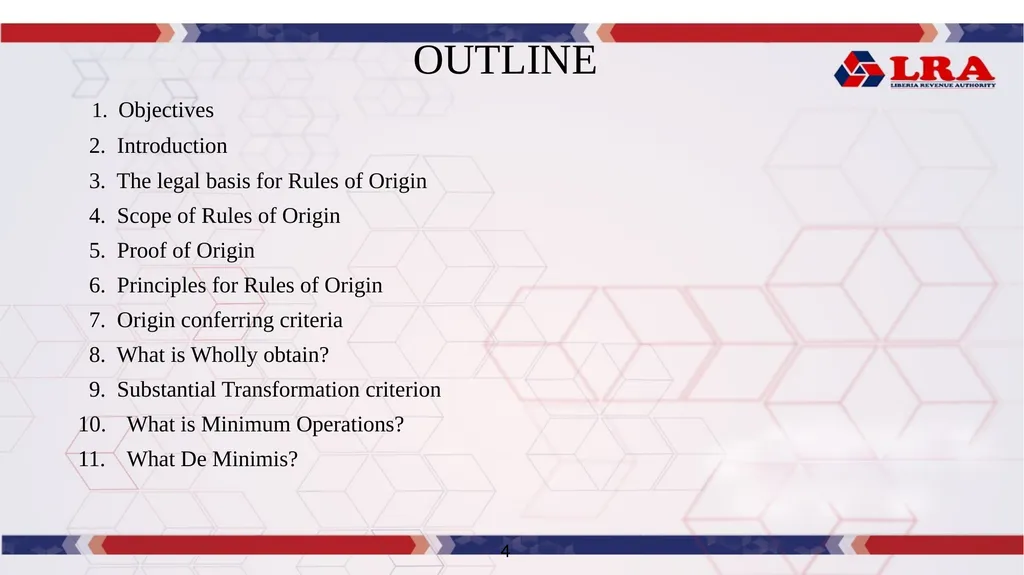
slide2. OUTLINE 1. Objectives
2. Introduction
3. The legal basis for Rules of Origin
4. Scope of Rules of Origin
5. Proof of Origin
6. Principles for Rules of Origin
7. Origin conferring criteria
8. What is Wholly obtain?
9. Substantial Transformation criterion
What is Minimum Operations?
What De Minimis? 4<br>
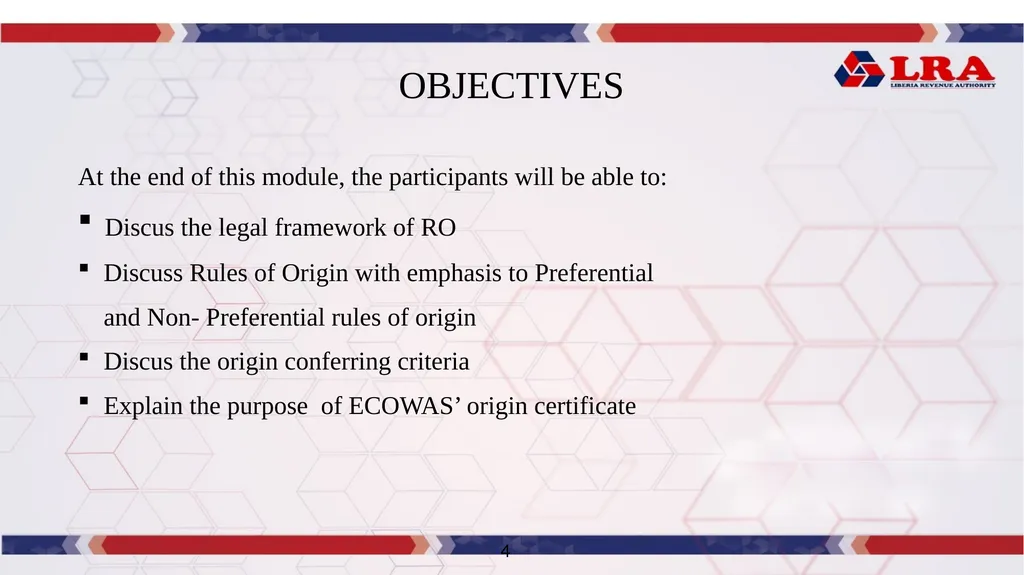
slide3. OBJECTIVES At the end of this module, the participants will be able to:
Discus the legal framework of RO
Discuss Rules of Origin with emphasis to Preferential
and Non- Preferential rules of origin
Discus the origin conferring criteria
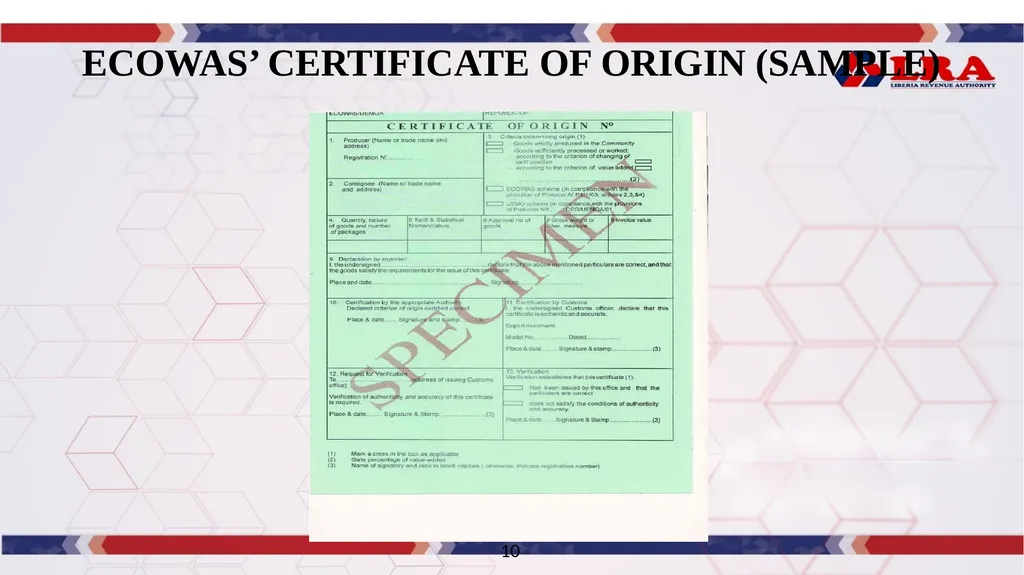
Explain the purpose of ECOWAS’ origin certificate 4<br>
slide4. INTRODUCTION Rules of Origin (RO) are the means by which we determine where goods originate, i.e. not where they have been shipped from, but where they are deemed to have been produced or manufactured. 1 4 1<br>
slide5. INTRODUCTION cont. The participants in this course are entreated to do their
utmost best to enhance their knowledge and skills to make
them efficient and active participants and to contribute
effectively to the conduct of the class session. This may lead
to a successful pass in the Customs Brokers Licensing
uniform examination. 2<br>
slide6. INTRODUCTION cont. On the other hand, participants who may not assert
themselves proficiently in this module, could stand the risk
of not passing the uniform examination and may fail to be
licensed to practice as professional Customs broker. 3<br>
slide7. WHAT IS THE LEGAL BASIS OF RO? Articles I, II, III and XI of GATT 1994 (MFN)
Article VI of GATT 1994 (adcd)
Article XIX of GATT 1994 (sgm)
Article IX of GATT 1994 & Annex II
Accession to WTO
Ratification of ECOWAS’ ETLS protocol, 2003
ACP, AGOA agreements, etc. 5<br>
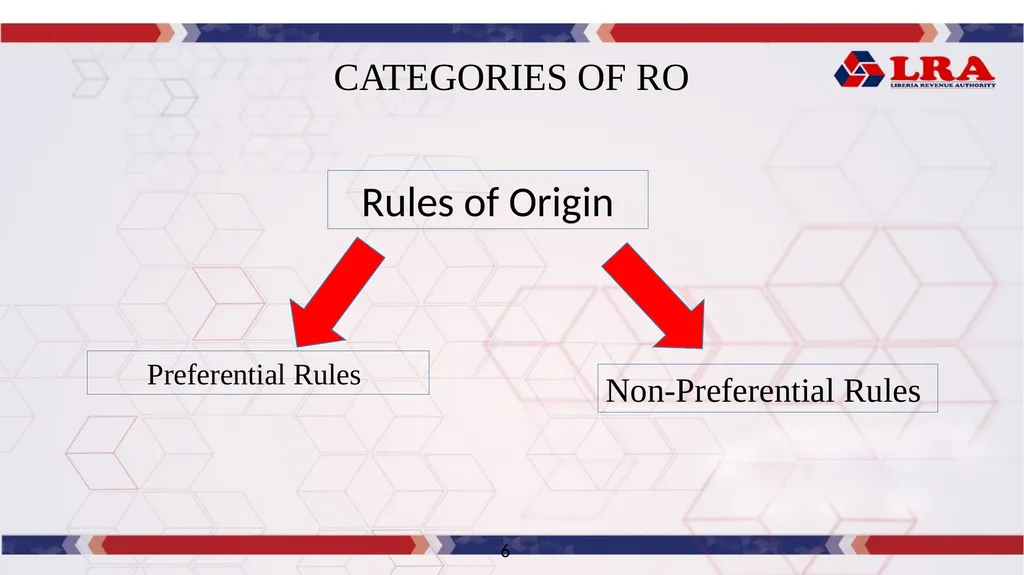
slide8. CATEGORIES OF RO 6 Preferential Rules Non-Preferential Rules Rules of Origin<br>
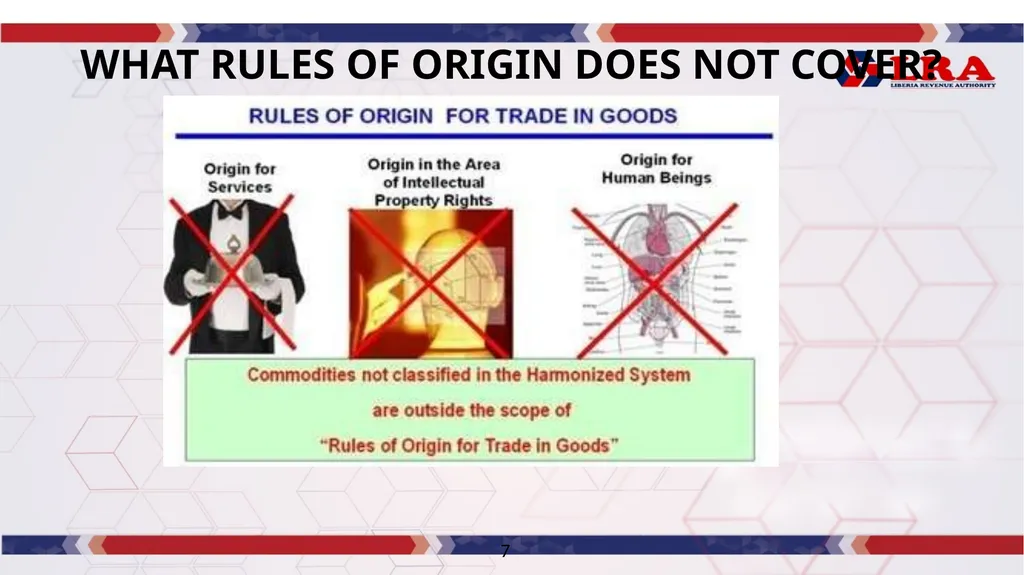
slide9. WHAT RULES OF ORIGIN DOES NOT COVER? 7<br>
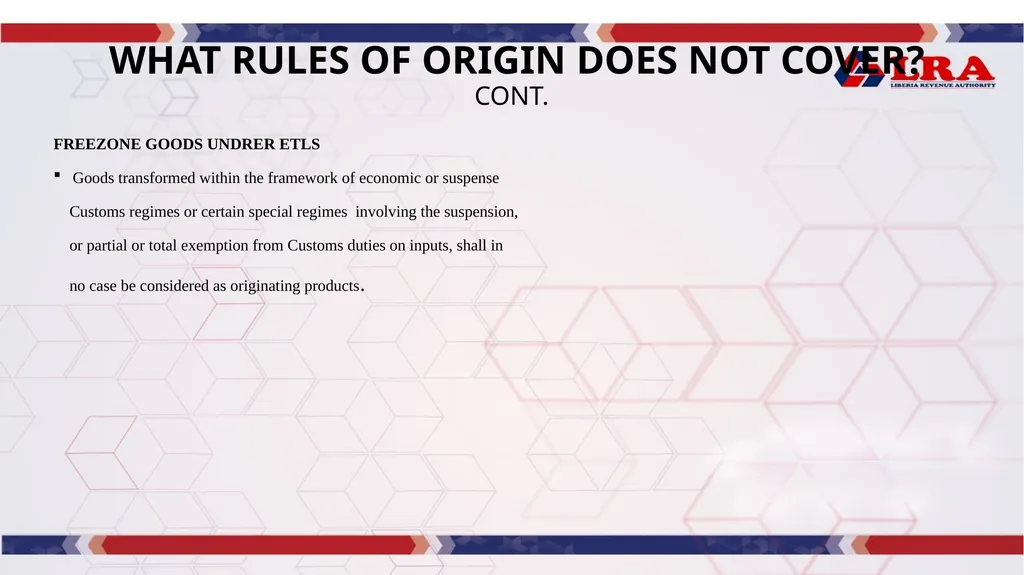
slide10. WHAT RULES OF ORIGIN DOES NOT COVER? CONT. FREEZONE GOODS UNDRER ETLS
Goods transformed within the framework of economic or suspense
Customs regimes or certain special regimes involving the suspension,
or partial or total exemption from Customs duties on inputs, shall in
no case be considered as originating products.<br>
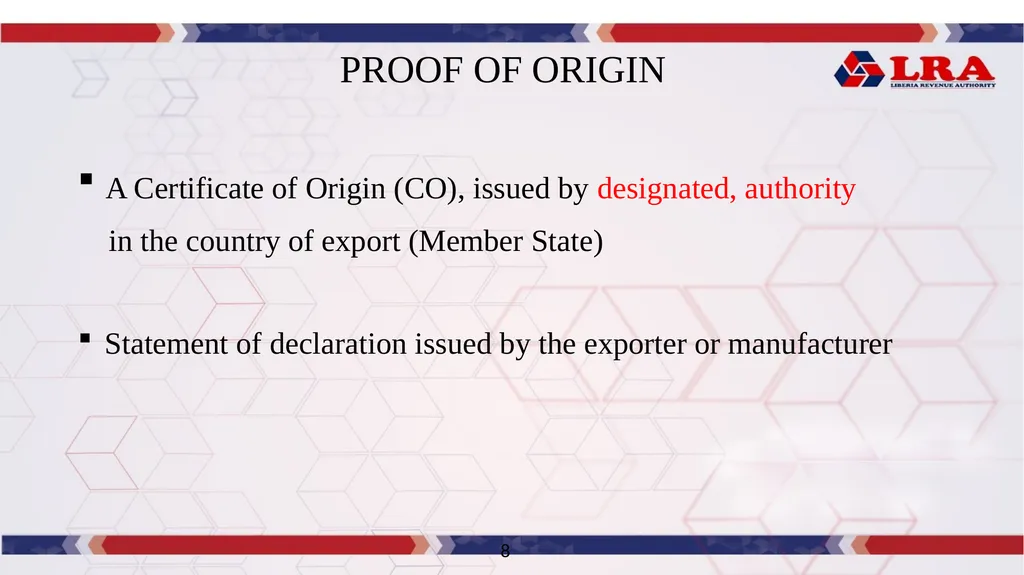
slide11. PROOF OF ORIGIN A Certificate of Origin (CO), issued by designated, authority
in the country of export (Member State)
Statement of declaration issued by the exporter or manufacturer 8<br>
slide12. ECOWAS’ CERTIFICATE OF ORIGIN (SAMPLE) 10<br>
slide13. PRINCIPLES FOR PROOF OF ORIGIN Principle 1: Simplicity
-The rules must be cleared and transparent in order
to minimize the possibility of being applied in
subjective, biased, or fraudulent manner. Else, they create
needless hitches that hinder trade. 9<br>
slide14. PRINCIPLES FOR PROOF OF ORIGIN cont. Principle 2: Predictability
-The rules must be amply clear, recognized and
stable to enable the manufacturer to predict in a
clear and secure manner how the rules will be applied
to various goods, taking into account their
respective destinations. 9<br>
slide15. NO CO REQUIREMENT IMPORTS Certificate of Origin shall not be required for
agricultural and livestock products, hand-made
articles or articles produced with or without the use of
tools, instruments or implements directly operated by
the craftsman.
Example:
Cows, goats, carved wood, plantains, chickens, etc. 9<br>
slide16. WHAT IS PREFERENTIAL RO? Simply means, trade agreements between
governments that allow goods of their countries to
be imported at reduced or zero duty rates.
Example:
Manu River Union Protocol (Guinea, Ivory Coast, Liberia & Sierra
Leone ) 11<br>
slide17. WHY USED PREFERENTIAL RO? It is used for the following:
1. Generalize System of Preferences (GSP);
2. Free Trade Agreement (FTA);
3. Regional Trade Agreement (RTA).
Example:
ACP Agreement (EU and African countries, +) 12<br>
slide18. WHY USE PREFERENTIAL RO? Cont. Examples:
1. ACP Agreement with EU and African countries
2. ETLS Protocol (ECOWAS members states)
3. Manu River Union Protocol (Guinea, Ivory Coast, Liberia &
S/Leone )
4. AGOA Protocol/Agreement (between America and
African countries, +). 18<br>
slide19. WHAT IS NON-PREFERENTIAL RO? Article 1 of GATT 1994 defines it as those laws, regulations and
administrative determinations of general application applied to
determine the country of origin of goods except those related to the
granting of tariff preferences.
Example: Most-Favor-Nation treatment (MFN)<br>
slide20. WHY USE NON-PREFERENTIAL RO? They are used for commercial policy measures as:
1. Anti-dumping and Countervailing duties; MFN;
2. Trade embargoes, Safeguard and retaliation measures;
3. Quantity restrictions and tariff quotas;
4. Trade statistics and Public tender; etc.<br>
slide21. ORIGIN CONFERRING CRITERIA They are 2 criteria that confer origin on trade in goods:
1. Wholly obtained criterion
2. Substantial/sufficient transformation criterion<br>
slide22. WHAT IS WHOLLY OBTAINED? Trade in goods considered wholly obtained includes:
1. live animals born and raised within the Member States;
2. mineral products extracted from the ground, sub-soil or sea bed
of Member States;
3. vegetable products harvested within Member States;
4. products obtained from animals living or raised in Member States;<br>
slide23. WHAT IS WHOLLY OBTAINED? Cont. 5. products obtained by hunting or fishing within member States;
6. products obtained from the sea, river and lakes within Member
States by vessels belonging to the Member States;
7. products manufactured aboard ship factories belonging to member
States exclusively from products referred to in paragraph (6) above;<br>
slide24. WHAT IS WHOLLY OBTAINED? Cont. 8. used articles fit only for the recovery of raw materials, provided
that such articles have been collected from users within member States;
9. scraps and waste resulting from manufacturing operations within
Member States;<br>
slide25. WHAT IS WHOLLY OBTAINED? Cont. 10. goods produced from the materials listed in paragraphs 2 to 9
above, used alone or mixed with other materials, provided that
they represent at least 60% of total quantity of raw materials used;
and
11. electrical energy produced in the Member States;<br>
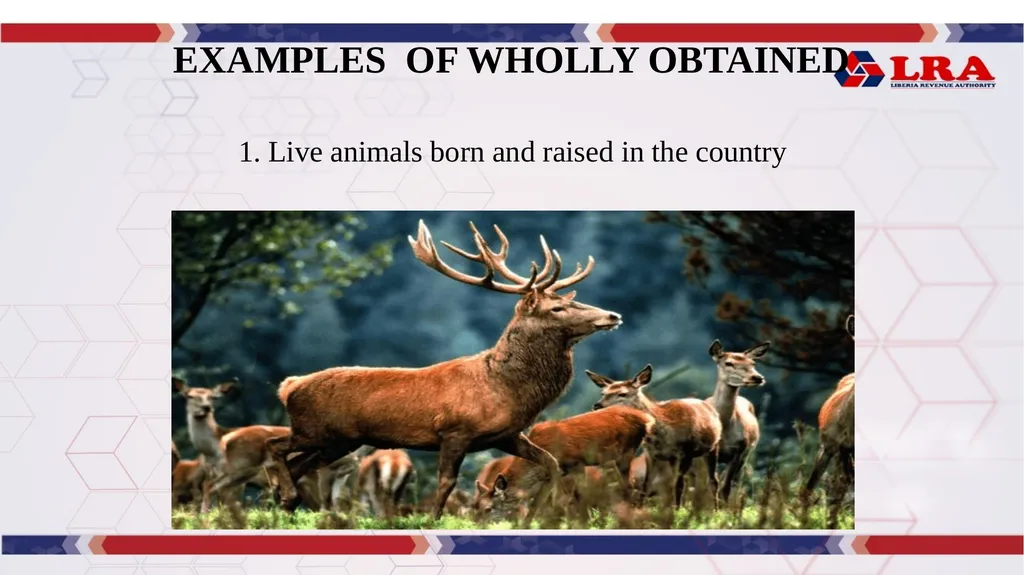
slide26. EXAMPLES OF WHOLLY OBTAINED 1. Live animals born and raised in the country<br>
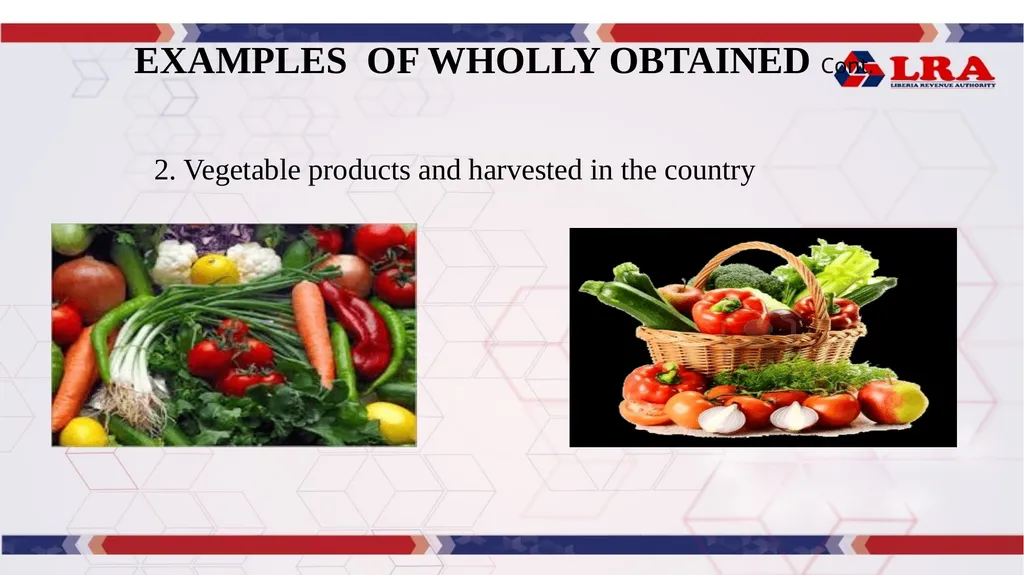
slide27. EXAMPLES OF WHOLLY OBTAINED Cont. 2. Vegetable products and harvested in the country<br>
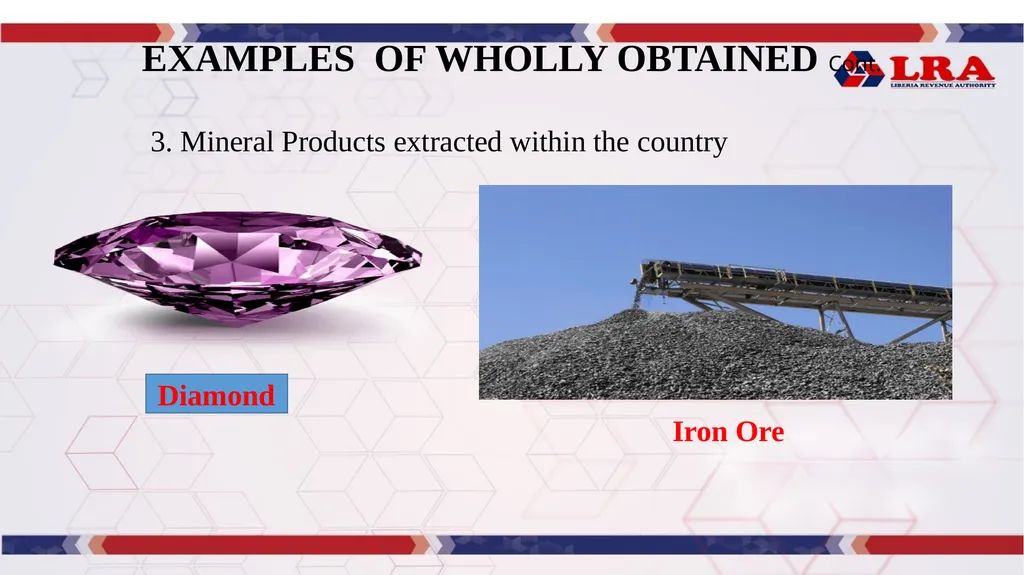
slide28. EXAMPLES OF WHOLLY OBTAINED Cont. 3. Mineral Products extracted within the country Diamond Iron Ore<br>
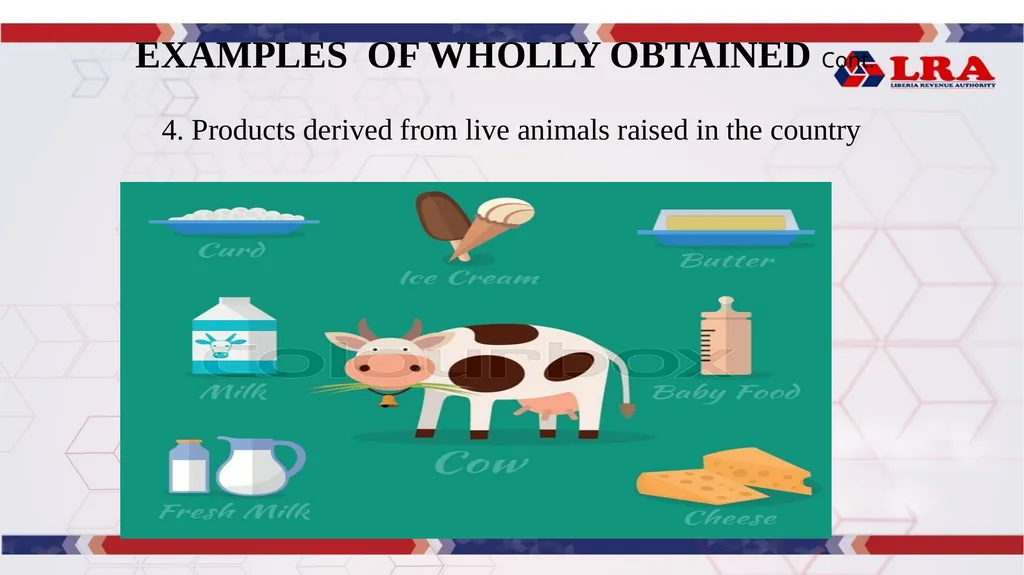
slide29. EXAMPLES OF WHOLLY OBTAINED Cont. 4. Products derived from live animals raised in the country<br>
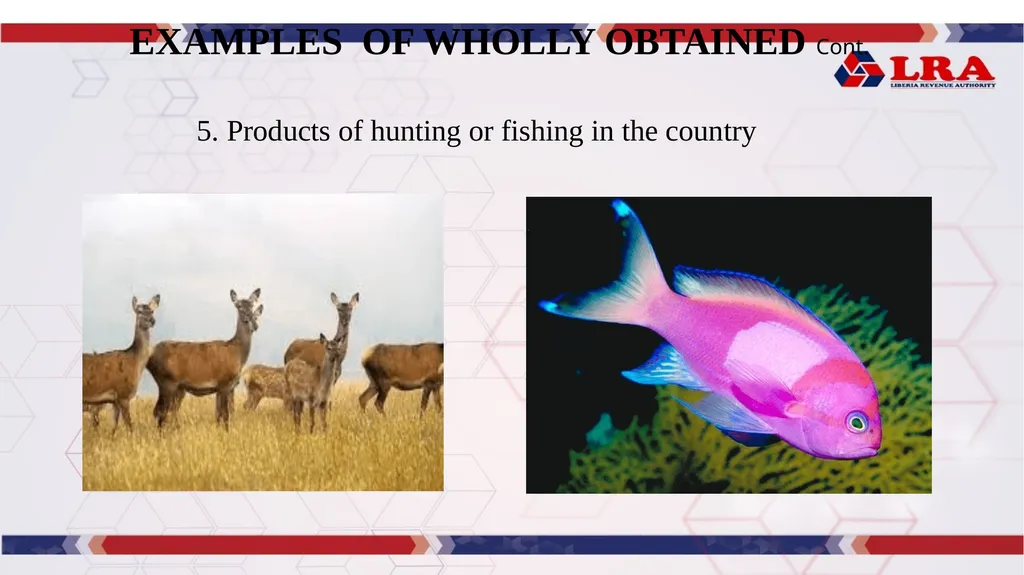
slide30. EXAMPLES OF WHOLLY OBTAINED Cont. 5. Products of hunting or fishing in the country<br>
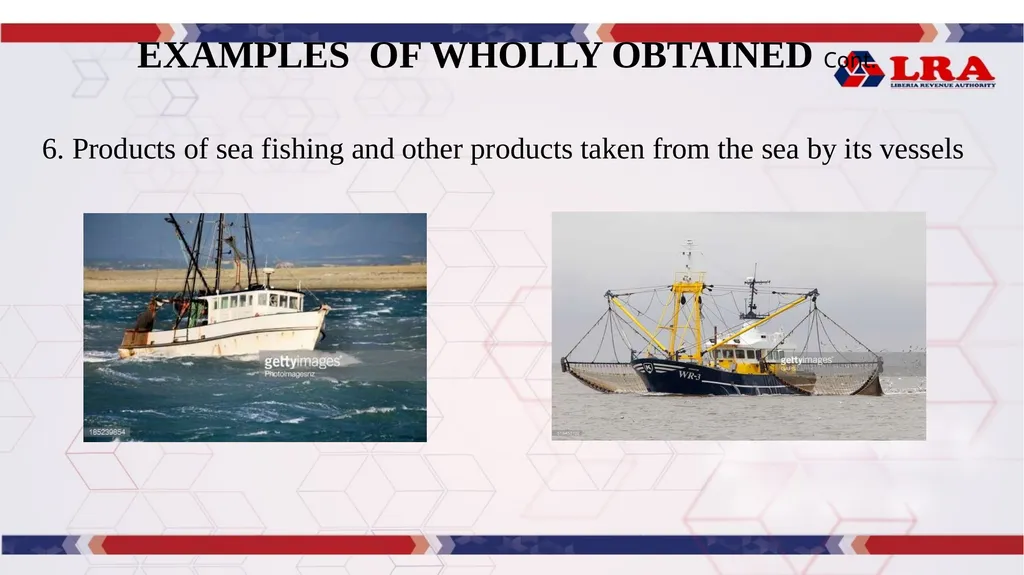
slide31. EXAMPLES OF WHOLLY OBTAINED Cont. 6. Products of sea fishing and other products taken from the sea by its vessels<br>
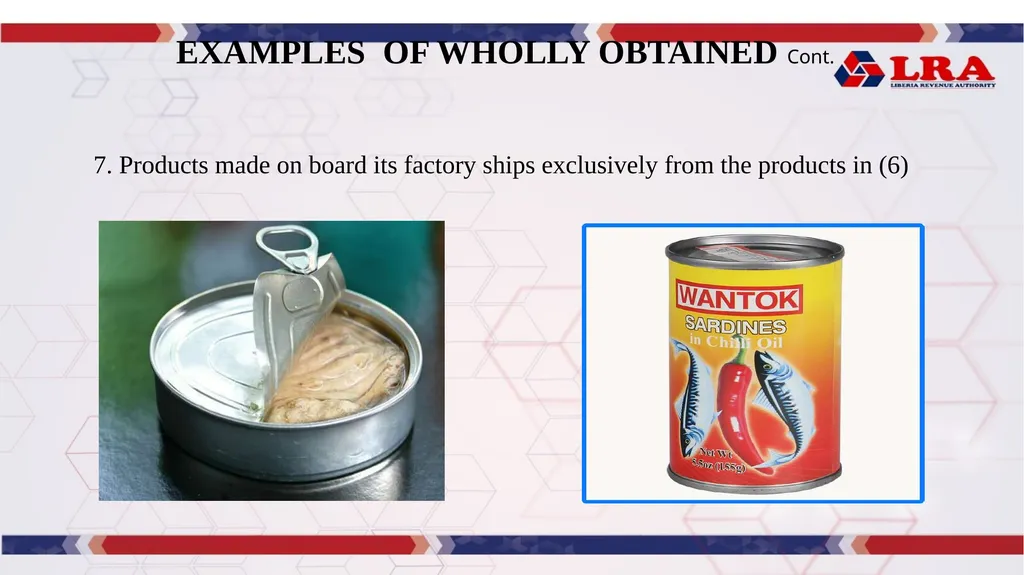
slide32. EXAMPLES OF WHOLLY OBTAINED Cont. 7. Products made on board its factory ships exclusively from the products in (6)<br>
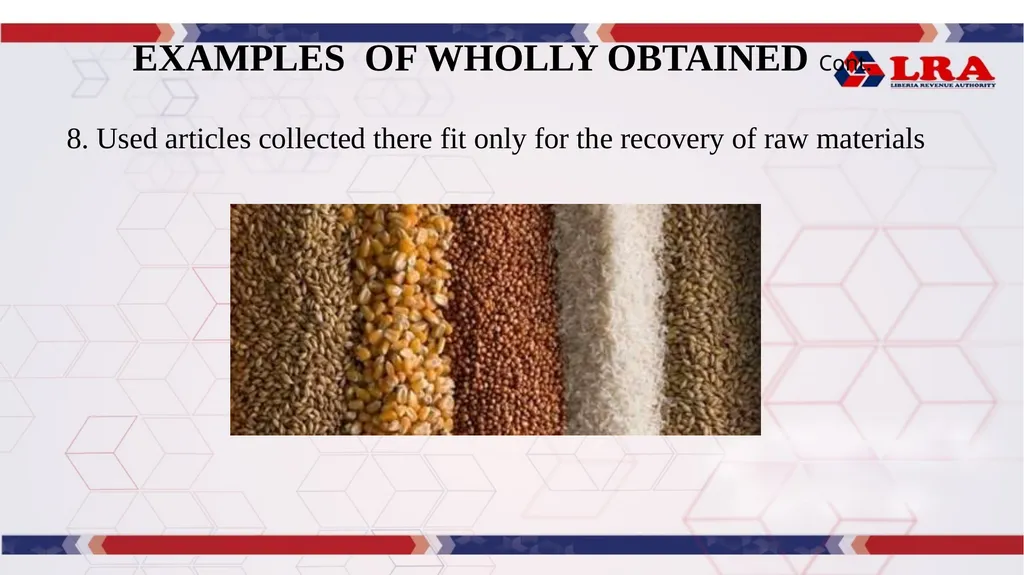
slide33. EXAMPLES OF WHOLLY OBTAINED Cont. 8. Used articles collected there fit only for the recovery of raw materials<br>
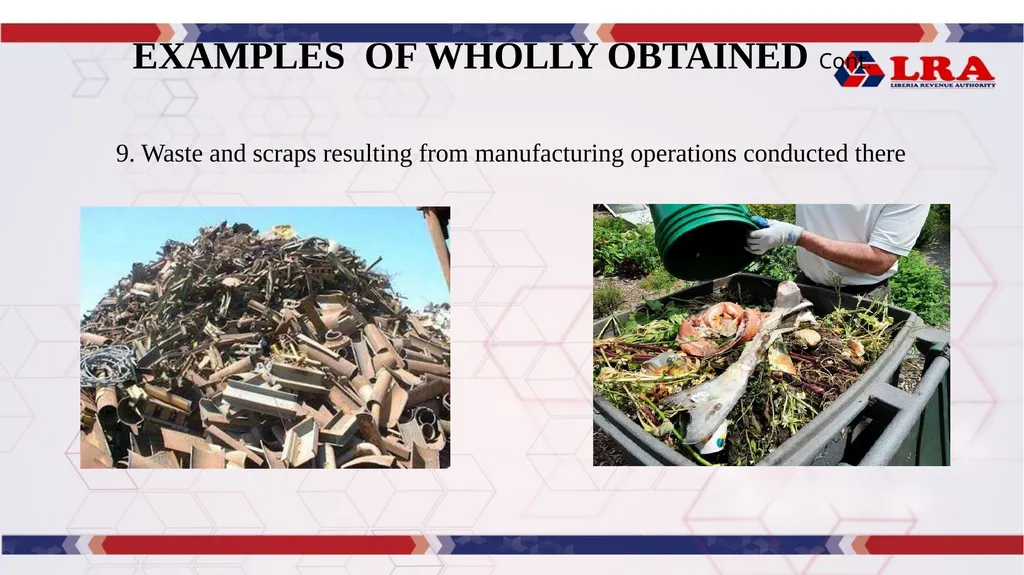
slide34. EXAMPLES OF WHOLLY OBTAINED Cont. 9. Waste and scraps resulting from manufacturing operations conducted there<br>
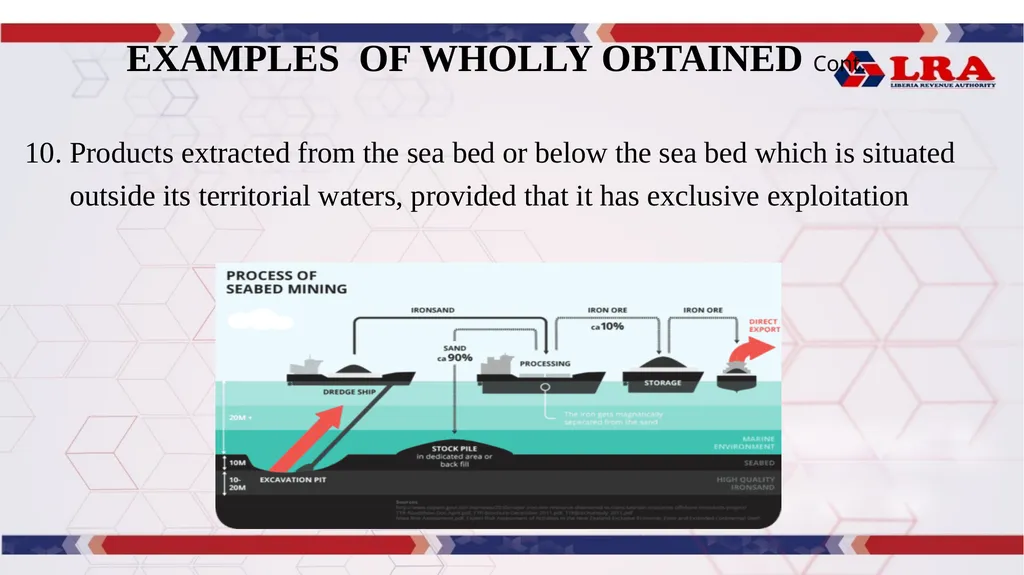
slide35. EXAMPLES OF WHOLLY OBTAINED Cont. 10. Products extracted from the sea bed or below the sea bed which is situated
outside its territorial waters, provided that it has exclusive exploitation<br>
slide36. EXAMPLES OF WHOLLY OBTAINED Cont. 10. Products produced goods exclusively from originating
products specified in (1-10)
11. Electrical energy produced in the Member States<br>
slide37. WP’S FARMULA. Goods are regarded as WHOLLY PRODUCED within ECOWAS,
if at least 60% of the total quantity of raw materials used
originate from the ECOWAS region quantity of raw materials
used originate from the ECOWAS region
WP= ECOWAS RM/(ECOWAS RM + FOREIGN RM) in %
Where
ECOWAS RM: Quantity of raw materials originated from ECOWAS
FOREIGN RM: Quantity of raw materials originated from Foreign
=WP > 60%<br>
slide38. SUBSTANTIAL TRANSFORMATION CRITERION There are 3 major criteria:
1. Change of Tariff Classification criterion
2. Value Added (ad valorem percentage) criterion
3. Manufacture or Processing operations (technical
requirement) criterion.<br>
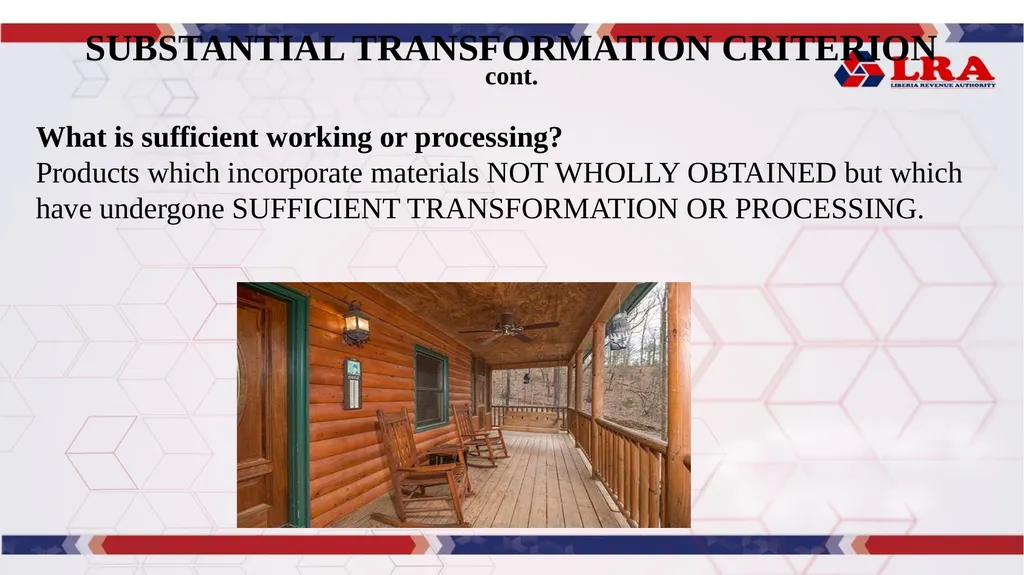
slide39. SUBSTANTIAL TRANSFORMATION CRITERION cont. What is sufficient working or processing?
Products which incorporate materials NOT WHOLLY OBTAINED but which have undergone SUFFICIENT TRANSFORMATION OR PROCESSING.<br>
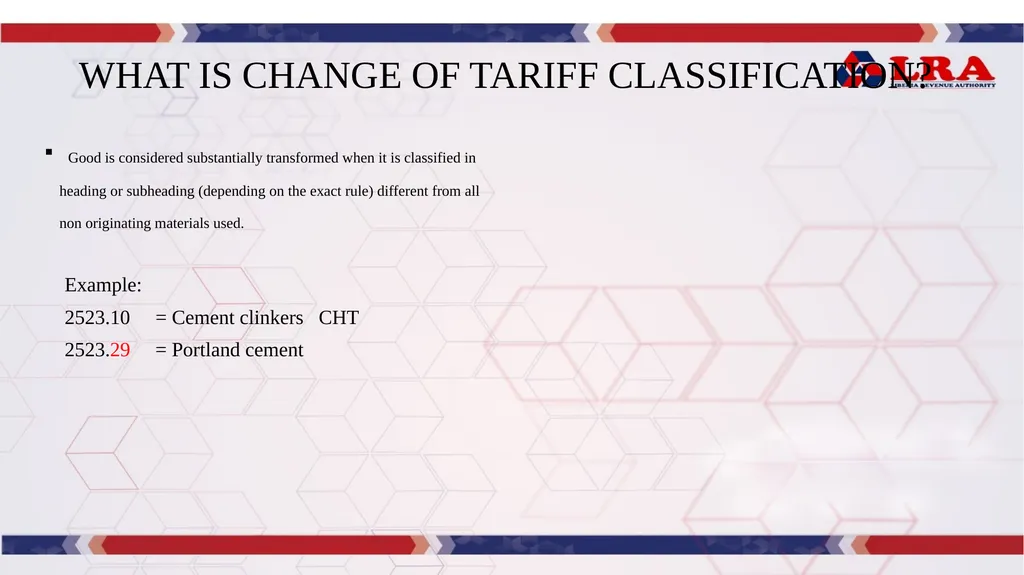
slide40. WHAT IS CHANGE OF TARIFF CLASSIFICATION? Good is considered substantially transformed when it is classified in
heading or subheading (depending on the exact rule) different from all
non originating materials used.
Example:
2523.10 = Cement clinkers CHT
2523.29 = Portland cement<br>
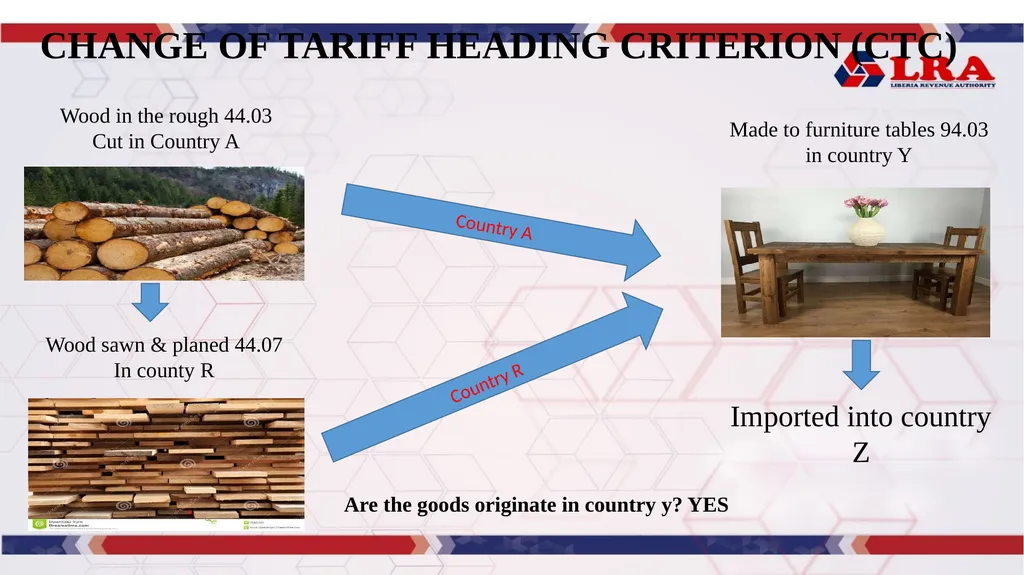
slide41. CHANGE OF TARIFF HEADING CRITERION (CTC) Wood sawn & planed 44.07
In county R Wood in the rough 44.03
Cut in Country A Made to furniture tables 94.03 in country Y Imported into country Z Country A Country R Are the goods originate in country y? YES<br>
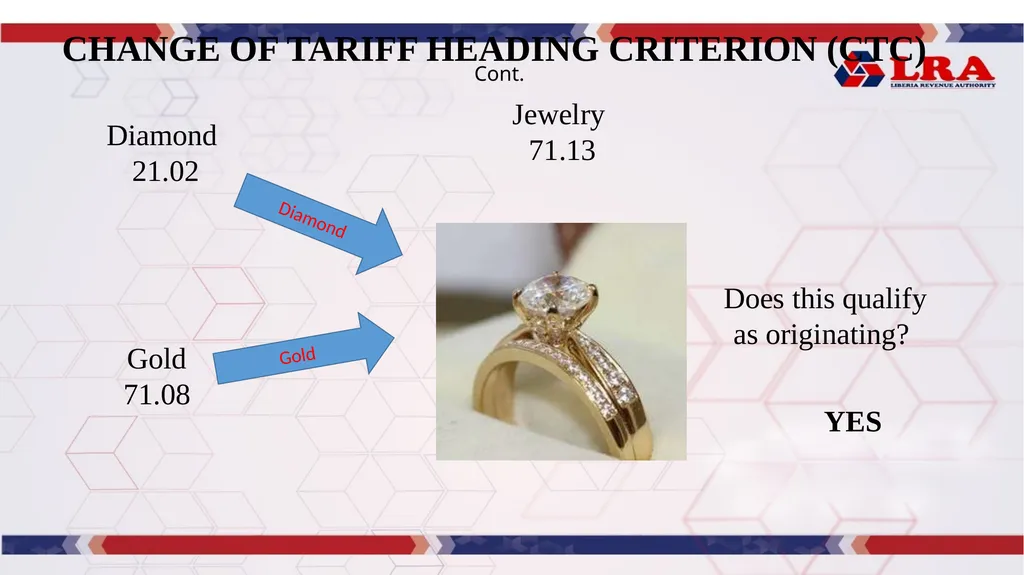
slide42. CHANGE OF TARIFF HEADING CRITERION (CTC) Cont. Diamond
21.02 Gold
71.08 Jewelry
71.13 Does this qualify as originating? YES Diamond Gold<br>
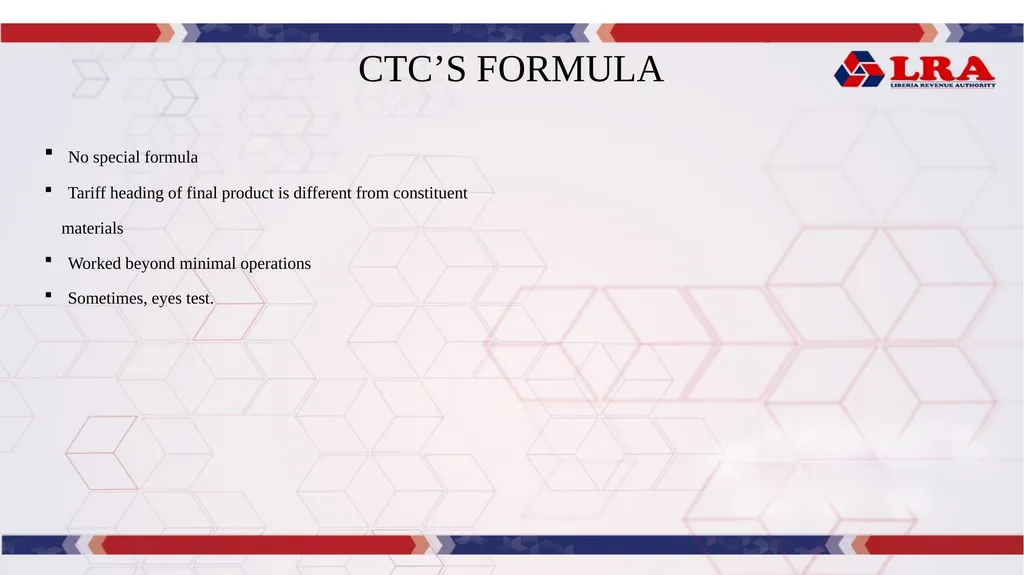
slide43. CTC’S FORMULA No special formula
Tariff heading of final product is different from constituent
materials
Worked beyond minimal operations
Sometimes, eyes test.<br>
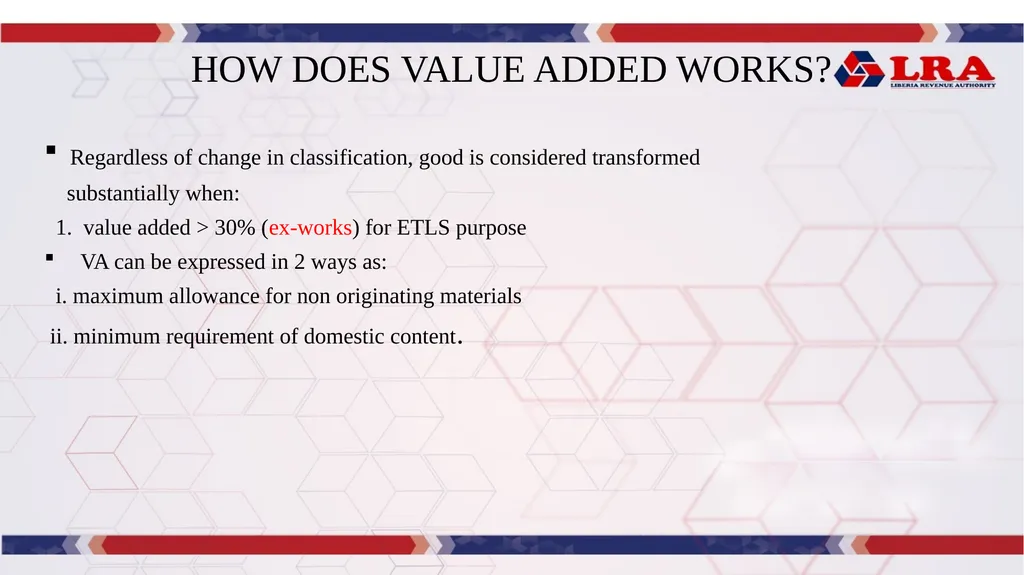
slide44. HOW DOES VALUE ADDED WORKS? Regardless of change in classification, good is considered transformed
substantially when:
1. value added > 30% (ex-works) for ETLS purpose
VA can be expressed in 2 ways as:
i. maximum allowance for non originating materials
ii. minimum requirement of domestic content.<br>
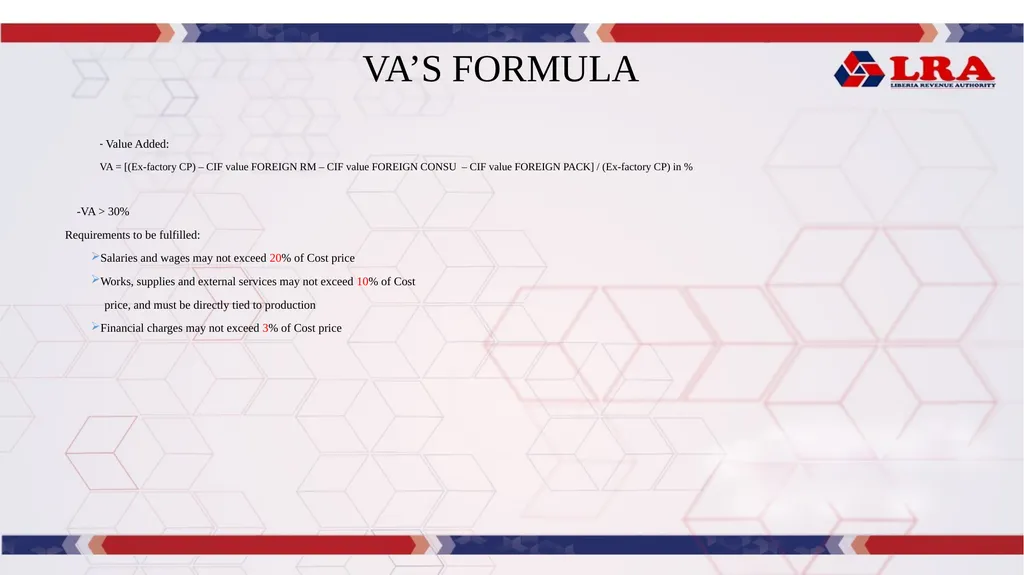
slide45. VA’S FORMULA - Value Added:
VA = [(Ex-factory CP) – CIF value FOREIGN RM – CIF value FOREIGN CONSU – CIF value FOREIGN PACK] / (Ex-factory CP) in %
-VA > 30%
Requirements to be fulfilled:
Salaries and wages may not exceed 20% of Cost price
Works, supplies and external services may not exceed 10% of Cost
price, and must be directly tied to production
Financial charges may not exceed 3% of Cost price<br>
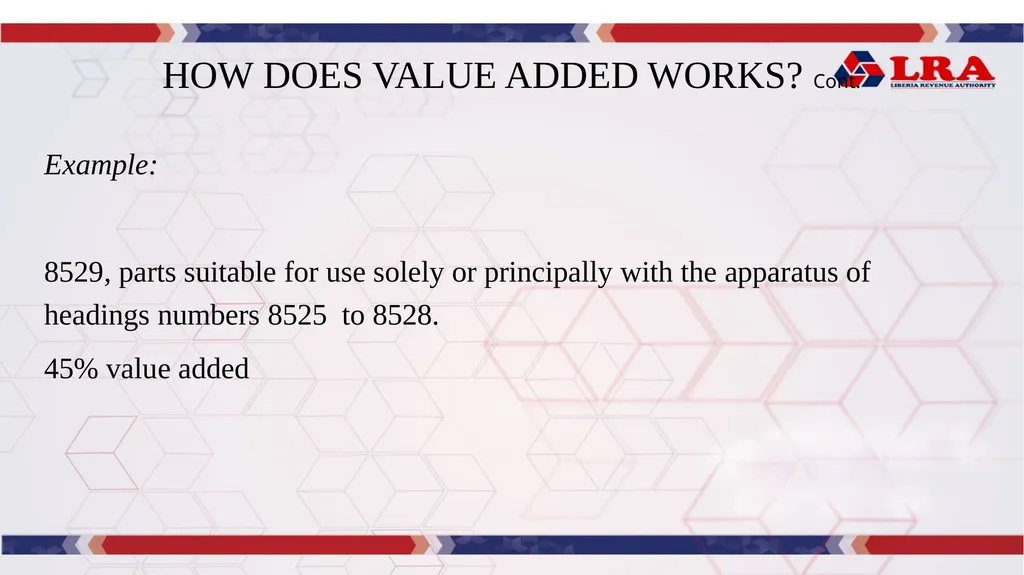
slide46. HOW DOES VALUE ADDED WORKS? Cont. Example:
8529, parts suitable for use solely or principally with the apparatus of headings numbers 8525 to 8528.
45% value added<br>
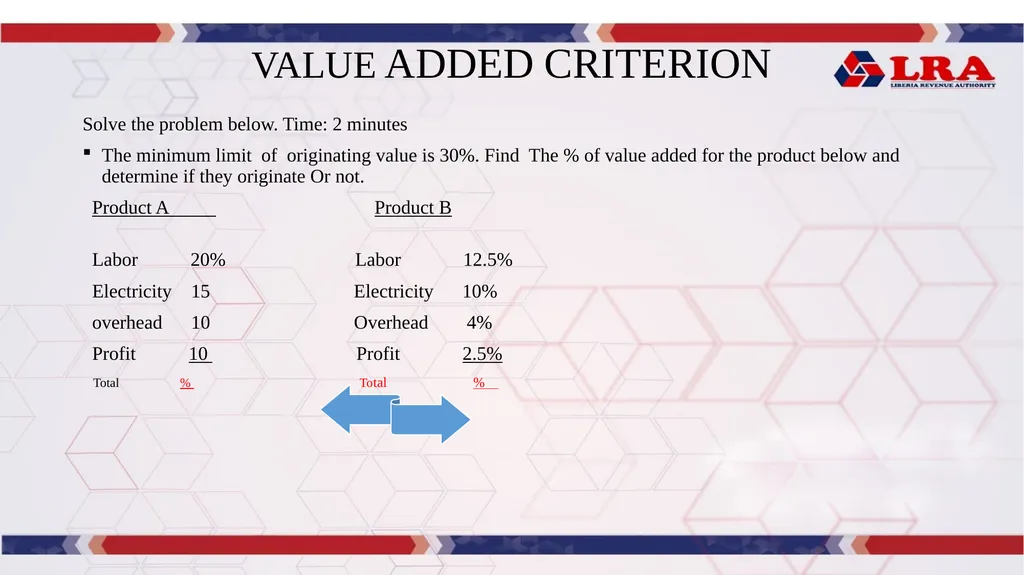
slide47. VALUE ADDED CRITERION Solve the problem below. Time: 2 minutes
The minimum limit of originating value is 30%. Find The % of value added for the product below and determine if they originate Or not.
Product A Product B
Labor 20% Labor 12.5%
Electricity 15 Electricity 10%
overhead 10 Overhead 4%
Profit 10 Profit 2.5%
Total % Total %<br>
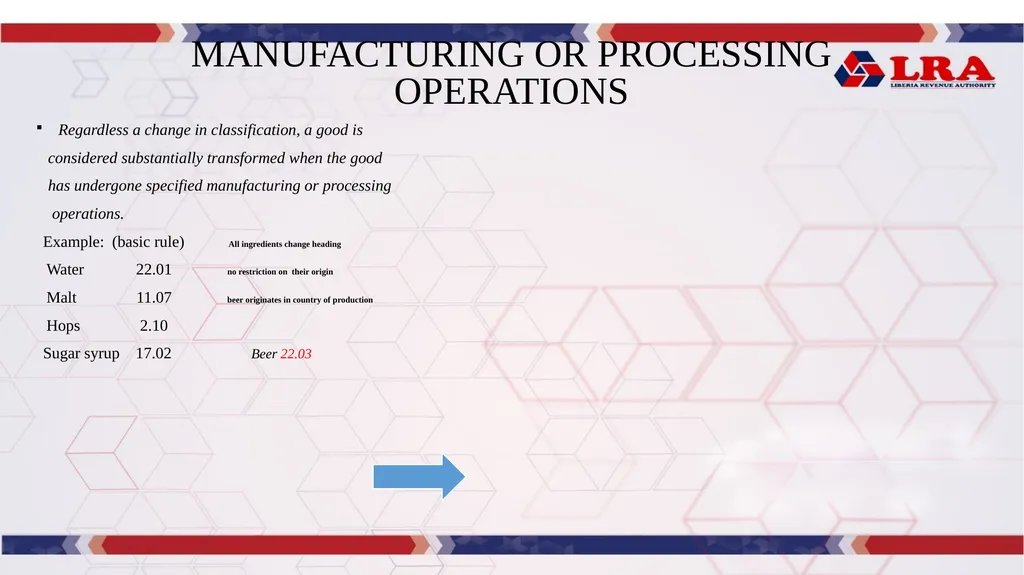
slide48. MANUFACTURING OR PROCESSING OPERATIONS Regardless a change in classification, a good is
considered substantially transformed when the good
has undergone specified manufacturing or processing
operations.
Example: (basic rule) All ingredients change heading
Water 22.01 no restriction on their origin
Malt 11.07 beer originates in country of production
Hops 2.10
Sugar syrup 17.02 Beer 22.03<br>
slide49. WHAT IS MINIMAL OPERATIONS? Reverse form of Manufacturing operations
Seen in Preferential and Non-preferential Agreements
Points to operations that are insufficient and do not confers origin
Examples:
1. labeling 2. Packaging 3. Assembling<br>
slide50. MINIMAL OPERATIONS, NO ORIGIN CONFERED 1. Operations for preservation of products during transport and storage:
chilling
placing in salt, sulphur dioxide, or other aqueous solutions
removal of damaged parts, etc.<br>
slide51. MINIMAL OPERATIONS, NO ORIGIN CONFERED cont. 2. Simple operations such as:
• Removal of dust, sifting or screening, sorting, washing, painting, cutting
up, and matching including the making up sets of articles;
3. Changing or packing and breaking up and assembly of consignments
• placing in bottles, flasks, bags, boxes
• fixing on cards, boards, and other simple packaging operations<br>
slide52. MINIMAL OPERATIONS, NO ORIGIN CONFERED cont. 4. Affixing marks, labels or other distinguishing signs on products or
on their packaging
5. Simple mixing of products, whether or not of different kinds, where
one or more of the component mixtures do not meet the conditions laid
down in the rules to enable them to be considered originating products<br>
slide53. MINIMAL OPERATIONS, NO ORIGIN CONFERED cont. 6. Simple assembly of parts of products to constitute a complete
product
7. Simple combination of two or more operations shown in 1 to 6
8. Slaughter of animals does not qualify as ‘sufficient
transformation’<br>
slide54. DE MIMIMIS OR TOLERANCE RULE Permits a specific share (often between 10% & 15%) of value or volume
of final product to be non originating
Final product maintains originating status
Applicable components identified in Agreement
Example:
HS chapters to which the tolerance does not apply.<br>
slide55. ROLLING-UP” OF PREFERENTIAL STATUS METHOD Rolling-Up: When establishing the origin status of parts:
Calculate the local content,
Calculate the non-originating materials,
If the parts qualifies as originating, then all the non-originating
materials obtain originating status.<br>
slide56. ROLLING-UP” OF PREFERENTIAL STATUS METHOD cont. ROLLING-UP” OF PREFERENTIAL STATUS METHOD
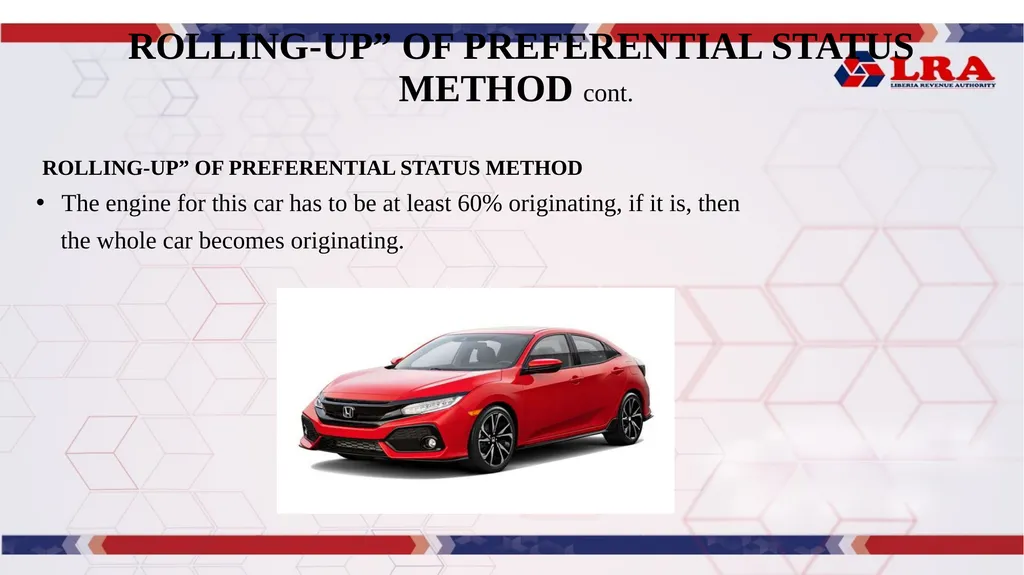
The engine for this car has to be at least 60% originating, if it is, then
the whole car becomes originating.<br>
slide57. ROLLING-UP” OF PREFERENTIAL STATUS METHOD cont. Rolling – up benefit:
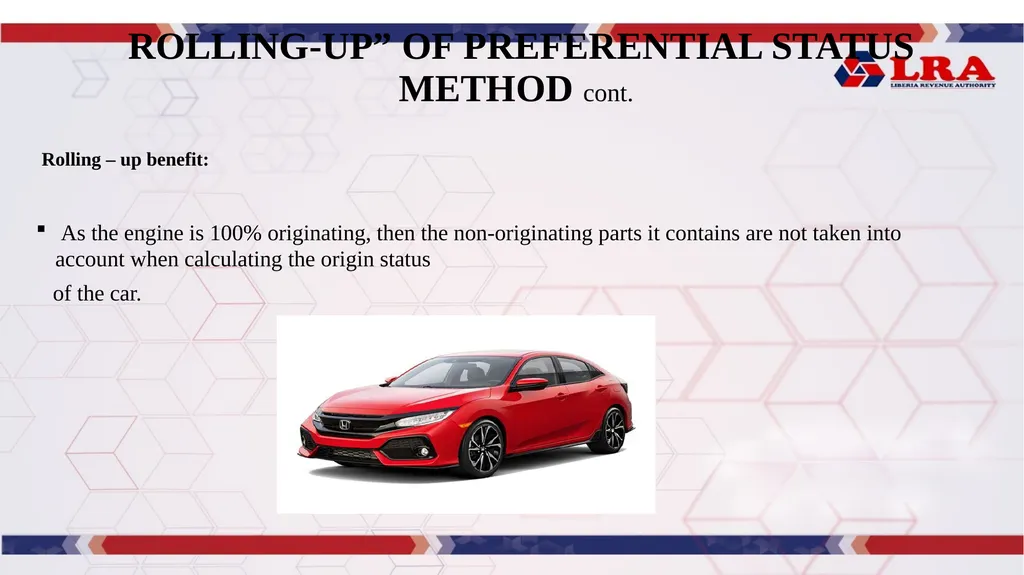
As the engine is 100% originating, then the non-originating parts it contains are not taken into account when calculating the origin status
of the car.<br>
slide58. ROLLING-UP” OF PREFERENTIAL STATUS METHOD cont. Rolling – up example:
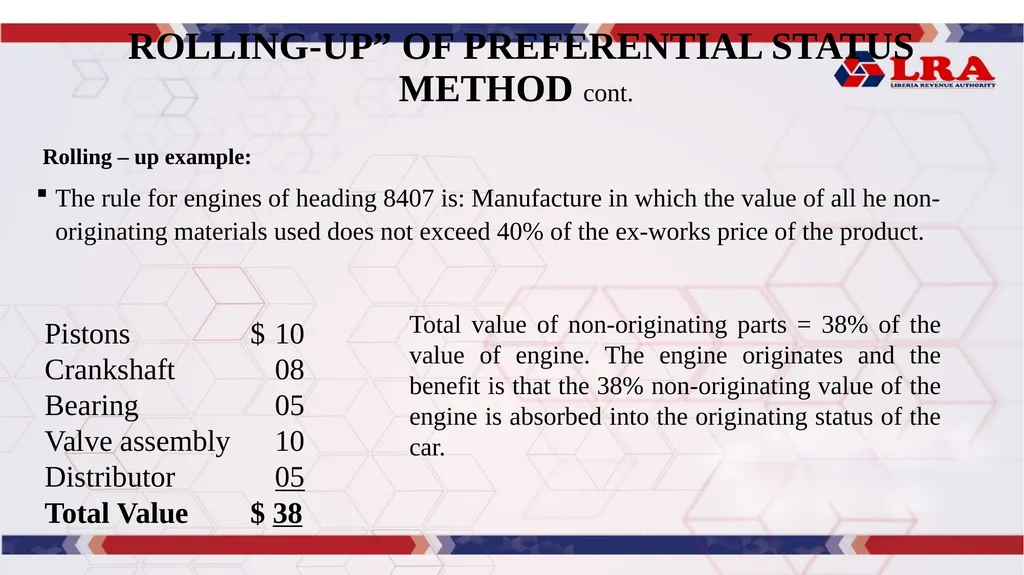
The rule for engines of heading 8407 is: Manufacture in which the value of all he non-originating materials used does not exceed 40% of the ex-works price of the product. Pistons $ 10
Crankshaft 08
Bearing 05
Valve assembly 10
Distributor 05
Total Value $ 38 Total value of non-originating parts = 38% of the value of engine. The engine originates and the benefit is that the 38% non-originating value of the engine is absorbed into the originating status of the car.<br>
slide59. DONOR COUNTRY CONTENT When component materials are supplied by a country, or a group of
countries such as the EU, and the finished product is to be exported
to that same supplying; then the materials supplied by the donor
country are deemed to have originated in the country of manufacture.<br>
slide60. TRANSPORT CONDITIONS What is directly consigned?
Goods transported without passing through another country – except
in the case of reginal cumulation.
Goods transshipped through another country for the purposes of consignment – provided they have remained under customs control.<br>
slide61. TRANSPORT CONDITIONS cont. Directly consigned, evidence required:
A through bill of lading issued in the exporting beneficiary country covering passage through the country of transit or;
Certification issued by customs in the country of transit detailing the goods, dates, transport, and conditions they remained in that country or;
Failing these, any substantial documents.<br>
slide62. SUMMARY In closing, we realized that RO is in short, a citizenship status of trade in goods;
We discussed RO from the perspective of its make up- Preferential and
Non-Preferential status;
Its legal basics including the proof origin and certificate of origin were sufficiently look at;
We further looked at the principles for proof of origin (simplicity and
predictability) as well as the origin conferring criteria of Wholly
obtained and Substantial/sufficient criteria;
We also, looked at what is considered value added, change of tariff
herding and minimum operations.<br>
slide63. SUMMARY cont. We also, looked at what is considered value added, change of tariff
herding and minimum operations.
Finally, we looked at De Minimis or Tolerance rules, Rolling –Up
of preferential status method and Transport conditions.<br>
slide64. THANK YOU Q &A<br>
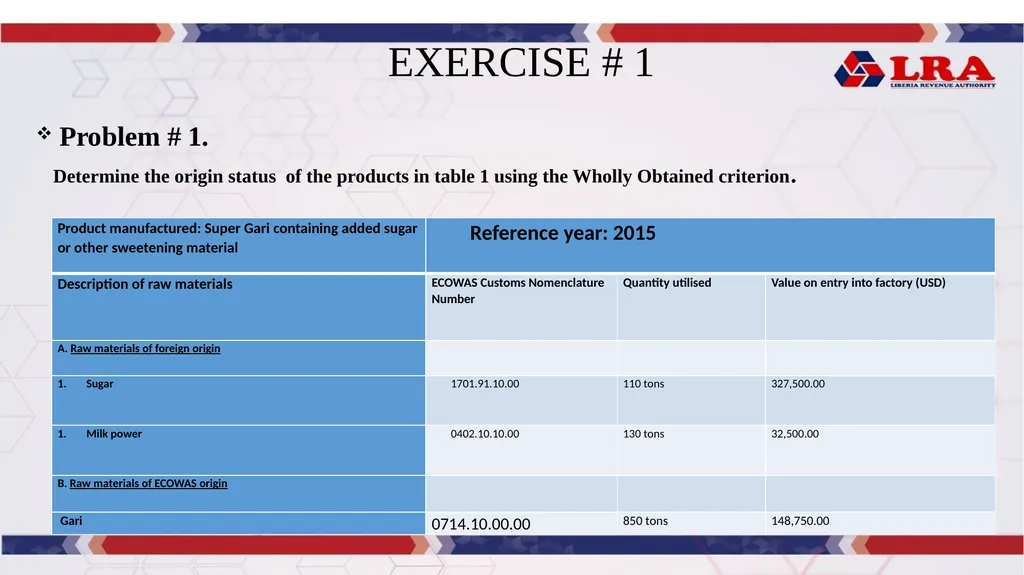
slide65. EXERCISE # 1 Problem # 1.
Determine the origin status of the products in table 1 using the Wholly Obtained criterion.<br>
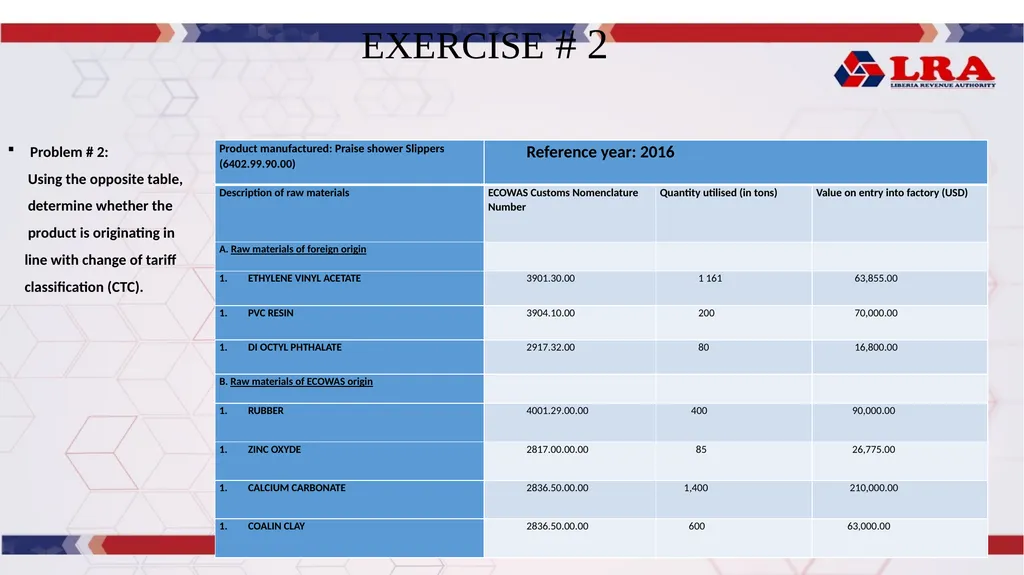
slide66. EXERCISE # 2 Problem # 2:
Using the opposite table,
determine whether the
product is originating in
line with change of tariff
classification (CTC).<br>
slide2. OUTLINE 1. Objectives
2. Introduction
3. The legal basis for Rules of Origin
4. Scope of Rules of Origin
5. Proof of Origin
6. Principles for Rules of Origin
7. Origin conferring criteria
8. What is Wholly obtain?
9. Substantial Transformation criterion
What is Minimum Operations?
What De Minimis? 4<br>
slide3. OBJECTIVES At the end of this module, the participants will be able to:
Discus the legal framework of RO
Discuss Rules of Origin with emphasis to Preferential
and Non- Preferential rules of origin
Discus the origin conferring criteria
Explain the purpose of ECOWAS’ origin certificate 4<br>
slide4. INTRODUCTION Rules of Origin (RO) are the means by which we determine where goods originate, i.e. not where they have been shipped from, but where they are deemed to have been produced or manufactured. 1 4 1<br>
slide5. INTRODUCTION cont. The participants in this course are entreated to do their
utmost best to enhance their knowledge and skills to make
them efficient and active participants and to contribute
effectively to the conduct of the class session. This may lead
to a successful pass in the Customs Brokers Licensing
uniform examination. 2<br>
slide6. INTRODUCTION cont. On the other hand, participants who may not assert
themselves proficiently in this module, could stand the risk
of not passing the uniform examination and may fail to be
licensed to practice as professional Customs broker. 3<br>
slide7. WHAT IS THE LEGAL BASIS OF RO? Articles I, II, III and XI of GATT 1994 (MFN)
Article VI of GATT 1994 (adcd)
Article XIX of GATT 1994 (sgm)
Article IX of GATT 1994 & Annex II
Accession to WTO
Ratification of ECOWAS’ ETLS protocol, 2003
ACP, AGOA agreements, etc. 5<br>
slide8. CATEGORIES OF RO 6 Preferential Rules Non-Preferential Rules Rules of Origin<br>
slide9. WHAT RULES OF ORIGIN DOES NOT COVER? 7<br>
slide10. WHAT RULES OF ORIGIN DOES NOT COVER? CONT. FREEZONE GOODS UNDRER ETLS
Goods transformed within the framework of economic or suspense
Customs regimes or certain special regimes involving the suspension,
or partial or total exemption from Customs duties on inputs, shall in
no case be considered as originating products.<br>
slide11. PROOF OF ORIGIN A Certificate of Origin (CO), issued by designated, authority
in the country of export (Member State)
Statement of declaration issued by the exporter or manufacturer 8<br>
slide12. ECOWAS’ CERTIFICATE OF ORIGIN (SAMPLE) 10<br>
slide13. PRINCIPLES FOR PROOF OF ORIGIN Principle 1: Simplicity
-The rules must be cleared and transparent in order
to minimize the possibility of being applied in
subjective, biased, or fraudulent manner. Else, they create
needless hitches that hinder trade. 9<br>
slide14. PRINCIPLES FOR PROOF OF ORIGIN cont. Principle 2: Predictability
-The rules must be amply clear, recognized and
stable to enable the manufacturer to predict in a
clear and secure manner how the rules will be applied
to various goods, taking into account their
respective destinations. 9<br>
slide15. NO CO REQUIREMENT IMPORTS Certificate of Origin shall not be required for
agricultural and livestock products, hand-made
articles or articles produced with or without the use of
tools, instruments or implements directly operated by
the craftsman.
Example:
Cows, goats, carved wood, plantains, chickens, etc. 9<br>
slide16. WHAT IS PREFERENTIAL RO? Simply means, trade agreements between
governments that allow goods of their countries to
be imported at reduced or zero duty rates.
Example:
Manu River Union Protocol (Guinea, Ivory Coast, Liberia & Sierra
Leone ) 11<br>
slide17. WHY USED PREFERENTIAL RO? It is used for the following:
1. Generalize System of Preferences (GSP);
2. Free Trade Agreement (FTA);
3. Regional Trade Agreement (RTA).
Example:
ACP Agreement (EU and African countries, +) 12<br>
slide18. WHY USE PREFERENTIAL RO? Cont. Examples:
1. ACP Agreement with EU and African countries
2. ETLS Protocol (ECOWAS members states)
3. Manu River Union Protocol (Guinea, Ivory Coast, Liberia &
S/Leone )
4. AGOA Protocol/Agreement (between America and
African countries, +). 18<br>
slide19. WHAT IS NON-PREFERENTIAL RO? Article 1 of GATT 1994 defines it as those laws, regulations and
administrative determinations of general application applied to
determine the country of origin of goods except those related to the
granting of tariff preferences.
Example: Most-Favor-Nation treatment (MFN)<br>
slide20. WHY USE NON-PREFERENTIAL RO? They are used for commercial policy measures as:
1. Anti-dumping and Countervailing duties; MFN;
2. Trade embargoes, Safeguard and retaliation measures;
3. Quantity restrictions and tariff quotas;
4. Trade statistics and Public tender; etc.<br>
slide21. ORIGIN CONFERRING CRITERIA They are 2 criteria that confer origin on trade in goods:
1. Wholly obtained criterion
2. Substantial/sufficient transformation criterion<br>
slide22. WHAT IS WHOLLY OBTAINED? Trade in goods considered wholly obtained includes:
1. live animals born and raised within the Member States;
2. mineral products extracted from the ground, sub-soil or sea bed
of Member States;
3. vegetable products harvested within Member States;
4. products obtained from animals living or raised in Member States;<br>
slide23. WHAT IS WHOLLY OBTAINED? Cont. 5. products obtained by hunting or fishing within member States;
6. products obtained from the sea, river and lakes within Member
States by vessels belonging to the Member States;
7. products manufactured aboard ship factories belonging to member
States exclusively from products referred to in paragraph (6) above;<br>
slide24. WHAT IS WHOLLY OBTAINED? Cont. 8. used articles fit only for the recovery of raw materials, provided
that such articles have been collected from users within member States;
9. scraps and waste resulting from manufacturing operations within
Member States;<br>
slide25. WHAT IS WHOLLY OBTAINED? Cont. 10. goods produced from the materials listed in paragraphs 2 to 9
above, used alone or mixed with other materials, provided that
they represent at least 60% of total quantity of raw materials used;
and
11. electrical energy produced in the Member States;<br>
slide26. EXAMPLES OF WHOLLY OBTAINED 1. Live animals born and raised in the country<br>
slide27. EXAMPLES OF WHOLLY OBTAINED Cont. 2. Vegetable products and harvested in the country<br>
slide28. EXAMPLES OF WHOLLY OBTAINED Cont. 3. Mineral Products extracted within the country Diamond Iron Ore<br>
slide29. EXAMPLES OF WHOLLY OBTAINED Cont. 4. Products derived from live animals raised in the country<br>
slide30. EXAMPLES OF WHOLLY OBTAINED Cont. 5. Products of hunting or fishing in the country<br>
slide31. EXAMPLES OF WHOLLY OBTAINED Cont. 6. Products of sea fishing and other products taken from the sea by its vessels<br>
slide32. EXAMPLES OF WHOLLY OBTAINED Cont. 7. Products made on board its factory ships exclusively from the products in (6)<br>
slide33. EXAMPLES OF WHOLLY OBTAINED Cont. 8. Used articles collected there fit only for the recovery of raw materials<br>
slide34. EXAMPLES OF WHOLLY OBTAINED Cont. 9. Waste and scraps resulting from manufacturing operations conducted there<br>
slide35. EXAMPLES OF WHOLLY OBTAINED Cont. 10. Products extracted from the sea bed or below the sea bed which is situated
outside its territorial waters, provided that it has exclusive exploitation<br>
slide36. EXAMPLES OF WHOLLY OBTAINED Cont. 10. Products produced goods exclusively from originating
products specified in (1-10)
11. Electrical energy produced in the Member States<br>
slide37. WP’S FARMULA. Goods are regarded as WHOLLY PRODUCED within ECOWAS,
if at least 60% of the total quantity of raw materials used
originate from the ECOWAS region quantity of raw materials
used originate from the ECOWAS region
WP= ECOWAS RM/(ECOWAS RM + FOREIGN RM) in %
Where
ECOWAS RM: Quantity of raw materials originated from ECOWAS
FOREIGN RM: Quantity of raw materials originated from Foreign
=WP > 60%<br>
slide38. SUBSTANTIAL TRANSFORMATION CRITERION There are 3 major criteria:
1. Change of Tariff Classification criterion
2. Value Added (ad valorem percentage) criterion
3. Manufacture or Processing operations (technical
requirement) criterion.<br>
slide39. SUBSTANTIAL TRANSFORMATION CRITERION cont. What is sufficient working or processing?
Products which incorporate materials NOT WHOLLY OBTAINED but which have undergone SUFFICIENT TRANSFORMATION OR PROCESSING.<br>
slide40. WHAT IS CHANGE OF TARIFF CLASSIFICATION? Good is considered substantially transformed when it is classified in
heading or subheading (depending on the exact rule) different from all
non originating materials used.
Example:
2523.10 = Cement clinkers CHT
2523.29 = Portland cement<br>
slide41. CHANGE OF TARIFF HEADING CRITERION (CTC) Wood sawn & planed 44.07
In county R Wood in the rough 44.03
Cut in Country A Made to furniture tables 94.03 in country Y Imported into country Z Country A Country R Are the goods originate in country y? YES<br>
slide42. CHANGE OF TARIFF HEADING CRITERION (CTC) Cont. Diamond
21.02 Gold
71.08 Jewelry
71.13 Does this qualify as originating? YES Diamond Gold<br>
slide43. CTC’S FORMULA No special formula
Tariff heading of final product is different from constituent
materials
Worked beyond minimal operations
Sometimes, eyes test.<br>
slide44. HOW DOES VALUE ADDED WORKS? Regardless of change in classification, good is considered transformed
substantially when:
1. value added > 30% (ex-works) for ETLS purpose
VA can be expressed in 2 ways as:
i. maximum allowance for non originating materials
ii. minimum requirement of domestic content.<br>
slide45. VA’S FORMULA - Value Added:
VA = [(Ex-factory CP) – CIF value FOREIGN RM – CIF value FOREIGN CONSU – CIF value FOREIGN PACK] / (Ex-factory CP) in %
-VA > 30%
Requirements to be fulfilled:
Salaries and wages may not exceed 20% of Cost price
Works, supplies and external services may not exceed 10% of Cost
price, and must be directly tied to production
Financial charges may not exceed 3% of Cost price<br>
slide46. HOW DOES VALUE ADDED WORKS? Cont. Example:
8529, parts suitable for use solely or principally with the apparatus of headings numbers 8525 to 8528.
45% value added<br>
slide47. VALUE ADDED CRITERION Solve the problem below. Time: 2 minutes
The minimum limit of originating value is 30%. Find The % of value added for the product below and determine if they originate Or not.
Product A Product B
Labor 20% Labor 12.5%
Electricity 15 Electricity 10%
overhead 10 Overhead 4%
Profit 10 Profit 2.5%
Total % Total %<br>
slide48. MANUFACTURING OR PROCESSING OPERATIONS Regardless a change in classification, a good is
considered substantially transformed when the good
has undergone specified manufacturing or processing
operations.
Example: (basic rule) All ingredients change heading
Water 22.01 no restriction on their origin
Malt 11.07 beer originates in country of production
Hops 2.10
Sugar syrup 17.02 Beer 22.03<br>
slide49. WHAT IS MINIMAL OPERATIONS? Reverse form of Manufacturing operations
Seen in Preferential and Non-preferential Agreements
Points to operations that are insufficient and do not confers origin
Examples:
1. labeling 2. Packaging 3. Assembling<br>
slide50. MINIMAL OPERATIONS, NO ORIGIN CONFERED 1. Operations for preservation of products during transport and storage:
chilling
placing in salt, sulphur dioxide, or other aqueous solutions
removal of damaged parts, etc.<br>
slide51. MINIMAL OPERATIONS, NO ORIGIN CONFERED cont. 2. Simple operations such as:
• Removal of dust, sifting or screening, sorting, washing, painting, cutting
up, and matching including the making up sets of articles;
3. Changing or packing and breaking up and assembly of consignments
• placing in bottles, flasks, bags, boxes
• fixing on cards, boards, and other simple packaging operations<br>
slide52. MINIMAL OPERATIONS, NO ORIGIN CONFERED cont. 4. Affixing marks, labels or other distinguishing signs on products or
on their packaging
5. Simple mixing of products, whether or not of different kinds, where
one or more of the component mixtures do not meet the conditions laid
down in the rules to enable them to be considered originating products<br>
slide53. MINIMAL OPERATIONS, NO ORIGIN CONFERED cont. 6. Simple assembly of parts of products to constitute a complete
product
7. Simple combination of two or more operations shown in 1 to 6
8. Slaughter of animals does not qualify as ‘sufficient
transformation’<br>
slide54. DE MIMIMIS OR TOLERANCE RULE Permits a specific share (often between 10% & 15%) of value or volume
of final product to be non originating
Final product maintains originating status
Applicable components identified in Agreement
Example:
HS chapters to which the tolerance does not apply.<br>
slide55. ROLLING-UP” OF PREFERENTIAL STATUS METHOD Rolling-Up: When establishing the origin status of parts:
Calculate the local content,
Calculate the non-originating materials,
If the parts qualifies as originating, then all the non-originating
materials obtain originating status.<br>
slide56. ROLLING-UP” OF PREFERENTIAL STATUS METHOD cont. ROLLING-UP” OF PREFERENTIAL STATUS METHOD
The engine for this car has to be at least 60% originating, if it is, then
the whole car becomes originating.<br>
slide57. ROLLING-UP” OF PREFERENTIAL STATUS METHOD cont. Rolling – up benefit:
As the engine is 100% originating, then the non-originating parts it contains are not taken into account when calculating the origin status
of the car.<br>
slide58. ROLLING-UP” OF PREFERENTIAL STATUS METHOD cont. Rolling – up example:
The rule for engines of heading 8407 is: Manufacture in which the value of all he non-originating materials used does not exceed 40% of the ex-works price of the product. Pistons $ 10
Crankshaft 08
Bearing 05
Valve assembly 10
Distributor 05
Total Value $ 38 Total value of non-originating parts = 38% of the value of engine. The engine originates and the benefit is that the 38% non-originating value of the engine is absorbed into the originating status of the car.<br>
slide59. DONOR COUNTRY CONTENT When component materials are supplied by a country, or a group of
countries such as the EU, and the finished product is to be exported
to that same supplying; then the materials supplied by the donor
country are deemed to have originated in the country of manufacture.<br>
slide60. TRANSPORT CONDITIONS What is directly consigned?
Goods transported without passing through another country – except
in the case of reginal cumulation.
Goods transshipped through another country for the purposes of consignment – provided they have remained under customs control.<br>
slide61. TRANSPORT CONDITIONS cont. Directly consigned, evidence required:
A through bill of lading issued in the exporting beneficiary country covering passage through the country of transit or;
Certification issued by customs in the country of transit detailing the goods, dates, transport, and conditions they remained in that country or;
Failing these, any substantial documents.<br>
slide62. SUMMARY In closing, we realized that RO is in short, a citizenship status of trade in goods;
We discussed RO from the perspective of its make up- Preferential and
Non-Preferential status;
Its legal basics including the proof origin and certificate of origin were sufficiently look at;
We further looked at the principles for proof of origin (simplicity and
predictability) as well as the origin conferring criteria of Wholly
obtained and Substantial/sufficient criteria;
We also, looked at what is considered value added, change of tariff
herding and minimum operations.<br>
slide63. SUMMARY cont. We also, looked at what is considered value added, change of tariff
herding and minimum operations.
Finally, we looked at De Minimis or Tolerance rules, Rolling –Up
of preferential status method and Transport conditions.<br>
slide64. THANK YOU Q &A<br>
slide65. EXERCISE # 1 Problem # 1.
Determine the origin status of the products in table 1 using the Wholly Obtained criterion.<br>
slide66. EXERCISE # 2 Problem # 2:
Using the opposite table,
determine whether the
product is originating in
line with change of tariff
classification (CTC).<br>