
MODULE Introduction to gender-based violence (GBV)
TF
Published · 44 slides · 0 views
1 / 1

Description
MODULE Introduction to gender-based violence (GBV) and sexual violence against men and boys (SVAMB) 1 Module 1 2 Brainstorm: Defining gender-based violence (GBV) What does it mean? Introduction Module 1 3 Power Gender equality Violence
Related Topics
Share
Embed code
Download this presentation From Below
"MODULE Introduction to gender-based violence (GBV)" is the property of its rightful owner. Permission is granted to download and print the materials on this website for personal, non-commercial use only, and to display it on your personal computer provided you do not modify the materials and that you retain all copyright notices contained in the materials. By downloading content from our website, you accept the terms of this agreement.
Presentation Transcript
01
MODULE Introduction to gender-based violence (GBV) and sexual violence against men and boys (SVAMB) 1<br>
02
Module 1 2 Brainstorm:
Defining gender-based violence (GBV)
What does it mean? Introduction<br>
Defining gender-based violence (GBV)
What does it mean? Introduction<br>
03
Module 1 3 Power
Gender equality
Violence
Informed consent Introduction<br>
Gender equality
Violence
Informed consent Introduction<br>
04
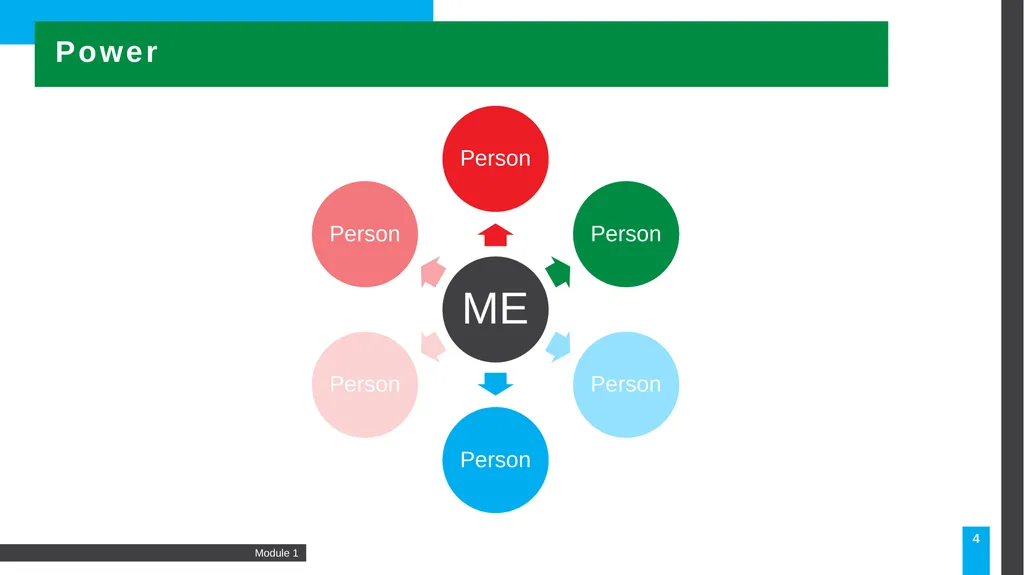
Module 1 4 Power<br>
05
Module 1 5 Economic
Political
Social
Age-related
Educational
Physical Gender-based
Class-based
Ethnicity-based
Race-based
Religion-based
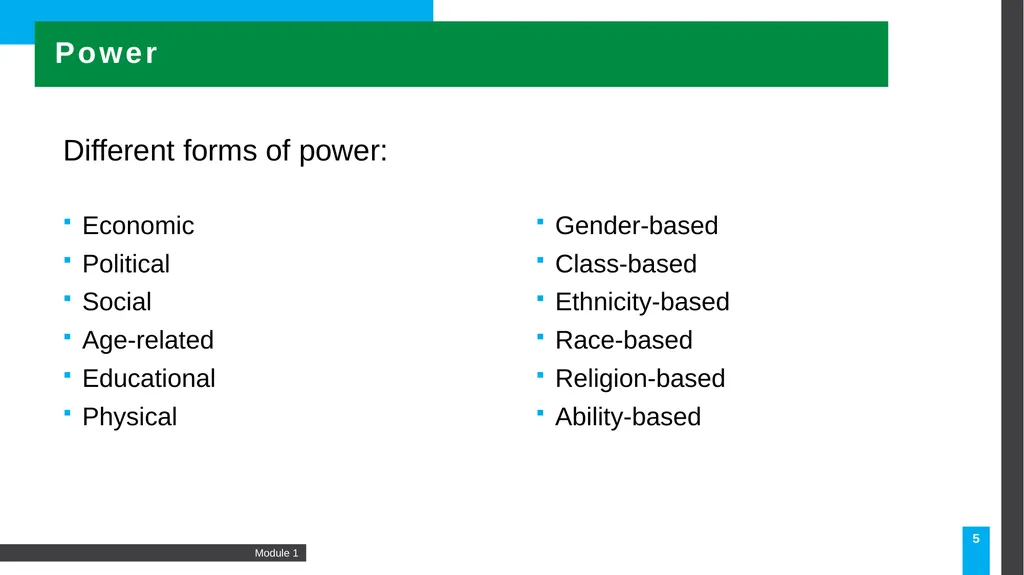
Ability-based Different forms of power: Power<br>
Political
Social
Age-related
Educational
Physical Gender-based
Class-based
Ethnicity-based
Race-based
Religion-based
Ability-based Different forms of power: Power<br>
06
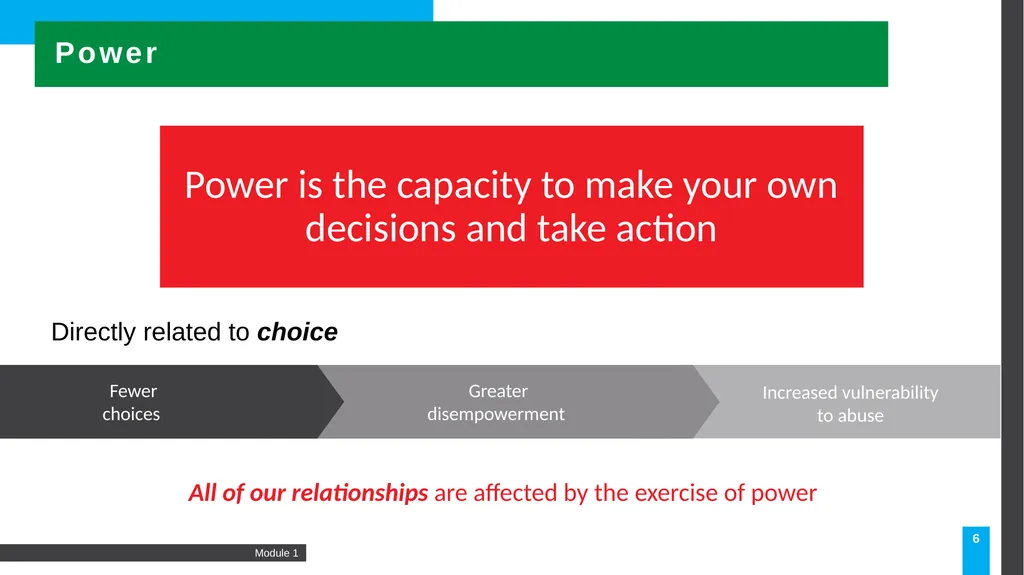
Module 1 6 Directly related to choice Power Power is the capacity to make your own decisions and take action All of our relationships are affected by the exercise of power Fewer choices Greater disempowerment Increased vulnerability to abuse<br>
07
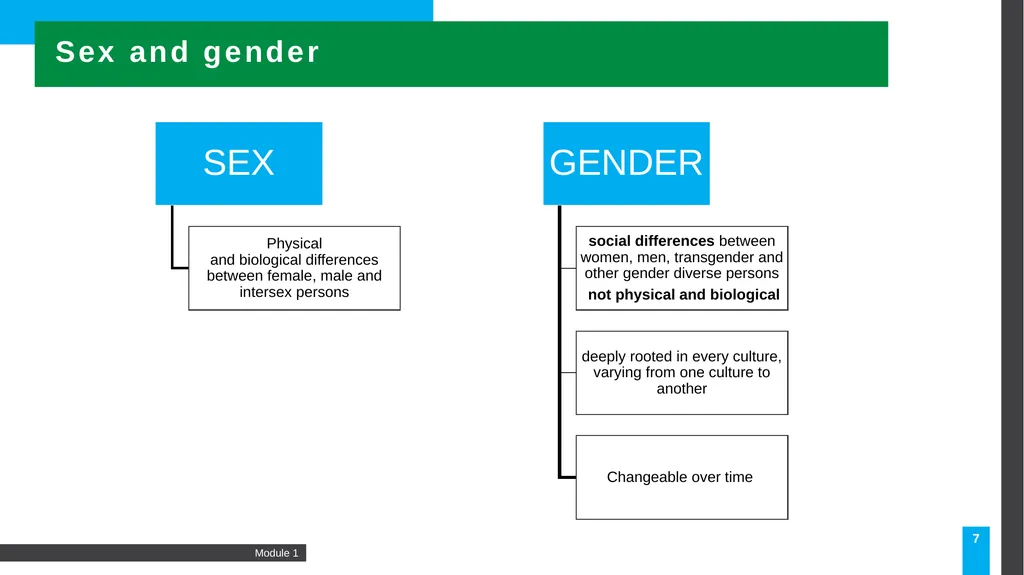
Module 1 7 Sex and gender<br>
08
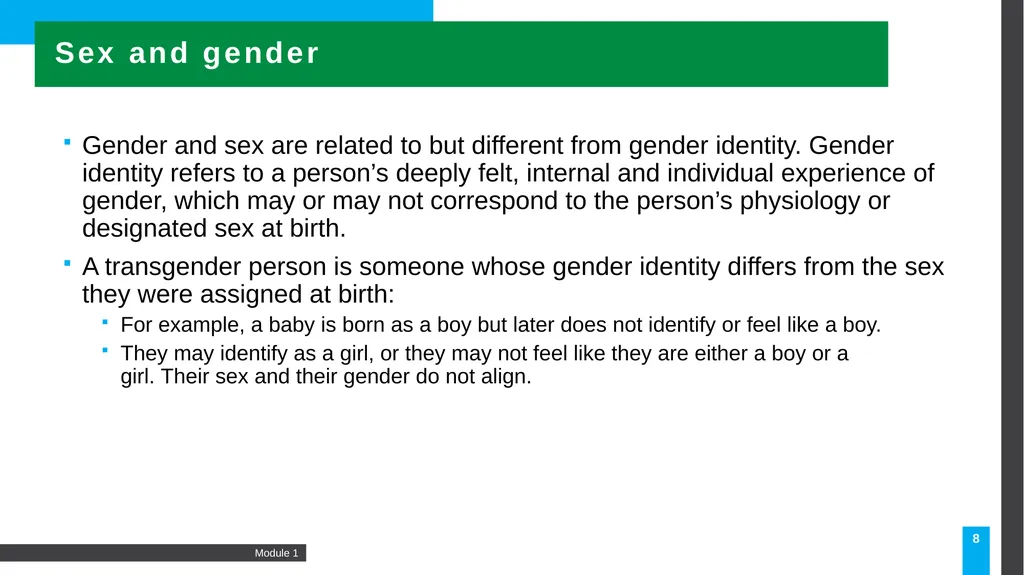
Module 1 8 Gender and sex are related to but different from gender identity. Gender identity refers to a person’s deeply felt, internal and individual experience of gender, which may or may not correspond to the person’s physiology or designated sex at birth.
A transgender person is someone whose gender identity differs from the sex they were assigned at birth:
For example, a baby is born as a boy but later does not identify or feel like a boy.
They may identify as a girl, or they may not feel like they are either a boy or a girl. Their sex and their gender do not align. Sex and gender<br>
A transgender person is someone whose gender identity differs from the sex they were assigned at birth:
For example, a baby is born as a boy but later does not identify or feel like a boy.
They may identify as a girl, or they may not feel like they are either a boy or a girl. Their sex and their gender do not align. Sex and gender<br>
09
Module 1 9 Your gender has an impact on:
Roles
Responsibilities
Expectations
Privileges
Rights
Limitations
Opportunities
Access to services Sex and gender<br>
Roles
Responsibilities
Expectations
Privileges
Rights
Limitations
Opportunities
Access to services Sex and gender<br>
10
Module 1 10 Violence What is violence?<br>
11
Module 1 11 Violence Violence is any act that causes harm.
It involves the use of some type of force, real or implied.<br>
It involves the use of some type of force, real or implied.<br>
12
Module 1 12 is not just physical
can include emotional, social/economic abuse, coercion or pressure
can be hidden
is context-specific Violence<br>
can include emotional, social/economic abuse, coercion or pressure
can be hidden
is context-specific Violence<br>
13
Module 1 13 Consent What is consent?<br>
14
Module 1 14 Consent means that people make an informed choice, freely and voluntarily, in an equal power relationship.
Acts of GBV and SVAMB occur without informed consent.
Saying yes does not = consent. "Yes" is not true consent if said under duress.
Children under the age of 18 are unable to give informed consent for acts such as female genital mutilation/cutting (FGM/C), marriage, sexual relations, etc. Consent<br>
Acts of GBV and SVAMB occur without informed consent.
Saying yes does not = consent. "Yes" is not true consent if said under duress.
Children under the age of 18 are unable to give informed consent for acts such as female genital mutilation/cutting (FGM/C), marriage, sexual relations, etc. Consent<br>
15
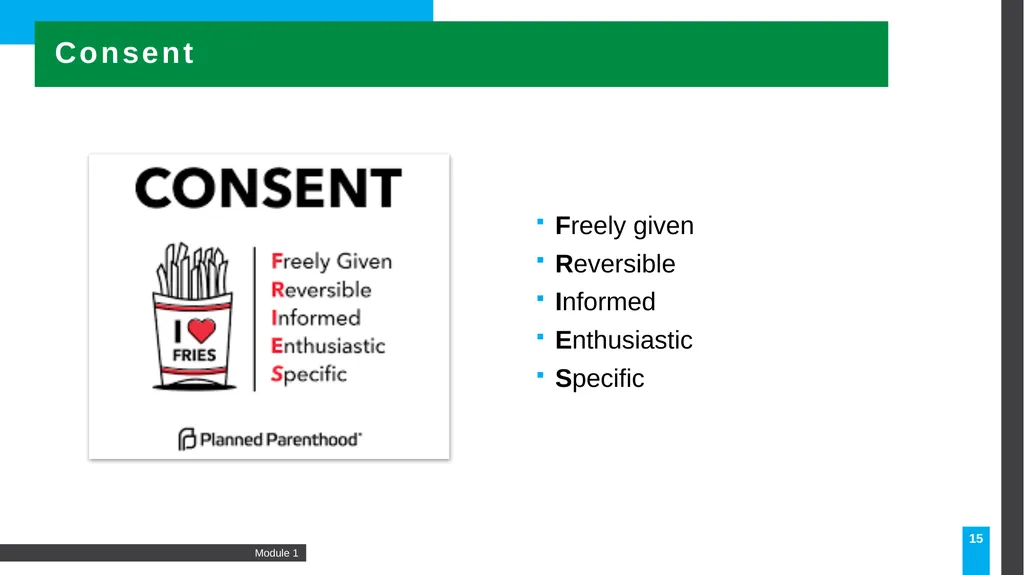
Module 1 15 Freely given
Reversible
Informed
Enthusiastic
Specific Consent<br>
Reversible
Informed
Enthusiastic
Specific Consent<br>
16
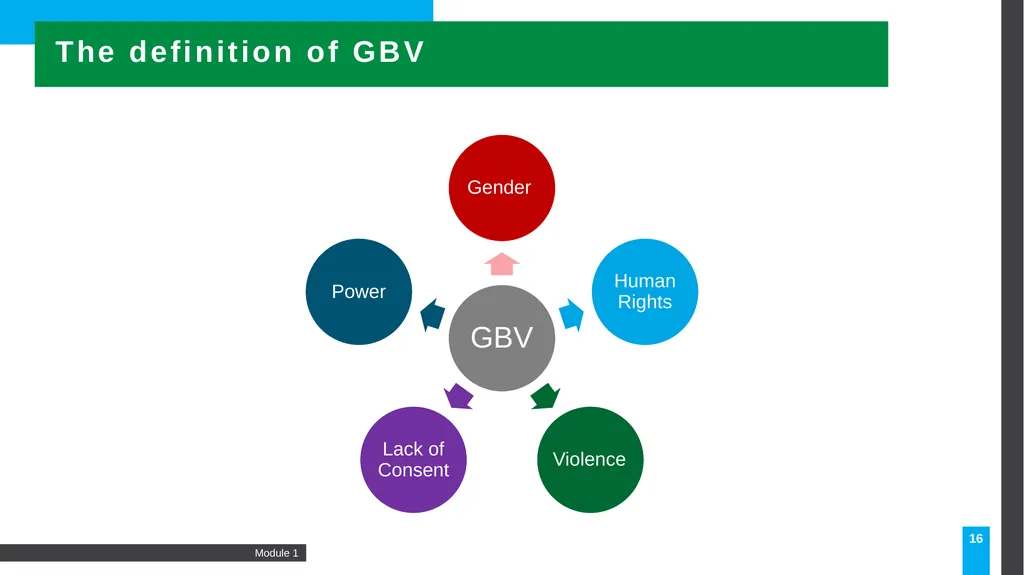
Module 1 16 The definition of GBV<br>
17
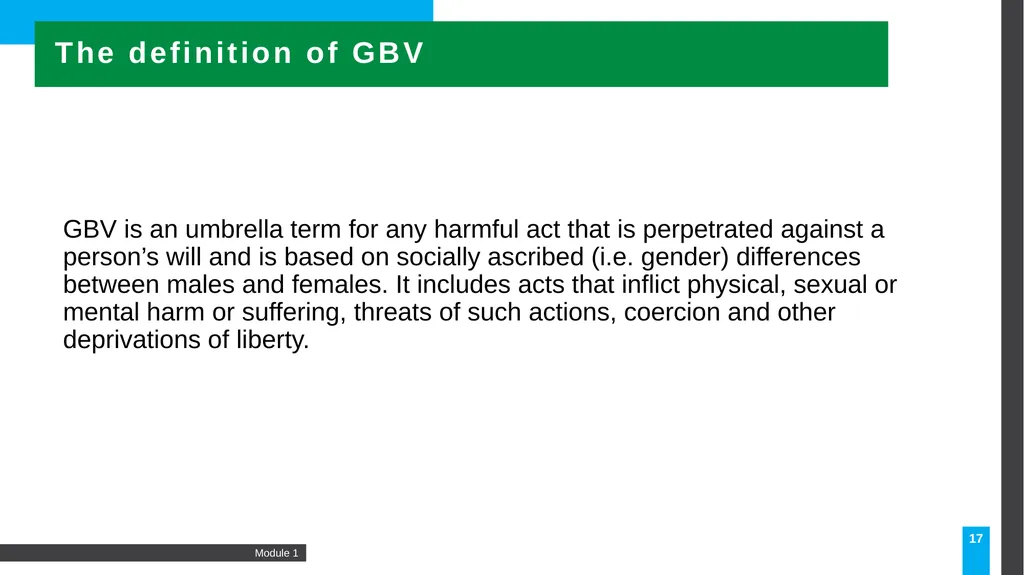
Module 1 17 GBV is an umbrella term for any harmful act that is perpetrated against a person’s will and is based on socially ascribed (i.e. gender) differences between males and females. It includes acts that inflict physical, sexual or mental harm or suffering, threats of such actions, coercion and other deprivations of liberty. The definition of GBV<br>
18
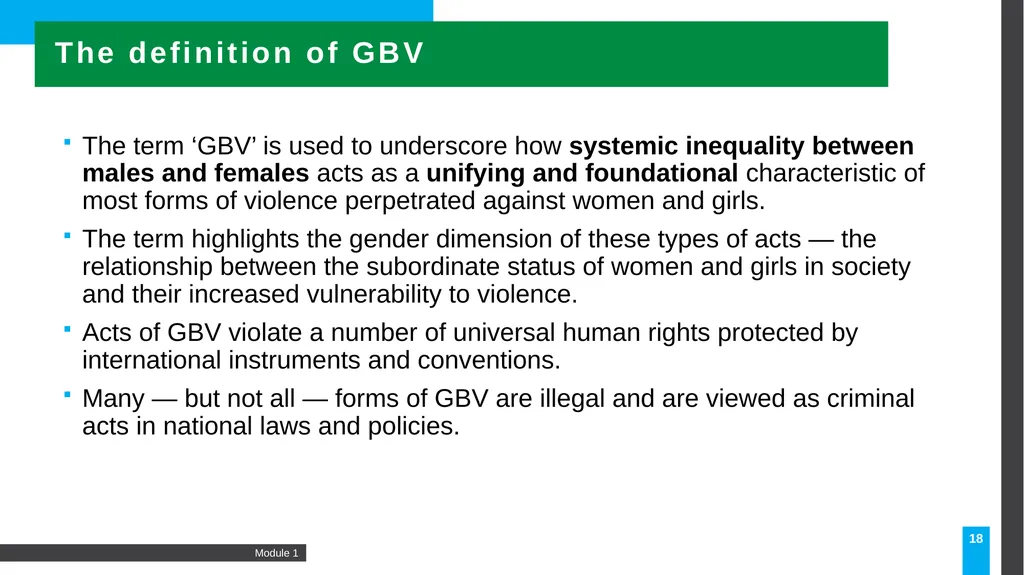
Module 1 18 The term ‘GBV’ is used to underscore how systemic inequality between males and females acts as a unifying and foundational characteristic of most forms of violence perpetrated against women and girls.
The term highlights the gender dimension of these types of acts — the relationship between the subordinate status of women and girls in society and their increased vulnerability to violence.
Acts of GBV violate a number of universal human rights protected by international instruments and conventions.
Many — but not all — forms of GBV are illegal and are viewed as criminal acts in national laws and policies. The definition of GBV<br>
The term highlights the gender dimension of these types of acts — the relationship between the subordinate status of women and girls in society and their increased vulnerability to violence.
Acts of GBV violate a number of universal human rights protected by international instruments and conventions.
Many — but not all — forms of GBV are illegal and are viewed as criminal acts in national laws and policies. The definition of GBV<br>
19
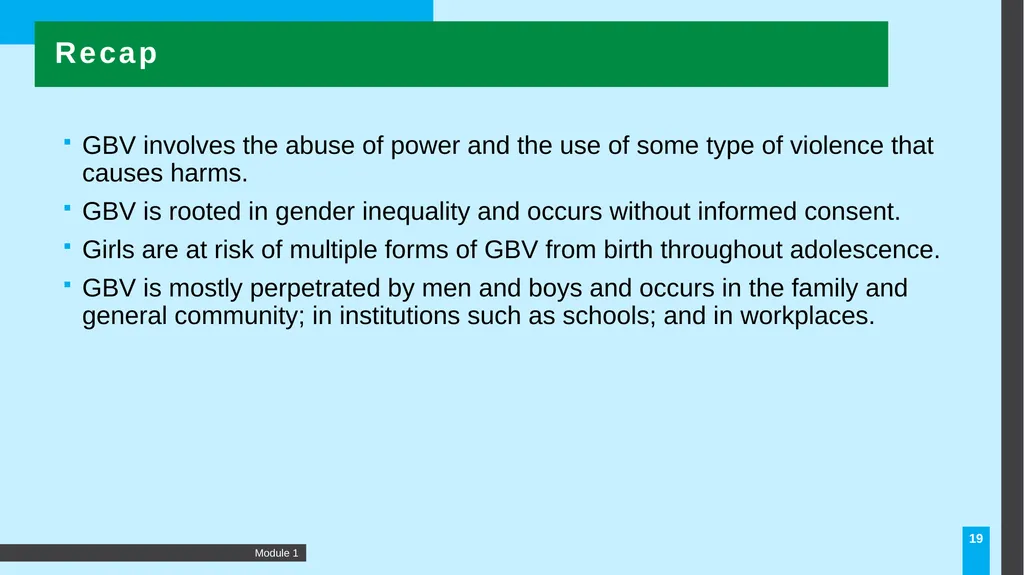
19 GBV involves the abuse of power and the use of some type of violence that causes harms.
GBV is rooted in gender inequality and occurs without informed consent.
Girls are at risk of multiple forms of GBV from birth throughout adolescence.
GBV is mostly perpetrated by men and boys and occurs in the family and general community; in institutions such as schools; and in workplaces. Recap Module 1<br>
GBV is rooted in gender inequality and occurs without informed consent.
Girls are at risk of multiple forms of GBV from birth throughout adolescence.
GBV is mostly perpetrated by men and boys and occurs in the family and general community; in institutions such as schools; and in workplaces. Recap Module 1<br>
20
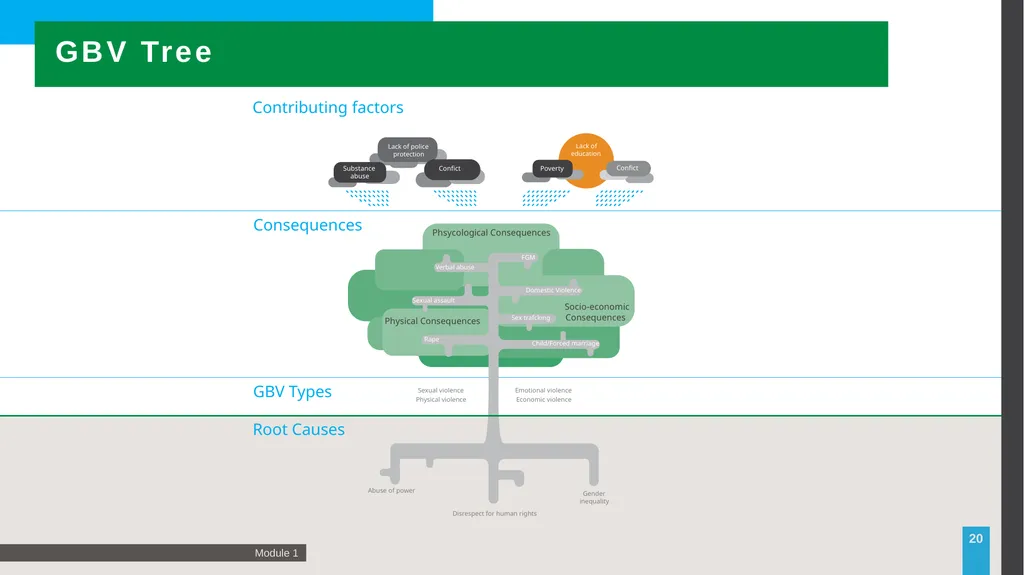
Module 1 20 GBV Tree<br>
21
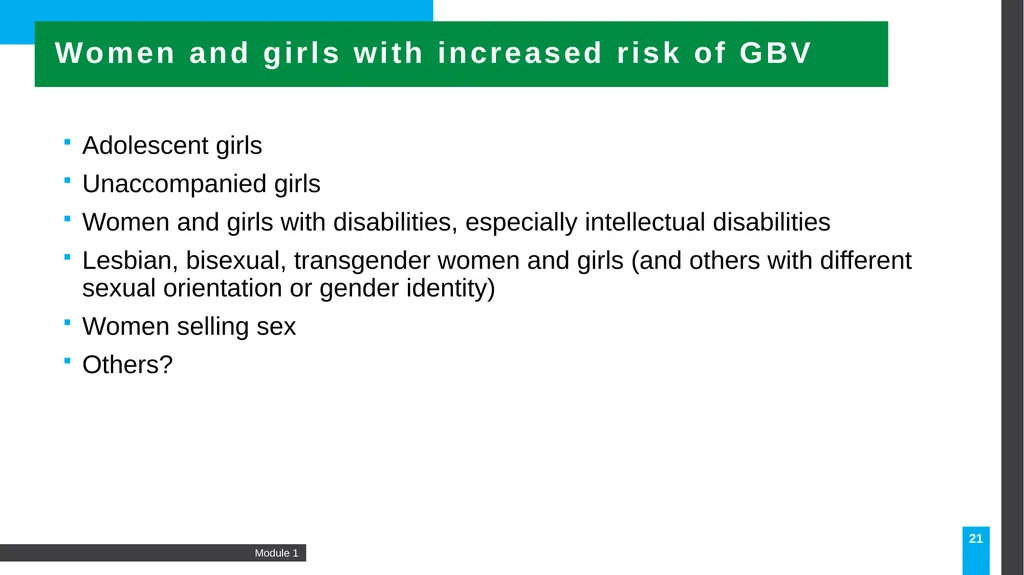
Module 1 21 Adolescent girls
Unaccompanied girls
Women and girls with disabilities, especially intellectual disabilities
Lesbian, bisexual, transgender women and girls (and others with different sexual orientation or gender identity)
Women selling sex
Others? Women and girls with increased risk of GBV<br>
Unaccompanied girls
Women and girls with disabilities, especially intellectual disabilities
Lesbian, bisexual, transgender women and girls (and others with different sexual orientation or gender identity)
Women selling sex
Others? Women and girls with increased risk of GBV<br>
22
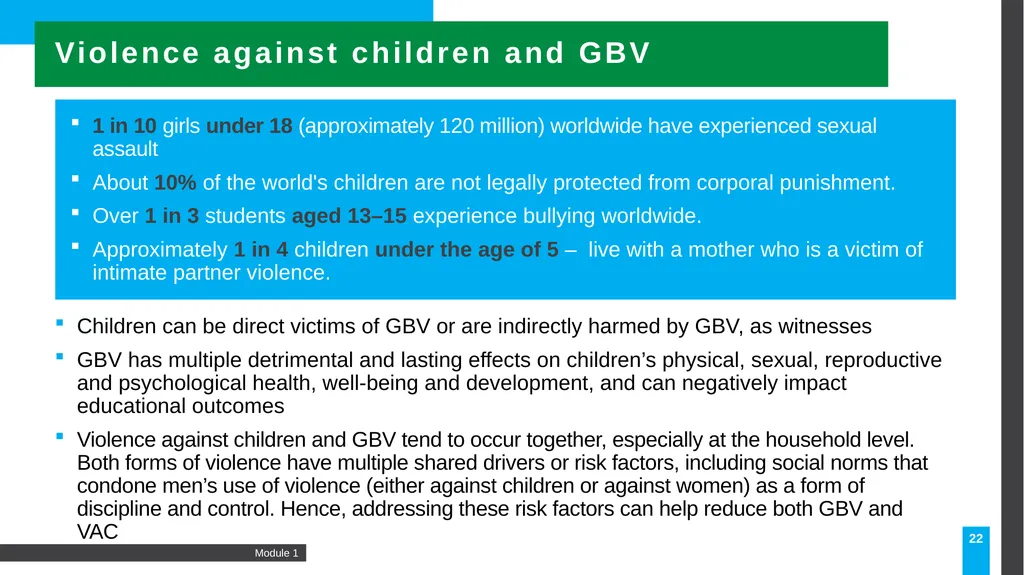
22 Violence against children and GBV 1 in 10 girls under 18 (approximately 120 million) worldwide have experienced sexual assault
About 10% of the world's children are not legally protected from corporal punishment.
Over 1 in 3 students aged 13–15 experience bullying worldwide.
Approximately 1 in 4 children under the age of 5 – live with a mother who is a victim of intimate partner violence. Module 1 Children can be direct victims of GBV or are indirectly harmed by GBV, as witnesses
GBV has multiple detrimental and lasting effects on children’s physical, sexual, reproductive and psychological health, well-being and development, and can negatively impact educational outcomes
Violence against children and GBV tend to occur together, especially at the household level. Both forms of violence have multiple shared drivers or risk factors, including social norms that condone men’s use of violence (either against children or against women) as a form of discipline and control. Hence, addressing these risk factors can help reduce both GBV and VAC<br>
About 10% of the world's children are not legally protected from corporal punishment.
Over 1 in 3 students aged 13–15 experience bullying worldwide.
Approximately 1 in 4 children under the age of 5 – live with a mother who is a victim of intimate partner violence. Module 1 Children can be direct victims of GBV or are indirectly harmed by GBV, as witnesses
GBV has multiple detrimental and lasting effects on children’s physical, sexual, reproductive and psychological health, well-being and development, and can negatively impact educational outcomes
Violence against children and GBV tend to occur together, especially at the household level. Both forms of violence have multiple shared drivers or risk factors, including social norms that condone men’s use of violence (either against children or against women) as a form of discipline and control. Hence, addressing these risk factors can help reduce both GBV and VAC<br>
23
Module 1 23 Discussion What do we know about GBV in this setting?<br>
24
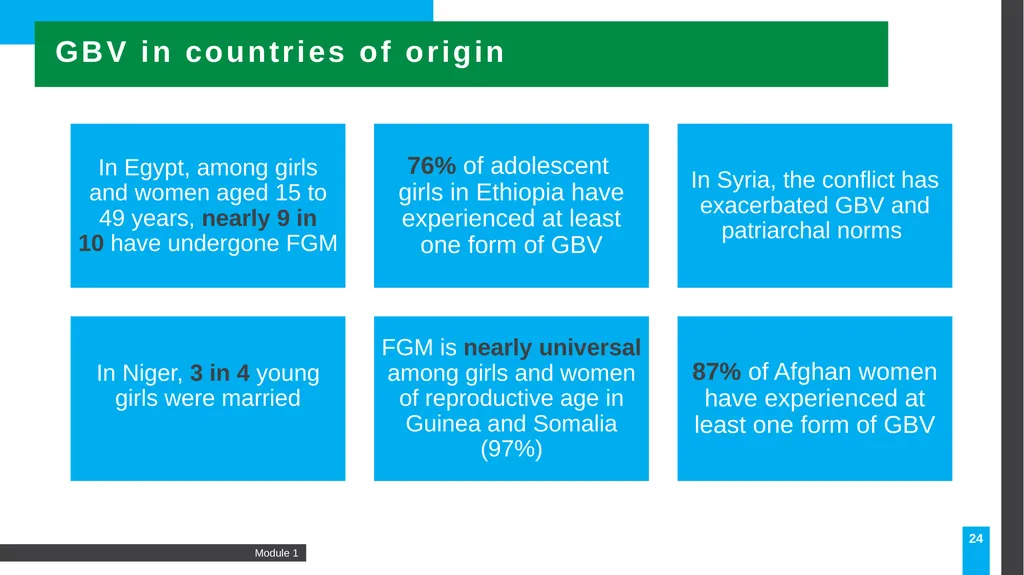
Module 1 24 GBV in countries of origin<br>
25
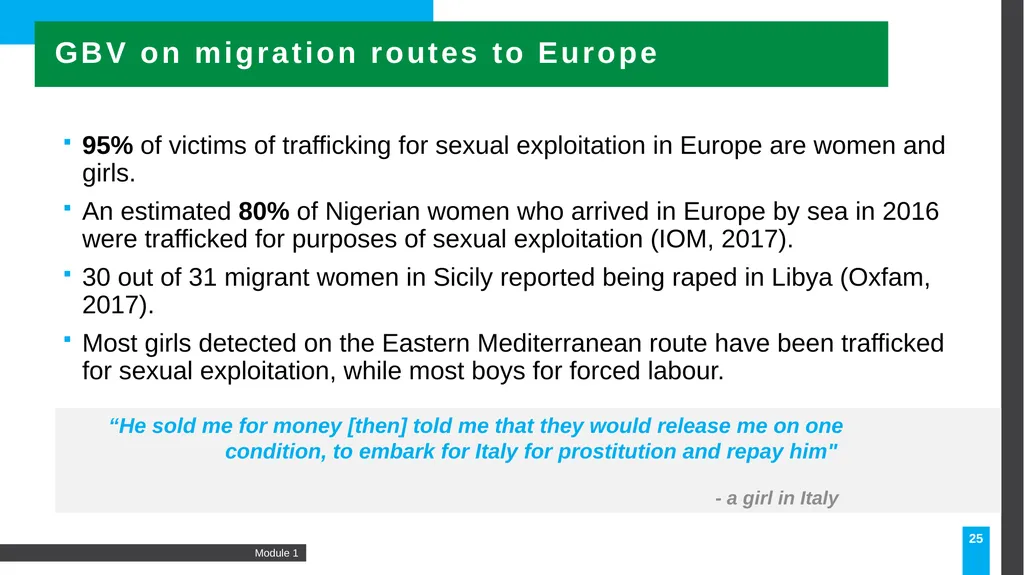
Module 1 25 95% of victims of trafficking for sexual exploitation in Europe are women and girls.
An estimated 80% of Nigerian women who arrived in Europe by sea in 2016 were trafficked for purposes of sexual exploitation (IOM, 2017).
30 out of 31 migrant women in Sicily reported being raped in Libya (Oxfam, 2017).
Most girls detected on the Eastern Mediterranean route have been trafficked for sexual exploitation, while most boys for forced labour. GBV on migration routes to Europe “He sold me for money [then] told me that they would release me on one condition, to embark for Italy for prostitution and repay him"
- a girl in Italy<br>
An estimated 80% of Nigerian women who arrived in Europe by sea in 2016 were trafficked for purposes of sexual exploitation (IOM, 2017).
30 out of 31 migrant women in Sicily reported being raped in Libya (Oxfam, 2017).
Most girls detected on the Eastern Mediterranean route have been trafficked for sexual exploitation, while most boys for forced labour. GBV on migration routes to Europe “He sold me for money [then] told me that they would release me on one condition, to embark for Italy for prostitution and repay him"
- a girl in Italy<br>
26
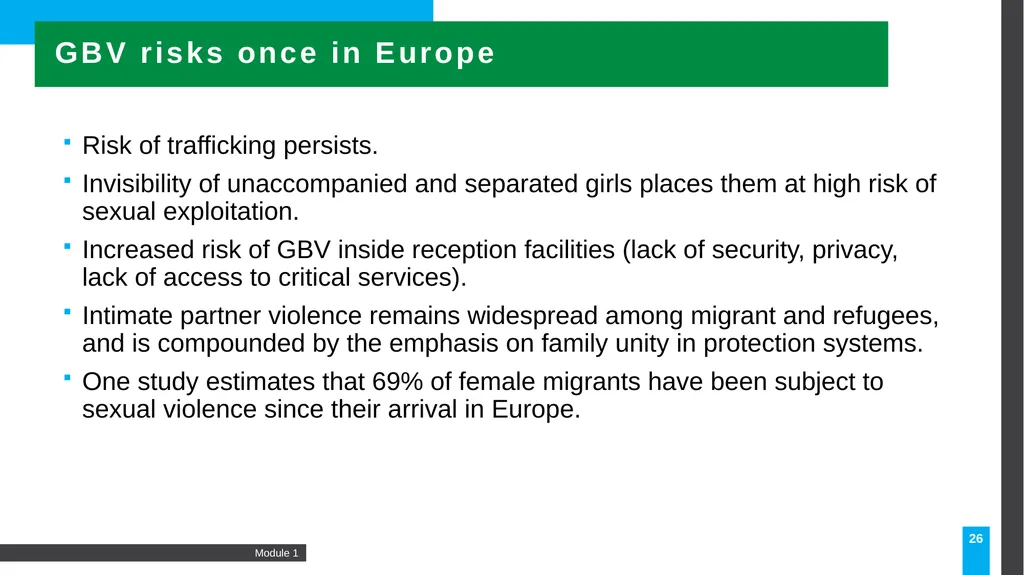
Module 1 26 Risk of trafficking persists.
Invisibility of unaccompanied and separated girls places them at high risk of sexual exploitation.
Increased risk of GBV inside reception facilities (lack of security, privacy, lack of access to critical services).
Intimate partner violence remains widespread among migrant and refugees, and is compounded by the emphasis on family unity in protection systems.
One study estimates that 69% of female migrants have been subject to sexual violence since their arrival in Europe. GBV risks once in Europe<br>
Invisibility of unaccompanied and separated girls places them at high risk of sexual exploitation.
Increased risk of GBV inside reception facilities (lack of security, privacy, lack of access to critical services).
Intimate partner violence remains widespread among migrant and refugees, and is compounded by the emphasis on family unity in protection systems.
One study estimates that 69% of female migrants have been subject to sexual violence since their arrival in Europe. GBV risks once in Europe<br>
27
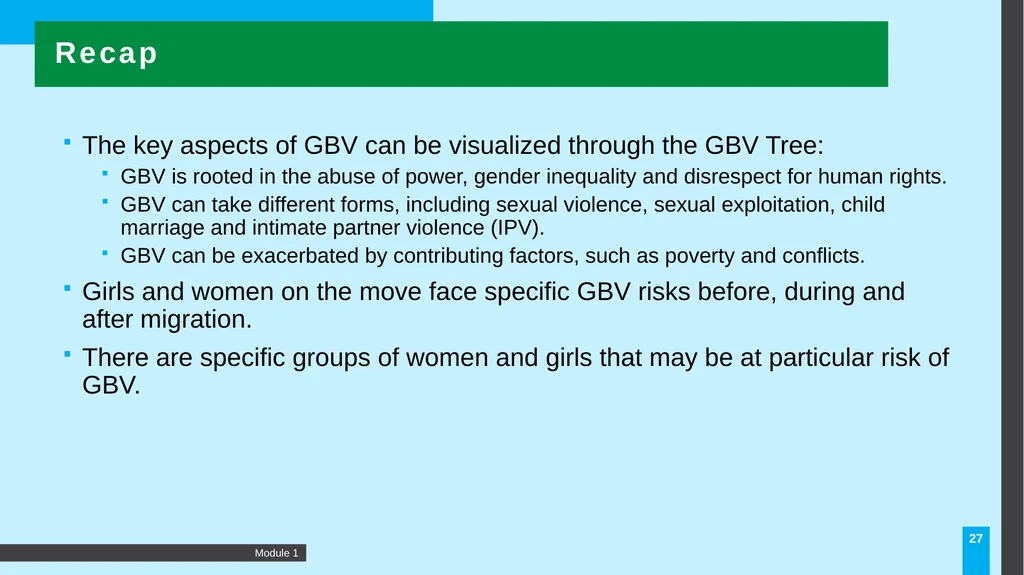
27 3/5/2021 The key aspects of GBV can be visualized through the GBV Tree:
GBV is rooted in the abuse of power, gender inequality and disrespect for human rights.
GBV can take different forms, including sexual violence, sexual exploitation, child marriage and intimate partner violence (IPV).
GBV can be exacerbated by contributing factors, such as poverty and conflicts.
Girls and women on the move face specific GBV risks before, during and after migration.
There are specific groups of women and girls that may be at particular risk of GBV. Recap Module 1<br>
GBV is rooted in the abuse of power, gender inequality and disrespect for human rights.
GBV can take different forms, including sexual violence, sexual exploitation, child marriage and intimate partner violence (IPV).
GBV can be exacerbated by contributing factors, such as poverty and conflicts.
Girls and women on the move face specific GBV risks before, during and after migration.
There are specific groups of women and girls that may be at particular risk of GBV. Recap Module 1<br>
28
Understanding sexual violence against men and boys (SVAMB) 28 Module 1<br>
29
The root causes of GBV against women and girls include abuse of power, gender inequality, disrespect for human rights.
SVAMB is sometimes used to undermine masculine norms but is not driven by gender inequality itself.
Sexual violence against men is not intended to keep men subordinate to women or further inequality between men and women.
Therefore, we do not use the term 'GBV' to describe sexual violence against men and boys. SVAMB & GBV Module 1 29<br>
SVAMB is sometimes used to undermine masculine norms but is not driven by gender inequality itself.
Sexual violence against men is not intended to keep men subordinate to women or further inequality between men and women.
Therefore, we do not use the term 'GBV' to describe sexual violence against men and boys. SVAMB & GBV Module 1 29<br>
30
Module 1 30 Against:
Adult men
Adolescent boys
Young boys
Older men
Gay and transgender men and boys
Any man or boy
In:
Home countries
Conflict settings
Migration routes
Refugee and displaced settings, including in Europe SVAMB is perpetrated…<br>
Adult men
Adolescent boys
Young boys
Older men
Gay and transgender men and boys
Any man or boy
In:
Home countries
Conflict settings
Migration routes
Refugee and displaced settings, including in Europe SVAMB is perpetrated…<br>
31
Module 1 31 What do we know? What do we know about sexual violence against men and boys who have arrived in this setting?<br>
32
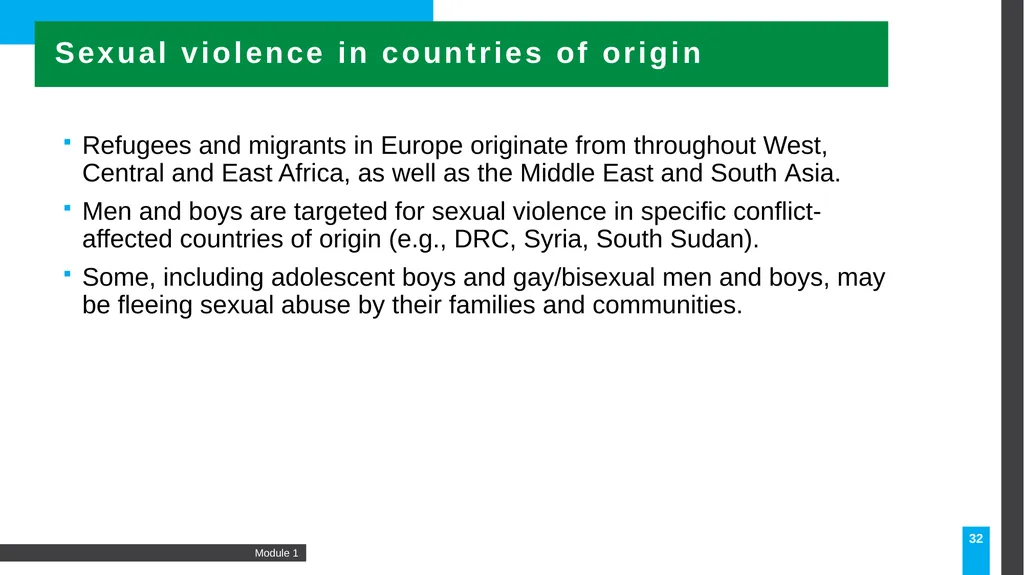
Module 1 32 Refugees and migrants in Europe originate from throughout West, Central and East Africa, as well as the Middle East and South Asia.
Men and boys are targeted for sexual violence in specific conflict-affected countries of origin (e.g., DRC, Syria, South Sudan).
Some, including adolescent boys and gay/bisexual men and boys, may be fleeing sexual abuse by their families and communities. Sexual violence in countries of origin<br>
Men and boys are targeted for sexual violence in specific conflict-affected countries of origin (e.g., DRC, Syria, South Sudan).
Some, including adolescent boys and gay/bisexual men and boys, may be fleeing sexual abuse by their families and communities. Sexual violence in countries of origin<br>
33
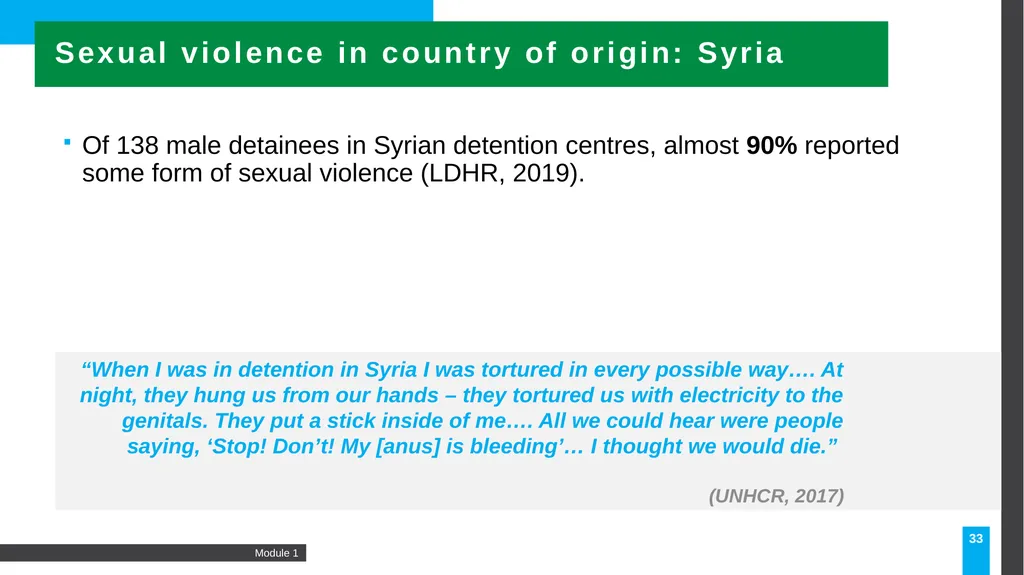
Module 1 33 Of 138 male detainees in Syrian detention centres, almost 90% reported some form of sexual violence (LDHR, 2019). Sexual violence in country of origin: Syria “When I was in detention in Syria I was tortured in every possible way…. At night, they hung us from our hands – they tortured us with electricity to the genitals. They put a stick inside of me…. All we could hear were people saying, ‘Stop! Don’t! My [anus] is bleeding’… I thought we would die.”
(UNHCR, 2017)<br>
(UNHCR, 2017)<br>
34
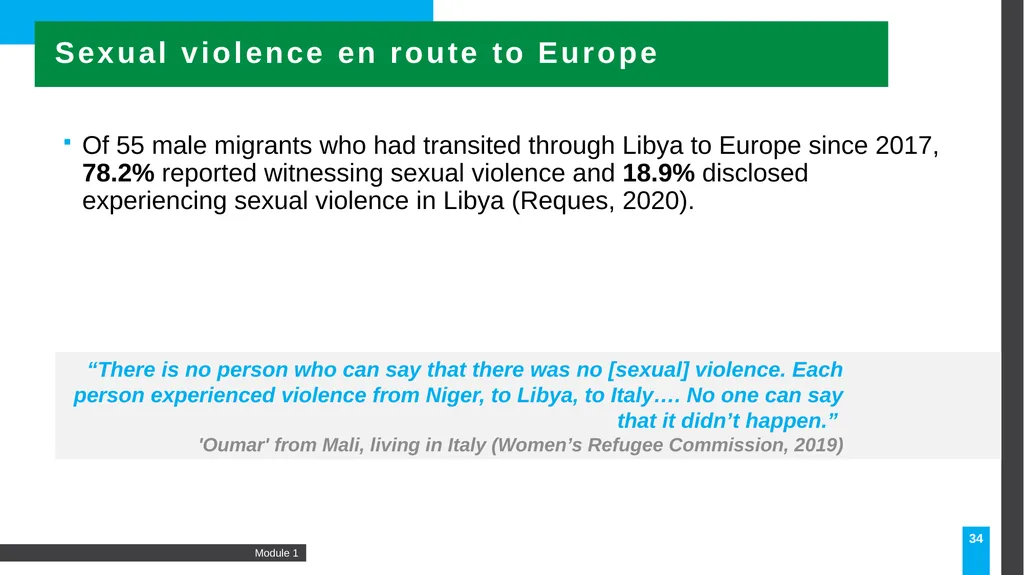
Module 1 34 Of 55 male migrants who had transited through Libya to Europe since 2017, 78.2% reported witnessing sexual violence and 18.9% disclosed experiencing sexual violence in Libya (Reques, 2020). Sexual violence en route to Europe “There is no person who can say that there was no [sexual] violence. Each person experienced violence from Niger, to Libya, to Italy…. No one can say that it didn’t happen.”
'Oumar' from Mali, living in Italy (Women’s Refugee Commission, 2019)<br>
'Oumar' from Mali, living in Italy (Women’s Refugee Commission, 2019)<br>
35
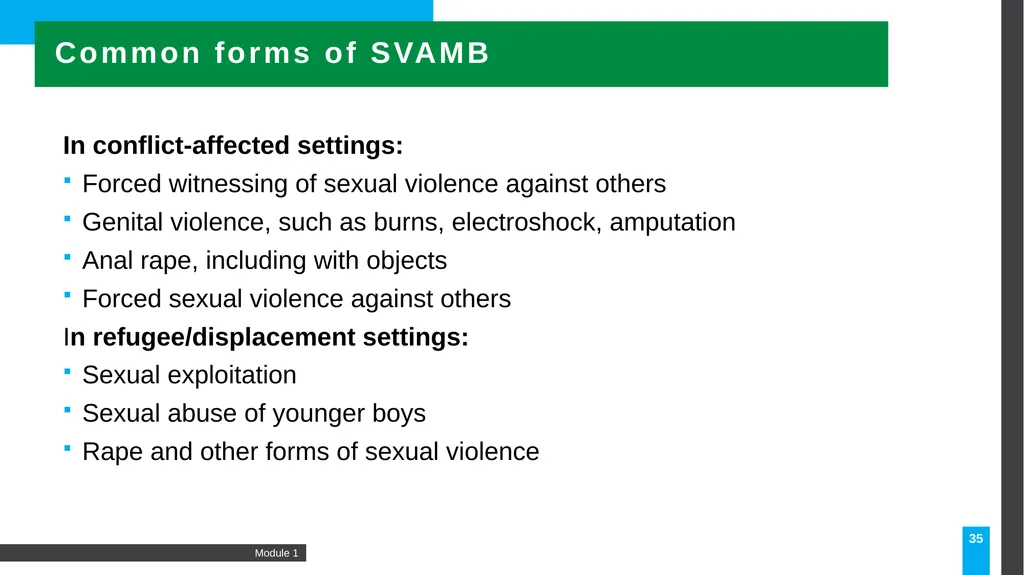
Module 1 35 In conflict-affected settings:
Forced witnessing of sexual violence against others
Genital violence, such as burns, electroshock, amputation
Anal rape, including with objects
Forced sexual violence against others
In refugee/displacement settings:
Sexual exploitation
Sexual abuse of younger boys
Rape and other forms of sexual violence Common forms of SVAMB<br>
Forced witnessing of sexual violence against others
Genital violence, such as burns, electroshock, amputation
Anal rape, including with objects
Forced sexual violence against others
In refugee/displacement settings:
Sexual exploitation
Sexual abuse of younger boys
Rape and other forms of sexual violence Common forms of SVAMB<br>
36
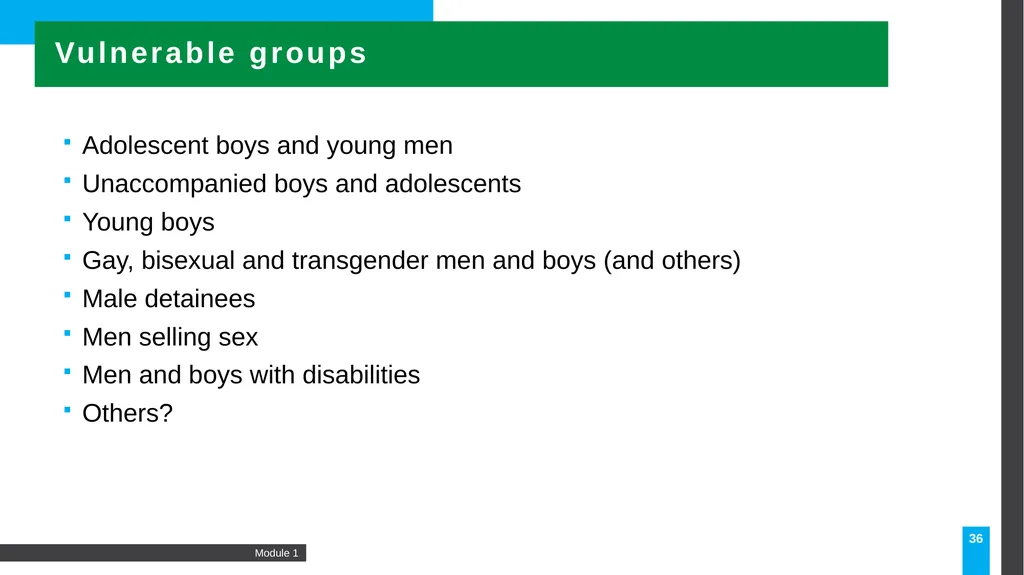
Module 1 36 Adolescent boys and young men
Unaccompanied boys and adolescents
Young boys
Gay, bisexual and transgender men and boys (and others)
Male detainees
Men selling sex
Men and boys with disabilities
Others? Vulnerable groups<br>
Unaccompanied boys and adolescents
Young boys
Gay, bisexual and transgender men and boys (and others)
Male detainees
Men selling sex
Men and boys with disabilities
Others? Vulnerable groups<br>
37
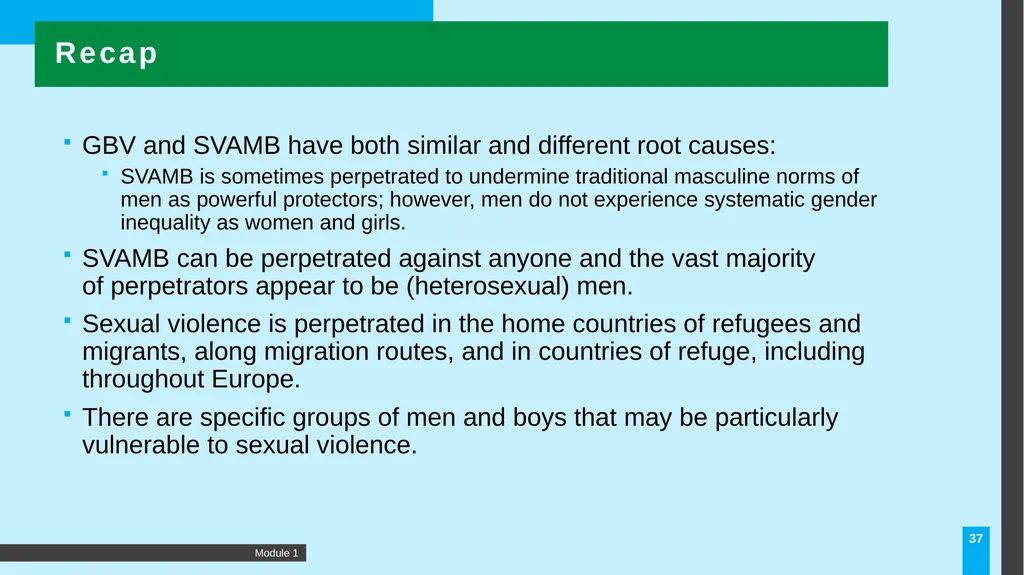
37 GBV and SVAMB have both similar and different root causes:
SVAMB is sometimes perpetrated to undermine traditional masculine norms of men as powerful protectors; however, men do not experience systematic gender inequality as women and girls.
SVAMB can be perpetrated against anyone and the vast majority of perpetrators appear to be (heterosexual) men.
Sexual violence is perpetrated in the home countries of refugees and migrants, along migration routes, and in countries of refuge, including throughout Europe.
There are specific groups of men and boys that may be particularly vulnerable to sexual violence. Recap Module 1<br>
SVAMB is sometimes perpetrated to undermine traditional masculine norms of men as powerful protectors; however, men do not experience systematic gender inequality as women and girls.
SVAMB can be perpetrated against anyone and the vast majority of perpetrators appear to be (heterosexual) men.
Sexual violence is perpetrated in the home countries of refugees and migrants, along migration routes, and in countries of refuge, including throughout Europe.
There are specific groups of men and boys that may be particularly vulnerable to sexual violence. Recap Module 1<br>
38
Module 1 38 Consequences of GBV and SVAMB GROUP WORK
Group 1: Physical consequence
Group 2: Mental health consequences
Group 3: Social consequences<br>
Group 1: Physical consequence
Group 2: Mental health consequences
Group 3: Social consequences<br>
39
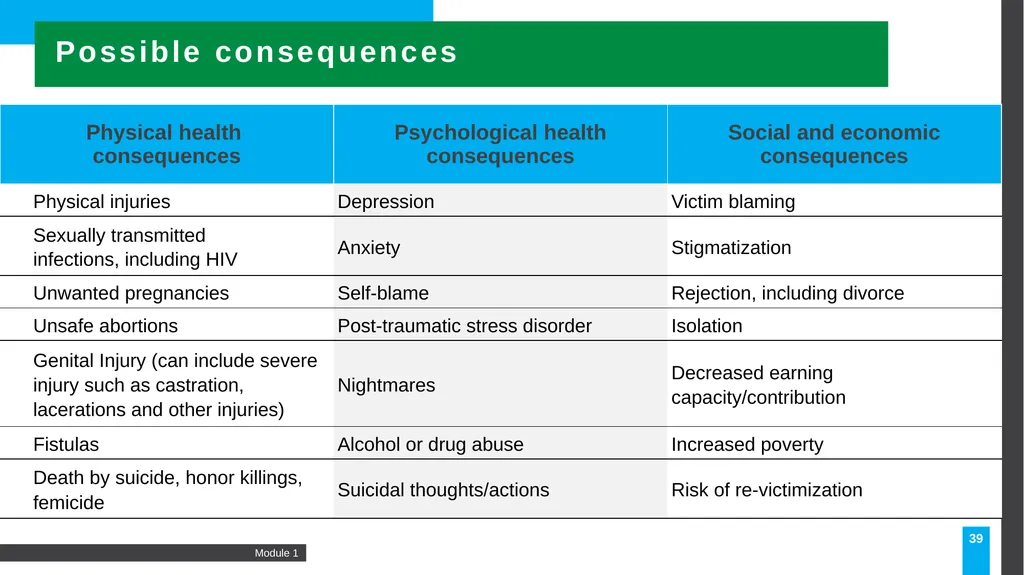
Module 1 39 Possible consequences<br>
40
Multi-sectoral response for survivors and barriers to care Module 1 40<br>
41
Survivors of sexual violence and GBV have the right to survivor-centred care and support services to help them heal and recover from the consequences of violence. Services for survivors Module 1 41<br>
42
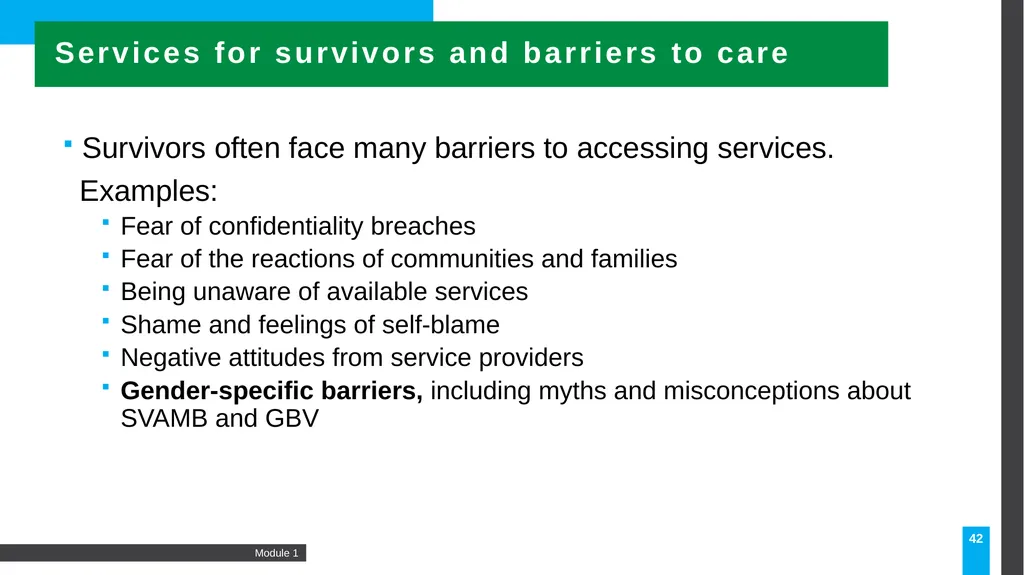
Module 1 42 Survivors often face many barriers to accessing services.
Examples:
Fear of confidentiality breaches
Fear of the reactions of communities and families
Being unaware of available services
Shame and feelings of self-blame
Negative attitudes from service providers
Gender-specific barriers, including myths and misconceptions about SVAMB and GBV Services for survivors and barriers to care<br>
Examples:
Fear of confidentiality breaches
Fear of the reactions of communities and families
Being unaware of available services
Shame and feelings of self-blame
Negative attitudes from service providers
Gender-specific barriers, including myths and misconceptions about SVAMB and GBV Services for survivors and barriers to care<br>
43
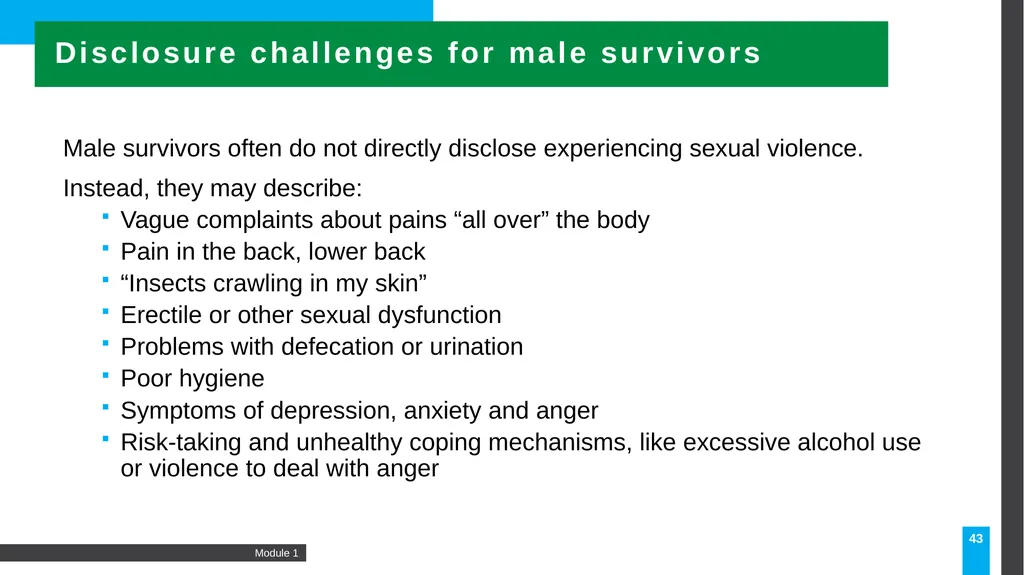
Module 1 43 Male survivors often do not directly disclose experiencing sexual violence.
Instead, they may describe:
Vague complaints about pains “all over” the body
Pain in the back, lower back
“Insects crawling in my skin”
Erectile or other sexual dysfunction
Problems with defecation or urination
Poor hygiene
Symptoms of depression, anxiety and anger
Risk-taking and unhealthy coping mechanisms, like excessive alcohol use or violence to deal with anger Disclosure challenges for male survivors<br>
Instead, they may describe:
Vague complaints about pains “all over” the body
Pain in the back, lower back
“Insects crawling in my skin”
Erectile or other sexual dysfunction
Problems with defecation or urination
Poor hygiene
Symptoms of depression, anxiety and anger
Risk-taking and unhealthy coping mechanisms, like excessive alcohol use or violence to deal with anger Disclosure challenges for male survivors<br>
44
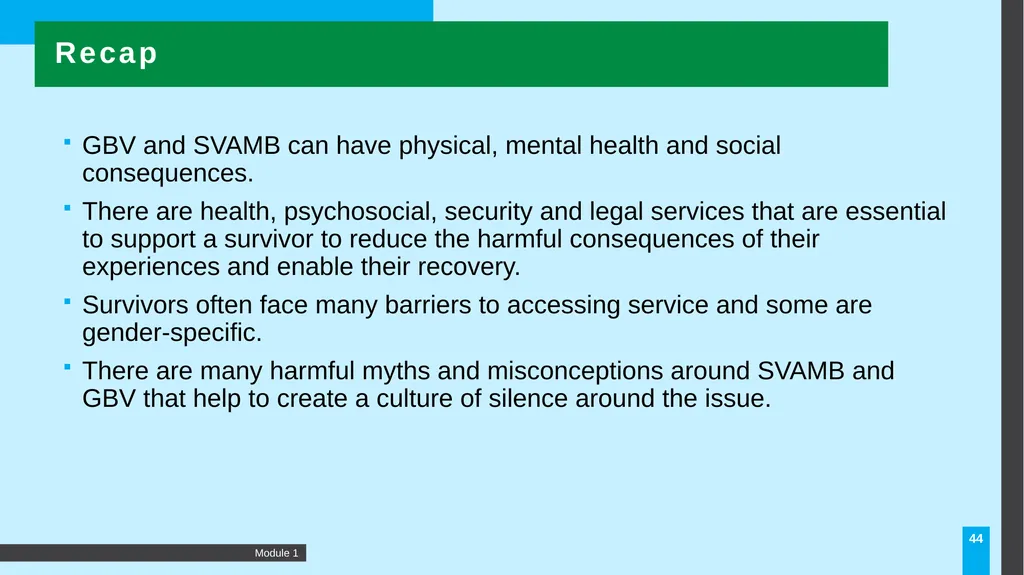
44 GBV and SVAMB can have physical, mental health and social consequences.
There are health, psychosocial, security and legal services that are essential to support a survivor to reduce the harmful consequences of their experiences and enable their recovery.
Survivors often face many barriers to accessing service and some are gender-specific.
There are many harmful myths and misconceptions around SVAMB and GBV that help to create a culture of silence around the issue. Recap Module 1<br>
There are health, psychosocial, security and legal services that are essential to support a survivor to reduce the harmful consequences of their experiences and enable their recovery.
Survivors often face many barriers to accessing service and some are gender-specific.
There are many harmful myths and misconceptions around SVAMB and GBV that help to create a culture of silence around the issue. Recap Module 1<br>