
Module L – Situational and Organizational Factors
LS
Published · 49 slides · 0 views

1 / 1
Description
Module L Situational and Organizational Factors Affecting Sexual Abuse, Types of Offenders, Grooming Techniques, and Prevention of Abuse For Parishes and Dioceses L-1 Situational and Organizational Factors Related to Sexual Abuse of
Related Topics
Share
Embed code
Download this presentation From Below
"Module L – Situational and Organizational Factors" is the property of its rightful owner. Permission is granted to download and print the materials on this website for personal, non-commercial use only, and to display it on your personal computer provided you do not modify the materials and that you retain all copyright notices contained in the materials. By downloading content from our website, you accept the terms of this agreement.
Presentation Transcript
01
Module L – Situational and Organizational Factors Affecting Sexual Abuse, Types of Offenders, Grooming Techniques, and Prevention of Abuse
For Parishes and Dioceses L-1<br>
For Parishes and Dioceses L-1<br>
02
Situational and Organizational Factors Related to Sexual Abuse of Minors by Catholic Priests
Types of Offenders, Grooming Techniques, and Prevention L-2<br>
Types of Offenders, Grooming Techniques, and Prevention L-2<br>
03
Main Sources of Data Reports presented to the United States Conference of Catholic Bishops by the John Jay College Research Team, The City University of New York
The Causes and Context of Sexual Abuse of Minors by Catholic Priests in the United States, 1950-2010, March, 2011
The Nature and Scope of Sexual Abuse of Minors by Catholic Priests and Deacons in the United States, 1950-2002, February 2004 L-3<br>
The Causes and Context of Sexual Abuse of Minors by Catholic Priests in the United States, 1950-2010, March, 2011
The Nature and Scope of Sexual Abuse of Minors by Catholic Priests and Deacons in the United States, 1950-2002, February 2004 L-3<br>
04
I. Situational Factors:
Settings and Circumstances
of Sexual Abuse L-4<br>
Settings and Circumstances
of Sexual Abuse L-4<br>
05
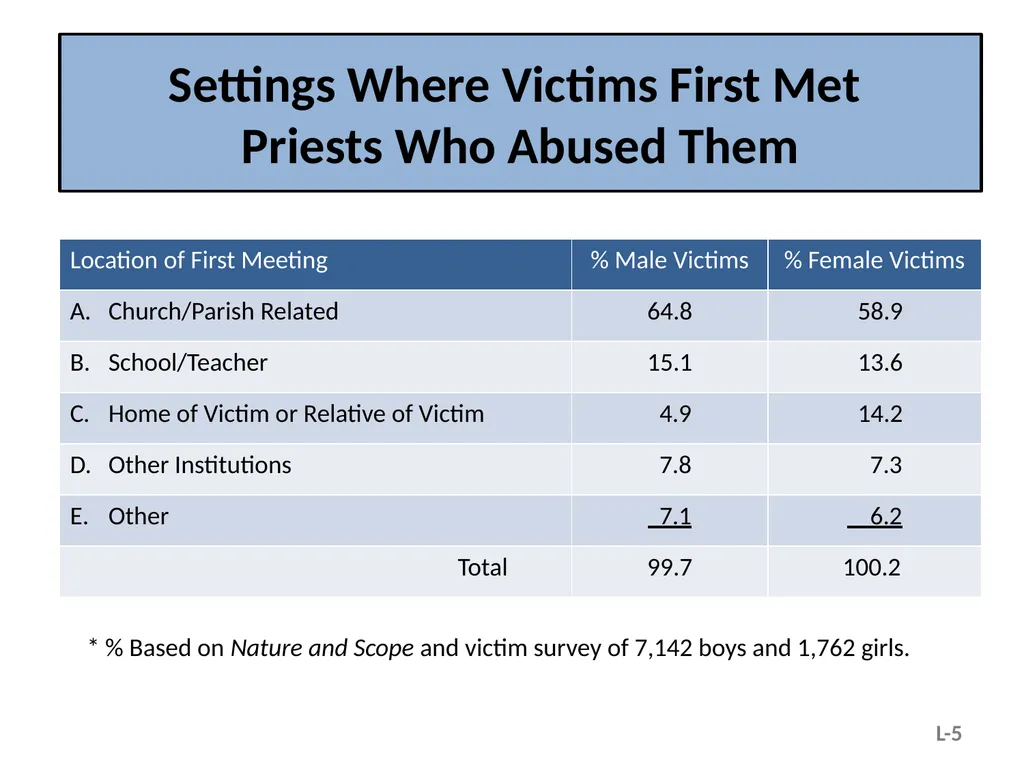
Settings Where Victims First Met
Priests Who Abused Them * % Based on Nature and Scope and victim survey of 7,142 boys and 1,762 girls. L-5<br>
06
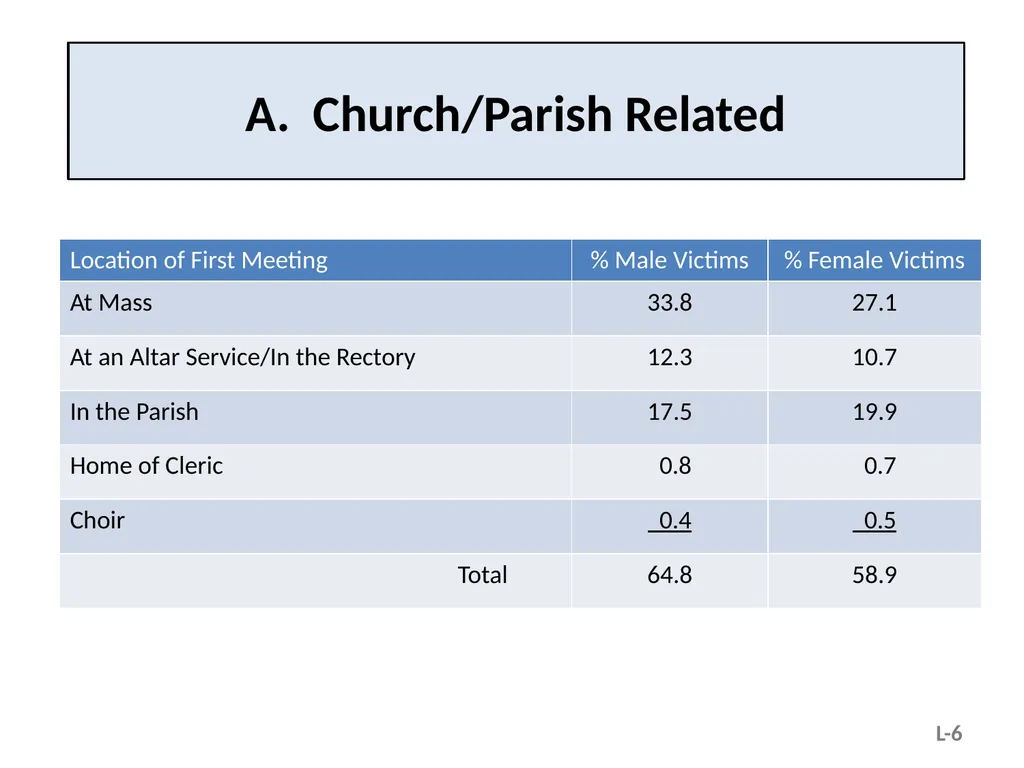
A. Church/Parish Related L-6<br>
07
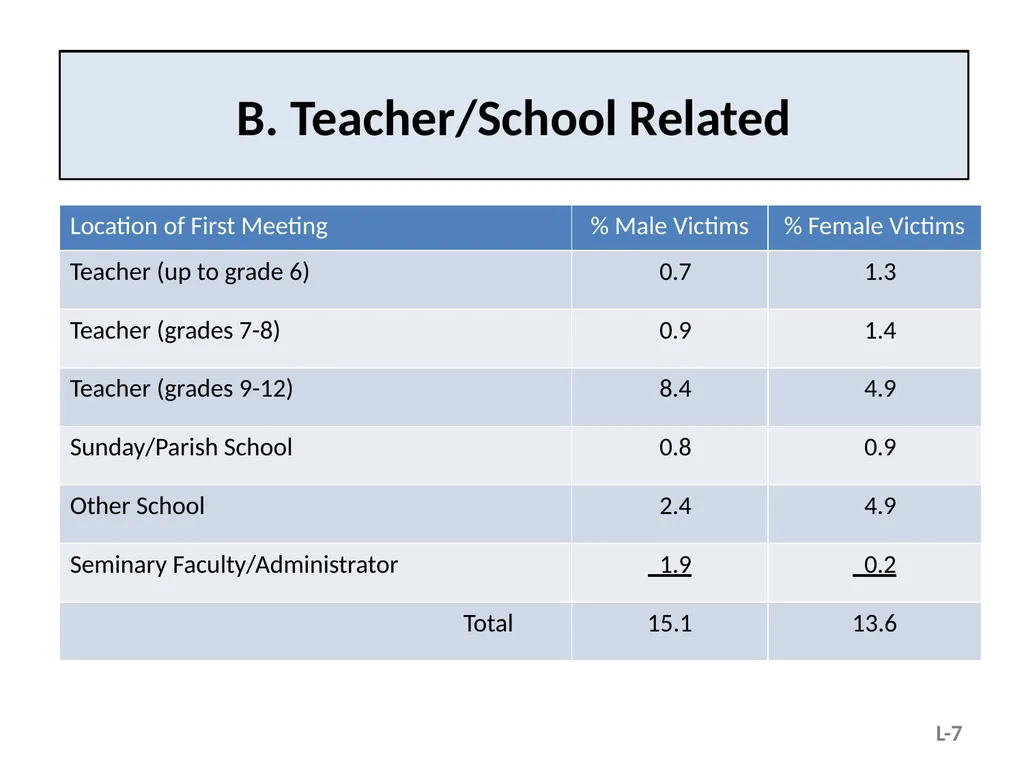
B. Teacher/School Related L-7<br>
08
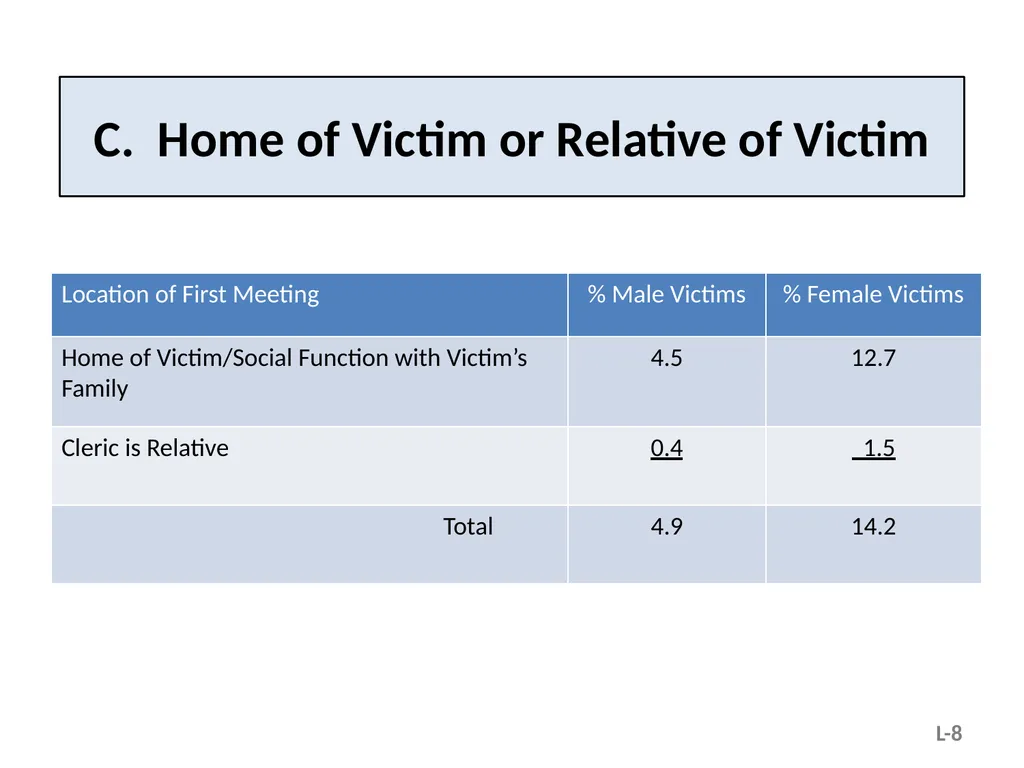
C. Home of Victim or Relative of Victim L-8<br>
09
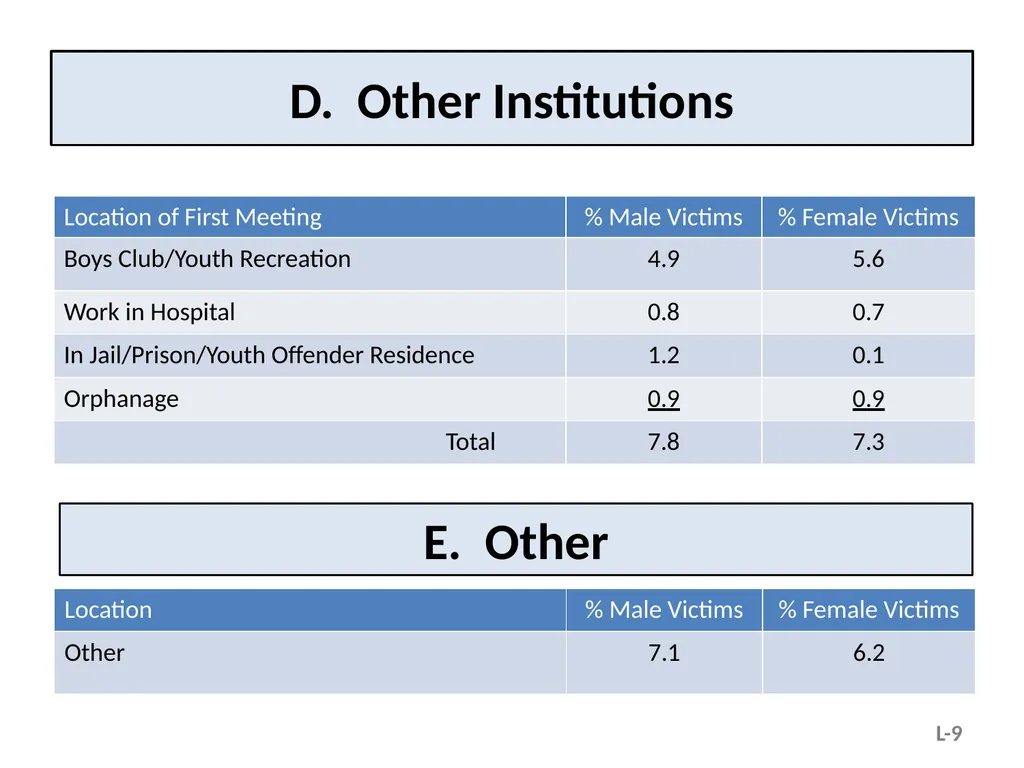
D. Other Institutions E. Other L-9<br>
10
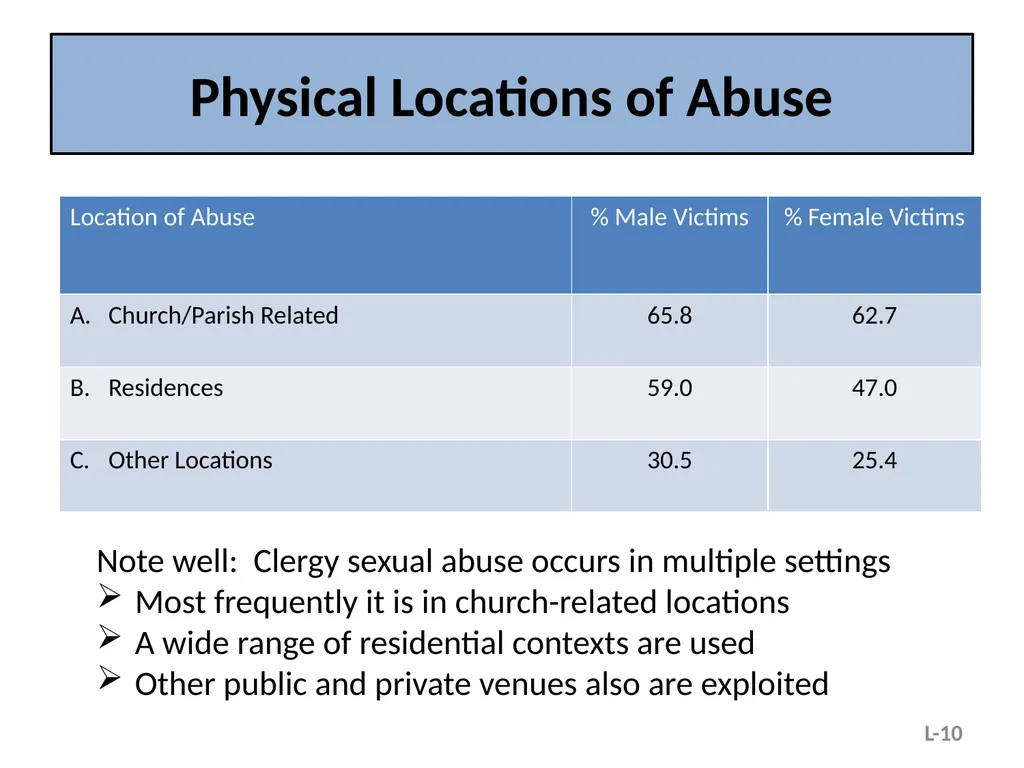
Physical Locations of Abuse L-10 Note well: Clergy sexual abuse occurs in multiple settings
Most frequently it is in church-related locations
A wide range of residential contexts are used
Other public and private venues also are exploited<br>
Most frequently it is in church-related locations
A wide range of residential contexts are used
Other public and private venues also are exploited<br>
11
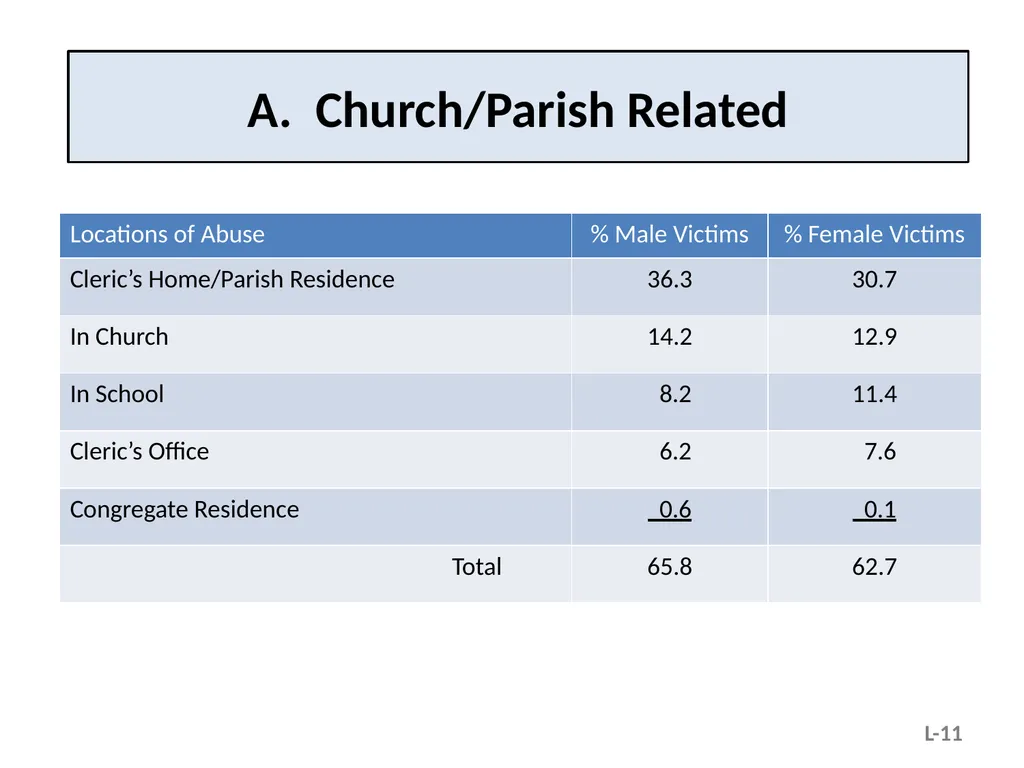
A. Church/Parish Related L-11<br>
12
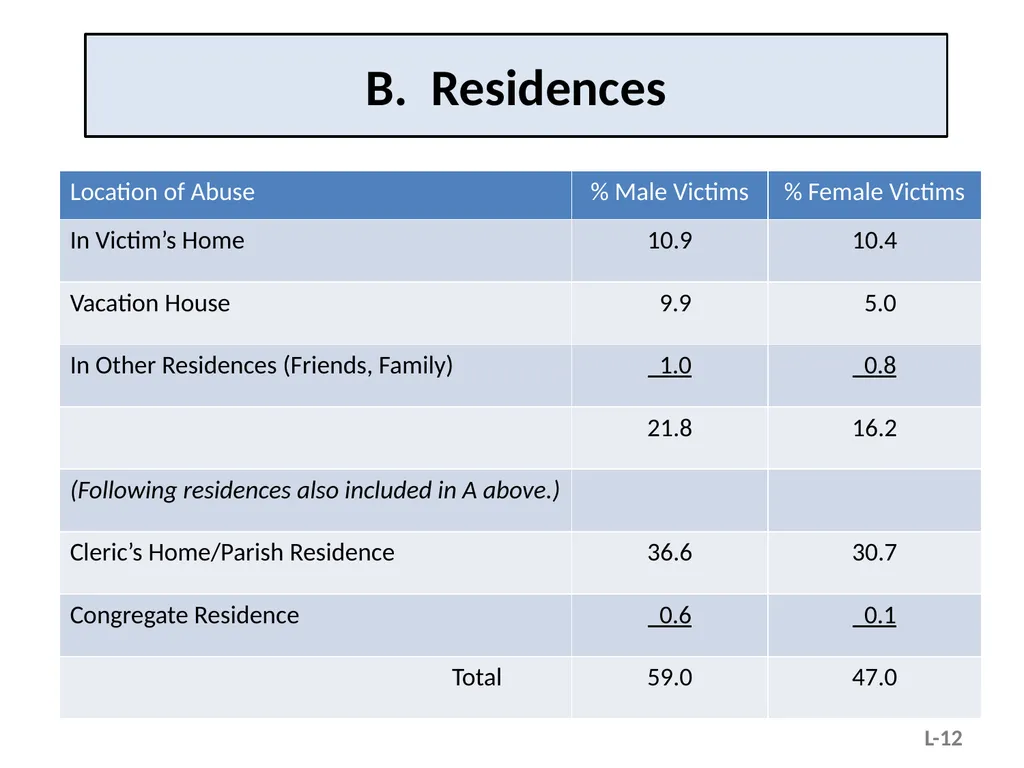
B. Residences L-12<br>
13
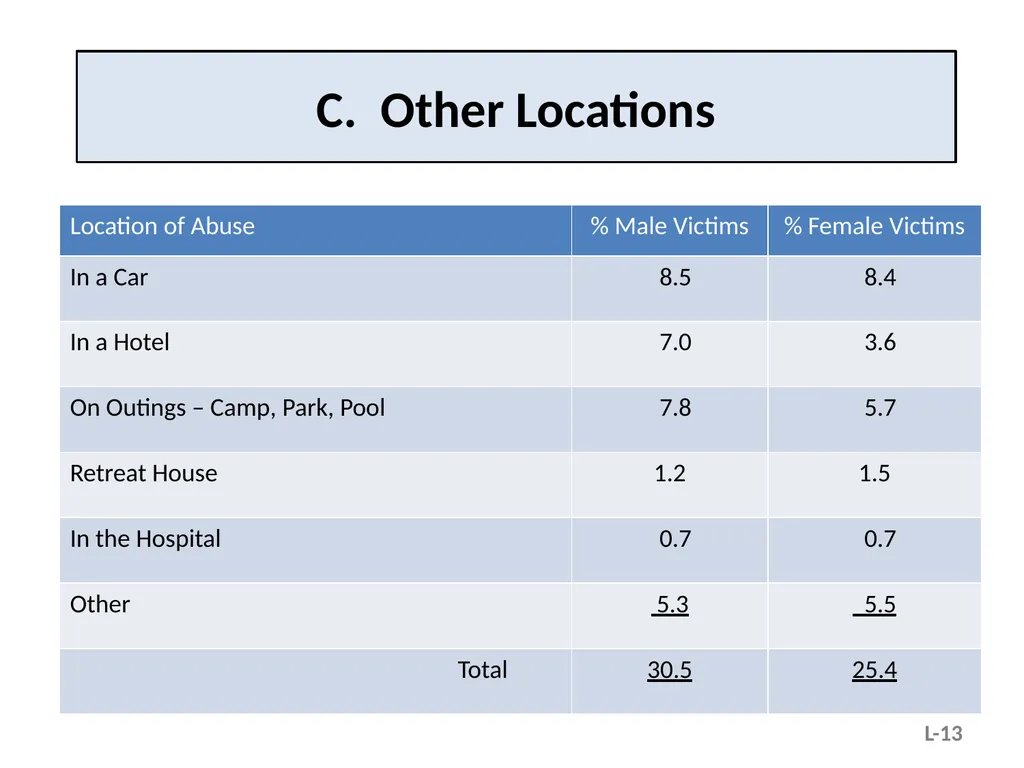
C. Other Locations L-13<br>
14
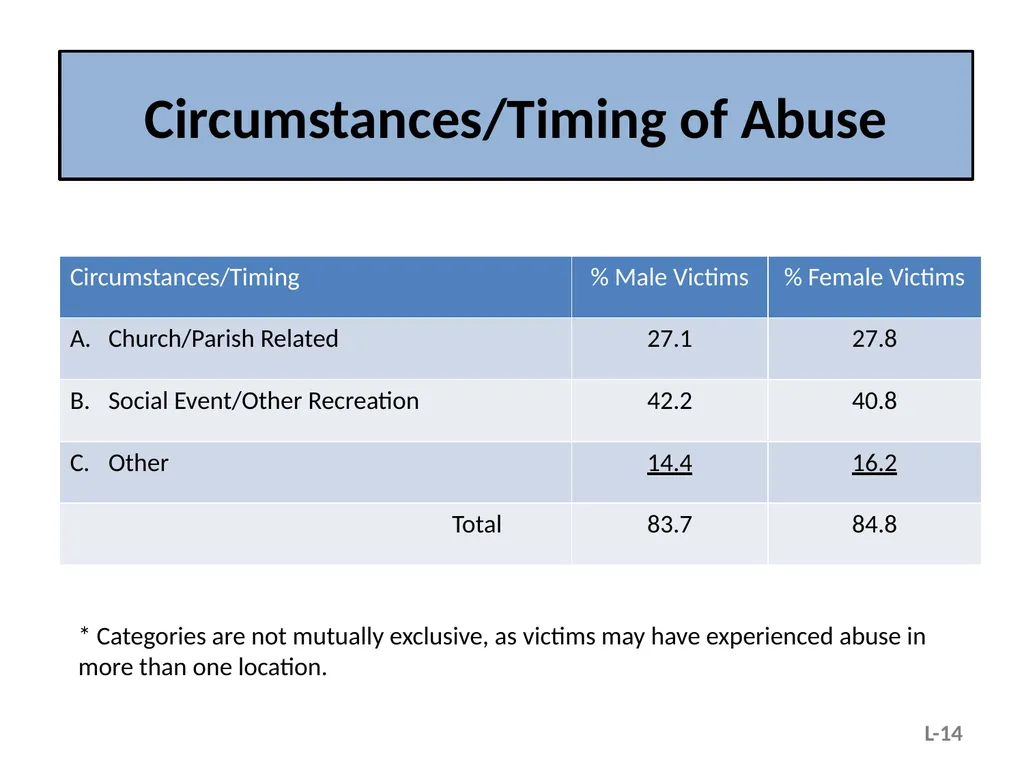
Circumstances/Timing of Abuse * Categories are not mutually exclusive, as victims may have experienced abuse in more than one location. L-14<br>
15
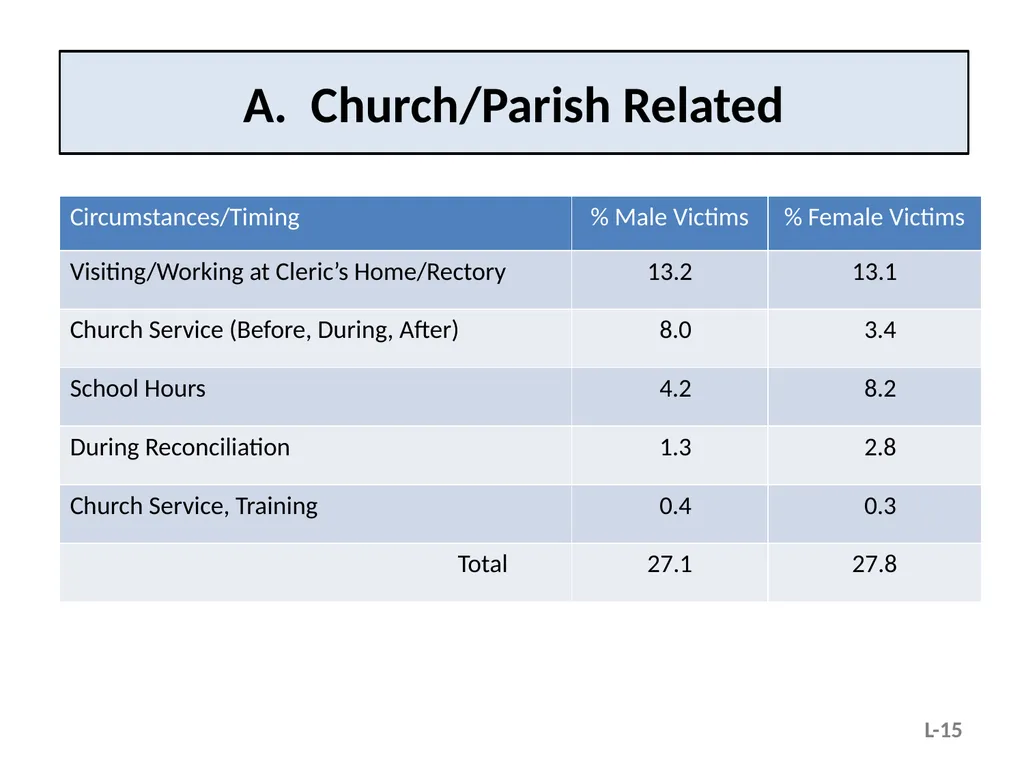
A. Church/Parish Related L-15<br>
16
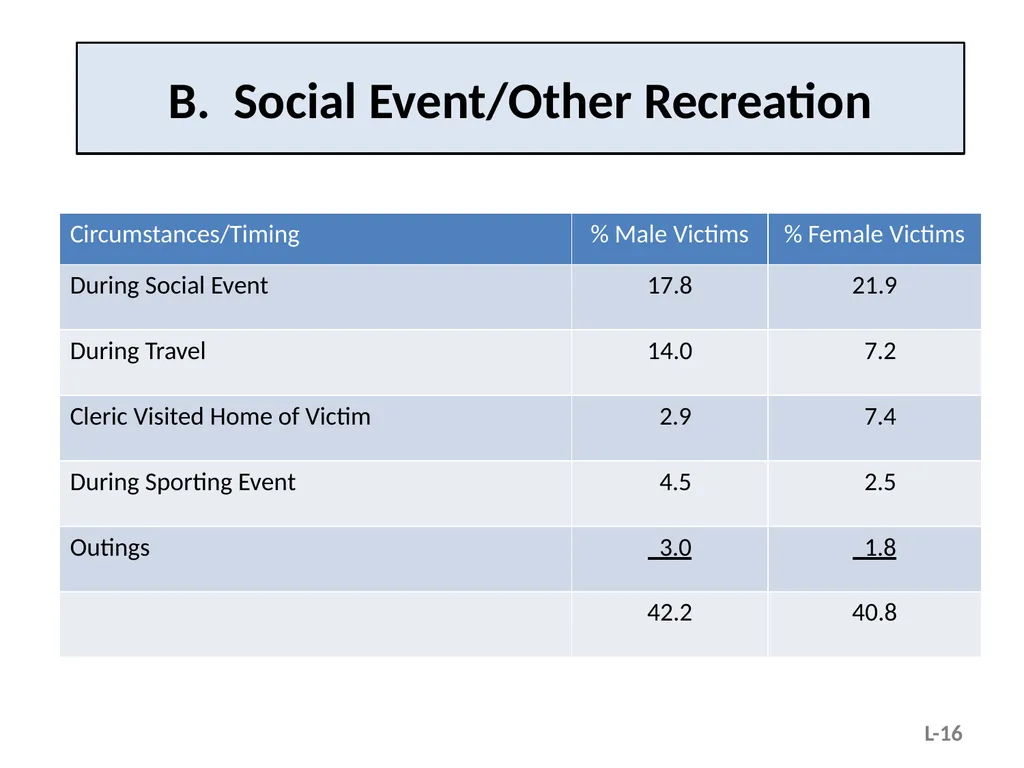
B. Social Event/Other Recreation L-16<br>
17
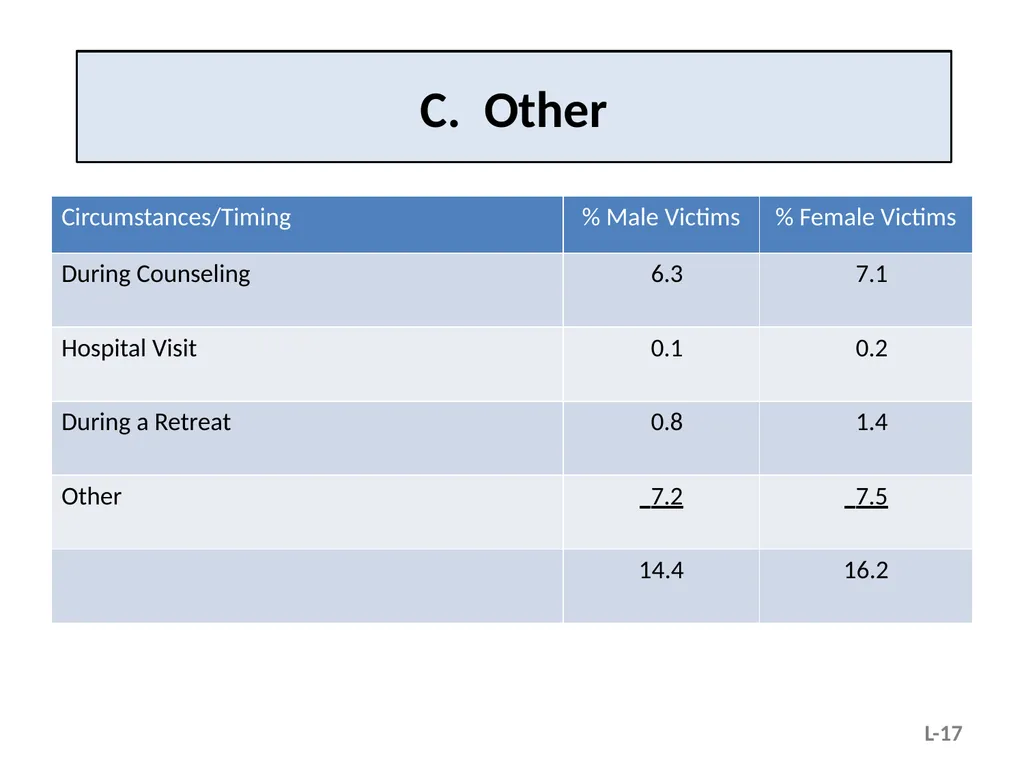
C. Other L-17<br>
18
II. Organizational Factors
Relating to Abuse L-18<br>
Relating to Abuse L-18<br>
19
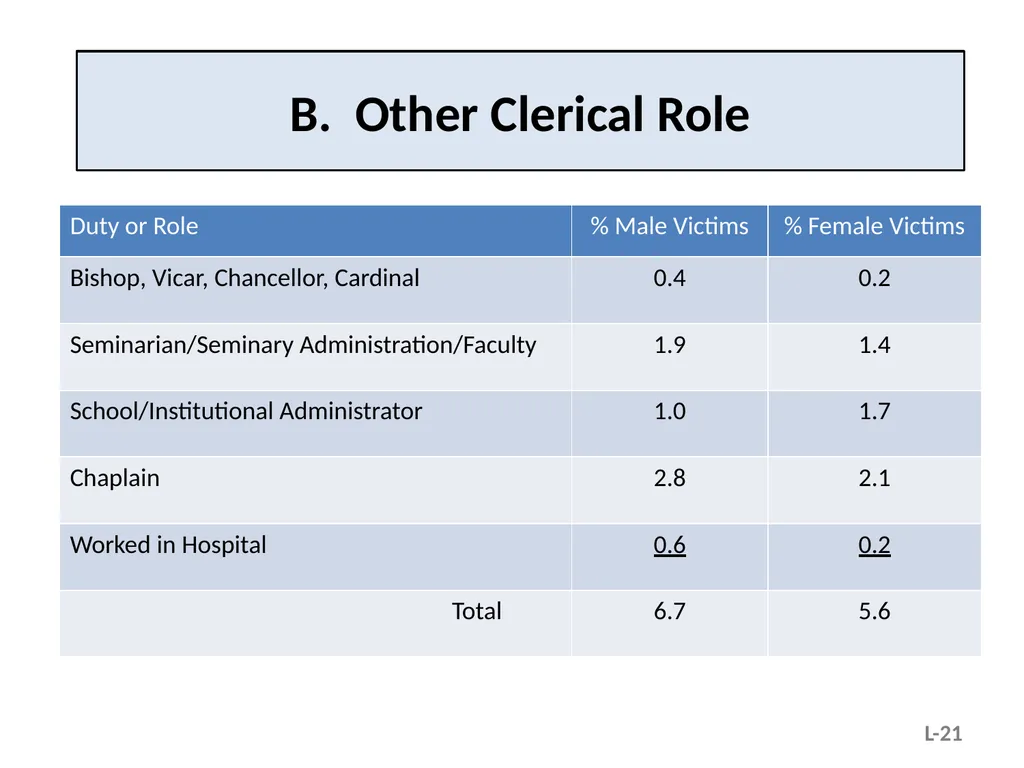
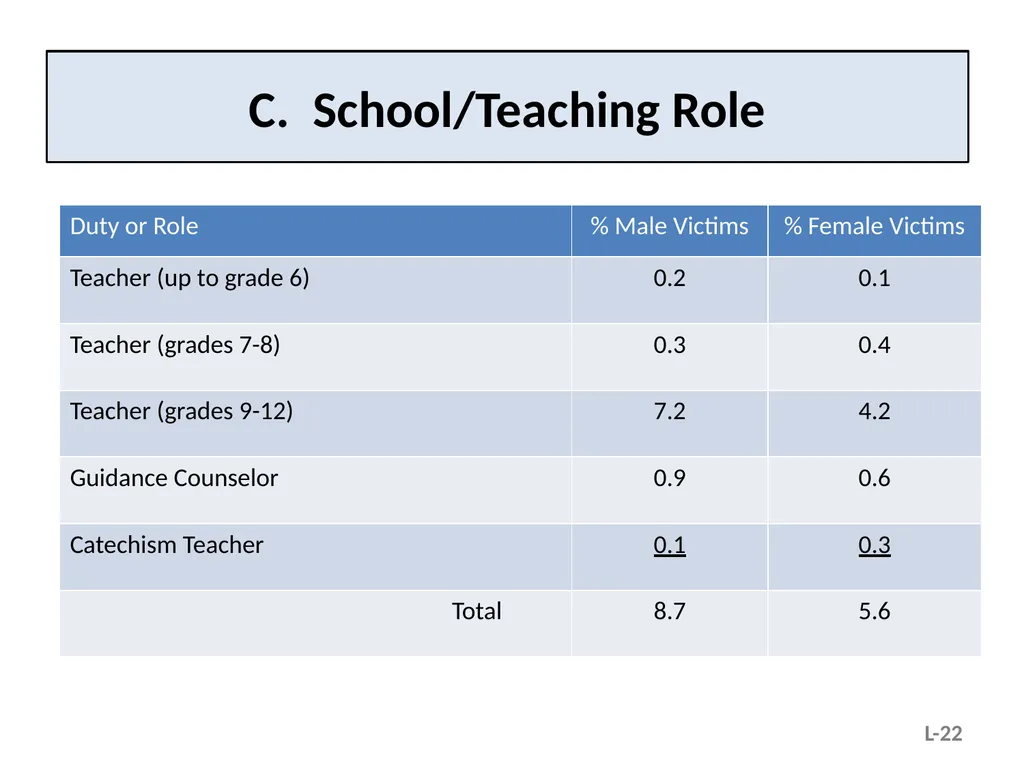
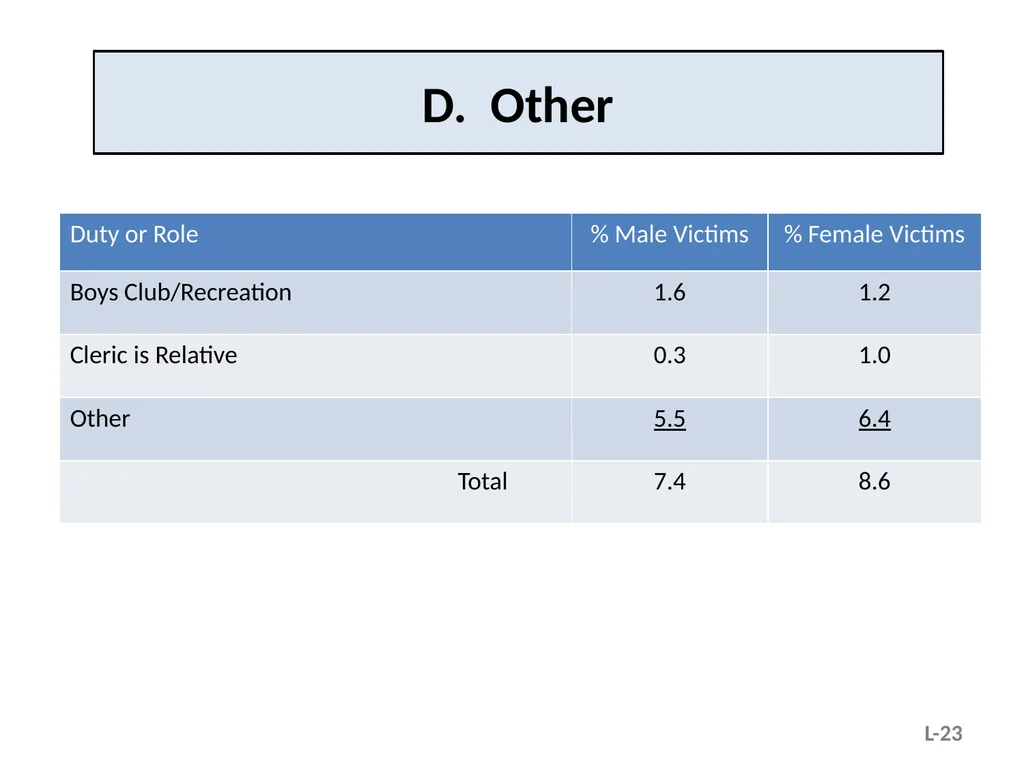
Priest’s Primary Duty or Role
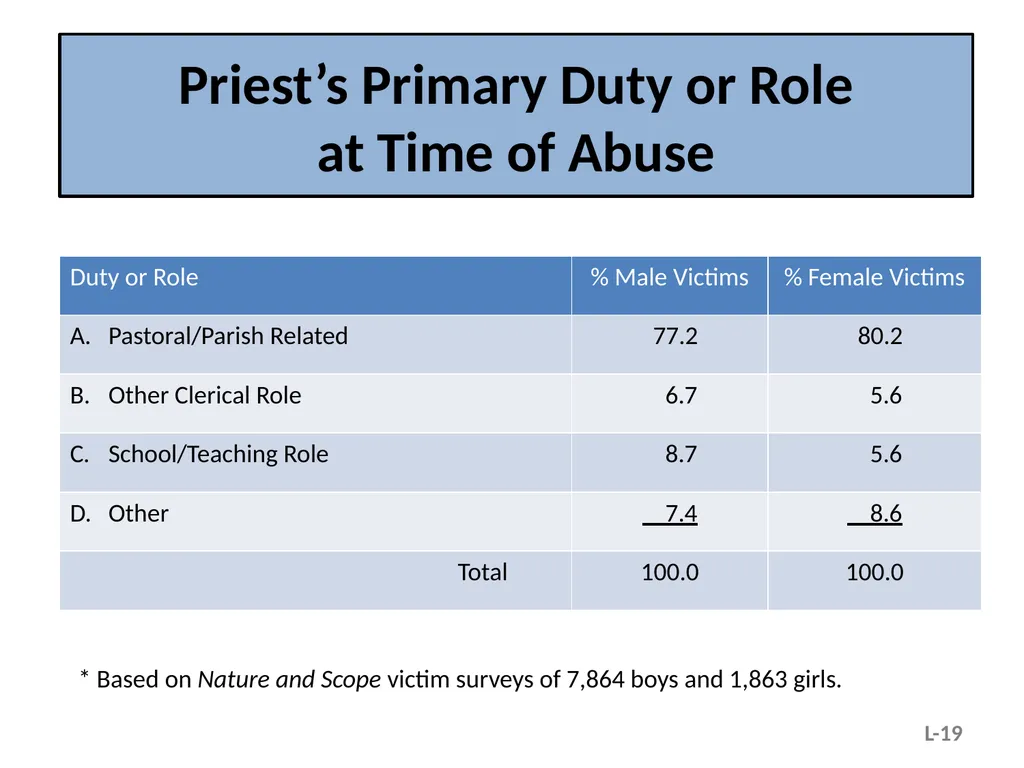
at Time of Abuse * Based on Nature and Scope victim surveys of 7,864 boys and 1,863 girls. L-19<br>
20
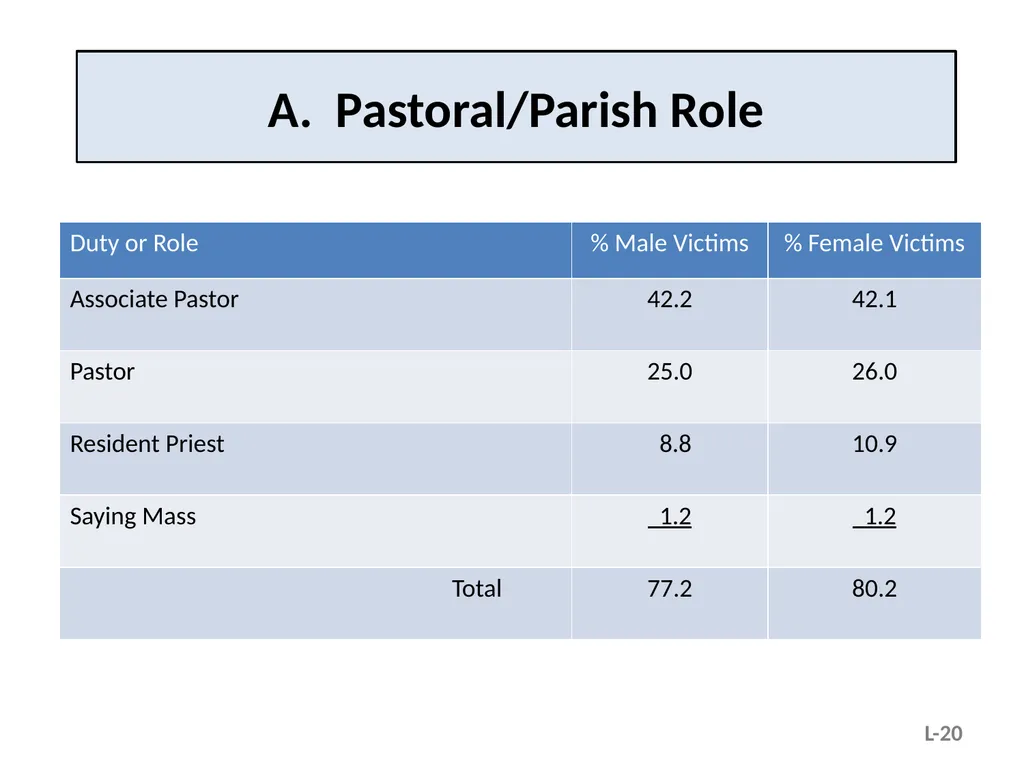
A. Pastoral/Parish Role L-20<br>
21
B. Other Clerical Role L-21<br>
22
C. School/Teaching Role L-22<br>
23
D. Other L-23<br>
24
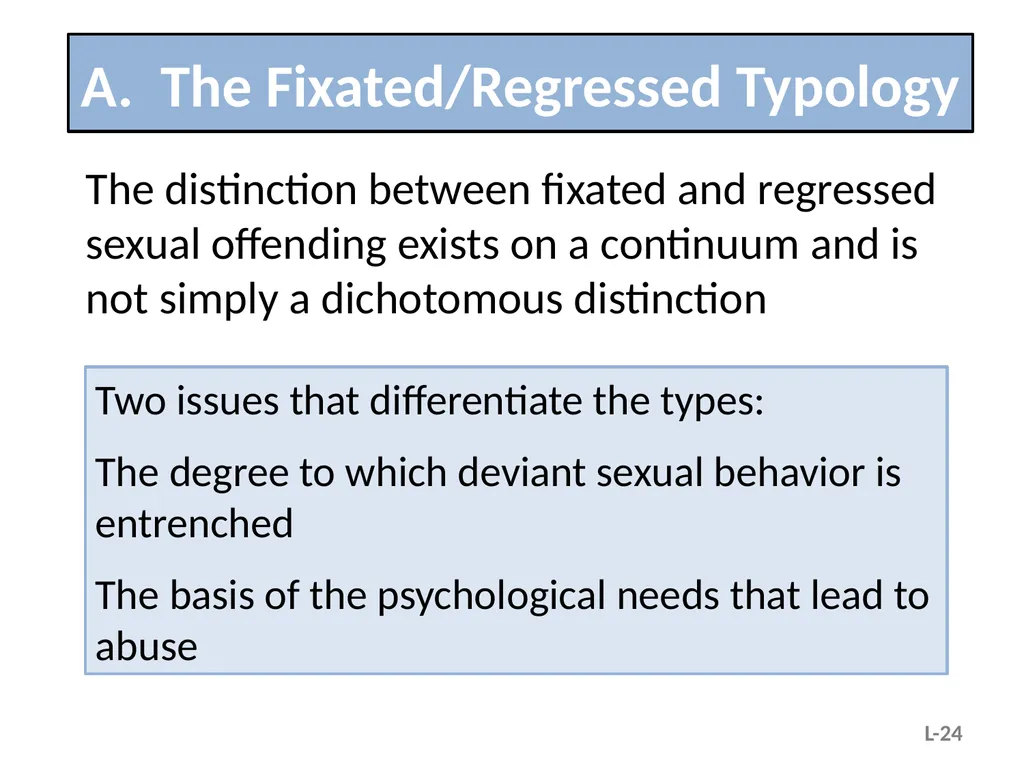
A. The Fixated/Regressed Typology The distinction between fixated and regressed sexual offending exists on a continuum and is not simply a dichotomous distinction L-24 Two issues that differentiate the types:
The degree to which deviant sexual behavior is entrenched
The basis of the psychological needs that lead to abuse<br>
The degree to which deviant sexual behavior is entrenched
The basis of the psychological needs that lead to abuse<br>
25
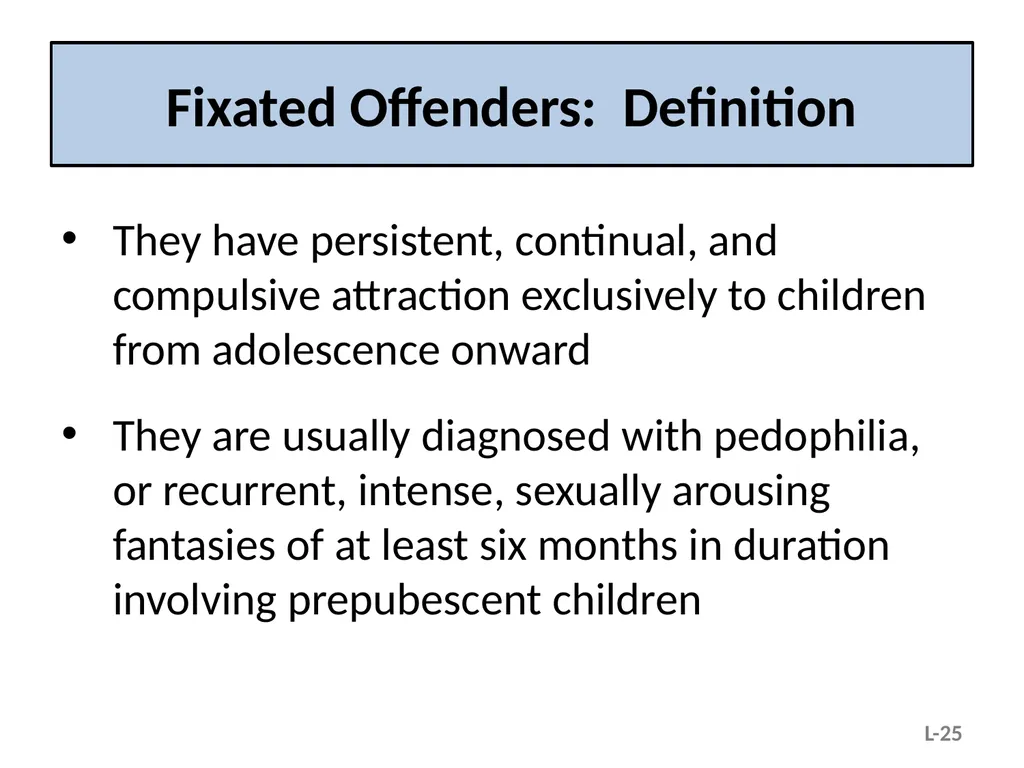
Fixated Offenders: Definition They have persistent, continual, and compulsive attraction exclusively to children from adolescence onward
They are usually diagnosed with pedophilia, or recurrent, intense, sexually arousing fantasies of at least six months in duration involving prepubescent children L-25<br>
They are usually diagnosed with pedophilia, or recurrent, intense, sexually arousing fantasies of at least six months in duration involving prepubescent children L-25<br>
26
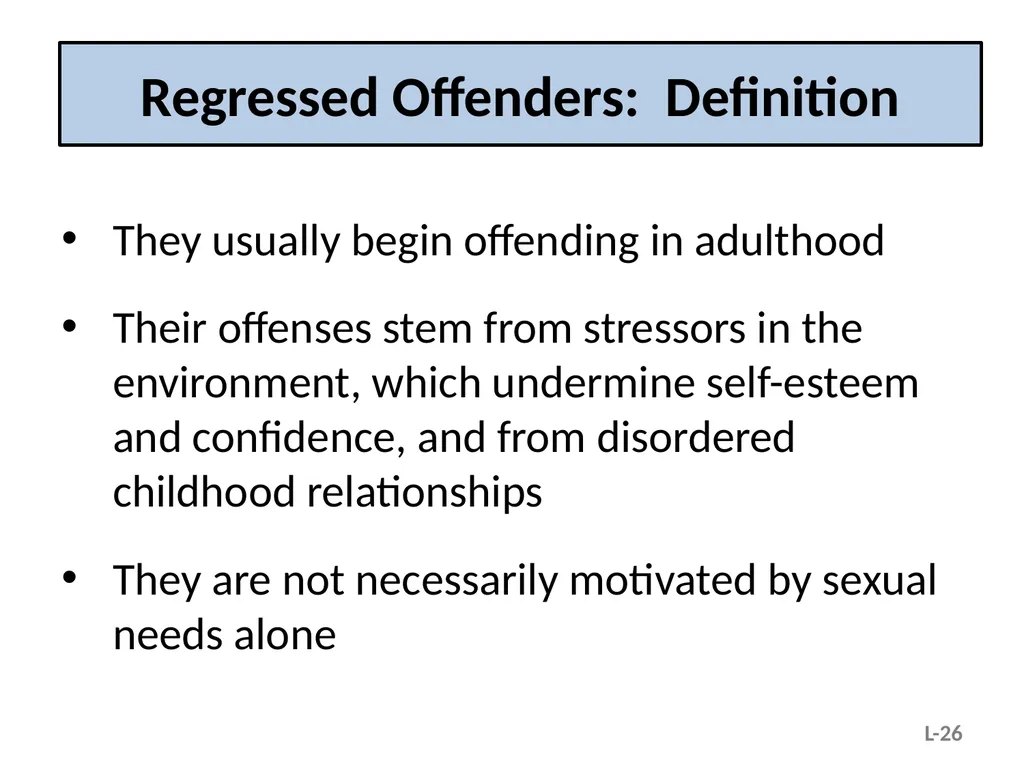
Regressed Offenders: Definition They usually begin offending in adulthood
Their offenses stem from stressors in the environment, which undermine self-esteem and confidence, and from disordered childhood relationships
They are not necessarily motivated by sexual needs alone L-26<br>
Their offenses stem from stressors in the environment, which undermine self-esteem and confidence, and from disordered childhood relationships
They are not necessarily motivated by sexual needs alone L-26<br>
27
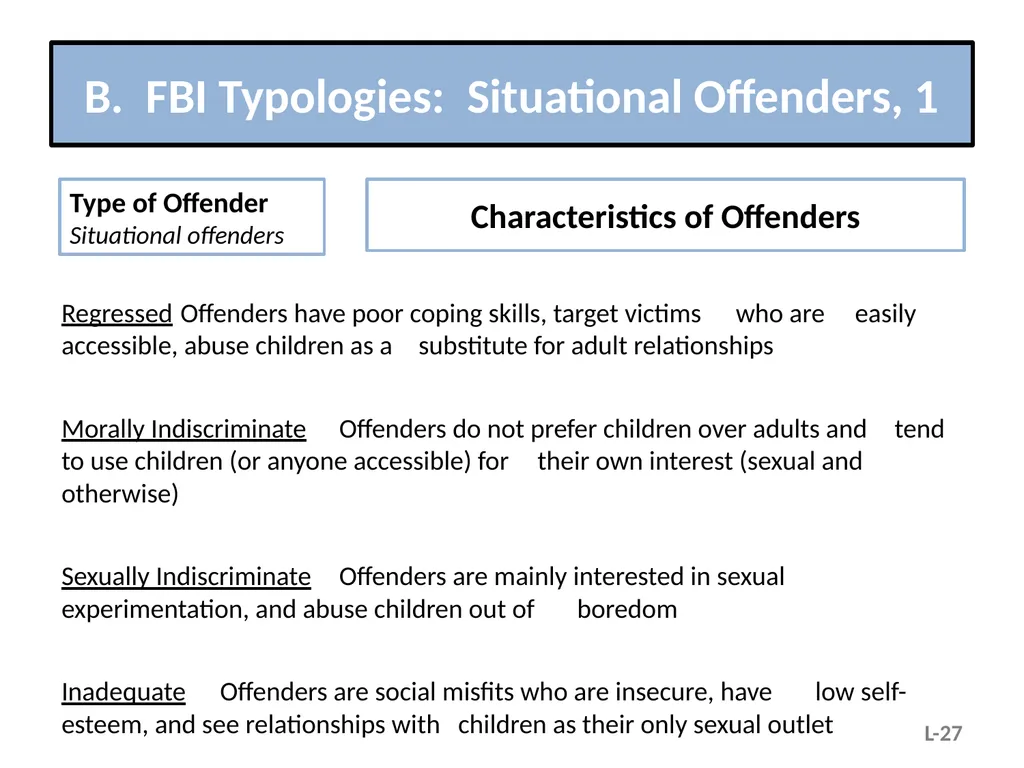
B. FBI Typologies: Situational Offenders, 1 Regressed Offenders have poor coping skills, target victims who are easily accessible, abuse children as a substitute for adult relationships
Morally Indiscriminate Offenders do not prefer children over adults and tend to use children (or anyone accessible) for their own interest (sexual and otherwise)
Sexually Indiscriminate Offenders are mainly interested in sexual experimentation, and abuse children out of boredom
Inadequate Offenders are social misfits who are insecure, have low self-esteem, and see relationships with children as their only sexual outlet L-27 Type of Offender Situational offenders Characteristics of Offenders<br>
Morally Indiscriminate Offenders do not prefer children over adults and tend to use children (or anyone accessible) for their own interest (sexual and otherwise)
Sexually Indiscriminate Offenders are mainly interested in sexual experimentation, and abuse children out of boredom
Inadequate Offenders are social misfits who are insecure, have low self-esteem, and see relationships with children as their only sexual outlet L-27 Type of Offender Situational offenders Characteristics of Offenders<br>
28
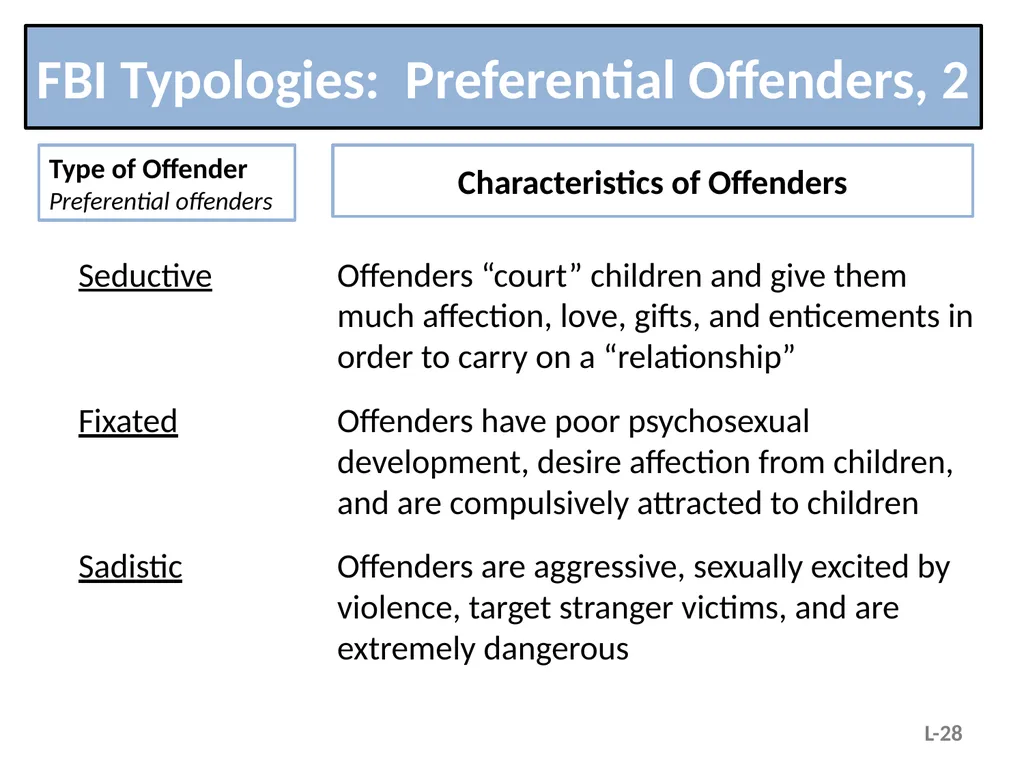
FBI Typologies: Preferential Offenders, 2 Seductive Offenders “court” children and give them much affection, love, gifts, and enticements in order to carry on a “relationship”
Fixated Offenders have poor psychosexual development, desire affection from children, and are compulsively attracted to children
Sadistic Offenders are aggressive, sexually excited by violence, target stranger victims, and are extremely dangerous L-28 Type of Offender
Preferential offenders Characteristics of Offenders<br>
Fixated Offenders have poor psychosexual development, desire affection from children, and are compulsively attracted to children
Sadistic Offenders are aggressive, sexually excited by violence, target stranger victims, and are extremely dangerous L-28 Type of Offender
Preferential offenders Characteristics of Offenders<br>
29
C. Personality Characteristics of
Clergy Offenders, 1 One review of literature maintained that clergy offenders displayed shyness, loneliness, and passivity
MMPI scores illustrated the presence of depression, authority concerns, and addiction problems
Rorschach results indicated greater affect constriction than normal
Offending clergy exhibited the presence of over-controlled hostility more than non-offending clergy L-29 Several researchers have concluded that clergy offenders are truly unique in comparison to offenders within the general population.<br>
MMPI scores illustrated the presence of depression, authority concerns, and addiction problems
Rorschach results indicated greater affect constriction than normal
Offending clergy exhibited the presence of over-controlled hostility more than non-offending clergy L-29 Several researchers have concluded that clergy offenders are truly unique in comparison to offenders within the general population.<br>
30
Personality Characteristics of
Clergy Offenders, 2 One of the specific clergy studies found that offenders came from backgrounds
Characterized by rigidity and dysfunction with themes of abuse
Had little insight into these areas
Had insufficient training in the issue of transference/counter transference
Had virtually no training or education concerning sexual abuse, domestic violence, addictive disease, or healthy professional boundaries, and
Failed to appreciate how their history of trauma affected their professional life L-30<br>
Characterized by rigidity and dysfunction with themes of abuse
Had little insight into these areas
Had insufficient training in the issue of transference/counter transference
Had virtually no training or education concerning sexual abuse, domestic violence, addictive disease, or healthy professional boundaries, and
Failed to appreciate how their history of trauma affected their professional life L-30<br>
31
Onset of Abuse, 3: Overcoming External Factors that May Prevent Abuse from Occurring Abusers often create opportunities for the abuse to take place, such as socializing and building trust with the victim’s family
Abusers must overcome the child’s resistance to the abuse, which is generally achieved through grooming tactics such as verbal and/or physical coercion, seduction, games, and enticements L-31<br>
Abusers must overcome the child’s resistance to the abuse, which is generally achieved through grooming tactics such as verbal and/or physical coercion, seduction, games, and enticements L-31<br>
32
C. Grooming Behavior Examples of various tactics or methods used to entice victims:
seduction or manipulation
verbal or physical intimidation
provision of “benefits” such as tickets to sporting events, or taking them on trips, money, or other gifts
building of personal and family relationships Grooming is a pre-meditated behavior intended to manipulate a potential victim into complying with sexual abuse L-32<br>
seduction or manipulation
verbal or physical intimidation
provision of “benefits” such as tickets to sporting events, or taking them on trips, money, or other gifts
building of personal and family relationships Grooming is a pre-meditated behavior intended to manipulate a potential victim into complying with sexual abuse L-32<br>
33
Grooming 2,
Seduction and Testing of a Child This tactic is used when there is a relationship with a child and the child is accustomed to the affectionate expression of the offender
The offender gradually extends the affectionate behavior, all the while “testing” the child’s response; if no overt resistance is observed, the sexual abuse continues L-33<br>
The offender gradually extends the affectionate behavior, all the while “testing” the child’s response; if no overt resistance is observed, the sexual abuse continues L-33<br>
34
Grooming 3, Emotional Manipulation
and Verbal Coercion These were the most common tactics used by offenders to groom their victims. Examples:
- Doing favors for the victim in exchange for sex
- Emotionally blackmailing the victim into compliance
- Even though it may appear that there is room for negotiation on the part of the victim, the outcome always favors the offender L-34<br>
- Doing favors for the victim in exchange for sex
- Emotionally blackmailing the victim into compliance
- Even though it may appear that there is room for negotiation on the part of the victim, the outcome always favors the offender L-34<br>
35
Grooming 4,
Catching the Victim by Surprise The offender orchestrates a situation to distract the victim or seizes the opportunity to abuse when it occurs
A frequent situational opportunity arises when potential victims become altar servers or otherwise serve a role in the church
Seizing the opportunity is most common and is usually the result of the offender’s frustration from waiting for the right time to initiate contact L-35<br>
A frequent situational opportunity arises when potential victims become altar servers or otherwise serve a role in the church
Seizing the opportunity is most common and is usually the result of the offender’s frustration from waiting for the right time to initiate contact L-35<br>
36
Grooming 5,
Using Verbal or Physical Force The offender garners victim compliance through use of force
The offender either commands the victim to perform sexual acts and/or physically forces the victim to engage in sexual acts
This factor is more common among the most serious, repeat offenders L-36<br>
The offender either commands the victim to perform sexual acts and/or physically forces the victim to engage in sexual acts
This factor is more common among the most serious, repeat offenders L-36<br>
37
Grooming 6,
Disguising Sexual Advances This tactic disguised sexual advances in the context of playing a game. Example:
Offender will begin by tickling the victim and gradually progress to fondling
While this approach may appear spontaneous, it has been well planned by the offender, yet orchestrated in a rather surreptitious manner L-37<br>
Offender will begin by tickling the victim and gradually progress to fondling
While this approach may appear spontaneous, it has been well planned by the offender, yet orchestrated in a rather surreptitious manner L-37<br>
38
Grooming 7, Using Alcohol and Drugs During the peak years of abuse, the use of alcohol and drugs by abusive priests increased significantly, but only for male victims Why this finding is important:
The increase in the use of alcohol and drugs by the abuser is consistent with the increase in the abuse of males
The increase in the abuse of males is consistent with the increase in the abuse of minors by priests
The use of alcohol and/or drugs by the abuser is a feature of the “situational” or “regressed” child abuser, but not of the “fixated” abuser L-38<br>
The increase in the use of alcohol and drugs by the abuser is consistent with the increase in the abuse of males
The increase in the abuse of males is consistent with the increase in the abuse of minors by priests
The use of alcohol and/or drugs by the abuser is a feature of the “situational” or “regressed” child abuser, but not of the “fixated” abuser L-38<br>
39
Grooming 8, Building Relationships
with the Families of Victims Family relationships were built to gain trust
Parents of abused children trusted the priests without reservation
The children who were abused often accepted the abuse and did not report it for many years This lack of disclosure and concern about reporting the abuse was one reason it was able to persist L-39<br>
Parents of abused children trusted the priests without reservation
The children who were abused often accepted the abuse and did not report it for many years This lack of disclosure and concern about reporting the abuse was one reason it was able to persist L-39<br>
40
Grooming 9,
Effects of Grooming over Time Grooming tactics are premeditated and more methodically planned than spontaneous abuse
The offender is willing to wait months or even possibly years to accomplish his task
Eventually the victim becomes groomed to the point that engaging in sex with the offender is more or less automatic L-40<br>
The offender is willing to wait months or even possibly years to accomplish his task
Eventually the victim becomes groomed to the point that engaging in sex with the offender is more or less automatic L-40<br>
41
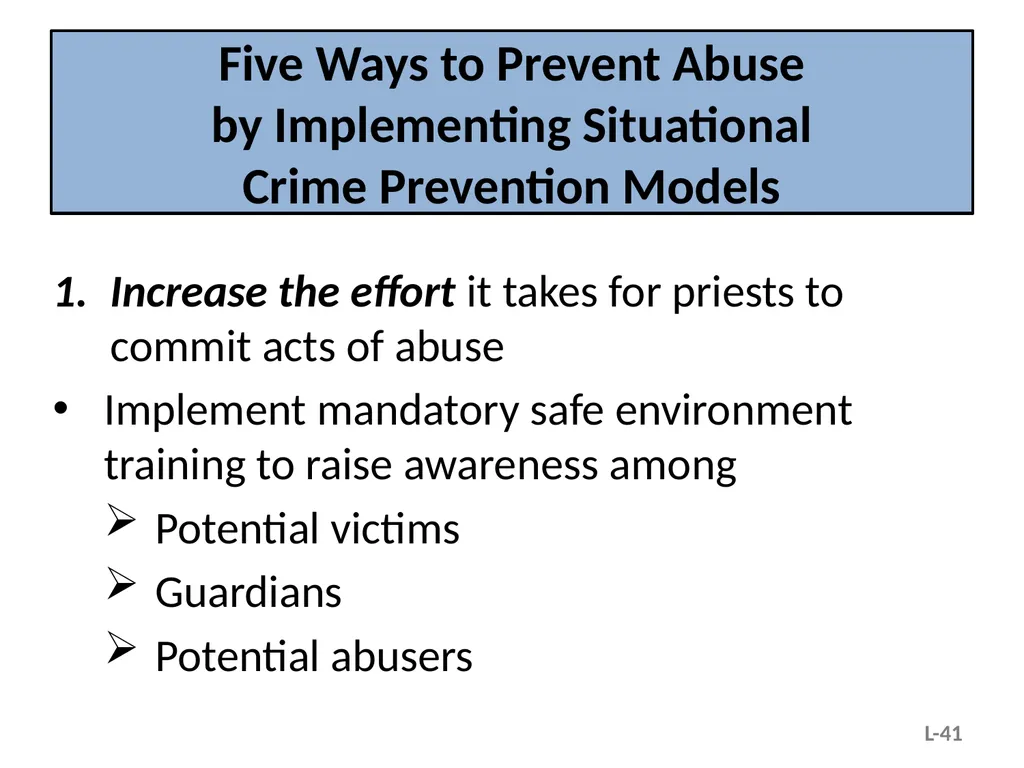
Five Ways to Prevent Abuse
by Implementing Situational
Crime Prevention Models Increase the effort it takes for priests to commit acts of abuse
Implement mandatory safe environment training to raise awareness among
Potential victims
Guardians
Potential abusers L-41<br>
Implement mandatory safe environment training to raise awareness among
Potential victims
Guardians
Potential abusers L-41<br>
42
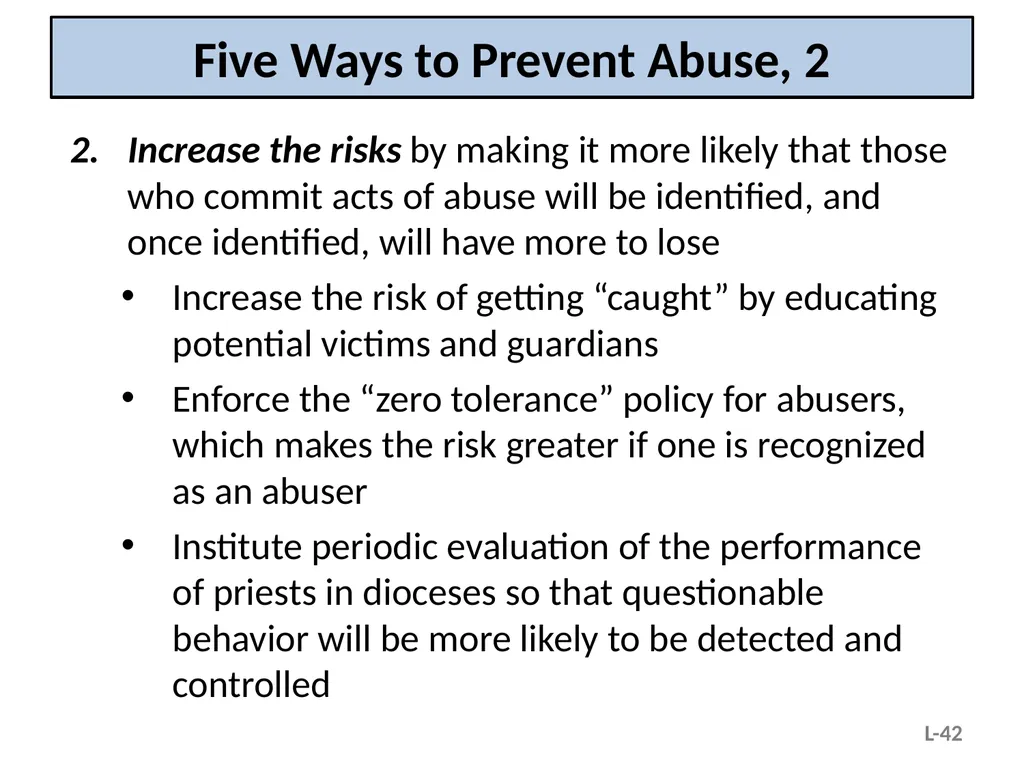
Five Ways to Prevent Abuse, 2 Increase the risks by making it more likely that those who commit acts of abuse will be identified, and once identified, will have more to lose
Increase the risk of getting “caught” by educating potential victims and guardians
Enforce the “zero tolerance” policy for abusers, which makes the risk greater if one is recognized as an abuser
Institute periodic evaluation of the performance of priests in dioceses so that questionable behavior will be more likely to be detected and controlled L-42<br>
Increase the risk of getting “caught” by educating potential victims and guardians
Enforce the “zero tolerance” policy for abusers, which makes the risk greater if one is recognized as an abuser
Institute periodic evaluation of the performance of priests in dioceses so that questionable behavior will be more likely to be detected and controlled L-42<br>
43
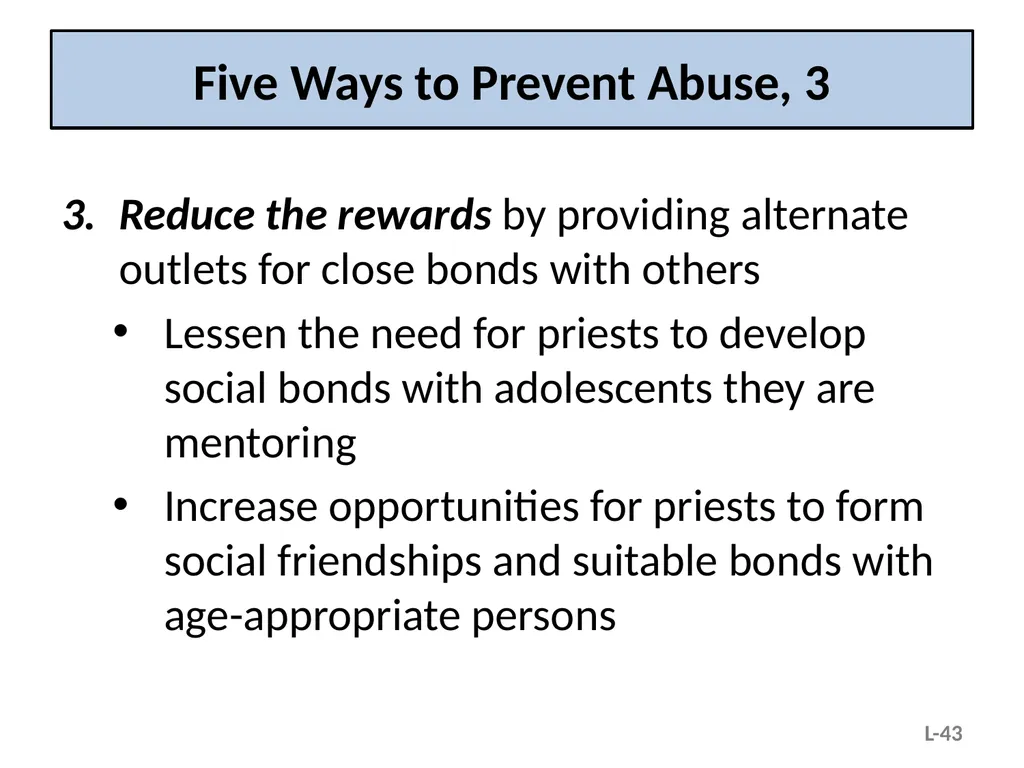
Five Ways to Prevent Abuse, 3 Reduce the rewards by providing alternate outlets for close bonds with others
Lessen the need for priests to develop social bonds with adolescents they are mentoring
Increase opportunities for priests to form social friendships and suitable bonds with age-appropriate persons L-43<br>
Lessen the need for priests to develop social bonds with adolescents they are mentoring
Increase opportunities for priests to form social friendships and suitable bonds with age-appropriate persons L-43<br>
44
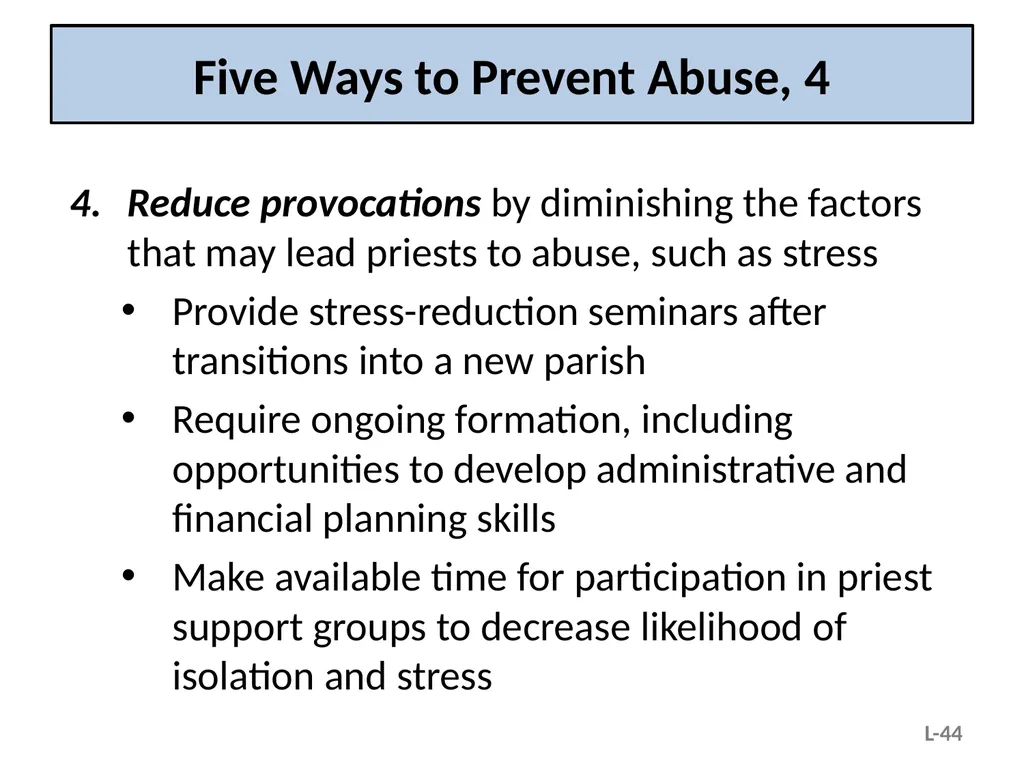
Five Ways to Prevent Abuse, 4 Reduce provocations by diminishing the factors that may lead priests to abuse, such as stress
Provide stress-reduction seminars after transitions into a new parish
Require ongoing formation, including opportunities to develop administrative and financial planning skills
Make available time for participation in priest support groups to decrease likelihood of isolation and stress L-44<br>
Provide stress-reduction seminars after transitions into a new parish
Require ongoing formation, including opportunities to develop administrative and financial planning skills
Make available time for participation in priest support groups to decrease likelihood of isolation and stress L-44<br>
45
Five Ways to Prevent Abuse, 5 Remove excuses through education about what types of behavior are and are not appropriate with minors
Eliminate, as far as possible, the ability of priests to use techniques of ‘neutralization,’ whereby they excuse and justify inappropriate behavior
Techniques of neutralization often develop over time and after periods of stress or other negative experiences in work and life L-45<br>
Eliminate, as far as possible, the ability of priests to use techniques of ‘neutralization,’ whereby they excuse and justify inappropriate behavior
Techniques of neutralization often develop over time and after periods of stress or other negative experiences in work and life L-45<br>
46
Summary of Situational and Organizational Factors, Types of Offenders, Grooming, and Prevention
Related to Sexual Abuse of Minors Situational Factors: Settings and Circumstances of Sexual Abuse
Settings Where Victims First Met Priests Who Abused Them, Physical Locations of Abuse, and Circumstances and Timing of Abuse
Organizational Factors Related to Abuse
- Priests’ Primary Duty or Role at Time of Abuse
Types of Offenders: Fixated, Regressed, Situational, and Preferential
Characteristics of Clergy Offenders
Grooming Techniques
Situational Crime Prevention L-46<br>
Settings Where Victims First Met Priests Who Abused Them, Physical Locations of Abuse, and Circumstances and Timing of Abuse
Organizational Factors Related to Abuse
- Priests’ Primary Duty or Role at Time of Abuse
Types of Offenders: Fixated, Regressed, Situational, and Preferential
Characteristics of Clergy Offenders
Grooming Techniques
Situational Crime Prevention L-46<br>
47
Discussion Questions, 1 L-47 Taking into account the circumstances and timing that were most common when abuse was perpetrated, what instructions should be given to parishioners, especially parents, and to children about sexual abuse?
What safeguards should be implemented in parish settings to reduce the probability of abuse?
Considering the settings and locations where abuse took place, what precautions should priests and other church leaders take relative to where they meet young people?
What are the major differences between types of sexual offenders?<br>
What safeguards should be implemented in parish settings to reduce the probability of abuse?
Considering the settings and locations where abuse took place, what precautions should priests and other church leaders take relative to where they meet young people?
What are the major differences between types of sexual offenders?<br>
48
Discussion Questions, 2 What risk factors particular to clergy might be observed in potential clergy sex offenders?
What are the essential ingredients of educational programs that can help prevent sexual abuse?
What components of the prevention models are most useful in your situation?
How can oversight be enhanced to prevent further sexual abuse?
To what extent are recommendations on education of young people, parishioners, and church leaders being implemented? L- 48 Link to USCCB – http://www.usccb.org/issues-and-action/child-and-youth-protection/charter.cfm<br>
What are the essential ingredients of educational programs that can help prevent sexual abuse?
What components of the prevention models are most useful in your situation?
How can oversight be enhanced to prevent further sexual abuse?
To what extent are recommendations on education of young people, parishioners, and church leaders being implemented? L- 48 Link to USCCB – http://www.usccb.org/issues-and-action/child-and-youth-protection/charter.cfm<br>
49
Prepared by:
Sister Katarina Schuth, O.S.F., St. Paul Seminary School of Divinity, University of St. Thomas
Technical Associate: Catherine Slight
Consultants:
Dr. Karen Terry and Margaret Smith, John Jay College of Criminal Justice, authors of major studies on sexual abuse for the USCCB;
Dr. Mary Gautier, Center for Applied Research in the Apostolate L-49<br>
Sister Katarina Schuth, O.S.F., St. Paul Seminary School of Divinity, University of St. Thomas
Technical Associate: Catherine Slight
Consultants:
Dr. Karen Terry and Margaret Smith, John Jay College of Criminal Justice, authors of major studies on sexual abuse for the USCCB;
Dr. Mary Gautier, Center for Applied Research in the Apostolate L-49<br>