
Module L1 Human Specimen Collection, Transport &
TD
Published · 53 slides · 0 views
1 / 1



Description
Module L1 Human Specimen Collection, Transport Virus Sharing Learning Objectives Describe specimens collection for influenza virus diagnosis Understand specimen data collection and tracking Understand specimen handling and storage for
Related Topics
Download this presentation From Below
"Module L1 Human Specimen Collection, Transport &" is the property of its rightful owner. Permission is granted to download and print the materials on this website for personal, non-commercial use only, and to display it on your personal computer provided you do not modify the materials and that you retain all copyright notices contained in the materials. By downloading content from our website, you accept the terms of this agreement.
Share
Embed code
Presentation Transcript
01
Module L1
Human Specimen Collection,
Transport & Virus Sharing<br>
02
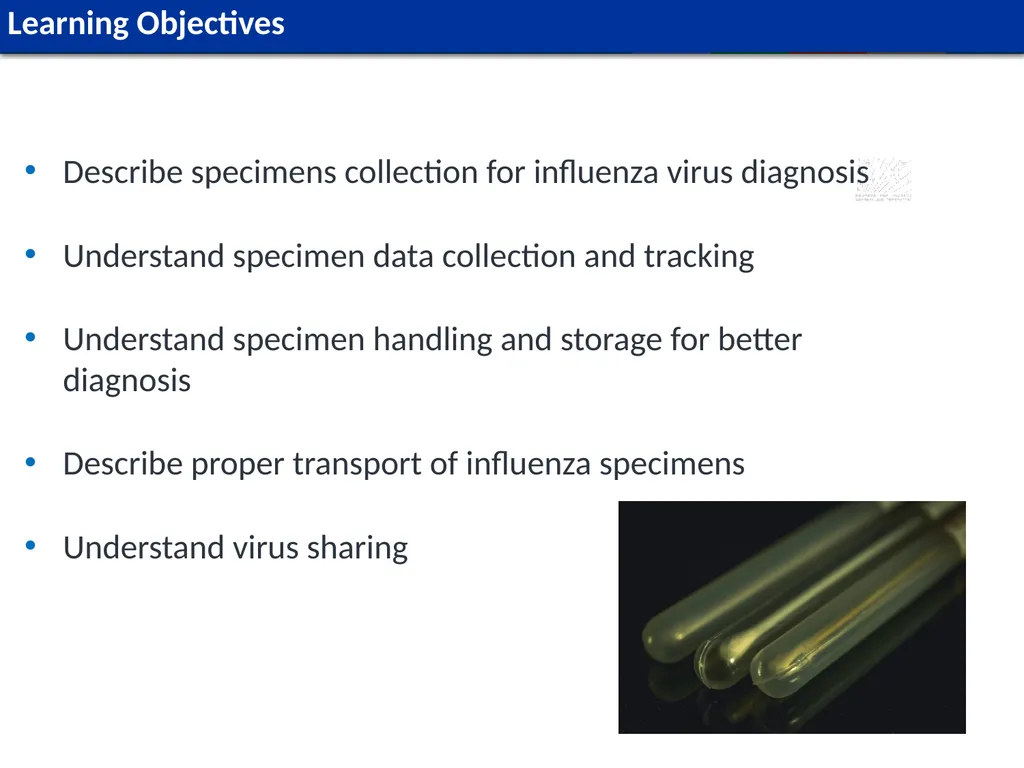
Learning Objectives Describe specimens collection for influenza virus diagnosis
Understand specimen data collection and tracking
Understand specimen handling and storage for better diagnosis
Describe proper transport of influenza specimens
Understand virus sharing<br>
Understand specimen data collection and tracking
Understand specimen handling and storage for better diagnosis
Describe proper transport of influenza specimens
Understand virus sharing<br>
03
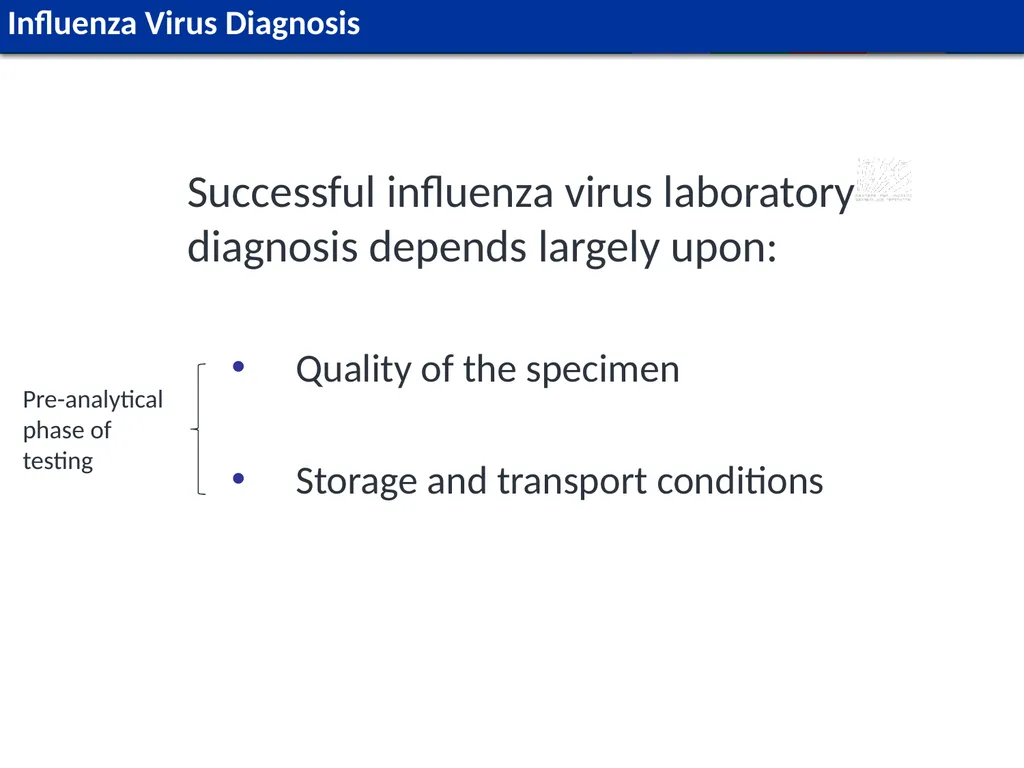
Successful influenza virus laboratory diagnosis depends largely upon:
Quality of the specimen
Storage and transport conditions Pre-analytical phase of testing Influenza Virus Diagnosis<br>
Quality of the specimen
Storage and transport conditions Pre-analytical phase of testing Influenza Virus Diagnosis<br>
04
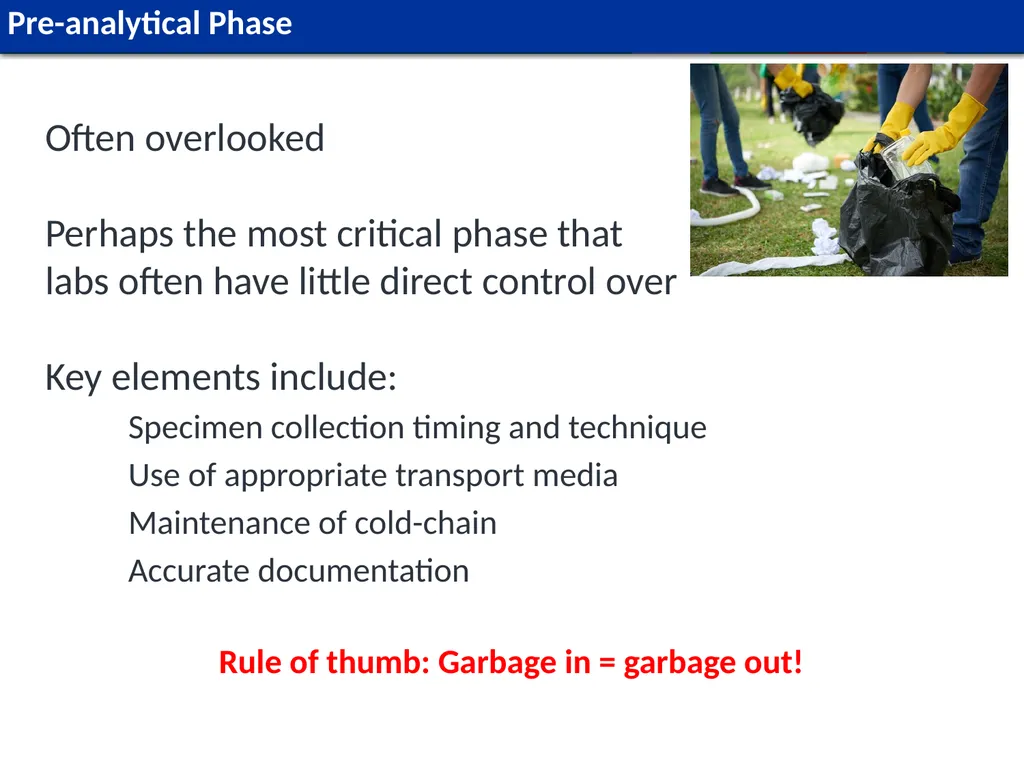
Pre-analytical Phase Often overlooked
Perhaps the most critical phase that labs often have little direct control over
Key elements include:
Specimen collection timing and technique
Use of appropriate transport media
Maintenance of cold-chain
Accurate documentation Rule of thumb: Garbage in = garbage out!<br>
Perhaps the most critical phase that labs often have little direct control over
Key elements include:
Specimen collection timing and technique
Use of appropriate transport media
Maintenance of cold-chain
Accurate documentation Rule of thumb: Garbage in = garbage out!<br>
05
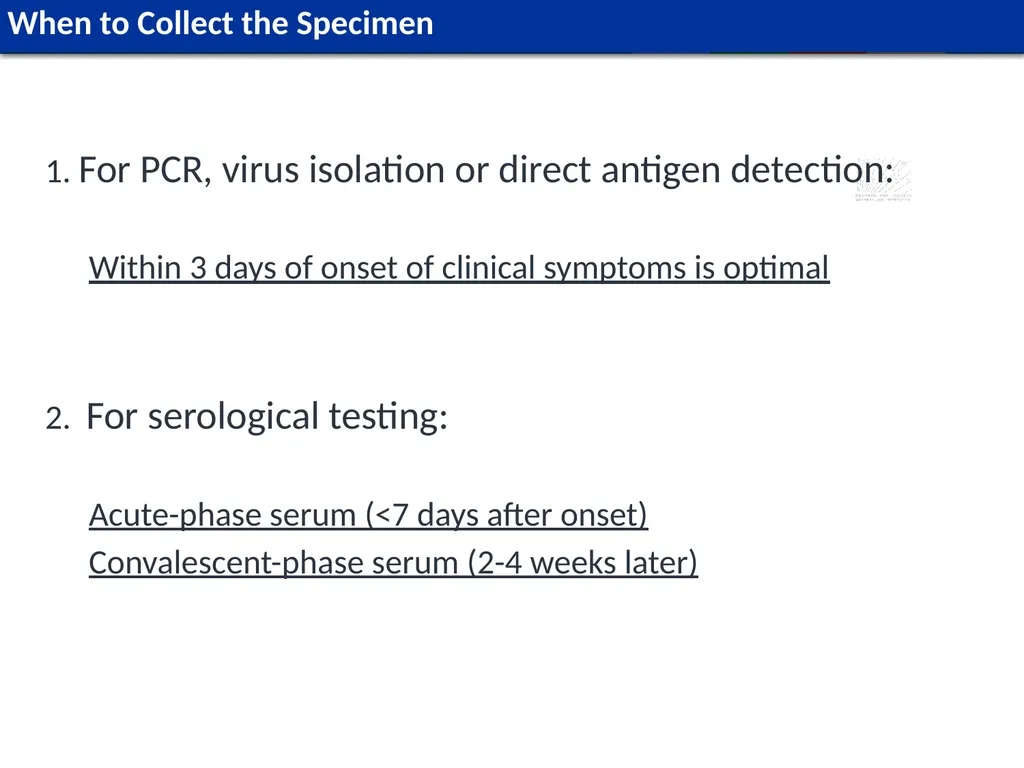
When to Collect the Specimen 1. For PCR, virus isolation or direct antigen detection:
Within 3 days of onset of clinical symptoms is optimal
2. For serological testing:
Acute-phase serum (<7 days after onset)
Convalescent-phase serum (2-4 weeks later)<br>
Within 3 days of onset of clinical symptoms is optimal
2. For serological testing:
Acute-phase serum (<7 days after onset)
Convalescent-phase serum (2-4 weeks later)<br>
06
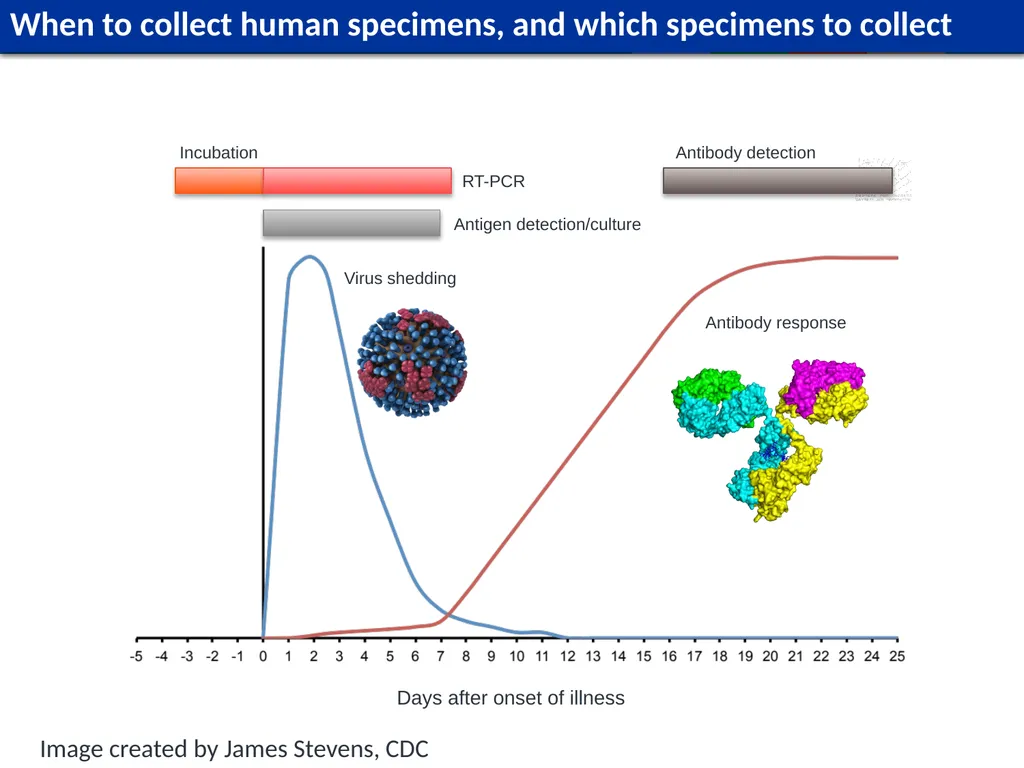
When to collect human specimens, and which specimens to collect Days after onset of illness Incubation Antibody detection Antibody response Virus shedding Antigen detection/culture RT-PCR Image created by James Stevens, CDC<br>
07
Nasopharyngeal swabs or aspirates
Throat swab
Nasal wash or swab
Broncho-alveolar lavage (BAL)
Endotracheal aspirate
Serum Images: http://www.who.int/csr/resources/publications/surveillance/WHO_CDS_EPR_ARO_2006_1/en/ Type of Specimen - Human<br>
Throat swab
Nasal wash or swab
Broncho-alveolar lavage (BAL)
Endotracheal aspirate
Serum Images: http://www.who.int/csr/resources/publications/surveillance/WHO_CDS_EPR_ARO_2006_1/en/ Type of Specimen - Human<br>
08
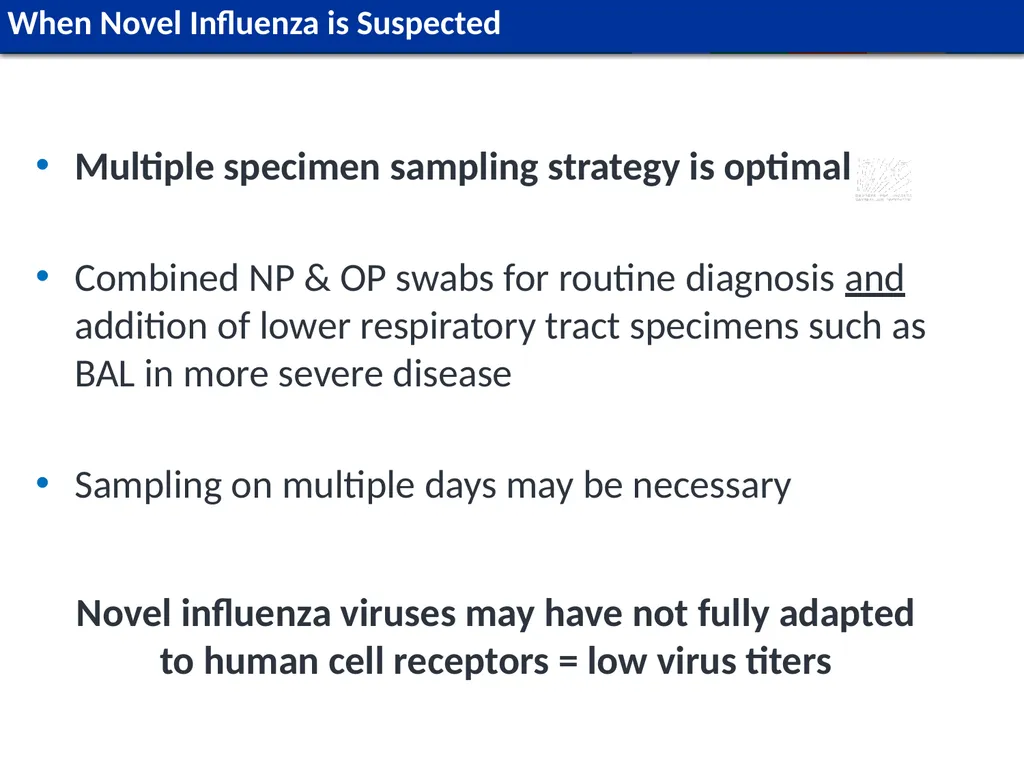
When Novel Influenza is Suspected Multiple specimen sampling strategy is optimal
Combined NP & OP swabs for routine diagnosis and addition of lower respiratory tract specimens such as BAL in more severe disease
Sampling on multiple days may be necessary Novel influenza viruses may have not fully adapted to human cell receptors = low virus titers<br>
Combined NP & OP swabs for routine diagnosis and addition of lower respiratory tract specimens such as BAL in more severe disease
Sampling on multiple days may be necessary Novel influenza viruses may have not fully adapted to human cell receptors = low virus titers<br>
09
Swab Type<br>
10
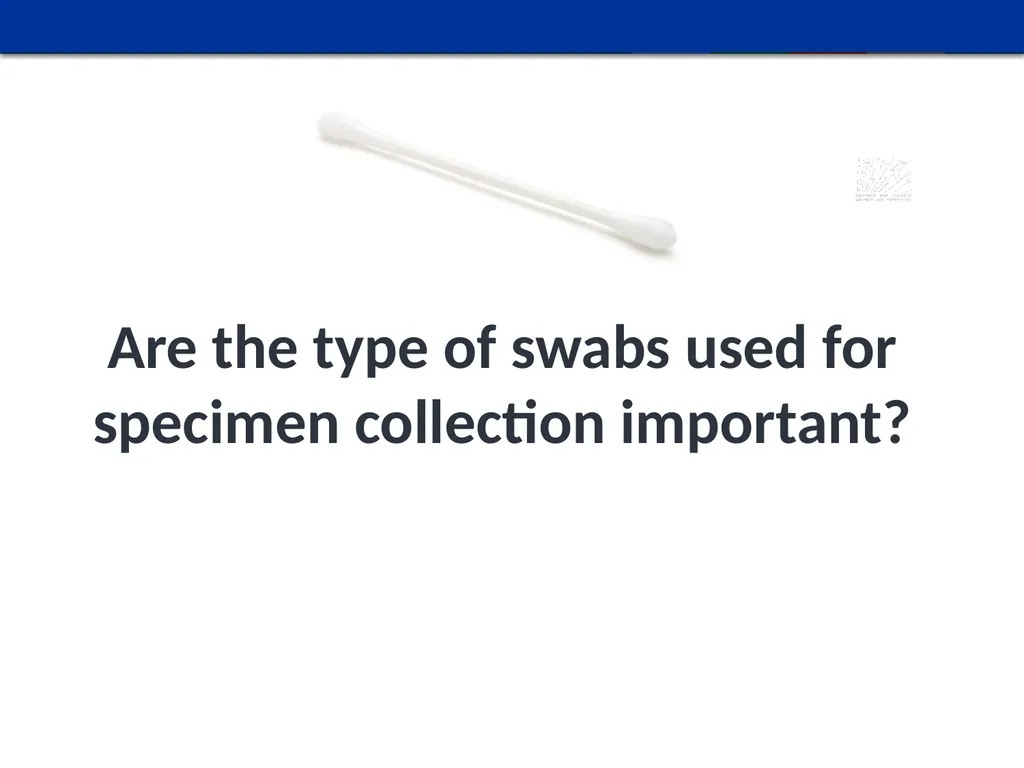
Are the type of swabs used for specimen collection important?<br>
11
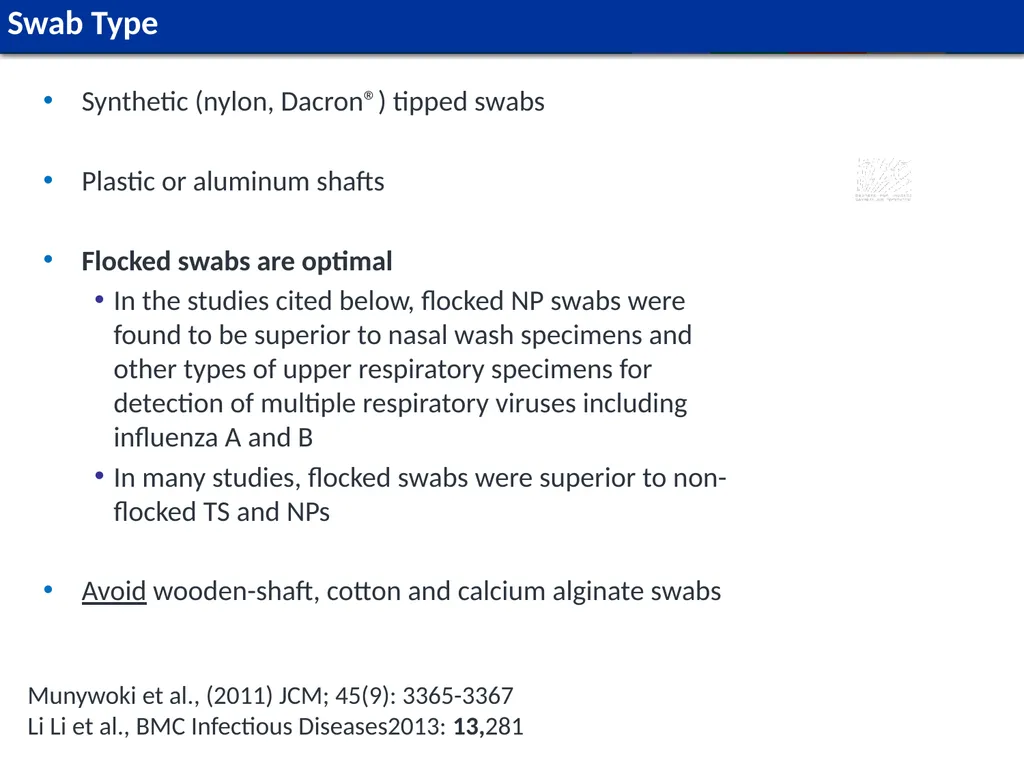
Swab Type Synthetic (nylon, Dacron®) tipped swabs
Plastic or aluminum shafts
Flocked swabs are optimal
In the studies cited below, flocked NP swabs were found to be superior to nasal wash specimens and other types of upper respiratory specimens for detection of multiple respiratory viruses including influenza A and B
In many studies, flocked swabs were superior to non-flocked TS and NPs
Avoid wooden-shaft, cotton and calcium alginate swabs Munywoki et al., (2011) JCM; 45(9): 3365-3367
Li Li et al., BMC Infectious Diseases2013: 13,281<br>
Plastic or aluminum shafts
Flocked swabs are optimal
In the studies cited below, flocked NP swabs were found to be superior to nasal wash specimens and other types of upper respiratory specimens for detection of multiple respiratory viruses including influenza A and B
In many studies, flocked swabs were superior to non-flocked TS and NPs
Avoid wooden-shaft, cotton and calcium alginate swabs Munywoki et al., (2011) JCM; 45(9): 3365-3367
Li Li et al., BMC Infectious Diseases2013: 13,281<br>
12
Collection Technique<br>
13
Videos Human:
Joint Commission/SIRAS
https://www.jointcommission.org/siras.aspx
Nasopharyngeal swab technique: NEJM
https://www.youtube.com/watch?v=DVJNWefmHjE
Animal:
Sample collection from live birds: FAO
https://www.youtube.com/watch?v=Jy0Dxiq2BnQ<br>
Joint Commission/SIRAS
https://www.jointcommission.org/siras.aspx
Nasopharyngeal swab technique: NEJM
https://www.youtube.com/watch?v=DVJNWefmHjE
Animal:
Sample collection from live birds: FAO
https://www.youtube.com/watch?v=Jy0Dxiq2BnQ<br>
14
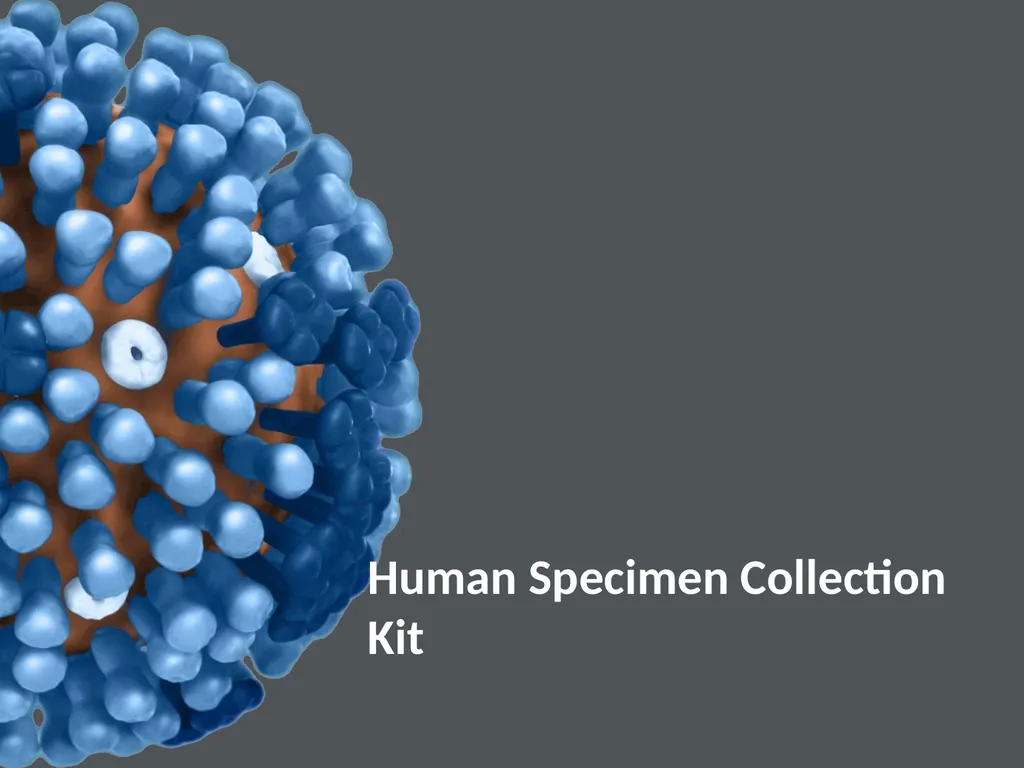
Human Specimen Collection Kit<br>
15
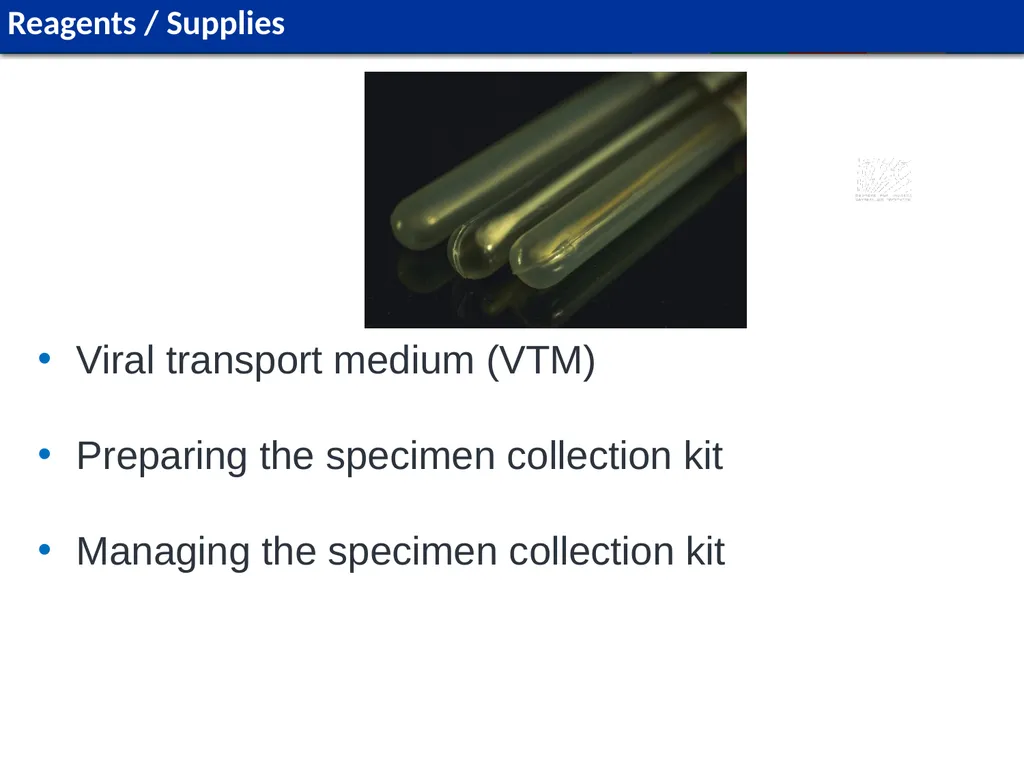
Reagents / Supplies Viral transport medium (VTM)
Preparing the specimen collection kit
Managing the specimen collection kit<br>
Preparing the specimen collection kit
Managing the specimen collection kit<br>
16
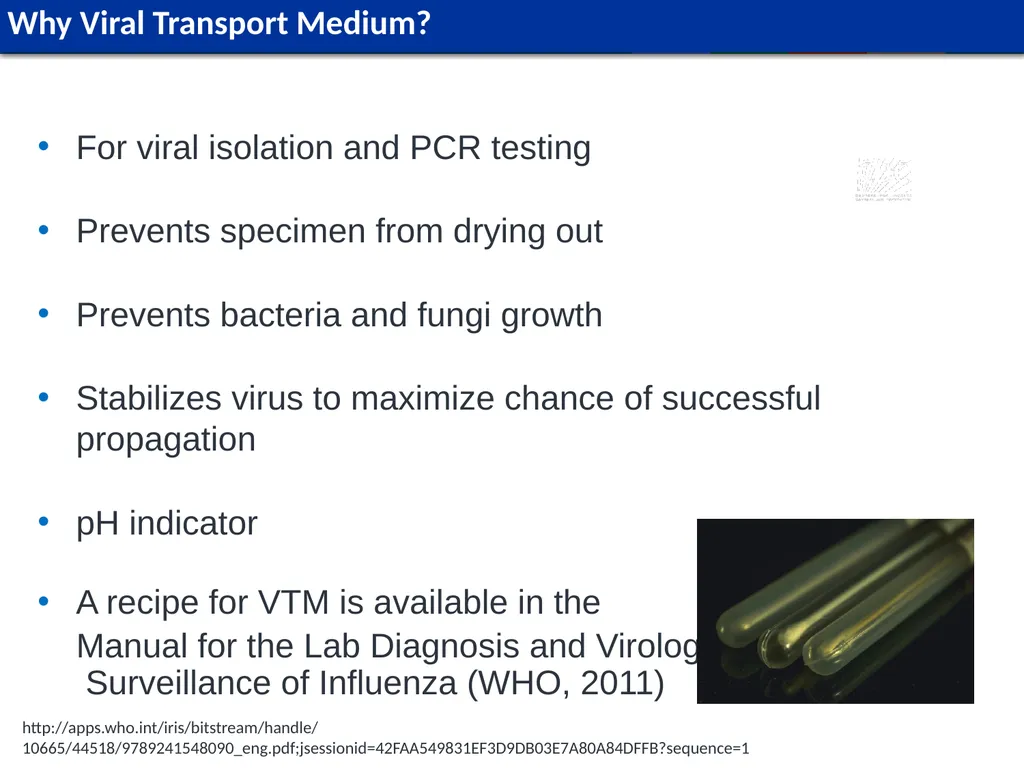
Why Viral Transport Medium? For viral isolation and PCR testing
Prevents specimen from drying out
Prevents bacteria and fungi growth
Stabilizes virus to maximize chance of successful propagation
pH indicator
A recipe for VTM is available in the
Manual for the Lab Diagnosis and Virologic Surveillance of Influenza (WHO, 2011) http://apps.who.int/iris/bitstream/handle/10665/44518/9789241548090_eng.pdf;jsessionid=42FAA549831EF3D9DB03E7A80A84DFFB?sequence=1<br>
Prevents specimen from drying out
Prevents bacteria and fungi growth
Stabilizes virus to maximize chance of successful propagation
pH indicator
A recipe for VTM is available in the
Manual for the Lab Diagnosis and Virologic Surveillance of Influenza (WHO, 2011) http://apps.who.int/iris/bitstream/handle/10665/44518/9789241548090_eng.pdf;jsessionid=42FAA549831EF3D9DB03E7A80A84DFFB?sequence=1<br>
17
Viral Transport Medium Storage VTM should be dispensed in sterile collection vials
Sterile glass beads should also be included in the vial
Optimally, provide a 3.0 ml volume of VTM to ensure adequate volume for complete characterization of the specimen
Ideally choose VTM that can be stored at room temperature
Otherwise, store VTM at -20°C and thaw when needed<br>
Sterile glass beads should also be included in the vial
Optimally, provide a 3.0 ml volume of VTM to ensure adequate volume for complete characterization of the specimen
Ideally choose VTM that can be stored at room temperature
Otherwise, store VTM at -20°C and thaw when needed<br>
18
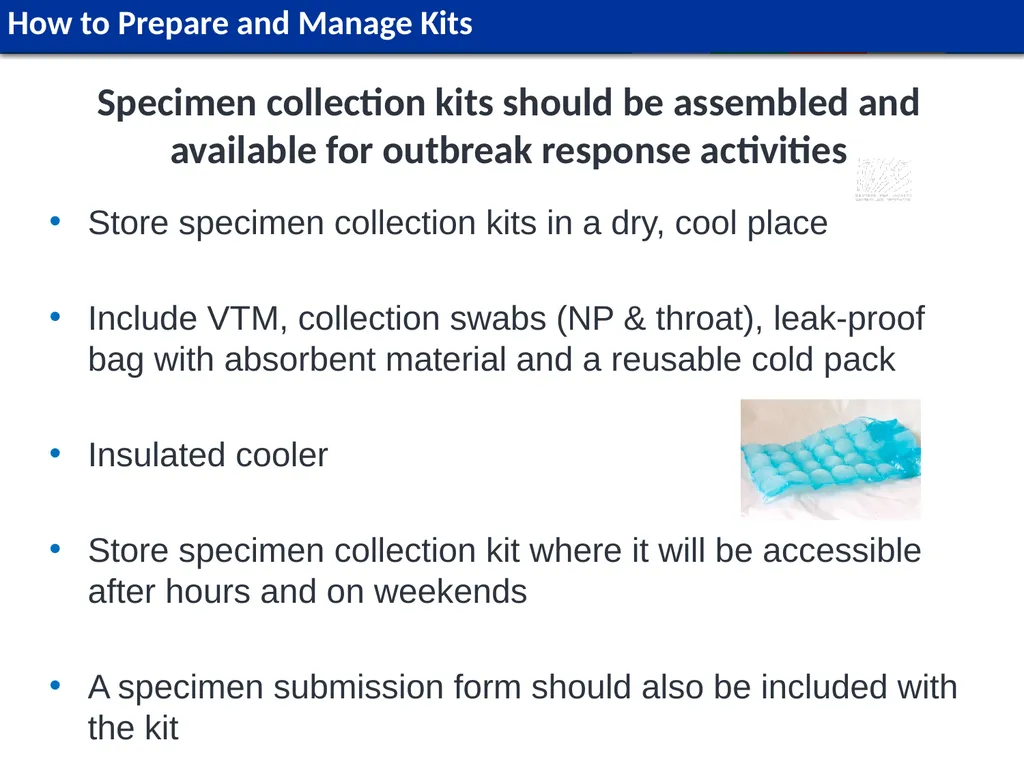
How to Prepare and Manage Kits Store specimen collection kits in a dry, cool place
Include VTM, collection swabs (NP & throat), leak-proof bag with absorbent material and a reusable cold pack
Insulated cooler
Store specimen collection kit where it will be accessible after hours and on weekends
A specimen submission form should also be included with the kit Specimen collection kits should be assembled and available for outbreak response activities<br>
Include VTM, collection swabs (NP & throat), leak-proof bag with absorbent material and a reusable cold pack
Insulated cooler
Store specimen collection kit where it will be accessible after hours and on weekends
A specimen submission form should also be included with the kit Specimen collection kits should be assembled and available for outbreak response activities<br>
19
Discussion Question In your country or location, have you had any problems with having the materials you need on hand for specimen collection?<br>
20
Target Cases<br>
21
Case Definitions Symptomatic cases (seasonal flu)
Follow case definition
Symptoms consistent with influenza (ILI) or ARI
Severe acute respiratory illness (SARI)
http://www.who.int/influenza/surveillance_monitoring/ili_sari_surveillance_case_definition/en/
Zoonotic influenza
Follow case definition
Cases and symptomatic contacts (contact with suspected or probable cases)
http://www.who.int/influenza/resources/documents/case_definition2006_08_29/en/<br>
Follow case definition
Symptoms consistent with influenza (ILI) or ARI
Severe acute respiratory illness (SARI)
http://www.who.int/influenza/surveillance_monitoring/ili_sari_surveillance_case_definition/en/
Zoonotic influenza
Follow case definition
Cases and symptomatic contacts (contact with suspected or probable cases)
http://www.who.int/influenza/resources/documents/case_definition2006_08_29/en/<br>
22
When to Collect the Specimen? As soon as possible after symptoms begin; within 3 days of illness onset is optimal
Before antiviral medications are administered
Even if symptoms began more than one week ago
Collect multiple specimens on multiple days when you have access to patient<br>
Before antiviral medications are administered
Even if symptoms began more than one week ago
Collect multiple specimens on multiple days when you have access to patient<br>
23
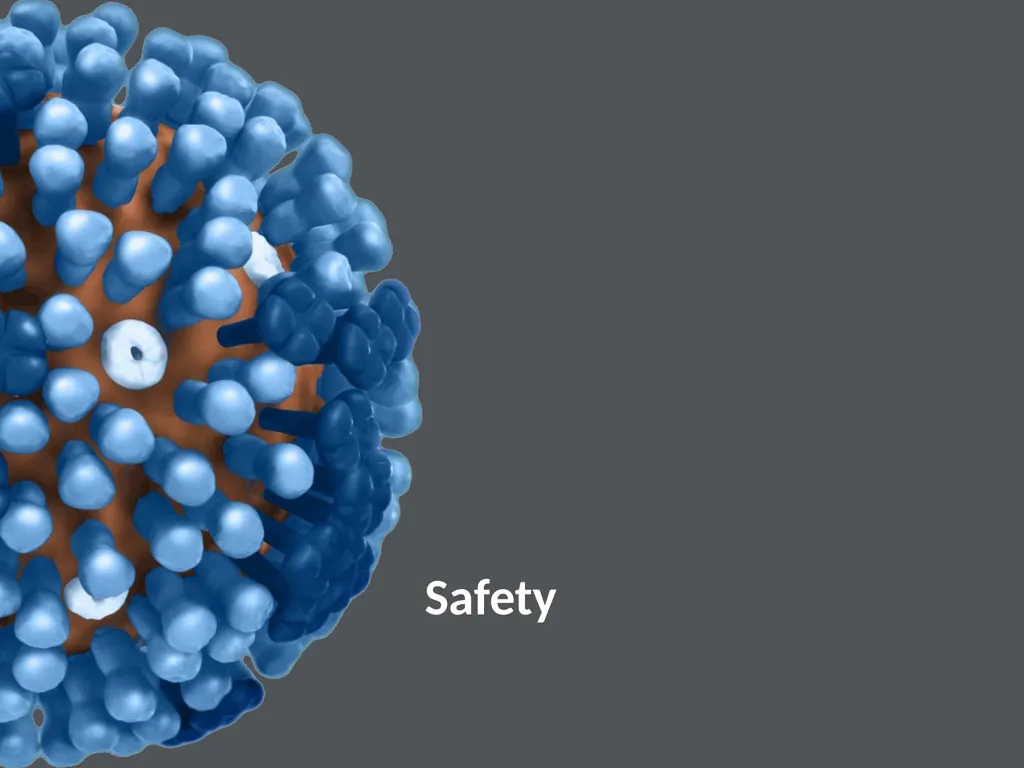
Safety<br>
24
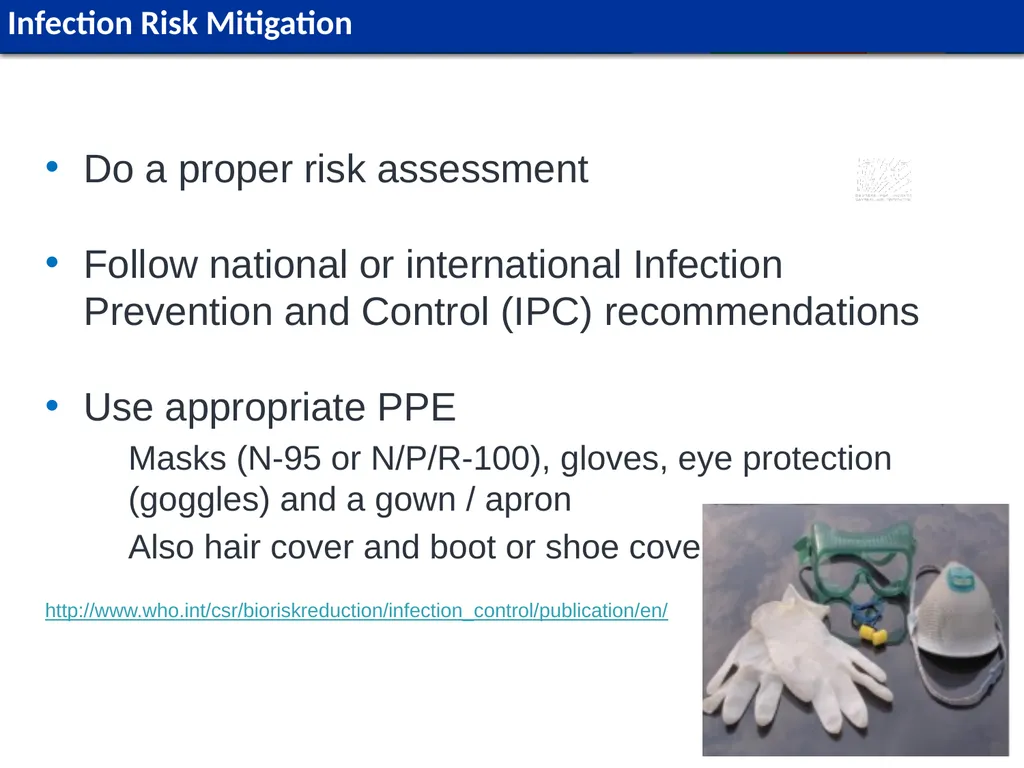
Infection Risk Mitigation Do a proper risk assessment
Follow national or international Infection Prevention and Control (IPC) recommendations
Use appropriate PPE
Masks (N-95 or N/P/R-100), gloves, eye protection (goggles) and a gown / apron
Also hair cover and boot or shoe covers
http://www.who.int/csr/bioriskreduction/infection_control/publication/en/<br>
Follow national or international Infection Prevention and Control (IPC) recommendations
Use appropriate PPE
Masks (N-95 or N/P/R-100), gloves, eye protection (goggles) and a gown / apron
Also hair cover and boot or shoe covers
http://www.who.int/csr/bioriskreduction/infection_control/publication/en/<br>
25
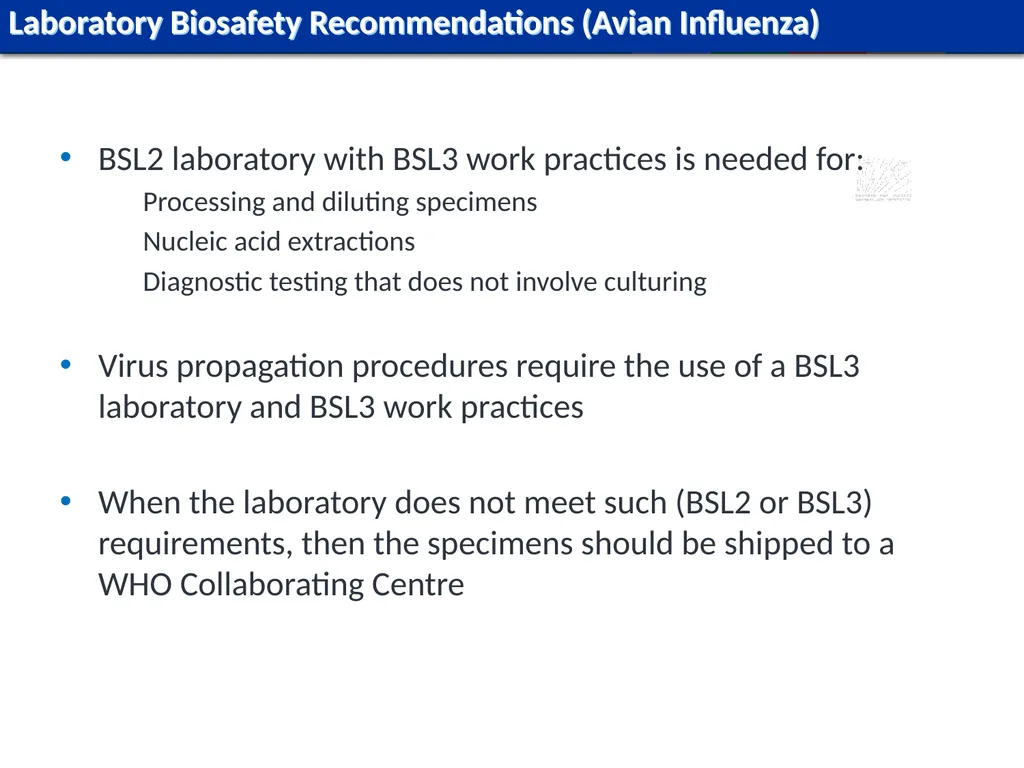
Laboratory Biosafety Recommendations (Avian Influenza) BSL2 laboratory with BSL3 work practices is needed for:
Processing and diluting specimens
Nucleic acid extractions
Diagnostic testing that does not involve culturing
Virus propagation procedures require the use of a BSL3 laboratory and BSL3 work practices
When the laboratory does not meet such (BSL2 or BSL3) requirements, then the specimens should be shipped to a WHO Collaborating Centre<br>
Processing and diluting specimens
Nucleic acid extractions
Diagnostic testing that does not involve culturing
Virus propagation procedures require the use of a BSL3 laboratory and BSL3 work practices
When the laboratory does not meet such (BSL2 or BSL3) requirements, then the specimens should be shipped to a WHO Collaborating Centre<br>
26
References Biosafety for AI (H5N1)
http://www.who.int/influenza/resources/documents/guidelines_handling_specimens/en/
WHO Laboratory Biosafety Manual
http://www.who.int/csr/resources/publications/biosafety/WHO_CDS_CSR_LYO_2004_11/en/<br>
http://www.who.int/influenza/resources/documents/guidelines_handling_specimens/en/
WHO Laboratory Biosafety Manual
http://www.who.int/csr/resources/publications/biosafety/WHO_CDS_CSR_LYO_2004_11/en/<br>
27
Specimen Data Collection
and Tracking<br>
28
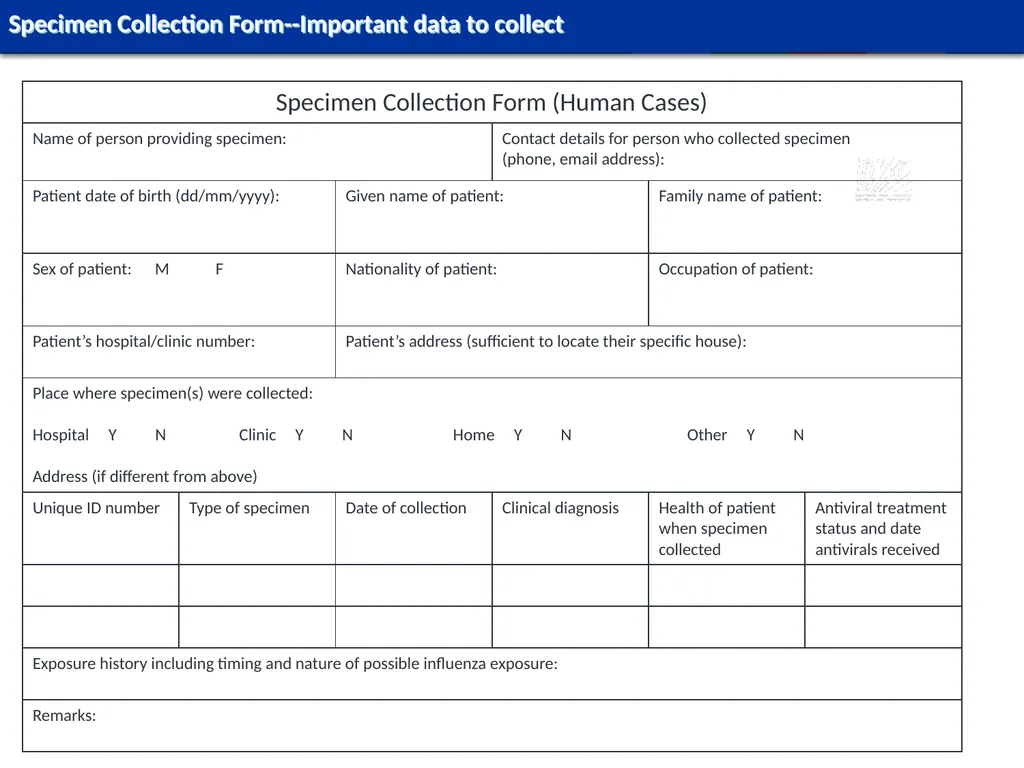
Specimen Collection Form--Important data to collect<br>
29
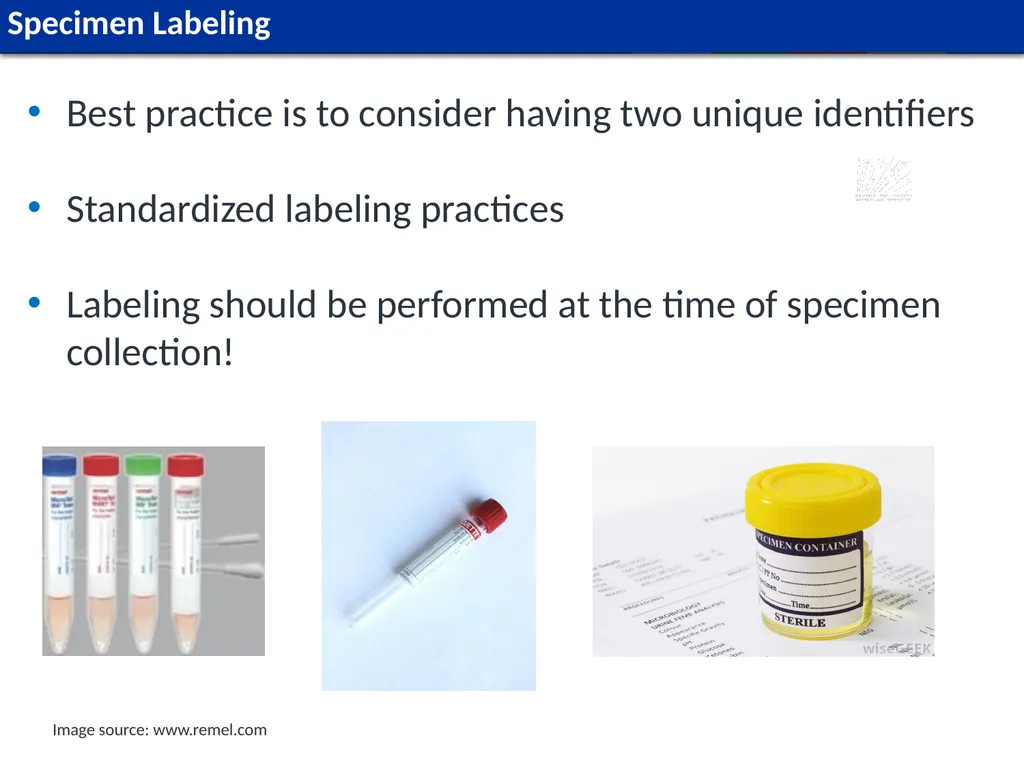
Specimen Labeling Best practice is to consider having two unique identifiers
Standardized labeling practices
Labeling should be performed at the time of specimen collection! Image source: www.remel.com<br>
Standardized labeling practices
Labeling should be performed at the time of specimen collection! Image source: www.remel.com<br>
30
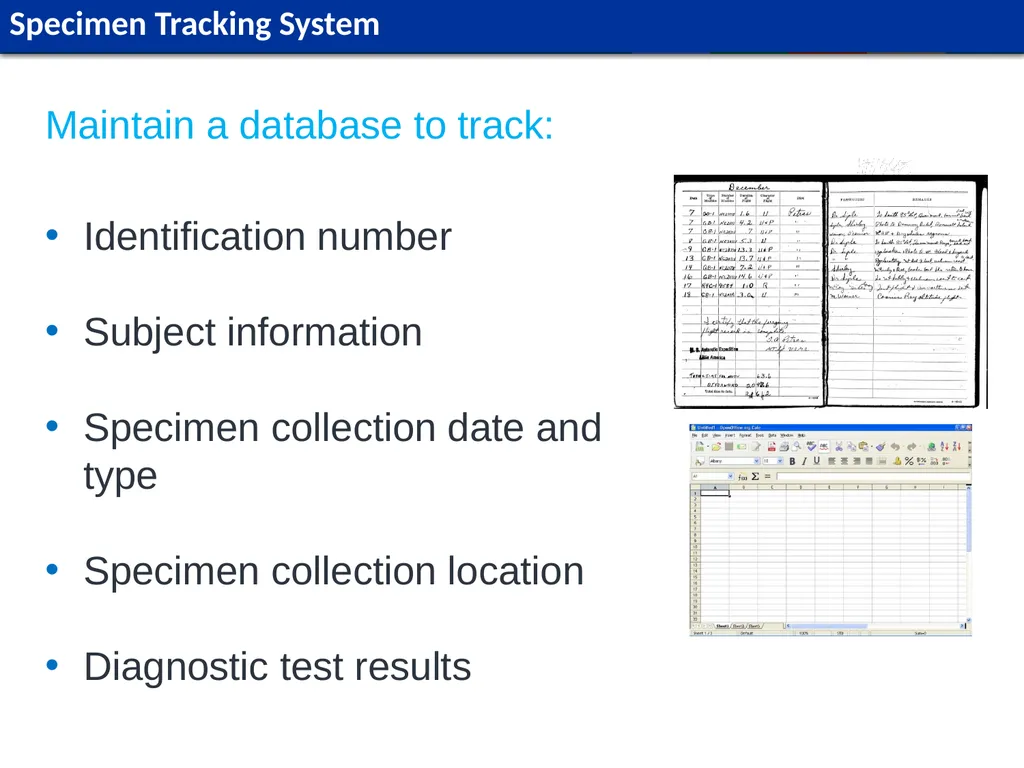
Specimen Tracking System Maintain a database to track:
Identification number
Subject information
Specimen collection date and type
Specimen collection location
Diagnostic test results<br>
Identification number
Subject information
Specimen collection date and type
Specimen collection location
Diagnostic test results<br>
31
Discussion Questions In your country or location, do you have a database in place for specimen tracking?
In your country or location, have you had any problems with specimen tracking?<br>
In your country or location, have you had any problems with specimen tracking?<br>
32
Specimen Storage<br>
33
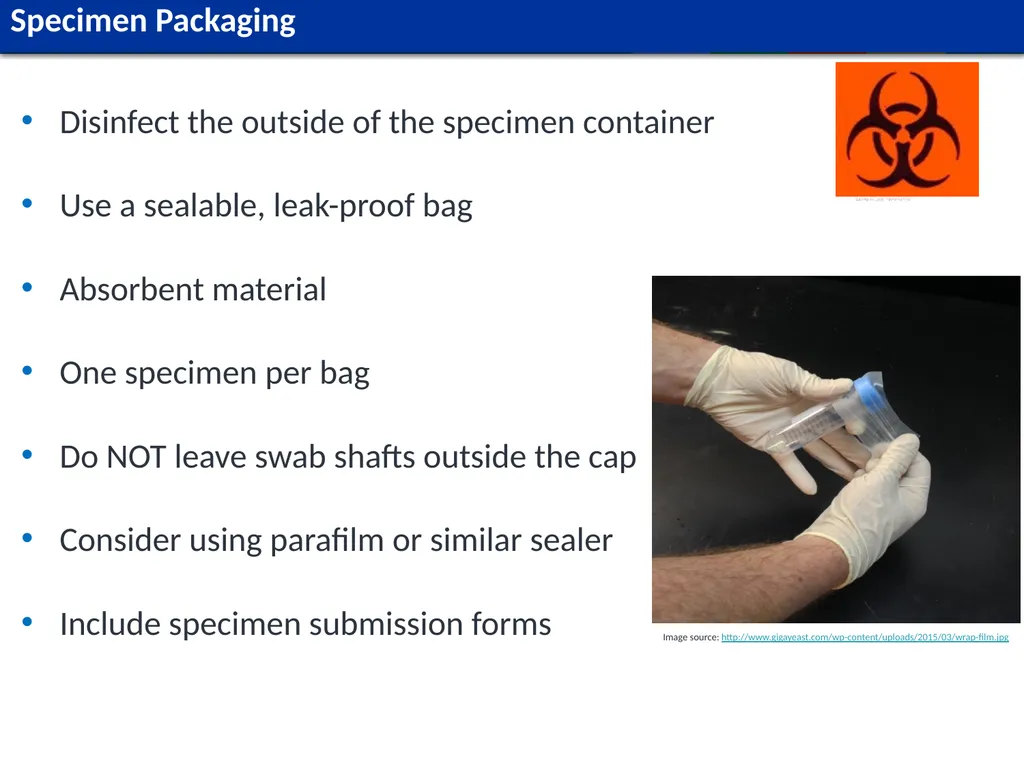
Specimen Packaging Disinfect the outside of the specimen container
Use a sealable, leak-proof bag
Absorbent material
One specimen per bag
Do NOT leave swab shafts outside the cap
Consider using parafilm or similar sealer
Include specimen submission forms Image source: http://www.gigayeast.com/wp-content/uploads/2015/03/wrap-film.jpg<br>
Use a sealable, leak-proof bag
Absorbent material
One specimen per bag
Do NOT leave swab shafts outside the cap
Consider using parafilm or similar sealer
Include specimen submission forms Image source: http://www.gigayeast.com/wp-content/uploads/2015/03/wrap-film.jpg<br>
34
Specimen Storage Transport to laboratory as soon as possible
Store specimens at 4°C before and during transportation if within 48 hours
Store specimens at -70°C beyond 48 hours
Do not store in standard freezer – keep on ice or in refrigerator
At -20°C ice crystals form that break the virus open and affect specimen quality
Avoid freeze-thaw cycles
Better to keep on ice for a week than to have repeat freeze and thaw<br>
Store specimens at 4°C before and during transportation if within 48 hours
Store specimens at -70°C beyond 48 hours
Do not store in standard freezer – keep on ice or in refrigerator
At -20°C ice crystals form that break the virus open and affect specimen quality
Avoid freeze-thaw cycles
Better to keep on ice for a week than to have repeat freeze and thaw<br>
35
Discussion Question In your country or location, have you had any problems with specimen storage?<br>
36
Infectious Substance Transport<br>
37
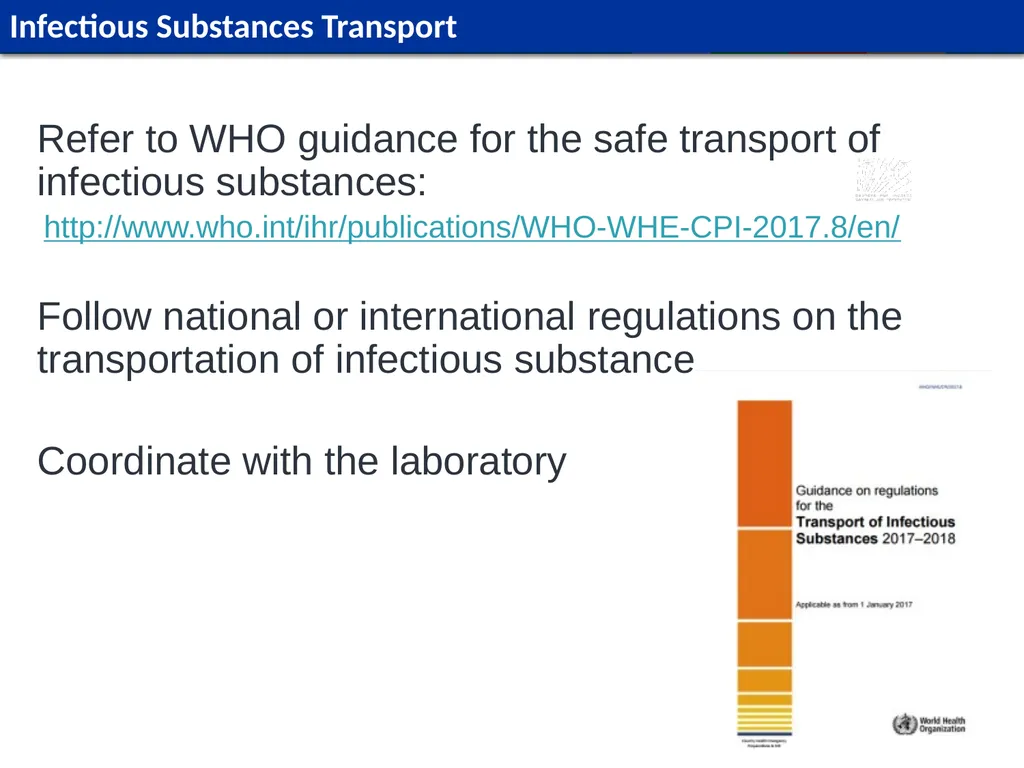
Infectious Substances Transport Refer to WHO guidance for the safe transport of infectious substances:
http://www.who.int/ihr/publications/WHO-WHE-CPI-2017.8/en/
Follow national or international regulations on the transportation of infectious substance
Coordinate with the laboratory<br>
http://www.who.int/ihr/publications/WHO-WHE-CPI-2017.8/en/
Follow national or international regulations on the transportation of infectious substance
Coordinate with the laboratory<br>
38
Infectious Substances Shipping Categories International Air Transport Association(IATA) has classified packaging and shipping requirements as Category A, Category B and Exempt
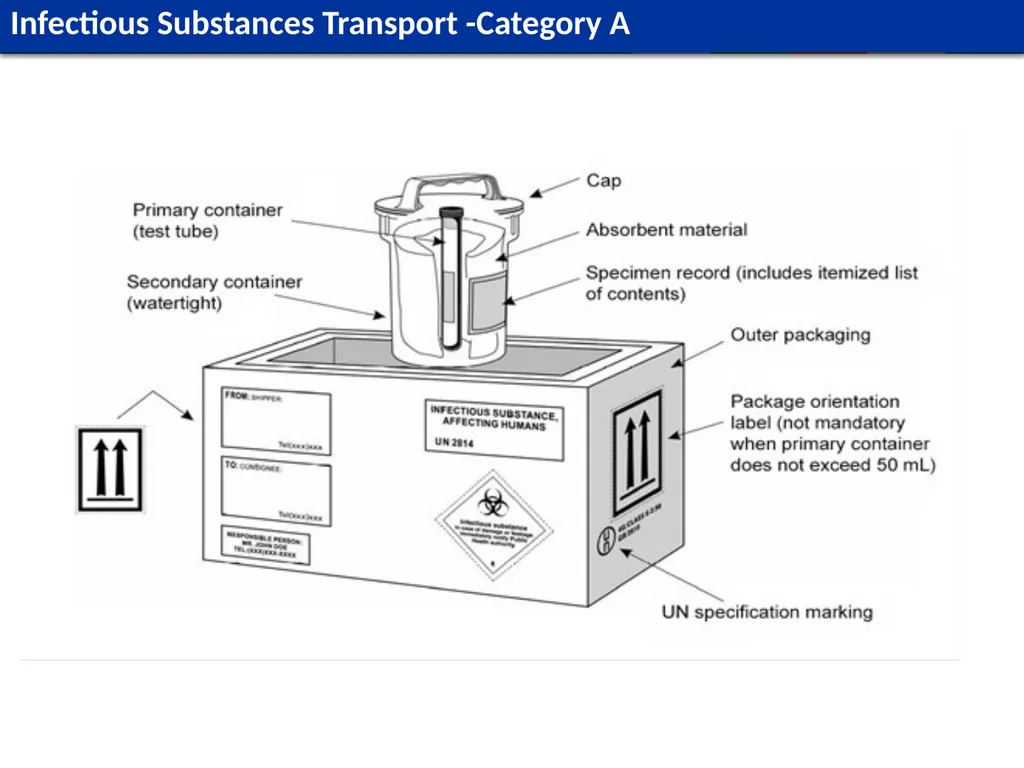
Category A is an infectious substance that contains a highly pathogenic microorganism or cultures of other dangerous pathogens such as avian influenza
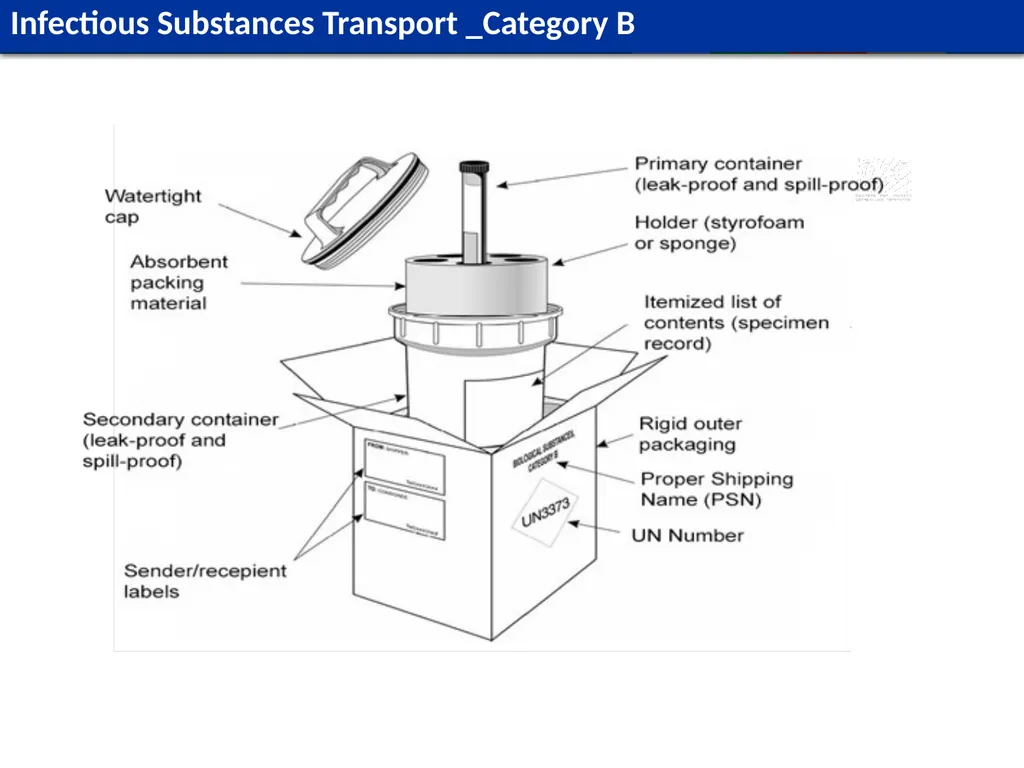
Category B substances includes diagnostic specimens from which an infectious agent has not been isolated, but may contain an infectious agent
Protect the environment, the carrier and the sample<br>
Category A is an infectious substance that contains a highly pathogenic microorganism or cultures of other dangerous pathogens such as avian influenza
Category B substances includes diagnostic specimens from which an infectious agent has not been isolated, but may contain an infectious agent
Protect the environment, the carrier and the sample<br>
39
Infectious Substances Transport -Category A<br>
40
Infectious Substances Transport _Category B<br>
41
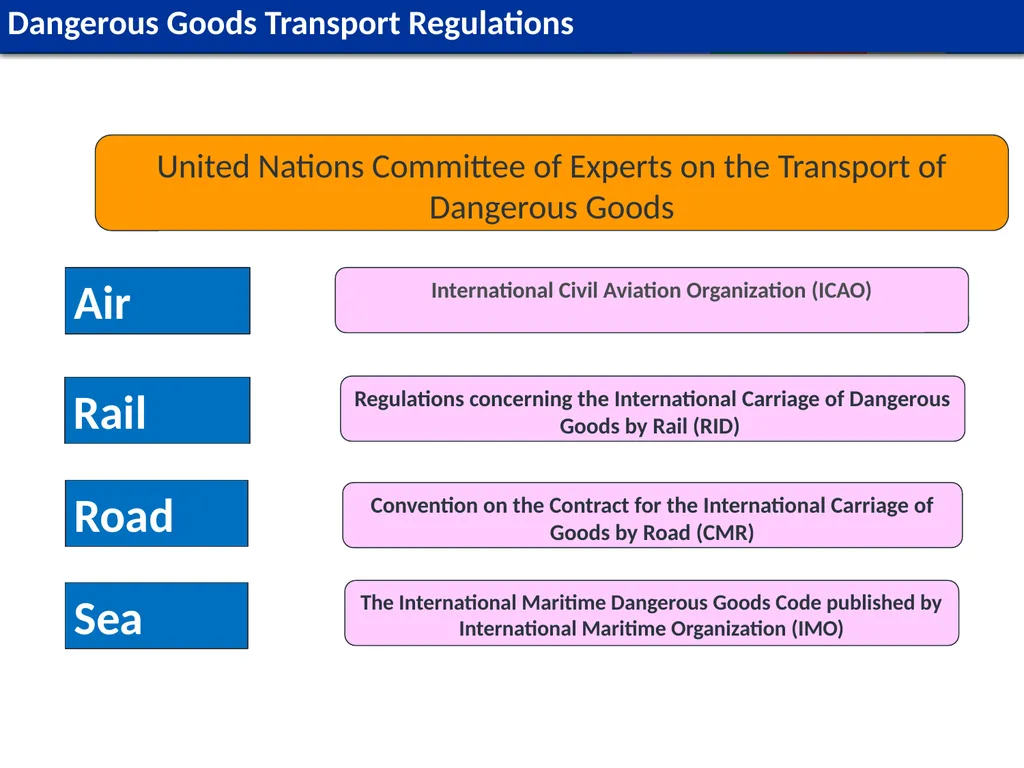
Dangerous Goods Transport Regulations Air Rail Road Sea International Civil Aviation Organization (ICAO) Regulations concerning the International Carriage of Dangerous Goods by Rail (RID) Convention on the Contract for the International Carriage of Goods by Road (CMR) The International Maritime Dangerous Goods Code published by International Maritime Organization (IMO) United Nations Committee of Experts on the Transport of Dangerous Goods<br>
42
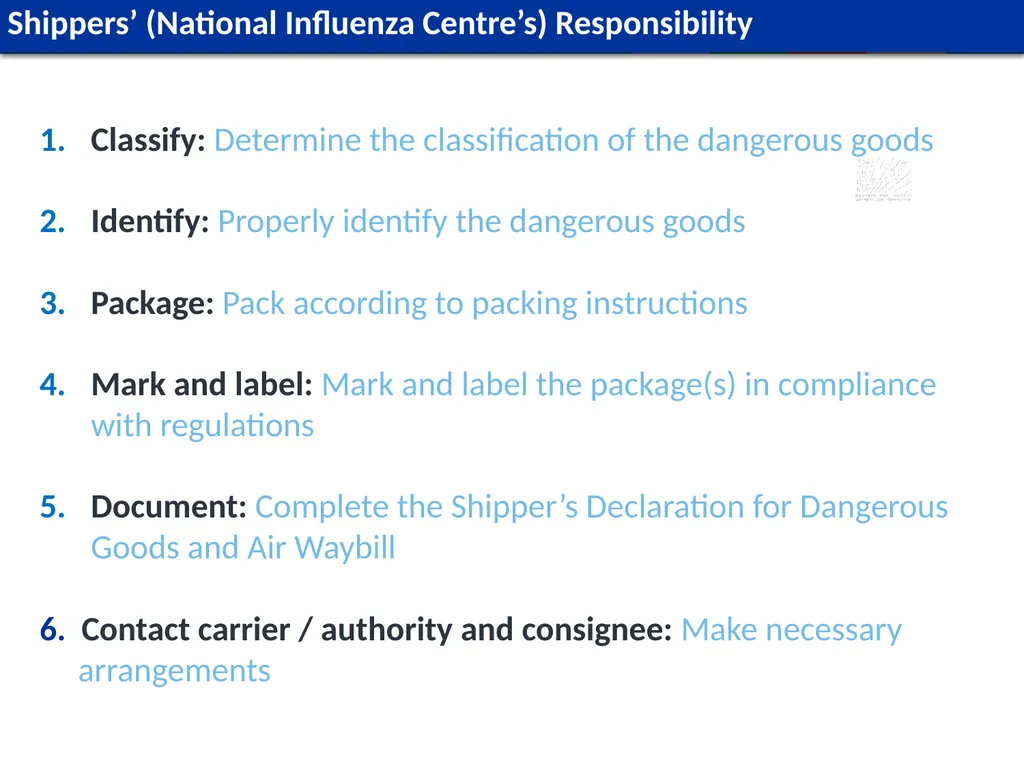
Shippers’ (National Influenza Centre’s) Responsibility Classify: Determine the classification of the dangerous goods
Identify: Properly identify the dangerous goods
Package: Pack according to packing instructions
Mark and label: Mark and label the package(s) in compliance with regulations
Document: Complete the Shipper’s Declaration for Dangerous Goods and Air Waybill
6. Contact carrier / authority and consignee: Make necessary arrangements<br>
Identify: Properly identify the dangerous goods
Package: Pack according to packing instructions
Mark and label: Mark and label the package(s) in compliance with regulations
Document: Complete the Shipper’s Declaration for Dangerous Goods and Air Waybill
6. Contact carrier / authority and consignee: Make necessary arrangements<br>
43
Virus Sharing<br>
44
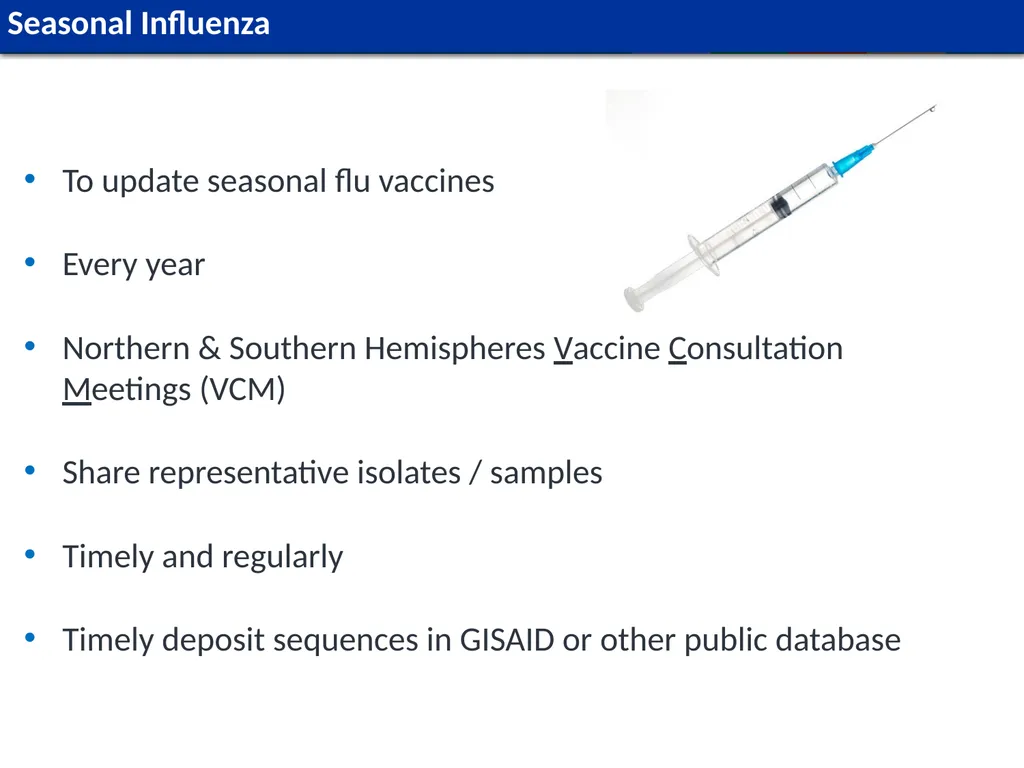
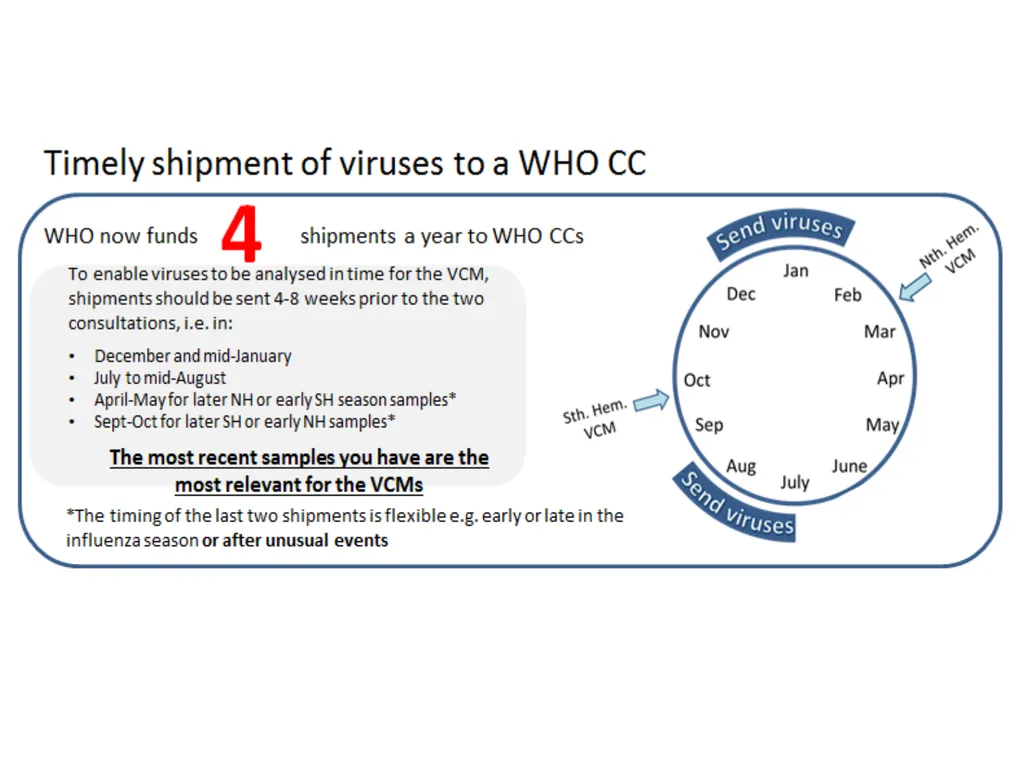
Seasonal Influenza To update seasonal flu vaccines
Every year
Northern & Southern Hemispheres Vaccine Consultation Meetings (VCM)
Share representative isolates / samples
Timely and regularly
Timely deposit sequences in GISAID or other public database<br>
Every year
Northern & Southern Hemispheres Vaccine Consultation Meetings (VCM)
Share representative isolates / samples
Timely and regularly
Timely deposit sequences in GISAID or other public database<br>
45
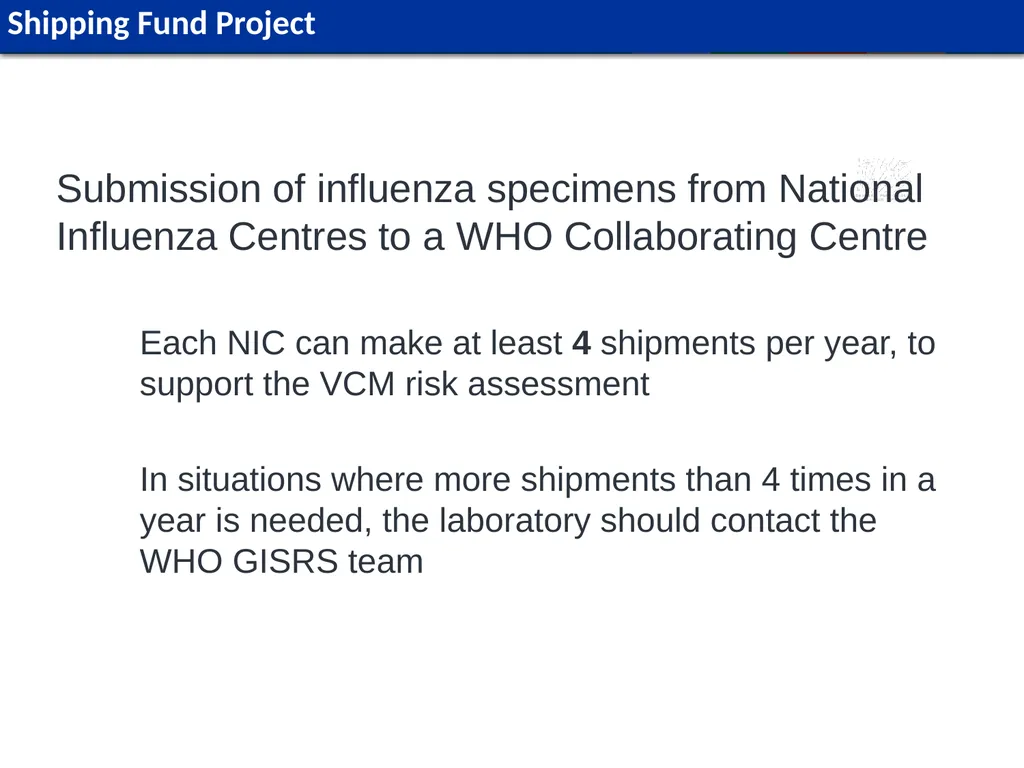
Shipping Fund Project Submission of influenza specimens from National Influenza Centres to a WHO Collaborating Centre
Each NIC can make at least 4 shipments per year, to support the VCM risk assessment
In situations where more shipments than 4 times in a year is needed, the laboratory should contact the WHO GISRS team<br>
Each NIC can make at least 4 shipments per year, to support the VCM risk assessment
In situations where more shipments than 4 times in a year is needed, the laboratory should contact the WHO GISRS team<br>
46
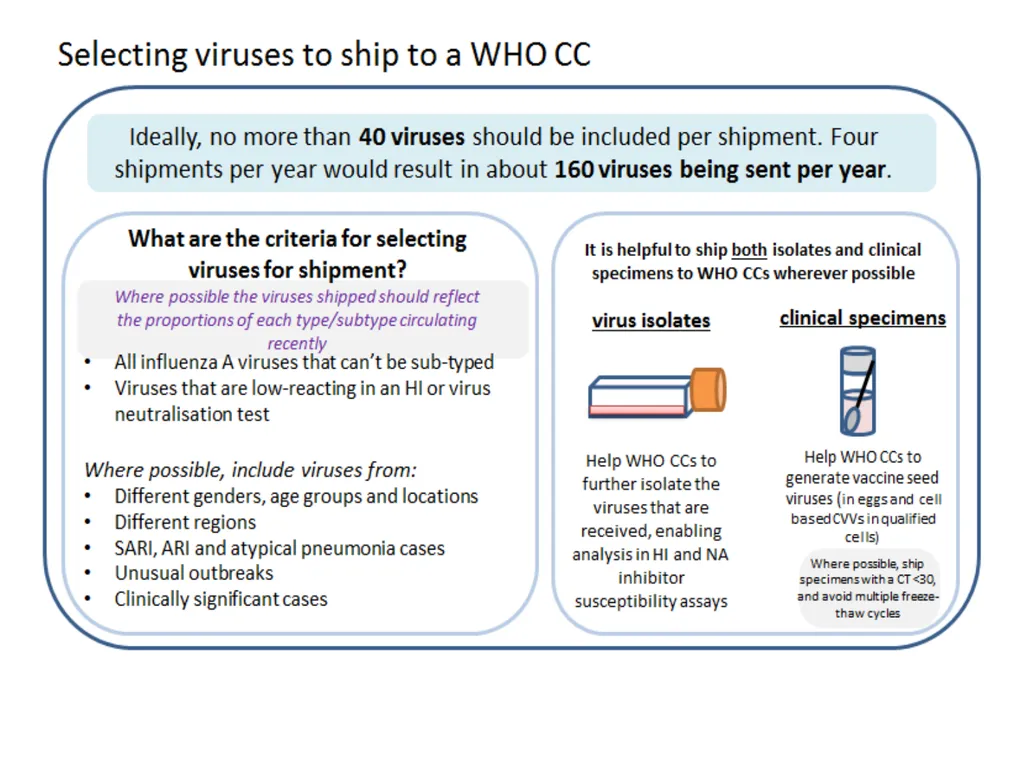
http://www.who.int/influenza/gisrs_laboratory/national_influenza_centres/NIC_virus_sharing_guidance_20171103.pdf<br>
47
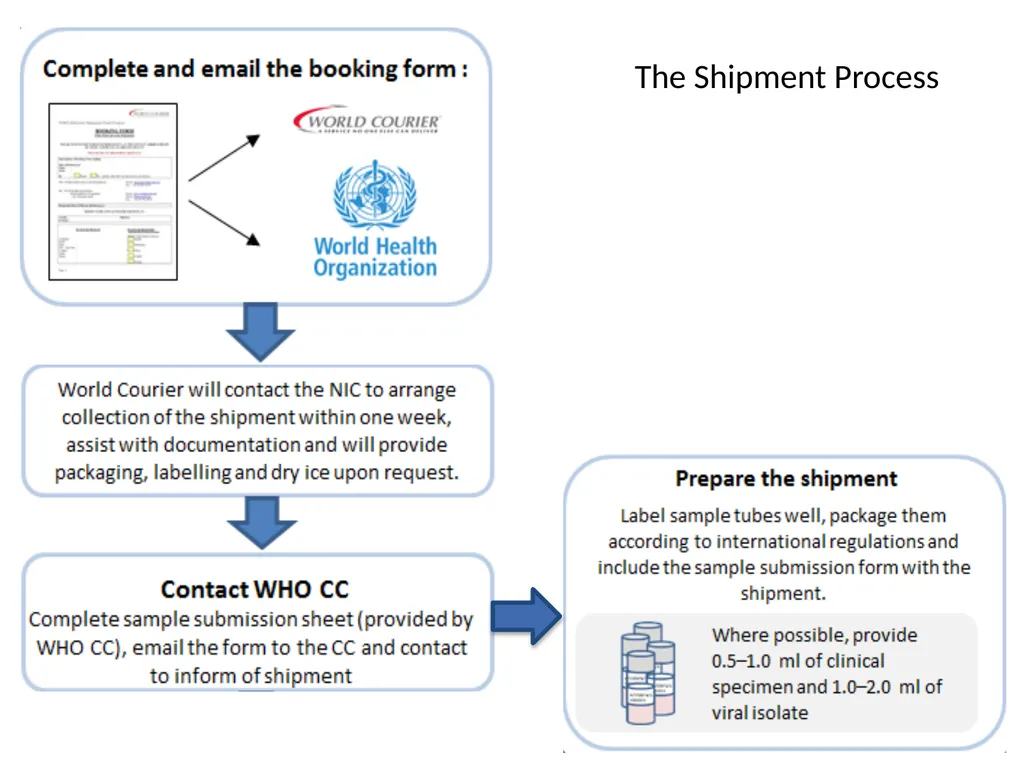
The Shipment Process<br>
48
Zoonotic Influenza Viruses Share as soon as possible
Share original specimen
Deposit virus sequences to GISAID or other public database
Share virus isolate, if available<br>
Share original specimen
Deposit virus sequences to GISAID or other public database
Share virus isolate, if available<br>
49
PLEASE NOTE Cost of extra shipments will only be covered by the WHO in some conditions
All NICs are encouraged to plan their shipments
The WHO Global Influenza Programme has launched an educational video on influenza, available in 6 languages:
Arabic: https://www.youtube.com/watch?v=PxW6Pg1AnwI
Chinese: https://www.youtube.com/watch?v=xW9gDKEPitQ
English: https://www.youtube.com/watch?v=yhhJfT86Bgg
French: https://www.youtube.com/watch?v=8mo8rWWJZkc
Russian: https://www.youtube.com/watch?v=XQO6nbkKUWQ
Spanish: https://www.youtube.com/watch?v=qXr75cKxwTY<br>
All NICs are encouraged to plan their shipments
The WHO Global Influenza Programme has launched an educational video on influenza, available in 6 languages:
Arabic: https://www.youtube.com/watch?v=PxW6Pg1AnwI
Chinese: https://www.youtube.com/watch?v=xW9gDKEPitQ
English: https://www.youtube.com/watch?v=yhhJfT86Bgg
French: https://www.youtube.com/watch?v=8mo8rWWJZkc
Russian: https://www.youtube.com/watch?v=XQO6nbkKUWQ
Spanish: https://www.youtube.com/watch?v=qXr75cKxwTY<br>
50
Enquiries and Contact Information For standard shipping arrangements, please contact World Courier at opsgva@worldcourier.ch or fax +41 22 8273070
For any specific queries surrounding logistics and shipping, please contact WHO Shipping and Logistics Support, Mr Christian Fuster, email: fusterc@who.int or +41 22 7912869 (indicating it is related to the WHO Influenza Shipment Fund Project in the subject heading.)<br>
For any specific queries surrounding logistics and shipping, please contact WHO Shipping and Logistics Support, Mr Christian Fuster, email: fusterc@who.int or +41 22 7912869 (indicating it is related to the WHO Influenza Shipment Fund Project in the subject heading.)<br>
51
http://www.who.int/influenza/gisrs_laboratory/en/ THANK YOU<br>