
MONEY MATTERS SESSION #4 – CAREER PLANNING
NS
Published · 44 slides · 0 views
1 / 1





Description
MONEY MATTERS SESSION 4 CAREER PLANNING Maximizing your income and managing your expenses to support your personal professional goals. Manage Your Money Today Maximize Your Money in the Future November 17, 2021 Owning Your Financial
Related Topics
Share
Embed code
Download this presentation From Below
"MONEY MATTERS SESSION #4 – CAREER PLANNING" is the property of its rightful owner. Permission is granted to download and print the materials on this website for personal, non-commercial use only, and to display it on your personal computer provided you do not modify the materials and that you retain all copyright notices contained in the materials. By downloading content from our website, you accept the terms of this agreement.
Presentation Transcript
01
MONEY MATTERS
SESSION #4 – CAREER PLANNING
Maximizing your income and managing your expenses to support your personal & professional goals.
Manage Your Money Today
Maximize Your Money in the Future
November 17, 2021<br>
SESSION #4 – CAREER PLANNING
Maximizing your income and managing your expenses to support your personal & professional goals.
Manage Your Money Today
Maximize Your Money in the Future
November 17, 2021<br>
02
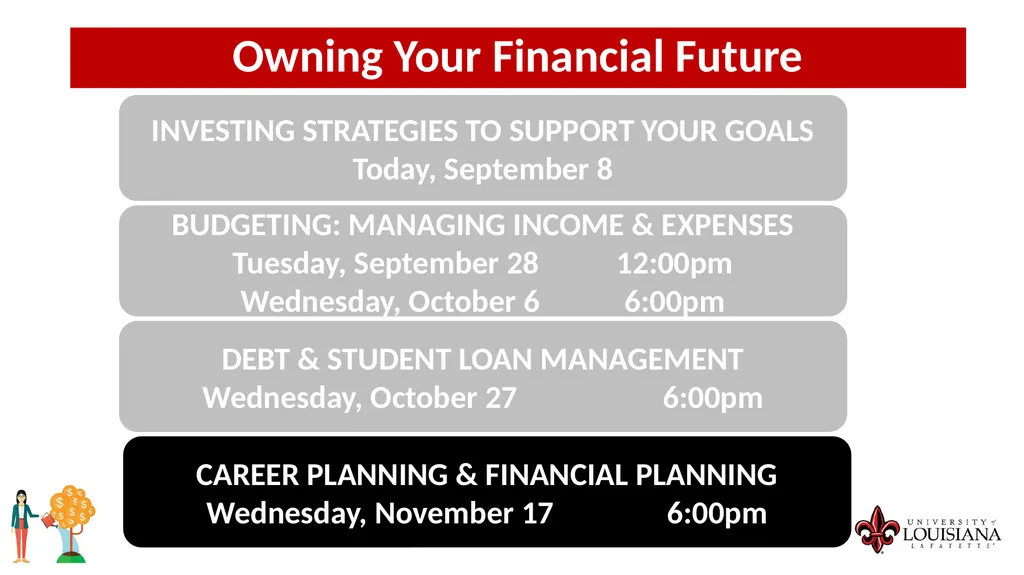
Owning Your Financial Future INVESTING STRATEGIES TO SUPPORT YOUR GOALS
Today, September 8 BUDGETING: MANAGING INCOME & EXPENSES
Tuesday, September 28 12:00pm
Wednesday, October 6 6:00pm DEBT & STUDENT LOAN MANAGEMENT
Wednesday, October 27 6:00pm CAREER PLANNING & FINANCIAL PLANNING
Wednesday, November 17 6:00pm<br>
Today, September 8 BUDGETING: MANAGING INCOME & EXPENSES
Tuesday, September 28 12:00pm
Wednesday, October 6 6:00pm DEBT & STUDENT LOAN MANAGEMENT
Wednesday, October 27 6:00pm CAREER PLANNING & FINANCIAL PLANNING
Wednesday, November 17 6:00pm<br>
03
Owning Your Financial Future INVESTING STRATEGIES TO SUPPORT YOUR GOALS
Today, September 8 BUDGETING: MANAGING INCOME & EXPENSES
Tuesday, September 28 12:00pm
Wednesday, October 6 6:00pm DEBT & STUDENT LOAN MANAGEMENT
Wednesday, October 27 6:00pm CAREER PLANNING & FINANCIAL PLANNING
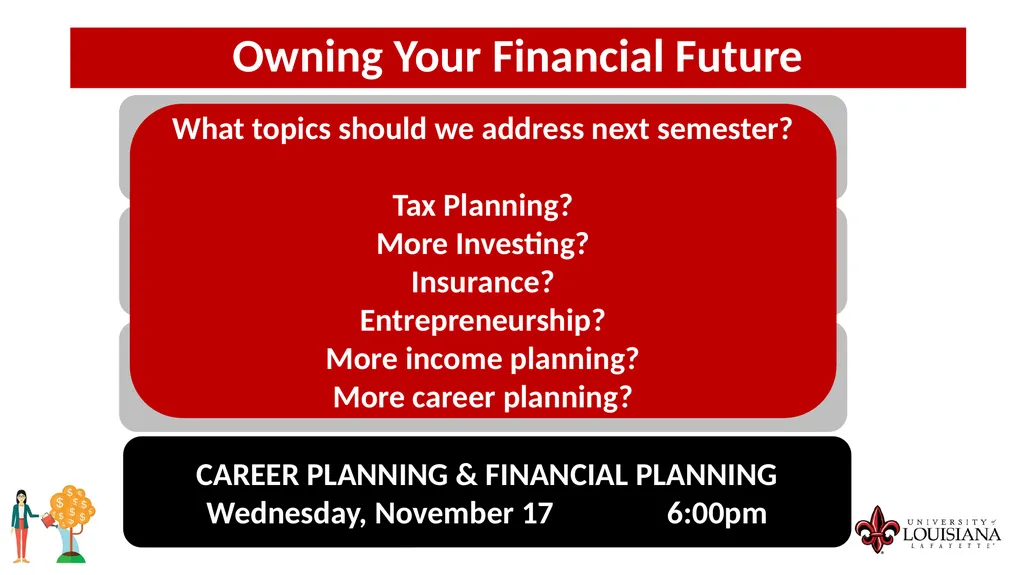
Wednesday, November 17 6:00pm What topics should we address next semester?
Tax Planning?
More Investing?
Insurance?
Entrepreneurship?
More income planning?
More career planning?<br>
Today, September 8 BUDGETING: MANAGING INCOME & EXPENSES
Tuesday, September 28 12:00pm
Wednesday, October 6 6:00pm DEBT & STUDENT LOAN MANAGEMENT
Wednesday, October 27 6:00pm CAREER PLANNING & FINANCIAL PLANNING
Wednesday, November 17 6:00pm What topics should we address next semester?
Tax Planning?
More Investing?
Insurance?
Entrepreneurship?
More income planning?
More career planning?<br>
04
More Generally…
With Respect to Other Grad School Programming for Spring 2022:
Are there any events or topics that you would like to see us have for you in Spring 2022?
We will re-visit these planning questions at the end of tonight’s session.<br>
With Respect to Other Grad School Programming for Spring 2022:
Are there any events or topics that you would like to see us have for you in Spring 2022?
We will re-visit these planning questions at the end of tonight’s session.<br>
05
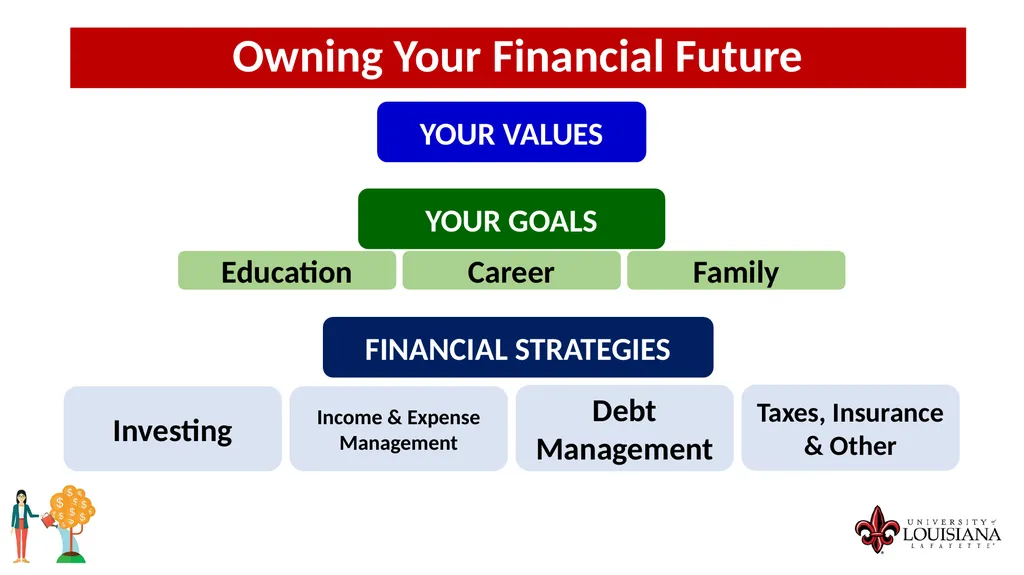
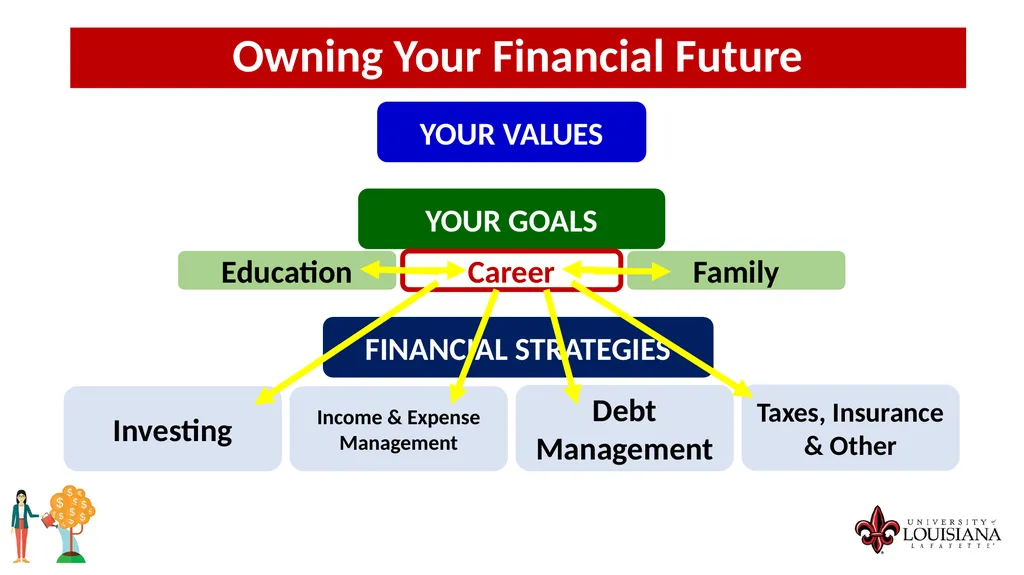
Owning Your Financial Future YOUR VALUES YOUR GOALS Career Family Education FINANCIAL STRATEGIES Investing Income & Expense Management Debt Management Taxes, Insurance & Other<br>
06
Owning Your Financial Future YOUR VALUES YOUR GOALS Career Family Education FINANCIAL STRATEGIES Investing Income & Expense Management Debt Management Taxes, Insurance & Other<br>
07
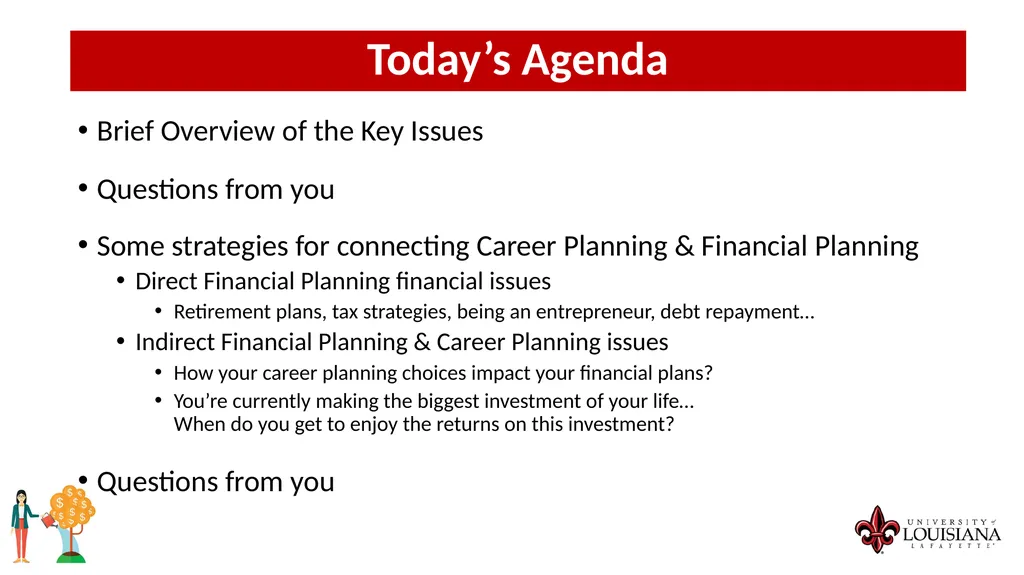
Today’s Agenda Brief Overview of the Key Issues
Questions from you
Some strategies for connecting Career Planning & Financial Planning
Direct Financial Planning financial issues
Retirement plans, tax strategies, being an entrepreneur, debt repayment…
Indirect Financial Planning & Career Planning issues
How your career planning choices impact your financial plans?
You’re currently making the biggest investment of your life… When do you get to enjoy the returns on this investment?
Questions from you<br>
Questions from you
Some strategies for connecting Career Planning & Financial Planning
Direct Financial Planning financial issues
Retirement plans, tax strategies, being an entrepreneur, debt repayment…
Indirect Financial Planning & Career Planning issues
How your career planning choices impact your financial plans?
You’re currently making the biggest investment of your life… When do you get to enjoy the returns on this investment?
Questions from you<br>
08
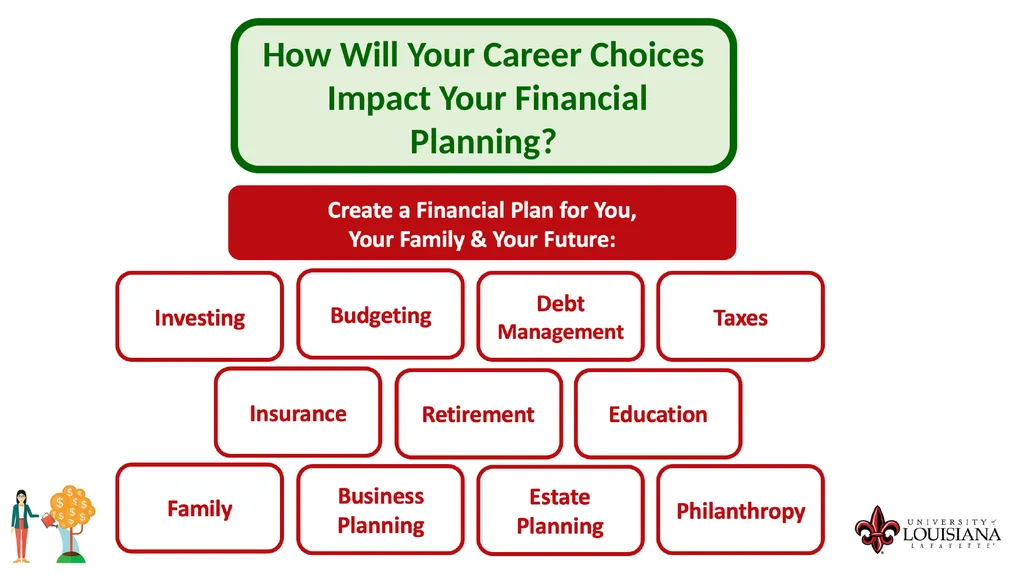
How Will Your Career Choices
Impact Your Financial Planning?<br>
Impact Your Financial Planning?<br>
09
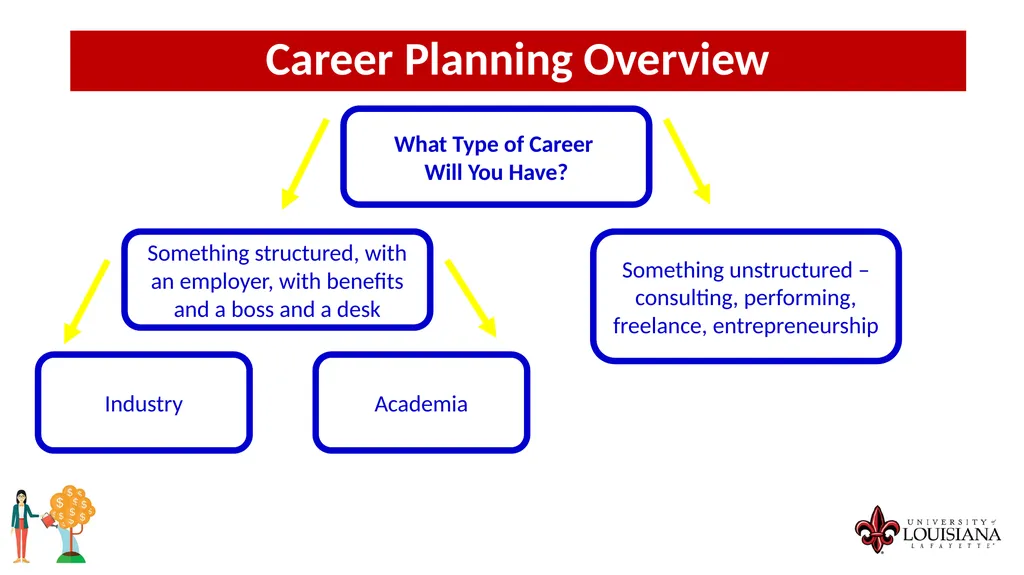
Career Planning Overview What Type of Career
Will You Have? Something structured, with an employer, with benefits and a boss and a desk Something unstructured – consulting, performing, freelance, entrepreneurship Industry Academia<br>
Will You Have? Something structured, with an employer, with benefits and a boss and a desk Something unstructured – consulting, performing, freelance, entrepreneurship Industry Academia<br>
10
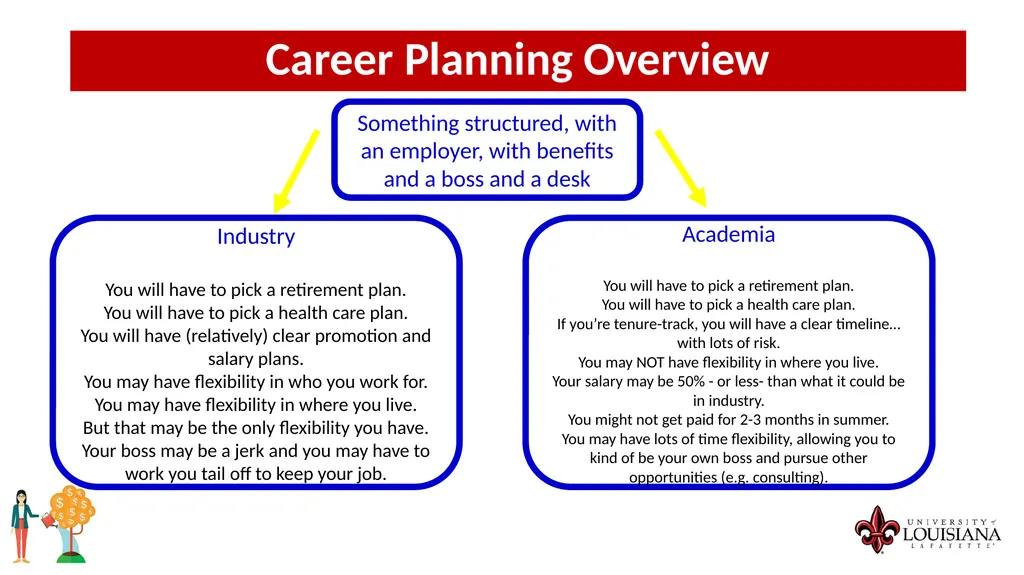
Career Planning Overview Something structured, with an employer, with benefits and a boss and a desk Industry
You will have to pick a retirement plan.
You will have to pick a health care plan.
You will have (relatively) clear promotion and salary plans.
You may have flexibility in who you work for.
You may have flexibility in where you live.
But that may be the only flexibility you have. Your boss may be a jerk and you may have to work you tail off to keep your job. Academia
You will have to pick a retirement plan.
You will have to pick a health care plan.
If you’re tenure-track, you will have a clear timeline…with lots of risk.
You may NOT have flexibility in where you live.
Your salary may be 50% - or less- than what it could be in industry.
You might not get paid for 2-3 months in summer.
You may have lots of time flexibility, allowing you to kind of be your own boss and pursue other opportunities (e.g. consulting).<br>
You will have to pick a retirement plan.
You will have to pick a health care plan.
You will have (relatively) clear promotion and salary plans.
You may have flexibility in who you work for.
You may have flexibility in where you live.
But that may be the only flexibility you have. Your boss may be a jerk and you may have to work you tail off to keep your job. Academia
You will have to pick a retirement plan.
You will have to pick a health care plan.
If you’re tenure-track, you will have a clear timeline…with lots of risk.
You may NOT have flexibility in where you live.
Your salary may be 50% - or less- than what it could be in industry.
You might not get paid for 2-3 months in summer.
You may have lots of time flexibility, allowing you to kind of be your own boss and pursue other opportunities (e.g. consulting).<br>
11
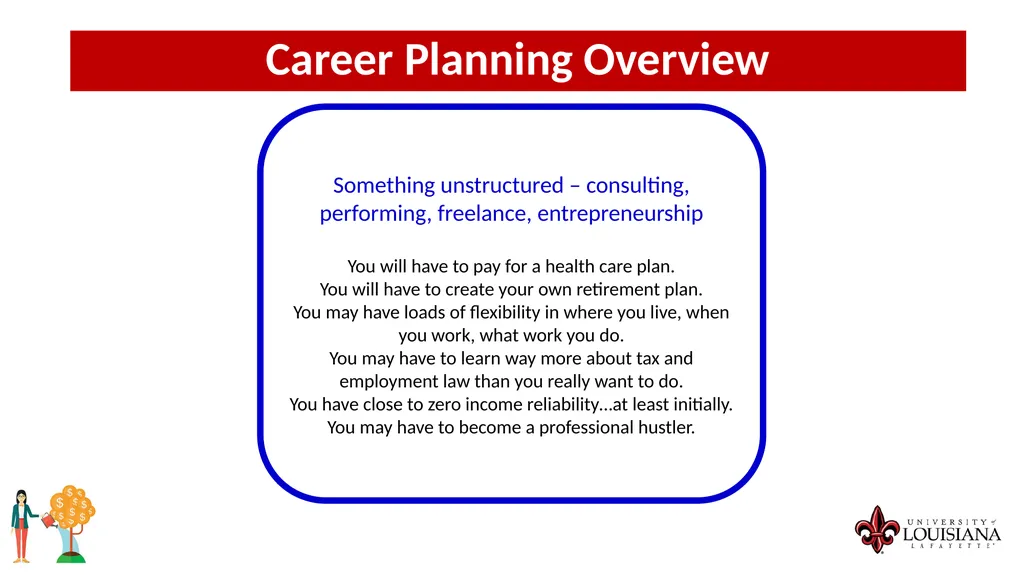
Career Planning Overview Something unstructured – consulting, performing, freelance, entrepreneurship
You will have to pay for a health care plan.
You will have to create your own retirement plan.
You may have loads of flexibility in where you live, when you work, what work you do.
You may have to learn way more about tax and employment law than you really want to do.
You have close to zero income reliability…at least initially. You may have to become a professional hustler.<br>
You will have to pay for a health care plan.
You will have to create your own retirement plan.
You may have loads of flexibility in where you live, when you work, what work you do.
You may have to learn way more about tax and employment law than you really want to do.
You have close to zero income reliability…at least initially. You may have to become a professional hustler.<br>
12
Questions From You #1a How early should I be career planning?
How much of my time can I expect to spend career planning?<br>
How much of my time can I expect to spend career planning?<br>
13
Questions From You #1b What if I'm interested in a unique
non-academic career, can I find assistance with something like that at UL?
Is there anyone other than my advisor that I can reach out to in regards to career planning?<br>
Is there anyone other than my advisor that I can reach out to in regards to career planning?<br>
14
Questions From You #2 What would I do if I found out that my career isn't the one for me?
For example…Given the downturn in the oil and gas industry which has been a major employer of many geoscientists in the past decade, I really don't know the pathway to follow with a degree in geology as employment in the field has really been on the decline.
How and when do I know that I need to make a career change or transition?<br>
For example…Given the downturn in the oil and gas industry which has been a major employer of many geoscientists in the past decade, I really don't know the pathway to follow with a degree in geology as employment in the field has really been on the decline.
How and when do I know that I need to make a career change or transition?<br>
15
Questions From You #3 I have a really good job offer in Boston and an okay job offer in New Orleans. My partner will be in grad school for 2 more years in Louisiana. Eventually we want to settle in or near Louisiana.
What should I do?<br>
What should I do?<br>
16
Questions From You #3 I have a really good job offer in Boston and an okay job offer in New Orleans. My partner will be in grad school for 2 more years in Louisiana. Eventually we want to settle in or near Louisiana.
What should I do?
Only you can answer this.
Focus on your goals, focus on your priorities.
You can make lists and spreadsheets and you can calculate the estimated financial value of each option.
But ultimately this is a personal decision that only you and your family can answer.
How much of the short-term are you willing to sacrifice for the long-term?<br>
What should I do?
Only you can answer this.
Focus on your goals, focus on your priorities.
You can make lists and spreadsheets and you can calculate the estimated financial value of each option.
But ultimately this is a personal decision that only you and your family can answer.
How much of the short-term are you willing to sacrifice for the long-term?<br>
17
Questions From You #4 (or #3b) I am graduating with my Master of Architecture. I have an opportunity to take a job in the Northeast with a really reputable firm that will take great care of me and pay for all of my continuing education and certifications over the next 3-5 years.
I also have an opportunity to take a job closer to home, but I will have to pay for all of my continuing education and certifications to advance my career.
Eventually, I would like to open my own practice in Louisiana – but that may be 5-10 years away.
What should I do?<br>
I also have an opportunity to take a job closer to home, but I will have to pay for all of my continuing education and certifications to advance my career.
Eventually, I would like to open my own practice in Louisiana – but that may be 5-10 years away.
What should I do?<br>
18
Questions From You #4 (or #3b) I am graduating with my Master of Architecture. I have an opportunity to take a job in the Northeast with a really reputable firm that will take great care of me and pay for all of my continuing education and certifications over the next 3-5 years.
I also have an opportunity to take a job closer to home, but I will have to pay for all of my continuing education and certifications to advance my career.
Eventually, I would like to open my own practice in Louisiana – but that may be 5-10 years away.
What should I do?
Again…Only you can answer this.
Focus on your goals, focus on your priorities.
You can make lists and spreadsheets and you can calculate the estimated financial value of each option.
But ultimately this is a personal decision that only you and your partner can answer.
How much of the short-term are you willing to sacrifice for the long-term?<br>
I also have an opportunity to take a job closer to home, but I will have to pay for all of my continuing education and certifications to advance my career.
Eventually, I would like to open my own practice in Louisiana – but that may be 5-10 years away.
What should I do?
Again…Only you can answer this.
Focus on your goals, focus on your priorities.
You can make lists and spreadsheets and you can calculate the estimated financial value of each option.
But ultimately this is a personal decision that only you and your partner can answer.
How much of the short-term are you willing to sacrifice for the long-term?<br>
19
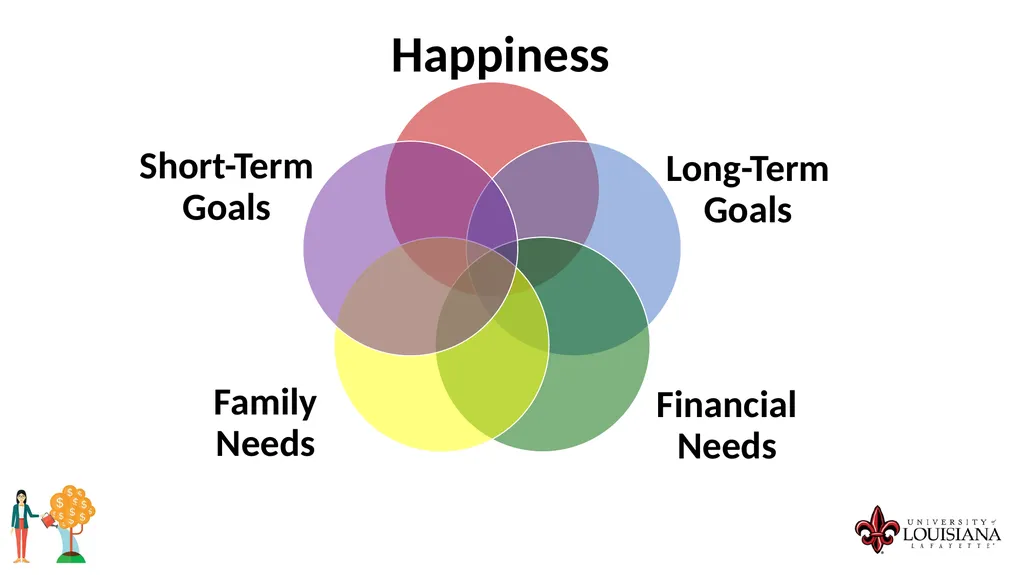
Questions From You #3 and #4 Decisions about jobs and careers are very personal.
They are classic trade-offs between short-term and long-term goals.
They are typically about more than just you – talk to your family.
How to decide?<br>
They are classic trade-offs between short-term and long-term goals.
They are typically about more than just you – talk to your family.
How to decide?<br>
20
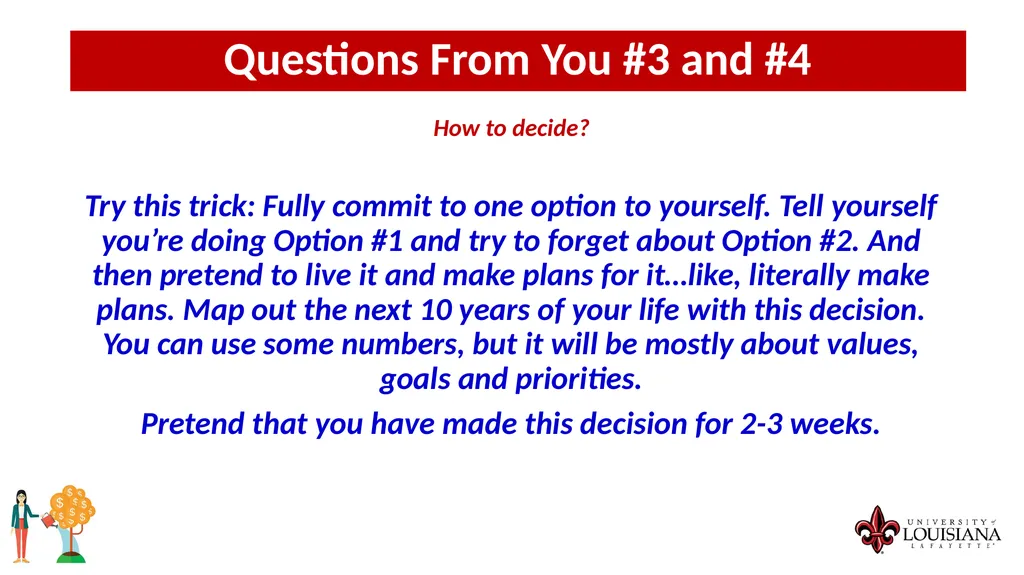
Questions From You #3 and #4 How to decide?
Try this trick: Fully commit to one option to yourself. Tell yourself you’re doing Option #1 and try to forget about Option #2. And then pretend to live it and make plans for it…like, literally make plans. Map out the next 10 years of your life with this decision. You can use some numbers, but it will be mostly about values, goals and priorities.
Pretend that you have made this decision for 2-3 weeks.<br>
Try this trick: Fully commit to one option to yourself. Tell yourself you’re doing Option #1 and try to forget about Option #2. And then pretend to live it and make plans for it…like, literally make plans. Map out the next 10 years of your life with this decision. You can use some numbers, but it will be mostly about values, goals and priorities.
Pretend that you have made this decision for 2-3 weeks.<br>
21
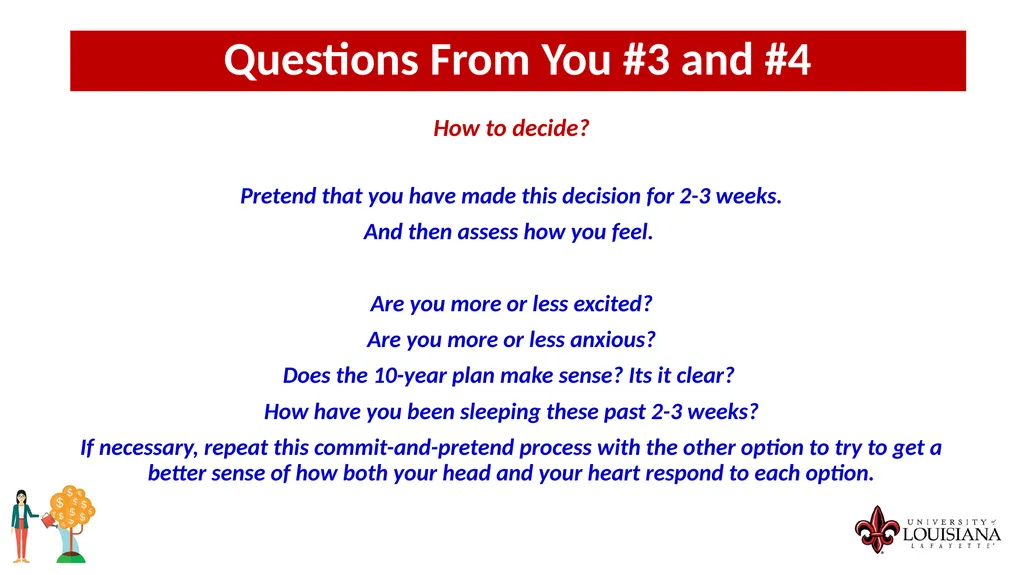
Questions From You #3 and #4 How to decide?
Pretend that you have made this decision for 2-3 weeks.
And then assess how you feel.
Are you more or less excited?
Are you more or less anxious?
Does the 10-year plan make sense? Its it clear?
How have you been sleeping these past 2-3 weeks?
If necessary, repeat this commit-and-pretend process with the other option to try to get a better sense of how both your head and your heart respond to each option.<br>
Pretend that you have made this decision for 2-3 weeks.
And then assess how you feel.
Are you more or less excited?
Are you more or less anxious?
Does the 10-year plan make sense? Its it clear?
How have you been sleeping these past 2-3 weeks?
If necessary, repeat this commit-and-pretend process with the other option to try to get a better sense of how both your head and your heart respond to each option.<br>
22
Questions From You #5 I am about to start a new job and my human resources advisor has warned me that I will have to make decisions about a company-provided retirement and health plans on my first day at work.
How do I decide which plans I want?
What if I choose the wrong plan – can I change my decision later?<br>
How do I decide which plans I want?
What if I choose the wrong plan – can I change my decision later?<br>
23
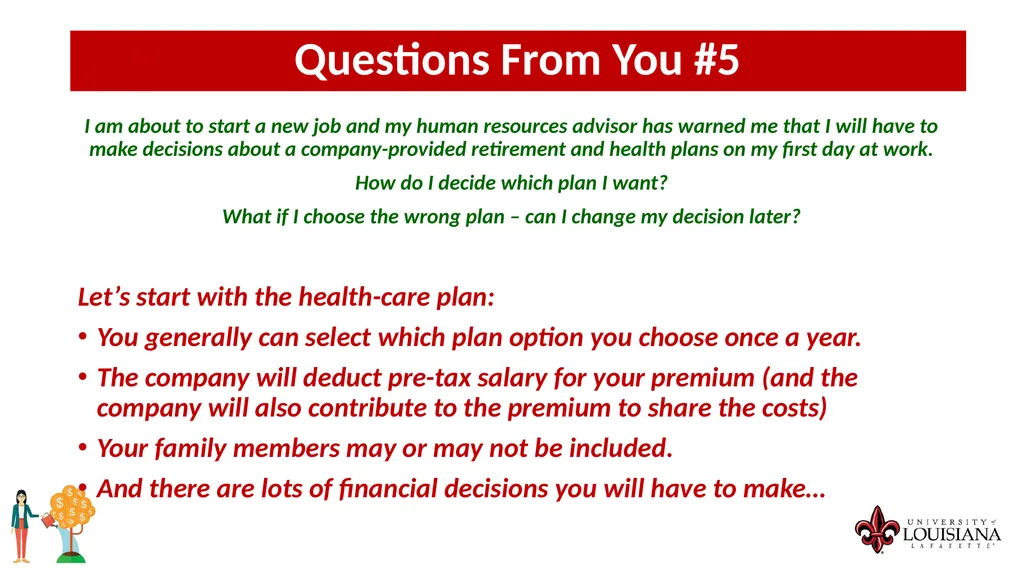
Questions From You #5 I am about to start a new job and my human resources advisor has warned me that I will have to make decisions about a company-provided retirement and health plans on my first day at work.
How do I decide which plan I want?
What if I choose the wrong plan – can I change my decision later?
Let’s start with the health-care plan:
You generally can select which plan option you choose once a year.
The company will deduct pre-tax salary for your premium (and the company will also contribute to the premium to share the costs)
Your family members may or may not be included.
And there are lots of financial decisions you will have to make…<br>
How do I decide which plan I want?
What if I choose the wrong plan – can I change my decision later?
Let’s start with the health-care plan:
You generally can select which plan option you choose once a year.
The company will deduct pre-tax salary for your premium (and the company will also contribute to the premium to share the costs)
Your family members may or may not be included.
And there are lots of financial decisions you will have to make…<br>
24
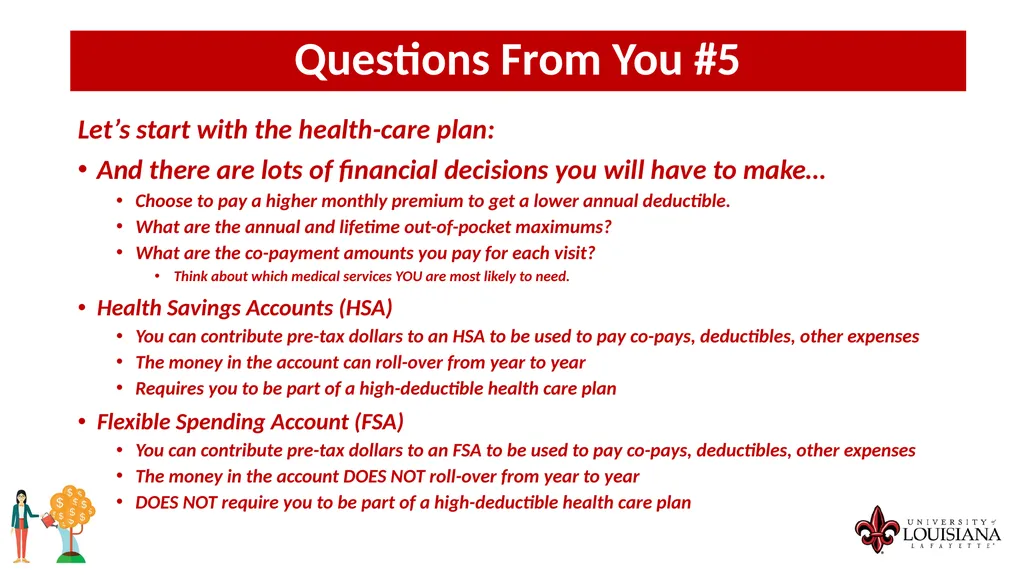
Questions From You #5 Let’s start with the health-care plan:
And there are lots of financial decisions you will have to make…
Choose to pay a higher monthly premium to get a lower annual deductible.
What are the annual and lifetime out-of-pocket maximums?
What are the co-payment amounts you pay for each visit?
Think about which medical services YOU are most likely to need.
Health Savings Accounts (HSA)
You can contribute pre-tax dollars to an HSA to be used to pay co-pays, deductibles, other expenses
The money in the account can roll-over from year to year
Requires you to be part of a high-deductible health care plan
Flexible Spending Account (FSA)
You can contribute pre-tax dollars to an FSA to be used to pay co-pays, deductibles, other expenses
The money in the account DOES NOT roll-over from year to year
DOES NOT require you to be part of a high-deductible health care plan<br>
And there are lots of financial decisions you will have to make…
Choose to pay a higher monthly premium to get a lower annual deductible.
What are the annual and lifetime out-of-pocket maximums?
What are the co-payment amounts you pay for each visit?
Think about which medical services YOU are most likely to need.
Health Savings Accounts (HSA)
You can contribute pre-tax dollars to an HSA to be used to pay co-pays, deductibles, other expenses
The money in the account can roll-over from year to year
Requires you to be part of a high-deductible health care plan
Flexible Spending Account (FSA)
You can contribute pre-tax dollars to an FSA to be used to pay co-pays, deductibles, other expenses
The money in the account DOES NOT roll-over from year to year
DOES NOT require you to be part of a high-deductible health care plan<br>
25
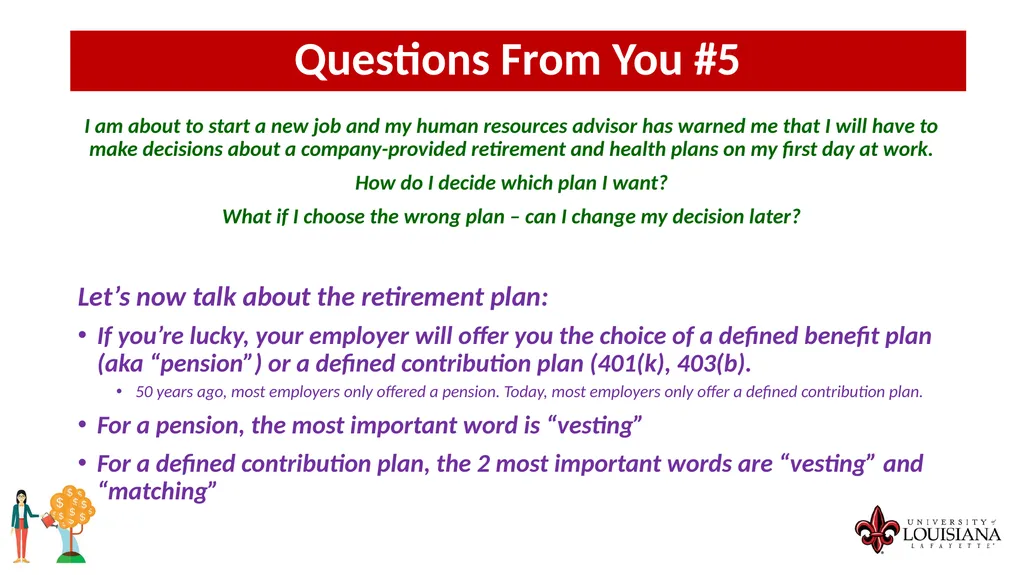
Questions From You #5 I am about to start a new job and my human resources advisor has warned me that I will have to make decisions about a company-provided retirement and health plans on my first day at work.
How do I decide which plan I want?
What if I choose the wrong plan – can I change my decision later?
Let’s now talk about the retirement plan:
If you’re lucky, your employer will offer you the choice of a defined benefit plan (aka “pension”) or a defined contribution plan (401(k), 403(b).
50 years ago, most employers only offered a pension. Today, most employers only offer a defined contribution plan.
For a pension, the most important word is “vesting”
For a defined contribution plan, the 2 most important words are “vesting” and “matching”<br>
How do I decide which plan I want?
What if I choose the wrong plan – can I change my decision later?
Let’s now talk about the retirement plan:
If you’re lucky, your employer will offer you the choice of a defined benefit plan (aka “pension”) or a defined contribution plan (401(k), 403(b).
50 years ago, most employers only offered a pension. Today, most employers only offer a defined contribution plan.
For a pension, the most important word is “vesting”
For a defined contribution plan, the 2 most important words are “vesting” and “matching”<br>
26
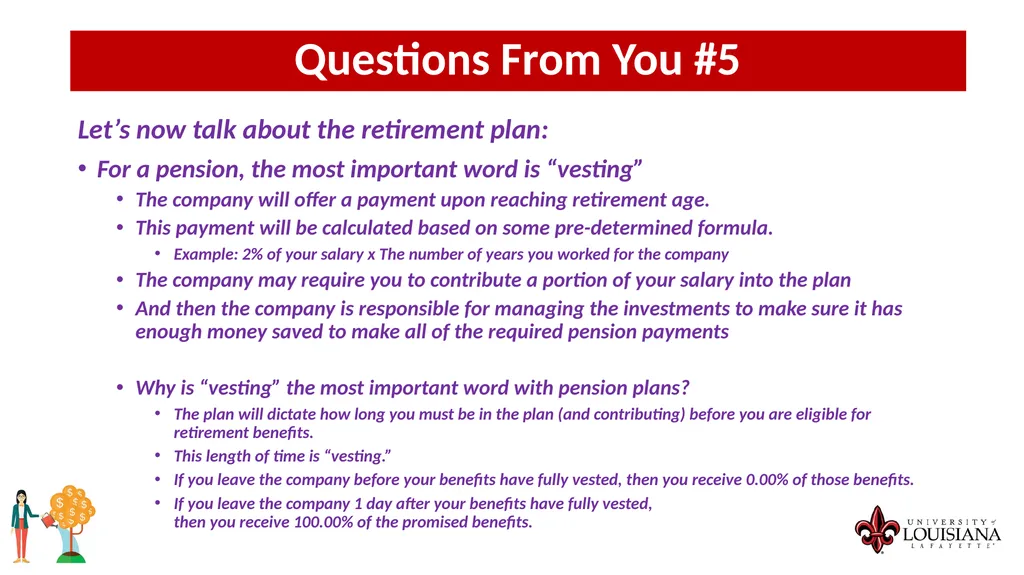
Questions From You #5 Let’s now talk about the retirement plan:
For a pension, the most important word is “vesting”
The company will offer a payment upon reaching retirement age.
This payment will be calculated based on some pre-determined formula.
Example: 2% of your salary x The number of years you worked for the company
The company may require you to contribute a portion of your salary into the plan
And then the company is responsible for managing the investments to make sure it has enough money saved to make all of the required pension payments
Why is “vesting” the most important word with pension plans?
The plan will dictate how long you must be in the plan (and contributing) before you are eligible for retirement benefits.
This length of time is “vesting.”
If you leave the company before your benefits have fully vested, then you receive 0.00% of those benefits.
If you leave the company 1 day after your benefits have fully vested, then you receive 100.00% of the promised benefits.<br>
For a pension, the most important word is “vesting”
The company will offer a payment upon reaching retirement age.
This payment will be calculated based on some pre-determined formula.
Example: 2% of your salary x The number of years you worked for the company
The company may require you to contribute a portion of your salary into the plan
And then the company is responsible for managing the investments to make sure it has enough money saved to make all of the required pension payments
Why is “vesting” the most important word with pension plans?
The plan will dictate how long you must be in the plan (and contributing) before you are eligible for retirement benefits.
This length of time is “vesting.”
If you leave the company before your benefits have fully vested, then you receive 0.00% of those benefits.
If you leave the company 1 day after your benefits have fully vested, then you receive 100.00% of the promised benefits.<br>
27
Questions From You #5 For a 401(k) or 403(b), the most important words are “vesting” and “matching”
Vesting is generally the same as with a pension plan – when you receive benefits, kind of.
Any contributions you make into the plan are always 100% vested. They always belong to you.
But if the company makes any matching contributions, they may be subject to a vesting period. If you leave the company before the matches vest, you receive 0.00% of these matched contributions.
Matching is (kind of) free money from your employer.
The retirement plan will specify what percentage of your salary your employer will match as a contribution into your retirement plan.
It’s a “match” because the company only contributes if you contribute first.
Example: At UL Lafayette, I contribute 8% of my salary to my 403(b), the University will match with a 6% contribution. So I will end up with 14% of my salary going into a retirement plan.
If I contribute 7% of my salary to my 403(b), the University will not match anything. So I will end up with 7% of my salary going into a retirement plan.
Once your money is in your retirement plan, then the company will have a plan sponsor (e.g investment company) manage your account.
But YOU are responsible for directing your money into a menu of investment options that the plan sponsor allows.
These options will generally be mutual funds, not individual stocks, crypto, real estate, NFTs…<br>
Vesting is generally the same as with a pension plan – when you receive benefits, kind of.
Any contributions you make into the plan are always 100% vested. They always belong to you.
But if the company makes any matching contributions, they may be subject to a vesting period. If you leave the company before the matches vest, you receive 0.00% of these matched contributions.
Matching is (kind of) free money from your employer.
The retirement plan will specify what percentage of your salary your employer will match as a contribution into your retirement plan.
It’s a “match” because the company only contributes if you contribute first.
Example: At UL Lafayette, I contribute 8% of my salary to my 403(b), the University will match with a 6% contribution. So I will end up with 14% of my salary going into a retirement plan.
If I contribute 7% of my salary to my 403(b), the University will not match anything. So I will end up with 7% of my salary going into a retirement plan.
Once your money is in your retirement plan, then the company will have a plan sponsor (e.g investment company) manage your account.
But YOU are responsible for directing your money into a menu of investment options that the plan sponsor allows.
These options will generally be mutual funds, not individual stocks, crypto, real estate, NFTs…<br>
28
Questions From You #5 Why would you want to give up some of your hard-earned paycheck today in order to put it into a retirement fund that you may not touch for 40 years?
Two reasons: Matching & Tax-Deferral.
We saw how a company match can effectively increase your compensation
Tax-Deferral is the other big advantage of retirement plans
Any money you contribute to a retirement plan today is before tax.
The before tax amount will be invested.
Your investments will grow at some rate of return over the long term until you retire.
When you reach retirement age (generally over 60), you can begin withdrawing money from your retirement plan
You will pay ordinary income taxes on these withdrawals
You will never pay capital gains taxes on how much your initial investments grew<br>
Two reasons: Matching & Tax-Deferral.
We saw how a company match can effectively increase your compensation
Tax-Deferral is the other big advantage of retirement plans
Any money you contribute to a retirement plan today is before tax.
The before tax amount will be invested.
Your investments will grow at some rate of return over the long term until you retire.
When you reach retirement age (generally over 60), you can begin withdrawing money from your retirement plan
You will pay ordinary income taxes on these withdrawals
You will never pay capital gains taxes on how much your initial investments grew<br>
29
Questions From You #6 I’m going to be a consultant and entrepreneur. Is there a way I can benefit with my own retirement plan even without an employer doing it for me?
Yes. How? With an IRA, Individual Retirement Account:
A traditional IRA allows you to invest $6,000 of pre-tax money into a qualified account, and then you direct where you invest the money and how it grows
You cannot access the money, without fees and taxes, until retirement
There are income limits to whom can participate; very high income folks cannot participate
You pay ordinary income tax when you withdraw the money in retirement
A Roth IRA allows you to invest $6,000 of after-tax money into a qualified account, and then you direct where you invest the money and how it grows
The income limits are less than with a traditional IRA
You do not pay any tax when you withdraw the money in retirement…because you already paid income taxes.<br>
Yes. How? With an IRA, Individual Retirement Account:
A traditional IRA allows you to invest $6,000 of pre-tax money into a qualified account, and then you direct where you invest the money and how it grows
You cannot access the money, without fees and taxes, until retirement
There are income limits to whom can participate; very high income folks cannot participate
You pay ordinary income tax when you withdraw the money in retirement
A Roth IRA allows you to invest $6,000 of after-tax money into a qualified account, and then you direct where you invest the money and how it grows
The income limits are less than with a traditional IRA
You do not pay any tax when you withdraw the money in retirement…because you already paid income taxes.<br>
30
Questions From You #5 and #6 A few concluding comments about retirement plans:
If possible, set up an IRA, a Roth IRA and take the maximum advantage of whatever retirement plan options your employer offers.
Why? Flexibility.
If your income grows, you may make too much to get an IRA or Roth
Having different accounts with different tax rules allows you to choose how you withdraw money in retirement
Imagine you do some work when you’re 75 that pays you $200,000. You may choose to withdraw a lot from your Roth IRA (which will be tax-free) and less from your IRA (which will be taxed) so you can avoid claiming more income in a year when you’re in a high-tax bracket.
Then if you take the year off when you’re 76, you’ll drop down to a lower tax bracket, and you may choose to withdraw a lot from your IRA and a little from your Roth IRA.<br>
If possible, set up an IRA, a Roth IRA and take the maximum advantage of whatever retirement plan options your employer offers.
Why? Flexibility.
If your income grows, you may make too much to get an IRA or Roth
Having different accounts with different tax rules allows you to choose how you withdraw money in retirement
Imagine you do some work when you’re 75 that pays you $200,000. You may choose to withdraw a lot from your Roth IRA (which will be tax-free) and less from your IRA (which will be taxed) so you can avoid claiming more income in a year when you’re in a high-tax bracket.
Then if you take the year off when you’re 76, you’ll drop down to a lower tax bracket, and you may choose to withdraw a lot from your IRA and a little from your Roth IRA.<br>
31
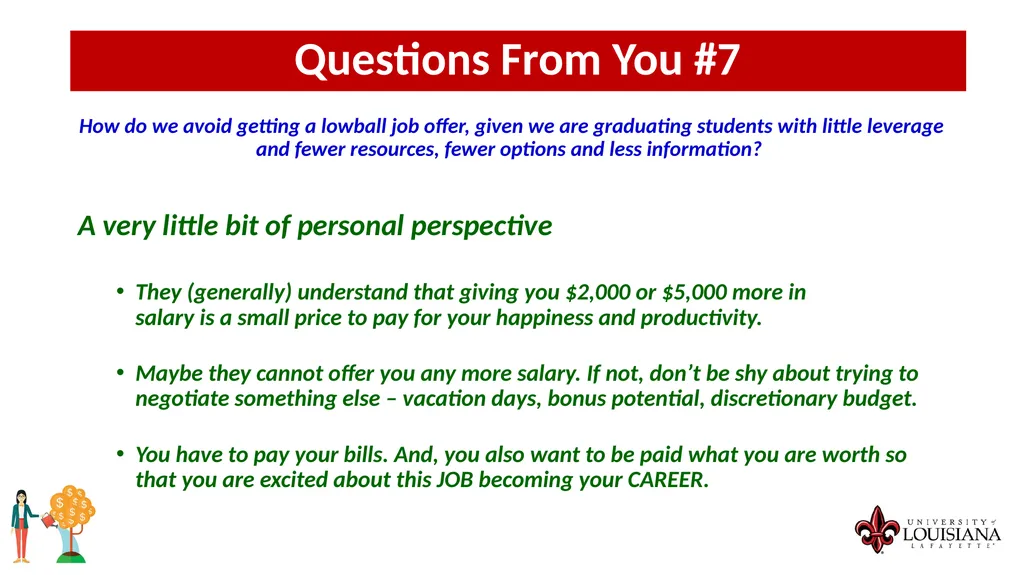
Questions From You #7 How do we avoid getting a lowball job offer, given we are graduating students with little leverage and fewer resources, fewer options and less information?<br>
32
Questions From You #7 How do we avoid getting a lowball job offer, given we are graduating students with little leverage and fewer resources, fewer options and less information?
The financial planning answer:
If you know what your budget is and what your short- and medium-term financial goals are, you can do the math to determine what the minimum compensation you need from any job.
Include goals, family & partner situations, debt repayment, insurance and finally-living-like-an-adult expenses (such as eating less rice and ramen).<br>
The financial planning answer:
If you know what your budget is and what your short- and medium-term financial goals are, you can do the math to determine what the minimum compensation you need from any job.
Include goals, family & partner situations, debt repayment, insurance and finally-living-like-an-adult expenses (such as eating less rice and ramen).<br>
33
Questions From You #7 How do we avoid getting a lowball job offer, given we are graduating students with little leverage and fewer resources, fewer options and less information?
The career planning answer:
Know your value. Talk to other graduates. Talk to faculty. Talk to family. If possible, talk to other people who have been hired by the same company. Do your research.
Put your emotional intelligence (EQ) to work to try to determine how much leverage you have. Try to get a sense of how much they want you.
In general, the higher the salary, the more they want you.
In general, the more they have invested in recruiting you, the more they want you.
Try to get a sense of how unique the position is.
Try to get a sense of what they would do if you asked for more money
Would they have to start the recruiting process over? Or is their second choice candidate simply a phone call away?<br>
The career planning answer:
Know your value. Talk to other graduates. Talk to faculty. Talk to family. If possible, talk to other people who have been hired by the same company. Do your research.
Put your emotional intelligence (EQ) to work to try to determine how much leverage you have. Try to get a sense of how much they want you.
In general, the higher the salary, the more they want you.
In general, the more they have invested in recruiting you, the more they want you.
Try to get a sense of how unique the position is.
Try to get a sense of what they would do if you asked for more money
Would they have to start the recruiting process over? Or is their second choice candidate simply a phone call away?<br>
34
Questions From You #7 How do we avoid getting a lowball job offer, given we are graduating students with little leverage and fewer resources, fewer options and less information?
A very little bit of personal perspective
I have had 6 full-time jobs as an adult. I have asked for more salary all 6 times. I have received more salary all 6 times.
Most employers will respect that you asked, even if they cannot meet your request. It suggests that you know your value – or value yourself more. Know your value.
Most of the people you’re interviewing with have negotiated more salary in their lives, too.<br>
A very little bit of personal perspective
I have had 6 full-time jobs as an adult. I have asked for more salary all 6 times. I have received more salary all 6 times.
Most employers will respect that you asked, even if they cannot meet your request. It suggests that you know your value – or value yourself more. Know your value.
Most of the people you’re interviewing with have negotiated more salary in their lives, too.<br>
35
Questions From You #7 How do we avoid getting a lowball job offer, given we are graduating students with little leverage and fewer resources, fewer options and less information?
A very little bit of personal perspective
They (generally) understand that giving you $2,000 or $5,000 more in salary is a small price to pay for your happiness and productivity.
Maybe they cannot offer you any more salary. If not, don’t be shy about trying to negotiate something else – vacation days, bonus potential, discretionary budget.
You have to pay your bills. And, you also want to be paid what you are worth so that you are excited about this JOB becoming your CAREER.<br>
A very little bit of personal perspective
They (generally) understand that giving you $2,000 or $5,000 more in salary is a small price to pay for your happiness and productivity.
Maybe they cannot offer you any more salary. If not, don’t be shy about trying to negotiate something else – vacation days, bonus potential, discretionary budget.
You have to pay your bills. And, you also want to be paid what you are worth so that you are excited about this JOB becoming your CAREER.<br>
36
Isn’t this a lot like what you do with your education planning?<br>
37
Isn’t this a lot like what you do with your education planning? You’ve been doing this with your education for years.
You’re about to begin doing this with your career…and you will continue working through this process for the next 30 or 40 years.
Whether it’s education planning or career planning, by now we know that all of our personal decisions with have financial implications.
The more we plan ahead and integrate our decision-making process, the more control we will have over our futures…and the less money will be a source of stress and the more money will be a source of empowerment.<br>
You’re about to begin doing this with your career…and you will continue working through this process for the next 30 or 40 years.
Whether it’s education planning or career planning, by now we know that all of our personal decisions with have financial implications.
The more we plan ahead and integrate our decision-making process, the more control we will have over our futures…and the less money will be a source of stress and the more money will be a source of empowerment.<br>
38
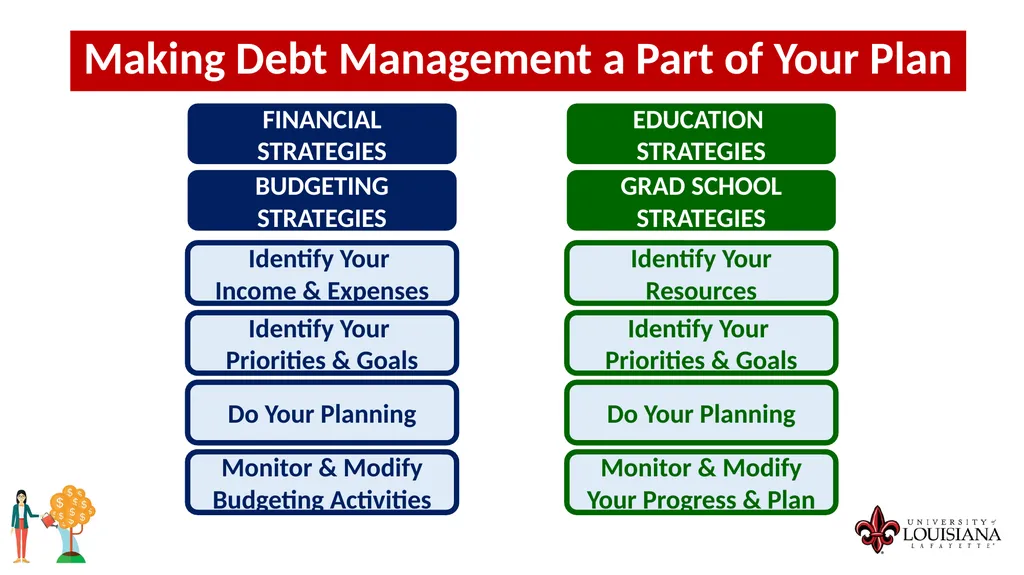
Making Debt Management a Part of Your Plan FINANCIAL STRATEGIES BUDGETING
STRATEGIES Identify Your Income & Expenses Identify Your Priorities & Goals Do Your Planning Monitor & Modify Budgeting Activities EDUCATION STRATEGIES GRAD SCHOOL STRATEGIES Identify Your Resources Identify Your Priorities & Goals Do Your Planning Monitor & Modify Your Progress & Plan<br>
STRATEGIES Identify Your Income & Expenses Identify Your Priorities & Goals Do Your Planning Monitor & Modify Budgeting Activities EDUCATION STRATEGIES GRAD SCHOOL STRATEGIES Identify Your Resources Identify Your Priorities & Goals Do Your Planning Monitor & Modify Your Progress & Plan<br>
39
FINANCIAL STRATEGIES BUDGETING
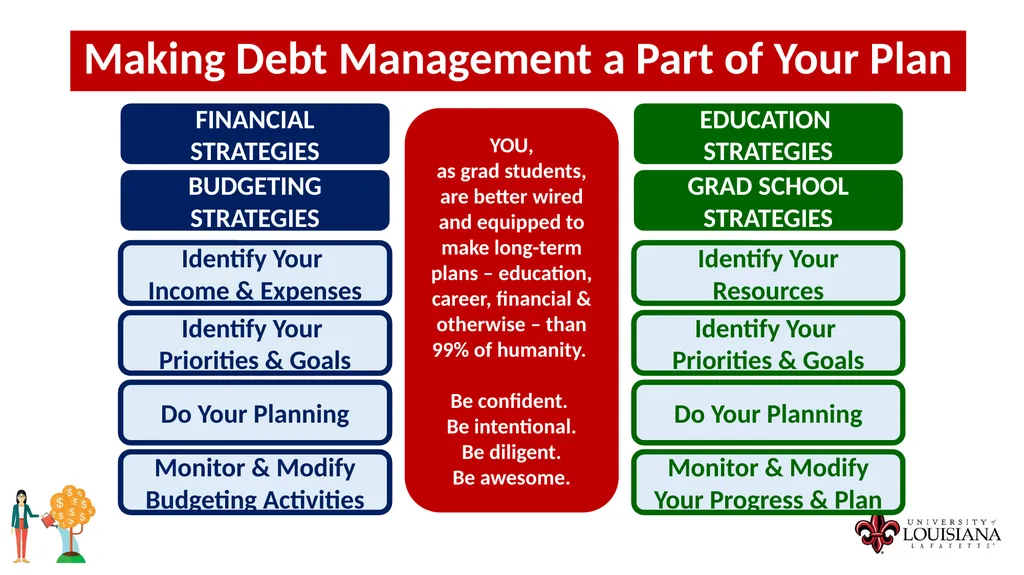
STRATEGIES Identify Your Income & Expenses Identify Your Priorities & Goals Do Your Planning Monitor & Modify Budgeting Activities EDUCATION STRATEGIES GRAD SCHOOL STRATEGIES Identify Your Resources Identify Your Priorities & Goals Do Your Planning Monitor & Modify Your Progress & Plan YOU,
as grad students, are better wired and equipped to make long-term plans – education, career, financial & otherwise – than 99% of humanity.
Be confident. Be intentional.
Be diligent.
Be awesome. Making Debt Management a Part of Your Plan<br>
STRATEGIES Identify Your Income & Expenses Identify Your Priorities & Goals Do Your Planning Monitor & Modify Budgeting Activities EDUCATION STRATEGIES GRAD SCHOOL STRATEGIES Identify Your Resources Identify Your Priorities & Goals Do Your Planning Monitor & Modify Your Progress & Plan YOU,
as grad students, are better wired and equipped to make long-term plans – education, career, financial & otherwise – than 99% of humanity.
Be confident. Be intentional.
Be diligent.
Be awesome. Making Debt Management a Part of Your Plan<br>
40
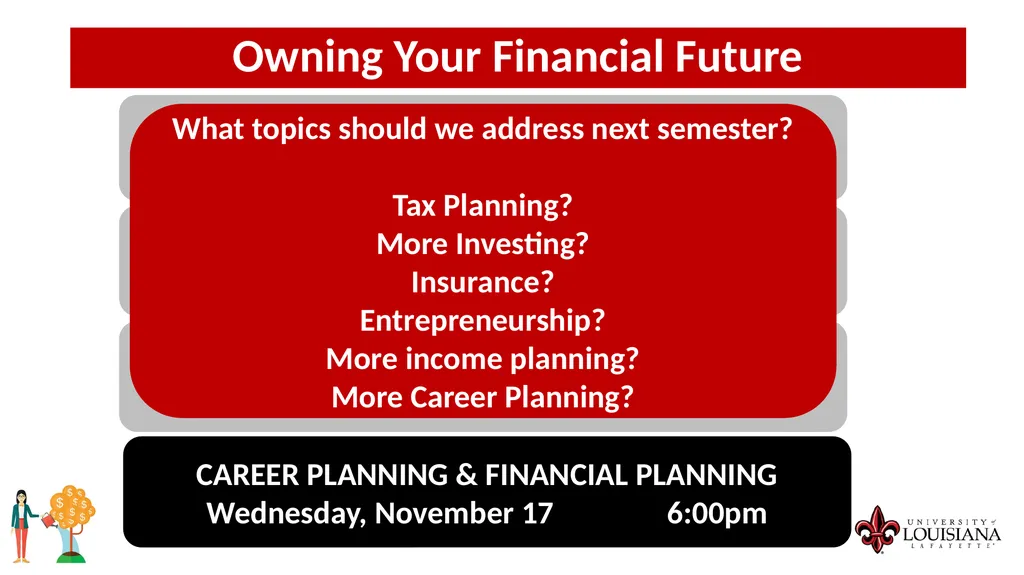
Owning Your Financial Future INVESTING STRATEGIES TO SUPPORT YOUR GOALS
Today, September 8 BUDGETING: MANAGING INCOME & EXPENSES
Tuesday, September 28 12:00pm
Wednesday, October 6 6:00pm DEBT & STUDENT LOAN MANAGEMENT
Wednesday, October 27 6:00pm CAREER PLANNING & FINANCIAL PLANNING
Wednesday, November 17 6:00pm What topics should we address next semester?
Tax Planning?
More Investing?
Insurance?
Entrepreneurship?
More income planning?
More Career Planning?<br>
Today, September 8 BUDGETING: MANAGING INCOME & EXPENSES
Tuesday, September 28 12:00pm
Wednesday, October 6 6:00pm DEBT & STUDENT LOAN MANAGEMENT
Wednesday, October 27 6:00pm CAREER PLANNING & FINANCIAL PLANNING
Wednesday, November 17 6:00pm What topics should we address next semester?
Tax Planning?
More Investing?
Insurance?
Entrepreneurship?
More income planning?
More Career Planning?<br>
41
More Generally…
With Respect to Other Grad School Programming for Spring 2022 – Are there any events or topics that you would like to see us have for you in Spring 2022?
We will re-visit these planning questions at the end of tonight’s session.<br>
With Respect to Other Grad School Programming for Spring 2022 – Are there any events or topics that you would like to see us have for you in Spring 2022?
We will re-visit these planning questions at the end of tonight’s session.<br>
42
brian.bolton@louisiana.edu<br>