Monitoring Matrix 2.0 Workshop 28-29 October, Skopje AGENDA METHODOLOGY Methodological plan Instruments Survey FoI Sampling Indicators scale definitions THE MM IN PRACTICE OTHER RELATED ISSUES Methodological Plan Based on the Toolkit
"Monitoring Matrix 2.0 Workshop 28-29 October," is the property of its rightful owner. Permission is granted to
download and print the materials on this website for personal, non-commercial use only, and to display it
on your personal computer provided you do not modify the materials and that you retain all copyright
notices contained in the materials. By downloading content from our website, you accept the terms of this
agreement.
AGENDA METHODOLOGY
Methodological plan
Instruments
Survey
FoI
Sampling
Indicators scale definitions
THE MM IN PRACTICE
OTHER RELATED ISSUES<br>
03
Methodological Plan Based on the Toolkit
Changes in the MP – redefining the Matrix?
Goal: More clarity, transparency and standardization of the process
What are the key elements of EE in the Balkans?
How to make it more efficient?
Mandatory vs. additional data
Core standards?<br>
04
FoI Bank of questions
No need to ask them all, just make sure you find those data
Discussion on the format in which data is available on the basis of previous experience -> adjust questions
Copies of documents/decisions?
Grouping per institution?<br>
05
Topic guides for semi-structured interviews Interviews with media/journalists?
Interviews with representatives of organisations of volunteers?
Interviews with representative of the institution/ mechanism for CSO cooperation
Same list and institutions
Context specific questions & listed questions (for comparison)<br>
06
Survey Based only on mandatory data types in the MP
Reflects comments/changes in the MP
Current changes – clarification (explanations) and reformulation (negative framing)
Short (as much as possible)
Are there Qs that can be answered through other instruments?<br>
07
Survey (and when that is agreed…)
Translate/adjust according to the legal framework in each country
Don’t change the meaning
Keep it standardized and unified
Test it (sequencing, language/jargon)
Administering the survey?<br>
08
Sampling Sampling is key!
How to make the sample
List of registered CSOs
Mapping active CSOs in policy processes on local/national level
Cross-strategy
How to ensure a good sample and better responsiveness?
Invest time in updating the list (contacts, names, emails)
Keep the survey open for a longer time<br>
09
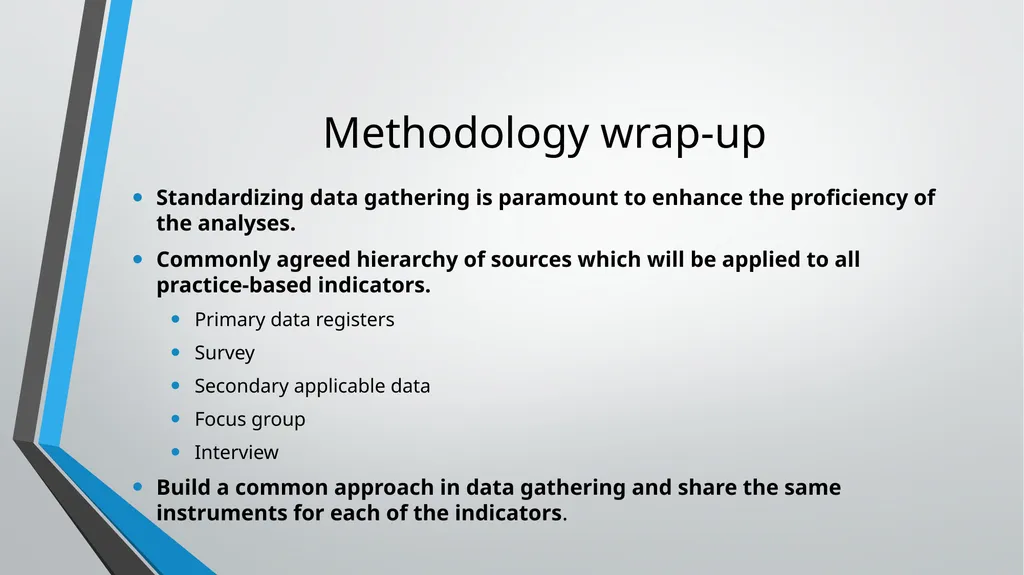
Methodology wrap-up Standardizing data gathering is paramount to enhance the proficiency of the analyses.
Commonly agreed hierarchy of sources which will be applied to all practice-based indicators.
Primary data registers
Survey
Secondary applicable data
Focus group
Interview
Build a common approach in data gathering and share the same instruments for each of the indicators.<br>
10
About the scoring The scoring part of the MM is a necessary feature and should be implemented by all partners. It is important to develop a meaning of the scores at the level of indicators. A peer review process should ensure unified scoring across partners.
The weighting of scores needs to be focused on practice. Furthermore, the weight of areas should not only be based on the number of indicators but on the importance of the areas from the perspective of the toolkit and the advocacy goals of the network.<br>
11
Presentation and advocacy The weaknesses of the advocacy potential are in the style and presentation of the reports.
transfer results solely to graphs and tables and leaving the text only dealing with conclusions, arguments and explanations
The scoring simplifies the findings, puts them into a common framework of explanation and thus serves the purpose of easy comprehension of decision makers<br>