
Morality and Ethics 1 Morality and Ethics Knowing
OM
Published · 13 slides · 0 views
1 / 1
Description
Morality and Ethics 1 Morality and Ethics Knowing what is the right thing to do in any given situation isnt always easy. Christianity is a religion in which beliefs are supposed to be lived out and used as a guide for behaviour, so
Related Topics
Share
Embed code
Download this presentation From Below
"Morality and Ethics 1 Morality and Ethics Knowing" is the property of its rightful owner. Permission is granted to download and print the materials on this website for personal, non-commercial use only, and to display it on your personal computer provided you do not modify the materials and that you retain all copyright notices contained in the materials. By downloading content from our website, you accept the terms of this agreement.
Presentation Transcript
01
Morality and
Ethics 1<br>
02
Morality and Ethics Knowing what is the right thing to do in any given situation isn’t always easy. Christianity is a religion in which beliefs are supposed to be lived out and used as a guide for behaviour, so questions of morality and ethics are very important for Christians.
Christians believe that the Bible can help them to understand how they ought to make decisions about right and wrong in their own lives today. They believe it to be God’s word, which they can apply to their moral choices. 2 How can we know right from wrong? Is there always a clear difference between what is right and what is wrong? Where do we get our sense of right and wrong from? Working with a partner, write a list of beliefs, ideas, people, events and sources of information that might influence our sense of right and wrong.
Which do you think are the most important influences on your own sense of right and wrong? What are the least important?<br>
Christians believe that the Bible can help them to understand how they ought to make decisions about right and wrong in their own lives today. They believe it to be God’s word, which they can apply to their moral choices. 2 How can we know right from wrong? Is there always a clear difference between what is right and what is wrong? Where do we get our sense of right and wrong from? Working with a partner, write a list of beliefs, ideas, people, events and sources of information that might influence our sense of right and wrong.
Which do you think are the most important influences on your own sense of right and wrong? What are the least important?<br>
03
3 Should we follow the rules or trust our good intentions? One of the key questions about morality is whether it should be about following rules or about having good intentions for our actions.
Absolute morality is the belief that our decision making should be led by rules, and that those rules should never be broken.
Relative morality is the belief that we can choose how to act, and not always be governed by rules. Some people talk about the idea of “the lesser of two evils” and trying to make the choices which will do the least amount of harm in the long term.
Closely related to relative morality is ‘situational ethics’, which is named after a book by the philosopher Joseph Fletcher. He argued that following the way of love should take priority over following the rules.
Within Christianity, there are both rules and general principles which believers use to guide their decision making.<br>
Absolute morality is the belief that our decision making should be led by rules, and that those rules should never be broken.
Relative morality is the belief that we can choose how to act, and not always be governed by rules. Some people talk about the idea of “the lesser of two evils” and trying to make the choices which will do the least amount of harm in the long term.
Closely related to relative morality is ‘situational ethics’, which is named after a book by the philosopher Joseph Fletcher. He argued that following the way of love should take priority over following the rules.
Within Christianity, there are both rules and general principles which believers use to guide their decision making.<br>
04
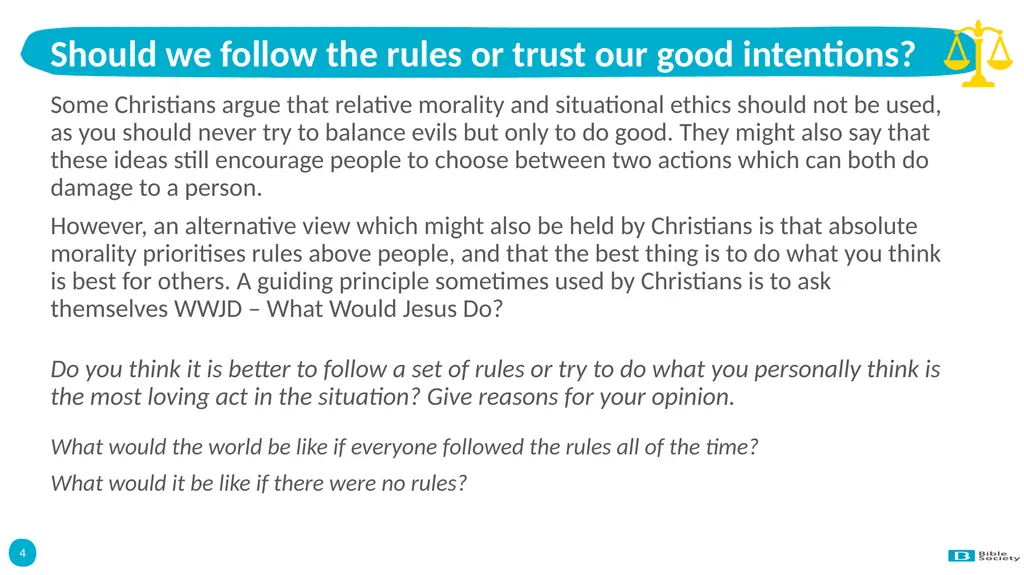
4 Should we follow the rules or trust our good intentions? Some Christians argue that relative morality and situational ethics should not be used, as you should never try to balance evils but only to do good. They might also say that these ideas still encourage people to choose between two actions which can both do damage to a person.
However, an alternative view which might also be held by Christians is that absolute morality prioritises rules above people, and that the best thing is to do what you think is best for others. A guiding principle sometimes used by Christians is to ask themselves WWJD – What Would Jesus Do?
Do you think it is better to follow a set of rules or try to do what you personally think is the most loving act in the situation? Give reasons for your opinion. What would the world be like if everyone followed the rules all of the time?
What would it be like if there were no rules?<br>
However, an alternative view which might also be held by Christians is that absolute morality prioritises rules above people, and that the best thing is to do what you think is best for others. A guiding principle sometimes used by Christians is to ask themselves WWJD – What Would Jesus Do?
Do you think it is better to follow a set of rules or try to do what you personally think is the most loving act in the situation? Give reasons for your opinion. What would the world be like if everyone followed the rules all of the time?
What would it be like if there were no rules?<br>
05
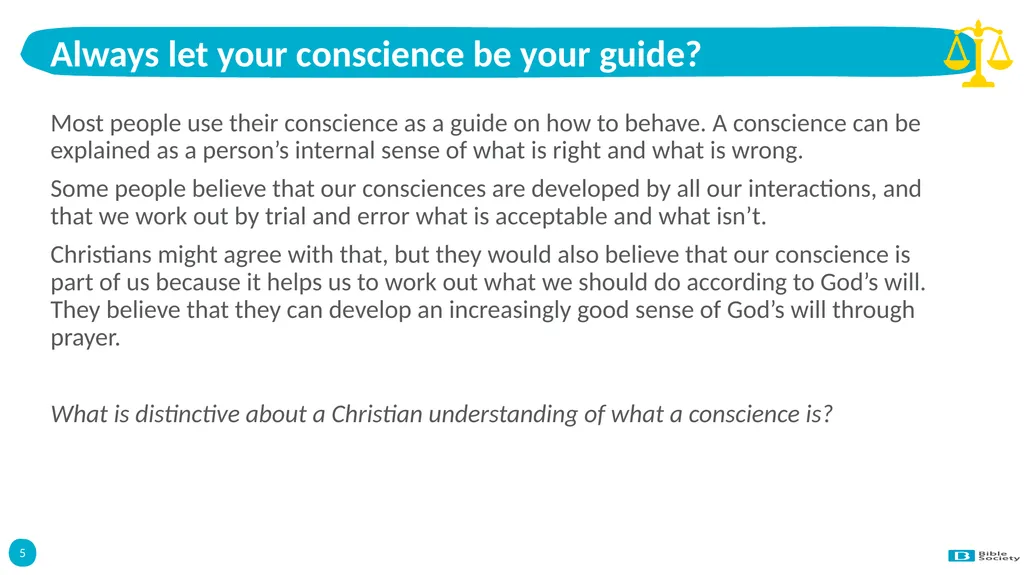
5 Always let your conscience be your guide? Most people use their conscience as a guide on how to behave. A conscience can be explained as a person’s internal sense of what is right and what is wrong.
Some people believe that our consciences are developed by all our interactions, and that we work out by trial and error what is acceptable and what isn’t.
Christians might agree with that, but they would also believe that our conscience is part of us because it helps us to work out what we should do according to God’s will. They believe that they can develop an increasingly good sense of God’s will through prayer.
What is distinctive about a Christian understanding of what a conscience is?<br>
Some people believe that our consciences are developed by all our interactions, and that we work out by trial and error what is acceptable and what isn’t.
Christians might agree with that, but they would also believe that our conscience is part of us because it helps us to work out what we should do according to God’s will. They believe that they can develop an increasingly good sense of God’s will through prayer.
What is distinctive about a Christian understanding of what a conscience is?<br>
06
6 What does the Old Testament say about right and wrong? One of the themes of the Old Testament is that God promised to be in a relationship with the Israelites; and that the Israelites promised to honour God in their lives and worship. In the Bible, this promise is called a covenant.
The rules that God provided for the Israelites to follow include the Ten Commandments, and many Christians believe that they can find in them a set of clear directions to follow and apply to this day.
You can read the Ten Commandments on the separate sheet.
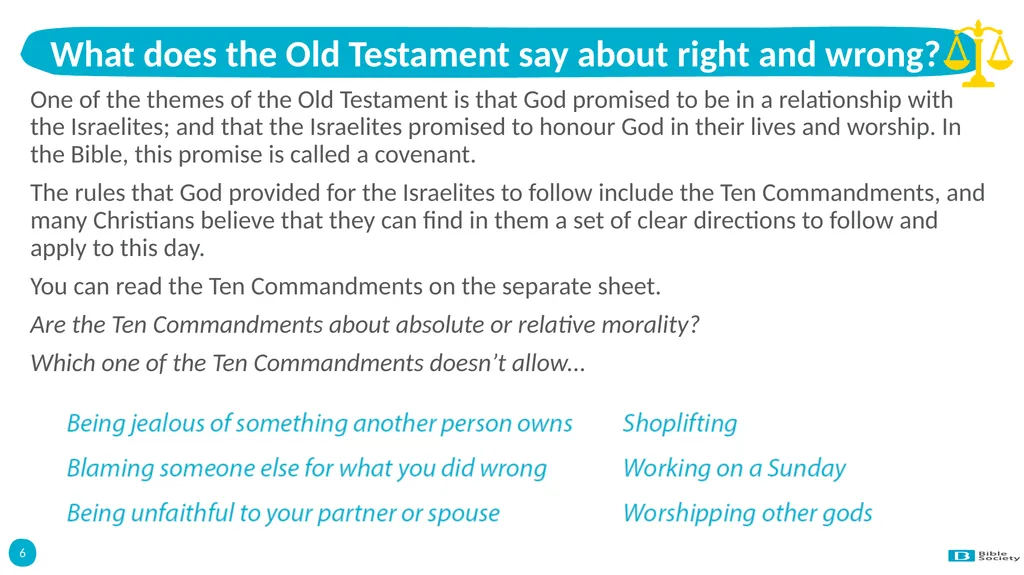
Are the Ten Commandments about absolute or relative morality?
Which one of the Ten Commandments doesn’t allow...<br>
The rules that God provided for the Israelites to follow include the Ten Commandments, and many Christians believe that they can find in them a set of clear directions to follow and apply to this day.
You can read the Ten Commandments on the separate sheet.
Are the Ten Commandments about absolute or relative morality?
Which one of the Ten Commandments doesn’t allow...<br>
07
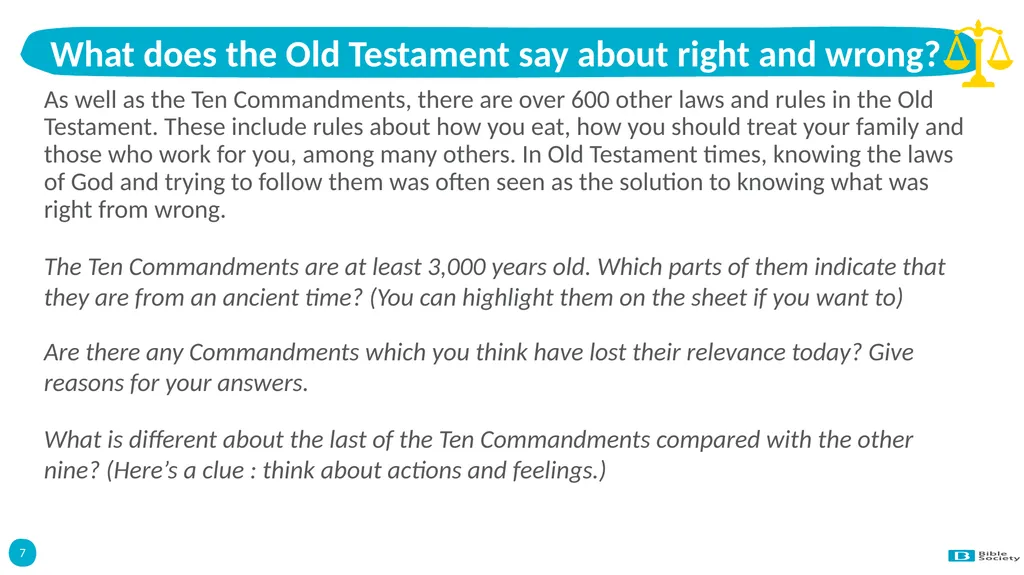
7 What does the Old Testament say about right and wrong? As well as the Ten Commandments, there are over 600 other laws and rules in the Old Testament. These include rules about how you eat, how you should treat your family and those who work for you, among many others. In Old Testament times, knowing the laws of God and trying to follow them was often seen as the solution to knowing what was right from wrong.
The Ten Commandments are at least 3,000 years old. Which parts of them indicate that they are from an ancient time? (You can highlight them on the sheet if you want to)
Are there any Commandments which you think have lost their relevance today? Give reasons for your answers.
What is different about the last of the Ten Commandments compared with the other nine? (Here’s a clue : think about actions and feelings.)<br>
The Ten Commandments are at least 3,000 years old. Which parts of them indicate that they are from an ancient time? (You can highlight them on the sheet if you want to)
Are there any Commandments which you think have lost their relevance today? Give reasons for your answers.
What is different about the last of the Ten Commandments compared with the other nine? (Here’s a clue : think about actions and feelings.)<br>
08
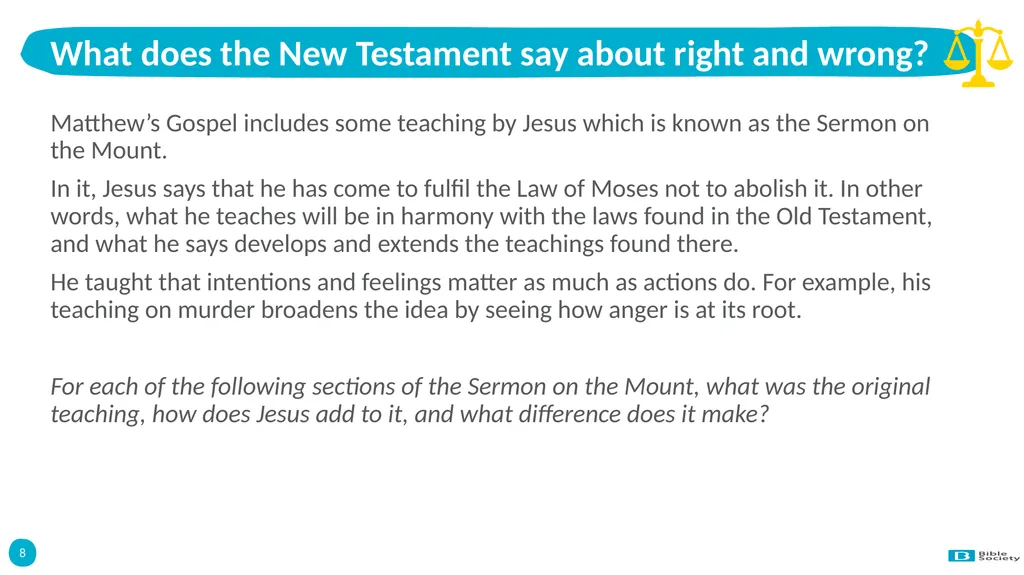
8 What does the New Testament say about right and wrong? Matthew’s Gospel includes some teaching by Jesus which is known as the Sermon on the Mount.
In it, Jesus says that he has come to fulfil the Law of Moses not to abolish it. In other words, what he teaches will be in harmony with the laws found in the Old Testament, and what he says develops and extends the teachings found there.
He taught that intentions and feelings matter as much as actions do. For example, his teaching on murder broadens the idea by seeing how anger is at its root.
For each of the following sections of the Sermon on the Mount, what was the original teaching, how does Jesus add to it, and what difference does it make?<br>
In it, Jesus says that he has come to fulfil the Law of Moses not to abolish it. In other words, what he teaches will be in harmony with the laws found in the Old Testament, and what he says develops and extends the teachings found there.
He taught that intentions and feelings matter as much as actions do. For example, his teaching on murder broadens the idea by seeing how anger is at its root.
For each of the following sections of the Sermon on the Mount, what was the original teaching, how does Jesus add to it, and what difference does it make?<br>
09
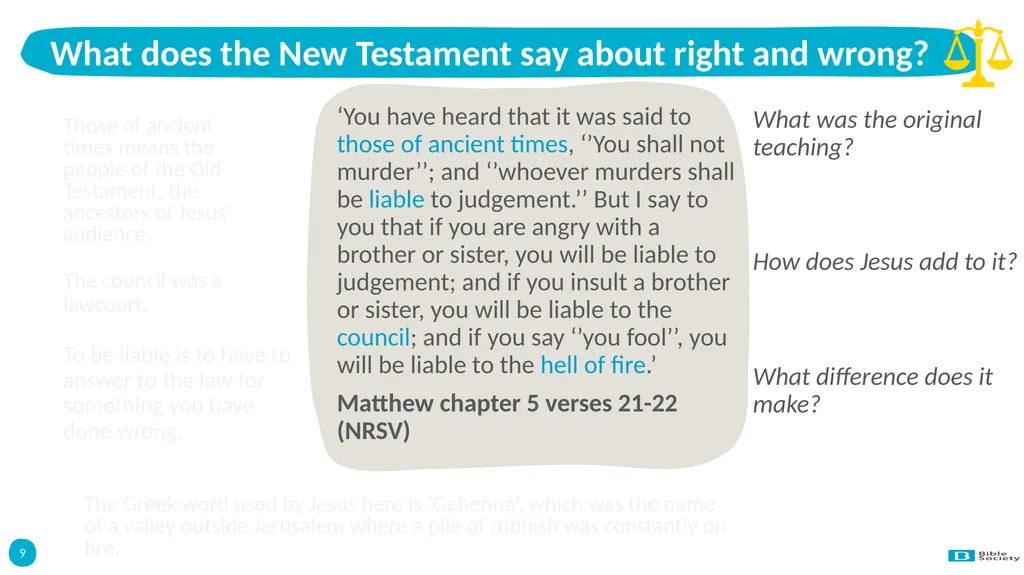
9 What does the New Testament say about right and wrong? What was the original teaching?
How does Jesus add to it?
What difference does it make? ‘You have heard that it was said to those of ancient times, ‘’You shall not murder’’; and ‘’whoever murders shall be liable to judgement.’’ But I say to you that if you are angry with a brother or sister, you will be liable to judgement; and if you insult a brother or sister, you will be liable to the council; and if you say ‘’you fool’’, you will be liable to the hell of fire.’
Matthew chapter 5 verses 21-22 (NRSV) Those of ancient times means the people of the Old Testament, the ancestors of Jesus’ audience. The council was a lawcourt. To be liable is to have to answer to the law for something you have done wrong. The Greek word used by Jesus here is ‘Gehenna’, which was the name of a valley outside Jerusalem where a pile of rubbish was constantly on fire.<br>
How does Jesus add to it?
What difference does it make? ‘You have heard that it was said to those of ancient times, ‘’You shall not murder’’; and ‘’whoever murders shall be liable to judgement.’’ But I say to you that if you are angry with a brother or sister, you will be liable to judgement; and if you insult a brother or sister, you will be liable to the council; and if you say ‘’you fool’’, you will be liable to the hell of fire.’
Matthew chapter 5 verses 21-22 (NRSV) Those of ancient times means the people of the Old Testament, the ancestors of Jesus’ audience. The council was a lawcourt. To be liable is to have to answer to the law for something you have done wrong. The Greek word used by Jesus here is ‘Gehenna’, which was the name of a valley outside Jerusalem where a pile of rubbish was constantly on fire.<br>
10
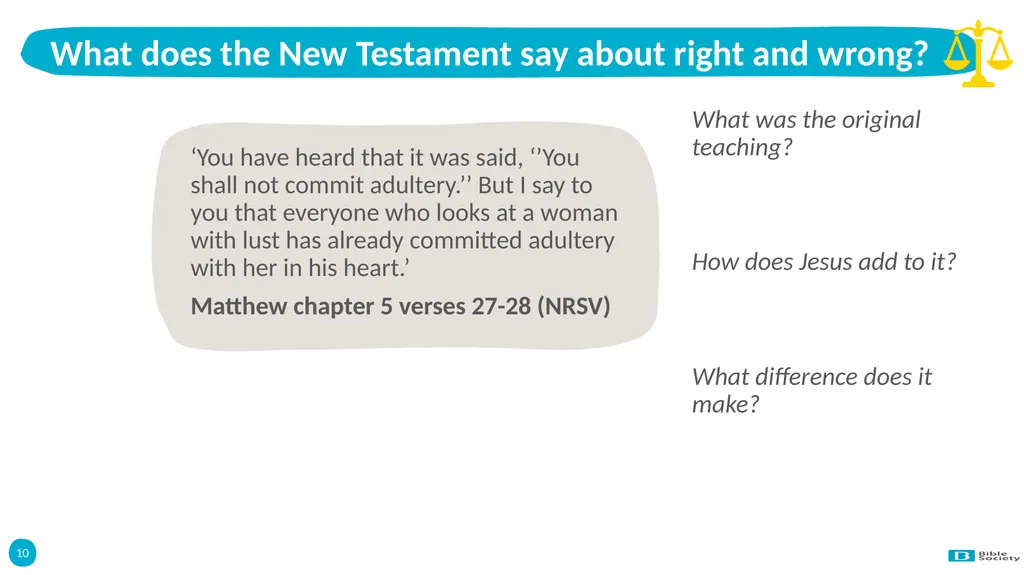
10 What does the New Testament say about right and wrong? ‘You have heard that it was said, ‘’You shall not commit adultery.’’ But I say to you that everyone who looks at a woman with lust has already committed adultery with her in his heart.’
Matthew chapter 5 verses 27-28 (NRSV) What was the original teaching?
How does Jesus add to it?
What difference does it make?<br>
Matthew chapter 5 verses 27-28 (NRSV) What was the original teaching?
How does Jesus add to it?
What difference does it make?<br>
11
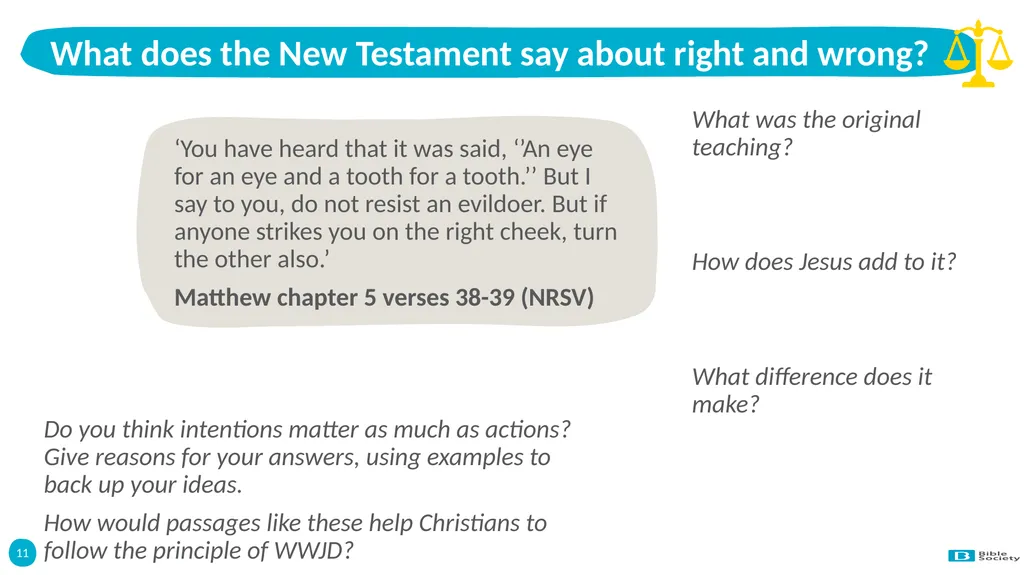
11 What does the New Testament say about right and wrong? ‘You have heard that it was said, ‘’An eye for an eye and a tooth for a tooth.’’ But I say to you, do not resist an evildoer. But if anyone strikes you on the right cheek, turn the other also.’
Matthew chapter 5 verses 38-39 (NRSV) Do you think intentions matter as much as actions? Give reasons for your answers, using examples to back up your ideas.
How would passages like these help Christians to follow the principle of WWJD? What was the original teaching?
How does Jesus add to it?
What difference does it make?<br>
Matthew chapter 5 verses 38-39 (NRSV) Do you think intentions matter as much as actions? Give reasons for your answers, using examples to back up your ideas.
How would passages like these help Christians to follow the principle of WWJD? What was the original teaching?
How does Jesus add to it?
What difference does it make?<br>
12
12 What does the New Testament say about right and wrong? The Indian political and spiritual leader Mahatma Gandhi who was a Hindu said of Jesus’ teaching,
‘’...although I am myself not a Christian, as an humble student of the Bible, who approaches it with faith and reverence, I wish respectfully to place before you the essence of the Sermon on the Mount... “
Christians usually believe that the teachings of Jesus, found in the Gospels, have a superior authority to the rest of the Bible (though that doesn’t mean that the rest of the Bible is unimportant to them). Martin Luther King looked to the Sermon on the Mount for inspiration, saying that it had influenced his campaign against racism, having seen Gandhi use non-violence to help him in South Africa and India.<br>
‘’...although I am myself not a Christian, as an humble student of the Bible, who approaches it with faith and reverence, I wish respectfully to place before you the essence of the Sermon on the Mount... “
Christians usually believe that the teachings of Jesus, found in the Gospels, have a superior authority to the rest of the Bible (though that doesn’t mean that the rest of the Bible is unimportant to them). Martin Luther King looked to the Sermon on the Mount for inspiration, saying that it had influenced his campaign against racism, having seen Gandhi use non-violence to help him in South Africa and India.<br>
13
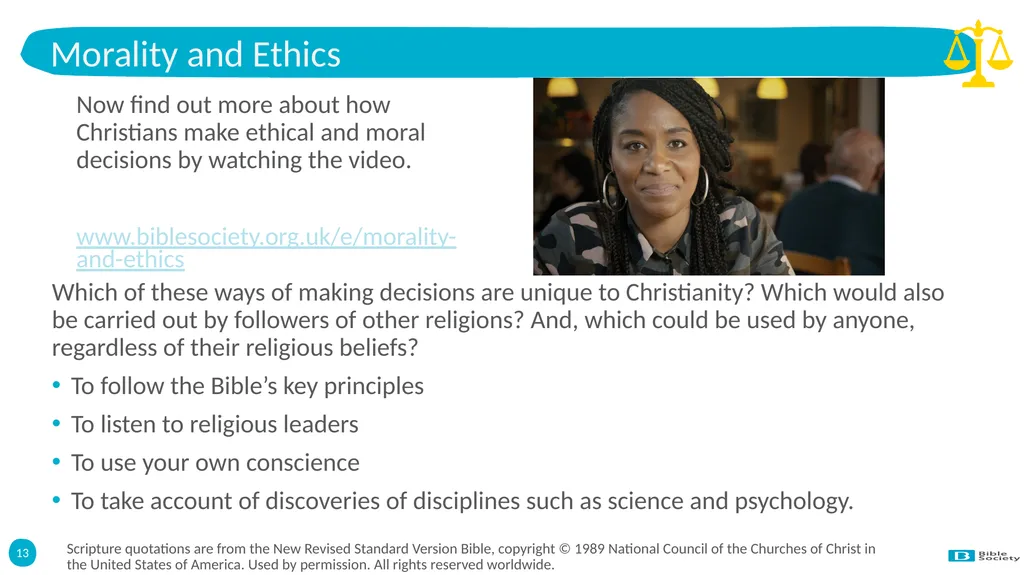
13 Morality and Ethics Now find out more about how Christians make ethical and moral decisions by watching the video.
www.biblesociety.org.uk/e/morality-and-ethics Which of these ways of making decisions are unique to Christianity? Which would also be carried out by followers of other religions? And, which could be used by anyone, regardless of their religious beliefs?
To follow the Bible’s key principles
To listen to religious leaders
To use your own conscience
To take account of discoveries of disciplines such as science and psychology. Scripture quotations are from the New Revised Standard Version Bible, copyright © 1989 National Council of the Churches of Christ in the United States of America. Used by permission. All rights reserved worldwide.<br>
www.biblesociety.org.uk/e/morality-and-ethics Which of these ways of making decisions are unique to Christianity? Which would also be carried out by followers of other religions? And, which could be used by anyone, regardless of their religious beliefs?
To follow the Bible’s key principles
To listen to religious leaders
To use your own conscience
To take account of discoveries of disciplines such as science and psychology. Scripture quotations are from the New Revised Standard Version Bible, copyright © 1989 National Council of the Churches of Christ in the United States of America. Used by permission. All rights reserved worldwide.<br>