
More Anonymous Onion Routing Through Trust Aaron


Description: More Anonymous Onion Routing Through Trust Aaron Johnson and Paul Syverson 22nd IEEE Computer Security Foundations Symposium July 2009 1 How Onion Routing Works User u running client Internet destination d Routers running servers u d 1 2 3
Related Topics
Download Presentation
"More Anonymous Onion Routing Through Trust Aaron" is the property of its rightful owner. Permission is granted to download and print the materials on this website for personal, non-commercial use only, and to display it on your personal computer provided you do not modify the materials and that you retain all copyright notices contained in the materials. By downloading content from our website, you accept the terms of this agreement.
Presentation Transcript
slide1. More Anonymous Onion Routing Through Trust Aaron Johnson and Paul Syverson
22nd IEEE Computer Security Foundations Symposium
July 2009 1<br>
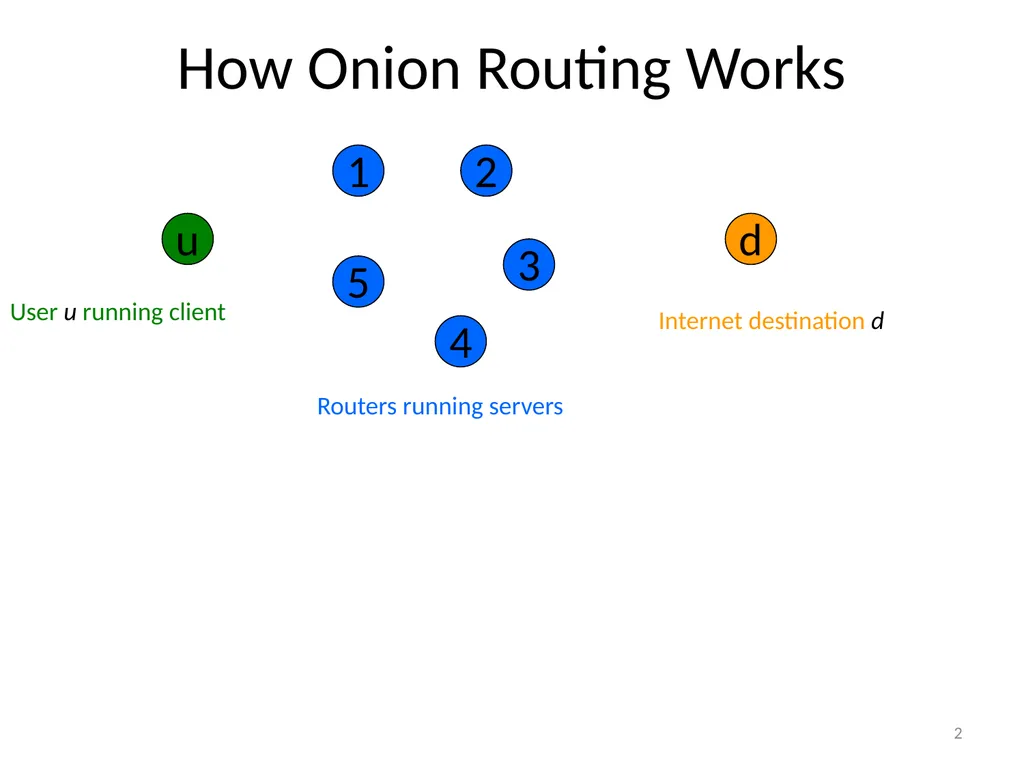
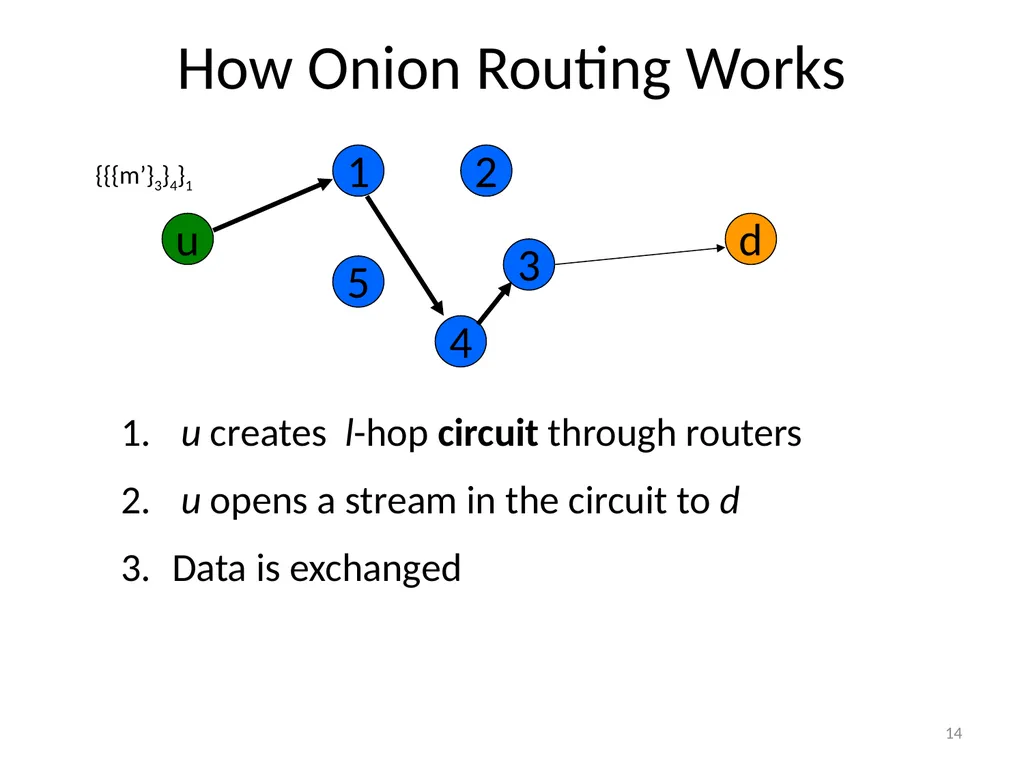
slide2. How Onion Routing Works User u running client Internet destination d Routers running servers u d 1 2 3 4 5 2<br>
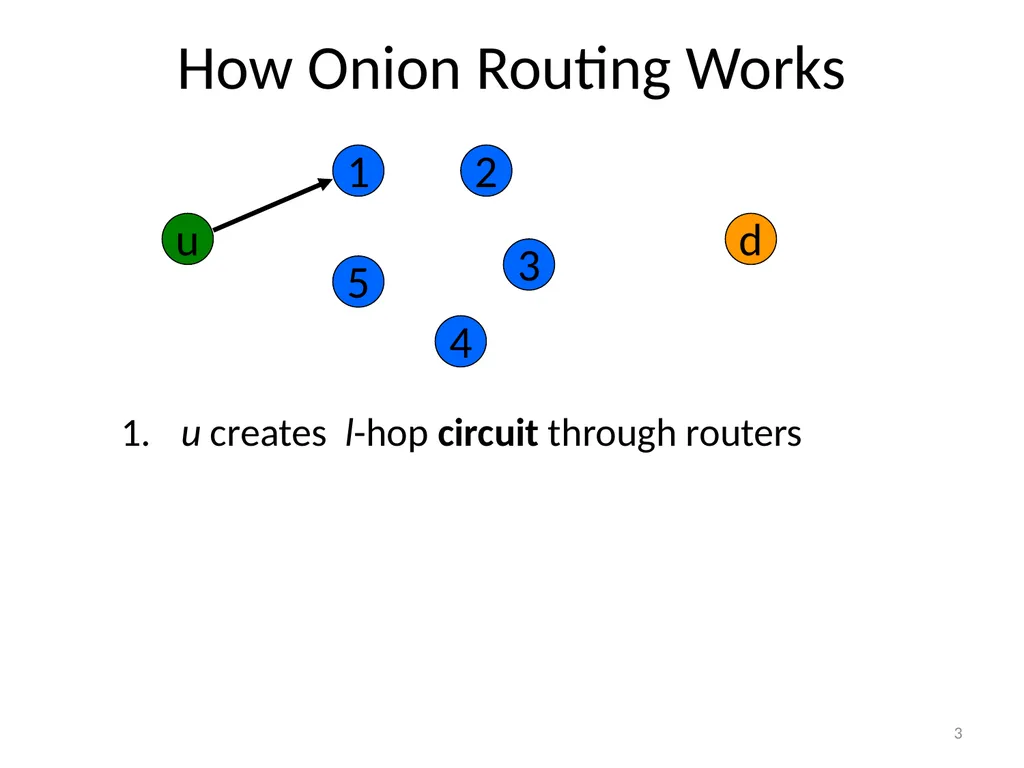
slide3. How Onion Routing Works u d u creates l-hop circuit through routers 1 2 3 4 5 3<br>
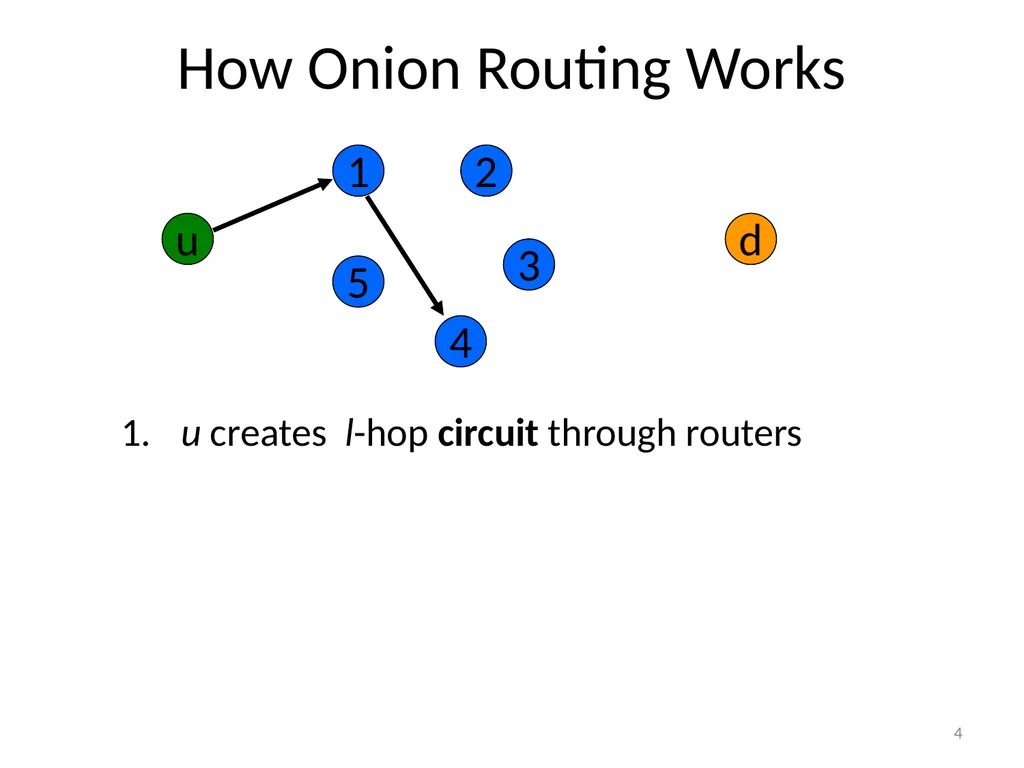
slide4. How Onion Routing Works u d u creates l-hop circuit through routers 1 2 3 4 5 4<br>
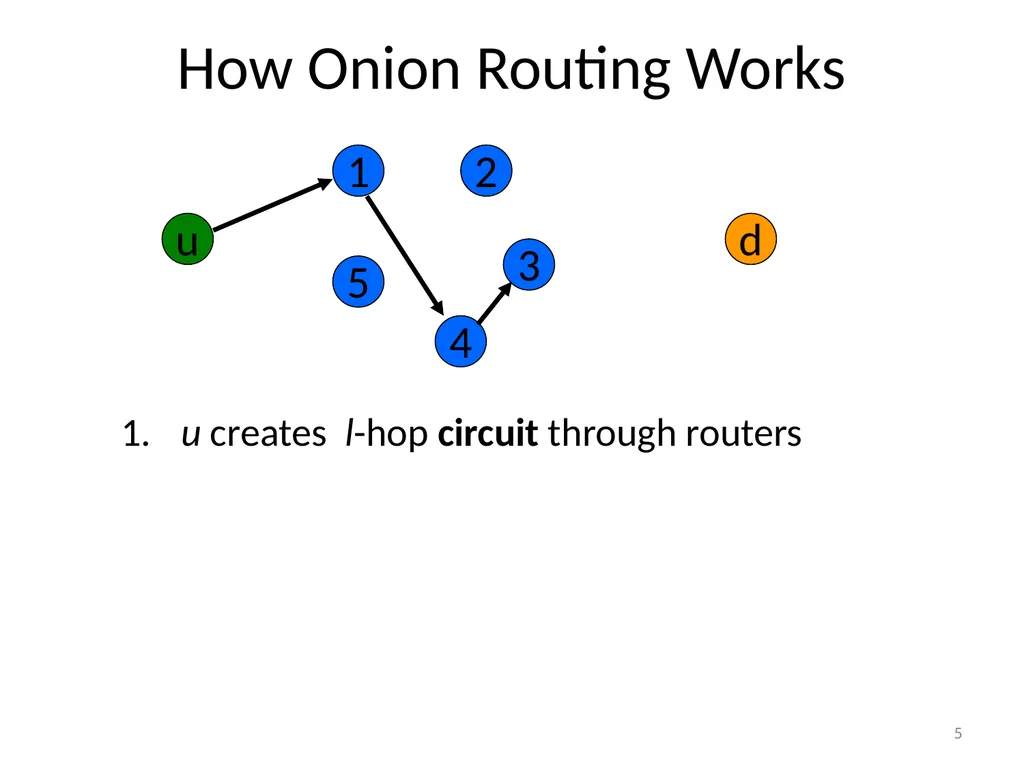
slide5. How Onion Routing Works u d u creates l-hop circuit through routers 1 2 3 4 5 5<br>
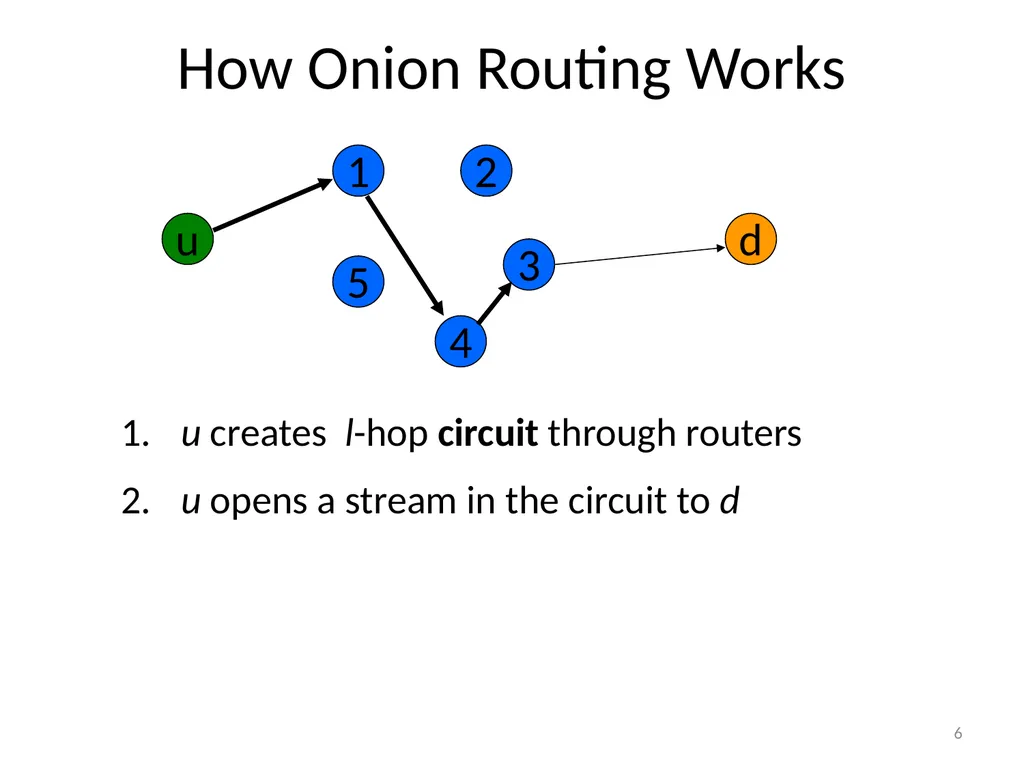
slide6. How Onion Routing Works u d u creates l-hop circuit through routers
u opens a stream in the circuit to d 1 2 3 4 5 6<br>
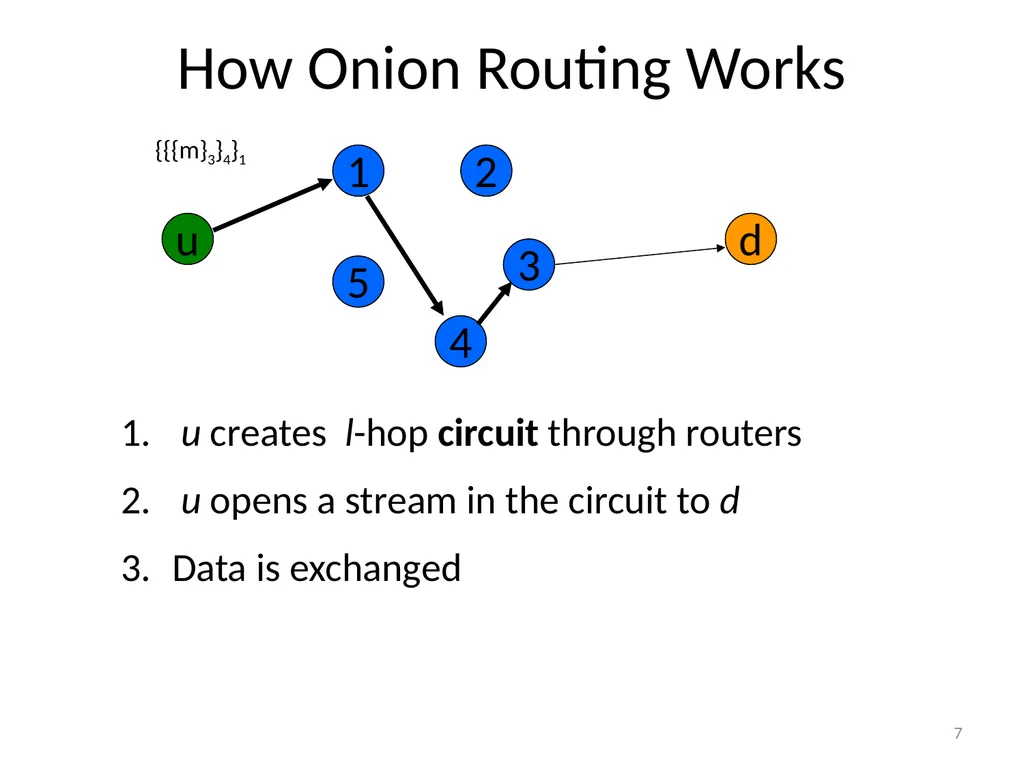
slide7. How Onion Routing Works u d u creates l-hop circuit through routers
u opens a stream in the circuit to d
Data is exchanged {{{m}3}4}1 1 2 3 4 5 7<br>
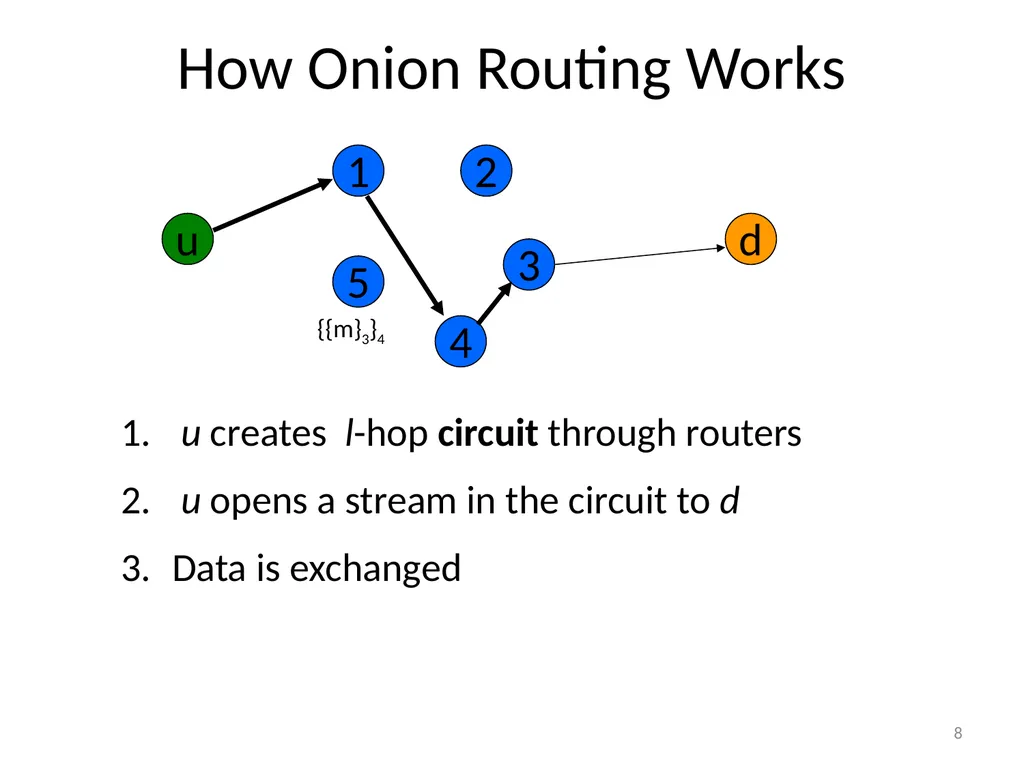
slide8. How Onion Routing Works u d u creates l-hop circuit through routers
u opens a stream in the circuit to d
Data is exchanged {{m}3}4 1 2 3 4 5 8<br>
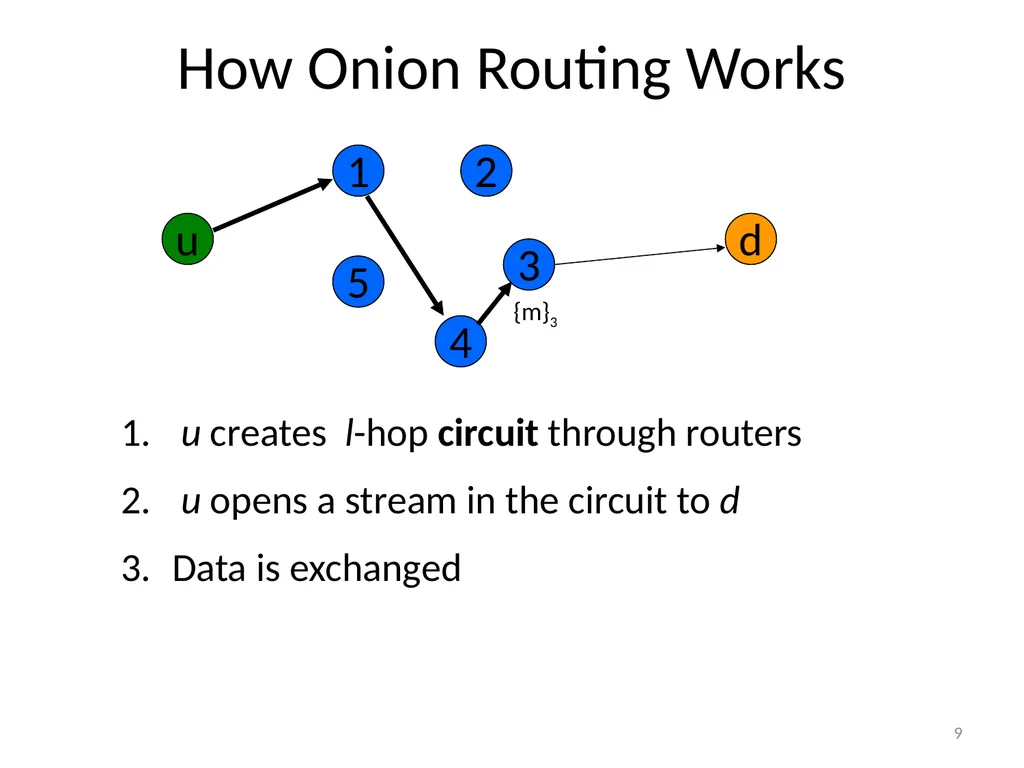
slide9. How Onion Routing Works u d u creates l-hop circuit through routers
u opens a stream in the circuit to d
Data is exchanged {m}3 1 2 3 4 5 9<br>
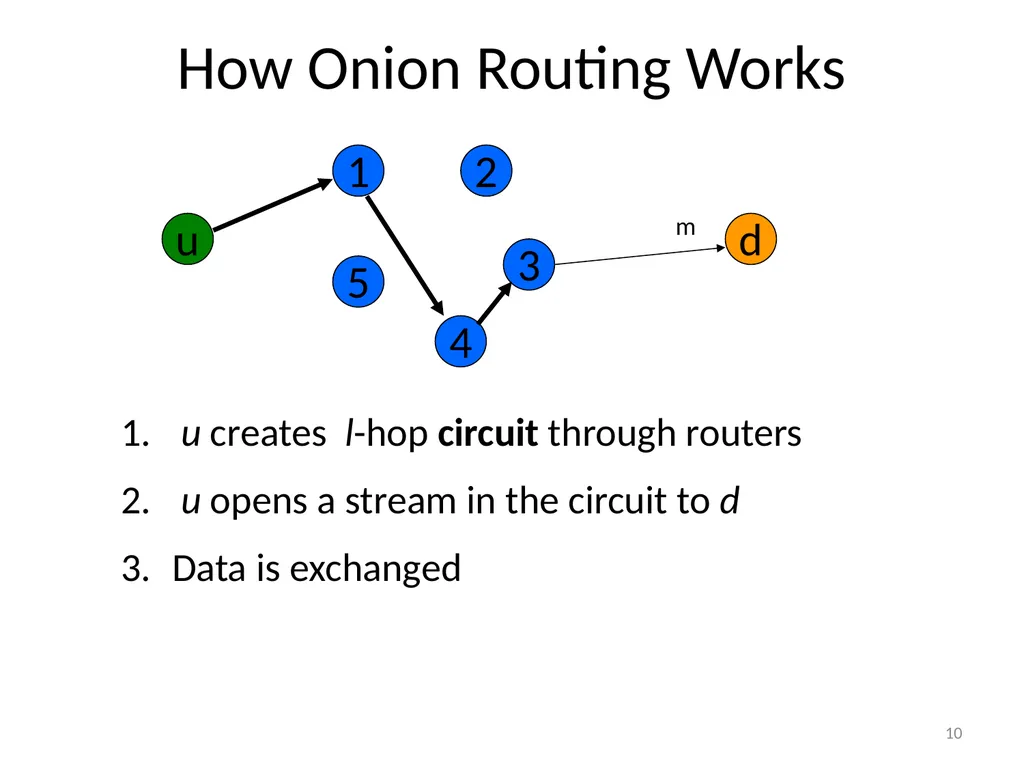
slide10. How Onion Routing Works u d u creates l-hop circuit through routers
u opens a stream in the circuit to d
Data is exchanged m 1 2 3 4 5 10<br>
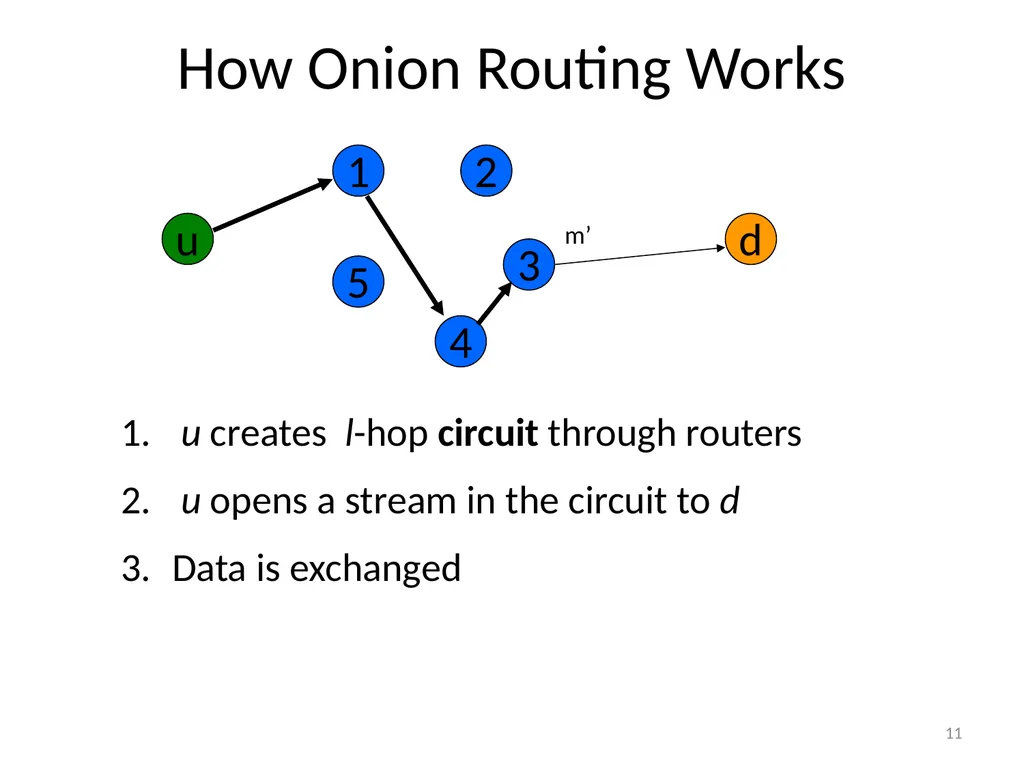
slide11. How Onion Routing Works u d u creates l-hop circuit through routers
u opens a stream in the circuit to d
Data is exchanged m’ 1 2 3 4 5 11<br>
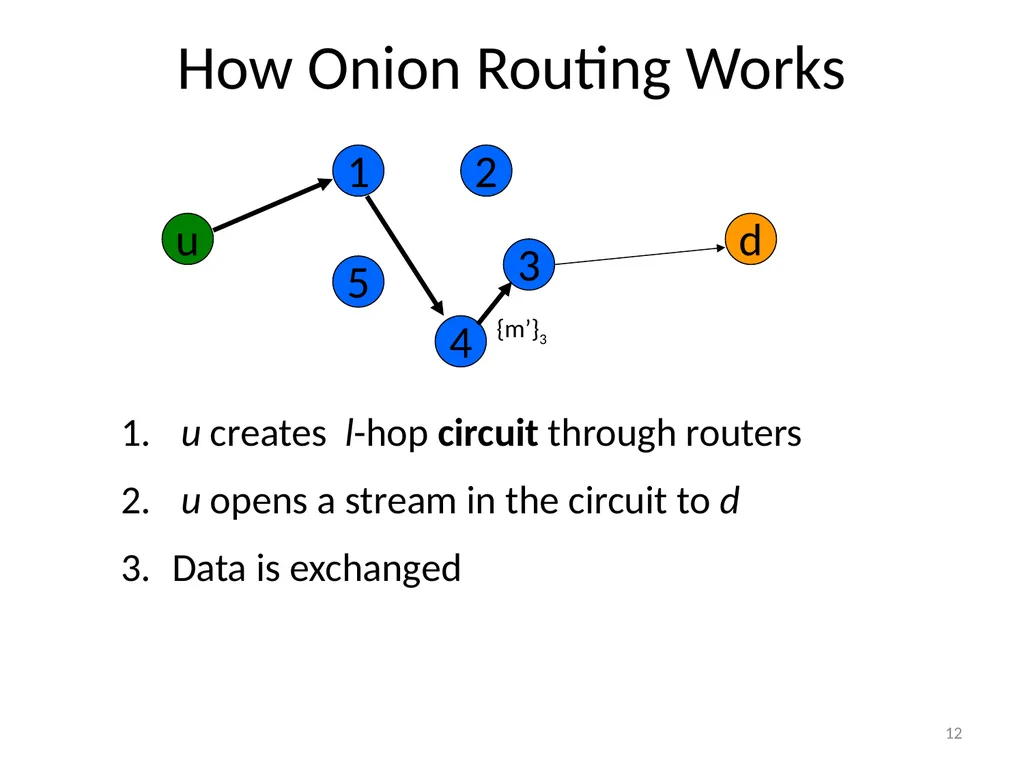
slide12. How Onion Routing Works u d u creates l-hop circuit through routers
u opens a stream in the circuit to d
Data is exchanged {m’}3 1 2 3 4 5 12<br>
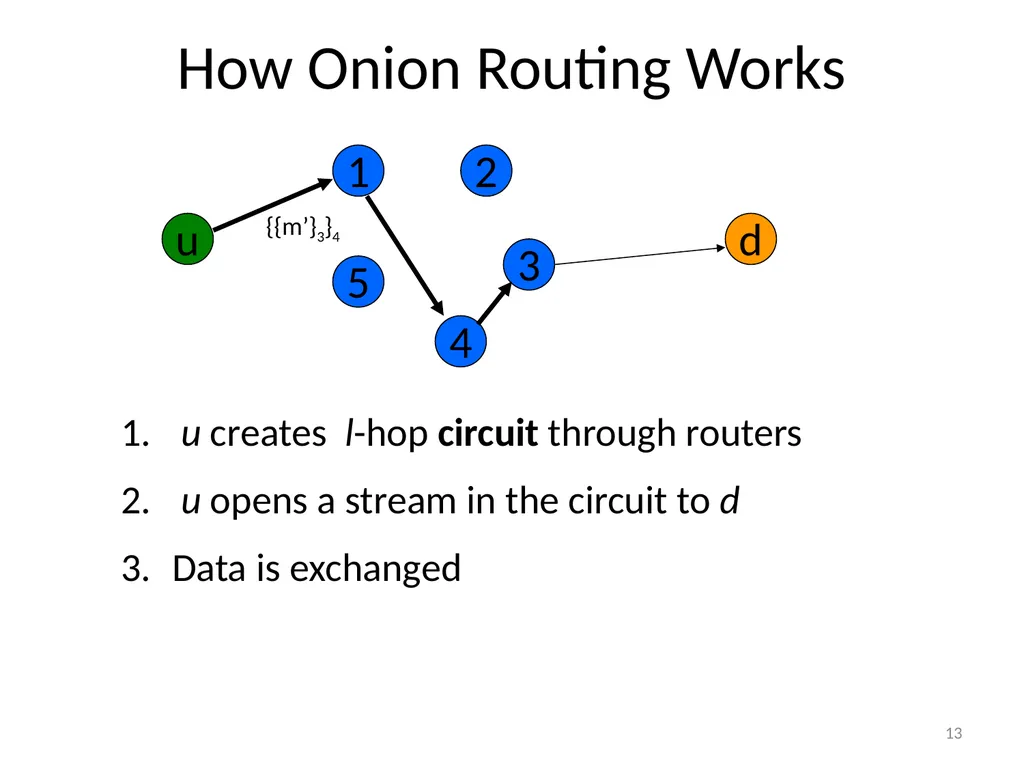
slide13. How Onion Routing Works u d u creates l-hop circuit through routers
u opens a stream in the circuit to d
Data is exchanged {{m’}3}4 1 2 3 4 5 13<br>
slide14. How Onion Routing Works u d u creates l-hop circuit through routers
u opens a stream in the circuit to d
Data is exchanged {{{m’}3}4}1 1 2 3 4 5 14<br>
slide15. Onion Routing Practical design with low latency and overhead
Open source implementation (http://www.torproject.org/)
Over 1500 volunteer routers
Estimated 200,000 users 15<br>
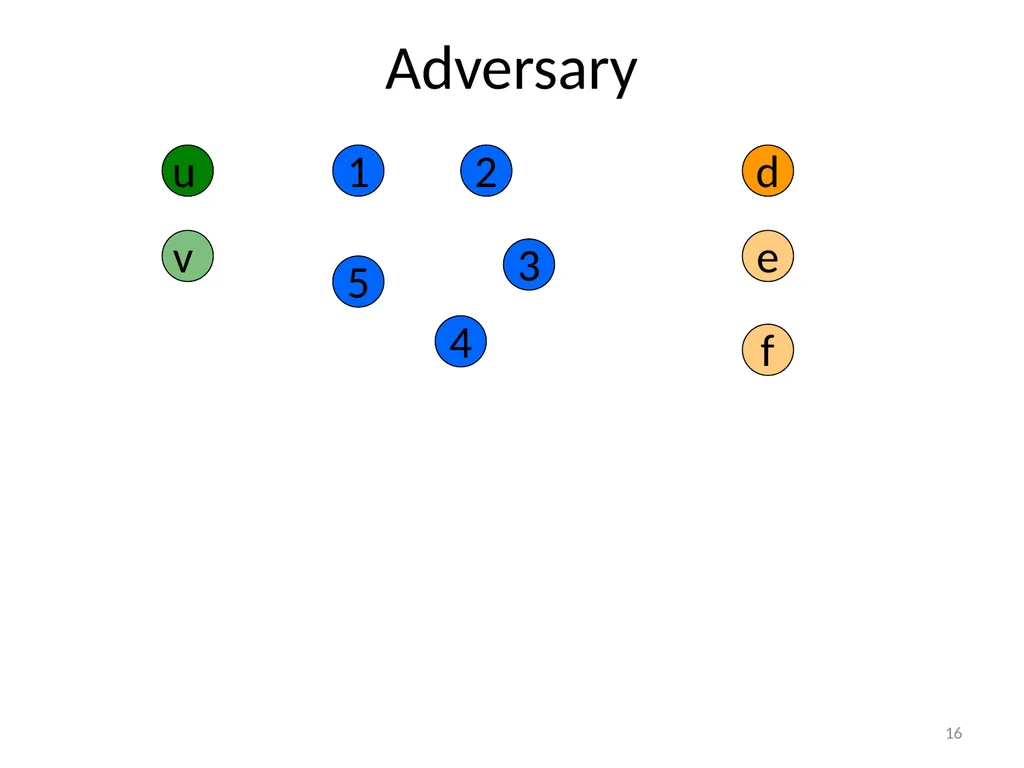
slide16. Adversary u 2 4 5 d v e f 16 1 3<br>
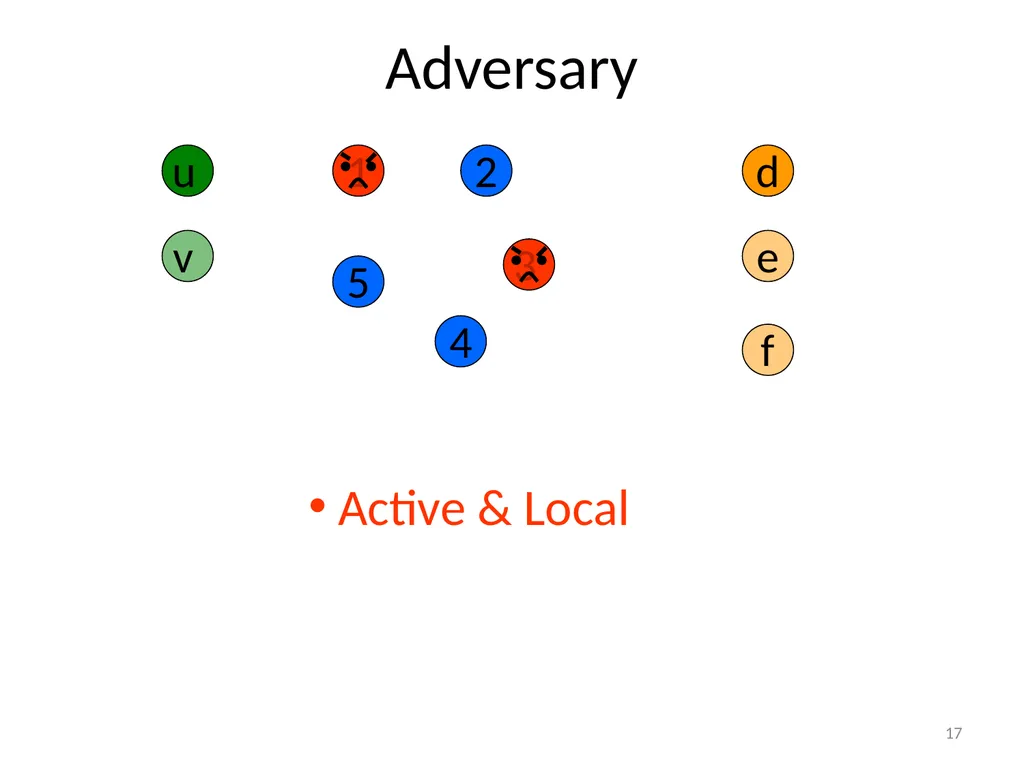
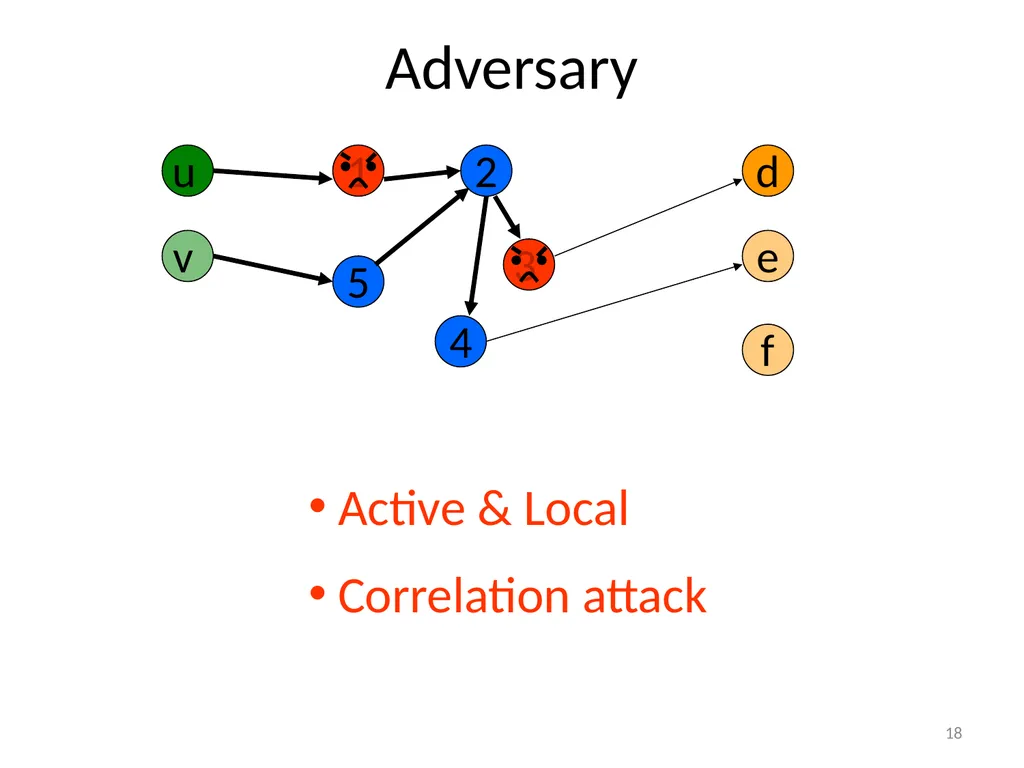
slide17. Adversary u 1 2 3 4 5 d v e f 17 Active & Local<br>
slide18. Adversary u 1 2 3 4 5 d v e f 18 Active & Local
Correlation attack<br>
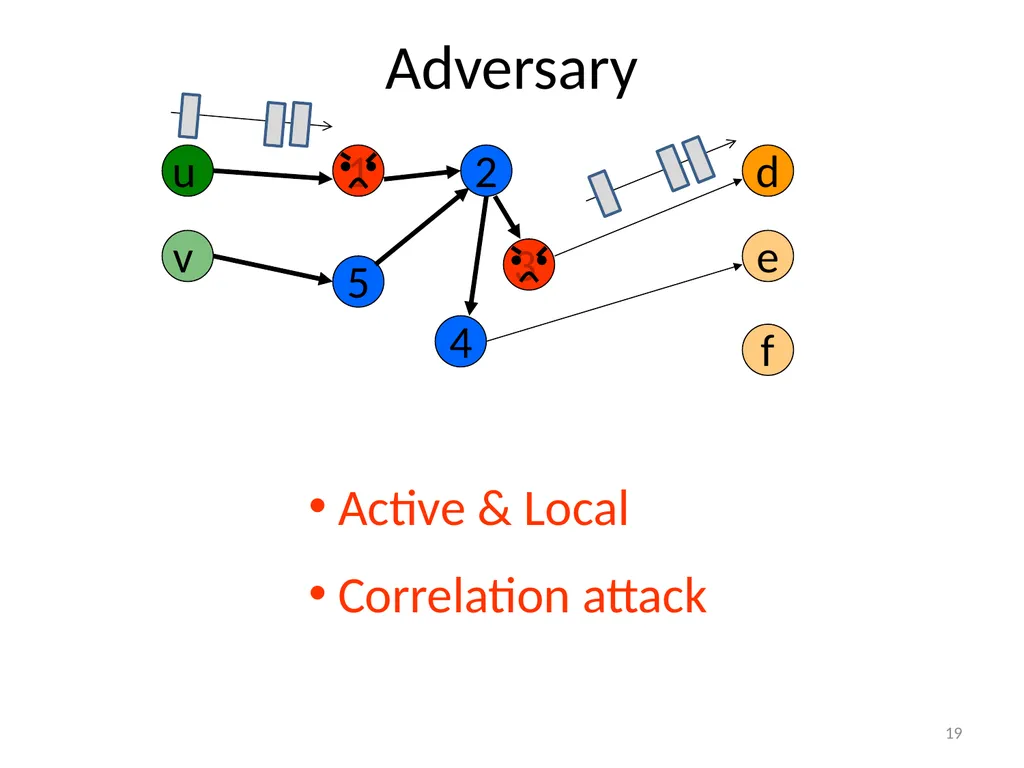
slide19. Adversary u 1 2 3 4 5 d v e f 19 Active & Local
Correlation attack<br>
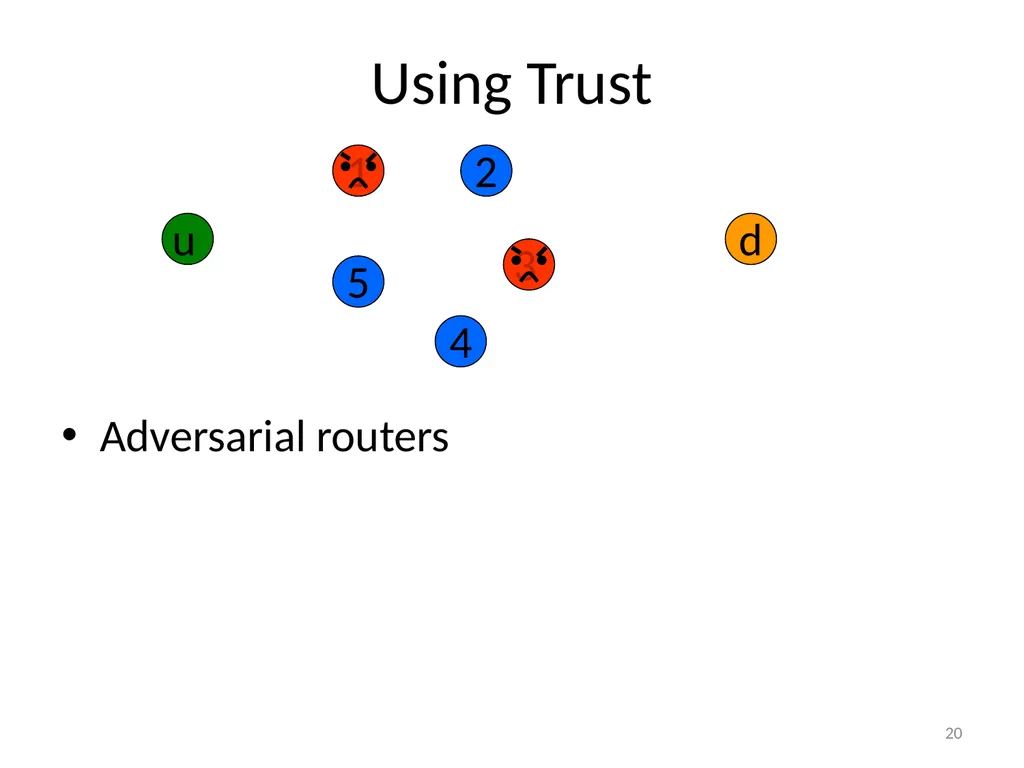
slide20. Using Trust Adversarial routers 20 u 1 2 3 4 5 d<br>
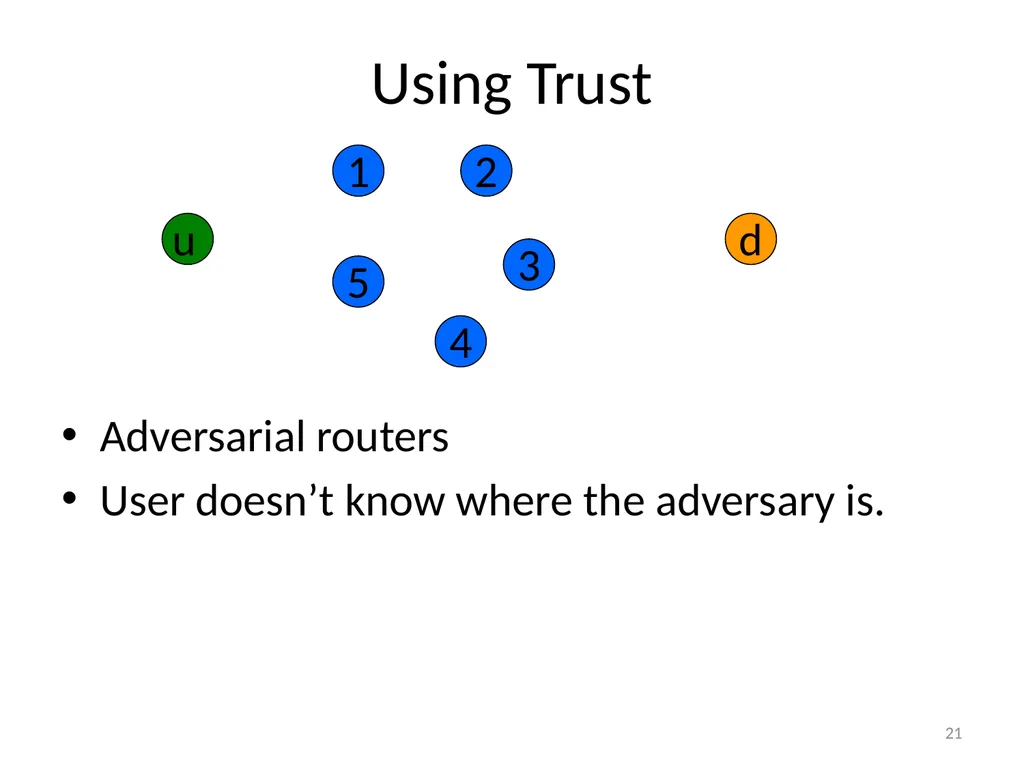
slide21. Using Trust 21 u 1 2 3 4 5 d Adversarial routers
User doesn’t know where the adversary is.<br>
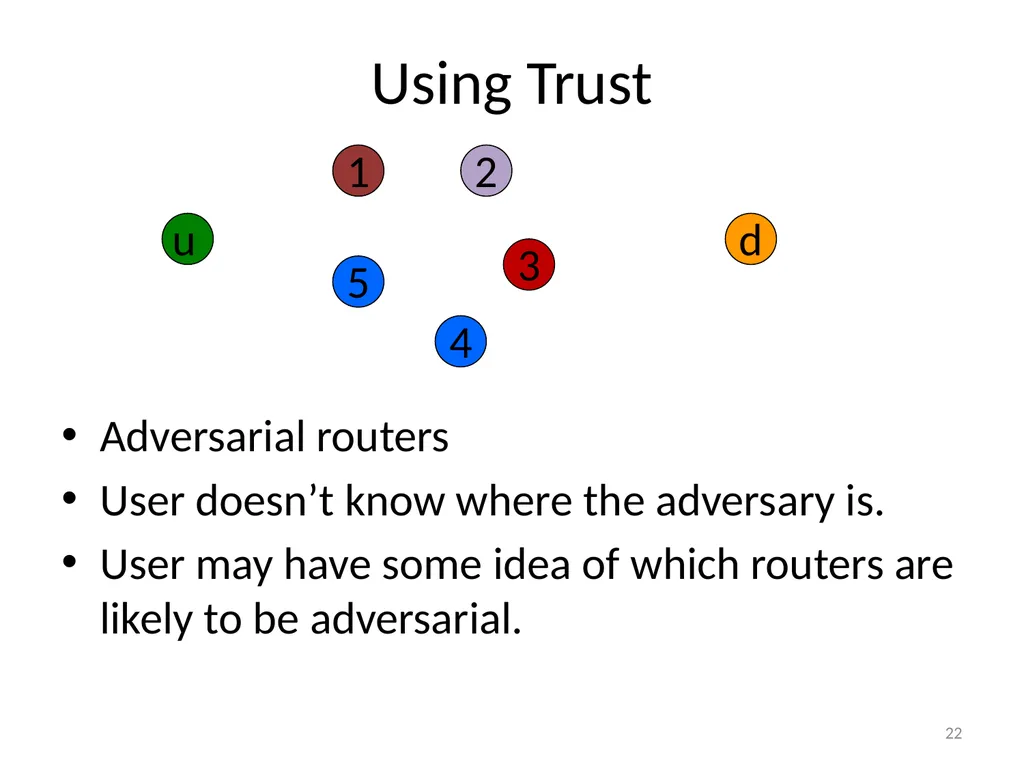
slide22. Using Trust 22 u 1 2 3 4 5 d Adversarial routers
User doesn’t know where the adversary is.
User may have some idea of which routers are likely to be adversarial.<br>
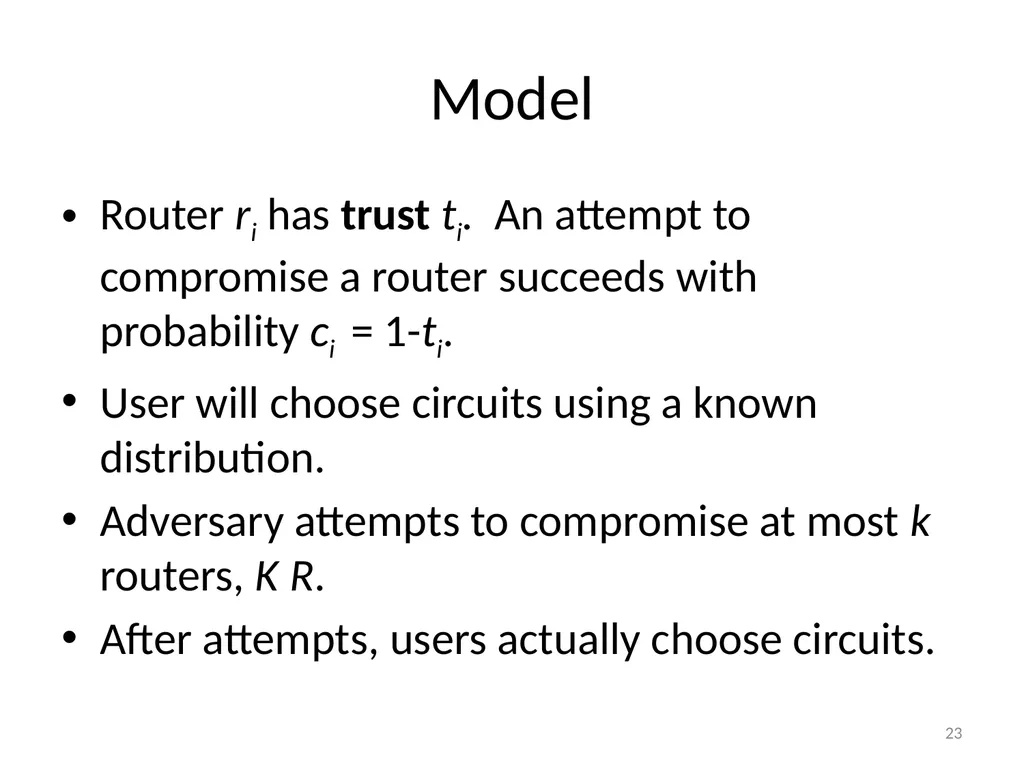
slide23. Model Router ri has trust ti. An attempt to compromise a router succeeds with probability ci = 1-ti.
User will choose circuits using a known distribution.
Adversary attempts to compromise at most k routers, KR.
After attempts, users actually choose circuits. 23<br>
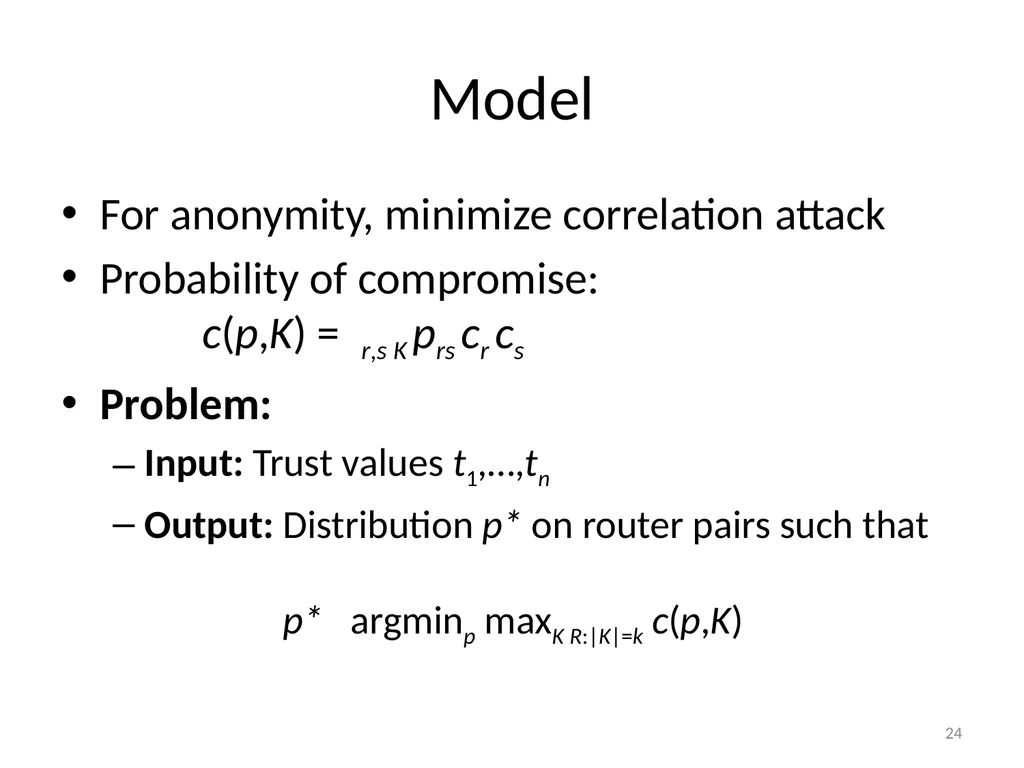
slide24. Model For anonymity, minimize correlation attack
Probability of compromise: c(p,K) = r,sK prs cr cs
Problem:
Input: Trust values t1,…,tn
Output: Distribution p* on router pairs such that p* argminp maxKR:|K|=k c(p,K) 24<br>
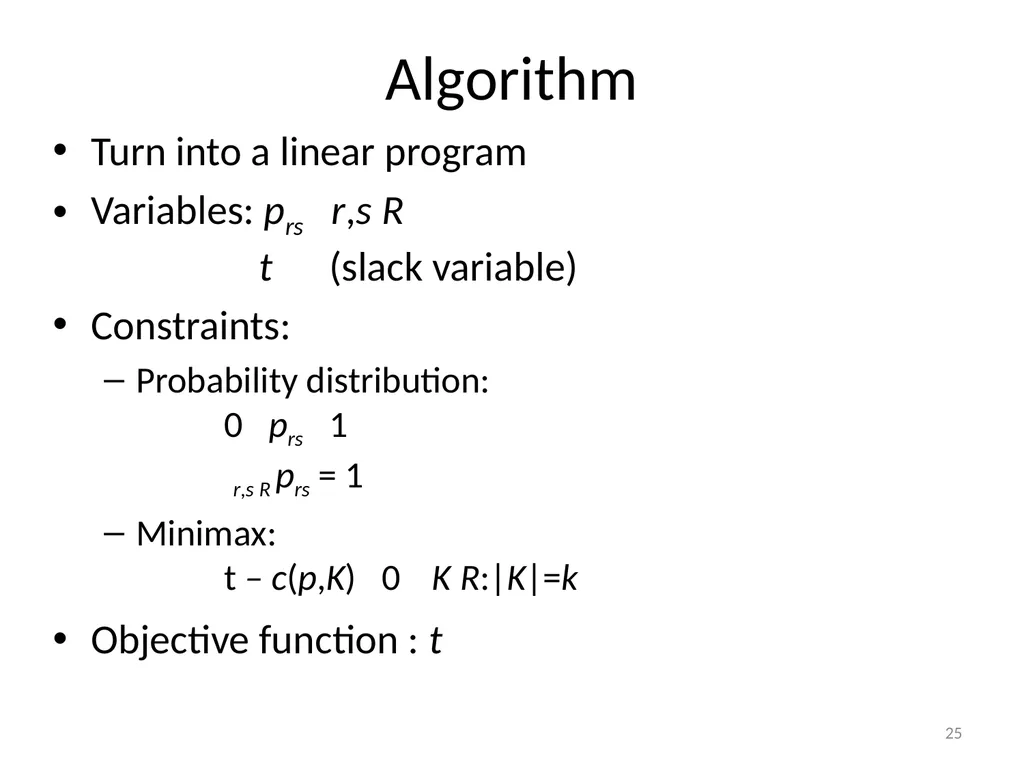
slide25. Algorithm Turn into a linear program
Variables: prs r,sR t (slack variable)
Constraints:
Probability distribution: 0 prs 1 r,sR prs = 1
Minimax: t – c(p,K) 0 KR:|K|=k
Objective function : t 25<br>
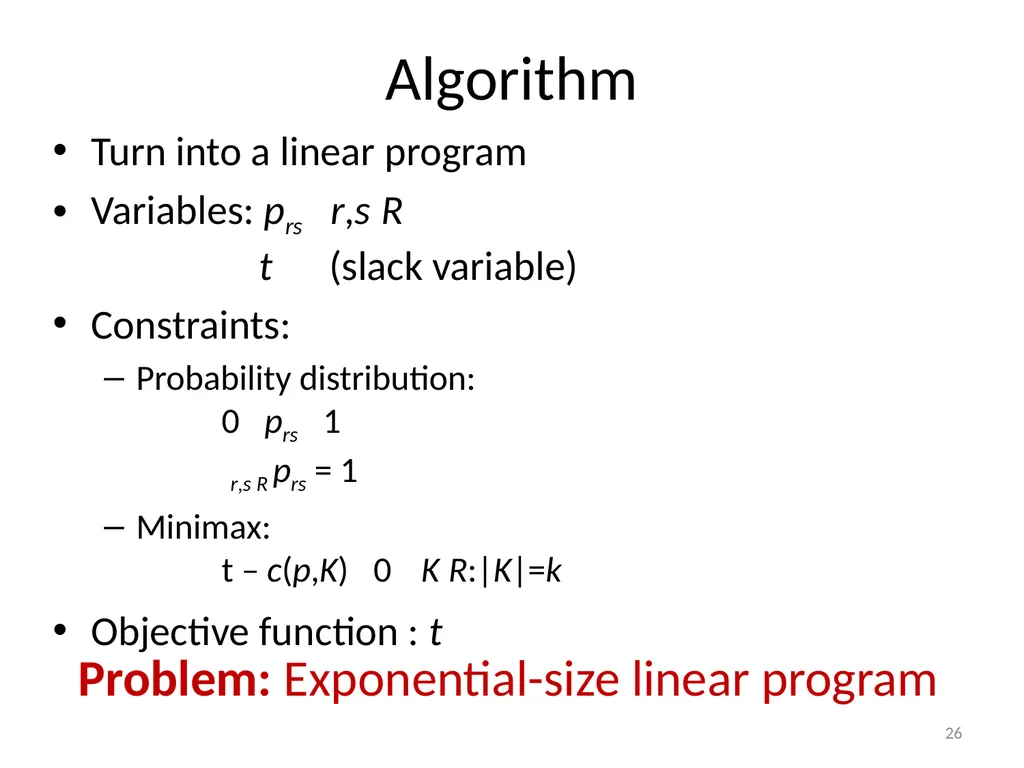
slide26. Algorithm Turn into a linear program
Variables: prs r,sR t (slack variable)
Constraints:
Probability distribution: 0 prs 1 r,sR prs = 1
Minimax: t – c(p,K) 0 KR:|K|=k
Objective function : t 26 Problem: Exponential-size linear program<br>
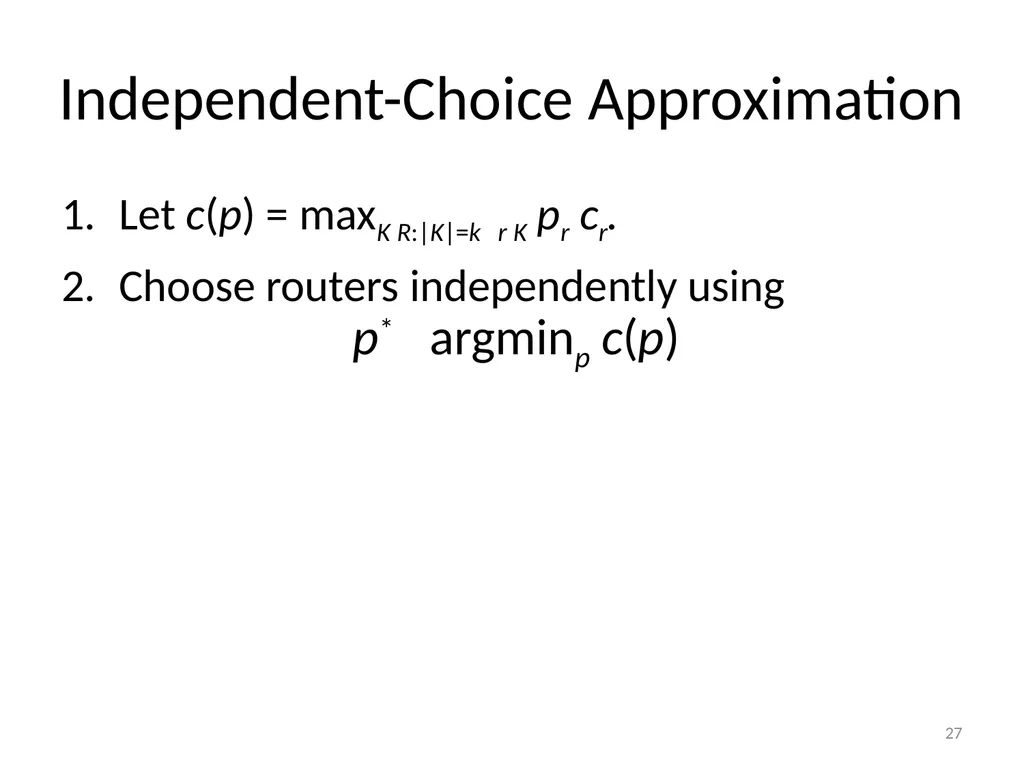
slide27. Independent-Choice Approximation Let c(p) = maxKR:|K|=k rK pr cr.
Choose routers independently using 27 p* argminp c(p)<br>
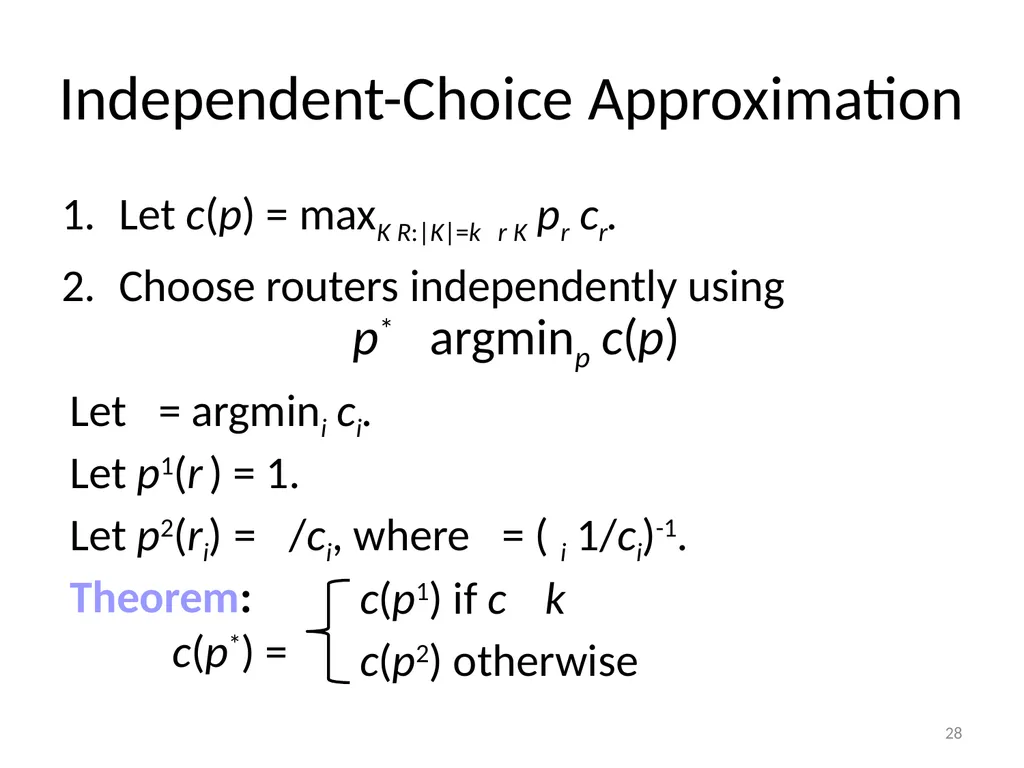
slide28. Independent-Choice Approximation Let c(p) = maxKR:|K|=k rK pr cr.
Choose routers independently using 28 p* argminp c(p) Let = argmini ci.
Let p1(r) = 1.
Let p2(ri)= /ci, where = (i 1/ci)-1.
Theorem:
c(p*) = c(p1) if c k
c(p2) otherwise<br>
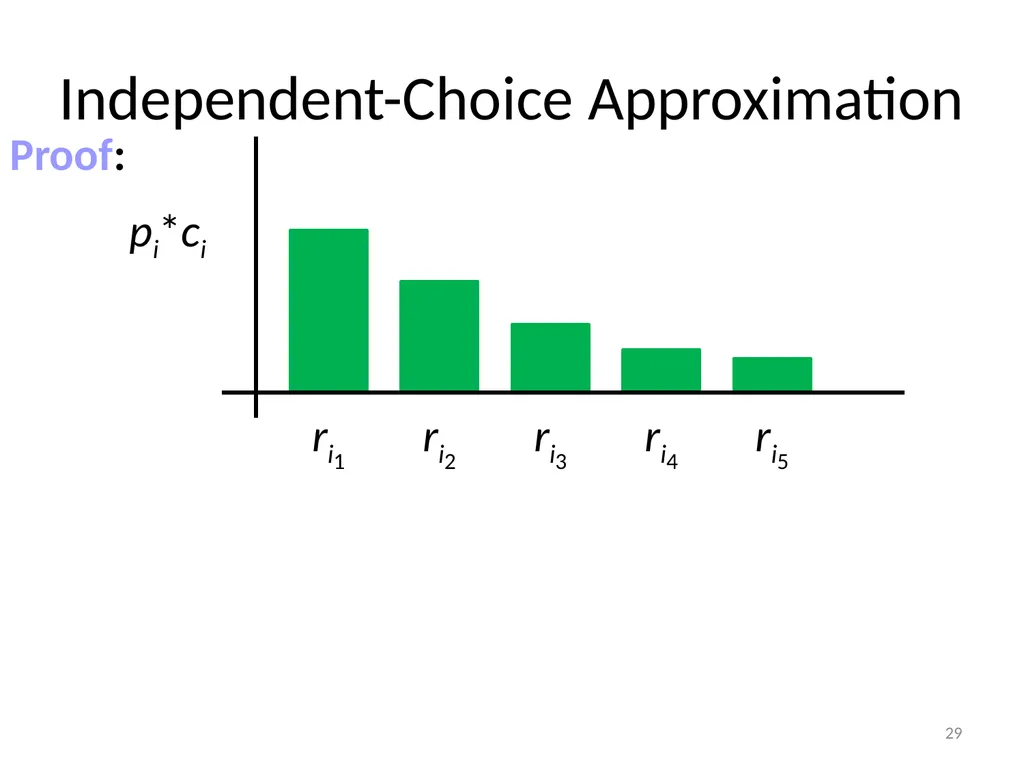
slide29. 29 pi*ci ri1 ri2 ri3 ri4 ri5 Proof: Independent-Choice Approximation<br>
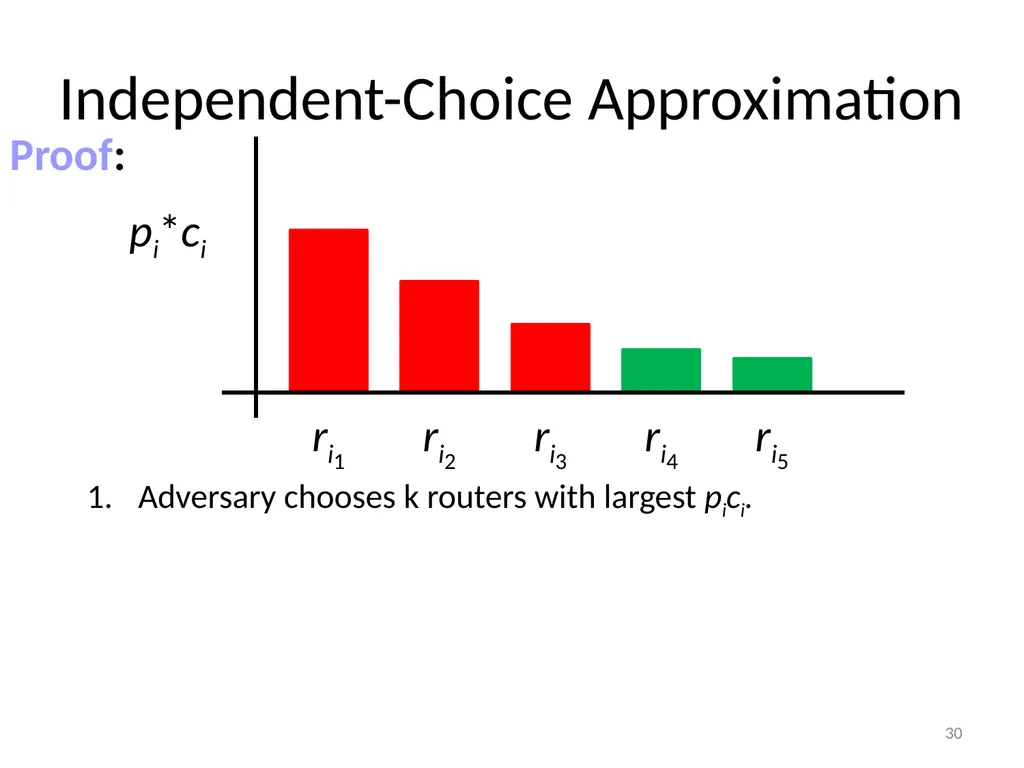
slide30. 30 ri1 ri2 ri3 ri4 ri5 Proof: Adversary chooses k routers with largest pici. pi*ci Independent-Choice Approximation<br>
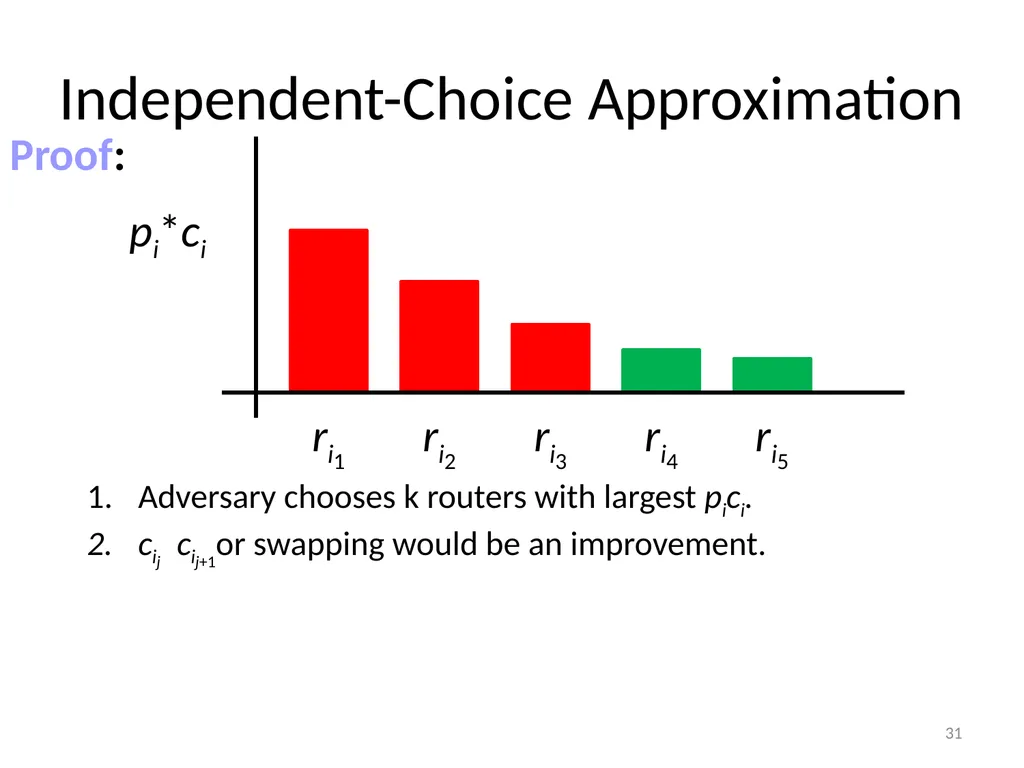
slide31. 31 ri1 ri2 ri3 ri4 ri5 Proof: Adversary chooses k routers with largest pici.
cij cij+1or swapping would be an improvement. pi*ci Independent-Choice Approximation<br>
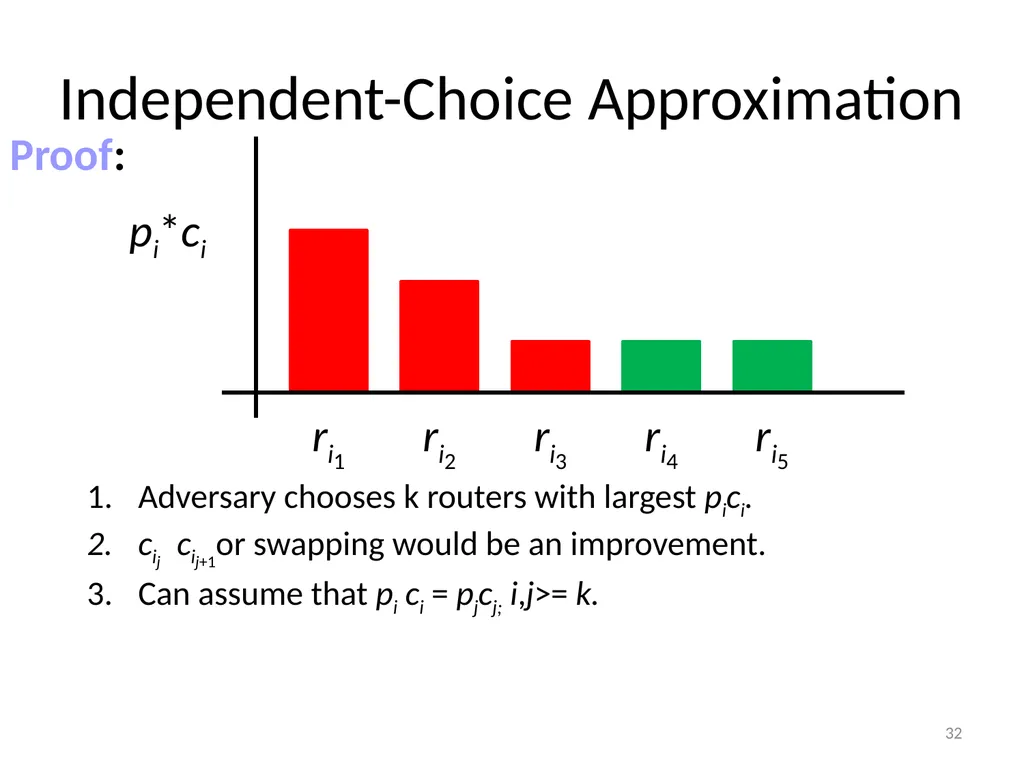
slide32. 32 ri1 ri2 ri3 ri4 ri5 Proof: Adversary chooses k routers with largest pici.
cij cij+1or swapping would be an improvement.
Can assume that pi ci = pjcj; i,j>= k. pi*ci Independent-Choice Approximation<br>
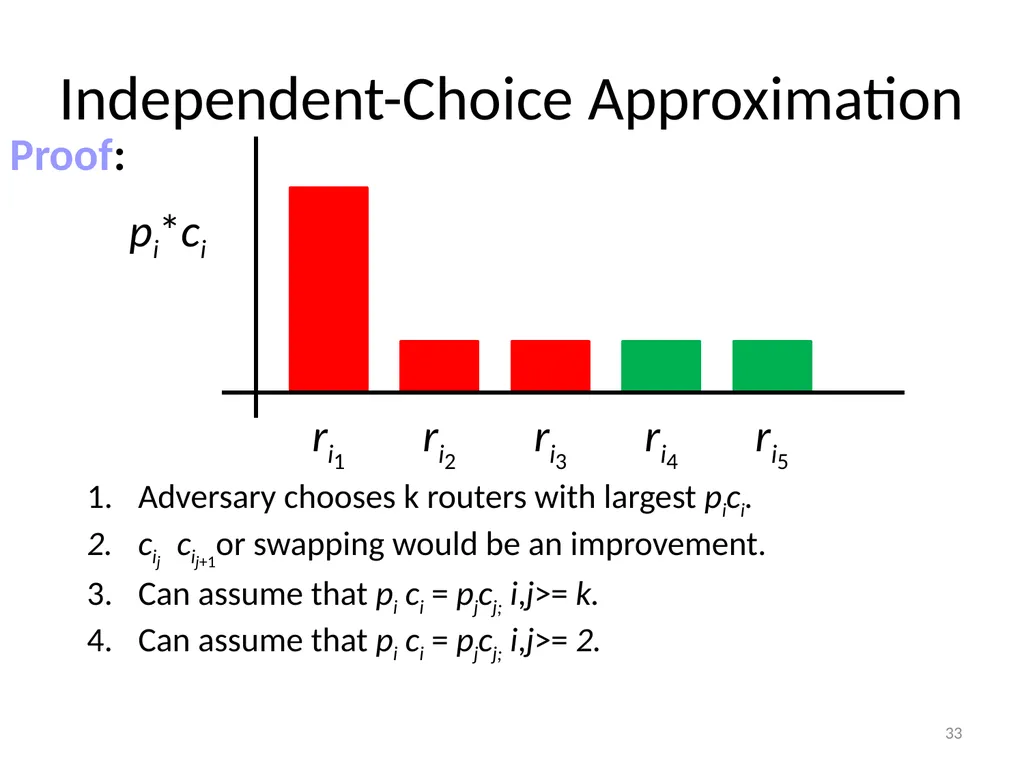
slide33. 33 ri1 ri2 ri3 ri4 ri5 Proof: Adversary chooses k routers with largest pici.
cij cij+1or swapping would be an improvement.
Can assume that pi ci = pjcj; i,j>= k.
Can assume that pi ci = pjcj; i,j>= 2. pi*ci Independent-Choice Approximation<br>
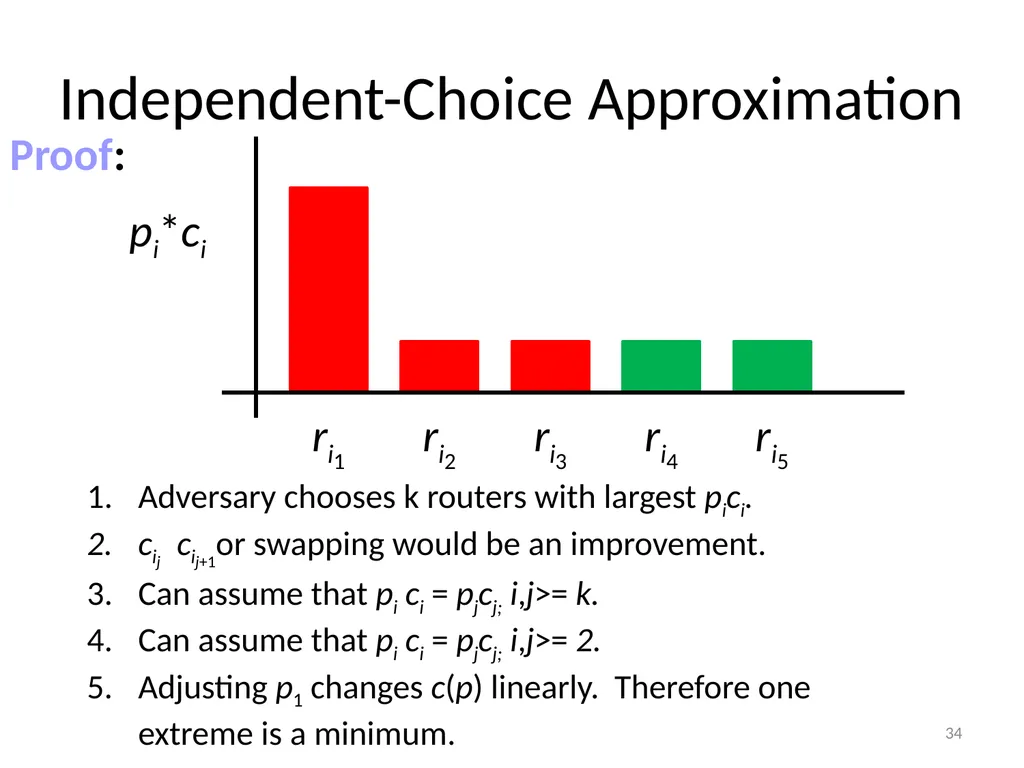
slide34. 34 ri1 ri2 ri3 ri4 ri5 Proof: Adversary chooses k routers with largest pici.
cij cij+1or swapping would be an improvement.
Can assume that pi ci = pjcj; i,j>= k.
Can assume that pi ci = pjcj; i,j>= 2.
Adjusting p1 changes c(p) linearly. Therefore one extreme is a minimum. pi*ci Independent-Choice Approximation<br>
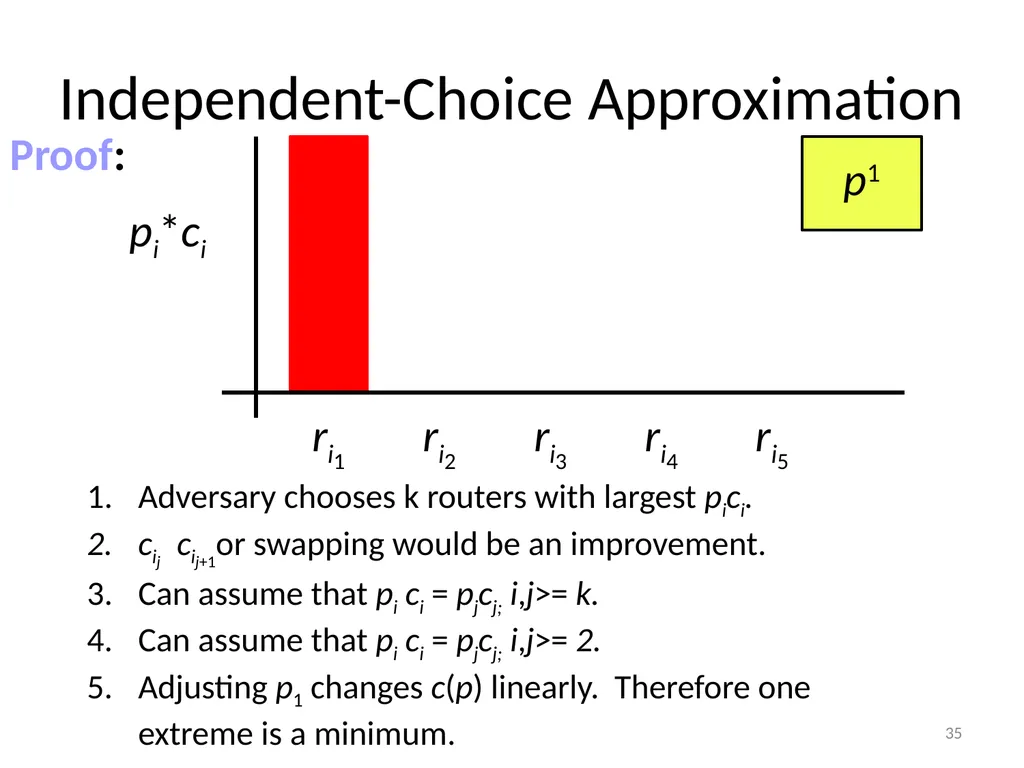
slide35. 35 ri1 ri2 ri3 ri4 ri5 Proof: Adversary chooses k routers with largest pici.
cij cij+1or swapping would be an improvement.
Can assume that pi ci = pjcj; i,j>= k.
Can assume that pi ci = pjcj; i,j>= 2.
Adjusting p1 changes c(p) linearly. Therefore one extreme is a minimum. p1 pi*ci Independent-Choice Approximation<br>
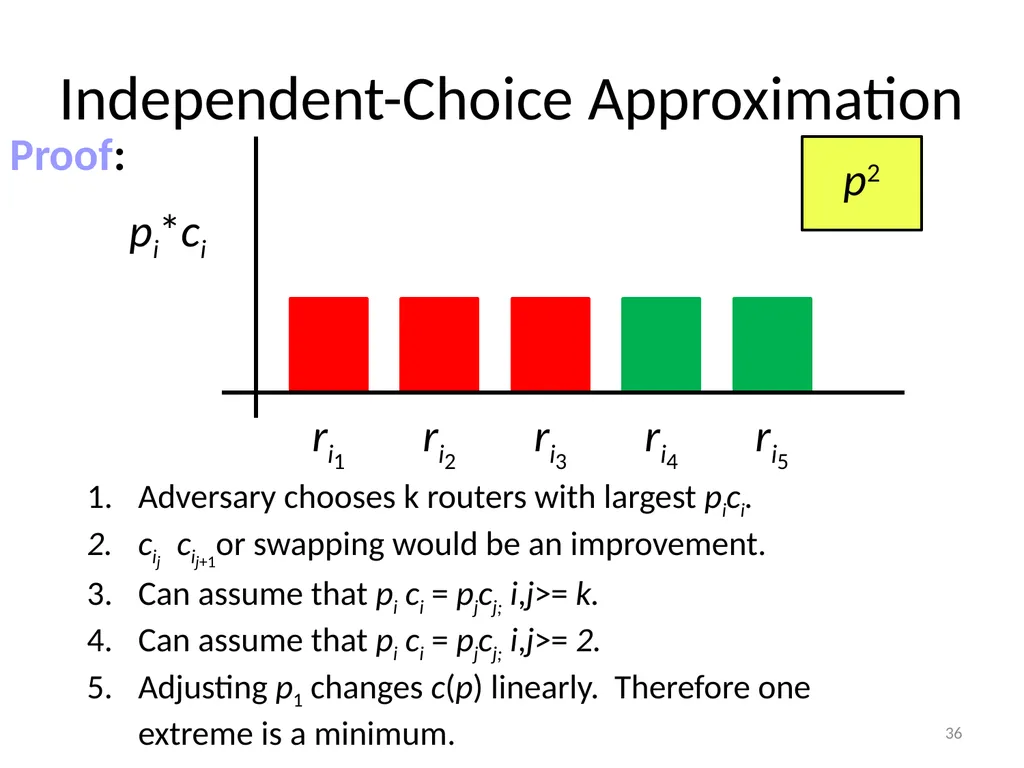
slide36. 36 ri1 ri2 ri3 ri4 ri5 Proof: Adversary chooses k routers with largest pici.
cij cij+1or swapping would be an improvement.
Can assume that pi ci = pjcj; i,j>= k.
Can assume that pi ci = pjcj; i,j>= 2.
Adjusting p1 changes c(p) linearly. Therefore one extreme is a minimum. p2 Independent-Choice Approximation pi*ci<br>
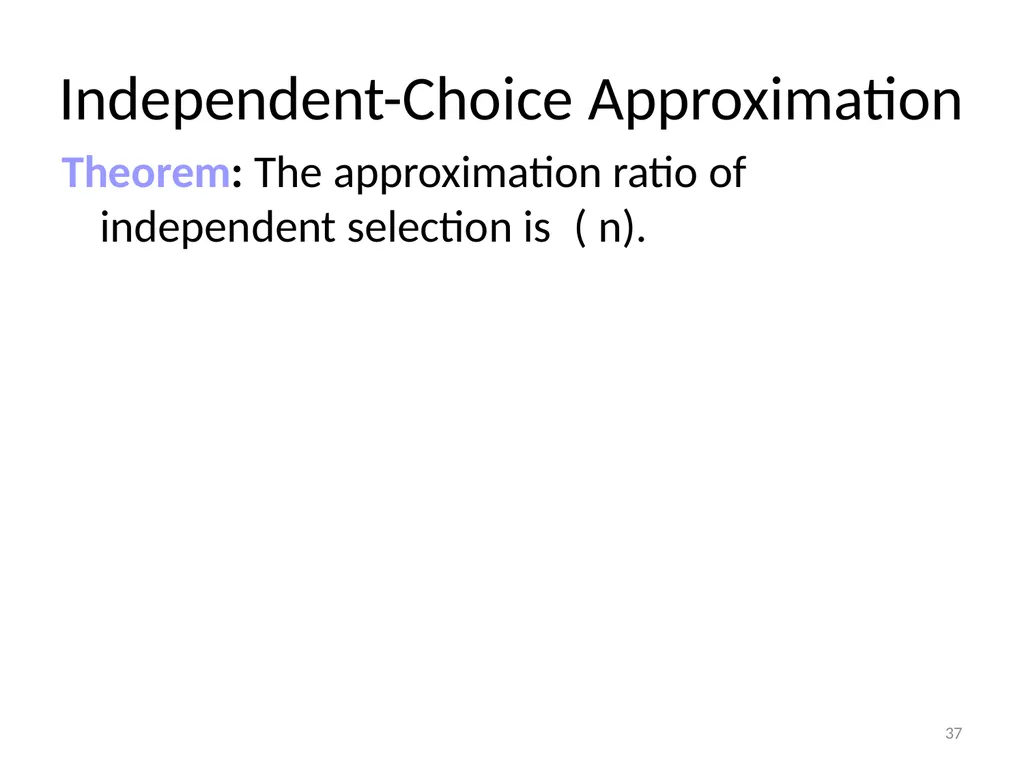
slide37. Theorem: The approximation ratio of independent selection is (n). 37 Independent-Choice Approximation<br>
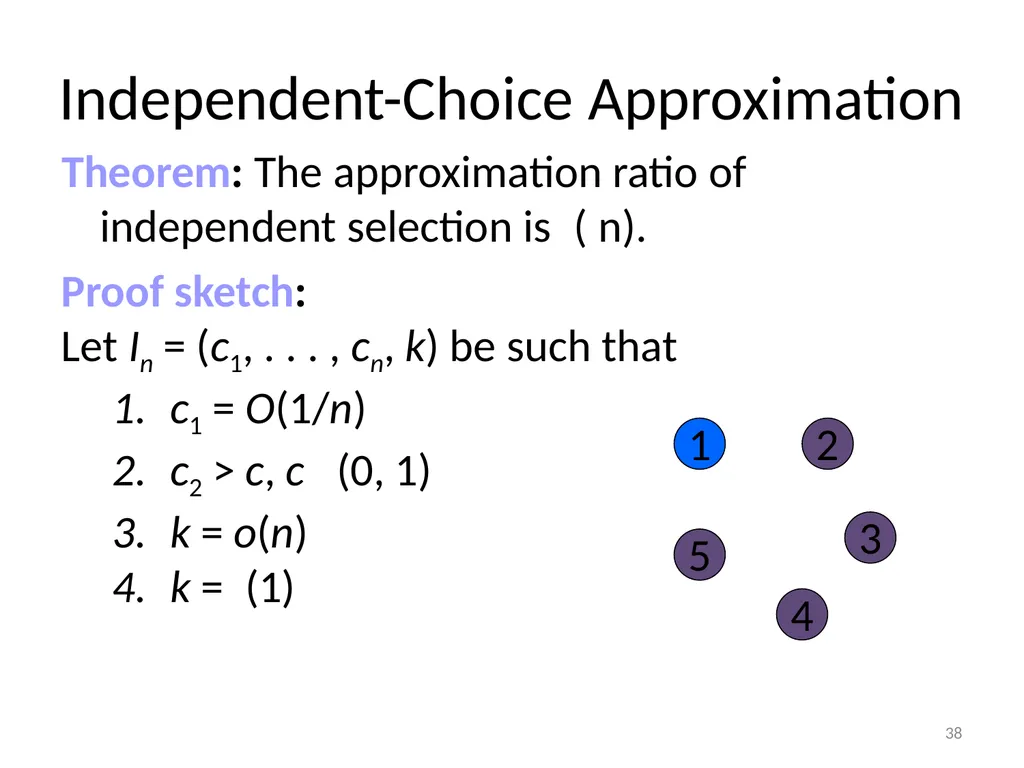
slide38. Theorem: The approximation ratio of independent selection is (n). 38 Proof sketch:
Let In = (c1, . . . , cn, k) be such that
c1 = O(1/n)
c2 > c, c (0, 1)
k = o(n)
k = (1) 1 2 3 4 5 Independent-Choice Approximation<br>
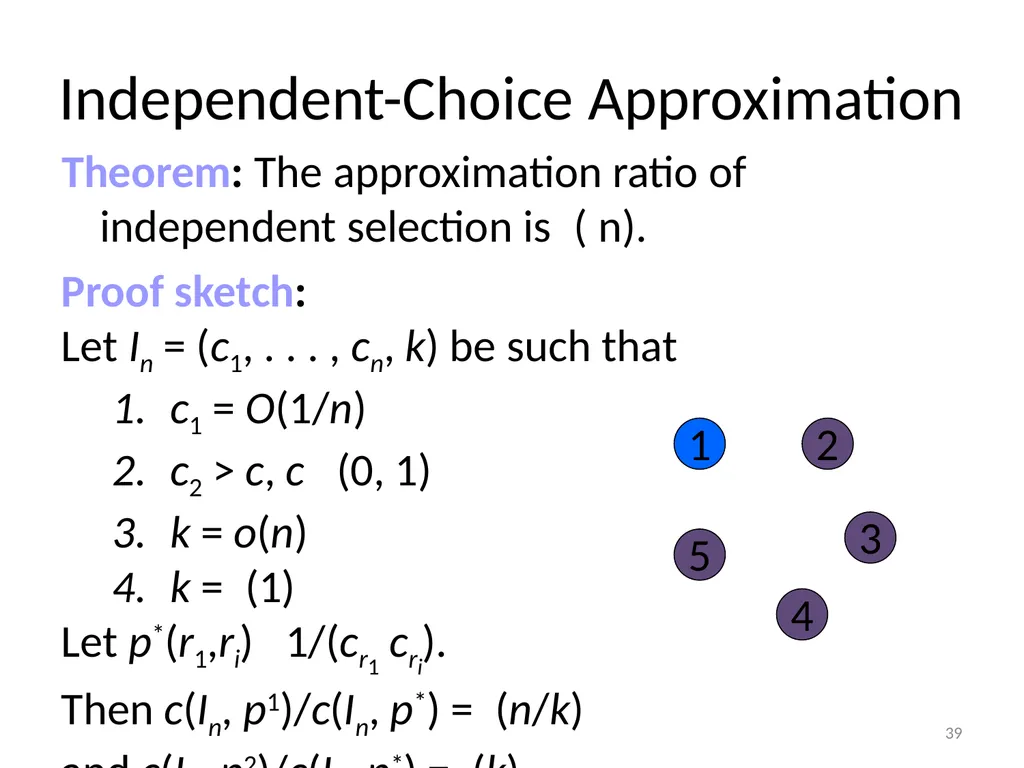
slide39. Theorem: The approximation ratio of independent selection is (n). 39 Proof sketch:
Let In = (c1, . . . , cn, k) be such that
c1 = O(1/n)
c2 > c, c (0, 1)
k = o(n)
k = (1)
Let p*(r1,ri) 1/(cr1 cri).
Then c(In, p1)/c(In, p*) = (n/k)
and c(In, p2)/c(In, p*) = (k). 1 2 3 4 5 Independent-Choice Approximation<br>
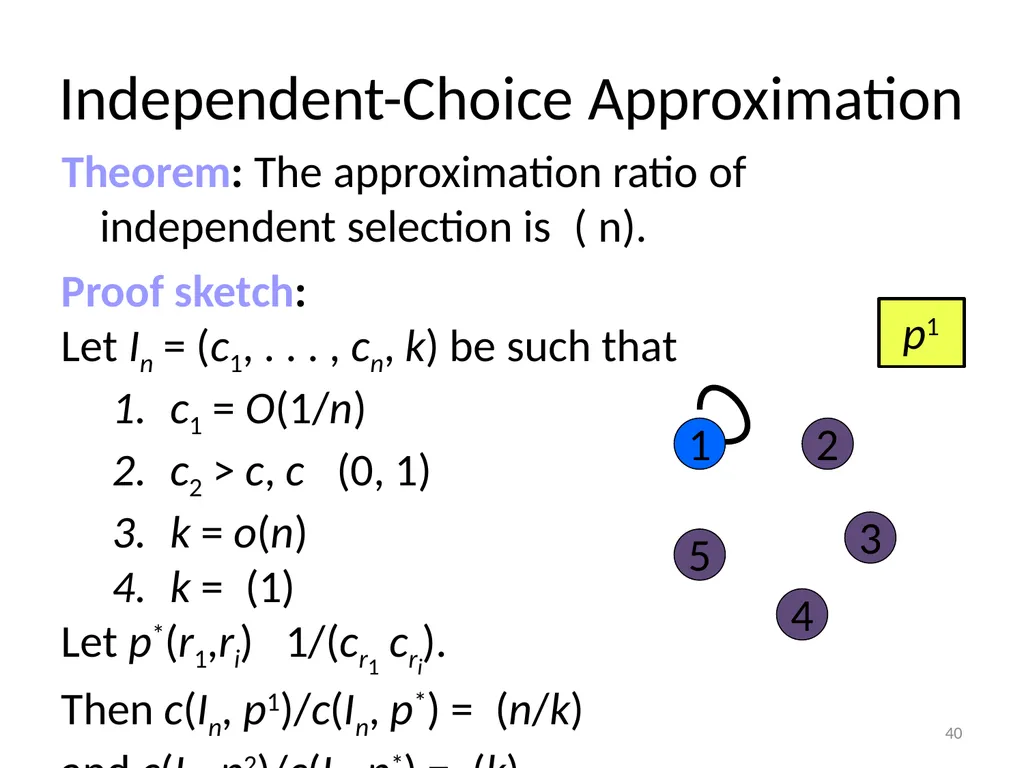
slide40. Theorem: The approximation ratio of independent selection is (n). 40 Proof sketch:
Let In = (c1, . . . , cn, k) be such that
c1 = O(1/n)
c2 > c, c (0, 1)
k = o(n)
k = (1)
Let p*(r1,ri) 1/(cr1 cri).
Then c(In, p1)/c(In, p*) = (n/k)
and c(In, p2)/c(In, p*) = (k). 1 2 3 4 5 p1 Independent-Choice Approximation<br>
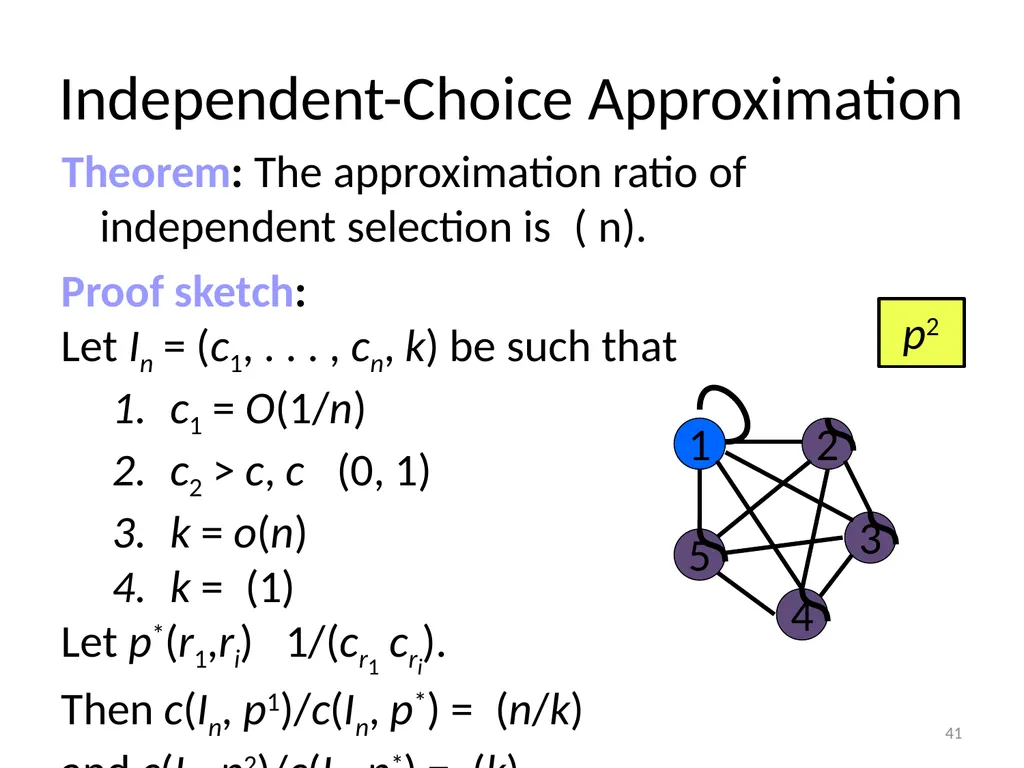
slide41. Theorem: The approximation ratio of independent selection is (n). 41 Proof sketch:
Let In = (c1, . . . , cn, k) be such that
c1 = O(1/n)
c2 > c, c (0, 1)
k = o(n)
k = (1)
Let p*(r1,ri) 1/(cr1 cri).
Then c(In, p1)/c(In, p*) = (n/k)
and c(In, p2)/c(In, p*) = (k). 1 2 3 4 5 p2 Independent-Choice Approximation<br>
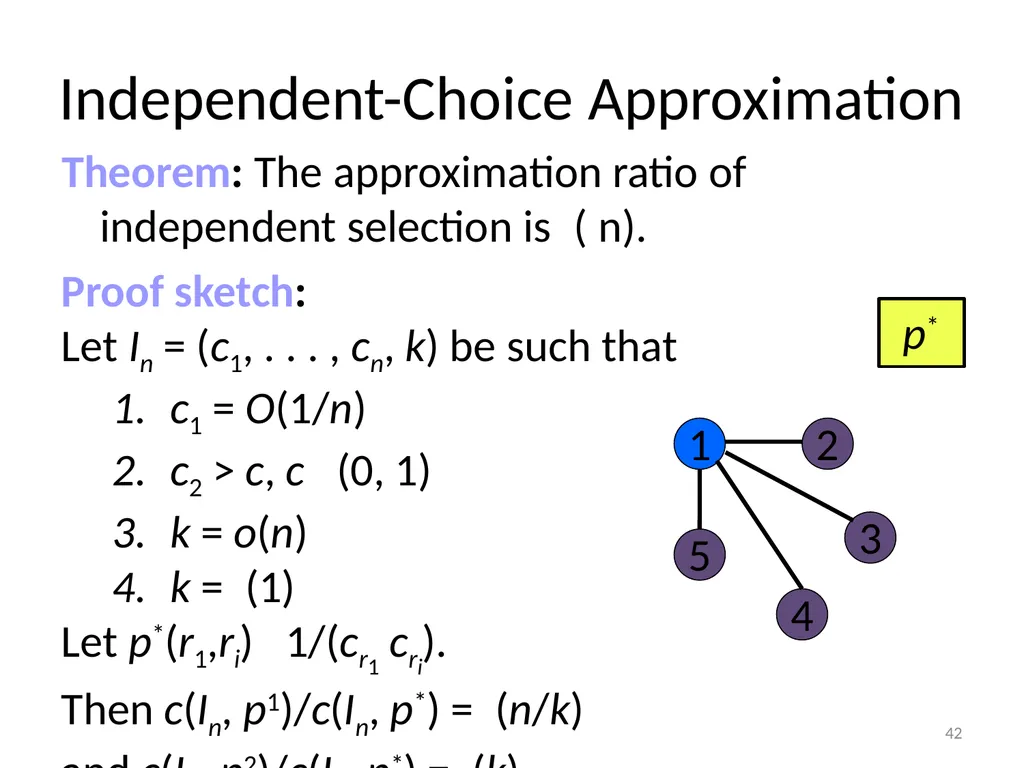
slide42. Theorem: The approximation ratio of independent selection is (n). 42 Proof sketch:
Let In = (c1, . . . , cn, k) be such that
c1 = O(1/n)
c2 > c, c (0, 1)
k = o(n)
k = (1)
Let p*(r1,ri) 1/(cr1 cri).
Then c(In, p1)/c(In, p*) = (n/k)
and c(In, p2)/c(In, p*) = (k). 1 2 3 4 5 p* Independent-Choice Approximation<br>
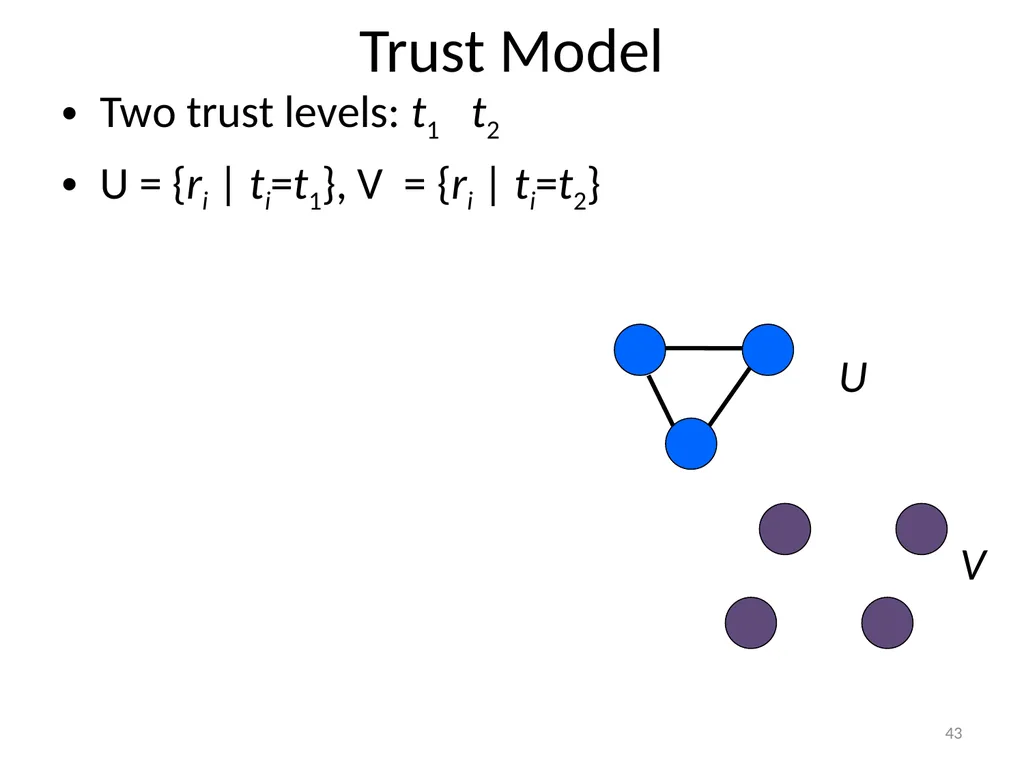
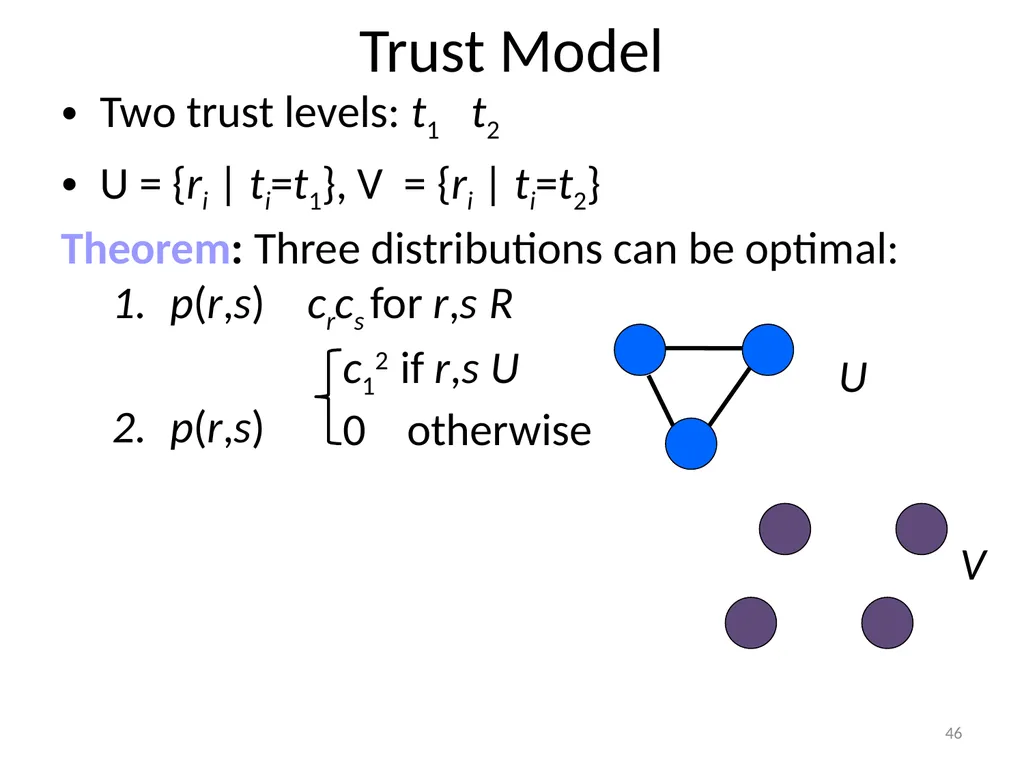
slide43. 43 U V Trust Model Two trust levels: t1 t2
U = {ri | ti=t1}, V = {ri | ti=t2}<br>
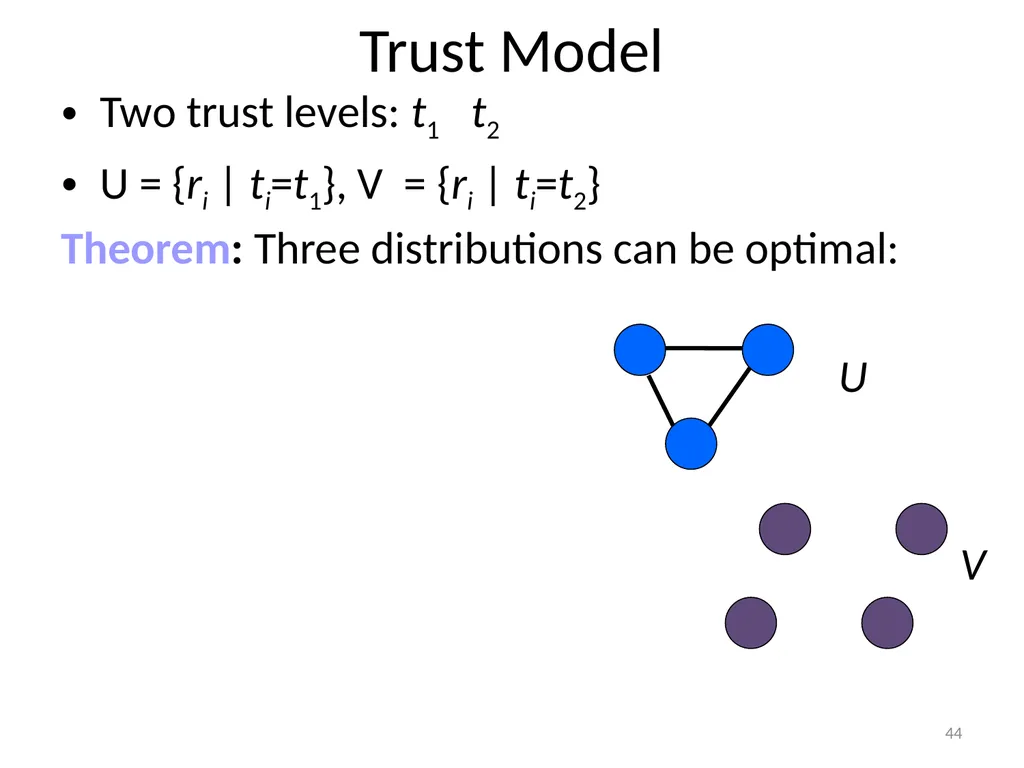
slide44. 44 U V Trust Model Two trust levels: t1 t2
U = {ri | ti=t1}, V = {ri | ti=t2} Theorem: Three distributions can be optimal:<br>
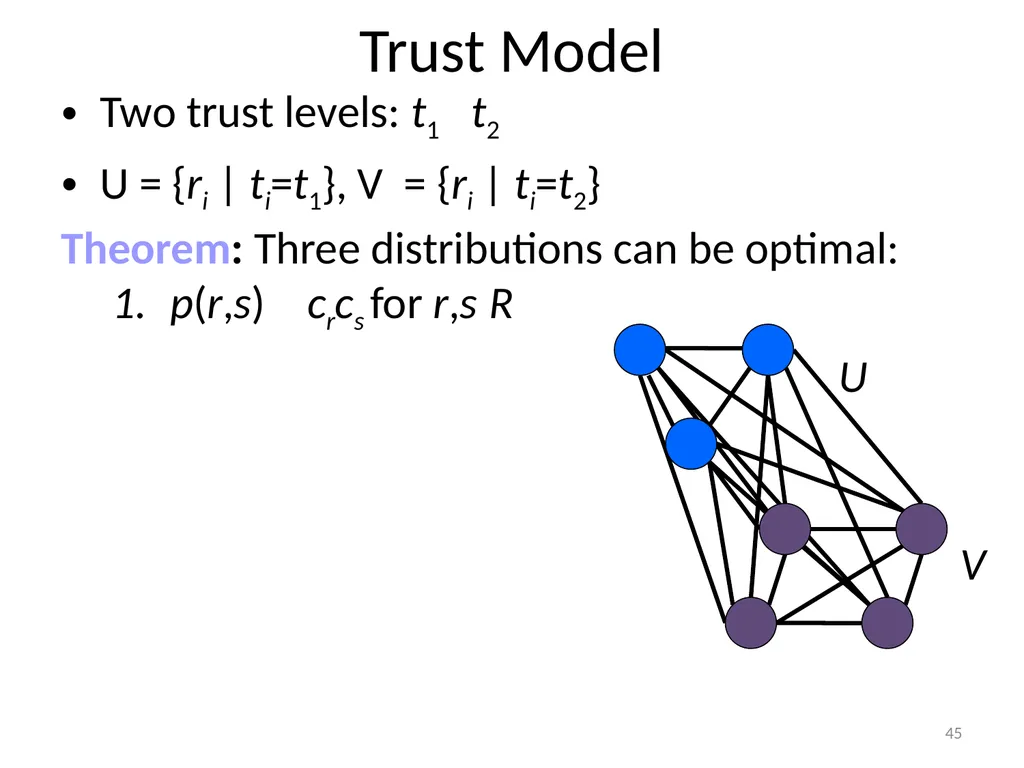
slide45. Trust Model Two trust levels: t1 t2
U = {ri | ti=t1}, V = {ri | ti=t2} 45 Theorem: Three distributions can be optimal:
p(r,s) crcs for r,sR U V<br>
slide46. Trust Model Two trust levels: t1 t2
U = {ri | ti=t1}, V = {ri | ti=t2} 46 Theorem: Three distributions can be optimal:
p(r,s) crcs for r,sR
p(r,s) c12 if r,sU
0 otherwise U V<br>
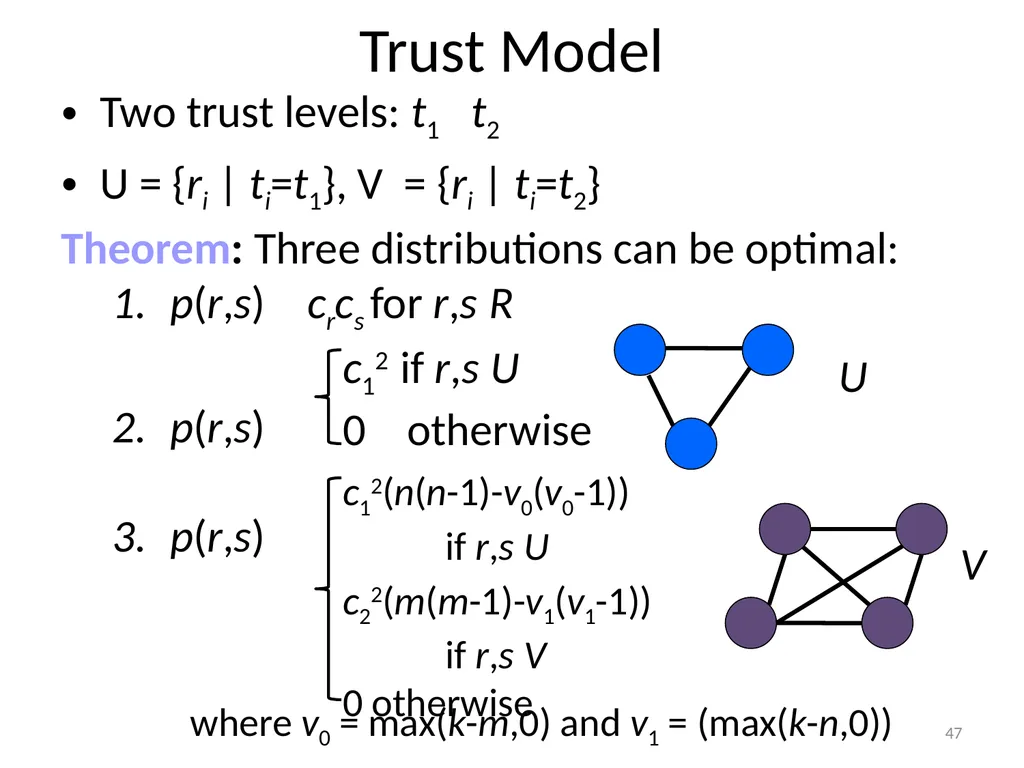
slide47. Trust Model Two trust levels: t1 t2
U = {ri | ti=t1}, V = {ri | ti=t2} 47 Theorem: Three distributions can be optimal:
p(r,s) crcs for r,sR
p(r,s)
p(r,s) c12 if r,sU
0 otherwise c12(n(n-1)-v0(v0-1)) if r,sU
c22(m(m-1)-v1(v1-1)) if r,sV
0 otherwise U V where v0 = max(k-m,0) and v1 = (max(k-n,0))<br>
slide48. Generalization and Other Applications Pick a subset of size j
Minimize the chance that all are compromised
Examples:
Heterogenous sensor networks
Distributed computation (e.g. SETI@home)
Data integrity in routing 48<br>
slide49. Future Work Generalization to other problems
Heterogeneous trust
Users choose paths differently
User profiling
Adversary may not know trust values
Roving adversary 49<br>
22nd IEEE Computer Security Foundations Symposium
July 2009 1<br>
slide2. How Onion Routing Works User u running client Internet destination d Routers running servers u d 1 2 3 4 5 2<br>
slide3. How Onion Routing Works u d u creates l-hop circuit through routers 1 2 3 4 5 3<br>
slide4. How Onion Routing Works u d u creates l-hop circuit through routers 1 2 3 4 5 4<br>
slide5. How Onion Routing Works u d u creates l-hop circuit through routers 1 2 3 4 5 5<br>
slide6. How Onion Routing Works u d u creates l-hop circuit through routers
u opens a stream in the circuit to d 1 2 3 4 5 6<br>
slide7. How Onion Routing Works u d u creates l-hop circuit through routers
u opens a stream in the circuit to d
Data is exchanged {{{m}3}4}1 1 2 3 4 5 7<br>
slide8. How Onion Routing Works u d u creates l-hop circuit through routers
u opens a stream in the circuit to d
Data is exchanged {{m}3}4 1 2 3 4 5 8<br>
slide9. How Onion Routing Works u d u creates l-hop circuit through routers
u opens a stream in the circuit to d
Data is exchanged {m}3 1 2 3 4 5 9<br>
slide10. How Onion Routing Works u d u creates l-hop circuit through routers
u opens a stream in the circuit to d
Data is exchanged m 1 2 3 4 5 10<br>
slide11. How Onion Routing Works u d u creates l-hop circuit through routers
u opens a stream in the circuit to d
Data is exchanged m’ 1 2 3 4 5 11<br>
slide12. How Onion Routing Works u d u creates l-hop circuit through routers
u opens a stream in the circuit to d
Data is exchanged {m’}3 1 2 3 4 5 12<br>
slide13. How Onion Routing Works u d u creates l-hop circuit through routers
u opens a stream in the circuit to d
Data is exchanged {{m’}3}4 1 2 3 4 5 13<br>
slide14. How Onion Routing Works u d u creates l-hop circuit through routers
u opens a stream in the circuit to d
Data is exchanged {{{m’}3}4}1 1 2 3 4 5 14<br>
slide15. Onion Routing Practical design with low latency and overhead
Open source implementation (http://www.torproject.org/)
Over 1500 volunteer routers
Estimated 200,000 users 15<br>
slide16. Adversary u 2 4 5 d v e f 16 1 3<br>
slide17. Adversary u 1 2 3 4 5 d v e f 17 Active & Local<br>
slide18. Adversary u 1 2 3 4 5 d v e f 18 Active & Local
Correlation attack<br>
slide19. Adversary u 1 2 3 4 5 d v e f 19 Active & Local
Correlation attack<br>
slide20. Using Trust Adversarial routers 20 u 1 2 3 4 5 d<br>
slide21. Using Trust 21 u 1 2 3 4 5 d Adversarial routers
User doesn’t know where the adversary is.<br>
slide22. Using Trust 22 u 1 2 3 4 5 d Adversarial routers
User doesn’t know where the adversary is.
User may have some idea of which routers are likely to be adversarial.<br>
slide23. Model Router ri has trust ti. An attempt to compromise a router succeeds with probability ci = 1-ti.
User will choose circuits using a known distribution.
Adversary attempts to compromise at most k routers, KR.
After attempts, users actually choose circuits. 23<br>
slide24. Model For anonymity, minimize correlation attack
Probability of compromise: c(p,K) = r,sK prs cr cs
Problem:
Input: Trust values t1,…,tn
Output: Distribution p* on router pairs such that p* argminp maxKR:|K|=k c(p,K) 24<br>
slide25. Algorithm Turn into a linear program
Variables: prs r,sR t (slack variable)
Constraints:
Probability distribution: 0 prs 1 r,sR prs = 1
Minimax: t – c(p,K) 0 KR:|K|=k
Objective function : t 25<br>
slide26. Algorithm Turn into a linear program
Variables: prs r,sR t (slack variable)
Constraints:
Probability distribution: 0 prs 1 r,sR prs = 1
Minimax: t – c(p,K) 0 KR:|K|=k
Objective function : t 26 Problem: Exponential-size linear program<br>
slide27. Independent-Choice Approximation Let c(p) = maxKR:|K|=k rK pr cr.
Choose routers independently using 27 p* argminp c(p)<br>
slide28. Independent-Choice Approximation Let c(p) = maxKR:|K|=k rK pr cr.
Choose routers independently using 28 p* argminp c(p) Let = argmini ci.
Let p1(r) = 1.
Let p2(ri)= /ci, where = (i 1/ci)-1.
Theorem:
c(p*) = c(p1) if c k
c(p2) otherwise<br>
slide29. 29 pi*ci ri1 ri2 ri3 ri4 ri5 Proof: Independent-Choice Approximation<br>
slide30. 30 ri1 ri2 ri3 ri4 ri5 Proof: Adversary chooses k routers with largest pici. pi*ci Independent-Choice Approximation<br>
slide31. 31 ri1 ri2 ri3 ri4 ri5 Proof: Adversary chooses k routers with largest pici.
cij cij+1or swapping would be an improvement. pi*ci Independent-Choice Approximation<br>
slide32. 32 ri1 ri2 ri3 ri4 ri5 Proof: Adversary chooses k routers with largest pici.
cij cij+1or swapping would be an improvement.
Can assume that pi ci = pjcj; i,j>= k. pi*ci Independent-Choice Approximation<br>
slide33. 33 ri1 ri2 ri3 ri4 ri5 Proof: Adversary chooses k routers with largest pici.
cij cij+1or swapping would be an improvement.
Can assume that pi ci = pjcj; i,j>= k.
Can assume that pi ci = pjcj; i,j>= 2. pi*ci Independent-Choice Approximation<br>
slide34. 34 ri1 ri2 ri3 ri4 ri5 Proof: Adversary chooses k routers with largest pici.
cij cij+1or swapping would be an improvement.
Can assume that pi ci = pjcj; i,j>= k.
Can assume that pi ci = pjcj; i,j>= 2.
Adjusting p1 changes c(p) linearly. Therefore one extreme is a minimum. pi*ci Independent-Choice Approximation<br>
slide35. 35 ri1 ri2 ri3 ri4 ri5 Proof: Adversary chooses k routers with largest pici.
cij cij+1or swapping would be an improvement.
Can assume that pi ci = pjcj; i,j>= k.
Can assume that pi ci = pjcj; i,j>= 2.
Adjusting p1 changes c(p) linearly. Therefore one extreme is a minimum. p1 pi*ci Independent-Choice Approximation<br>
slide36. 36 ri1 ri2 ri3 ri4 ri5 Proof: Adversary chooses k routers with largest pici.
cij cij+1or swapping would be an improvement.
Can assume that pi ci = pjcj; i,j>= k.
Can assume that pi ci = pjcj; i,j>= 2.
Adjusting p1 changes c(p) linearly. Therefore one extreme is a minimum. p2 Independent-Choice Approximation pi*ci<br>
slide37. Theorem: The approximation ratio of independent selection is (n). 37 Independent-Choice Approximation<br>
slide38. Theorem: The approximation ratio of independent selection is (n). 38 Proof sketch:
Let In = (c1, . . . , cn, k) be such that
c1 = O(1/n)
c2 > c, c (0, 1)
k = o(n)
k = (1) 1 2 3 4 5 Independent-Choice Approximation<br>
slide39. Theorem: The approximation ratio of independent selection is (n). 39 Proof sketch:
Let In = (c1, . . . , cn, k) be such that
c1 = O(1/n)
c2 > c, c (0, 1)
k = o(n)
k = (1)
Let p*(r1,ri) 1/(cr1 cri).
Then c(In, p1)/c(In, p*) = (n/k)
and c(In, p2)/c(In, p*) = (k). 1 2 3 4 5 Independent-Choice Approximation<br>
slide40. Theorem: The approximation ratio of independent selection is (n). 40 Proof sketch:
Let In = (c1, . . . , cn, k) be such that
c1 = O(1/n)
c2 > c, c (0, 1)
k = o(n)
k = (1)
Let p*(r1,ri) 1/(cr1 cri).
Then c(In, p1)/c(In, p*) = (n/k)
and c(In, p2)/c(In, p*) = (k). 1 2 3 4 5 p1 Independent-Choice Approximation<br>
slide41. Theorem: The approximation ratio of independent selection is (n). 41 Proof sketch:
Let In = (c1, . . . , cn, k) be such that
c1 = O(1/n)
c2 > c, c (0, 1)
k = o(n)
k = (1)
Let p*(r1,ri) 1/(cr1 cri).
Then c(In, p1)/c(In, p*) = (n/k)
and c(In, p2)/c(In, p*) = (k). 1 2 3 4 5 p2 Independent-Choice Approximation<br>
slide42. Theorem: The approximation ratio of independent selection is (n). 42 Proof sketch:
Let In = (c1, . . . , cn, k) be such that
c1 = O(1/n)
c2 > c, c (0, 1)
k = o(n)
k = (1)
Let p*(r1,ri) 1/(cr1 cri).
Then c(In, p1)/c(In, p*) = (n/k)
and c(In, p2)/c(In, p*) = (k). 1 2 3 4 5 p* Independent-Choice Approximation<br>
slide43. 43 U V Trust Model Two trust levels: t1 t2
U = {ri | ti=t1}, V = {ri | ti=t2}<br>
slide44. 44 U V Trust Model Two trust levels: t1 t2
U = {ri | ti=t1}, V = {ri | ti=t2} Theorem: Three distributions can be optimal:<br>
slide45. Trust Model Two trust levels: t1 t2
U = {ri | ti=t1}, V = {ri | ti=t2} 45 Theorem: Three distributions can be optimal:
p(r,s) crcs for r,sR U V<br>
slide46. Trust Model Two trust levels: t1 t2
U = {ri | ti=t1}, V = {ri | ti=t2} 46 Theorem: Three distributions can be optimal:
p(r,s) crcs for r,sR
p(r,s) c12 if r,sU
0 otherwise U V<br>
slide47. Trust Model Two trust levels: t1 t2
U = {ri | ti=t1}, V = {ri | ti=t2} 47 Theorem: Three distributions can be optimal:
p(r,s) crcs for r,sR
p(r,s)
p(r,s) c12 if r,sU
0 otherwise c12(n(n-1)-v0(v0-1)) if r,sU
c22(m(m-1)-v1(v1-1)) if r,sV
0 otherwise U V where v0 = max(k-m,0) and v1 = (max(k-n,0))<br>
slide48. Generalization and Other Applications Pick a subset of size j
Minimize the chance that all are compromised
Examples:
Heterogenous sensor networks
Distributed computation (e.g. SETI@home)
Data integrity in routing 48<br>
slide49. Future Work Generalization to other problems
Heterogeneous trust
Users choose paths differently
User profiling
Adversary may not know trust values
Roving adversary 49<br>