Mortgages, Privacy, and Deidentified Data Professor Peter Swire Ohio State University Center for American Progress Consumer Financial Protection Bureau Conference on New Research on Sustainable Mortgages Access to Credit October 6,
"“Mortgages, Privacy, and Deidentified Data”" is the property of its rightful owner. Permission is granted to
download and print the materials on this website for personal, non-commercial use only, and to display it
on your personal computer provided you do not modify the materials and that you retain all copyright
notices contained in the materials. By downloading content from our website, you accept the terms of this
agreement.
Presentation Transcript
01
“Mortgages, Privacy, and Deidentified Data” Professor Peter Swire
Ohio State University
Center for American Progress
Consumer Financial Protection Bureau Conference on “New Research on Sustainable Mortgages & Access to Credit”
October 6, 2011<br>
02
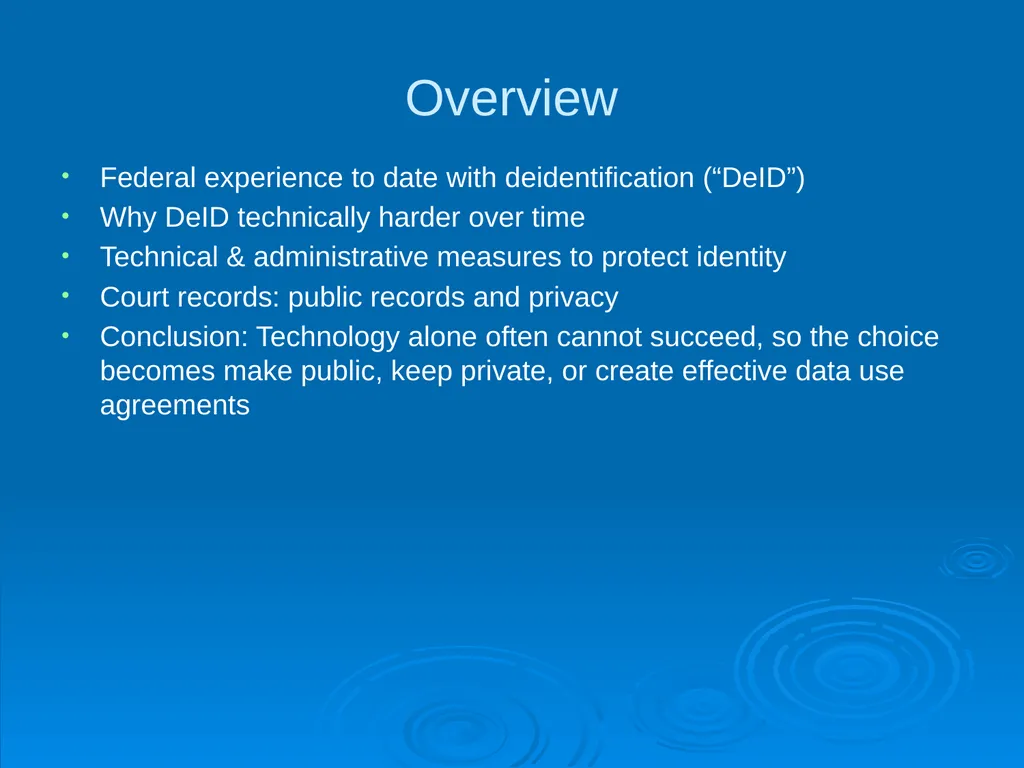
Overview Federal experience to date with deidentification (“DeID”)
Why DeID technically harder over time
Technical & administrative measures to protect identity
Court records: public records and privacy
Conclusion: Technology alone often cannot succeed, so the choice becomes make public, keep private, or create effective data use agreements<br>
03
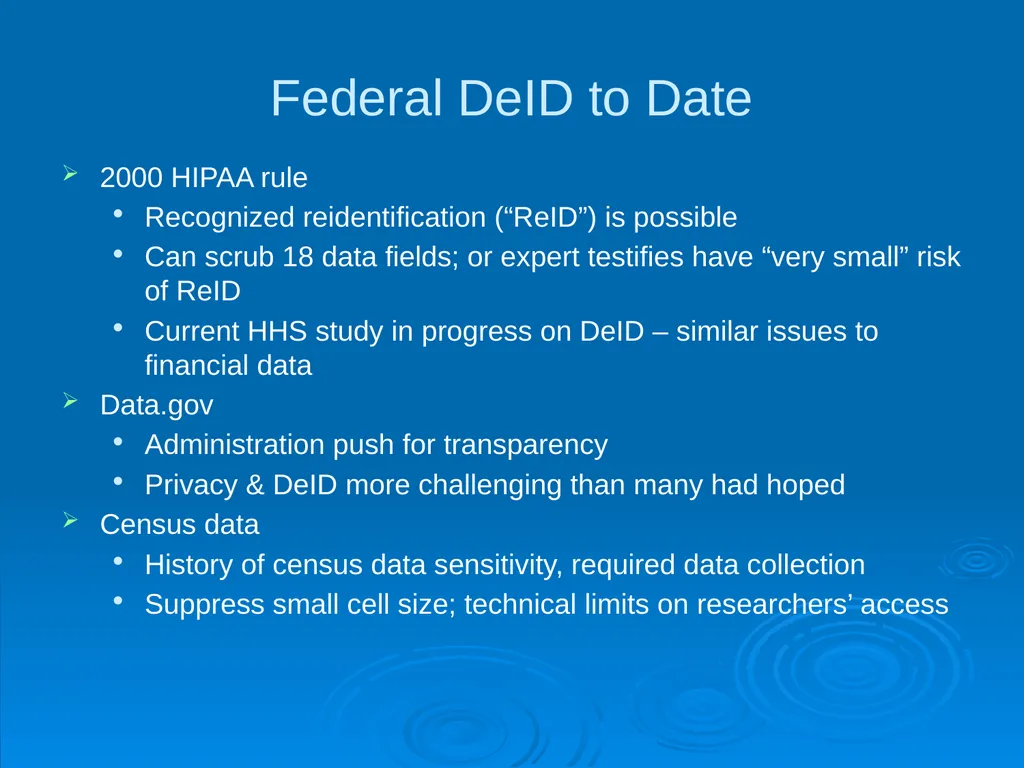
Federal DeID to Date 2000 HIPAA rule
Recognized reidentification (“ReID”) is possible
Can scrub 18 data fields; or expert testifies have “very small” risk of ReID
Current HHS study in progress on DeID – similar issues to financial data
Data.gov
Administration push for transparency
Privacy & DeID more challenging than many had hoped
Census data
History of census data sensitivity, required data collection
Suppress small cell size; technical limits on researchers’ access<br>
04
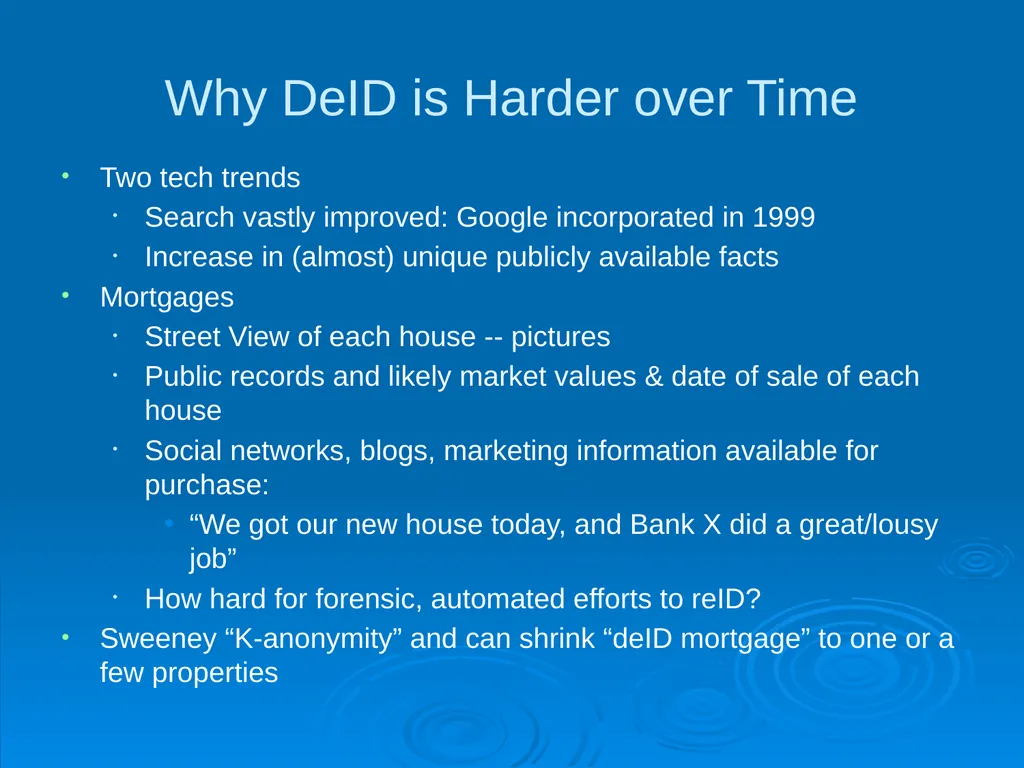
Why DeID is Harder over Time Two tech trends
Search vastly improved: Google incorporated in 1999
Increase in (almost) unique publicly available facts
Mortgages
Street View of each house -- pictures
Public records and likely market values & date of sale of each house
Social networks, blogs, marketing information available for purchase:
“We got our new house today, and Bank X did a great/lousy job”
How hard for forensic, automated efforts to reID?
Sweeney “K-anonymity” and can shrink “deID mortgage” to one or a few properties<br>
05
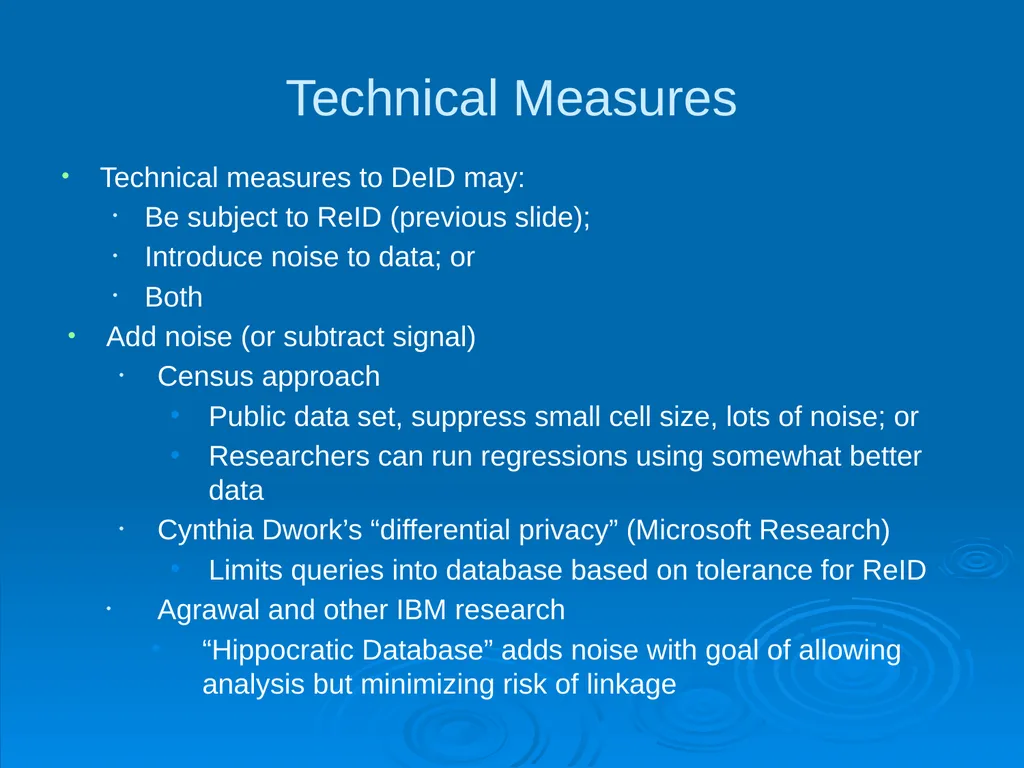
Technical Measures Technical measures to DeID may:
Be subject to ReID (previous slide);
Introduce noise to data; or
Both
Add noise (or subtract signal)
Census approach
Public data set, suppress small cell size, lots of noise; or
Researchers can run regressions using somewhat better data
Cynthia Dwork’s “differential privacy” (Microsoft Research)
Limits queries into database based on tolerance for ReID
Agrawal and other IBM research
“Hippocratic Database” adds noise with goal of allowing analysis but minimizing risk of linkage<br>
06
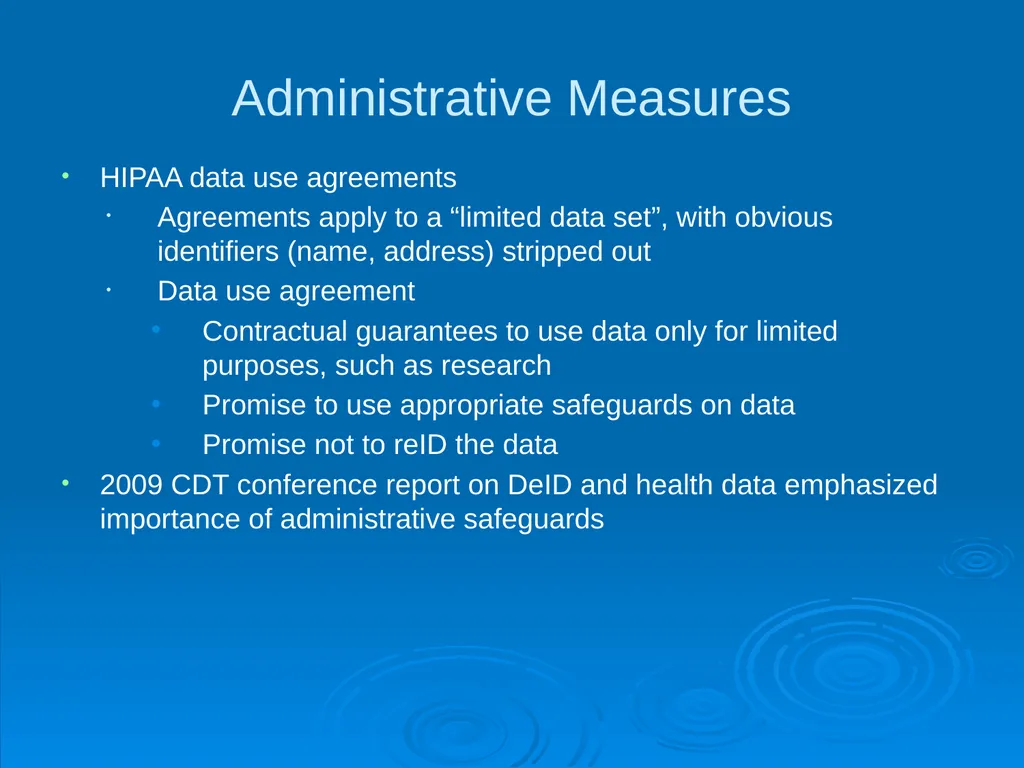
Administrative Measures HIPAA data use agreements
Agreements apply to a “limited data set”, with obvious identifiers (name, address) stripped out
Data use agreement
Contractual guarantees to use data only for limited purposes, such as research
Promise to use appropriate safeguards on data
Promise not to reID the data
2009 CDT conference report on DeID and health data emphasized importance of administrative safeguards<br>
07
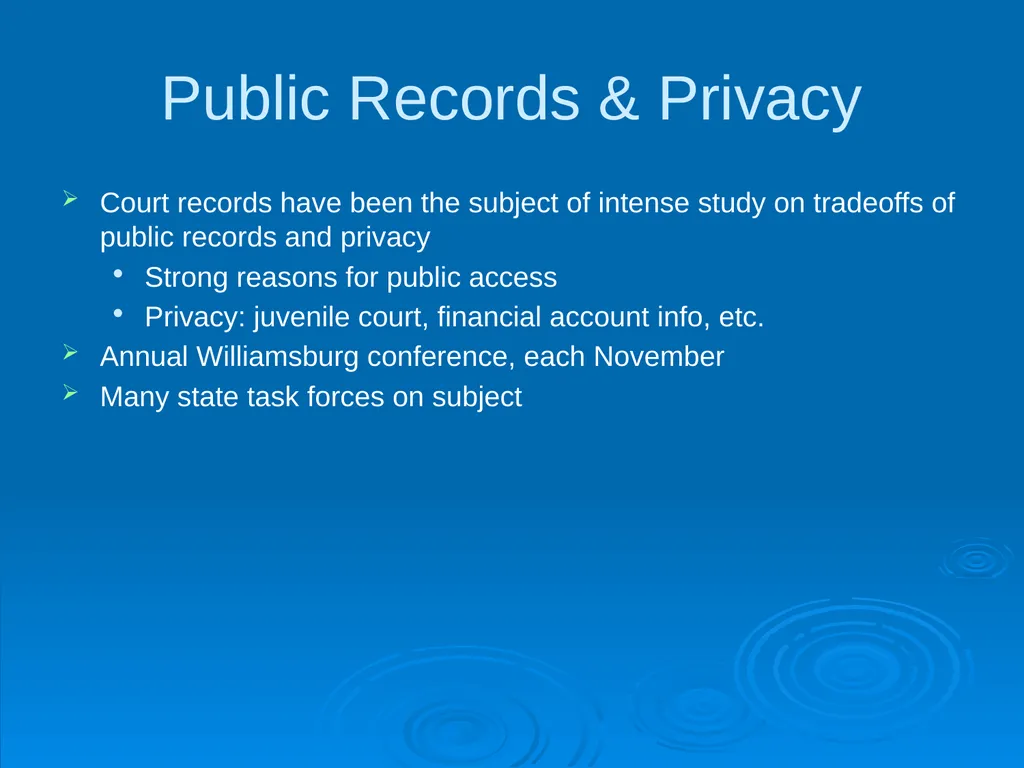
Public Records & Privacy Court records have been the subject of intense study on tradeoffs of public records and privacy
Strong reasons for public access
Privacy: juvenile court, financial account info, etc.
Annual Williamsburg conference, each November
Many state task forces on subject<br>
08
Conclusion Some records are or should be public
Some records are or should be private
Ability to ReID is large and growing
Technical measures to mask exist but are limited in applicability
Administrative measures often essential for researchers to get meaningful results
Technology alone often cannot succeed, so the choice becomes make public, keep private, or create effective data use agreements<br>