04
Mosquito morphology<br>
05
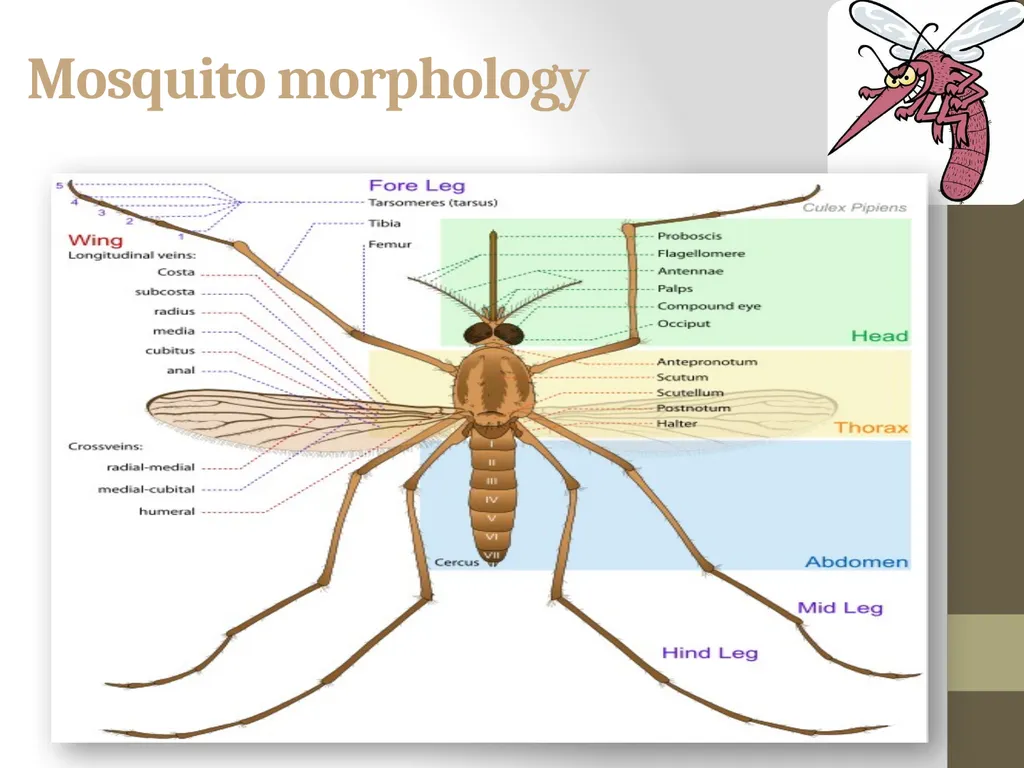
Mosquito morphology Body is small, fragile, 3-6mm long.
A slightly shorter spread of its narrow wings.
Its body, like that of other insects, consists of head, thorax, and abdomen.
The round head has a long proboscis (tubular mouth part) and antennae.<br>
06
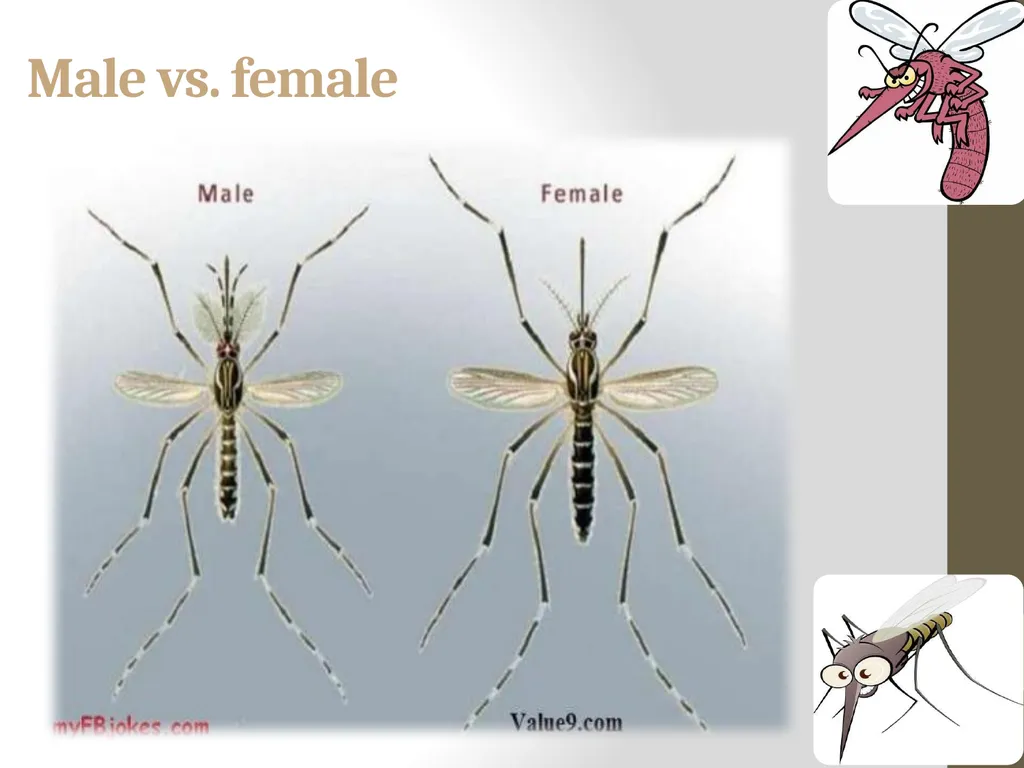
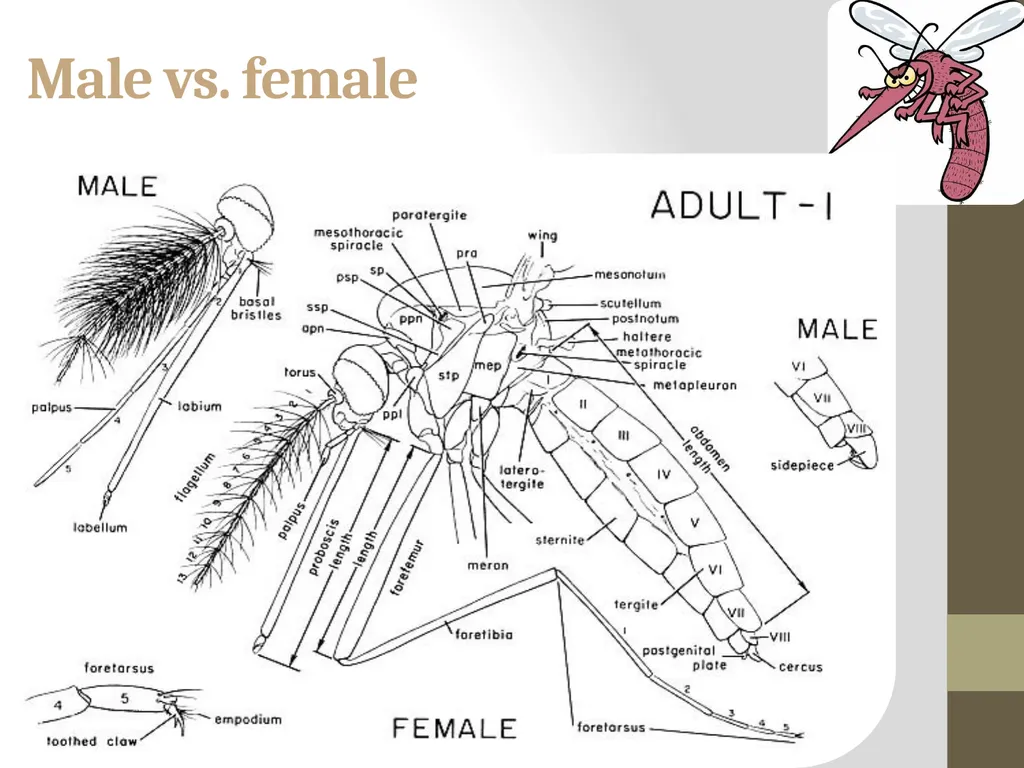
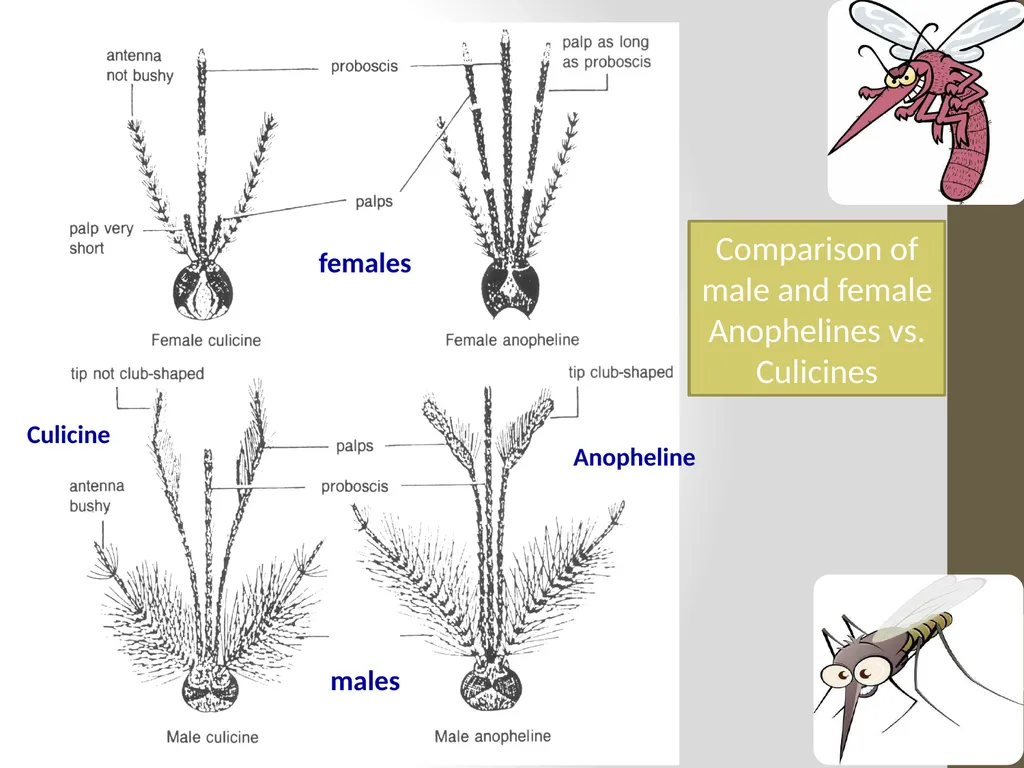
Mosquito morphology In the male, long hairs on the antennae give these appendages a feathery appearance.
Hairs on the antennae of the female are shorter.
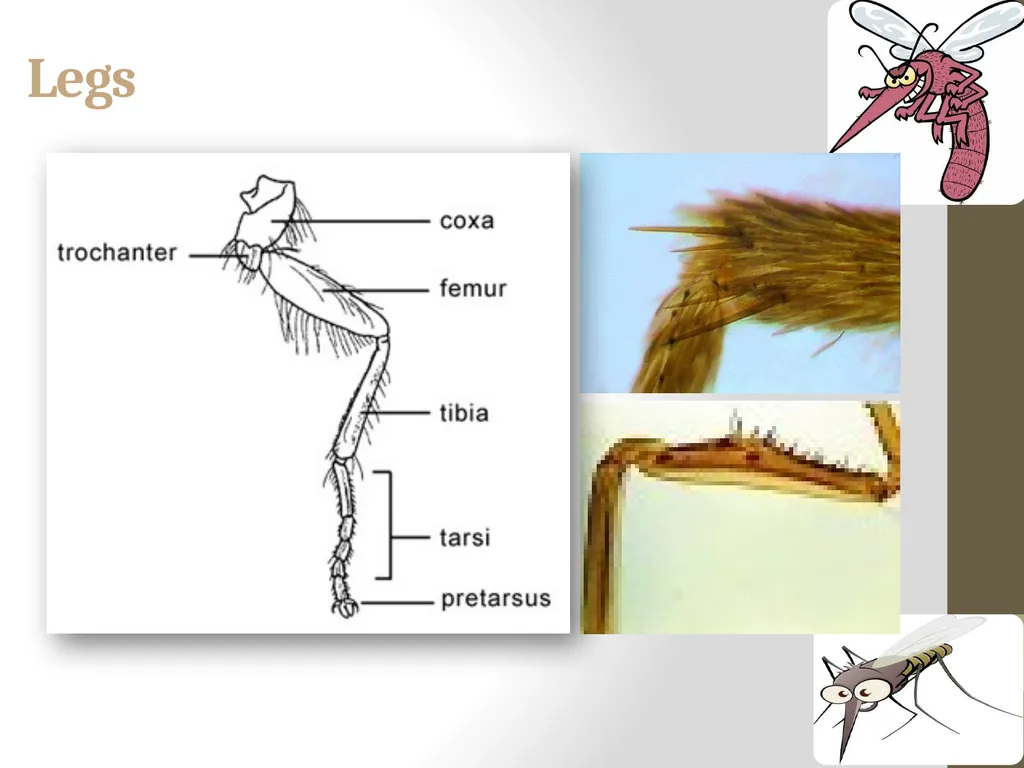
The mosquito's slender legs are attached to the triangular thorax.
The abdomen is long and narrow<br>
08
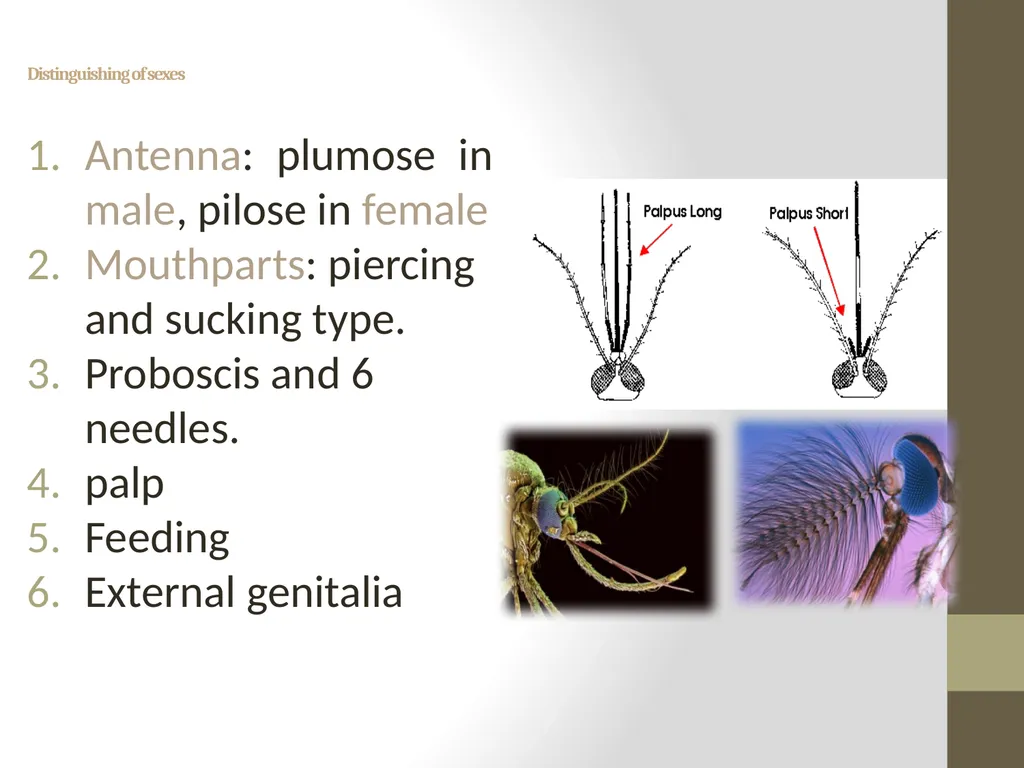
Distinguishing of sexes Antenna: plumose in male, pilose in female
Mouthparts: piercing and sucking type.
Proboscis and 6 needles.
palp
Feeding
External genitalia<br>
10
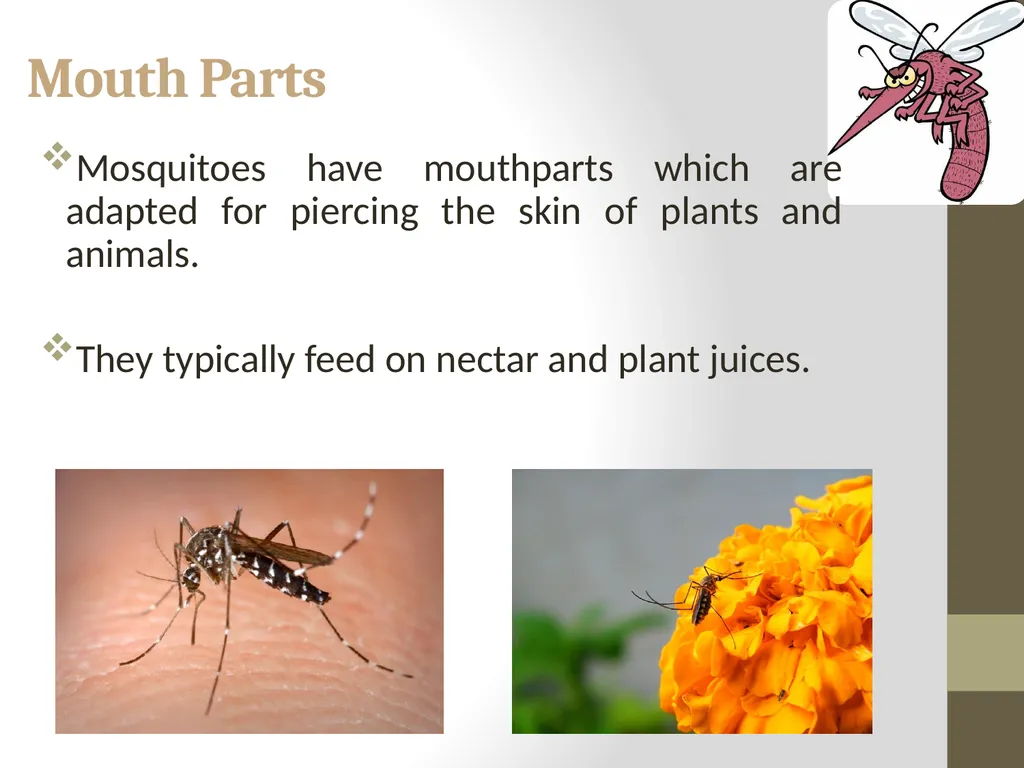
Mouth Parts Mosquitoes have mouthparts which are adapted for piercing the skin of plants and animals.
They typically feed on nectar and plant juices.<br>
11
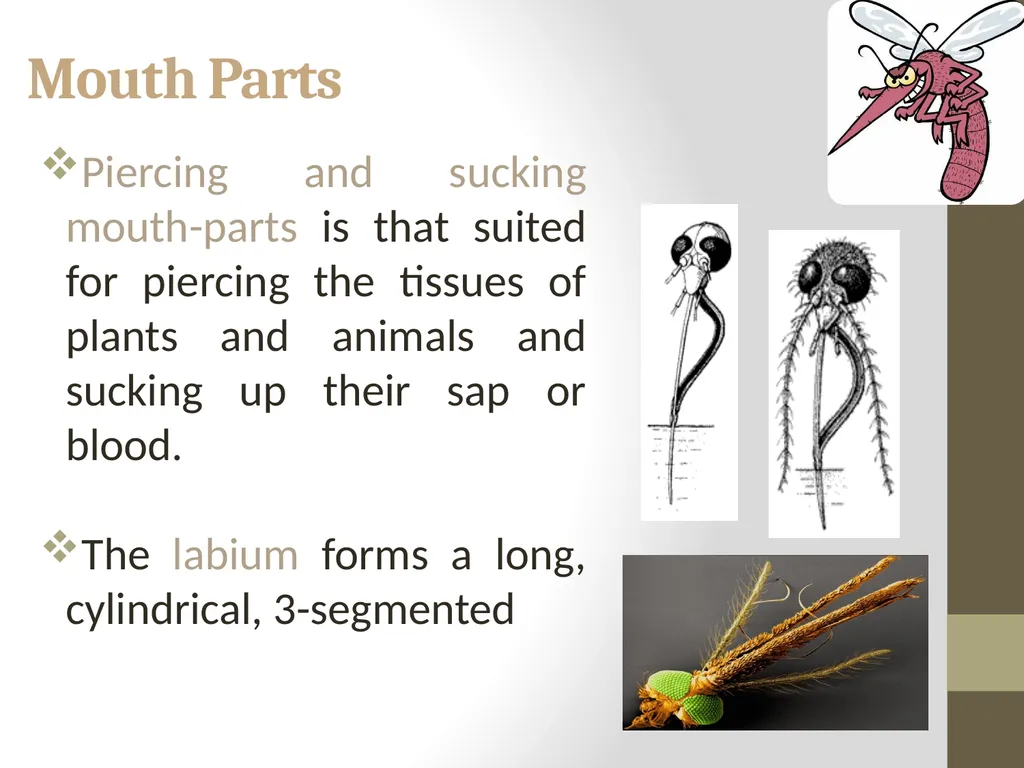
Mouth Parts Piercing and sucking mouth-parts is that suited for piercing the tissues of plants and animals and sucking up their sap or blood.
The labium forms a long, cylindrical, 3-segmented<br>
12
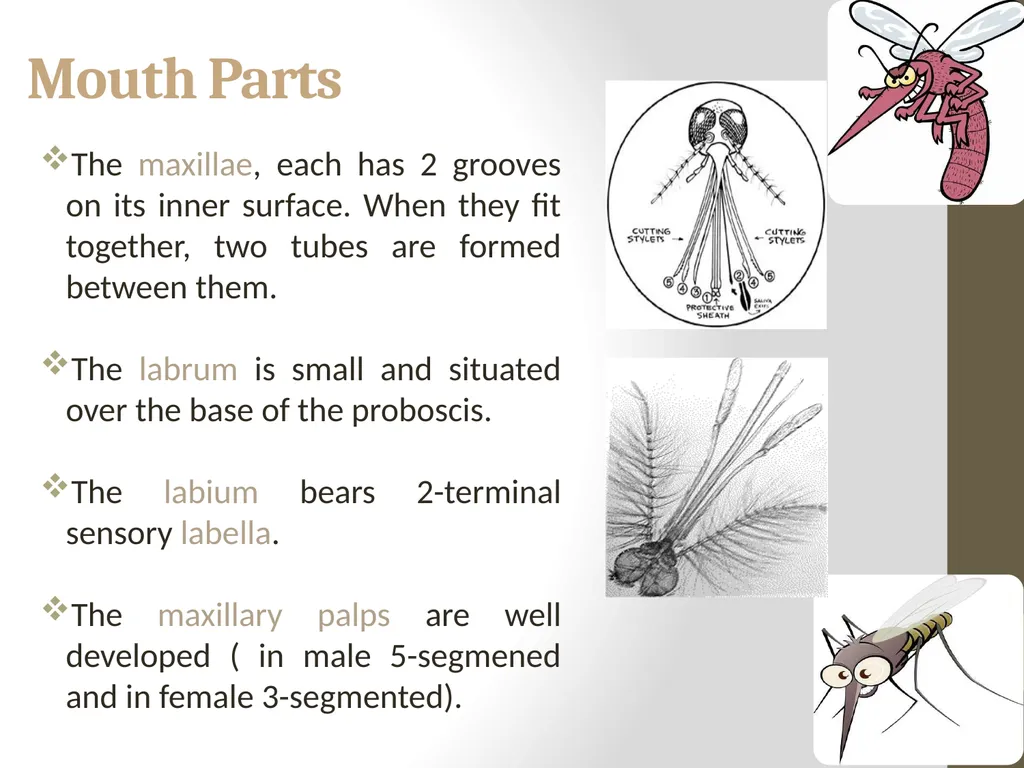
Mouth Parts The maxillae, each has 2 grooves on its inner surface. When they fit together, two tubes are formed between them.
The labrum is small and situated over the base of the proboscis.
The labium bears 2-terminal sensory labella.
The maxillary palps are well developed ( in male 5-segmened and in female 3-segmented).<br>
13
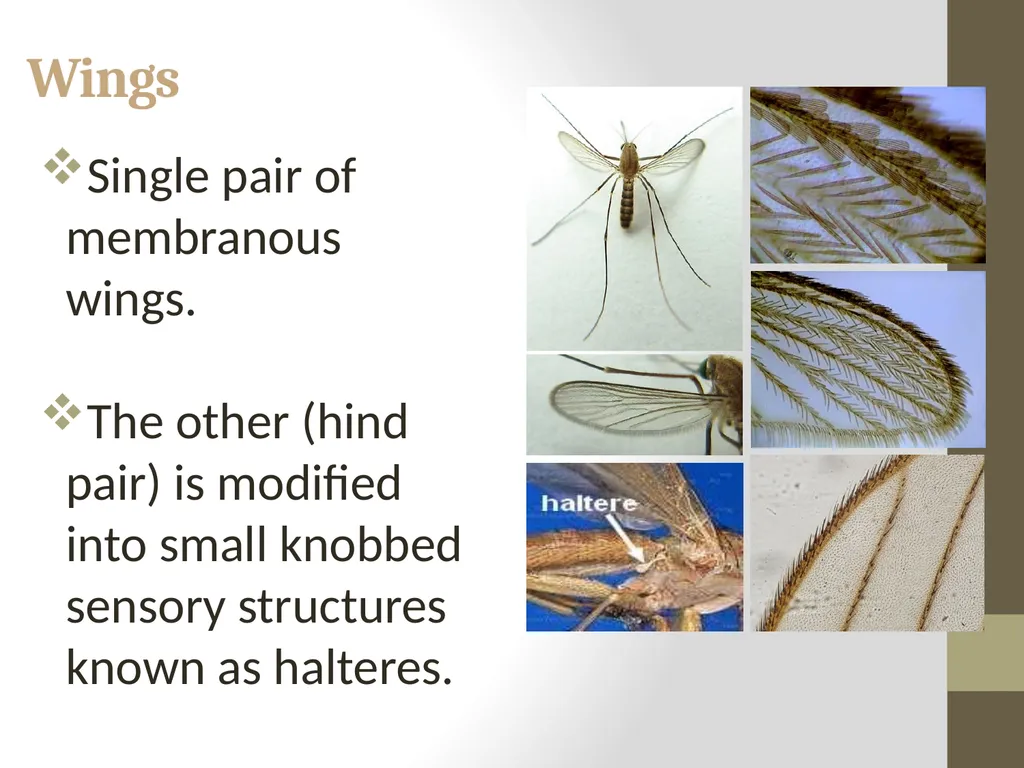
Wings Single pair of membranous wings.
The other (hind pair) is modified into small knobbed sensory structures known as halteres.<br>
15
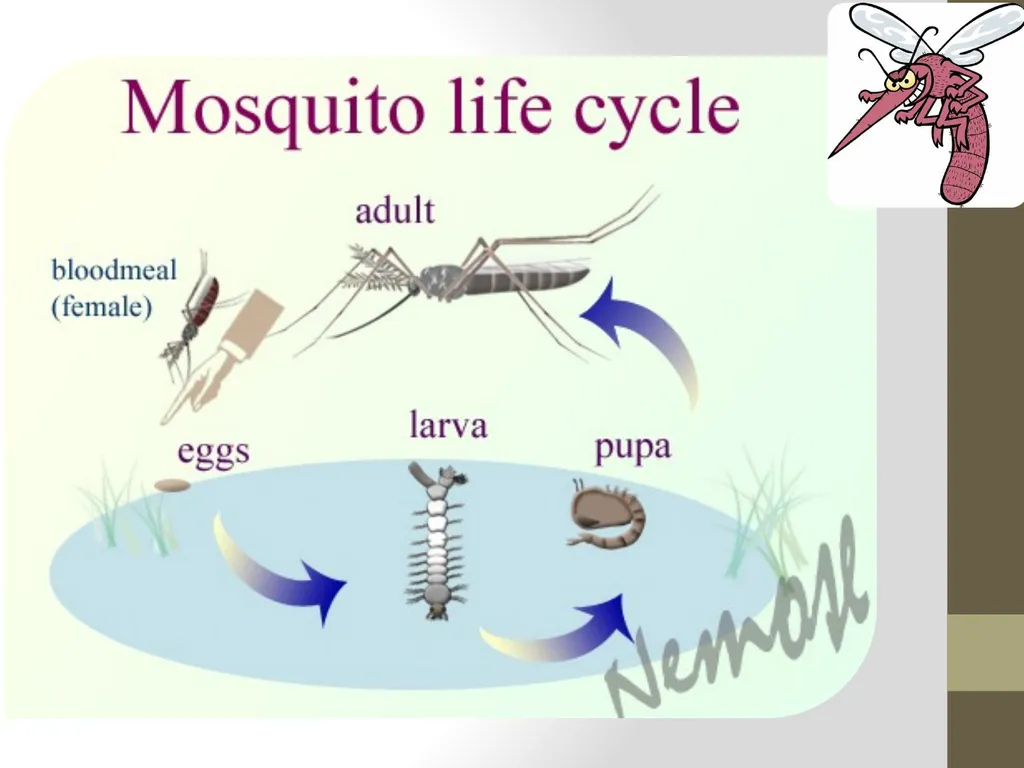
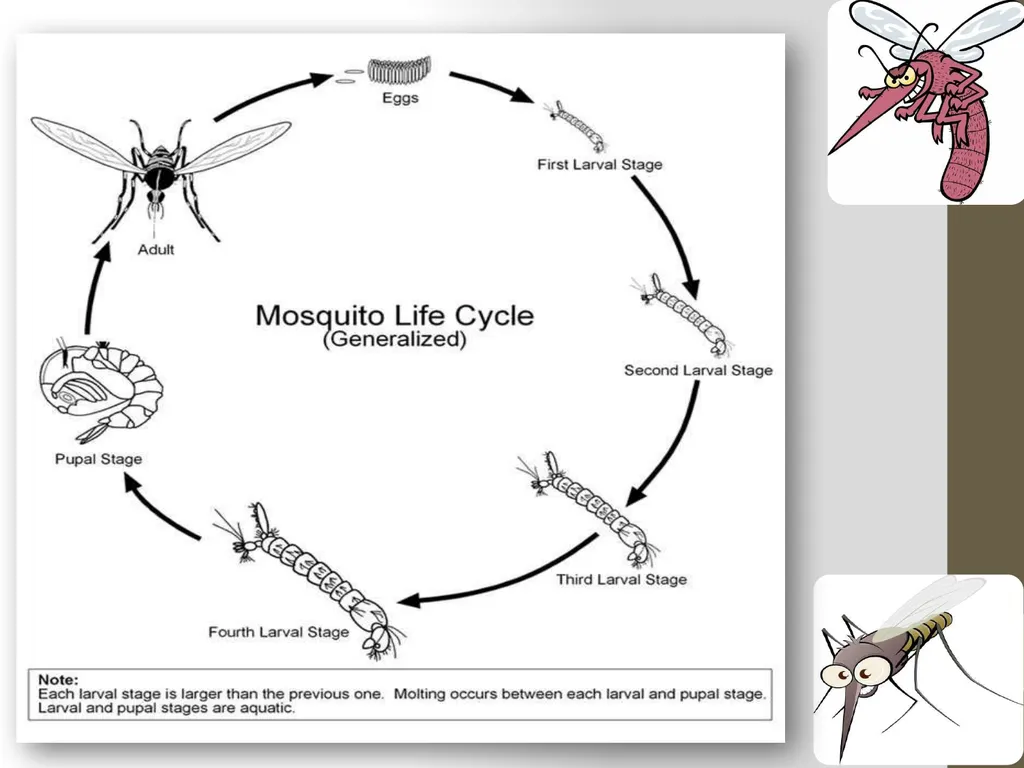
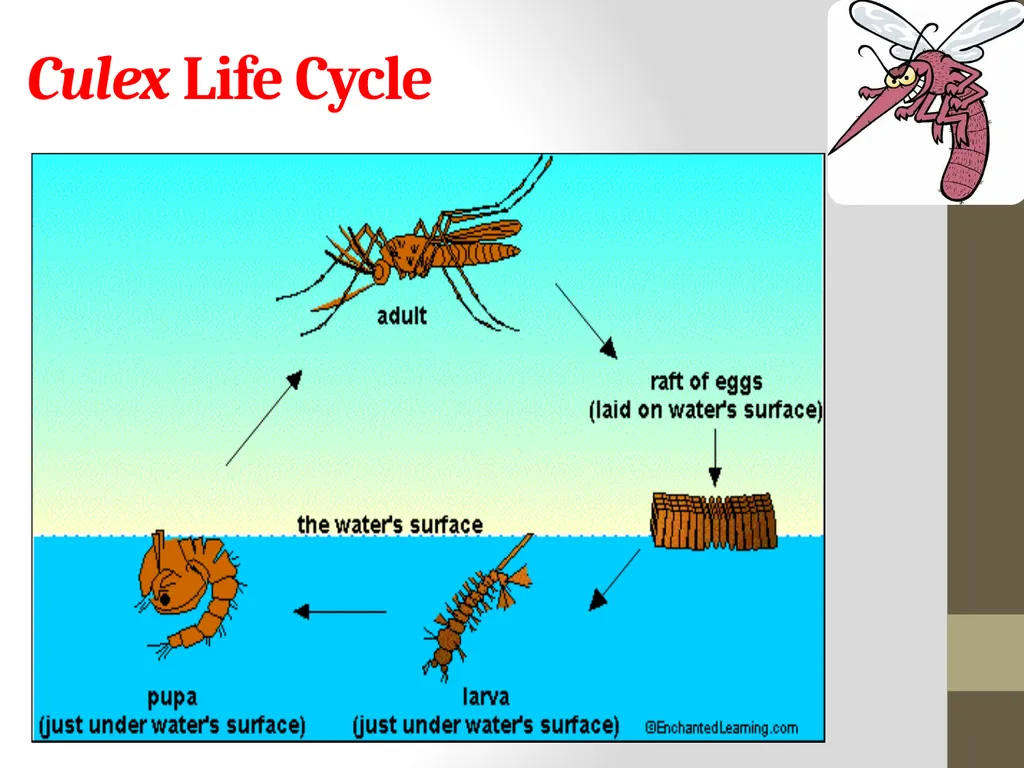
Mosquito life cycle Mosquitoes are aquatic in their early stages.
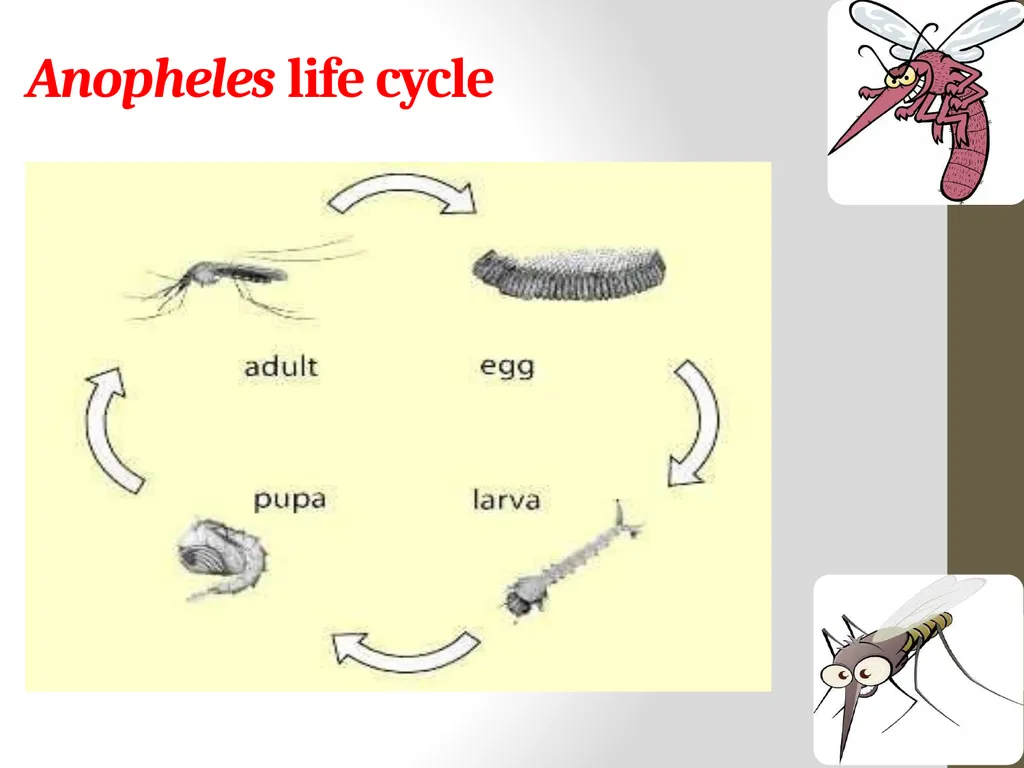
Mosquitoes go through four stages in their life cycle: egg, larva, pupa, and adult or imago.
The first three stages are aquatic.
Adult females lay their eggs in water.
5–14 days, depending on the species and the ambient temperature; eggs hatch to become larvae, then pupae.
The adult mosquito emerges from the pupa as it floats at the water surface.<br>
16
Medical importance Flower pollination.
In some species of mosquito, the females feed on humans, and are therefore vectors for a number of infectious diseases affecting millions of people per year.<br>
17
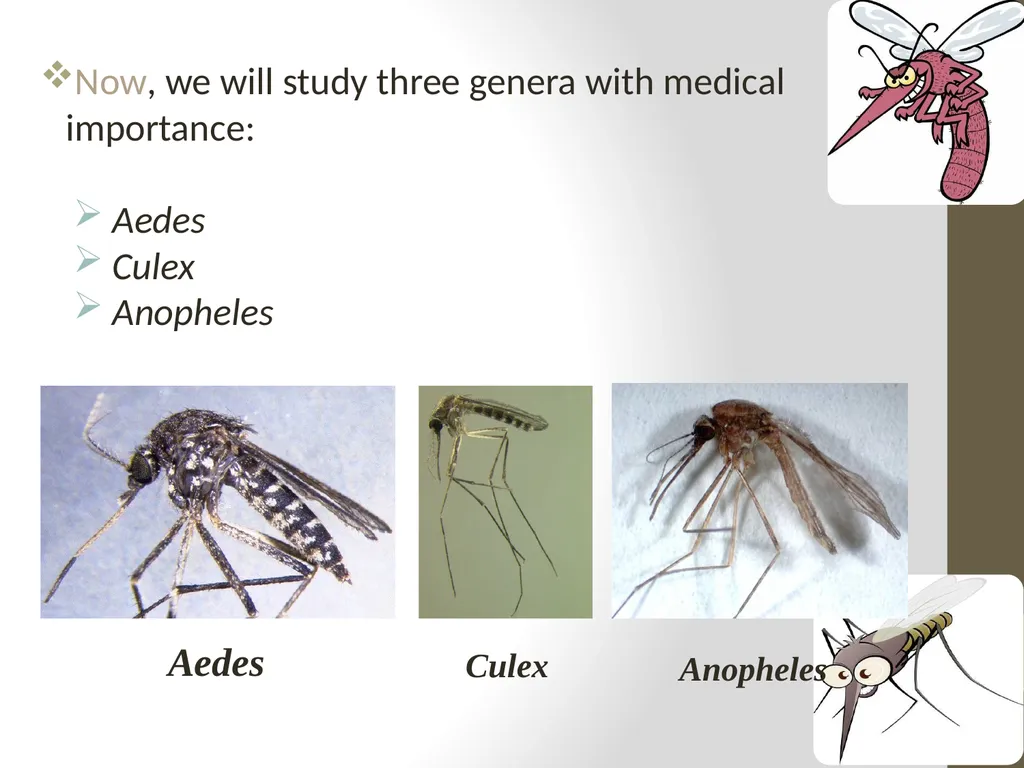
Now, we will study three genera with medical importance:
Aedes
Culex
Anopheles Aedes Culex Anopheles<br>
18
Description Aedes adult
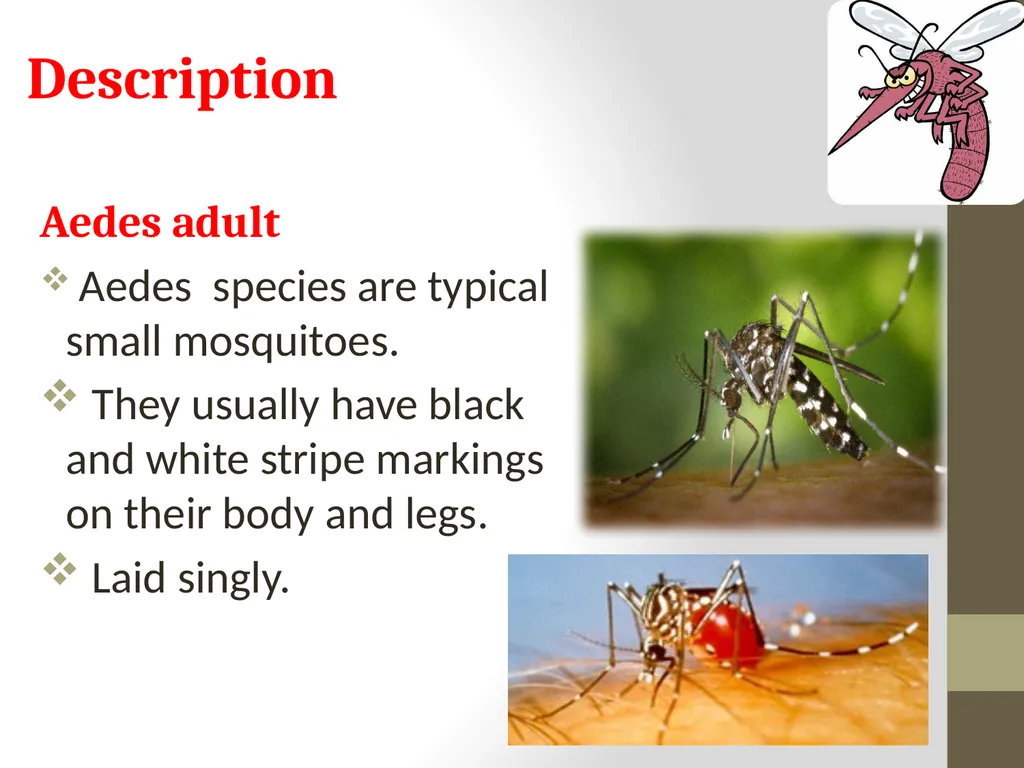
Aedes species are typical small mosquitoes.
They usually have black and white stripe markings on their body and legs.
Laid singly.<br>
19
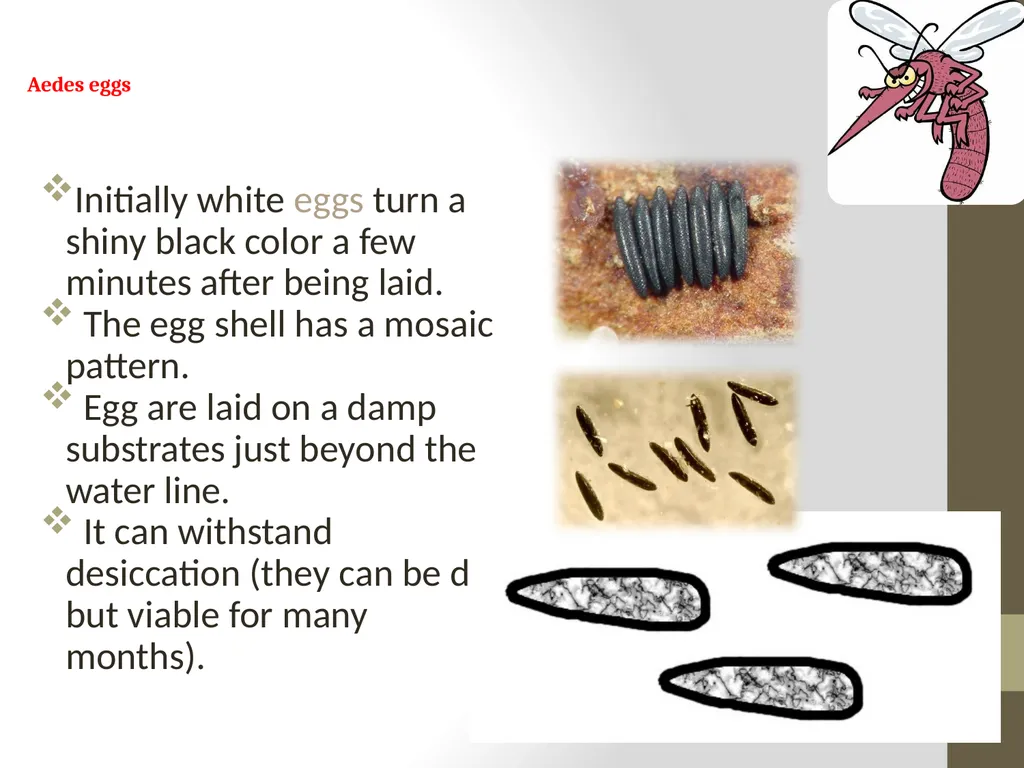
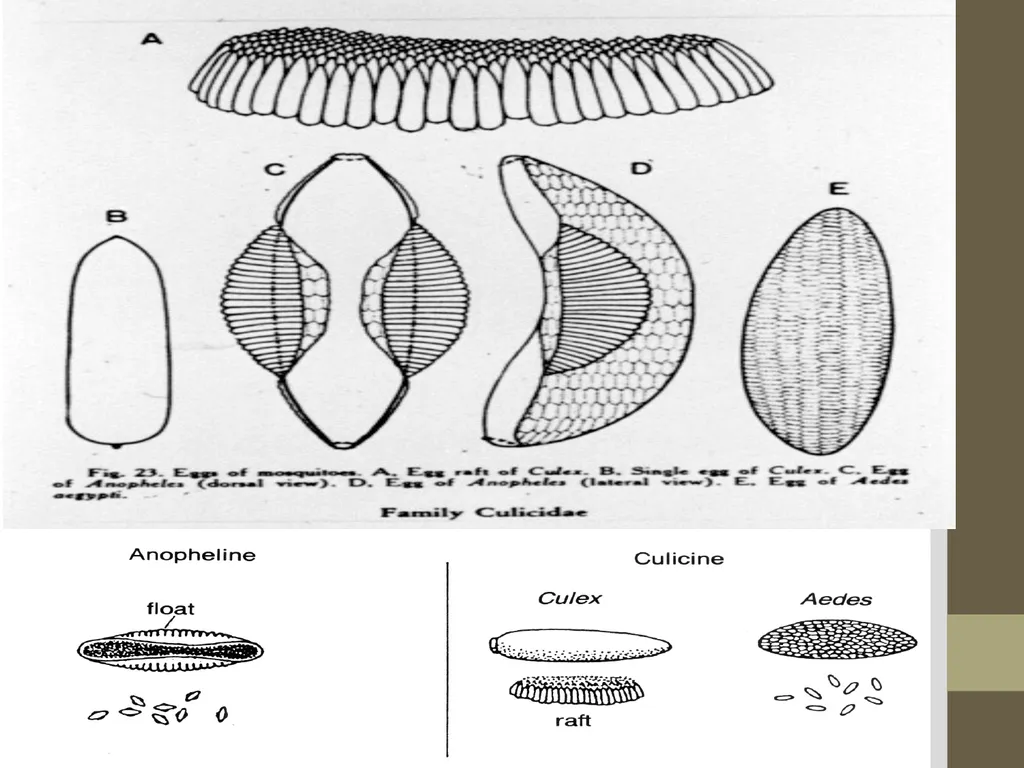
Aedes eggs Initially white eggs turn a shiny black color a few minutes after being laid.
The egg shell has a mosaic pattern.
Egg are laid on a damp substrates just beyond the water line.
It can withstand desiccation (they can be dry but viable for many months).<br>
20
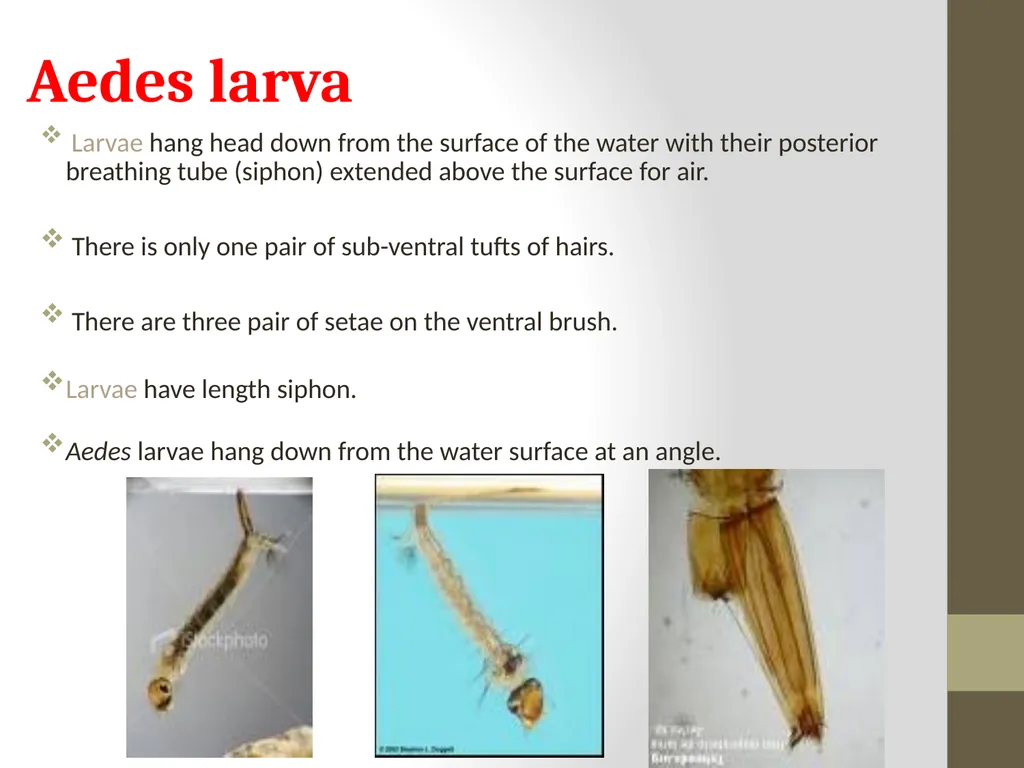
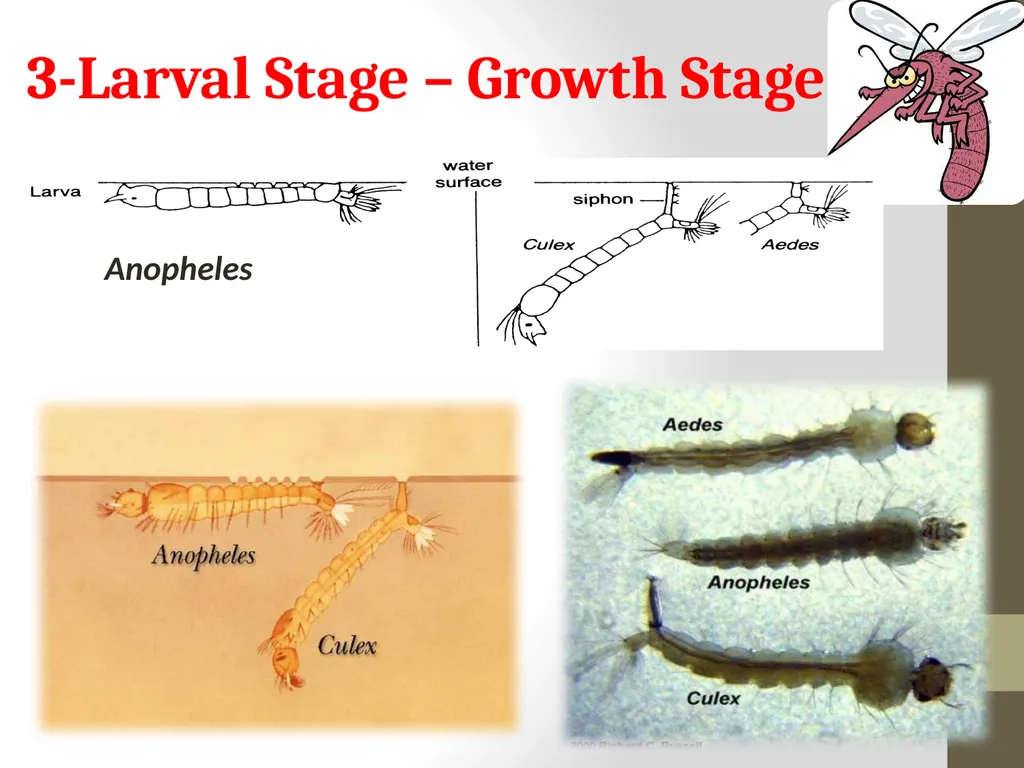
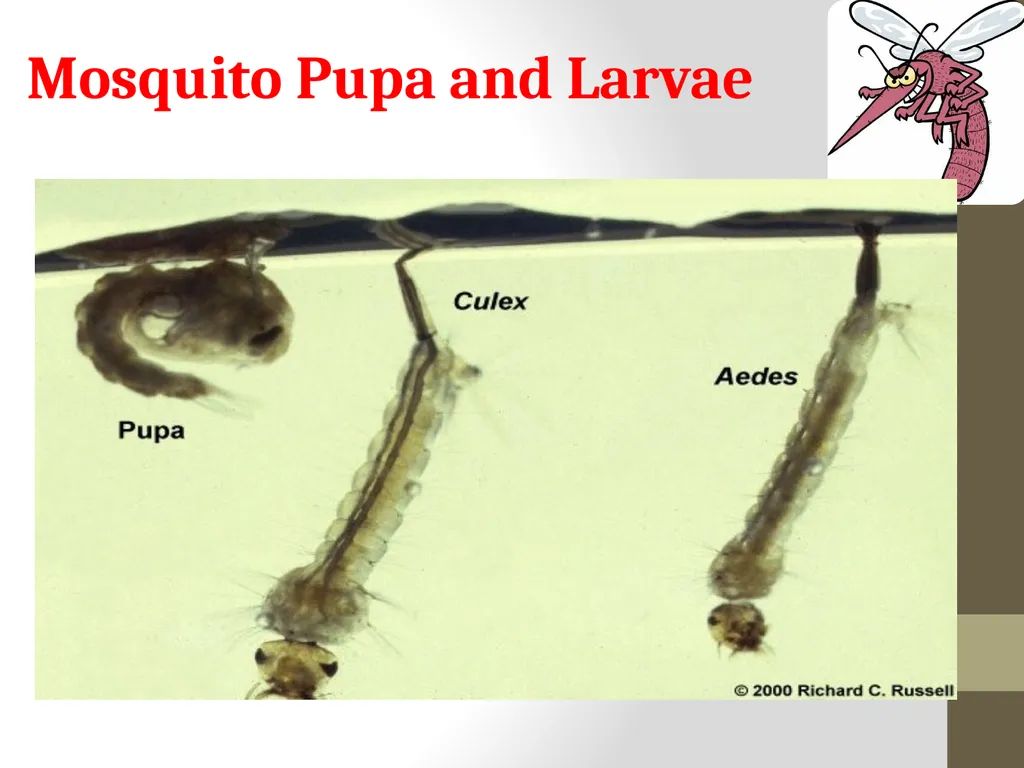
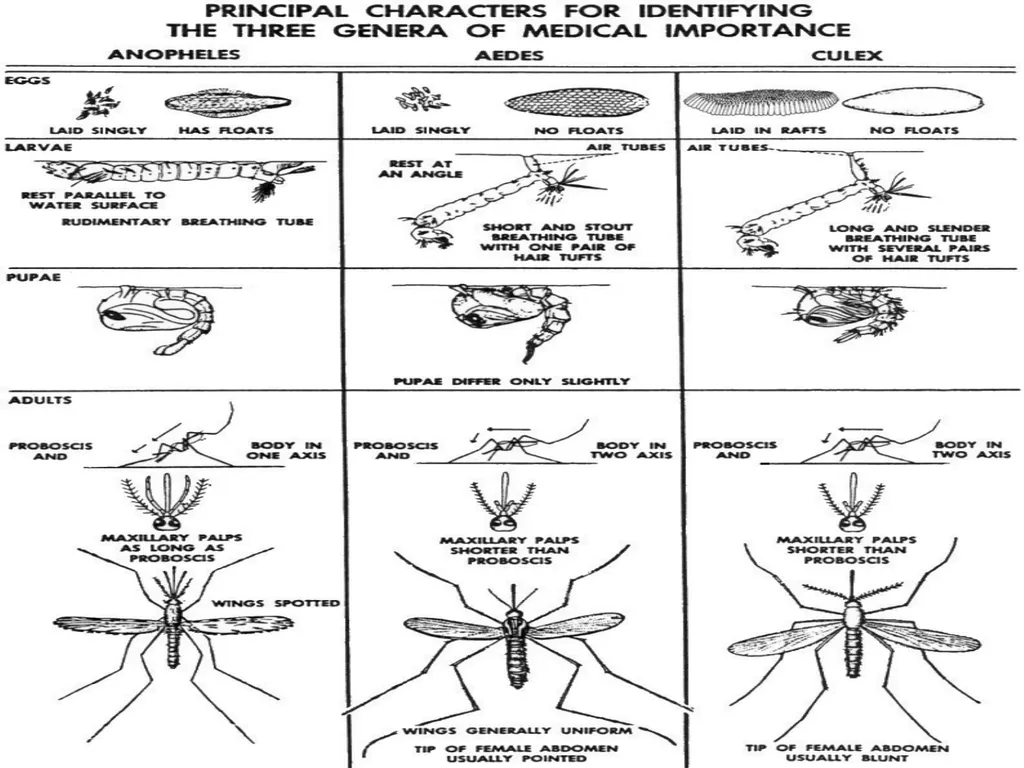
Aedes larva Larvae hang head down from the surface of the water with their posterior breathing tube (siphon) extended above the surface for air.
There is only one pair of sub-ventral tufts of hairs.
There are three pair of setae on the ventral brush.
Larvae have length siphon.
Aedes larvae hang down from the water surface at an angle.<br>
21
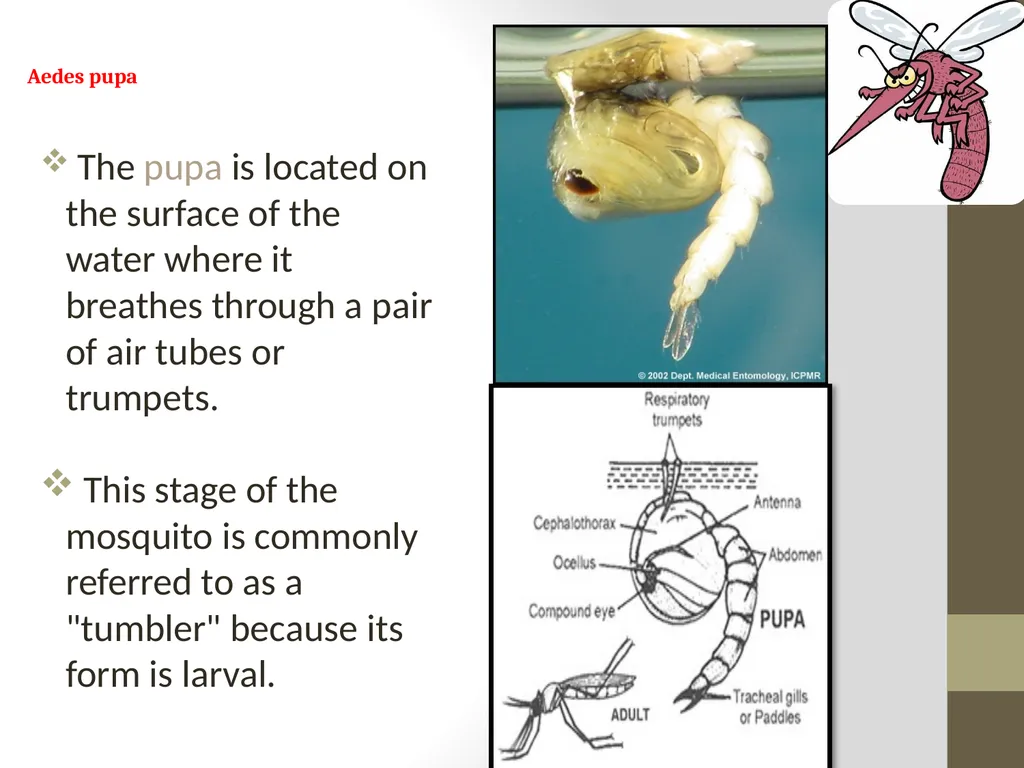
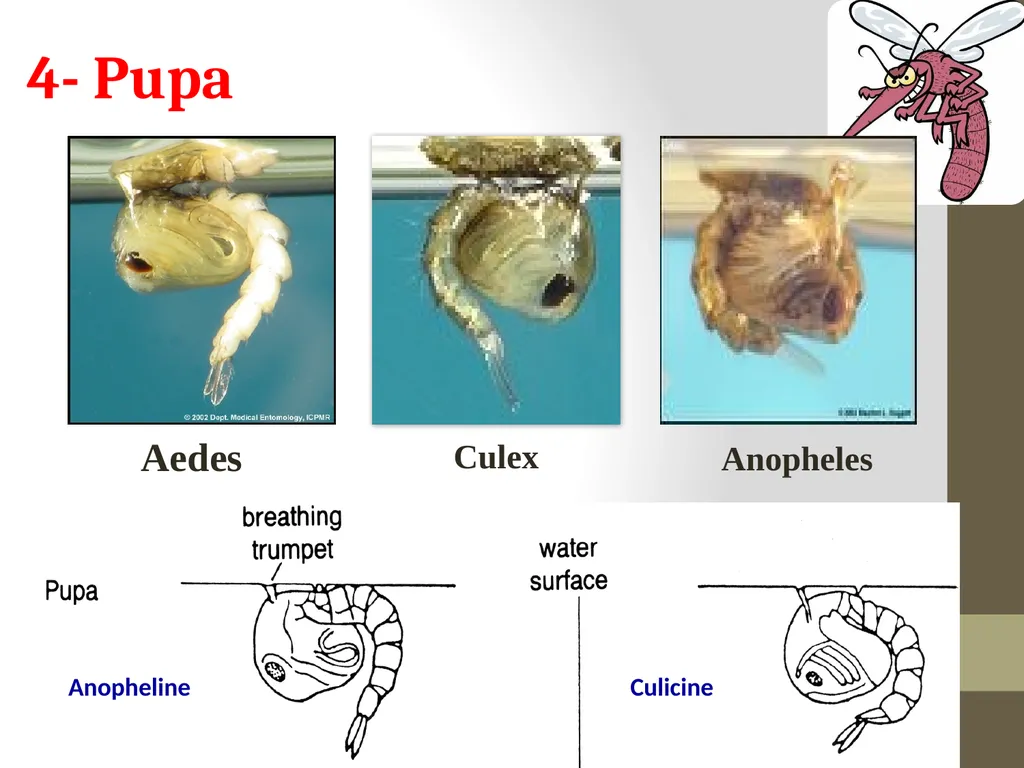
Aedes pupa The pupa is located on the surface of the water where it breathes through a pair of air tubes or trumpets.
This stage of the mosquito is commonly referred to as a "tumbler" because its form is larval.<br>
22
Life cycle of Aedes<br>
23
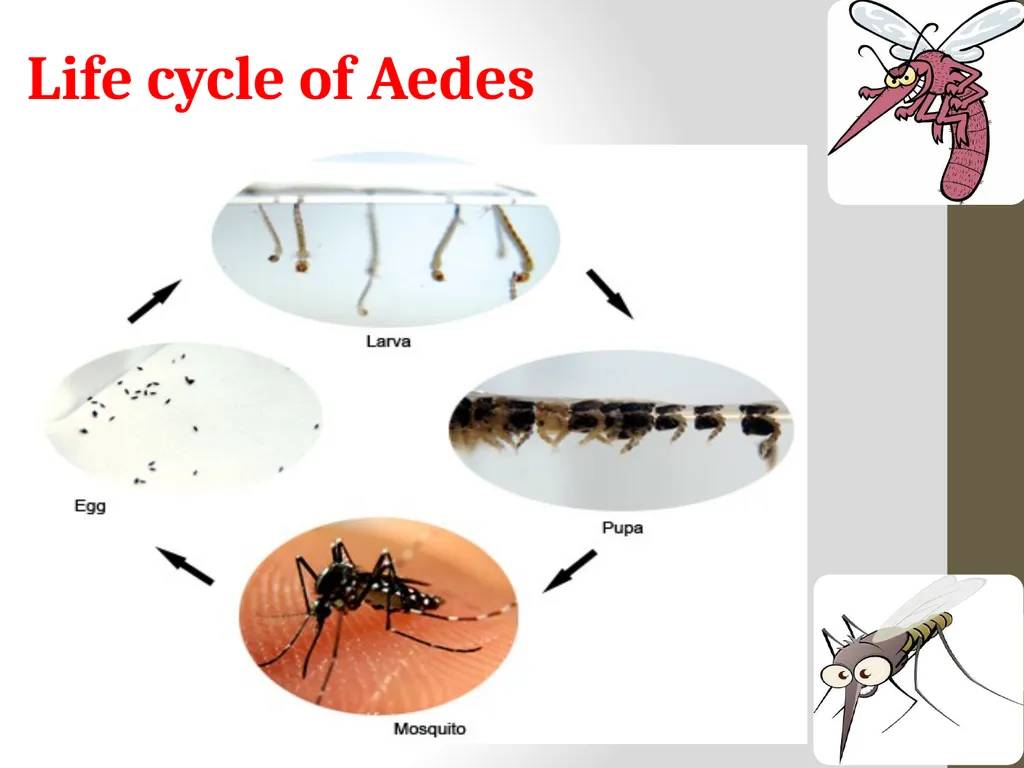
Life cycle of Aedes Under optimal conditions, the egg of an Aedes mosquito can hatch into a larva in less than a day.
The larva then takes about four days to develop in a pupa, from which an adult mosquito will emerge after two days.
Three days after the mosquito has bitten a person and taken in blood, it will lay eggs, and the cycle begins again.<br>
24
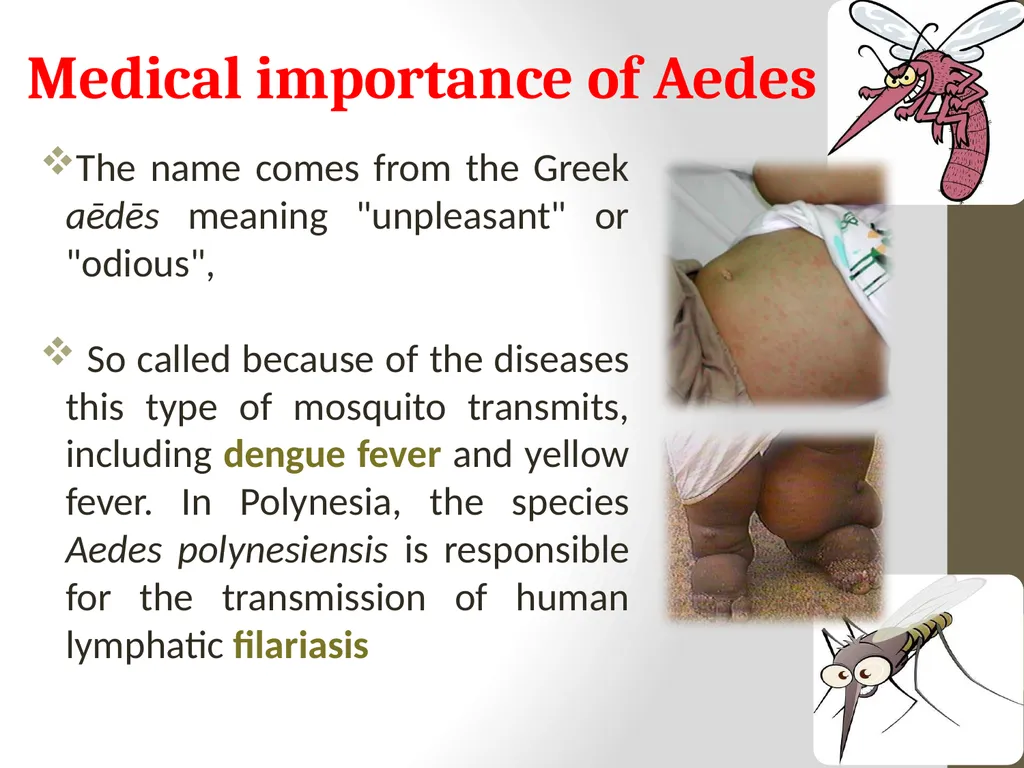
Medical importance of Aedes The name comes from the Greek aēdēs meaning "unpleasant" or "odious",
So called because of the diseases this type of mosquito transmits, including dengue fever and yellow fever. In Polynesia, the species Aedes polynesiensis is responsible for the transmission of human lymphatic filariasis<br>
25
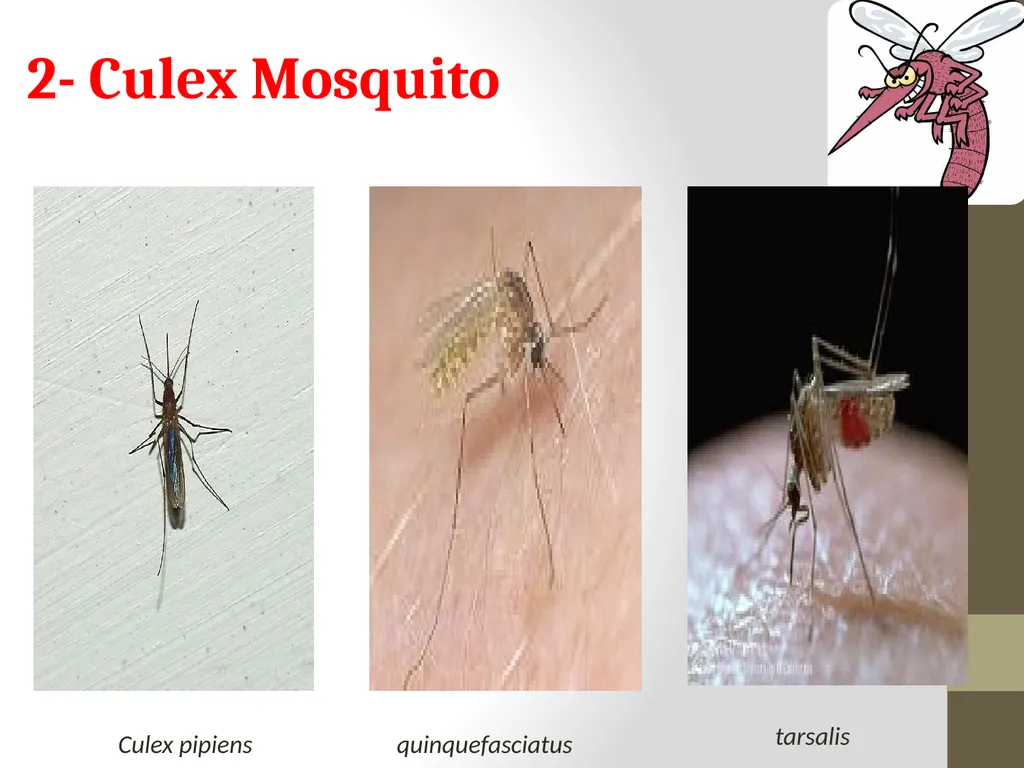
2- Culex Mosquito 3 famous culex species
C. pipiens
C. quinquefasciatus
C. tarsalis<br>
26
2- Culex Mosquito Culex pipiens quinquefasciatus tarsalis<br>
27
Description Culex adult
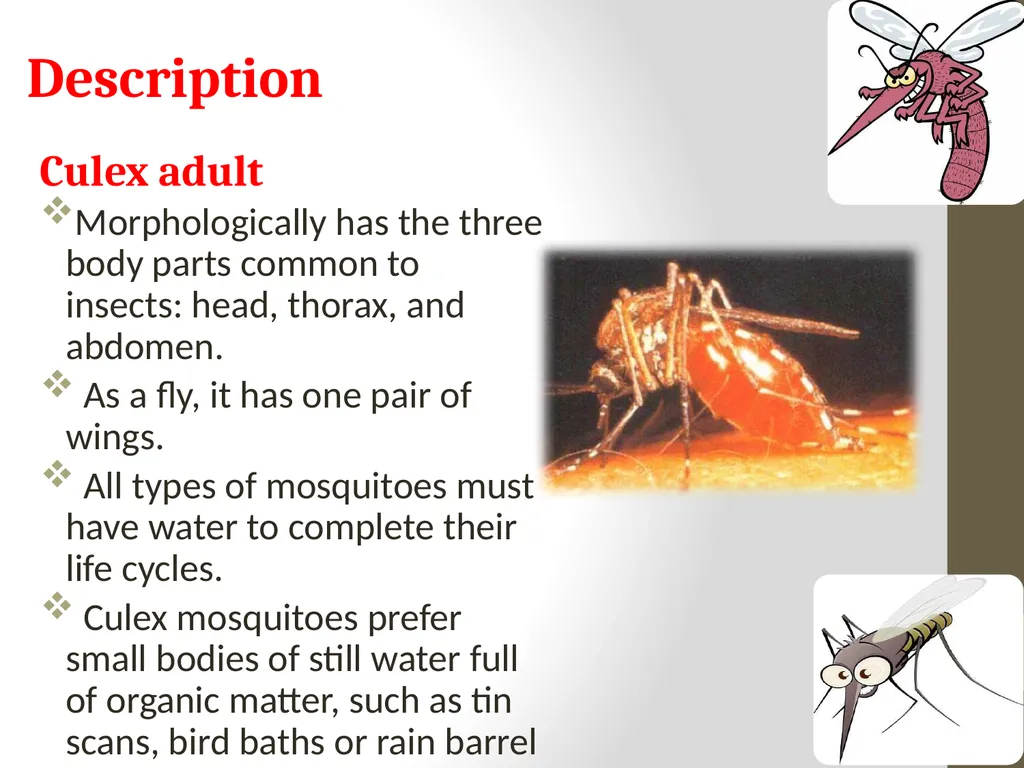
Morphologically has the three body parts common to insects: head, thorax, and abdomen.
As a fly, it has one pair of wings.
All types of mosquitoes must have water to complete their life cycles.
Culex mosquitoes prefer small bodies of still water full of organic matter, such as tin scans, bird baths or rain barrel<br>
28
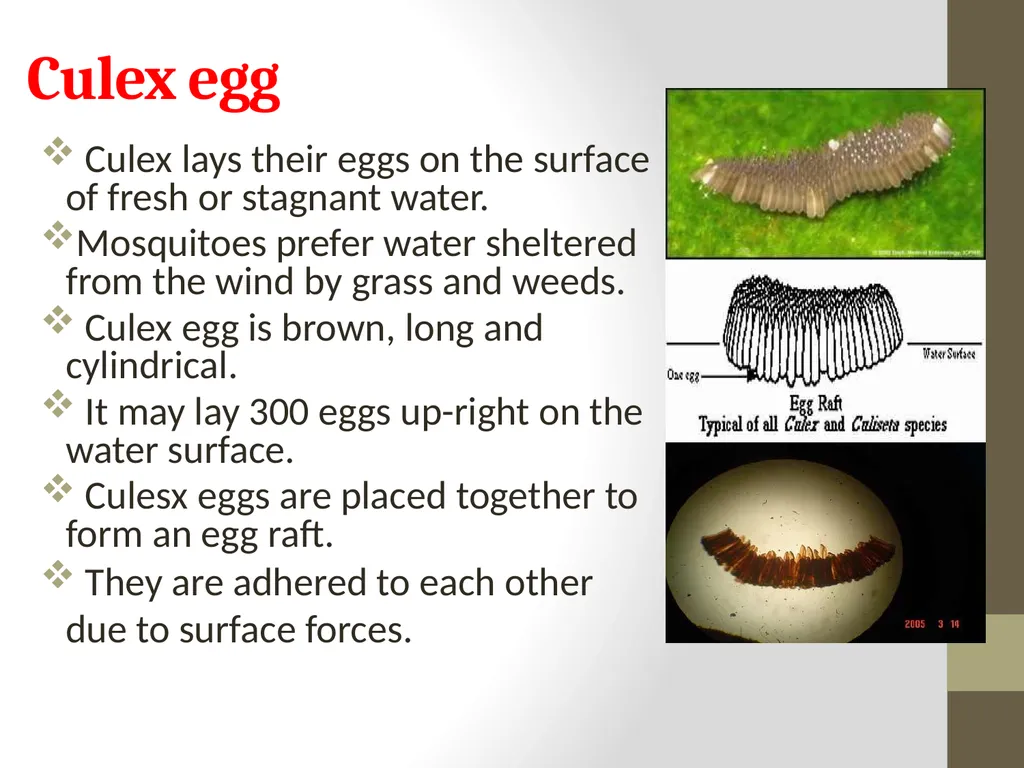
Culex egg Culex lays their eggs on the surface of fresh or stagnant water.
Mosquitoes prefer water sheltered from the wind by grass and weeds.
Culex egg is brown, long and cylindrical.
It may lay 300 eggs up-right on the water surface.
Culesx eggs are placed together to form an egg raft.
They are adhered to each other due to surface forces.<br>
29
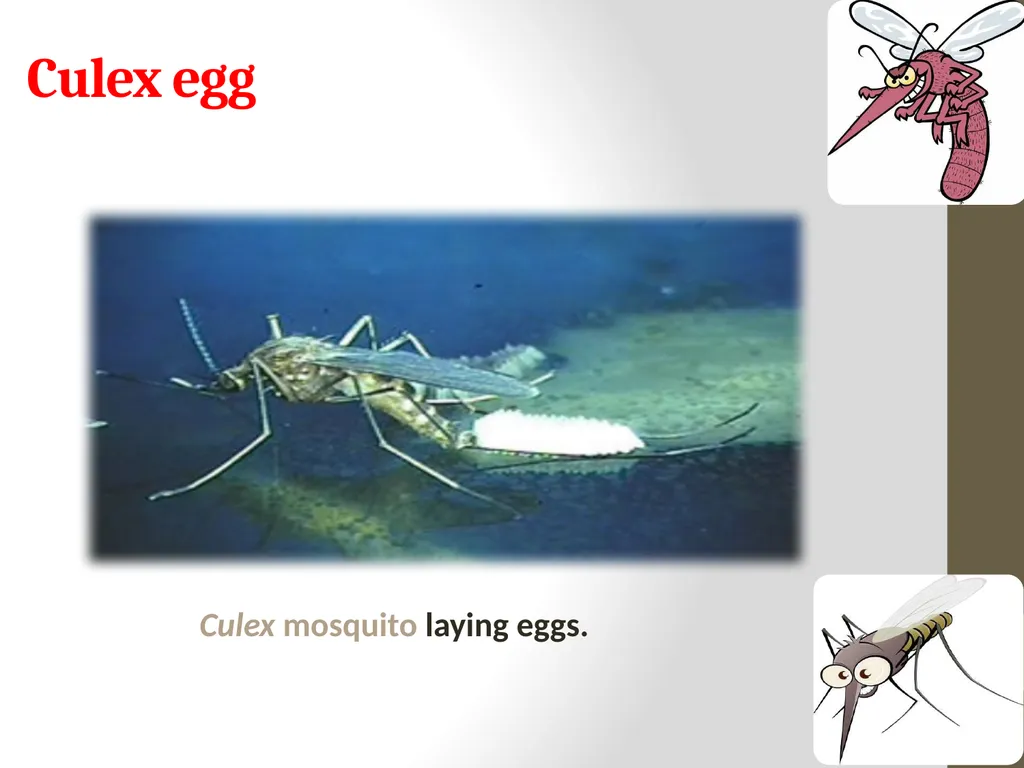
Culex egg Culex mosquito laying eggs.<br>
30
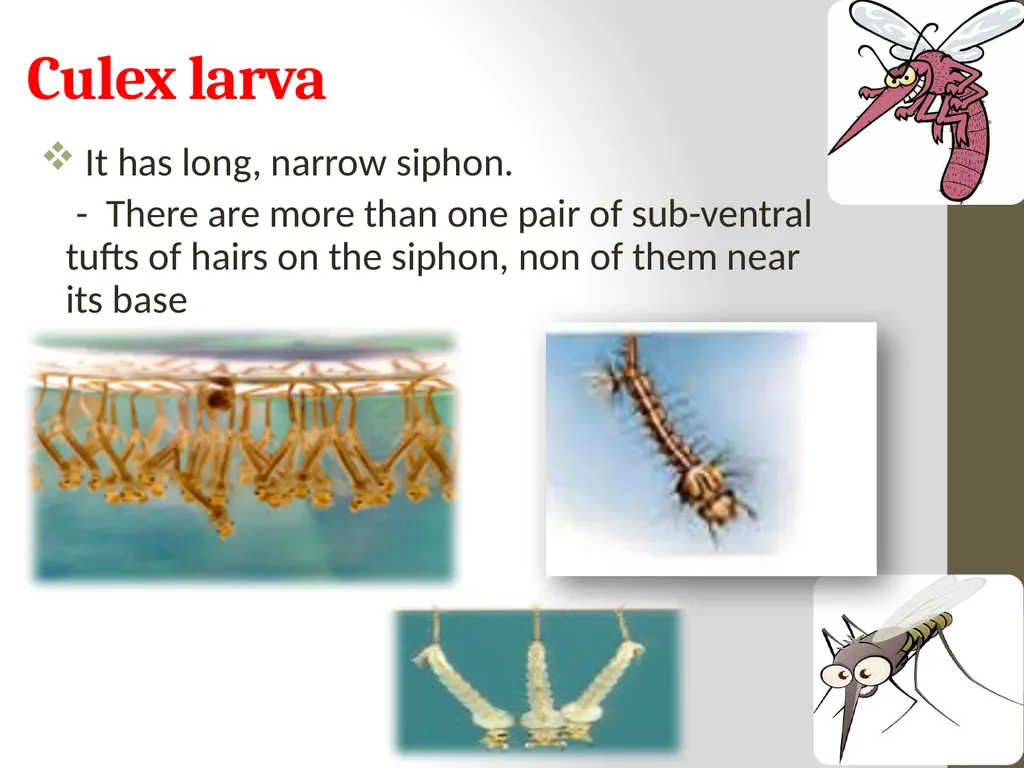
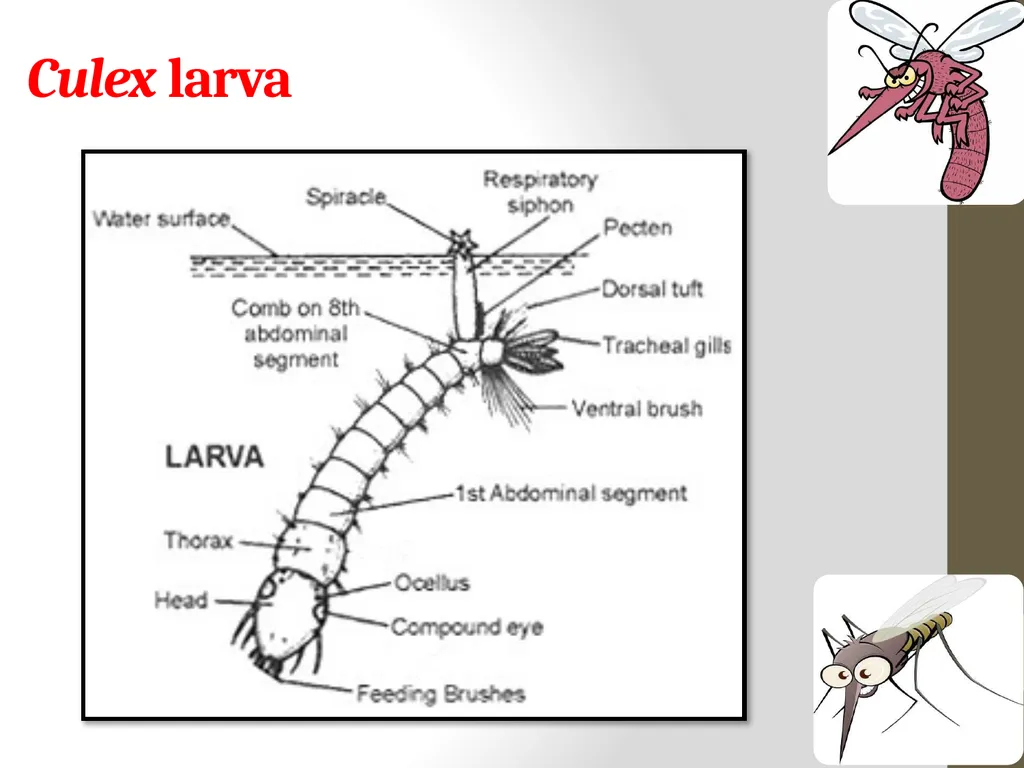
Culex larva It has long, narrow siphon.
- There are more than one pair of sub-ventral tufts of hairs on the siphon, non of them near its base<br>
32
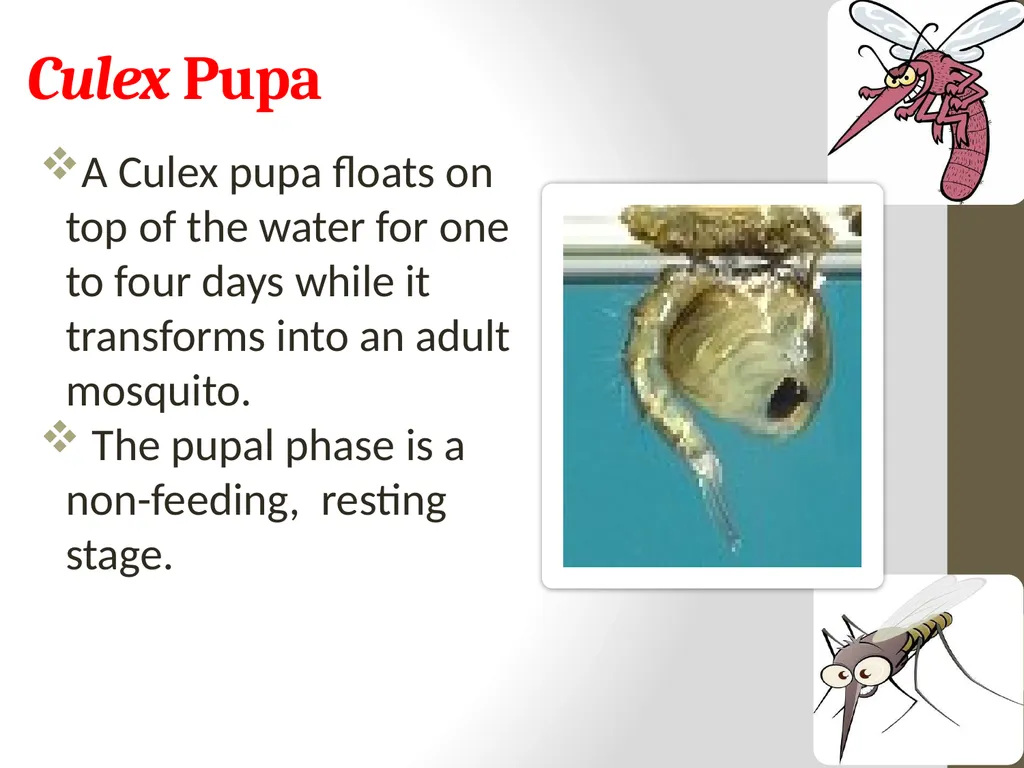
Culex Pupa A Culex pupa floats on top of the water for one to four days while it transforms into an adult mosquito.
The pupal phase is a non-feeding, resting stage.<br>
34
Medical importance of culex 1. Annoyance pest :
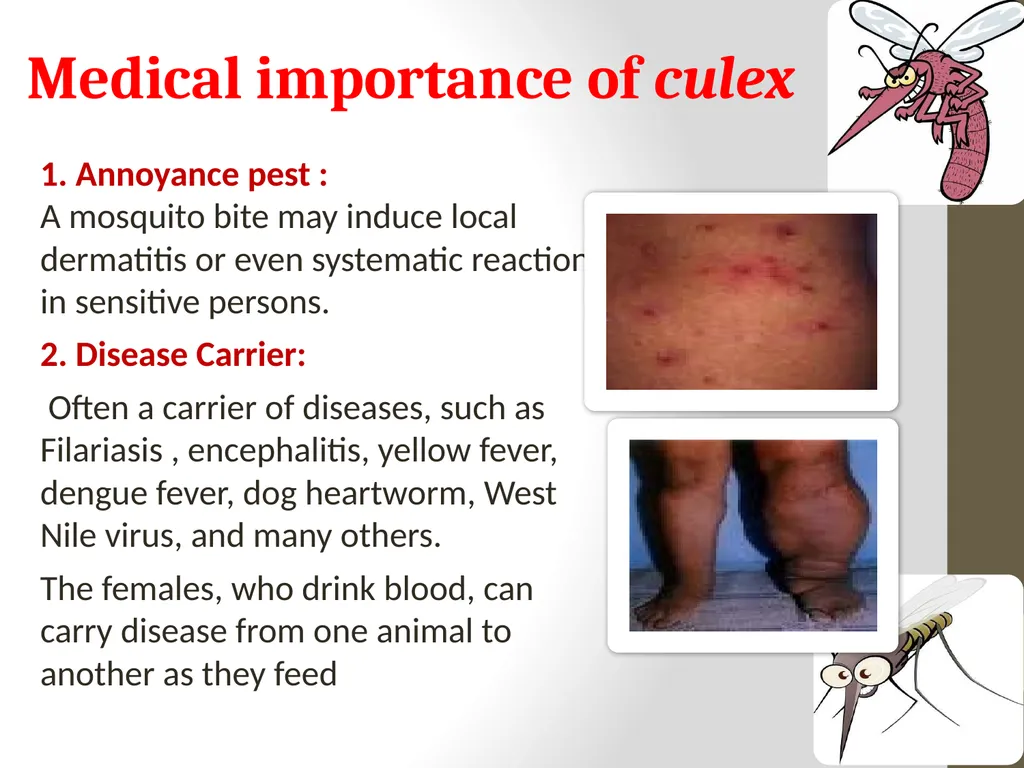
A mosquito bite may induce local dermatitis or even systematic reaction in sensitive persons.
2. Disease Carrier:
Often a carrier of diseases, such as Filariasis , encephalitis, yellow fever, dengue fever, dog heartworm, West Nile virus, and many others.
The females, who drink blood, can carry disease from one animal to another as they feed<br>
35
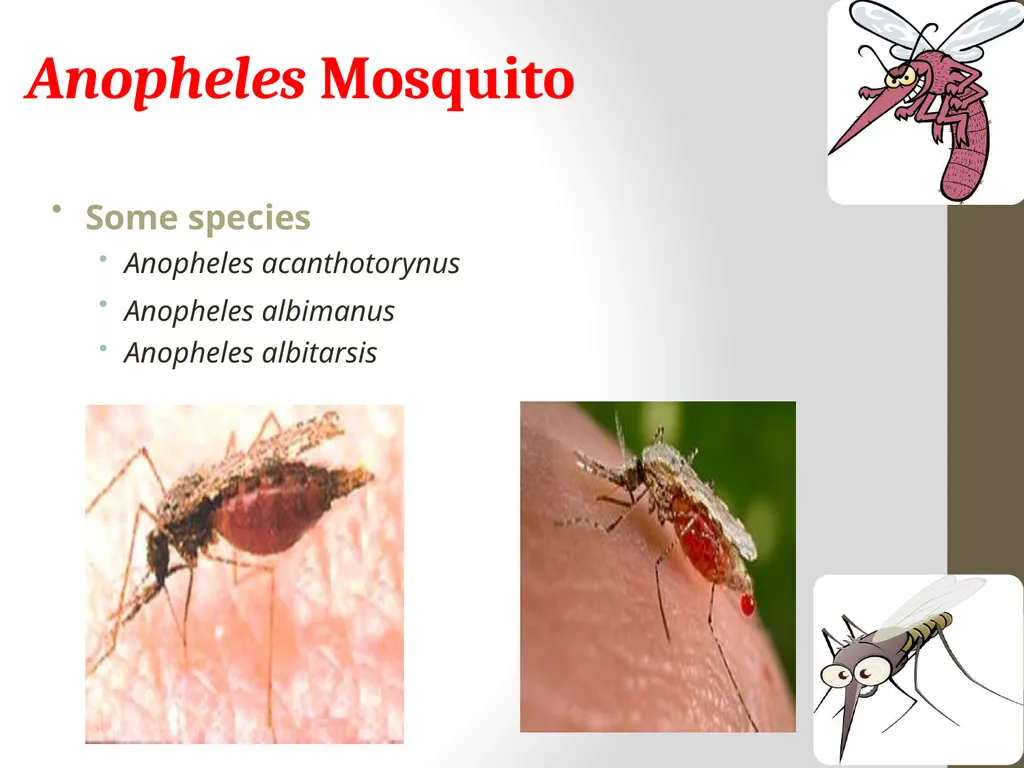
Anopheles Mosquito Some species
Anopheles acanthotorynus
Anopheles albimanus
Anopheles albitarsis<br>
36
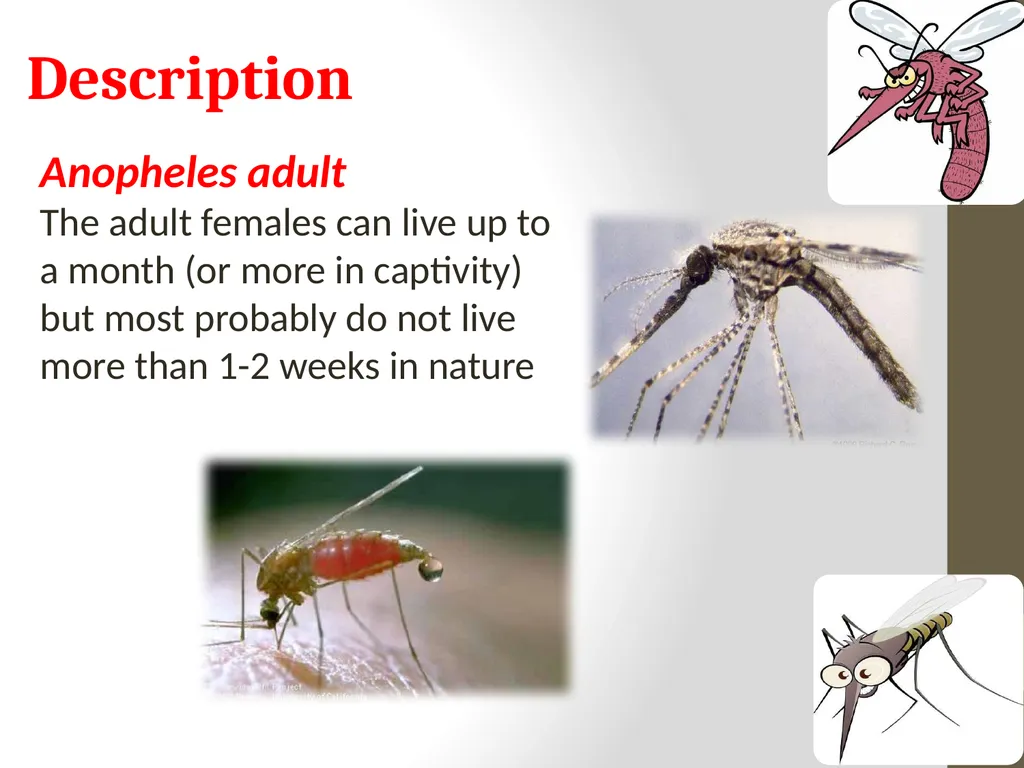
Description Anopheles adult
The adult females can live up to a month (or more in captivity) but most probably do not live more than 1-2 weeks in nature<br>
37
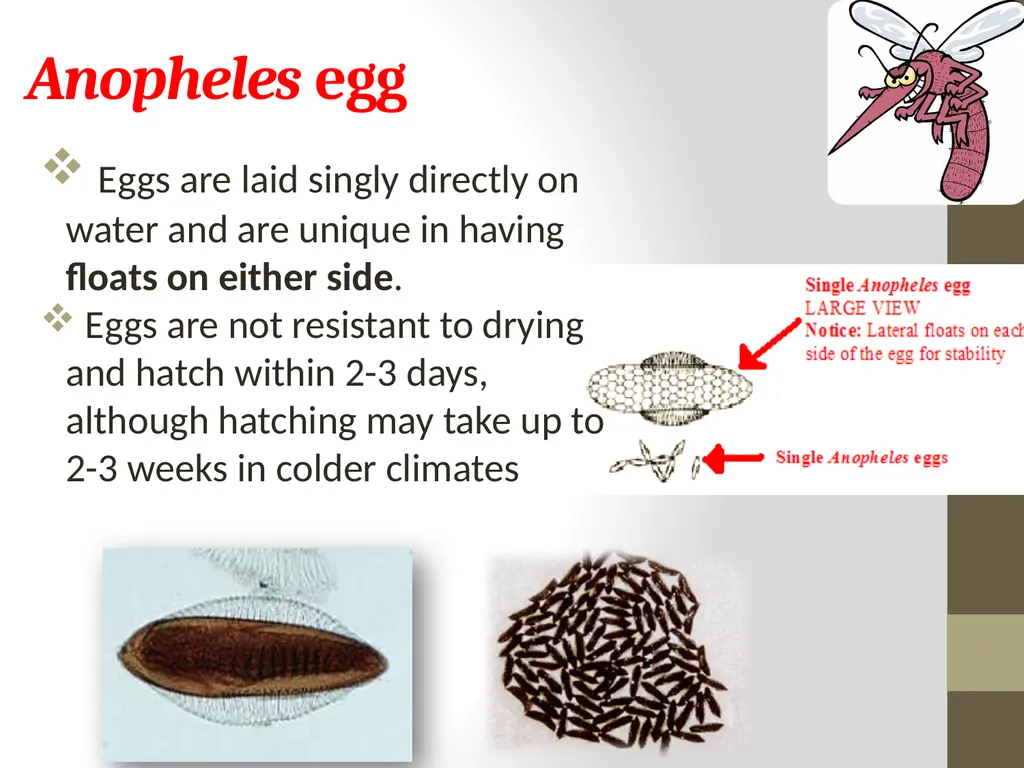
Anopheles egg Eggs are laid singly directly on water and are unique in having floats on either side.
Eggs are not resistant to drying and hatch within 2-3 days, although hatching may take up to 2-3 weeks in colder climates<br>
38
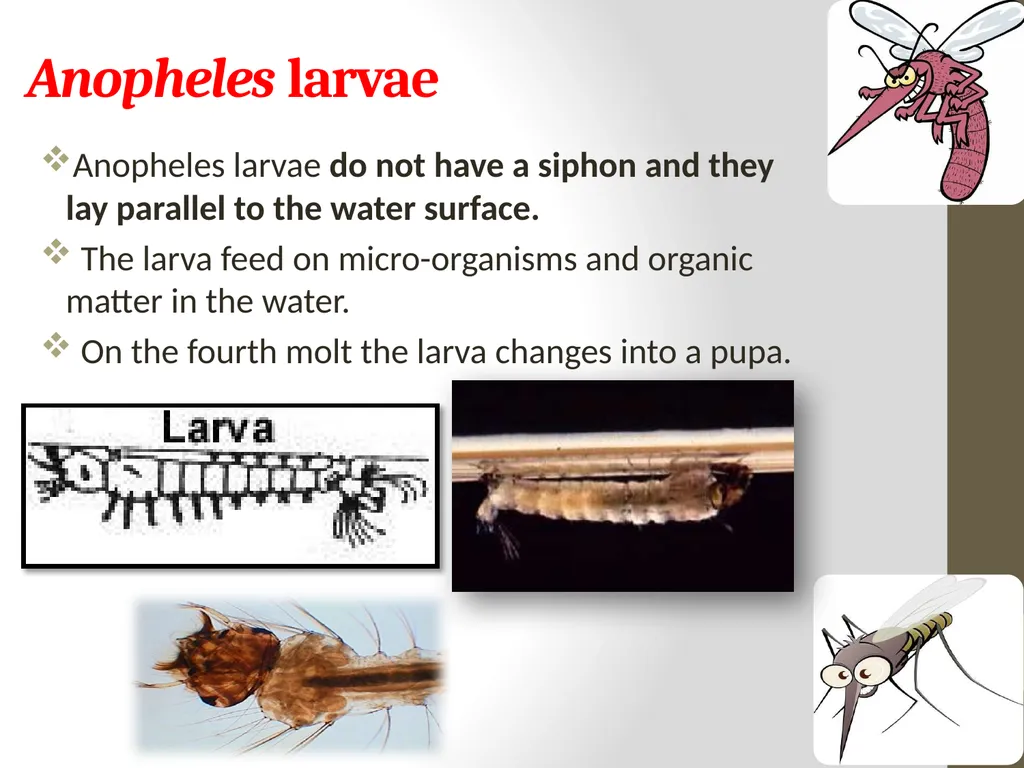
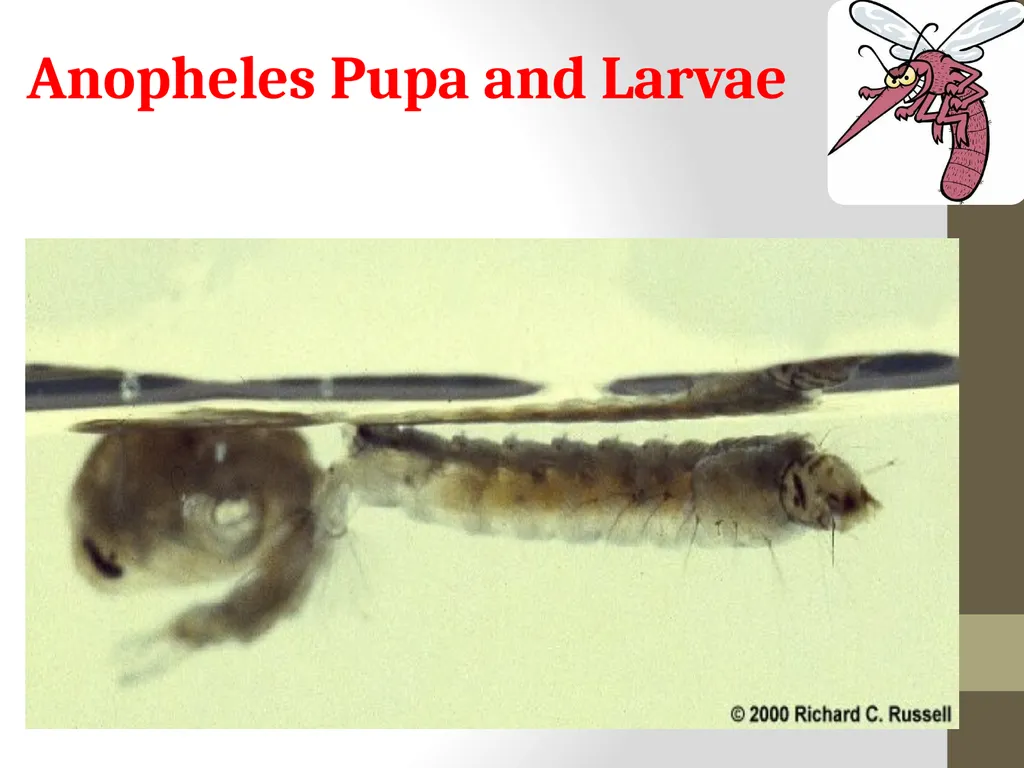
Anopheles larvae Anopheles larvae do not have a siphon and they lay parallel to the water surface.
The larva feed on micro-organisms and organic matter in the water.
On the fourth molt the larva changes into a pupa.<br>
39
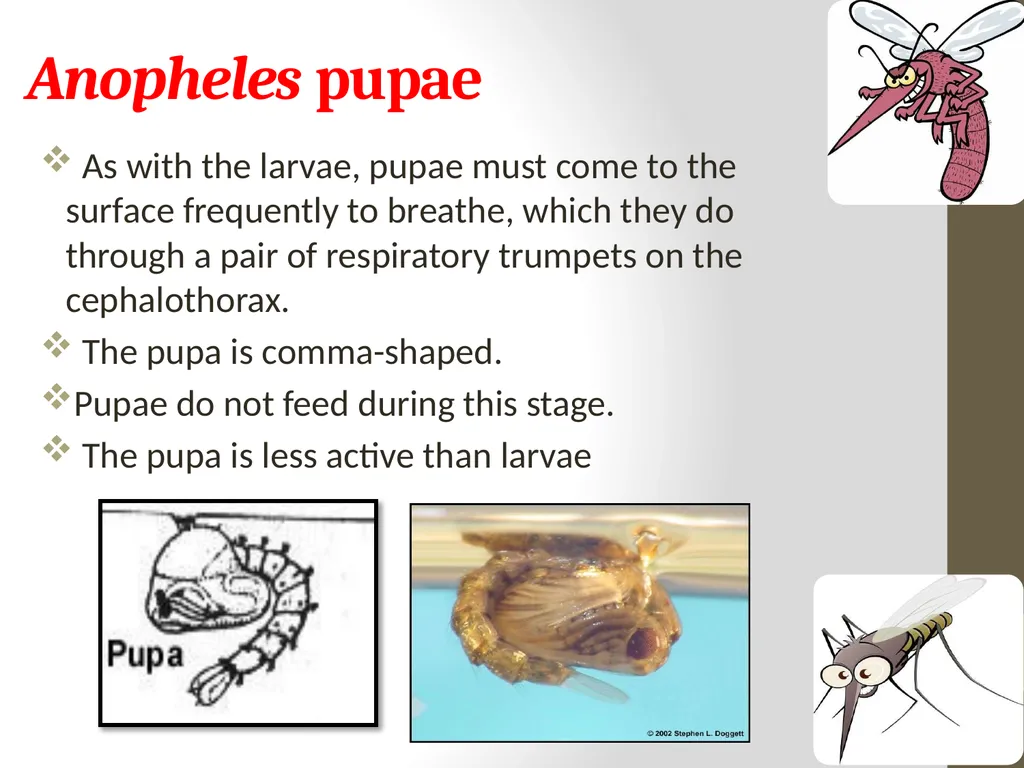
Anopheles pupae As with the larvae, pupae must come to the surface frequently to breathe, which they do through a pair of respiratory trumpets on the cephalothorax.
The pupa is comma-shaped.
Pupae do not feed during this stage.
The pupa is less active than larvae<br>
40
Anopheles life cycle<br>
41
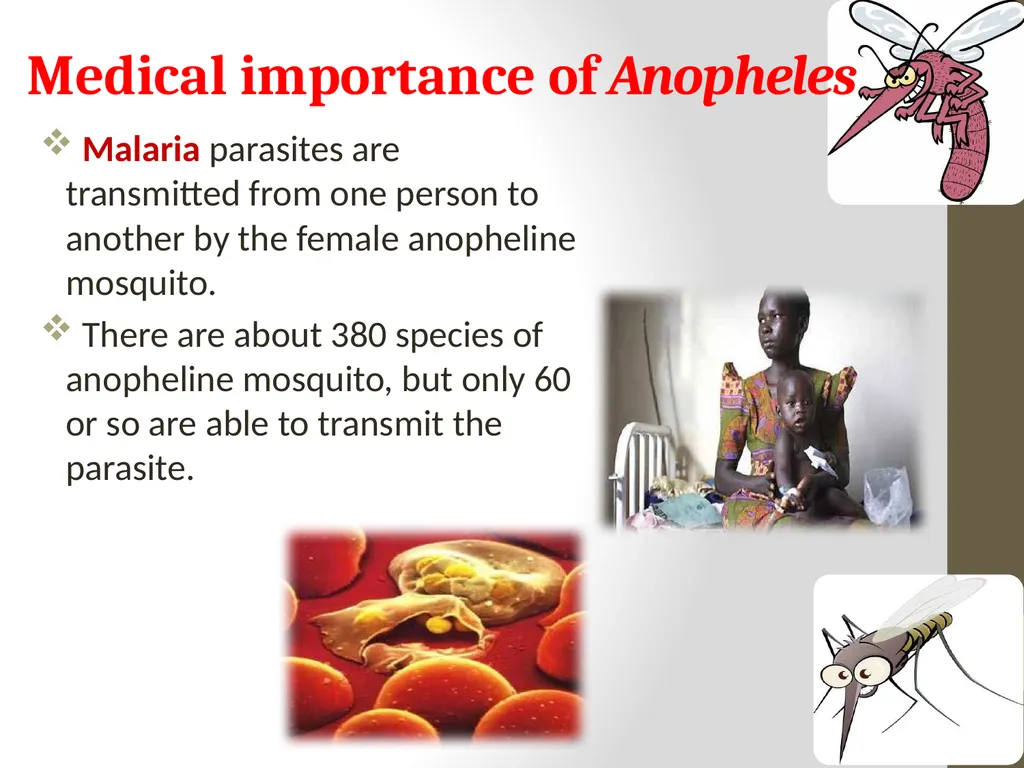
Medical importance of Anopheles Malaria parasites are transmitted from one person to another by the female anopheline mosquito.
There are about 380 species of anopheline mosquito, but only 60 or so are able to transmit the parasite.<br>
42
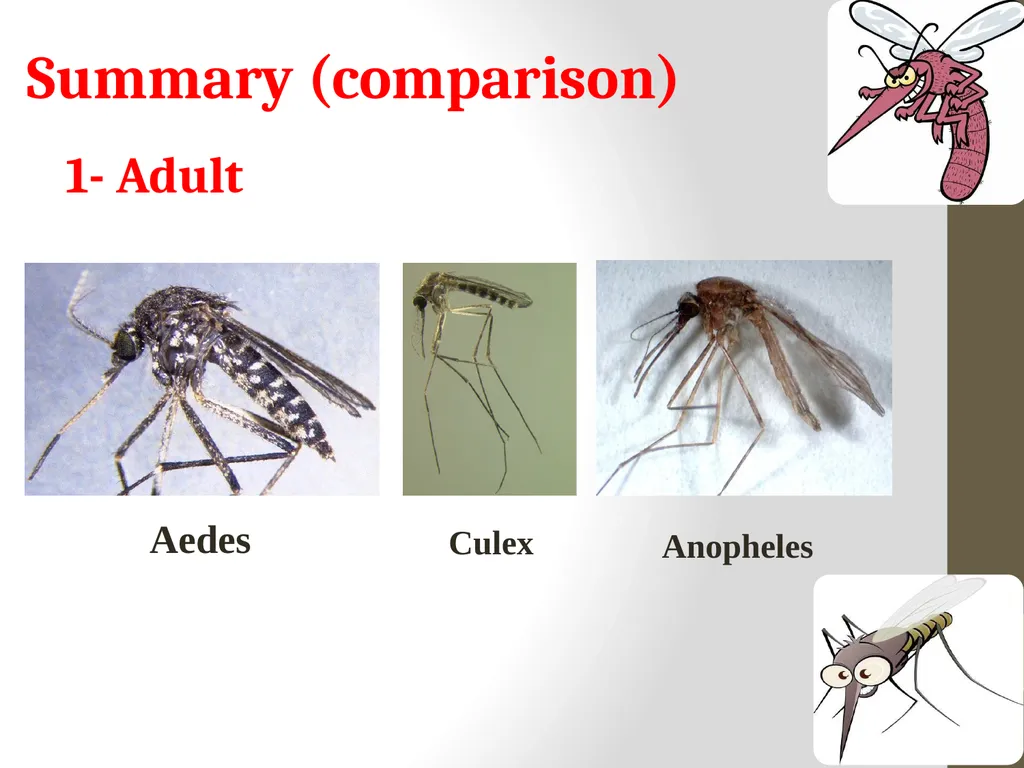
Summary (comparison) 1- Adult Aedes Culex Anopheles<br>
43
2- Eggs (3 strategies) Singly on water surface
Anopheles
Singly in a pile, on moist substrates
Aedes
Form of a raft, on water surface
Culex Aedes Culex Anopheles<br>
44
3-Larval Stage – Growth Stage Anopheles<br>
45
4- Pupa Aedes Culex Anopheles Culicine Anopheline<br>
46
Mosquito Pupa and Larvae<br>
47
Anopheles Pupa and Larvae<br>
48
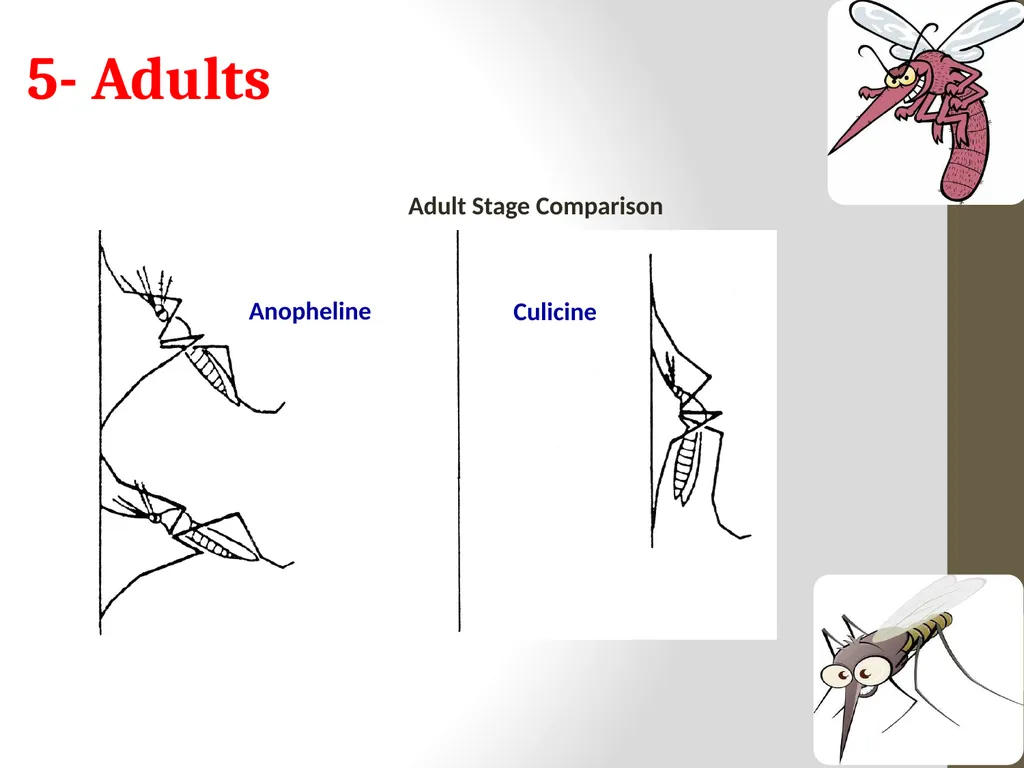
5- Adults Culicine Anopheline Adult Stage Comparison<br>
49
females males Anopheline Culicine Comparison of male and female Anophelines vs. Culicines<br>