
‘Mostly Harmless Econometrics: A non Empiricist’s
PT
Published · 60 slides · 0 views

1 / 1


Description
Mostly Harmless Econometrics: A non Empiricists Companion Professor Paul Downward Association for Heterodox Economics Postgraduate workshop 10th-11th January 2019 Context Draws on reflections that were derived from initial issues raised
Related Topics
Share
Embed code
Download this presentation From Below
"‘Mostly Harmless Econometrics: A non Empiricist’s" is the property of its rightful owner. Permission is granted to download and print the materials on this website for personal, non-commercial use only, and to display it on your personal computer provided you do not modify the materials and that you retain all copyright notices contained in the materials. By downloading content from our website, you accept the terms of this agreement.
Presentation Transcript
01
‘Mostly Harmless Econometrics: A non Empiricist’s Companion’ Professor Paul Downward
Association for Heterodox Economics Postgraduate workshop 10th-11th January 2019<br>
Association for Heterodox Economics Postgraduate workshop 10th-11th January 2019<br>
02
Context Draws on reflections that were derived from initial issues raised in my PhD
Core ideas published e.g. with Andrew Mearman (see reading)
(marginal) reflection on some recent developments in Econometrics<br>
Core ideas published e.g. with Andrew Mearman (see reading)
(marginal) reflection on some recent developments in Econometrics<br>
03
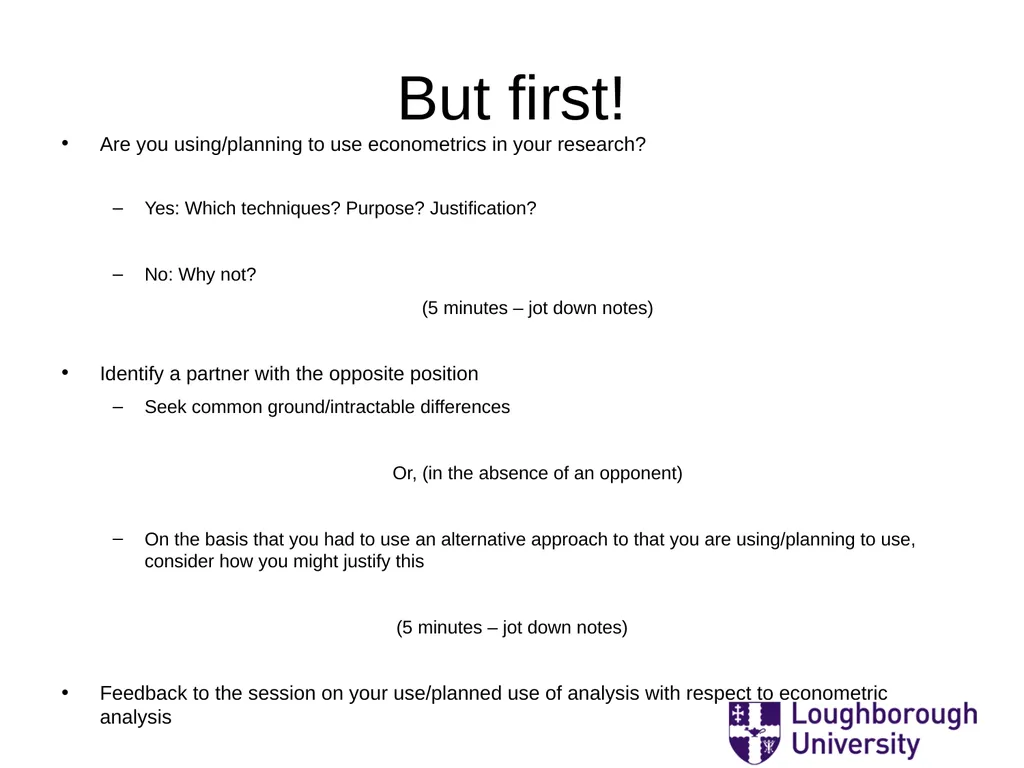
But first! Are you using/planning to use econometrics in your research?
Yes: Which techniques? Purpose? Justification?
No: Why not?
(5 minutes – jot down notes)
Identify a partner with the opposite position
Seek common ground/intractable differences
Or, (in the absence of an opponent)
On the basis that you had to use an alternative approach to that you are using/planning to use, consider how you might justify this
(5 minutes – jot down notes)
Feedback to the session on your use/planned use of analysis with respect to econometric analysis<br>
Yes: Which techniques? Purpose? Justification?
No: Why not?
(5 minutes – jot down notes)
Identify a partner with the opposite position
Seek common ground/intractable differences
Or, (in the absence of an opponent)
On the basis that you had to use an alternative approach to that you are using/planning to use, consider how you might justify this
(5 minutes – jot down notes)
Feedback to the session on your use/planned use of analysis with respect to econometric analysis<br>
04
Maybe this is trivial?<br>
05
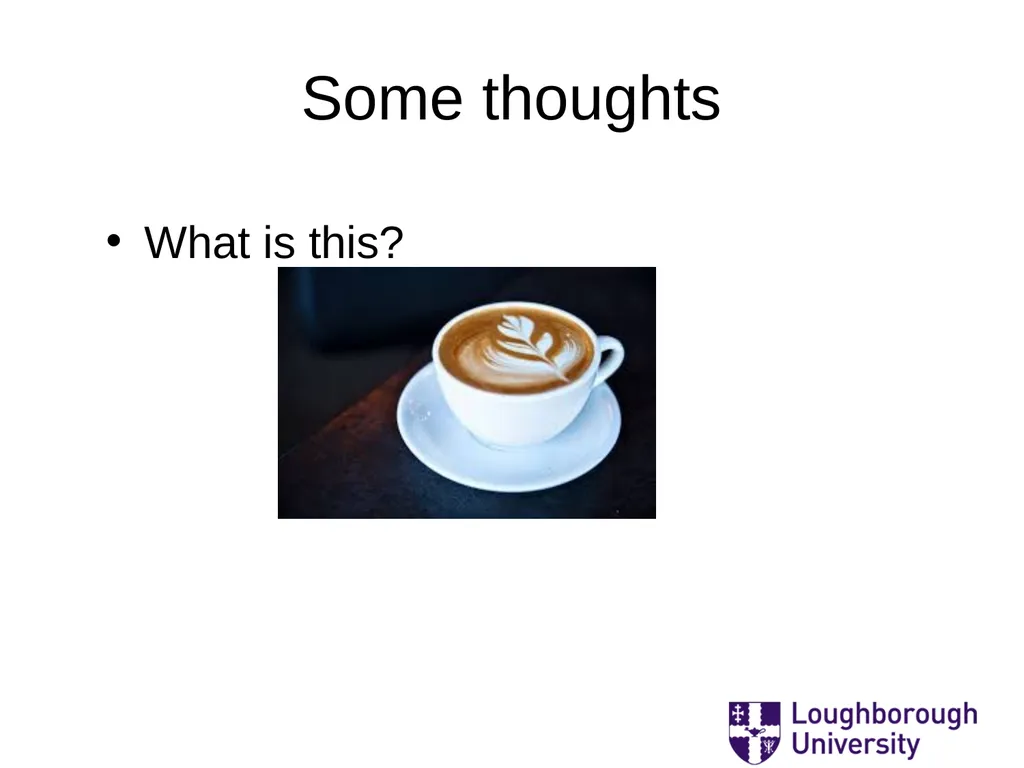
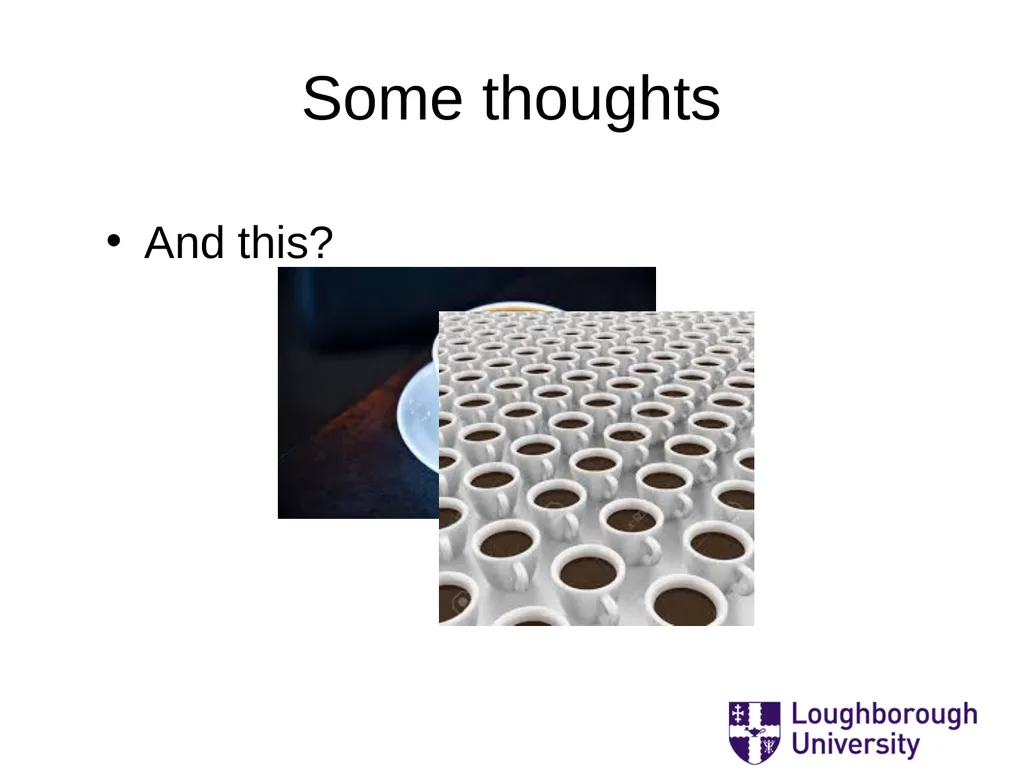
Some thoughts What is this?<br>
06
Some thoughts And this?<br>
07
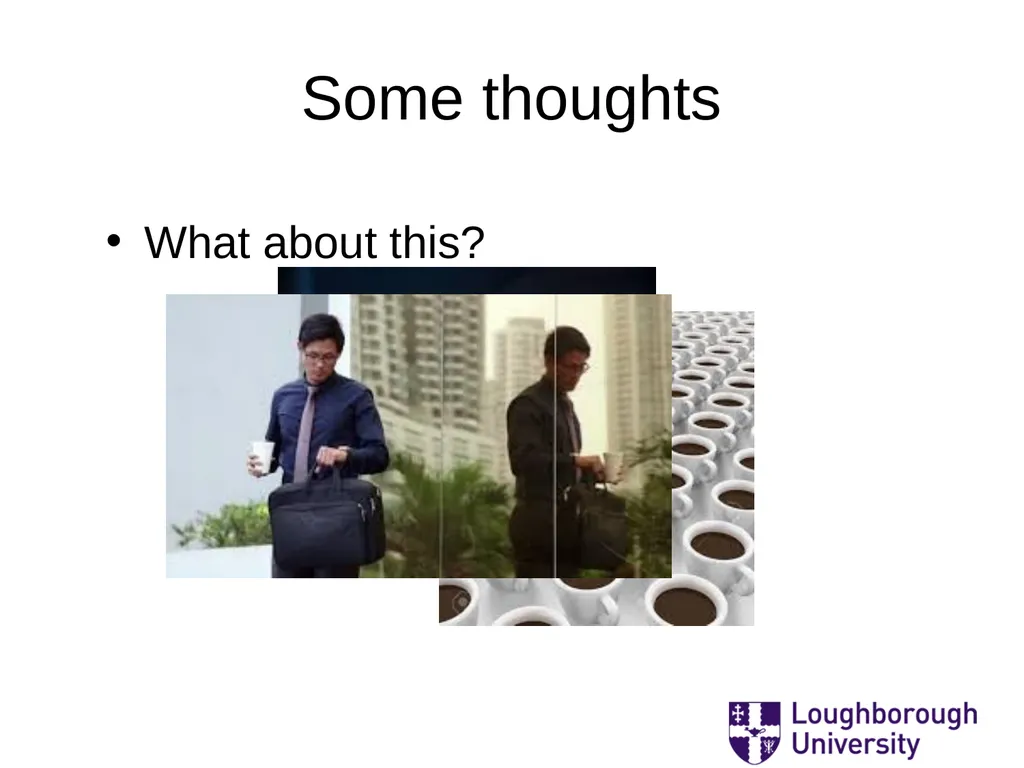
Some thoughts What about this?<br>
08
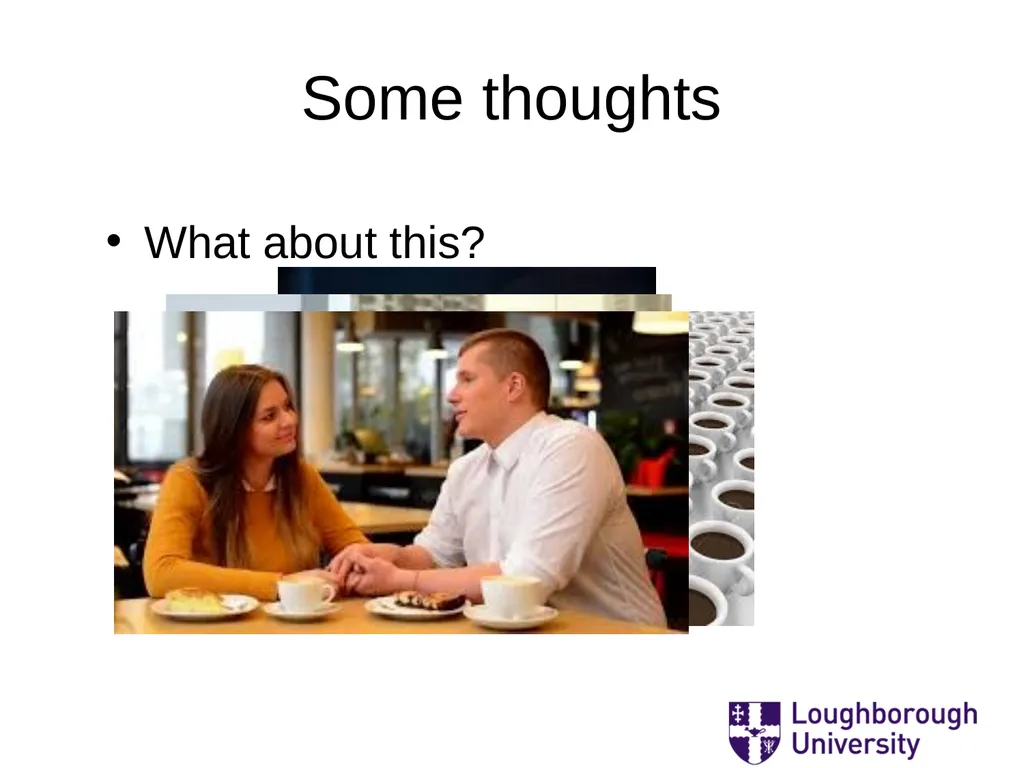
Some thoughts What about this?<br>
09
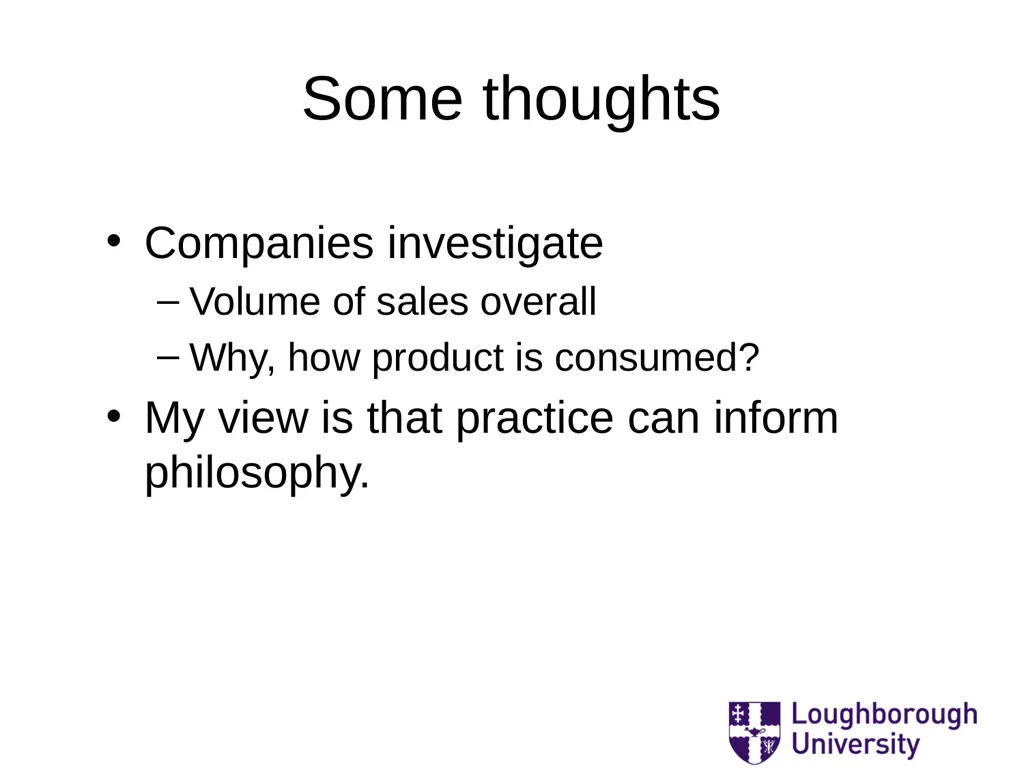
Some thoughts Companies investigate
Volume of sales overall
Why, how product is consumed?
My view is that practice can inform philosophy.<br>
Volume of sales overall
Why, how product is consumed?
My view is that practice can inform philosophy.<br>
10
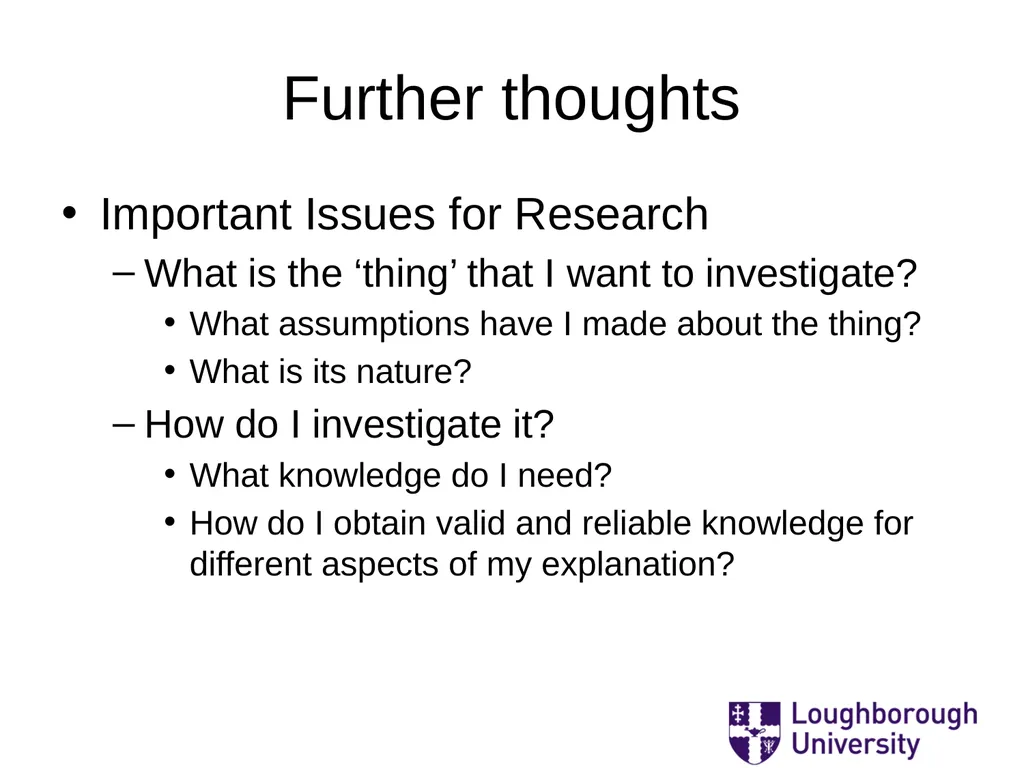
Further thoughts Important Issues for Research
What is the ‘thing’ that I want to investigate?
What assumptions have I made about the thing?
What is its nature?
How do I investigate it?
What knowledge do I need?
How do I obtain valid and reliable knowledge for different aspects of my explanation?<br>
What is the ‘thing’ that I want to investigate?
What assumptions have I made about the thing?
What is its nature?
How do I investigate it?
What knowledge do I need?
How do I obtain valid and reliable knowledge for different aspects of my explanation?<br>
11
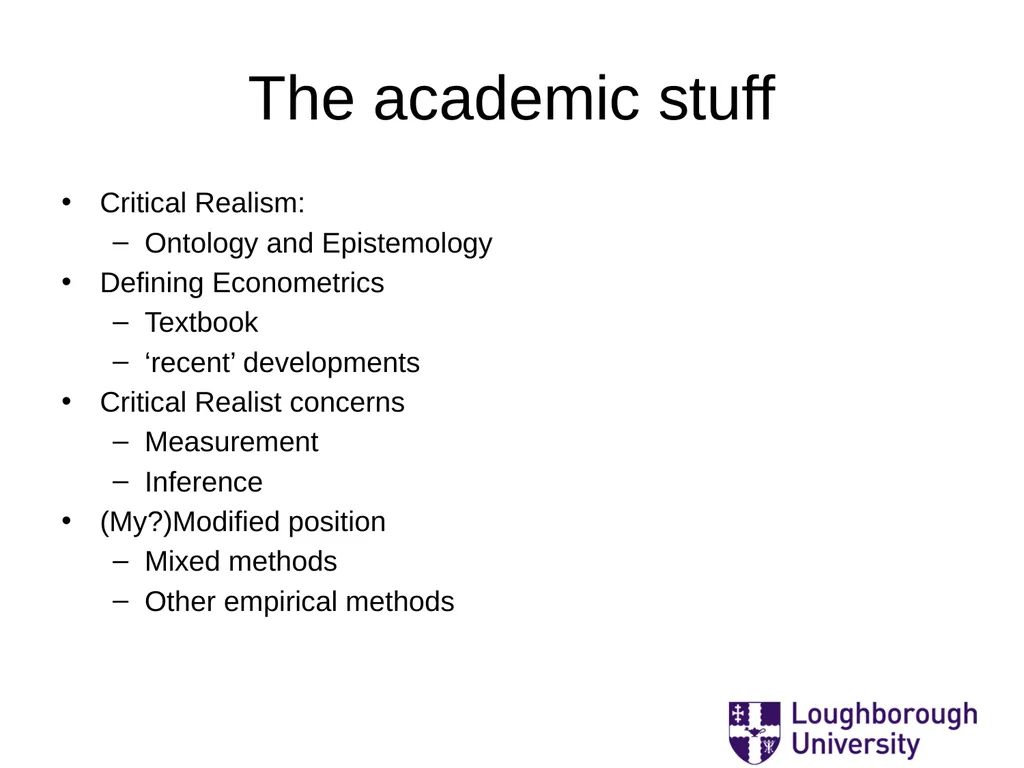
The academic stuff Critical Realism:
Ontology and Epistemology
Defining Econometrics
Textbook
‘recent’ developments
Critical Realist concerns
Measurement
Inference
(My?)Modified position
Mixed methods
Other empirical methods<br>
Ontology and Epistemology
Defining Econometrics
Textbook
‘recent’ developments
Critical Realist concerns
Measurement
Inference
(My?)Modified position
Mixed methods
Other empirical methods<br>
12
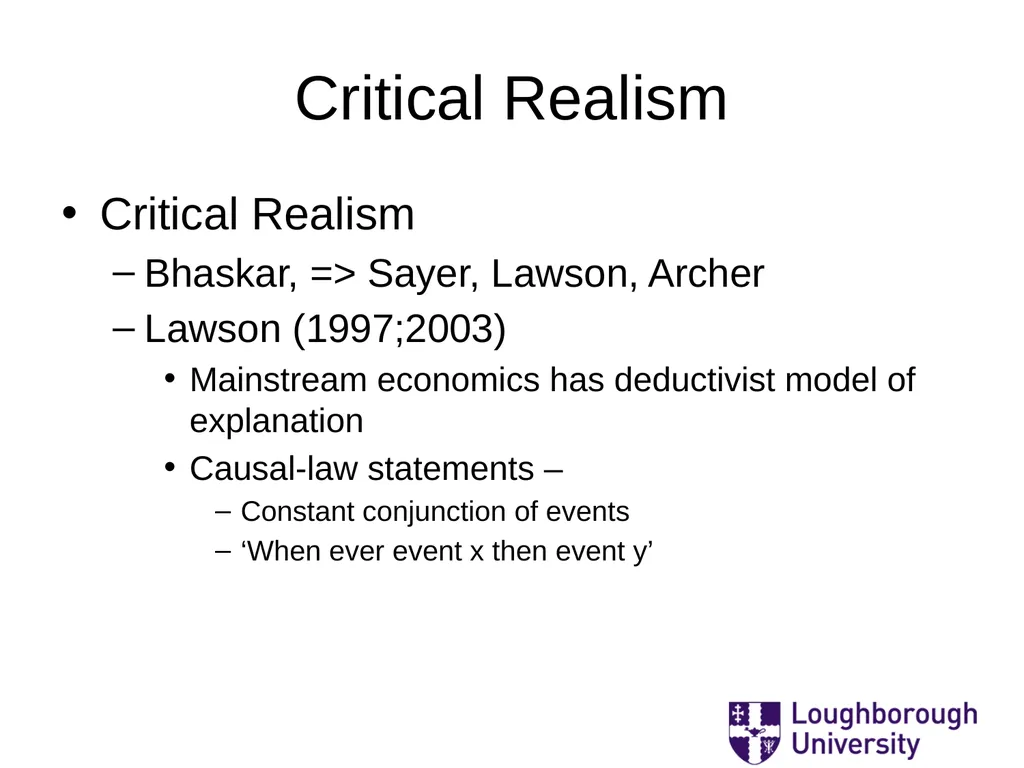
Critical Realism Critical Realism
Bhaskar, => Sayer, Lawson, Archer
Lawson (1997;2003)
Mainstream economics has deductivist model of explanation
Causal-law statements –
Constant conjunction of events
‘When ever event x then event y’<br>
Bhaskar, => Sayer, Lawson, Archer
Lawson (1997;2003)
Mainstream economics has deductivist model of explanation
Causal-law statements –
Constant conjunction of events
‘When ever event x then event y’<br>
13
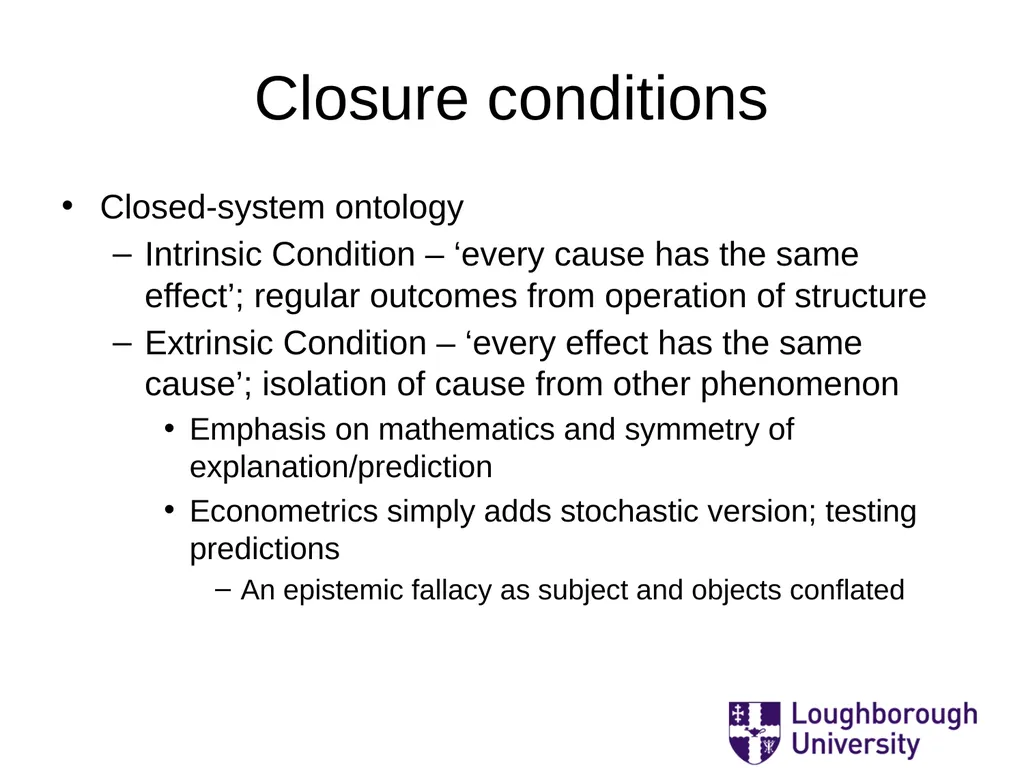
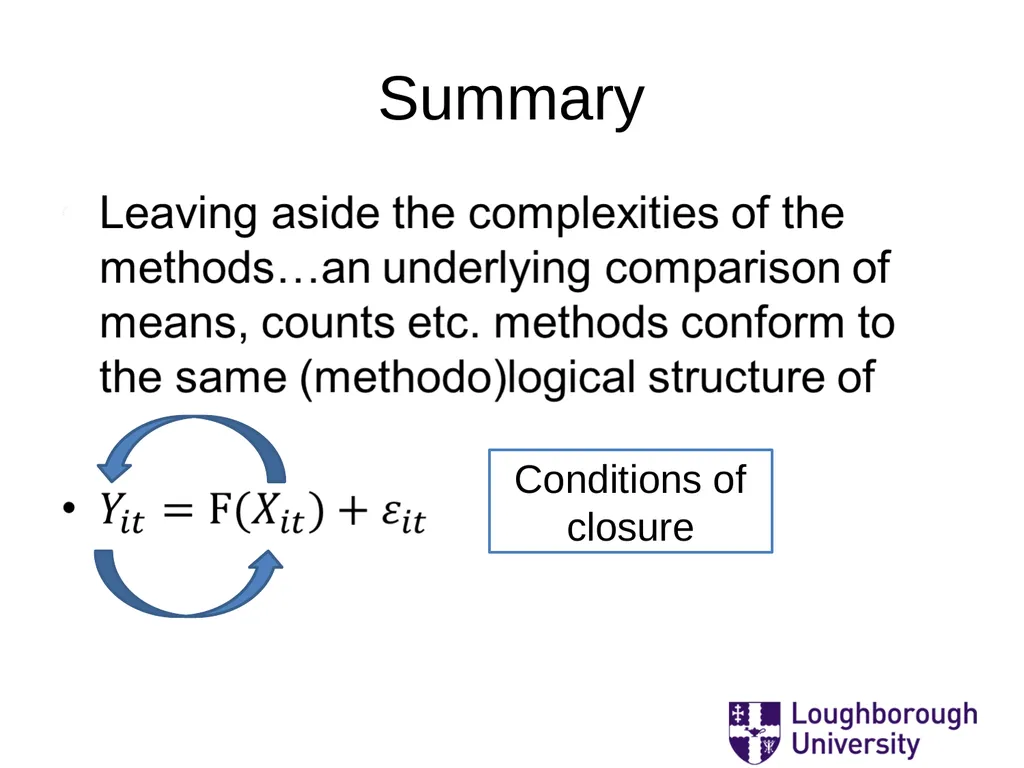
Closure conditions Closed-system ontology
Intrinsic Condition – ‘every cause has the same effect’; regular outcomes from operation of structure
Extrinsic Condition – ‘every effect has the same cause’; isolation of cause from other phenomenon
Emphasis on mathematics and symmetry of explanation/prediction
Econometrics simply adds stochastic version; testing predictions
An epistemic fallacy as subject and objects conflated<br>
Intrinsic Condition – ‘every cause has the same effect’; regular outcomes from operation of structure
Extrinsic Condition – ‘every effect has the same cause’; isolation of cause from other phenomenon
Emphasis on mathematics and symmetry of explanation/prediction
Econometrics simply adds stochastic version; testing predictions
An epistemic fallacy as subject and objects conflated<br>
14
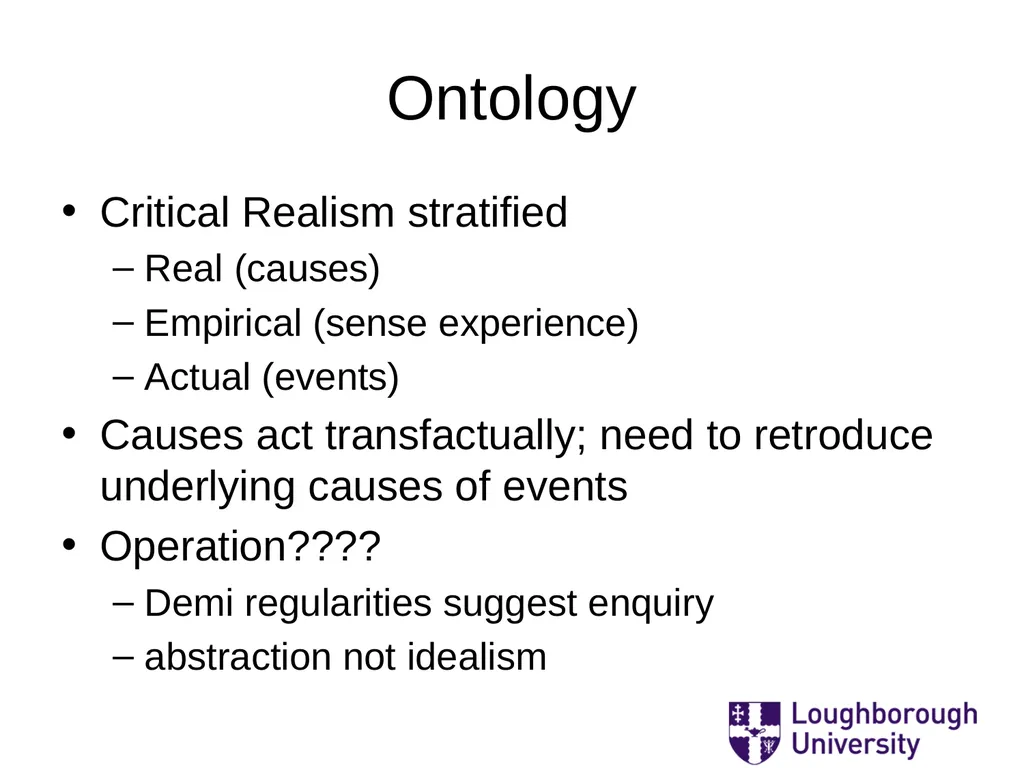
Ontology Critical Realism stratified
Real (causes)
Empirical (sense experience)
Actual (events)
Causes act transfactually; need to retroduce underlying causes of events
Operation????
Demi regularities suggest enquiry
abstraction not idealism<br>
Real (causes)
Empirical (sense experience)
Actual (events)
Causes act transfactually; need to retroduce underlying causes of events
Operation????
Demi regularities suggest enquiry
abstraction not idealism<br>
15
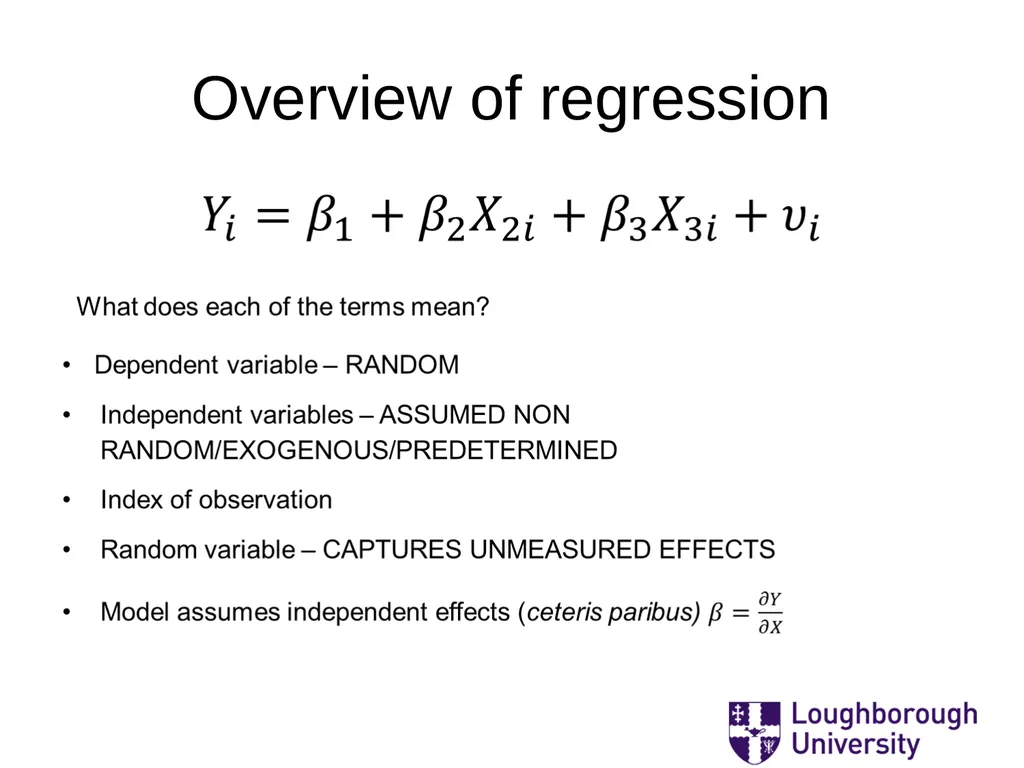
Overview of regression<br>
16
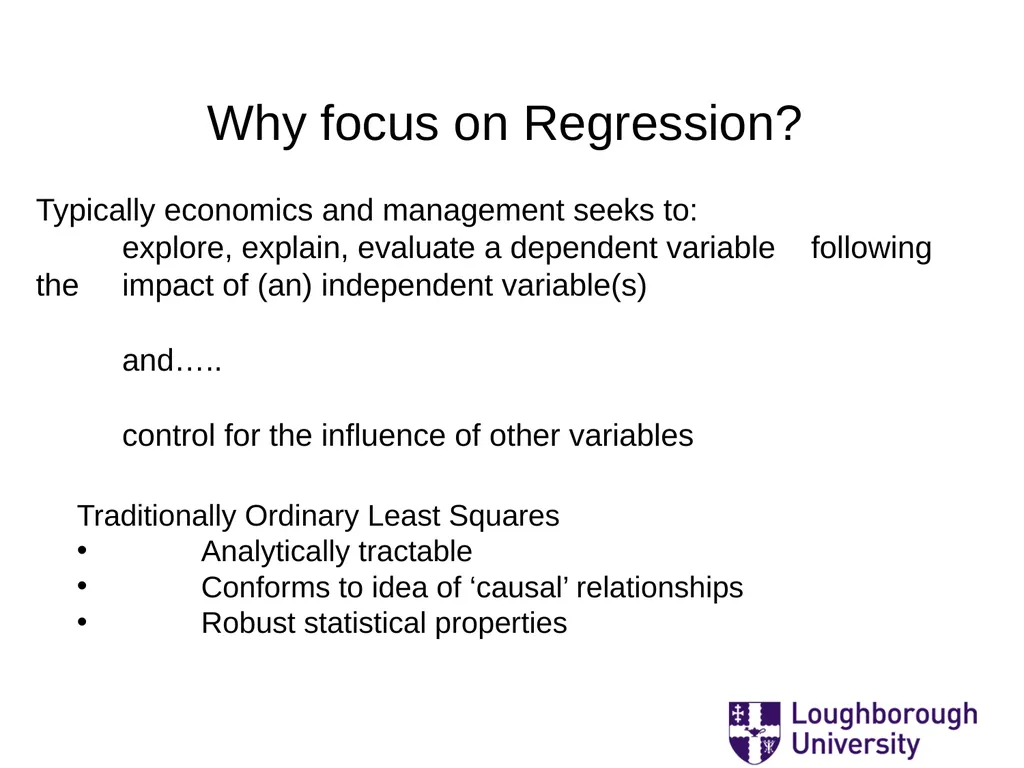
Why focus on Regression? Typically economics and management seeks to:
explore, explain, evaluate a dependent variable following the impact of (an) independent variable(s)
and…..
control for the influence of other variables Traditionally Ordinary Least Squares
Analytically tractable
Conforms to idea of ‘causal’ relationships
Robust statistical properties<br>
explore, explain, evaluate a dependent variable following the impact of (an) independent variable(s)
and…..
control for the influence of other variables Traditionally Ordinary Least Squares
Analytically tractable
Conforms to idea of ‘causal’ relationships
Robust statistical properties<br>
17
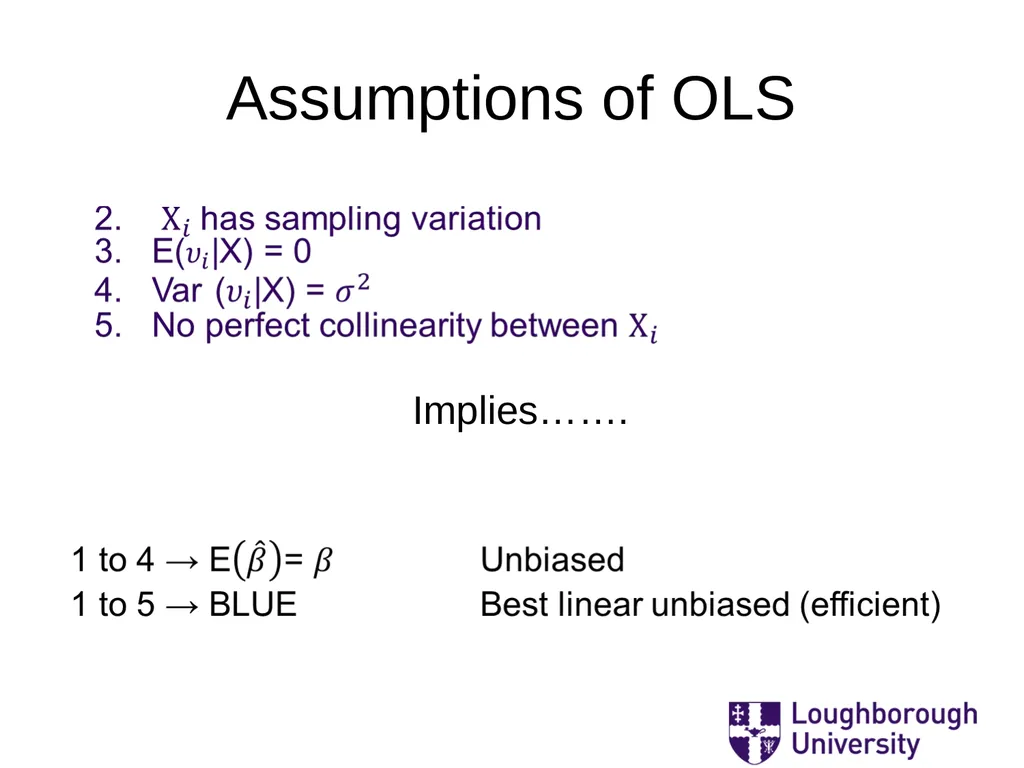
Assumptions of OLS Implies…….<br>
18
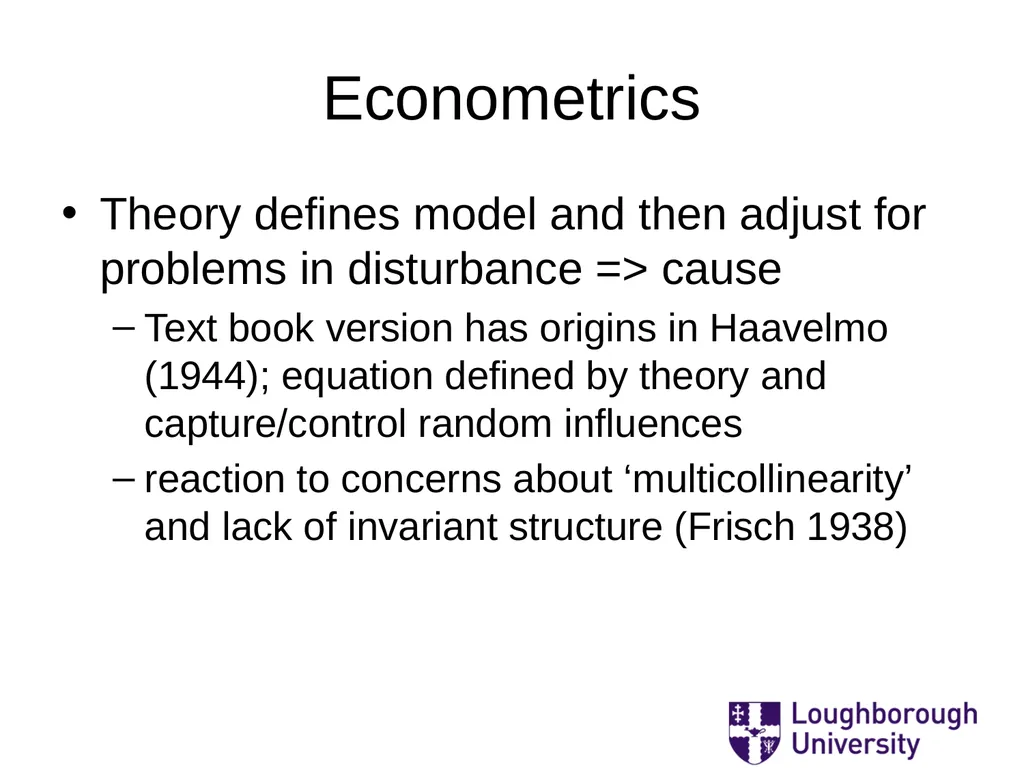
Econometrics Theory defines model and then adjust for problems in disturbance => cause
Text book version has origins in Haavelmo (1944); equation defined by theory and capture/control random influences
reaction to concerns about ‘multicollinearity’ and lack of invariant structure (Frisch 1938)<br>
Text book version has origins in Haavelmo (1944); equation defined by theory and capture/control random influences
reaction to concerns about ‘multicollinearity’ and lack of invariant structure (Frisch 1938)<br>
19
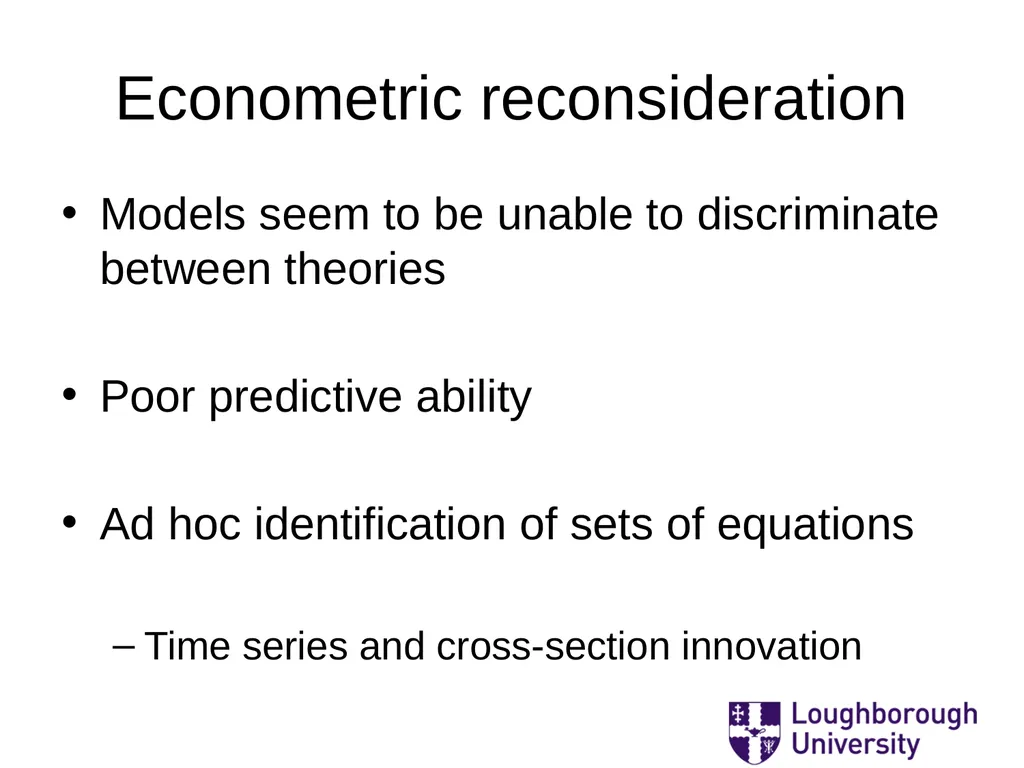
Econometric reconsideration Models seem to be unable to discriminate between theories
Poor predictive ability
Ad hoc identification of sets of equations
Time series and cross-section innovation<br>
Poor predictive ability
Ad hoc identification of sets of equations
Time series and cross-section innovation<br>
20
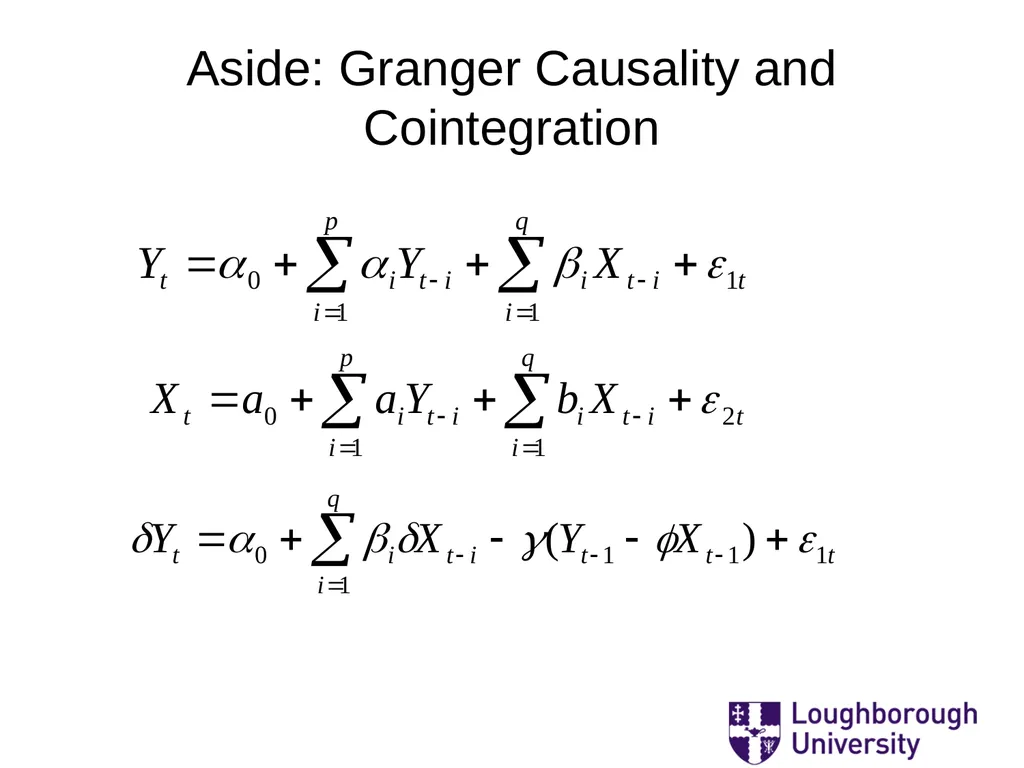
Aside: Granger Causality and Cointegration<br>
21
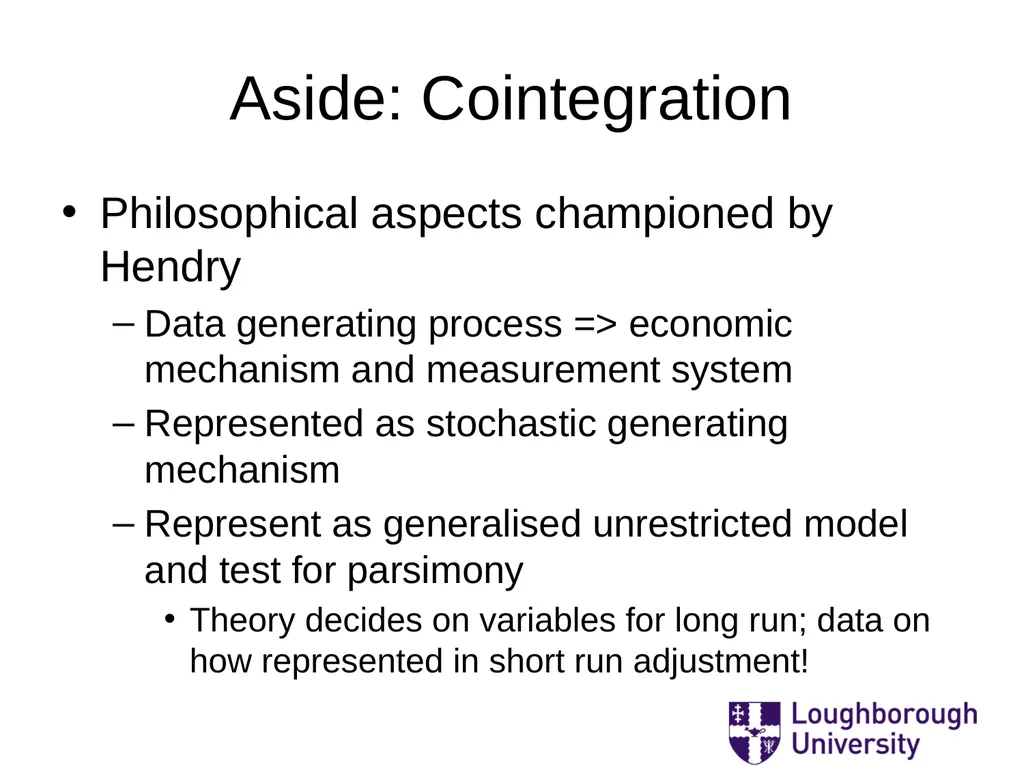
Aside: Cointegration Philosophical aspects championed by Hendry
Data generating process => economic mechanism and measurement system
Represented as stochastic generating mechanism
Represent as generalised unrestricted model and test for parsimony
Theory decides on variables for long run; data on how represented in short run adjustment!<br>
Data generating process => economic mechanism and measurement system
Represented as stochastic generating mechanism
Represent as generalised unrestricted model and test for parsimony
Theory decides on variables for long run; data on how represented in short run adjustment!<br>
22
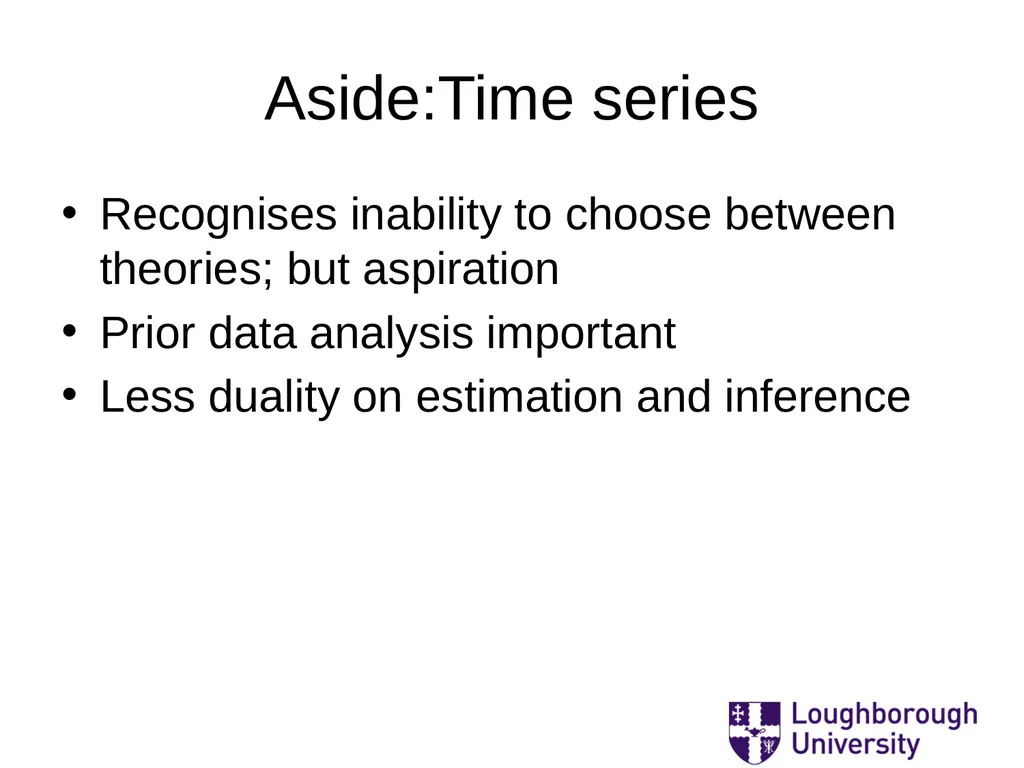
Aside:Time series Recognises inability to choose between theories; but aspiration
Prior data analysis important
Less duality on estimation and inference<br>
Prior data analysis important
Less duality on estimation and inference<br>
23
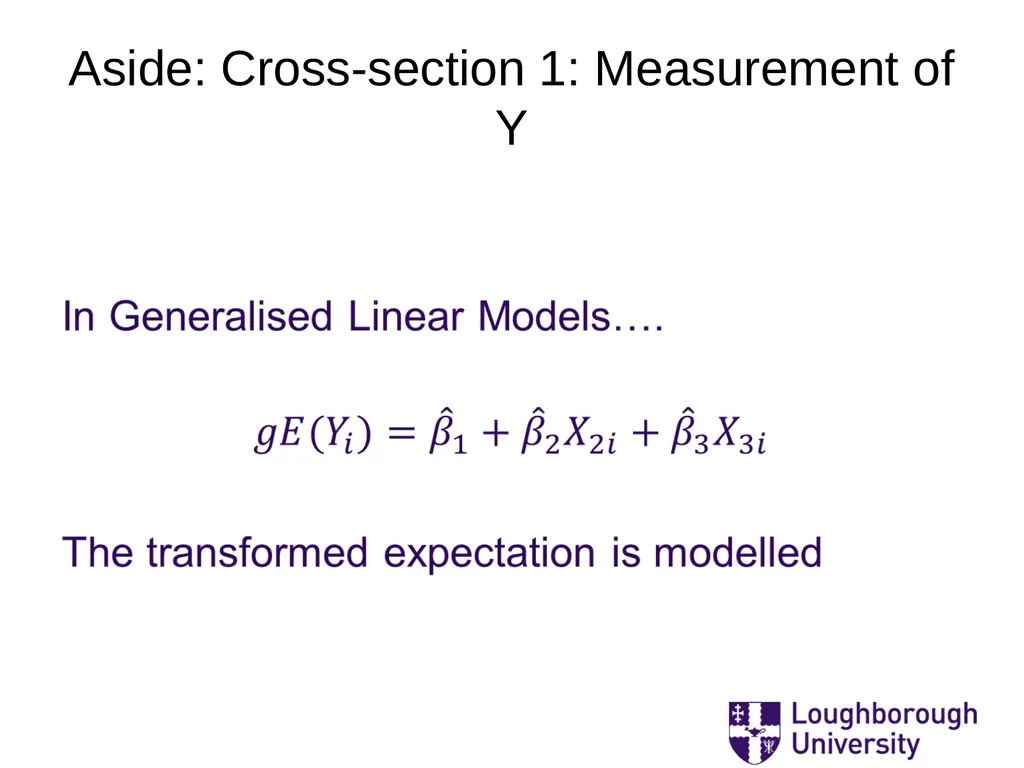
Aside: Cross-section 1: Measurement of Y<br>
24
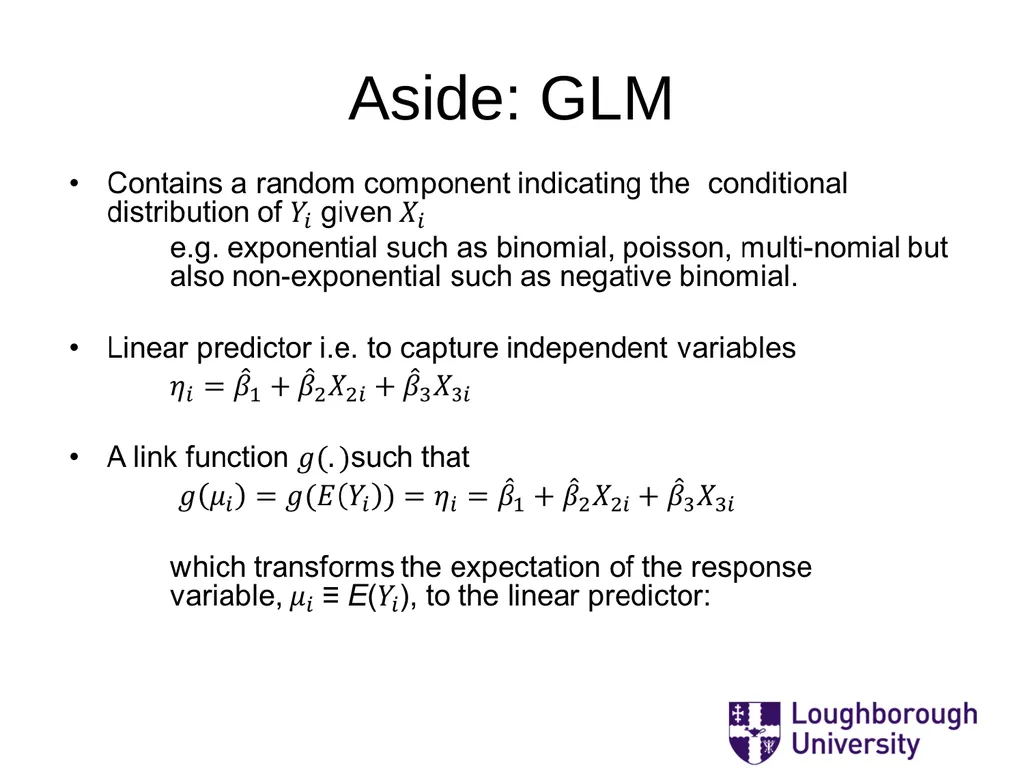
Aside: GLM<br>
25
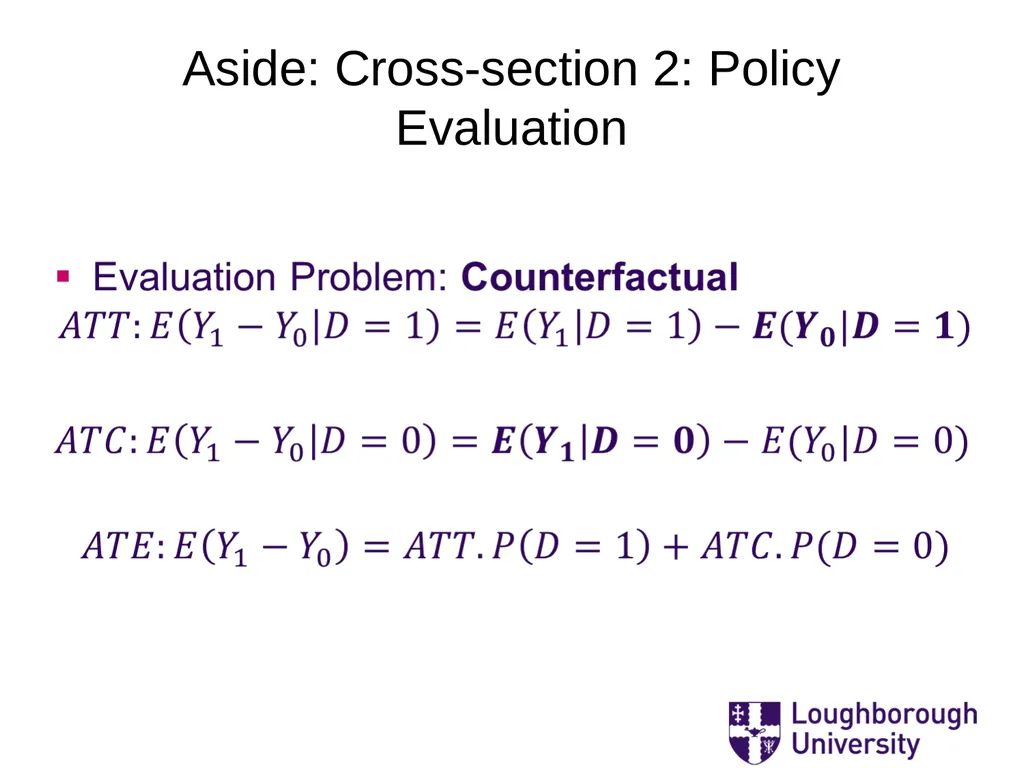
Aside: Cross-section 2: Policy Evaluation<br>
26
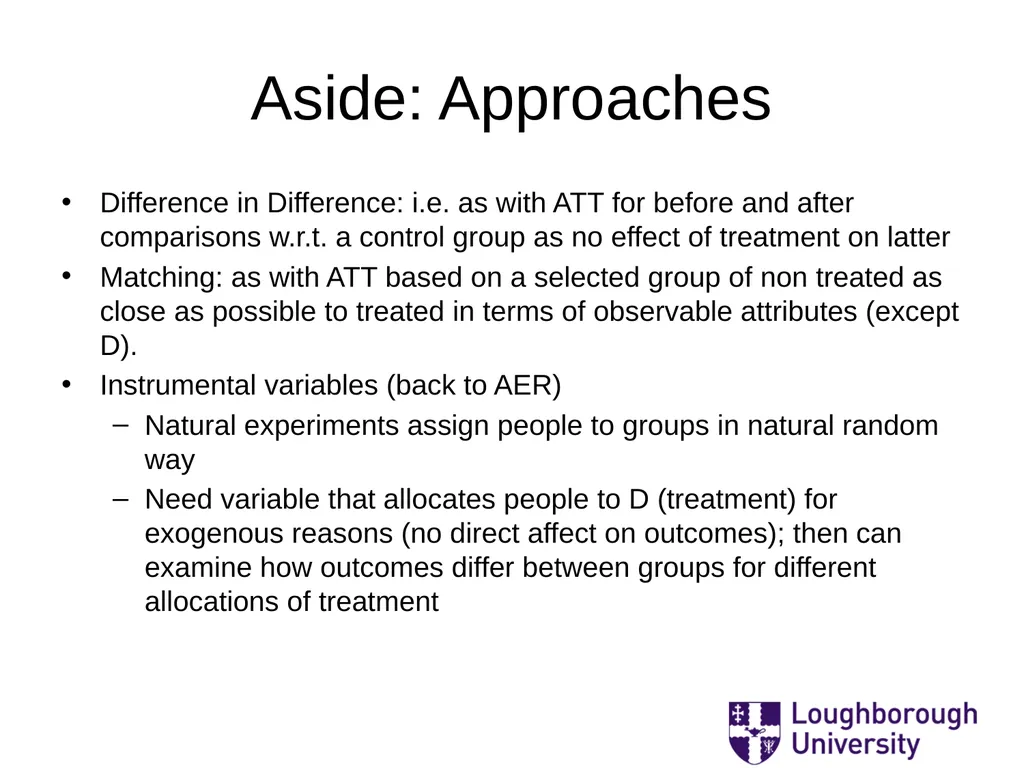
Aside: Approaches Difference in Difference: i.e. as with ATT for before and after comparisons w.r.t. a control group as no effect of treatment on latter
Matching: as with ATT based on a selected group of non treated as close as possible to treated in terms of observable attributes (except D).
Instrumental variables (back to AER)
Natural experiments assign people to groups in natural random way
Need variable that allocates people to D (treatment) for exogenous reasons (no direct affect on outcomes); then can examine how outcomes differ between groups for different allocations of treatment<br>
Matching: as with ATT based on a selected group of non treated as close as possible to treated in terms of observable attributes (except D).
Instrumental variables (back to AER)
Natural experiments assign people to groups in natural random way
Need variable that allocates people to D (treatment) for exogenous reasons (no direct affect on outcomes); then can examine how outcomes differ between groups for different allocations of treatment<br>
27
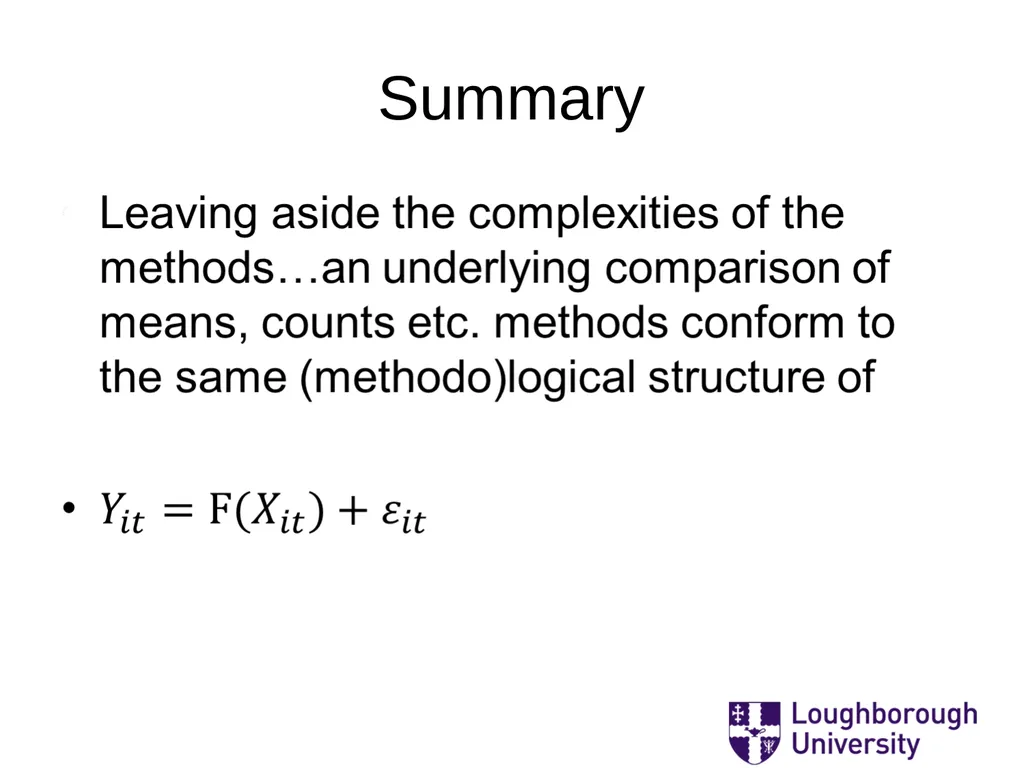
Summary<br>
28
Summary Conditions of closure<br>
29
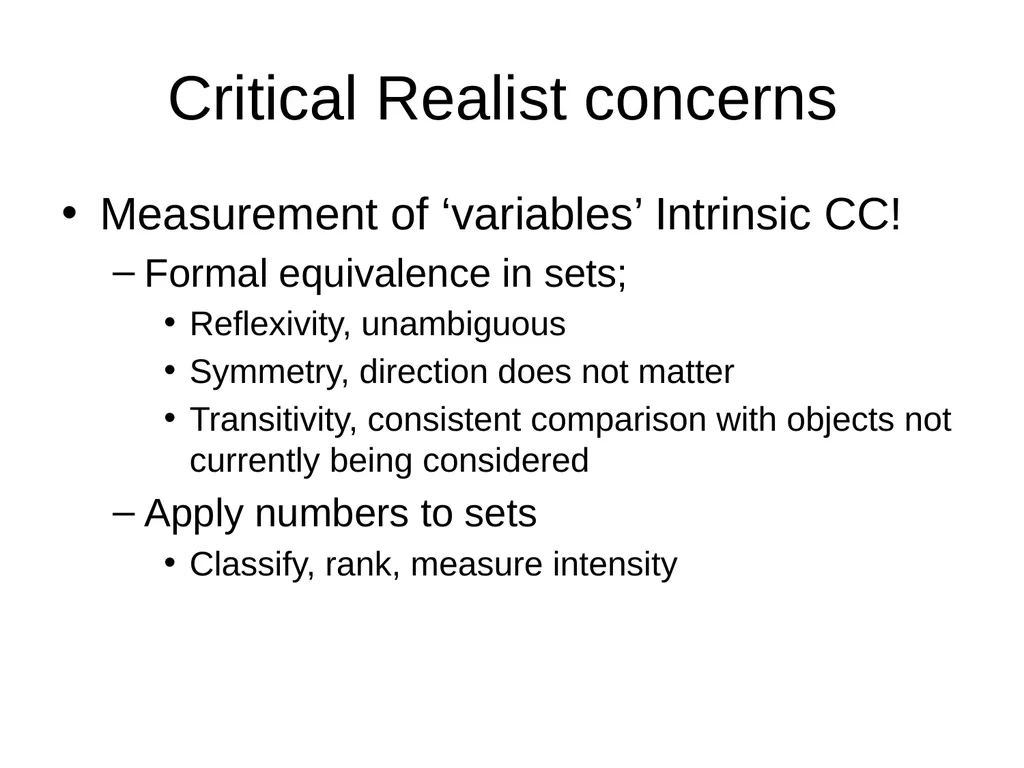
Critical Realist concerns Measurement of ‘variables’ Intrinsic CC!
Formal equivalence in sets;
Reflexivity, unambiguous
Symmetry, direction does not matter
Transitivity, consistent comparison with objects not currently being considered
Apply numbers to sets
Classify, rank, measure intensity<br>
Formal equivalence in sets;
Reflexivity, unambiguous
Symmetry, direction does not matter
Transitivity, consistent comparison with objects not currently being considered
Apply numbers to sets
Classify, rank, measure intensity<br>
30
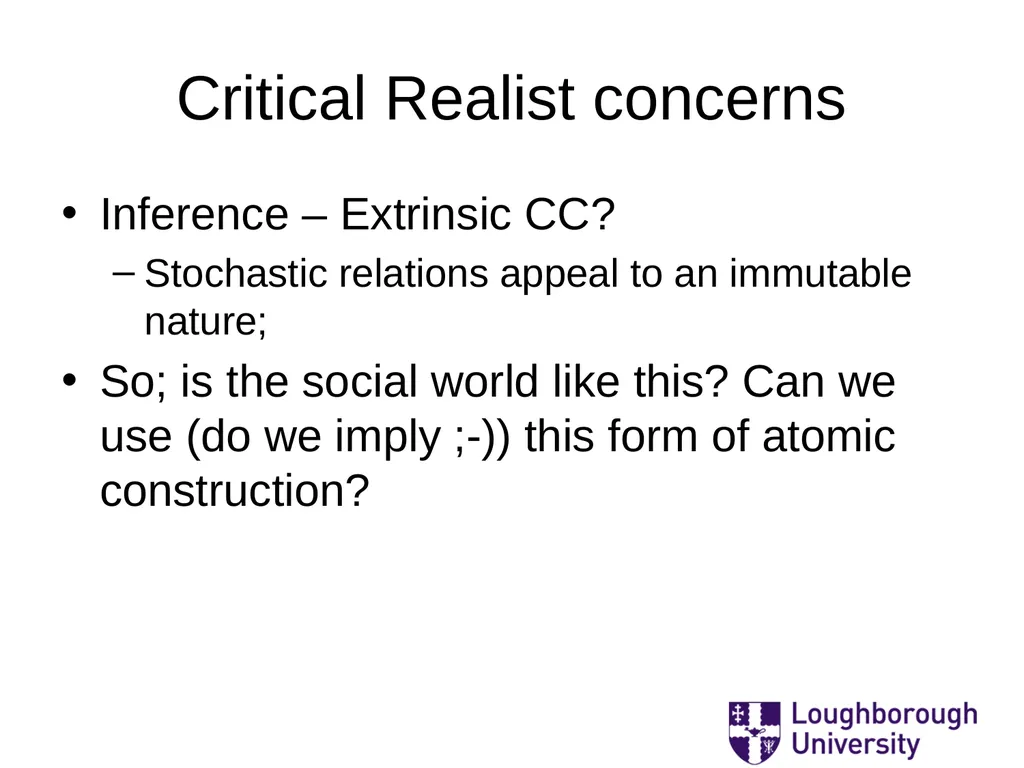
Critical Realist concerns Inference – Extrinsic CC?
Stochastic relations appeal to an immutable nature;
So; is the social world like this? Can we use (do we imply ;-)) this form of atomic construction?<br>
Stochastic relations appeal to an immutable nature;
So; is the social world like this? Can we use (do we imply ;-)) this form of atomic construction?<br>
31
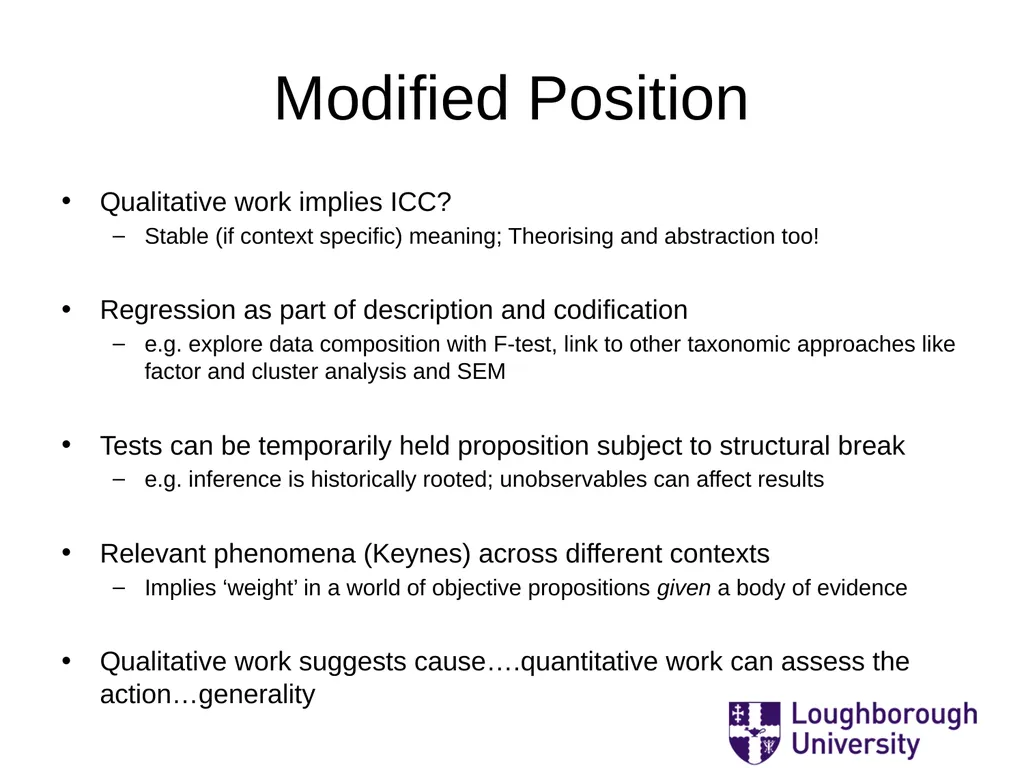
Modified Position Qualitative work implies ICC?
Stable (if context specific) meaning; Theorising and abstraction too!
Regression as part of description and codification
e.g. explore data composition with F-test, link to other taxonomic approaches like factor and cluster analysis and SEM
Tests can be temporarily held proposition subject to structural break
e.g. inference is historically rooted; unobservables can affect results
Relevant phenomena (Keynes) across different contexts
Implies ‘weight’ in a world of objective propositions given a body of evidence
Qualitative work suggests cause….quantitative work can assess the action…generality<br>
Stable (if context specific) meaning; Theorising and abstraction too!
Regression as part of description and codification
e.g. explore data composition with F-test, link to other taxonomic approaches like factor and cluster analysis and SEM
Tests can be temporarily held proposition subject to structural break
e.g. inference is historically rooted; unobservables can affect results
Relevant phenomena (Keynes) across different contexts
Implies ‘weight’ in a world of objective propositions given a body of evidence
Qualitative work suggests cause….quantitative work can assess the action…generality<br>
32
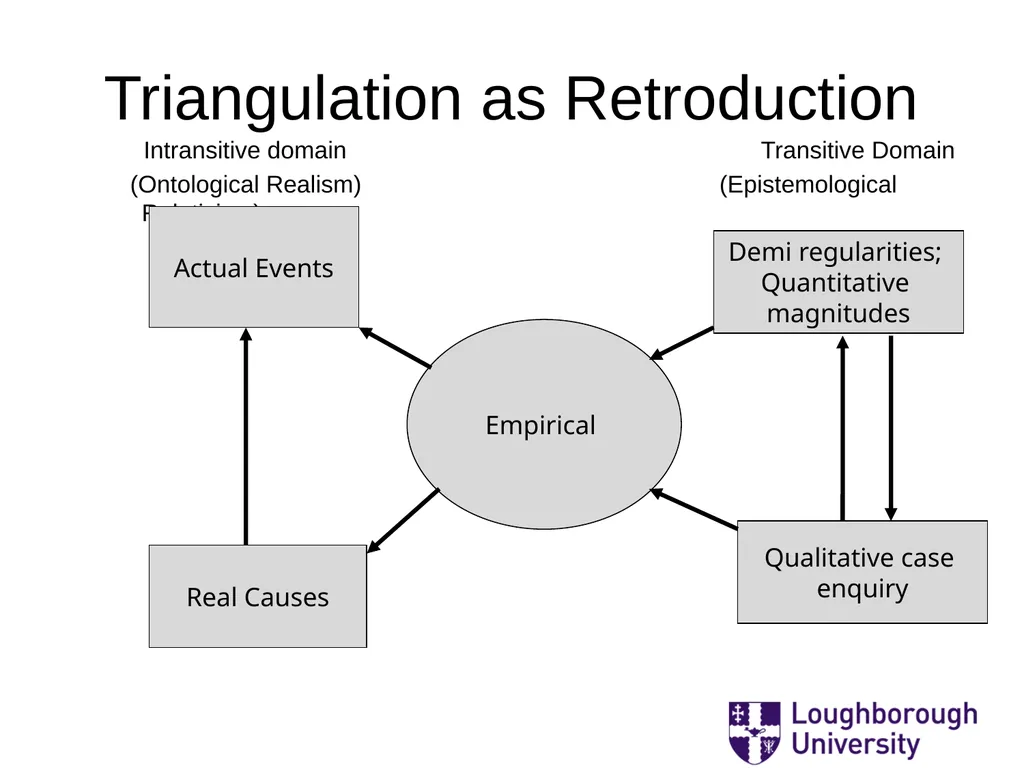
Triangulation as Retroduction Intransitive domain Transitive Domain
(Ontological Realism) (Epistemological Relativism) Actual Events Real Causes Demi regularities;
Quantitative
magnitudes Qualitative case
enquiry Empirical<br>
(Ontological Realism) (Epistemological Relativism) Actual Events Real Causes Demi regularities;
Quantitative
magnitudes Qualitative case
enquiry Empirical<br>
33
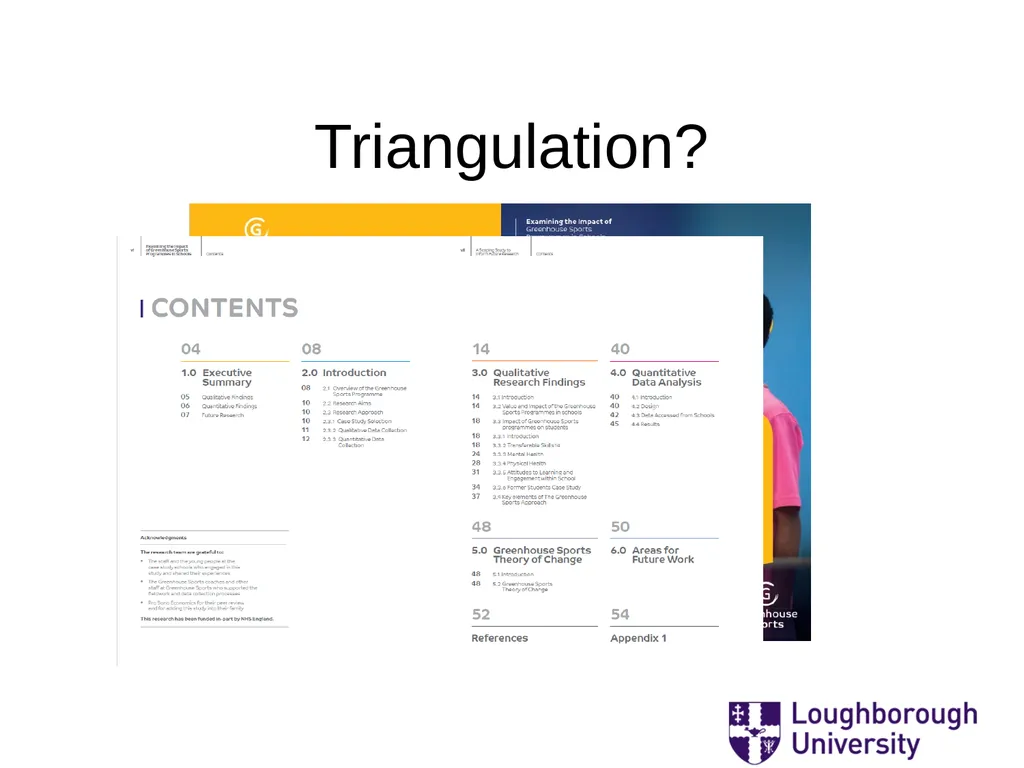
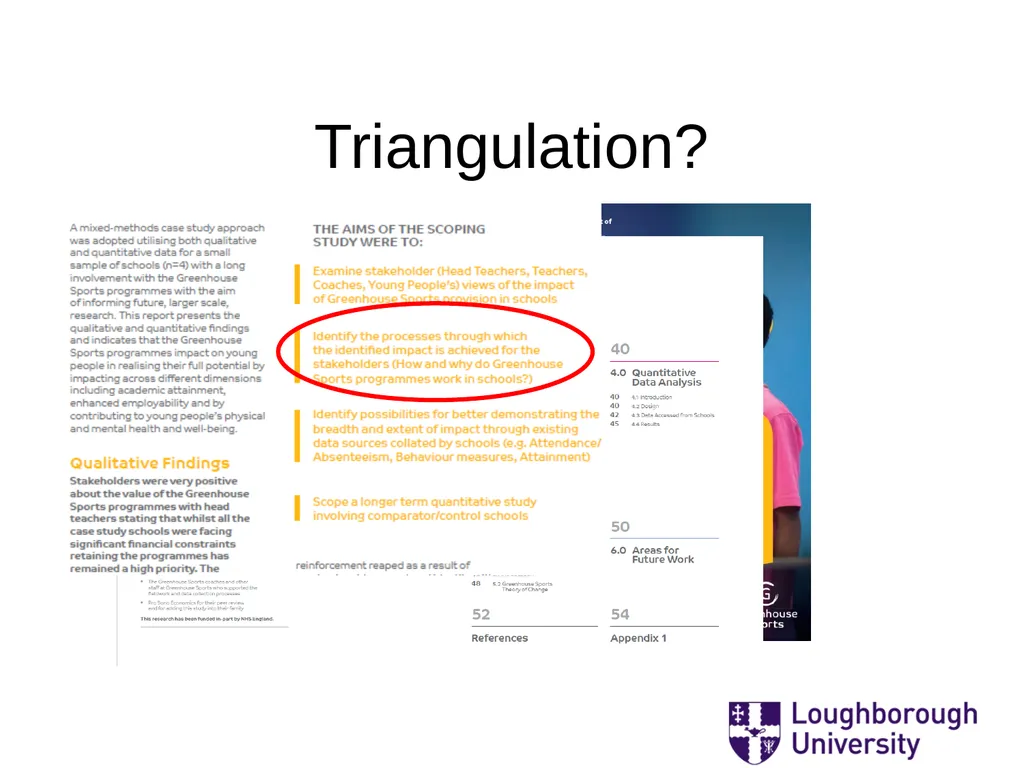
Triangulation?<br>
34
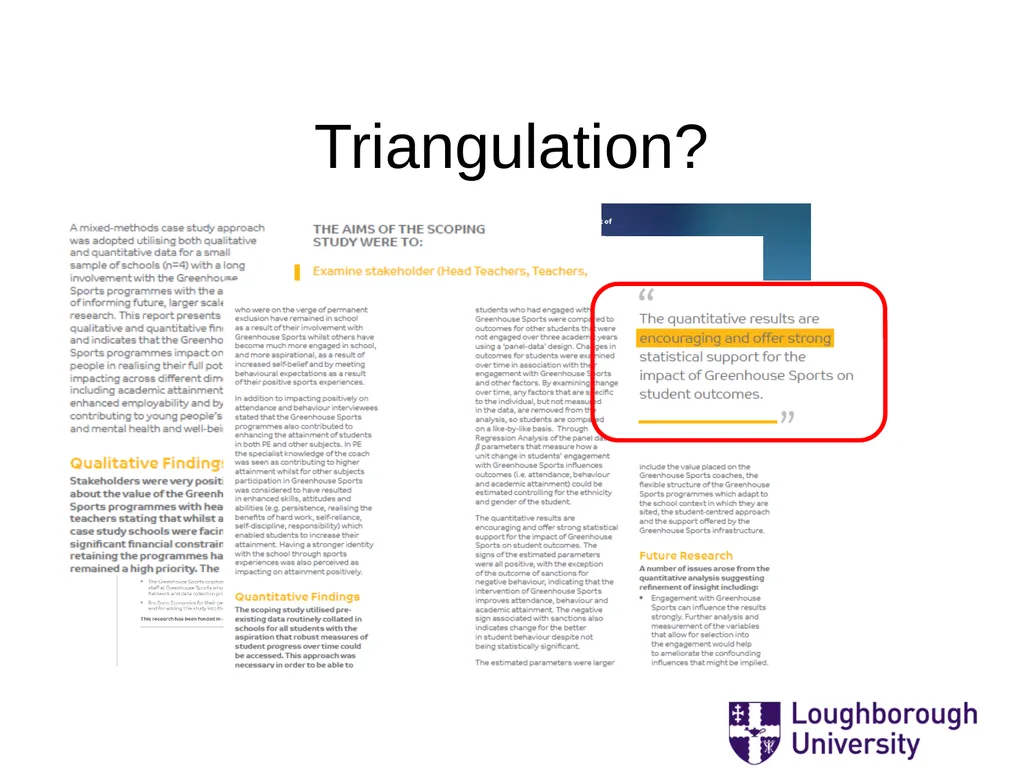
Triangulation?<br>
35
Triangulation?<br>
36
Triangulation?<br>
37
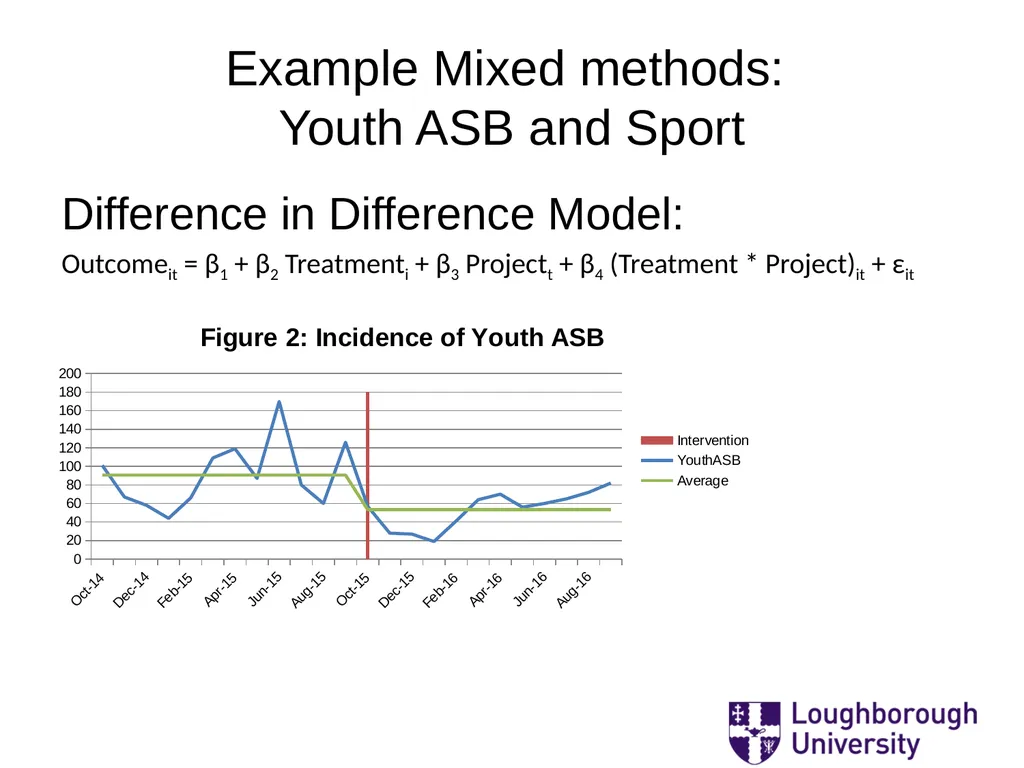
Example Mixed methods:
Youth ASB and Sport Difference in Difference Model:
Outcomeit = β1 + β2 Treatmenti + β3 Projectt + β4 (Treatment * Project)it + εit<br>
Outcomeit = β1 + β2 Treatmenti + β3 Projectt + β4 (Treatment * Project)it + εit<br>
38
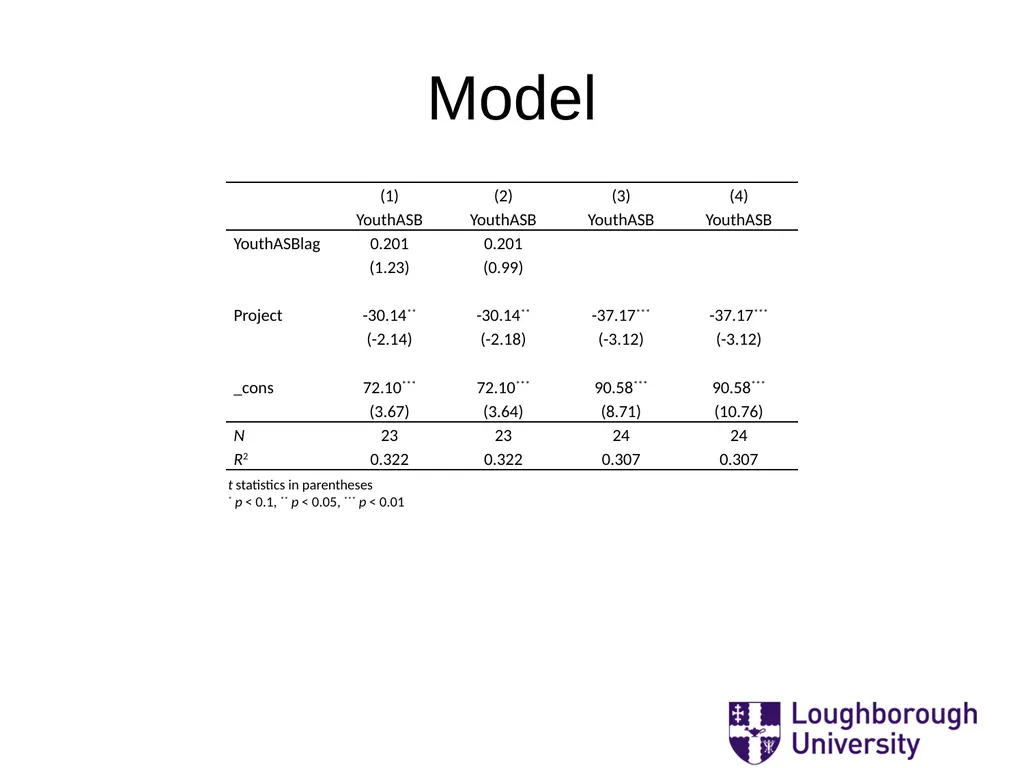
Model t statistics in parentheses
* p < 0.1, ** p < 0.05, *** p < 0.01<br>
* p < 0.1, ** p < 0.05, *** p < 0.01<br>
39
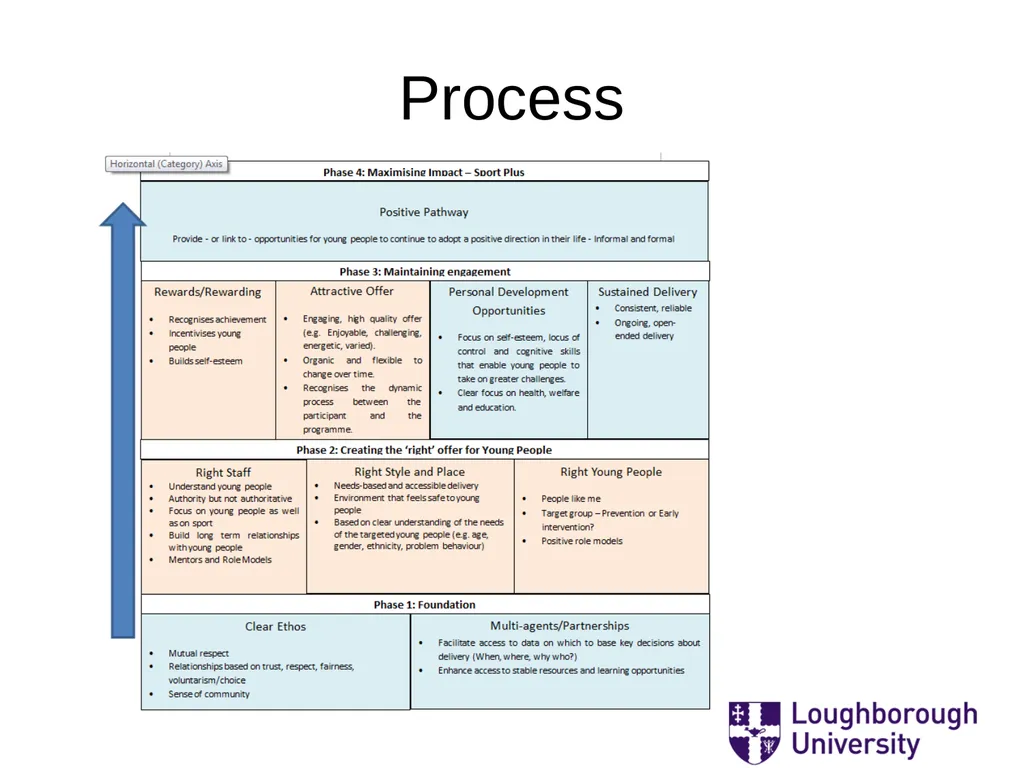
Process<br>
40
Some asides Data summary and exploration<br>
41
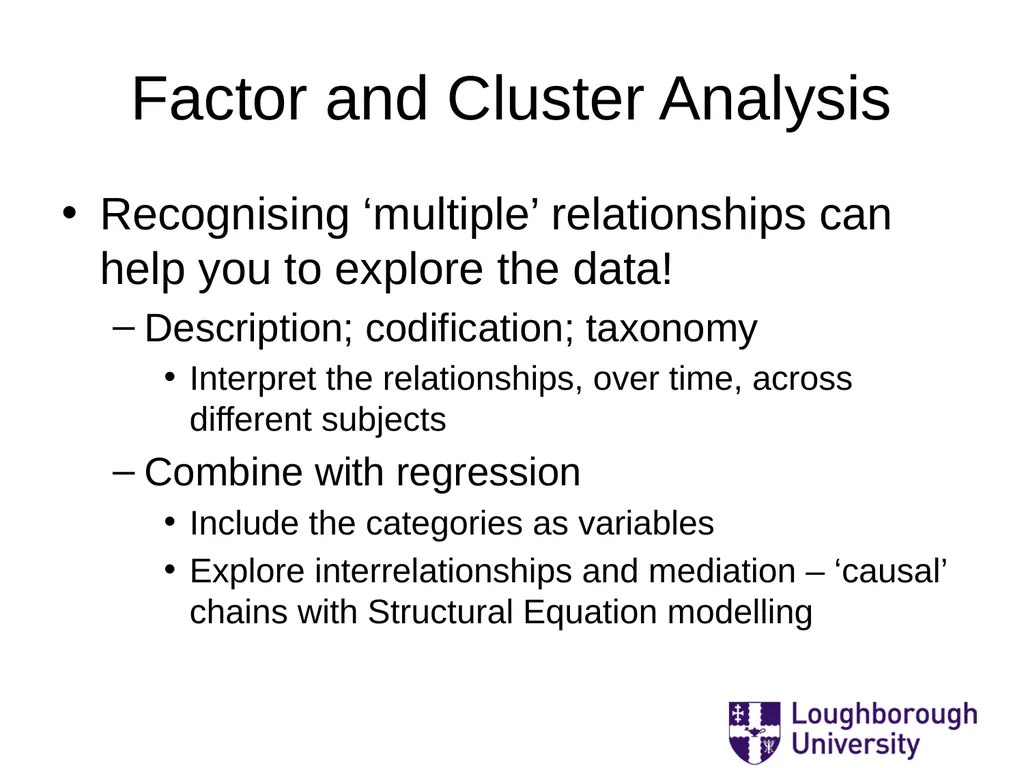
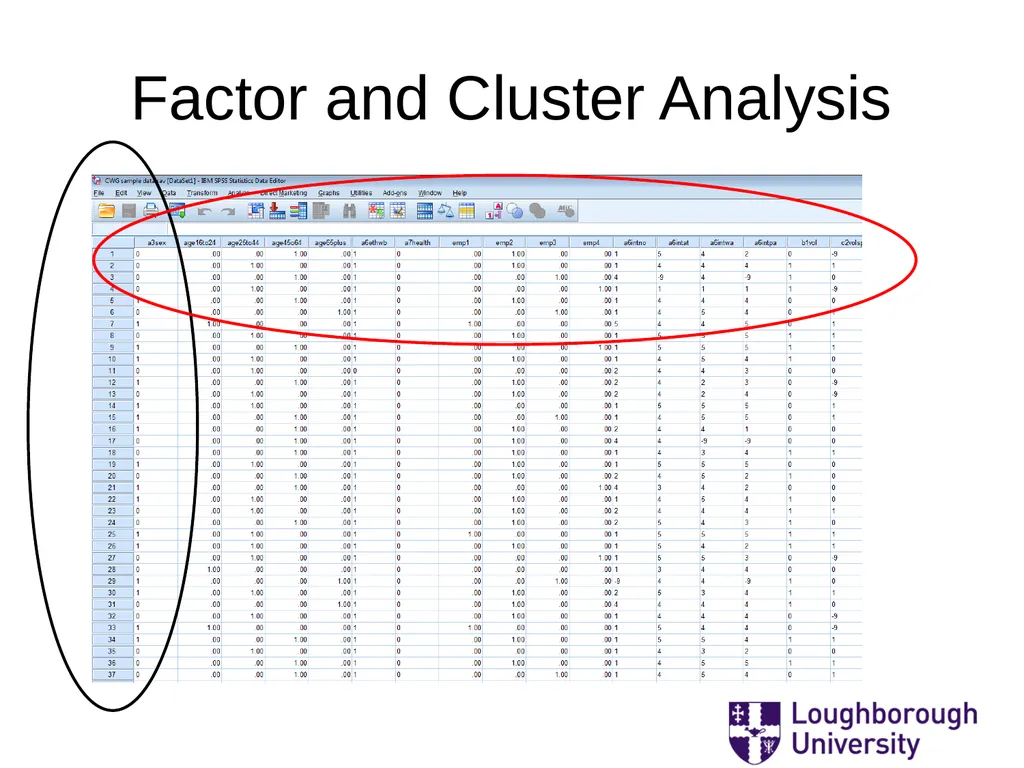
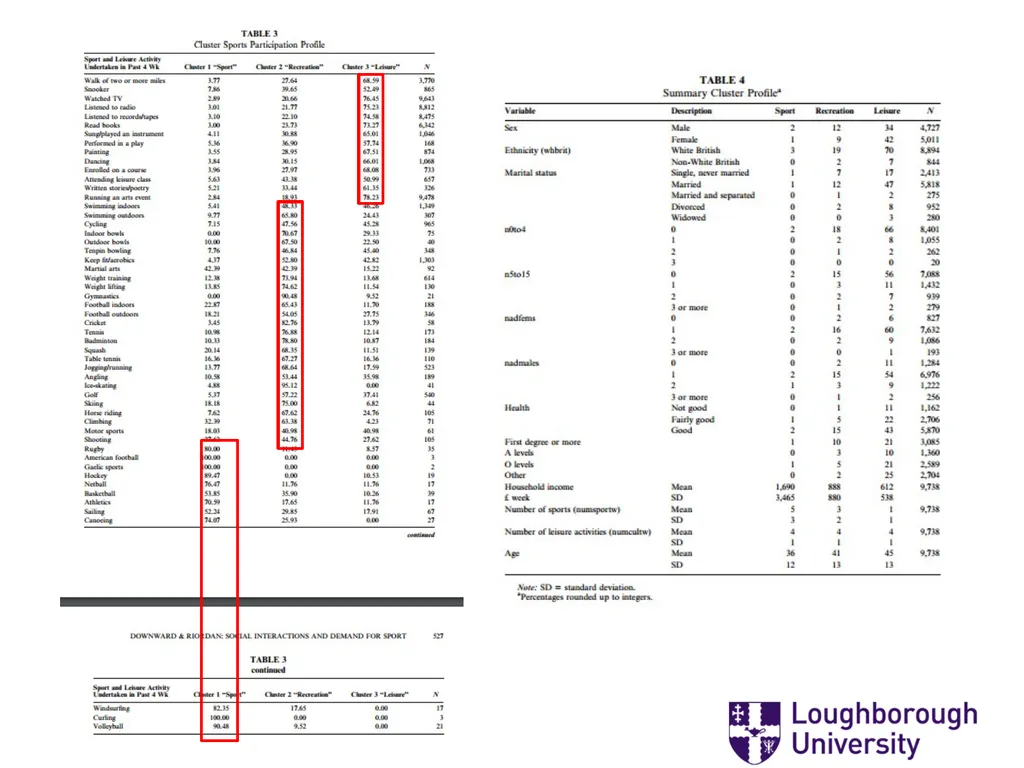
Factor and Cluster Analysis Recognising ‘multiple’ relationships can help you to explore the data!
Description; codification; taxonomy
Interpret the relationships, over time, across different subjects
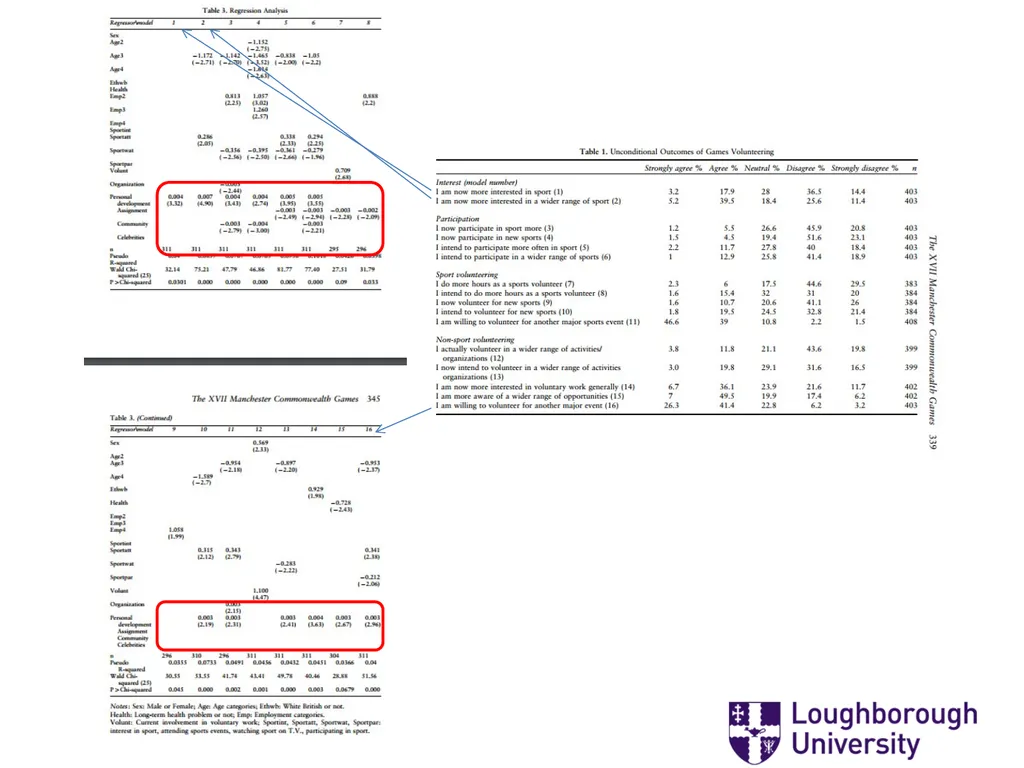
Combine with regression
Include the categories as variables
Explore interrelationships and mediation – ‘causal’ chains with Structural Equation modelling<br>
Description; codification; taxonomy
Interpret the relationships, over time, across different subjects
Combine with regression
Include the categories as variables
Explore interrelationships and mediation – ‘causal’ chains with Structural Equation modelling<br>
42
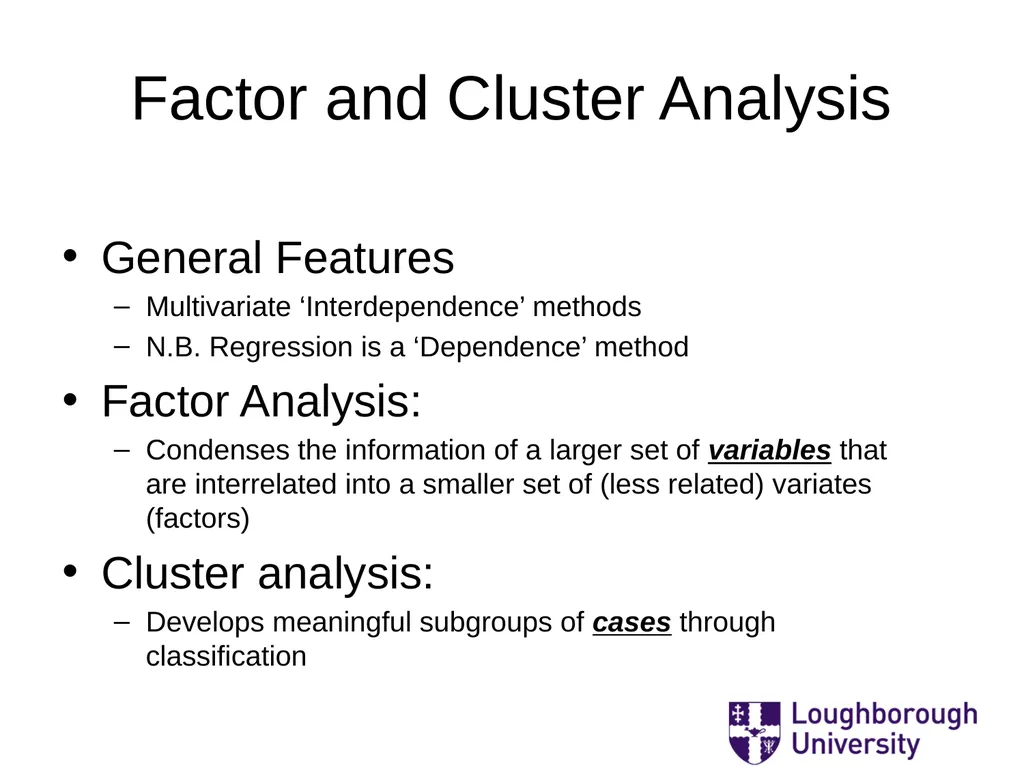
Factor and Cluster Analysis General Features
Multivariate ‘Interdependence’ methods
N.B. Regression is a ‘Dependence’ method
Factor Analysis:
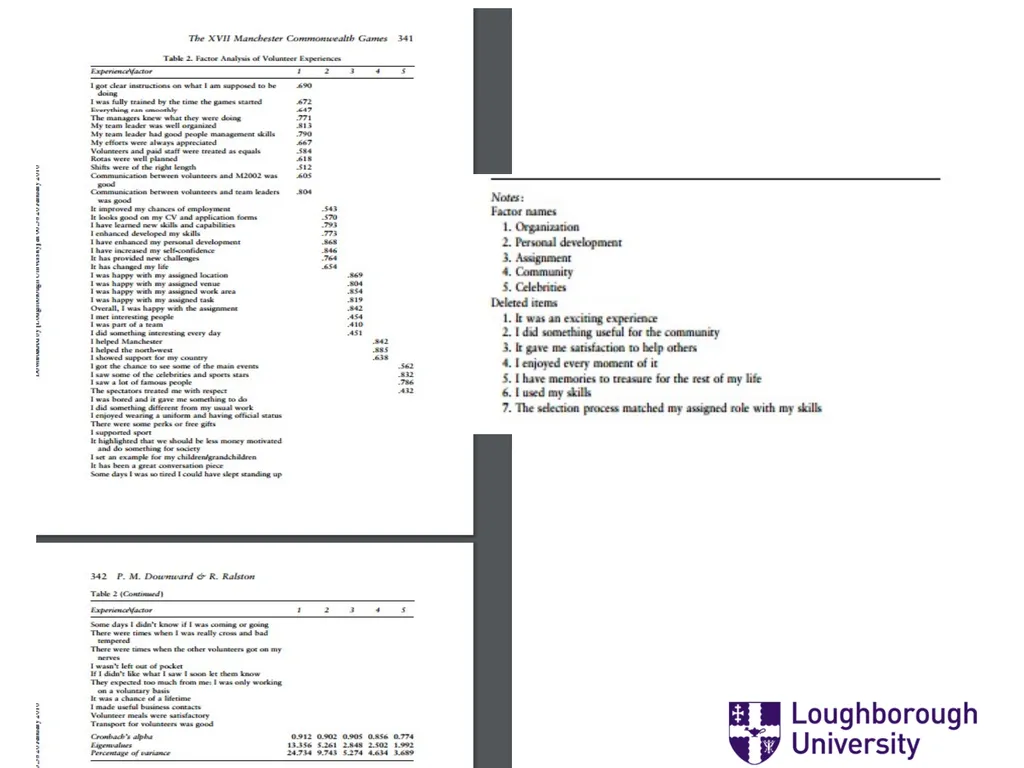
Condenses the information of a larger set of variables that are interrelated into a smaller set of (less related) variates (factors)
Cluster analysis:
Develops meaningful subgroups of cases through classification<br>
Multivariate ‘Interdependence’ methods
N.B. Regression is a ‘Dependence’ method
Factor Analysis:
Condenses the information of a larger set of variables that are interrelated into a smaller set of (less related) variates (factors)
Cluster analysis:
Develops meaningful subgroups of cases through classification<br>
43
Factor and Cluster Analysis<br>
44
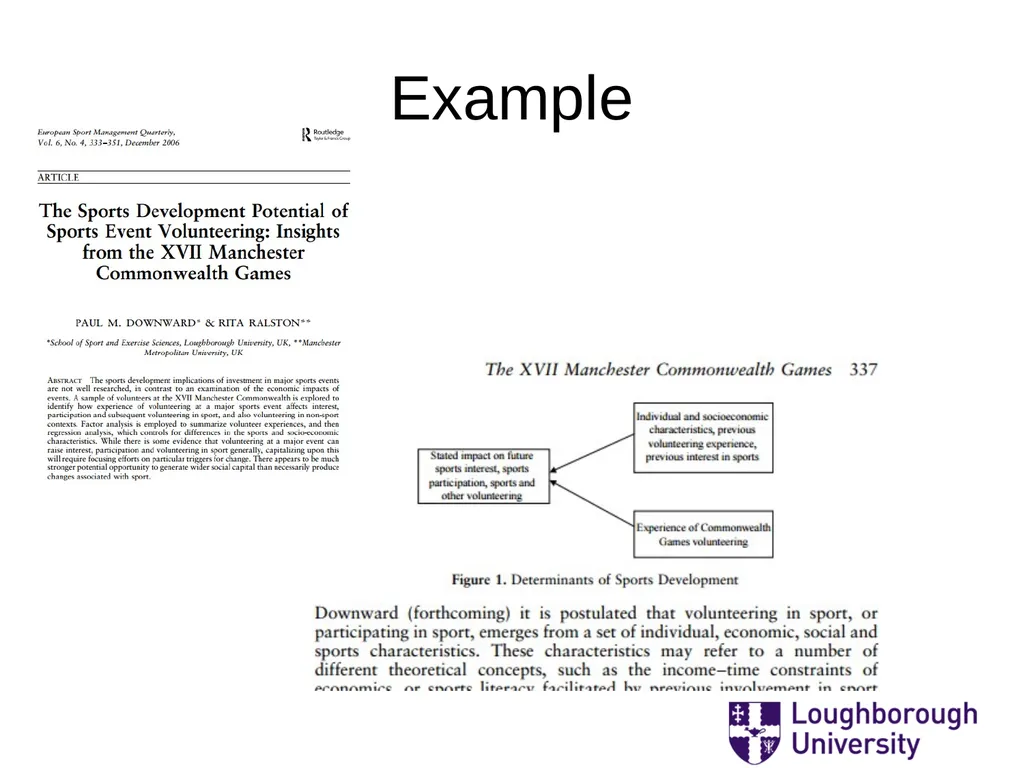
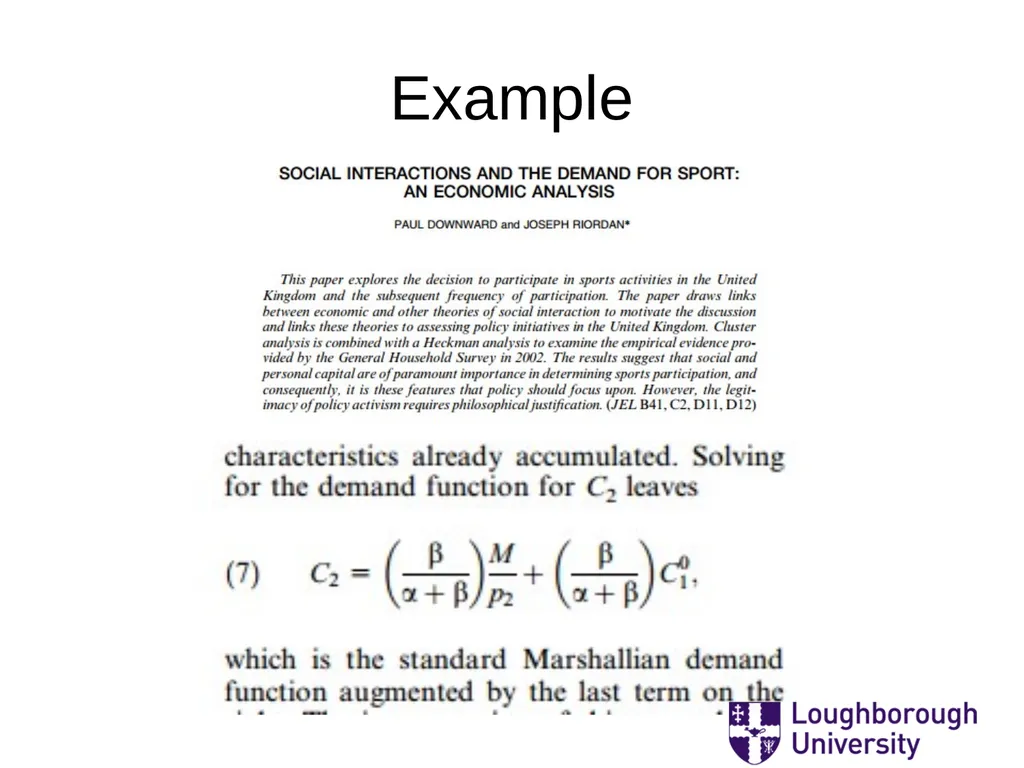
Example<br>
45
Example<br>
46
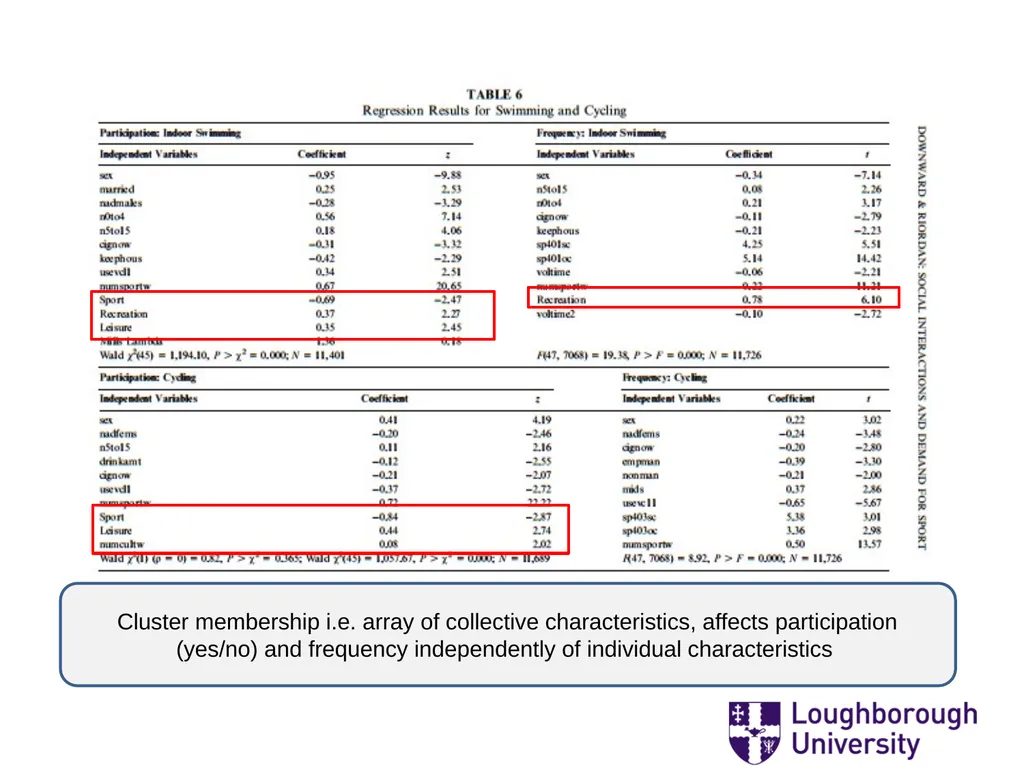
Cluster membership i.e. array of collective characteristics, affects participation (yes/no) and frequency independently of individual characteristics<br>
47
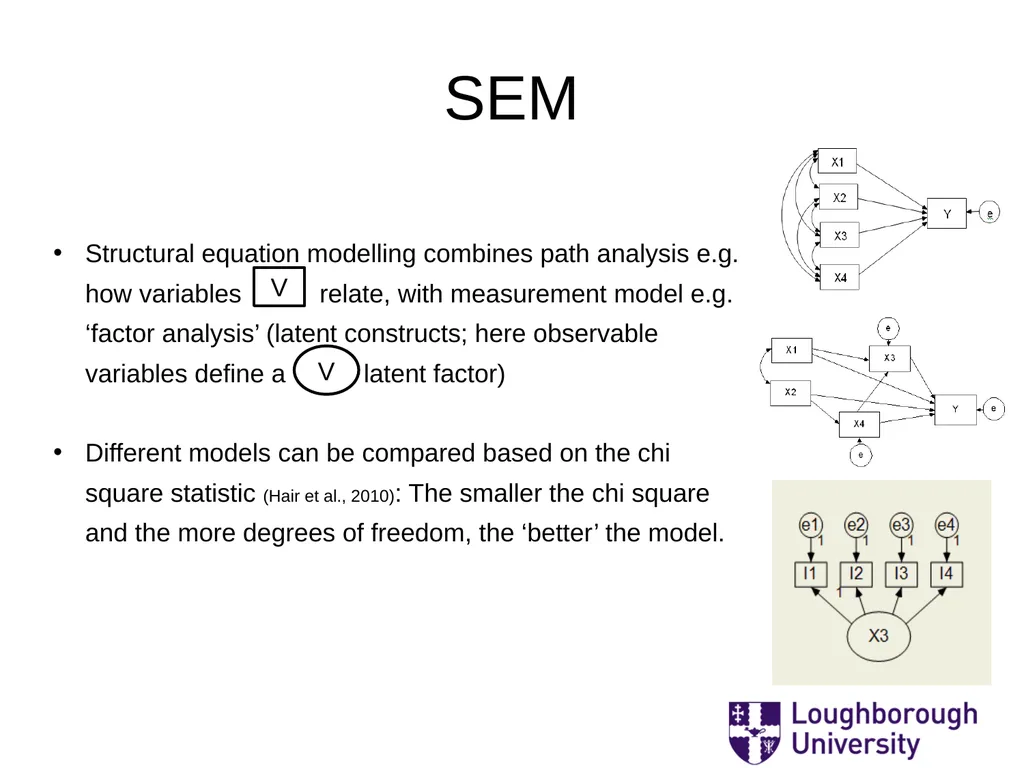
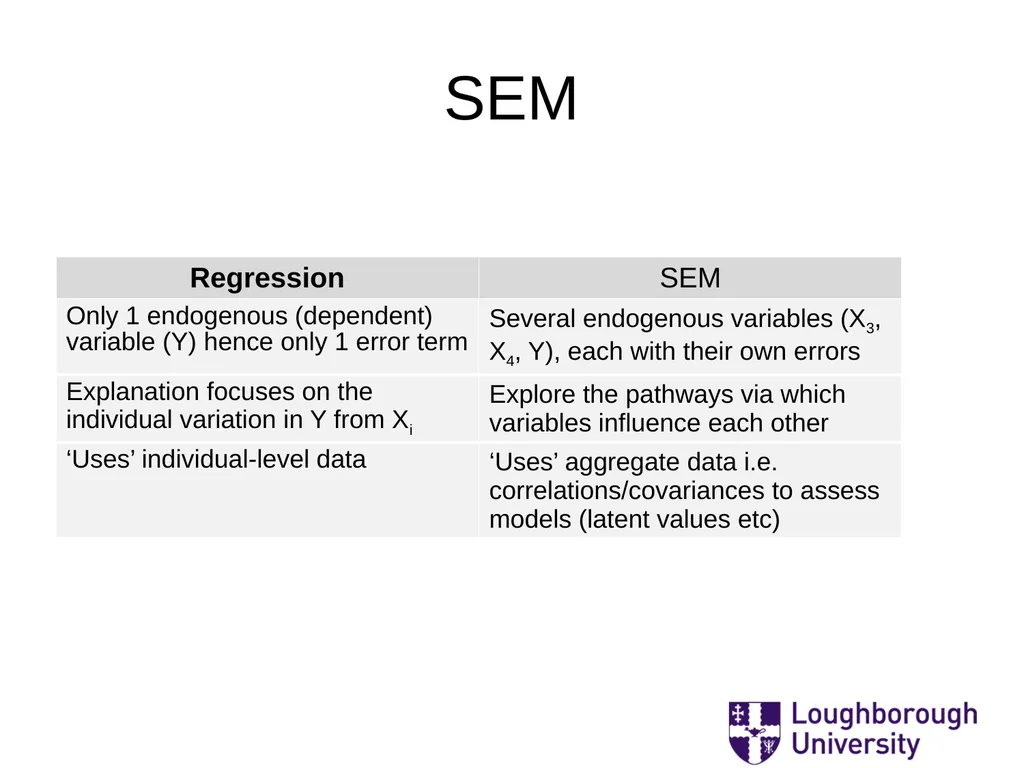
Structural equation modelling combines path analysis e.g. how variables relate, with measurement model e.g. ‘factor analysis’ (latent constructs; here observable variables define a latent factor)
Different models can be compared based on the chi square statistic (Hair et al., 2010): The smaller the chi square and the more degrees of freedom, the ‘better’ the model. SEM V V<br>
Different models can be compared based on the chi square statistic (Hair et al., 2010): The smaller the chi square and the more degrees of freedom, the ‘better’ the model. SEM V V<br>
48
SEM<br>
49
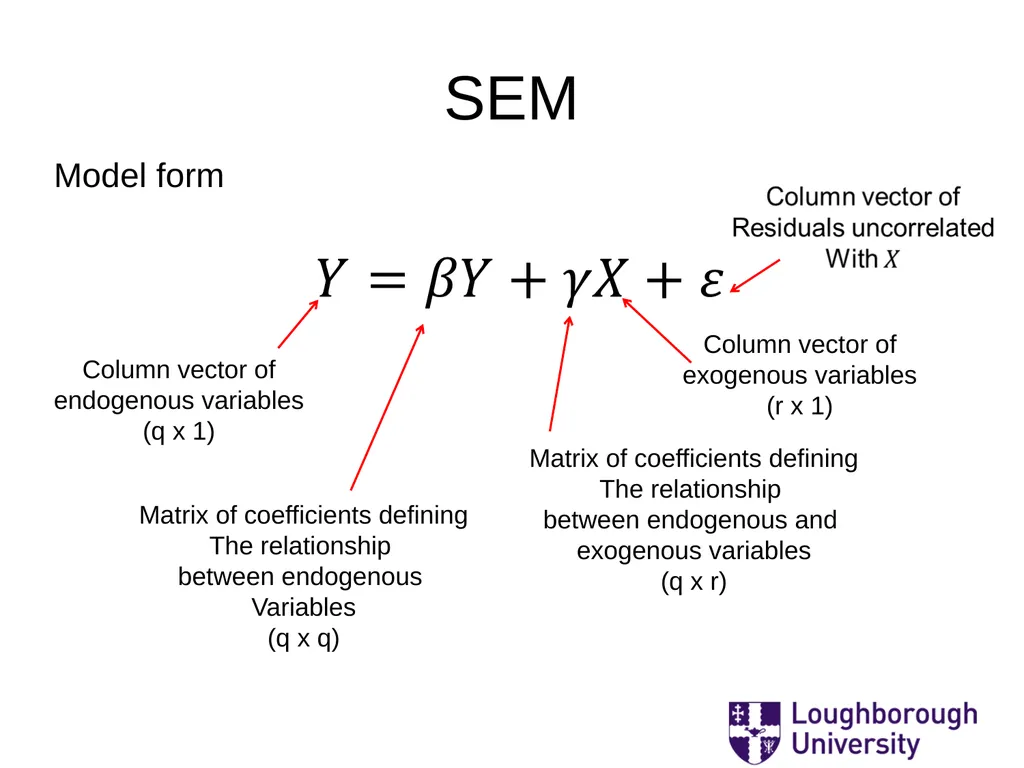
Column vector of
endogenous variables
(q x 1) Matrix of coefficients defining
The relationship
between endogenous
Variables
(q x q) Matrix of coefficients defining
The relationship
between endogenous and
exogenous variables
(q x r) Column vector of
exogenous variables
(r x 1) Model form SEM<br>
endogenous variables
(q x 1) Matrix of coefficients defining
The relationship
between endogenous
Variables
(q x q) Matrix of coefficients defining
The relationship
between endogenous and
exogenous variables
(q x r) Column vector of
exogenous variables
(r x 1) Model form SEM<br>
50
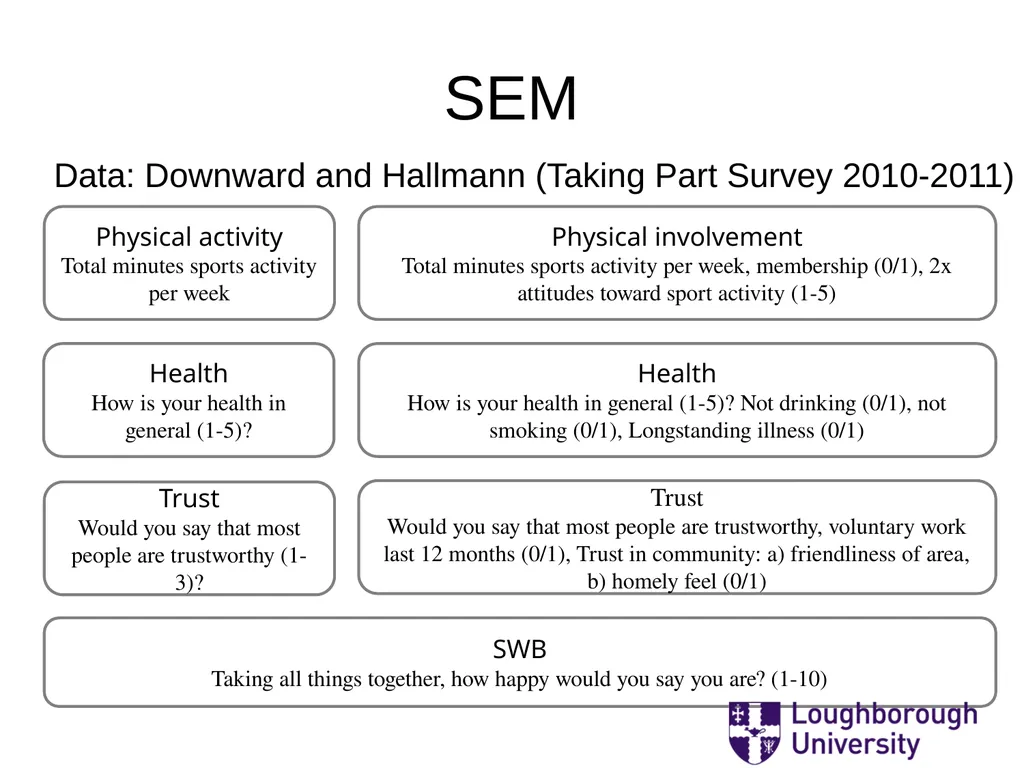
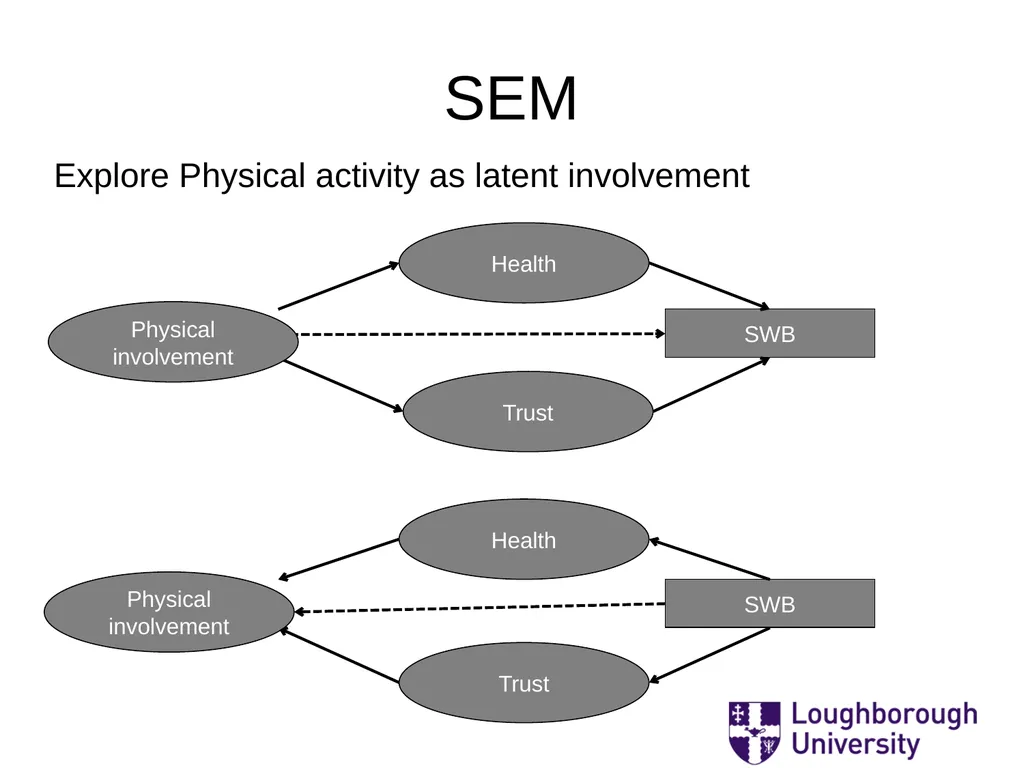
Physical activity
Total minutes sports activity per week Physical involvement
Total minutes sports activity per week, membership (0/1), 2x attitudes toward sport activity (1-5) Health
How is your health in general (1-5)? Health
How is your health in general (1-5)? Not drinking (0/1), not smoking (0/1), Longstanding illness (0/1) Trust
Would you say that most people are trustworthy (1-3)? Trust
Would you say that most people are trustworthy, voluntary work last 12 months (0/1), Trust in community: a) friendliness of area, b) homely feel (0/1) SWB
Taking all things together, how happy would you say you are? (1-10) Data: Downward and Hallmann (Taking Part Survey 2010-2011) SEM<br>
Total minutes sports activity per week Physical involvement
Total minutes sports activity per week, membership (0/1), 2x attitudes toward sport activity (1-5) Health
How is your health in general (1-5)? Health
How is your health in general (1-5)? Not drinking (0/1), not smoking (0/1), Longstanding illness (0/1) Trust
Would you say that most people are trustworthy (1-3)? Trust
Would you say that most people are trustworthy, voluntary work last 12 months (0/1), Trust in community: a) friendliness of area, b) homely feel (0/1) SWB
Taking all things together, how happy would you say you are? (1-10) Data: Downward and Hallmann (Taking Part Survey 2010-2011) SEM<br>
51
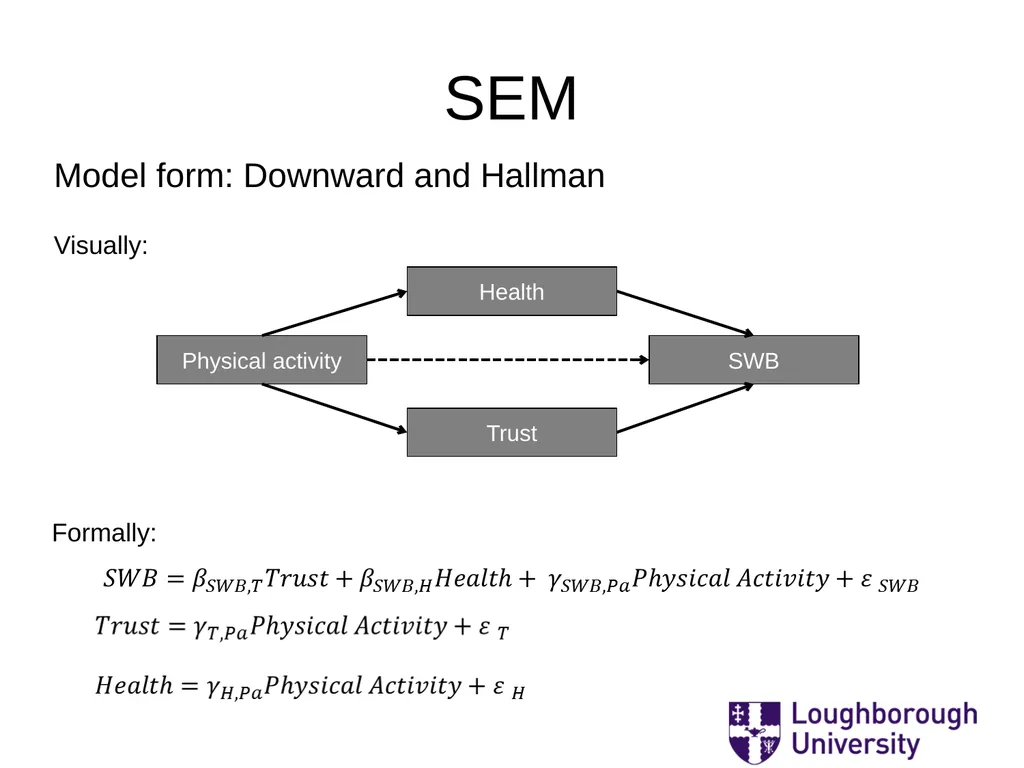
Visually: Physical activity SWB Health Trust Formally: Model form: Downward and Hallman SEM<br>
52
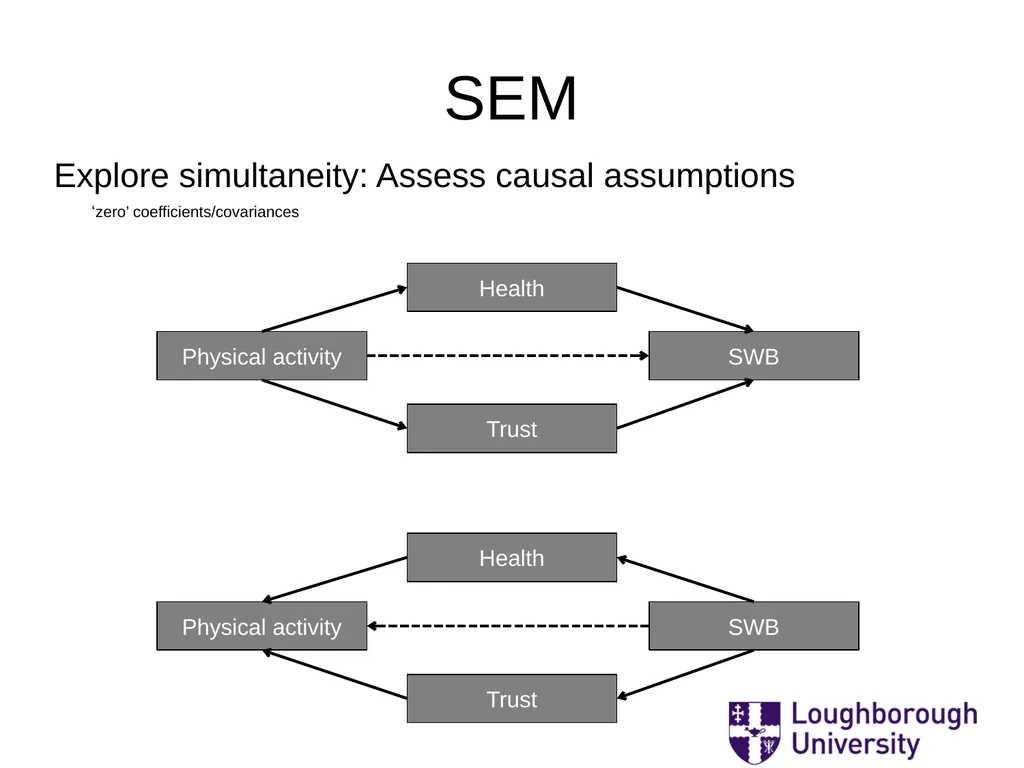
Physical activity SWB Health Trust Physical activity SWB Health Trust Explore simultaneity: Assess causal assumptions
‘zero’ coefficients/covariances SEM<br>
‘zero’ coefficients/covariances SEM<br>
53
SWB SWB Physical involvement Health Trust Health Trust Physical involvement Explore Physical activity as latent involvement SEM<br>
54
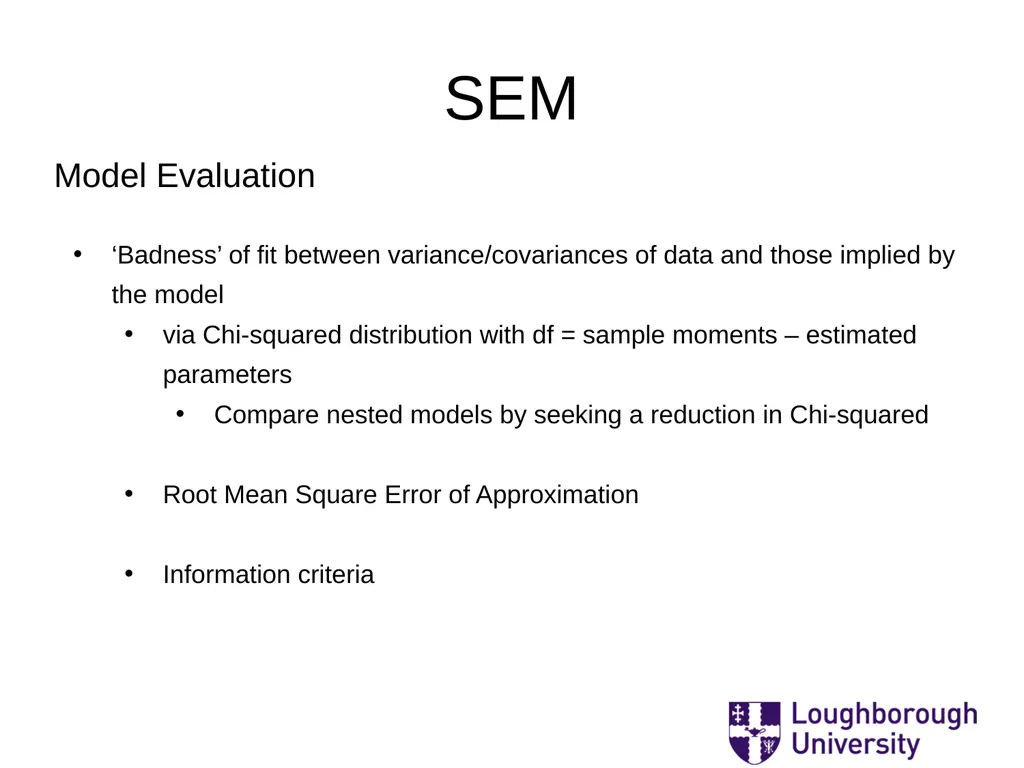
‘Badness’ of fit between variance/covariances of data and those implied by the model
via Chi-squared distribution with df = sample moments – estimated parameters
Compare nested models by seeking a reduction in Chi-squared
Root Mean Square Error of Approximation
Information criteria Model Evaluation SEM<br>
via Chi-squared distribution with df = sample moments – estimated parameters
Compare nested models by seeking a reduction in Chi-squared
Root Mean Square Error of Approximation
Information criteria Model Evaluation SEM<br>
55
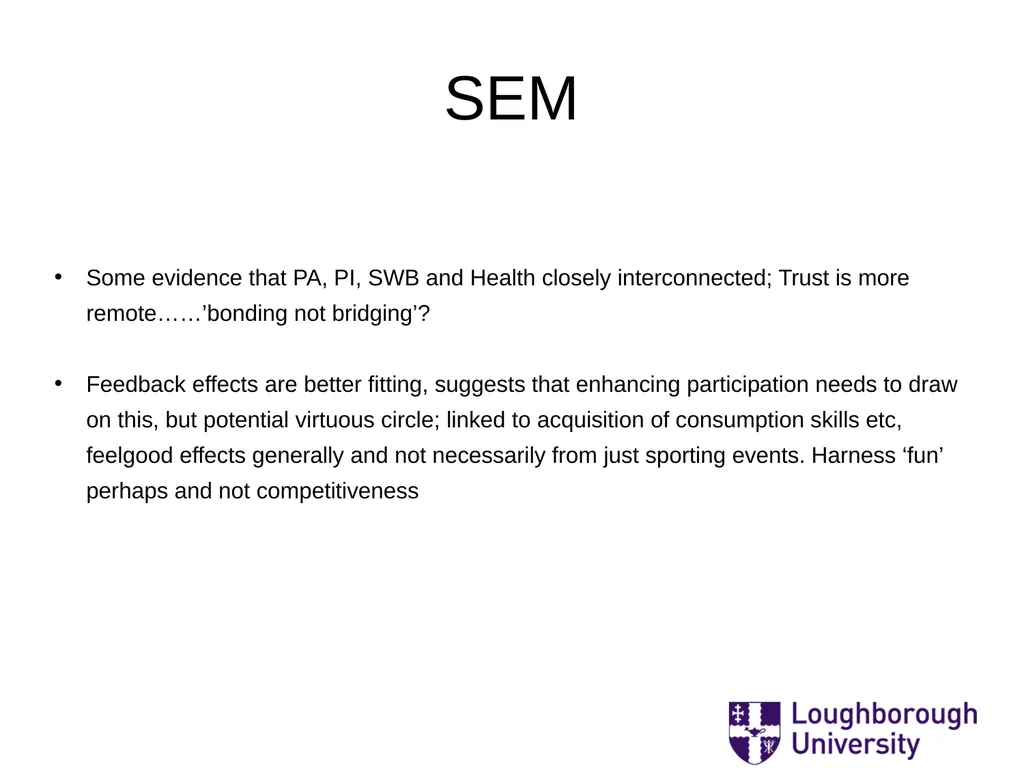
Some evidence that PA, PI, SWB and Health closely interconnected; Trust is more remote……’bonding not bridging’?
Feedback effects are better fitting, suggests that enhancing participation needs to draw on this, but potential virtuous circle; linked to acquisition of consumption skills etc, feelgood effects generally and not necessarily from just sporting events. Harness ‘fun’ perhaps and not competitiveness SEM<br>
Feedback effects are better fitting, suggests that enhancing participation needs to draw on this, but potential virtuous circle; linked to acquisition of consumption skills etc, feelgood effects generally and not necessarily from just sporting events. Harness ‘fun’ perhaps and not competitiveness SEM<br>
56
So… I see quantitative methods as integral to economic/policy/social/management research
Focus on what it can do, not what it cannot – CR cautions about the latter
In economics a peculiarly tight almost conflation of regression analysis with theory
Marginal effects (ceteris paribus) of atomically separable objects
No need for realism of assumptions because explanation is prediction (in sample)
Questions?<br>
Focus on what it can do, not what it cannot – CR cautions about the latter
In economics a peculiarly tight almost conflation of regression analysis with theory
Marginal effects (ceteris paribus) of atomically separable objects
No need for realism of assumptions because explanation is prediction (in sample)
Questions?<br>
57
So… Questions (Reflect on – 10 minutes)
What is meant by the intrinsic condition of closure?
What is meant by the extrinsic condition of closure?
Are they present or not in statistical modelling?
Are they be apparent, or not in your research?
What are your reflections on the triangulation schema?
Could this apply to your research
Feedback to the group on any adaptation to your initial thoughts. (20 minutes)<br>
What is meant by the intrinsic condition of closure?
What is meant by the extrinsic condition of closure?
Are they present or not in statistical modelling?
Are they be apparent, or not in your research?
What are your reflections on the triangulation schema?
Could this apply to your research
Feedback to the group on any adaptation to your initial thoughts. (20 minutes)<br>