04
Motion in 2D
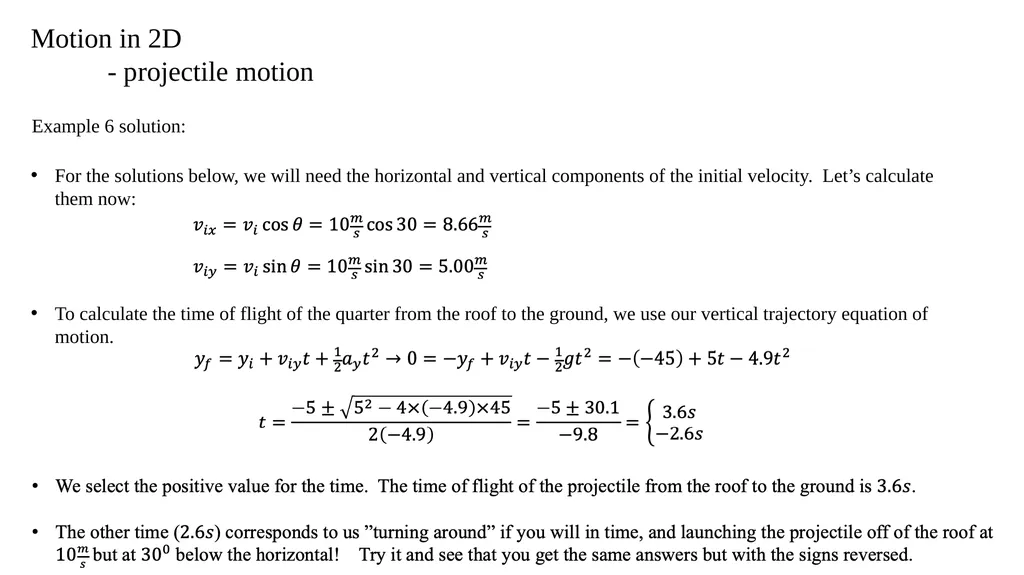
- projectile motion For the solutions below, we will need the horizontal and vertical components of the initial velocity. Let’s calculate them now:
To calculate the time of flight of the quarter from the roof to the ground, we use our vertical trajectory equation of motion. Example 6 solution:<br>
05
Motion in 2D
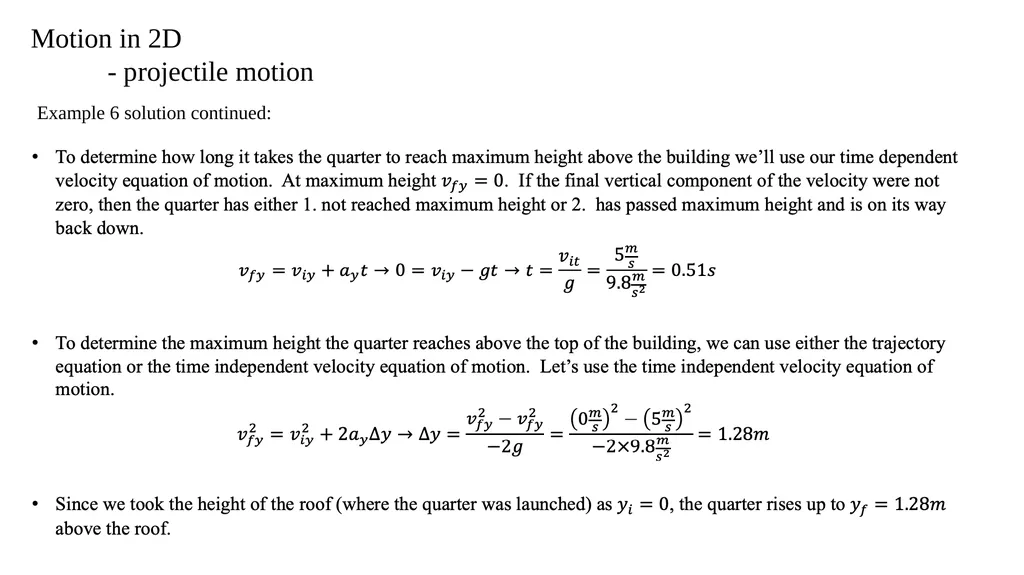
- projectile motion Example 6 solution continued:<br>
06
Motion in 2D
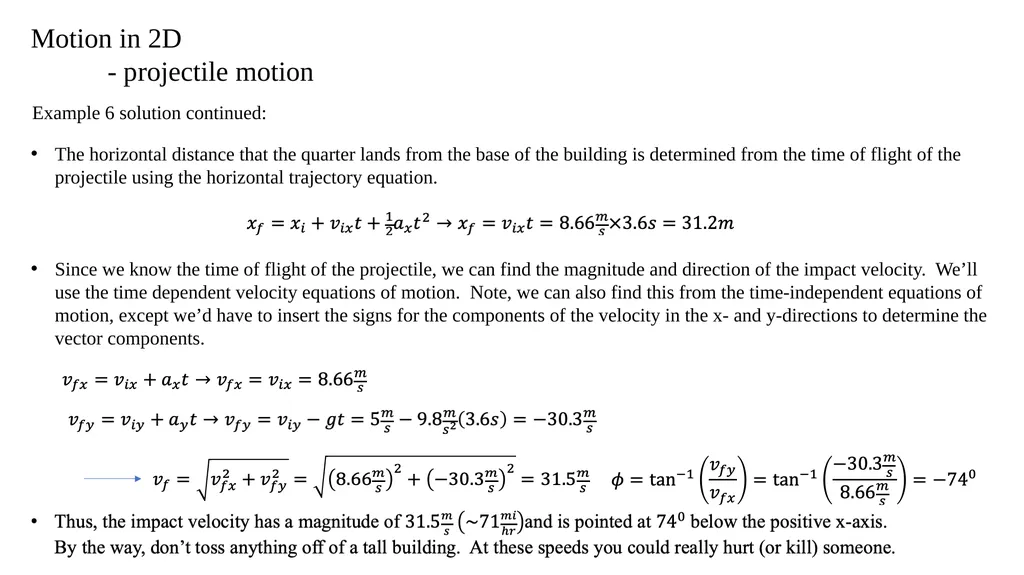
- projectile motion Example 6 solution continued: The horizontal distance that the quarter lands from the base of the building is determined from the time of flight of the projectile using the horizontal trajectory equation.
Since we know the time of flight of the projectile, we can find the magnitude and direction of the impact velocity. We’ll use the time dependent velocity equations of motion. Note, we can also find this from the time-independent equations of motion, except we’d have to insert the signs for the components of the velocity in the x- and y-directions to determine the vector components.<br>
07
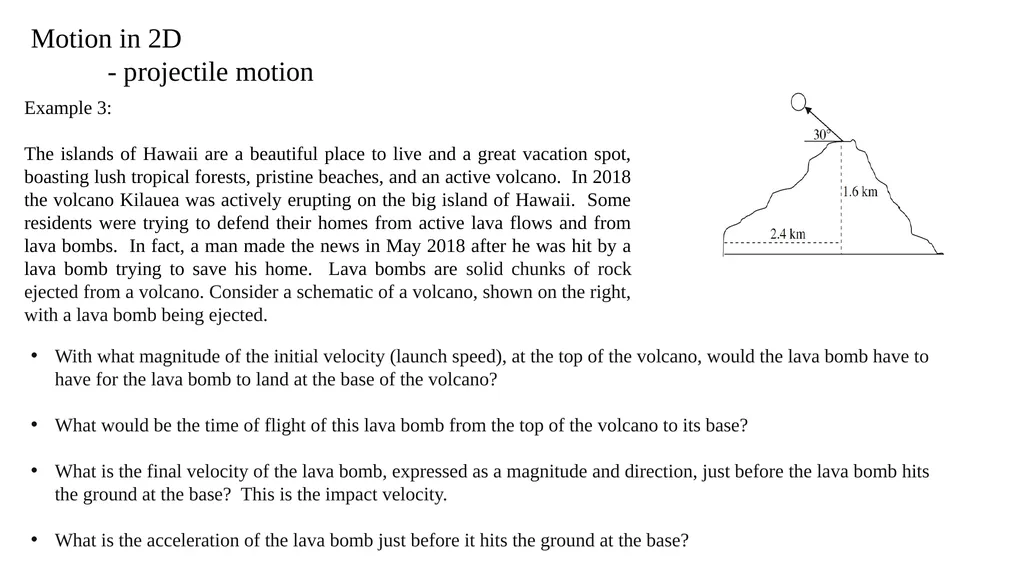
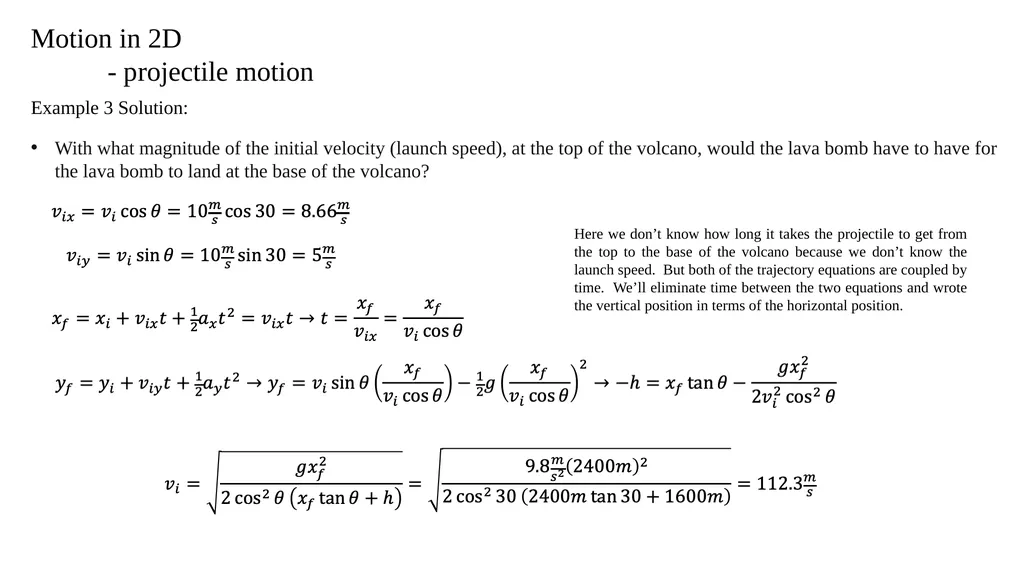
With what magnitude of the initial velocity (launch speed), at the top of the volcano, would the lava bomb have to have for the lava bomb to land at the base of the volcano?
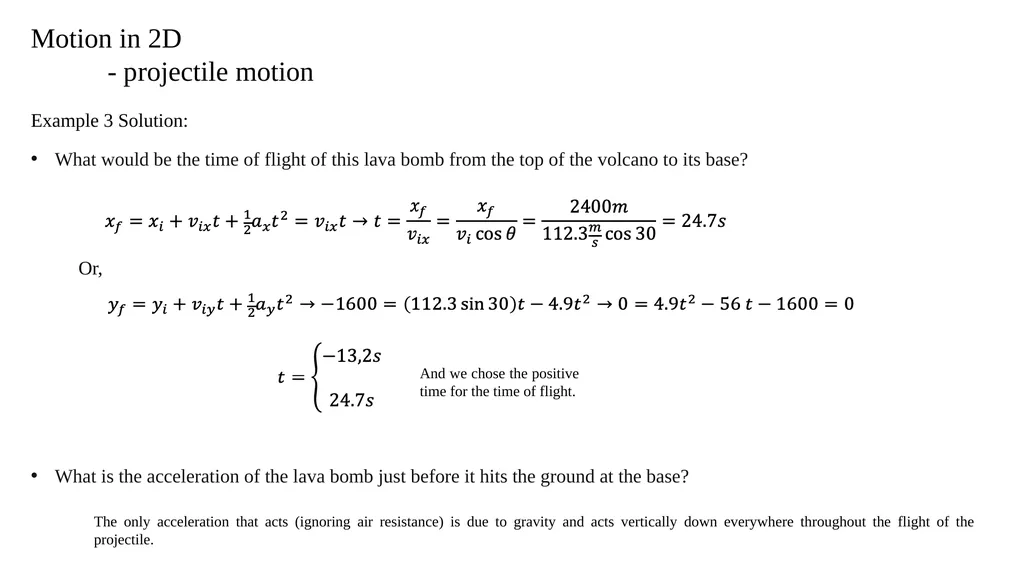
What would be the time of flight of this lava bomb from the top of the volcano to its base?
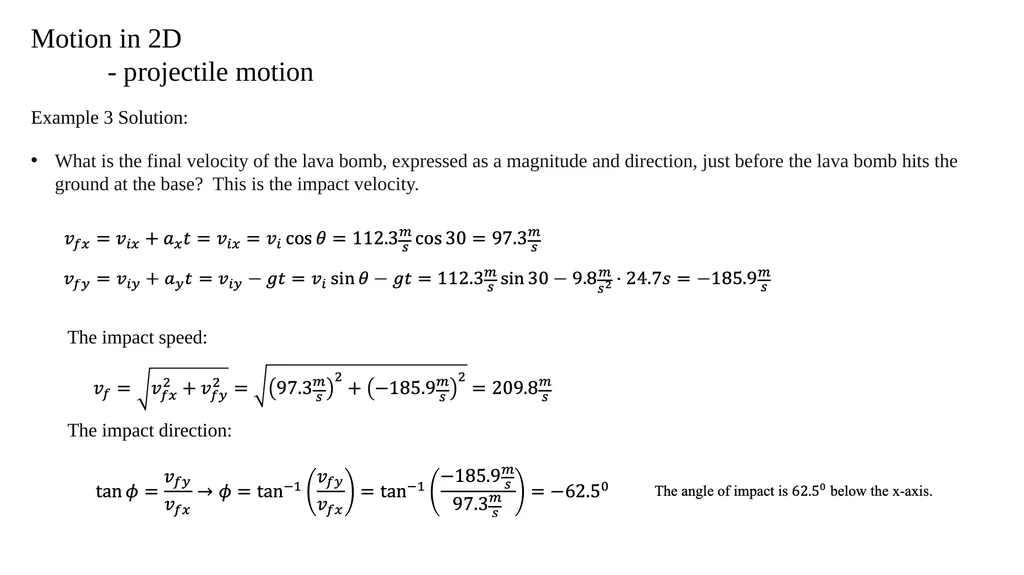
What is the final velocity of the lava bomb, expressed as a magnitude and direction, just before the lava bomb hits the ground at the base? This is the impact velocity.
What is the acceleration of the lava bomb just before it hits the ground at the base? Example 3:
The islands of Hawaii are a beautiful place to live and a great vacation spot, boasting lush tropical forests, pristine beaches, and an active volcano. In 2018 the volcano Kilauea was actively erupting on the big island of Hawaii. Some residents were trying to defend their homes from active lava flows and from lava bombs. In fact, a man made the news in May 2018 after he was hit by a lava bomb trying to save his home. Lava bombs are solid chunks of rock ejected from a volcano. Consider a schematic of a volcano, shown on the right, with a lava bomb being ejected. Motion in 2D
- projectile motion<br>
08
Motion in 2D
- projectile motion Example 3 Solution: With what magnitude of the initial velocity (launch speed), at the top of the volcano, would the lava bomb have to have for the lava bomb to land at the base of the volcano? Here we don’t know how long it takes the projectile to get from the top to the base of the volcano because we don’t know the launch speed. But both of the trajectory equations are coupled by time. We’ll eliminate time between the two equations and wrote the vertical position in terms of the horizontal position.<br>
09
What would be the time of flight of this lava bomb from the top of the volcano to its base? Motion in 2D
- projectile motion Example 3 Solution: What is the acceleration of the lava bomb just before it hits the ground at the base? The only acceleration that acts (ignoring air resistance) is due to gravity and acts vertically down everywhere throughout the flight of the projectile. And we chose the positive time for the time of flight. Or,<br>
10
What is the final velocity of the lava bomb, expressed as a magnitude and direction, just before the lava bomb hits the ground at the base? This is the impact velocity. Motion in 2D
- projectile motion Example 3 Solution: The impact speed: The impact direction:<br>
11
Motion in 2D
- projectile motion<br>
12
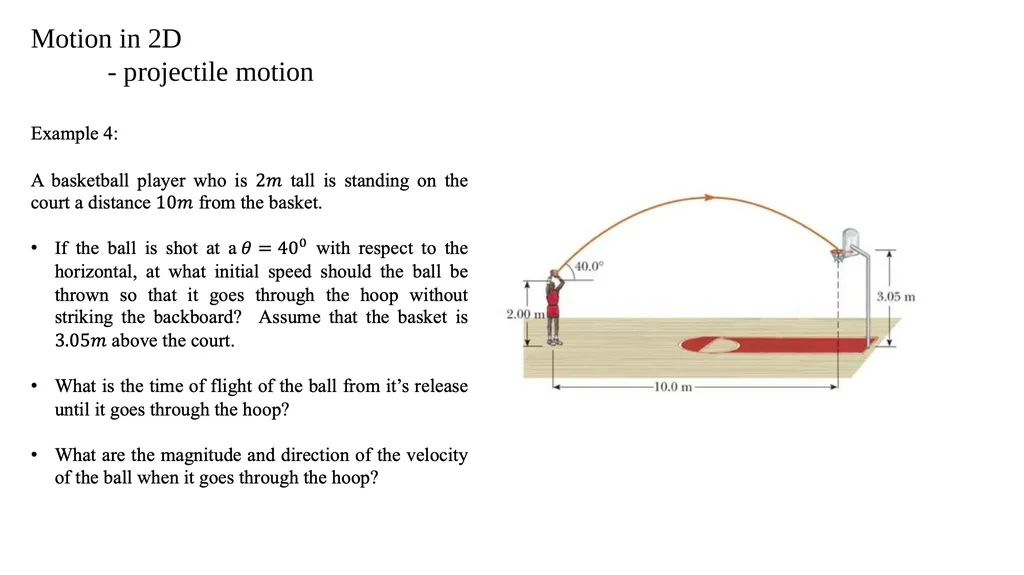
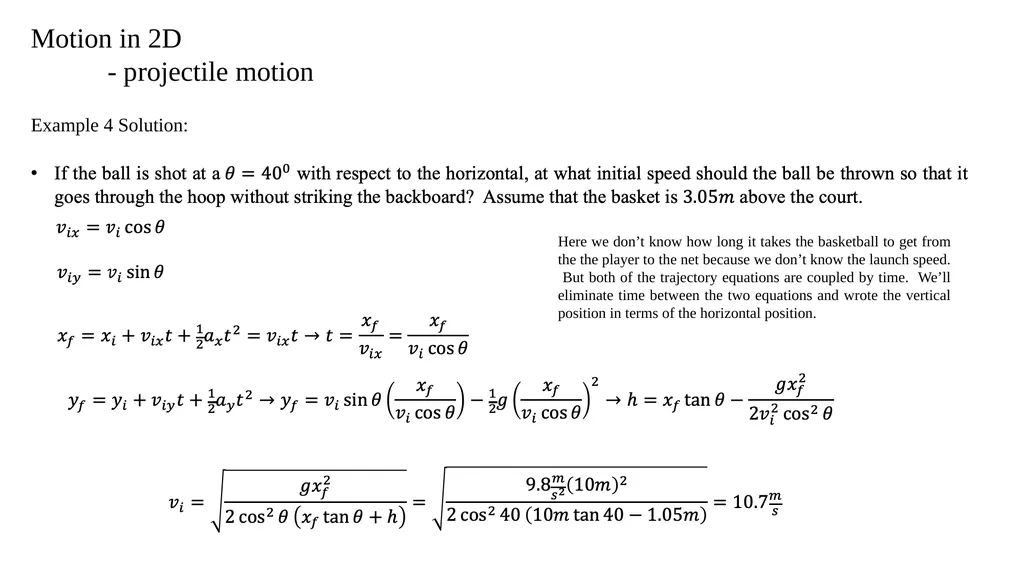
Example 4 Solution: Motion in 2D
- projectile motion Here we don’t know how long it takes the basketball to get from the the player to the net because we don’t know the launch speed. But both of the trajectory equations are coupled by time. We’ll eliminate time between the two equations and wrote the vertical position in terms of the horizontal position.<br>
13
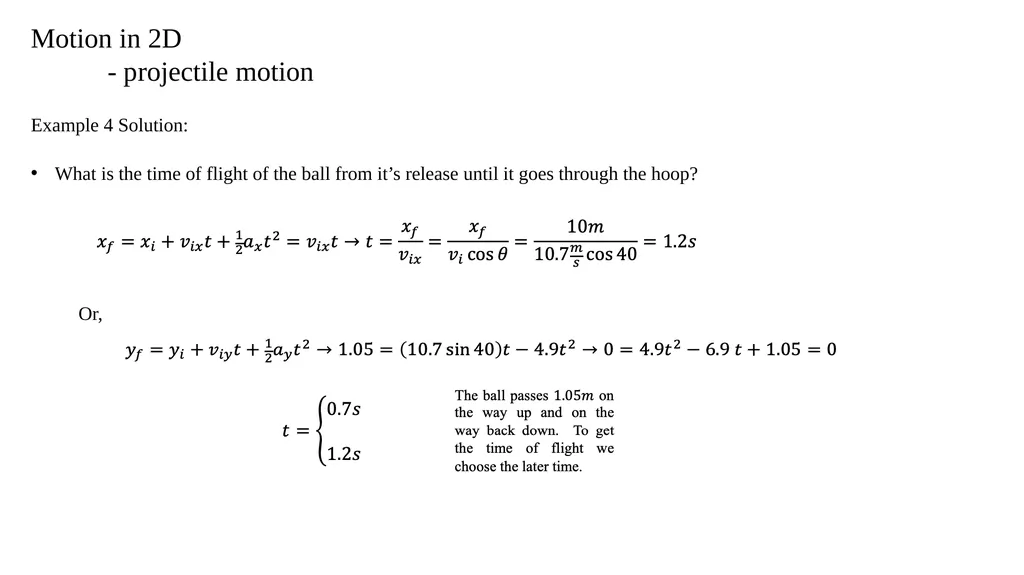
Example 4 Solution: Motion in 2D
- projectile motion What is the time of flight of the ball from it’s release until it goes through the hoop? Or,<br>
14
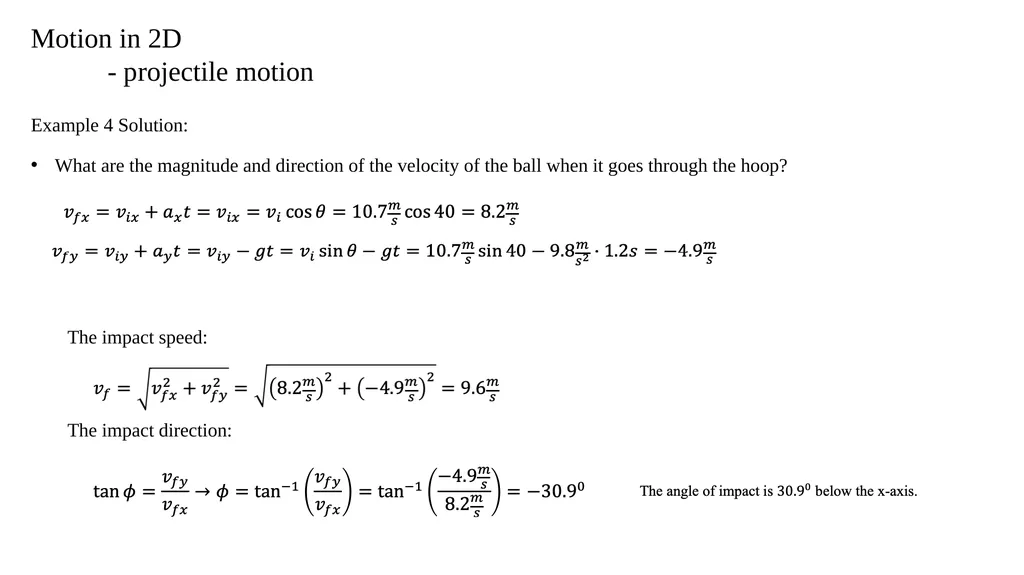
Example 4 Solution: Motion in 2D
- projectile motion The impact speed: The impact direction: What are the magnitude and direction of the velocity of the ball when it goes through the hoop?<br>
15
Motion in 2D
- projectile motion<br>
16
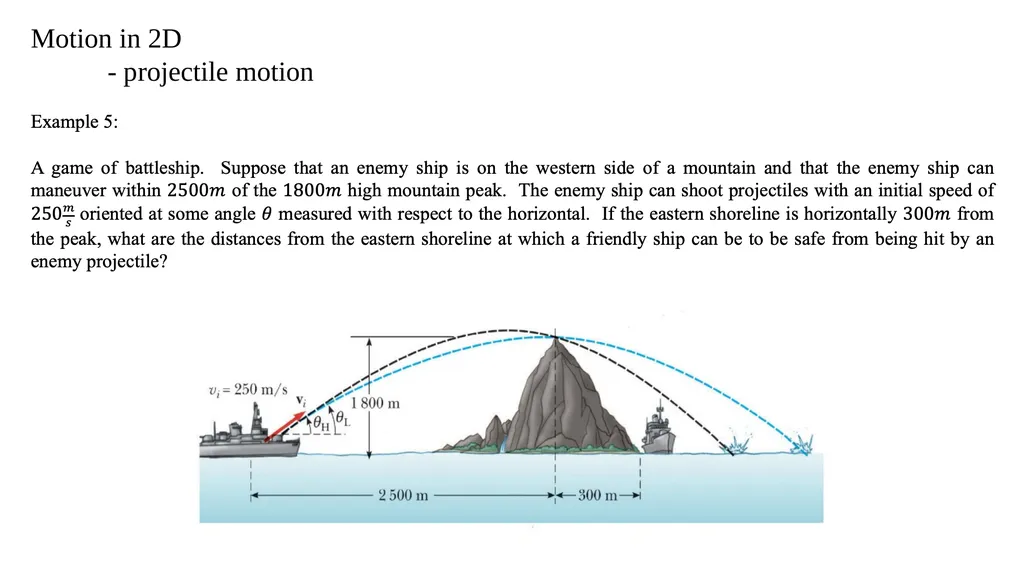
Example 5 Solution: Motion in 2D
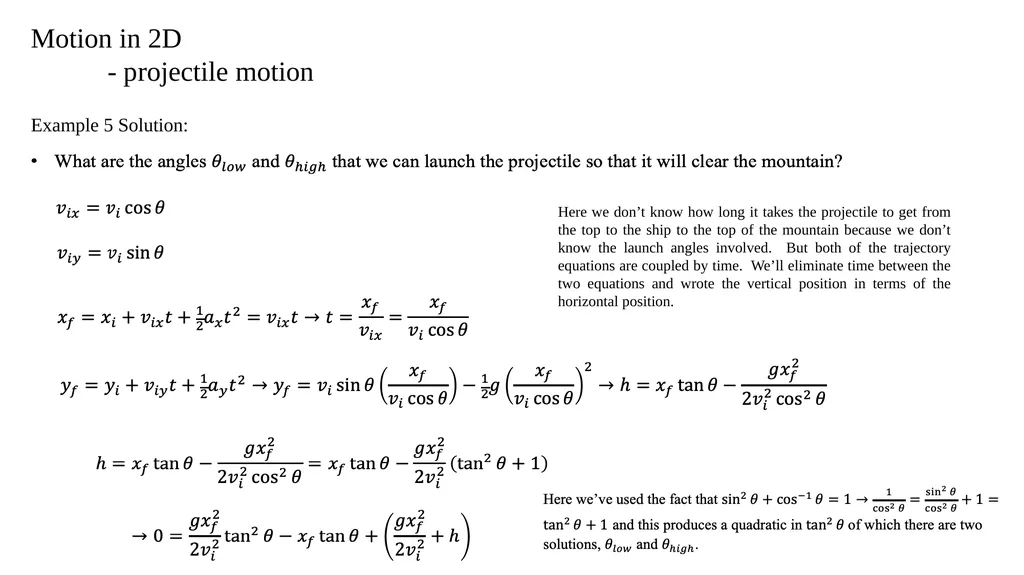
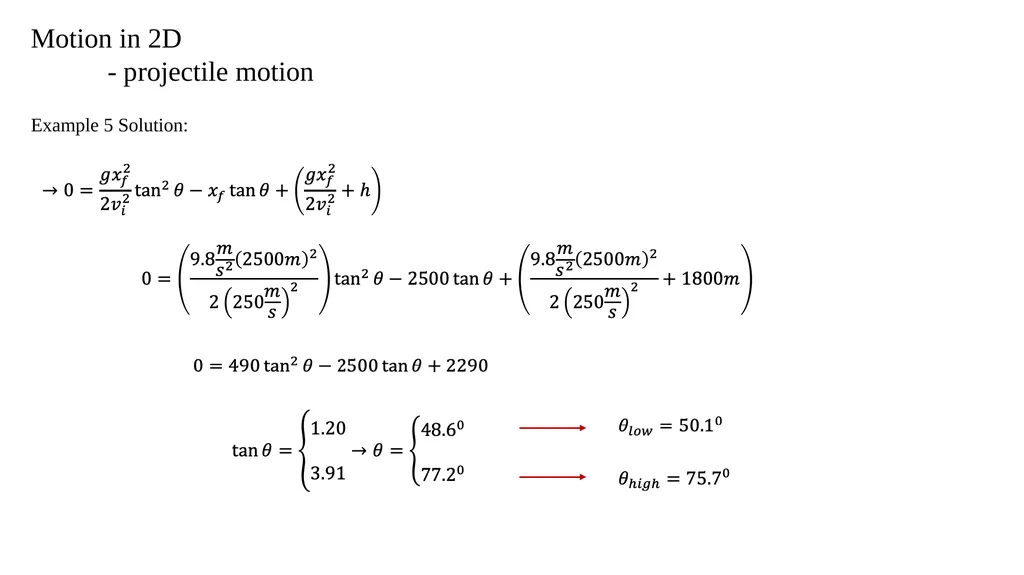
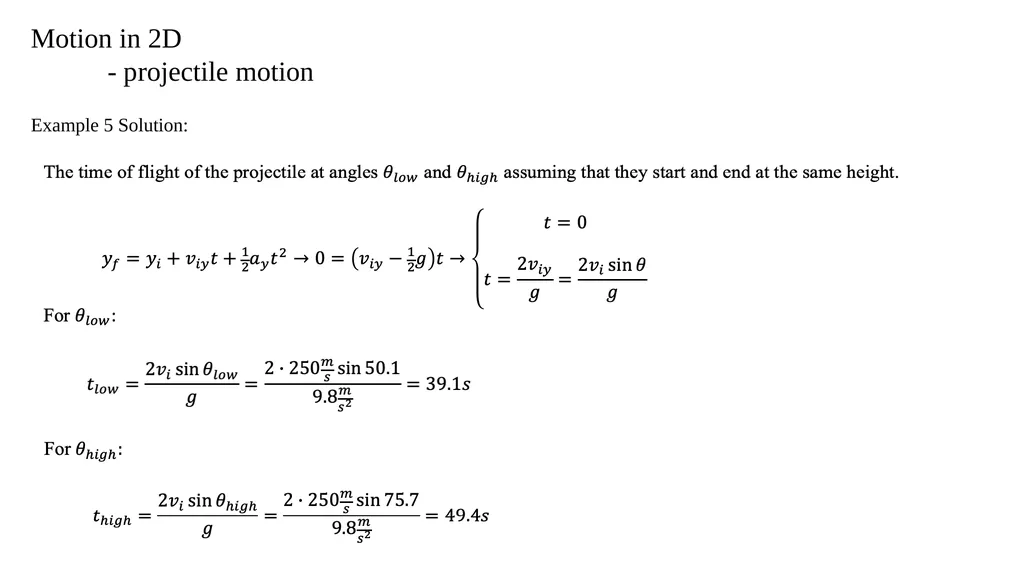
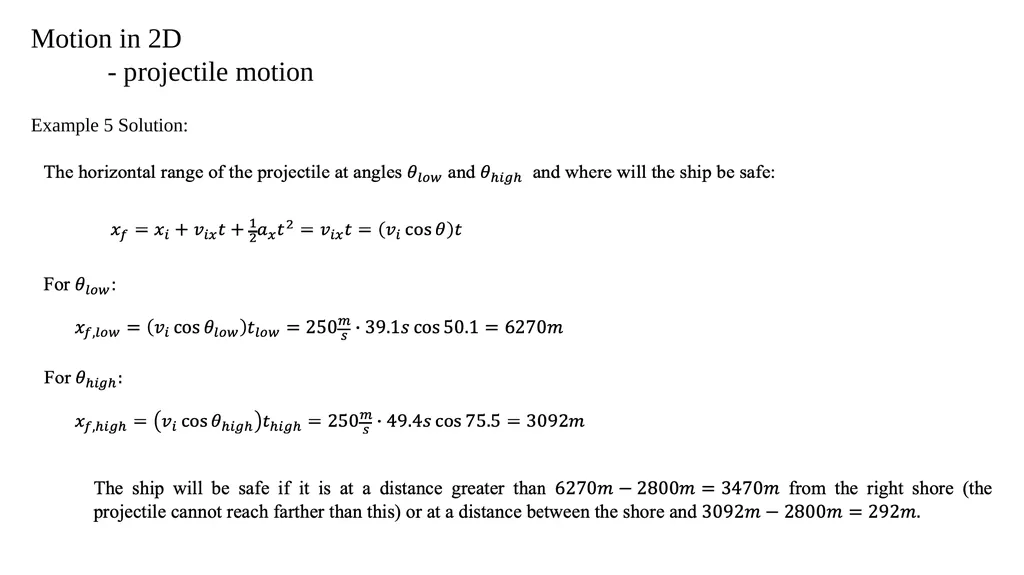
- projectile motion Here we don’t know how long it takes the projectile to get from the top to the ship to the top of the mountain because we don’t know the launch angles involved. But both of the trajectory equations are coupled by time. We’ll eliminate time between the two equations and wrote the vertical position in terms of the horizontal position.<br>
17
Example 5 Solution: Motion in 2D
- projectile motion<br>
18
Example 5 Solution: Motion in 2D
- projectile motion<br>
19
Example 5 Solution: Motion in 2D
- projectile motion<br>
20
Motion in 2D
- projectile motion<br>
21
Motion in 2D
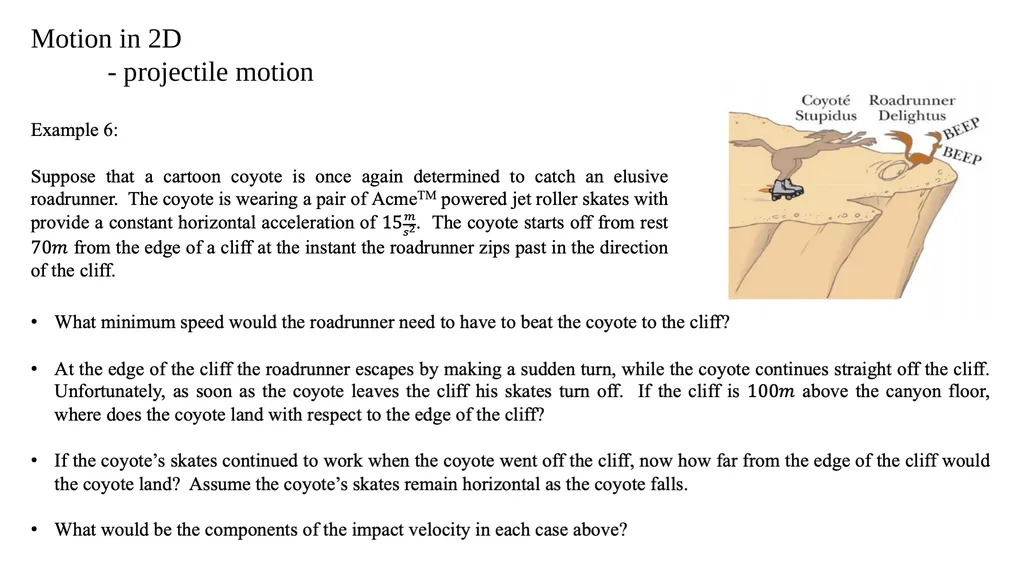
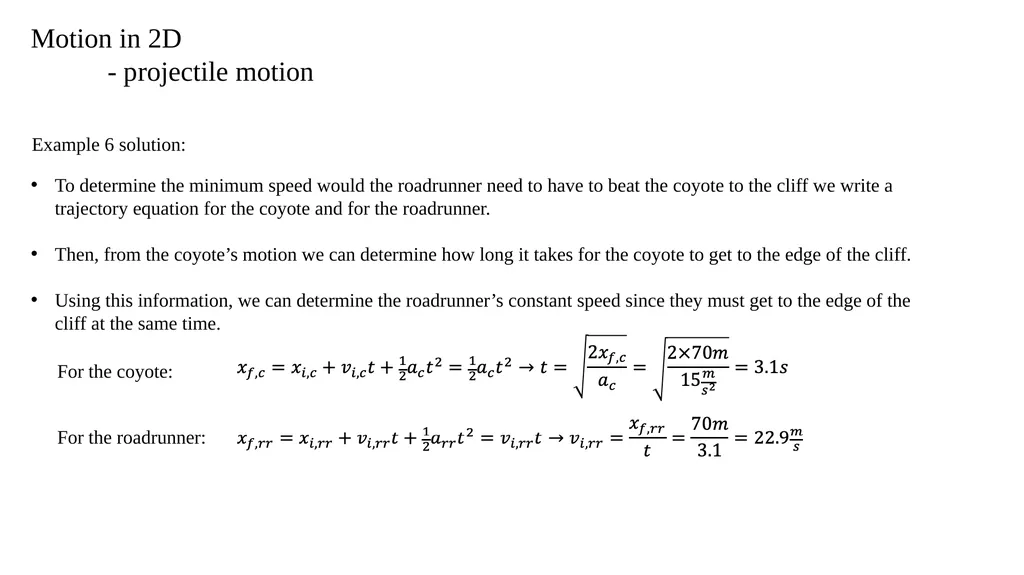
- projectile motion Example 6 solution: To determine the minimum speed would the roadrunner need to have to beat the coyote to the cliff we write a trajectory equation for the coyote and for the roadrunner.
Then, from the coyote’s motion we can determine how long it takes for the coyote to get to the edge of the cliff.
Using this information, we can determine the roadrunner’s constant speed since they must get to the edge of the cliff at the same time. For the coyote: For the roadrunner:<br>
22
Motion in 2D
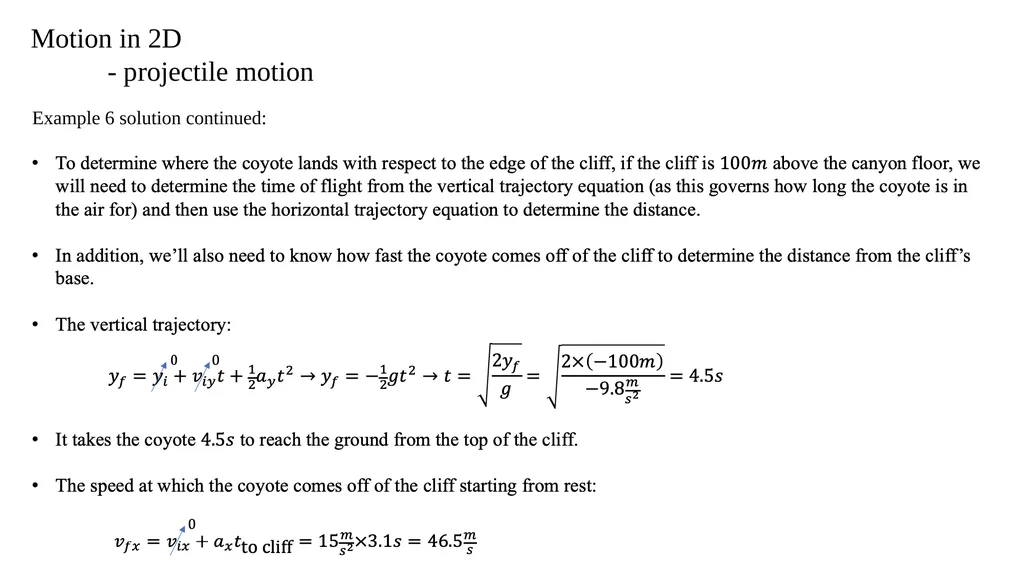
- projectile motion Example 6 solution continued:<br>
23
Motion in 2D
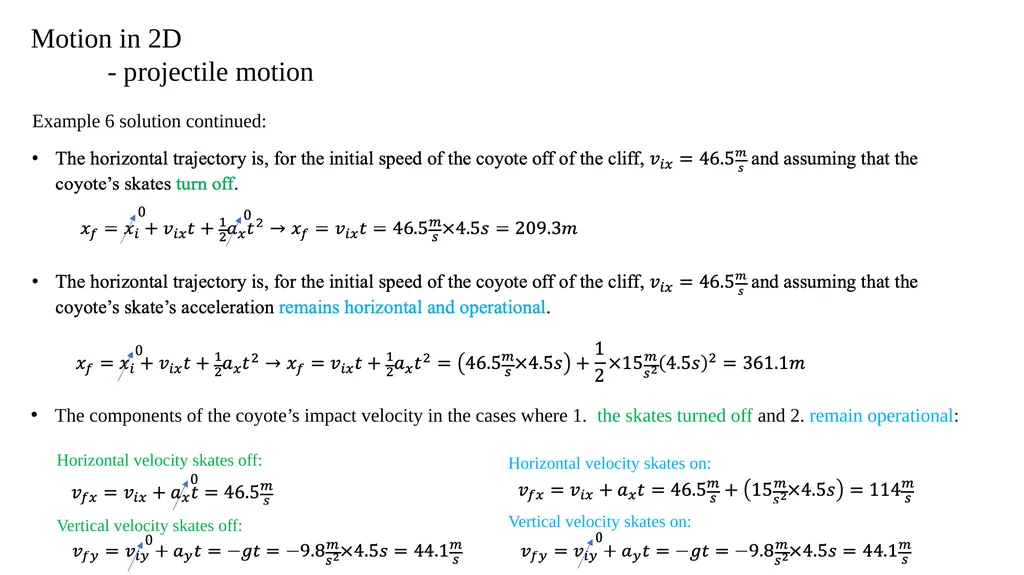
- projectile motion Example 6 solution continued: The components of the coyote’s impact velocity in the cases where 1. the skates turned off and 2. remain operational: Horizontal velocity skates off: Vertical velocity skates off: Horizontal velocity skates on: Vertical velocity skates on:<br>
24
Motion in 2D
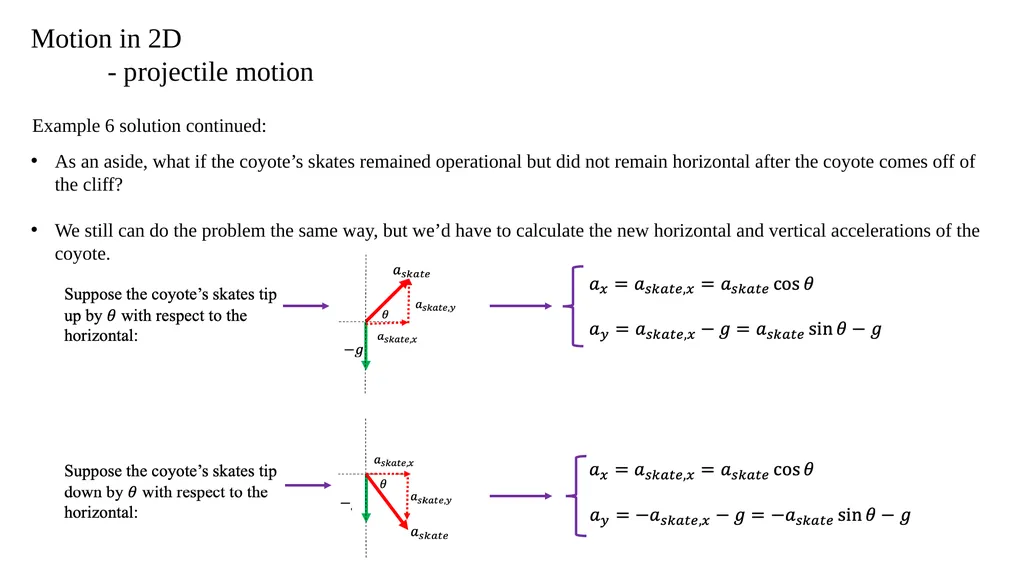
- projectile motion Example 6 solution continued: As an aside, what if the coyote’s skates remained operational but did not remain horizontal after the coyote comes off of the cliff?
We still can do the problem the same way, but we’d have to calculate the new horizontal and vertical accelerations of the coyote.<br>
25
Motion in 2D
- projectile motion<br>
26
Motion in 2D
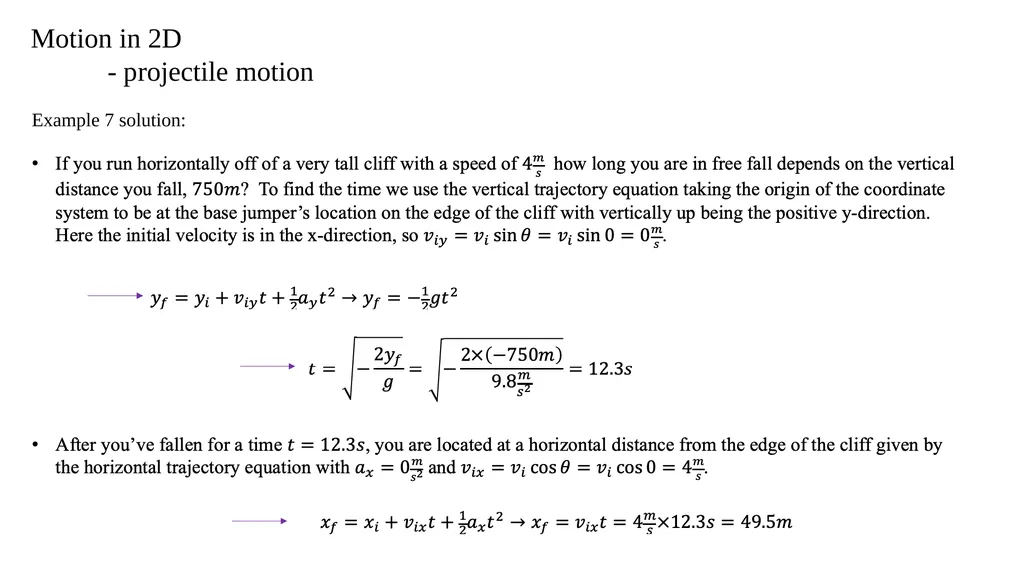
- projectile motion Example 7 solution:<br>
27
Motion in 2D
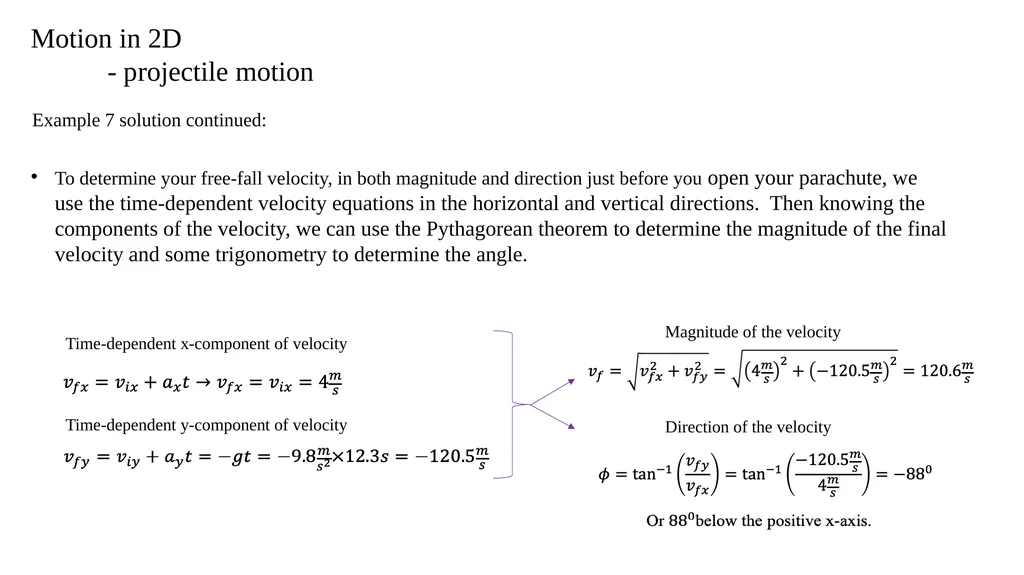
- projectile motion Example 7 solution continued: To determine your free-fall velocity, in both magnitude and direction just before you open your parachute, we use the time-dependent velocity equations in the horizontal and vertical directions. Then knowing the components of the velocity, we can use the Pythagorean theorem to determine the magnitude of the final velocity and some trigonometry to determine the angle. Time-dependent x-component of velocity Time-dependent y-component of velocity Magnitude of the velocity Direction of the velocity<br>
28
Motion in 2D
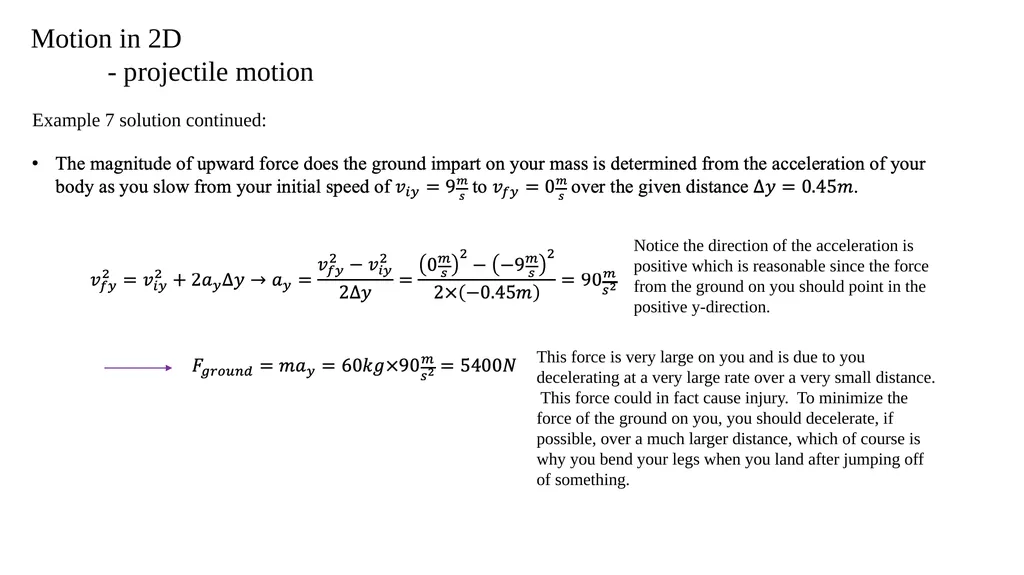
- projectile motion Example 7 solution continued: Notice the direction of the acceleration is positive which is reasonable since the force from the ground on you should point in the positive y-direction. This force is very large on you and is due to you decelerating at a very large rate over a very small distance. This force could in fact cause injury. To minimize the force of the ground on you, you should decelerate, if possible, over a much larger distance, which of course is why you bend your legs when you land after jumping off of something.<br>