MRI Safety Training Safety Background The MRI scanner is a very large and powerful magnet Most clinical scanners are 1.5 - 3 Tesla scanners 3 Tesla 30,000 gauss Earths magnetic field 0.5 gauss MRI SAFETY Magnetic Resonance Imaging (MRI)
"MRI Safety Training Safety Background The MRI" is the property of its rightful owner. Permission is granted to
download and print the materials on this website for personal, non-commercial use only, and to display it
on your personal computer provided you do not modify the materials and that you retain all copyright
notices contained in the materials. By downloading content from our website, you accept the terms of this
agreement.
Presentation Transcript
01
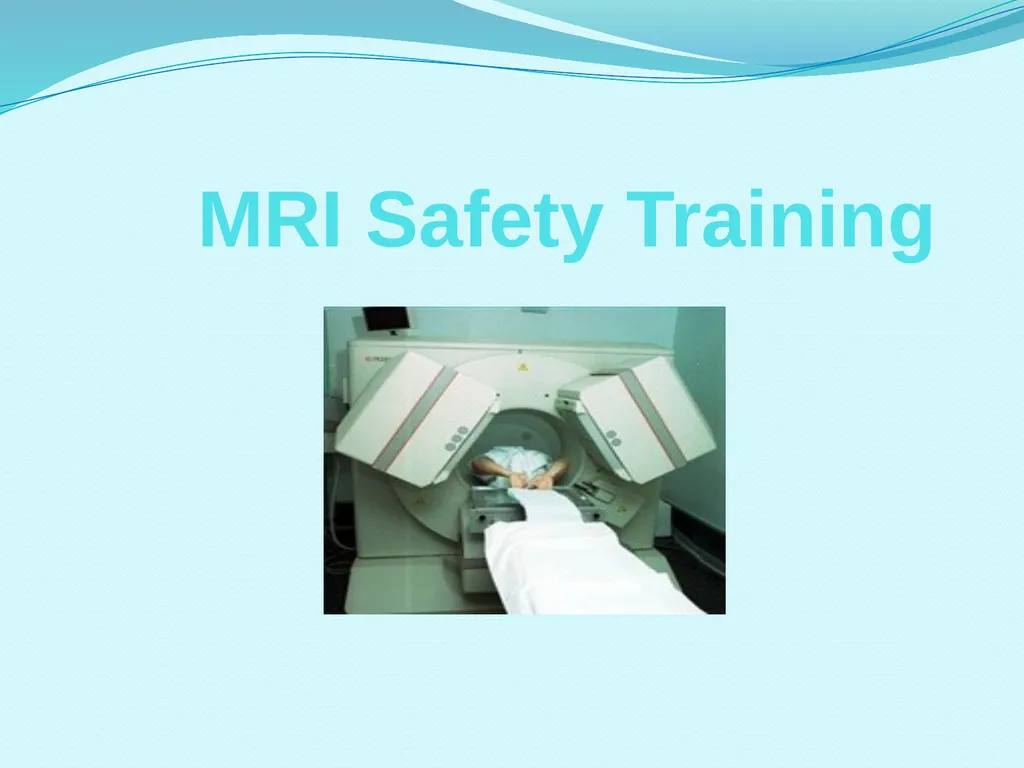
MRI Safety Training<br>
02
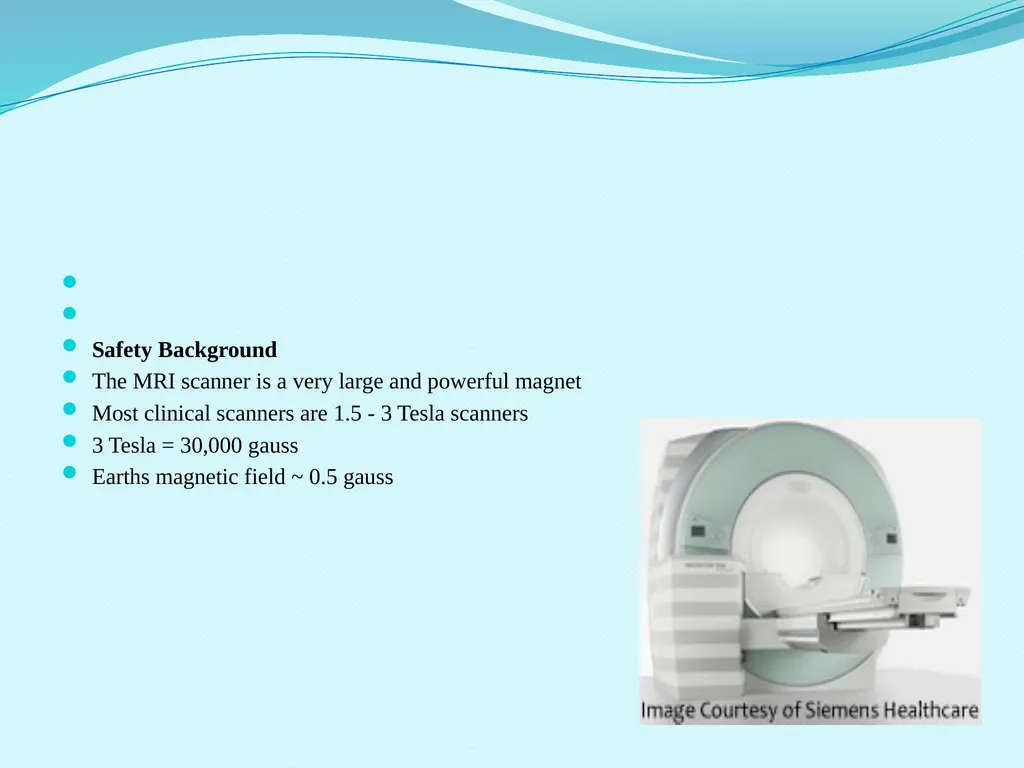
Safety Background
The MRI scanner is a very large and powerful magnet
Most clinical scanners are 1.5 - 3 Tesla scanners
3 Tesla = 30,000 gauss
Earths magnetic field ~ 0.5 gauss<br>
03
MRI SAFETY Magnetic Resonance Imaging (MRI) is one of the most powerful medical diagnostic technologies, combining strong magnetic fields with powerful computer image processing.<br>
04
Function The core of an MRI machine is a very high-strength magnet arranged to surround most of the patient's body. This magnet is usually wrapped with coils of copper wire, and when electricity flows through the wire a powerful magnetic field is produced.<br>
05
Significance In normal MRI machines, the magnets are superconducting---their wires have zero resistance to the flow of electric current. The only way to achieve superconductivity is to make the magnets ultra-cold by submerging them in liquid helium: at about -453 °F, the magnet assembly is barely 5°F above absolute zero. Often, this liquid helium is surrounded by an insulating blanket of liquid nitrogen. Because superconducting wires continually conduct and recalculated the electric current without resistance, the magnetic field is present 24 hours a day; whether the MRI machine is being used or not.<br>
06
Considerations Safe operation of an MRI machine requires managing three main categories of potential safety issues, all addressed by MRI safety training programs: 1. Medical/biological effects of high-strength magnets 2. Area/vicinity effects of high-strength magnets 3. Cryogenic (ultra-cold) gases<br>
07
Biological magnetic issues There's no evidence indicating biological side effects from the magnetic fields of an MRI scan, and MRI machines don't utilize any ionizing radiation that can damage cells or DNA. Pregnant patients and technicians are generally advised to avoid MRI during the early months of pregnancy, due to a lack of research on potential magnetic effects on the developing fetus. MRI operators are trained on pregnancy safety guidelines.<br>
08
Magnetic object safety The main potential danger from MRI machines comes from the interaction of the magnetic field with metallic objects or particles. Any metal inside the patient (such as medical devices or shrapnel) can cause severe injuries. Metallic objects in the vicinity of an MRI room can be attracted by the "fringe" magnetic field---causing them to be sucked into the MRI machine at high speed, posing a severe danger to patients. MRI training videos demonstrate this threat. MRI safety training outlines the methods of screening for potentially hazardous metal in a patient's body, and for preventing the entry of any ferromagnetic objects into the MRI room.<br>
09
Potential Projectiles: Examples Cell phone
Keys
Glasses
Hair pins / barrettes
Jewelry
Safety pins
Paper clips
Coins
Pens
Pocket knife
Nail clippers
Steel-toed boots / shoes
Tools
Clipboards
No loose metallic objects should be taken into the Scan room!<br>
10
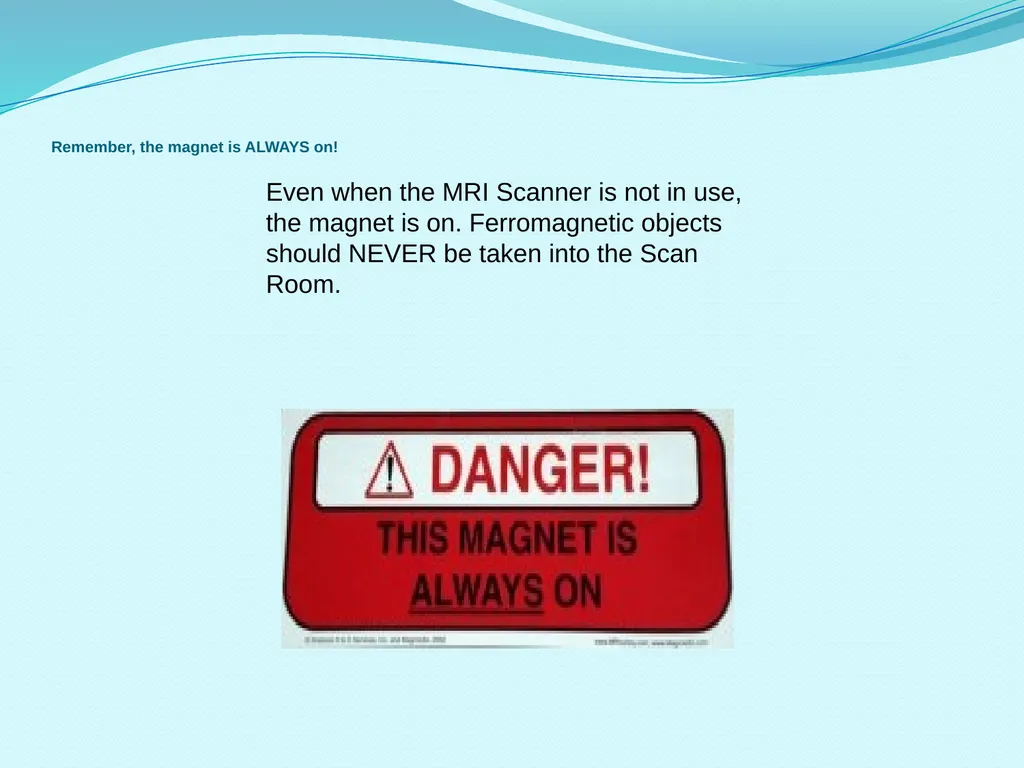
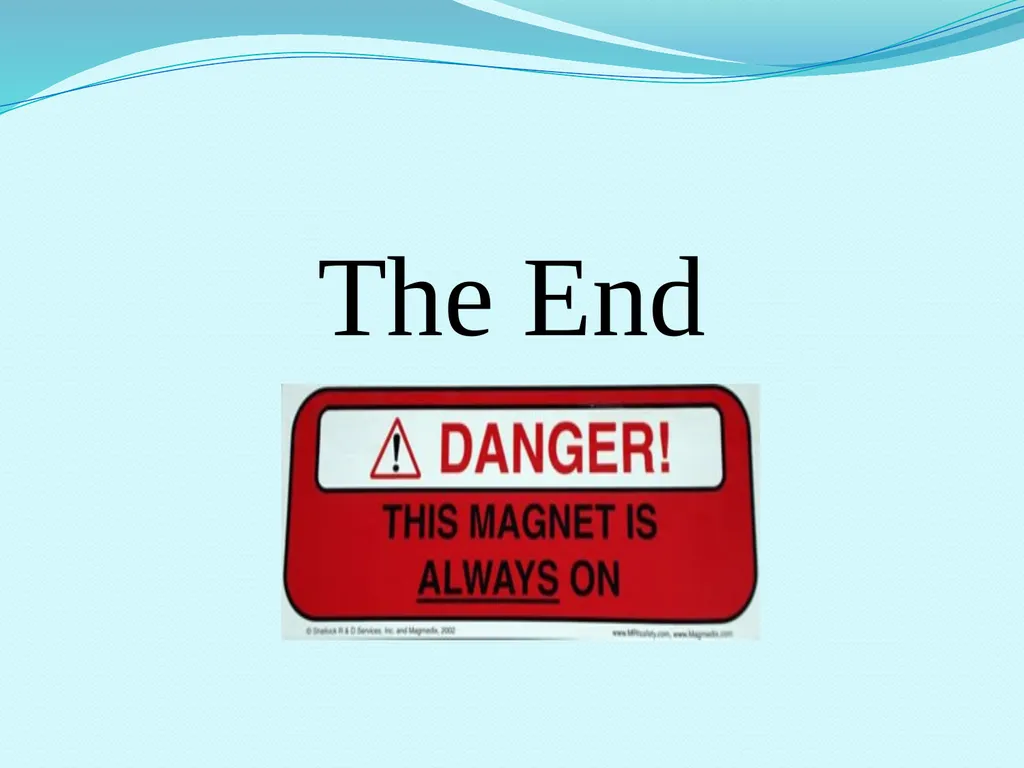
Remember, the magnet is ALWAYS on! Even when the MRI Scanner is not in use, the magnet is on. Ferromagnetic objects should NEVER be taken into the Scan Room.<br>
11
Cryogenic safety MRI operators are trained in the safe management of cryogenic equipment and gases. In the event of a rapid boil-off of the liquid nitrogen or liquid helium surrounding the magnet (a "quench"), a failure of the emergency venting system can cause a life-threatening oxygen shortage in the MRI room. MRI safety training includes preparation for unplanned and emergency quench conditions with vent malfunction. Additionally, operators are trained in emergency shutdown procedures short of a damaging quench---which is typically only initiated if a patient's life is threatened by a foreign metallic object.<br>
12
Hearing Protection in the MR A characteristic of the switching gradient fields is the production of acoustic noise. When the alternating low-frequency currents flow through the gradient coils, which are immersed in the high static magnetic field , forces are exerted on the gradient coils that move like a loudspeaker coil and generate sound waves. The level of this acoustic noise at the location of the subject or volunteer can reach an unacceptable and even dangerous level.
All personnel (MRI Technician, research group member, volunteer subject, family member, etc.) are required to wear hearing protection in the magnet room while the scanning procedure is being performed.<br>
13
Additional training issues Operators may also be trained in responding to medical emergencies during an MRI scan; fire and evacuation procedures; and hearing protection and communication during the often-noisy scanning process.<br>
14
Safety Issue of Static Magnetic Field All non-MR personnel & study subjects entering
the MRI scanner room must be screened.
ACR recommends that non-emergent
patients should be screened by two separate
individuals.
Consider using plain-film radiographic study
to confirm the absence of metal fragments in
critical parts of the body.<br>
15
Zone 1: Reception area
Zone 2: Screening interview area
Zone 3: Control area, access restricted with key locks, passkey systems etc.
Zone 4: MR scanner room
MR personnel must have safety training,
non-MR personnel cannot have independent
access to Zone 3 or 4. Safety Issue of Static Magnetic Field Zones<br>
16
Biological Effect of Radiofrequency Field (1) Radiofrequency energy deposited in the body during an MR examination will be converted into heat.
‘Specific Absorption Rate’ (SAR) is defined
as the average energy dissipated in the body per unit mass and time.
This heat gain is countered by heat loss
through sweat glands and cutaneous blood
vessels.<br>
17
Thermal Safety of Subject Resonant circuitry can result in heating of the tips of wires or leads to temperature in excess of 90 deg C within a few seconds
All unnecessary electrically conductive materials should be removed before imaging.
All attached leads should be covered with cold compress or ice pack.
Avoid any large conductive loops, including limbs(do not cross arms or legs in the MR, this forms a loop as well).
Care should be taken to place thermal insulation between the subject and electrically conductive material.<br>
18
Only items marked “MR Safe” are permitted in the magnet room. If there is a question concerning the MR safety aspect of any item—do not allow it to be brought into the magnet room!<br>
19
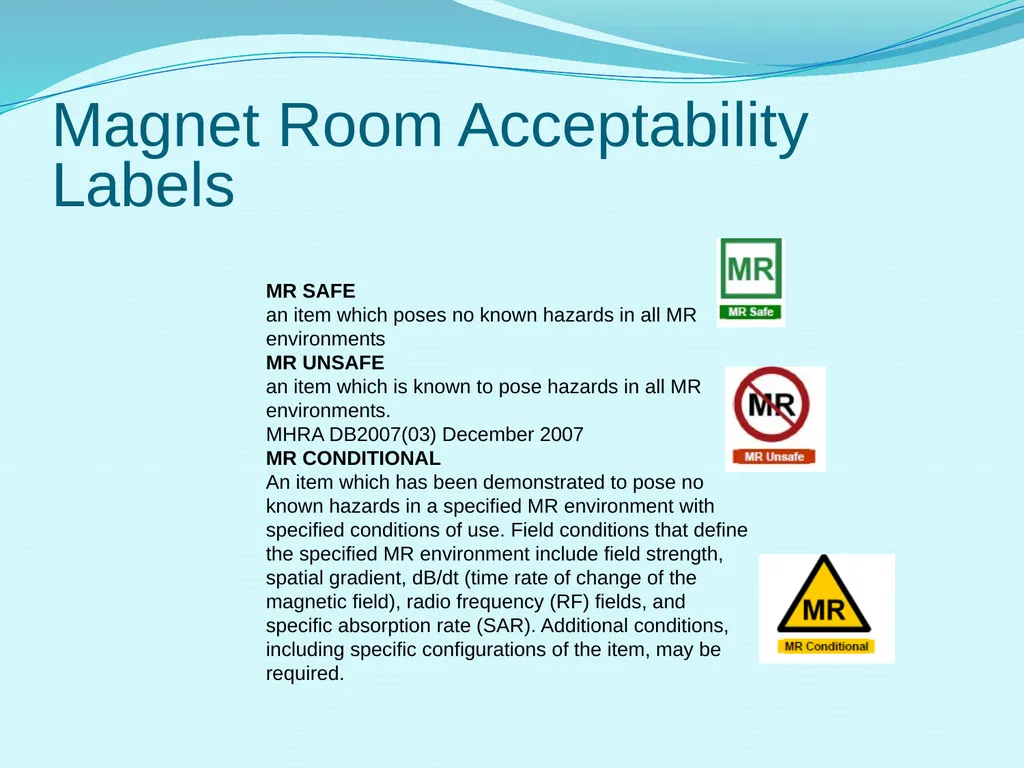
Magnet Room Acceptability Labels MR SAFE
an item which poses no known hazards in all MR environments
MR UNSAFE
an item which is known to pose hazards in all MR environments.
MHRA DB2007(03) December 2007
MR CONDITIONAL
An item which has been demonstrated to pose no known hazards in a specified MR environment with specified conditions of use. Field conditions that define the specified MR environment include field strength, spatial gradient, dB/dt (time rate of change of the magnetic field), radio frequency (RF) fields, and specific absorption rate (SAR). Additional conditions, including specific configurations of the item, may be required.<br>