"Multicultural Education By: Brittany Bryant &" is the property of its rightful owner. Permission is granted to
download and print the materials on this website for personal, non-commercial use only, and to display it
on your personal computer provided you do not modify the materials and that you retain all copyright
notices contained in the materials. By downloading content from our website, you accept the terms of this
agreement.
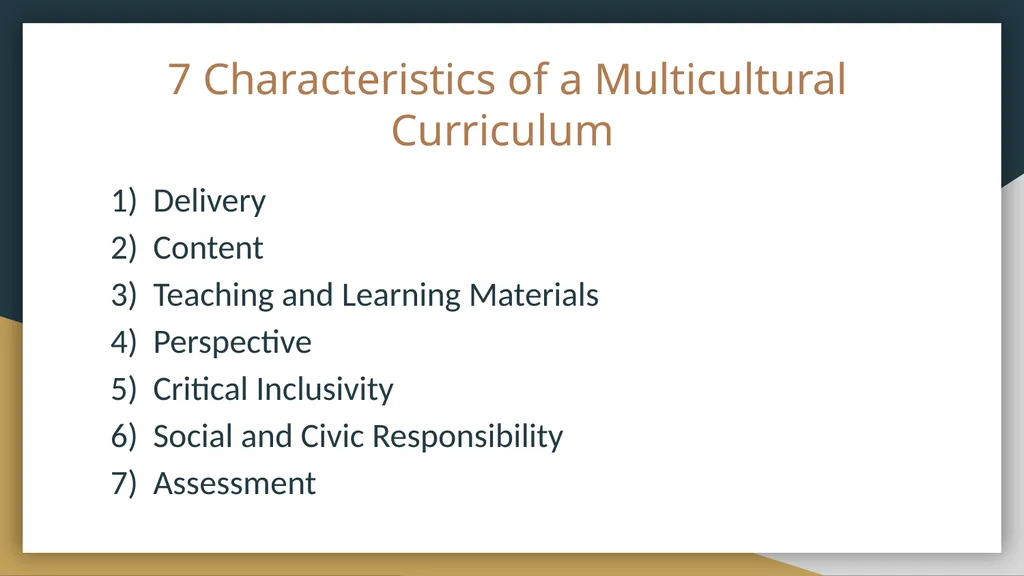
7 Characteristics of a Multicultural Curriculum Delivery
Content
Teaching and Learning Materials
Perspective
Critical Inclusivity
Social and Civic Responsibility
Assessment<br>
03
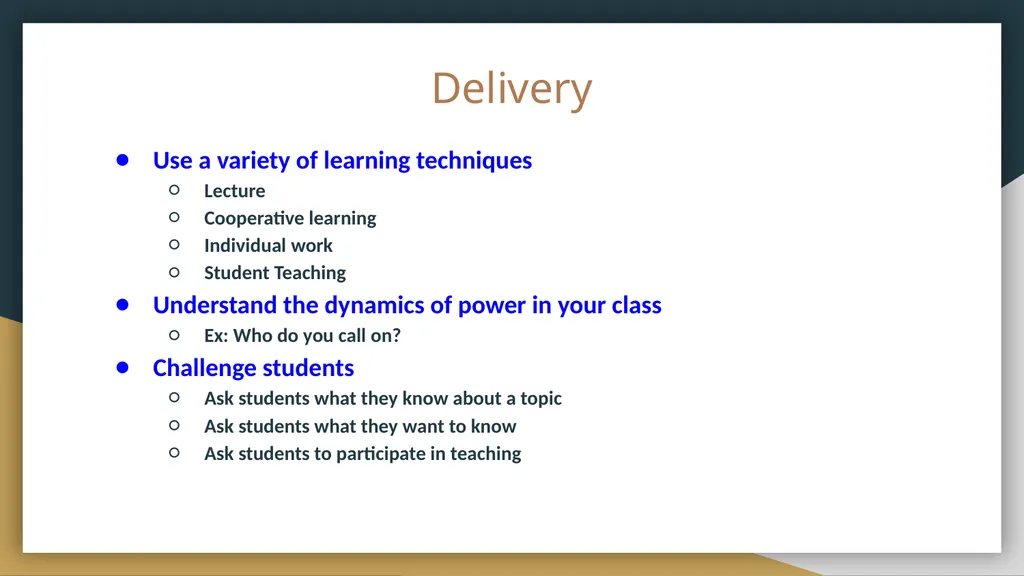
Delivery Use a variety of learning techniques
Lecture
Cooperative learning
Individual work
Student Teaching
Understand the dynamics of power in your class
Ex: Who do you call on?
Challenge students
Ask students what they know about a topic
Ask students what they want to know
Ask students to participate in teaching<br>
04
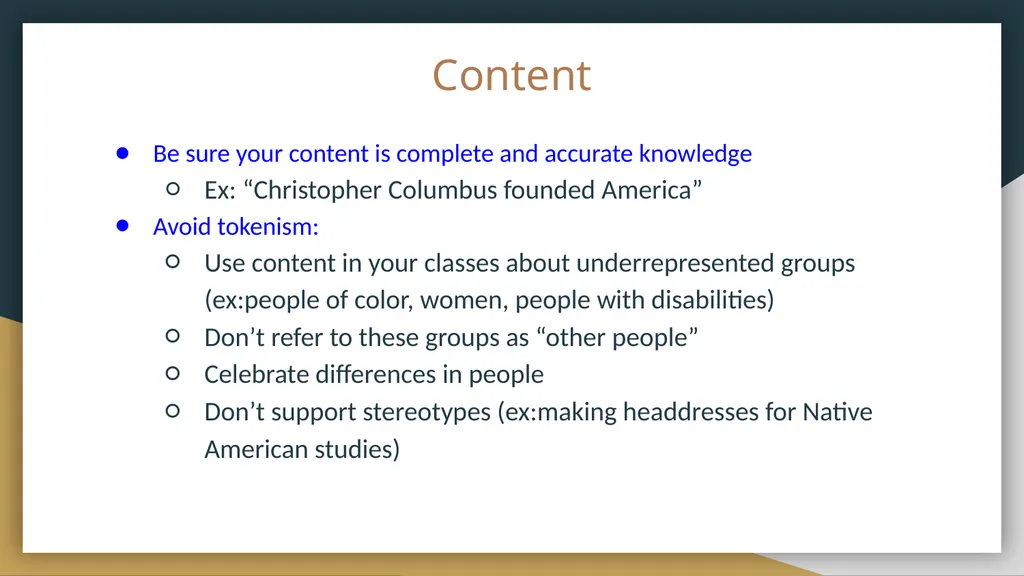
Content Be sure your content is complete and accurate knowledge
Ex: “Christopher Columbus founded America”
Avoid tokenism:
Use content in your classes about underrepresented groups (ex:people of color, women, people with disabilities)
Don’t refer to these groups as “other people”
Celebrate differences in people
Don’t support stereotypes (ex:making headdresses for Native American studies)<br>
05
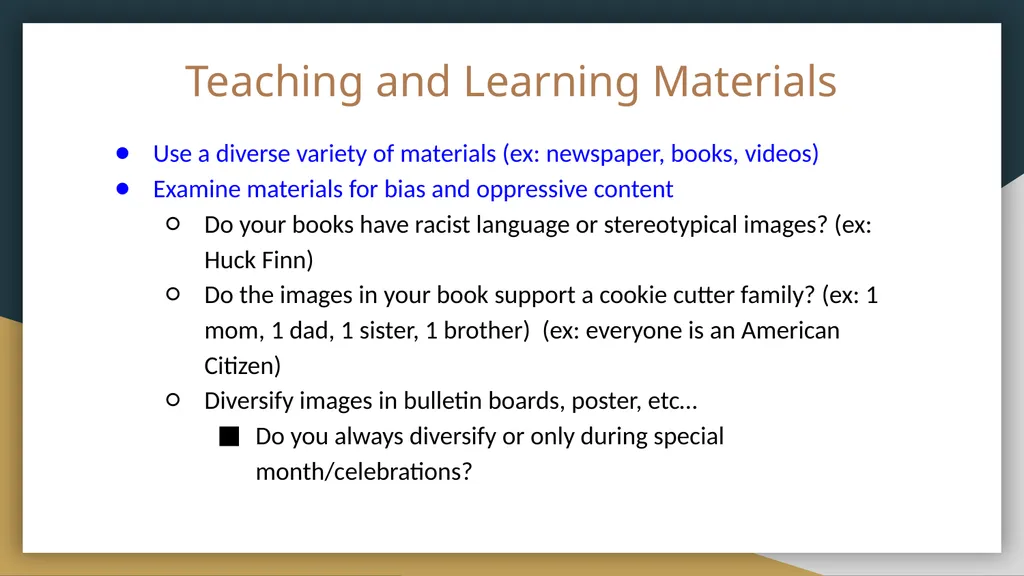
Teaching and Learning Materials Use a diverse variety of materials (ex: newspaper, books, videos)
Examine materials for bias and oppressive content
Do your books have racist language or stereotypical images? (ex: Huck Finn)
Do the images in your book support a cookie cutter family? (ex: 1 mom, 1 dad, 1 sister, 1 brother) (ex: everyone is an American Citizen)
Diversify images in bulletin boards, poster, etc…
Do you always diversify or only during special month/celebrations?<br>
06
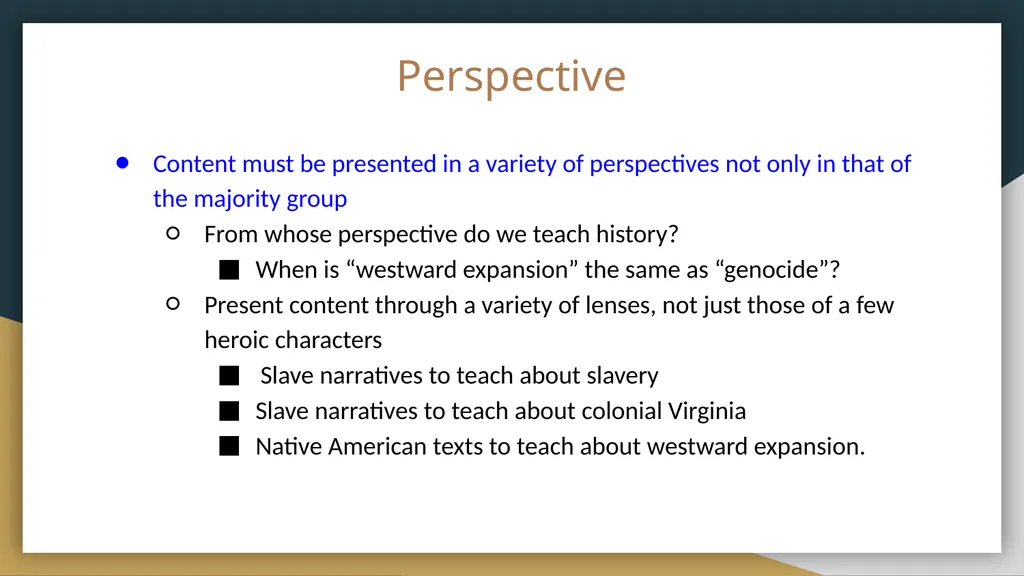
Perspective Content must be presented in a variety of perspectives not only in that of the majority group
From whose perspective do we teach history?
When is “westward expansion” the same as “genocide”?
Present content through a variety of lenses, not just those of a few heroic characters
Slave narratives to teach about slavery
Slave narratives to teach about colonial Virginia
Native American texts to teach about westward expansion.<br>
07
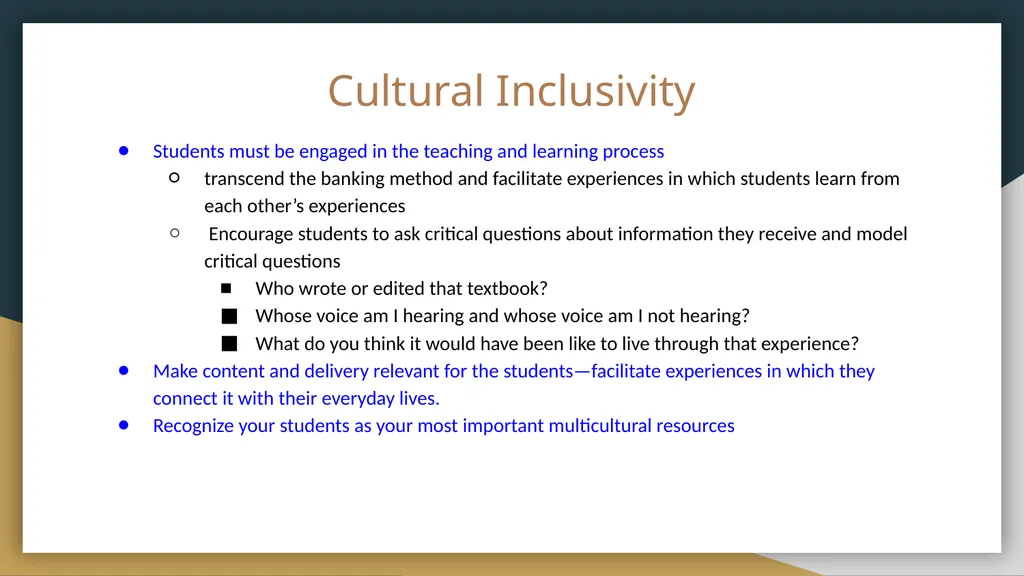
Cultural Inclusivity Students must be engaged in the teaching and learning process
transcend the banking method and facilitate experiences in which students learn from each other’s experiences
Encourage students to ask critical questions about information they receive and model critical questions
Who wrote or edited that textbook?
Whose voice am I hearing and whose voice am I not hearing?
What do you think it would have been like to live through that experience?
Make content and delivery relevant for the students—facilitate experiences in which they connect it with their everyday lives.
Recognize your students as your most important multicultural resources<br>
08
Social and Civic Responsibility If we hope to prepare students to be active participants in society, we must educate them about issues in society and model a sense of civic responsibility.
Starting with the youngest students, incorporate discussions about inequality into your lesson
Talk about individuals whose fought for social injustices. (find people from majority groups who fought types of oppression.)
For example: Albert Einstein, Eleanor Roosevelt, MLK
If an opportunity arises to address racism, sexism, homophobia, or other forms of oppression, facilitate it.
Connect teaching and learning to local community and larger global issues<br>
09
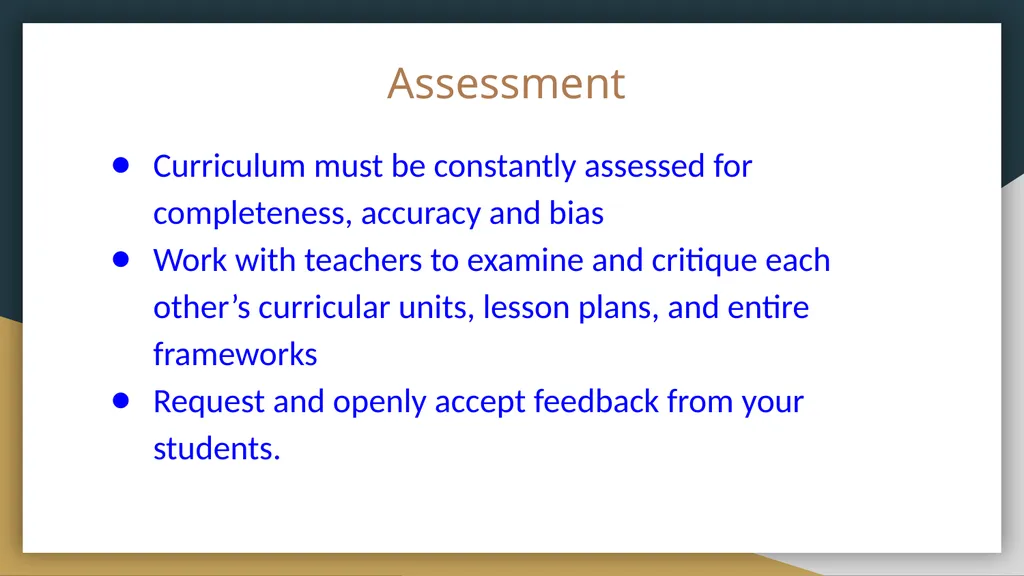
Assessment Curriculum must be constantly assessed for completeness, accuracy and bias
Work with teachers to examine and critique each other’s curricular units, lesson plans, and entire frameworks
Request and openly accept feedback from your students.<br>
10
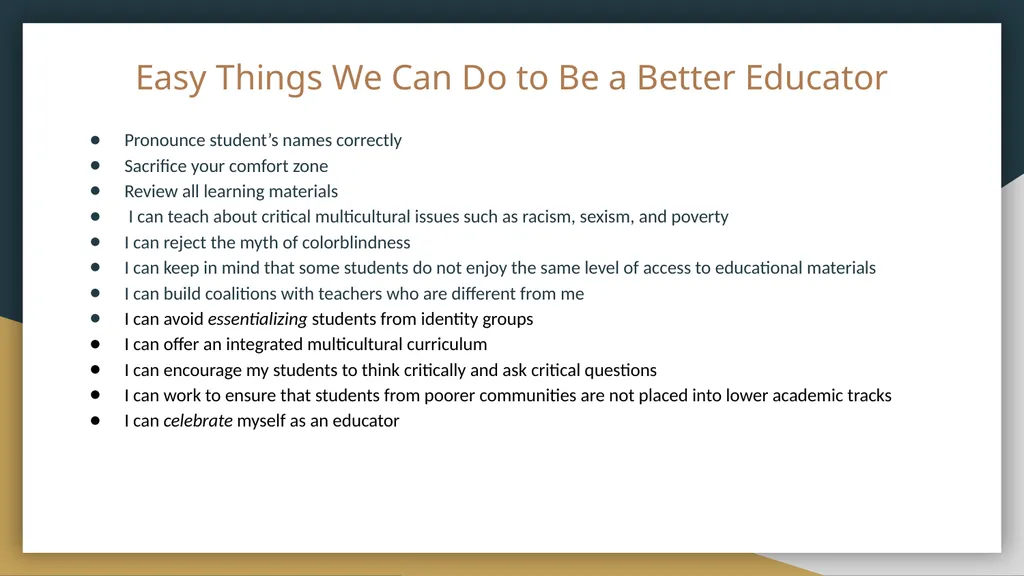
Easy Things We Can Do to Be a Better Educator Pronounce student’s names correctly
Sacrifice your comfort zone
Review all learning materials
I can teach about critical multicultural issues such as racism, sexism, and poverty
I can reject the myth of colorblindness
I can keep in mind that some students do not enjoy the same level of access to educational materials
I can build coalitions with teachers who are different from me
I can avoid essentializing students from identity groups
I can offer an integrated multicultural curriculum
I can encourage my students to think critically and ask critical questions
I can work to ensure that students from poorer communities are not placed into lower academic tracks
I can celebrate myself as an educator<br>
11
Activity Number 1 Get a piece of paper
Imagine you are having a dinner party
Write down the names of 5 people you would invite<br>
12
Activity number 2 Name a Hero: White Male (NOT an entertainer or athlete)<br>
13
Activity 2 continued Name a Hero: A White Female (NOT an entertainer or athlete)<br>
14
Activity 2 Continued Name a Hero: An African American Male (NOT an entertainer or athlete)<br>
15
Activity 2 Continued Name a Hero: An African American Female (NOT an entertainer or athlete)<br>
16
Activity 2 Continued Name a Hero: A Hispanic/Latino Male<br>
17
Activity 2 Continued Name a Hero: A Hispanic/Latina Female<br>
18
Activity 2 Continued Name a Hero: Native American Male/Female<br>
19
Activity 2 Continued Name a Hero: Asian Male/Female<br>