
Multiemployer Plan Payroll Compliance Audits
LO
Published · 38 slides · 0 views
1 / 1



Description
Multiemployer Plan Payroll Compliance Audits Employee Benefit Plan Audit Quality Center AICPA Whats New with SSAE 18? Handouts for todays event You can download presentation slides (in PDF or PowerPoint format) and other handouts by
Related Topics
Share
Embed code
Download this presentation From Below
"Multiemployer Plan Payroll Compliance Audits" is the property of its rightful owner. Permission is granted to download and print the materials on this website for personal, non-commercial use only, and to display it on your personal computer provided you do not modify the materials and that you retain all copyright notices contained in the materials. By downloading content from our website, you accept the terms of this agreement.
Presentation Transcript
01
Multiemployer Plan Payroll Compliance Audits Employee Benefit Plan
Audit Quality Center AICPA What’s New with SSAE 18?<br>
Audit Quality Center AICPA What’s New with SSAE 18?<br>
02
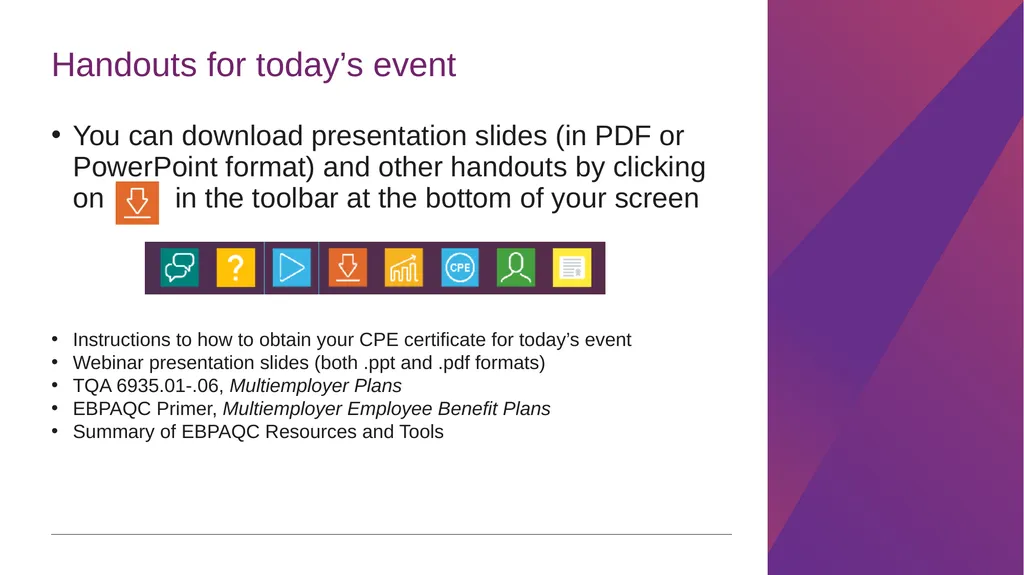
Handouts for today’s event You can download presentation slides (in PDF or PowerPoint format) and other handouts by clicking on in the toolbar at the bottom of your screen
Instructions to how to obtain your CPE certificate for today’s event
Webinar presentation slides (both .ppt and .pdf formats)
TQA 6935.01-.06, Multiemployer Plans
EBPAQC Primer, Multiemployer Employee Benefit Plans
Summary of EBPAQC Resources and Tools<br>
Instructions to how to obtain your CPE certificate for today’s event
Webinar presentation slides (both .ppt and .pdf formats)
TQA 6935.01-.06, Multiemployer Plans
EBPAQC Primer, Multiemployer Employee Benefit Plans
Summary of EBPAQC Resources and Tools<br>
03
Presenters Doug Bertossi – CliftonLarsonAllen LLP
Eileen Brassil – Legacy Professionals LLP
David Evangelista – MBAF CPAs and Advisors, LLC<br>
Eileen Brassil – Legacy Professionals LLP
David Evangelista – MBAF CPAs and Advisors, LLC<br>
04
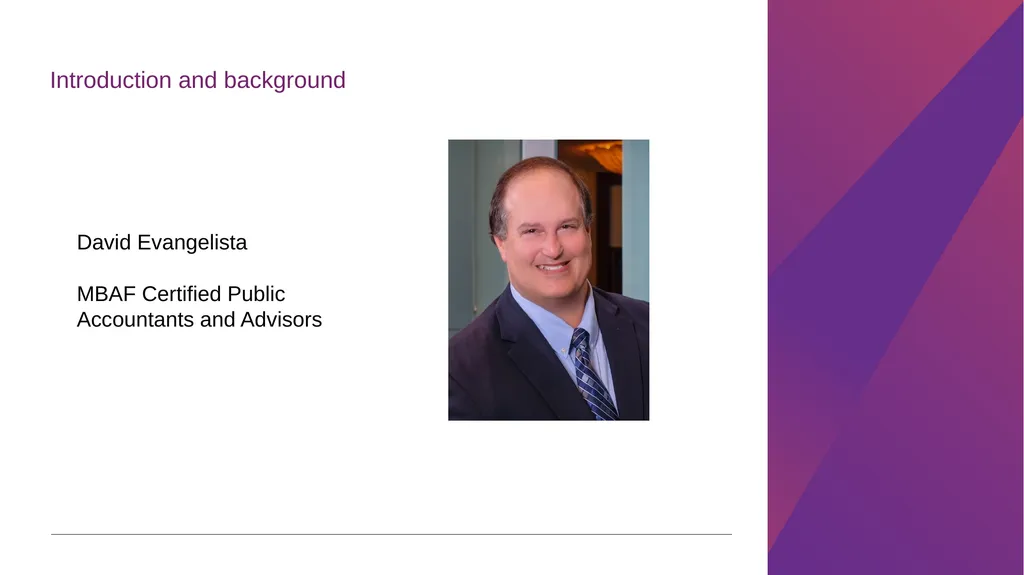
Introduction and background David Evangelista
MBAF Certified Public Accountants and Advisors<br>
MBAF Certified Public Accountants and Advisors<br>
05
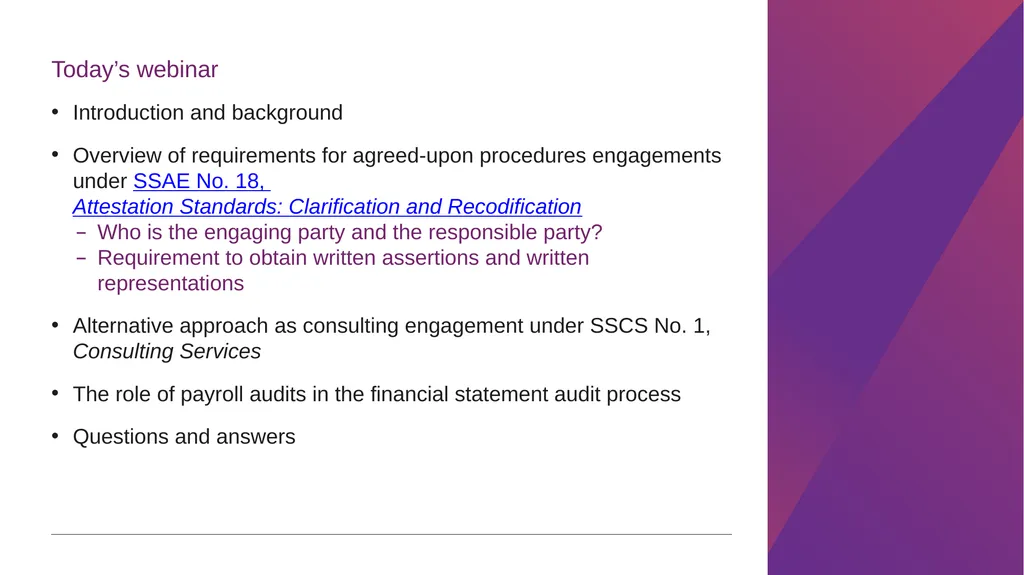
Today’s webinar Introduction and background
Overview of requirements for agreed-upon procedures engagements under SSAE No. 18, Attestation Standards: Clarification and Recodification
Who is the engaging party and the responsible party?
Requirement to obtain written assertions and written representations
Alternative approach as consulting engagement under SSCS No. 1, Consulting Services
The role of payroll audits in the financial statement audit process
Questions and answers<br>
Overview of requirements for agreed-upon procedures engagements under SSAE No. 18, Attestation Standards: Clarification and Recodification
Who is the engaging party and the responsible party?
Requirement to obtain written assertions and written representations
Alternative approach as consulting engagement under SSCS No. 1, Consulting Services
The role of payroll audits in the financial statement audit process
Questions and answers<br>
06
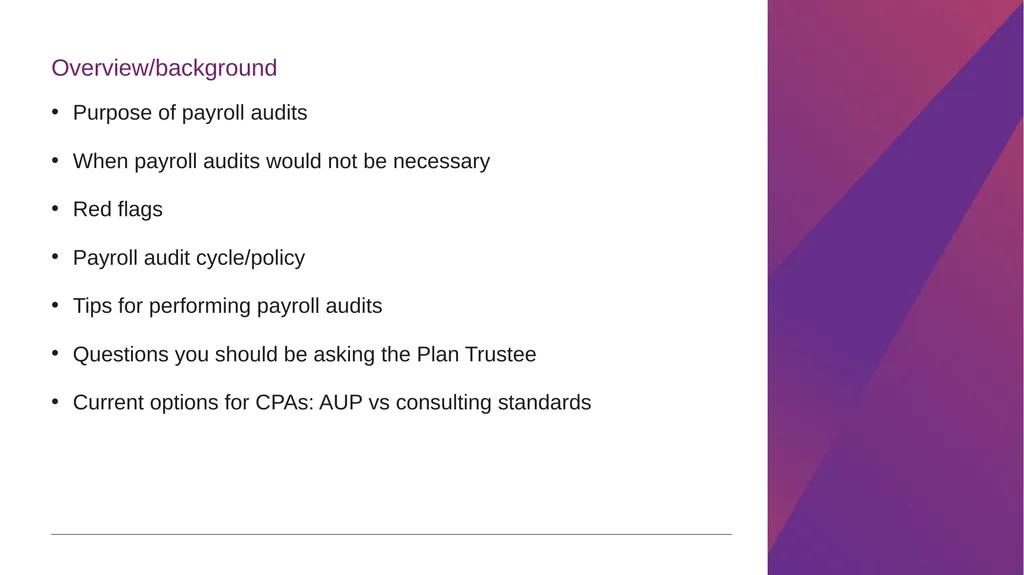
Overview/background Purpose of payroll audits
When payroll audits would not be necessary
Red flags
Payroll audit cycle/policy
Tips for performing payroll audits
Questions you should be asking the Plan Trustee
Current options for CPAs: AUP vs consulting standards<br>
When payroll audits would not be necessary
Red flags
Payroll audit cycle/policy
Tips for performing payroll audits
Questions you should be asking the Plan Trustee
Current options for CPAs: AUP vs consulting standards<br>
07
Agreed-Upon Procedures<br>
08
Performing agreed-upon procedures Doug Bertossi
CliftonLarsonAllen LLP<br>
CliftonLarsonAllen LLP<br>
09
AUP general considerations Need to follow SSAE 18, AT-C Section 215, Agreed-Upon Procedures Engagements
SSAE 18 effective for reports dated on or after May 1, 2017
Offers more structure and consistency
Independence is not a concern if perform the plan financial statement audit as well<br>
SSAE 18 effective for reports dated on or after May 1, 2017
Offers more structure and consistency
Independence is not a concern if perform the plan financial statement audit as well<br>
10
Definitions Engaging party
The engaging party is the party that hires the practitioner to provide the service. The engaging party need not be the responsible party.
Responsible party
The responsible party is someone who takes responsibility for the subject matter. Generally, the responsible party is the management of the entity whose subject matter is being measured.<br>
The engaging party is the party that hires the practitioner to provide the service. The engaging party need not be the responsible party.
Responsible party
The responsible party is someone who takes responsibility for the subject matter. Generally, the responsible party is the management of the entity whose subject matter is being measured.<br>
11
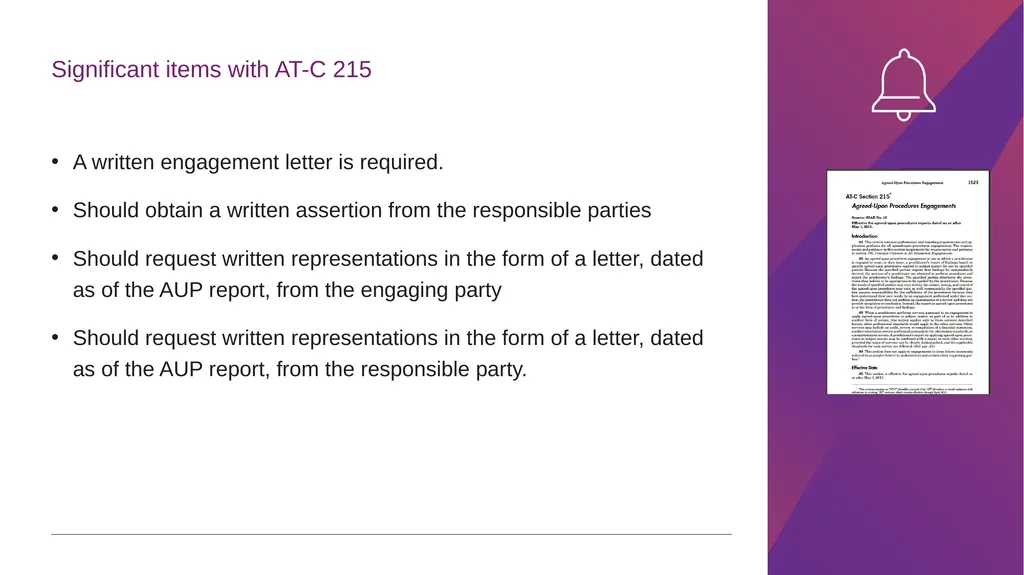
Significant items with AT-C 215 A written engagement letter is required.
Should obtain a written assertion from the responsible parties
Should request written representations in the form of a letter, dated as of the AUP report, from the engaging party
Should request written representations in the form of a letter, dated as of the AUP report, from the responsible party.<br>
Should obtain a written assertion from the responsible parties
Should request written representations in the form of a letter, dated as of the AUP report, from the engaging party
Should request written representations in the form of a letter, dated as of the AUP report, from the responsible party.<br>
12
Q&A section 6935, Multiemployer Plans 03, Obtaining engagement letters
.04, Requesting and obtaining representation letters from engaging party
.05, When representation letters are not received from responsible parties
.06, Use of AUP or other reports as audit evidence in a plan audit<br>
.04, Requesting and obtaining representation letters from engaging party
.05, When representation letters are not received from responsible parties
.06, Use of AUP or other reports as audit evidence in a plan audit<br>
13
Engagement letters Agreed-upon terms of the engagement should be specified in sufficient detail in an engagement letter or other suitable form of written agreement.
Received prior to the commencement of the engagement.
Q&A 6935 guidance
While separate AUP reports are issued for each engagement, all payroll compliance services to be performed may be covered by a single agreement with the plan trustee.<br>
Received prior to the commencement of the engagement.
Q&A 6935 guidance
While separate AUP reports are issued for each engagement, all payroll compliance services to be performed may be covered by a single agreement with the plan trustee.<br>
14
Assertion from responsible parties Assertion is a declaration(s) about whether the subject matter is in accordance with the criteria.
Assertion should be provided in writing.
Assertion may be acknowledged in a representation letter.<br>
Assertion should be provided in writing.
Assertion may be acknowledged in a representation letter.<br>
15
Assertion from responsible parties If the responsible party refuses to provide a written assertion
The practitioner should disclose in the written report the contributing employer’s refusal to provide
If the practitioner is aware prior to obtaining the written engagement letter, in accordance with AT-C 215.16 the engagement letter should make clear that no such assertion will be provided<br>
The practitioner should disclose in the written report the contributing employer’s refusal to provide
If the practitioner is aware prior to obtaining the written engagement letter, in accordance with AT-C 215.16 the engagement letter should make clear that no such assertion will be provided<br>
16
Representations from engaging party Should request representations from the engaging party in addition to the representations requested from the responsible parties.
Representations should be provided in writing.
Representation letters should be as of the date of the practitioner’s report.<br>
Representations should be provided in writing.
Representation letters should be as of the date of the practitioner’s report.<br>
17
Representations from engaging party What if Engaging Party does not provide a representation letter or it is improperly dated?
The practitioner should refer to the guidance in AT-C 215.31, which states that the practitioner should:
Discuss the matter with the appropriate party(ies).
Reevaluate the integrity of those from whom the representations were requested or received and evaluate the effect, if any, on the engagement, and
If any of the matters are not resolved to the practitioner’s satisfaction, take appropriate action, which may include:
Withdrawing from the engagement, or
Determining the effect on the practitioner’s report<br>
The practitioner should refer to the guidance in AT-C 215.31, which states that the practitioner should:
Discuss the matter with the appropriate party(ies).
Reevaluate the integrity of those from whom the representations were requested or received and evaluate the effect, if any, on the engagement, and
If any of the matters are not resolved to the practitioner’s satisfaction, take appropriate action, which may include:
Withdrawing from the engagement, or
Determining the effect on the practitioner’s report<br>
18
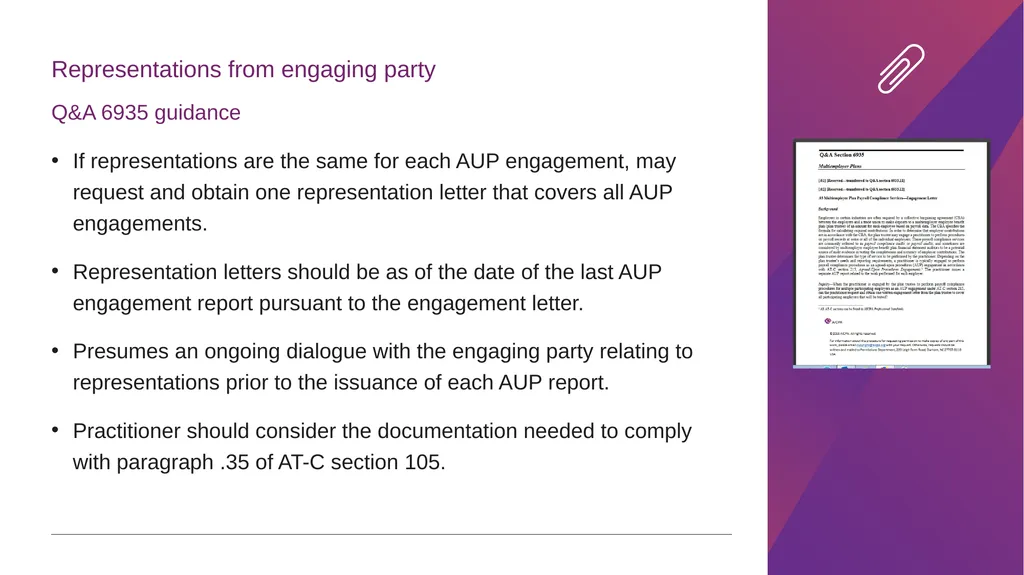
Representations from engaging party Q&A 6935 guidance
If representations are the same for each AUP engagement, may request and obtain one representation letter that covers all AUP engagements.
Representation letters should be as of the date of the last AUP engagement report pursuant to the engagement letter.
Presumes an ongoing dialogue with the engaging party relating to representations prior to the issuance of each AUP report.
Practitioner should consider the documentation needed to comply with paragraph .35 of AT-C section 105.<br>
If representations are the same for each AUP engagement, may request and obtain one representation letter that covers all AUP engagements.
Representation letters should be as of the date of the last AUP engagement report pursuant to the engagement letter.
Presumes an ongoing dialogue with the engaging party relating to representations prior to the issuance of each AUP report.
Practitioner should consider the documentation needed to comply with paragraph .35 of AT-C section 105.<br>
19
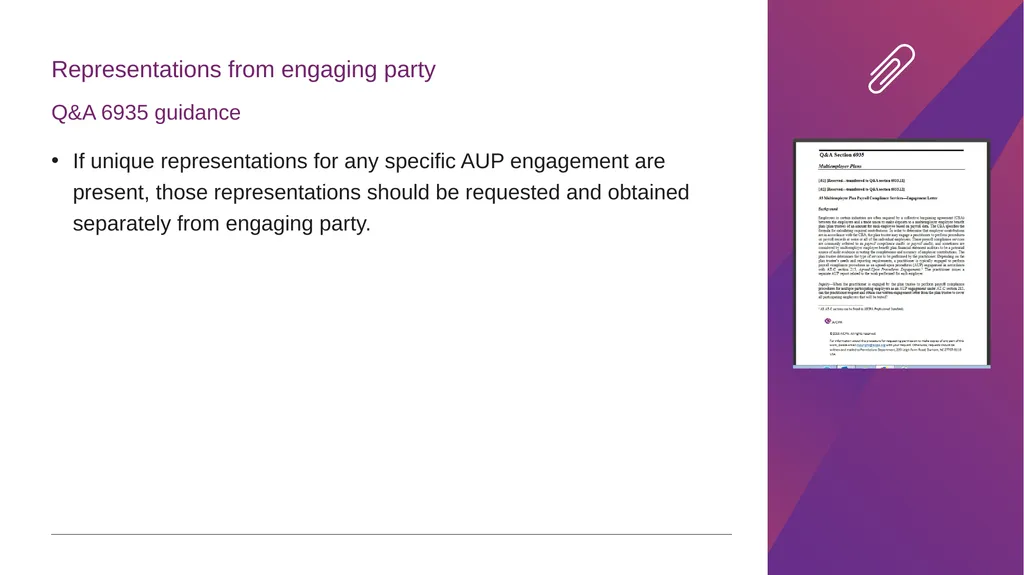
Representations from engaging party Q&A 6935 guidance
If unique representations for any specific AUP engagement are present, those representations should be requested and obtained separately from engaging party.<br>
If unique representations for any specific AUP engagement are present, those representations should be requested and obtained separately from engaging party.<br>
20
Representations from responsible parties Should request representations from the responsible parties in addition to the representations requested from the engaging party.
Representations should be provided in writing.
Representation letters should be as of the date of the practitioner’s report.<br>
Representations should be provided in writing.
Representation letters should be as of the date of the practitioner’s report.<br>
21
Representations from responsible parties What if a Responsible Party does not provide a representation letter?
The practitioner should refer to the guidance in AT-C 215.32, which states that the practitioner should:
Make inquiries of the responsible party about, and seek oral responses to, the matters in paragraph .28
If one or more of the requested representations are not provided in writing or orally from the responsible party, the practitioner should take appropriate action, which may include (ref. .A33):
Withdrawing from the engagement, or
Determining the effect on the practitioner’s report<br>
The practitioner should refer to the guidance in AT-C 215.32, which states that the practitioner should:
Make inquiries of the responsible party about, and seek oral responses to, the matters in paragraph .28
If one or more of the requested representations are not provided in writing or orally from the responsible party, the practitioner should take appropriate action, which may include (ref. .A33):
Withdrawing from the engagement, or
Determining the effect on the practitioner’s report<br>
22
Representations from responsible parties What if a Responsible Party does not provide a representation letter?
Q&A 6935 guidance
Use professional judgment to determine whether the AUP can be performed appropriately.
If CBA legally requires the contributing employer to make all relevant payroll records available, it may not be necessary to for the practitioner to request and obtain a representation letter covering the completeness and accuracy of those payroll records.<br>
Q&A 6935 guidance
Use professional judgment to determine whether the AUP can be performed appropriately.
If CBA legally requires the contributing employer to make all relevant payroll records available, it may not be necessary to for the practitioner to request and obtain a representation letter covering the completeness and accuracy of those payroll records.<br>
23
AUP practical considerations Discuss logistics of obtaining written representation letters with Board of Trustees
Consider including legal counsel
Educate contributing employers during performance of procedures
Provide letters to be signed to engaging party and responsible party with a few days lead time and dictate the date to them
Consider application of Q&A Section 6935<br>
Consider including legal counsel
Educate contributing employers during performance of procedures
Provide letters to be signed to engaging party and responsible party with a few days lead time and dictate the date to them
Consider application of Q&A Section 6935<br>
24
Consulting engagements<br>
25
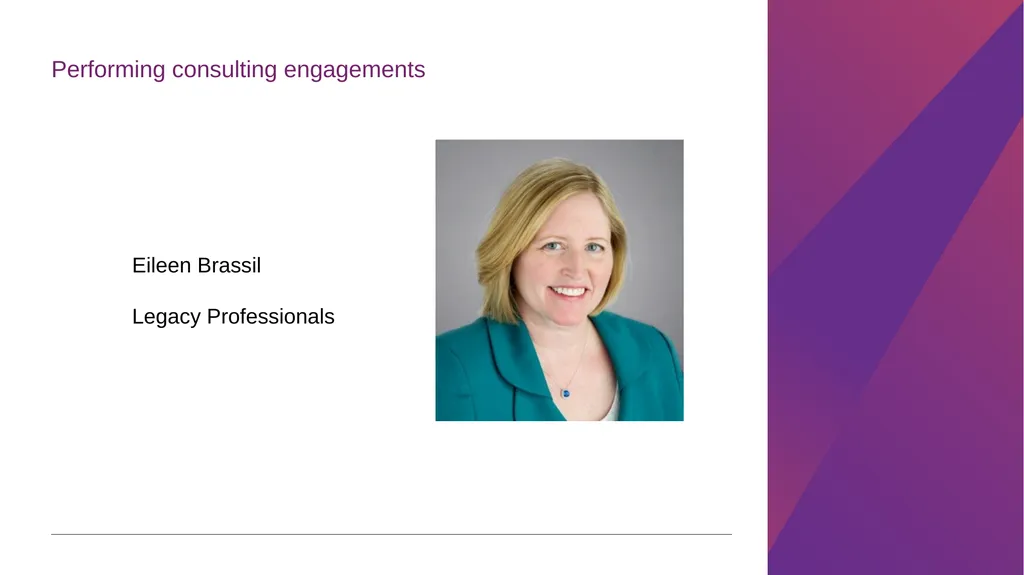
Performing consulting engagements Eileen Brassil
Legacy Professionals<br>
Legacy Professionals<br>
26
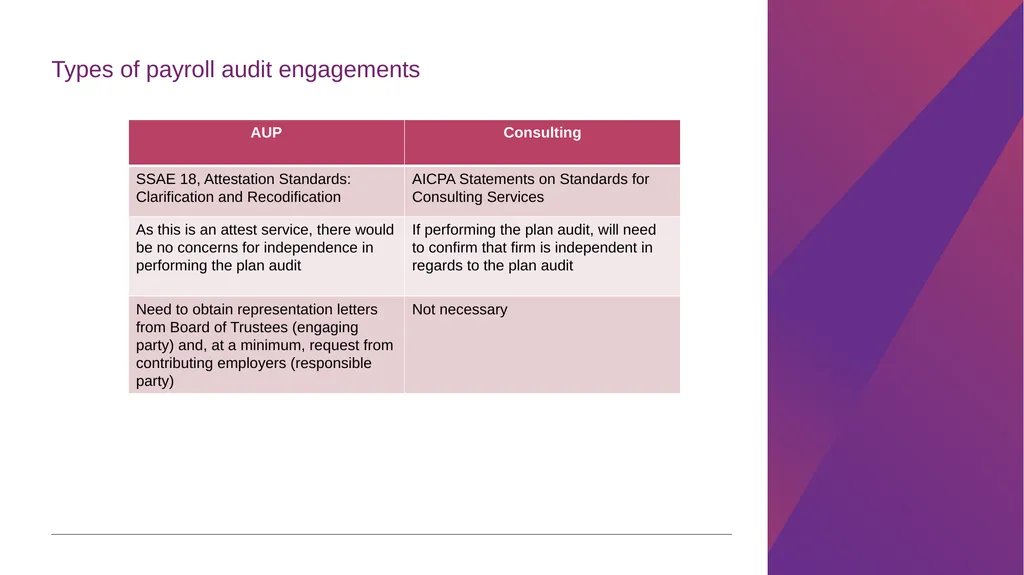
Consulting engagement Perform under SSCS No. 1, Consulting Services
Considered nonattest services
If CPA firm performs the plan’s financial statement audit, will need to ensure that performing this engagement will not impair auditor independence
Does not require a CPA to perform<br>
Considered nonattest services
If CPA firm performs the plan’s financial statement audit, will need to ensure that performing this engagement will not impair auditor independence
Does not require a CPA to perform<br>
27
Independence issues regarding nonattest services (consulting engagement) Need to consider if perform the plan’s financial statement audit
Ensure that auditor has not accepted any management responsibilities
Establish in writing with the Board of Trustees:
Objectives of the engagement
Services to be performed
Client’s acceptance of its responsibilities
Practitioner’s responsibilities
Any limitations of the engagement
EBPAQC tool, Documentation of Review of AICPA Independence Requirements Where Nonattest Services Are Performed for an EBP Audit Client<br>
Ensure that auditor has not accepted any management responsibilities
Establish in writing with the Board of Trustees:
Objectives of the engagement
Services to be performed
Client’s acceptance of its responsibilities
Practitioner’s responsibilities
Any limitations of the engagement
EBPAQC tool, Documentation of Review of AICPA Independence Requirements Where Nonattest Services Are Performed for an EBP Audit Client<br>
28
Consulting engagements – what is different from an AUP engagement Offers more flexibility on procedures and report
Do not need to have a written engagement letter
Do not need to receive representation letters<br>
Do not need to have a written engagement letter
Do not need to receive representation letters<br>
29
Types of payroll audit engagements<br>
30
The role of payroll audits in the financial statement audit process<br>
31
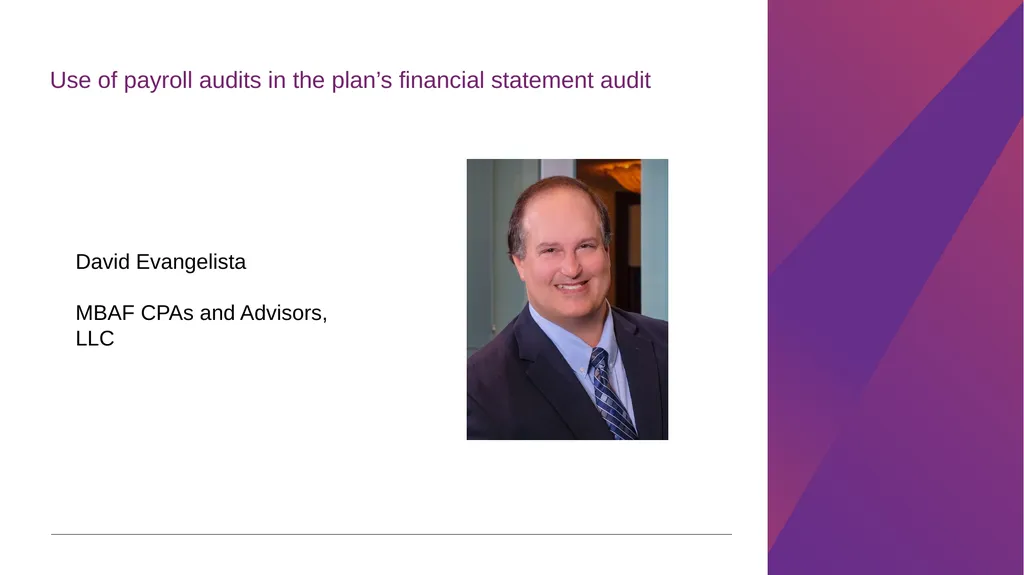
Use of payroll audits in the plan’s financial statement audit David Evangelista
MBAF CPAs and Advisors, LLC<br>
MBAF CPAs and Advisors, LLC<br>
32
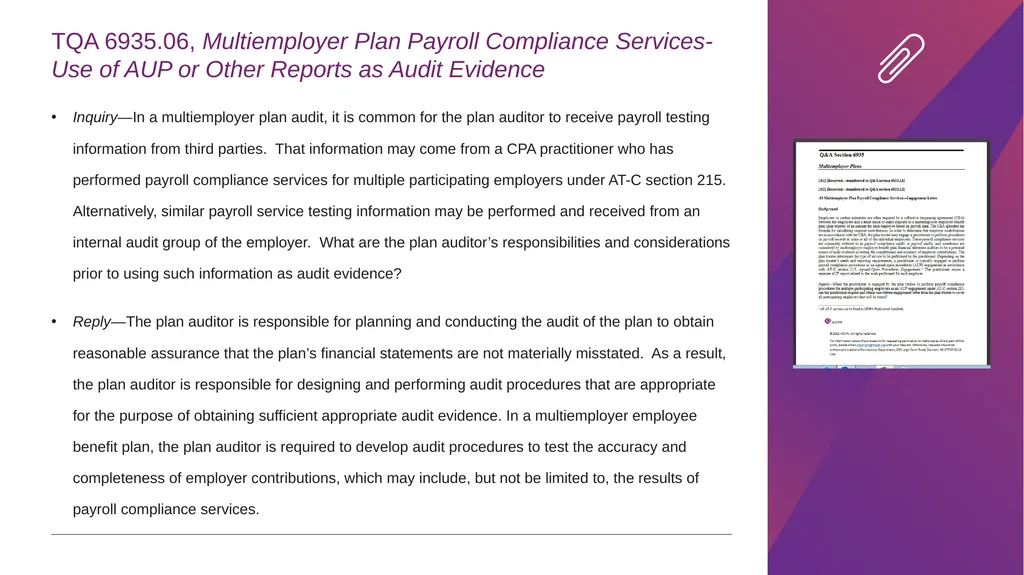
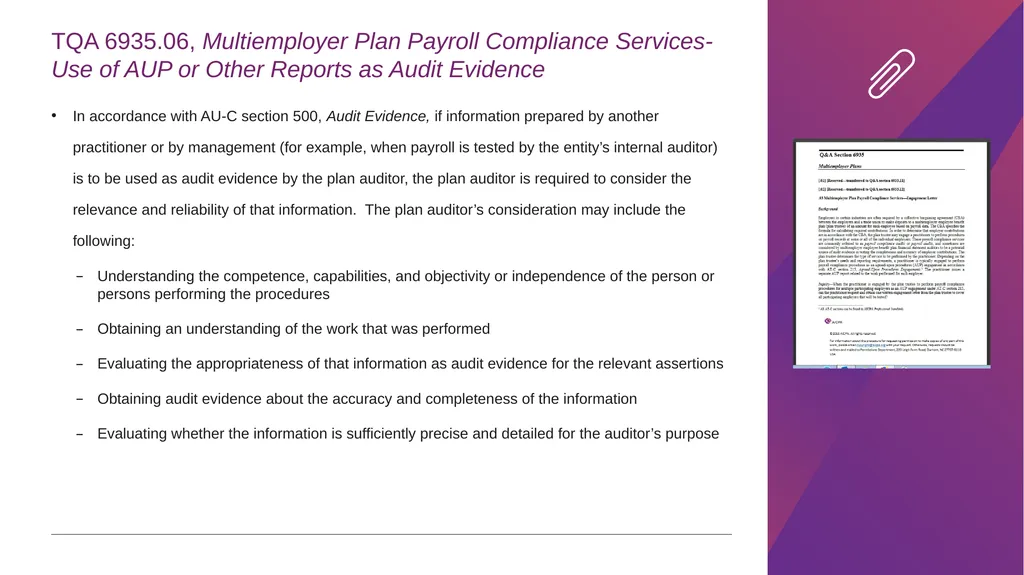
TQA 6935.06, Multiemployer Plan Payroll Compliance Services-Use of AUP or Other Reports as Audit Evidence Inquiry—In a multiemployer plan audit, it is common for the plan auditor to receive payroll testing information from third parties. That information may come from a CPA practitioner who has performed payroll compliance services for multiple participating employers under AT-C section 215. Alternatively, similar payroll service testing information may be performed and received from an internal audit group of the employer. What are the plan auditor’s responsibilities and considerations prior to using such information as audit evidence?
Reply—The plan auditor is responsible for planning and conducting the audit of the plan to obtain reasonable assurance that the plan’s financial statements are not materially misstated. As a result, the plan auditor is responsible for designing and performing audit procedures that are appropriate for the purpose of obtaining sufficient appropriate audit evidence. In a multiemployer employee benefit plan, the plan auditor is required to develop audit procedures to test the accuracy and completeness of employer contributions, which may include, but not be limited to, the results of payroll compliance services.<br>
Reply—The plan auditor is responsible for planning and conducting the audit of the plan to obtain reasonable assurance that the plan’s financial statements are not materially misstated. As a result, the plan auditor is responsible for designing and performing audit procedures that are appropriate for the purpose of obtaining sufficient appropriate audit evidence. In a multiemployer employee benefit plan, the plan auditor is required to develop audit procedures to test the accuracy and completeness of employer contributions, which may include, but not be limited to, the results of payroll compliance services.<br>
33
TQA 6935.06, Multiemployer Plan Payroll Compliance Services-Use of AUP or Other Reports as Audit Evidence In accordance with AU-C section 500, Audit Evidence, if information prepared by another practitioner or by management (for example, when payroll is tested by the entity’s internal auditor) is to be used as audit evidence by the plan auditor, the plan auditor is required to consider the relevance and reliability of that information. The plan auditor’s consideration may include the following:
Understanding the competence, capabilities, and objectivity or independence of the person or persons performing the procedures
Obtaining an understanding of the work that was performed
Evaluating the appropriateness of that information as audit evidence for the relevant assertions
Obtaining audit evidence about the accuracy and completeness of the information
Evaluating whether the information is sufficiently precise and detailed for the auditor’s purpose<br>
Understanding the competence, capabilities, and objectivity or independence of the person or persons performing the procedures
Obtaining an understanding of the work that was performed
Evaluating the appropriateness of that information as audit evidence for the relevant assertions
Obtaining audit evidence about the accuracy and completeness of the information
Evaluating whether the information is sufficiently precise and detailed for the auditor’s purpose<br>
34
Discussion questions How does your firm rely on these payroll compliance audits when testing employer contributions in the plan’s financial statement audit?
Are your procedures different if the engagement is an agreed-upon procedures or consulting engagement?<br>
Are your procedures different if the engagement is an agreed-upon procedures or consulting engagement?<br>
35
Question & answer session<br>
36
CPE Certificate Don’t forget to download your CPE certificate!
Click on
Now!<br>
Click on
Now!<br>
37
We welcome your feedback!
Please complete the online evaluation<br>
Please complete the online evaluation<br>
38
Thank You<br>