
Multiplicity Adjustment in Design and Analysis of



Description: Multiplicity Adjustment in Design and Analysis of Clinical Trials Daniel Zhao Presidential Professor Associate Dean for Research Hudson College of Public Health University of Oklahoma Health Sciences Center 8132021 Outline Motivate using
Related Topics
Download Presentation
"Multiplicity Adjustment in Design and Analysis of" is the property of its rightful owner. Permission is granted to download and print the materials on this website for personal, non-commercial use only, and to display it on your personal computer provided you do not modify the materials and that you retain all copyright notices contained in the materials. By downloading content from our website, you accept the terms of this agreement.
Presentation Transcript
slide1. Multiplicity Adjustment in Design and Analysis of Clinical Trials Daniel Zhao
Presidential Professor
Associate Dean for Research
Hudson College of Public Health
University of Oklahoma Health Sciences Center
8/13/2021<br>
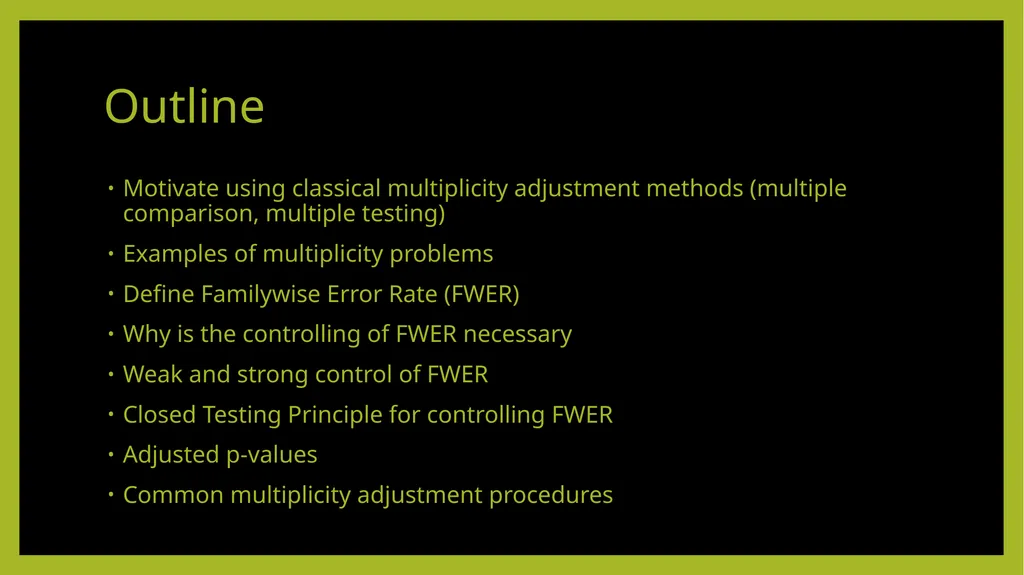
slide2. Outline Motivate using classical multiplicity adjustment methods (multiple comparison, multiple testing)
Examples of multiplicity problems
Define Familywise Error Rate (FWER)
Why is the controlling of FWER necessary
Weak and strong control of FWER
Closed Testing Principle for controlling FWER
Adjusted p-values
Common multiplicity adjustment procedures 2<br>
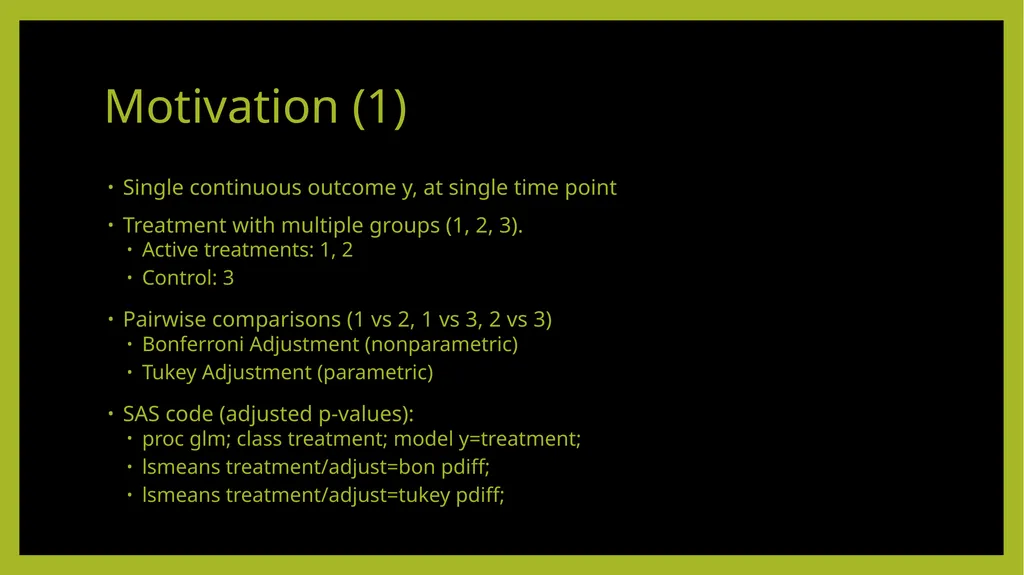
slide3. Motivation (1) Single continuous outcome y, at single time point
Treatment with multiple groups (1, 2, 3).
Active treatments: 1, 2
Control: 3
Pairwise comparisons (1 vs 2, 1 vs 3, 2 vs 3)
Bonferroni Adjustment (nonparametric)
Tukey Adjustment (parametric)
SAS code (adjusted p-values):
proc glm; class treatment; model y=treatment;
lsmeans treatment/adjust=bon pdiff;
lsmeans treatment/adjust=tukey pdiff; 3<br>
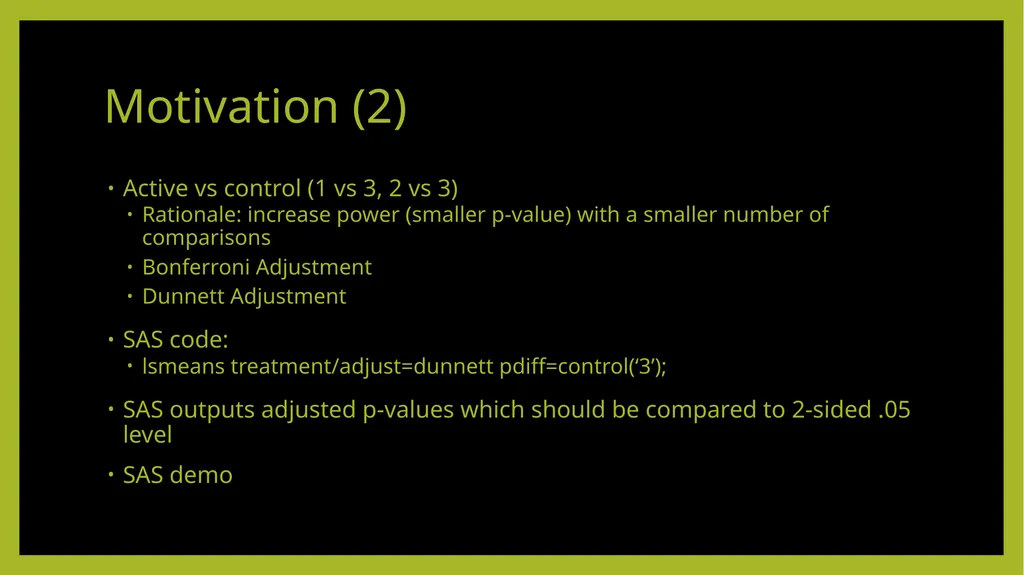
slide4. Motivation (2) Active vs control (1 vs 3, 2 vs 3)
Rationale: increase power (smaller p-value) with a smaller number of comparisons
Bonferroni Adjustment
Dunnett Adjustment
SAS code:
lsmeans treatment/adjust=dunnett pdiff=control(‘3’);
SAS outputs adjusted p-values which should be compared to 2-sided .05 level
SAS demo 4<br>
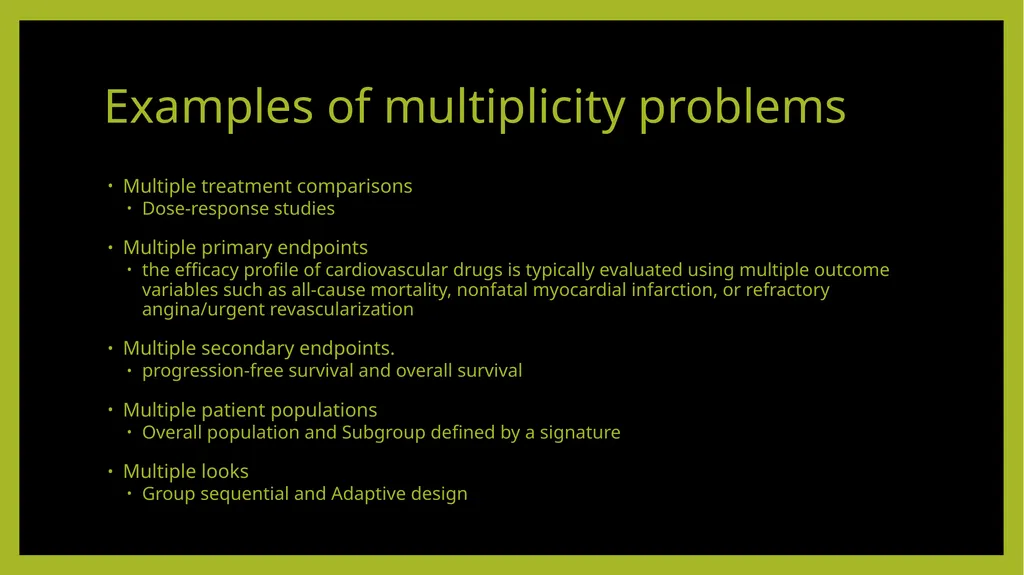
slide5. Examples of multiplicity problems Multiple treatment comparisons
Dose-response studies
Multiple primary endpoints
the efficacy profile of cardiovascular drugs is typically evaluated using multiple outcome variables such as all-cause mortality, nonfatal myocardial infarction, or refractory angina/urgent revascularization
Multiple secondary endpoints.
progression-free survival and overall survival
Multiple patient populations
Overall population and Subgroup defined by a signature
Multiple looks
Group sequential and Adaptive design 5<br>
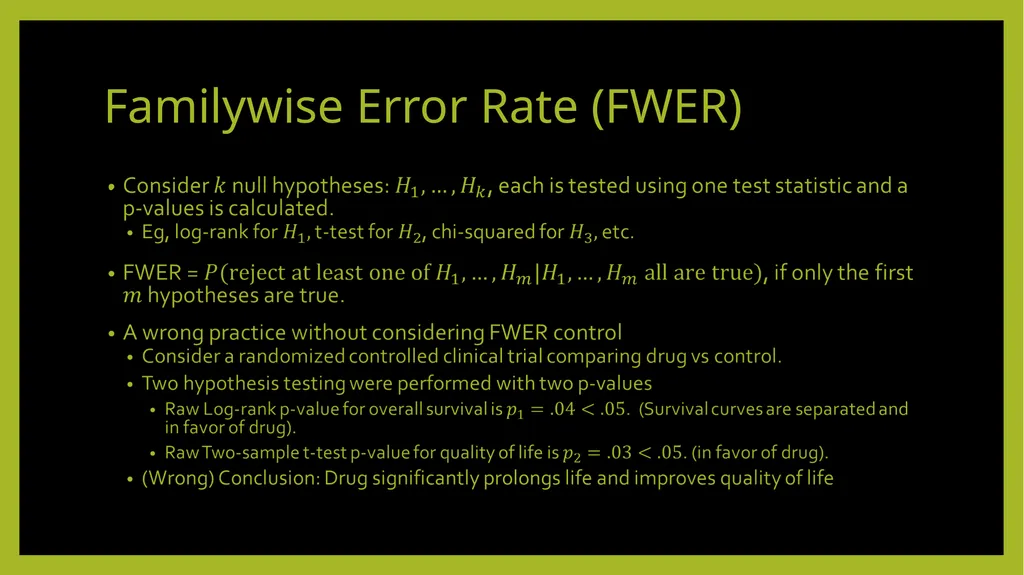
slide6. Familywise Error Rate (FWER) 6<br>
slide7. What happens if FWER is not controlled? 7<br>
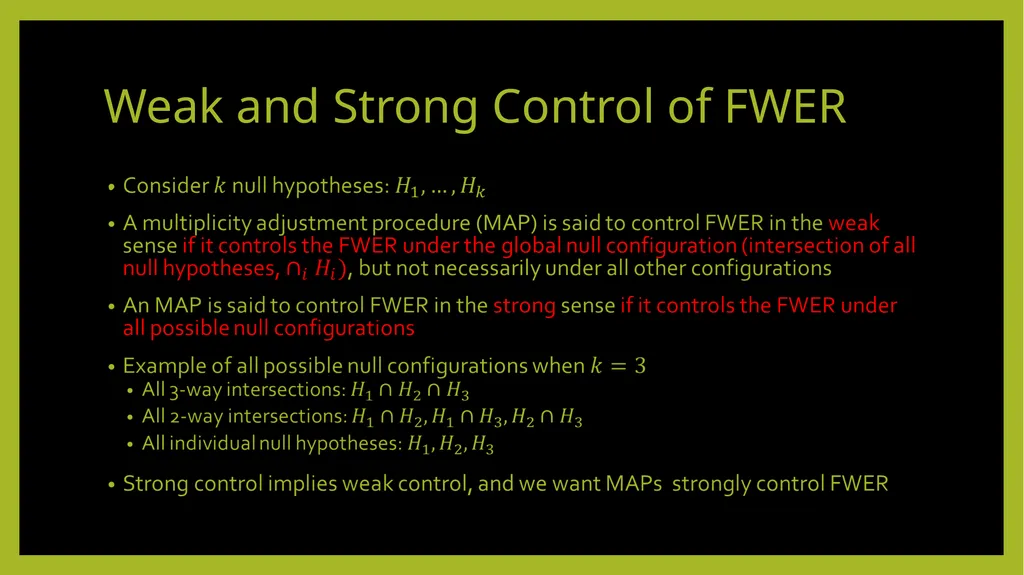
slide8. Weak and Strong Control of FWER 8<br>
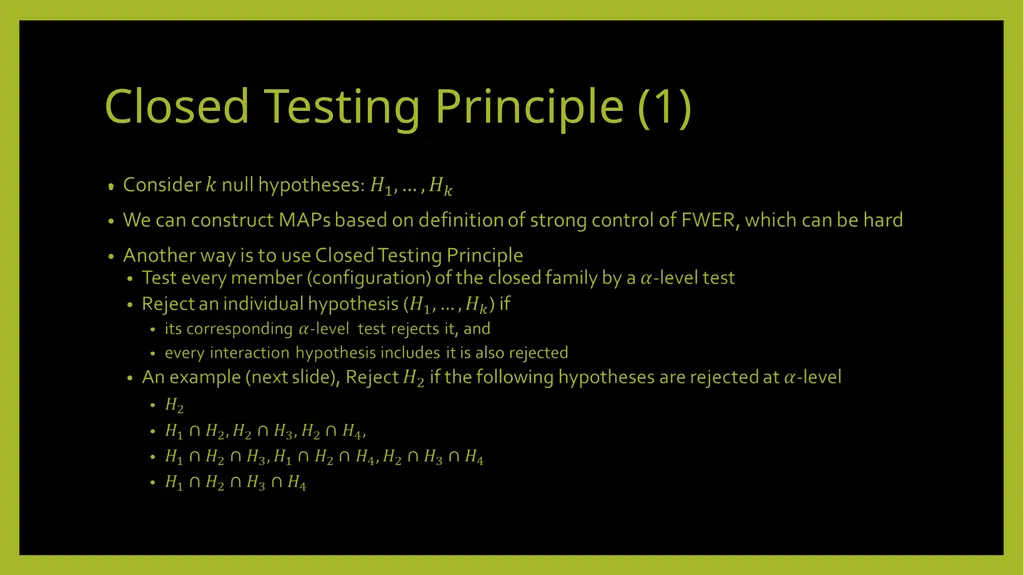
slide9. Closed Testing Principle (1) 9<br>
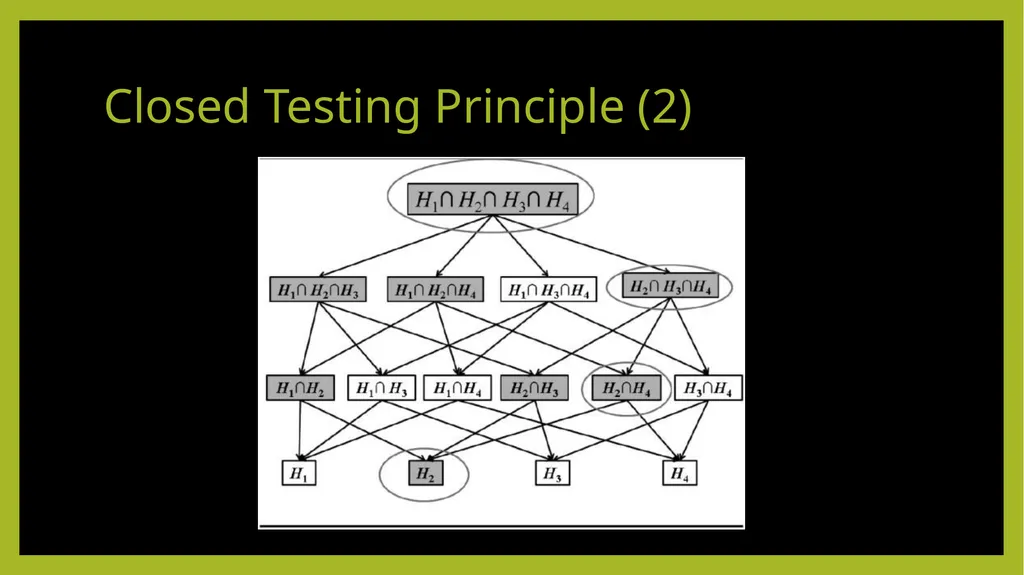
slide10. Closed Testing Principle (2) 10<br>
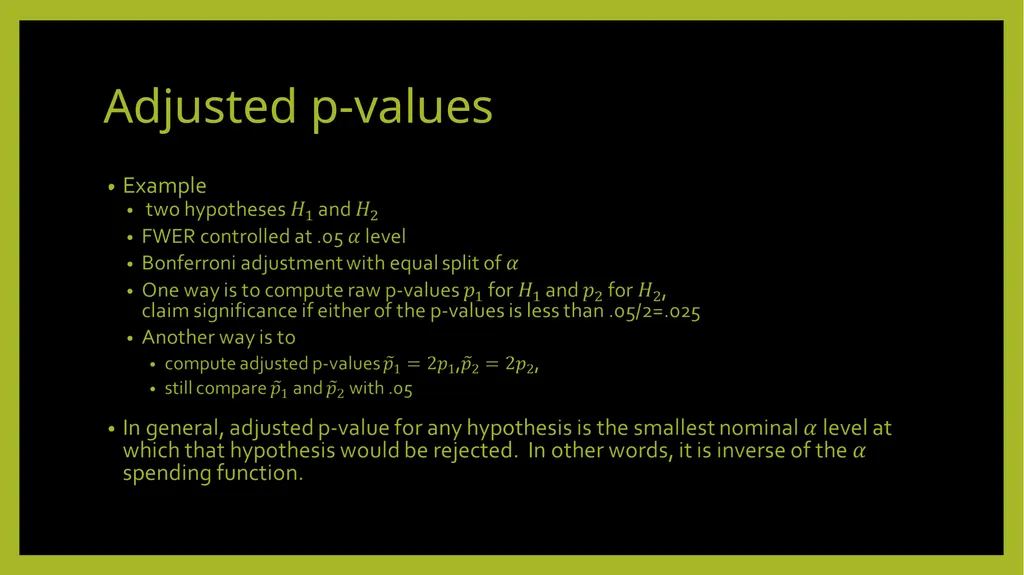
slide11. Adjusted p-values 11<br>
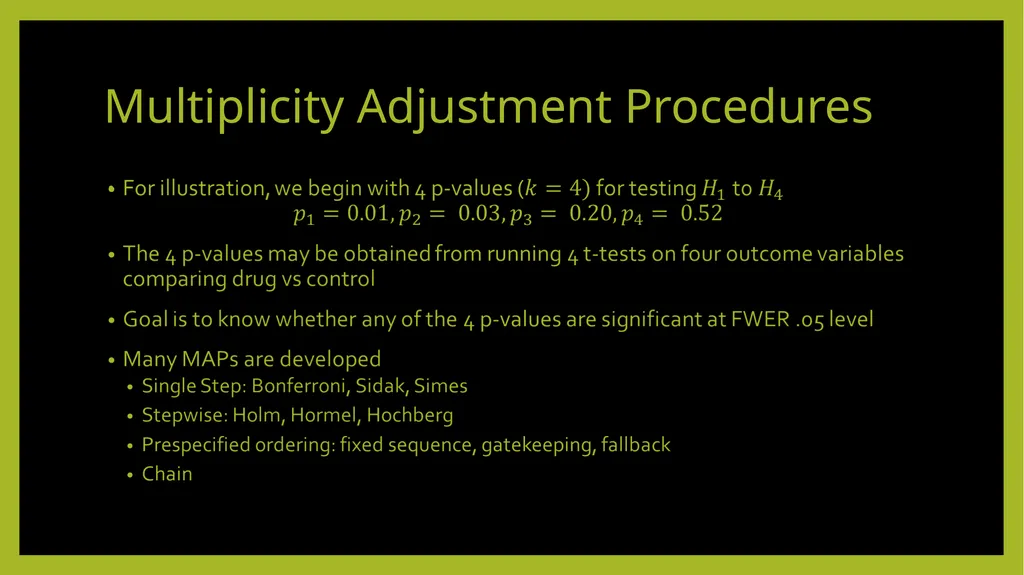
slide12. Multiplicity Adjustment Procedures 12<br>
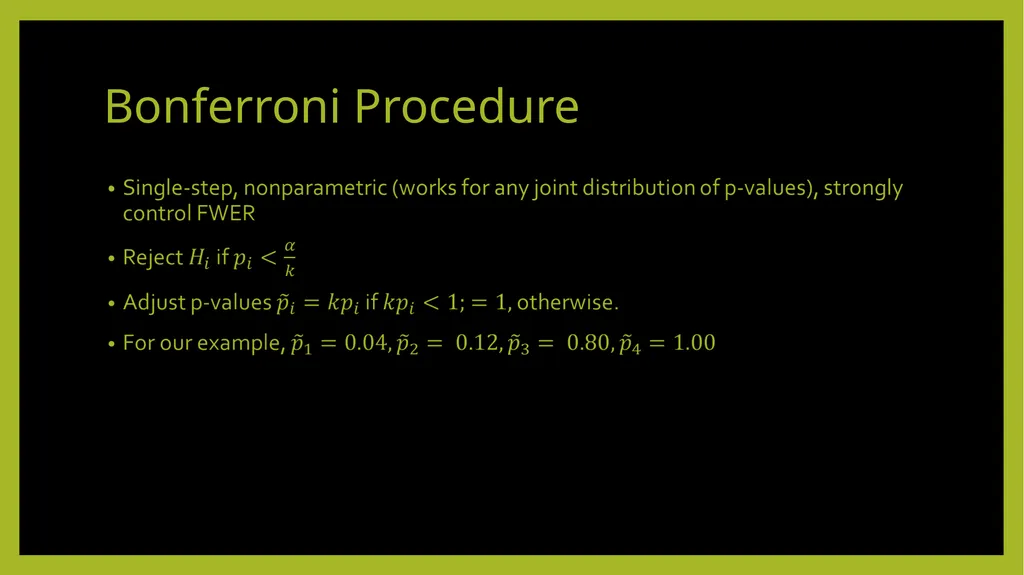
slide13. Bonferroni Procedure 13<br>
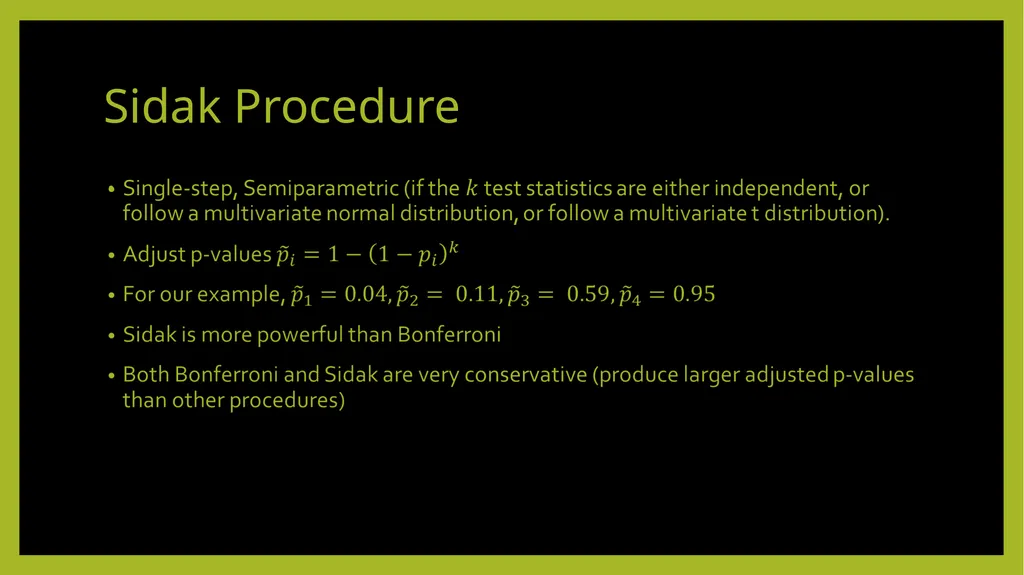
slide14. Sidak Procedure 14<br>
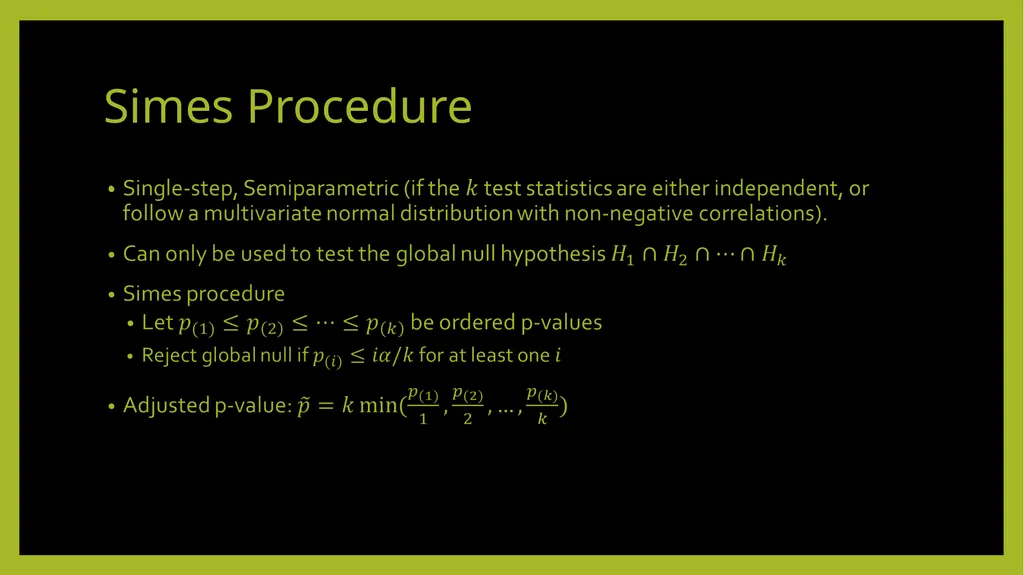
slide15. Simes Procedure 15<br>
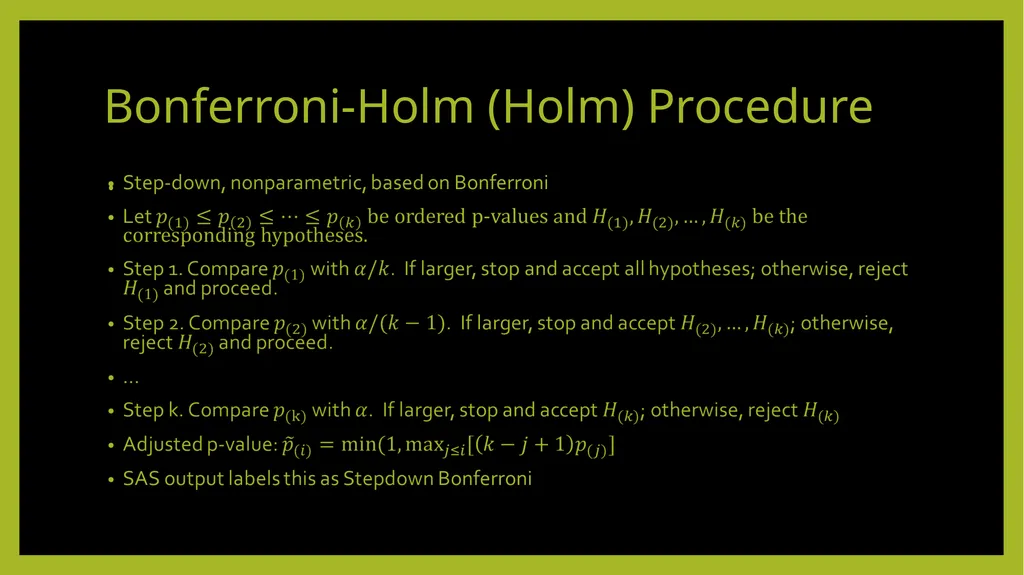
slide16. Bonferroni-Holm (Holm) Procedure 16<br>
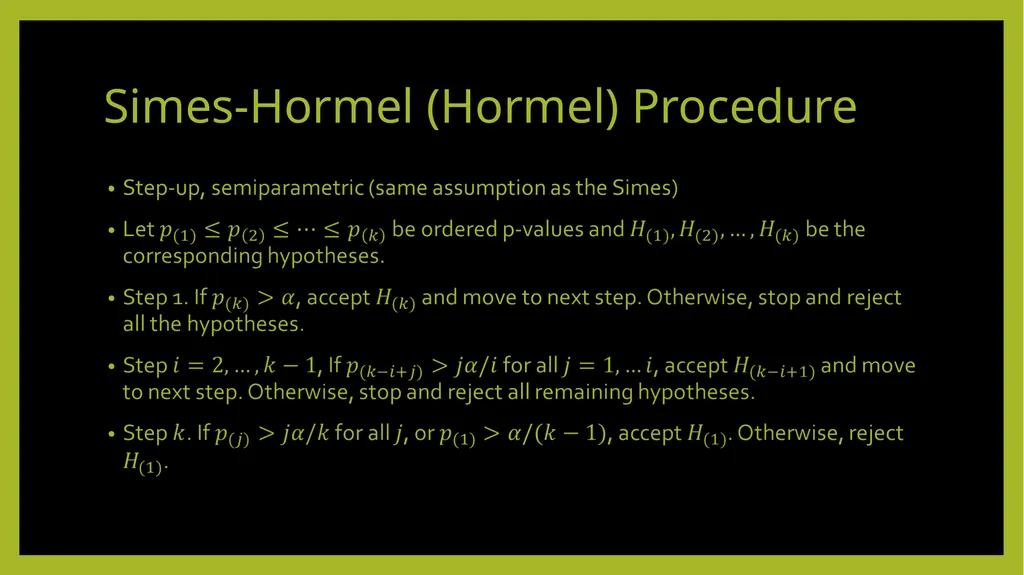
slide17. Simes-Hormel (Hormel) Procedure 17<br>
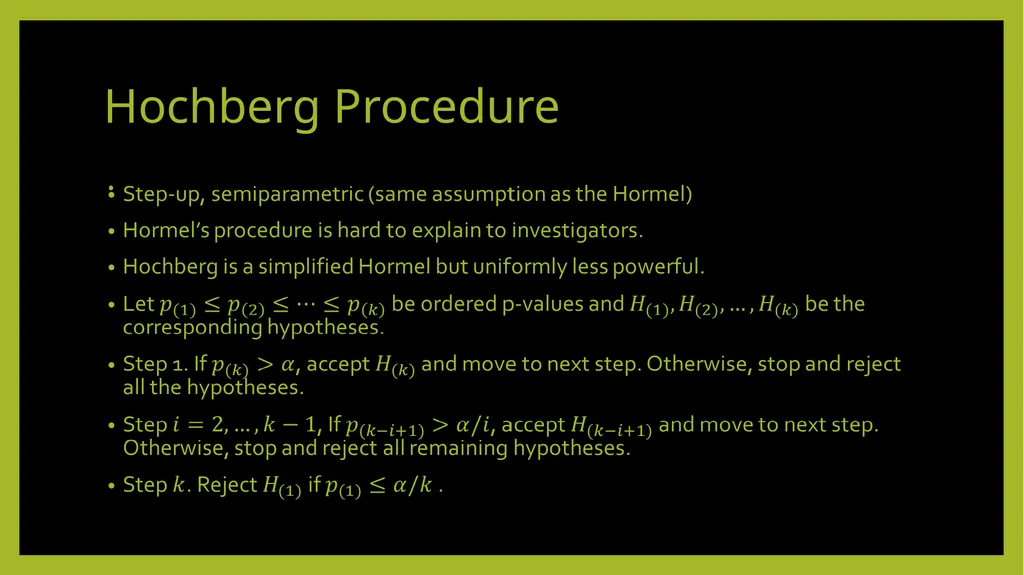
slide18. Hochberg Procedure 18<br>
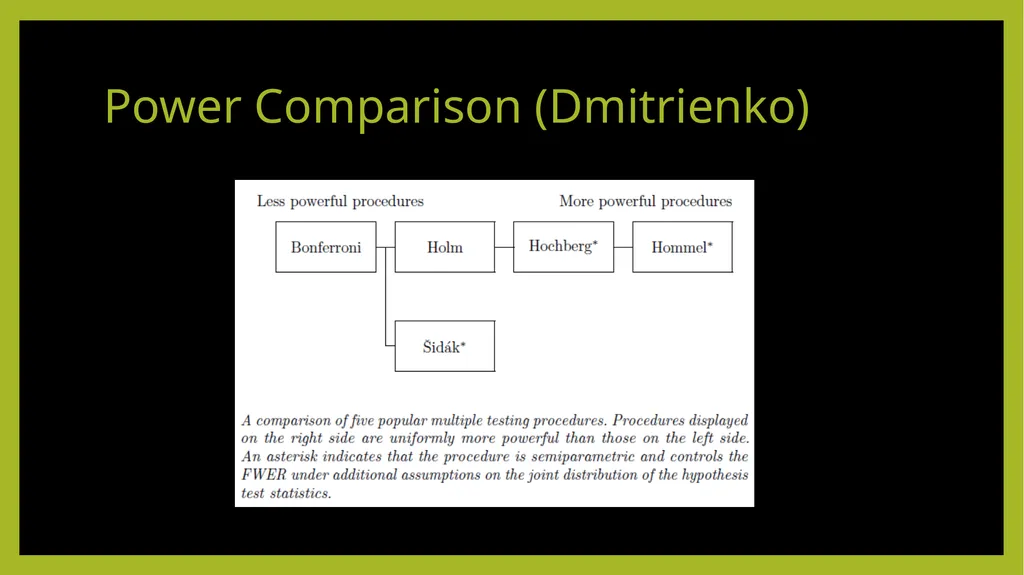
slide19. Power Comparison (Dmitrienko) 19<br>
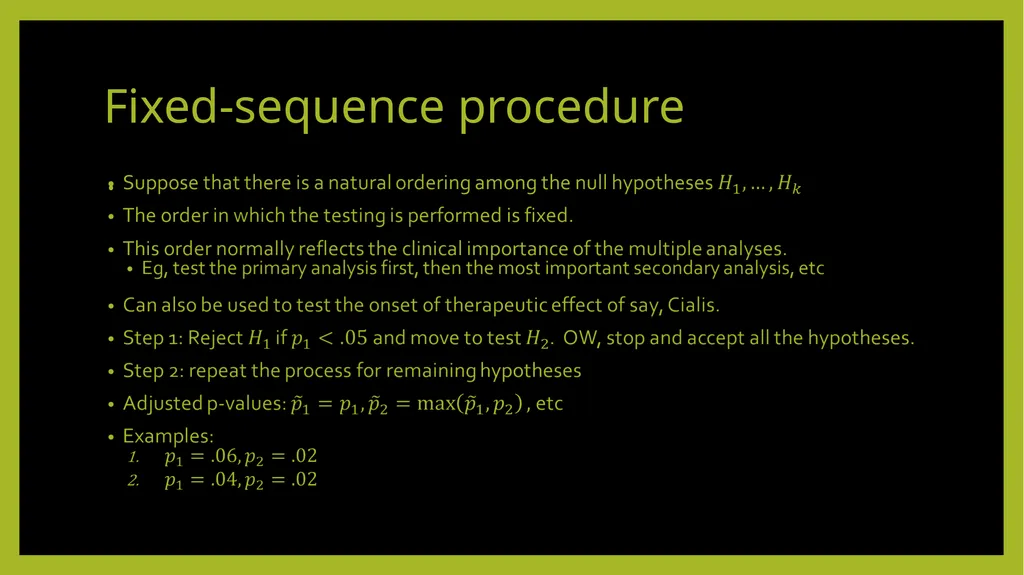
slide20. Fixed-sequence procedure 20<br>
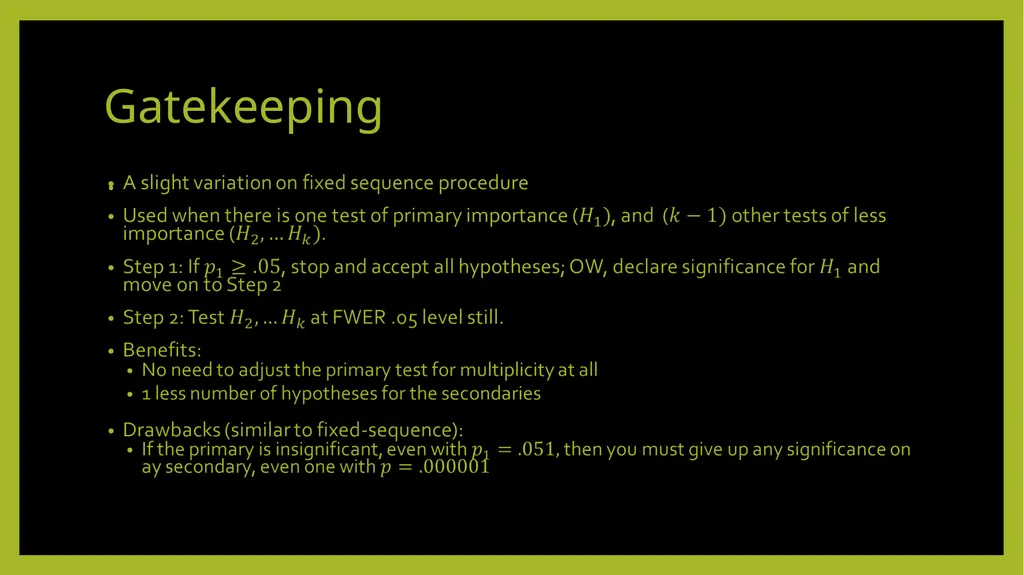
slide21. Gatekeeping 21<br>
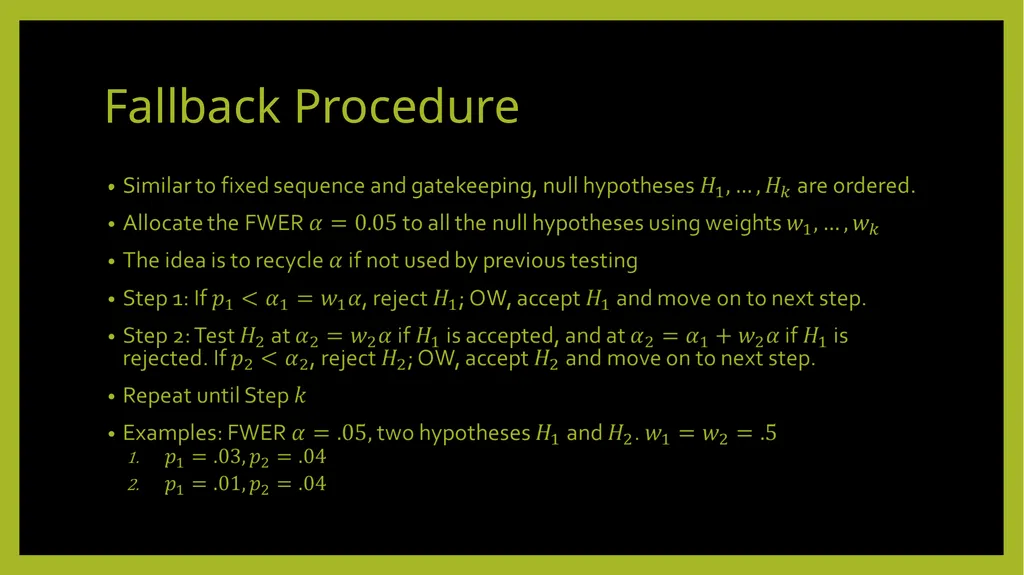
slide22. Fallback Procedure 22<br>
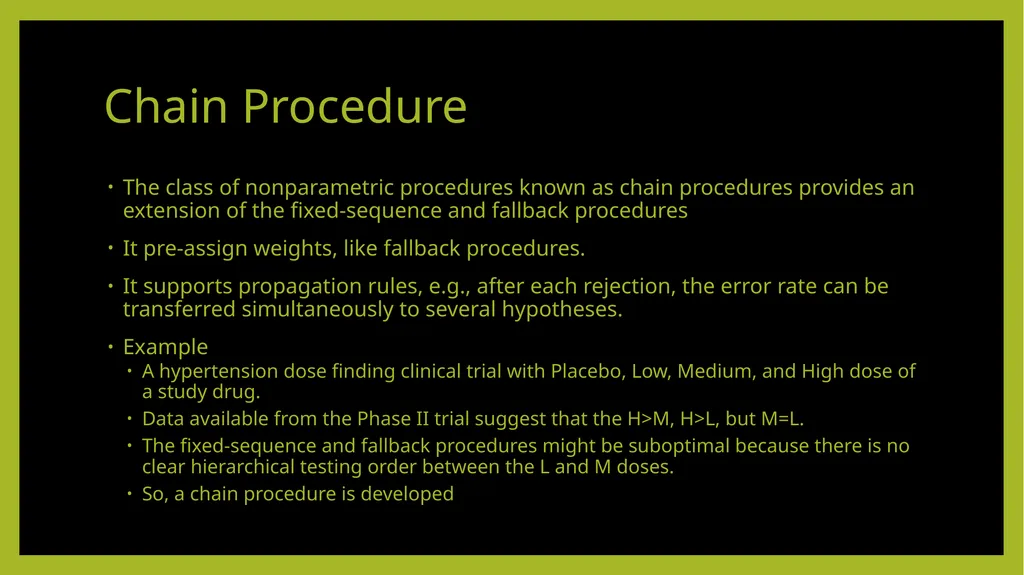
slide23. Chain Procedure The class of nonparametric procedures known as chain procedures provides an extension of the fixed-sequence and fallback procedures
It pre-assign weights, like fallback procedures.
It supports propagation rules, e.g., after each rejection, the error rate can be transferred simultaneously to several hypotheses.
Example
A hypertension dose finding clinical trial with Placebo, Low, Medium, and High dose of a study drug.
Data available from the Phase II trial suggest that the H>M, H>L, but M=L.
The fixed-sequence and fallback procedures might be suboptimal because there is no clear hierarchical testing order between the L and M doses.
So, a chain procedure is developed 23<br>
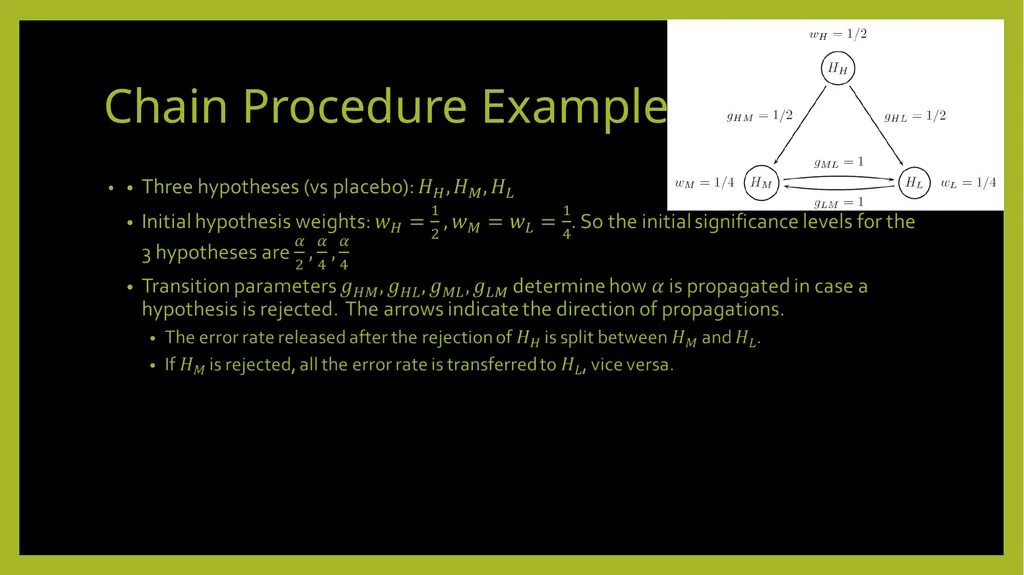
slide24. Chain Procedure Example (1) 24<br>
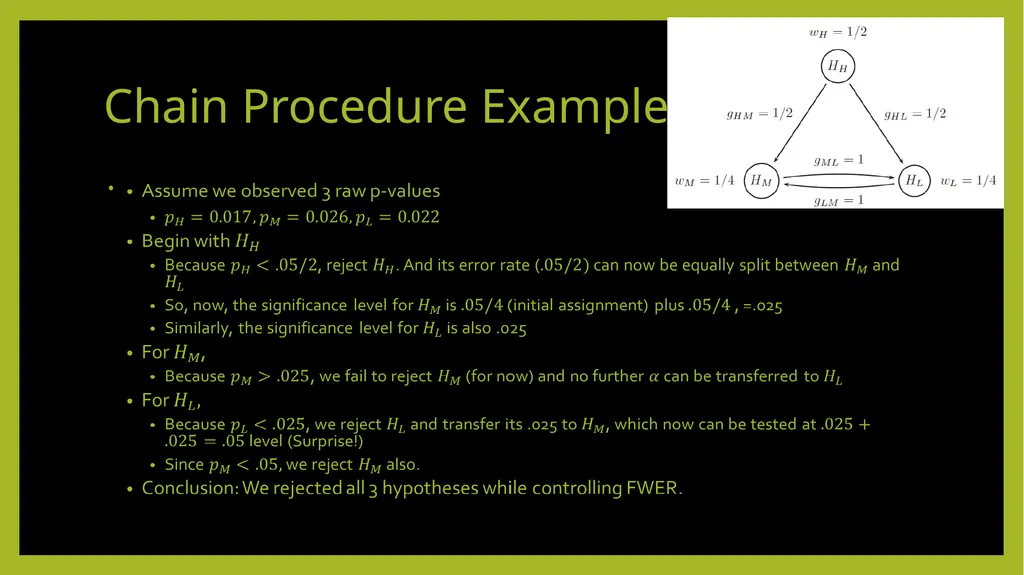
slide25. Chain Procedure Example (2) 25<br>
slide2. Outline Motivate using classical multiplicity adjustment methods (multiple comparison, multiple testing)
Examples of multiplicity problems
Define Familywise Error Rate (FWER)
Why is the controlling of FWER necessary
Weak and strong control of FWER
Closed Testing Principle for controlling FWER
Adjusted p-values
Common multiplicity adjustment procedures 2<br>
slide3. Motivation (1) Single continuous outcome y, at single time point
Treatment with multiple groups (1, 2, 3).
Active treatments: 1, 2
Control: 3
Pairwise comparisons (1 vs 2, 1 vs 3, 2 vs 3)
Bonferroni Adjustment (nonparametric)
Tukey Adjustment (parametric)
SAS code (adjusted p-values):
proc glm; class treatment; model y=treatment;
lsmeans treatment/adjust=bon pdiff;
lsmeans treatment/adjust=tukey pdiff; 3<br>
slide4. Motivation (2) Active vs control (1 vs 3, 2 vs 3)
Rationale: increase power (smaller p-value) with a smaller number of comparisons
Bonferroni Adjustment
Dunnett Adjustment
SAS code:
lsmeans treatment/adjust=dunnett pdiff=control(‘3’);
SAS outputs adjusted p-values which should be compared to 2-sided .05 level
SAS demo 4<br>
slide5. Examples of multiplicity problems Multiple treatment comparisons
Dose-response studies
Multiple primary endpoints
the efficacy profile of cardiovascular drugs is typically evaluated using multiple outcome variables such as all-cause mortality, nonfatal myocardial infarction, or refractory angina/urgent revascularization
Multiple secondary endpoints.
progression-free survival and overall survival
Multiple patient populations
Overall population and Subgroup defined by a signature
Multiple looks
Group sequential and Adaptive design 5<br>
slide6. Familywise Error Rate (FWER) 6<br>
slide7. What happens if FWER is not controlled? 7<br>
slide8. Weak and Strong Control of FWER 8<br>
slide9. Closed Testing Principle (1) 9<br>
slide10. Closed Testing Principle (2) 10<br>
slide11. Adjusted p-values 11<br>
slide12. Multiplicity Adjustment Procedures 12<br>
slide13. Bonferroni Procedure 13<br>
slide14. Sidak Procedure 14<br>
slide15. Simes Procedure 15<br>
slide16. Bonferroni-Holm (Holm) Procedure 16<br>
slide17. Simes-Hormel (Hormel) Procedure 17<br>
slide18. Hochberg Procedure 18<br>
slide19. Power Comparison (Dmitrienko) 19<br>
slide20. Fixed-sequence procedure 20<br>
slide21. Gatekeeping 21<br>
slide22. Fallback Procedure 22<br>
slide23. Chain Procedure The class of nonparametric procedures known as chain procedures provides an extension of the fixed-sequence and fallback procedures
It pre-assign weights, like fallback procedures.
It supports propagation rules, e.g., after each rejection, the error rate can be transferred simultaneously to several hypotheses.
Example
A hypertension dose finding clinical trial with Placebo, Low, Medium, and High dose of a study drug.
Data available from the Phase II trial suggest that the H>M, H>L, but M=L.
The fixed-sequence and fallback procedures might be suboptimal because there is no clear hierarchical testing order between the L and M doses.
So, a chain procedure is developed 23<br>
slide24. Chain Procedure Example (1) 24<br>
slide25. Chain Procedure Example (2) 25<br>