04
Question #2 What skills will these children need to be successful in this world you have imagined twenty years from now?<br>
05
Question #3 What were the conditions that made your high-performance learning experiences so powerful?<br>
06
Question #4 What would learning be like if it were designed around your answers to the first three questions?<br>
07
“For us to grow, we have to educate people to do jobs that don’t yet exist, which means we have to invent them and train people to do them at the same time. That is harder, and it is why we need everyone to aspire to be a creative creator or creative server.”
Thomas Friedman and Michael Mandelbaum, That Used to Be Us, pp. 137 (2011)<br>
08
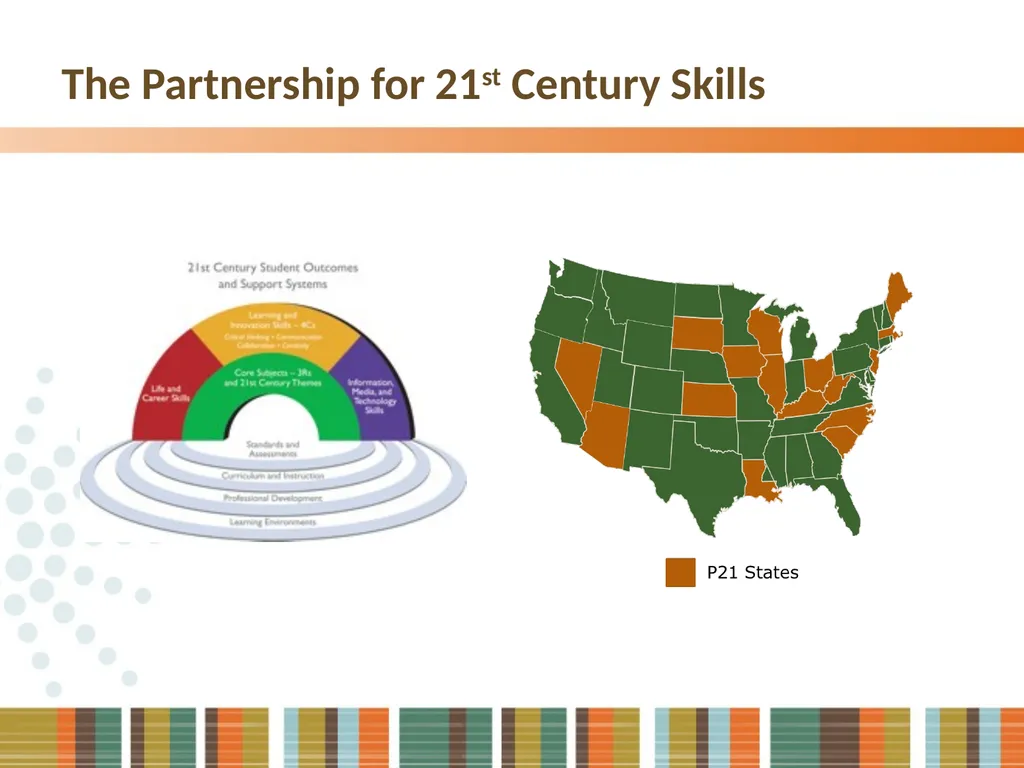
What are 21st Century Skills?<br>
09
The Partnership for 21st Century Skills<br>
10
P21 Strategic Council Members http://www.p21.org<br>
11
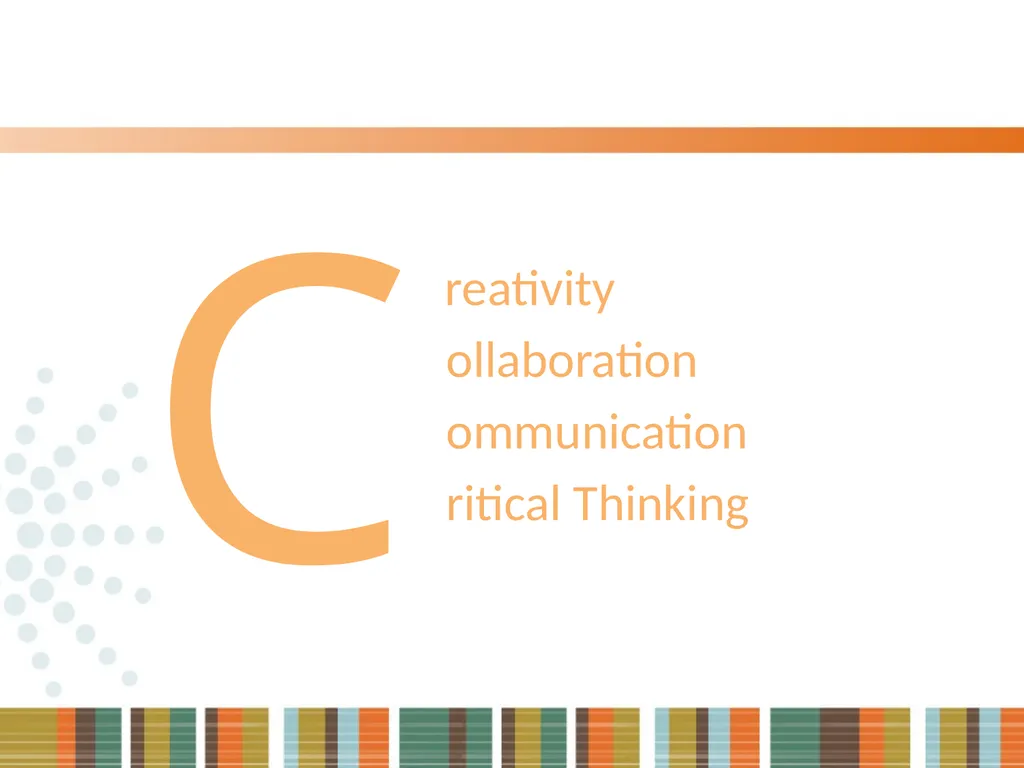
reativity
ollaboration
ommunication
ritical Thinking C<br>
12
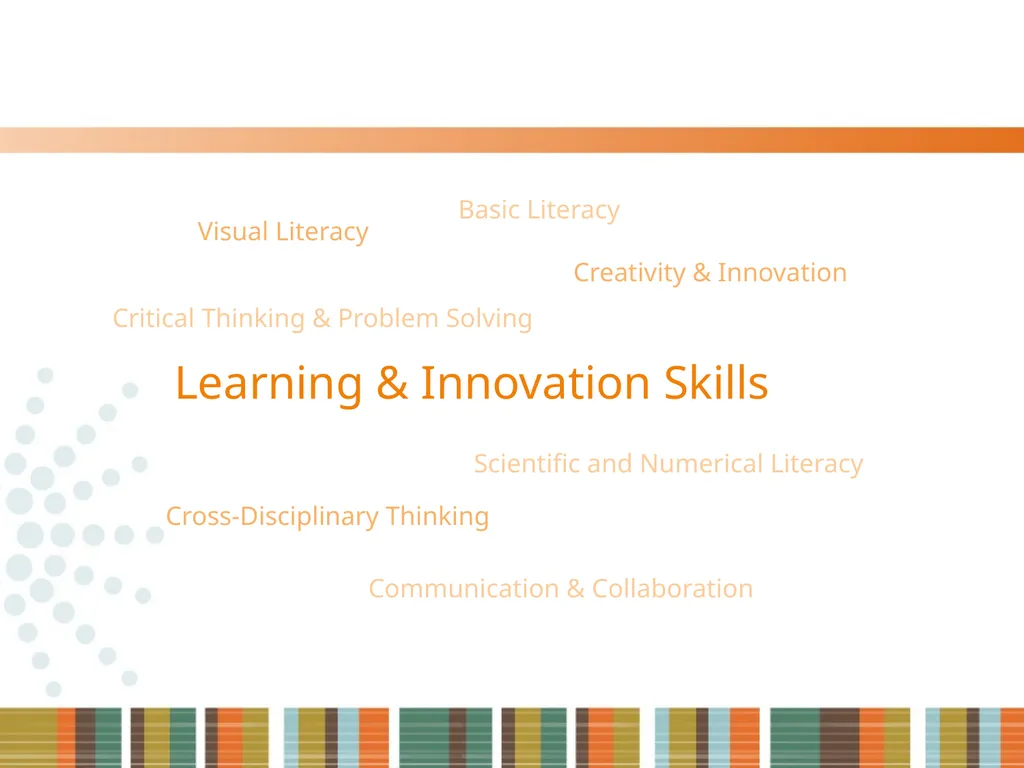
Learning & Innovation Skills Critical Thinking & Problem Solving Creativity & Innovation Communication & Collaboration Visual Literacy Scientific and Numerical Literacy Cross-Disciplinary Thinking Basic Literacy<br>
13
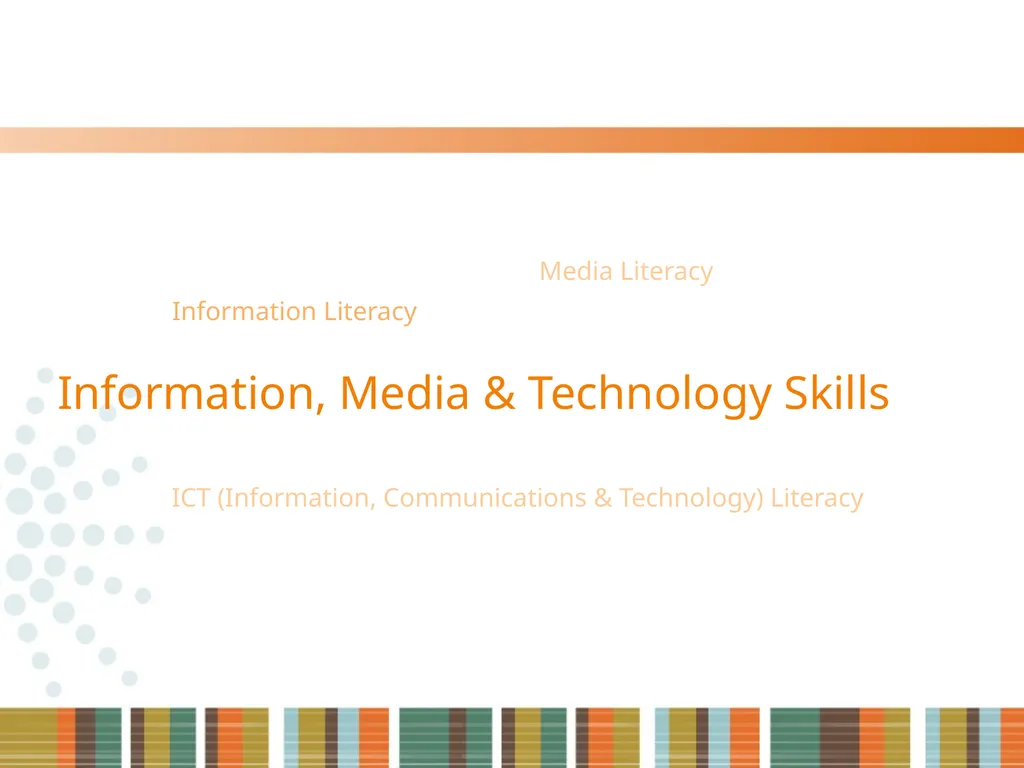
Information, Media & Technology Skills ICT (Information, Communications & Technology) Literacy Information Literacy Media Literacy<br>
14
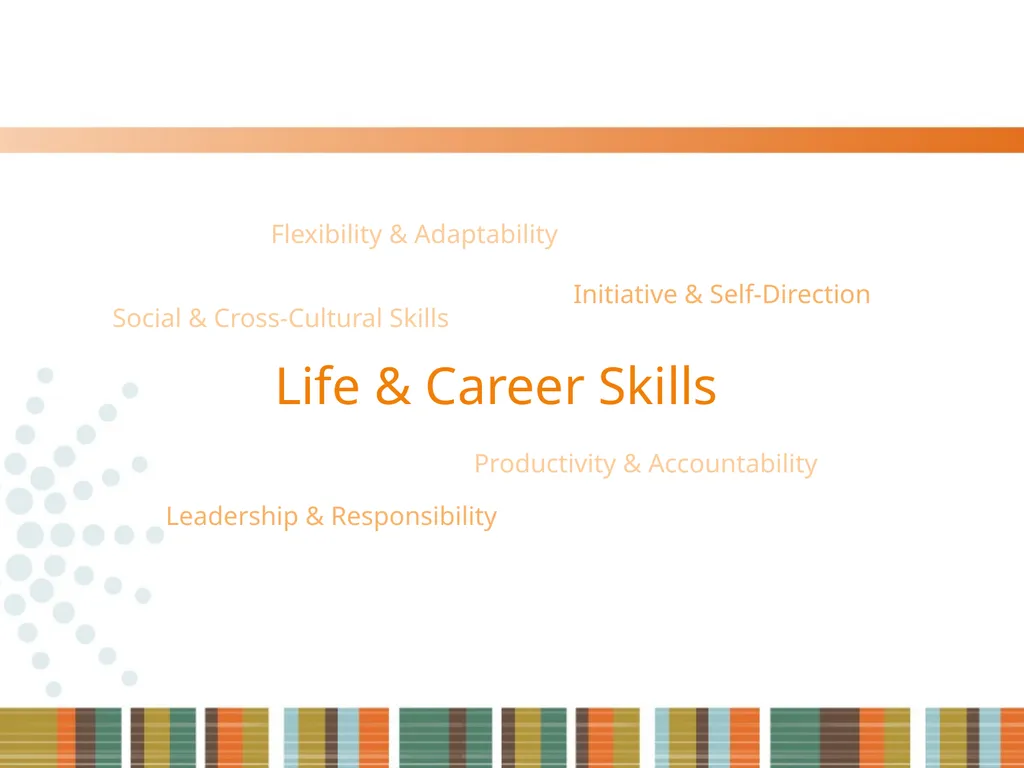
Life & Career Skills Social & Cross-Cultural Skills Initiative & Self-Direction Productivity & Accountability Leadership & Responsibility Flexibility & Adaptability<br>
15
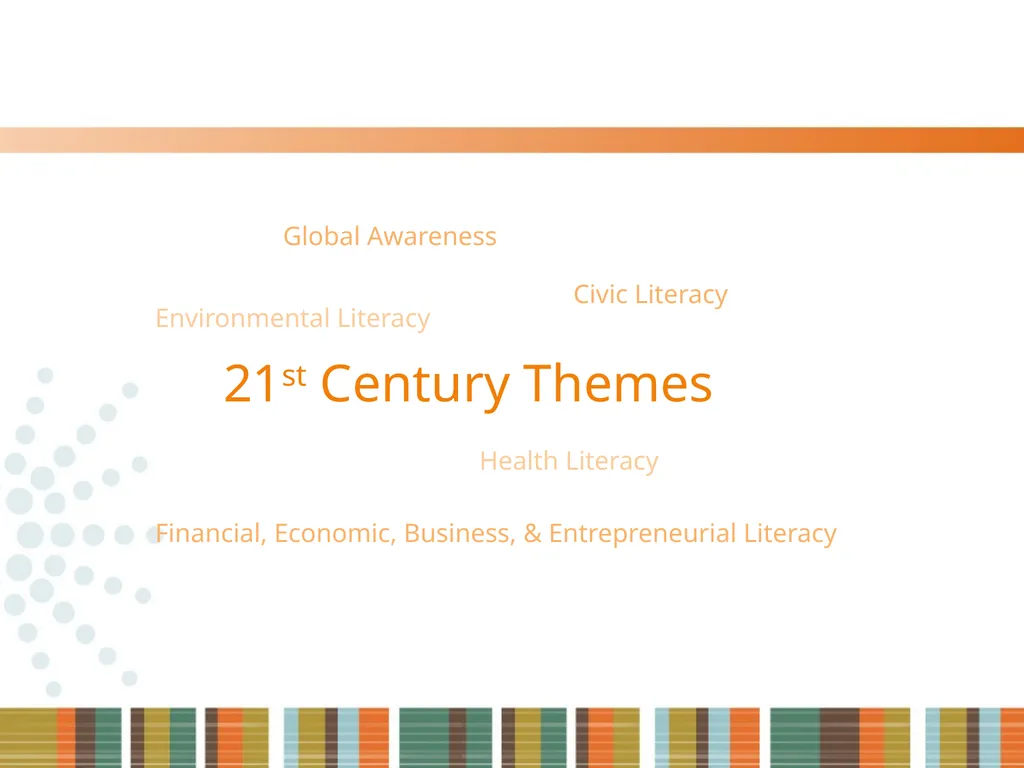
21st Century Themes Environmental Literacy Civic Literacy Global Awareness Health Literacy Financial, Economic, Business, & Entrepreneurial Literacy<br>
16
“In the 21st century…expertise is less about having a stockpile of information or facts at one’s disposal and increasingly about knowing how to find and evaluate information on a given topic”
-Douglas Thomas and John Seely Brown, A New Culture of Learning: Cultivating the Imagination in a World of Constant Change (2011)<br>
17
Why are 21st Century Skills Important?<br>
18
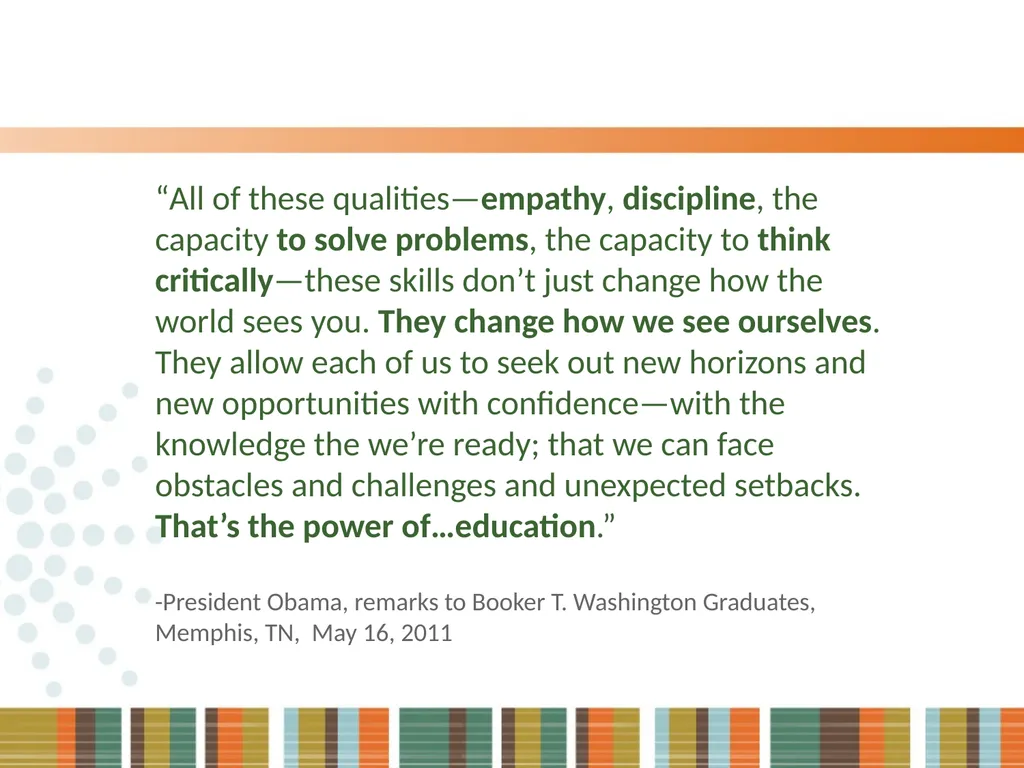
“All of these qualities—empathy, discipline, the capacity to solve problems, the capacity to think critically—these skills don’t just change how the world sees you. They change how we see ourselves. They allow each of us to seek out new horizons and new opportunities with confidence—with the knowledge the we’re ready; that we can face obstacles and challenges and unexpected setbacks. That’s the power of…education.”
-President Obama, remarks to Booker T. Washington Graduates, Memphis, TN, May 16, 2011<br>
19
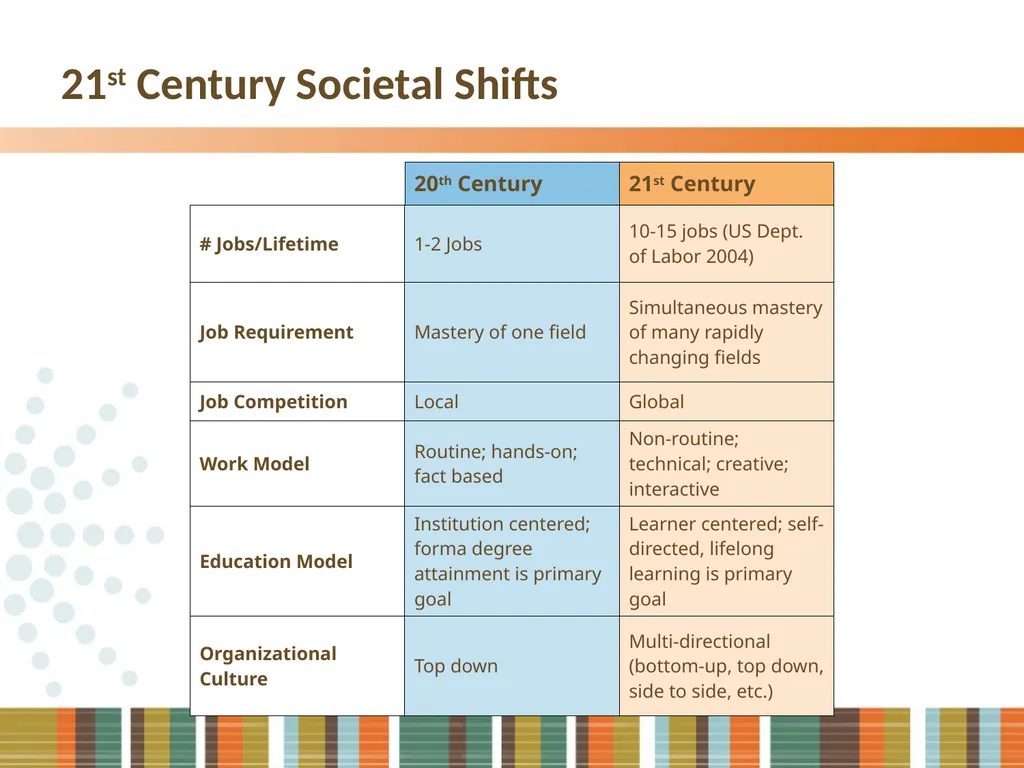
21st Century Societal Shifts<br>
20
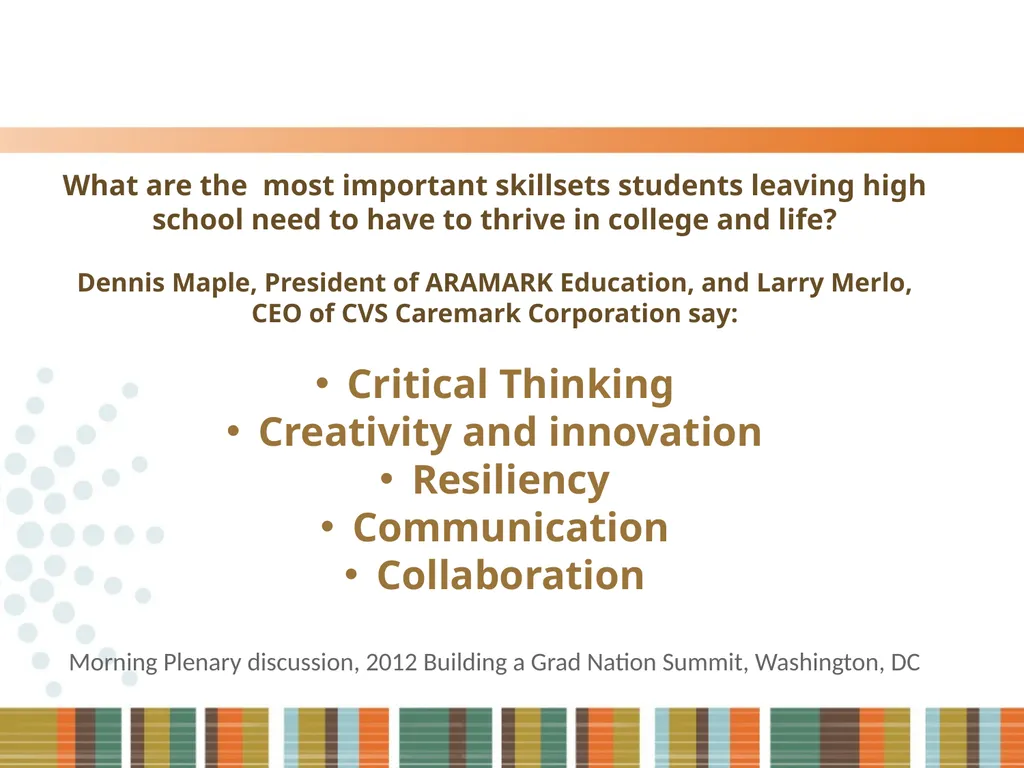
What are the most important skillsets students leaving high school need to have to thrive in college and life?
Dennis Maple, President of ARAMARK Education, and Larry Merlo, CEO of CVS Caremark Corporation say:
Critical Thinking
Creativity and innovation
Resiliency
Communication
Collaboration
Morning Plenary discussion, 2012 Building a Grad Nation Summit, Washington, DC<br>
21
“Today's technology-enabled, information-rich, deeply interconnected world means learning not only can – but should – happen anywhere, anytime. We need to recognize these experiences, whether the environments are physical or online, and whether learning takes place in schools, colleges or adult education centers, or in afterschool, workplace, military or community settings.”
Secretary of Education, Arne Duncan, at 4th Annual Launch of the MacArthur Foundation Digital Media and Lifelong Learning Competition (9/15/11)<br>
22
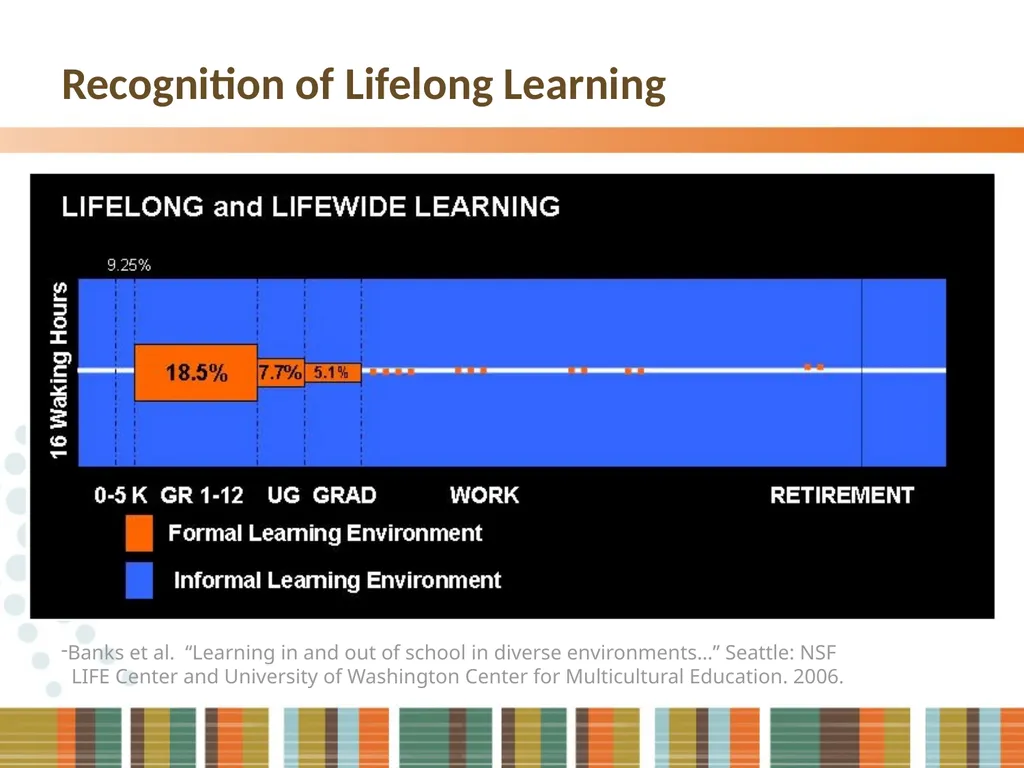
Recognition of Lifelong Learning Banks et al. “Learning in and out of school in diverse environments…” Seattle: NSF
LIFE Center and University of Washington Center for Multicultural Education. 2006.<br>
23
From “Connected” to “Hyper-Connected” Back in 2005,
“… ‘Twitter’ was still a sound, the ‘cloud’ was something in the sky, ‘3G’ was a parking space, ‘applications’ were what you sent to college, and ‘Skype’ was a typo.”
From That Used to Be Us (2011) by Thomas Friedman and Michael Mandelbaum<br>
24
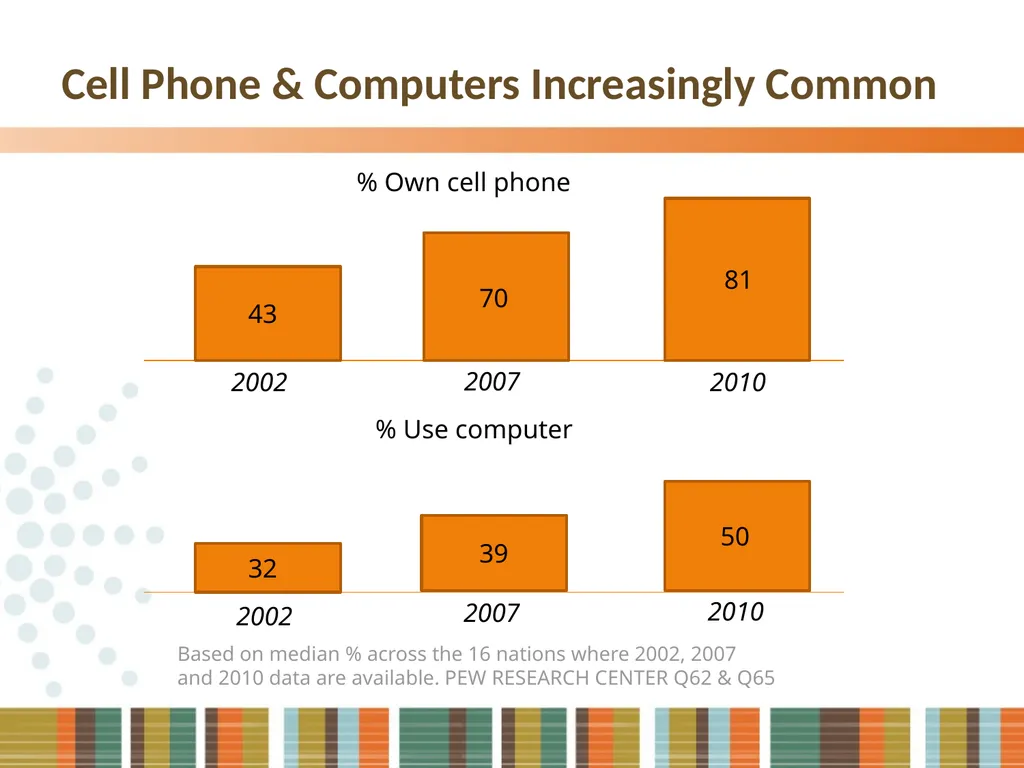
Cell Phone & Computers Increasingly Common % Own cell phone % Use computer 43 70 81 32 39 50 2002 2007 2010 2002 2007 2010 Based on median % across the 16 nations where 2002, 2007
and 2010 data are available. PEW RESEARCH CENTER Q62 & Q65<br>
25
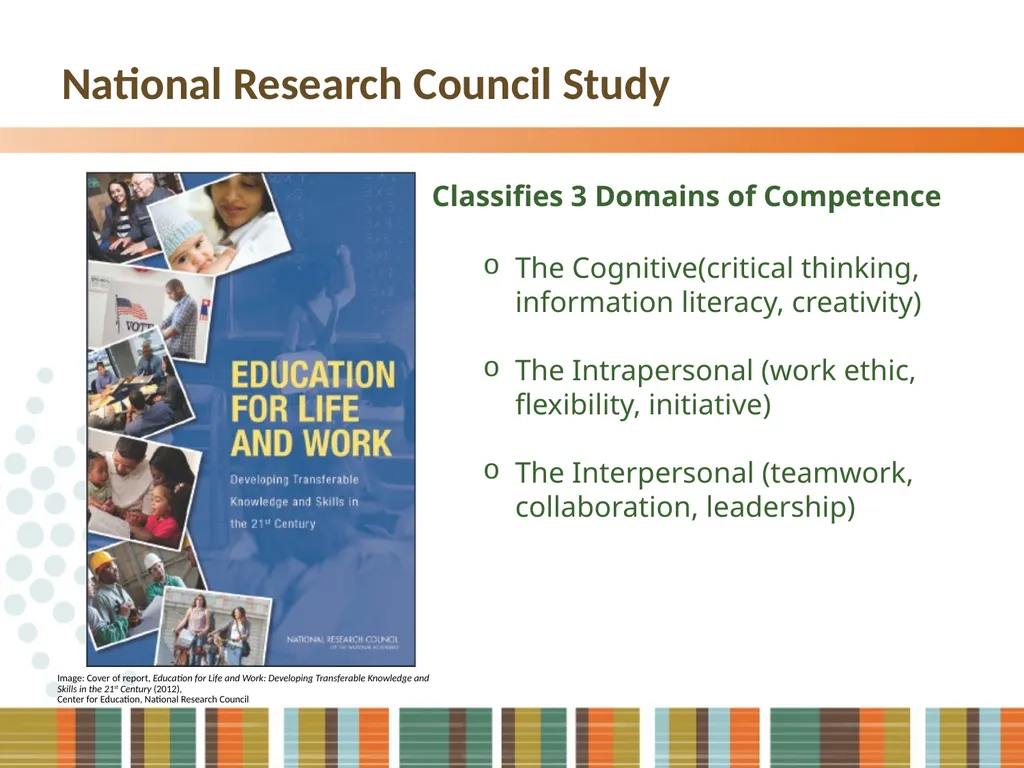
National Research Council Study Image: Cover of report, Education for Life and Work: Developing Transferable Knowledge and Skills in the 21st Century (2012),�Center for Education, National Research Council Classifies 3 Domains of Competence
The Cognitive(critical thinking, information literacy, creativity)
The Intrapersonal (work ethic, flexibility, initiative)
The Interpersonal (teamwork, collaboration, leadership)<br>
26
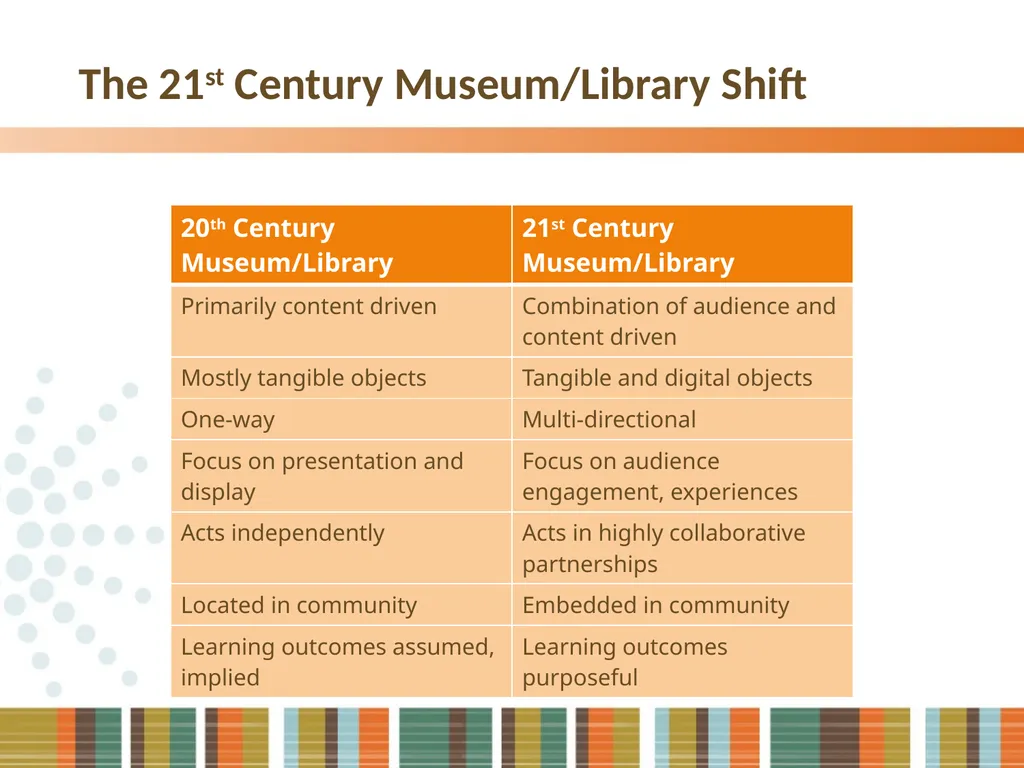
The 21st Century Museum/Library Shift<br>
27
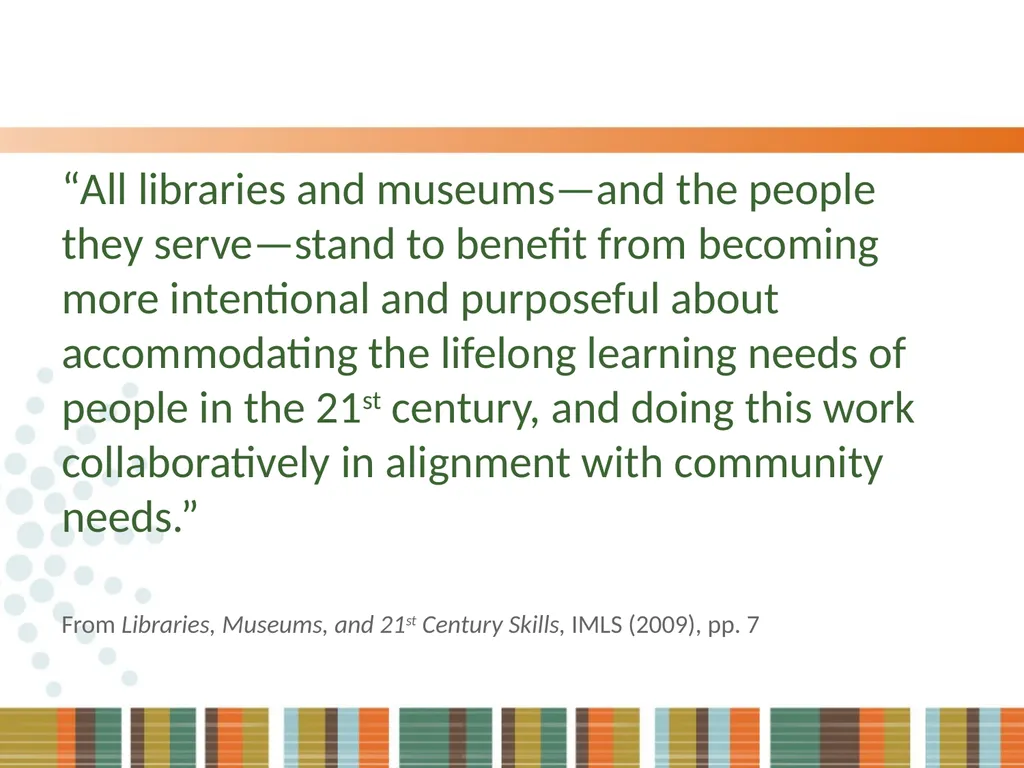
“All libraries and museums—and the people they serve—stand to benefit from becoming more intentional and purposeful about accommodating the lifelong learning needs of people in the 21st century, and doing this work collaboratively in alignment with community needs.”
From Libraries, Museums, and 21st Century Skills, IMLS (2009), pp. 7<br>
28
Where can I find more information about 21st Century Skills?<br>
29
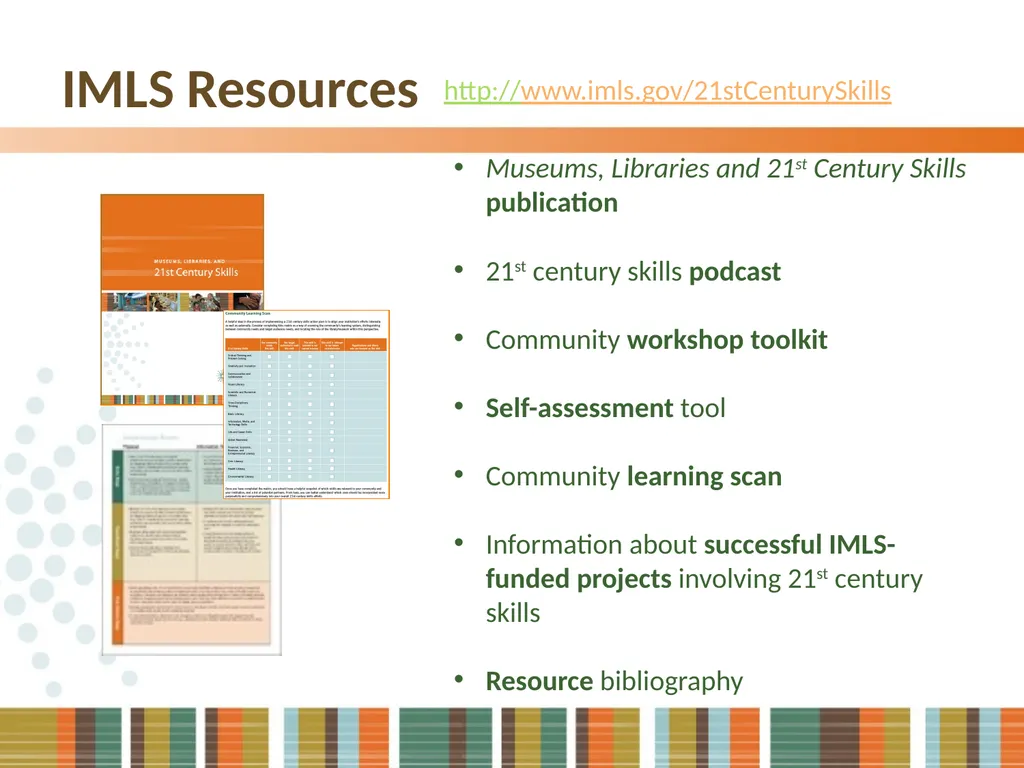
IMLS Resources http://www.imls.gov/21stCenturySkills Museums, Libraries and 21st Century Skills publication
21st century skills podcast
Community workshop toolkit
Self-assessment tool
Community learning scan
Information about successful IMLS-funded projects involving 21st century skills
Resource bibliography<br>
30
Other Useful Resources For a list of other useful resources, please visit the “other resources” tab of the IMLS 21st Century Skills website to find a list of helpful links and a bibliography of current research and reports. www.imls.gov/21stcenturyskills<br>