
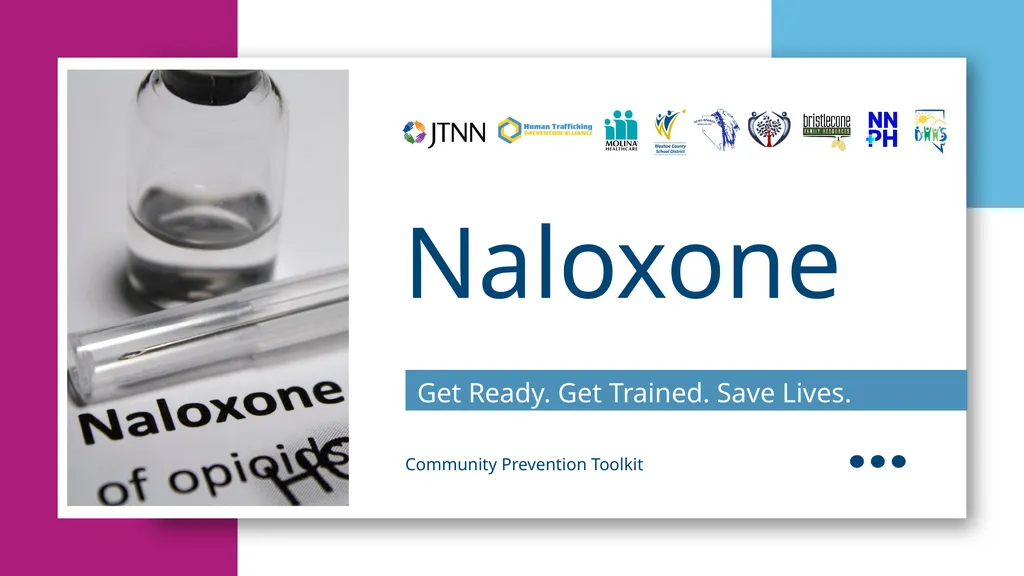
Naloxone Get Ready. Get Trained. Save Lives.




Description: Naloxone Get Ready. Get Trained. Save Lives. Community Prevention Toolkit ACKNOWLEDGEMENTS This presentation was created by Join Together Northern Nevada with support from community partners. Funding for this presentation was provided by
Related Topics
Download Presentation
"Naloxone Get Ready. Get Trained. Save Lives." is the property of its rightful owner. Permission is granted to download and print the materials on this website for personal, non-commercial use only, and to display it on your personal computer provided you do not modify the materials and that you retain all copyright notices contained in the materials. By downloading content from our website, you accept the terms of this agreement.
Presentation Transcript
slide1. Naloxone Get Ready. Get Trained. Save Lives. Community Prevention Toolkit<br>
slide2. ACKNOWLEDGEMENTS This presentation was created by Join Together Northern Nevada with support from community partners.
Funding for this presentation was provided by Department of Public and Behavioral Health.<br>
slide3. An overdose happens when a person takes an amount of a drug, or a combination of drugs, that is more than their body can handle.
As a result, the central nervous system is not able to control basic life functions, like breathing or body temperature, and the person may lose consciousness
Both people new to taking drugs and people experienced with taking drugs can overdose.
Naloxone is a medication that can temporarily reverse an opioid overdose. WHAT IS AN OVERDOSE? WHAT IS NALOXONE?<br>
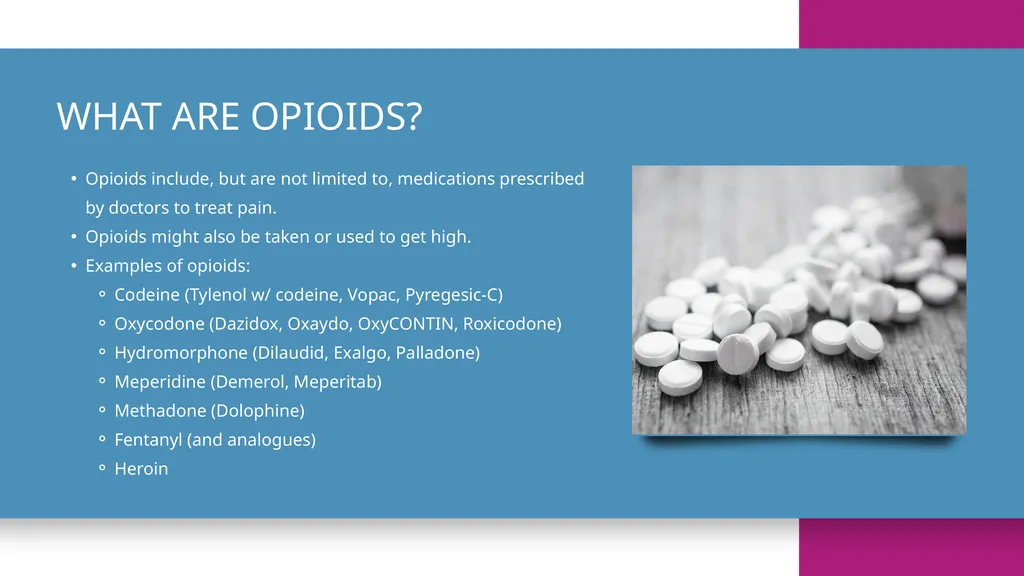
slide4. Opioids include, but are not limited to, medications prescribed by doctors to treat pain.
Opioids might also be taken or used to get high.
Examples of opioids:
Codeine (Tylenol w/ codeine, Vopac, Pyregesic-C)
Oxycodone (Dazidox, Oxaydo, OxyCONTIN, Roxicodone)
Hydromorphone (Dilaudid, Exalgo, Palladone)
Meperidine (Demerol, Meperitab)
Methadone (Dolophine)
Fentanyl (and analogues)
Heroin WHAT ARE OPIOIDS?<br>
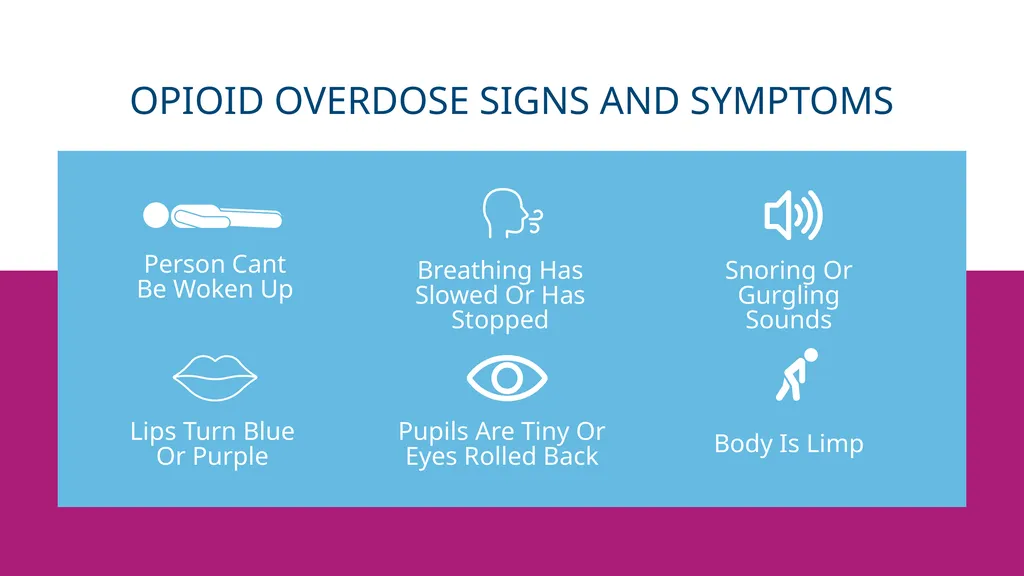
slide5. OPIOID OVERDOSE SIGNS AND SYMPTOMS Person Cant Be Woken Up Breathing Has Slowed Or Has Stopped Snoring Or Gurgling Sounds Lips Turn Blue Or Purple Pupils Are Tiny Or Eyes Rolled Back Body Is Limp<br>
slide6. RESPONDING TO AN OVERDOSE<br>
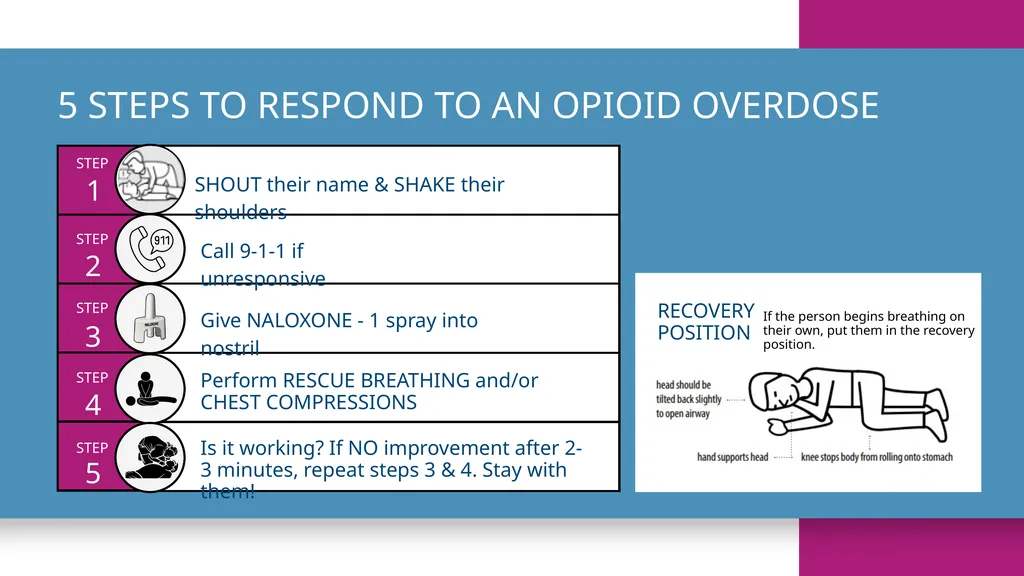
slide7. 5 STEPS TO RESPOND TO AN OPIOID OVERDOSE STEP STEP STEP STEP STEP 1 2 3 4 5 SHOUT their name & SHAKE their shoulders Call 9-1-1 if unresponsive Give NALOXONE - 1 spray into nostril Perform RESCUE BREATHING and/or CHEST COMPRESSIONS Is it working? If NO improvement after 2-3 minutes, repeat steps 3 & 4. Stay with them! RECOVERY
POSITION If the person begins breathing on their own, put them in the recovery position.<br>
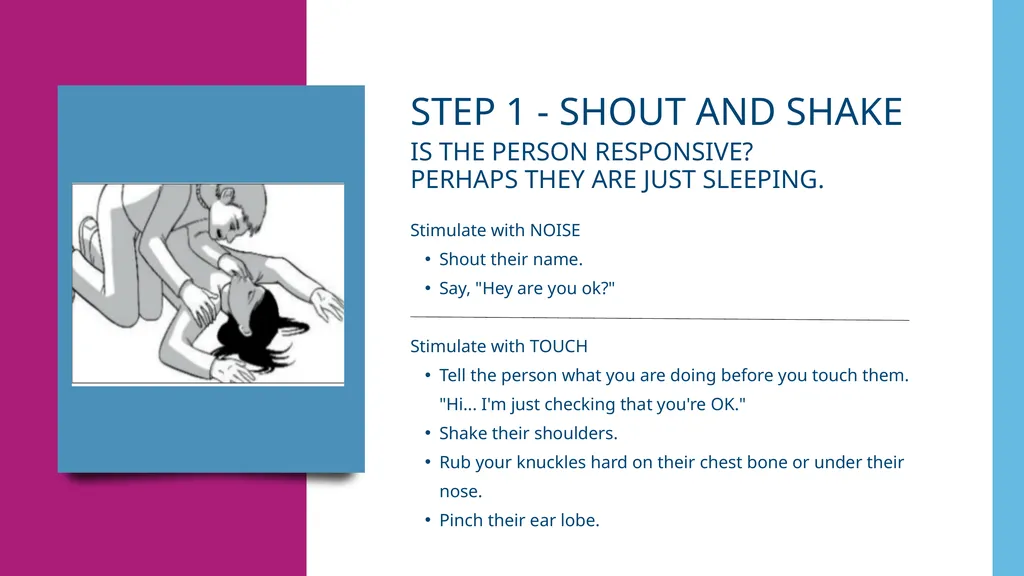
slide8. Stimulate with NOISE
Shout their name.
Say, "Hey are you ok?"
Stimulate with TOUCH
Tell the person what you are doing before you touch them. "Hi... I'm just checking that you're OK."
Shake their shoulders.
Rub your knuckles hard on their chest bone or under their nose.
Pinch their ear lobe. STEP 1 - SHOUT AND SHAKE IS THE PERSON RESPONSIVE?
PERHAPS THEY ARE JUST SLEEPING.<br>
slide9. ARE THEY RESPONDING? If the person responds to stimuli, keep an eye on them.
Do not leave them alone in case the drugs they took have not fully taken effect - they could still overdose.
If the person does not respond to Step 1, proceed to Step 2, calling 911.<br>
slide10. If the person is unconscious, call 911. Some dispatchers will ask if you need ambulance, fire or police. Speak calmly and clearly. Tell the dispatcher someone is unconscious and not responding. ...continued... STEP 2 - CALL 911<br>
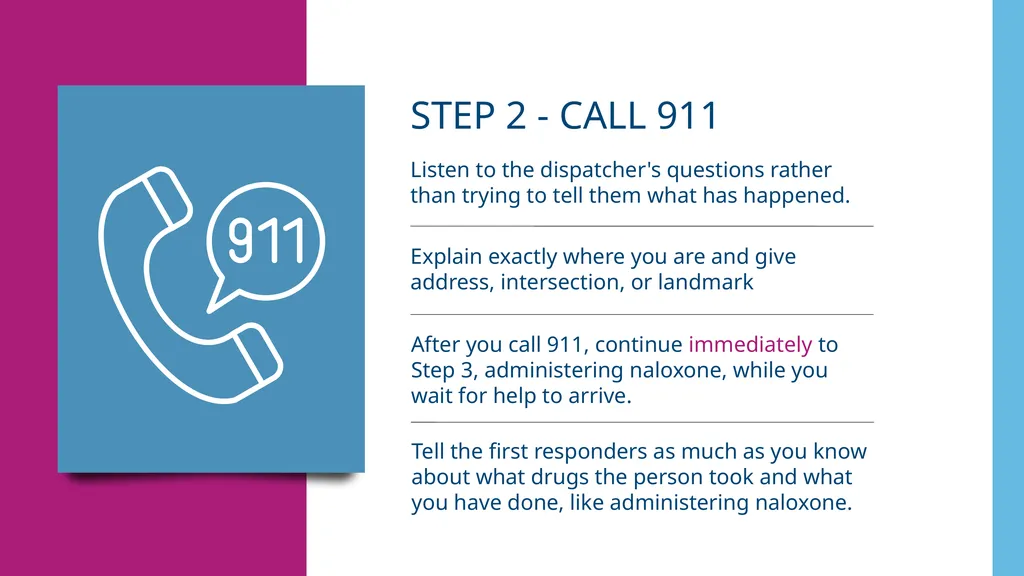
slide11. Listen to the dispatcher's questions rather than trying to tell them what has happened. Explain exactly where you are and give address, intersection, or landmark After you call 911, continue immediately to Step 3, administering naloxone, while you wait for help to arrive. Tell the first responders as much as you know about what drugs the person took and what you have done, like administering naloxone. STEP 2 - CALL 911<br>
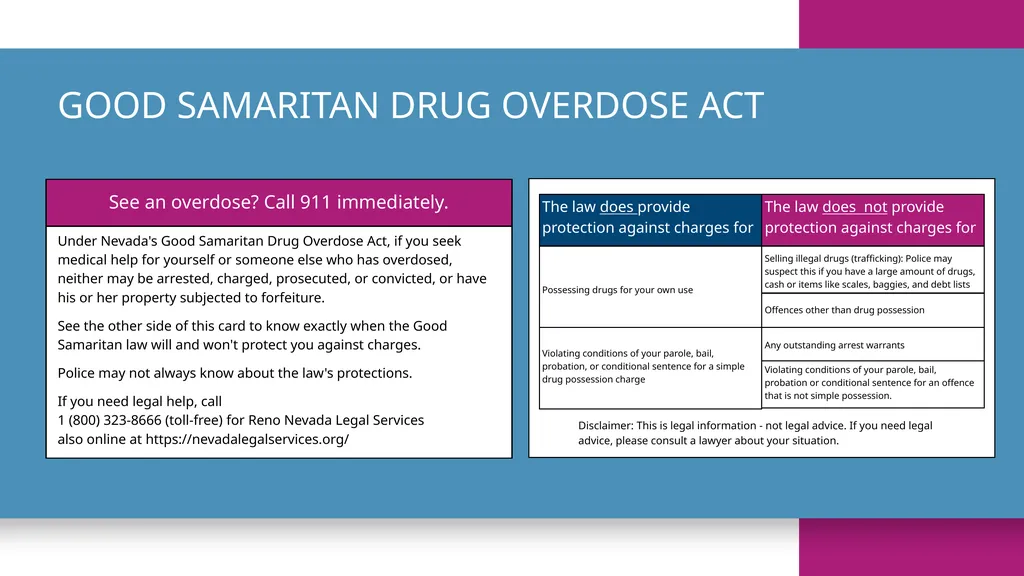
slide12. GOOD SAMARITAN DRUG OVERDOSE ACT Under Nevada's Good Samaritan Drug Overdose Act, if you seek medical help for yourself or someone else who has overdosed, neither may be arrested, charged, prosecuted, or convicted, or have his or her property subjected to forfeiture.
See the other side of this card to know exactly when the Good Samaritan law will and won't protect you against charges.
Police may not always know about the law's protections.
If you need legal help, call
1 (800) 323-8666 (toll-free) for Reno Nevada Legal Services
also online at https://nevadalegalservices.org/ Disclaimer: This is legal information - not legal advice. If you need legal advice, please consult a lawyer about your situation.<br>
slide13. Naloxone is a non-addictive, non-psychoactive drug that blocks the effects of opioids on the body. Temporarily reverses the effect of an opioid overdose.
There is no effect if naloxone is given to a person who has not used opioids
If unsure, administer Does not create a "high" STEP 3 - GIVE NALOXONE Works quickly (less than 5 minutes) Wears off quickly (30-45 mintues)<br>
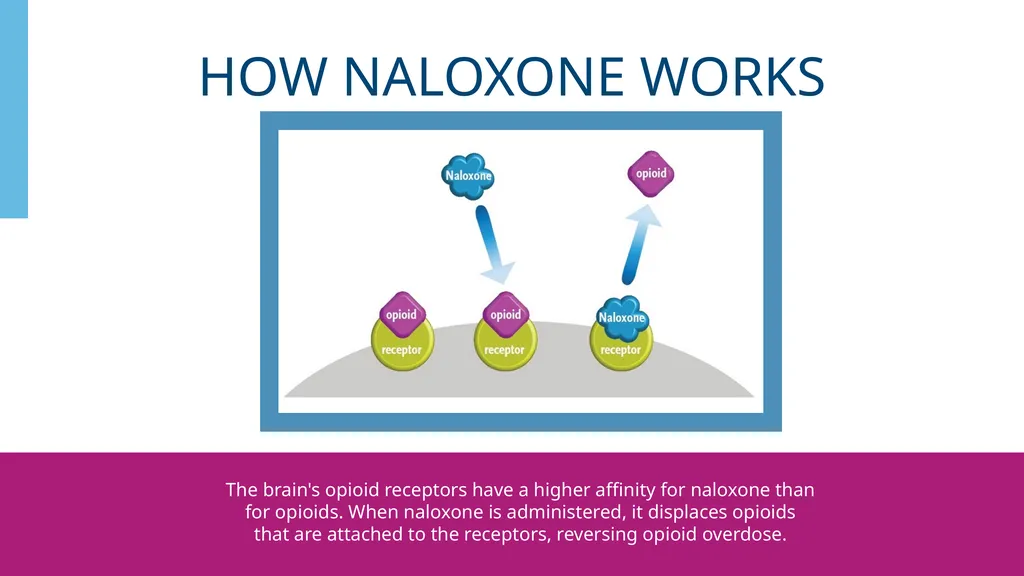
slide14. HOW NALOXONE WORKS The brain's opioid receptors have a higher affinity for naloxone than for opioids. When naloxone is administered, it displaces opioids that are attached to the receptors, reversing opioid overdose.<br>
slide15. Nasal spray naloxone is also known by the brand name "Narcan.”
Administered into the nostril; does not require breathing to be absorbed across the mucosal lining. NASAL SPRAY NALOXONE<br>
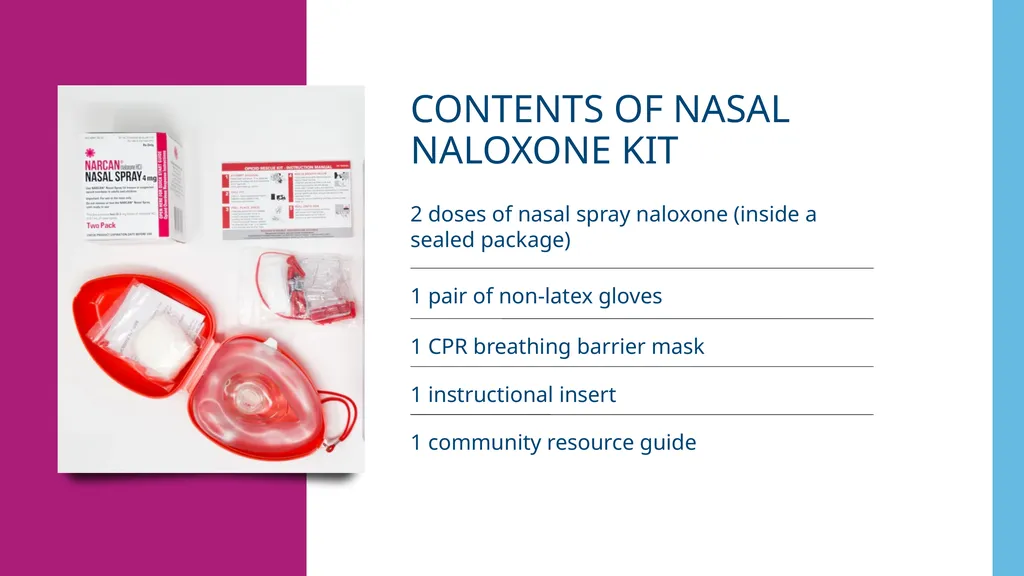
slide16. CONTENTS OF NASAL NALOXONE KIT 2 doses of nasal spray naloxone (inside a sealed package) 1 pair of non-latex gloves 1 CPR breathing barrier mask 1 instructional insert 1 community resource guide<br>
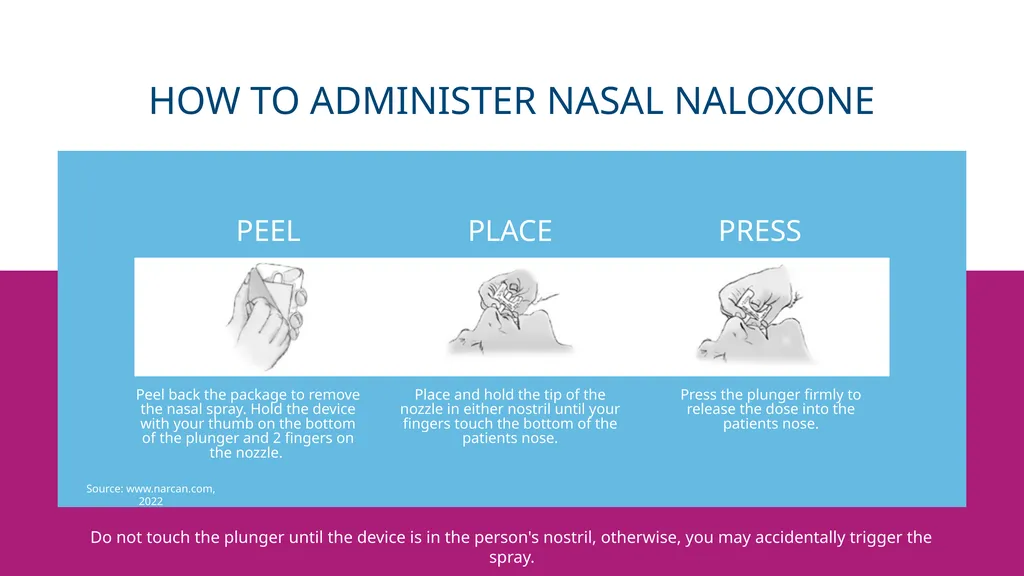
slide17. HOW TO ADMINISTER NASAL NALOXONE PEEL Peel back the package to remove the nasal spray. Hold the device with your thumb on the bottom of the plunger and 2 fingers on the nozzle. Place and hold the tip of the nozzle in either nostril until your fingers touch the bottom of the patients nose. Press the plunger firmly to release the dose into the patients nose. PLACE PRESS Source: www.narcan.com, 2022 Do not touch the plunger until the device is in the person's nostril, otherwise, you may accidentally trigger the spray.<br>
slide18. HEAVY NOD VERSUS OVERDOSE The most significant danger from opioid overdose is that breathing is too slow and the person does not get enough oxygen.
Sometimes a person may not be overly responsive to shouting and shaking, but their breathing is OK.
Check to see how well the person is breathing...<br>
slide19. If the person does not respond to shaking and shouting, check their breathing.
Is their chest and/or stomach rising and falling?
Place the back of your hand over their mouth; can you feel their breath?
Hold the glass screen of your mobile phone over their mouth; does it fog up?
If the person is breathing, put the person in the recovery position and keep monitoring them until they are more alert.
The recovery position will keep their airway clear and open.
It will also prevent them from choking if they vomit. HOW TO CHECK FOR BREATHING<br>
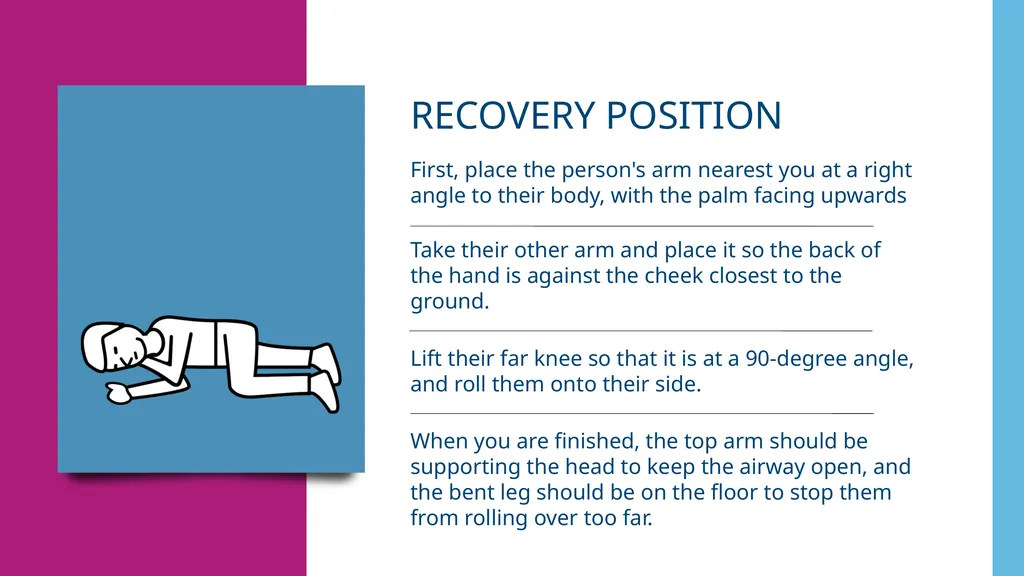
slide20. First, place the person's arm nearest you at a right angle to their body, with the palm facing upwards Take their other arm and place it so the back of the hand is against the cheek closest to the ground. Lift their far knee so that it is at a 90-degree angle, and roll them onto their side. RECOVERY POSITION When you are finished, the top arm should be supporting the head to keep the airway open, and the bent leg should be on the floor to stop them from rolling over too far.<br>
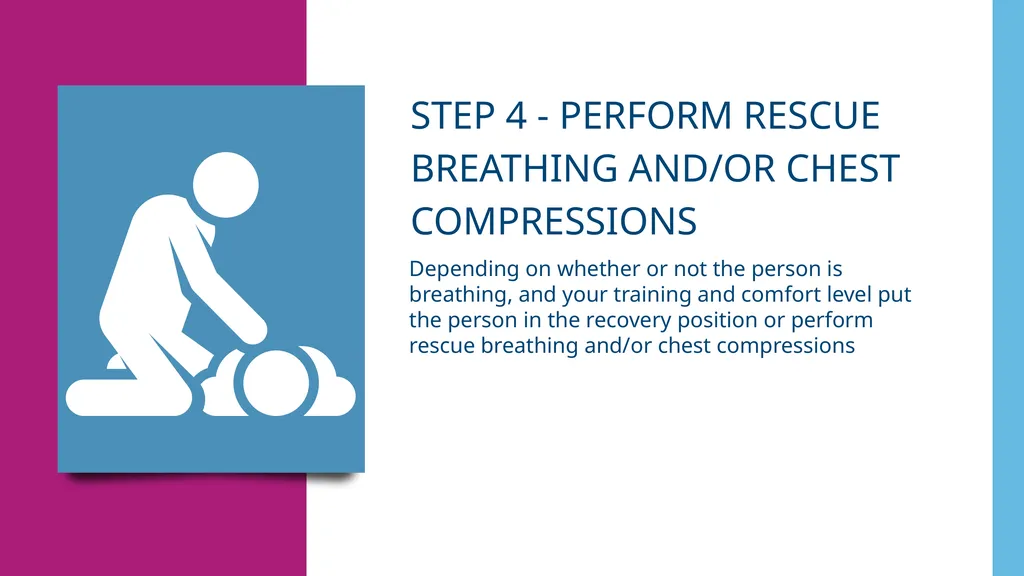
slide21. STEP 4 - PERFORM RESCUE BREATHING AND/OR CHEST COMPRESSIONS Depending on whether or not the person is breathing, and your training and comfort level put the person in the recovery position or perform rescue breathing and/or chest compressions<br>
slide22. STEP 5 - IS IT WORKING? Continue performing rescue breathing and/or chest compressions after administering naloxone, if necessary. Naloxone usually starts working in 2-3 minutes. After this time, check their breathing again. If the person is not responding, administer a second dose - Use the other nostril for 2nd spray. You can keep repeating doses as necessary, if you have access to additional doses. Continue rescue breathing and/or chest compressions until the person becomes alert or until help arrives.<br>
slide23. IF NALOXONE IS NOT WORKING Reasons a person may not respond to naloxone
The person is not under the influence of opioids
Administering naloxone will not harm them
There could be another serious medical issue
A higher dose of naloxone is needed
Some fentanyl analogues require additional doses of naloxone
911 should already have been called regardless<br>
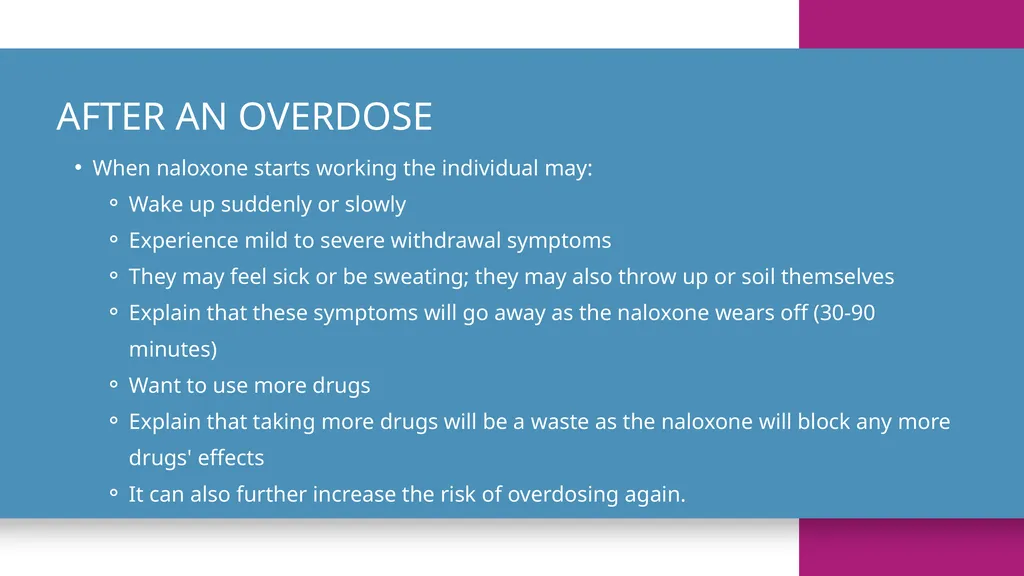
slide24. When naloxone starts working the individual may:
Wake up suddenly or slowly
Experience mild to severe withdrawal symptoms
They may feel sick or be sweating; they may also throw up or soil themselves
Explain that these symptoms will go away as the naloxone wears off (30-90 minutes)
Want to use more drugs
Explain that taking more drugs will be a waste as the naloxone will block any more drugs' effects
It can also further increase the risk of overdosing again. AFTER AN OVERDOSE<br>
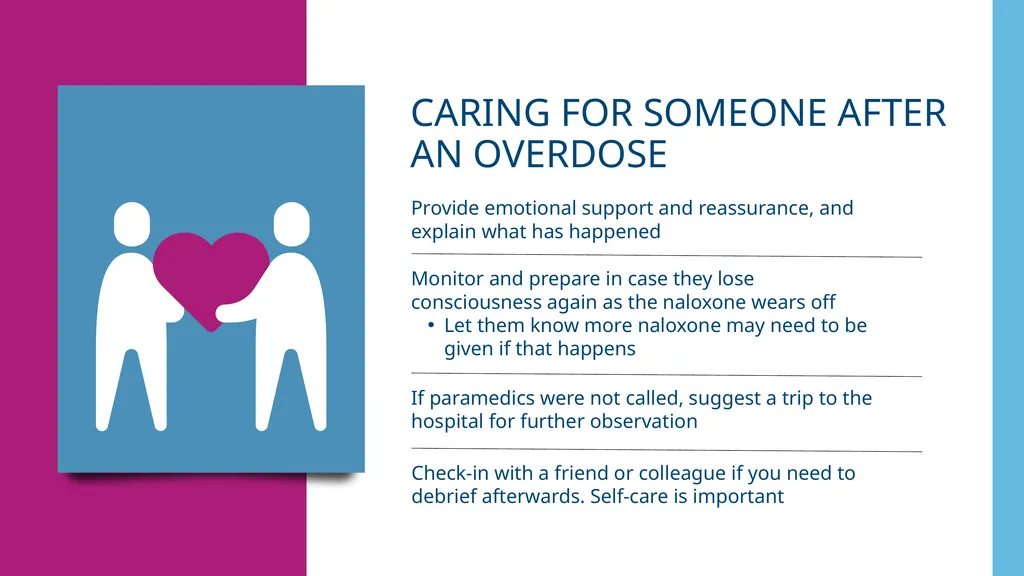
slide25. CARING FOR SOMEONE AFTER AN OVERDOSE Provide emotional support and reassurance, and explain what has happened Monitor and prepare in case they lose consciousness again as the naloxone wears off
Let them know more naloxone may need to be given if that happens If paramedics were not called, suggest a trip to the hospital for further observation Check-in with a friend or colleague if you need to debrief afterwards. Self-care is important<br>
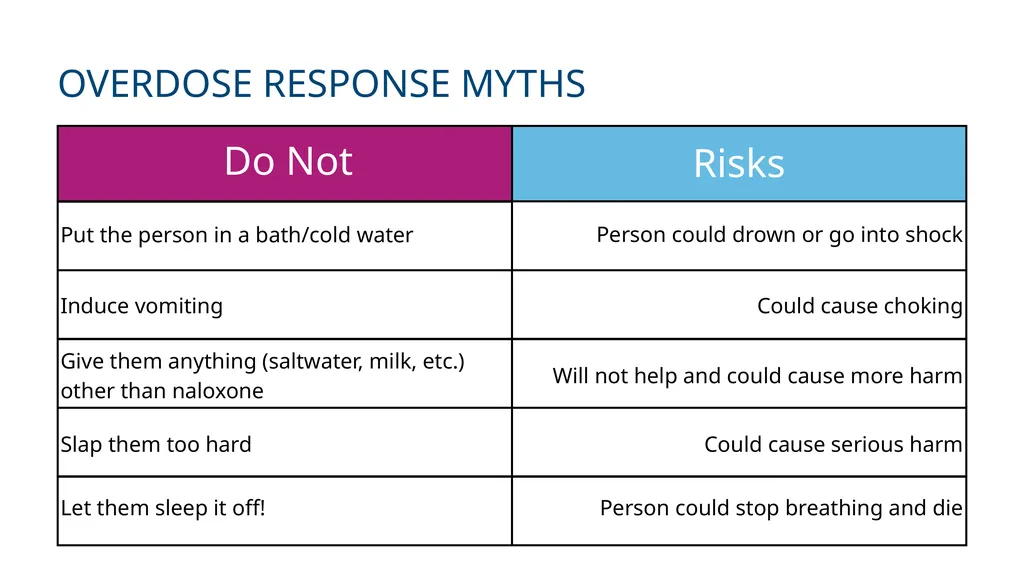
slide26. OVERDOSE RESPONSE MYTHS<br>
slide27. PREVENTING OPIOID OVERDOSE<br>
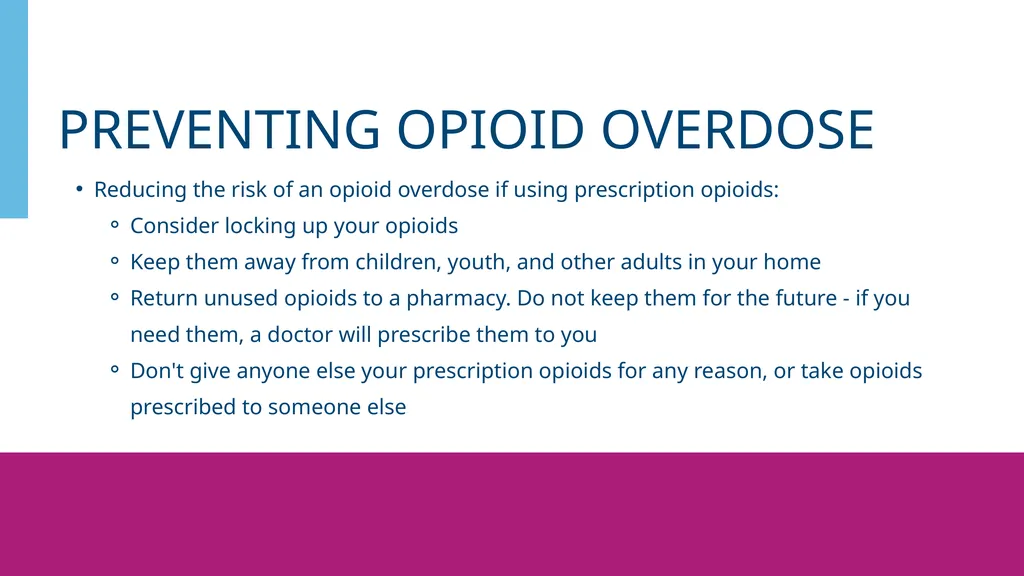
slide28. PREVENTING OPIOID OVERDOSE Reducing the risk of an opioid overdose if using prescription opioids:
Consider locking up your opioids
Keep them away from children, youth, and other adults in your home
Return unused opioids to a pharmacy. Do not keep them for the future - if you need them, a doctor will prescribe them to you
Don't give anyone else your prescription opioids for any reason, or take opioids prescribed to someone else<br>
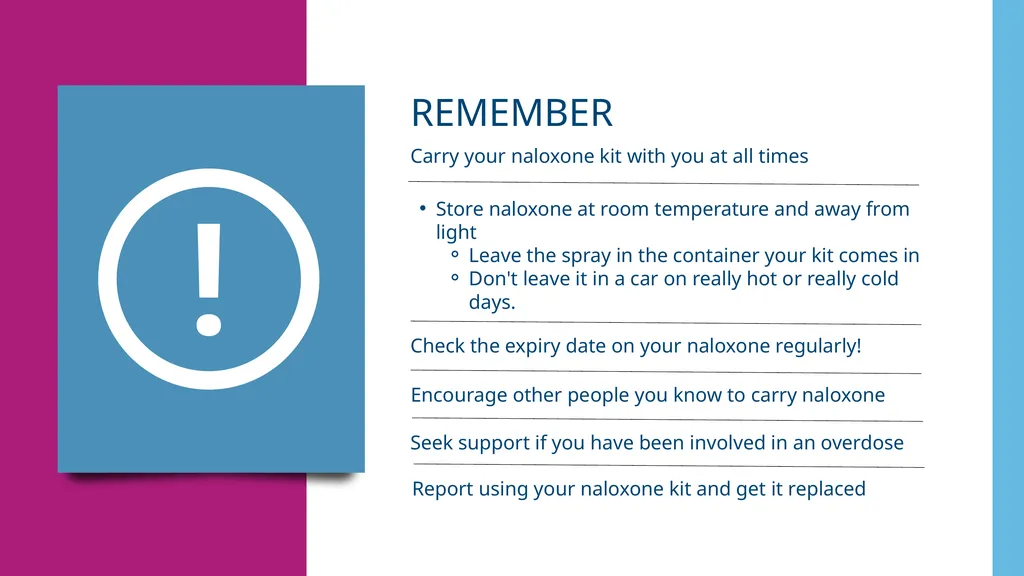
slide29. REMEMBER Carry your naloxone kit with you at all times Store naloxone at room temperature and away from light
Leave the spray in the container your kit comes in
Don't leave it in a car on really hot or really cold days. Check the expiry date on your naloxone regularly! Encourage other people you know to carry naloxone Seek support if you have been involved in an overdose Report using your naloxone kit and get it replaced<br>
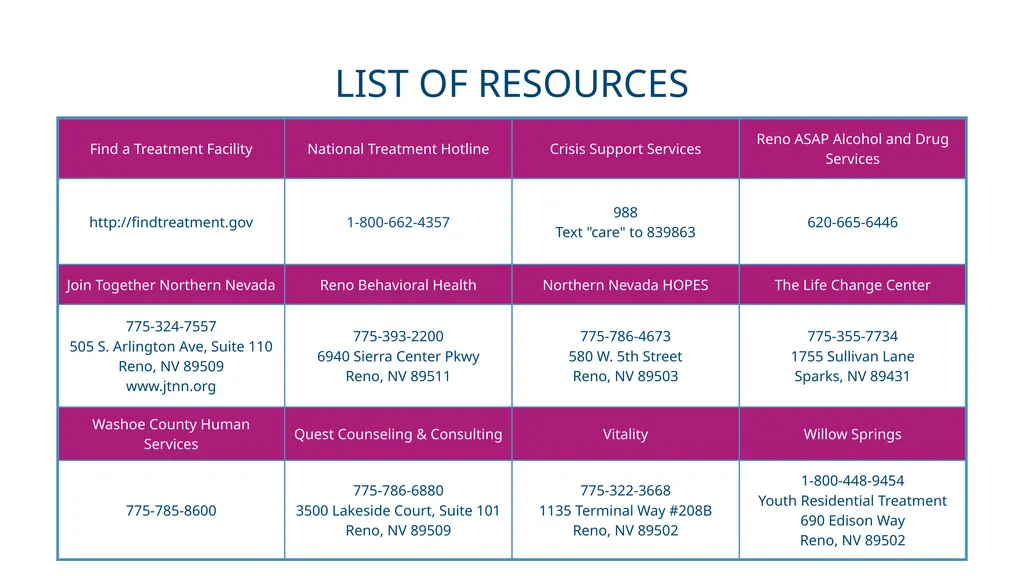
slide30. LIST OF RESOURCES<br>
slide2. ACKNOWLEDGEMENTS This presentation was created by Join Together Northern Nevada with support from community partners.
Funding for this presentation was provided by Department of Public and Behavioral Health.<br>
slide3. An overdose happens when a person takes an amount of a drug, or a combination of drugs, that is more than their body can handle.
As a result, the central nervous system is not able to control basic life functions, like breathing or body temperature, and the person may lose consciousness
Both people new to taking drugs and people experienced with taking drugs can overdose.
Naloxone is a medication that can temporarily reverse an opioid overdose. WHAT IS AN OVERDOSE? WHAT IS NALOXONE?<br>
slide4. Opioids include, but are not limited to, medications prescribed by doctors to treat pain.
Opioids might also be taken or used to get high.
Examples of opioids:
Codeine (Tylenol w/ codeine, Vopac, Pyregesic-C)
Oxycodone (Dazidox, Oxaydo, OxyCONTIN, Roxicodone)
Hydromorphone (Dilaudid, Exalgo, Palladone)
Meperidine (Demerol, Meperitab)
Methadone (Dolophine)
Fentanyl (and analogues)
Heroin WHAT ARE OPIOIDS?<br>
slide5. OPIOID OVERDOSE SIGNS AND SYMPTOMS Person Cant Be Woken Up Breathing Has Slowed Or Has Stopped Snoring Or Gurgling Sounds Lips Turn Blue Or Purple Pupils Are Tiny Or Eyes Rolled Back Body Is Limp<br>
slide6. RESPONDING TO AN OVERDOSE<br>
slide7. 5 STEPS TO RESPOND TO AN OPIOID OVERDOSE STEP STEP STEP STEP STEP 1 2 3 4 5 SHOUT their name & SHAKE their shoulders Call 9-1-1 if unresponsive Give NALOXONE - 1 spray into nostril Perform RESCUE BREATHING and/or CHEST COMPRESSIONS Is it working? If NO improvement after 2-3 minutes, repeat steps 3 & 4. Stay with them! RECOVERY
POSITION If the person begins breathing on their own, put them in the recovery position.<br>
slide8. Stimulate with NOISE
Shout their name.
Say, "Hey are you ok?"
Stimulate with TOUCH
Tell the person what you are doing before you touch them. "Hi... I'm just checking that you're OK."
Shake their shoulders.
Rub your knuckles hard on their chest bone or under their nose.
Pinch their ear lobe. STEP 1 - SHOUT AND SHAKE IS THE PERSON RESPONSIVE?
PERHAPS THEY ARE JUST SLEEPING.<br>
slide9. ARE THEY RESPONDING? If the person responds to stimuli, keep an eye on them.
Do not leave them alone in case the drugs they took have not fully taken effect - they could still overdose.
If the person does not respond to Step 1, proceed to Step 2, calling 911.<br>
slide10. If the person is unconscious, call 911. Some dispatchers will ask if you need ambulance, fire or police. Speak calmly and clearly. Tell the dispatcher someone is unconscious and not responding. ...continued... STEP 2 - CALL 911<br>
slide11. Listen to the dispatcher's questions rather than trying to tell them what has happened. Explain exactly where you are and give address, intersection, or landmark After you call 911, continue immediately to Step 3, administering naloxone, while you wait for help to arrive. Tell the first responders as much as you know about what drugs the person took and what you have done, like administering naloxone. STEP 2 - CALL 911<br>
slide12. GOOD SAMARITAN DRUG OVERDOSE ACT Under Nevada's Good Samaritan Drug Overdose Act, if you seek medical help for yourself or someone else who has overdosed, neither may be arrested, charged, prosecuted, or convicted, or have his or her property subjected to forfeiture.
See the other side of this card to know exactly when the Good Samaritan law will and won't protect you against charges.
Police may not always know about the law's protections.
If you need legal help, call
1 (800) 323-8666 (toll-free) for Reno Nevada Legal Services
also online at https://nevadalegalservices.org/ Disclaimer: This is legal information - not legal advice. If you need legal advice, please consult a lawyer about your situation.<br>
slide13. Naloxone is a non-addictive, non-psychoactive drug that blocks the effects of opioids on the body. Temporarily reverses the effect of an opioid overdose.
There is no effect if naloxone is given to a person who has not used opioids
If unsure, administer Does not create a "high" STEP 3 - GIVE NALOXONE Works quickly (less than 5 minutes) Wears off quickly (30-45 mintues)<br>
slide14. HOW NALOXONE WORKS The brain's opioid receptors have a higher affinity for naloxone than for opioids. When naloxone is administered, it displaces opioids that are attached to the receptors, reversing opioid overdose.<br>
slide15. Nasal spray naloxone is also known by the brand name "Narcan.”
Administered into the nostril; does not require breathing to be absorbed across the mucosal lining. NASAL SPRAY NALOXONE<br>
slide16. CONTENTS OF NASAL NALOXONE KIT 2 doses of nasal spray naloxone (inside a sealed package) 1 pair of non-latex gloves 1 CPR breathing barrier mask 1 instructional insert 1 community resource guide<br>
slide17. HOW TO ADMINISTER NASAL NALOXONE PEEL Peel back the package to remove the nasal spray. Hold the device with your thumb on the bottom of the plunger and 2 fingers on the nozzle. Place and hold the tip of the nozzle in either nostril until your fingers touch the bottom of the patients nose. Press the plunger firmly to release the dose into the patients nose. PLACE PRESS Source: www.narcan.com, 2022 Do not touch the plunger until the device is in the person's nostril, otherwise, you may accidentally trigger the spray.<br>
slide18. HEAVY NOD VERSUS OVERDOSE The most significant danger from opioid overdose is that breathing is too slow and the person does not get enough oxygen.
Sometimes a person may not be overly responsive to shouting and shaking, but their breathing is OK.
Check to see how well the person is breathing...<br>
slide19. If the person does not respond to shaking and shouting, check their breathing.
Is their chest and/or stomach rising and falling?
Place the back of your hand over their mouth; can you feel their breath?
Hold the glass screen of your mobile phone over their mouth; does it fog up?
If the person is breathing, put the person in the recovery position and keep monitoring them until they are more alert.
The recovery position will keep their airway clear and open.
It will also prevent them from choking if they vomit. HOW TO CHECK FOR BREATHING<br>
slide20. First, place the person's arm nearest you at a right angle to their body, with the palm facing upwards Take their other arm and place it so the back of the hand is against the cheek closest to the ground. Lift their far knee so that it is at a 90-degree angle, and roll them onto their side. RECOVERY POSITION When you are finished, the top arm should be supporting the head to keep the airway open, and the bent leg should be on the floor to stop them from rolling over too far.<br>
slide21. STEP 4 - PERFORM RESCUE BREATHING AND/OR CHEST COMPRESSIONS Depending on whether or not the person is breathing, and your training and comfort level put the person in the recovery position or perform rescue breathing and/or chest compressions<br>
slide22. STEP 5 - IS IT WORKING? Continue performing rescue breathing and/or chest compressions after administering naloxone, if necessary. Naloxone usually starts working in 2-3 minutes. After this time, check their breathing again. If the person is not responding, administer a second dose - Use the other nostril for 2nd spray. You can keep repeating doses as necessary, if you have access to additional doses. Continue rescue breathing and/or chest compressions until the person becomes alert or until help arrives.<br>
slide23. IF NALOXONE IS NOT WORKING Reasons a person may not respond to naloxone
The person is not under the influence of opioids
Administering naloxone will not harm them
There could be another serious medical issue
A higher dose of naloxone is needed
Some fentanyl analogues require additional doses of naloxone
911 should already have been called regardless<br>
slide24. When naloxone starts working the individual may:
Wake up suddenly or slowly
Experience mild to severe withdrawal symptoms
They may feel sick or be sweating; they may also throw up or soil themselves
Explain that these symptoms will go away as the naloxone wears off (30-90 minutes)
Want to use more drugs
Explain that taking more drugs will be a waste as the naloxone will block any more drugs' effects
It can also further increase the risk of overdosing again. AFTER AN OVERDOSE<br>
slide25. CARING FOR SOMEONE AFTER AN OVERDOSE Provide emotional support and reassurance, and explain what has happened Monitor and prepare in case they lose consciousness again as the naloxone wears off
Let them know more naloxone may need to be given if that happens If paramedics were not called, suggest a trip to the hospital for further observation Check-in with a friend or colleague if you need to debrief afterwards. Self-care is important<br>
slide26. OVERDOSE RESPONSE MYTHS<br>
slide27. PREVENTING OPIOID OVERDOSE<br>
slide28. PREVENTING OPIOID OVERDOSE Reducing the risk of an opioid overdose if using prescription opioids:
Consider locking up your opioids
Keep them away from children, youth, and other adults in your home
Return unused opioids to a pharmacy. Do not keep them for the future - if you need them, a doctor will prescribe them to you
Don't give anyone else your prescription opioids for any reason, or take opioids prescribed to someone else<br>
slide29. REMEMBER Carry your naloxone kit with you at all times Store naloxone at room temperature and away from light
Leave the spray in the container your kit comes in
Don't leave it in a car on really hot or really cold days. Check the expiry date on your naloxone regularly! Encourage other people you know to carry naloxone Seek support if you have been involved in an overdose Report using your naloxone kit and get it replaced<br>
slide30. LIST OF RESOURCES<br>