
Naloxone (NaRCAN) Access training Learning

Description: Naloxone (NaRCAN) Access training Learning objectives By the end of the presentation, you will: Understand the Community-Based Naloxone Access Program (CBNAP) Standing Order Be able to recognize and effectively respond to an opioid overdose
Related Topics
Download Presentation
"Naloxone (NaRCAN) Access training Learning" is the property of its rightful owner. Permission is granted to download and print the materials on this website for personal, non-commercial use only, and to display it on your personal computer provided you do not modify the materials and that you retain all copyright notices contained in the materials. By downloading content from our website, you accept the terms of this agreement.
Presentation Transcript
slide1. Naloxone (NaRCAN) Access training<br>
slide2. Learning objectives By the end of the presentation, you will:
Understand the Community-Based Naloxone Access Program (CBNAP) Standing Order
Be able to recognize and effectively respond to an opioid overdose
Know what naloxone is, how to store it, and how to administer it Nigel Brunsdon, www.injectingadvice.com<br>
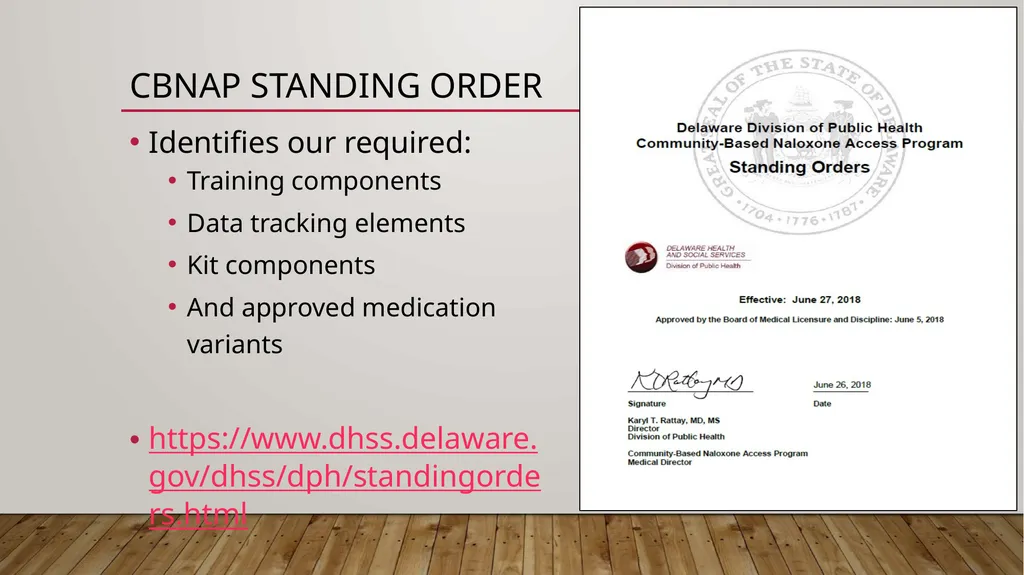
slide3. CBNAP Standing Order Identifies our required:
Training components
Data tracking elements
Kit components
And approved medication variants
https://www.dhss.delaware.gov/dhss/dph/standingorders.html<br>
slide4. “Opioid Overdose Responder Training” Training may be provided by:
Approved community-based classes;
Approved Point of Distribution training;
Online videos;
Direct instruction from a pharmacist or other healthcare provider.
Available classes, upcoming events, online videos can be found at:
https://www.helpisherede.com/overdose-prevention/narcan-training<br>
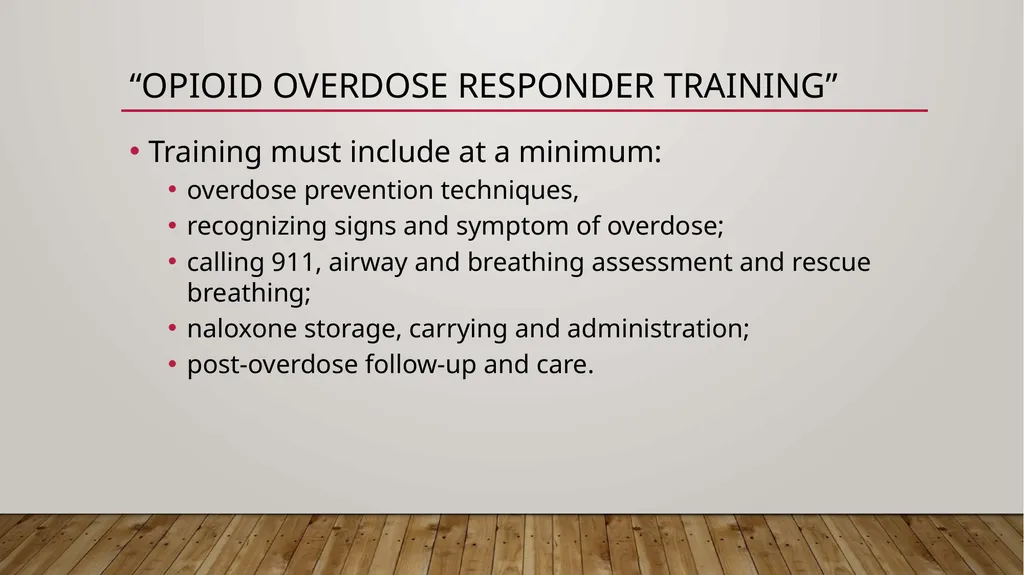
slide5. “Opioid Overdose Responder Training” Training must include at a minimum:
overdose prevention techniques,
recognizing signs and symptom of overdose;
calling 911, airway and breathing assessment and rescue breathing;
naloxone storage, carrying and administration;
post-overdose follow-up and care.<br>
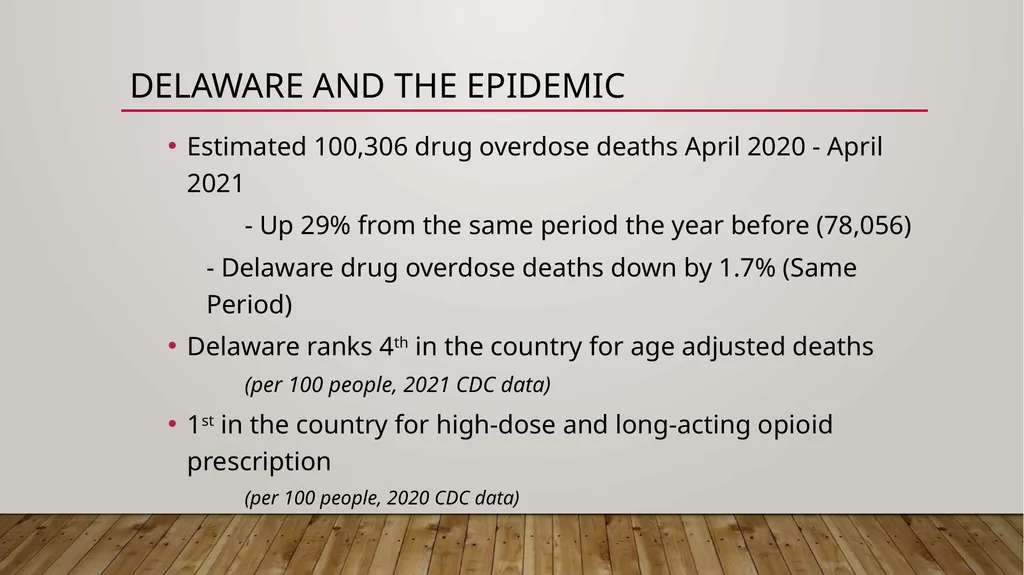
slide6. Delaware and the epidemic Estimated 100,306 drug overdose deaths April 2020 - April 2021
- Up 29% from the same period the year before (78,056)
- Delaware drug overdose deaths down by 1.7% (Same Period)
Delaware ranks 4th in the country for age adjusted deaths
(per 100 people, 2021 CDC data)
1st in the country for high-dose and long-acting opioid prescription
(per 100 people, 2020 CDC data)<br>
slide7. NALOXONE (NARCAN) Myths http://www.yourtrainingedge.com/top-10-training-myths/<br>
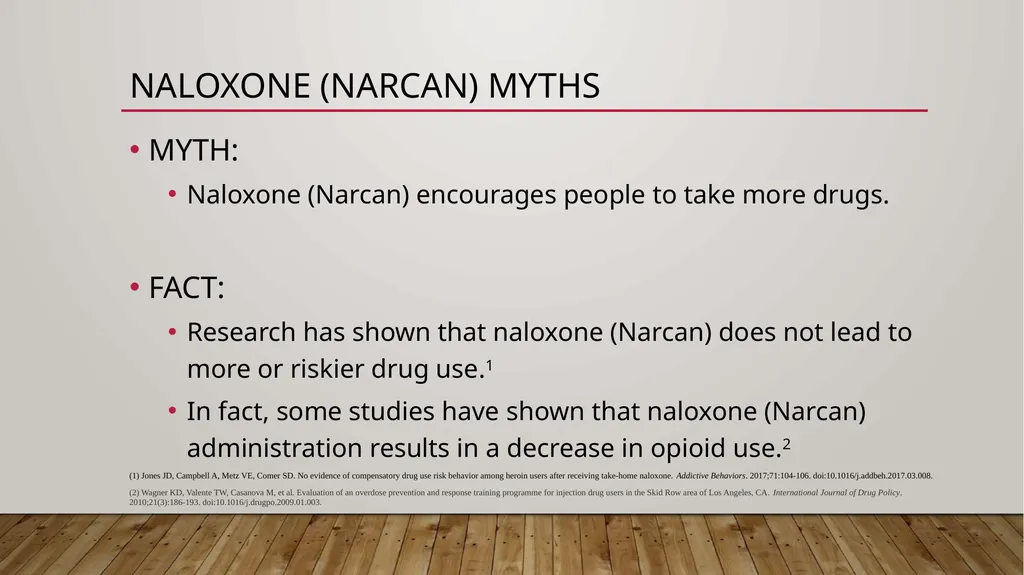
slide8. NALOXONE (NARCAN) Myths MYTH:
Naloxone (Narcan) encourages people to take more drugs.
FACT:
Research has shown that naloxone (Narcan) does not lead to more or riskier drug use.1
In fact, some studies have shown that naloxone (Narcan) administration results in a decrease in opioid use.2 (1) Jones JD, Campbell A, Metz VE, Comer SD. No evidence of compensatory drug use risk behavior among heroin users after receiving take-home naloxone. Addictive Behaviors. 2017;71:104-106. doi:10.1016/j.addbeh.2017.03.008. (2) Wagner KD, Valente TW, Casanova M, et al. Evaluation of an overdose prevention and response training programme for injection drug users in the Skid Row area of Los Angeles, CA. International Journal of Drug Policy. 2010;21(3):186-193. doi:10.1016/j.drugpo.2009.01.003.<br>
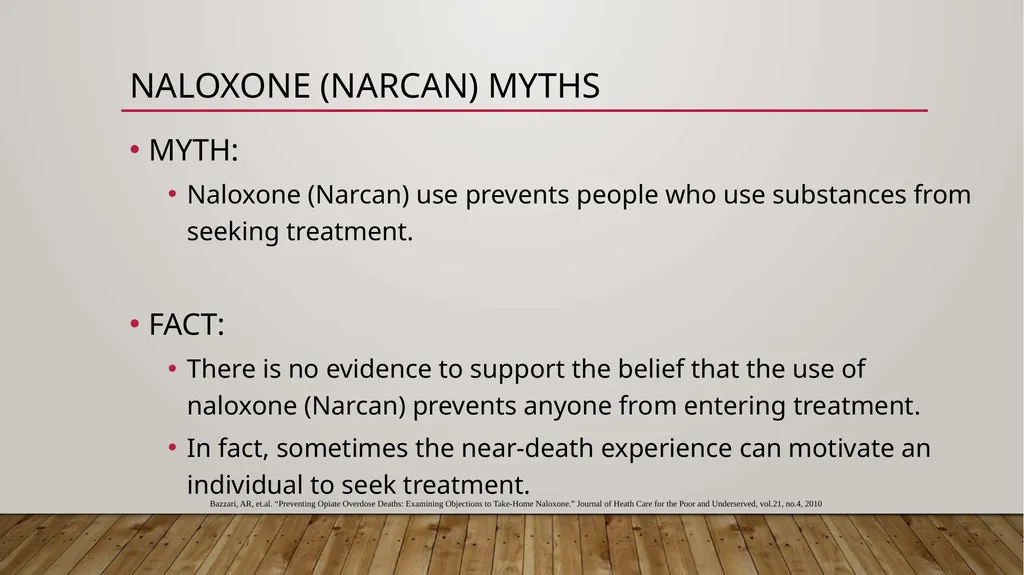
slide9. NALOXONE (NARCAN) Myths MYTH:
Naloxone (Narcan) use prevents people who use substances from seeking treatment.
FACT:
There is no evidence to support the belief that the use of naloxone (Narcan) prevents anyone from entering treatment.
In fact, sometimes the near-death experience can motivate an individual to seek treatment. Bazzari, AR, et.al. “Preventing Opiate Overdose Deaths: Examining Objections to Take-Home Naloxone.” Journal of Heath Care for the Poor and Underserved, vol.21, no.4, 2010<br>
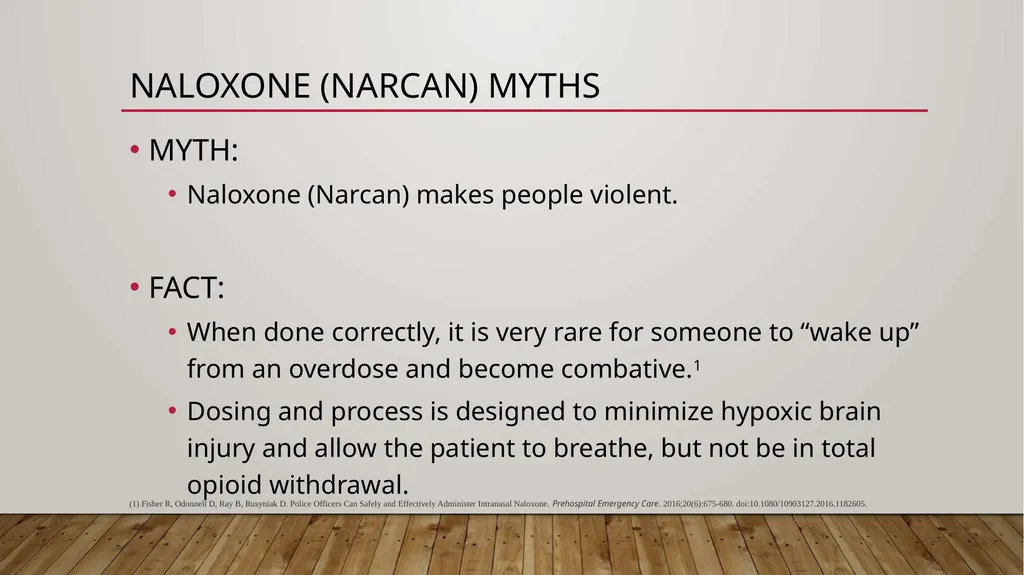
slide10. Naloxone (NARCAN) Myths MYTH:
Naloxone (Narcan) makes people violent.
FACT:
When done correctly, it is very rare for someone to “wake up” from an overdose and become combative.1
Dosing and process is designed to minimize hypoxic brain injury and allow the patient to breathe, but not be in total opioid withdrawal. (1) Fisher R, Odonnell D, Ray B, Rusyniak D. Police Officers Can Safely and Effectively Administer Intranasal Naloxone. Prehospital Emergency Care. 2016;20(6):675-680. doi:10.1080/10903127.2016.1182605.<br>
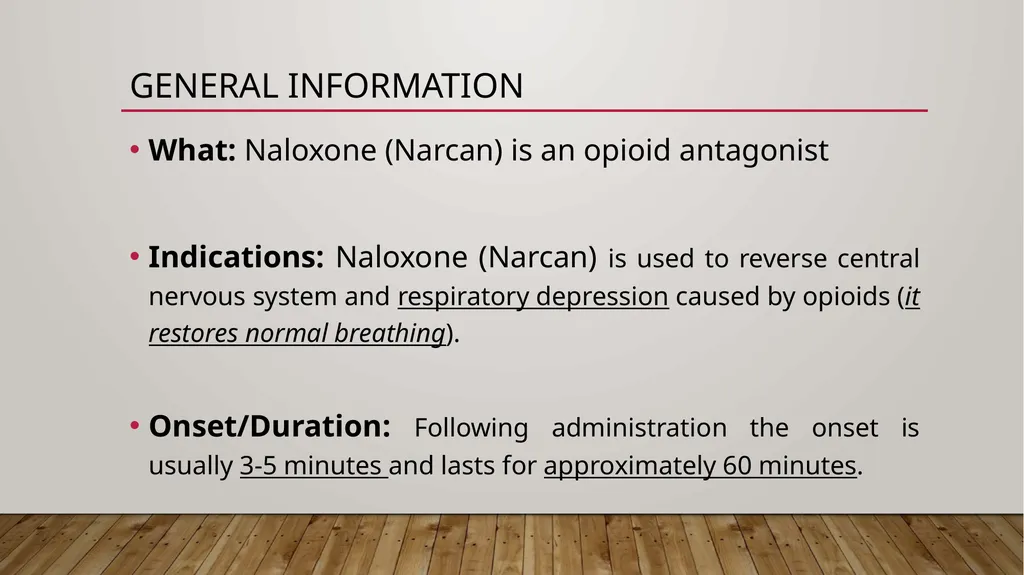
slide11. General information What: Naloxone (Narcan) is an opioid antagonist
Indications: Naloxone (Narcan) is used to reverse central nervous system and respiratory depression caused by opioids (it restores normal breathing).
Onset/Duration: Following administration the onset is usually 3-5 minutes and lasts for approximately 60 minutes.<br>
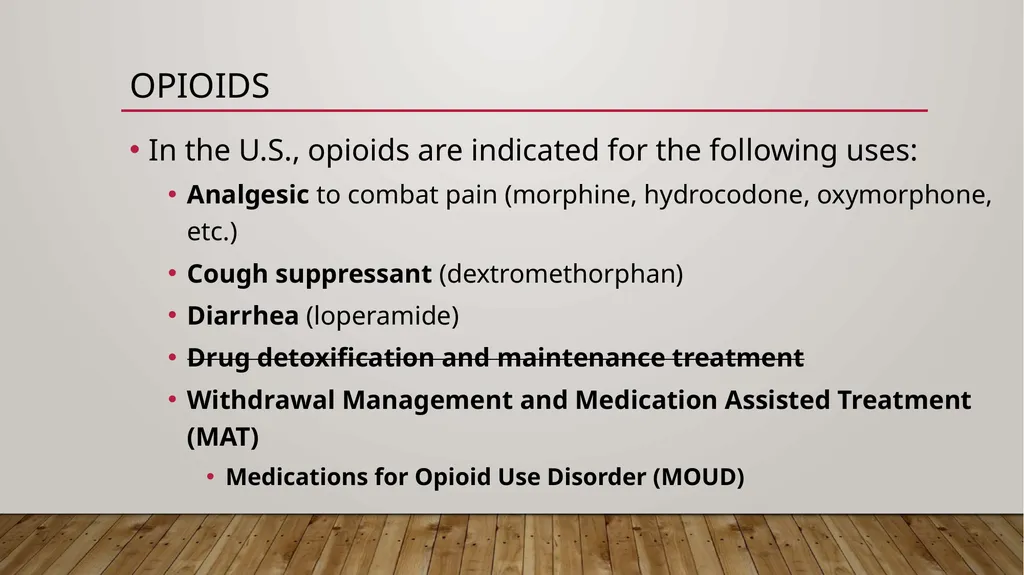
slide12. Opioids In the U.S., opioids are indicated for the following uses:
Analgesic to combat pain (morphine, hydrocodone, oxymorphone, etc.)
Cough suppressant (dextromethorphan)
Diarrhea (loperamide)
Drug detoxification and maintenance treatment
Withdrawal Management and Medication Assisted Treatment (MAT)
Medications for Opioid Use Disorder (MOUD)<br>
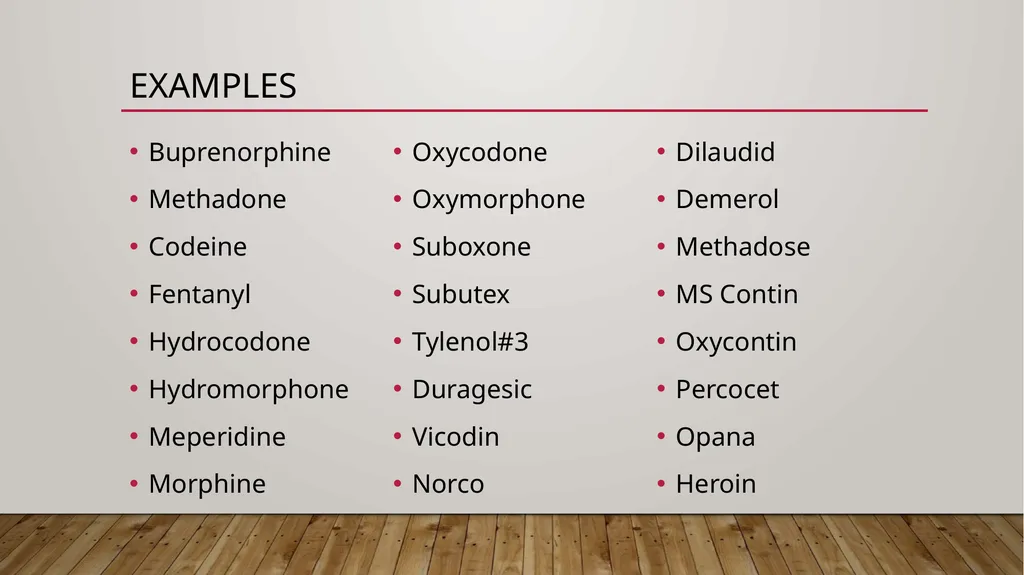
slide13. examples Buprenorphine
Methadone
Codeine
Fentanyl
Hydrocodone
Hydromorphone
Meperidine
Morphine
Oxycodone
Oxymorphone
Suboxone
Subutex
Tylenol#3
Duragesic
Vicodin
Norco
Dilaudid
Demerol
Methadose
MS Contin
Oxycontin
Percocet
Opana
Heroin<br>
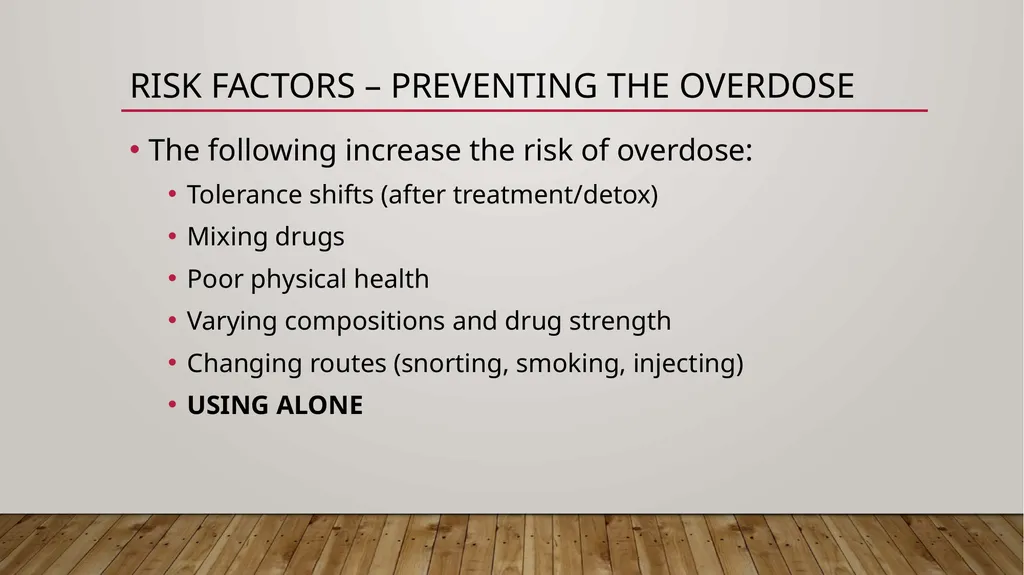
slide14. Risk Factors – Preventing the Overdose The following increase the risk of overdose:
Tolerance shifts (after treatment/detox)
Mixing drugs
Poor physical health
Varying compositions and drug strength
Changing routes (snorting, smoking, injecting)
USING ALONE<br>
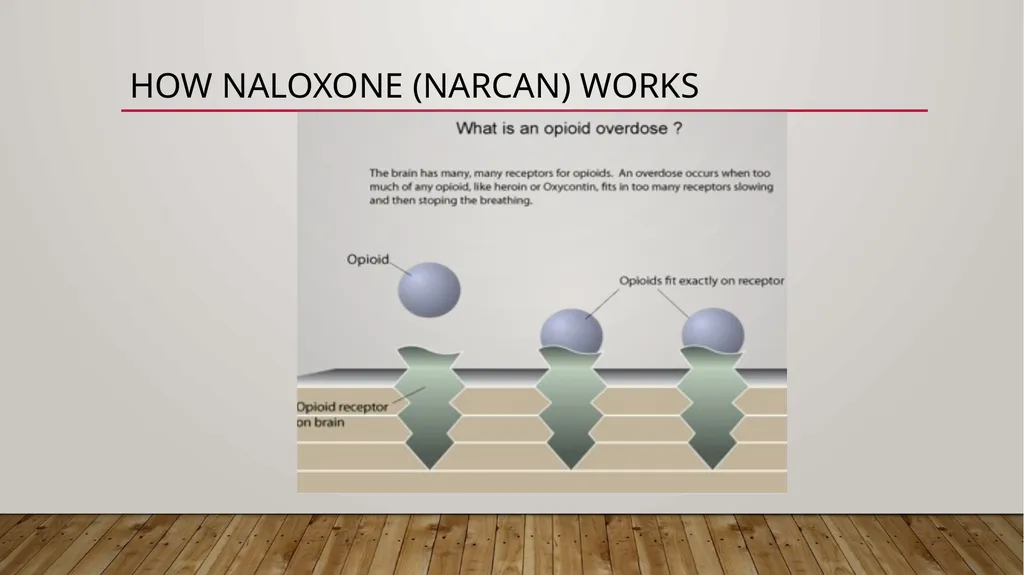
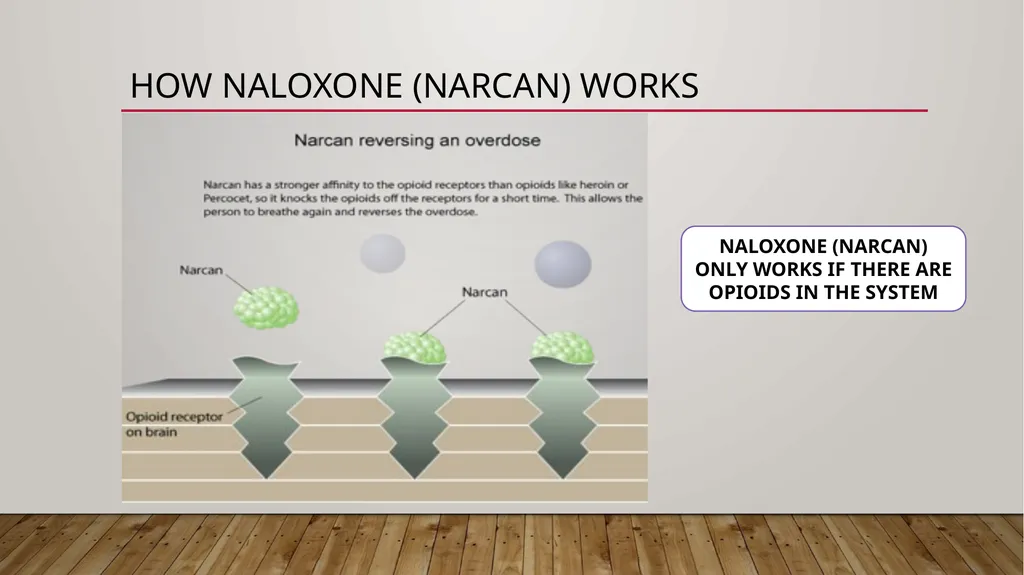
slide15. How naloxone (Narcan) works<br>
slide16. How naloxone (Narcan) works NALOXONE (NARCAN) ONLY WORKS IF THERE ARE OPIOIDS IN THE SYSTEM<br>
slide17. storage and expiration Store Naloxone (Narcan) at room temperature
Avoid sunlight
Do not refrigerate
Do not leave in the glovebox
Naloxone (Narcan) has a shelf life of 36 months
Check the expiration date
Expired kits should be replaced with a new kit<br>
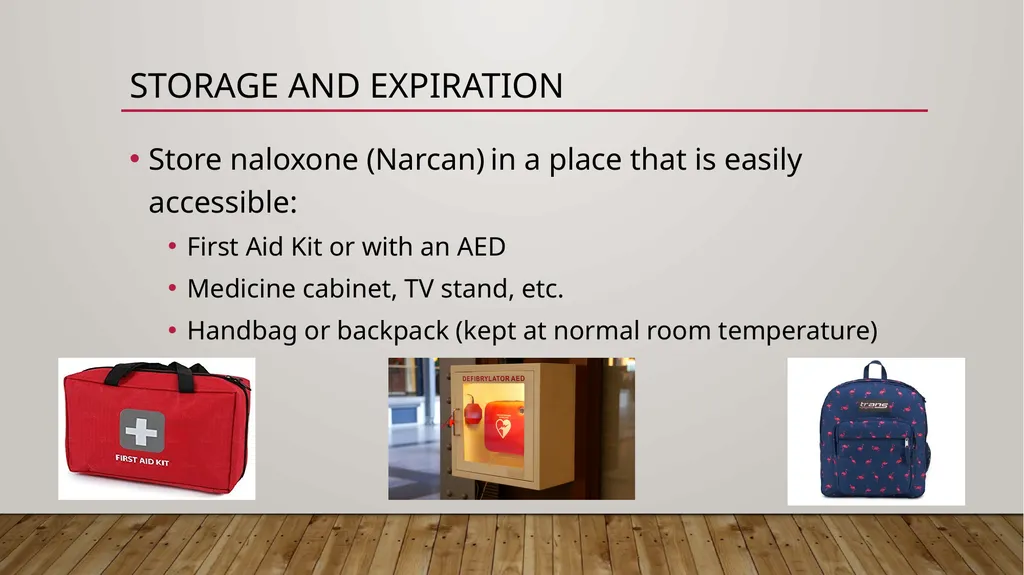
slide18. storage and expiration Store naloxone (Narcan) in a place that is easily accessible:
First Aid Kit or with an AED
Medicine cabinet, TV stand, etc.
Handbag or backpack (kept at normal room temperature)<br>
slide19. Opioid Overdose Responder Action Steps<br>
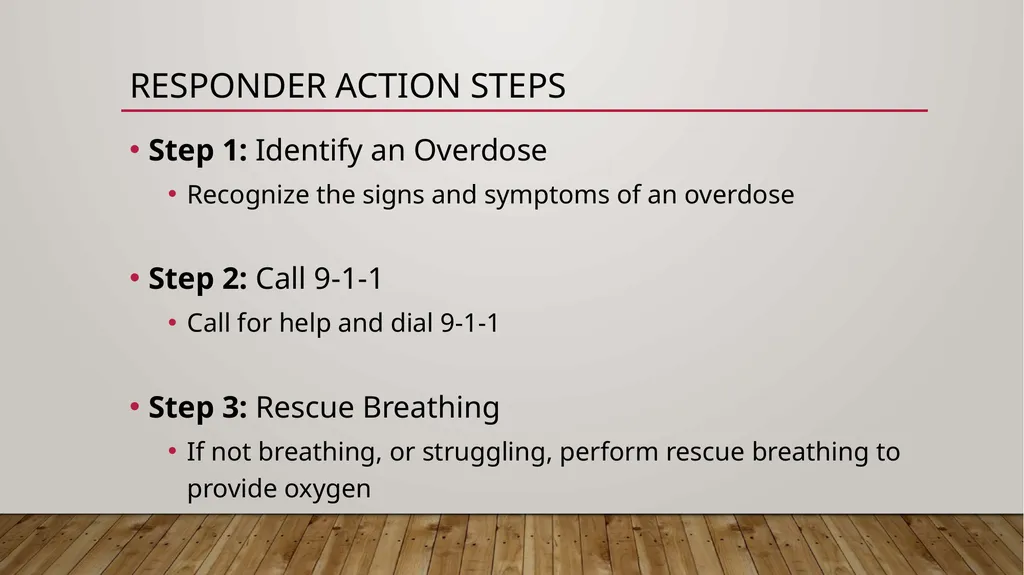
slide20. Responder action steps Step 1: Identify an Overdose
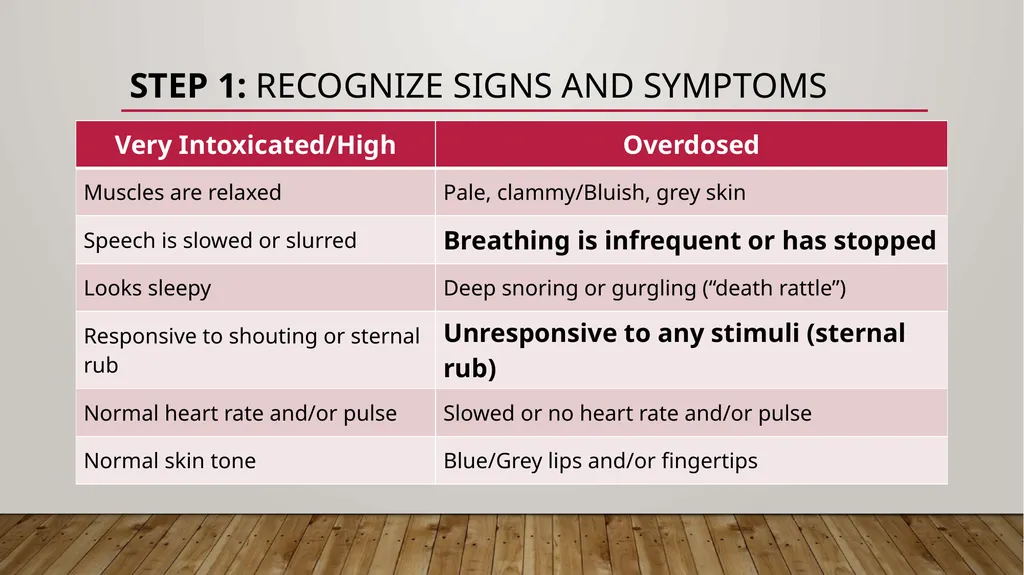
Recognize the signs and symptoms of an overdose
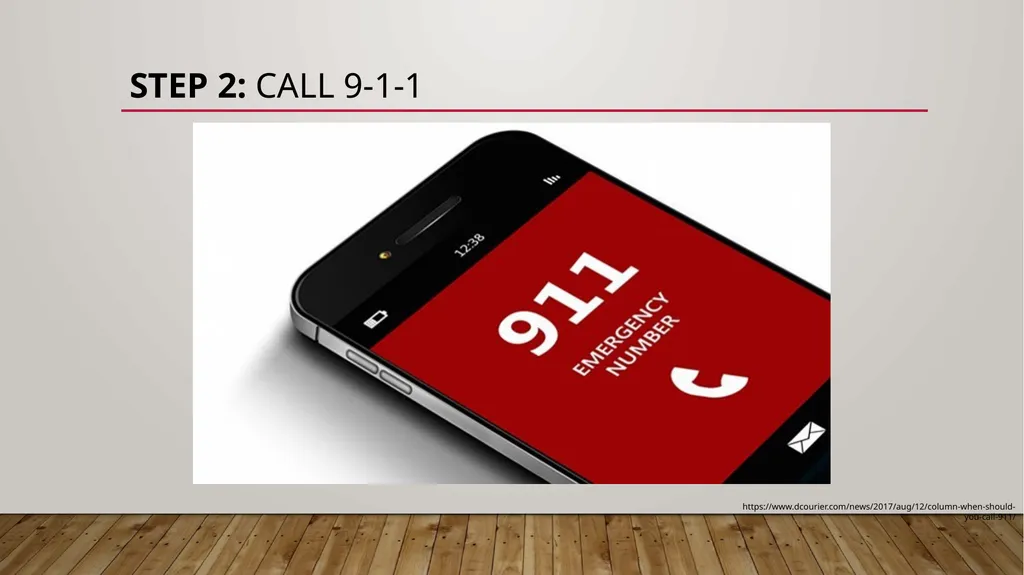
Step 2: Call 9-1-1
Call for help and dial 9-1-1
Step 3: Rescue Breathing
If not breathing, or struggling, perform rescue breathing to provide oxygen<br>
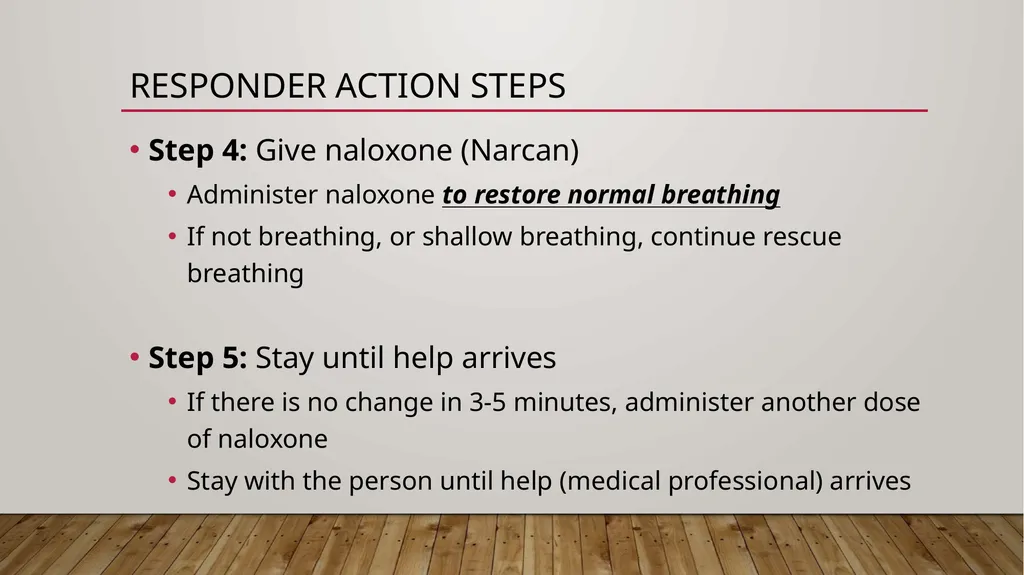
slide21. Responder action steps Step 4: Give naloxone (Narcan)
Administer naloxone to restore normal breathing
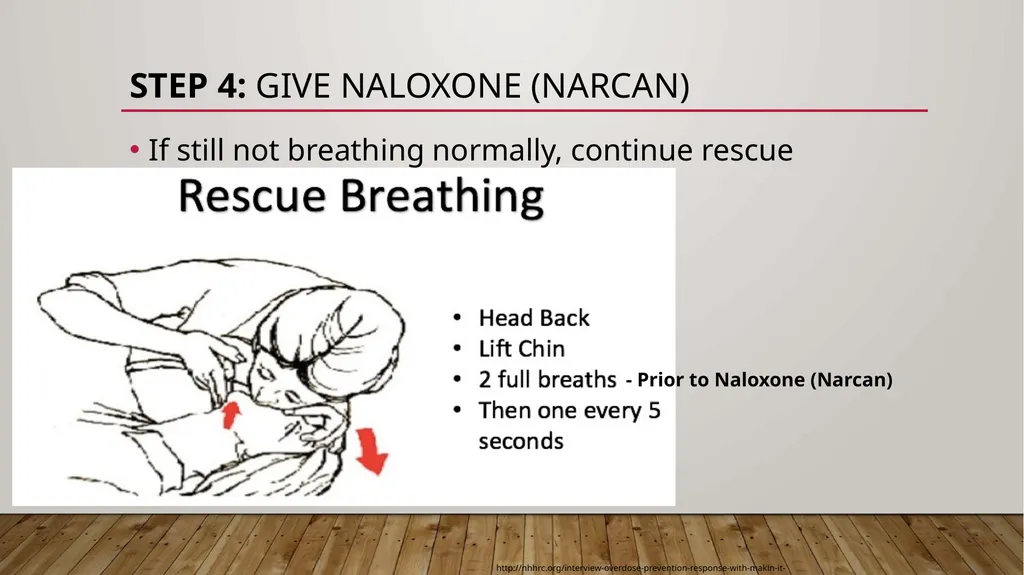
If not breathing, or shallow breathing, continue rescue breathing
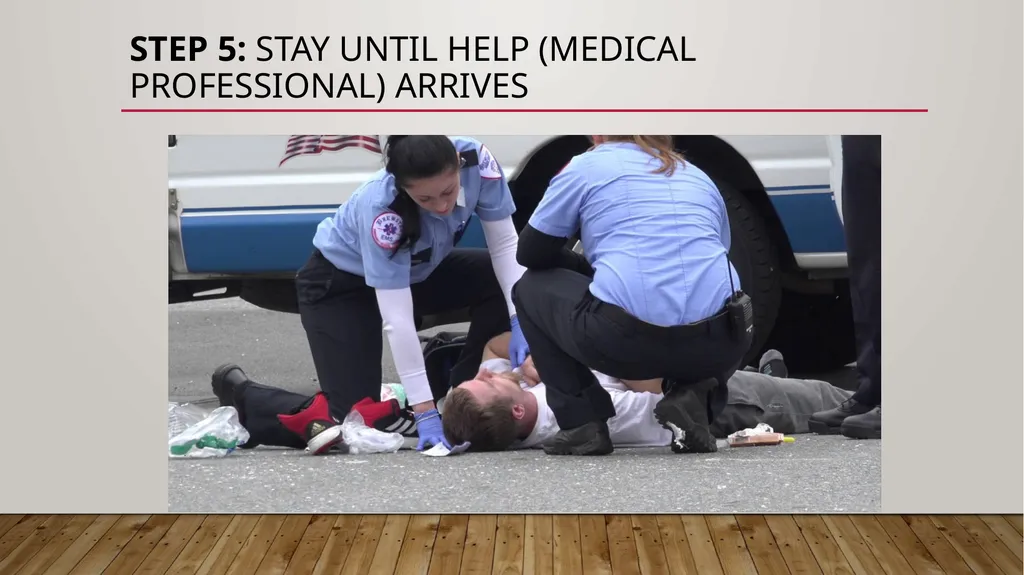
Step 5: Stay until help arrives
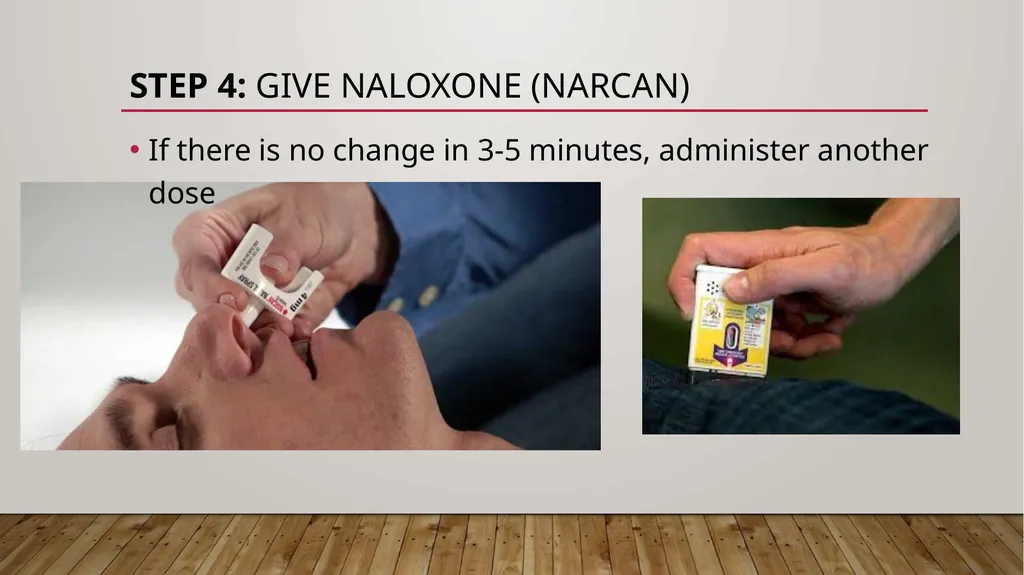
If there is no change in 3-5 minutes, administer another dose of naloxone
Stay with the person until help (medical professional) arrives<br>
slide22. Step 1: Recognize signs and symptoms<br>
slide23. Step 2: Call 9-1-1 https://www.dcourier.com/news/2017/aug/12/column-when-should-you-call-911/<br>
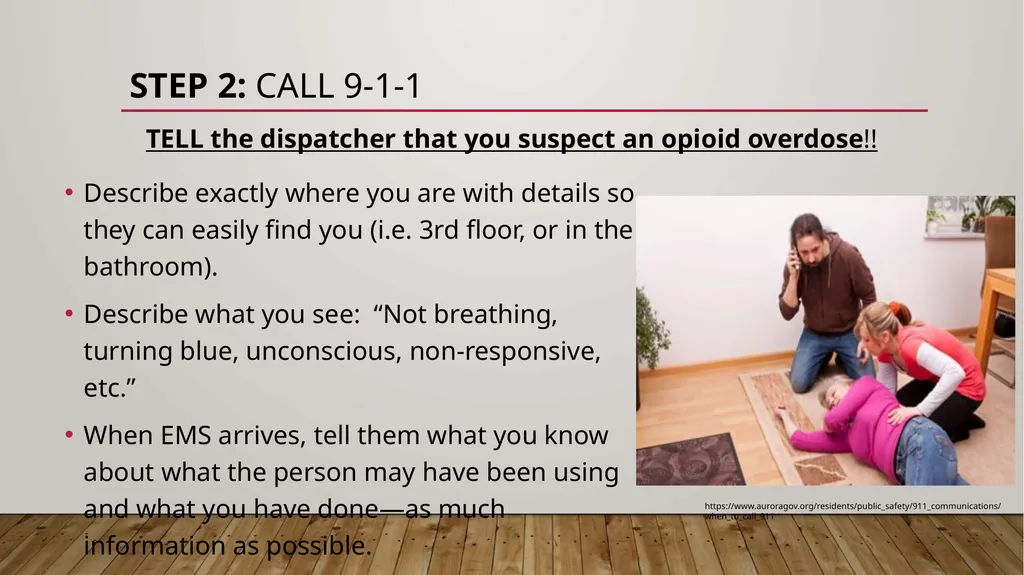
slide24. Step 2: Call 9-1-1 https://www.auroragov.org/residents/public_safety/911_communications/when_to_call_911 Describe exactly where you are with details so they can easily find you (i.e. 3rd floor, or in the bathroom).
Describe what you see: “Not breathing, turning blue, unconscious, non-responsive, etc.”
When EMS arrives, tell them what you know about what the person may have been using and what you have done—as much information as possible. TELL the dispatcher that you suspect an opioid overdose!!<br>
slide25. 9-1-1 Concerns Criminal Immunity: Title 16, Chapter 47, § 4769 - Criminal immunity of non-felony offenses for persons who suffer or report an alcohol or drug overdose or other life-threatening medical emergency, if:
reports the emergency in good faith, and the person provides all relevant medical information
Good Samaritan: Title 16, Chapter 68, § 6801 - Persons rendering emergency care exempt from liability
Individuals providing emergency care in good faith, without gross negligence, etc. are immune from liability for civil damages.<br>
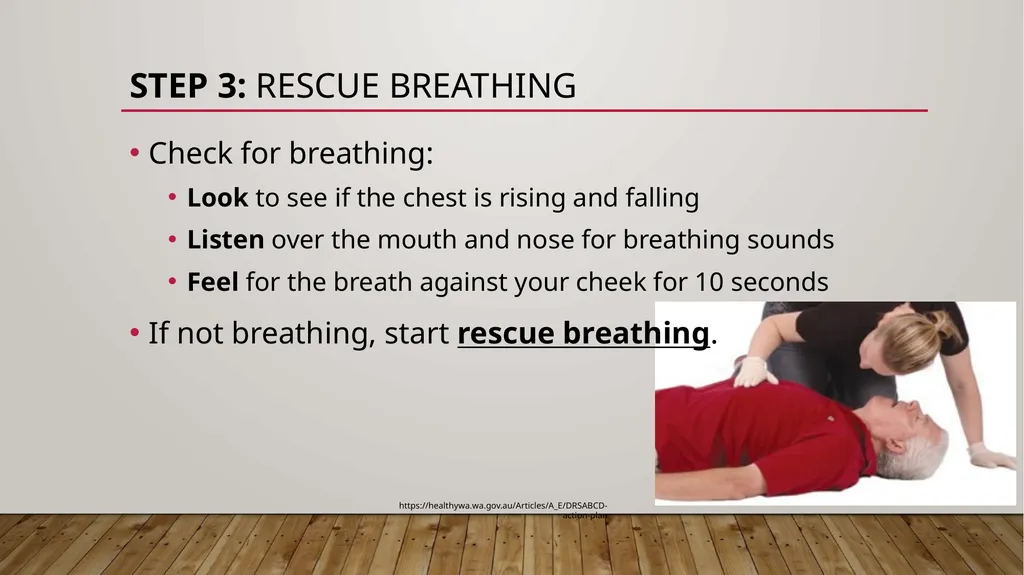
slide26. Step 3: Rescue breathing https://healthywa.wa.gov.au/Articles/A_E/DRSABCD-action-plan Check for breathing:
Look to see if the chest is rising and falling
Listen over the mouth and nose for breathing sounds
Feel for the breath against your cheek for 10 seconds
If not breathing, start rescue breathing.<br>
slide27. Step 3: Rescue breathing https://harmreduction.org/issues/overdose-prevention/overview/overdose-basics/responding-to-opioid-overdose/perform-rescue-breathing/<br>
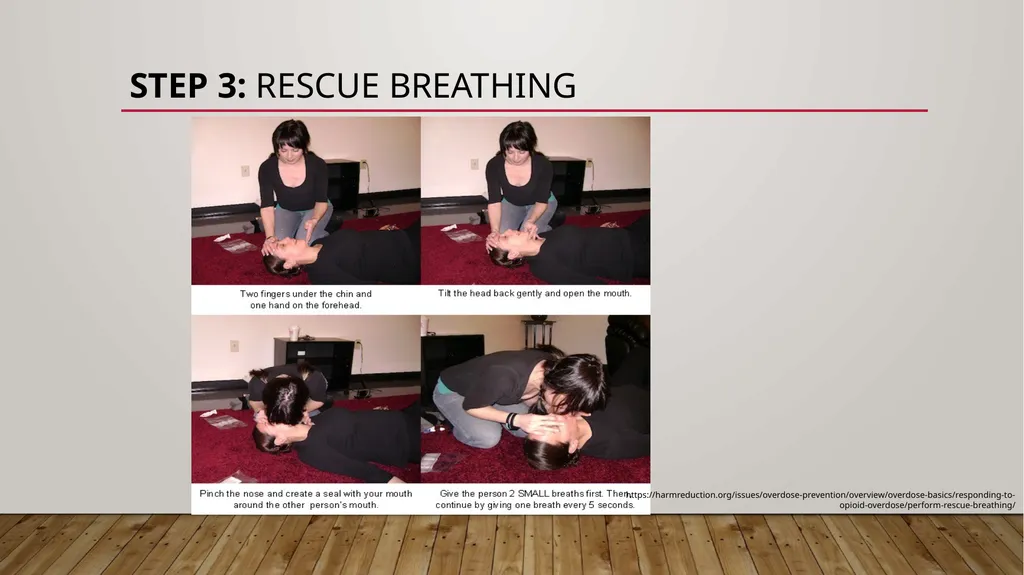
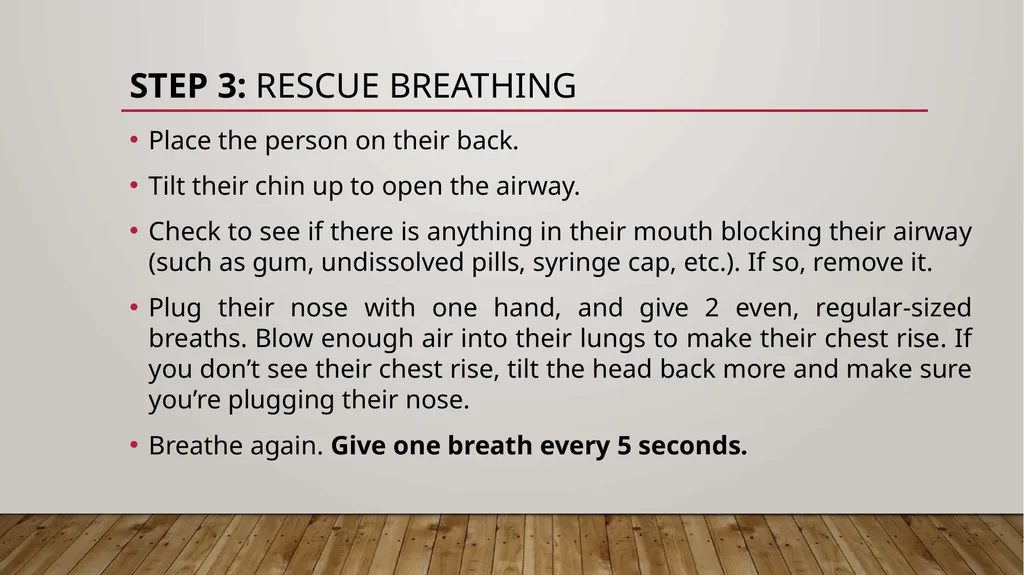
slide28. Step 3: Rescue breathing Place the person on their back.
Tilt their chin up to open the airway.
Check to see if there is anything in their mouth blocking their airway (such as gum, undissolved pills, syringe cap, etc.). If so, remove it.
Plug their nose with one hand, and give 2 even, regular-sized breaths. Blow enough air into their lungs to make their chest rise. If you don’t see their chest rise, tilt the head back more and make sure you’re plugging their nose.
Breathe again. Give one breath every 5 seconds.<br>
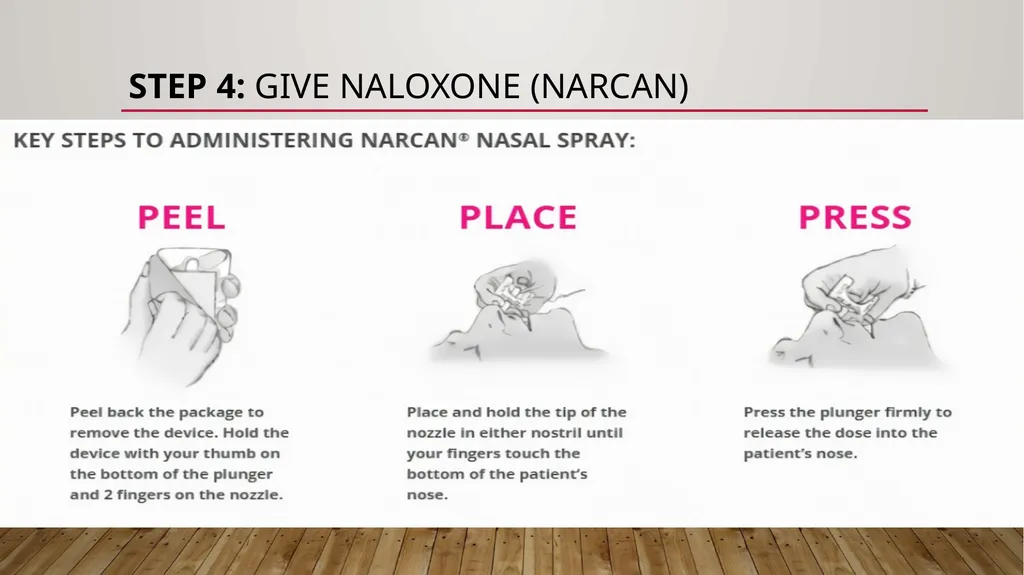
slide29. Step 4: Give NALOXONE (NARCAN)<br>
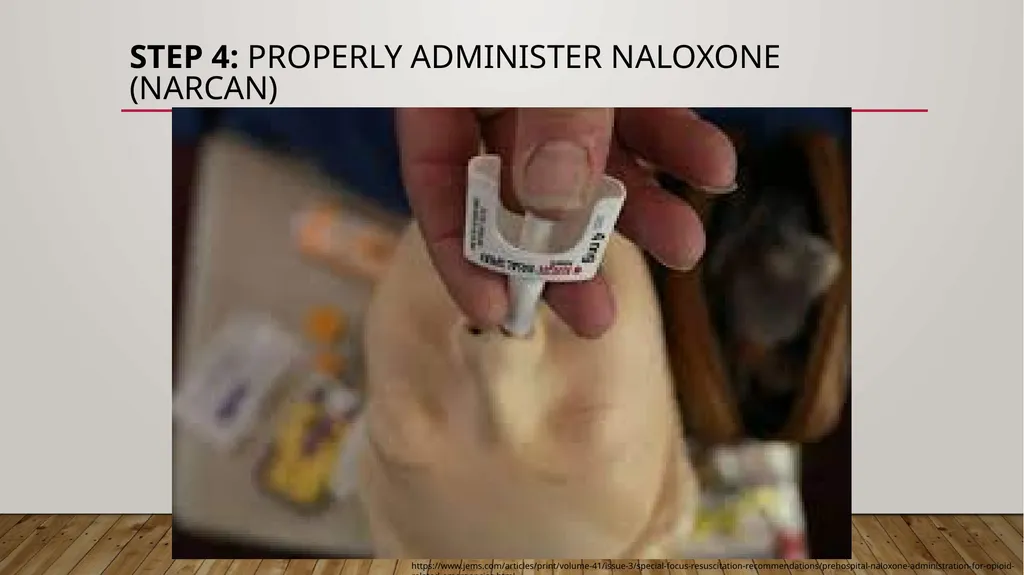
slide30. Step 4: PROPERLY Administer NALOXONE (NARCAN) https://www.jems.com/articles/print/volume-41/issue-3/special-focus-resuscitation-recommendations/prehospital-naloxone-administration-for-opioid-related-emergencies.html<br>
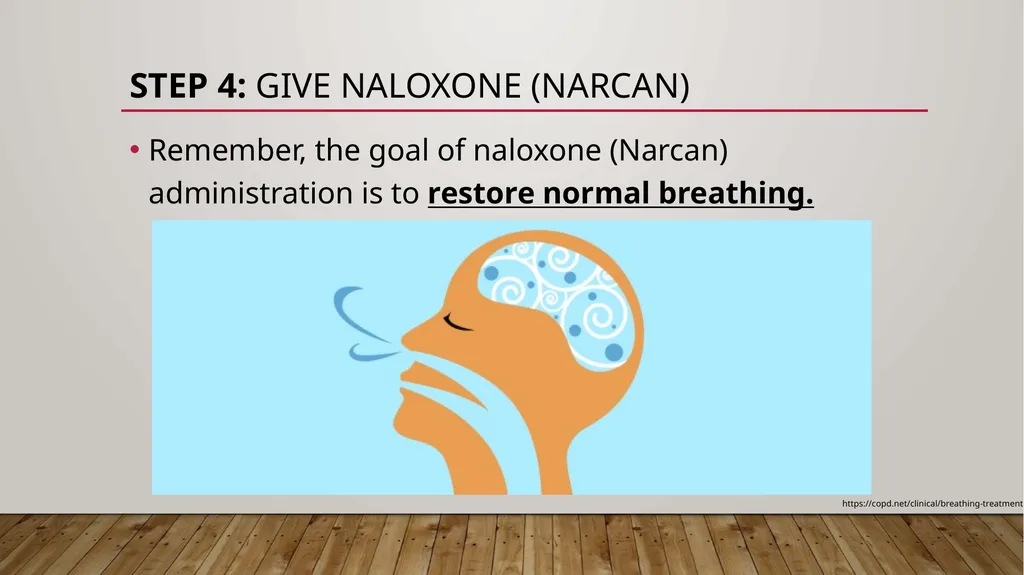
slide31. Step 4: Give Naloxone (NARCAN) Remember, the goal of naloxone (Narcan) administration is to restore normal breathing. https://copd.net/clinical/breathing-treatments/<br>
slide32. Step 4: Give Naloxone (NARCAN) Administer naloxone (Narcan) to restore normal breathing.
Naloxone (Narcan) is reversing the effects of an opioid; some withdrawal effects may occur.
However, the amount provided in the naloxone (Narcan) kit and the method with which it is administered should NOT cause severe withdrawal symptoms.<br>
slide33. Step 4: Give Naloxone (NARCAN) http://nhhrc.org/interview-overdose-prevention-response-with-makin-it-happen/ If still not breathing normally, continue rescue breathing - Prior to Naloxone (Narcan)<br>
slide34. Step 4: Give Naloxone (NARCAN) If there is no change in 3-5 minutes, administer another dose<br>
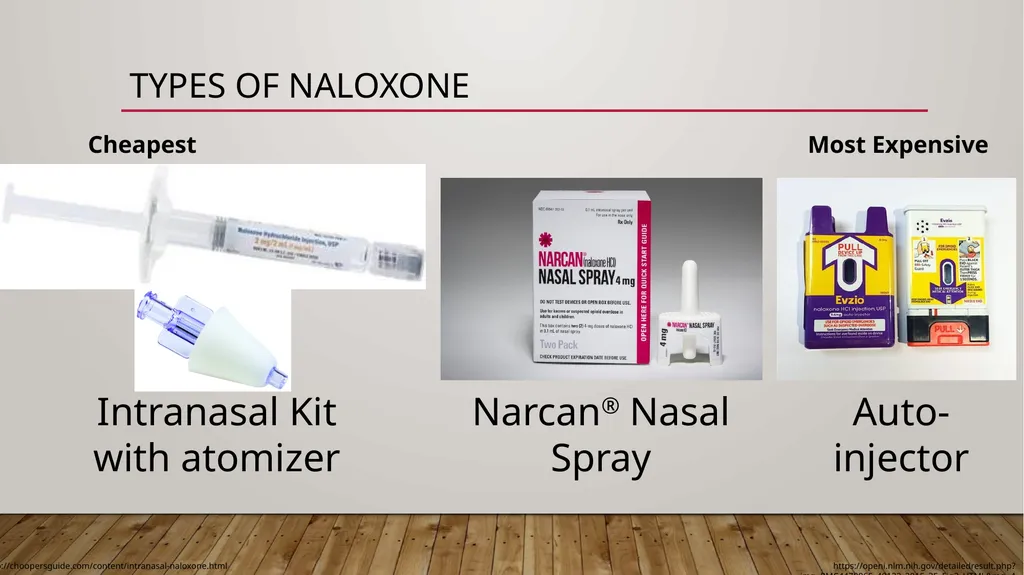
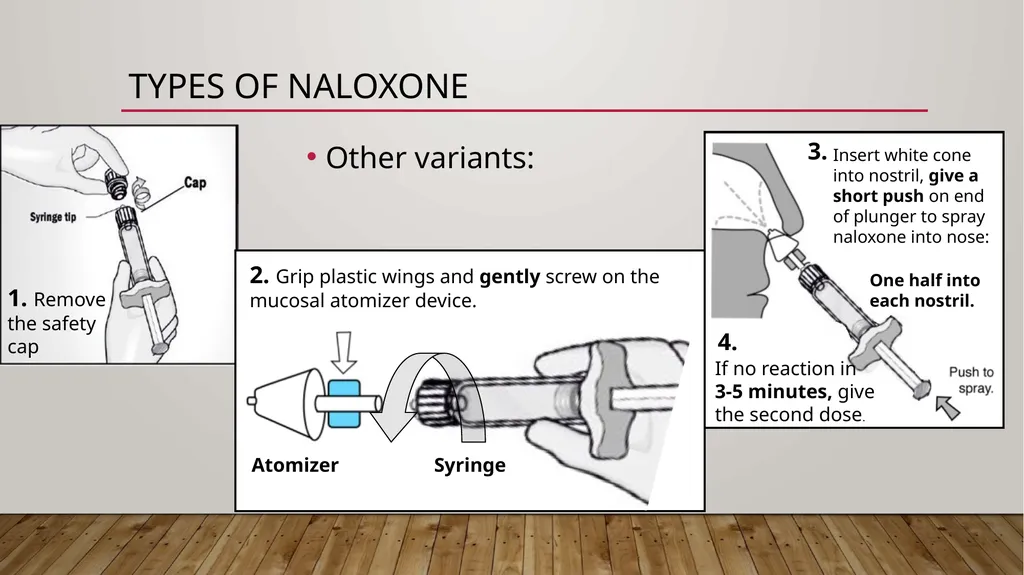
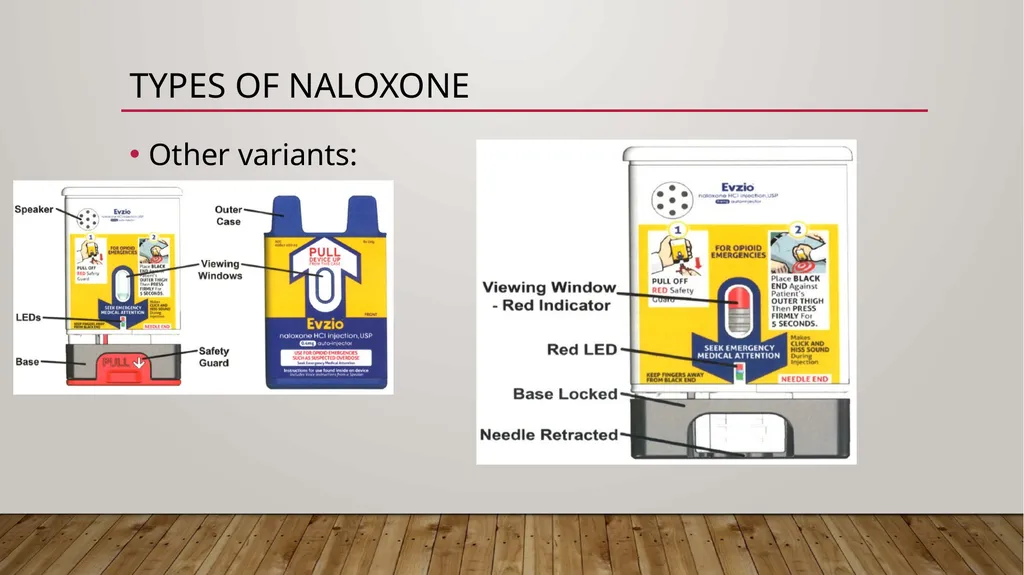
slide35. Types of naloxone https://openi.nlm.nih.gov/detailedresult.php?img=PMC4470965_40122_2015_35_Fig2_HTML&req=4 http://choopersguide.com/content/intranasal-naloxone.html Intranasal Kit with atomizer Auto-injector Narcan® Nasal Spray Cheapest Most Expensive<br>
slide36. Types of naloxone Other variants:<br>
slide37. Types of naloxone Other variants:<br>
slide38. Step 5: Stay until help (medical professional) arrives<br>
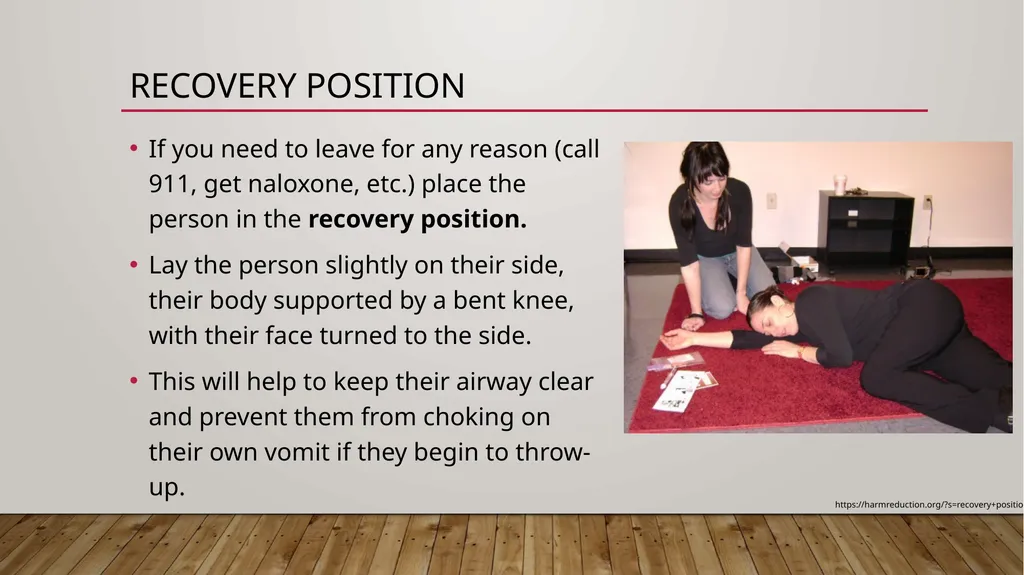
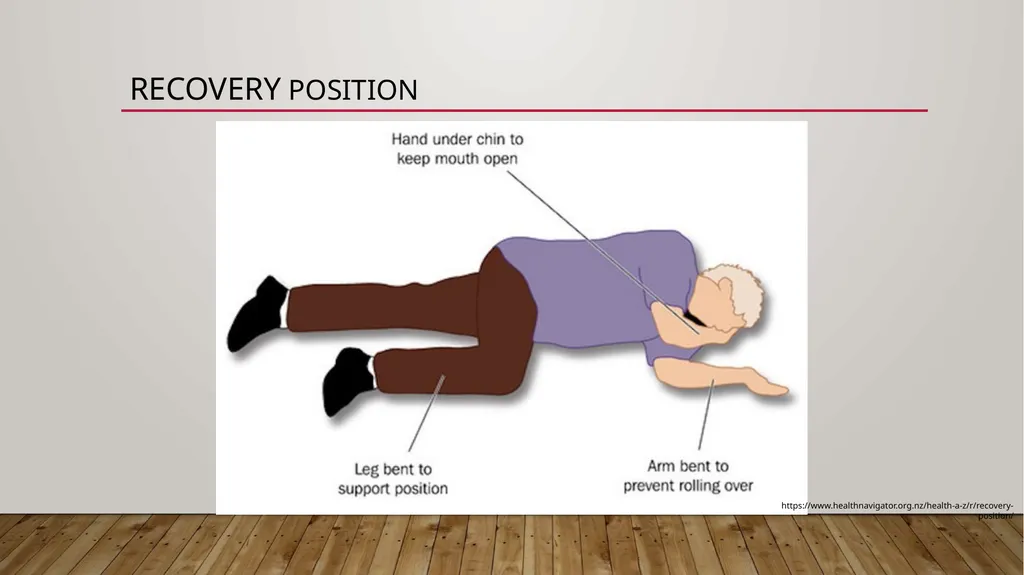
slide39. Recovery Position If you need to leave for any reason (call 911, get naloxone, etc.) place the person in the recovery position.
Lay the person slightly on their side, their body supported by a bent knee, with their face turned to the side.
This will help to keep their airway clear and prevent them from choking on their own vomit if they begin to throw-up. https://harmreduction.org/?s=recovery+position<br>
slide40. Recovery Position https://www.healthnavigator.org.nz/health-a-z/r/recovery-position/<br>
slide41. What to expect after giving NALOXONE (naRCAN) While many people will react quickly, it will take a few minutes for the naloxone to have an effect.
Remember, the goal of naloxone (Narcan) is to restore normal breathing.
Naloxone (Narcan) blocks opioids from acting, so withdrawal symptoms may occur.
However, the dose and administration instructions provided should not lead to severe withdrawal symptoms.
It is important that one does not use again until the naloxone wears off so that a re-overdose does not occur.<br>
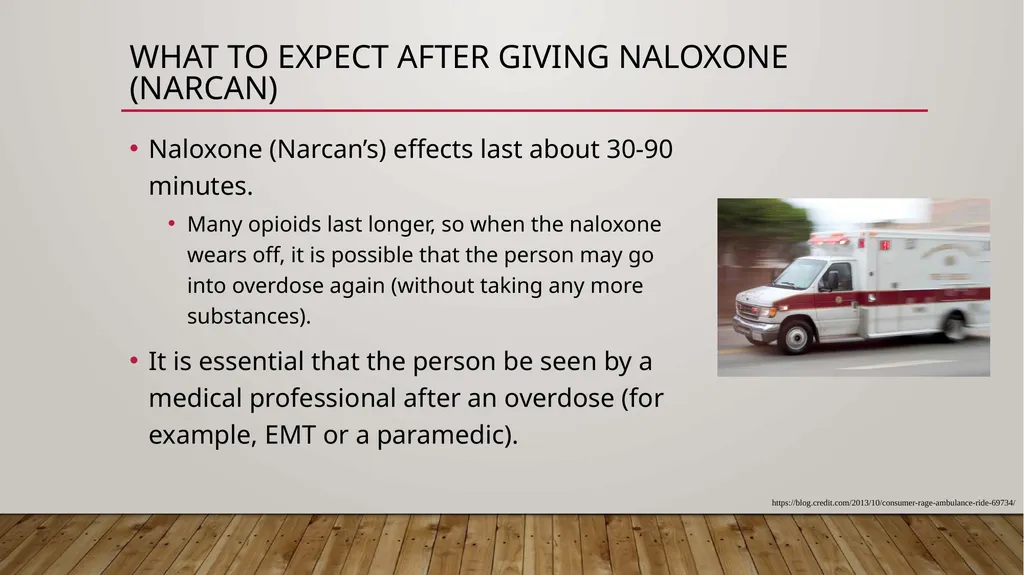
slide42. What to expect after giving NALOXONE (NARCAN) Naloxone (Narcan’s) effects last about 30-90 minutes.
Many opioids last longer, so when the naloxone wears off, it is possible that the person may go into overdose again (without taking any more substances).
It is essential that the person be seen by a medical professional after an overdose (for example, EMT or a paramedic). https://blog.credit.com/2013/10/consumer-rage-ambulance-ride-69734/<br>
slide43. What if you don’t have NALOXONE (NARCAN)? Call 9-1-1
Start rescue breathing and continue until medical help arrives.
If there is more than one person present, take turns. https://harmreduction.org/issues/overdose-prevention/overview/overdose-basics/responding-to-opioid-overdose/perform-rescue-breathing/<br>
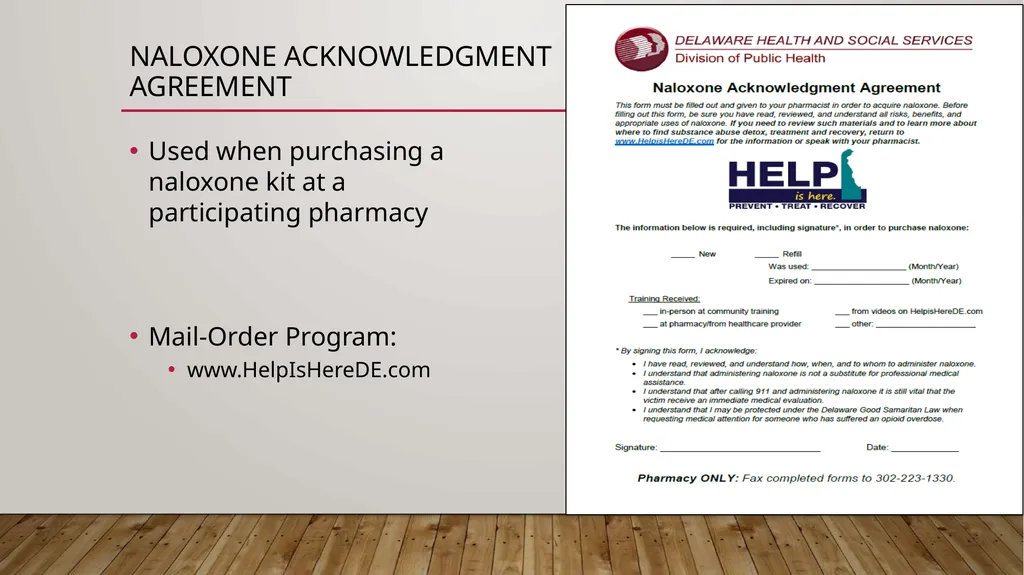
slide44. Naloxone Acknowledgment Agreement Used when purchasing a naloxone kit at a participating pharmacy
Mail-Order Program:
www.HelpIsHereDE.com<br>
slide45. DHSS Opioid Rescue Kit Components<br>
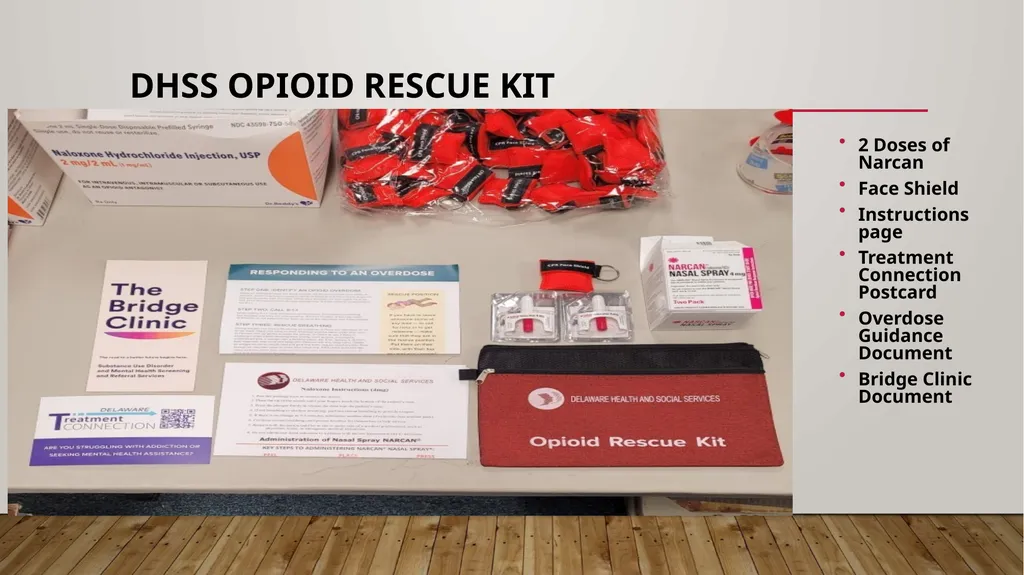
slide46. DHSS Opioid rescue kit 2 Doses of Narcan
Face Shield
Instructions page
Treatment Connection Postcard
Overdose Guidance Document
Bridge Clinic Document<br>
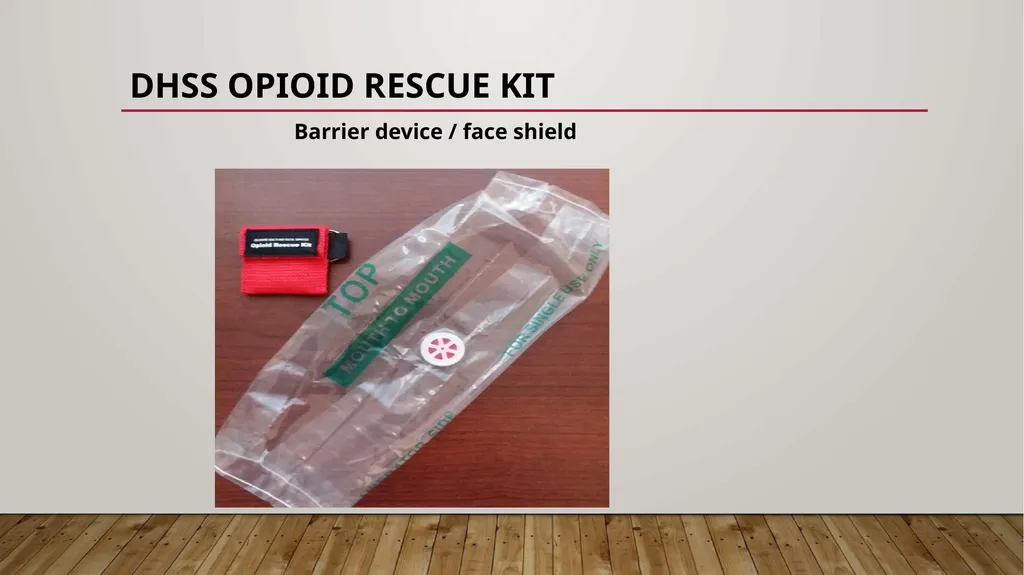
slide47. DHSS Opioid rescue kit Barrier device / face shield<br>
slide48. Questions? https://www.huffpost.com/entry/asking-questions-is-really-hard_b_7052722<br>
slide49. Contact DSAMH Naloxone Support Team
Narcan.Train@delaware.gov
302-255-2777<br>
slide2. Learning objectives By the end of the presentation, you will:
Understand the Community-Based Naloxone Access Program (CBNAP) Standing Order
Be able to recognize and effectively respond to an opioid overdose
Know what naloxone is, how to store it, and how to administer it Nigel Brunsdon, www.injectingadvice.com<br>
slide3. CBNAP Standing Order Identifies our required:
Training components
Data tracking elements
Kit components
And approved medication variants
https://www.dhss.delaware.gov/dhss/dph/standingorders.html<br>
slide4. “Opioid Overdose Responder Training” Training may be provided by:
Approved community-based classes;
Approved Point of Distribution training;
Online videos;
Direct instruction from a pharmacist or other healthcare provider.
Available classes, upcoming events, online videos can be found at:
https://www.helpisherede.com/overdose-prevention/narcan-training<br>
slide5. “Opioid Overdose Responder Training” Training must include at a minimum:
overdose prevention techniques,
recognizing signs and symptom of overdose;
calling 911, airway and breathing assessment and rescue breathing;
naloxone storage, carrying and administration;
post-overdose follow-up and care.<br>
slide6. Delaware and the epidemic Estimated 100,306 drug overdose deaths April 2020 - April 2021
- Up 29% from the same period the year before (78,056)
- Delaware drug overdose deaths down by 1.7% (Same Period)
Delaware ranks 4th in the country for age adjusted deaths
(per 100 people, 2021 CDC data)
1st in the country for high-dose and long-acting opioid prescription
(per 100 people, 2020 CDC data)<br>
slide7. NALOXONE (NARCAN) Myths http://www.yourtrainingedge.com/top-10-training-myths/<br>
slide8. NALOXONE (NARCAN) Myths MYTH:
Naloxone (Narcan) encourages people to take more drugs.
FACT:
Research has shown that naloxone (Narcan) does not lead to more or riskier drug use.1
In fact, some studies have shown that naloxone (Narcan) administration results in a decrease in opioid use.2 (1) Jones JD, Campbell A, Metz VE, Comer SD. No evidence of compensatory drug use risk behavior among heroin users after receiving take-home naloxone. Addictive Behaviors. 2017;71:104-106. doi:10.1016/j.addbeh.2017.03.008. (2) Wagner KD, Valente TW, Casanova M, et al. Evaluation of an overdose prevention and response training programme for injection drug users in the Skid Row area of Los Angeles, CA. International Journal of Drug Policy. 2010;21(3):186-193. doi:10.1016/j.drugpo.2009.01.003.<br>
slide9. NALOXONE (NARCAN) Myths MYTH:
Naloxone (Narcan) use prevents people who use substances from seeking treatment.
FACT:
There is no evidence to support the belief that the use of naloxone (Narcan) prevents anyone from entering treatment.
In fact, sometimes the near-death experience can motivate an individual to seek treatment. Bazzari, AR, et.al. “Preventing Opiate Overdose Deaths: Examining Objections to Take-Home Naloxone.” Journal of Heath Care for the Poor and Underserved, vol.21, no.4, 2010<br>
slide10. Naloxone (NARCAN) Myths MYTH:
Naloxone (Narcan) makes people violent.
FACT:
When done correctly, it is very rare for someone to “wake up” from an overdose and become combative.1
Dosing and process is designed to minimize hypoxic brain injury and allow the patient to breathe, but not be in total opioid withdrawal. (1) Fisher R, Odonnell D, Ray B, Rusyniak D. Police Officers Can Safely and Effectively Administer Intranasal Naloxone. Prehospital Emergency Care. 2016;20(6):675-680. doi:10.1080/10903127.2016.1182605.<br>
slide11. General information What: Naloxone (Narcan) is an opioid antagonist
Indications: Naloxone (Narcan) is used to reverse central nervous system and respiratory depression caused by opioids (it restores normal breathing).
Onset/Duration: Following administration the onset is usually 3-5 minutes and lasts for approximately 60 minutes.<br>
slide12. Opioids In the U.S., opioids are indicated for the following uses:
Analgesic to combat pain (morphine, hydrocodone, oxymorphone, etc.)
Cough suppressant (dextromethorphan)
Diarrhea (loperamide)
Drug detoxification and maintenance treatment
Withdrawal Management and Medication Assisted Treatment (MAT)
Medications for Opioid Use Disorder (MOUD)<br>
slide13. examples Buprenorphine
Methadone
Codeine
Fentanyl
Hydrocodone
Hydromorphone
Meperidine
Morphine
Oxycodone
Oxymorphone
Suboxone
Subutex
Tylenol#3
Duragesic
Vicodin
Norco
Dilaudid
Demerol
Methadose
MS Contin
Oxycontin
Percocet
Opana
Heroin<br>
slide14. Risk Factors – Preventing the Overdose The following increase the risk of overdose:
Tolerance shifts (after treatment/detox)
Mixing drugs
Poor physical health
Varying compositions and drug strength
Changing routes (snorting, smoking, injecting)
USING ALONE<br>
slide15. How naloxone (Narcan) works<br>
slide16. How naloxone (Narcan) works NALOXONE (NARCAN) ONLY WORKS IF THERE ARE OPIOIDS IN THE SYSTEM<br>
slide17. storage and expiration Store Naloxone (Narcan) at room temperature
Avoid sunlight
Do not refrigerate
Do not leave in the glovebox
Naloxone (Narcan) has a shelf life of 36 months
Check the expiration date
Expired kits should be replaced with a new kit<br>
slide18. storage and expiration Store naloxone (Narcan) in a place that is easily accessible:
First Aid Kit or with an AED
Medicine cabinet, TV stand, etc.
Handbag or backpack (kept at normal room temperature)<br>
slide19. Opioid Overdose Responder Action Steps<br>
slide20. Responder action steps Step 1: Identify an Overdose
Recognize the signs and symptoms of an overdose
Step 2: Call 9-1-1
Call for help and dial 9-1-1
Step 3: Rescue Breathing
If not breathing, or struggling, perform rescue breathing to provide oxygen<br>
slide21. Responder action steps Step 4: Give naloxone (Narcan)
Administer naloxone to restore normal breathing
If not breathing, or shallow breathing, continue rescue breathing
Step 5: Stay until help arrives
If there is no change in 3-5 minutes, administer another dose of naloxone
Stay with the person until help (medical professional) arrives<br>
slide22. Step 1: Recognize signs and symptoms<br>
slide23. Step 2: Call 9-1-1 https://www.dcourier.com/news/2017/aug/12/column-when-should-you-call-911/<br>
slide24. Step 2: Call 9-1-1 https://www.auroragov.org/residents/public_safety/911_communications/when_to_call_911 Describe exactly where you are with details so they can easily find you (i.e. 3rd floor, or in the bathroom).
Describe what you see: “Not breathing, turning blue, unconscious, non-responsive, etc.”
When EMS arrives, tell them what you know about what the person may have been using and what you have done—as much information as possible. TELL the dispatcher that you suspect an opioid overdose!!<br>
slide25. 9-1-1 Concerns Criminal Immunity: Title 16, Chapter 47, § 4769 - Criminal immunity of non-felony offenses for persons who suffer or report an alcohol or drug overdose or other life-threatening medical emergency, if:
reports the emergency in good faith, and the person provides all relevant medical information
Good Samaritan: Title 16, Chapter 68, § 6801 - Persons rendering emergency care exempt from liability
Individuals providing emergency care in good faith, without gross negligence, etc. are immune from liability for civil damages.<br>
slide26. Step 3: Rescue breathing https://healthywa.wa.gov.au/Articles/A_E/DRSABCD-action-plan Check for breathing:
Look to see if the chest is rising and falling
Listen over the mouth and nose for breathing sounds
Feel for the breath against your cheek for 10 seconds
If not breathing, start rescue breathing.<br>
slide27. Step 3: Rescue breathing https://harmreduction.org/issues/overdose-prevention/overview/overdose-basics/responding-to-opioid-overdose/perform-rescue-breathing/<br>
slide28. Step 3: Rescue breathing Place the person on their back.
Tilt their chin up to open the airway.
Check to see if there is anything in their mouth blocking their airway (such as gum, undissolved pills, syringe cap, etc.). If so, remove it.
Plug their nose with one hand, and give 2 even, regular-sized breaths. Blow enough air into their lungs to make their chest rise. If you don’t see their chest rise, tilt the head back more and make sure you’re plugging their nose.
Breathe again. Give one breath every 5 seconds.<br>
slide29. Step 4: Give NALOXONE (NARCAN)<br>
slide30. Step 4: PROPERLY Administer NALOXONE (NARCAN) https://www.jems.com/articles/print/volume-41/issue-3/special-focus-resuscitation-recommendations/prehospital-naloxone-administration-for-opioid-related-emergencies.html<br>
slide31. Step 4: Give Naloxone (NARCAN) Remember, the goal of naloxone (Narcan) administration is to restore normal breathing. https://copd.net/clinical/breathing-treatments/<br>
slide32. Step 4: Give Naloxone (NARCAN) Administer naloxone (Narcan) to restore normal breathing.
Naloxone (Narcan) is reversing the effects of an opioid; some withdrawal effects may occur.
However, the amount provided in the naloxone (Narcan) kit and the method with which it is administered should NOT cause severe withdrawal symptoms.<br>
slide33. Step 4: Give Naloxone (NARCAN) http://nhhrc.org/interview-overdose-prevention-response-with-makin-it-happen/ If still not breathing normally, continue rescue breathing - Prior to Naloxone (Narcan)<br>
slide34. Step 4: Give Naloxone (NARCAN) If there is no change in 3-5 minutes, administer another dose<br>
slide35. Types of naloxone https://openi.nlm.nih.gov/detailedresult.php?img=PMC4470965_40122_2015_35_Fig2_HTML&req=4 http://choopersguide.com/content/intranasal-naloxone.html Intranasal Kit with atomizer Auto-injector Narcan® Nasal Spray Cheapest Most Expensive<br>
slide36. Types of naloxone Other variants:<br>
slide37. Types of naloxone Other variants:<br>
slide38. Step 5: Stay until help (medical professional) arrives<br>
slide39. Recovery Position If you need to leave for any reason (call 911, get naloxone, etc.) place the person in the recovery position.
Lay the person slightly on their side, their body supported by a bent knee, with their face turned to the side.
This will help to keep their airway clear and prevent them from choking on their own vomit if they begin to throw-up. https://harmreduction.org/?s=recovery+position<br>
slide40. Recovery Position https://www.healthnavigator.org.nz/health-a-z/r/recovery-position/<br>
slide41. What to expect after giving NALOXONE (naRCAN) While many people will react quickly, it will take a few minutes for the naloxone to have an effect.
Remember, the goal of naloxone (Narcan) is to restore normal breathing.
Naloxone (Narcan) blocks opioids from acting, so withdrawal symptoms may occur.
However, the dose and administration instructions provided should not lead to severe withdrawal symptoms.
It is important that one does not use again until the naloxone wears off so that a re-overdose does not occur.<br>
slide42. What to expect after giving NALOXONE (NARCAN) Naloxone (Narcan’s) effects last about 30-90 minutes.
Many opioids last longer, so when the naloxone wears off, it is possible that the person may go into overdose again (without taking any more substances).
It is essential that the person be seen by a medical professional after an overdose (for example, EMT or a paramedic). https://blog.credit.com/2013/10/consumer-rage-ambulance-ride-69734/<br>
slide43. What if you don’t have NALOXONE (NARCAN)? Call 9-1-1
Start rescue breathing and continue until medical help arrives.
If there is more than one person present, take turns. https://harmreduction.org/issues/overdose-prevention/overview/overdose-basics/responding-to-opioid-overdose/perform-rescue-breathing/<br>
slide44. Naloxone Acknowledgment Agreement Used when purchasing a naloxone kit at a participating pharmacy
Mail-Order Program:
www.HelpIsHereDE.com<br>
slide45. DHSS Opioid Rescue Kit Components<br>
slide46. DHSS Opioid rescue kit 2 Doses of Narcan
Face Shield
Instructions page
Treatment Connection Postcard
Overdose Guidance Document
Bridge Clinic Document<br>
slide47. DHSS Opioid rescue kit Barrier device / face shield<br>
slide48. Questions? https://www.huffpost.com/entry/asking-questions-is-really-hard_b_7052722<br>
slide49. Contact DSAMH Naloxone Support Team
Narcan.Train@delaware.gov
302-255-2777<br>