
Name: Brett RINI Division: Nuclear Installation
Description: Name: Brett RINI Division: Nuclear Installation Safety Section: Regulatory Activities Section International Atomic Energy Agency DS539 Licensing Process for Nuclear Installations Revision of Safety Guide SSG-12 58th Meeting of the Nuclear
Related Topics
Download Presentation
"Name: Brett RINI Division: Nuclear Installation" is the property of its rightful owner. Permission is granted to download and print the materials on this website for personal, non-commercial use only, and to display it on your personal computer provided you do not modify the materials and that you retain all copyright notices contained in the materials. By downloading content from our website, you accept the terms of this agreement.
Presentation Transcript
slide1. Name: Brett RINI
Division: Nuclear Installation Safety
Section: Regulatory Activities Section
International Atomic Energy Agency DS539 Licensing Process for Nuclear Installations Revision of Safety Guide SSG-12 58th Meeting of the Nuclear Safety Standards Committee (NUSSC)
19-21 November 2024<br>
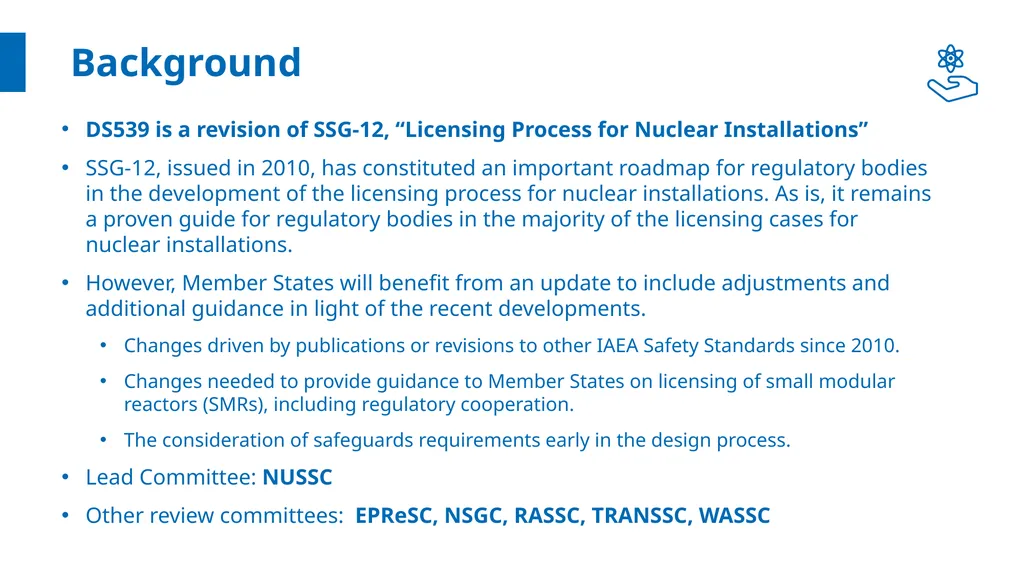
slide2. Background DS539 is a revision of SSG-12, “Licensing Process for Nuclear Installations”
SSG-12, issued in 2010, has constituted an important roadmap for regulatory bodies in the development of the licensing process for nuclear installations. As is, it remains a proven guide for regulatory bodies in the majority of the licensing cases for nuclear installations.
However, Member States will benefit from an update to include adjustments and additional guidance in light of the recent developments.
Changes driven by publications or revisions to other IAEA Safety Standards since 2010.
Changes needed to provide guidance to Member States on licensing of small modular reactors (SMRs), including regulatory cooperation.
The consideration of safeguards requirements early in the design process.
Lead Committee: NUSSC
Other review committees: EPReSC, NSGC, RASSC, TRANSSC, WASSC<br>
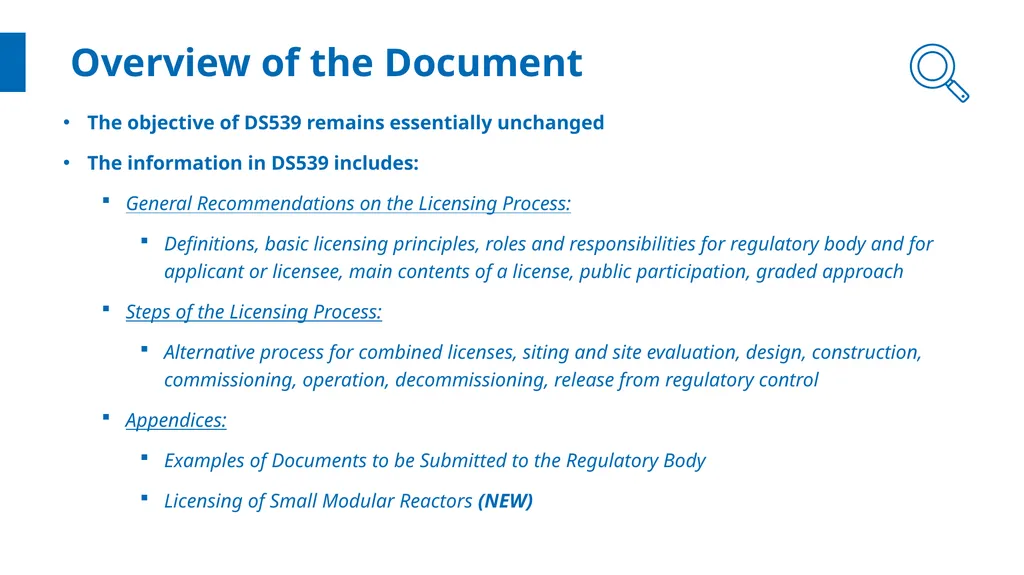
slide3. Overview of the Document The objective of DS539 remains essentially unchanged
The information in DS539 includes:
General Recommendations on the Licensing Process:
Definitions, basic licensing principles, roles and responsibilities for regulatory body and for applicant or licensee, main contents of a license, public participation, graded approach
Steps of the Licensing Process:
Alternative process for combined licenses, siting and site evaluation, design, construction, commissioning, operation, decommissioning, release from regulatory control
Appendices:
Examples of Documents to be Submitted to the Regulatory Body
Licensing of Small Modular Reactors (NEW)<br>
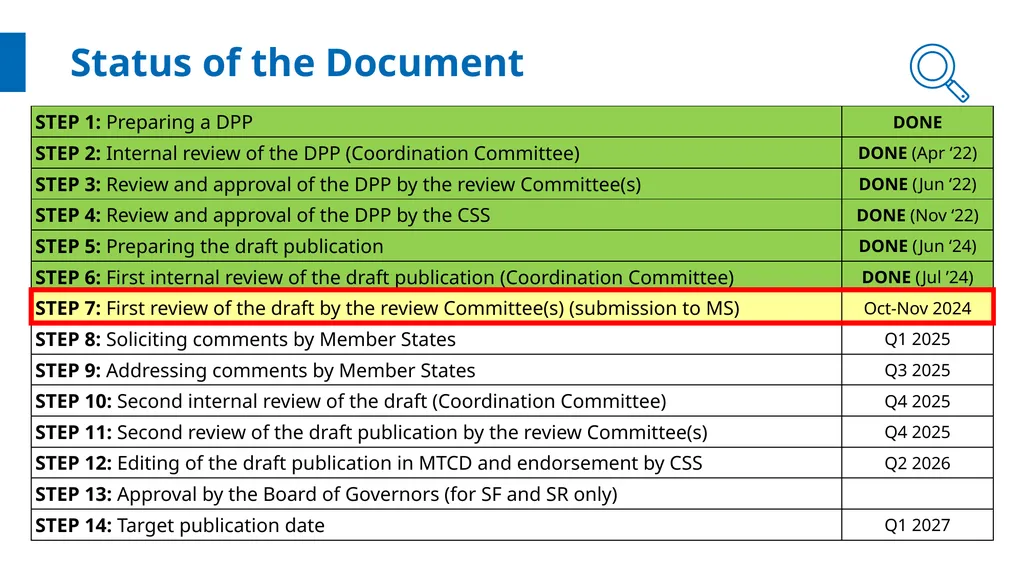
slide4. Status of the Document<br>
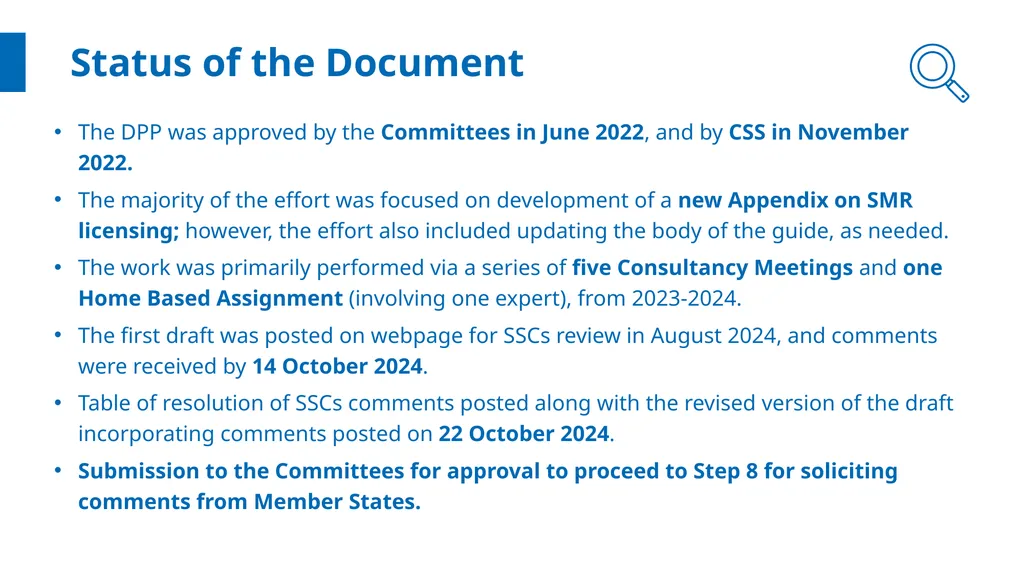
slide5. Status of the Document The DPP was approved by the Committees in June 2022, and by CSS in November 2022.
The majority of the effort was focused on development of a new Appendix on SMR licensing; however, the effort also included updating the body of the guide, as needed.
The work was primarily performed via a series of five Consultancy Meetings and one Home Based Assignment (involving one expert), from 2023-2024.
The first draft was posted on webpage for SSCs review in August 2024, and comments were received by 14 October 2024.
Table of resolution of SSCs comments posted along with the revised version of the draft incorporating comments posted on 22 October 2024.
Submission to the Committees for approval to proceed to Step 8 for soliciting comments from Member States.<br>
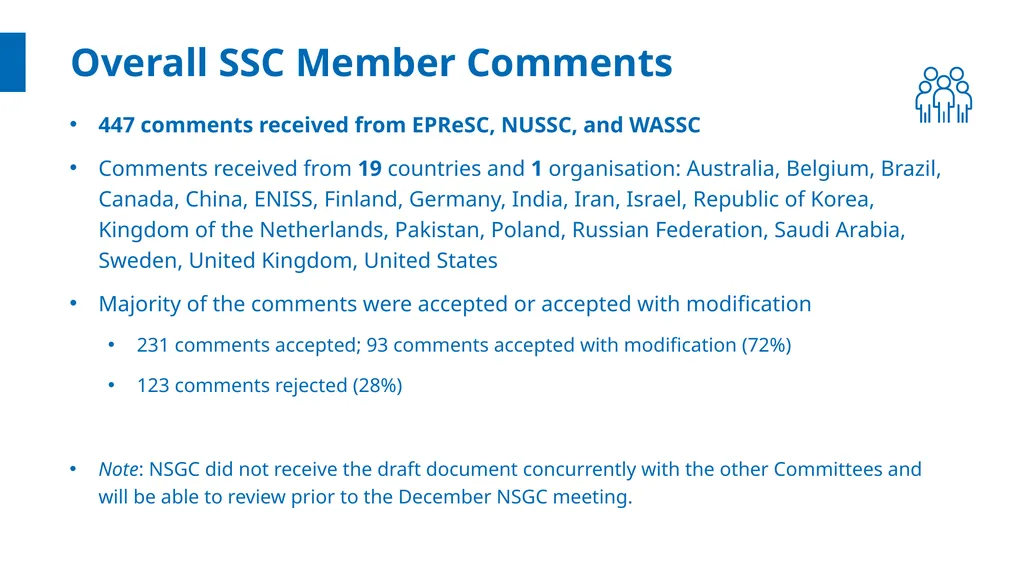
slide6. Overall SSC Member Comments 447 comments received from EPReSC, NUSSC, and WASSC
Comments received from 19 countries and 1 organisation: Australia, Belgium, Brazil, Canada, China, ENISS, Finland, Germany, India, Iran, Israel, Republic of Korea, Kingdom of the Netherlands, Pakistan, Poland, Russian Federation, Saudi Arabia, Sweden, United Kingdom, United States
Majority of the comments were accepted or accepted with modification
231 comments accepted; 93 comments accepted with modification (72%)
123 comments rejected (28%)
Note: NSGC did not receive the draft document concurrently with the other Committees and will be able to review prior to the December NSGC meeting.<br>
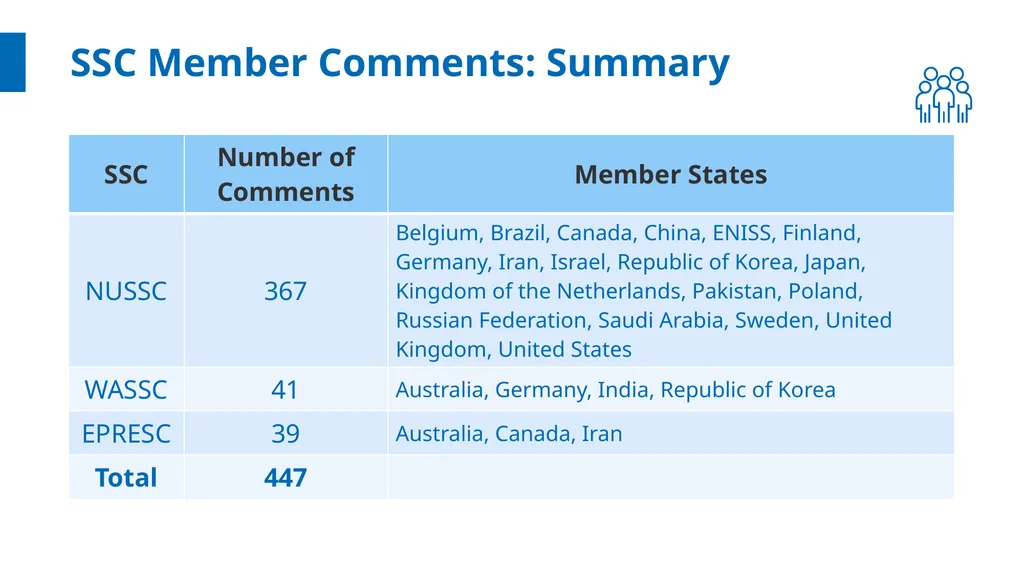
slide7. SSC Member Comments: Summary<br>
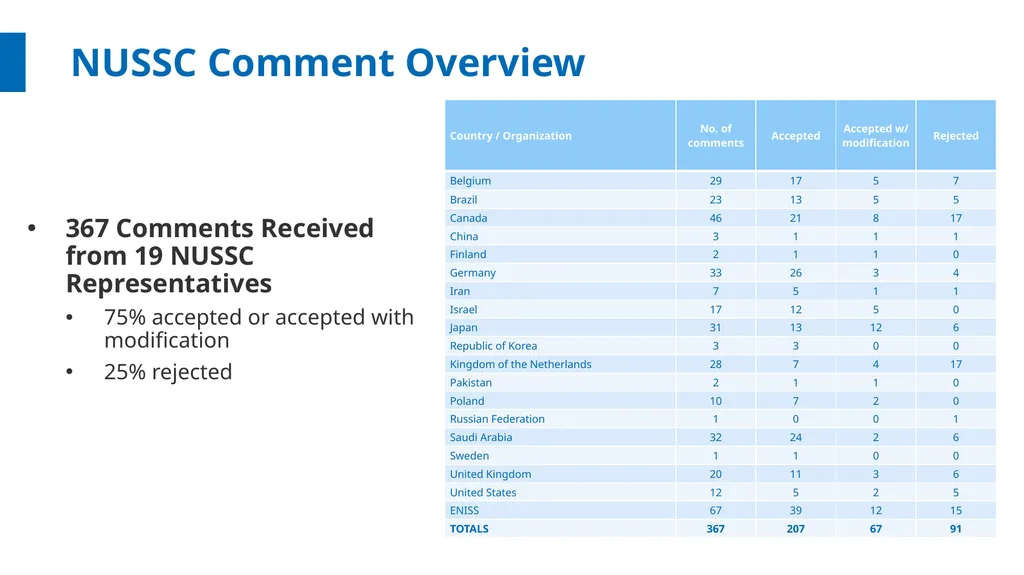
slide8. NUSSC Comment Overview 367 Comments Received from 19 NUSSC Representatives
75% accepted or accepted with modification
25% rejected<br>
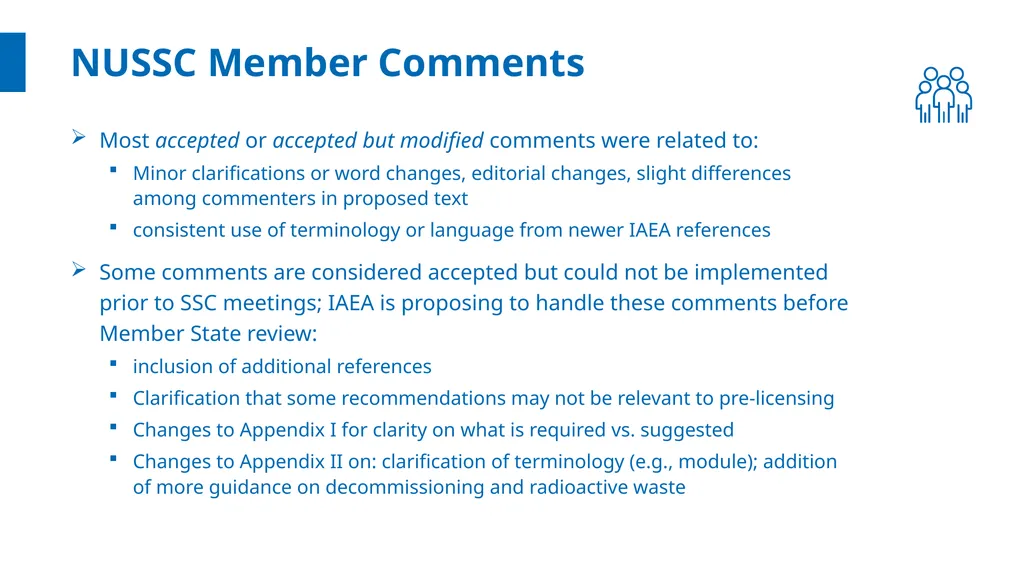
slide9. NUSSC Member Comments Most accepted or accepted but modified comments were related to:
Minor clarifications or word changes, editorial changes, slight differences among commenters in proposed text
consistent use of terminology or language from newer IAEA references
Some comments are considered accepted but could not be implemented prior to SSC meetings; IAEA is proposing to handle these comments before Member State review:
inclusion of additional references
Clarification that some recommendations may not be relevant to pre-licensing
Changes to Appendix I for clarity on what is required vs. suggested
Changes to Appendix II on: clarification of terminology (e.g., module); addition of more guidance on decommissioning and radioactive waste<br>
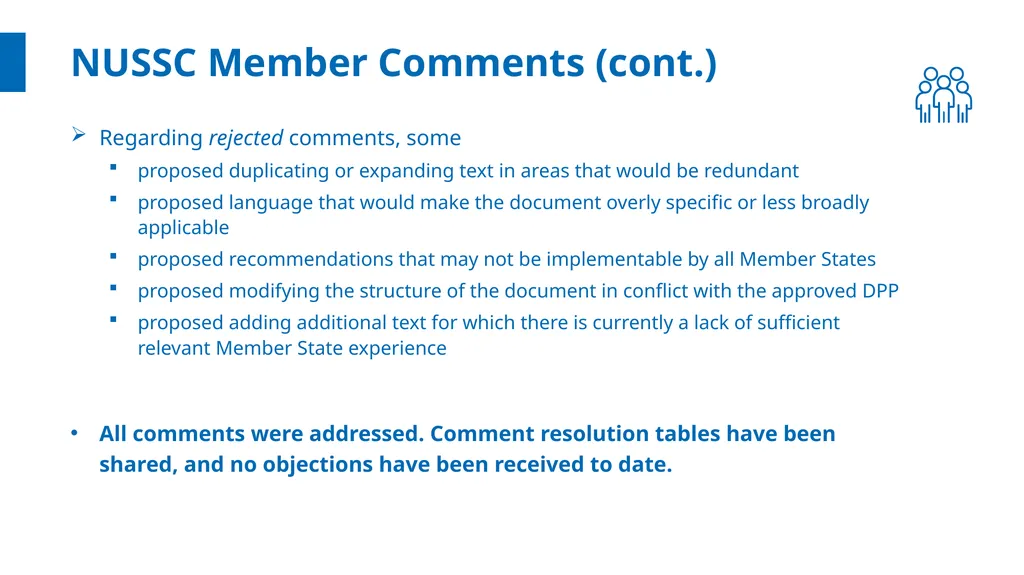
slide10. NUSSC Member Comments (cont.) Regarding rejected comments, some
proposed duplicating or expanding text in areas that would be redundant
proposed language that would make the document overly specific or less broadly applicable
proposed recommendations that may not be implementable by all Member States
proposed modifying the structure of the document in conflict with the approved DPP
proposed adding additional text for which there is currently a lack of sufficient relevant Member State experience
All comments were addressed. Comment resolution tables have been shared, and no objections have been received to date.<br>
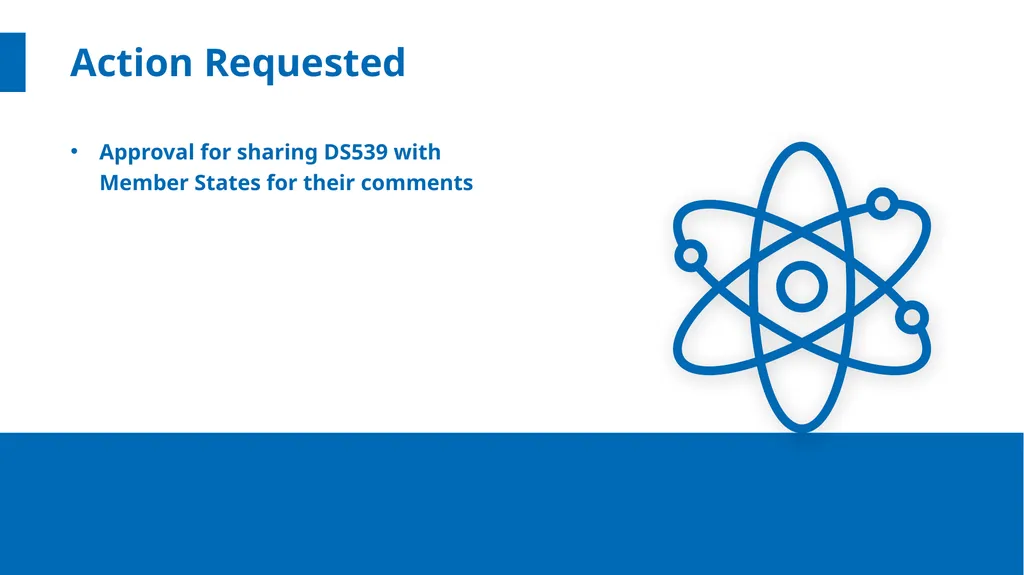
slide11. Action Requested Approval for sharing DS539 with Member States for their comments<br>
slide12. b.rini@iaea.org<br>
Division: Nuclear Installation Safety
Section: Regulatory Activities Section
International Atomic Energy Agency DS539 Licensing Process for Nuclear Installations Revision of Safety Guide SSG-12 58th Meeting of the Nuclear Safety Standards Committee (NUSSC)
19-21 November 2024<br>
slide2. Background DS539 is a revision of SSG-12, “Licensing Process for Nuclear Installations”
SSG-12, issued in 2010, has constituted an important roadmap for regulatory bodies in the development of the licensing process for nuclear installations. As is, it remains a proven guide for regulatory bodies in the majority of the licensing cases for nuclear installations.
However, Member States will benefit from an update to include adjustments and additional guidance in light of the recent developments.
Changes driven by publications or revisions to other IAEA Safety Standards since 2010.
Changes needed to provide guidance to Member States on licensing of small modular reactors (SMRs), including regulatory cooperation.
The consideration of safeguards requirements early in the design process.
Lead Committee: NUSSC
Other review committees: EPReSC, NSGC, RASSC, TRANSSC, WASSC<br>
slide3. Overview of the Document The objective of DS539 remains essentially unchanged
The information in DS539 includes:
General Recommendations on the Licensing Process:
Definitions, basic licensing principles, roles and responsibilities for regulatory body and for applicant or licensee, main contents of a license, public participation, graded approach
Steps of the Licensing Process:
Alternative process for combined licenses, siting and site evaluation, design, construction, commissioning, operation, decommissioning, release from regulatory control
Appendices:
Examples of Documents to be Submitted to the Regulatory Body
Licensing of Small Modular Reactors (NEW)<br>
slide4. Status of the Document<br>
slide5. Status of the Document The DPP was approved by the Committees in June 2022, and by CSS in November 2022.
The majority of the effort was focused on development of a new Appendix on SMR licensing; however, the effort also included updating the body of the guide, as needed.
The work was primarily performed via a series of five Consultancy Meetings and one Home Based Assignment (involving one expert), from 2023-2024.
The first draft was posted on webpage for SSCs review in August 2024, and comments were received by 14 October 2024.
Table of resolution of SSCs comments posted along with the revised version of the draft incorporating comments posted on 22 October 2024.
Submission to the Committees for approval to proceed to Step 8 for soliciting comments from Member States.<br>
slide6. Overall SSC Member Comments 447 comments received from EPReSC, NUSSC, and WASSC
Comments received from 19 countries and 1 organisation: Australia, Belgium, Brazil, Canada, China, ENISS, Finland, Germany, India, Iran, Israel, Republic of Korea, Kingdom of the Netherlands, Pakistan, Poland, Russian Federation, Saudi Arabia, Sweden, United Kingdom, United States
Majority of the comments were accepted or accepted with modification
231 comments accepted; 93 comments accepted with modification (72%)
123 comments rejected (28%)
Note: NSGC did not receive the draft document concurrently with the other Committees and will be able to review prior to the December NSGC meeting.<br>
slide7. SSC Member Comments: Summary<br>
slide8. NUSSC Comment Overview 367 Comments Received from 19 NUSSC Representatives
75% accepted or accepted with modification
25% rejected<br>
slide9. NUSSC Member Comments Most accepted or accepted but modified comments were related to:
Minor clarifications or word changes, editorial changes, slight differences among commenters in proposed text
consistent use of terminology or language from newer IAEA references
Some comments are considered accepted but could not be implemented prior to SSC meetings; IAEA is proposing to handle these comments before Member State review:
inclusion of additional references
Clarification that some recommendations may not be relevant to pre-licensing
Changes to Appendix I for clarity on what is required vs. suggested
Changes to Appendix II on: clarification of terminology (e.g., module); addition of more guidance on decommissioning and radioactive waste<br>
slide10. NUSSC Member Comments (cont.) Regarding rejected comments, some
proposed duplicating or expanding text in areas that would be redundant
proposed language that would make the document overly specific or less broadly applicable
proposed recommendations that may not be implementable by all Member States
proposed modifying the structure of the document in conflict with the approved DPP
proposed adding additional text for which there is currently a lack of sufficient relevant Member State experience
All comments were addressed. Comment resolution tables have been shared, and no objections have been received to date.<br>
slide11. Action Requested Approval for sharing DS539 with Member States for their comments<br>
slide12. b.rini@iaea.org<br>