National Coordination Centre Pharmacovigilance Programme of India Causality Assessment- Logic and Method Causality Assessment is defined as the evaluation of the likelihood that a medicine was the causative agent of an observed adverse
"National Coordination Centre Pharmacovigilance" is the property of its rightful owner. Permission is granted to
download and print the materials on this website for personal, non-commercial use only, and to display it
on your personal computer provided you do not modify the materials and that you retain all copyright
notices contained in the materials. By downloading content from our website, you accept the terms of this
agreement.
Presentation Transcript
01
National Coordination Centre
Pharmacovigilance Programme of India Causality Assessment- Logic and Method<br>
02
Causality Assessment is defined as the evaluation of the likelihood that a medicine was the causative agent of an observed adverse reaction
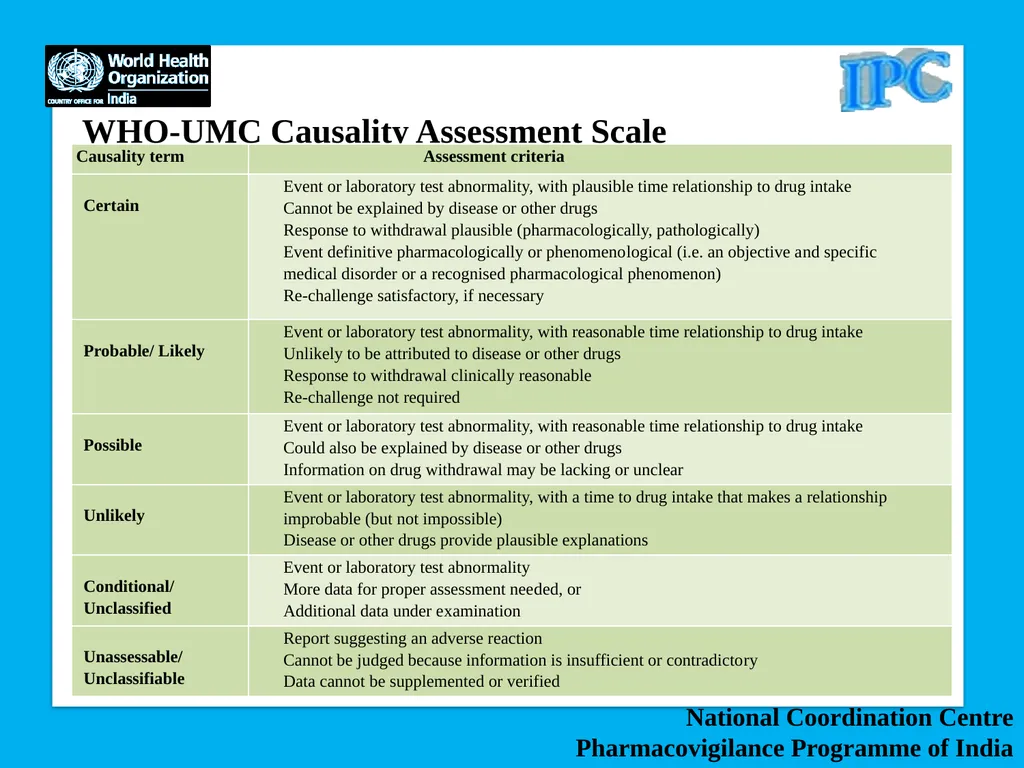
AMC is responsible for making causality assessment of reports and will be reviewed at NCC. The PvPI follows WHO-UMC causality assessment scale for establishing the relation between the suspected drug and suspected adverse drug event. The WHO-UMC scale is used as a practical tool for the assessment of case reports National Coordination Centre
Pharmacovigilance Programme of India<br>
03
National Coordination Centre
Pharmacovigilance Programme of India DEFINITIONS Adverse reaction: “a response to a medicine which is noxious and unintended, and which occurs at doses normally used in man”
Adverse event: any new clinical experience that occurs after commencing a medicine, not necessarily a response to a medicine, and is recorded without judgement on its causality.<br>
04
National Coordination Centre
Pharmacovigilance Programme of India Question arises: Did the drug do it? Answer
Yes
Yes, but only in certain circumstances (risk factors)
Yes, because it interacted with other medicine
No, it was another drug prescribed with it
No, it was due to the patient’s disease
No, that drug could not cause that reaction<br>
05
National Coordination Centre
Indian Pharmacopoeia Commission National Coordination Centre
Pharmacovigilance Programme of India Data needed for assessing causality Results of dechallenge & rechallenge
Outcome of the event
Patient medical history
Past diseases of importance eg hepatitis and drug addiction
0ther current diseases (co-morbidities) eg
Tuberculosis
Diabetes
Alcoholism
Psychiatric disturbances
Factors leading to immunodeficiency<br>
06
National Coordination Centre
Pharmacovigilance Programme of India Analysis of causality We use all the information available on the report
Our pharmacological knowledge
Our knowledge of previous reports received
Our knowledge of any literature reports<br>
07
National Coordination Centre
Pharmacovigilance Programme of India Assessment of event Initially, what we are really doing is assessing the strength of the relationship between the drug and the event
We can seldom say without any doubt that a specific drug caused a specific reaction
We work with imperfect data and our conclusions are those of probability<br>
08
Assessment of event National Coordination Centre
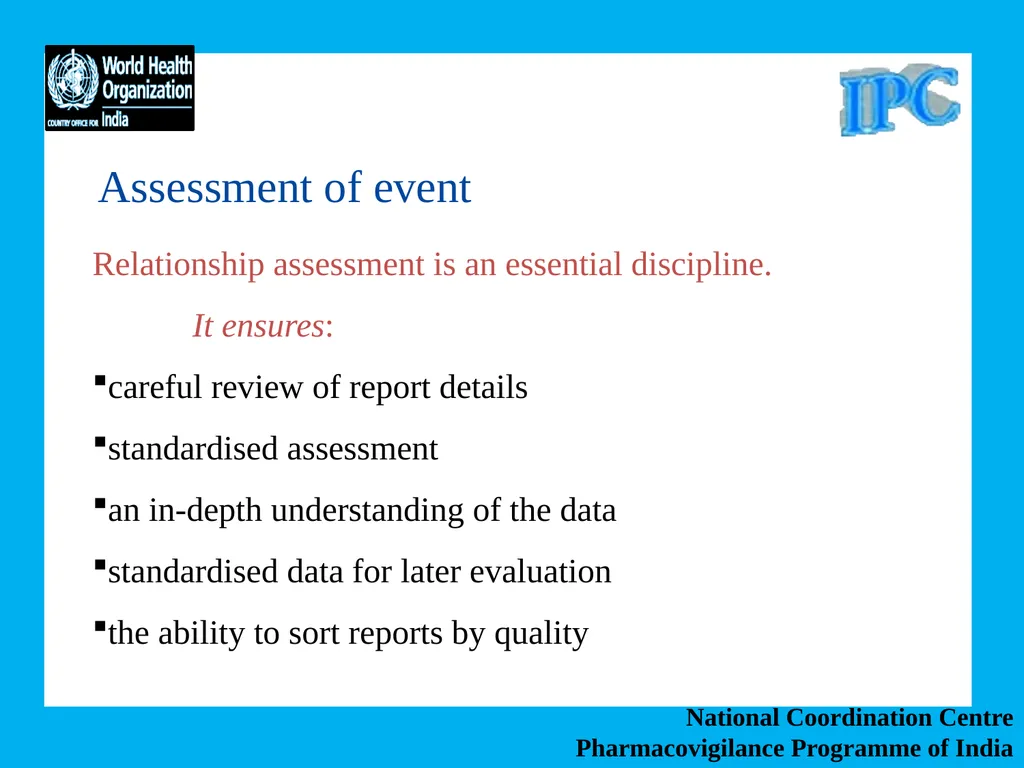
Pharmacovigilance Programme of India Relationship assessment is an essential discipline. It ensures:
careful review of report details
standardised assessment
an in-depth understanding of the data
standardised data for later evaluation
the ability to sort reports by quality<br>
09
National Coordination Centre
Pharmacovigilance Programme of India WHO-UMC Causality Assessment Scale<br>
10
National Coordination Centre
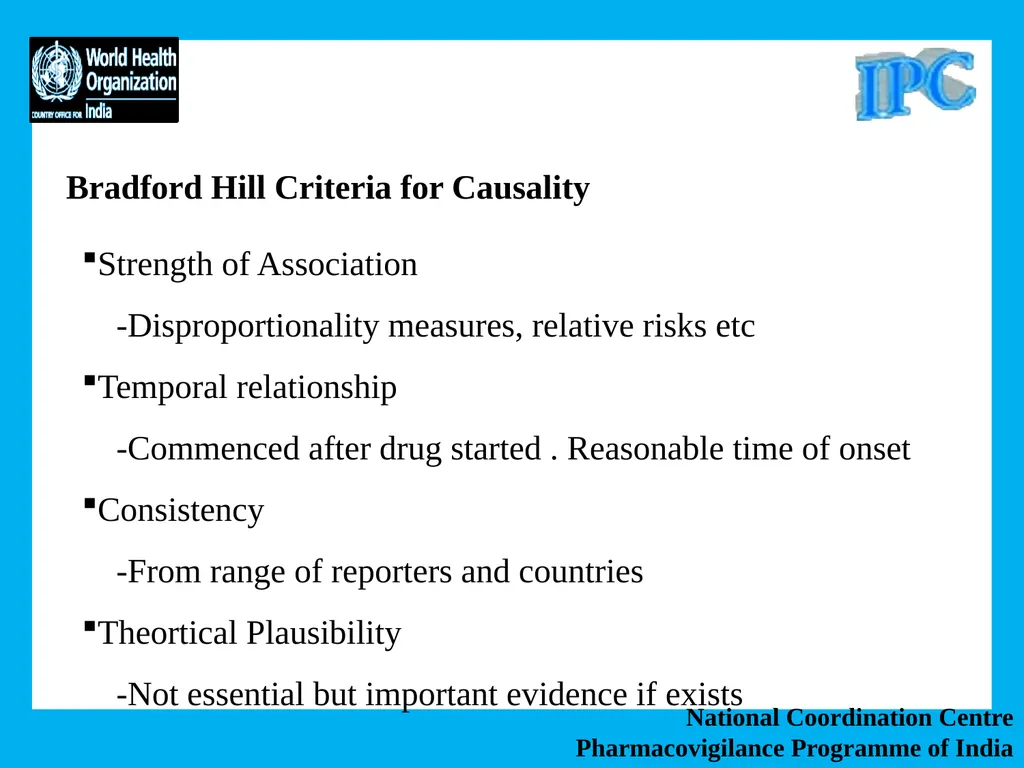
Pharmacovigilance Programme of India Bradford Hill Criteria for Causality Strength of Association
-Disproportionality measures, relative risks etc
Temporal relationship
-Commenced after drug started . Reasonable time of onset
Consistency
-From range of reporters and countries
Theortical Plausibility
-Not essential but important evidence if exists<br>
11
National Coordination Centre
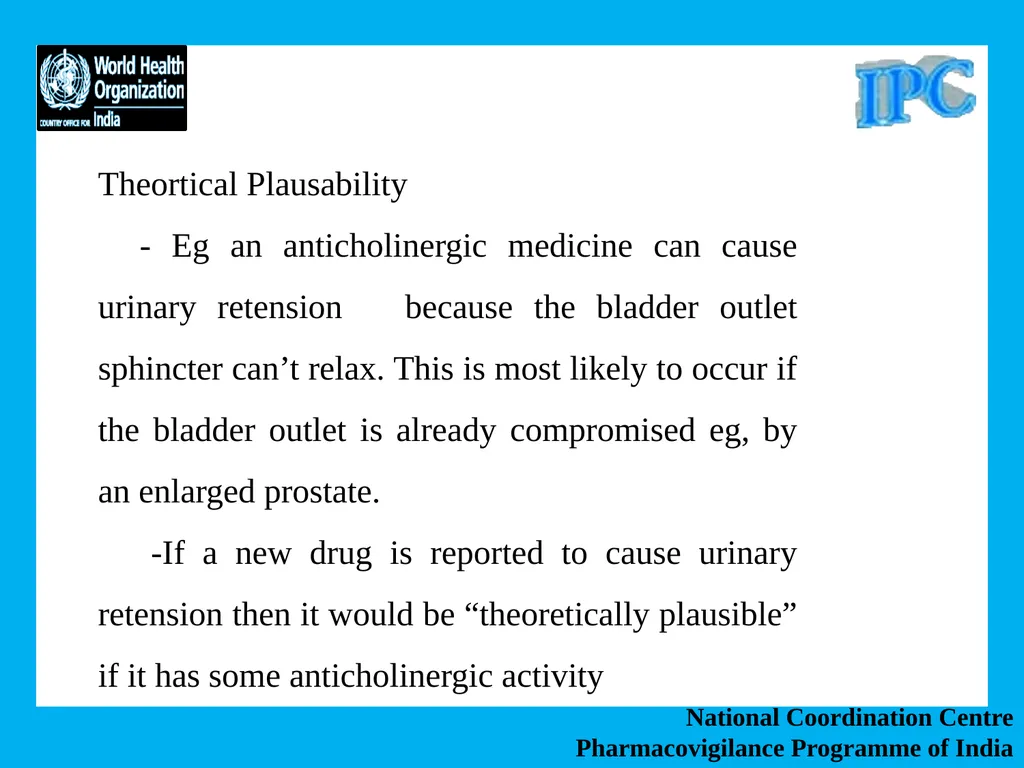
Pharmacovigilance Programme of India Theortical Plausability
- Eg an anticholinergic medicine can cause urinary retension because the bladder outlet sphincter can’t relax. This is most likely to occur if the bladder outlet is already compromised eg, by an enlarged prostate.
-If a new drug is reported to cause urinary retension then it would be “theoretically plausible” if it has some anticholinergic activity<br>
12
Bradford Hill Criteria for Causality Coherence
-Fits with existing knowledge, eg frusemide will not cause hyperkalaemia
Specificity
-Many ADRs have multiple causes eg acute renal failure
- Generally drugs cause ADRs through specific mechanism eg interstitial nephritis causing acute renal failure
- Are a number of medicine suspect?
Dose- response relationship
Experimental evidence
-Prolonged QT interval
Analogy
-Similar reactions observed with other members of ATC group. National Coordination Centre
Pharmacovigilance Programme of India<br>
13
The process of assessment Establishing the relationship Dates of use of all medicine(s)
Date of onset of event
Response to dechallenge
Response to rechallenge
Outcome
Disease being treated
Other diseases, drugs
Type of suspect drug and event National Coordination Centre
Pharmacovigilance Programme of India<br>
14
The process of assessment Establishing causality Subjective evaluation (ICSRs)
Is a reaction plausible?
Consider
indication for use
background or past disease
pharmacology
prior knowledge of similar reports with the suspect drug or related drugs
Is there a possible mechanism? National Coordination Centre
Pharmacovigilance Programme of India<br>
15
The process of assessment The end process Discuss and consult
Establish an opinion on causality
Publish
Be prepared to revise your decision National Coordination Centre
Pharmacovigilance Programme of India<br>
16
Relationship with event An event with:
a plausible time to onset
no dechallenge information
other medicines could have caused the event
Relationship- Possible National Coordination Centre
Pharmacovigilance Programme of India<br>
17
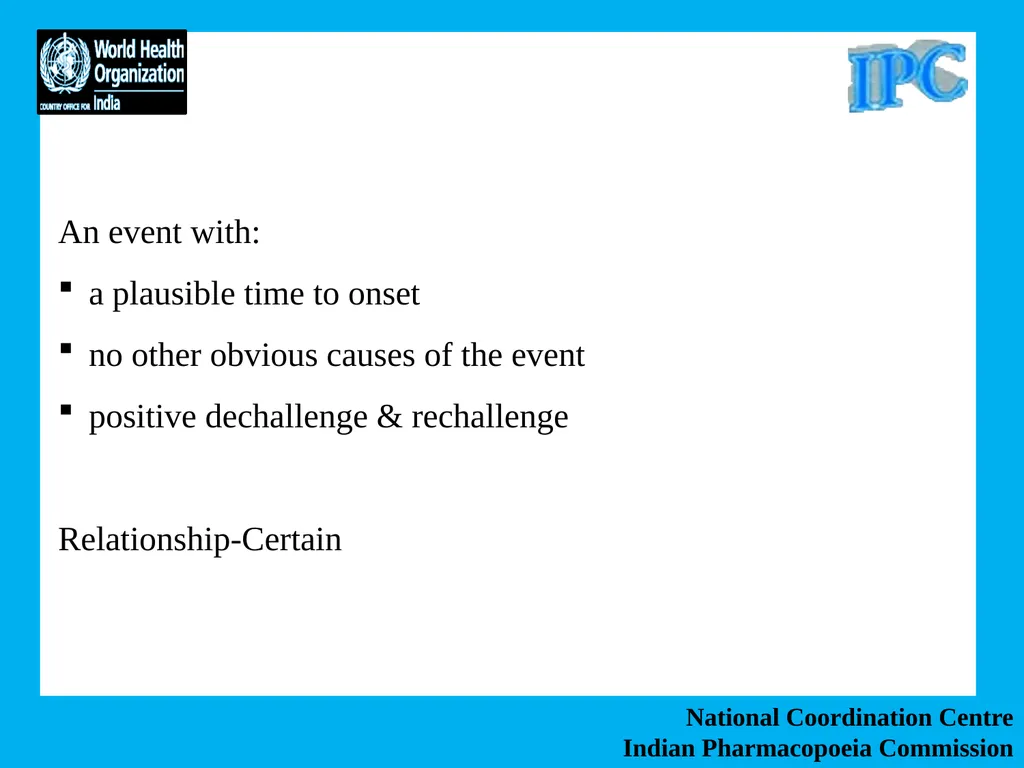
An event with:
a plausible time to onset
no other obvious causes of the event
positive dechallenge & rechallenge
Relationship-Certain National Coordination Centre
Indian Pharmacopoeia Commission<br>
18
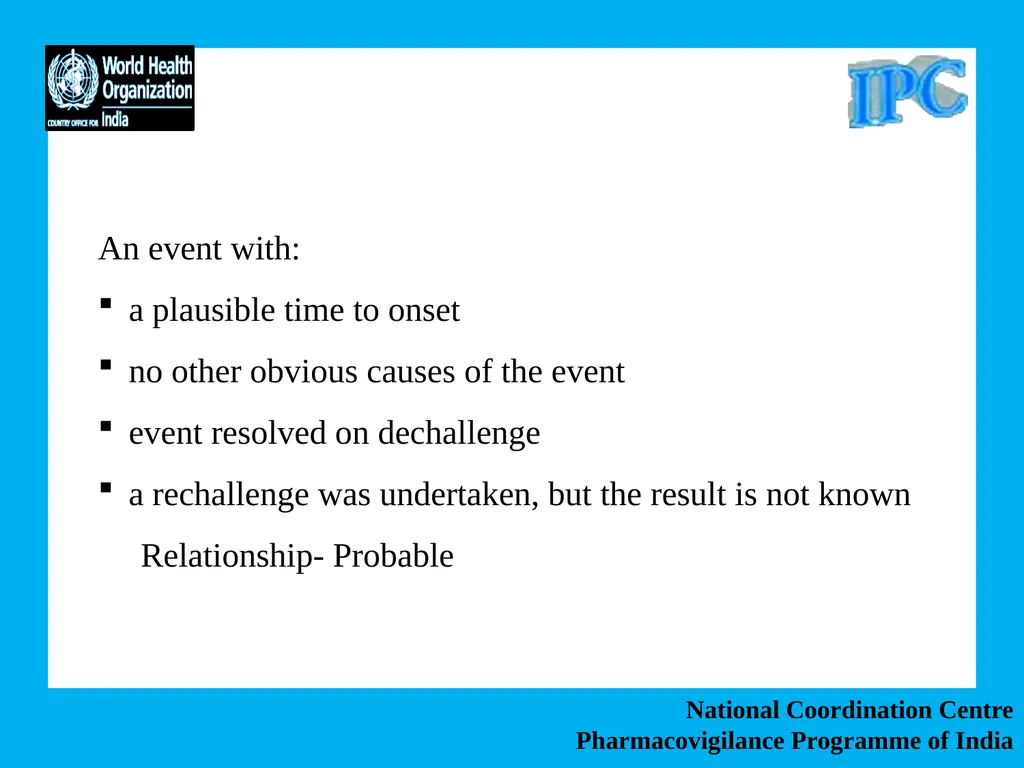
An event with:
a plausible time to onset
no other obvious causes of the event
event resolved on dechallenge
a rechallenge was undertaken, but the result is not known
Relationship- Probable National Coordination Centre
Pharmacovigilance Programme of India<br>
19
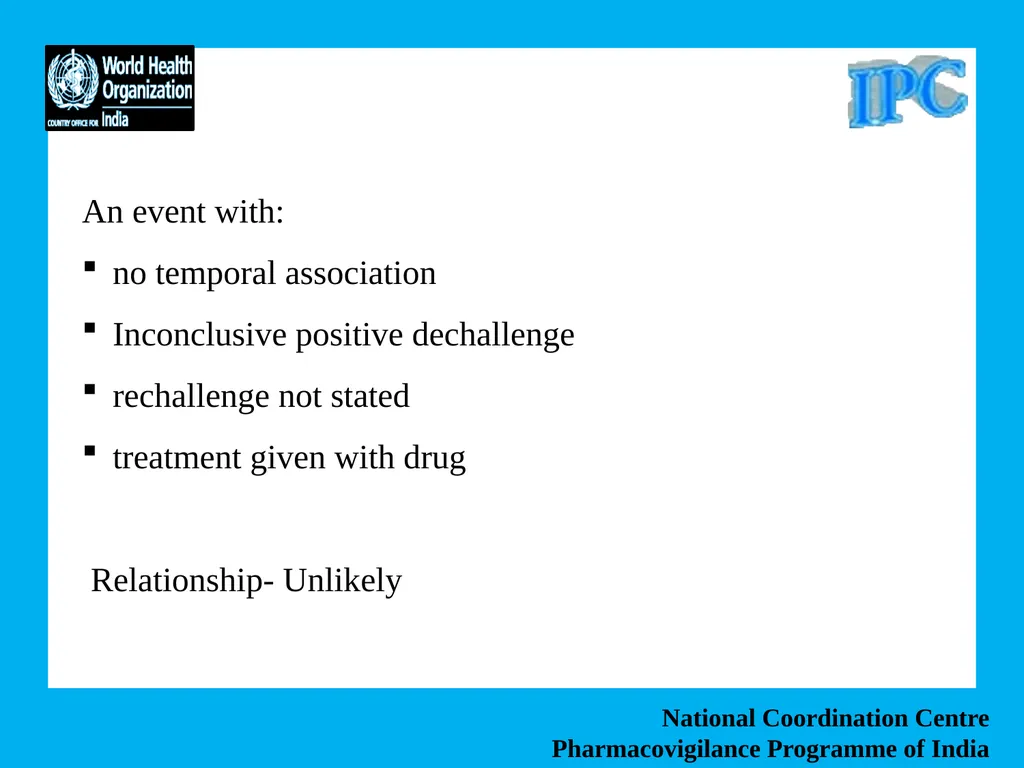
An event with:
no temporal association
Inconclusive positive dechallenge
rechallenge not stated
treatment given with drug
Relationship- Unlikely National Coordination Centre
Pharmacovigilance Programme of India<br>
20
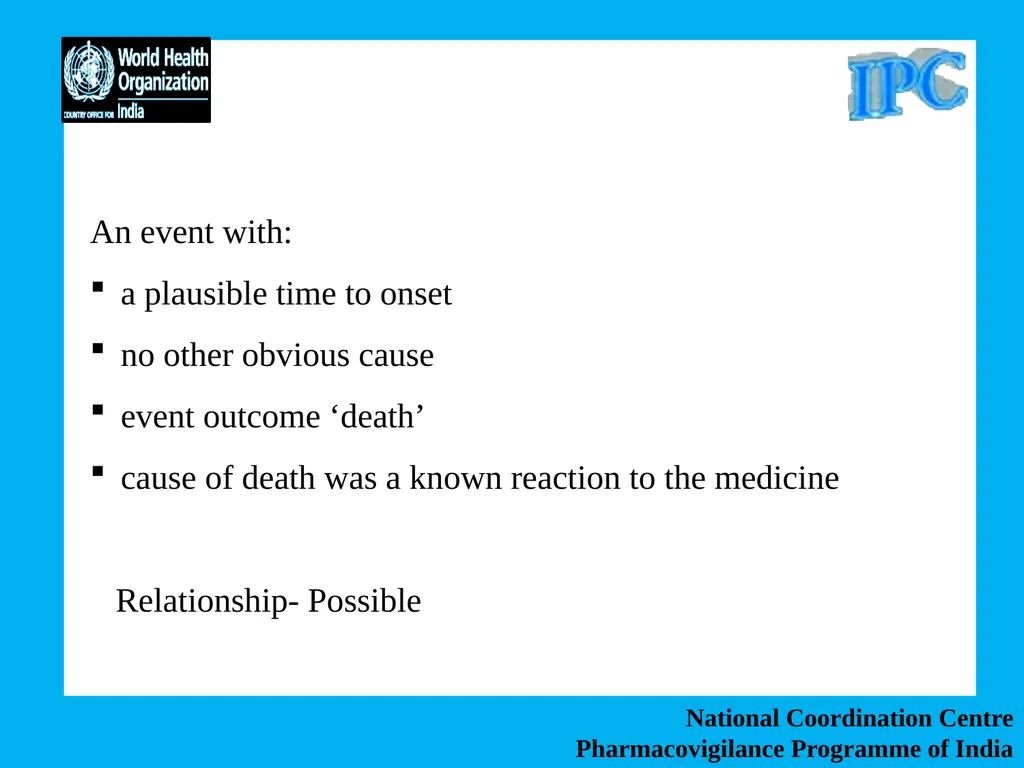
An event with:
a plausible time to onset
no other obvious cause
event outcome ‘death’
cause of death was a known reaction to the medicine
Relationship- Possible National Coordination Centre
Pharmacovigilance Programme of India<br>
21
An event with:
a plausible time to onset
no other obvious causes of the event
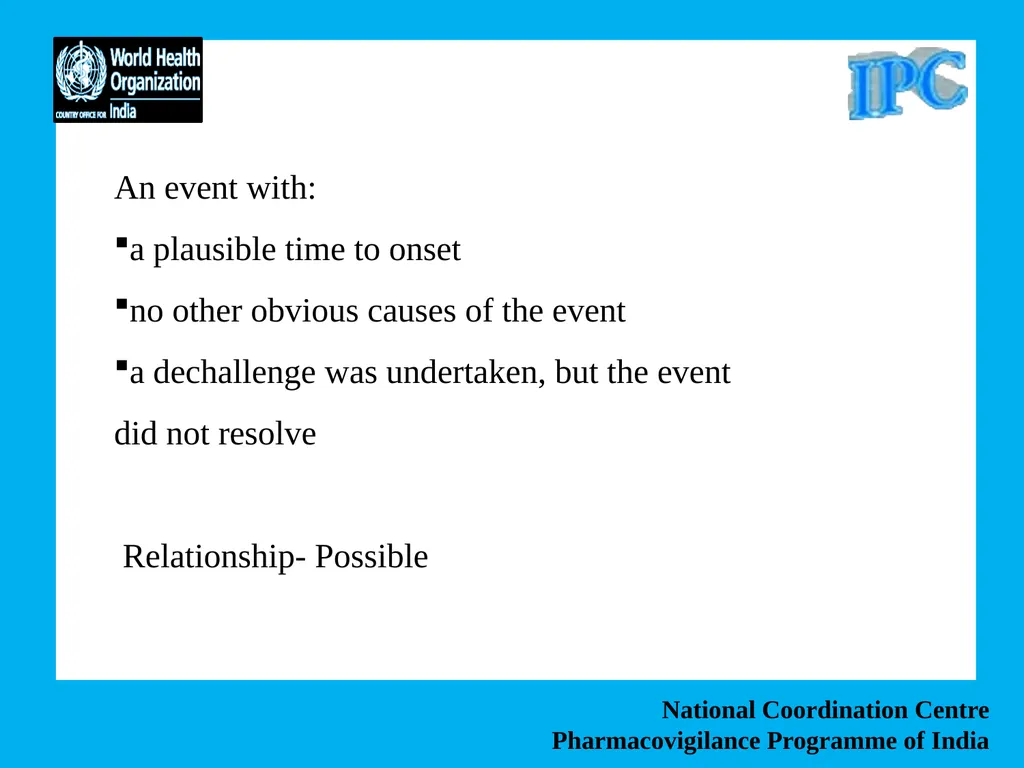
a dechallenge was undertaken, but the event did not resolve
Relationship- Possible National Coordination Centre
Pharmacovigilance Programme of India<br>
22
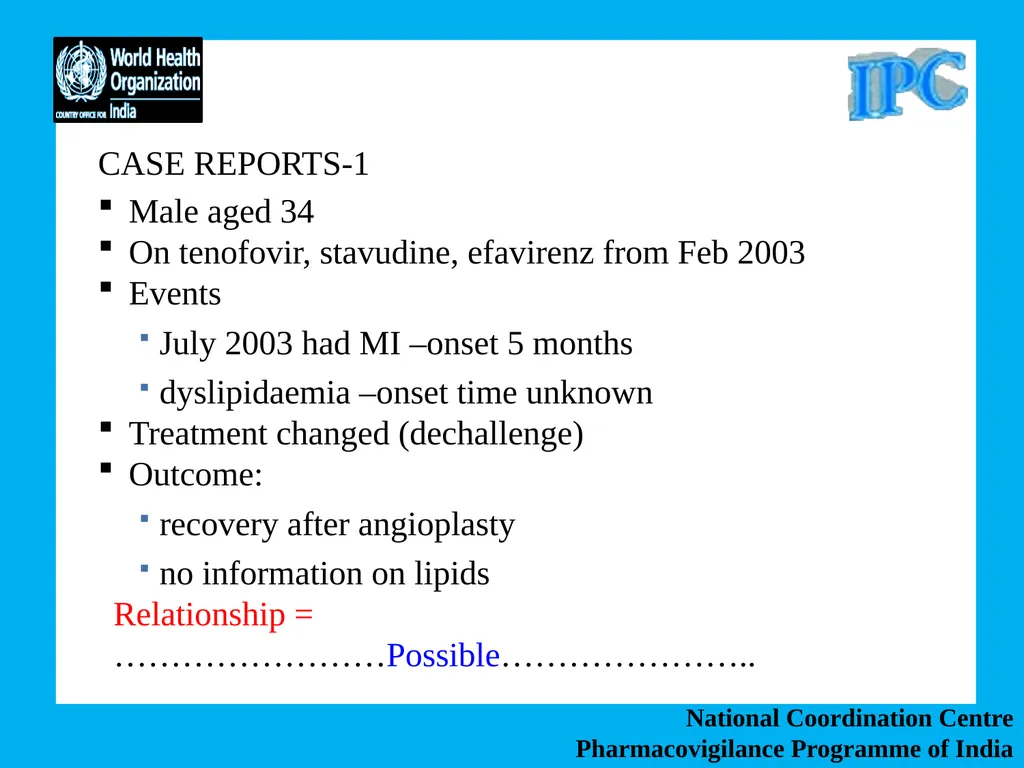
CASE REPORTS-1 Male aged 34
On tenofovir, stavudine, efavirenz from Feb 2003
Events
July 2003 had MI –onset 5 months
dyslipidaemia –onset time unknown
Treatment changed (dechallenge)
Outcome:
recovery after angioplasty
no information on lipids
Relationship =
……………………Possible………………….. National Coordination Centre
Pharmacovigilance Programme of India<br>
23
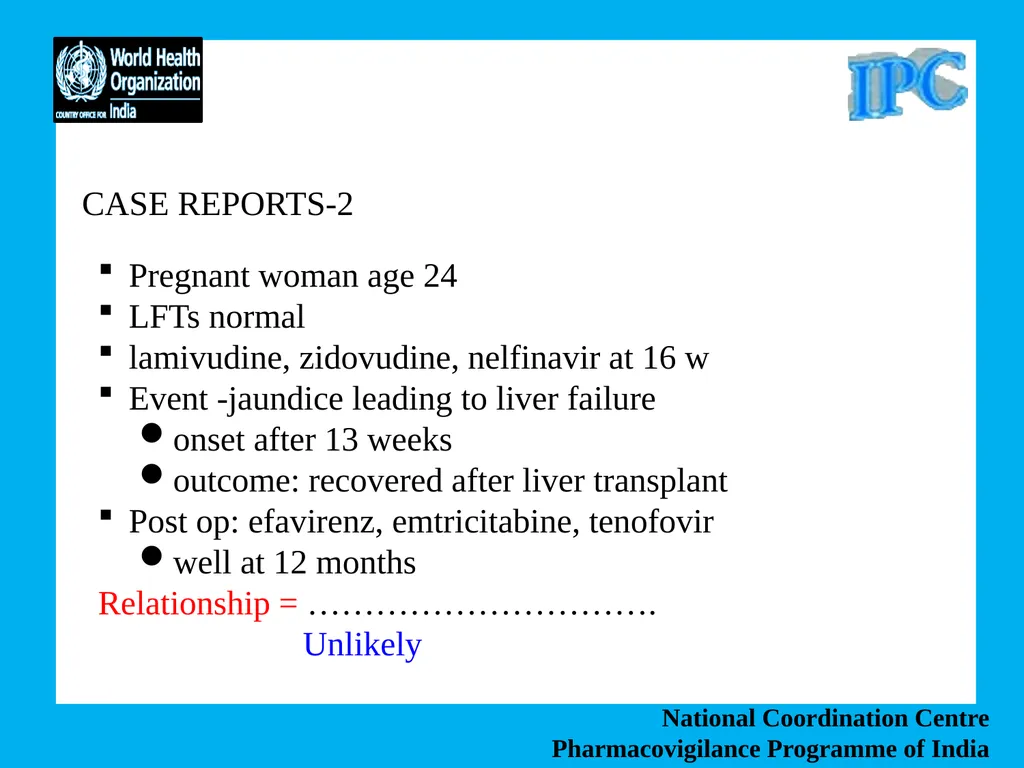
CASE REPORTS-2 Pregnant woman age 24
LFTs normal
lamivudine, zidovudine, nelfinavir at 16 w
Event -jaundice leading to liver failure
onset after 13 weeks
outcome: recovered after liver transplant
Post op: efavirenz, emtricitabine, tenofovir
well at 12 months
Relationship = ………………………….
Unlikely National Coordination Centre
Pharmacovigilance Programme of India<br>
24
National Coordination Centre
Pharmacovigilance Programme of India THANK YOU<br>