Natural Hazards and Risks in Structural Engineering Modul Disaster Management and mitigation strategies Prof. Dr. Frank Eckardt The Sociology of Disaster THE kiel school of disaster sociology LECTURE 2 Philosophical principles The Social
"Natural Hazards and Risks in Structural" is the property of its rightful owner. Permission is granted to
download and print the materials on this website for personal, non-commercial use only, and to display it
on your personal computer provided you do not modify the materials and that you retain all copyright
notices contained in the materials. By downloading content from our website, you accept the terms of this
agreement.
Presentation Transcript
01
Natural Hazards and Risks in Structural Engineering
Modul „Disaster Management and
mitigation strategies“
Prof. Dr. Frank Eckardt The Sociology of Disaster THE kiel school of disaster sociology LECTURE 2<br>
02
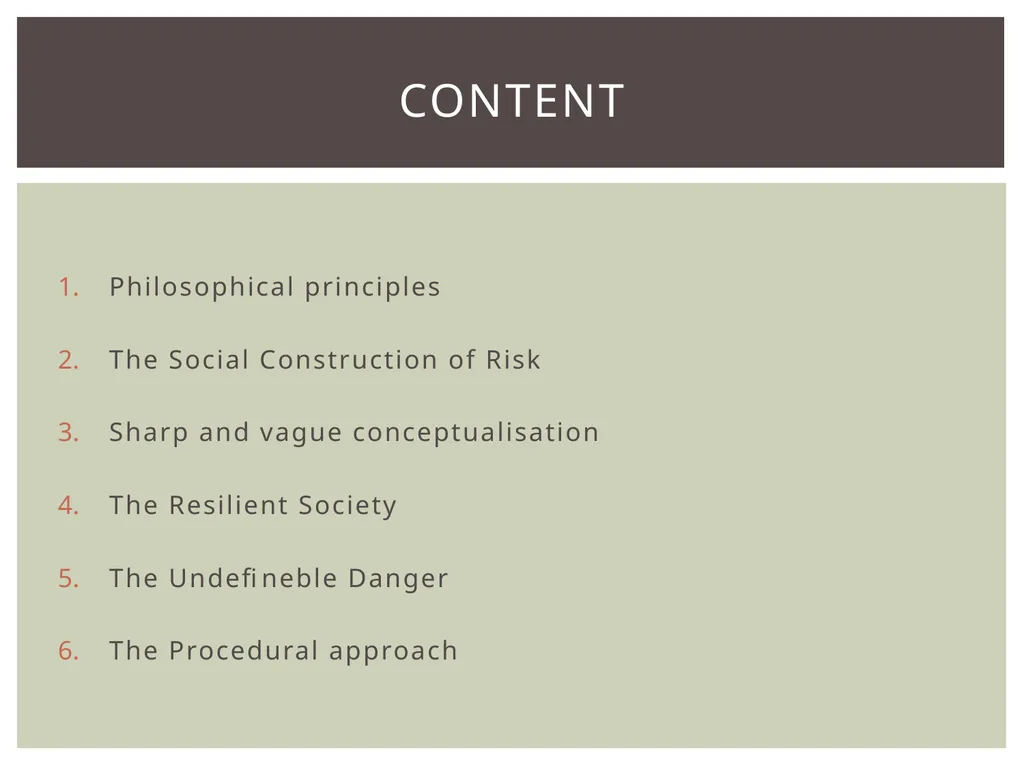
Philosophical principles
The Social Construction of Risk
Sharp and vague conceptualisation
The Resilient Society
The Undefineble Danger
The Procedural approach Content<br>
03
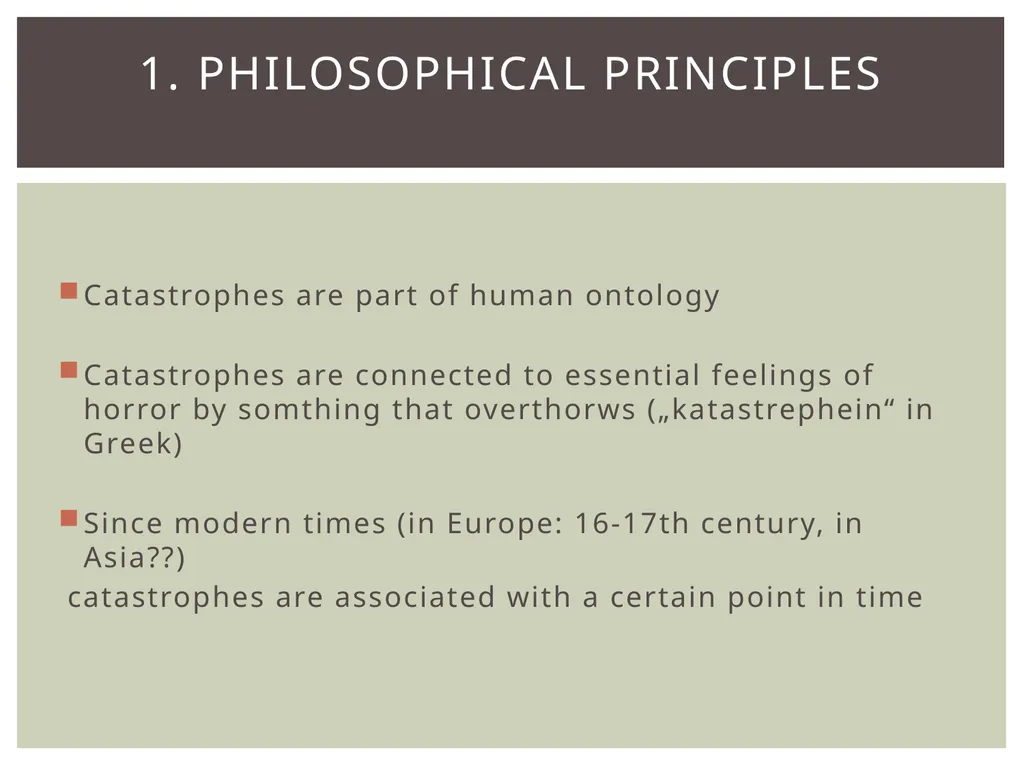
Catastrophes are part of human ontology
Catastrophes are connected to essential feelings of horror by somthing that overthorws („katastrephein“ in Greek)
Since modern times (in Europe: 16-17th century, in Asia??)
catastrophes are associated with a certain point in time 1. Philosophical principles<br>
04
Catastrophes are retold as modern drama
With the dramatization of the catastrophe, the „unbearable“ is given a way of narrating fate
Dramatisation aims at catharsis: healing through temporary identification 1. Philosophical principles<br>
05
Dramatizing catastrophes only works in a context of communication
They offer a social ritual that allows to restall order
It allows to continue with the idea of controll of nature and society 1. Philosophical principles<br>
06
Modern societies are requiring permanent re-negotiation of social order
This implies „wrong“ decisions
Catastrophes are making a judgement on theses decisions in two ways: Firstly, about the importance of these irregularities
Secondly, it implies a reflection on the old order 2. The Social Construction of Risk<br>
07
The question „what went wrong?“ enables collective understanding of the observation and experience
Technological stability versus flexibility of catstrophic moments
Desillusionment about the possibilities of technological systems 2. The Social Construction of Risk<br>
08
Contemporary „healing“ for catastrophes are based on technological belief
Technology has offered a world of symbols that includes the promise of an opaque, transparent and universal answer to the threats of modern life
Catastrophes are however a personal and historical proof on the hiats of the technological narrative 2. The Social Construction of Risk<br>
09
Contesting the term of „natural disaster“
Critical reflection on the sharp conceptualisation on „natural causes“
Terminology relates to a de-dramatization of catastrophs 3. Sharp and vague conceptualisation<br>
10
Sharp conceptualisations are part of the rational dream
Its technological language limits the legitime pictures (metaphores) and thereby possible alternatives of action
It places thinking and planning before action 3. Sharp and vague conceptualisation<br>
11
Sociologically, disasters are characterized by a synchronisation of action and reflection
What is wrong and what works is thus not a result of an adaptation of a technology
Solution and risk are EXPERIENCE 3. Sharp and vague conceptualisation<br>
12
Science in a situation of catstrophe requires a farewell to the idea of „technological solution“
It recures on earlier „lived by“ experience (what worked elsewhere)
It does not look for a general and universal solution but of a certain situation (For whome would it work?) 4. The Undefineble Danger<br>
13
Changing perspective of catastrophe studies:
Inclusion of knowledge from „normal life“
Castrophes are the extremes of omnipresent dangers
Taking up the coping mechanisms of people 4. The Undefineble Danger<br>
14
A New Agenda: The Resilient Society
How do people handle dangers normally?
What kind of rituals are present?
What are the obstacles for people to „muddle through“? 5. The Resilient Society<br>
15
Relience replaces a deficit perspective and looks at the strenght of people
Relience praises „heroness“ and avoids victimization
Resilience is a new language (narrative) with ist own metaphors and „script“ 5. The Resilient Society<br>
16
Key assumptions of the FAKKEL model:
Rituals are established by a magical belief
Rapidity of „events“ challenges these belief systems
These challenges go beyond pre-existing rituals of self-assurance 6. The Procedural approach<br>
17
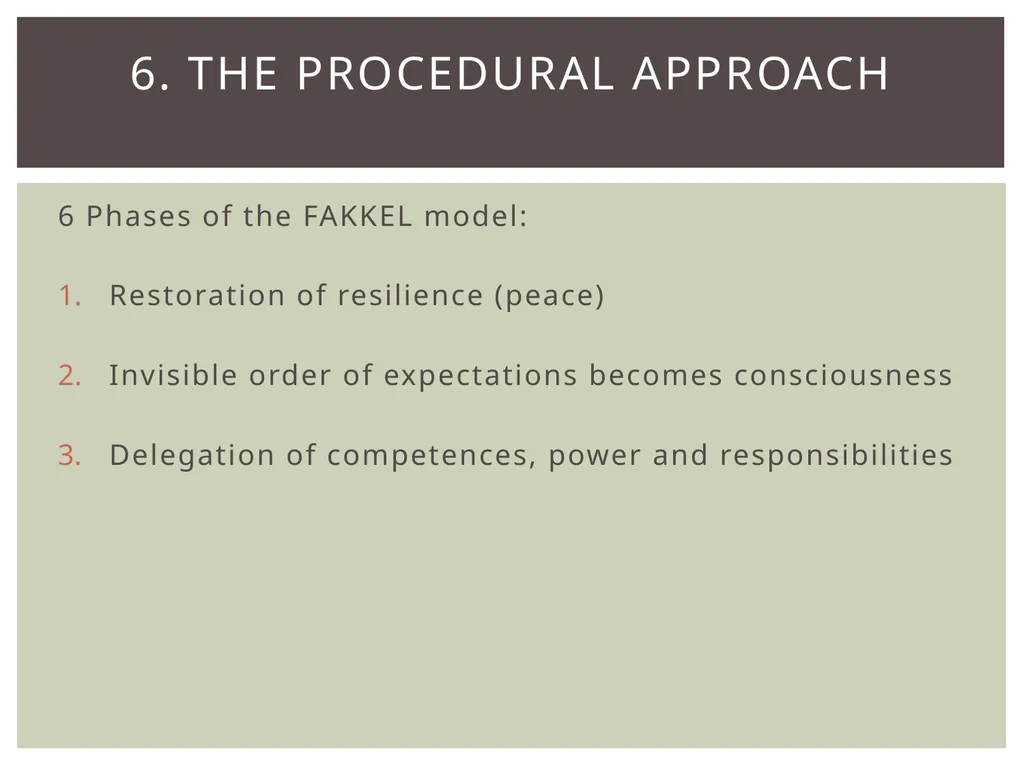
6 Phases of the FAKKEL model:
Restoration of resilience (peace)
Invisible order of expectations becomes consciousness
Delegation of competences, power and responsibilities 6. The Procedural approach<br>
18
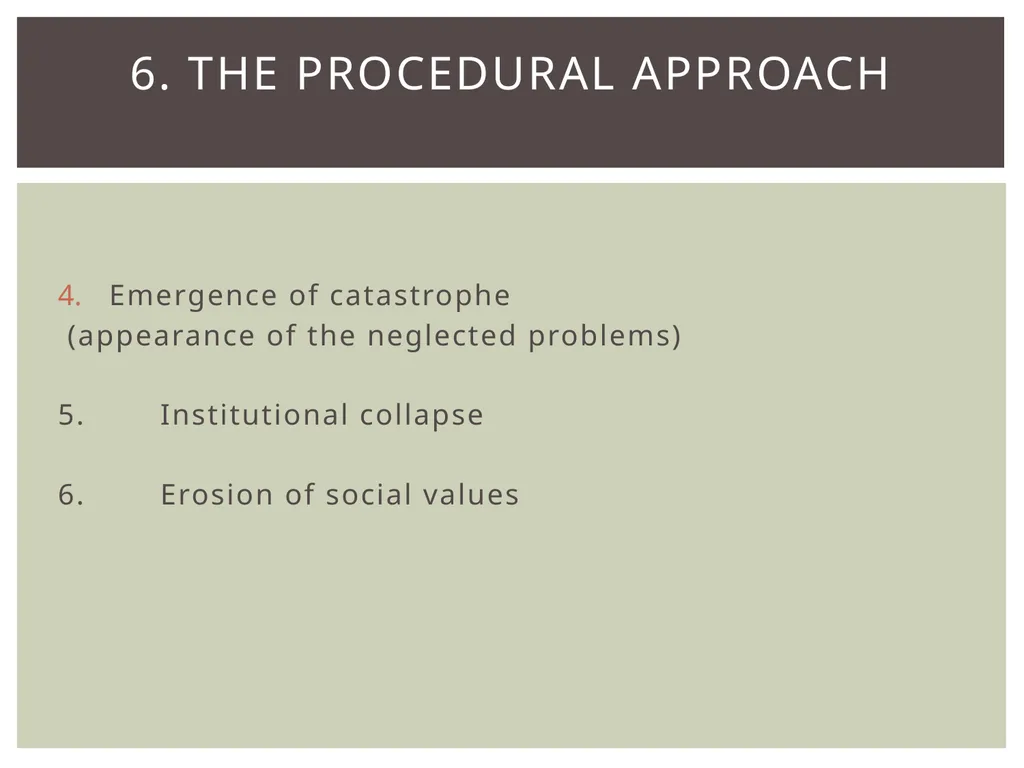
Emergence of catastrophe
(appearance of the neglected problems)
5. Institutional collapse
6. Erosion of social values 6. The Procedural approach<br>
19
Martin Voss (2006) Symbolische Formen. Grundlagen und Elemente einer Soziologie der Katastrophe. Bielefeld: transcript. MAIN REFERENCES<br>