Naturalism Dr. Kasturi Karmakar Assistant
Description: Naturalism Dr. Kasturi Karmakar Assistant Professor Faculty of Education ICFAI University Tripura Naturalism Nature is everything, there is nothing beyond it. Nature is also termed as materialism. Man should investigate the truth of nature
Related Topics
Download Presentation
"Naturalism Dr. Kasturi Karmakar Assistant" is the property of its rightful owner. Permission is granted to download and print the materials on this website for personal, non-commercial use only, and to display it on your personal computer provided you do not modify the materials and that you retain all copyright notices contained in the materials. By downloading content from our website, you accept the terms of this agreement.
Presentation Transcript
slide1. Naturalism Dr. Kasturi Karmakar
Assistant Professor
Faculty of Education
ICFAI University Tripura<br>
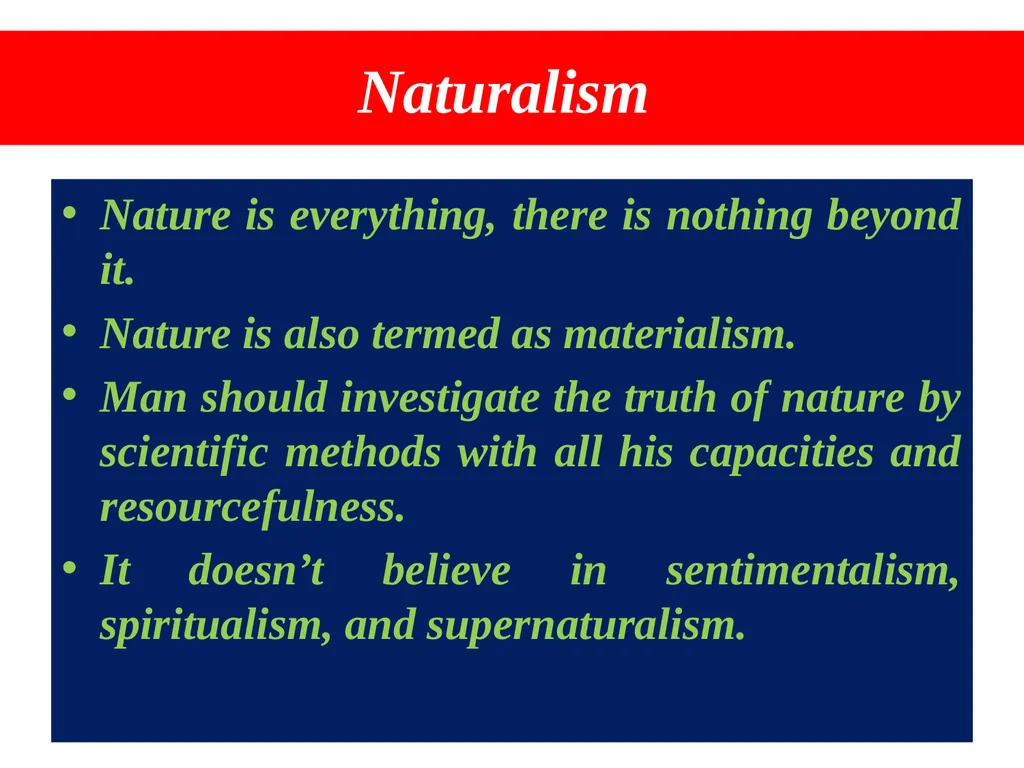
slide2. Naturalism Nature is everything, there is nothing beyond it.
Nature is also termed as materialism.
Man should investigate the truth of nature by scientific methods with all his capacities and resourcefulness.
It doesn’t believe in sentimentalism, spiritualism, and supernaturalism.<br>
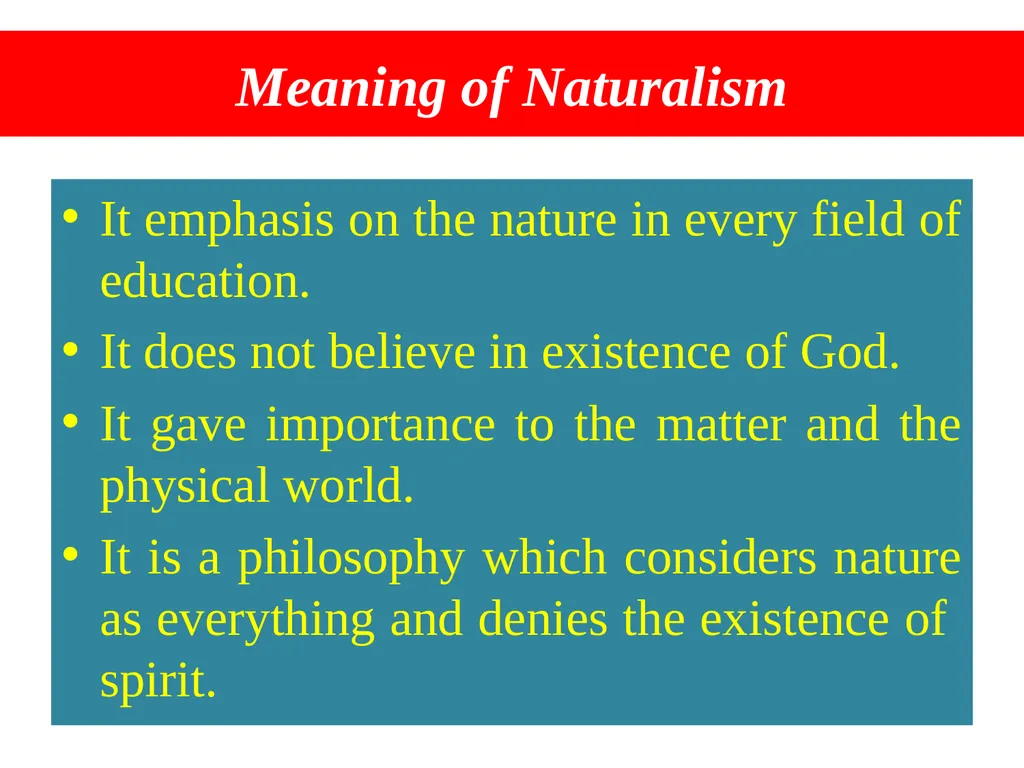
slide3. Meaning of Naturalism It emphasis on the nature in every field of education.
It does not believe in existence of God.
It gave importance to the matter and the physical world.
It is a philosophy which considers nature as everything and denies the existence of spirit.<br>
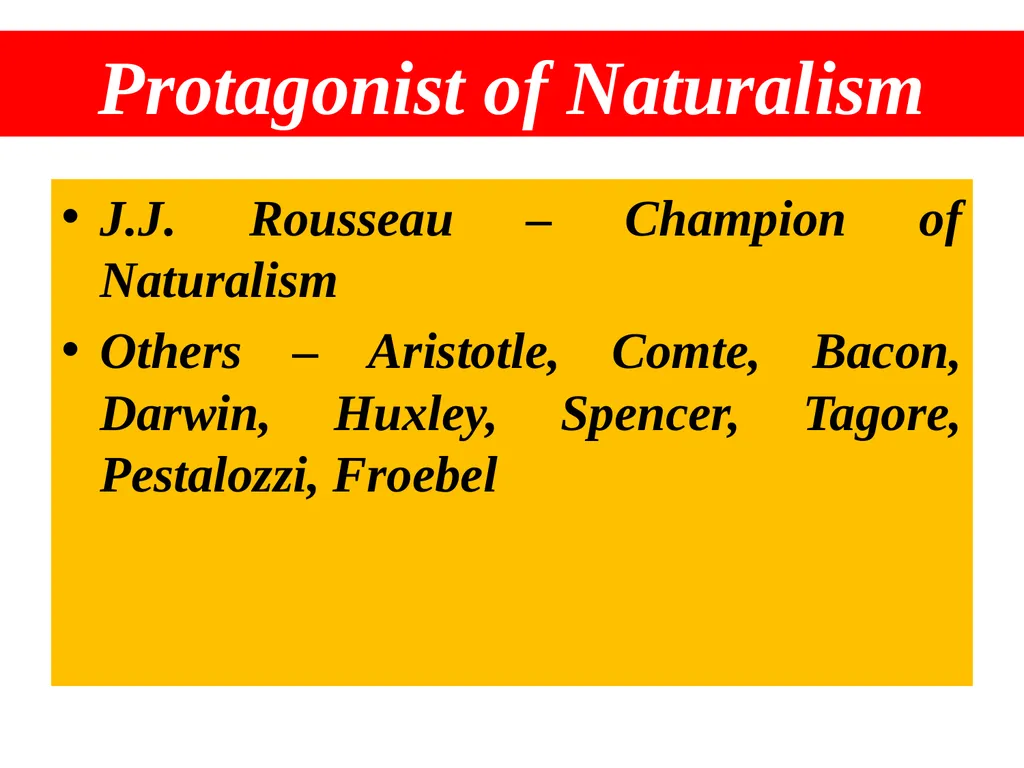
slide4. Protagonist of Naturalism J.J. Rousseau – Champion of Naturalism
Others – Aristotle, Comte, Bacon, Darwin, Huxley, Spencer, Tagore, Pestalozzi, Froebel<br>
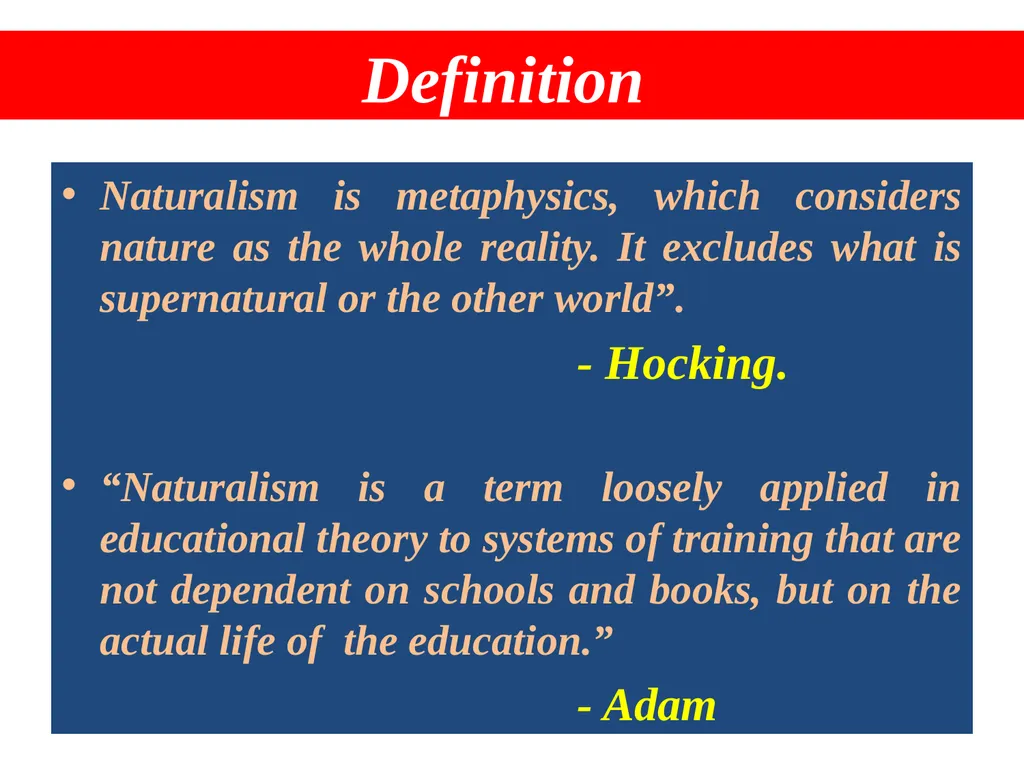
slide5. Definition Naturalism is metaphysics, which considers nature as the whole reality. It excludes what is supernatural or the other world”.
- Hocking.
“Naturalism is a term loosely applied in educational theory to systems of training that are not dependent on schools and books, but on the actual life of the education.”
- Adam<br>
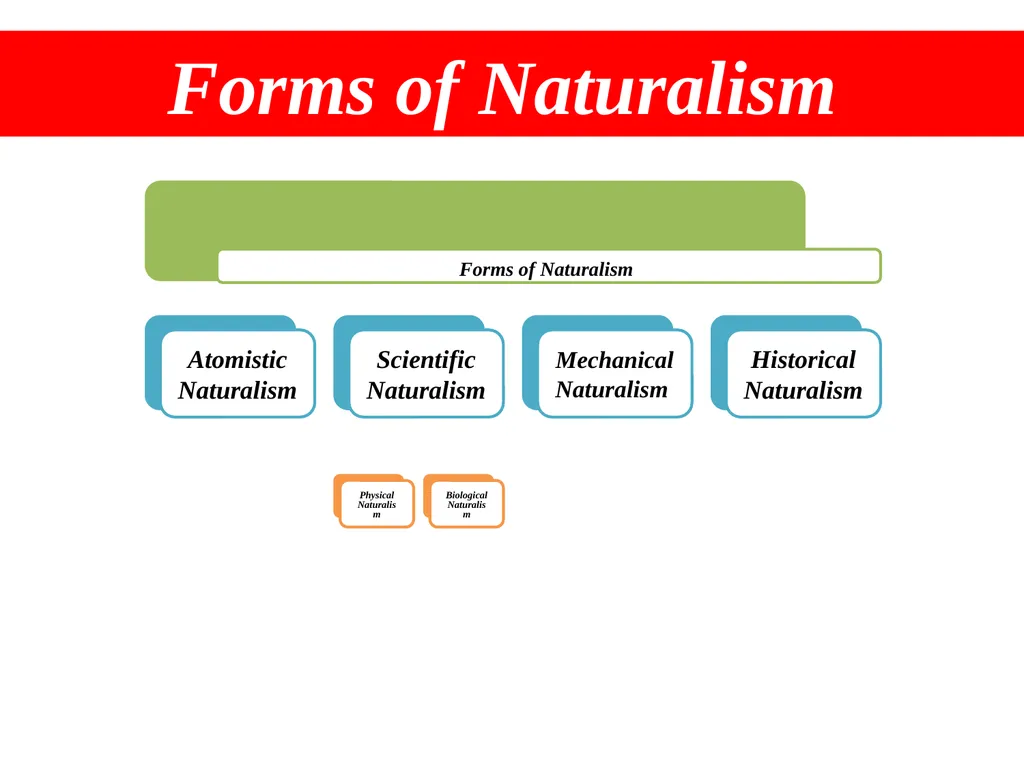
slide6. Forms of Naturalism<br>
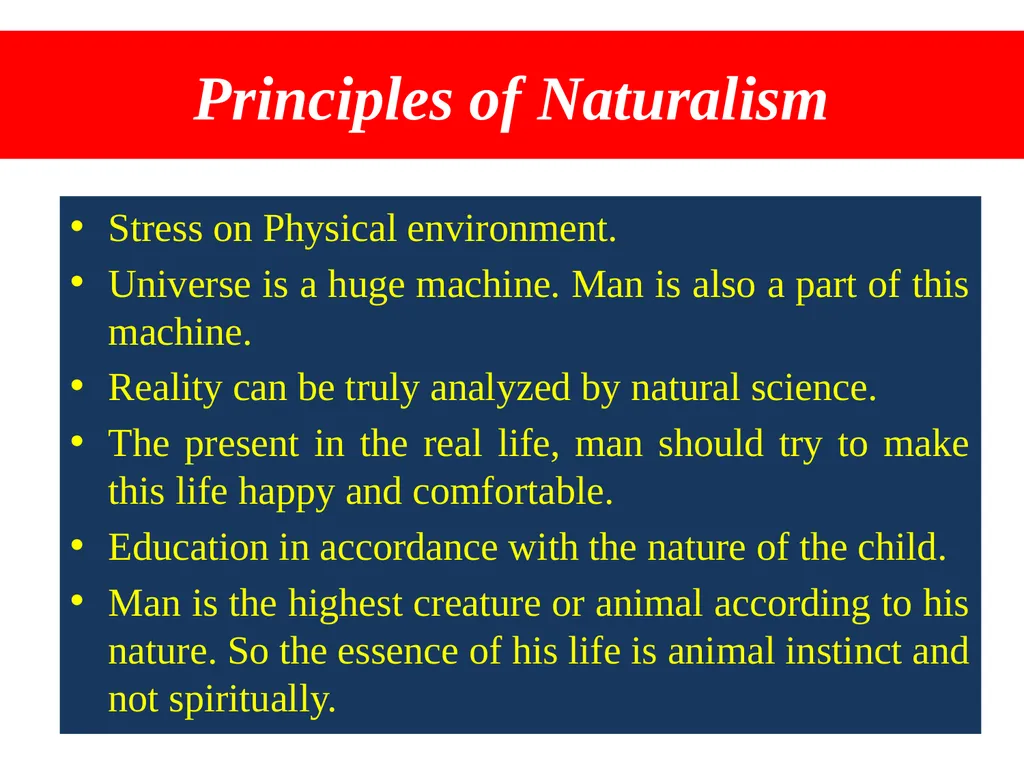
slide7. Principles of Naturalism Stress on Physical environment.
Universe is a huge machine. Man is also a part of this machine.
Reality can be truly analyzed by natural science.
The present in the real life, man should try to make this life happy and comfortable.
Education in accordance with the nature of the child.
Man is the highest creature or animal according to his nature. So the essence of his life is animal instinct and not spiritually.<br>
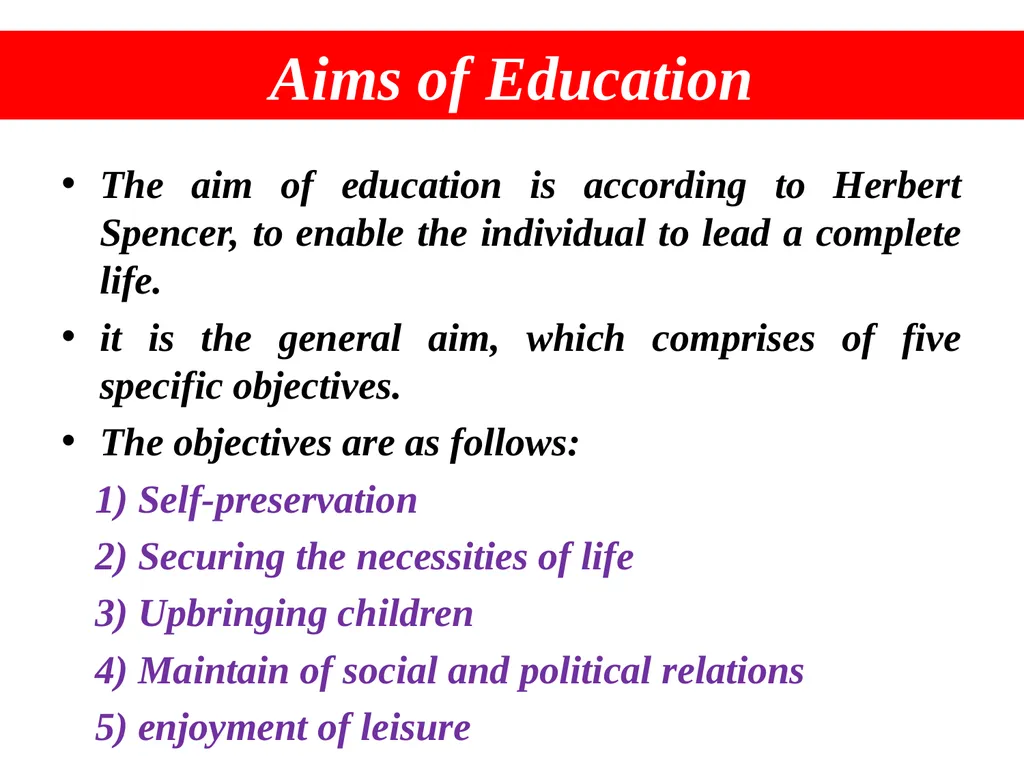
slide8. Aims of Education The aim of education is according to Herbert Spencer, to enable the individual to lead a complete life.
it is the general aim, which comprises of five specific objectives.
The objectives are as follows:
1) Self-preservation
2) Securing the necessities of life
3) Upbringing children
4) Maintain of social and political relations
5) enjoyment of leisure<br>
slide9. “Senses are the gateway of knowledge”. Aims of Education<br>
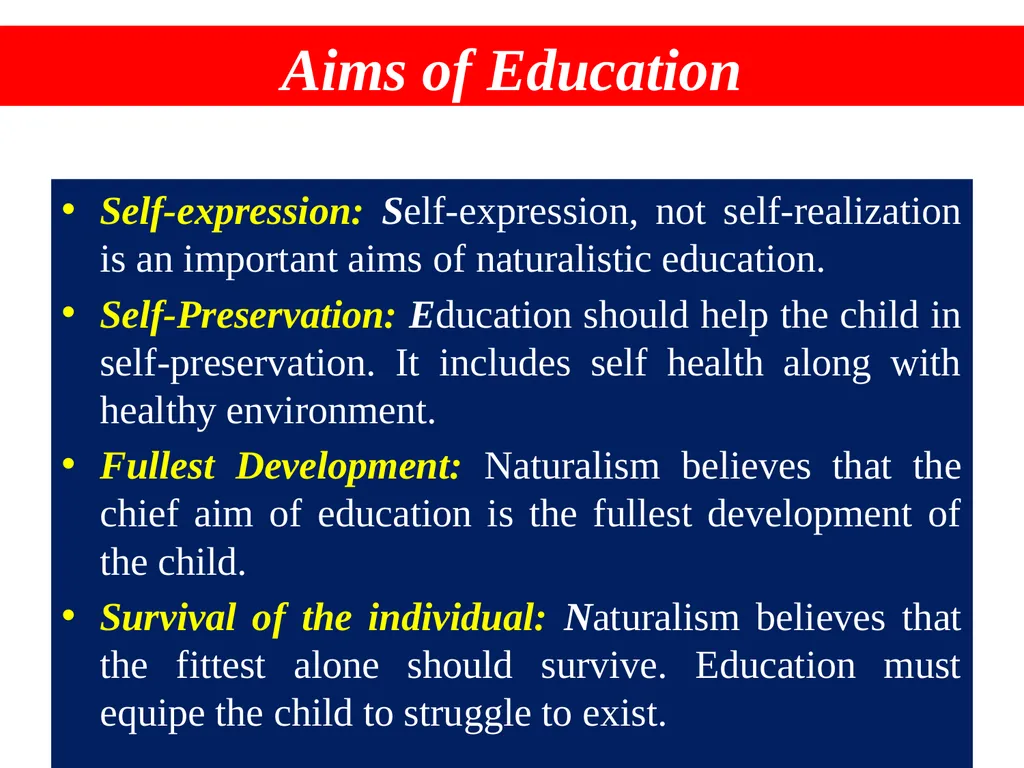
slide10. Aims of Education Self-expression: Self-expression, not self-realization is an important aims of naturalistic education.
Self-Preservation: Education should help the child in self-preservation. It includes self health along with healthy environment.
Fullest Development: Naturalism believes that the chief aim of education is the fullest development of the child.
Survival of the individual: Naturalism believes that the fittest alone should survive. Education must equipe the child to struggle to exist.<br>
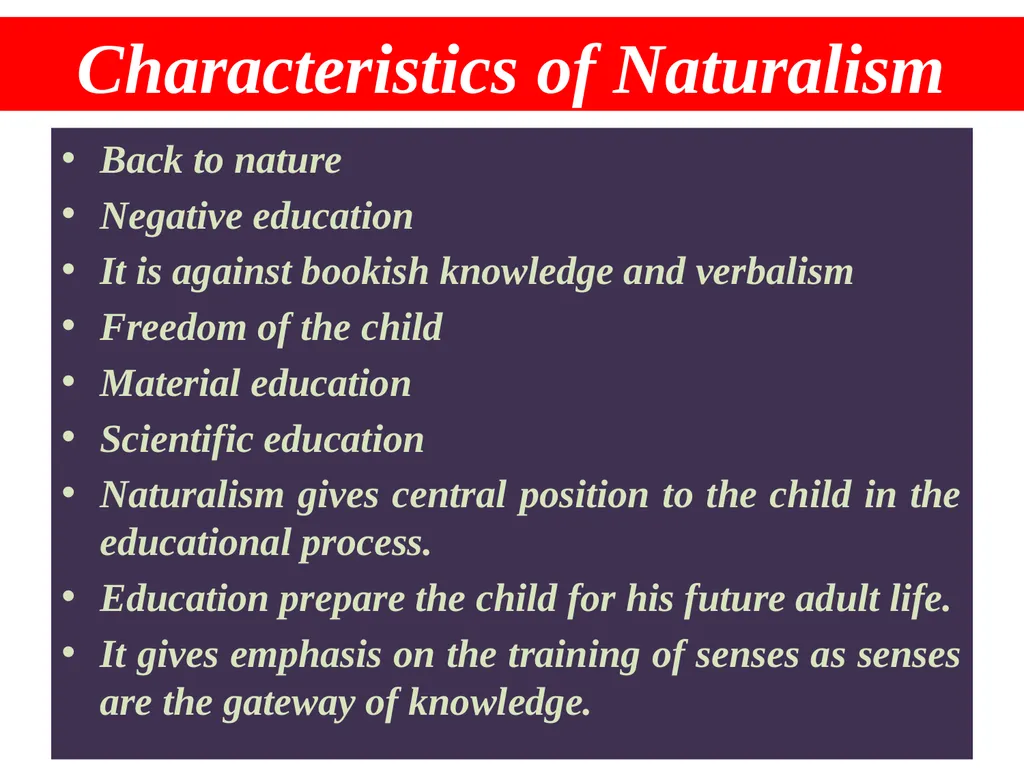
slide11. Characteristics of Naturalism Back to nature
Negative education
It is against bookish knowledge and verbalism
Freedom of the child
Material education
Scientific education
Naturalism gives central position to the child in the educational process.
Education prepare the child for his future adult life.
It gives emphasis on the training of senses as senses are the gateway of knowledge.<br>
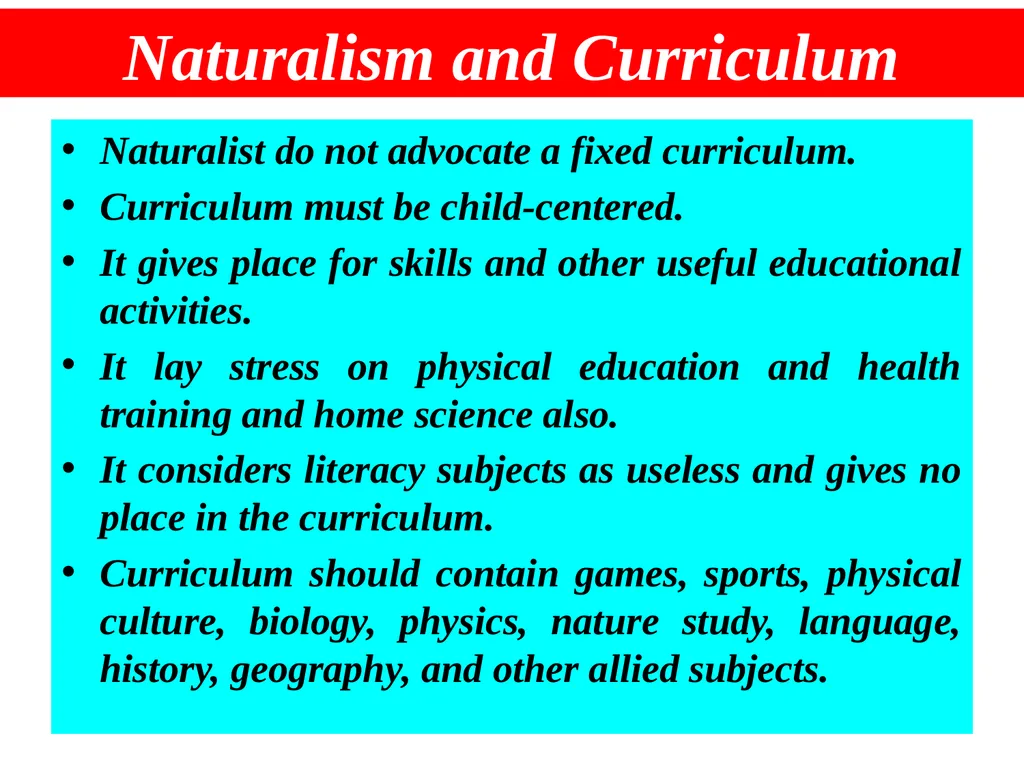
slide12. Naturalism and Curriculum Naturalist do not advocate a fixed curriculum.
Curriculum must be child-centered.
It gives place for skills and other useful educational activities.
It lay stress on physical education and health training and home science also.
It considers literacy subjects as useless and gives no place in the curriculum.
Curriculum should contain games, sports, physical culture, biology, physics, nature study, language, history, geography, and other allied subjects.<br>
slide13. Herbert Spencer classifies all human activities into five and assigns a place to each of them in the curriculum. The five activities in order of priority are
i) Activities of self-preservation
ii) Activities of a Vocation
iii) Activities of a worthy citizenship
iv) Activities of a worthy home membership
v) Activities of the leisure time Naturalism and Curriculum<br>
slide14. Naturalism and Method of Teaching Naturalism is a result against the old, traditional, bookish system of education.
Direct experience with nature, things, and men is the keynote of instruction according to naturalists.
They follow different method of teaching according to the interests, capacities, and aptitude of the child
Learning by doing
Heuristic Method
Direct method<br>
slide15. Observation and excursion
Play way method
Learning through senses
Learning through participation
Other methods: Naturalists adopt Dalton plan, Kindergarten, Excursion method, Montessori Method, Experimentation so as to bring about a natural development in the child. Naturalism and Method of Teaching<br>
slide16. Naturalism and Teacher Teacher should behave sympathitically and affectionately forwards the children.
Nature- supreme Teacher
Teacher the observer
Understand about child
Teacher the stage setter
Teacher the gardener<br>
slide17. Naturalism and Discipline Naturalist gives full freedom to the child to perform and learn whatever he likes.
No punishment
Full freedom
Free society
Naturalists assume that the child has no knowledge of good and bad, but suffers pain when he makes a mistake, and pleasure when he does something right. Thus he gets reward or punishment for his actions.<br>
slide18. They disapprove of punishment to children.
Punishment should be determined by natural consequences of wrong deeds.
If the child breaks the windowpane of his room, he should not be punished physically as Rosseau did imagine for Emile. Naturalism and Discipline<br>
slide19. Naturalism and School School environment should be completely free, flexible and without any rigidity.
It should be helpful for the free and natural development of the child.
It should be situated in the lap of nature, far away from cities.
There should not be any fixed time table and ready dozes of knowledge.
School develops the feeling of self learning and self-discipline.
It does not want to burden the child with examination.
There should be no provision for punishment.<br>
slide20. Limitations of Naturalism Naturalism does not offer definite aims of education.
It neglects books, which are treasure of knowledge contained in the printed material.
Naturalism does not give due importance to the moral and spiritual development of the child.
Naturalism assigns very little importance to the teacher in the educative process.<br>
slide21. Merits of Naturalism It gives the child a very important place in the educational process. It treats a child as child and not as an adult. The child is good and pure at the terms of birth.
It motivates the child to acquire more knowledge in the natural environment.
It considers nature as the best teacher in whose company the child learns better.
It prepares and encourages the child to engage in experimentation, discoveries and inventions.
It considers individual interests, aptitude, inclination, needs and capacities while structuring the curriculum.<br>

Assistant Professor
Faculty of Education
ICFAI University Tripura<br>
slide2. Naturalism Nature is everything, there is nothing beyond it.
Nature is also termed as materialism.
Man should investigate the truth of nature by scientific methods with all his capacities and resourcefulness.
It doesn’t believe in sentimentalism, spiritualism, and supernaturalism.<br>
slide3. Meaning of Naturalism It emphasis on the nature in every field of education.
It does not believe in existence of God.
It gave importance to the matter and the physical world.
It is a philosophy which considers nature as everything and denies the existence of spirit.<br>
slide4. Protagonist of Naturalism J.J. Rousseau – Champion of Naturalism
Others – Aristotle, Comte, Bacon, Darwin, Huxley, Spencer, Tagore, Pestalozzi, Froebel<br>
slide5. Definition Naturalism is metaphysics, which considers nature as the whole reality. It excludes what is supernatural or the other world”.
- Hocking.
“Naturalism is a term loosely applied in educational theory to systems of training that are not dependent on schools and books, but on the actual life of the education.”
- Adam<br>
slide6. Forms of Naturalism<br>
slide7. Principles of Naturalism Stress on Physical environment.
Universe is a huge machine. Man is also a part of this machine.
Reality can be truly analyzed by natural science.
The present in the real life, man should try to make this life happy and comfortable.
Education in accordance with the nature of the child.
Man is the highest creature or animal according to his nature. So the essence of his life is animal instinct and not spiritually.<br>
slide8. Aims of Education The aim of education is according to Herbert Spencer, to enable the individual to lead a complete life.
it is the general aim, which comprises of five specific objectives.
The objectives are as follows:
1) Self-preservation
2) Securing the necessities of life
3) Upbringing children
4) Maintain of social and political relations
5) enjoyment of leisure<br>
slide9. “Senses are the gateway of knowledge”. Aims of Education<br>
slide10. Aims of Education Self-expression: Self-expression, not self-realization is an important aims of naturalistic education.
Self-Preservation: Education should help the child in self-preservation. It includes self health along with healthy environment.
Fullest Development: Naturalism believes that the chief aim of education is the fullest development of the child.
Survival of the individual: Naturalism believes that the fittest alone should survive. Education must equipe the child to struggle to exist.<br>
slide11. Characteristics of Naturalism Back to nature
Negative education
It is against bookish knowledge and verbalism
Freedom of the child
Material education
Scientific education
Naturalism gives central position to the child in the educational process.
Education prepare the child for his future adult life.
It gives emphasis on the training of senses as senses are the gateway of knowledge.<br>
slide12. Naturalism and Curriculum Naturalist do not advocate a fixed curriculum.
Curriculum must be child-centered.
It gives place for skills and other useful educational activities.
It lay stress on physical education and health training and home science also.
It considers literacy subjects as useless and gives no place in the curriculum.
Curriculum should contain games, sports, physical culture, biology, physics, nature study, language, history, geography, and other allied subjects.<br>
slide13. Herbert Spencer classifies all human activities into five and assigns a place to each of them in the curriculum. The five activities in order of priority are
i) Activities of self-preservation
ii) Activities of a Vocation
iii) Activities of a worthy citizenship
iv) Activities of a worthy home membership
v) Activities of the leisure time Naturalism and Curriculum<br>
slide14. Naturalism and Method of Teaching Naturalism is a result against the old, traditional, bookish system of education.
Direct experience with nature, things, and men is the keynote of instruction according to naturalists.
They follow different method of teaching according to the interests, capacities, and aptitude of the child
Learning by doing
Heuristic Method
Direct method<br>
slide15. Observation and excursion
Play way method
Learning through senses
Learning through participation
Other methods: Naturalists adopt Dalton plan, Kindergarten, Excursion method, Montessori Method, Experimentation so as to bring about a natural development in the child. Naturalism and Method of Teaching<br>
slide16. Naturalism and Teacher Teacher should behave sympathitically and affectionately forwards the children.
Nature- supreme Teacher
Teacher the observer
Understand about child
Teacher the stage setter
Teacher the gardener<br>
slide17. Naturalism and Discipline Naturalist gives full freedom to the child to perform and learn whatever he likes.
No punishment
Full freedom
Free society
Naturalists assume that the child has no knowledge of good and bad, but suffers pain when he makes a mistake, and pleasure when he does something right. Thus he gets reward or punishment for his actions.<br>
slide18. They disapprove of punishment to children.
Punishment should be determined by natural consequences of wrong deeds.
If the child breaks the windowpane of his room, he should not be punished physically as Rosseau did imagine for Emile. Naturalism and Discipline<br>
slide19. Naturalism and School School environment should be completely free, flexible and without any rigidity.
It should be helpful for the free and natural development of the child.
It should be situated in the lap of nature, far away from cities.
There should not be any fixed time table and ready dozes of knowledge.
School develops the feeling of self learning and self-discipline.
It does not want to burden the child with examination.
There should be no provision for punishment.<br>
slide20. Limitations of Naturalism Naturalism does not offer definite aims of education.
It neglects books, which are treasure of knowledge contained in the printed material.
Naturalism does not give due importance to the moral and spiritual development of the child.
Naturalism assigns very little importance to the teacher in the educative process.<br>
slide21. Merits of Naturalism It gives the child a very important place in the educational process. It treats a child as child and not as an adult. The child is good and pure at the terms of birth.
It motivates the child to acquire more knowledge in the natural environment.
It considers nature as the best teacher in whose company the child learns better.
It prepares and encourages the child to engage in experimentation, discoveries and inventions.
It considers individual interests, aptitude, inclination, needs and capacities while structuring the curriculum.<br>