Paulo Freire Dr. Kasturi Karmakar Assistant Professor Faculty of Education ICFAI University Tripura Goals of Education Power Awareness Critical Literacy Desocialisation Self-Education Dialogical Method Active, dialogical, critical and
Related Topics
Share
Embed code
Download this presentation From Below
"Paulo Freire Dr. Kasturi Karmakar Assistant" is the property of its rightful owner. Permission is granted to
download and print the materials on this website for personal, non-commercial use only, and to display it
on your personal computer provided you do not modify the materials and that you retain all copyright
notices contained in the materials. By downloading content from our website, you accept the terms of this
agreement.
Presentation Transcript
01
Paulo Freire Dr. Kasturi Karmakar
Assistant Professor
Faculty of Education
ICFAI University Tripura<br>
02
Goals of Education Power Awareness
Critical Literacy
Desocialisation
Self-Education<br>
03
Dialogical Method Active, ‘dialogical’, critical and criticism – Stimulating method
Change in the ‘programme’ and ‘content’ of education.
Use of ‘techniques’ like thematic “breakdown” and “codification”.<br>
04
Banking Concept of Education Teacher turns students into “containers”, into “receptacles” to be “filled”.
Education thus becomes an act of depositing, in which the students are the depositories and the teacher is the depositor.
Instead of communicating, the teacher issue communiqués and makes deposits which the students patiently receive, memorise and repeat.<br>
05
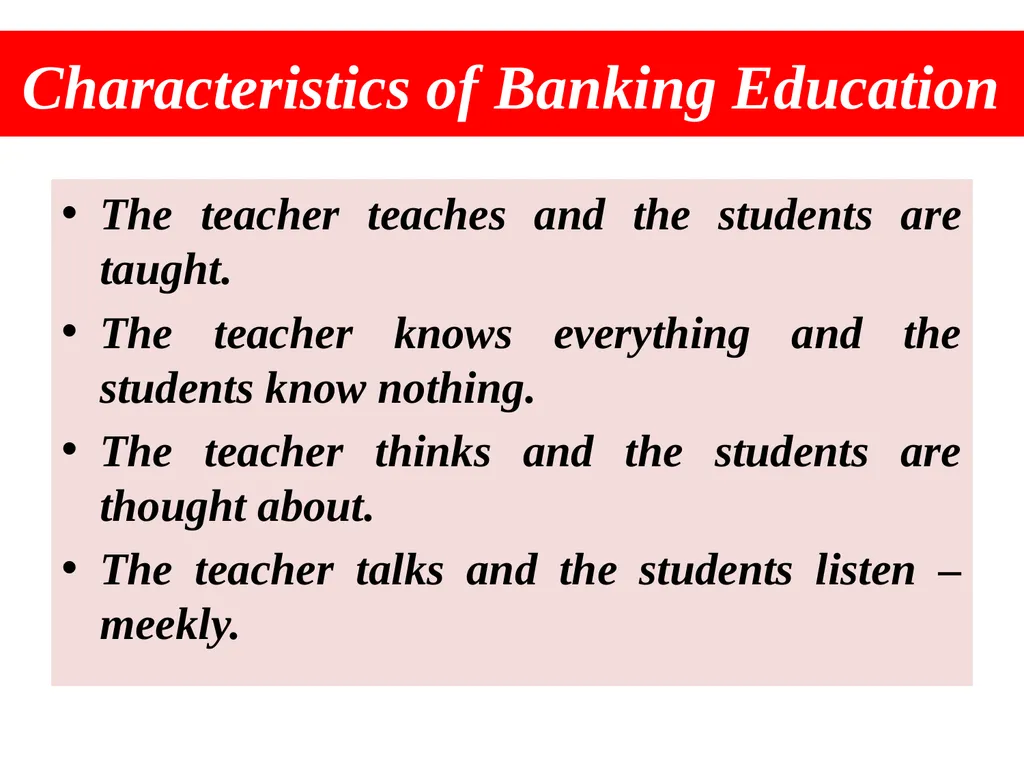
Characteristics of Banking Education The teacher teaches and the students are taught.
The teacher knows everything and the students know nothing.
The teacher thinks and the students are thought about.
The teacher talks and the students listen – meekly.<br>
06
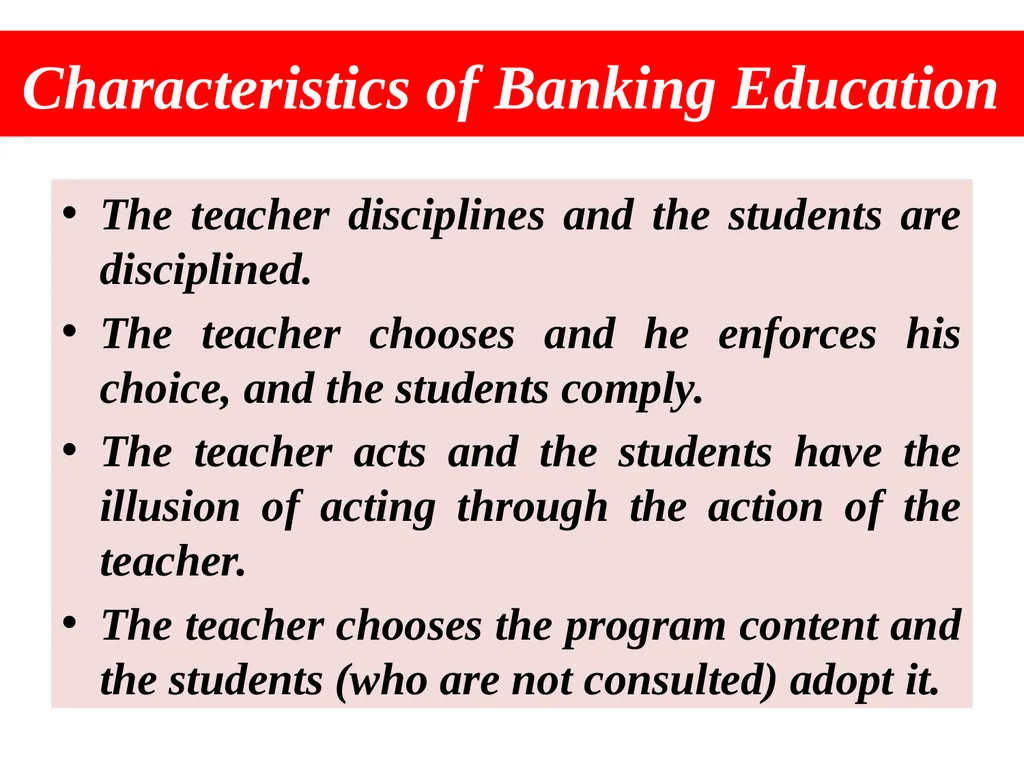
The teacher disciplines and the students are disciplined.
The teacher chooses and he enforces his choice, and the students comply.
The teacher acts and the students have the illusion of acting through the action of the teacher.
The teacher chooses the program content and the students (who are not consulted) adopt it. Characteristics of Banking Education<br>
07
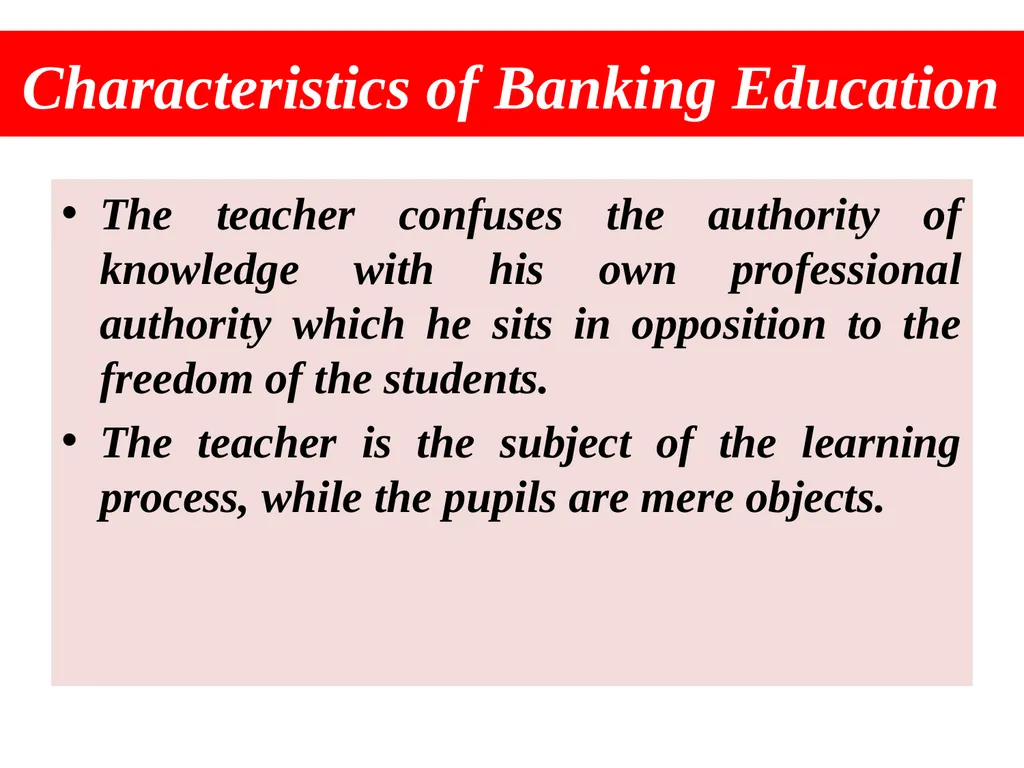
The teacher confuses the authority of knowledge with his own professional authority which he sits in opposition to the freedom of the students.
The teacher is the subject of the learning process, while the pupils are mere objects. Characteristics of Banking Education<br>
08
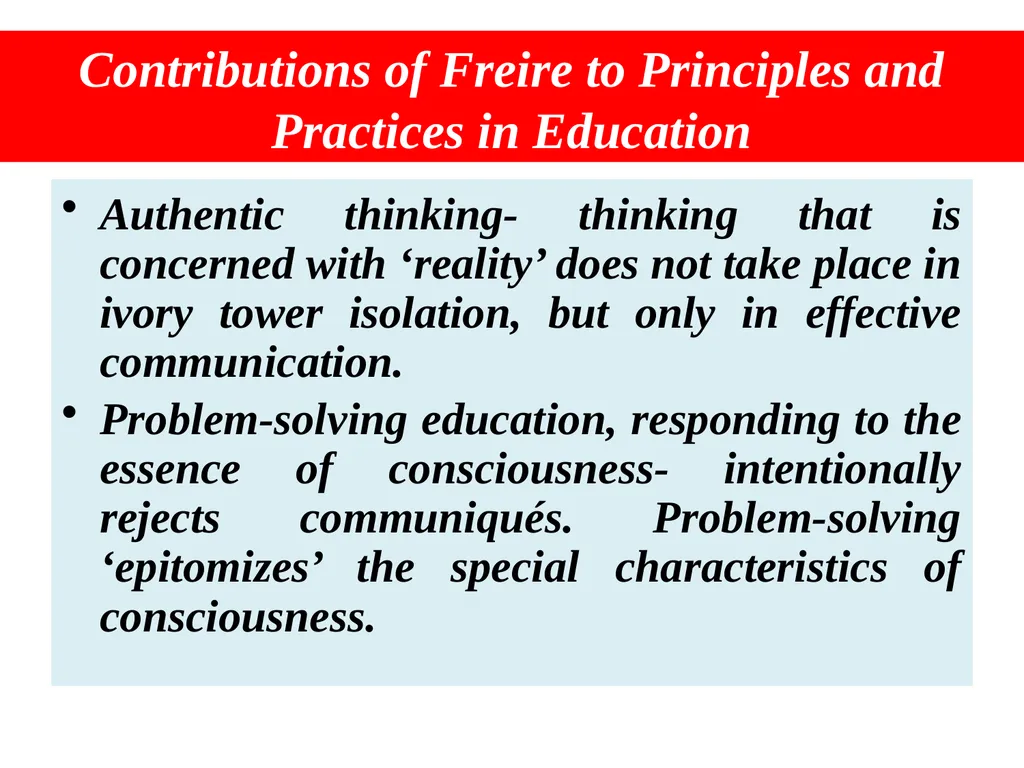
Contributions of Freire to Principles and Practices in Education Authentic thinking- thinking that is concerned with ‘reality’ does not take place in ivory tower isolation, but only in effective communication.
Problem-solving education, responding to the essence of consciousness- intentionally rejects communiqués. Problem-solving ‘epitomizes’ the special characteristics of consciousness.<br>
09
The movement of enquiry must be directed towards humanization. The pursuit of humanity cannot unfold in the antagonistic relation between oppressors and oppressed.
Teachers cannot think ‘without’ the pupils, nor ‘for’ the pupils but only ‘with’ the pupils.
In the banking system of education there should be a two-way traffic. The roles of the depositors, the prescribers and the receivers must be exchanged to a great measure. Contributions of Freire to Principles and Practices in Education<br>
10
There should be true communication between the teacher and the students. A teacher cannot think for his students. He also cannot impose his thought on them.
In the dialogical relations, no one teaches another, nor is anyone self-taught. People teach each other. Contributions of Freire to Principles and Practices in Education<br>
11
Dialogue cannot exist without humility.
Faith is an ‘ apriori’ requirement for dialogue.
Problem-solving in the dialogical system stimulates creativity and true reflection.
In the dialogical relations, arguments based on authority are no longer valid. Authority is on the ‘side’ of freedom, not ‘against’ it. Contributions of Freire to Principles and Practices in Education<br>