
Navigating DETC Accreditation DETC's Fall Workshop
Description: Navigating DETC Accreditation DETCs Fall Workshop October 14-16, 2012 Santa Fe, NM Paul McDonald Janet Perry Karen Smith, Ph.D. Leslie Gargiulo, Ph.D. 1 All standards Leslie Core Education standards -Janet Subject Specialists Report
Related Topics
Download Presentation
"Navigating DETC Accreditation DETC's Fall Workshop" is the property of its rightful owner. Permission is granted to download and print the materials on this website for personal, non-commercial use only, and to display it on your personal computer provided you do not modify the materials and that you retain all copyright notices contained in the materials. By downloading content from our website, you accept the terms of this agreement.
Presentation Transcript
slide1. Navigating DETC Accreditation DETC's Fall Workshop
October 14-16, 2012
Santa Fe, NM
Paul McDonald
Janet Perry
Karen Smith, Ph.D.
Leslie Gargiulo, Ph.D. 1<br>
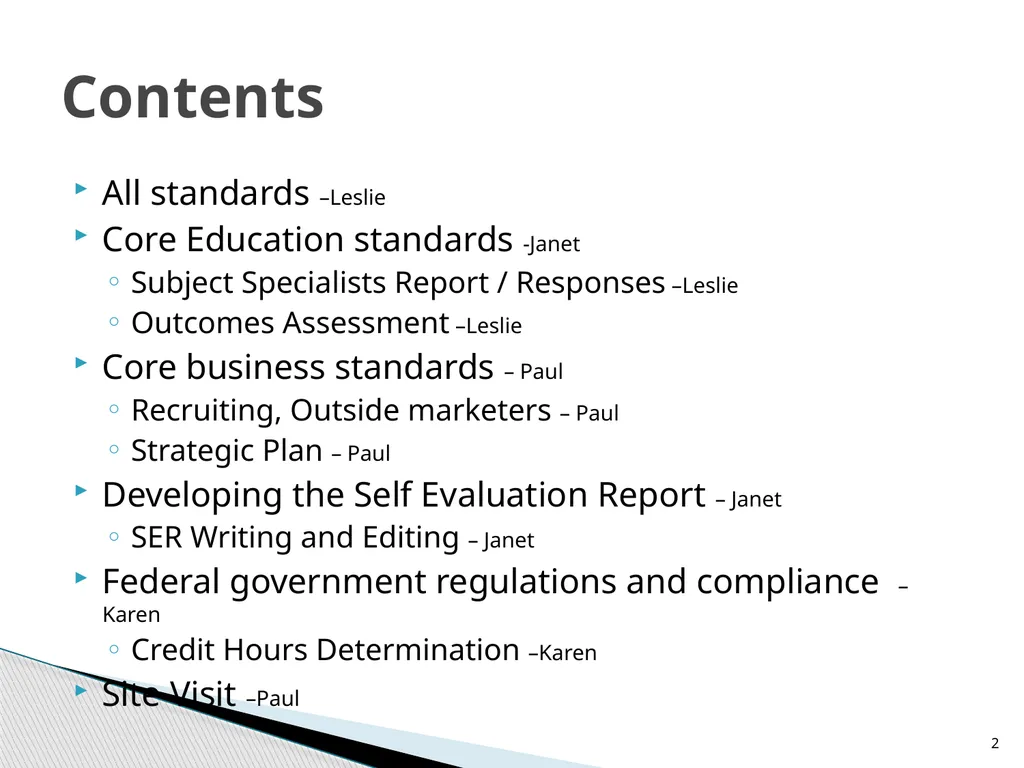
slide2. All standards –Leslie
Core Education standards -Janet
Subject Specialists Report / Responses –Leslie
Outcomes Assessment –Leslie
Core business standards – Paul
Recruiting, Outside marketers – Paul
Strategic Plan – Paul
Developing the Self Evaluation Report – Janet
SER Writing and Editing – Janet
Federal government regulations and compliance –Karen
Credit Hours Determination –Karen
Site Visit –Paul Contents 2<br>
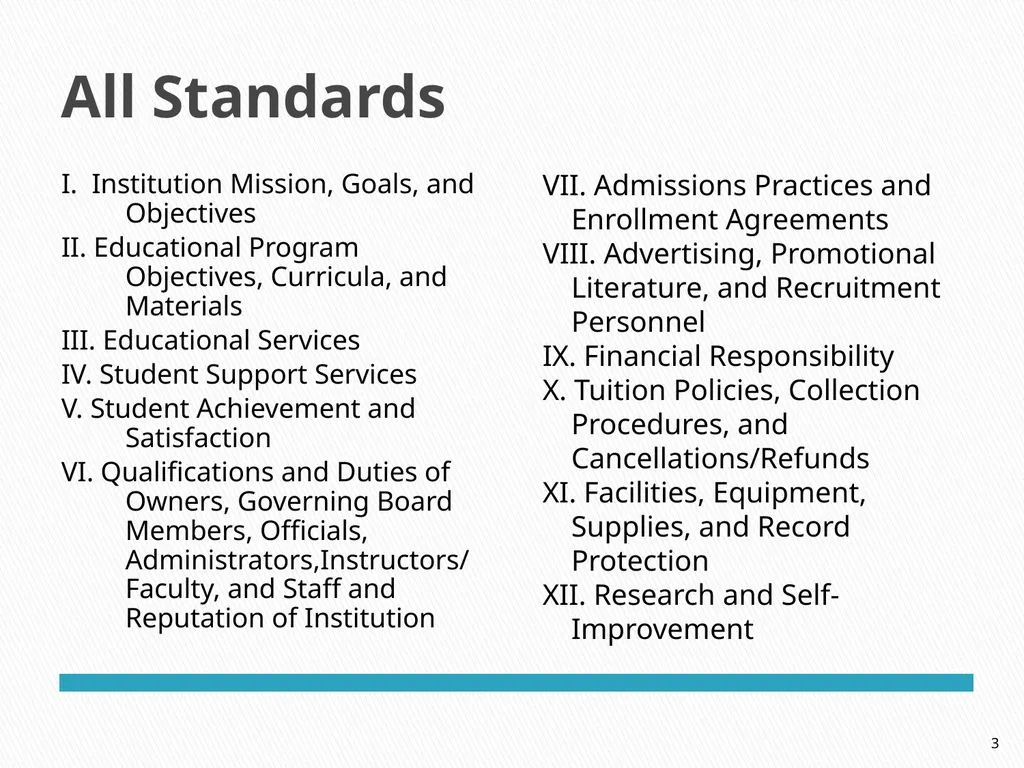
slide3. All Standards I. Institution Mission, Goals, and Objectives
II. Educational Program Objectives, Curricula, and Materials
III. Educational Services
IV. Student Support Services
V. Student Achievement and Satisfaction
VI. Qualifications and Duties of Owners, Governing Board Members, Officials, Administrators,Instructors/ Faculty, and Staff and Reputation of Institution VII. Admissions Practices and Enrollment Agreements
VIII. Advertising, Promotional Literature, and Recruitment Personnel
IX. Financial Responsibility
X. Tuition Policies, Collection Procedures, and Cancellations/Refunds
XI. Facilities, Equipment, Supplies, and Record Protection
XII. Research and Self-Improvement 3<br>
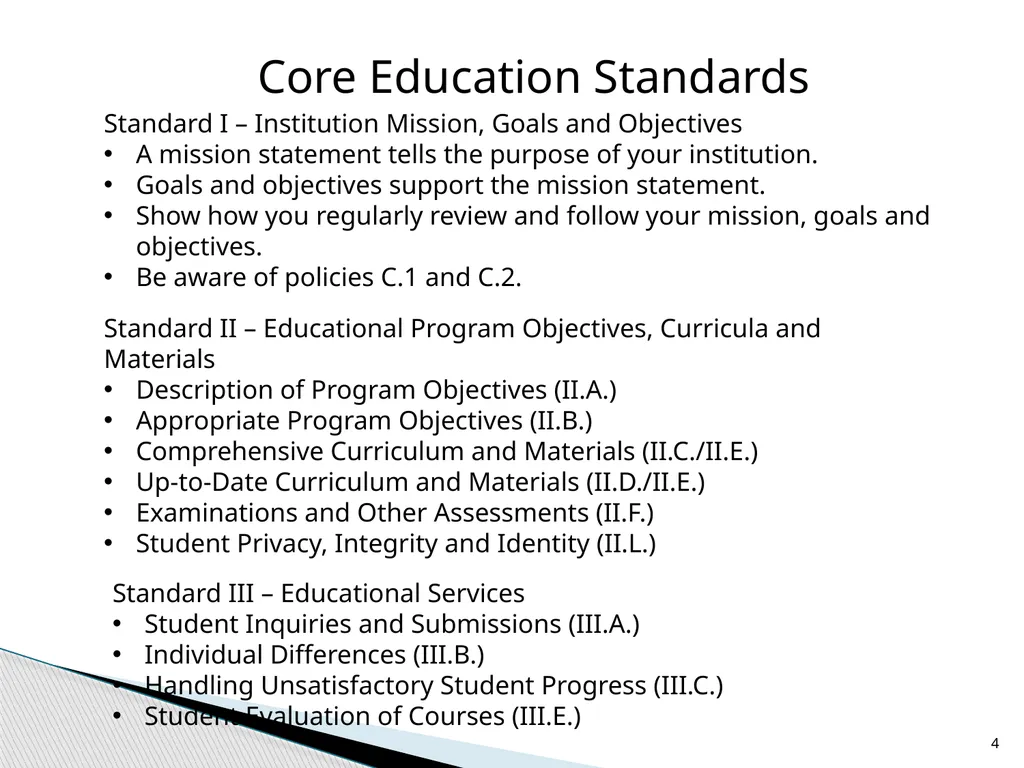
slide4. Standard I – Institution Mission, Goals and Objectives
A mission statement tells the purpose of your institution.
Goals and objectives support the mission statement.
Show how you regularly review and follow your mission, goals and objectives.
Be aware of policies C.1 and C.2. Standard II – Educational Program Objectives, Curricula and Materials
Description of Program Objectives (II.A.)
Appropriate Program Objectives (II.B.)
Comprehensive Curriculum and Materials (II.C./II.E.)
Up-to-Date Curriculum and Materials (II.D./II.E.)
Examinations and Other Assessments (II.F.)
Student Privacy, Integrity and Identity (II.L.) Standard III – Educational Services
Student Inquiries and Submissions (III.A.)
Individual Differences (III.B.)
Handling Unsatisfactory Student Progress (III.C.)
Student Evaluation of Courses (III.E.) Core Education Standards 4<br>
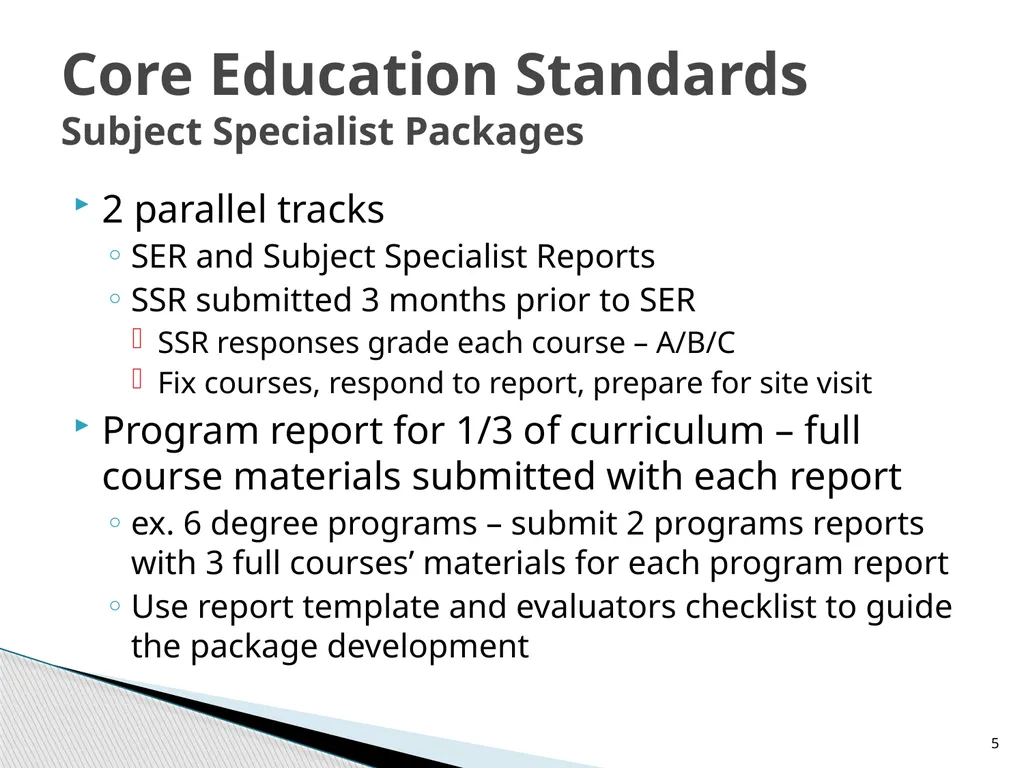
slide5. 2 parallel tracks
SER and Subject Specialist Reports
SSR submitted 3 months prior to SER
SSR responses grade each course – A/B/C
Fix courses, respond to report, prepare for site visit
Program report for 1/3 of curriculum – full course materials submitted with each report
ex. 6 degree programs – submit 2 programs reports with 3 full courses’ materials for each program report
Use report template and evaluators checklist to guide the package development Core Education Standards Subject Specialist Packages 5<br>
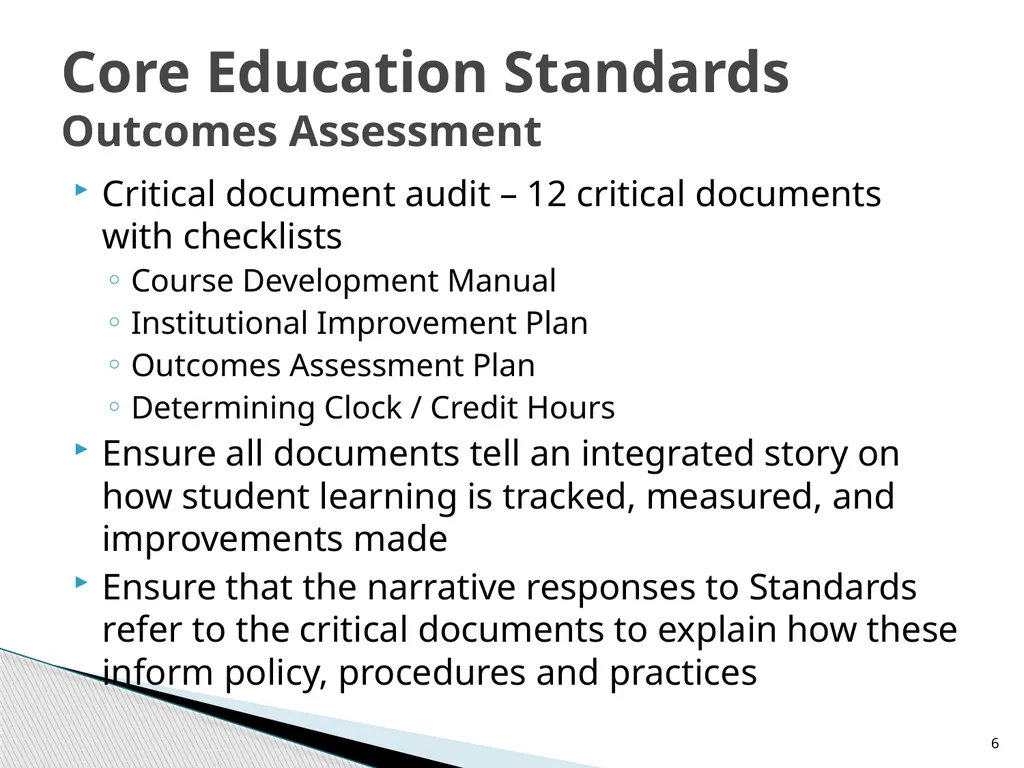
slide6. Critical document audit – 12 critical documents with checklists
Course Development Manual
Institutional Improvement Plan
Outcomes Assessment Plan
Determining Clock / Credit Hours
Ensure all documents tell an integrated story on how student learning is tracked, measured, and improvements made
Ensure that the narrative responses to Standards refer to the critical documents to explain how these inform policy, procedures and practices Core Education Standards Outcomes Assessment 6<br>
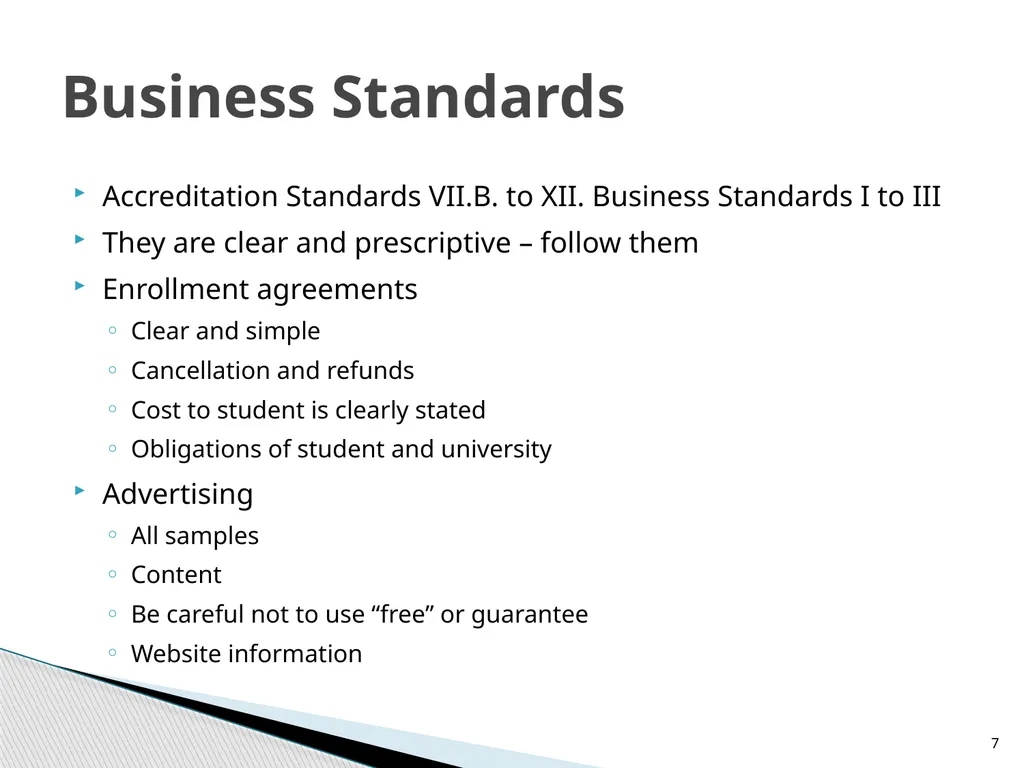
slide7. Business Standards Accreditation Standards VII.B. to XII. Business Standards I to III
They are clear and prescriptive – follow them
Enrollment agreements
Clear and simple
Cancellation and refunds
Cost to student is clearly stated
Obligations of student and university
Advertising
All samples
Content
Be careful not to use “free” or guarantee
Website information 7<br>
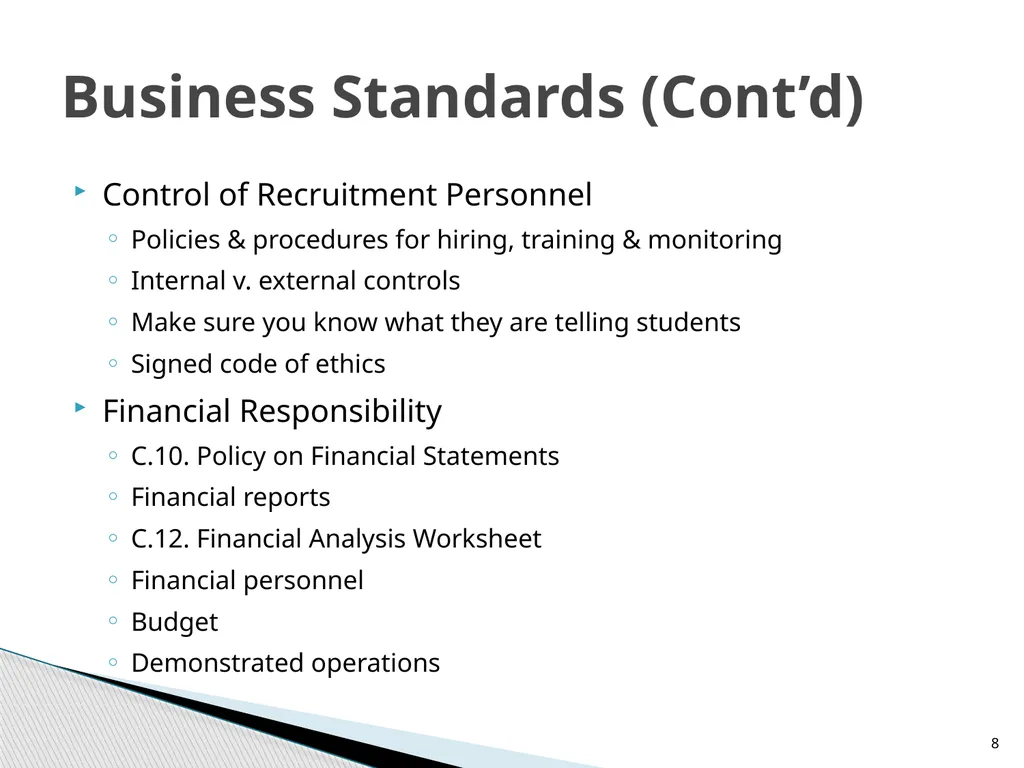
slide8. Business Standards (Cont’d) Control of Recruitment Personnel
Policies & procedures for hiring, training & monitoring
Internal v. external controls
Make sure you know what they are telling students
Signed code of ethics
Financial Responsibility
C.10. Policy on Financial Statements
Financial reports
C.12. Financial Analysis Worksheet
Financial personnel
Budget
Demonstrated operations 8<br>
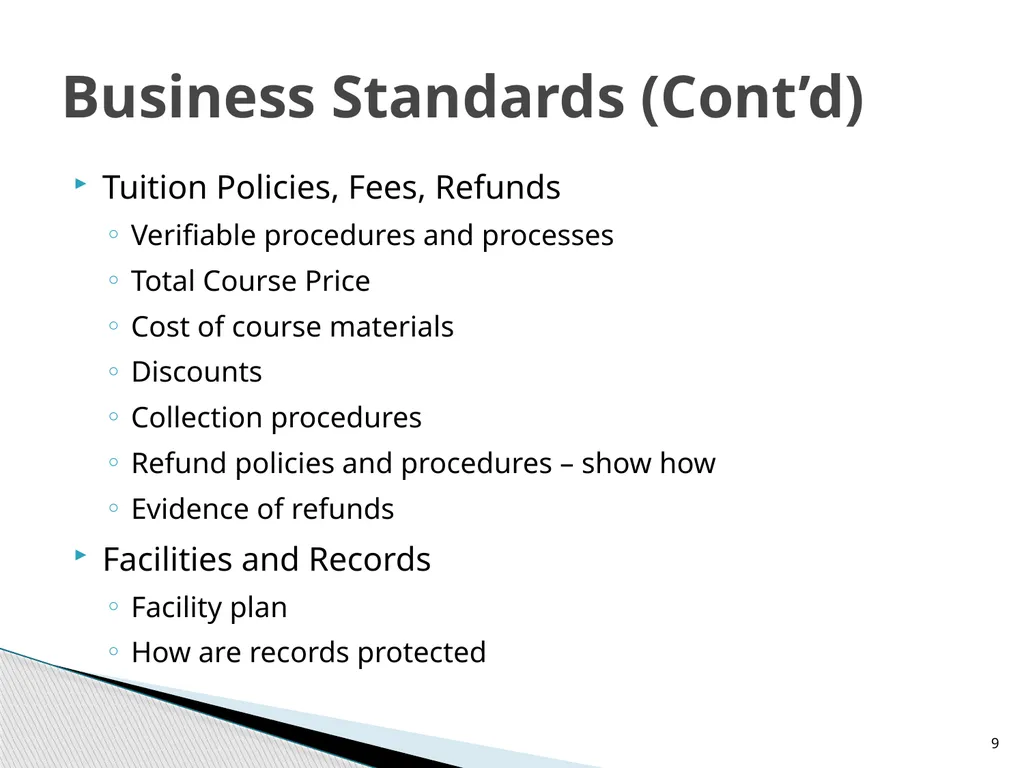
slide9. Business Standards (Cont’d) Tuition Policies, Fees, Refunds
Verifiable procedures and processes
Total Course Price
Cost of course materials
Discounts
Collection procedures
Refund policies and procedures – show how
Evidence of refunds
Facilities and Records
Facility plan
How are records protected 9<br>
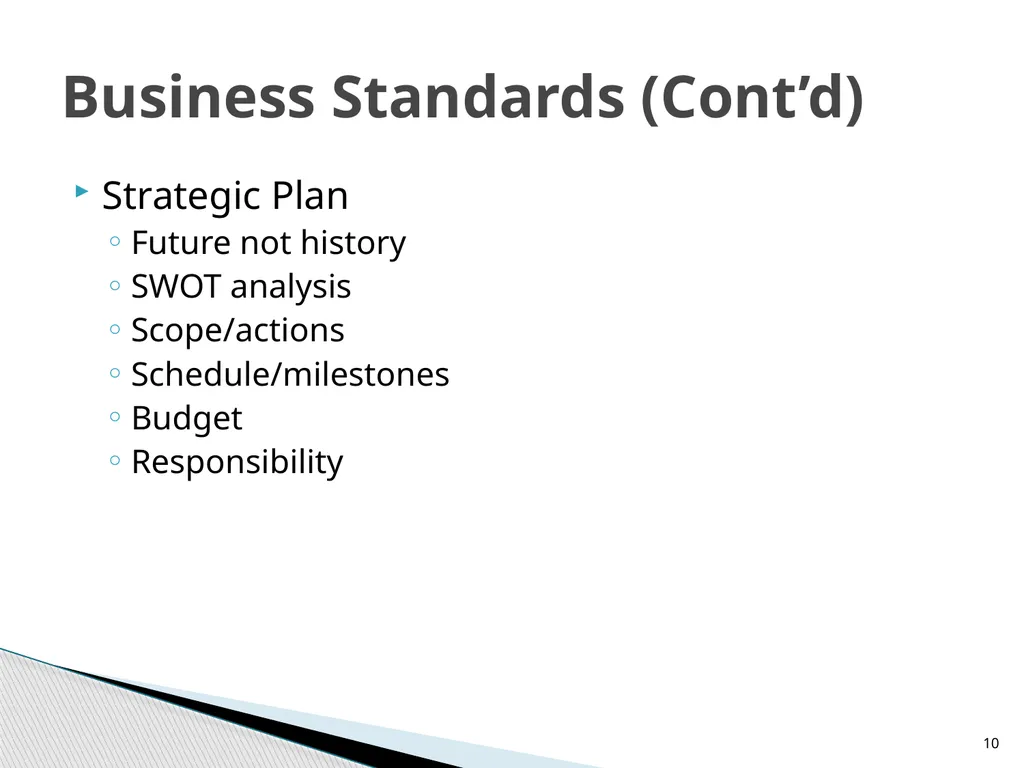
slide10. Business Standards (Cont’d) Strategic Plan
Future not history
SWOT analysis
Scope/actions
Schedule/milestones
Budget
Responsibility 10<br>
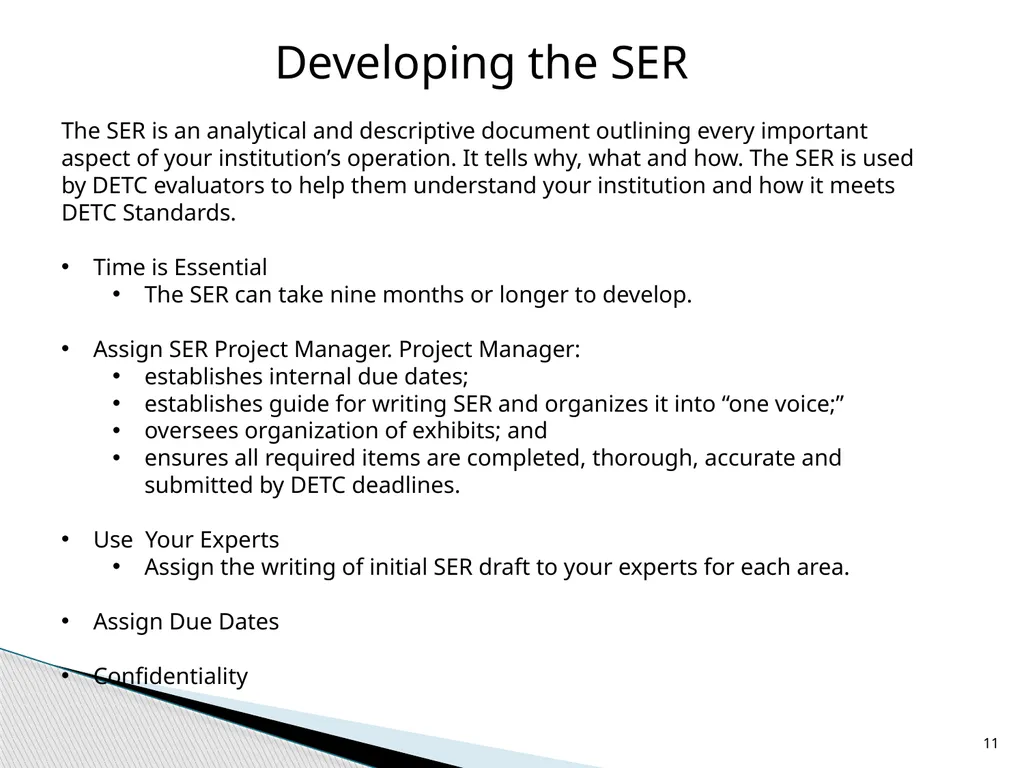
slide11. Developing the SER The SER is an analytical and descriptive document outlining every important aspect of your institution’s operation. It tells why, what and how. The SER is used by DETC evaluators to help them understand your institution and how it meets DETC Standards.
Time is Essential
The SER can take nine months or longer to develop.
Assign SER Project Manager. Project Manager:
establishes internal due dates;
establishes guide for writing SER and organizes it into “one voice;”
oversees organization of exhibits; and
ensures all required items are completed, thorough, accurate and submitted by DETC deadlines.
Use Your Experts
Assign the writing of initial SER draft to your experts for each area.
Assign Due Dates
Confidentiality 11<br>
slide12. Writing and Editing Your SER Read DETC instructions for completing the SER.
Answer each question honestly, factually, completely and concisely.
Use Standards as a guide for answering questions.
“Toot your horn.”
Identify challenges or weaknesses, and show how you are addressing them.
Take the reader step by step through procedures and processes.
If something is not applicable, make sure you state “not applicable.”
Include table of contents.
Final SER should be in “one voice.”
Provide contact person for each Standard topic.
Provide all required exhibits.
Edit, edit, edit.
Content
Typos
Grammar/Usage
Voice
Exhibits 12<br>
slide13. Gainful Employment in a Recognized Occupation
Consumer Protection for Misleading Information, Recruiting, and State Oversight
Ensuring Only Eligible Students Receive Federal Funds
Clarification of Federal Aid Eligible Courses and Allocation DoE Regulations on Program Integrity 13<br>
slide14. Proxy Measure of a Quantity of Student Learning
Carnegie Unit
Level of Instruction
Academic Rigor
Course Time Requirements Credit Hour Determination 14<br>
slide15. The Site Visit – Before Before – Developing the SER
Follow timeline – stay up with the changes
Wide participation but one project manager
Write in basic English – edit
Follow current format
Use the evaluator’s form as a checklist
Consultants?
Read D.6. “Undergoing an Onsite Visit” 15<br>
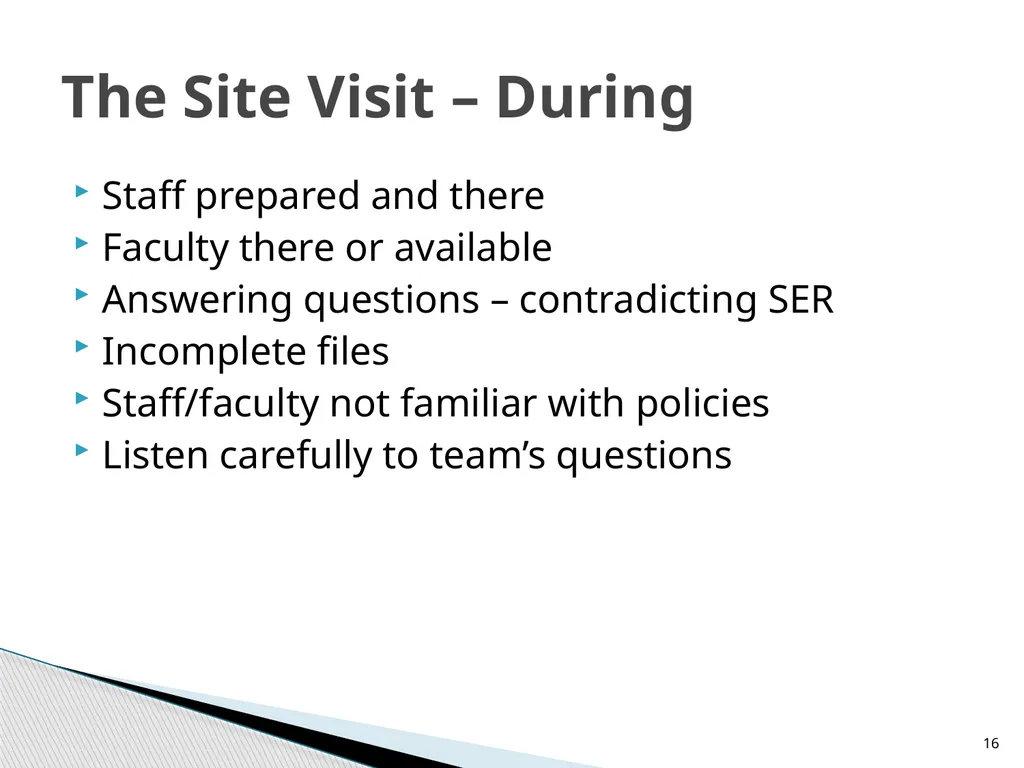
slide16. The Site Visit – During Staff prepared and there
Faculty there or available
Answering questions – contradicting SER
Incomplete files
Staff/faculty not familiar with policies
Listen carefully to team’s questions 16<br>
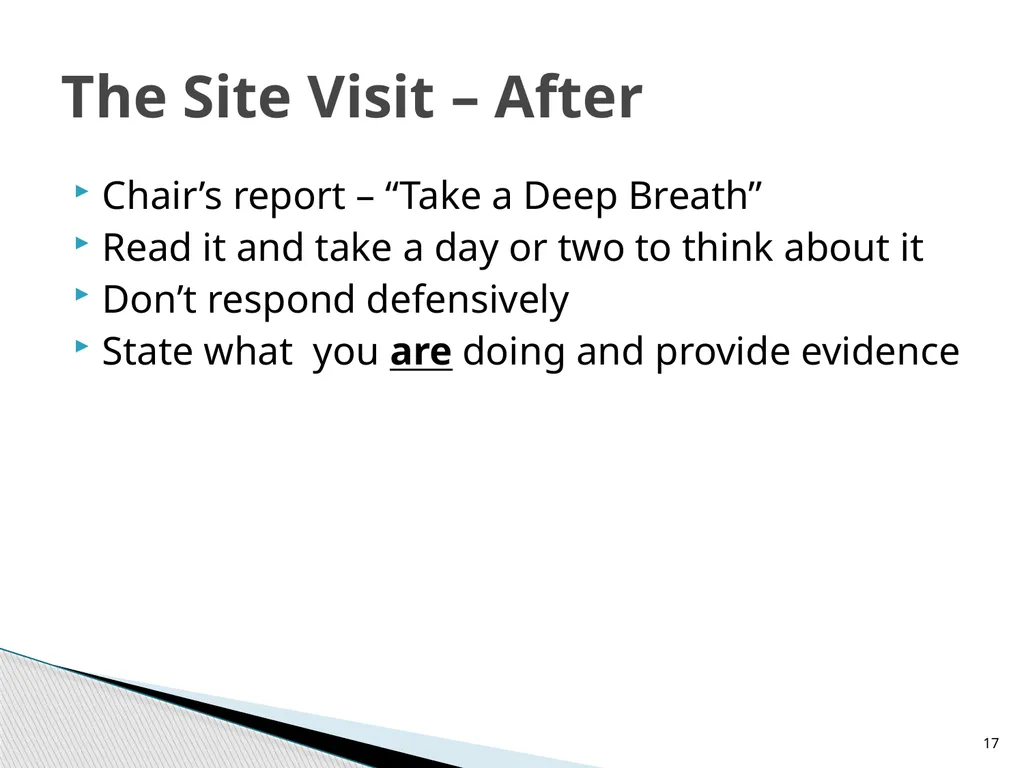
slide17. The Site Visit – After Chair’s report – “Take a Deep Breath”
Read it and take a day or two to think about it
Don’t respond defensively
State what you are doing and provide evidence 17<br>
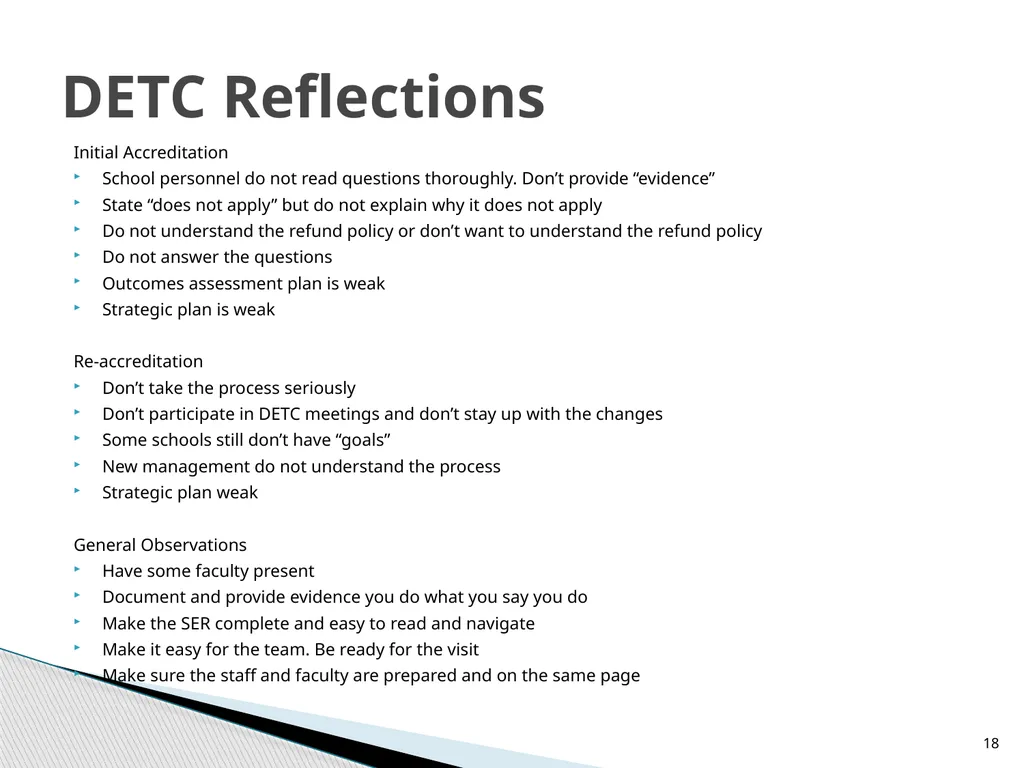
slide18. Initial Accreditation
School personnel do not read questions thoroughly. Don’t provide “evidence”
State “does not apply” but do not explain why it does not apply
Do not understand the refund policy or don’t want to understand the refund policy
Do not answer the questions
Outcomes assessment plan is weak
Strategic plan is weak
Re-accreditation
Don’t take the process seriously
Don’t participate in DETC meetings and don’t stay up with the changes
Some schools still don’t have “goals”
New management do not understand the process
Strategic plan weak
General Observations
Have some faculty present
Document and provide evidence you do what you say you do
Make the SER complete and easy to read and navigate
Make it easy for the team. Be ready for the visit
Make sure the staff and faculty are prepared and on the same page DETC Reflections 18<br>
slide19. ?? Questions 19<br>
Paul McDonald
Janet Perry
Karen Smith, Ph.D.
Leslie Gargiulo, Ph.D. 1<br>
slide2. All standards –Leslie
Core Education standards -Janet
Subject Specialists Report / Responses –Leslie
Outcomes Assessment –Leslie
Core business standards – Paul
Recruiting, Outside marketers – Paul
Strategic Plan – Paul
Developing the Self Evaluation Report – Janet
SER Writing and Editing – Janet
Federal government regulations and compliance –Karen
Credit Hours Determination –Karen
Site Visit –Paul Contents 2<br>
slide3. All Standards I. Institution Mission, Goals, and Objectives
II. Educational Program Objectives, Curricula, and Materials
III. Educational Services
IV. Student Support Services
V. Student Achievement and Satisfaction
VI. Qualifications and Duties of Owners, Governing Board Members, Officials, Administrators,Instructors/ Faculty, and Staff and Reputation of Institution VII. Admissions Practices and Enrollment Agreements
VIII. Advertising, Promotional Literature, and Recruitment Personnel
IX. Financial Responsibility
X. Tuition Policies, Collection Procedures, and Cancellations/Refunds
XI. Facilities, Equipment, Supplies, and Record Protection
XII. Research and Self-Improvement 3<br>
slide4. Standard I – Institution Mission, Goals and Objectives
A mission statement tells the purpose of your institution.
Goals and objectives support the mission statement.
Show how you regularly review and follow your mission, goals and objectives.
Be aware of policies C.1 and C.2. Standard II – Educational Program Objectives, Curricula and Materials
Description of Program Objectives (II.A.)
Appropriate Program Objectives (II.B.)
Comprehensive Curriculum and Materials (II.C./II.E.)
Up-to-Date Curriculum and Materials (II.D./II.E.)
Examinations and Other Assessments (II.F.)
Student Privacy, Integrity and Identity (II.L.) Standard III – Educational Services
Student Inquiries and Submissions (III.A.)
Individual Differences (III.B.)
Handling Unsatisfactory Student Progress (III.C.)
Student Evaluation of Courses (III.E.) Core Education Standards 4<br>
slide5. 2 parallel tracks
SER and Subject Specialist Reports
SSR submitted 3 months prior to SER
SSR responses grade each course – A/B/C
Fix courses, respond to report, prepare for site visit
Program report for 1/3 of curriculum – full course materials submitted with each report
ex. 6 degree programs – submit 2 programs reports with 3 full courses’ materials for each program report
Use report template and evaluators checklist to guide the package development Core Education Standards Subject Specialist Packages 5<br>
slide6. Critical document audit – 12 critical documents with checklists
Course Development Manual
Institutional Improvement Plan
Outcomes Assessment Plan
Determining Clock / Credit Hours
Ensure all documents tell an integrated story on how student learning is tracked, measured, and improvements made
Ensure that the narrative responses to Standards refer to the critical documents to explain how these inform policy, procedures and practices Core Education Standards Outcomes Assessment 6<br>
slide7. Business Standards Accreditation Standards VII.B. to XII. Business Standards I to III
They are clear and prescriptive – follow them
Enrollment agreements
Clear and simple
Cancellation and refunds
Cost to student is clearly stated
Obligations of student and university
Advertising
All samples
Content
Be careful not to use “free” or guarantee
Website information 7<br>
slide8. Business Standards (Cont’d) Control of Recruitment Personnel
Policies & procedures for hiring, training & monitoring
Internal v. external controls
Make sure you know what they are telling students
Signed code of ethics
Financial Responsibility
C.10. Policy on Financial Statements
Financial reports
C.12. Financial Analysis Worksheet
Financial personnel
Budget
Demonstrated operations 8<br>
slide9. Business Standards (Cont’d) Tuition Policies, Fees, Refunds
Verifiable procedures and processes
Total Course Price
Cost of course materials
Discounts
Collection procedures
Refund policies and procedures – show how
Evidence of refunds
Facilities and Records
Facility plan
How are records protected 9<br>
slide10. Business Standards (Cont’d) Strategic Plan
Future not history
SWOT analysis
Scope/actions
Schedule/milestones
Budget
Responsibility 10<br>
slide11. Developing the SER The SER is an analytical and descriptive document outlining every important aspect of your institution’s operation. It tells why, what and how. The SER is used by DETC evaluators to help them understand your institution and how it meets DETC Standards.
Time is Essential
The SER can take nine months or longer to develop.
Assign SER Project Manager. Project Manager:
establishes internal due dates;
establishes guide for writing SER and organizes it into “one voice;”
oversees organization of exhibits; and
ensures all required items are completed, thorough, accurate and submitted by DETC deadlines.
Use Your Experts
Assign the writing of initial SER draft to your experts for each area.
Assign Due Dates
Confidentiality 11<br>
slide12. Writing and Editing Your SER Read DETC instructions for completing the SER.
Answer each question honestly, factually, completely and concisely.
Use Standards as a guide for answering questions.
“Toot your horn.”
Identify challenges or weaknesses, and show how you are addressing them.
Take the reader step by step through procedures and processes.
If something is not applicable, make sure you state “not applicable.”
Include table of contents.
Final SER should be in “one voice.”
Provide contact person for each Standard topic.
Provide all required exhibits.
Edit, edit, edit.
Content
Typos
Grammar/Usage
Voice
Exhibits 12<br>
slide13. Gainful Employment in a Recognized Occupation
Consumer Protection for Misleading Information, Recruiting, and State Oversight
Ensuring Only Eligible Students Receive Federal Funds
Clarification of Federal Aid Eligible Courses and Allocation DoE Regulations on Program Integrity 13<br>
slide14. Proxy Measure of a Quantity of Student Learning
Carnegie Unit
Level of Instruction
Academic Rigor
Course Time Requirements Credit Hour Determination 14<br>
slide15. The Site Visit – Before Before – Developing the SER
Follow timeline – stay up with the changes
Wide participation but one project manager
Write in basic English – edit
Follow current format
Use the evaluator’s form as a checklist
Consultants?
Read D.6. “Undergoing an Onsite Visit” 15<br>
slide16. The Site Visit – During Staff prepared and there
Faculty there or available
Answering questions – contradicting SER
Incomplete files
Staff/faculty not familiar with policies
Listen carefully to team’s questions 16<br>
slide17. The Site Visit – After Chair’s report – “Take a Deep Breath”
Read it and take a day or two to think about it
Don’t respond defensively
State what you are doing and provide evidence 17<br>
slide18. Initial Accreditation
School personnel do not read questions thoroughly. Don’t provide “evidence”
State “does not apply” but do not explain why it does not apply
Do not understand the refund policy or don’t want to understand the refund policy
Do not answer the questions
Outcomes assessment plan is weak
Strategic plan is weak
Re-accreditation
Don’t take the process seriously
Don’t participate in DETC meetings and don’t stay up with the changes
Some schools still don’t have “goals”
New management do not understand the process
Strategic plan weak
General Observations
Have some faculty present
Document and provide evidence you do what you say you do
Make the SER complete and easy to read and navigate
Make it easy for the team. Be ready for the visit
Make sure the staff and faculty are prepared and on the same page DETC Reflections 18<br>
slide19. ?? Questions 19<br>