
NCHRP 20-89 - Intellectual Property Management
NS
Published · 100 slides · 0 views

1 / 1
Description
NCHRP 20-89 - Intellectual Property Management Guide for State Departments of Transportation 1 Project Team Briefing Content Research Motivation Objective Research Approach Tasks Research Findings Recommendations Research Motivation
Related Topics
Share
Embed code
Download this presentation From Below
"NCHRP 20-89 - Intellectual Property Management" is the property of its rightful owner. Permission is granted to download and print the materials on this website for personal, non-commercial use only, and to display it on your personal computer provided you do not modify the materials and that you retain all copyright notices contained in the materials. By downloading content from our website, you accept the terms of this agreement.
Presentation Transcript
01
NCHRP 20-89 - Intellectual Property Management Guide for State Departments of Transportation 1<br>
02
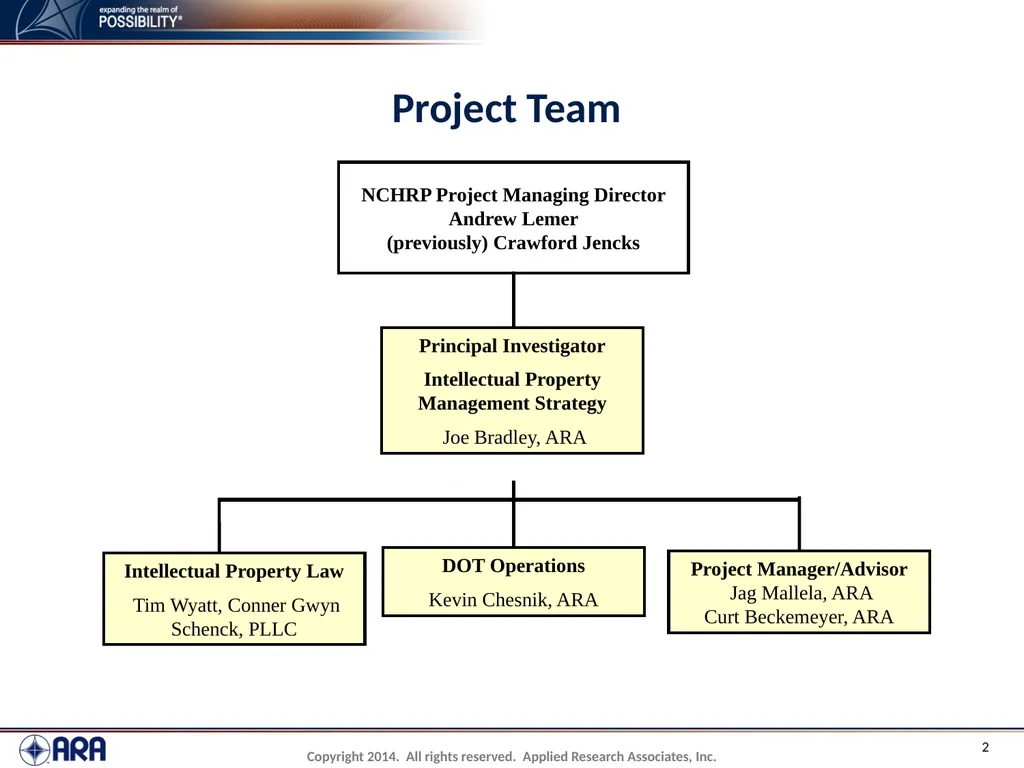
Project Team<br>
03
Briefing Content Research Motivation & Objective
Research Approach & Tasks
Research Findings
Recommendations<br>
Research Approach & Tasks
Research Findings
Recommendations<br>
04
Research Motivation & Objective<br>
05
Research Motivating Situation In 2008, the FHWA, AASHTO, and NCHRP sponsored a scan of international transportation research programs to access international practices and identify ways that the United States might benefit. One interesting finding was that, in European and Asian countries, IP was one measure of the effectiveness of transportation research programs and was viewed as a key to national economic growth.
U.S. transportation research organizations may benefit from an understanding of intellectual property risks, benefits, and management.<br>
U.S. transportation research organizations may benefit from an understanding of intellectual property risks, benefits, and management.<br>
06
Research Objectives The objective of this research is to develop an intellectual property management guide for state DOTs that will provide:
General definitions and background details regarding intellectual property.
A framework for intellectual property management.
A process/methodology for managing intellectual property.<br>
General definitions and background details regarding intellectual property.
A framework for intellectual property management.
A process/methodology for managing intellectual property.<br>
07
Project Scope Define the nature and types of intellectual property.
Document laws that govern and impact intellectual property and intellectual property management.
Document and suggest intellectual property management strategies.
Define and formalize a process for identifying and managing intellectual property assets.
Develop a practical guide for decision-makers.<br>
Document laws that govern and impact intellectual property and intellectual property management.
Document and suggest intellectual property management strategies.
Define and formalize a process for identifying and managing intellectual property assets.
Develop a practical guide for decision-makers.<br>
08
The WORK That was Done<br>
09
Project Tasks and Activities Collected and reviewed information/literature relevant to intellectual property, intellectual property management, and intellectual property law.
Surveyed state DOT personnel to assess current practices in managing intellectual property.
Investigated approaches to intellectual property management in comparable scientific and technical disciplines and similar organizations (e.g., universities, state DOTs, private organizations, public organizations).
Prepared an intellectual property management guidebook.
Prepared a final report.
Prepared a briefing on the overall research project.<br>
Surveyed state DOT personnel to assess current practices in managing intellectual property.
Investigated approaches to intellectual property management in comparable scientific and technical disciplines and similar organizations (e.g., universities, state DOTs, private organizations, public organizations).
Prepared an intellectual property management guidebook.
Prepared a final report.
Prepared a briefing on the overall research project.<br>
10
Information Gathering Reviewed literature on intellectual property and intellectual property management.
What is it?
Why is it important?
What are some methods of practice, policy, and overall goals?
Assessed current intellectual property management (IPM) practices within state DOTs along with discussions with RAC members.
Phone calls.
Email correspondence with several organizations.
Surveys.
Reviewed IPM practices by both public and private organizations.<br>
What is it?
Why is it important?
What are some methods of practice, policy, and overall goals?
Assessed current intellectual property management (IPM) practices within state DOTs along with discussions with RAC members.
Phone calls.
Email correspondence with several organizations.
Surveys.
Reviewed IPM practices by both public and private organizations.<br>
11
Research Findings
Introduction to Intellectual Property<br>
12
What is Intellectual Property?<br>
13
Definition of Intellectual Property Intellectual property refers to the creative activities of literary, artistic, and scientific works, performances of performing artist, and broadcasts; inventions in all fields of human endeavor; scientific discoveries; industrial design; trademarks, service marks, and commercial names, designations, protection against unfair competition, and all other rights resulting from intellectual activity in the industrial, scientific, literary or artistic fields.
(World Intellectual Property Organization (WIPO), 1967, Article 2)<br>
(World Intellectual Property Organization (WIPO), 1967, Article 2)<br>
14
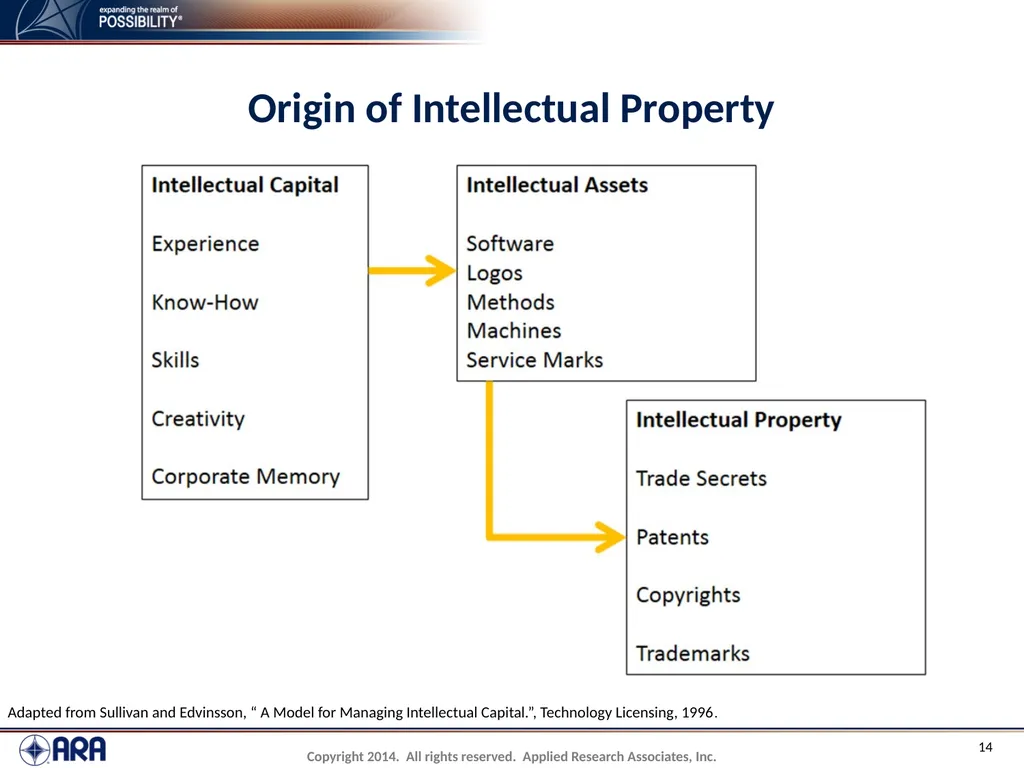
Origin of Intellectual Property Adapted from Sullivan and Edvinsson, “ A Model for Managing Intellectual Capital.”, Technology Licensing, 1996.<br>
15
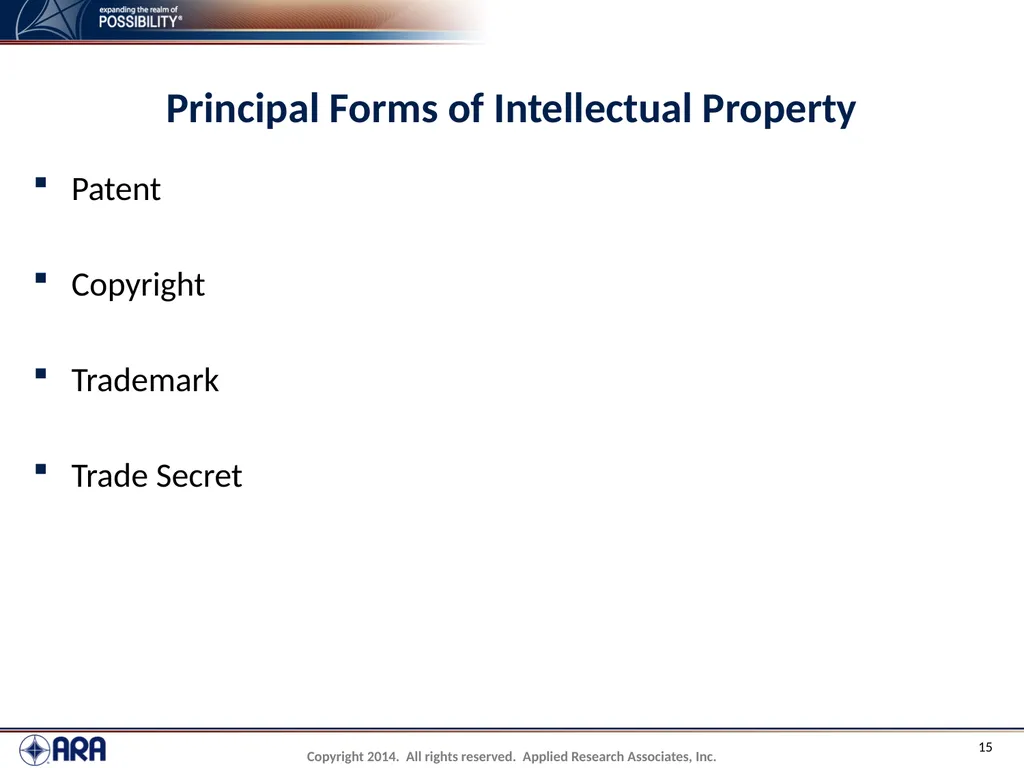
Principal Forms of Intellectual Property Patent
Copyright
Trademark
Trade Secret<br>
Copyright
Trademark
Trade Secret<br>
16
What is a Patent?<br>
17
What is a Patent? A patent is a property right granted by the government to the inventor for a limited time in exchange for public disclosure of the invention. It allows the inventor to exclude others from making, using, offering for sale, selling the invention, or importing a claimed invention in the country where the asset is protected.<br>
18
Types of Patents Utility patent covers the functionality aspects of machines, processes, compositions of matter, and/or articles of manufacture. This is the most common type of patent and typically provides the most value and protection for a given invention.
Design patent covers the ornamental design of manufactured artifacts, not the process or methods of manufacture.
Plant patent cover new varieties of asexual reproducing plants, either invented or discovered.<br>
Design patent covers the ornamental design of manufactured artifacts, not the process or methods of manufacture.
Plant patent cover new varieties of asexual reproducing plants, either invented or discovered.<br>
19
Criteria for Patent New (35 U.S.C § 102)
The present invention cannot be covered in any prior art. Prior art pertains to any subject matter prior to filing the patent application. The invention must not be published, be on sale, or be in use more than one year before the patent application filing date.
Useful (35 U.S.C § 101)
The present invention must explicitly show that it will achieve a particular benefit. The invention must not be immoral or contrary to public policy.<br>
The present invention cannot be covered in any prior art. Prior art pertains to any subject matter prior to filing the patent application. The invention must not be published, be on sale, or be in use more than one year before the patent application filing date.
Useful (35 U.S.C § 101)
The present invention must explicitly show that it will achieve a particular benefit. The invention must not be immoral or contrary to public policy.<br>
20
Criteria for Patent Non-obvious (35 U.S.C § 103)
The present invention must be creative or distinct enough that an individual of ordinary skill in that relevant subject matter field would not be able to readily deduce the invention from publicly available resources.
Fully Disclosed (35 U.S.C § 112)
The inventor must provide a description of the invention, the manner and process of making and using the invention, and the best manner of practicing this invention that is known to the inventor.<br>
The present invention must be creative or distinct enough that an individual of ordinary skill in that relevant subject matter field would not be able to readily deduce the invention from publicly available resources.
Fully Disclosed (35 U.S.C § 112)
The inventor must provide a description of the invention, the manner and process of making and using the invention, and the best manner of practicing this invention that is known to the inventor.<br>
21
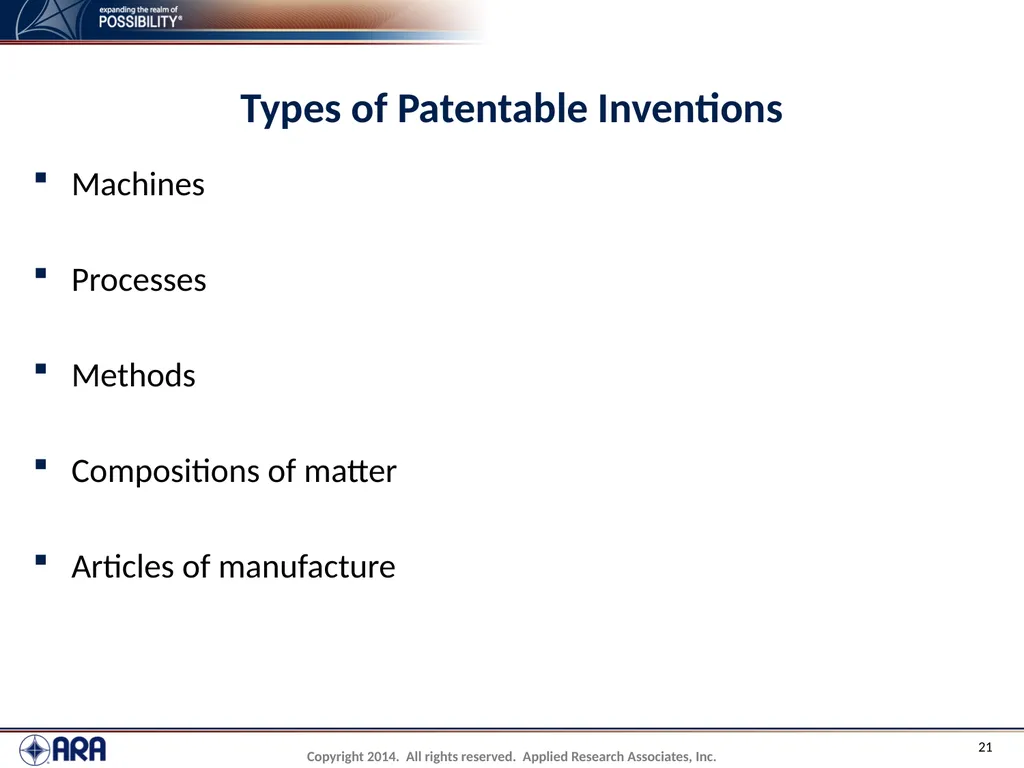
Types of Patentable Inventions Machines
Processes
Methods
Compositions of matter
Articles of manufacture<br>
Processes
Methods
Compositions of matter
Articles of manufacture<br>
22
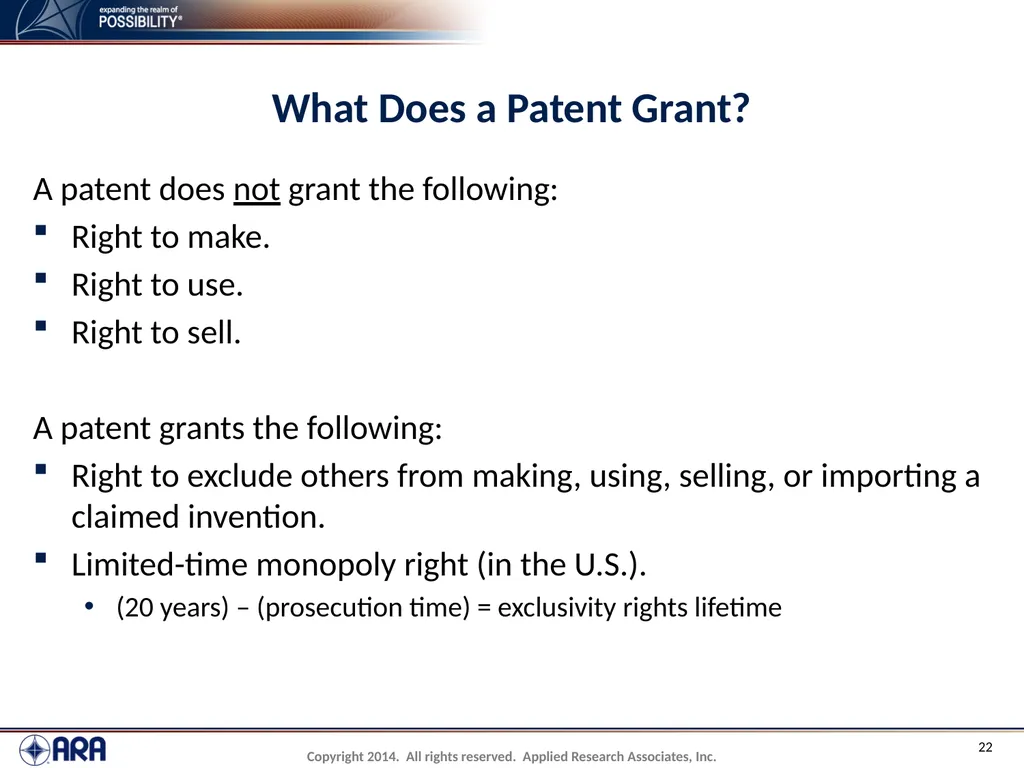
What Does a Patent Grant? A patent does not grant the following:
Right to make.
Right to use.
Right to sell.
A patent grants the following:
Right to exclude others from making, using, selling, or importing a claimed invention.
Limited-time monopoly right (in the U.S.).
(20 years) – (prosecution time) = exclusivity rights lifetime<br>
Right to make.
Right to use.
Right to sell.
A patent grants the following:
Right to exclude others from making, using, selling, or importing a claimed invention.
Limited-time monopoly right (in the U.S.).
(20 years) – (prosecution time) = exclusivity rights lifetime<br>
23
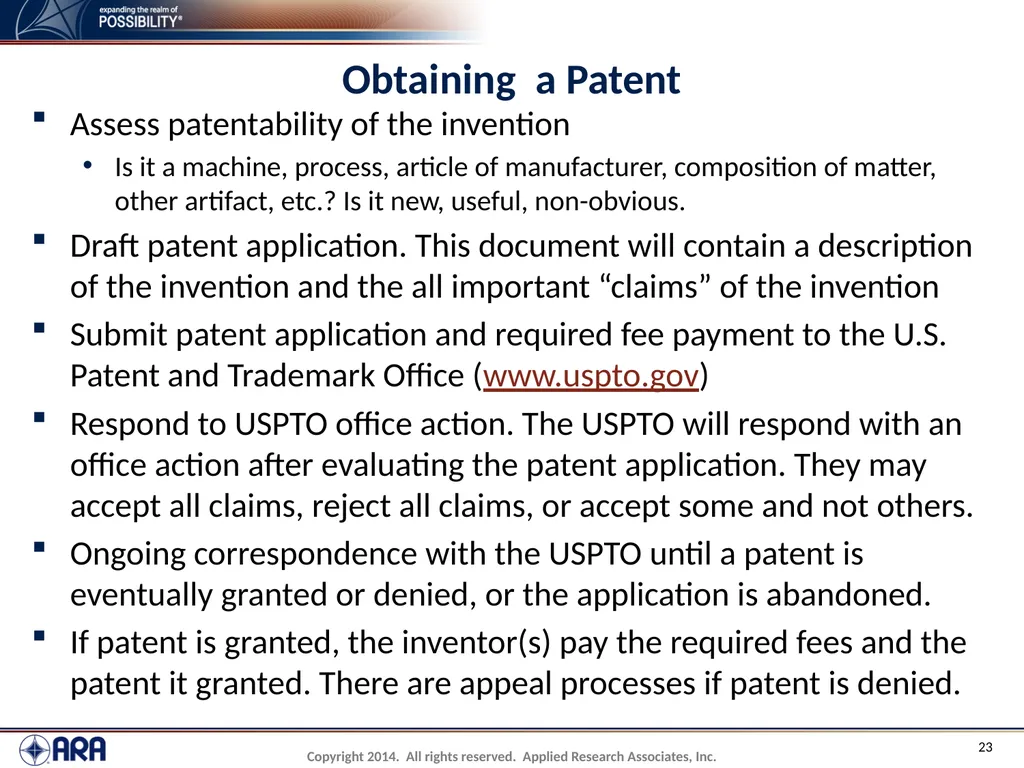
Obtaining a Patent Assess patentability of the invention
Is it a machine, process, article of manufacturer, composition of matter, other artifact, etc.? Is it new, useful, non-obvious.
Draft patent application. This document will contain a description of the invention and the all important “claims” of the invention
Submit patent application and required fee payment to the U.S. Patent and Trademark Office (www.uspto.gov)
Respond to USPTO office action. The USPTO will respond with an office action after evaluating the patent application. They may accept all claims, reject all claims, or accept some and not others.
Ongoing correspondence with the USPTO until a patent is eventually granted or denied, or the application is abandoned.
If patent is granted, the inventor(s) pay the required fees and the patent it granted. There are appeal processes if patent is denied.<br>
Is it a machine, process, article of manufacturer, composition of matter, other artifact, etc.? Is it new, useful, non-obvious.
Draft patent application. This document will contain a description of the invention and the all important “claims” of the invention
Submit patent application and required fee payment to the U.S. Patent and Trademark Office (www.uspto.gov)
Respond to USPTO office action. The USPTO will respond with an office action after evaluating the patent application. They may accept all claims, reject all claims, or accept some and not others.
Ongoing correspondence with the USPTO until a patent is eventually granted or denied, or the application is abandoned.
If patent is granted, the inventor(s) pay the required fees and the patent it granted. There are appeal processes if patent is denied.<br>
24
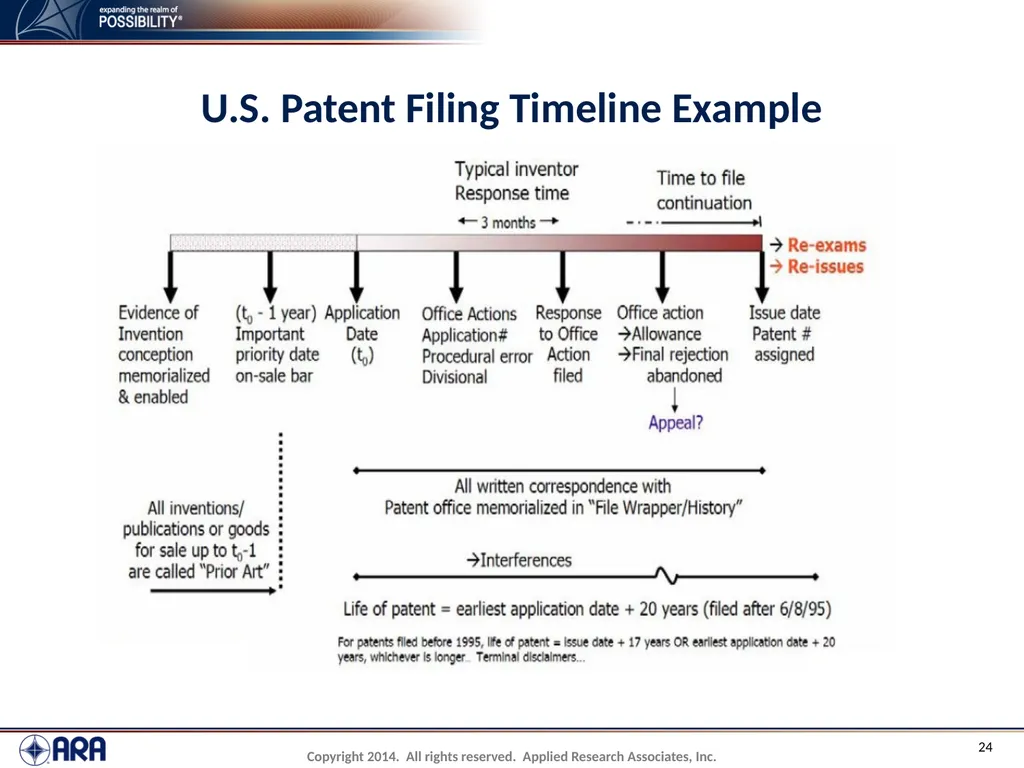
U.S. Patent Filing Timeline Example<br>
25
Notice of Patent The patentee may notify the public of the existence of the patent by adding the words "patented" or "U.S. Patent No." along with the patent number.
This notice is marked on the articles that are marketed or sold based on the patented invention.
Upon filing a non-provisional patent, the inventor may include the notice “Patent Pending” for the invention.<br>
This notice is marked on the articles that are marketed or sold based on the patented invention.
Upon filing a non-provisional patent, the inventor may include the notice “Patent Pending” for the invention.<br>
26
What is A copyright?<br>
27
What is a Copyright? A copyright is a statutory privilege that grants a limited or mini-monopoly to a creator or author(s) of an original work of authorship fixed in a tangible or permanent means of expression. There are no registration requirements to lay claim to copyright authorship. A copyright may arise automatically without the need for a notice, publication, or registration. However, in the event of an infringement action, registration with the U.S. Copyright Office is required.<br>
28
Copyrights Copyright secures the author’s rights to control access to creative expression
Duplication
Distribution
Copyright allows creator(s) to exclude others from (w/o permission):
Reproducing
Adapting
Distributing
Performing
Displaying
Copyright Lifetime
Lifetime of author + 70 years
95 years from first publication (corporations as authors)
Administration
U.S. Copyright Office in the Library of Congress<br>
Duplication
Distribution
Copyright allows creator(s) to exclude others from (w/o permission):
Reproducing
Adapting
Distributing
Performing
Displaying
Copyright Lifetime
Lifetime of author + 70 years
95 years from first publication (corporations as authors)
Administration
U.S. Copyright Office in the Library of Congress<br>
29
Types of Copyrightable Works Articles, novels, works of nonfiction
Training materials
Public service announcements
Building and Engineering documents
State maps
Architectural works<br>
Training materials
Public service announcements
Building and Engineering documents
State maps
Architectural works<br>
30
Rights Afforded by Copyright Protection To reproduce the work.
To distribute the work to the public.
To prepare derivative works.
To perform the work publicly.
To display the work publicly.
To digitally perform the work.<br>
To distribute the work to the public.
To prepare derivative works.
To perform the work publicly.
To display the work publicly.
To digitally perform the work.<br>
31
Criteria for Copyright Be an original. The work must be independently developed by its author.
Meet a minimum level of creativity.
Be fixed in a tangible medium of expression. This is in terms that the expression can be perceived by the “lay” observer.<br>
Meet a minimum level of creativity.
Be fixed in a tangible medium of expression. This is in terms that the expression can be perceived by the “lay” observer.<br>
32
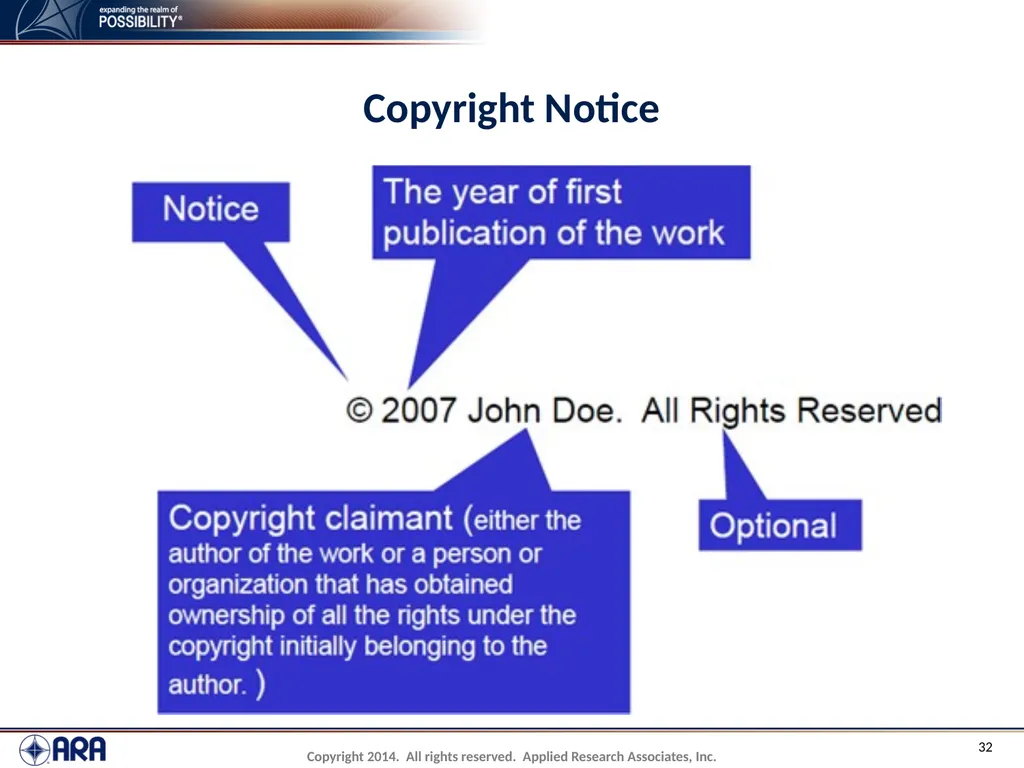
Copyright Notice<br>
33
Special Cases in Copyright Work Made For Hire
Fair Use Doctrine
First Sale Doctrine<br>
Fair Use Doctrine
First Sale Doctrine<br>
34
Works Made For Hire Copyright belongs to the party that commissioned the work.
Copyright belongs to the employer, when work is created by the employee in the course of performing work for the employer.<br>
Copyright belongs to the employer, when work is created by the employee in the course of performing work for the employer.<br>
35
First Sale Doctrine Limits the rights of a copyrighted work’s owner when a work is lawfully acquired.
Purchaser of a copy of a work generally has the right to:
Lend the work
Sell the work
Dispose of the work
Destroy the work<br>
Purchaser of a copy of a work generally has the right to:
Lend the work
Sell the work
Dispose of the work
Destroy the work<br>
36
First Sale Doctrine In the case of some digital content, the presumption is that purchasers are not generally entitled to resell or otherwise dispose of the work for commercial advantage. Digital content is oftentimes distributed via a license agreement, not an asset sale.
Limited purpose.
Nontransferable license for the purchaser’s private use.<br>
Limited purpose.
Nontransferable license for the purchaser’s private use.<br>
37
Fair Use Doctrine Certain publicly beneficial, noncommercial, and minimal uses of copyrighted material are “fair uses” and not infringement, even without consent of the copyright owner.
Fair use should not be assumed.
Factors impacting fair use:
The purpose and nature of the use.
The nature of the copyright.
The amount and substantiality of the portion used in relation to the copyrighted work as a whole.
The effect of the use upon the potential market for or value of the copyrighted work.<br>
Fair use should not be assumed.
Factors impacting fair use:
The purpose and nature of the use.
The nature of the copyright.
The amount and substantiality of the portion used in relation to the copyrighted work as a whole.
The effect of the use upon the potential market for or value of the copyrighted work.<br>
38
Obtaining a Copyright Author(s) should decide whether or not to protect and enforce the rights in a copyrighted work.
If the author(s) desire to protect rights, the author should register the copyright.
Submit material to the U.S. Copyright Office (http://www.copyright.gov) for claim to copyright
If application was accepted, the author receives certificate of registration indicating that the work has been registered.
If application not accepted, the author receives a letter explaining why it has been rejected.<br>
If the author(s) desire to protect rights, the author should register the copyright.
Submit material to the U.S. Copyright Office (http://www.copyright.gov) for claim to copyright
If application was accepted, the author receives certificate of registration indicating that the work has been registered.
If application not accepted, the author receives a letter explaining why it has been rejected.<br>
39
What is a Trademark?<br>
40
What is a Trademark? Trademarks identify the source of a product or service without being descriptive of the product’s function or the type of product.
A trademark is a word, phrase, symbol, or design, or a combination of words, phrases, symbols or designs, that identifies and distinguishes the source of the goods of one party from those of others.<br>
A trademark is a word, phrase, symbol, or design, or a combination of words, phrases, symbols or designs, that identifies and distinguishes the source of the goods of one party from those of others.<br>
41
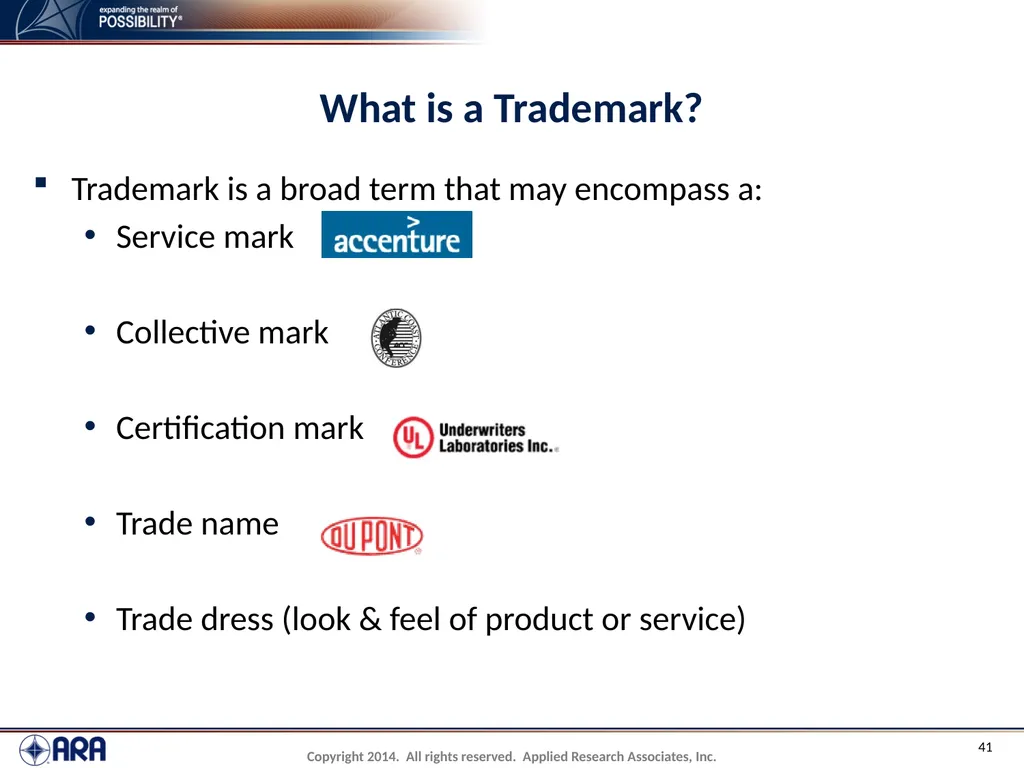
What is a Trademark? Trademark is a broad term that may encompass a:
Service mark
Collective mark
Certification mark
Trade name
Trade dress (look & feel of product or service)<br>
Service mark
Collective mark
Certification mark
Trade name
Trade dress (look & feel of product or service)<br>
42
Purpose of a Trademark Prevent competitors from stealing the goodwill that a company has established based on the quality and reputation of its products and services.
Ensure that consumers are not confused by products or services that would have similar sounding names or other similarity in attributes.<br>
Ensure that consumers are not confused by products or services that would have similar sounding names or other similarity in attributes.<br>
43
Criteria for Trademark The mark is already in use in commerce.
There is the “intent to use” the mark in commerce.<br>
There is the “intent to use” the mark in commerce.<br>
44
Obtaining a Trademark The mark should currently be in use or the creator has the intent to use the mark in commerce within six months.
File a trademark application with the U.S. Patent and Trademark Office (www.uspto.gov).
The application will be examined and the office action provided.
Trademark may be registered or rejected if it does not meet requirements.<br>
File a trademark application with the U.S. Patent and Trademark Office (www.uspto.gov).
The application will be examined and the office action provided.
Trademark may be registered or rejected if it does not meet requirements.<br>
45
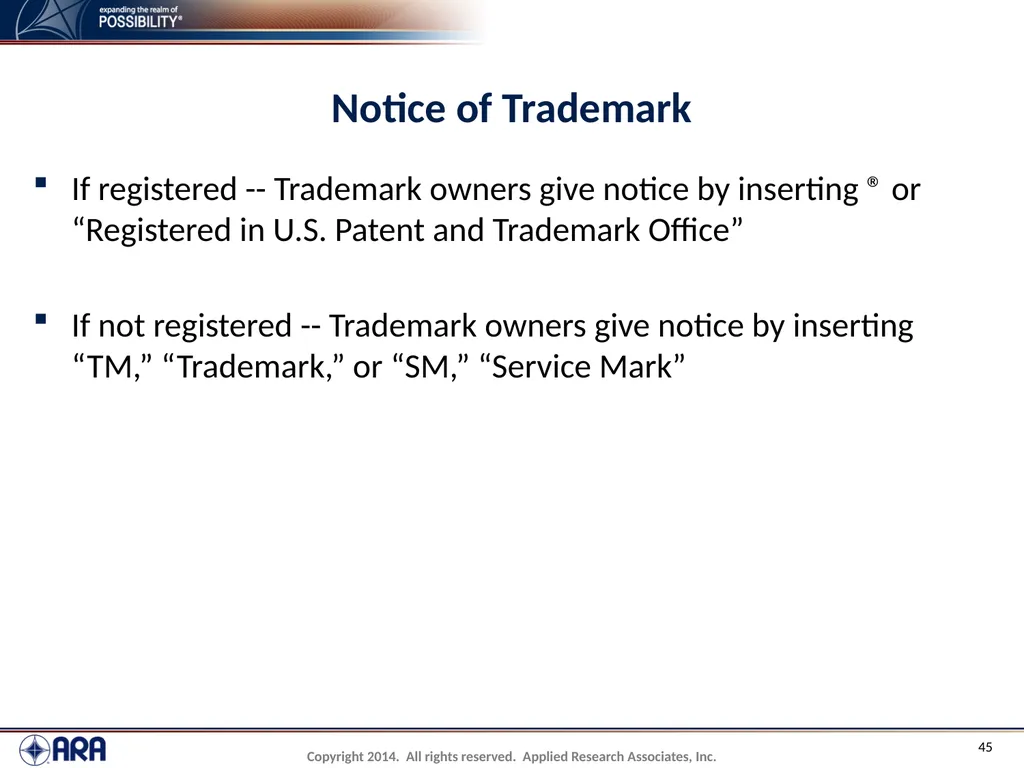
Notice of Trademark If registered -- Trademark owners give notice by inserting ® or “Registered in U.S. Patent and Trademark Office”
If not registered -- Trademark owners give notice by inserting “TM,” “Trademark,” or “SM,” “Service Mark”<br>
If not registered -- Trademark owners give notice by inserting “TM,” “Trademark,” or “SM,” “Service Mark”<br>
46
What is a Trade Secret?<br>
47
What is a Trade Secret? A trade secret constitutes confidential information that confers an economic advantage. Its value is derived from its secrecy.<br>
48
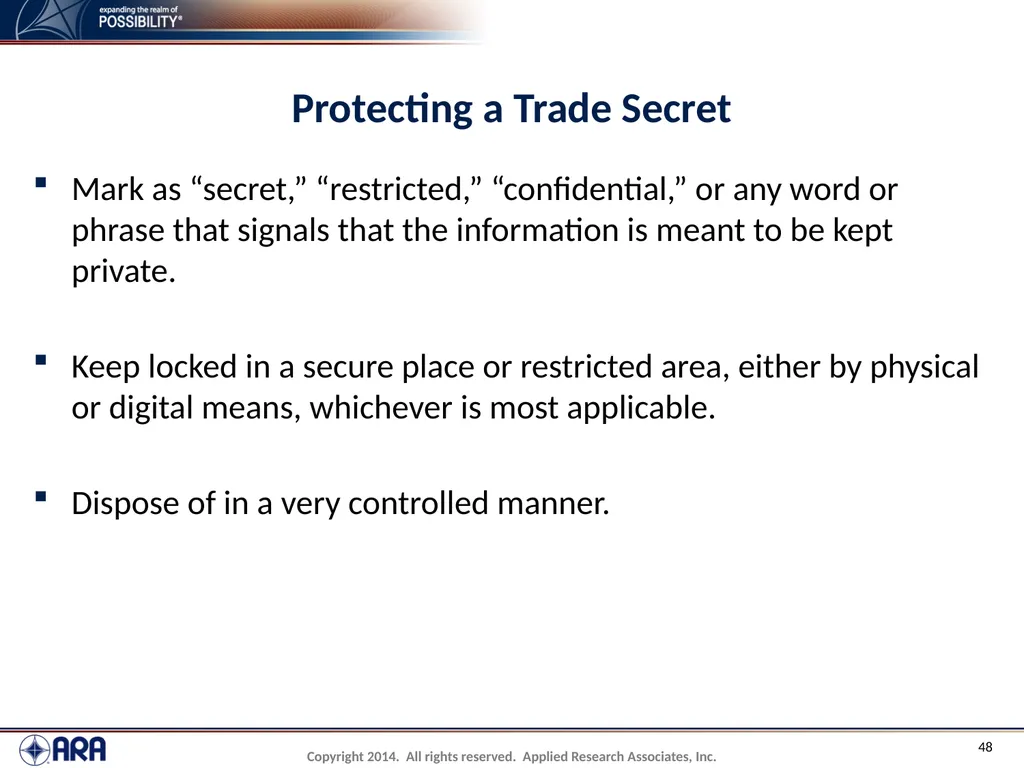
Protecting a Trade Secret Mark as “secret,” “restricted,” “confidential,” or any word or phrase that signals that the information is meant to be kept private.
Keep locked in a secure place or restricted area, either by physical or digital means, whichever is most applicable.
Dispose of in a very controlled manner.<br>
Keep locked in a secure place or restricted area, either by physical or digital means, whichever is most applicable.
Dispose of in a very controlled manner.<br>
49
Potential Types of Intellectual property FOR State Dots<br>
50
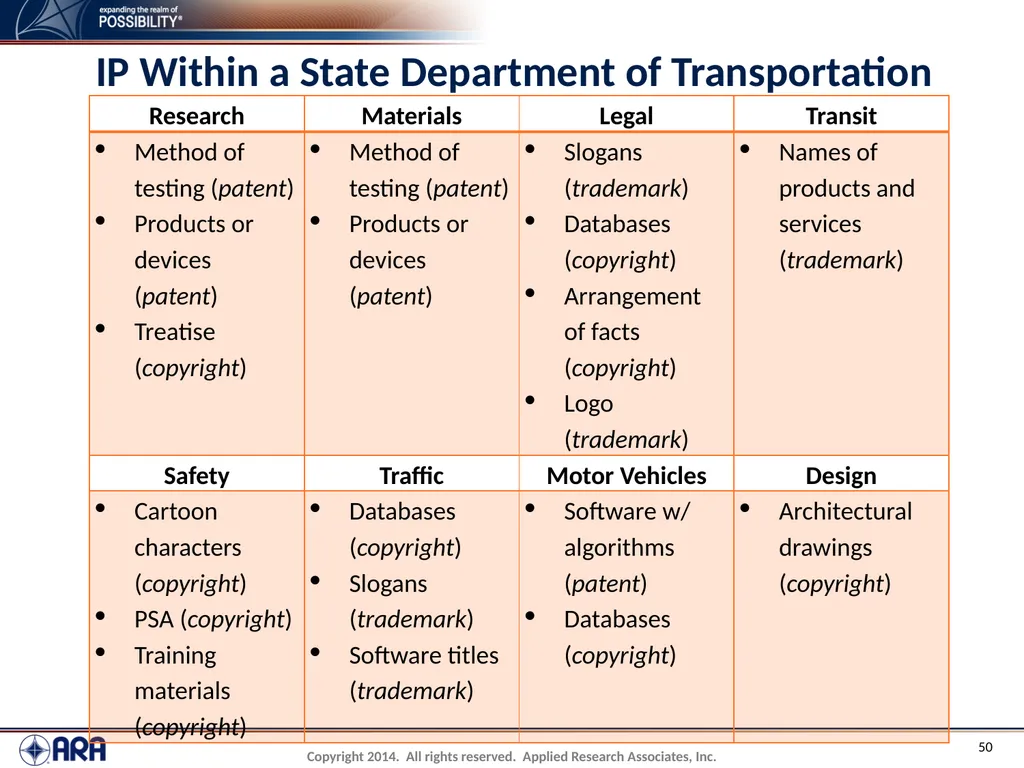
IP Within a State Department of Transportation<br>
51
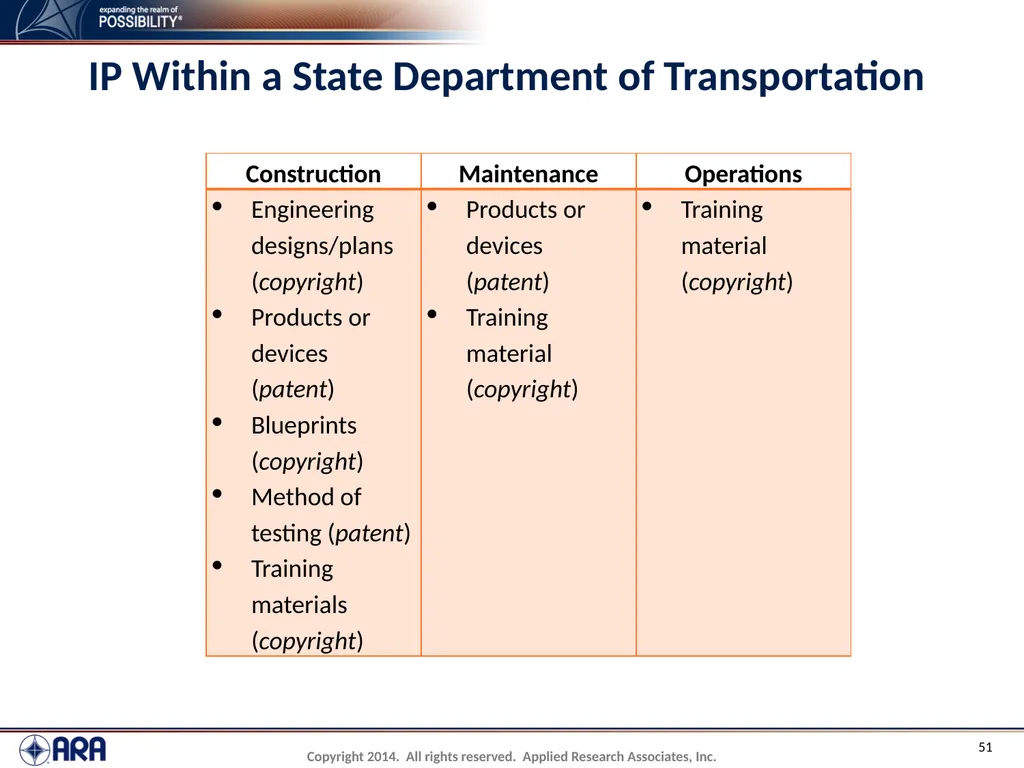
IP Within a State Department of Transportation<br>
52
What is Public Domain?<br>
53
Definition of Public Domain The public domain refers to information, of varying types, that is free for anyone to use. This information may have never been protected or may have entered the public domain upon expiration of one of the principal forms of IP protection.<br>
54
Benefits of Dedicating Intellectual Property
to the Public Domain Enabling low-cost access to information without the need to locate an owner of IP rights.
Promoting and expanding education through the spread of ideas, inventions, and discoveries.
Restricting another party from claiming IP rights to a creation.
Enabling competitive imitation.
Promoting innovation without the cost of IP protection and defending protected IP.<br>
Promoting and expanding education through the spread of ideas, inventions, and discoveries.
Restricting another party from claiming IP rights to a creation.
Enabling competitive imitation.
Promoting innovation without the cost of IP protection and defending protected IP.<br>
55
Risk of Dedicating Intellectual Property
to the Public Domain Loss of control over intellectual property – who is granted rights to use the IP?
Forfeit economic gain and/or sustainable competitive advantage.<br>
Forfeit economic gain and/or sustainable competitive advantage.<br>
56
What is Intellectual Property Management?<br>
57
Definition of Intellectual Property (IP) Management Realizing value through strategic and tactical options embedded in intellectual property rights (IPRs)<br>
58
Definition of Intellectual Property Rights IPR refers to the legally binding rights given to person(s) in regards to their creation. The creator is typically given an exclusive right over the use of his/her creation for a certain period of time.
The use of these rights by others must be authorized by the creator or any other owner of those rights.
(World Intellectual Property Organization [WIPO])<br>
The use of these rights by others must be authorized by the creator or any other owner of those rights.
(World Intellectual Property Organization [WIPO])<br>
59
Why is intellectual property management important To a State dot?<br>
60
Why IPM Should Be Important to a State DOT Risk management.
Financial investments and numerous projects and activities that may create intellectual property.
Many of the IP-generating activities (value creation) are outsourced (public-private partnerships).
Guidance to employees, contractors, and consultants on issues of IP management.
FHWA policy guidelines for state DOTs regarding IP (http://www.fhwa.dot.gov/programadmin/contracts/011106qa.cfm).
Maximizing taxpayer value - the return on taxpayer dollars.<br>
Financial investments and numerous projects and activities that may create intellectual property.
Many of the IP-generating activities (value creation) are outsourced (public-private partnerships).
Guidance to employees, contractors, and consultants on issues of IP management.
FHWA policy guidelines for state DOTs regarding IP (http://www.fhwa.dot.gov/programadmin/contracts/011106qa.cfm).
Maximizing taxpayer value - the return on taxpayer dollars.<br>
61
Maximizing Taxpayer Value Taxes support the activities carried-out by state DOTs.
Outcomes from state DOT funded research and other activities should contribute to the public good (tax paying public).
IP management can support a state’s economic development and financial growth initiatives.
Intellectual property is a resource that should be managed just as other transportation infrastructure (e.g., roadways, bridges, signs, etc.) is managed.<br>
Outcomes from state DOT funded research and other activities should contribute to the public good (tax paying public).
IP management can support a state’s economic development and financial growth initiatives.
Intellectual property is a resource that should be managed just as other transportation infrastructure (e.g., roadways, bridges, signs, etc.) is managed.<br>
62
Benefits of Managing Intellectual Property Maintain access to results derived from funded projects or employee inventors and creators.
Protect the interest and IP rights of others, including contractors and employees.
Shield state DOT contractors from IP infringement claims by other state DOT contractors or other third-party patent owners.
Identify contributions to the field by DOTs, including contractors and employee inventors.<br>
Protect the interest and IP rights of others, including contractors and employees.
Shield state DOT contractors from IP infringement claims by other state DOT contractors or other third-party patent owners.
Identify contributions to the field by DOTs, including contractors and employee inventors.<br>
63
Benefits of Managing Intellectual Property Secure monetary compensation for use of the IP owned by the DOT.
Encourage investment in technology development and commercialization.
Avoid becoming “captive” to incumbent contractors with proprietary technology.
Provide a mechanism for outbound licensing of rights to IP.<br>
Encourage investment in technology development and commercialization.
Avoid becoming “captive” to incumbent contractors with proprietary technology.
Provide a mechanism for outbound licensing of rights to IP.<br>
64
Risk of Not Managing Intellectual Property Inappropriate or unauthorized use of state DOT IP.
Liability if unknowingly using others’ IP without consent (e.g., a state DOT employee using copyrighted material found on the web).
A third party laying claim to IP that has been developed using state DOT funding.<br>
Liability if unknowingly using others’ IP without consent (e.g., a state DOT employee using copyrighted material found on the web).
A third party laying claim to IP that has been developed using state DOT funding.<br>
65
Intellectual Property Management PROCESS MODELS<br>
66
Research Findings
Common Structures, Practices, Operational Models<br>
67
Operating Structures Many organizations have established independent operating units headed by an intellectual property executive/director.
The intellectual property executive may report to a research administrator, a BoD, or a standing committee.
Working within the operating units are technology managers/specialists, legal professionals, and other specializations like marketing.<br>
The intellectual property executive may report to a research administrator, a BoD, or a standing committee.
Working within the operating units are technology managers/specialists, legal professionals, and other specializations like marketing.<br>
68
Operational Models Technology Identification & Triage process (TI&T)
Create a framework or outline of an organization’s assets.
Identify the technologies in each branch of that outline.
Define the technology and describe key management related characteristics (what type, if any, of IP protection to pursue, etc.).
Conduct a triage of the technologies in the portfolio to decide the appropriate and value maximizing disposition of each technology.
Create a marketing strategy for every technology as if it were to be licensed or sold.<br>
Create a framework or outline of an organization’s assets.
Identify the technologies in each branch of that outline.
Define the technology and describe key management related characteristics (what type, if any, of IP protection to pursue, etc.).
Conduct a triage of the technologies in the portfolio to decide the appropriate and value maximizing disposition of each technology.
Create a marketing strategy for every technology as if it were to be licensed or sold.<br>
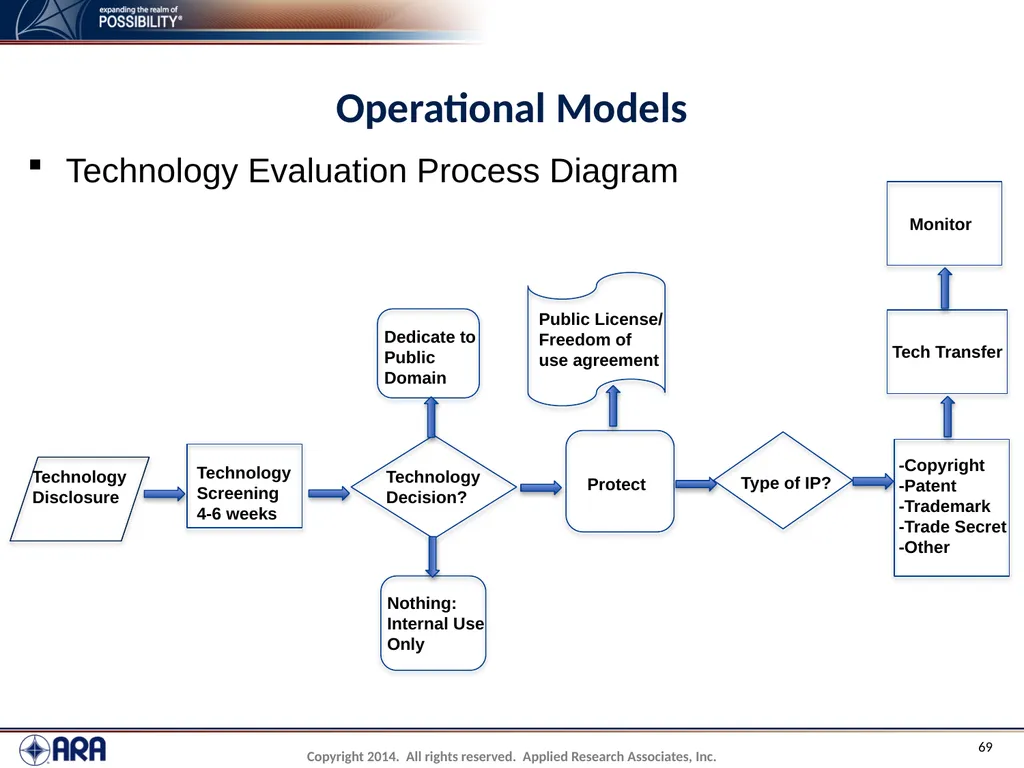
69
Operational Models Technology
Disclosure Technology
Screening
4-6 weeks Technology
Decision? Dedicate to
Public
Domain Nothing:
Internal Use
Only Protect Public License/
Freedom of
use agreement Type of IP? -Copyright
-Patent
-Trademark
-Trade Secret
-Other Tech Transfer Monitor Technology Evaluation Process Diagram<br>
Disclosure Technology
Screening
4-6 weeks Technology
Decision? Dedicate to
Public
Domain Nothing:
Internal Use
Only Protect Public License/
Freedom of
use agreement Type of IP? -Copyright
-Patent
-Trademark
-Trade Secret
-Other Tech Transfer Monitor Technology Evaluation Process Diagram<br>
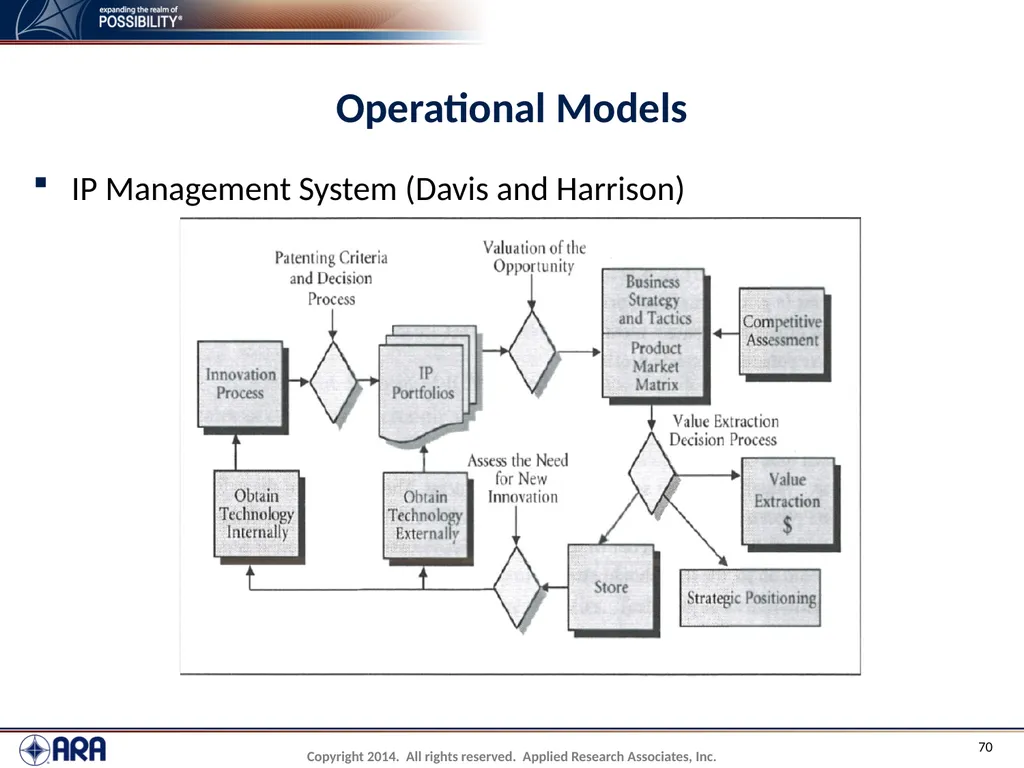
70
Operational Models IP Management System (Davis and Harrison)<br>
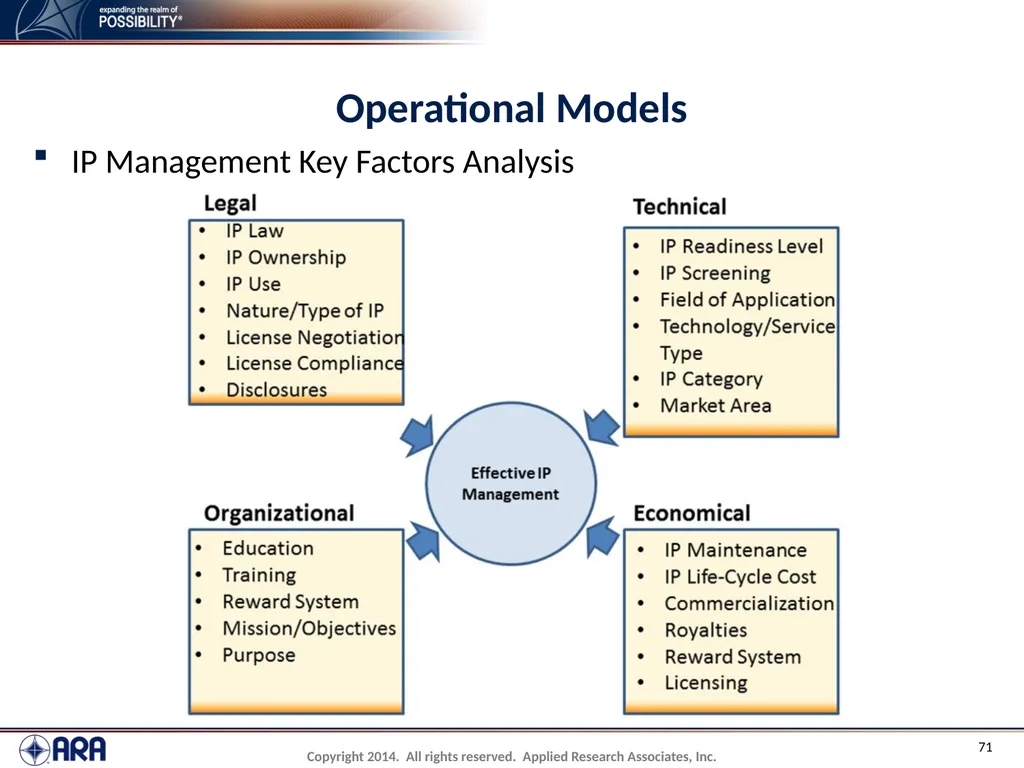
71
Operational Models IP Management Key Factors Analysis<br>
72
Research Findings
Survey Results<br>
73
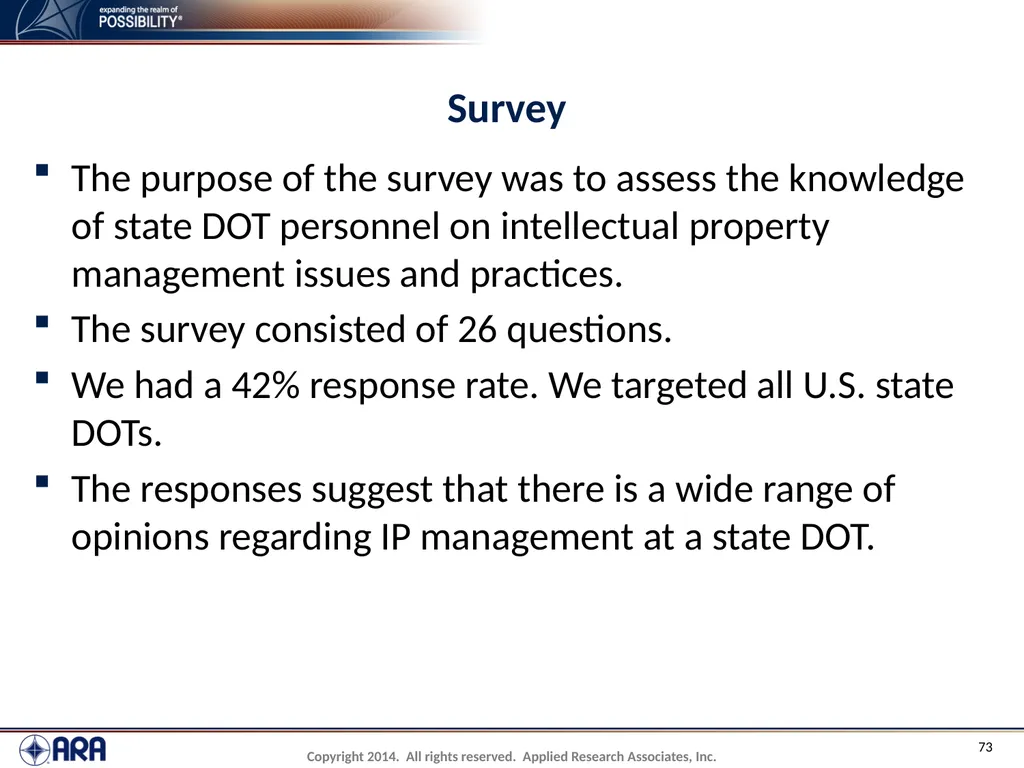
Survey The purpose of the survey was to assess the knowledge of state DOT personnel on intellectual property management issues and practices.
The survey consisted of 26 questions.
We had a 42% response rate. We targeted all U.S. state DOTs.
The responses suggest that there is a wide range of opinions regarding IP management at a state DOT.<br>
The survey consisted of 26 questions.
We had a 42% response rate. We targeted all U.S. state DOTs.
The responses suggest that there is a wide range of opinions regarding IP management at a state DOT.<br>
74
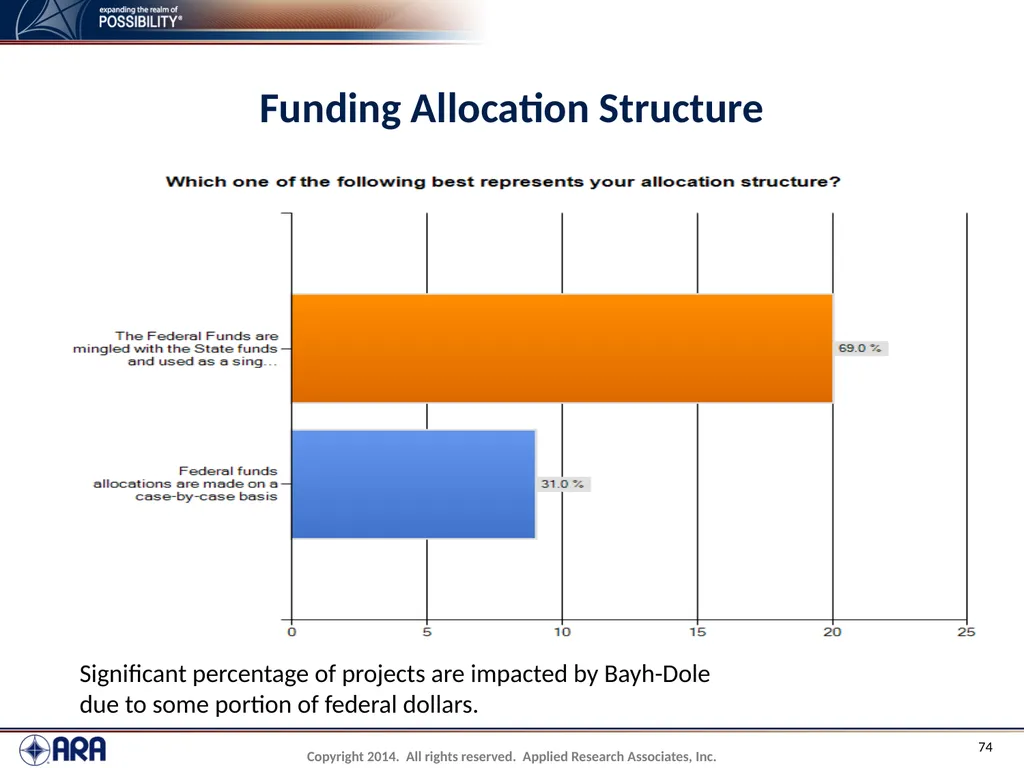
Funding Allocation Structure Significant percentage of projects are impacted by Bayh-Dole
due to some portion of federal dollars.<br>
due to some portion of federal dollars.<br>
75
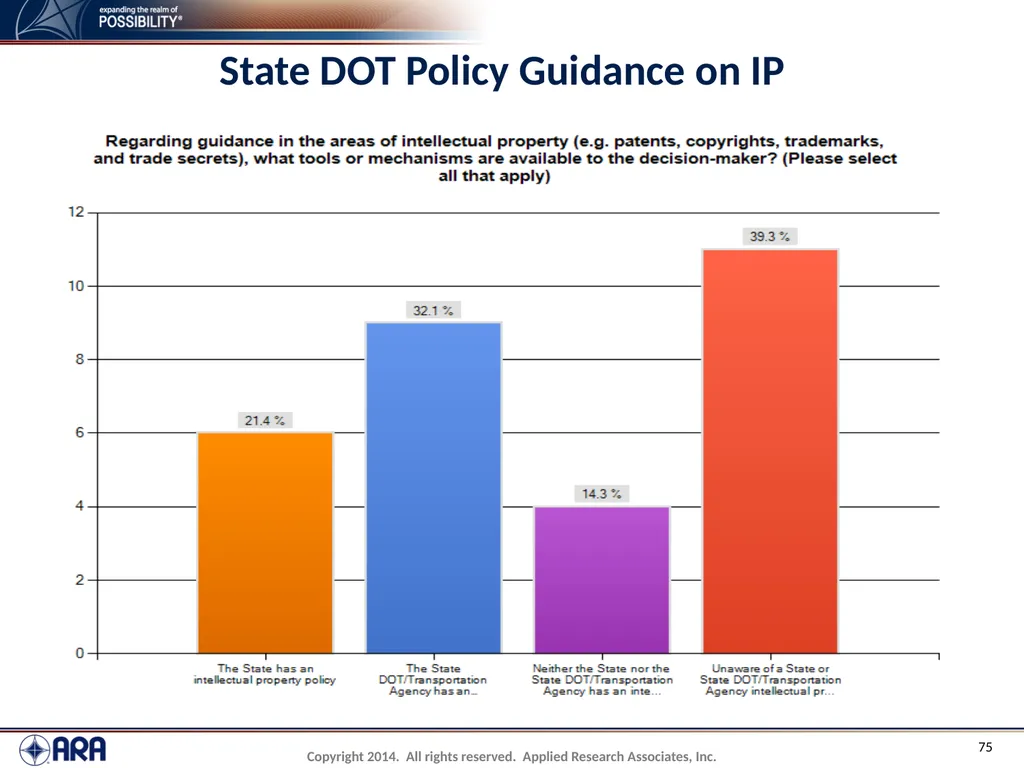
State DOT Policy Guidance on IP<br>
76
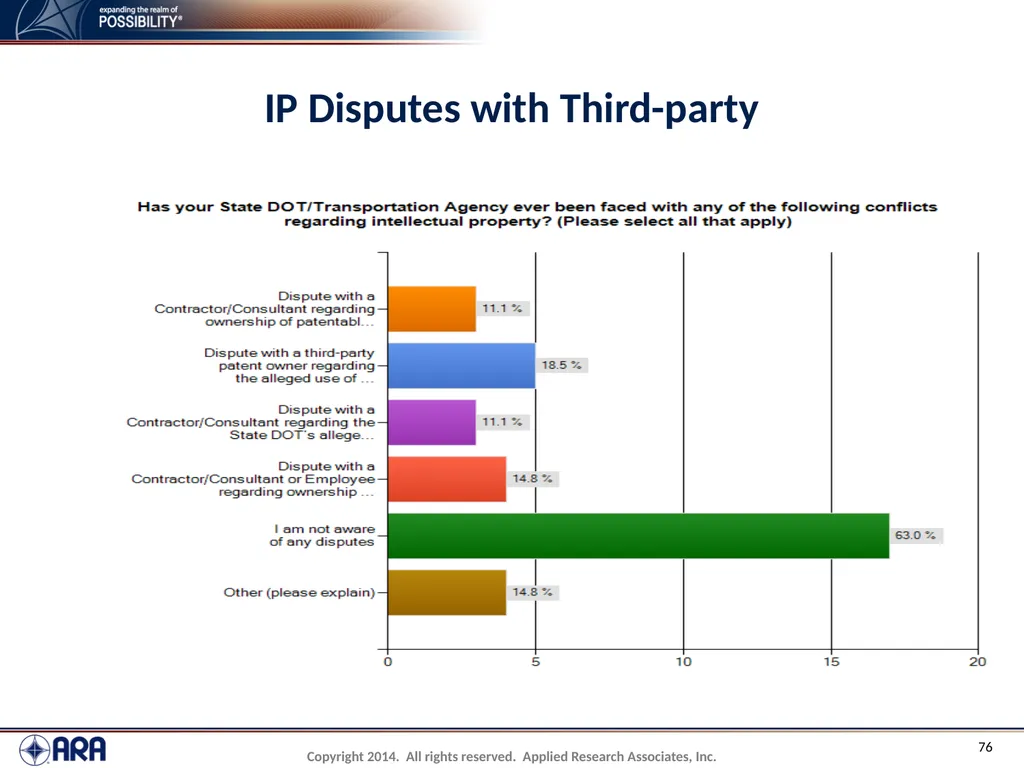
IP Disputes with Third-party<br>
77
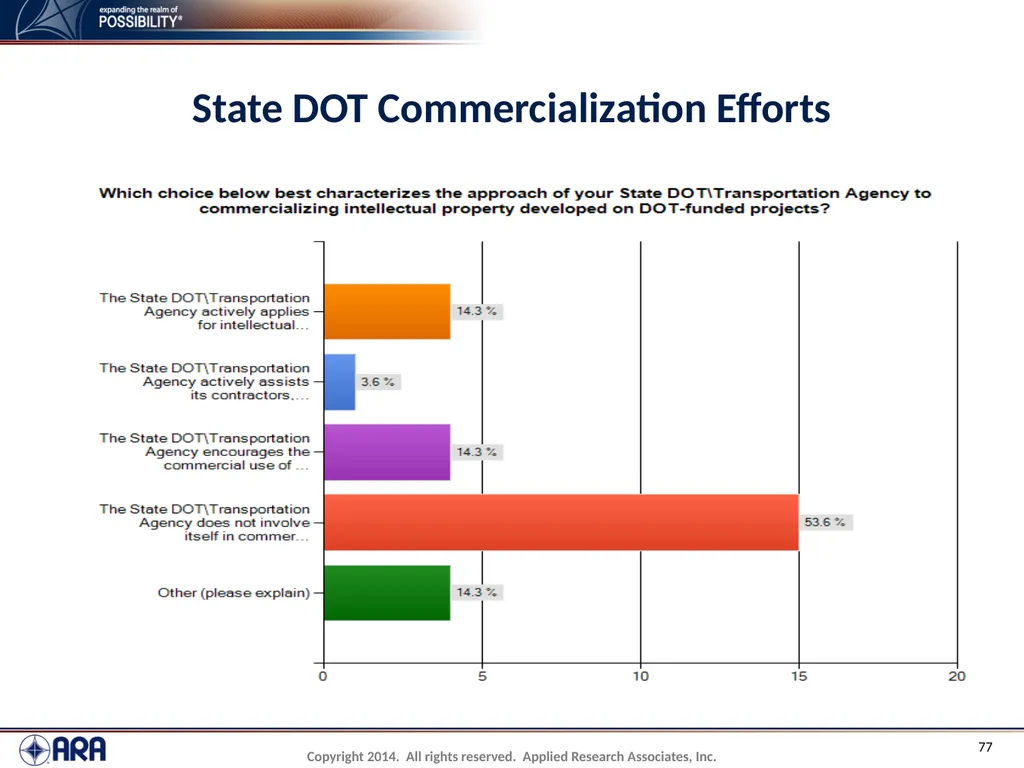
State DOT Commercialization Efforts<br>
78
Research Findings
Key Questions Addressed by This Research<br>
79
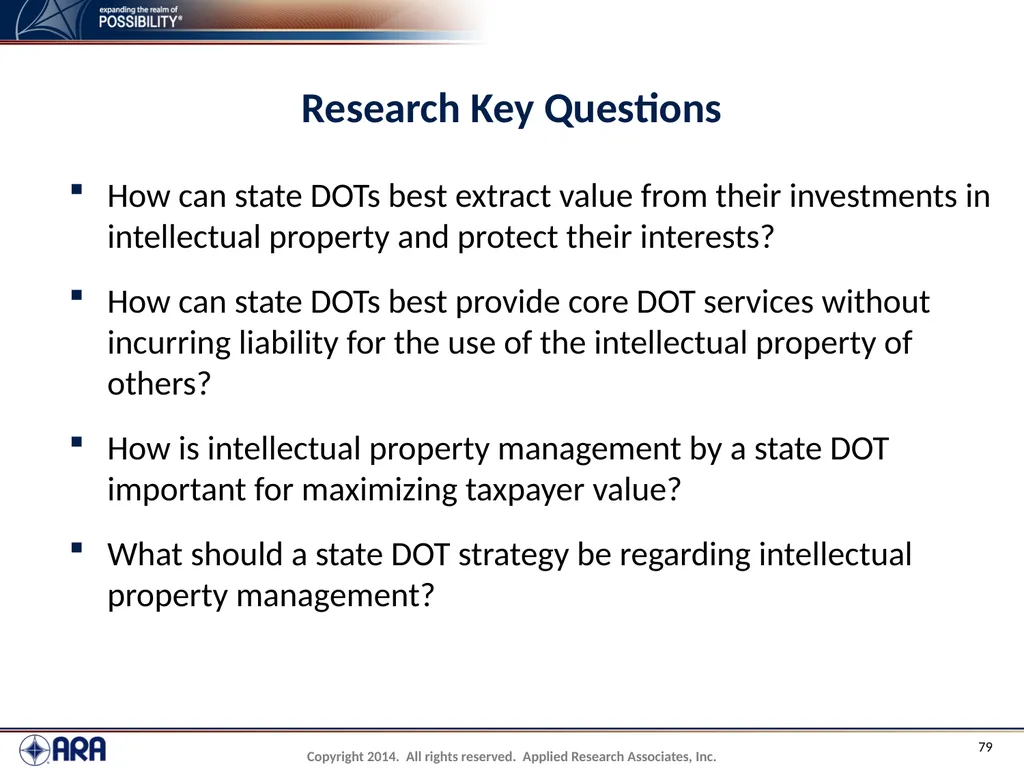
Research Key Questions How can state DOTs best extract value from their investments in intellectual property and protect their interests?
How can state DOTs best provide core DOT services without incurring liability for the use of the intellectual property of others?
How is intellectual property management by a state DOT important for maximizing taxpayer value?
What should a state DOT strategy be regarding intellectual property management?<br>
How can state DOTs best provide core DOT services without incurring liability for the use of the intellectual property of others?
How is intellectual property management by a state DOT important for maximizing taxpayer value?
What should a state DOT strategy be regarding intellectual property management?<br>
80
Intellectual Property Management Recommendations
A Process and Framework for State Departments of Transportation<br>
81
State DOT IP Management Goals Ensure that state DOTs have continued access to innovations developed with state DOT funding.
Obtain access (e.g., reciprocal licenses) to innovations developed by other public bodies (e.g., FHWA, other state DOTs, other state agencies).
Avoid becoming “captive” to incumbent contractors with proprietary technology.<br>
Obtain access (e.g., reciprocal licenses) to innovations developed by other public bodies (e.g., FHWA, other state DOTs, other state agencies).
Avoid becoming “captive” to incumbent contractors with proprietary technology.<br>
82
State DOT IP Management Goals Shield state DOT contractors from IP infringement claims by other state DOT contractors or third-party patent owner.
Encourage the most efficient methods to transfer new inventions/innovations to practice (perhaps economic growth).
Continue to support economic development in the state/nation.
Maximize taxpayer value – the return on taxpayer dollars.<br>
Encourage the most efficient methods to transfer new inventions/innovations to practice (perhaps economic growth).
Continue to support economic development in the state/nation.
Maximize taxpayer value – the return on taxpayer dollars.<br>
83
Intellectual Property Management Process/Procedure<br>
84
Preparing for IP Management for a State DOT Policy development
Intellectual property management process/procedure
Training
Support materials (e.g., checklist, sample documents)<br>
Intellectual property management process/procedure
Training
Support materials (e.g., checklist, sample documents)<br>
85
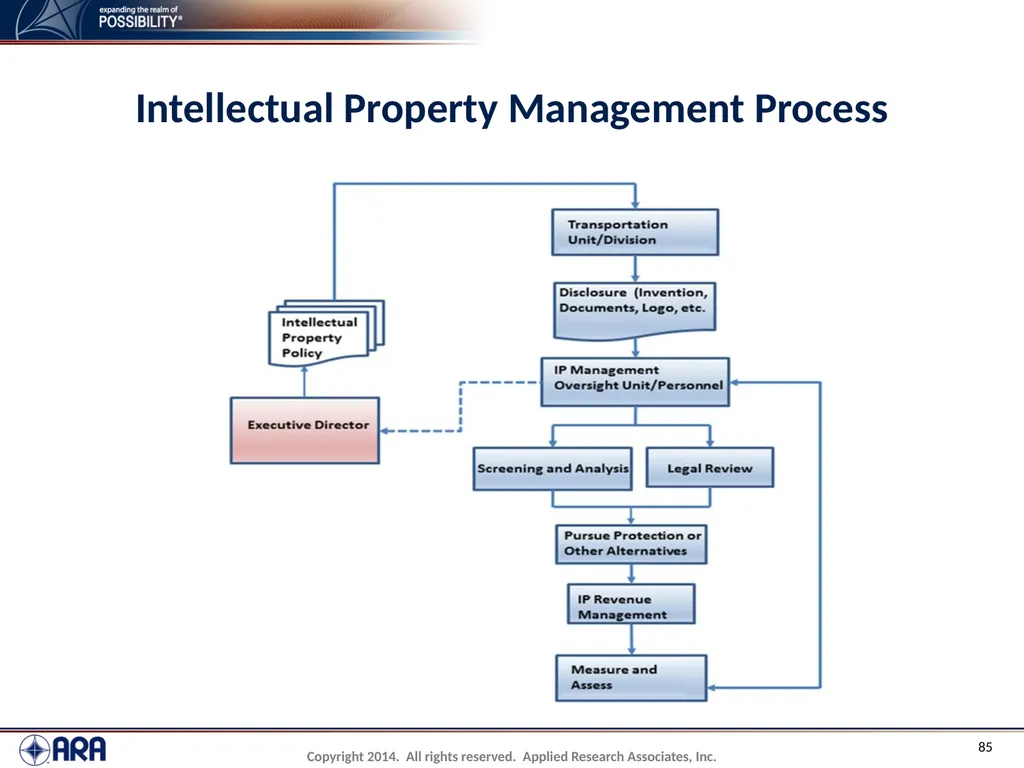
Intellectual Property Management Process<br>
86
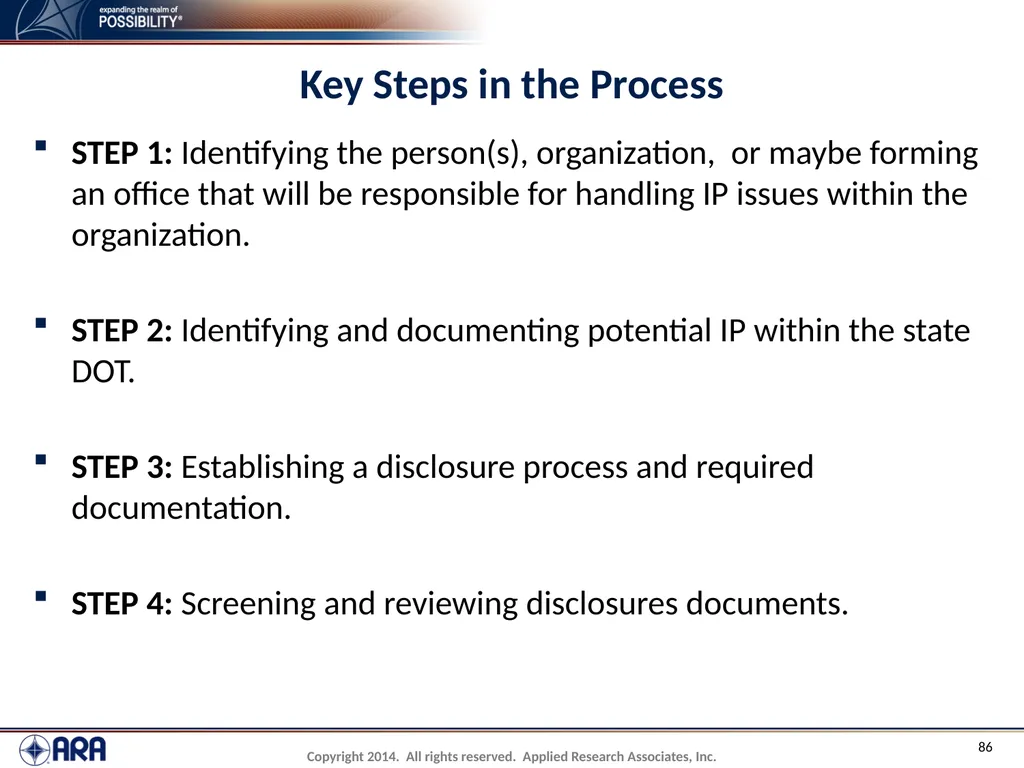
Key Steps in the Process STEP 1: Identifying the person(s), organization, or maybe forming an office that will be responsible for handling IP issues within the organization.
STEP 2: Identifying and documenting potential IP within the state DOT.
STEP 3: Establishing a disclosure process and required documentation.
STEP 4: Screening and reviewing disclosures documents.<br>
STEP 2: Identifying and documenting potential IP within the state DOT.
STEP 3: Establishing a disclosure process and required documentation.
STEP 4: Screening and reviewing disclosures documents.<br>
87
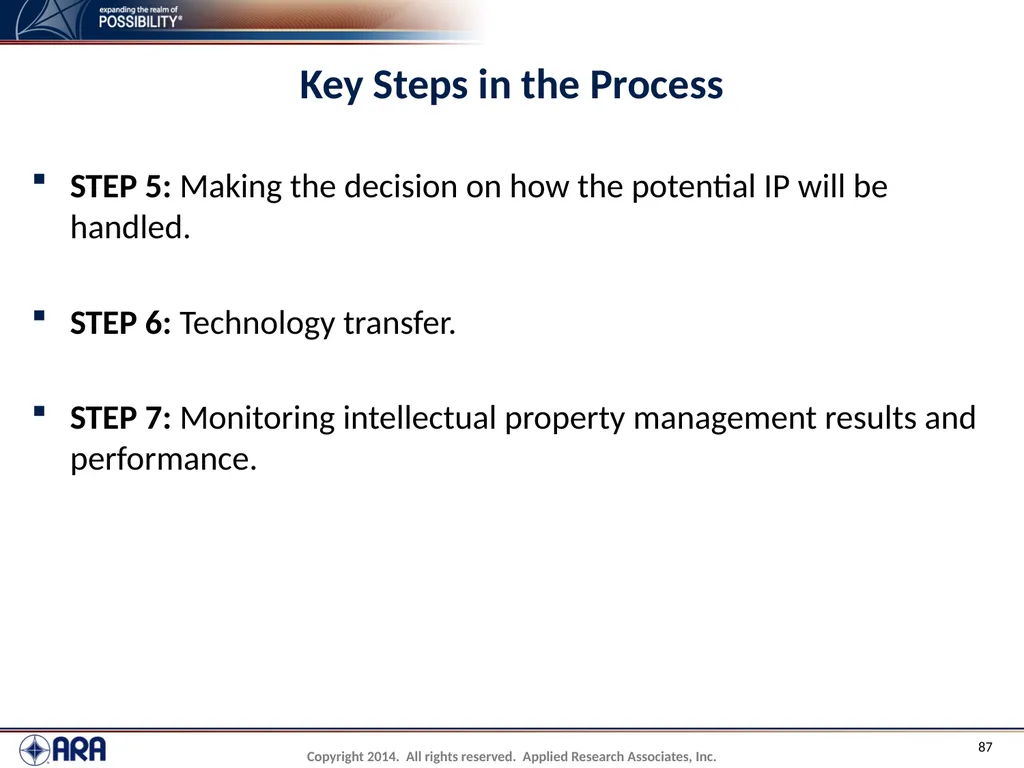
Key Steps in the Process STEP 5: Making the decision on how the potential IP will be handled.
STEP 6: Technology transfer.
STEP 7: Monitoring intellectual property management results and performance.<br>
STEP 6: Technology transfer.
STEP 7: Monitoring intellectual property management results and performance.<br>
88
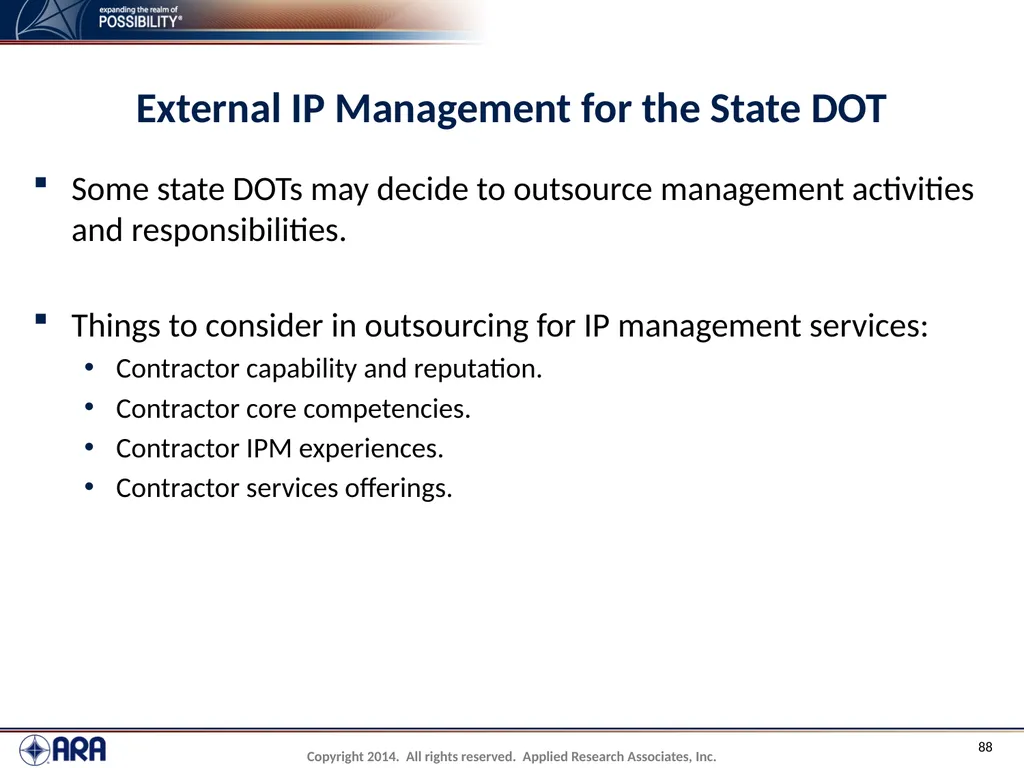
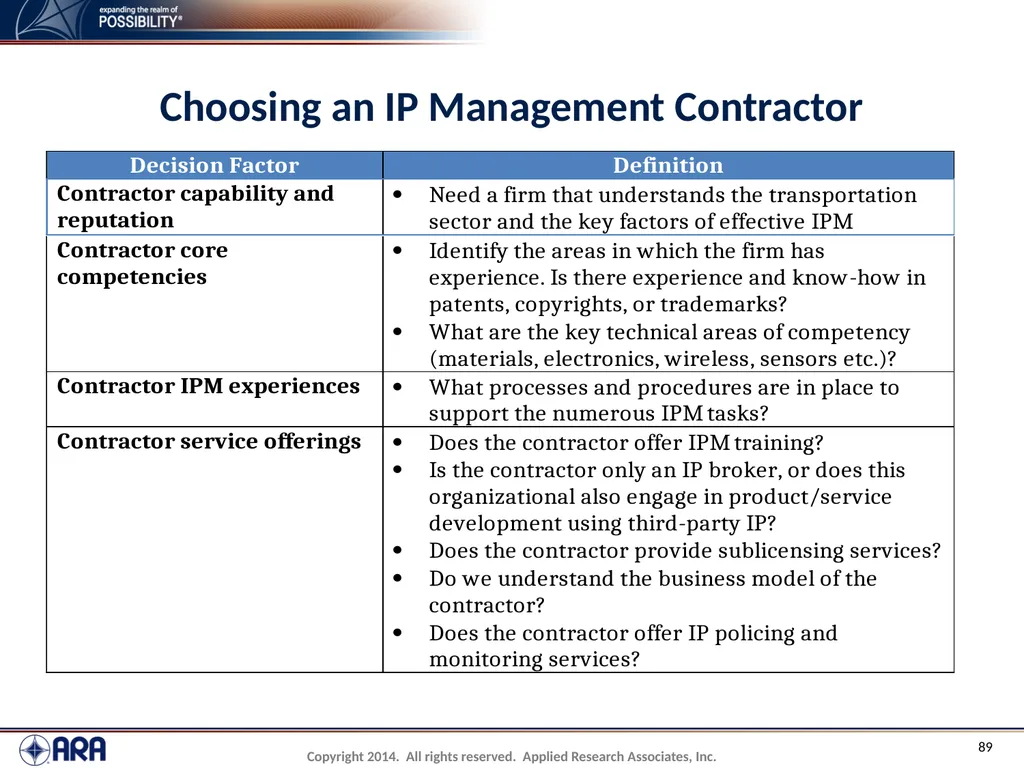
External IP Management for the State DOT Some state DOTs may decide to outsource management activities and responsibilities.
Things to consider in outsourcing for IP management services:
Contractor capability and reputation.
Contractor core competencies.
Contractor IPM experiences.
Contractor services offerings.<br>
Things to consider in outsourcing for IP management services:
Contractor capability and reputation.
Contractor core competencies.
Contractor IPM experiences.
Contractor services offerings.<br>
89
Choosing an IP Management Contractor<br>
90
Intellectual Property Organizational Training<br>
91
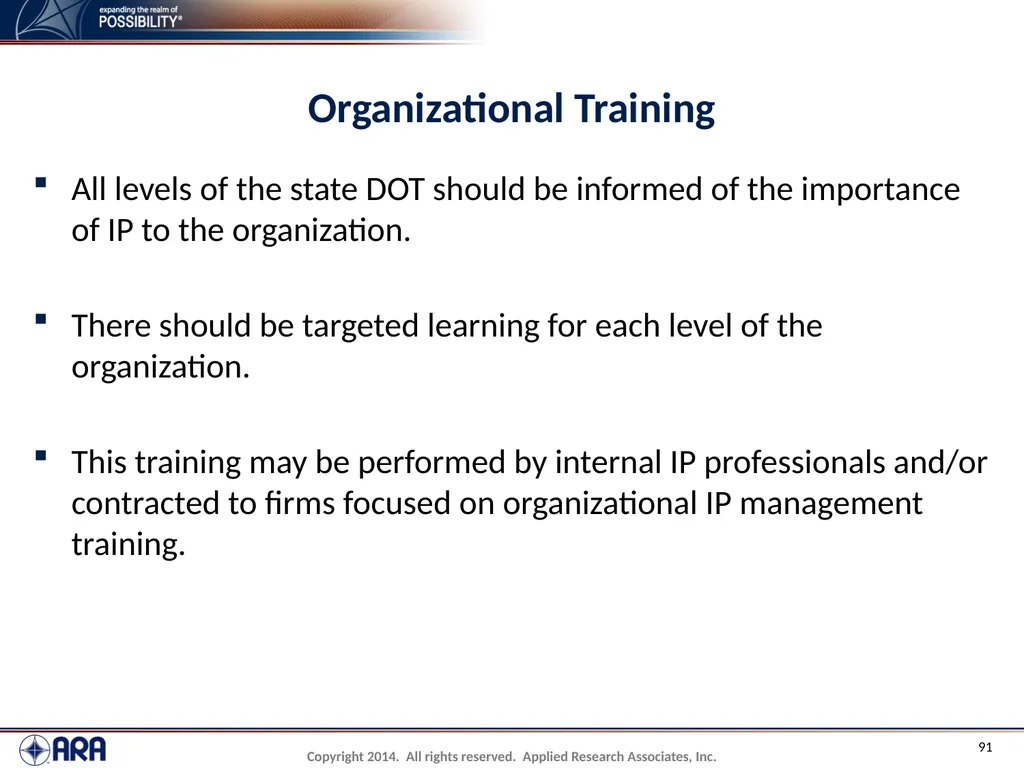
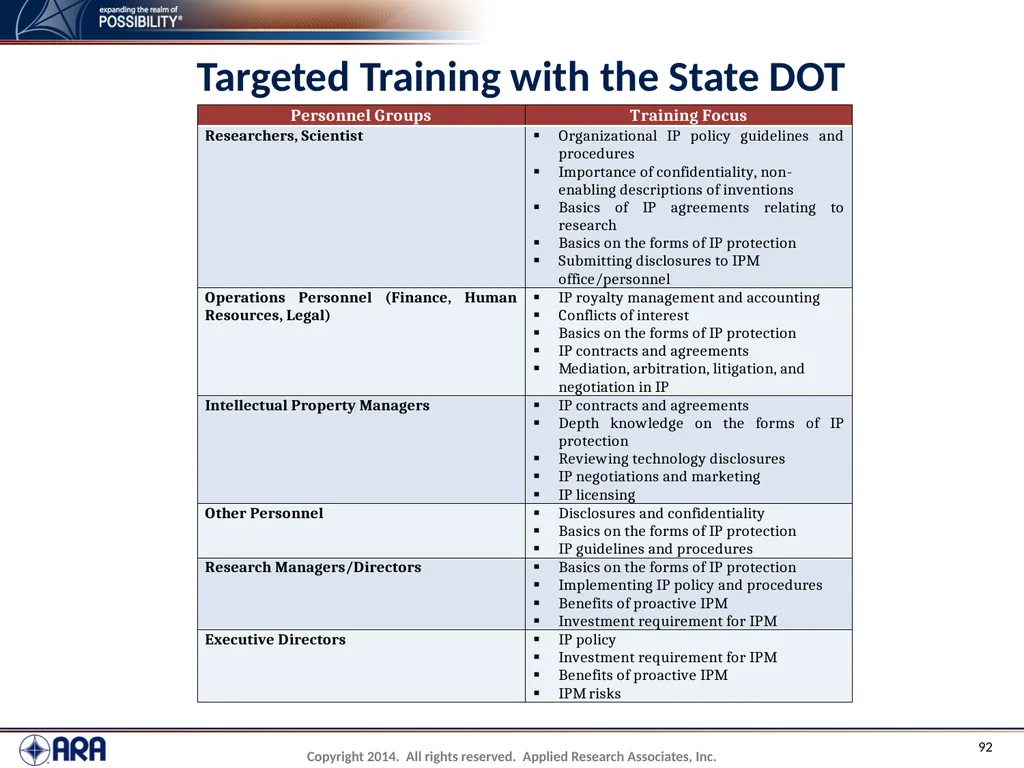
Organizational Training All levels of the state DOT should be informed of the importance of IP to the organization.
There should be targeted learning for each level of the organization.
This training may be performed by internal IP professionals and/or contracted to firms focused on organizational IP management training.<br>
There should be targeted learning for each level of the organization.
This training may be performed by internal IP professionals and/or contracted to firms focused on organizational IP management training.<br>
92
Targeted Training with the State DOT<br>
93
Materials to Support Proactive Intellectual Property Management<br>
94
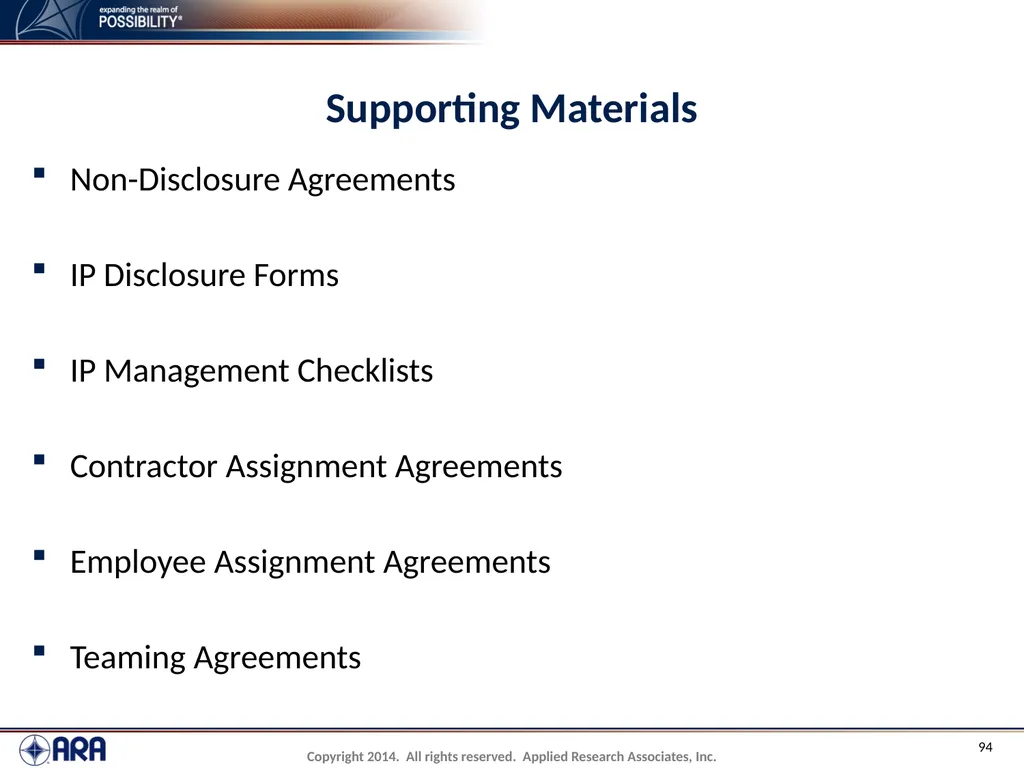
Supporting Materials Non-Disclosure Agreements
IP Disclosure Forms
IP Management Checklists
Contractor Assignment Agreements
Employee Assignment Agreements
Teaming Agreements<br>
IP Disclosure Forms
IP Management Checklists
Contractor Assignment Agreements
Employee Assignment Agreements
Teaming Agreements<br>
95
Cost of Implementing Proactive Intellectual Property Management Practices<br>
96
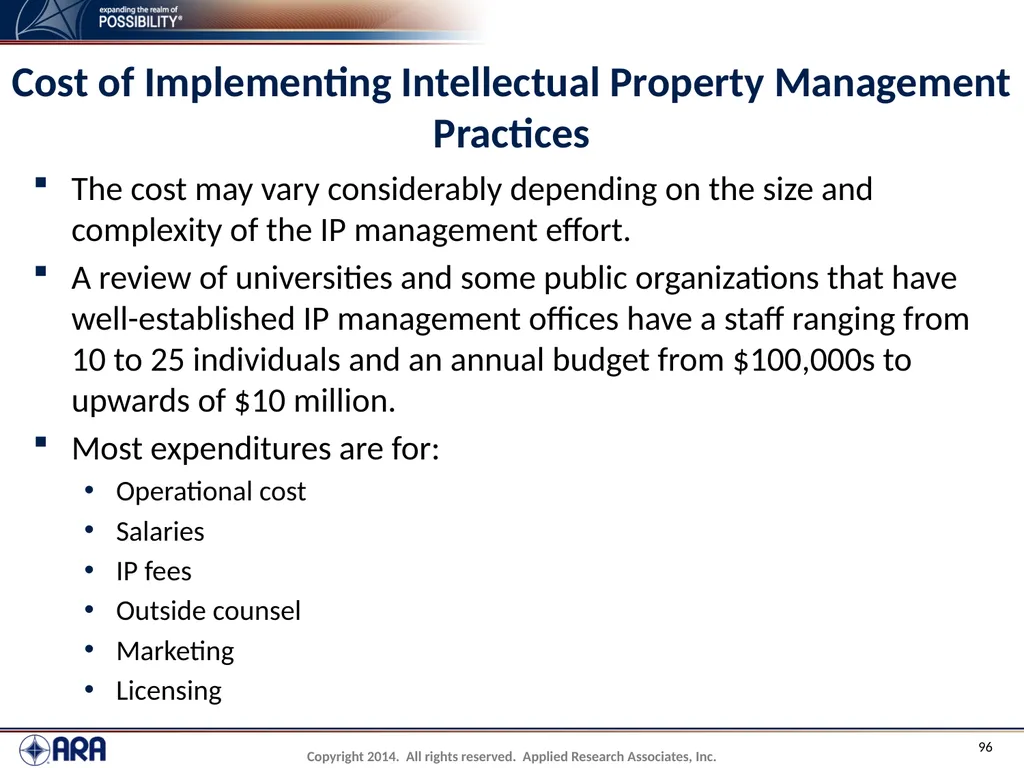
Cost of Implementing Intellectual Property Management Practices The cost may vary considerably depending on the size and complexity of the IP management effort.
A review of universities and some public organizations that have well-established IP management offices have a staff ranging from 10 to 25 individuals and an annual budget from $100,000s to upwards of $10 million.
Most expenditures are for:
Operational cost
Salaries
IP fees
Outside counsel
Marketing
Licensing<br>
A review of universities and some public organizations that have well-established IP management offices have a staff ranging from 10 to 25 individuals and an annual budget from $100,000s to upwards of $10 million.
Most expenditures are for:
Operational cost
Salaries
IP fees
Outside counsel
Marketing
Licensing<br>
97
SUMMARY – State Dot Intellectual property management<br>
98
Summary Details Each state DOT should first review the guidebook to establish a cursory understanding of IP and IP management, if unfamiliar with the subject matter.
Determine which IP assets could be managed as IP (this is not a one-size-fits-all approach).
Decide if IP should be managed internally or externally.<br>
Determine which IP assets could be managed as IP (this is not a one-size-fits-all approach).
Decide if IP should be managed internally or externally.<br>
99
Summary Details Select a unit/department for a pilot study.
Implement some portions of the framework and processes (it is not a requirement to implement all at once).
Measure the outcome of whichever IP management tactics the organization has implemented.
Continue to implement more components of the guide as necessary.<br>
Implement some portions of the framework and processes (it is not a requirement to implement all at once).
Measure the outcome of whichever IP management tactics the organization has implemented.
Continue to implement more components of the guide as necessary.<br>
100
THANK YOU<br>