
NEMSIS V3.5 The Important Changes: Describing the




Description: NEMSIS V3.5 The Important Changes: Describing the Whole EMS Event Its not just about eDisposition.12 1 Something Besides eDisposition.12 is changing in NEMSIS V3.5? Why yes it is! NEMSIS V3.5 has some big changes and the stakeholder talk
Related Topics
Download Presentation
"NEMSIS V3.5 The Important Changes: Describing the" is the property of its rightful owner. Permission is granted to download and print the materials on this website for personal, non-commercial use only, and to display it on your personal computer provided you do not modify the materials and that you retain all copyright notices contained in the materials. By downloading content from our website, you accept the terms of this agreement.
Presentation Transcript
slide1. NEMSIS V3.5
The Important Changes:
Describing the Whole EMS Event Its not just about eDisposition.12… 1<br>
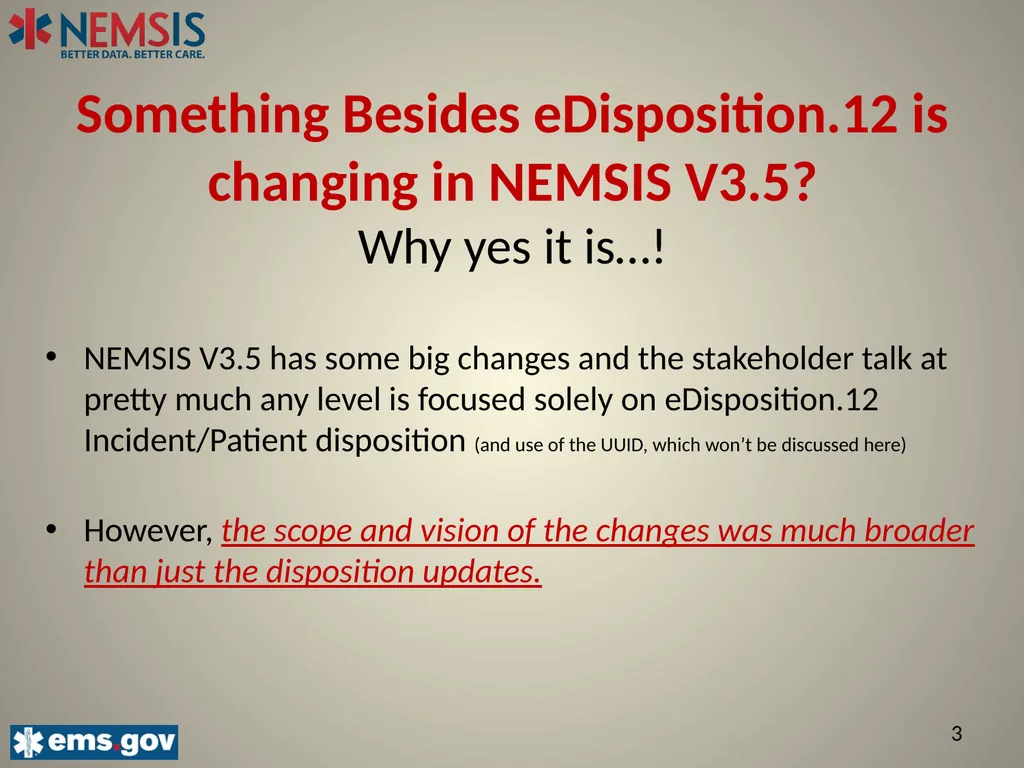
slide2. Something Besides eDisposition.12 is changing in NEMSIS V3.5? Why yes it is…! NEMSIS V3.5 has some big changes and the stakeholder talk at pretty much any level is focused solely on eDisposition.12 Incident/Patient disposition (and use of the UUID, which won’t be discussed here)
However, the scope and vision of the changes was much broader than just the disposition updates. 3<br>
slide3. What were the goals of the V3.5 Change? The primary goal of the V3.5 change was to improve the ability and flexibility to fully describe an EMS event in a away that couldn’t be done in previous NEMSIS dataset versions.
States and services needed more cohesive and flexible data to track, analyze and sometimes justify changes in the delivery of EMS care, environment and integration into the broader healthcare system.
Previous versions had limited ability to look at things like interfacility transfer levels, types and patterns, MIH programs, level and type of equipment available compared to the level of care actually provided. This lead to many custom elements and values being created to address these needs.
V3.5 was the opportunity to address these challenges and limitations.
Secondary goals included addressing the normal technical updates, addition of values needed, clarification of element names, definitions and updates to requirements generally seen in any version update. 3<br>
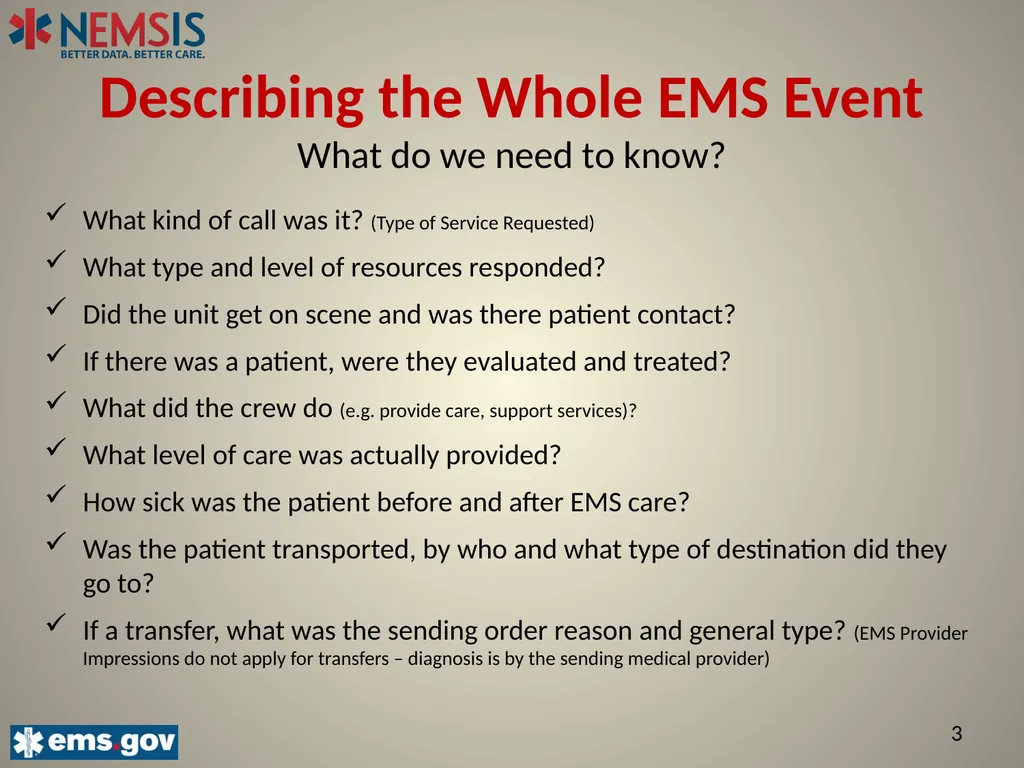
slide4. Describing the Whole EMS Event What do we need to know? What kind of call was it? (Type of Service Requested)
What type and level of resources responded?
Did the unit get on scene and was there patient contact?
If there was a patient, were they evaluated and treated?
What did the crew do (e.g. provide care, support services)?
What level of care was actually provided?
How sick was the patient before and after EMS care?
Was the patient transported, by who and what type of destination did they go to?
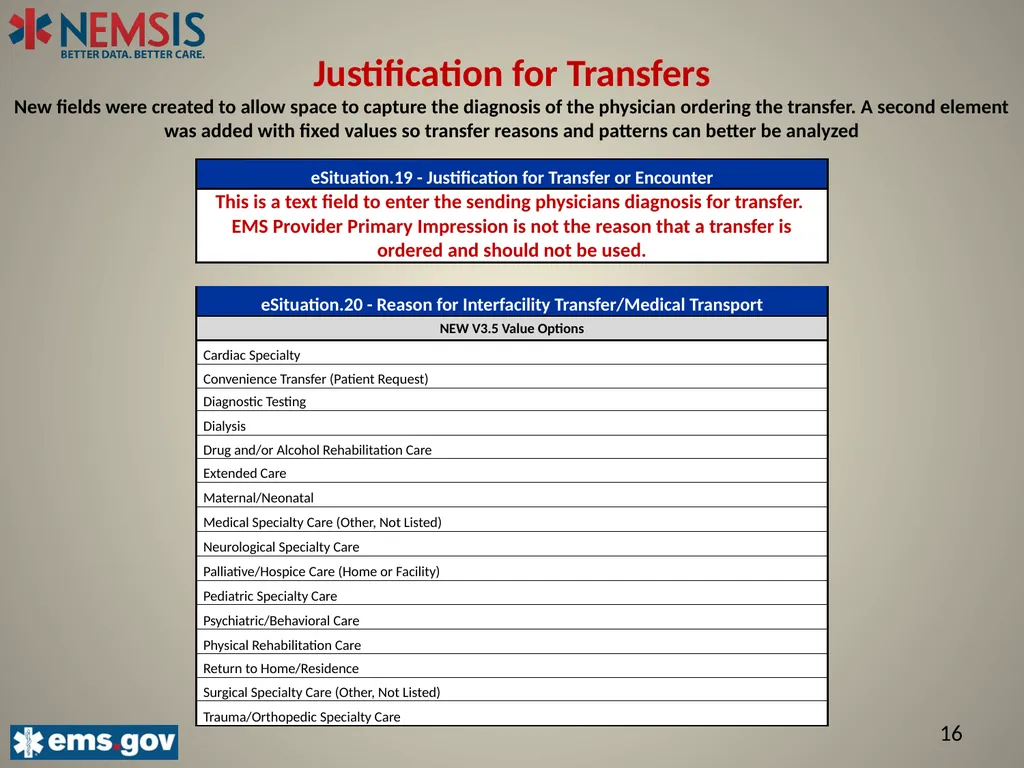
If a transfer, what was the sending order reason and general type? (EMS Provider Impressions do not apply for transfers – diagnosis is by the sending medical provider) 3<br>
slide5. Describing the Whole EMS Event What needed improvement from 3.4 (3.3.4, 2.0)? What kind of call was it? (Type of Service Requested)
Mostly limited to 911 and both transfer options were confusing, causing inconsistencies in data
There were dispositions that were better identified in other elements
“Primary Role of Unit” was limited. Needed to be expanded and incorporate the level of equipment with the responding unit
Determining level of care actually provided was difficult, required looking at several data elements resulting in states or services using custom elements to capture it (Often modifying already complicated eDisposition.12 values)
Incident/patient disposition collected 3-4 pieces of information in each value (always a limiting idea), did not address all EMS scenarios, provided no flexibility, and made data mining and business rules more difficult than needed
Capturing reasons for transfers couldn’t be done which is important for billing purposes and analyzing transfer volume and levels and referral patterns for systems-of-care
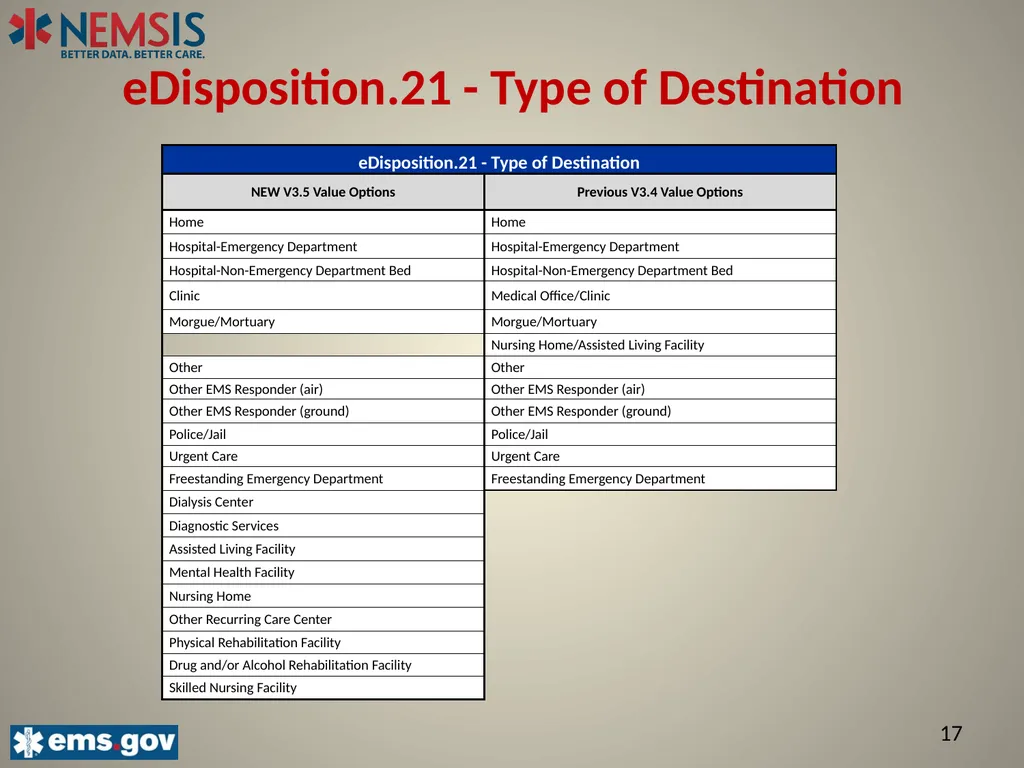
Type of destination options needed to be expanded for changes in EMS operations 3<br>
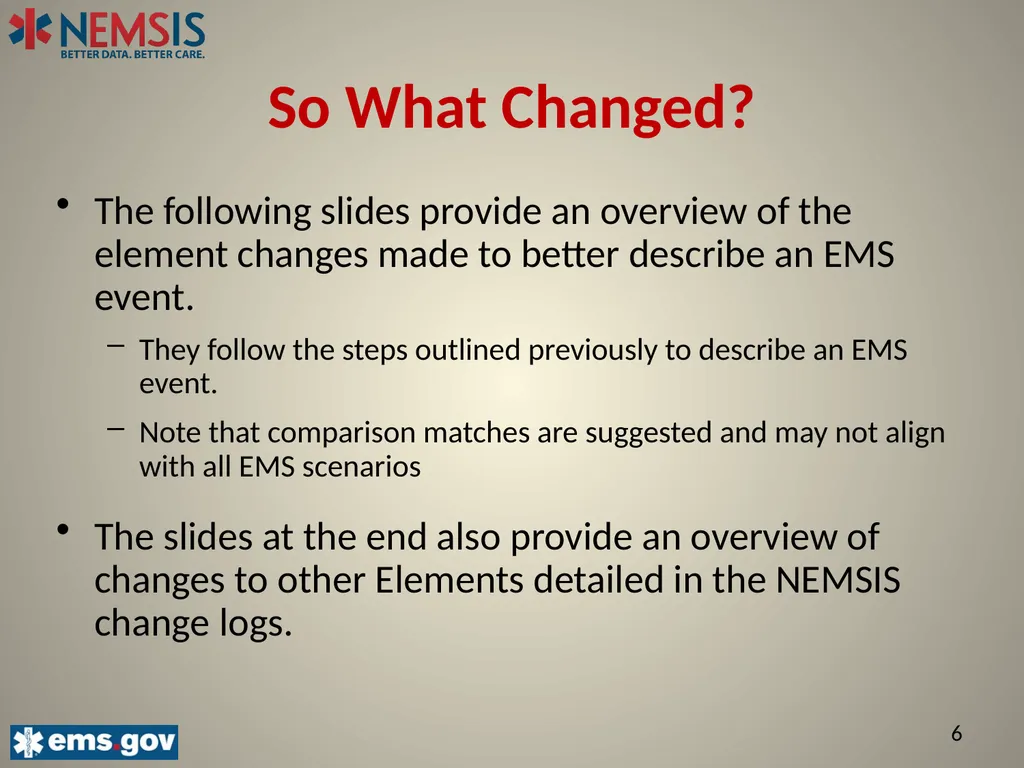
slide6. So What Changed? The following slides provide an overview of the element changes made to better describe an EMS event.
They follow the steps outlined previously to describe an EMS event.
Note that comparison matches are suggested and may not align with all EMS scenarios
The slides at the end also provide an overview of changes to other Elements detailed in the NEMSIS change logs. 6<br>
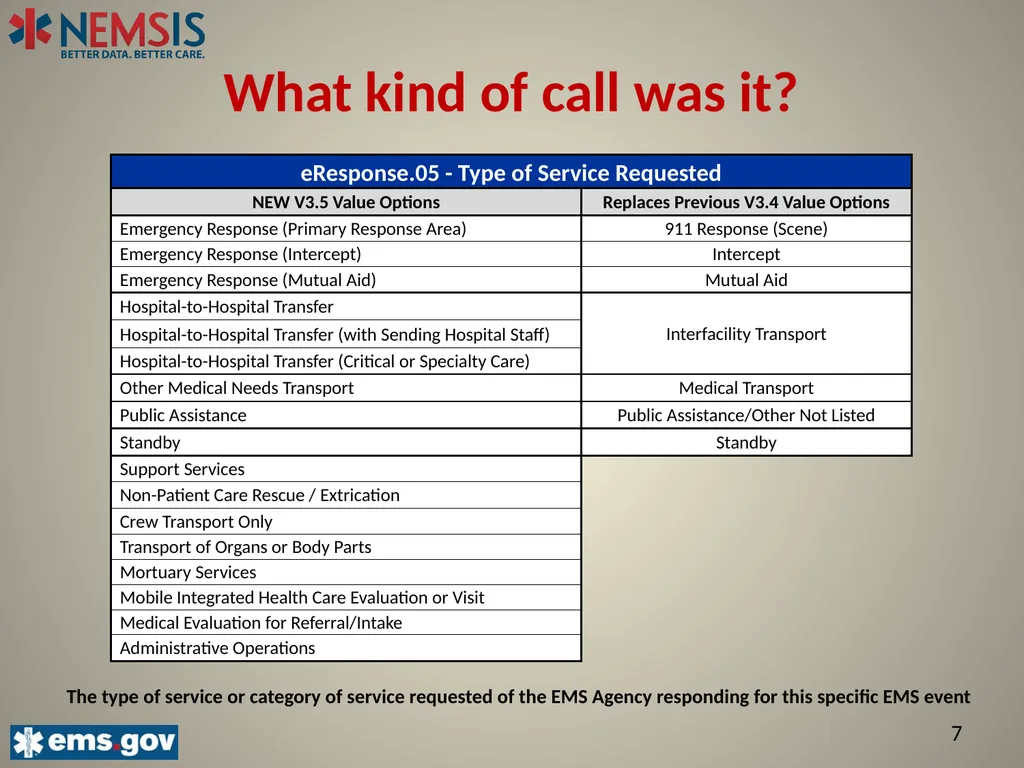
slide7. 7 What kind of call was it? The type of service or category of service requested of the EMS Agency responding for this specific EMS event<br>
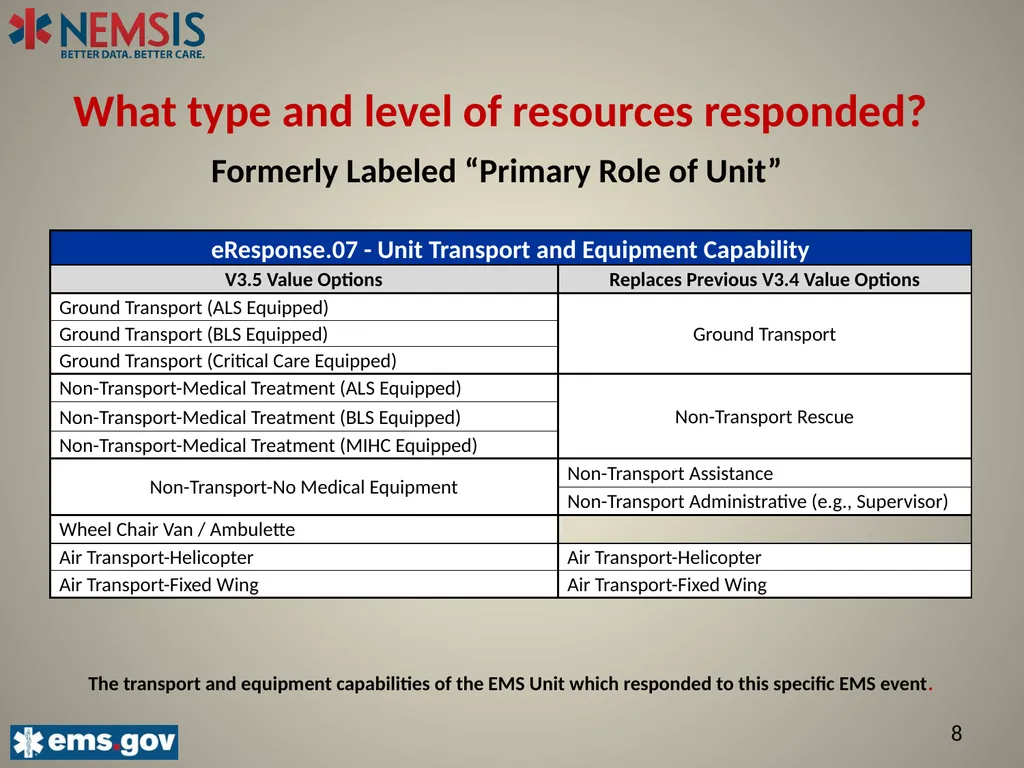
slide8. 8 What type and level of resources responded?
Formerly Labeled “Primary Role of Unit” The transport and equipment capabilities of the EMS Unit which responded to this specific EMS event.<br>
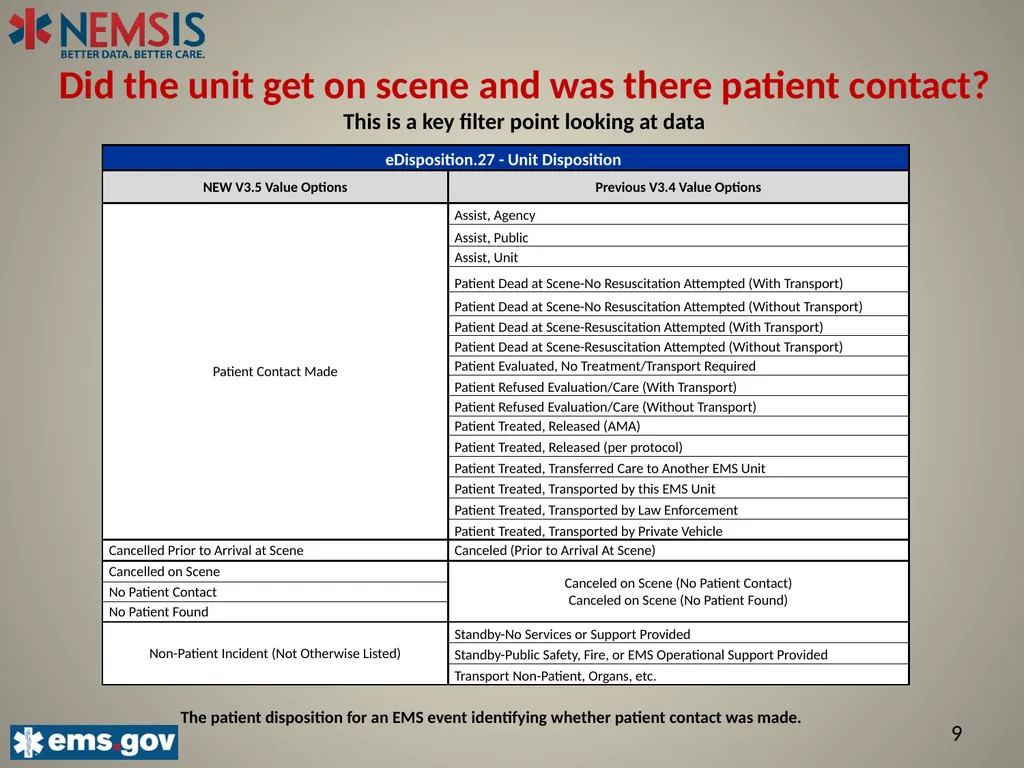
slide9. 9 Did the unit get on scene and was there patient contact?
This is a key filter point looking at data The patient disposition for an EMS event identifying whether patient contact was made.<br>
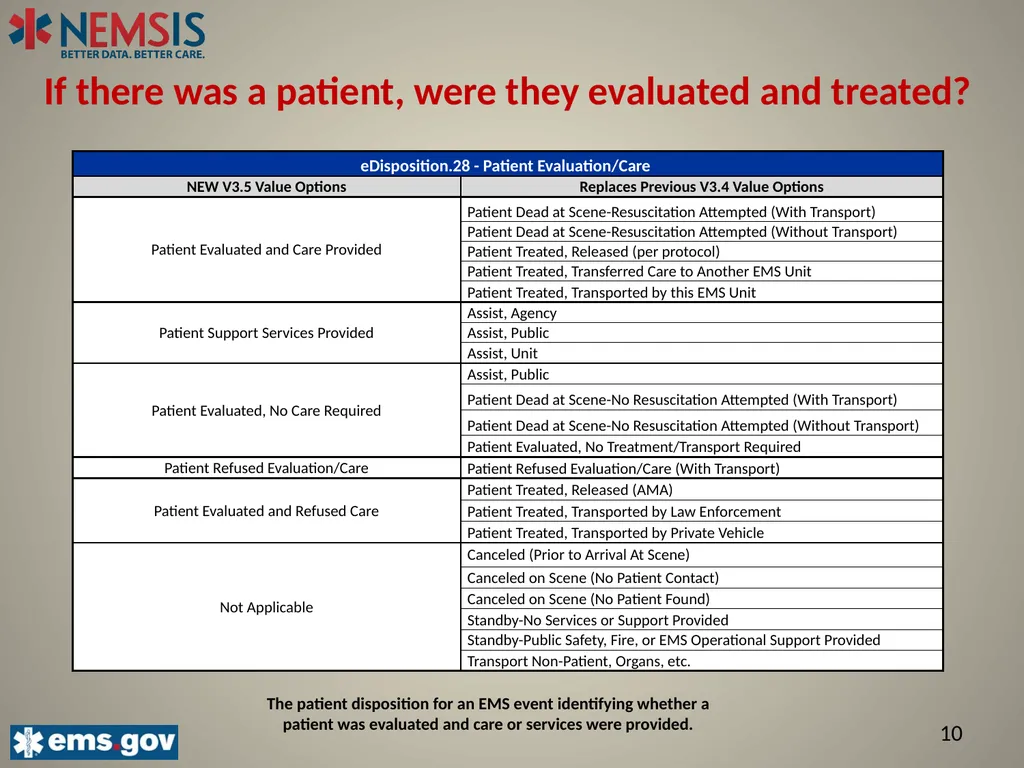
slide10. 10 If there was a patient, were they evaluated and treated? The patient disposition for an EMS event identifying whether a patient was evaluated and care or services were provided.<br>
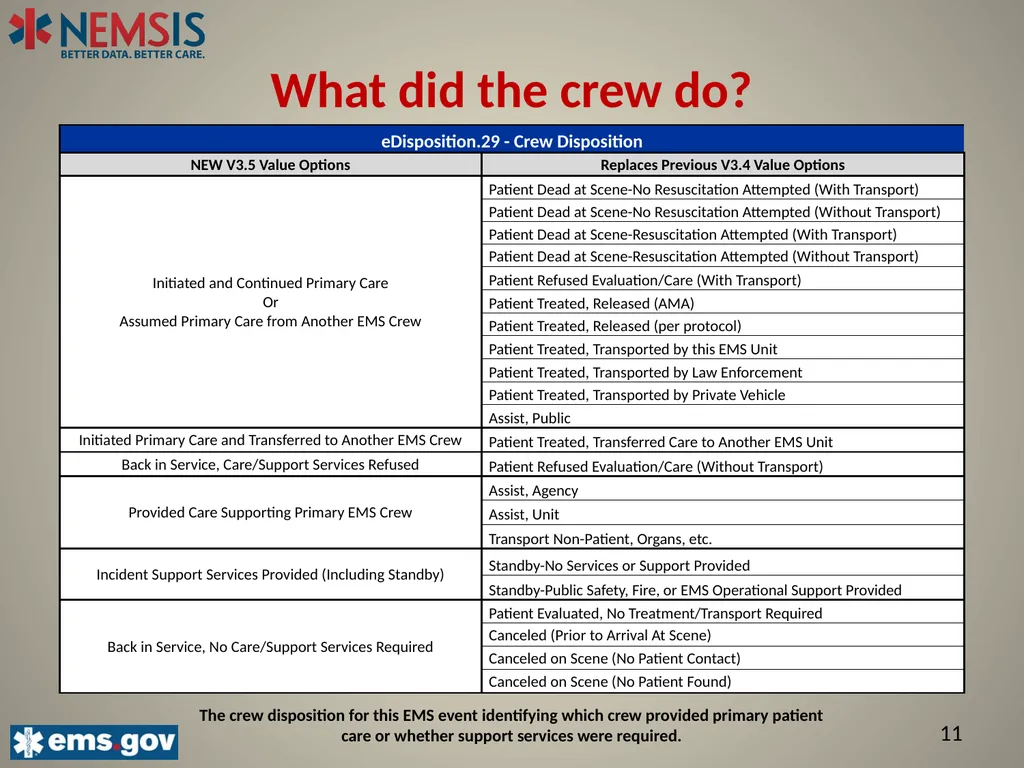
slide11. 11 What did the crew do? The crew disposition for this EMS event identifying which crew provided primary patient care or whether support services were required.<br>
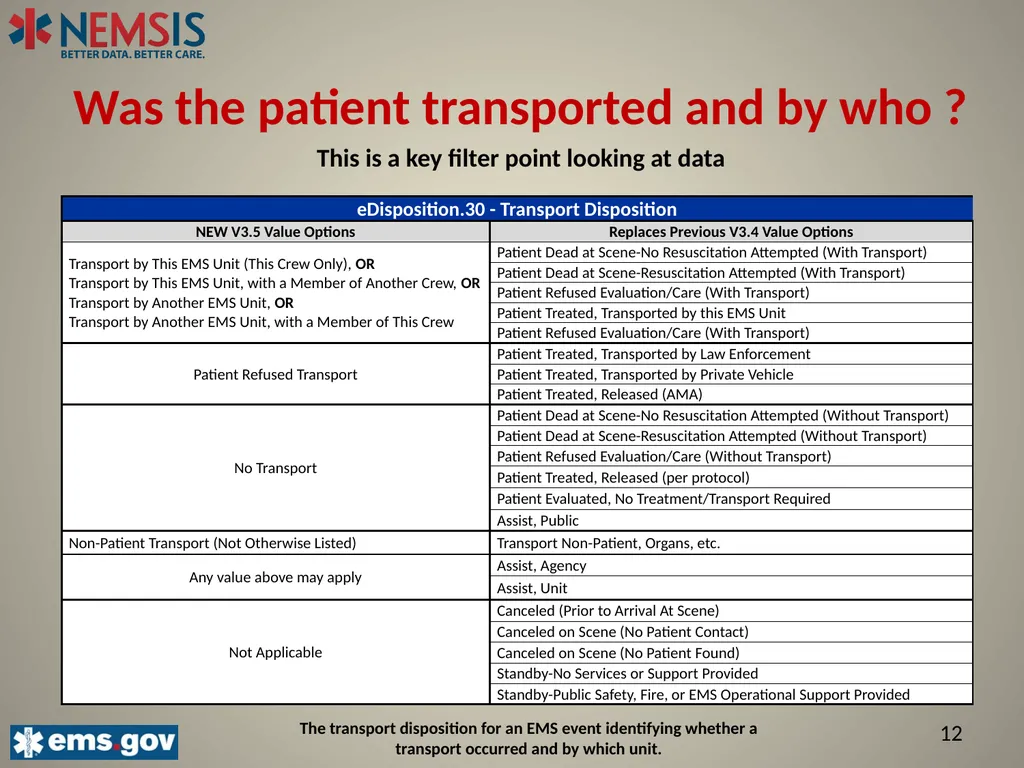
slide12. 12 Was the patient transported and by who ?
This is a key filter point looking at data The transport disposition for an EMS event identifying whether a transport occurred and by which unit.<br>
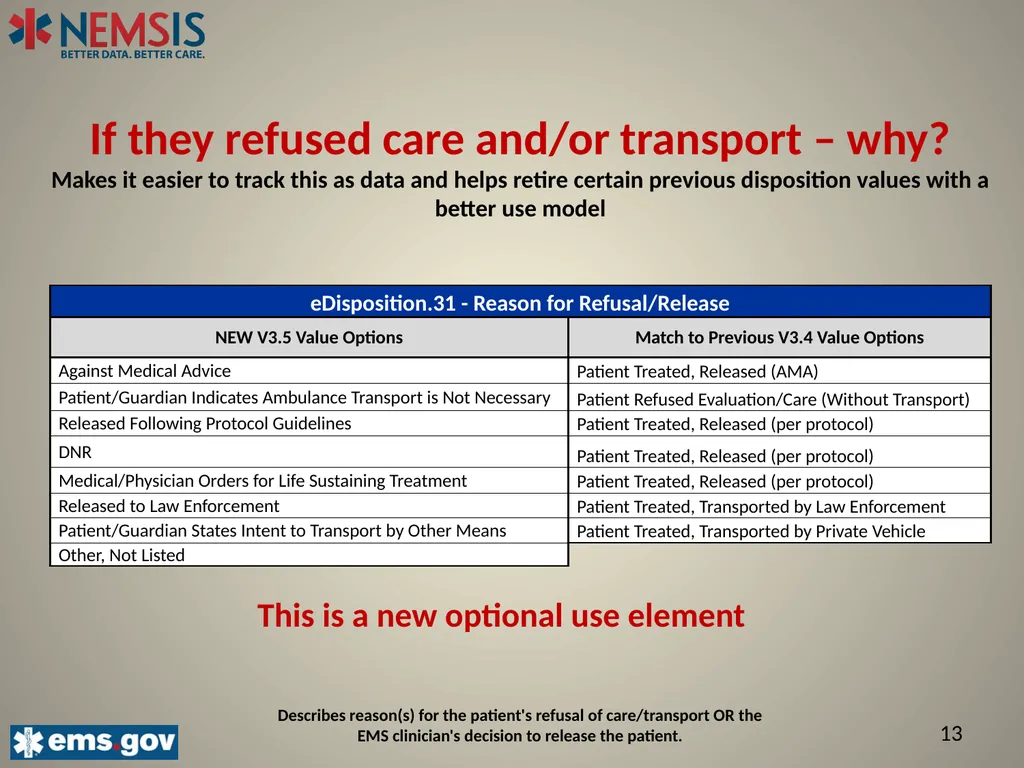
slide13. 13 If they refused care and/or transport – why? Makes it easier to track this as data and helps retire certain previous disposition values with a better use model This is a new optional use element Describes reason(s) for the patient's refusal of care/transport OR the EMS clinician's decision to release the patient.<br>
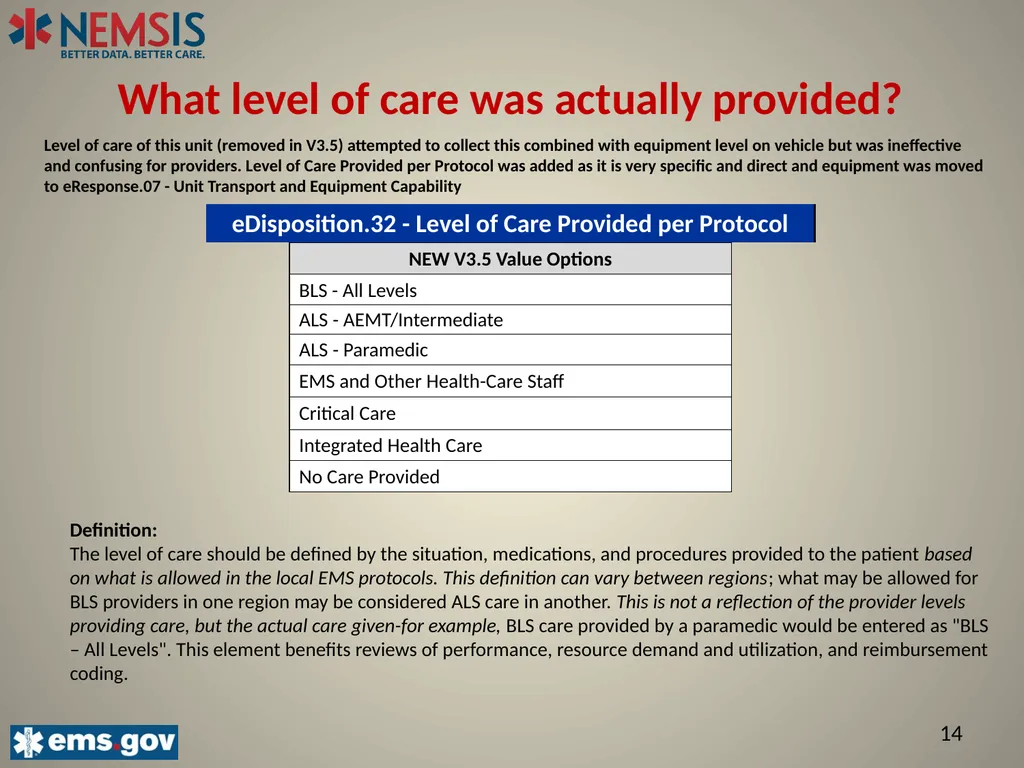
slide14. 14 Definition:
The level of care should be defined by the situation, medications, and procedures provided to the patient based on what is allowed in the local EMS protocols. This definition can vary between regions; what may be allowed for BLS providers in one region may be considered ALS care in another. This is not a reflection of the provider levels providing care, but the actual care given-for example, BLS care provided by a paramedic would be entered as "BLS – All Levels". This element benefits reviews of performance, resource demand and utilization, and reimbursement coding. What level of care was actually provided? Level of care of this unit (removed in V3.5) attempted to collect this combined with equipment level on vehicle but was ineffective and confusing for providers. Level of Care Provided per Protocol was added as it is very specific and direct and equipment was moved to eResponse.07 - Unit Transport and Equipment Capability<br>
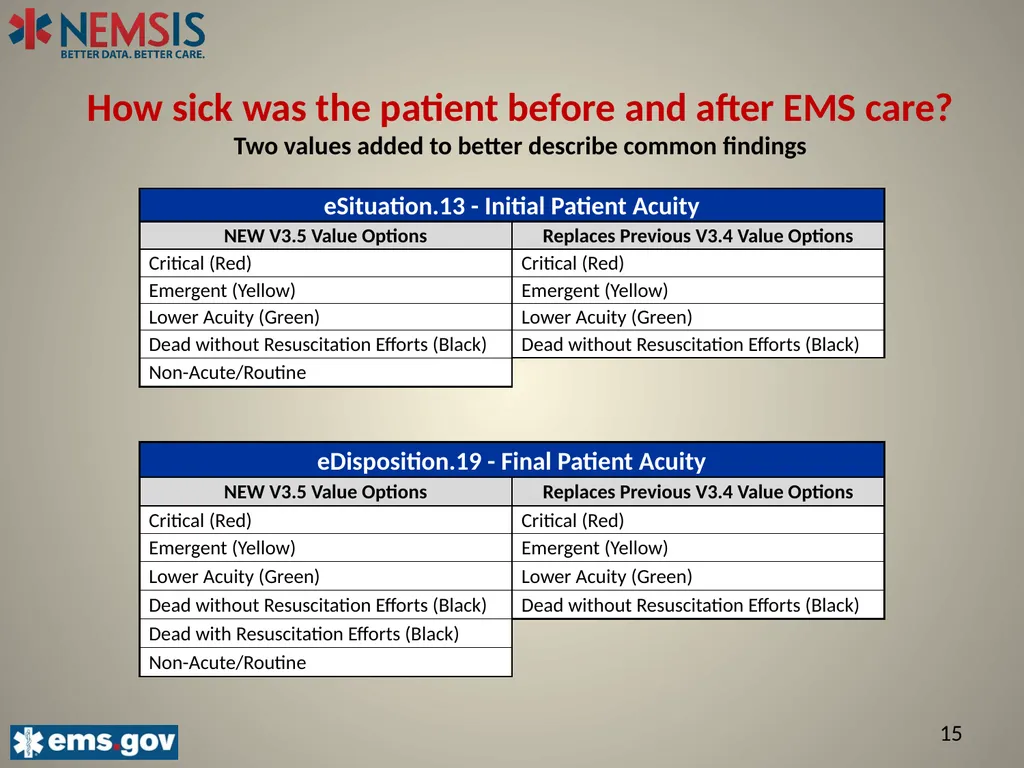
slide15. 15 How sick was the patient before and after EMS care? Two values added to better describe common findings<br>
slide16. 16 Justification for Transfers New fields were created to allow space to capture the diagnosis of the physician ordering the transfer. A second element was added with fixed values so transfer reasons and patterns can better be analyzed<br>
slide17. 17 eDisposition.21 - Type of Destination<br>
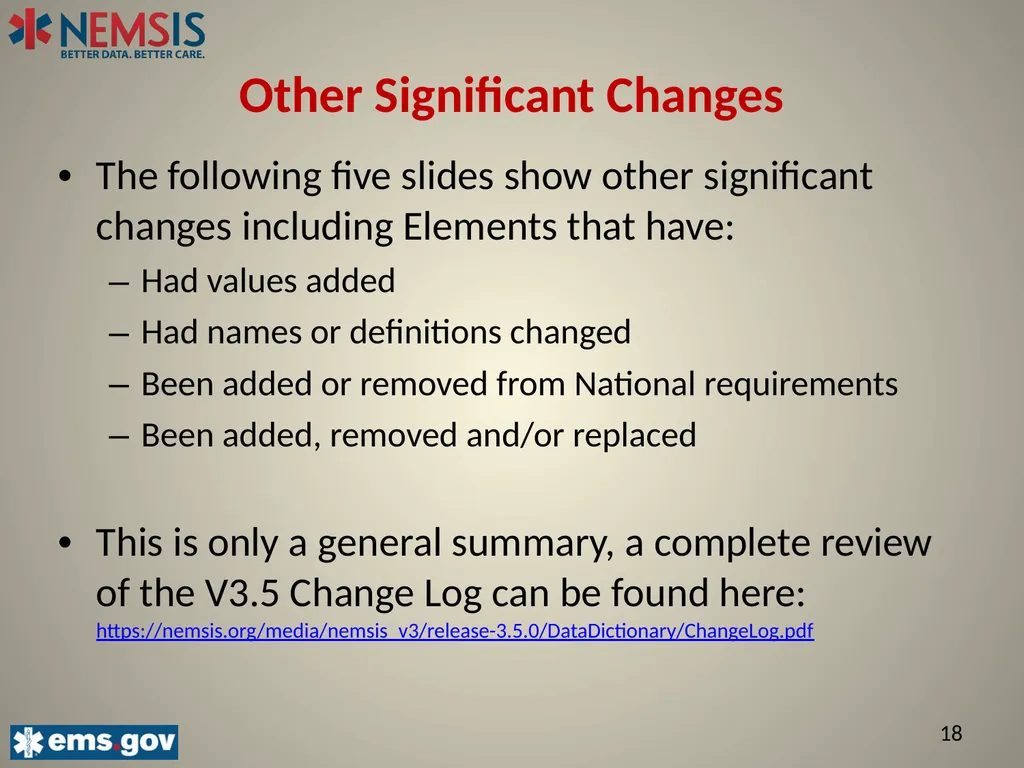
slide18. Other Significant Changes The following five slides show other significant changes including Elements that have:
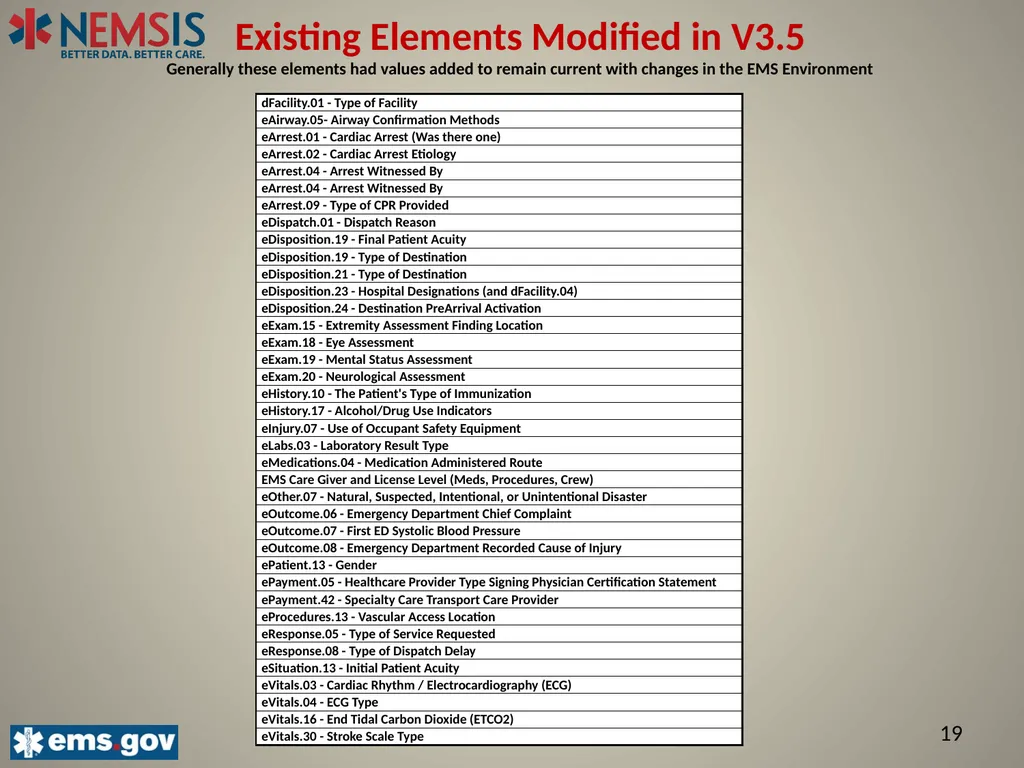
Had values added
Had names or definitions changed
Been added or removed from National requirements
Been added, removed and/or replaced
This is only a general summary, a complete review of the V3.5 Change Log can be found here: https://nemsis.org/media/nemsis_v3/release-3.5.0/DataDictionary/ChangeLog.pdf 18<br>
slide19. Existing Elements Modified in V3.5 Generally these elements had values added to remain current with changes in the EMS Environment 19<br>
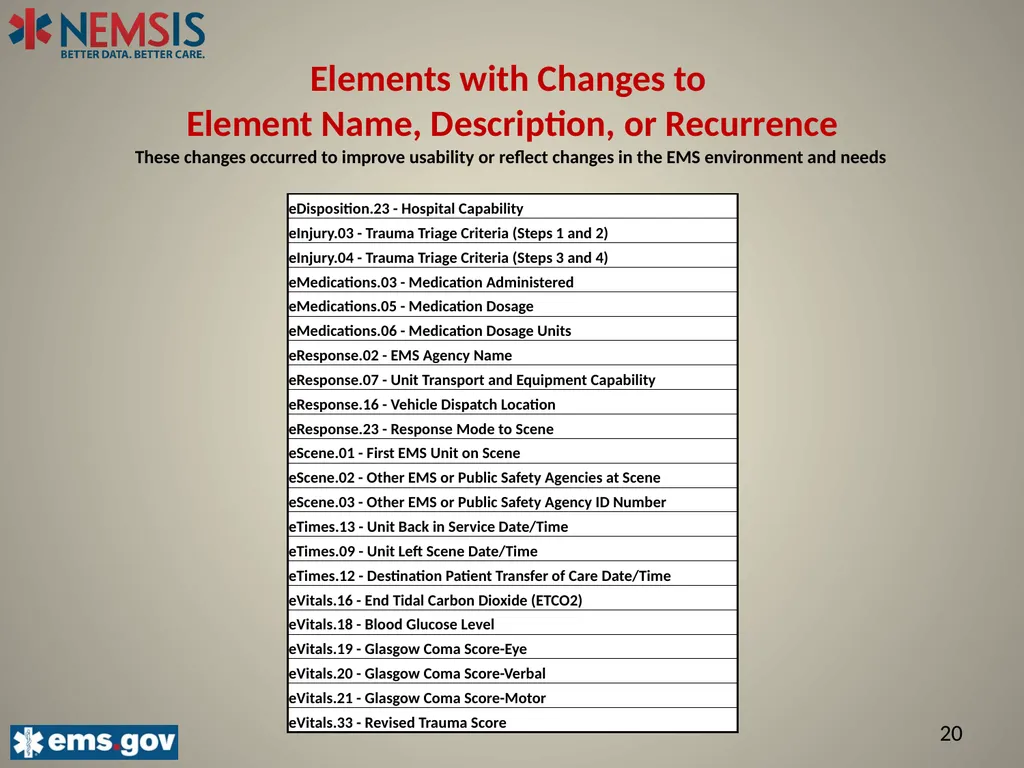
slide20. Elements with Changes to Element Name, Description, or Recurrence These changes occurred to improve usability or reflect changes in the EMS environment and needs 20<br>
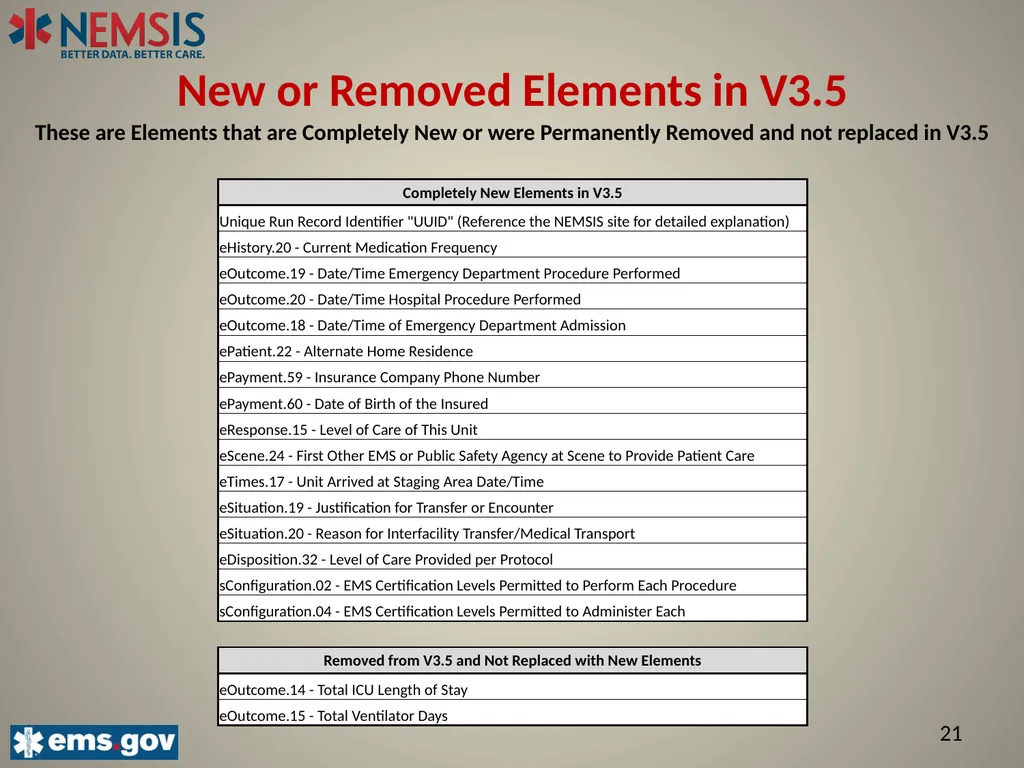
slide21. New or Removed Elements in V3.5 These are Elements that are Completely New or were Permanently Removed and not replaced in V3.5 21<br>
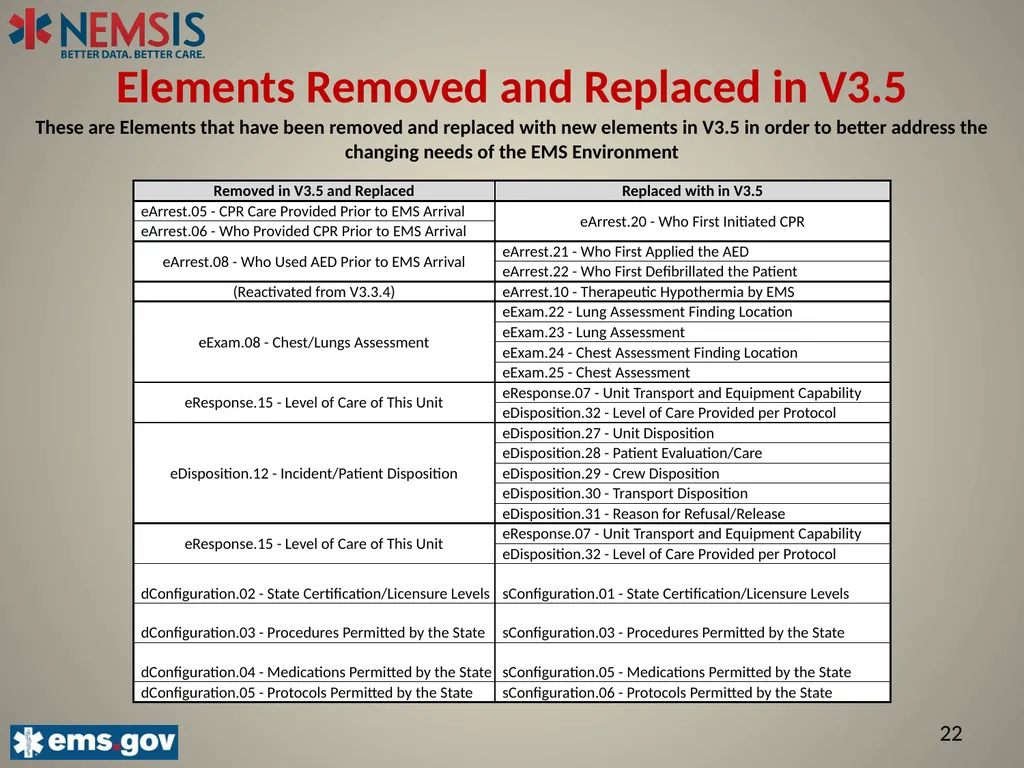
slide22. Elements Removed and Replaced in V3.5 These are Elements that have been removed and replaced with new elements in V3.5 in order to better address the changing needs of the EMS Environment 22<br>
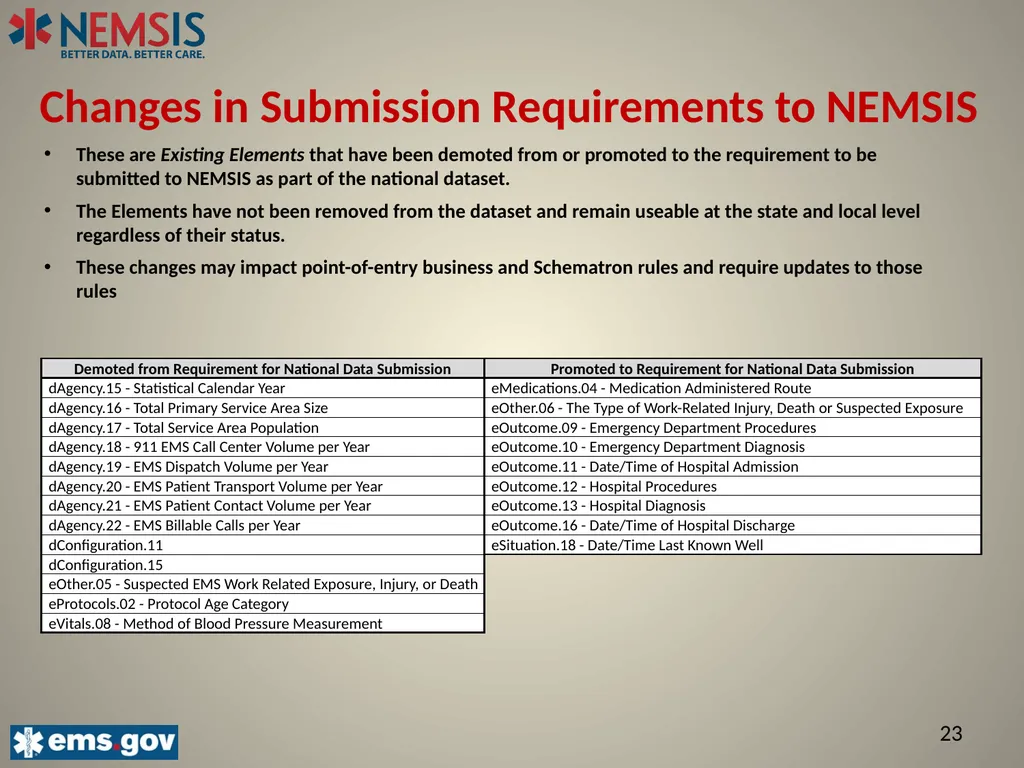
slide23. Changes in Submission Requirements to NEMSIS 23 These are Existing Elements that have been demoted from or promoted to the requirement to be submitted to NEMSIS as part of the national dataset.
The Elements have not been removed from the dataset and remain useable at the state and local level regardless of their status.
These changes may impact point-of-entry business and Schematron rules and require updates to those rules<br>
slide24. Questions? Please address any questions you may have to the NEMSIS Technical Assistance Center or your State EMS Data Management Team
This document is intended to be an informative overview of the changes in NEMSIS V3.5. The information contained here may be less specific or a combination of facts used in the interests of summarizing the data for easier reading. Please visit the NEMSIS website at www.nemsis.org for the definitive references, resources and technical specifications for V3.5. CC 24<br>
slide2. Something Besides eDisposition.12 is changing in NEMSIS V3.5? Why yes it is…! NEMSIS V3.5 has some big changes and the stakeholder talk at pretty much any level is focused solely on eDisposition.12 Incident/Patient disposition (and use of the UUID, which won’t be discussed here)
However, the scope and vision of the changes was much broader than just the disposition updates. 3<br>
slide3. What were the goals of the V3.5 Change? The primary goal of the V3.5 change was to improve the ability and flexibility to fully describe an EMS event in a away that couldn’t be done in previous NEMSIS dataset versions.
States and services needed more cohesive and flexible data to track, analyze and sometimes justify changes in the delivery of EMS care, environment and integration into the broader healthcare system.
Previous versions had limited ability to look at things like interfacility transfer levels, types and patterns, MIH programs, level and type of equipment available compared to the level of care actually provided. This lead to many custom elements and values being created to address these needs.
V3.5 was the opportunity to address these challenges and limitations.
Secondary goals included addressing the normal technical updates, addition of values needed, clarification of element names, definitions and updates to requirements generally seen in any version update. 3<br>
slide4. Describing the Whole EMS Event What do we need to know? What kind of call was it? (Type of Service Requested)
What type and level of resources responded?
Did the unit get on scene and was there patient contact?
If there was a patient, were they evaluated and treated?
What did the crew do (e.g. provide care, support services)?
What level of care was actually provided?
How sick was the patient before and after EMS care?
Was the patient transported, by who and what type of destination did they go to?
If a transfer, what was the sending order reason and general type? (EMS Provider Impressions do not apply for transfers – diagnosis is by the sending medical provider) 3<br>
slide5. Describing the Whole EMS Event What needed improvement from 3.4 (3.3.4, 2.0)? What kind of call was it? (Type of Service Requested)
Mostly limited to 911 and both transfer options were confusing, causing inconsistencies in data
There were dispositions that were better identified in other elements
“Primary Role of Unit” was limited. Needed to be expanded and incorporate the level of equipment with the responding unit
Determining level of care actually provided was difficult, required looking at several data elements resulting in states or services using custom elements to capture it (Often modifying already complicated eDisposition.12 values)
Incident/patient disposition collected 3-4 pieces of information in each value (always a limiting idea), did not address all EMS scenarios, provided no flexibility, and made data mining and business rules more difficult than needed
Capturing reasons for transfers couldn’t be done which is important for billing purposes and analyzing transfer volume and levels and referral patterns for systems-of-care
Type of destination options needed to be expanded for changes in EMS operations 3<br>
slide6. So What Changed? The following slides provide an overview of the element changes made to better describe an EMS event.
They follow the steps outlined previously to describe an EMS event.
Note that comparison matches are suggested and may not align with all EMS scenarios
The slides at the end also provide an overview of changes to other Elements detailed in the NEMSIS change logs. 6<br>
slide7. 7 What kind of call was it? The type of service or category of service requested of the EMS Agency responding for this specific EMS event<br>
slide8. 8 What type and level of resources responded?
Formerly Labeled “Primary Role of Unit” The transport and equipment capabilities of the EMS Unit which responded to this specific EMS event.<br>
slide9. 9 Did the unit get on scene and was there patient contact?
This is a key filter point looking at data The patient disposition for an EMS event identifying whether patient contact was made.<br>
slide10. 10 If there was a patient, were they evaluated and treated? The patient disposition for an EMS event identifying whether a patient was evaluated and care or services were provided.<br>
slide11. 11 What did the crew do? The crew disposition for this EMS event identifying which crew provided primary patient care or whether support services were required.<br>
slide12. 12 Was the patient transported and by who ?
This is a key filter point looking at data The transport disposition for an EMS event identifying whether a transport occurred and by which unit.<br>
slide13. 13 If they refused care and/or transport – why? Makes it easier to track this as data and helps retire certain previous disposition values with a better use model This is a new optional use element Describes reason(s) for the patient's refusal of care/transport OR the EMS clinician's decision to release the patient.<br>
slide14. 14 Definition:
The level of care should be defined by the situation, medications, and procedures provided to the patient based on what is allowed in the local EMS protocols. This definition can vary between regions; what may be allowed for BLS providers in one region may be considered ALS care in another. This is not a reflection of the provider levels providing care, but the actual care given-for example, BLS care provided by a paramedic would be entered as "BLS – All Levels". This element benefits reviews of performance, resource demand and utilization, and reimbursement coding. What level of care was actually provided? Level of care of this unit (removed in V3.5) attempted to collect this combined with equipment level on vehicle but was ineffective and confusing for providers. Level of Care Provided per Protocol was added as it is very specific and direct and equipment was moved to eResponse.07 - Unit Transport and Equipment Capability<br>
slide15. 15 How sick was the patient before and after EMS care? Two values added to better describe common findings<br>
slide16. 16 Justification for Transfers New fields were created to allow space to capture the diagnosis of the physician ordering the transfer. A second element was added with fixed values so transfer reasons and patterns can better be analyzed<br>
slide17. 17 eDisposition.21 - Type of Destination<br>
slide18. Other Significant Changes The following five slides show other significant changes including Elements that have:
Had values added
Had names or definitions changed
Been added or removed from National requirements
Been added, removed and/or replaced
This is only a general summary, a complete review of the V3.5 Change Log can be found here: https://nemsis.org/media/nemsis_v3/release-3.5.0/DataDictionary/ChangeLog.pdf 18<br>
slide19. Existing Elements Modified in V3.5 Generally these elements had values added to remain current with changes in the EMS Environment 19<br>
slide20. Elements with Changes to Element Name, Description, or Recurrence These changes occurred to improve usability or reflect changes in the EMS environment and needs 20<br>
slide21. New or Removed Elements in V3.5 These are Elements that are Completely New or were Permanently Removed and not replaced in V3.5 21<br>
slide22. Elements Removed and Replaced in V3.5 These are Elements that have been removed and replaced with new elements in V3.5 in order to better address the changing needs of the EMS Environment 22<br>
slide23. Changes in Submission Requirements to NEMSIS 23 These are Existing Elements that have been demoted from or promoted to the requirement to be submitted to NEMSIS as part of the national dataset.
The Elements have not been removed from the dataset and remain useable at the state and local level regardless of their status.
These changes may impact point-of-entry business and Schematron rules and require updates to those rules<br>
slide24. Questions? Please address any questions you may have to the NEMSIS Technical Assistance Center or your State EMS Data Management Team
This document is intended to be an informative overview of the changes in NEMSIS V3.5. The information contained here may be less specific or a combination of facts used in the interests of summarizing the data for easier reading. Please visit the NEMSIS website at www.nemsis.org for the definitive references, resources and technical specifications for V3.5. CC 24<br>