
Neural Engineering Neuroprosthetics is Problem
AS
Published · 11 slides · 0 views
1 / 1
Description
Neural Engineering Neuroprosthetics is Problem Posters should be up in room. Title at top, range ½ way down from Highly Agree to Highly Disagree Humans only use 10 of their brain Brain damage is always permanent Humans have the largest
Related Topics
Share
Embed code
Download this presentation From Below
"Neural Engineering Neuroprosthetics is Problem" is the property of its rightful owner. Permission is granted to download and print the materials on this website for personal, non-commercial use only, and to display it on your personal computer provided you do not modify the materials and that you retain all copyright notices contained in the materials. By downloading content from our website, you accept the terms of this agreement.
Presentation Transcript
01
Neural Engineering Neuroprosthetics is Problem<br>
02
Posters should be up in room. Title at top, range ½ way down from Highly Agree to Highly Disagree Humans only use 10% of their brain
Brain damage is always permanent
Humans have the largest brain of all animals
You are either Left-Brained (“artsy”) or Right-Brained (“logical”)
You lose large numbers of brain cells as you age<br>
Brain damage is always permanent
Humans have the largest brain of all animals
You are either Left-Brained (“artsy”) or Right-Brained (“logical”)
You lose large numbers of brain cells as you age<br>
03
Posters should be up in room. Title at top, range ½ from Highly Agree to Highly Disagree Humans only use 10% of their brain: False. We use 100% of our brains! Just think, if we only used 10% of our brain, then injury to 90% of the brain would be no big deal. All parts of the brain are always functioning at some level…unless they have suffered damage. Unfortunately this myth continues to be featured in popular media.
Brain damage is always permanent: False. It is true that the brain has a difficult time repairing/healing from serious injury, but there are many different types of brain damage; it depends on where the injury occurred and how serious it is. The brain can heal from mild injuries, such as a minor concussion, but severe injuries can certainly cause permanent damage. Brain plasticity allows for some recovery after certain types of brain injury. Brain plasticity is the brain’s ability to change over a person’s lifetime as new connections form—including synapses and neural pathways.
Humans have the largest brain of all animal: False. Elephants and whales have larger brains by weight than the average adult human brain, and depending on the species, dolphin brains weigh about the same or slightly more than a human brain. But brain size doesn’t tell us anything about intelligence. Keep in mind that these animals also have larger bodies than humans. It can be insightful to examine the ratio of brain weight to body weight. A few examples of this ratio: Humans 1:50, many mammals 1:180, most birds: 1:220. But humans are not the animal with the largest brain weight-to-body weight ratio. For example, hummingbirds and squirrel monkeys have a larger ratio. However, even this brain/body ratio really doesn’t tell us much about intelligence.
(Sources: Temporal Dynamics of Learning Center, http://tdlc.ucsd.edu/educators/educators_myths_biggest_brain.html; How Stuff Works, http://science.howstuffworks.com/life/inside-the-mind/human-brain/10-brain-myths5.htm; Neuroscience for Kids: Brain Facts and Figures, http://faculty.washington.edu/chudler/facts.html; Neuroscience for Kids: Q&A, http://faculty.washington.edu/chudler/qa2.html#q58; Neuroscience for Kids: Do We Use Only 10% of Our Brains?, http://faculty.washington.edu/chudler/tenper.html).<br>
Brain damage is always permanent: False. It is true that the brain has a difficult time repairing/healing from serious injury, but there are many different types of brain damage; it depends on where the injury occurred and how serious it is. The brain can heal from mild injuries, such as a minor concussion, but severe injuries can certainly cause permanent damage. Brain plasticity allows for some recovery after certain types of brain injury. Brain plasticity is the brain’s ability to change over a person’s lifetime as new connections form—including synapses and neural pathways.
Humans have the largest brain of all animal: False. Elephants and whales have larger brains by weight than the average adult human brain, and depending on the species, dolphin brains weigh about the same or slightly more than a human brain. But brain size doesn’t tell us anything about intelligence. Keep in mind that these animals also have larger bodies than humans. It can be insightful to examine the ratio of brain weight to body weight. A few examples of this ratio: Humans 1:50, many mammals 1:180, most birds: 1:220. But humans are not the animal with the largest brain weight-to-body weight ratio. For example, hummingbirds and squirrel monkeys have a larger ratio. However, even this brain/body ratio really doesn’t tell us much about intelligence.
(Sources: Temporal Dynamics of Learning Center, http://tdlc.ucsd.edu/educators/educators_myths_biggest_brain.html; How Stuff Works, http://science.howstuffworks.com/life/inside-the-mind/human-brain/10-brain-myths5.htm; Neuroscience for Kids: Brain Facts and Figures, http://faculty.washington.edu/chudler/facts.html; Neuroscience for Kids: Q&A, http://faculty.washington.edu/chudler/qa2.html#q58; Neuroscience for Kids: Do We Use Only 10% of Our Brains?, http://faculty.washington.edu/chudler/tenper.html).<br>
04
Posters should be up in room. Title at top, range ½ from Highly Agree to Highly Disagree You are either Left-Brained (“logical”) or Right-Brained (“artsy”): False. Recent studies using brain scan technology show that people use both parts of the brain most of the time. It is true that different functions are controlled by different areas of the brain, but you don’t use one hemisphere of your brain more often than the other. Science has not proven that there is a connection between certain personality traits and hemisphere dominance; it’s a cultural myth.
Adults lose large numbers of neurons as they age: False. While it is true that adults do lose neurons everyday (a common estimate is thousands per day), given that many neuroscientists estimate that the brain has around 100 billion neurons, the percentage lost over the adult years is actually quite low. Studies have shown that from an age range of 20 years to 90 years, less than 10% of all neocortical neurons are lost for both men and women. Loss of neurons is concentrated mostly in certain areas of the brain. Interestingly, a study showed that little loss of neocortical neurons occurs after age 65 in women.
As they age, older adult brains do experience some loss of brain mass, decreased cortical density, decreased length of white-matter tracts, shrinking of myelin sheaths on neuron axons, decreased production and reception of neurotransmitters, and decreased synapse density.
Another common myth is that the brain doesn’t generate new neurons, but in fact, neuroscientists have shown that certain areas of the brain (including the hippocampus and olfactory bulb) generate new neurons. A loss of cognitive function, or “mental sharpness”, in aging adults is caused by a complicated combination of genetic, environmental, and lifestyle factors that scientists are still trying to understand. But the brains of older adults can continue to change; brain plasticity allows for new connections between neurons to continue to form throughout a person’s lifetime.
(Sources: NPR, http://www.npr.org/blogs/13.7/2013/12/02/248089436/the-truth-about-the-left-brain-right-brain-relationship; The Guardian, http://www.theguardian.com/commentisfree/2013/nov/16/left-right-brain-distinction-myth; The Dana Alliance, http://www.dana.org/uploadedFiles/The_Dana_Alliances/Staying_Sharp/Staying%20Sharp%20Learning%20as%20We%20Age.pdf; Wbur’s Common Health, http://commonhealth.wbur.org/2013/06/brain-hundreds-new-neurons; Pakkenberg & Gunderson, J Comp Neurol, 1997, http://www.ncbi.nlm.nih.gov/pubmed/9215725; Pakkenberg et al., Exp Gerontol, 2003, http://www.ncbi.nlm.nih.gov/pubmed/12543266; Fabricius, Jacobsen & Pakkenberg, Neurobiol Aging, 2013, http://www.ncbi.nlm.nih.gov/pubmed/22878165).<br>
Adults lose large numbers of neurons as they age: False. While it is true that adults do lose neurons everyday (a common estimate is thousands per day), given that many neuroscientists estimate that the brain has around 100 billion neurons, the percentage lost over the adult years is actually quite low. Studies have shown that from an age range of 20 years to 90 years, less than 10% of all neocortical neurons are lost for both men and women. Loss of neurons is concentrated mostly in certain areas of the brain. Interestingly, a study showed that little loss of neocortical neurons occurs after age 65 in women.
As they age, older adult brains do experience some loss of brain mass, decreased cortical density, decreased length of white-matter tracts, shrinking of myelin sheaths on neuron axons, decreased production and reception of neurotransmitters, and decreased synapse density.
Another common myth is that the brain doesn’t generate new neurons, but in fact, neuroscientists have shown that certain areas of the brain (including the hippocampus and olfactory bulb) generate new neurons. A loss of cognitive function, or “mental sharpness”, in aging adults is caused by a complicated combination of genetic, environmental, and lifestyle factors that scientists are still trying to understand. But the brains of older adults can continue to change; brain plasticity allows for new connections between neurons to continue to form throughout a person’s lifetime.
(Sources: NPR, http://www.npr.org/blogs/13.7/2013/12/02/248089436/the-truth-about-the-left-brain-right-brain-relationship; The Guardian, http://www.theguardian.com/commentisfree/2013/nov/16/left-right-brain-distinction-myth; The Dana Alliance, http://www.dana.org/uploadedFiles/The_Dana_Alliances/Staying_Sharp/Staying%20Sharp%20Learning%20as%20We%20Age.pdf; Wbur’s Common Health, http://commonhealth.wbur.org/2013/06/brain-hundreds-new-neurons; Pakkenberg & Gunderson, J Comp Neurol, 1997, http://www.ncbi.nlm.nih.gov/pubmed/9215725; Pakkenberg et al., Exp Gerontol, 2003, http://www.ncbi.nlm.nih.gov/pubmed/12543266; Fabricius, Jacobsen & Pakkenberg, Neurobiol Aging, 2013, http://www.ncbi.nlm.nih.gov/pubmed/22878165).<br>
05
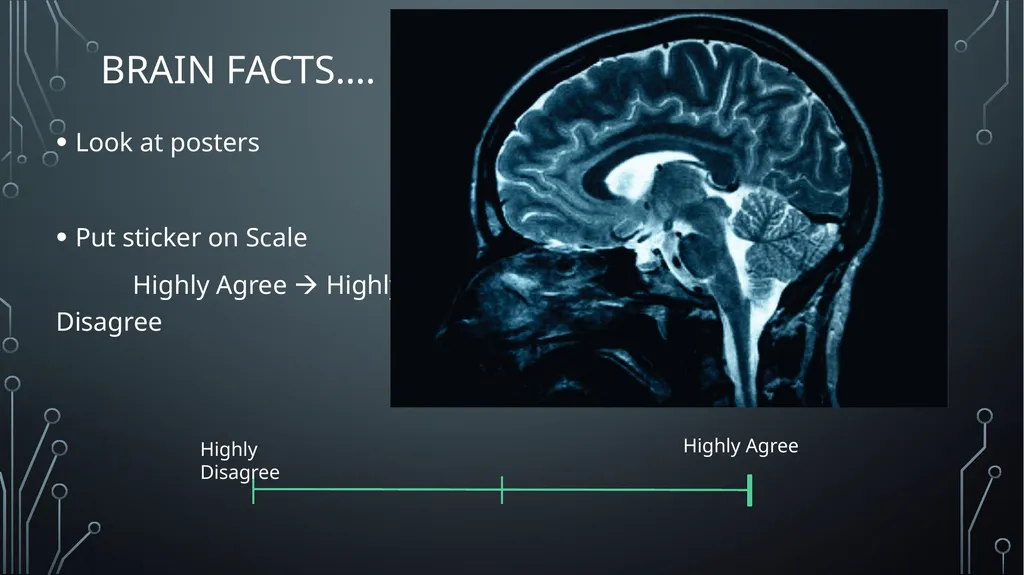
Brain Facts…. Look at posters
Put sticker on Scale
Highly Agree Highly Disagree Highly Disagree Highly Agree<br>
Put sticker on Scale
Highly Agree Highly Disagree Highly Disagree Highly Agree<br>
06
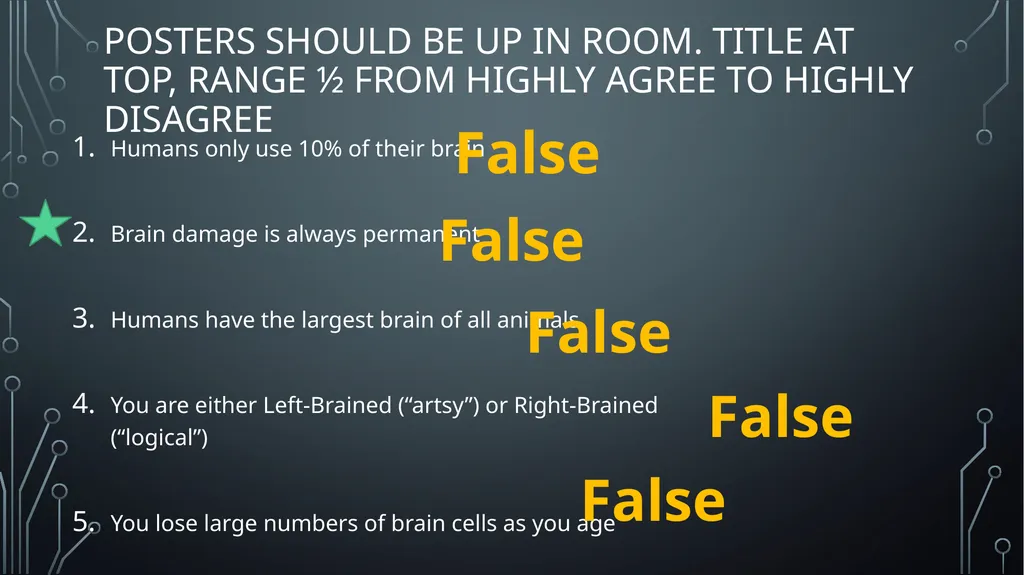
Posters should be up in room. Title at top, range ½ from Highly Agree to Highly Disagree Humans only use 10% of their brain
Brain damage is always permanent
Humans have the largest brain of all animals
You are either Left-Brained (“artsy”) or Right-Brained (“logical”)
You lose large numbers of brain cells as you age False False False False False<br>
Brain damage is always permanent
Humans have the largest brain of all animals
You are either Left-Brained (“artsy”) or Right-Brained (“logical”)
You lose large numbers of brain cells as you age False False False False False<br>
07
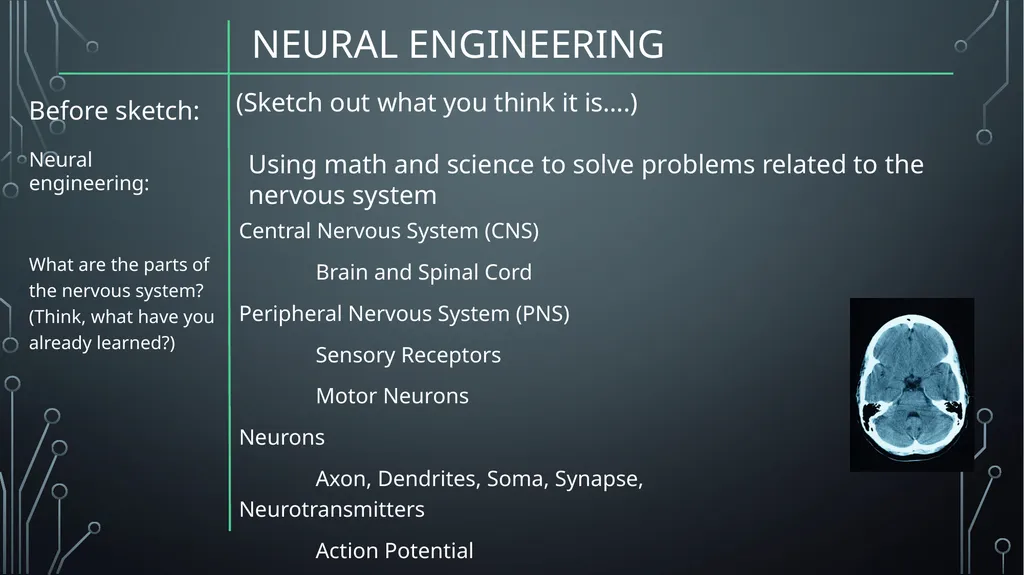
Neural engineering Before sketch: (Sketch out what you think it is….) Neural engineering: Using math and science to solve problems related to the nervous system What are the parts of the nervous system? (Think, what have you already learned?) Central Nervous System (CNS)
Brain and Spinal Cord
Peripheral Nervous System (PNS)
Sensory Receptors
Motor Neurons
Neurons
Axon, Dendrites, Soma, Synapse, Neurotransmitters
Action Potential<br>
Brain and Spinal Cord
Peripheral Nervous System (PNS)
Sensory Receptors
Motor Neurons
Neurons
Axon, Dendrites, Soma, Synapse, Neurotransmitters
Action Potential<br>
08
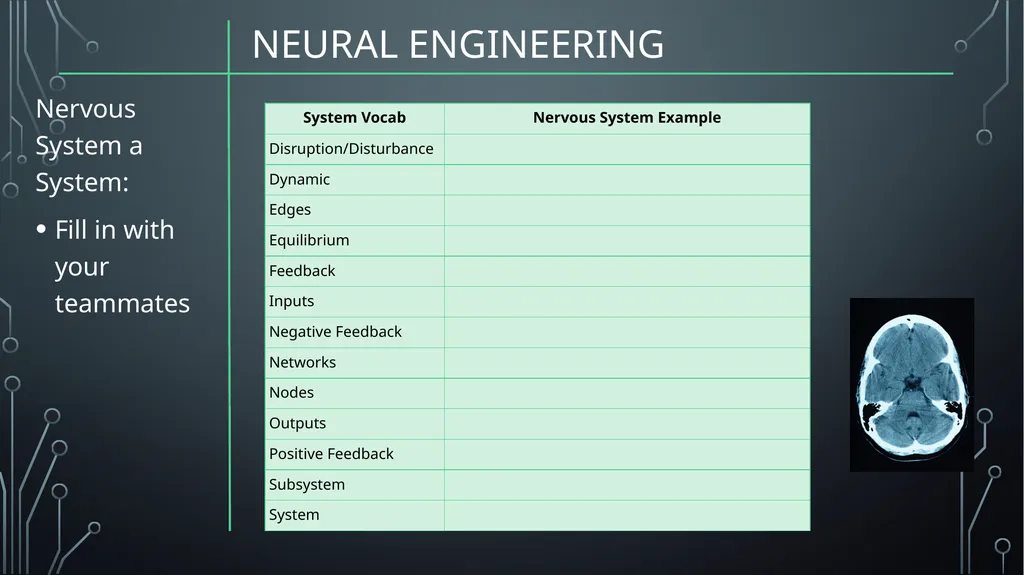
Neural engineering Nervous System a System:
Fill in with your teammates<br>
Fill in with your teammates<br>
09
Neural engineering Nervous System a System:
Fill in with your teammates<br>
Fill in with your teammates<br>
10
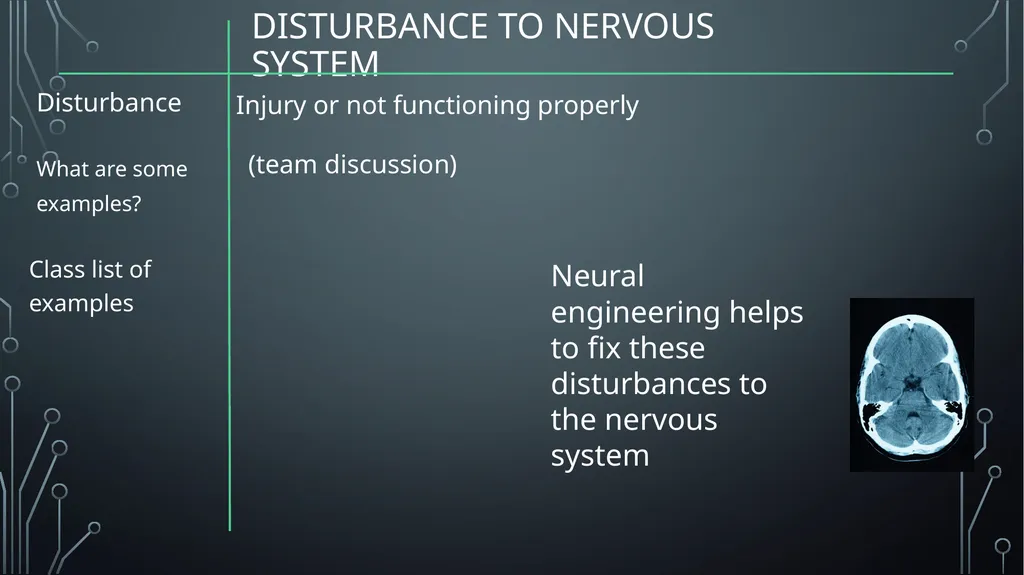
Disturbance to Nervous System Disturbance Injury or not functioning properly What are some examples? (team discussion) Class list of examples Neural engineering helps to fix these disturbances to the nervous system<br>
11
Disturbance to Nervous System Disturbance Injury or not functioning properly What are some examples? (team discussion) Class list of examples Concussion
Paralysis
Traumatic Brain Injury
Stroke
Amputation
Nerve Damage<br>
Paralysis
Traumatic Brain Injury
Stroke
Amputation
Nerve Damage<br>
12
Neural engineering examples Pull 1 page from envelope
Review page
Fill in table information
Put page back into envelope
Check-in with someone that had the same page. Do you need to modify your table?
Share with teammates
Sharer: CANNOT show table, must vocalize information
Listeners: Make sure to repeat back what you heard so that sharer can verify the information.<br>
Review page
Fill in table information
Put page back into envelope
Check-in with someone that had the same page. Do you need to modify your table?
Share with teammates
Sharer: CANNOT show table, must vocalize information
Listeners: Make sure to repeat back what you heard so that sharer can verify the information.<br>
13
Neural engineering examples See Neural Engineering Examples Teacher Key for some examples of responses based on the readings.<br>
14
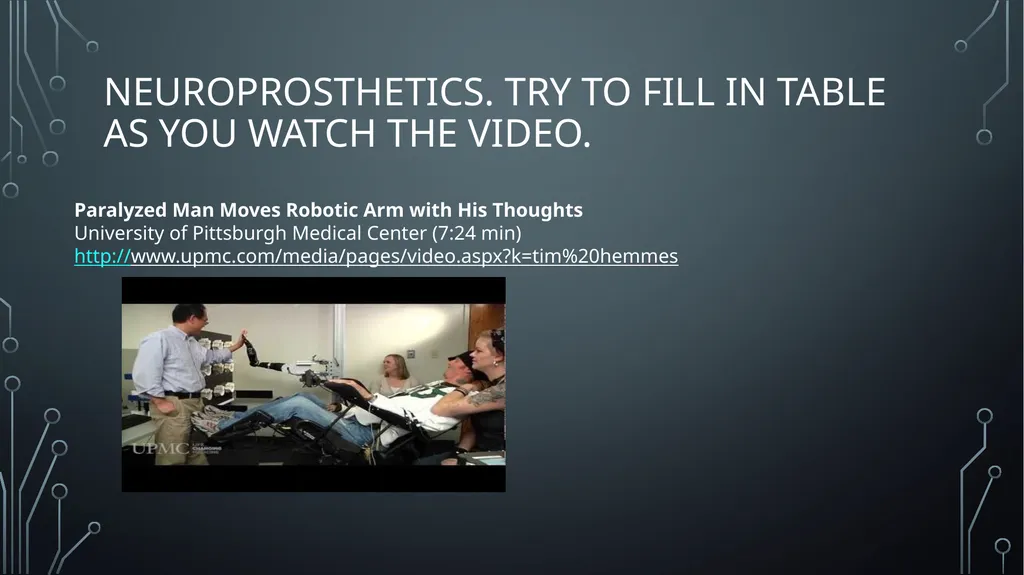
Neuroprosthetics. Try to fill in table as you watch the video. Paralyzed Man Moves Robotic Arm with His Thoughts
University of Pittsburgh Medical Center (7:24 min)
http://www.upmc.com/media/pages/video.aspx?k=tim%20hemmes<br>
University of Pittsburgh Medical Center (7:24 min)
http://www.upmc.com/media/pages/video.aspx?k=tim%20hemmes<br>
15
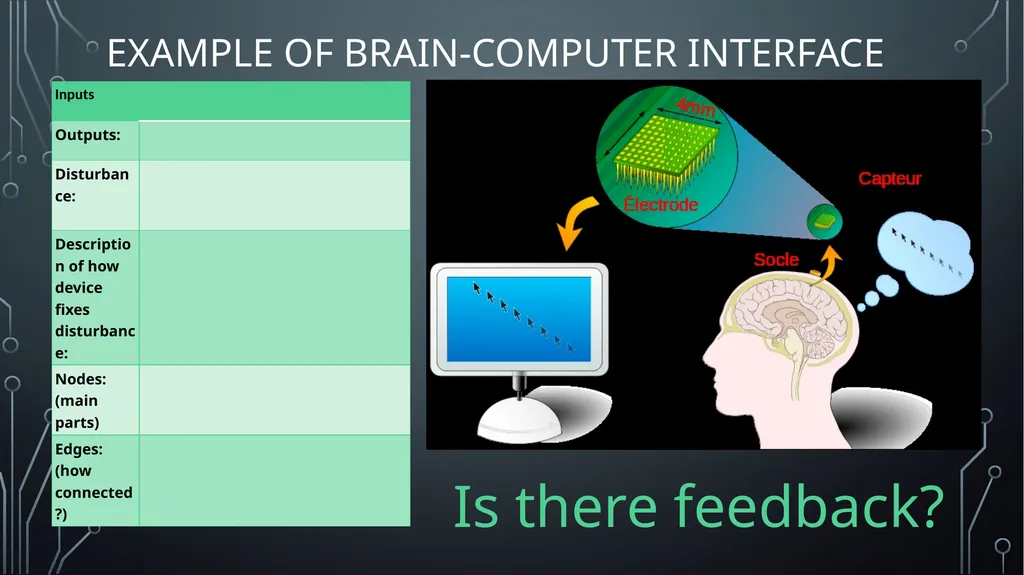
Example of Brain-Computer interface Is there feedback?<br>
16
Example of Brain Computer interface Is there Feedback?<br>
17
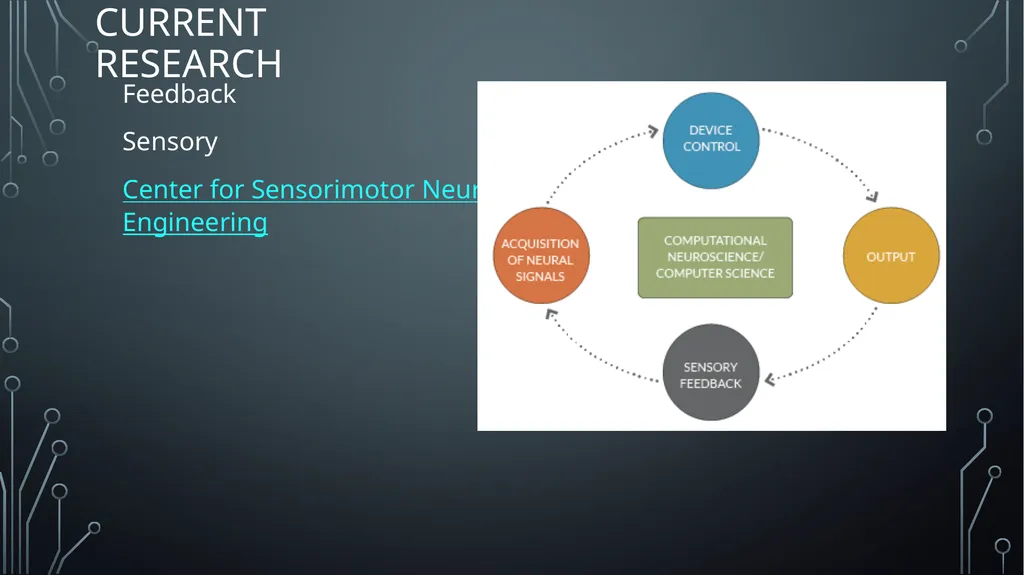
Current Research Feedback
Sensory
Center for Sensorimotor Neural Engineering<br>
Sensory
Center for Sensorimotor Neural Engineering<br>
18
Exit Ticket Sketch out Brain-Computer Interface. Feel free to use your notes from today. Homework What are 5 questions you have about Neuroprosthetics and/or Brain-Computer Interfaces?
(you will have time to research them)<br>
(you will have time to research them)<br>
19
Exit Ticket Sketch out Brain-Computer Interface. Feel free to use your notes from today. Assess the Exit Tickets the same night. It is important that students can sketch out the brain-computer interface as it is key to their problem. If students do not add system words to their sketch, pass back the next day and ask them to add in the vocabulary. Recollect and re-grade.<br>