04
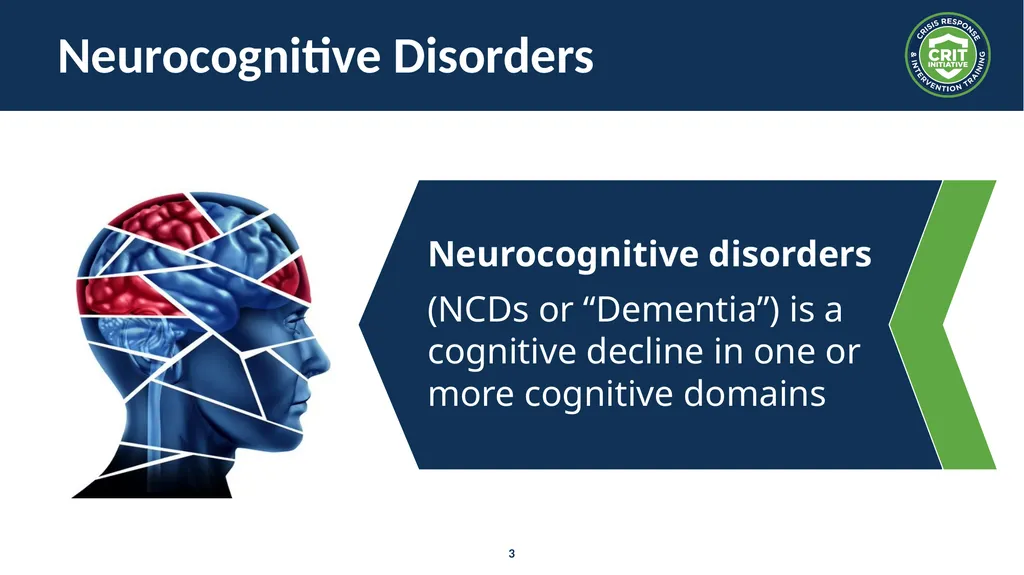
Neurocognitive Disorders Affect mental functions such as memory, thinking, and the ability to reason
Loss of ability to:
Understand or express speech
Execute or carry out learned purposeful movements
Recognize or comprehend the meaning of objects
May also experience changes in mood or personality<br>
05
Dementia Dementia is NOT a specific disease
It is a group of symptoms associated with a severe decline in memory or other thinking skills
Dementia is caused by damage to brain cells
Dementia can be reversible or irreversible<br>
06
Dementia: Symptoms and Behaviors Needs more time and energy to complete routine tasks
Has difficulty keeping track of things
May get lost or turned around easily
Experience subtle changes in mood and attitude
Has difficulties reading some facial expressions<br>
07
Dementia: Symptoms and Behaviors (continued) Difficulty remembering new information; struggles to remember past information
Difficulty with multi-tasking; needs simple directions and information
Easily distracted; struggles to stay focused
Difficulty with speech and expressions
Difficulty with daily living activities
Demonstrates unusual behavior in social settings
Makes decisions without the regard for others or safety<br>
08
Dementia – Alzheimer’s Disease Most common cause of dementia
A progressive condition
Involves a clear decline in memory, thinking, language, and learning
Earliest symptoms are typically changes to mood or personality, such as passivity<br>
09
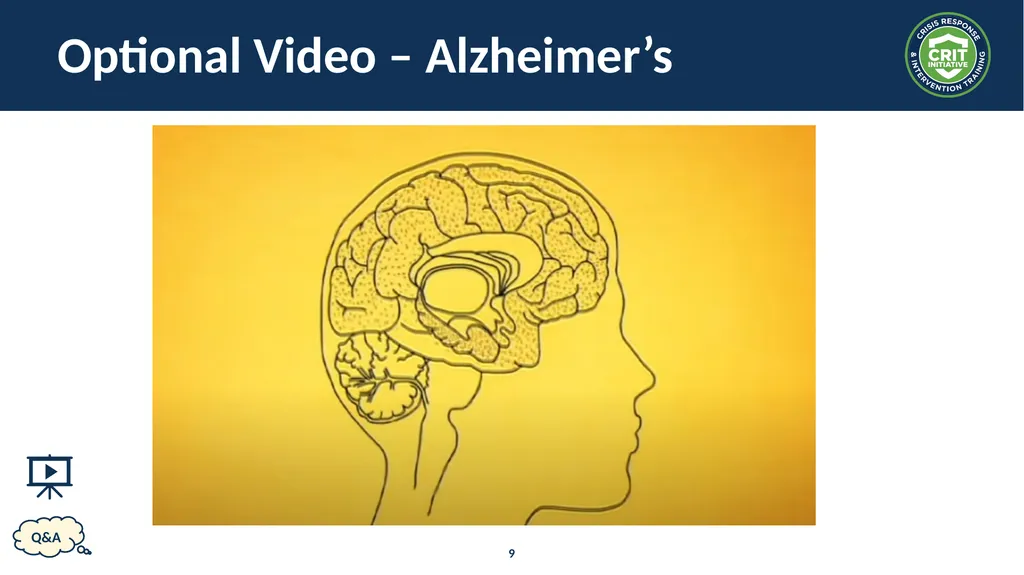
Optional Video – Alzheimer’s Q&A<br>
10
Older Adults with Dementia: Agitation Many older adults with dementia demonstrate agitation
Signs: physical or verbal aggression, hyperactivity, disinhibition, paranoia, refusal to accept assistance, disturbed sleep
Agitation may increase risk of aggressive behavior<br>
11
Older Adults with Dementia: �Altered Perceptions Hallucinations
Delusions
Misidentification Q&A<br>
12
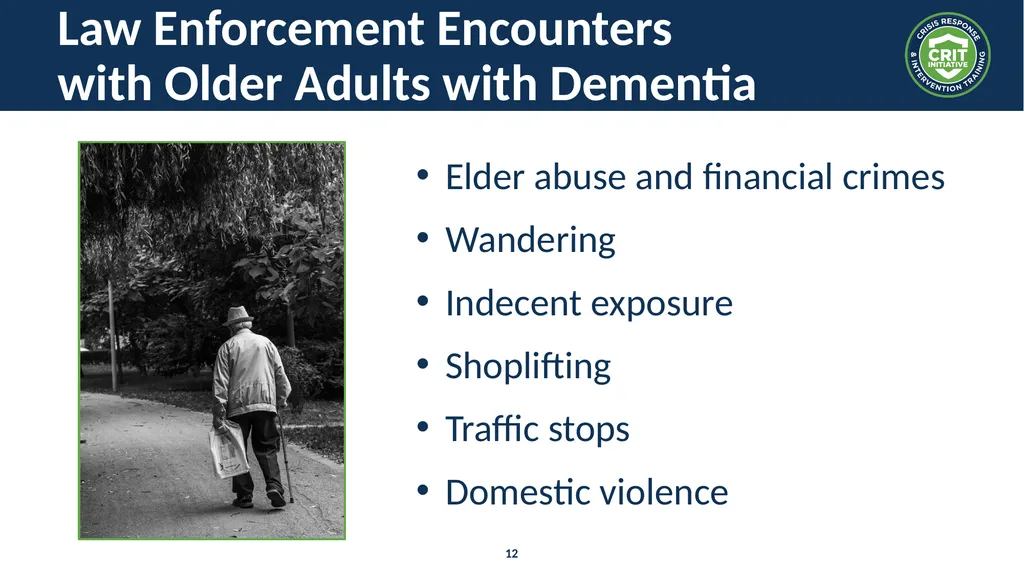
Law Enforcement Encounters �with Older Adults with Dementia Elder abuse and financial crimes
Wandering
Indecent exposure
Shoplifting
Traffic stops
Domestic violence<br>
13
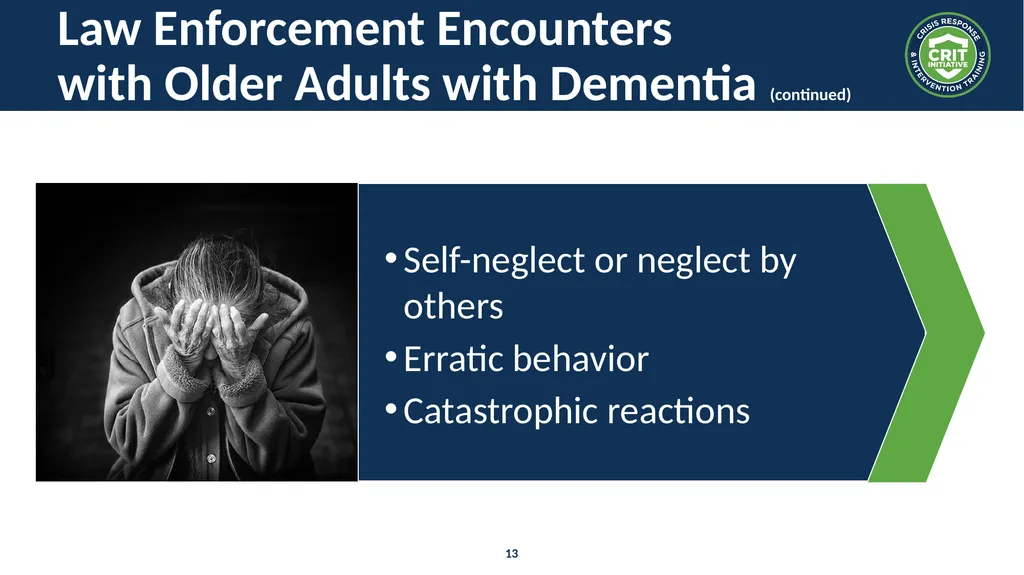
Law Enforcement Encounters �with Older Adults with Dementia (continued) Self-neglect or neglect by others
Erratic behavior
Catastrophic reactions<br>
14
Delirium A serious disturbance in mental abilities characterized by confused thinking and disrupted attention. Usually accompanied by disordered speech and hallucinations.<br>
15
Delirium: Symptoms and Behaviors Serious change in mental abilities
Reduced ability to focus and/or shift attention; difficulties orienting to one’s environment
Symptoms develop over a short period of time, from hours to a few days
Symptoms can fluctuate in severity throughout the day
Often can be traced to one or more contributing factors<br>
16
Traumatic Brain Injury Usually results from a violent blow or jolt to the head or body
Mild traumatic brain injury may affect your brain cells temporarily
More serious traumatic brain injury can result in long-term complications or death Q&A<br>
17
Traumatic Brain Injury: �Symptoms and Behaviors Physical Symptoms – dazed or confused, nausea or vomiting, fatigue or drowsiness, dizziness, or loss of balance
Sensory Symptoms – blurred vision, changes in taste and smell, sensitivity to light or sound
Cognitive or Mental Symptoms – memory problems, confusion, agitation, combative behavior, difficulty concentrating, depression, anxiety
Long-Term Effects – seizures, cognitive deficits, depression, aggression, Alzheimer's, psychosis, decline in cognitive function Q&A<br>
18
Tips for Responding Be patient, go slowly
Ask simple questions; allow plenty of time for a response
Avoid reasoning with them
If the person is agitated, focus on a topic that is positive
Avoid touching without permission or explanation
Check for Alert type bracelets
Contact family, if possible; contact service provider, if available QUICK TIPS<br>
19
Optional Case Scenario An officer is dispatched to speak to a taxicab driver in a parking lot near the airport. Upon arrival, the driver reports he picked up a passenger downtown, heading to the airport. When they got to the airport, the guy told him it was the wrong airport and he refused to get out of the car. The cab driver tried to explain to the guy there is no other airport nearby, to no avail. The cab driver wants the guy out of his car and to pay for the fare.
Upon approaching the cab, the officer notices that the passenger is an elderly gentleman in his 70s.<br>
20
Module Wrap-Up Questions? This curriculum was created through support by Grant No. 2020-NT-BX-K001 awarded by the Bureau of Justice Assistance. The Bureau of Justice Assistance is a component of the Department of Justice’s Office of Justice Programs, which also includes the Bureau of Justice Statistics, the National Institute of Justice, the Office of Juvenile Justice and Delinquency Prevention, the Office for Victims of Crime, and the SMART Office. Points of view or opinions in this document are those of the authors and do not necessarily reflect the official positions or policies of the U.S. Department of Justice.<br>